
Canada Sends $300 Billion a Year to Foreign Auto Companies. Here's the $15/Year Alternative Nobody's Talking About.

By Zeus eBikes Canada · March 28, 2026 · Editorial
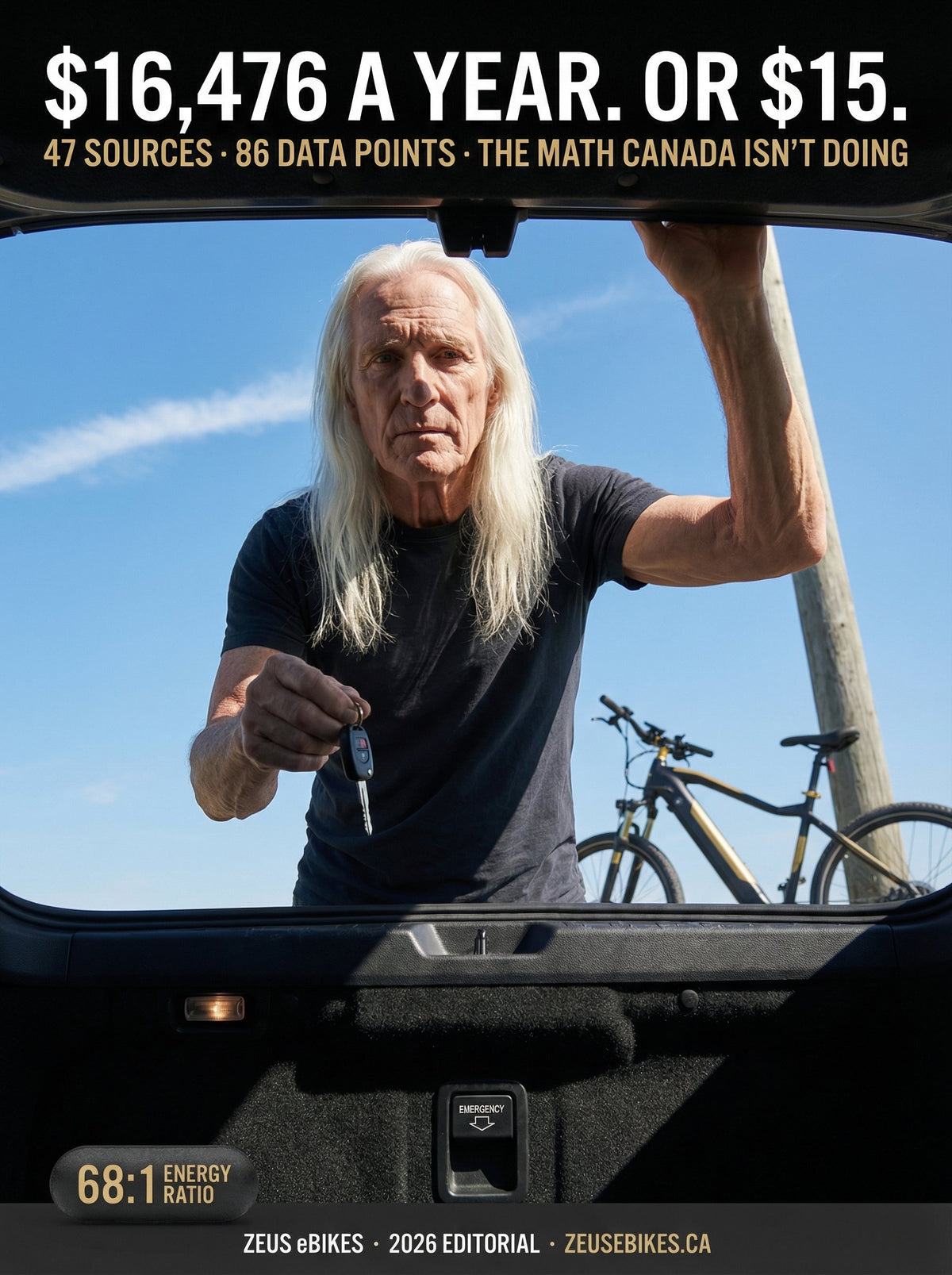
Every morning, 28 million Canadian adults perform the single largest act of foreign dependence in their daily lives. They start a car manufactured in Japan, Germany, South Korea, or the United States. They fill it with fuel priced by OPEC and global commodity markets. They insure it through a system that generated $10.2 billion in net income in 2023 alone. They park it on land worth more per square metre than the vehicle itself. And they send $16,476 a year to systems they do not control, cannot influence, and will never benefit from.
Meanwhile, every major party in Ottawa agrees on one thing: Canadian sovereignty matters. The debate consumes Parliament, cable news, and dinner tables from Victoria to St. John's. Ninety percent of Canadians say no to U.S. annexation (Angus Reid 2025). Ninety-one percent want to rely less on the United States (CBC 2025). Sixty-one percent are actively boycotting American companies (YouGov 2025). Canada just hit NATO's 2% spending target for the first time — $63.4 billion in defence (Canada.ca, March 2026).
But nobody — not a single federal party leader, not a single editorial board — is talking about the most personal sovereignty gap of all: the car.
This article follows the money. It tracks every dollar a Canadian household sends to foreign automakers, global oil markets, and a domestic insurance system that profits from your mandatory participation. Then it examines an alternative that costs $15 per year to operate, runs entirely on Canadian-generated electricity, and involves zero foreign governments in its energy chain.
This is not an argument to ban cars. It is not a pitch for a specific product. It is an investigation into why a country that controls 80% of its own electricity grid (Canada Energy Regulator 2025) has built a transportation system where every citizen is personally dependent on forces beyond Canadian borders — and what happens when you offer even a partial exit.
In This Article
- The $16,476 Question Nobody Asks
- Where Every Dollar Goes
- The Sovereignty Gap Nobody Sees
- What It Costs a Canadian Life
- The $15/Year Alternative
- What 10% Would Mean for Canada
- What Other Countries Proved
- The Honest Limitations
- The Sovereign Transportation Chain
- Frequently Asked Questions
- The Bottom Line
The $16,476 Question Nobody Asks
Car ownership costs the average Canadian household $16,476 per year (Ratehub 2026). That is not a theoretical maximum or a worst-case scenario. It is the blended average across provinces — including the car payment, insurance, fuel, maintenance, parking, and depreciation. For a two-car household in Ontario, the number exceeds $30,000.
Here is what makes that number different from every other household expense: almost none of it stays in Canada.
Your car was built by Toyota (Japan), Hyundai (South Korea), Volkswagen (Germany), Ford (USA), or Stellantis (Netherlands). Your fuel is priced by Brent crude benchmarks set in London and controlled by OPEC production quotas set in Vienna. Your tires were manufactured by Michelin (France), Bridgestone (Japan), or Goodyear (USA). Your replacement parts ship from supply chains that cross seventeen countries before reaching a Canadian auto shop.
Canadians do not ask where this money goes for the same reason fish do not ask what water is. The car is not experienced as a choice. It is experienced as a fact of life — like gravity or weather. You need a car because the country was built around cars. You need a car because your job is 22 kilometres away. You need a car because the grocery store is across a six-lane arterial road that was widened in 1987 to accommodate more cars.
The circularity is the point. The system that creates the dependency is funded by the dependency it creates.

📸 Playcut.ai — The last fill-up. $97.42. A single drop. A steady hand. The moment you pull out the needle.
Where Every Dollar Goes
Every major cost category of car ownership sends money to a system the Canadian driver does not control. The table below breaks down the Ratehub 2026 average, identifies where each dollar ends up, and names who profits.
| Cost Category | Annual Cost | Where the Money Goes | Who Benefits |
|---|---|---|---|
| Car payment / depreciation | ~$6,500 | Foreign manufacturer headquarters (Japan, Germany, South Korea, USA) | Toyota, VW, Hyundai, Ford, Stellantis shareholders |
| Fuel | ~$3,200 | Globally priced crude — Brent/WTI benchmarks. 77% of CAPP board members are foreign-owned (National Observer) | Saudi Aramco ($3,844/second in revenue), integrated oil majors, global commodity traders |
| Insurance | $1,920–$2,006 | Canadian P&C industry — $10.2 billion net income in 2023 | Primarily Canadian-owned insurers. Not a foreign villain — but a structural cost you cannot opt out of. |
| Maintenance & repairs | ~$1,800 | Parts supply chains across 17+ countries. Labour stays local. | Global parts manufacturers, local mechanics |
| Parking | ~$1,200 | Municipal governments & private lot operators | Varies — some Canadian, some foreign-owned REITs |
| Licensing, registration, fees | ~$500 | Provincial government | Canadian public — the one line item that stays here |
The licensing fee — the smallest line item — is the only one that directly funds Canadian public services. Everything else exits the household into systems where Canada is a price-taker, not a price-maker.
The Subsidy Scandal
Canadian governments do not merely tolerate this outflow. They subsidize it. Since 2020, federal and provincial governments have committed approximately $57 billion to foreign automakers — Volkswagen, Stellantis, Honda, and Northvolt (The Hub / Parliamentary Budget Officer). The Northvolt Quebec battery plant, which received billions in public subsidies, declared bankruptcy before producing a single battery cell (CBC 2025).
By comparison, the federal Active Transportation Fund — the entire national budget for cycling infrastructure, pedestrian pathways, and active mobility — received $400 million total (Infrastructure Canada).

📸 Playcut.ai — $57 billion to foreign automakers. $400 million for bike lanes. 142:1.
Already thinking about the alternative?
We have guides for every type of Canadian rider — no pressure, just data.

📸 Playcut.ai — King Street, Toronto. Everyone going the same direction. One of them is moving.
The Sovereignty Gap Nobody Sees
Canada is energy sovereign in almost every sector — except the one 28 million adults use every single day. Eighty percent of Canadian electricity generation is non-emitting (Canada Energy Regulator 2025). Canadian banks are Canadian-owned and Canadian-regulated. Canadian telecommunications, for all its faults, is Canadian-controlled. Canadian food production feeds 200 million people globally.
Transportation is the exception. It is the one area of daily life where every Canadian is personally, financially, and structurally dependent on foreign systems.
| Sector | Canadian Sovereignty | Foreign Dependency |
|---|---|---|
| Electricity | 80% non-emitting, Crown corporations (Hydro-Québec, BC Hydro, Manitoba Hydro) | Low — minor natural gas imports for generation |
| Banking | Big 5 are Canadian-chartered, OSFI-regulated | Low — some foreign subsidiary operations |
| Telecom | Canadian-owned carriers (Rogers, Bell, Telus) | Medium — foreign equipment, but Canadian control |
| Food production | Net exporter — feeds 200M+ globally | Medium — seasonal imports, global input prices |
| Transportation | Roads are Canadian. That is about it. | High — foreign vehicles, global fuel pricing, foreign parts supply chains, foreign manufacturer dependency |
Canada is the world's third-largest oil producer. It is a net energy exporter. It has the clean electricity grid to power a transportation transformation. And yet: Canadian households send billions annually to foreign auto companies and price their daily mobility against a barrel of crude set by traders in London.
The Oil Paradox
Canada has the world's third-largest proven oil reserves. It exported $488 billion worth of crude oil between 1988 and 2020. And yet the Heritage Trust Fund — Alberta's sovereign wealth fund, established in 1976 — sits at approximately $19 billion.
Norway established its sovereign wealth fund in 1990 — fourteen years after Alberta. Norway's fund is now worth approximately $2.0–2.2 trillion (Norges Bank Investment Management 2026). The comparison is not subtle.

📸 Playcut.ai — Same oil. Norway: $2 trillion. Alberta: $19 billion. Started 14 years later. Saved 105x more.
Meanwhile, 77% of the Canadian Association of Petroleum Producers (CAPP) board members represent foreign-owned companies that produce 97% of Canadian oil (National Observer). The industry held 1,135 lobbying meetings with federal officials in 2024 alone (Environmental Defence). The oil that comes out of Canadian ground generates wealth that largely exits Canada — and the fuel refined from it is priced as a global commodity, not a domestic resource.

📸 Playcut.ai — Your car is parked right now. It's parked 95% of its life. It cost $40,000.
What It Costs a Canadian Life
The financial cost is $16,476 a year. The human cost is harder to quantify — but the research is unambiguous. Car-dependent commuting extracts years from Canadian lives in time, health, relationships, and happiness.
Time
The average Toronto commute is 34.9 minutes one-way (Statistics Canada, May 2025). Toronto rush-hour car speed averages 16 km/h (INRIX 2025) — slower than a casual cyclist. Over a 43-year working life, that Toronto commute totals:
- 10,000 hours behind the wheel
- 416 full days — more than a year of 24-hour days
- 5.4 working years at 8 hours per day
If the $16,476 annual car cost were instead invested at a 7% average annual return over that same 43-year career, it would grow to approximately $2.3 million. That is not a typo. The opportunity cost of car ownership, compounded over a working life, is a retirement fund.
Health
Driving to work is not neutral on the body. A 2022 systematic review found that 73% of drivers report musculoskeletal pain — back, neck, and shoulder problems directly attributable to seated driving postures. But the comparison to the alternative is where the data becomes striking.
A landmark BMJ study (2017, n=263,450 UK adults, 5-year follow-up) found that people who cycled to work had:
- 46% lower risk of cardiovascular disease
- 41% lower risk of all-cause mortality
Copenhagen's decades of cycling investment data shows an average 3.7 additional years of life expectancy for regular cyclists compared to non-cyclists. A 2022 Frontiers in Public Health study found that e-bike riders specifically gained a 10% improvement in VO2max — translating to a 13% reduction in all-cause mortality risk.
Nobel laureate Daniel Kahneman's research on daily affect identified commuting as the single least enjoyable activity in daily life — ranking below housework, below childcare, below the job itself. The car is not just expensive. It is the worst part of most people's day.
Commuting is the single least enjoyable activity in daily life — ranking below housework, below childcare, below the job itself. Daniel Kahneman, Nobel Laureate · Daily Affect Research
Relationships
A 2011 study by Erika Sandow at Umeå University (Sweden) found that couples where one partner commutes more than 45 minutes each way face a 40% higher divorce risk compared to couples with short commutes. The mechanism is not mysterious: hours spent in traffic are hours not spent with your family.
The Racialized Disparity
Car dependency does not burden all Canadians equally. Statistics Canada data shows that South Asian Canadians average 31.9-minute commutes compared to 24.8 minutes for non-racialized Canadians — a 29% longer daily time burden. Racialized Canadians are more likely to live in transit-poor suburban areas where car ownership is not optional, creating a compounding cycle where the populations least able to absorb the $16,476 annual cost are the most dependent on it.
The $15/Year Alternative
An e-bike charged on Canadian hydroelectricity costs approximately $15 per year in electricity. In Quebec and Manitoba, where hydro rates are the lowest in North America, it drops to $5–8. That is the entire energy cost. No fuel. No oil changes. No transmission fluid. No fuel pump. No exhaust system. No catalytic converter.

📸 Playcut.ai — Somewhere in Quebec. The most sovereign act of transportation in Canada costs $15 a year.
The physics are blunt. A car weighs approximately 25 times the human inside it (US Department of Energy). Only 0.5% of the energy in a car's fuel actually moves the person — the rest moves 1,800 kg of steel, glass, and rubber, or is lost to heat, friction, and idling (Wikipedia, Energy Efficiency in Transport). A car is parked 95% of its life (US Department of Energy).
An e-bike uses approximately 15 watt-hours per kilometre. A car uses approximately 1,020 watt-hours per kilometre. That is a 68:1 energy efficiency ratio. The e-bike is not slightly more efficient. It is a different order of magnitude.

📸 Playcut.ai — 68:1. A car uses 68 times more energy to move one human the same distance.
| Metric | Average Car | E-Bike | Ratio |
|---|---|---|---|
| Energy per km | ~1,020 Wh | ~15 Wh | 68:1 car |
| Annual energy cost | ~$3,200 (fuel) | ~$15 (electricity) | 213:1 car |
| Weight moved per human | 1,800 kg vehicle / 75 kg human | 25 kg bike / 75 kg human | 72:1 car |
| Energy to move the human | 0.5% of fuel energy | ~85% of battery energy | 170:1 car |
| Time parked | 95% of its life | Similar — but takes 1/50th the space | — |
| Grid impact (per household) | N/A (liquid fuel) | 0.09% of household electricity use | Invisible |
Speed: The Urban Surprise
For trips under 10 km in urban rush hour, e-bikes are 40–56% faster than cars door-to-door. Not because e-bikes are fast — they top out at 32 km/h. Because cars in rush hour are slow. Toronto's average rush-hour speed of 16 km/h means an e-bike rider covering 8 km arrives in approximately 15 minutes. The car driver, after walking to the parking lot, waiting for traffic, finding parking at the destination, and walking from the parking lot to the door, arrives in 25–30 minutes.
Forty-seven percent of Canadian commutes are under 10 km (Statistics Canada). Nearly half the country commutes a distance where the car is not just more expensive — it is literally slower.
What This Is Not
This is not an argument that every Canadian should sell their car and buy an e-bike. That would be absurd. Canada is a northern country that spans 7,800 km. Twenty percent of the population lives in rural areas where distances make cycling impractical. Winter creates 5–7 months where riding requires serious preparation or is not feasible.
The argument is narrower and more honest: for the 47% of commutes under 10 km, in the 5–7 months of rideable weather, an e-bike offers a sovereign supplement that removes the most wasteful, most expensive, most foreign-dependent trips from your household budget. Not a car replacement. A car alternative — for the trips that never needed a car in the first place.

📸 Playcut.ai — Tim Hortons, Canada. "You spent $16,476 last year. I spent $15. We both got to work."
What 10% Would Mean for Canada
If every Canadian household replaced just 10% of car trips with e-bike trips, the national impact would be measurable at the GDP level. This is not a utopian fantasy. It is a conservative scenario — well within what the Netherlands, Denmark, and Germany have already achieved.
| Impact Metric | Conservative (5%) | Central (10%) | Ambitious (20%) |
|---|---|---|---|
| Gasoline saved | 2.2 billion litres | 4.35 billion litres | 8.7 billion litres |
| CO2 reduced | 5 Mt | 10 Mt (1.4% of national total) | 20 Mt |
| Household savings | $423/yr | $846/yr | $1,692/yr |
| National household savings | $6.8 billion | $13.6 billion | $27.2 billion |
| Healthcare savings (CVD, obesity, mental health) | $1.4 billion/yr | $2.8 billion/yr | $5.6 billion/yr |
| Additional grid load | 0.045% | 0.09% | 0.18% |
| Electricity cost per household | $2.63/yr | $5.25/yr | $10.50/yr |
The grid impact line is the one that matters for the sovereignty argument. Even at the ambitious 20% scenario, the additional electricity demand is 0.18% of Canada's grid capacity — functionally invisible. Canada's hydroelectric system was built to power cities and smelters. Charging 16 million e-bikes would register as a rounding error.
The healthcare savings alone — $2.8 billion per year at the central estimate — would fund the entire federal Active Transportation Fund seven times over. Every year.

📸 Playcut.ai — The dam that powers $15 a year of sovereign transportation.
Ready to run the numbers for your household?
We built detailed guides for every budget and every rider type.
What Other Countries Proved
Every country that invested in cycling infrastructure was told it would fail. Every country that invested thrived. The pattern is so consistent across decades, continents, and political systems that it constitutes proof by repetition.
The Netherlands: From 3,300 Deaths to 600
In 1971, the Netherlands recorded 3,300 traffic deaths — including 450 children. Dutch parents launched the "Stop de Kindermoord" (Stop the Child Murder) movement. The government responded with protected cycling infrastructure. Today, the Netherlands has the highest cycling modal share in the developed world and traffic deaths have fallen to approximately 600 per year — in a country whose population has grown by 4 million since 1971.
The economic return: Dutch cycling generates an estimated EUR 19 billion per year in health benefits, reduced congestion, and avoided infrastructure costs (Dutch Cycling Embassy).

📸 Playcut.ai — 1971: 3,300 dead on Dutch roads. 450 were children. They didn't ban cars. They built this.
Copenhagen: 49% and Counting
Forty-nine percent of all commutes in Copenhagen are by bicycle — the highest in any major Western city. The city did not achieve this by being culturally different. It achieved it by building 454 km of protected cycle tracks and making the car the slower, more expensive option for trips under 10 km. Copenhagen's cycling infrastructure generates $0.42 in public benefit for every kilometre cycled (City of Copenhagen Cost-Benefit Analysis). Driving generates a net cost.
China: 380 Million E-Bikes
China has approximately 380 million e-bikes in active use — more than the United States has cars (280 million registered vehicles). The e-bike did not replace the car in China. It filled the gap between walking and driving for the hundreds of millions of short trips that never needed a combustion engine. China's e-bike fleet represents the single largest deployment of electric vehicles in human history. It happened without government mandates, without subsidies, and without a national debate. It happened because e-bikes were cheaper, faster, and more practical for urban trips under 10 km.

📸 Playcut.ai — 380,000,000 e-bikes. More than America has cars. The biggest transportation revolution nobody in the West noticed.
Seoul: They Removed a Highway. Traffic Got Better.
In 2003, Seoul demolished the Cheonggyecheon Expressway — a six-lane elevated highway carrying 168,000 vehicles per day — and replaced it with a 5.8 km urban stream and park. Traffic engineers predicted gridlock. Instead, traffic dispersed. Commute times decreased. Property values along the corridor rose 30%. Air quality improved. The project is now studied in urban planning programmes worldwide as proof that removing car infrastructure does not create the predicted congestion collapse — because induced demand works in both directions.
Oulu, Finland: Winter Is Not an Excuse
Oulu sits at 65 degrees north latitude — roughly the same as Yellowknife, NWT. Average January temperature: -10 to -15 degrees Celsius. Snow cover from November through April. And Oulu maintains a 22% cycling modal share year-round, including winter. How? Heated cycle paths at key intersections. Priority snow clearing on bike routes. Studded tires. Cultural normalisation. The city proves that winter cycling is an infrastructure problem, not a physics problem.
One Bike Lane Versus One Car Lane
A single protected bike lane moves 7 times more people per hour than a single car lane (National Association of City Transportation Officials — NACTO). This is not an opinion about urban design. It is a throughput measurement. Cars are extraordinarily space-inefficient compared to every other form of urban transportation.

📸 Playcut.ai — Winnipeg, February. −32°C. The honest cost of the alternative.
The Honest Limitations
E-Bikes Are Manufactured in China
There is no Canadian e-bike manufacturer at scale. The motors, batteries, frames, and controllers of virtually every e-bike sold in Canada — including those sold by Canadian retailers — are manufactured in China. You cannot claim "transportation sovereignty" when the vehicle itself crosses the Pacific before reaching your garage. This is a genuine limitation. The sovereignty argument applies to the energy chain (Canadian hydro), not the manufacturing chain. We are honest about the distinction.
Winter: 5–7 Months of Reduced or Impossible Riding
Most of Canada has a riding season of 5–7 months. While winter e-biking is possible with fat tires and proper gear, it is not realistic for most casual riders. Cold temperatures reduce battery range by 20–40%. Snow, ice, and reduced visibility create genuine safety risks. For roughly half the year, most Canadian e-bike owners will not ride.
Rural Canada: 20% of the Population
Approximately 20% of Canadians live in rural areas where distances between home, work, and services make cycling impractical regardless of weather. An e-bike with a 60–100 km range does not help a farmer whose feed store is 45 km away on a gravel road. Rural car dependency is not solvable with e-bikes. It requires different solutions — and pretending otherwise is dishonest.
Safety: 14x Higher Injury Rate Per Trip
A 2024 American Journal of Public Health study found that e-bike riders face an injury rate approximately 14 times higher per trip than car occupants. Cyclists lack the protective metal cage, airbags, and crumple zones of a car. This is a real and serious trade-off. The net health outcome is still strongly positive — the cardiovascular and longevity benefits of regular cycling far outweigh the injury risk for most riders (BMJ 2017) — but the per-trip danger is higher, and it would be dishonest not to say so.
Battery Fires: A Real But Solvable Risk
Between 2019 and 2023, the U.S. Consumer Product Safety Commission (CPSC) documented 227 battery fire incidents and 39 deaths linked to e-bike and e-scooter batteries. The vast majority involved uncertified batteries or aftermarket replacements. UL 2849-certified batteries have a dramatically lower incident rate. The risk is real. The solution is buying from reputable retailers who sell certified products — not avoiding the technology entirely.
This Is Not for Everyone
An e-bike is not a solution for a single mother in Trois-Rivières who works nights and drives 35 km each way in January. It is not a solution for a construction worker in Fort McMurray hauling tools. It is not a solution for a wheelchair user, a person with severe mobility limitations, or anyone whose circumstances make cycling impossible.
This is a sovereign option for the 47% of Canadian commuters whose trips are under 10 km, in the months when riding is feasible, for the trips that never needed a 1,800 kg machine. If that describes even some of your trips, the rest of this article applies to you. If it does not, this article respects that.

📸 Playcut.ai — Canadian river → Canadian dam → Canadian grid → Canadian outlet → Canadian ride. $15/year.
The Sovereign Transportation Chain
There is exactly one powered transportation mode where every link in the energy chain is Canadian-owned, Canadian-operated, and Canadian-priced.
The Sovereign Transportation Chain
No car — not even an electric car — can claim this. EVs are manufactured abroad (or in Canadian plants owned by foreign companies). They require lithium, cobalt, and nickel supply chains that span the Congo, Chile, Indonesia, and China. Their electricity cost is lower than gasoline, but the vehicle itself is deeply embedded in global supply chains.
The e-bike's sovereign advantage is its simplicity. A 500 Wh battery. A hub motor or mid-drive. Charged from a standard 120V outlet. The energy cost per household is $5.25 per year at the 10% trip replacement scenario. The grid impact is 0.09%. The energy source — Canadian water falling through Canadian turbines in Canadian Crown corporation generating stations — is the most sovereign energy source on Earth.
The automobile industry spends $37–42 billion per year on global advertising to ensure you never think about this chain. To ensure the car remains invisible infrastructure — as unquestioned as the road beneath it. To ensure the question "who benefits when I start my car?" is never asked.
We are asking it now.
The Historical Machine
The car's dominance is not an accident of consumer preference. It was engineered. The word "jaywalking" was invented by the auto industry around 1920 to criminalise walking in streets that had always belonged to pedestrians (Peter Norton, Fighting Traffic, MIT Press). In 1949, General Motors, Firestone Tire, and Standard Oil of California were convicted of conspiring to dismantle electric streetcar systems across American cities. The fine: $5,000.

📸 Playcut.ai — Before 1920, this was not a crime. The auto industry invented "jaywalking" to make it one.
An estimated 50–75 million people have been killed in motor vehicle accidents since the invention of the car (compiled from WHO Global Status Reports on Road Safety, historical traffic fatality records). That is more than the death toll of World War I. The car is the most lethal consumer product in human history. And it has been normalised to the point where questioning it feels radical.
It is not radical. It is arithmetic.
The global auto industry — the media it funds (Postmedia, Canada's largest English newspaper chain, is 66% owned by U.S. hedge fund Chatham Asset Management), the infrastructure it demands, the subsidies it receives ($57 billion in Canada alone) — has built a system where the alternative is invisible. Not because the alternative does not work. But because the alternative threatens the most profitable consumer product ever created.
An e-bike costs $1,000–$4,000. It lasts 5–10 years. It runs on $15 of Canadian electricity per year. It requires no insurance, no licence, no registration, no parking fee, no oil change, no transmission service, no emissions test. It is the most energy-efficient powered transportation mode ever created by human engineering.
And it is available today.
Find your entry point.
Whether you are a commuter, a senior, a first-timer, or budget-conscious — we have a guide built for you.
Frequently Asked Questions
How much does car ownership cost in Canada per year?
The average Canadian household spends $16,476 per year on car ownership (Ratehub 2026). This includes the car payment, insurance ($1,920–$2,006/yr in Ontario), fuel at current prices (~$1.70/L), maintenance, parking, and depreciation. Over a 43-year driving life, that is $708,468 in nominal terms — or approximately $2.3 million if the annual cost were invested at 7% return.
How much does it cost to charge an e-bike per year in Canada?
Approximately $15 per year based on average Canadian residential electricity rates and typical commuter usage (charging a 500–750 Wh battery 3–4 times per week). In Quebec and Manitoba, where hydro rates are the lowest in North America, the cost drops to $5–8 per year. The additional grid load per household is approximately 0.09% — effectively invisible.
What percentage of Canadian electricity is clean?
Approximately 80% of Canadian electricity generation is non-emitting (Canada Energy Regulator 2025). Quebec: 94–99% hydro. Manitoba: 97% hydro. British Columbia: 91–98% clean. Ontario: 75% nuclear plus hydro. This makes Canada's grid one of the cleanest in the world — and the e-bike one of the cleanest transportation modes available anywhere.
Can an e-bike replace a car in Canada?
For most Canadians, no. And this article does not argue that it should. However, 47% of Canadian commutes are under 10 km (Statistics Canada) — a distance where e-bikes are 40–56% faster than cars door-to-door in urban rush hour. The realistic proposition is supplementation: using an e-bike for short trips, errands, and fair-weather commutes while keeping a car for longer distances and winter. Even replacing 10% of car trips would save $846 per year per household. See our detailed e-bike vs car comparison for the full cost breakdown.
Are e-bikes safe compared to cars?
E-bikes have a higher injury rate per trip — approximately 14x higher (American Journal of Public Health 2024) — because riders lack the protective cage of a vehicle. However, regular cycling reduces cardiovascular disease risk by 46% and all-cause mortality by 41% (BMJ 2017, n=263,450). The net health effect is strongly positive for most riders. Wearing a certified helmet and riding on protected infrastructure reduces injury risk substantially.
How much does Canada subsidize the auto industry?
Approximately $57 billion since 2020, committed to foreign automakers including Volkswagen, Stellantis, Honda, and Northvolt (The Hub / Parliamentary Budget Officer). The federal Active Transportation Fund, by comparison, received $400 million total — a ratio of 142:1 in favour of foreign auto companies.
What would happen if Canadians replaced 10% of car trips with e-bike trips?
The central estimate: 4.35 billion litres of gasoline saved, 10 million tonnes of CO2 reduced (1.4% of Canada's total), $13.6 billion in household savings ($846/household), $2.8 billion per year in healthcare savings, and an additional grid load of just 0.09%. The electricity cost per household would be approximately $5.25 per year.
What is the sovereign energy chain for an e-bike?
Canadian river (hydro) → Canadian Crown corporation (generation) → Canadian grid (delivery) → Canadian outlet (charging) → e-bike (transportation). Every link is Canadian-owned, Canadian-operated, and Canadian-priced. No foreign governments, no foreign corporations, and no global commodity markets are involved. This makes the e-bike the only powered transportation mode where Canadians control every step from energy source to wheel.

📸 Playcut.ai — The closing shot. $16,476 a year behind him. $15 a year ahead.
The Bottom Line
Canada sends approximately $300 billion a year to foreign auto companies, globally-priced fuel markets, and a system of mandatory costs that no individual Canadian controls. This is not a conspiracy theory. It is a line-item accounting of where the $16,476 annual car ownership cost goes, multiplied by 16 million Canadian households.
Meanwhile, Canada sits on one of the cleanest electricity grids in the world. Eighty percent non-emitting. Crown corporations generating power from Canadian rivers. A grid that could absorb 16 million e-bikes and register the load as a rounding error.
An e-bike is not a car replacement. It is a sovereign supplement — for the 47% of commutes that never needed 1,800 kg of foreign-manufactured steel. For the trips where the car is slower, more expensive, and less efficient by a factor of 68.
The question was never "car or e-bike?" The question is: "For the short trips, the errands, the daily commute under 10 km — does it make sense to send $16,476 a year to Tokyo, Wolfsburg, and OPEC? Or does it make sense to plug into a Canadian outlet and ride?"
Ninety percent of Canadians say they want sovereignty. The most personal form of sovereignty is controlling how you move. The technology exists. It costs $15 a year. The only thing standing between 28 million Canadians and transportation independence is a 100-year-old assumption that the car is the only way.
It never was.
Complete E-Bike Buying Guide for Canada — everything a first-timer needs to know, from motor types to sizing.
Best E-Bikes Under $2,000 in Canada — 12 verified picks if budget is the starting constraint.
Best Urban E-Bikes for Canadian Commuters — 6 picks for the daily commute that replaces car trips.
How to Finance an E-Bike in Canada — 7 financing options with real math.
Best Step-Thru E-Bikes in Canada — accessible designs for every rider.
Fat Tire E-Bikes for Canadian Conditions — the tires built for Canadian roads, trails, and seasons.
Best E-Bikes for Delivery in Canada — turn the e-bike into income, not just savings.
Best E-Bikes for Heavy Riders in Canada — verified picks for riders over 250 lbs.
Best E-Bike Deals in Canada (2026) — current sales and clearance pricing.
Best E-Bikes for Seniors in Canada — comfort, stability, and step-thru access.
By Zeus eBikes Canada · March 28, 2026 · All photography by Playcut.ai — personalised AI actor technology

Share:
Why Buy an Electric Bike from a Canadian Company (2026): 25 Picks, Real Warranty, $1,099–$6,299
Inside Canada's Online Fraud Crisis: $704 Million Reported. The Real Number Is Up to $14 Billion.