
eBike Safety in Canada (2026): Signals, Lights & Being Seen

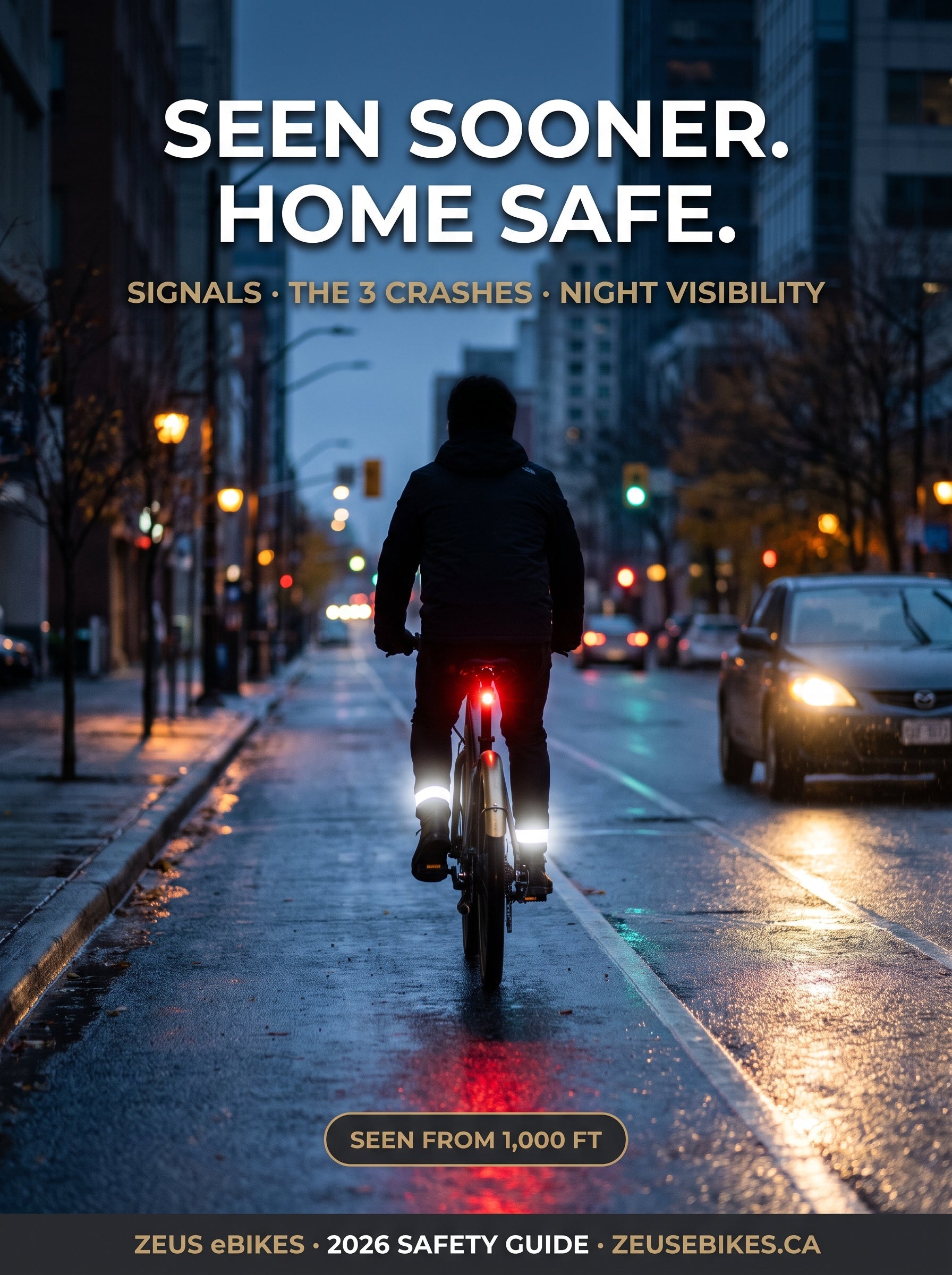
Seen sooner, home safe. Reflective ankle bands make a rider recognizable to drivers far sooner than a vest alone.
eBike safety in Canada comes down to a hard truth: being seen matters, but it is not what saves most riders. The cyclists killed on Canadian roads are overwhelmingly hit by a vehicle at a predictable conflict point — a door swinging open, a car turning across their path — and most of those crashes happen in perfectly good visibility. So the rider who gets home safe is not just the one with the brightest vest. It is the one who signals clearly, positions to be seen early, and rides around the three crashes that do the real damage.
This guide covers all of it — the hand signals every Canadian rider must know, how to actually be visible after dark, the gear that works (and the gear that only feels like it works), and the road habits that prevent the collisions. It is built on real Canadian collision data, not vibes, and every recommendation is something you can act on today.
To ride an eBike safely in Canada: signal every turn and stop (left arm out for left; right arm out for right; left arm down to slow), ride out of the door zone and control the lane at intersections, run a white front and red rear light after dark, and add reflective ankle bands — moving-leg reflectors get you recognized far sooner than a vest alone. Wear a certified helmet every ride. The three crashes to design around are the right hook, the left cross, and dooring. See the gear picks and the full method below, and confirm your province's exact rules in our Canadian eBike law guide.
What this guide covers
What actually kills cyclists in Canada — and why it should change how you ride
More Canadians are riding eBikes into their fall and winter commutes than ever, and in most of the country that means riding home in the dark from November through February. Get your safety approach wrong and the stakes are not a scolding — they are the roughly 74 cyclists killed on Canadian roads every year. This section shows you what the data says actually causes those deaths, so the rest of this guide can fix the right things.
Statistics Canada reviewed cycling fatalities from 2006 to 2017: 890 cyclists died, an average of 74 per year, and 73% of those fatal events involved a collision with a motor vehicle (Statistics Canada, Circumstances surrounding cycling fatalities in Canada, 2019). Most happened in cities — 56% urban versus 14% rural. Here is the part that surprises people: darkness, rain or blinding sunlight was a contributing visibility factor in only about 21% of fatal events. The large majority happened when the rider could be seen.
That is the reframe this whole guide turns on. If most riders are killed by a vehicle, in daylight, at a conflict point, then a reflective vest is not the finish line — it is table stakes. The habit that saves you is positioning and behaviour around vehicles: where you ride in the lane, how you approach intersections, and whether the driver turning across you actually registers you in time. Visibility gear still matters enormously for the dark Canadian commute — we will get to it — but it works best as one layer on top of riding technique, not as a substitute for it.
Being seen is necessary but not sufficient. Canadian riders are most often killed by a vehicle at a predictable conflict point, frequently in good visibility — so the biggest safety gains come from how you ride, then the gear that makes you unmissable after dark.
The 3 crashes to ride around — and exactly how to avoid each
Most serious car-versus-bike collisions in Canadian cities are one of three types: the right hook, the left cross, and dooring. Learn to recognize the set-up for each and you can position yourself out of the danger before it develops. This is the single most valuable skill in the guide.
1. Dooring — ride outside the door zone
Dooring is when someone in a parked car opens a door directly into your path with no time to react. You cannot out-react a door that appears a metre in front of you, so the fix is positional: ride at least one metre — an open door's width — away from any line of parked cars, even when that means taking the traffic lane. It feels wrong to move left into traffic, but a confident, predictable position in the lane is far safer than hugging the parked cars. If a bike lane is painted inside the door zone (many older ones are), ride at its outer edge.
2. The right hook — never sit on a vehicle's right at an intersection
The right hook is a vehicle turning right across a cyclist who is going straight on its right side. Avoid it by not passing cars on the right as you approach an intersection, and by moving into the lane so you are behind or clearly ahead of a turning vehicle, never beside it. Watch for a driver's front wheels rotating or a turn signal, assume large trucks and buses cannot see you on their right, and take the lane through the intersection so you are not squeezed into the turn.
3. The left cross — be seen and slow down at the point of conflict
The left cross is an oncoming vehicle turning left across your path, or a car pulling out from a side street or driveway. The driver's failure is not seeing you or misjudging your speed — which is more likely on an eBike, because you arrive faster than they expect. Defend against it: slow as you approach intersections and driveways, cover your brakes, and make eye contact with the driver who could turn across you. If you cannot confirm they have seen you, assume they have not.
Every one of these crashes happens at a conflict point — a spot where a driver's path can cross yours — and every one is defended the same way: be where the driver is looking, slow before the conflict, and never put yourself in a vehicle's blind spot or turning arc. Speed kept for the open straight; caution spent at the intersection.
Design your ride around the right hook, left cross, and dooring. Ride out of the door zone, control the lane at intersections, and make eye contact before you trust a driver to yield. This prevents the crashes gear cannot.
eBike hand signals every Canadian rider must know
Hand signals are how you tell drivers and other riders what you are about to do, and in Canada they are not optional — because an eBike is treated as a bicycle, you are legally required to signal your turns and stops. There are only three, they take five minutes to learn, and on an eBike they matter more because you are moving faster than drivers expect a cyclist to.
| Manoeuvre | Signal | How to do it |
|---|---|---|
| Left turn | Left arm straight out | Extend your left arm horizontally, pointing left. |
| Right turn | Right arm straight out (or left arm up) | Extend your right arm horizontally — clearest on a bike. The older method (left arm bent up at the elbow, hand pointing up) is also accepted. |
| Stopping / slowing | Left arm down | Bend your left arm down at the elbow, hand pointing down, palm facing back. |
Signal about 30 metres (roughly 100 feet) before the turn or stop, hold it for two or three seconds so it registers, then return your hand to the bar and — importantly — to your brake before you actually turn. On a heavier eBike you want both hands ready to brake as you commit to the manoeuvre. Signal even when you think no one is there; the driver you did not see is exactly the one who needed the warning. These are the signals taught by Ontario's Ministry of Transportation and recognized across Canada.
Three signals, legally required: left arm out (left), right arm out (right), left arm down (stop). Signal early, hold it, then get your hand back on the brake before you turn.
Want a bike that helps you be seen from the factory?
Zeus commuter and step-thru eBikes come with integrated front and rear lighting, so the legal minimum is handled before you add anything. Our team will help you match one to your commute at 1-866-938-7580.
Why 32 km/h changes the math
An eBike in Canada assists you up to 32 km/h, and that speed quietly changes every safety calculation. A driver glancing at an approaching cyclist estimates their speed from experience — and their experience is of a slower, unassisted bike. So they routinely misjudge how fast you are closing, which is exactly the error behind the left cross and the pull-out-from-a-side-street collision.
The answer is not to ride slower everywhere; it is to spend your speed on the open road and bank caution at the conflict points. Approach intersections, driveways and crosswalks ready to brake, not still accelerating. Remember too that an eBike is heavier than a regular bike and needs more distance to stop, so the habit of scrubbing speed before a potential conflict — rather than braking hard in it — is what keeps the extra speed an asset instead of a liability. This is also why being seen early matters so much on an eBike: the sooner a driver detects you, the more margin they have to correct their misjudgment of your speed.
How to actually be seen at night — the part most riders get wrong
The single biggest visibility upgrade is not the one most riders reach for. Riders reach for a reflective vest; the evidence says put reflective bands on your ankles. A vest is a static patch of light. Your legs move — and the human visual system is finely tuned to recognize the motion of a walking or pedalling person, a phenomenon researchers call "biomotion." Reflectors on your moving joints trigger that recognition, so a driver sees "person on a bike" far sooner than they see a floating rectangle of reflective fabric.
This is not opinion. In a peer-reviewed study, cyclists overestimated their own night-time visibility, and underestimated how much retroreflective markers on their ankles and knees improved it compared with a reflective vest alone (Wood, Tyrrell et al., Accident Analysis & Prevention, 2013). The riders who felt safest in a vest were often the least visible. The fix is cheap: a pair of reflective ankle bands worn with — not instead of — a front and rear light.
And in Canada, this is not just for dedicated night riders. Through the winter, sunset falls before 5 p.m. across most of the country, so a normal after-work commute is a dark-hours ride for months. Treat lights and ankle reflectors as standard equipment from October onward, the same way you treat winter tyres on a car.
1) Reflective ankle bands — biomotion, the highest impact per dollar. 2) A white front light and a red rear light — the legal minimum and your active visibility. 3) A blinking mode on the rear light — motion draws the eye. 4) Light or reflective clothing and a vest as a bonus layer. Do them in that order and skip nothing in the first two.
The gear that gets you home safe
Here is the visibility kit, ranked by impact rather than by price, and every item is available from a Canadian retailer. You do not need all of it at once — the first two lines are the ones that matter most. Notice that the reflective vest, the item most riders buy first, sits lower on the list on purpose.
| Priority | Item | Why it's ranked here | Price (CAD) | Store |
|---|---|---|---|---|
| 1 — highest impact | Reflective ankle bands | Biomotion: moving-leg reflectors get you recognized soonest | ~$15–20 | Amazon.ca |
| 2 — legal minimum | MEC Mica 60/30 front + rear set | White front + red rear = the law after dark | $44.95 | MEC |
| 2b | Lezyne Femto USB-C set | Compact always-on backup set | $64.99 | MEC |
| 3 | MEC Mica 100 rear + brake light | Brake flare in the rear-end / right-hook window | $39.95 | MEC |
| 4 — bonus layer | Zeus LED Reflective Safety Vest | Adds area, but a vest alone underperforms ankle biomotion | $69.00 | Zeus |
Reflective Ankle Bands
~$15–20The most effective safety item on this page, and the cheapest. Strapped to your ankles, they turn the up-and-down motion of pedalling into the exact signal a driver's brain reads as "a person on a bike," which the research shows is recognized far sooner than a static vest. Buy two, keep a spare pair in your bag, and put them on any time you might still be out after dusk. Amazon prices float — confirm the live price before you buy.
A white front light and a red rear light is what most provinces legally require after dark, and this Canadian-retailer set covers both in one rechargeable package. Run the front on steady so drivers can judge your position, and the rear on blink so it catches the eye. If your commute takes you onto unlit paths, step up to a brighter front unit — but for lit city streets, this is the honest baseline. Prefer a compact always-on backup? The Lezyne Femto USB-C set ($64.99) lives on the bike permanently.
An LED-equipped hi-vis vest adds a large, active block of visibility to your torso, and the built-in lights help in daylight and dusk. We are ranking it honestly as a complement, not a substitute: worn over ankle bands and with proper lights, it is a genuine upgrade; worn alone, it underperforms the ankle biomotion above. If you want one high-visibility layer that also has its own lights, this is a good Canadian-made-available option — just don't let it replace the first two lines of the kit.
The legal floor: lights, bell, helmet — and where to check
The exact rules are provincial, so the honest version is a national principle plus a link to your province. In short: after dark you need a white front light and a red rear light or reflector; most provinces also require a bell or horn; and helmet law varies — several provinces require one at every age, others only for minors. Because an eBike is a power-assisted bicycle, these bicycle rules apply to you, and sidewalk riding is banned by municipal bylaw in most cities.
Rather than reprint every province's statute here (and risk it going stale), we keep a maintained, province-by-province breakdown. Confirm your exact helmet age, light and equipment rules in the Canadian eBike laws guide, or go straight to your province: Ontario, British Columbia, Alberta, and more. On helmets specifically, the data settles the debate for us: Statistics Canada recorded that about a third of the cyclists killed from 2006 to 2017 were not wearing one (helmet status was unknown in roughly half of cases) — so whatever your province requires, wear a certified helmet every ride.
Minimum kit that is legal almost everywhere after dark: white front light, red rear light, a bell, and a helmet. The precise helmet and equipment rules vary by province — check yours here — but none of them are a reason to skip the helmet.
Frequently Asked Questions
Are hand signals legally required on an eBike in Canada?
Yes. Because an eBike (a power-assisted bicycle) is treated as a bicycle for rules of the road in every province, you are legally required to signal your turns and stops, just like any cyclist. The standard signals are: left arm straight out for a left turn; right arm straight out — or left arm bent up at the elbow — for a right turn; and left arm bent down at the elbow for slowing or stopping. Signal about 30 metres before the turn, then return your hand to the bar and brake.
What lights do I need on my eBike by law in Canada?
Most provinces require a white light on the front and a red light or red reflector on the rear when you ride between roughly half an hour before sunset and half an hour after sunrise. Many also require reflective material on the bike. The exact wording varies by province, so check your provincial rules — but a white front light and a red rear light is the practical minimum everywhere, and you should treat it as mandatory. A rear reflector alone is legal in some places but far weaker than an active red light.
Is a reflective vest enough to be seen at night?
Not on its own. Peer-reviewed research (Wood et al., Accident Analysis & Prevention, 2013) found that cyclists overestimate their own night-time visibility, and that retroreflective markers on the moving joints — especially the ankles — make a rider recognizable to drivers far sooner than a reflective vest alone. Your legs move in a way the human visual system detects as a person ("biomotion"). The strongest, cheapest upgrade is a pair of reflective ankle bands worn with a front and rear light; a vest is a useful addition, not a complete answer.
What is dooring and how do I avoid it?
Dooring is when someone opens a parked car's door into your path with no time for you to react. Avoid it by riding outside the "door zone" — at least one metre (about an open door's width) from any line of parked cars — even when that means riding in the traffic lane. It feels counterintuitive to move left, but a controlled position in the lane is far safer than hugging the parked cars where a door can appear instantly.
Do I need a helmet to ride an eBike in Canada?
It depends on your province — several require a helmet for eBike riders of all ages (including Quebec, Alberta, Saskatchewan, Manitoba, BC and others), while some only mandate them for minors. Regardless of the law where you ride, wear one. Statistics Canada data on cycling fatalities from 2006 to 2017 recorded that roughly a third of the fatally injured cyclists were not wearing a helmet (with helmet status unknown in about half of cases). Check your provincial rules in our eBike law guides, and treat a certified helmet as non-negotiable equipment.
Does my eBike need a bell in Canada?
In several provinces, yes — a working bell or horn is required equipment on a bicycle, and eBikes are included. Ontario, for example, requires an audible signalling device. Even where it is not strictly mandated, a bell is worth fitting: a quick ring warns pedestrians and other cyclists on shared paths, which is exactly where an eBike's extra speed can surprise people. Check your provincial rules for the specific requirement.
Can I ride my eBike on the sidewalk?
Almost never. Sidewalk riding is regulated by municipal bylaw across Canada, and most cities prohibit riding a bicycle or eBike on the sidewalk (Toronto fines are around $90). Beyond the fine, sidewalks are one of the most dangerous places to ride: drivers pulling out of driveways and turning at corners do not look for fast-moving traffic on the sidewalk, which sets up exactly the collisions you want to avoid. Ride on the road, in bike lanes, or on multi-use paths.
Why does eBike speed change how I should ride?
A power-assisted bicycle in Canada assists up to 32 km/h, so you arrive at intersections and close on parked cars faster than a driver expects a cyclist to. Higher speed means a driver has less time to judge your approach, and it means you need more distance to stop — an eBike is also heavier than a regular bike. The habits in this guide matter more on an eBike, not less: signal earlier, position for visibility, and scrub speed before intersections rather than braking hard in them.
The Bottom Line
Safe eBike riding in Canada is not about fear — it is about spending your attention where the data says it counts. Signal every turn, ride out of the door zone, control the lane at intersections, and make eye contact before you trust a driver to yield. Light up front and back after dark, put reflective bands on your ankles, and wear a helmet every ride. Do those things and you have addressed the crashes that actually happen, not just the ones that feel scary.
Ready to set yourself up right? Zeus ships eBikes across Canada — many with integrated lighting built in — backed by a 14-day return window and real people at 1-866-938-7580 who will help you pick a bike and the safety kit to go with it. Start with a well-lit commuter eBike or an easy-mount step-thru, and add the visibility gear above before your first dark ride.
Keep going: the Canadian eBike laws guide · the most comfortable eBike seat · best urban commuter eBikes · best eBikes for seniors · the complete Canadian eBike guide.
Visuals created by Playcut.ai

Share:
Welcome to Earth — Chapter Two: The Chassis
Generally Accepted Practice: How Four Undefined Words Removed Farm Animals From Canada's Cruelty Laws