
Why Is Car Insurance So Expensive in Canada? The 2026 Forensic Breakdown
Published: August 1, 2026 · By Milad Ghobadibeygvand, BScN (Western University, 2014)

July 1, 2026. The bill arrives whether you drive or not. What it buys got smaller — by regulation, without a press conference.
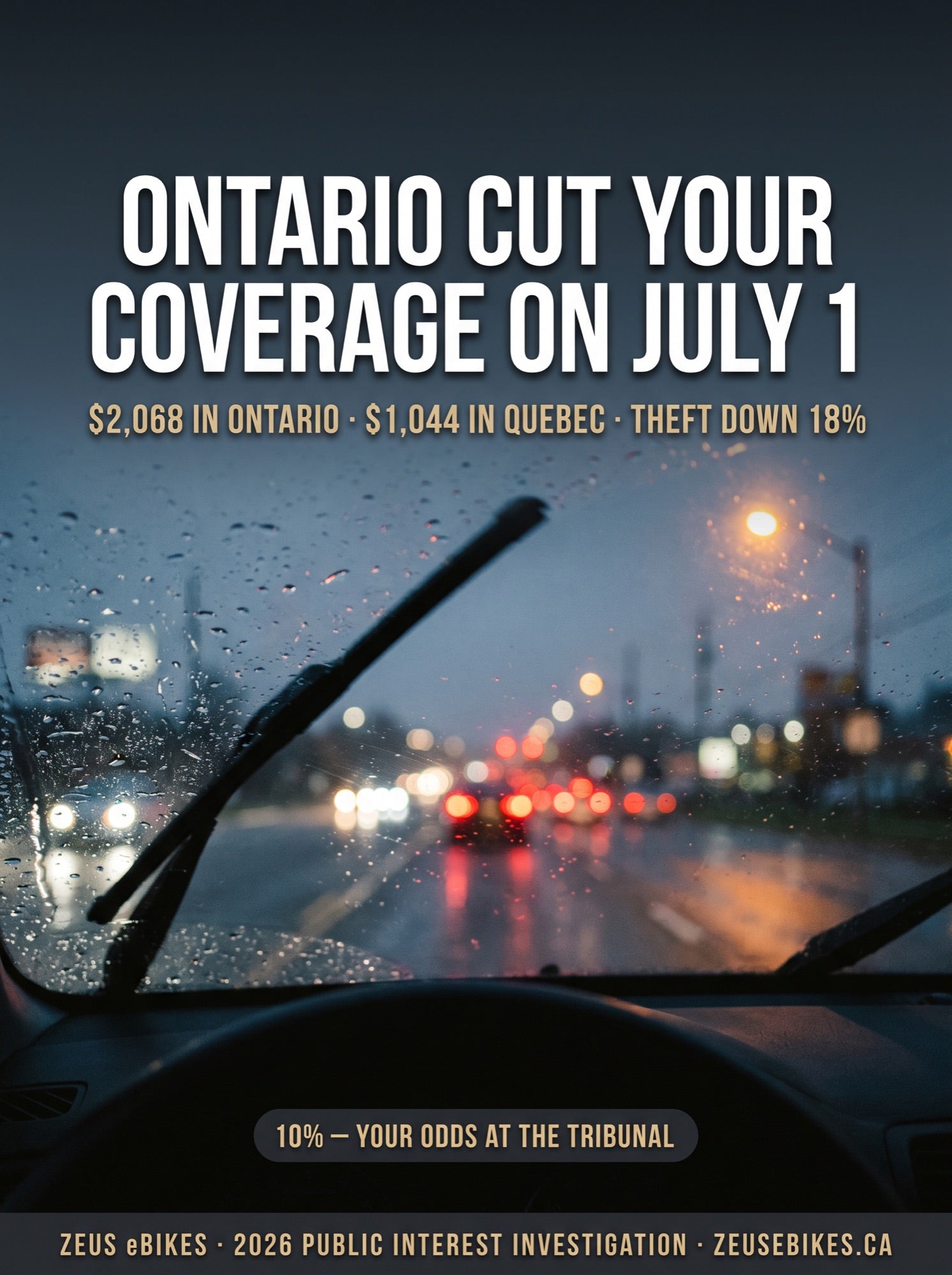
On July 1, 2026 — one month before this article was published — Ontario stopped automatically including income replacement in your car insurance policy. Also caregiver benefits. Also housekeeping. Also death and funeral benefits. If you are hit by a car tomorrow and cannot work, the benefit that used to be included in every policy by default is now available only if it was purchased — eligibility rules applied before and still do, but the coverage itself no longer arrives automatically. Most drivers do not know this happened, because it was done by regulation rather than by legislation, and regulations do not hold press conferences.
The stakes are simple and personal: Ontario's default insurance product became thinner on July 1, 2026. New policies no longer automatically include income replacement and seven other benefits; existing policyholders generally keep their prior coverage at renewal unless they agree in writing to change it — but every driver should now verify what the quoted price actually buys. This article follows the money — who set the price, who cut the coverage, who promised to fix it, and what the public record actually shows when you check.
This is a public-record analysis. Primary sources: Statistics Canada, Impacts of rising costs and claims on personal automobile insurance profitability and consumers in Canada, catalogue 11-621-M, released April 2, 2025; Ontario Regulation 383/24 amending the Statutory Accident Benefits Schedule (O. Reg. 34/10), in force July 1, 2026; the Legislative Assembly of Ontario's bill record for Bill 42, Ending Discrimination in Automobile Insurance Act (Parliament 42, Session 1); David Marshall, Fair Benefits Fairly Delivered: A Review of the Auto Insurance System in Ontario, final report to the Ontario Minister of Finance, April 11, 2017; Tribunal Watch Ontario, Auto Accident Benefits Adjudication: Backlog reduction but troubling trends, January 23, 2025; Alberta's Bill 47 care-first legislation (royal assent May 15, 2025; in force January 1, 2027); Équité Association's 2025 Auto Theft Trend Report; Public Safety Canada's reporting on the National Action Plan on Combatting Auto Theft; the Ontario Energy Board Regulated Price Plan Price Report for November 1, 2025 to October 31, 2026; FSRA's automobile insurance filing guidance on benchmark publication; and Intact Financial Corporation's Q4-2025 results release of February 10, 2026.
On industry sources. Figures from the Insurance Bureau of Canada and from Équité Association are used throughout — and are labelled every time. The IBC is the property and casualty industry's national lobby association. Équité Association is a not-for-profit founded by the insurance industry. Where their numbers are used, it is deliberately: an industry figure that undercuts an industry argument is the strongest evidence available. Where their numbers are estimates or commissioned projections rather than measurements, that is stated.
On what this analysis does not claim. Where the evidence supports an inference but not a conclusion, the inference is labelled as opinion. Where a credible source contradicts the argument of this article, that source is cited rather than omitted — most importantly the Ontario government's own commissioned expert, who concluded the problem was not excess insurer profit. See Are Insurers Gouging? and Limitations.
Canadian car insurance is expensive for four measurable reasons and one structural one. Measurable: vehicles cost more (median new vehicle price hit $65,219 in December 2024, up 61.5% in five years — Statistics Canada), parts and repairs cost more (+22.3% over the same five years), claims ratios climbed to a 90.4% peak in Q3 2024, and theft claims hit $1.5 billion in 2023. Structural — and this is the part nobody campaigns on — roughly one-third of Ontario benefit costs never reaches an injured person at all, going instead to duelling expert reports, legal fees and insurer defence costs. That finding is not an activist's claim. It is the conclusion of the Ontario government's own Special Advisor, delivered in 2017, and largely shelved.
Meanwhile premiums rose about 4.45% in 2026 while the default product got thinner: on July 1, 2026 most accident benefits became optional add-ons on new policies, included only if purchased.
What This Article Covers
- What You Actually Pay, By Province
- The $1,024 Question: Why Quebec Pays Half
- Theft Was Real. The Pass-Through Test Comes Next
- "It's Tariffs" — Reading the Fine Print
- Are Insurers Gouging? The Honest Answer
- Follow the Money: What the Market Leader Told Its Shareholders
- The One-Third That Never Reaches the Injured
- What Happens When You Actually Claim
- July 1, 2026: Less Coverage, Higher Price
- The Bill That Passed Twice and Died in Committee
- "A Stretch Goal": The 15% That Never Came
- Alberta 2027: The Right to Sue, Traded Away
- The Accountability Ledger
- The One Bill You Can Legally Cancel
- What This Cannot Replace — Honestly
- Limitations of This Analysis
- Frequently Asked Questions
- What You Can Actually Do This Week
What You Actually Pay, By Province
Statistics Canada put hard numbers to this in April 2025. As of December 2024, the average written auto insurance premium in Canada varied by more than double from the cheapest province to the most expensive — and the split does not fall along the lines most people assume.
| Province | Average written premium (Dec 2024) | Who underwrites injury coverage |
|---|---|---|
| Ontario | $2,068 | Private insurers |
| Alberta | $1,818 | Private insurers |
| British Columbia | $1,522 | Public (ICBC) |
| Quebec | $1,044 | Public for bodily injury (SAAQ); private for vehicle damage |
Source: Statistics Canada, catalogue 11-621-M, released April 2, 2025.
What a driver pays, by province
Average written automobile insurance premium, December 2024. Bars are coloured by who underwrites bodily-injury coverage — not by any claim that public delivery alone causes the gap.
Source: Statistics Canada, catalogue 11-621-M, released April 2, 2025.

Two premiums, two sets of plates, one household. The second vehicle often survives on habit rather than use — and it carries a full insurance line either way.
One honest asterisk on the Quebec figure before it does any work: Quebec motorists also fund the public bodily-injury plan through separate SAAQ insurance contributions (published on the SAAQ's insurance-contributions rate page) collected with driver's-licence and vehicle-registration payments — in 2026 the licence-side contribution carries a 75% rebate for drivers with no demerit points. So the $1,044 written premium is not Quebec's complete insurance-related burden, and the $1,024 gap should not be read as a complete all-in comparison. Even after adding those contributions, however, the gap remains large.
Over the decade from December 2014 to December 2024, the auto insurance component of the Consumer Price Index rose 36.4%. In the single year to December 2024, it rose 8.7%.
The $1,024 Question: Why Quebec Pays Half
Quebec drivers pay roughly half what Ontario drivers pay. The reason is not that Quebec drivers are safer or that Quebec cars are cheaper. It is that in 1978 Quebec removed bodily injury from the private market entirely. The Société de l'assurance automobile du Québec compensates injuries on a no-fault public basis; private insurers compete only on vehicle damage.
Now the honest part, because a comparison this convenient deserves scrutiny. This is not a clean natural experiment, and anyone who presents it as one is selling something. Quebec's low premium buys a genuinely different product. Quebec drivers gave up most of their right to sue for injury in exchange for the public scheme — the compensation is administrative, not adversarial, and for a catastrophically injured plaintiff who would have won a large tort award, that trade is not obviously favourable. Vehicle mix, population density, theft rates, weather, urban structure and litigation culture all differ between the provinces. The gap is real, large, and measured by Statistics Canada. What it proves is narrower than it first appears.
What it does establish is this: the price of auto insurance in Canada is not a law of physics. It is a policy outcome. Two provinces sharing a border, a currency, a climate and a car market produce a two-fold difference in price because they made different decisions about how injury compensation should work. Somebody chose. That is the entire point of this article.
Theft Was Real. The Pass-Through Test Comes Next
Through 2023 and 2024, the single loudest explanation for rising premiums was auto theft, and the case was genuinely strong. The Insurance Bureau of Canada — the industry's national lobby association — reported that the cost of claims to replace stolen vehicles reached a record $1.5 billion in 2023, an increase of 254% since 2018. Ontario theft claims rose 524% between 2018 and 2023, passing $1 billion for the first time. The IBC estimated that auto theft was adding approximately $130 per year to the average Ontario premium. Statistics Canada independently confirmed the $1.5 billion figure and counted 49,679 theft claims in 2023.
That was real. Governments responded. Following the National Summit on Combatting Auto Theft in February 2024, the federal government committed $15 million to law enforcement and $28 million to the Canada Border Services Agency to expand shipping-container inspection. The CBSA intercepted 2,277 stolen vehicles in 2024, up more than 25% year over year, and roughly 600 vehicles were recovered from the Port of Montreal in a single April 2024 operation.
And it worked. According to Équité Association — the insurance industry's own not-for-profit anti-fraud and theft organisation, not a critic — private passenger vehicle thefts fell 18% year over year in 2025, to 46,999 nationally. Ontario fell 22%. Quebec fell 25%.
Ontario premiums rose approximately 4.45% in 2026.

The CBSA intercepted 2,277 stolen vehicles in 2024, up more than 25% year over year. Thefts fell 18% nationally in 2025 — the industry's own figure.
The obvious inference is that somebody kept the difference. That inference is probably wrong, and explaining why is the most useful thing in this article.
So the honest reading is not "they pocketed it." It is this: the price you paid in 2026 reflects a theft problem that had already started receding by the time you paid it. That is a structural lag, not a conspiracy — and it cuts both ways, because the same lag meant drivers were under-charged for theft on the way up.
Which converts an accusation into something considerably more useful: a test with a date on it.
Mark the date. We will publish the check either way.
"It's Tariffs" — Reading the Fine Print
Tariffs are the current explanation for rising Canadian auto premiums, and the honest answer is that the projection doing the public work is much larger than the measurement. Statistics Canada recorded a 2.9% rise in vehicle parts, maintenance and repair costs between April 2025 and April 2026. The widely-quoted “up to 5%” premium figure is an industry-commissioned ceiling estimate, not an observed outcome.
The projection: Deloitte, in an analysis commissioned by the Insurance Bureau of Canada, estimated that 25% economy-wide tariffs imposed by the United States and reciprocated by Canada would raise the price of new vehicles and replacement parts by up to 10.9%, and could push Alberta premiums up by up to 5%.
The measurement: Statistics Canada's consumer price index for passenger vehicle parts, maintenance and repairs rose 2.9% between April 2025 and April 2026.
Two things are true simultaneously, and honest analysis requires holding both. Tariffs are a genuine cost pressure on repair inputs — that is not in dispute, and the longer-run effect may exceed what one year of CPI captures. And: the number doing the public work is a ceiling estimate ("up to"), produced by a consultancy retained by the trade association whose members benefit from a widely accepted justification for rate increases. That does not make the study wrong. It makes it evidence with a declared interest, which should be weighed accordingly — and which is rarely mentioned when the figure is quoted in the press.
Are Insurers Gouging? The Honest Answer
Are Canadian insurers gouging drivers? On the public evidence, no — not in the sense of unlawful or hidden profiteering. Statistics Canada put property and casualty return on equity at 12.6% in 2024 against a 10.5% historical average, and 18.2% in 2021. Above average, certainly. But Ontario's own commissioned expert found the core problem was structural, not excess profit.
The case that they are doing well. Statistics Canada tracked return on equity across the property and casualty industry: 18.2% in 2021 — the peak of the series and roughly 1.7 times the historical average of 10.5% — falling to 9.1% in 2023, then recovering to 12.6% in 2024. So in 2021 and again in 2024, the industry earned above its long-run average return. Anyone claiming the sector was uniformly losing money across this period is not describing the Statistics Canada data.
The case that it is more complicated. Those are all-lines P&C figures, not the Ontario auto line specifically. The IBC reports that over 2012–2022, Ontario auto produced about two cents of profit per dollar and a 7.9% return on equity, while Alberta auto lost about seven cents on the dollar. Those figures measure a different thing over a different period, and presenting them as a caught contradiction would be dishonest. Claims ratios genuinely deteriorated: from 77.7% in Q1 2020 to a 90.4% peak in Q3 2024. Vehicles genuinely got more expensive to replace — median new vehicle price $65,219 in December 2024, up 61.5% in five years; used vehicles up 82.2%. A 2022 Toyota RAV4 bumper repair requires 39 parts and averages $4,144, against 17 parts and $2,769 for the 2017 model — a 50% increase, per the IBC.
And here is the finding that should have ended the debate. In April 2017, David Marshall — appointed Special Advisor to Ontario's Minister of Finance — delivered a 103-page review with 35 recommendations. As reported by Global News and the legal and insurance trade press on the report's release, Marshall wrote that the problems in the system were structural — not excess insurance company profits, and not the behaviour of claimants or lawyers.
That is the government's own commissioned expert, and it cuts directly against the simplest version of the story. It is included here because omitting it would be cherry-picking, and because it points at something worse than greed.
Sourcing note: the finding above is stated as reported by named outlets covering the report's April 11, 2017 release. The Ontario government's hosted copy of the full report did not return a retrievable document at the time of writing, so it is not quoted verbatim here. See Limitations.
Follow the Money: What the Market Leader Told Its Shareholders
Industry-wide averages are easy to argue about; public companies have to file. Canada's largest property and casualty insurer reported an operating return on equity of 19.5% for 2025, its highest-ever net operating income per share, and a 21st consecutive annual dividend increase. Its personal auto premiums grew 9% while insured vehicles grew 2%. All of it disclosed publicly.
Intact Financial Corporation is Canada's largest property and casualty insurer by market share — industry analyses commonly place it near a fifth of the national market, though we have not independently re-derived that share. It is publicly traded, which means it must tell its shareholders the truth on a schedule. Here is what it told them on February 10, 2026, in its Q4-2025 results:
| Intact Financial Corporation — full-year 2025 | Reported figure |
|---|---|
| Operating return on equity | 19.5% |
| Reported return on equity | 18.4% |
| Net operating income per share | $19.21 — described as its highest ever |
| Quarterly common share dividend | $1.47, an increase of $0.14 (11%) |
| Consecutive years of dividend growth | 21 |
| Personal auto — operating direct premiums written | +9%, on unit growth of 2% |
Source: Intact Financial Corporation, Q4-2025 results release, February 10, 2026.
Chief Executive Officer Charles Brindamour's own summary: "We ended 2025 in a position of strength, after delivering our highest ever annual NOIPS, an outstanding operating ROE, and strong results across the business."
Now the discipline this article owes you. That 19.5% is consolidated — all lines, all geographies, including the company's United States and United Kingdom operations. It is not an Ontario auto figure, and anyone who presents it as one is doing the same trick this article criticised the lobby group for. Statistics Canada's industry-wide P&C return on equity for 2024 was 12.6%, against a 10.5% historical average. A single well-run company outperforming its sector is what well-run companies do. It is not, by itself, evidence of anything improper.
But one line in that table is auto-specific, and it is the one worth sitting with. Personal auto premiums written grew 9% while the number of insured units grew 2%. The company did not gain 9% more customers. The gap is consistent with materially higher average premium per insured vehicle — though it is not a clean seven-point rate calculation, because customer mix, vehicle mix, coverage selection and geography also move premiums written. Directionally, it is what a rate-increase cycle looks like from the revenue side; the company's own disclosure says nothing improper about it, and neither does this article.
One thing this article does not assert. Nothing here suggests Intact — or any individual insurer — caused, drafted or procured the July 1 benefit reductions. Those were made by the Government of Ontario through regulation. The company is cited because it is the largest player and its numbers are public, not because it is alleged to have done anything wrong.
The One-Third That Never Reaches the Injured
Roughly one-third of Ontario's accident benefit costs never reaches an injured person. It goes instead to competing expert opinions, lawyers' fees and insurer costs to defend claims. That finding came from David Marshall, the Ontario Minister of Finance's own Special Advisor, in April 2017. It is the most important sentence in Canadian auto insurance, and almost nobody has heard it.
He found that Ontario's average premium was higher than any other province's, that claims cost more and took longer to resolve, and that benefits were fair but were not being fairly delivered. Specifically: about one-third of overall benefit costs went not to treatment but to competing expert opinions, lawyers' fees and insurer costs to defend claims. Sprains and strains — the majority of claims — often took more than a year to settle.
Read that again as a consumer. Of the money collected from drivers and earmarked for injured people, roughly a third is consumed by the process of arguing about whether injured people should get it. Not by fraud. Not by generous payouts. By the adversarial machinery itself — duelling assessments, defence costs, litigation.
Marshall made 35 recommendations to fix this. By 2018, the insurance trade press was reporting the Marshall report as "dead." Its central structural reforms were not implemented.
What Happens When You Actually Claim
Premium is only half of what you buy. The other half is what happens when you need it. In Ontario, disputes between injured people and their own insurer go to the Licence Appeal Tribunal's Automobile Accident Benefits Service, which handles more than 96% of all LAT cases.
Tribunal Watch Ontario — an independent monitoring group — published the numbers in January 2025.
| Outcome at the Licence Appeal Tribunal | 2017 | 2023 |
|---|---|---|
| Injured claimant succeeds | 33% | 10% |
| Insurance company succeeds | 56% | 71% |
| Split decision | 11% | 19% |
Source: Tribunal Watch Ontario, January 23, 2025.
What happens when you fight your insurer
Outcomes at Ontario's Licence Appeal Tribunal — Automobile Accident Benefits Service, which handles more than 96% of all LAT cases. Split decisions (11% to 19%) are not plotted.
Source: Tribunal Watch Ontario, January 23, 2025.

Of more than 18,000 files closed at the tribunal in 2023–24, only 1,088 produced a final decision. Of those, injured claimants won one time in ten.
In 2017, an injured person who fought their insurer to a decision won a third of the time. By 2023, they won one time in ten.
The volume figures matter just as much. In 2023–24 the tribunal received more than 16,000 applications and closed more than 18,000 files — but issued only 1,088 final decisions, against 16,941 files settled or withdrawn. The overwhelming majority of disputes never reach adjudication at all. The tribunal hit only 70% of decisions within 90 days against an 80% target, and lawyers report post-hearing waits of a year or more.
The Ontario Trial Lawyers Association argues that some adjudicators show an "institutional bias against accident victims and in favour of insurance companies." That is an allegation, not a finding — and it comes from an association of plaintiff lawyers who have a direct commercial interest in the system's design. It is recorded here as their position. The Tribunal Watch numbers require no such caveat: they are simply what happened.
July 1, 2026: Less Coverage, Higher Price
On July 1, 2026, Ontario Regulation 383/24 amended the Statutory Accident Benefits Schedule. Three benefits remain mandatory in every policy: medical, rehabilitation and attendant care — capped at $3,500 under the Minor Injury Guideline, $65,000 combined for non-catastrophic impairment, and $1 million for catastrophic impairment.
Everything else became optional — meaning you now get it only if you buy it:
| Benefit | Before July 1, 2026 | Now |
|---|---|---|
| Income replacement | Included | Optional — must be purchased |
| Non-earner benefit (students, unemployed) | Included | Optional |
| Caregiver benefit | Included | Optional |
| Housekeeping and home maintenance | Included | Optional |
| Death and funeral benefits | Included | Optional |
| Visitor expenses | Included | Optional |
| Lost educational expenses | Included | Optional |
| Damage to personal items | Included | Optional |
| Medical / rehabilitation / attendant care | Included | Still mandatory |
Source: O. Reg. 383/24 amending O. Reg. 34/10, in force July 1, 2026.
What July 1, 2026 changed
Ontario Regulation 383/24. Three benefits stay in every policy automatically. Eight now arrive only if you bought them — and new policies default to the mandatory minimums.
Source: O. Reg. 383/24 amending O. Reg. 34/10, in force July 1, 2026.
Existing policies renew with current coverage unless you agree in writing to drop it. New policies default to mandatory minimums only. A first-time buyer in Ontario today is quoted, by default, a policy with no income replacement.

The most exposed person at the intersection is now the least covered by default. Optional benefits reach only the named insured's household.
We wrote about how Canadian road design and enforcement already fail cyclists in It's Not an Accident. It's a Blueprint. This regulation is the insurance-side companion to that story: the people most exposed on the road just lost the most default protection.
The Bill That Passed Twice and Died in Committee
Two drivers with identical records, identical vehicles and identical claims histories pay materially different premiums in Ontario depending on where they park at night. This is called territorial rating, and the Brampton comparison is the one that made it famous. In the figures most often cited in the Ontario debate, Brampton and Cornwall record broadly similar claim counts while the insured claim cost per vehicle in Brampton runs close to double, and Cornwall drivers pay well under half the annual premium. Treat the precise ratio with care — it circulates widely in advocacy material and press coverage, and the underlying regulatory tables are not published in a form that lets a reader re-derive it easily.
Critics — including the Wellesley Institute — argue that postal code correlates strongly with income, race, unemployment and educational attainment, and that pricing on it amounts to digital redlining. That is an argument about proxy discrimination, and it is contested; insurers respond that territory is a statistically valid predictor of claim cost, which is a defensible actuarial position. Ontario's regulator, the Financial Services Regulatory Authority, has acknowledged the postal-code approach is outdated but has declined to ban territorial rating.
Here is the part that is not contested, because it is in the legislative record.
Bill 42, the Ending Discrimination in Automobile Insurance Act, would have prohibited insurers from using factors primarily related to a person's postal code or telephone area code when classifying risk. Its legislative history, from the Legislative Assembly of Ontario:
| Stage | Date | Result |
|---|---|---|
| Sponsor | — | Hon. Parm Gill, Progressive Conservative MPP for Milton |
| First reading | October 15, 2018 | Carried |
| Second reading | March 21, 2019 | Debated and carried on division |
| Referred to | March 21, 2019 | Standing Committee on Finance and Economic Affairs |
| Third reading | — | Never held |
| Royal Assent | — | Never received |
Source: Legislative Assembly of Ontario, bill record, Parliament 42, Session 1. The bill died on the order paper at prorogation in September 2021.
This was not an opposition bill blocked by a hostile majority. It was sponsored by a member of the governing party — Parm Gill, who would later serve in that government's cabinet as Minister of Citizenship and Multiculturalism and subsequently Minister of Red Tape Reduction. The legislature voted for it twice. It was sent to committee in March 2019 and never came back. Then prorogation killed it.
Reasonable people can disagree about whether banning territorial rating would lower prices overall or simply redistribute them — that is a genuine policy question, and this article does not pretend it is settled. But the governing party did not lose that argument in public. It declined to have it. In this author's view, a bill that clears second reading and then vanishes in committee for two and a half years has not been defeated; it has been quietly withdrawn from public attention while the government keeps the credit for having introduced it.
"A Stretch Goal": The 15% That Never Came
In 2013, Ontario's Liberal government promised to cut average auto insurance premiums by 15% by August 2015. The promise was made as part of securing NDP support for a minority budget — which is to say, it was a bargaining chip before it was a policy.
The deadline arrived and passed. By the fourth quarter of 2016, the Financial Services Commission of Ontario's approved-rate data put the cumulative decrease since August 2013 at about 8.3% — a little over half the target. In the first quarter of 2017 approved rates rose 1.24%, pulling the cumulative cut back to a little over seven per cent.
Asked about the shortfall, Premier Kathleen Wynne said: "We always knew it was a stretch goal." (Global News, reporting her remarks.) The commitment had been presented to the legislature as a policy. It was described afterwards as an aspiration.
Then the direction reversed entirely. Between December 2014 and December 2024, the auto insurance component of the Consumer Price Index rose 36.4%.
Alberta 2027: The Right to Sue, Traded Away
Alberta is running the largest live experiment in Canadian auto insurance. Bill 47 received royal assent on May 15, 2025, and takes effect January 1, 2027, moving the province to a privately delivered, no-fault "care-first" system.
What Albertans gain: insurers capped at 5% average rate increases across their whole book, with renewals for average drivers capped at 10%; note that this cap is not indexed to inflation — Alberta's New Democrats have pushed for it to be adjusted annually against the provincial Consumer Price Index, which it currently is not; income replacement up to $125,000 per year until retirement; spousal death support up to $600,000; permanent impairment benefits up to $295,000; and unlimited treatment where it contributes to recovery.
What Albertans give up: the right to sue for most injuries. Under no-fault, your own insurer pays, and the courtroom door closes on most claims.
That may well be a good trade. Marshall's finding — that a third of benefit spending is consumed by adversarial process — is a serious argument for exactly this kind of reform, and the Alberta benefit levels are genuinely substantial. This article does not oppose care-first. It notes two things.
First: the trade is real for individuals. Someone catastrophically injured by an ordinarily negligent driver in 2027 will receive scheduled benefits rather than pursue a conventional tort award. Litigation survives only in defined circumstances — chiefly where the at-fault driver is convicted of prescribed Criminal Code or Traffic Safety Act offences (impaired driving being the obvious case), and even then only for limited heads of damage such as pain and suffering beyond benefits paid. For most people most of the time the trade is faster and better. For a minority with the worst injuries, it is worse.
Second: the "62% of Albertans support the new model" figure that circulated widely came from a Yorkville Strategies survey commissioned by the Insurance Bureau of Canada — the industry lobby association whose members are the ones being freed from tort liability. That does not make the number false. It makes it a number with an author, and the author is rarely named when it is quoted.
The Accountability Ledger
Stripped of narrative, here is the public record.
| Year | What happened | Source |
|---|---|---|
| 2013 | Ontario government promises a 15% average premium cut by August 2015 | Government commitment, minority budget deal |
| 2015–17 | Target missed; ~8.3% cumulative by Q4 2016, then rates turned upward; Premier calls it "a stretch goal" | FSCO approved-rate data; Global News |
| 2017 | Marshall report: problems are structural; ~⅓ of benefit costs never reach patients; 35 recommendations | Fair Benefits Fairly Delivered, April 11, 2017 |
| 2018 | Marshall reforms reported as "dead" | Insurance trade press |
| 2018–19 | Bill 42 (postal-code discrimination) passes first and second reading, goes to committee | Legislative Assembly of Ontario |
| 2017→2023 | Claimant success rate at the LAT falls from 33% to 10%; insurer success rises to 71% | Tribunal Watch Ontario, Jan 23, 2025 |
| 2021 | Bill 42 dies on the order paper at prorogation. P&C return on equity peaks at 18.2% | Legislature; Statistics Canada |
| 2014→2024 | Auto insurance CPI rises 36.4% | Statistics Canada 11-621-M |
| May 2025 | Alberta Bill 47 receives royal assent; no-fault from Jan 1, 2027 | Government of Alberta |
| 2025 | Auto theft falls 18% nationally; Ontario −22%, Quebec −25% | Équité Association |
| July 1, 2026 | Most Ontario accident benefits become optional; cyclists and pedestrians can lose access entirely | O. Reg. 383/24 |
| 2026 | Ontario premiums rise ~4.45% | FSRA-approved rate filings |
The One Bill You Can Legally Cancel
A legal power-assisted bicycle (generally up to 500 W nominal, with the motor cutting out at 32 km/h and operable pedals) requires no registration and no mandatory insurance in any Canadian province, and no driver's licence except for Québec riders aged 14 to 17. The recurring cost is electricity: roughly 7.8 cents per full charge, or about $6 a year for a daily commuter. Everything above is a system you do not control. This is the part you do.
Sit with what "no mandatory insurance" means. Not cheaper insurance. None. The premium simply does not exist as a category — there is no renewal to shop, no benchmark cycle, no tribunal, no committee. Full provincial detail is in our Canadian e-bike law guide.

No registration. No mandatory premium. No licence for an adult rider. About eight cents to fill — and no regulator, lobby group or committee gets a vote on it.
The running cost is electricity. Here is the arithmetic, with every input named:
| Input | Value | Source |
|---|---|---|
| Typical battery | 48 V × 15 Ah = 720 Wh (0.72 kWh) | Common commuter specification |
| Energy drawn from the wall per full charge | ~0.8 kWh (allowing ~85–90% charger efficiency) | Zeus calculation |
| Ontario off-peak electricity | 9.8¢ / kWh | OEB Regulated Price Plan, Nov 1 2025 – Oct 31 2026 |
| Cost of one full charge | ≈ 7.8 cents | 0.8 × $0.098 |
| Realistic range per charge | ~50–70 km | Zeus estimate, mixed terrain and rider weight |
| Commuter riding 20 km/day × 240 days | 4,800 km/yr ≈ 80 charges | Zeus calculation |
| Annual electricity cost | ≈ $6 | 80 × $0.078 |
Set that against the Statistics Canada figure for what the average Ontario driver pays in insurance alone: $2,068 per year. Not fuel. Not the car. Not maintenance, parking, depreciation or financing. Insurance alone.
Three honest qualifications, because the point of this article is that unqualified numbers are how people get misled:
- You may still want insurance. Many home and tenant policies extend to bicycles, often with limits and deductibles that make a claim impractical, and liability coverage is a separate question worth asking about. We cover what actually applies in Do you need e-bike insurance in Canada?
- Over 500 W is a different legal animal. Exceed the provincial threshold and you may be operating a motor vehicle requiring licence, registration and insurance — with penalties for doing so without them. The law guide above sets out each province's line.
- This is not a claim that an e-bike replaces a car. For many households it replaces one car, or a second car, or a share of trips. That distinction is the subject of the next section.
What This Cannot Replace — Honestly
An article that ends "so buy a bike" would deserve the scepticism it got. A power-assisted bicycle is not a car, and for a large number of Canadians it cannot become one.
- Rural and remote distance. A 60 km each-way commute on a highway shoulder is not a cycling problem to be solved with a better battery.
- Deep winter. Parts of Canada are genuinely, seriously not rideable for months. Winter cycling is real and growing, but it is a choice that requires equipment, road maintenance and tolerance that not everyone has.
- Children, care work and cargo. Two kids, a car seat and a hockey bag is a car trip in most family configurations, cargo bikes notwithstanding.
- Trades and equipment. If your work requires a vehicle, it requires a vehicle.
- Mobility and health. Not every body can ride, and no honest article pretends otherwise.
- Safety exposure. As the July 1 regulation makes brutally clear, cyclists carry more physical risk and — as of last month — less default insurance protection. That is a real cost on the other side of the ledger and it belongs here.
The defensible version of the argument is narrower and stronger than "replace your car." It is this: some two-car households may be able to remove one vehicle — and with it an entire insurance premium, a recurring, indexed cost that rises every year regardless of how well you drive. Whether yours is one of them is not something this article can know. The only reliable way to find out is to record one ordinary week of actual trips before deciding.
If you are testing that idea, our breakdown of e-bike versus car costs in Canada works the numbers, and the car-free Canada handbook covers what actually happens province by province when you try.
Limitations of This Analysis
Stating these is what separates analysis from advocacy.
- Commercial interest disclosed. Zeus eBikes Canada sells electric bicycles. An article concluding that car ownership is expensive is an article that serves our commercial interest. Every figure above is sourced so you can check it without trusting us.
- The Quebec comparison is not a controlled experiment. Different tort rights, vehicle mix, density, weather and litigation culture all contribute. The premium gap is measured; the causal attribution to public delivery is an inference.
- ROE figures span different scopes. The Statistics Canada return-on-equity series is all-lines property and casualty; IBC's Ontario auto figures cover a different line and period. They are not directly comparable and are not presented as such.
- The 4.45% 2026 Ontario figure derives from aggregations of FSRA-approved rate filings reported by rate-comparison services, not from a single official FSRA publication of an annual average.
- Falling theft does not obligate falling premiums, and the lag is real. FSRA benchmarks use June 30 and December 31 data, so 2026 rates largely reflect 2024–early-2025 experience. This article treats the theft question as a dated, falsifiable prediction about 2027 filings rather than as a proven failure to pass through savings.
- No party named in this article was contacted for comment before publication. This is a public-record analysis, not original reporting, and it does not meet the pre-publication comment standard a newsroom would apply. Every named party is invited to respond, and corrections will be published — see the right-of-reply note at the end.
- Intact's 19.5% operating ROE is consolidated across all lines and geographies, including its US and UK operations. It is not an Ontario auto figure and is not presented as one. Only the personal-auto premium and unit-growth figures are auto-specific.
- FSRA's and the SAAQ's websites block automated verification. Statements attributed to FSRA guidance and to the SAAQ's insurance-contribution rates were taken from those regulators' published pages as confirmed through retrievable means; the pages load normally in a browser but reject automated requests, so they are named rather than linked.
- Lobbying records were not obtained. We looked. Trade-association lobbying is lawful and disclosed, and we found no specific pattern worth reporting; the Ontario registry was not machine-readable for this analysis. Absence of a finding here is not evidence of absence.
- The primary text of O. Reg. 383/24 was confirmed through the regulator's guidance and legal-sector analysis; Ontario's e-Laws and CanLII interfaces block automated retrieval. Readers should consult the regulation directly.
- The Marshall report is cited as reported, not quoted verbatim. The Ontario government's hosted copy did not return a retrievable document at the time of writing. Its findings are stated here as reported by named outlets covering the April 11, 2017 release, and are not presented inside quotation marks.
- The Brampton–Cornwall ratio is widely cited but not independently re-derived here. It is presented as the figure used in the Ontario debate rather than as a verified regulatory statistic.
- This is not legal, insurance or financial advice. Coverage decisions depend on your province, your policy and your circumstances. Talk to a licensed broker before changing anything.
- Opinion is labelled. Where this article characterises political conduct — for example, that a bill dying in committee amounts to declining an argument rather than losing it — that is stated opinion offered as fair comment on a matter of public interest, based on the facts set out.
Frequently Asked Questions
Why is car insurance so expensive in Canada right now?
Four measurable drivers and one structural one. Vehicles cost far more to replace — the median new vehicle price reached $65,219 in December 2024, up 61.5% in five years, with parts and repair costs up 22.3% (Statistics Canada). Claims ratios peaked at 90.4% in Q3 2024. Theft claims hit $1.5 billion in 2023. Tariffs added pressure on parts. Structurally, Ontario's own 2017 government review found roughly one-third of benefit costs go to expert reports, legal fees and defence rather than to treatment.
Which province has the most expensive car insurance?
Ontario, at an average written premium of $2,068 as of December 2024, followed by Alberta at $1,818, British Columbia at $1,522 and Quebec at $1,044 (Statistics Canada, catalogue 11-621-M). Ontario has been the most expensive province for years; the 2017 Marshall review noted the same ranking.
Why is car insurance cheaper in Quebec?
Quebec moved bodily injury compensation out of the private market in 1978. The SAAQ handles injury claims on a public no-fault basis while private insurers compete only on vehicle damage. On the written-premium measure Quebec drivers pay roughly half the Ontario average, though Quebec motorists also fund the public plan through separate SAAQ contributions collected with licence and registration payments, so the gap is smaller all-in. They also gave up most of their right to sue for injury, and vehicle mix, density and litigation culture differ between the provinces.
What changed in Ontario auto insurance on July 1, 2026?
Under O. Reg. 383/24, only medical, rehabilitation and attendant care benefits remain mandatory. Income replacement, non-earner, caregiver, housekeeping, death and funeral, visitor expenses, lost educational expenses and damage to personal items all became optional. Existing policies renew unchanged unless you agree in writing otherwise, but new policies default to mandatory minimums only.
Do cyclists still get accident benefits if a car hits them in Ontario?
Mandatory benefits — medical, rehabilitation and attendant care — remain available. But optional benefits now cover only the named insured, their spouse, dependants and listed drivers, so a cyclist struck by a fully insured driver can lose access to optional benefits such as income replacement entirely. If you cycle, the coverage that matters is now on your own household auto policy, if you have one, plus your own disability and extended health coverage.
Did car insurance go down when auto theft fell?
No. Équité Association — the insurance industry's own anti-theft organisation — reported thefts fell 18% nationally in 2025, with Ontario down 22% and Quebec down 25%. Ontario premiums still rose approximately 4.45% in 2026. There is a structural reason: FSRA publishes the benchmarks underpinning rate filings twice a year using June 30 and December 31 data, so rates approved in 2026 largely reflect 2024 and early-2025 experience — when theft was peaking. The real test is whether the 2025 decline shows up as downward pressure in rate filings approved during 2027.
Do you need insurance for an electric bike in Canada?
A legal power-assisted bicycle — generally up to 500 W nominal, motor cutoff at 32 km/h, with operable pedals — requires no registration and no mandatory insurance in any province, and no licence outside Québec, where riders aged 14 to 17 need a moped licence (Class 6D). Exceed your province's threshold and it may be classified as a motor vehicle, which does require all three. Provincial detail is in our Canadian e-bike law guide and e-bike insurance guide.
What are my chances if I dispute a denied claim in Ontario?
In published adjudicated outcomes, poor and worsening: Tribunal Watch Ontario reported claimant success at the Licence Appeal Tribunal fell from 33% in 2017 to 10% in 2023, while insurer success rose from 56% to 71%. But most disputes never reach a decision at all — of more than 18,000 files closed in 2023–24, only 1,088 produced a final decision; the rest settled or were withdrawn, on terms the public record does not disclose. Those percentages describe decided cases, not any individual's probability of recovery.
What You Can Actually Do This Week
None of this is a counsel of despair. Four of these take under an hour, and the first one is free.
- Read your accident benefits page. Confirm whether you still have income replacement. If you bought a new policy after July 1, 2026, assume you do not until you verify otherwise.
- Ask your broker, in writing, what theft loading is in your premium and what claim period it is derived from. You are entitled to ask. Given the benchmark lag, the honest answer in 2026 is "2024 data" — and that is precisely why the 2027 renewal is the one to scrutinise.
- Shop the renewal. Approved rate changes in Ontario ranged from roughly 0.03% to 10.37% in a single quarter. Those are different companies pricing the same driver.
- Count your household's actual car-trips. Not the trips you imagine — a week of real ones. Some two-car households discover the second vehicle covers a surprisingly small number of trips; the log will tell you whether yours is one of them.
- Write to your MPP or MLA. Ask why Bill 42 died in committee. Ask which of Marshall's 35 recommendations were implemented. These are answerable questions and they are on the public record.
The through-line of this article is not that insurance companies are evil. It is that a system was examined by the government's own expert nine years ago, found to be structurally broken in a specific and fixable way, and then not fixed — while the price rose 36.4% over a decade and the coverage was quietly reduced last month. Insurers set prices inside rules. Governments write the rules. The rules were written in rooms you were not in, and they can be rewritten in the same rooms.
In the meantime, there is exactly one line on the average Canadian household's transport budget that a person can cancel unilaterally, without permission, without a hearing and without waiting for a committee to report back.
Right of reply. If you represent an insurer, a regulator or an elected office named in this article and believe any fact here is inaccurate, write to milad@zeusebikes.ca with the correction and the source. Corrections will be published.
- Why Is Canada So Expensive? The Forensic 2026 Breakdown — nine cost systems, every number sourced
- Why Is Gas So Expensive in Canada? — refining margins, not crude oil
- Canada's $300 Billion Car Dependency — where the money leaves the country
- It's Not an Accident. It's a Blueprint. — how road design and enforcement fail cyclists
- How to Finance an Electric Bike in Canada — if the up-front cost is the obstacle
- How Much Does an Electric Bike Actually Cost in Canada?
Share:
Generally Accepted Practice: How Four Undefined Words Removed Farm Animals From Canada's Cruelty Laws
Vancouver eBike Laws 2026: The Four Rulebooks, Where You Can Actually Ride & 5 Picks That Fit the Regulation