
Best 1000W Electric Bikes in Canada (2026): 9 Verified Picks, $1,999–$4,099

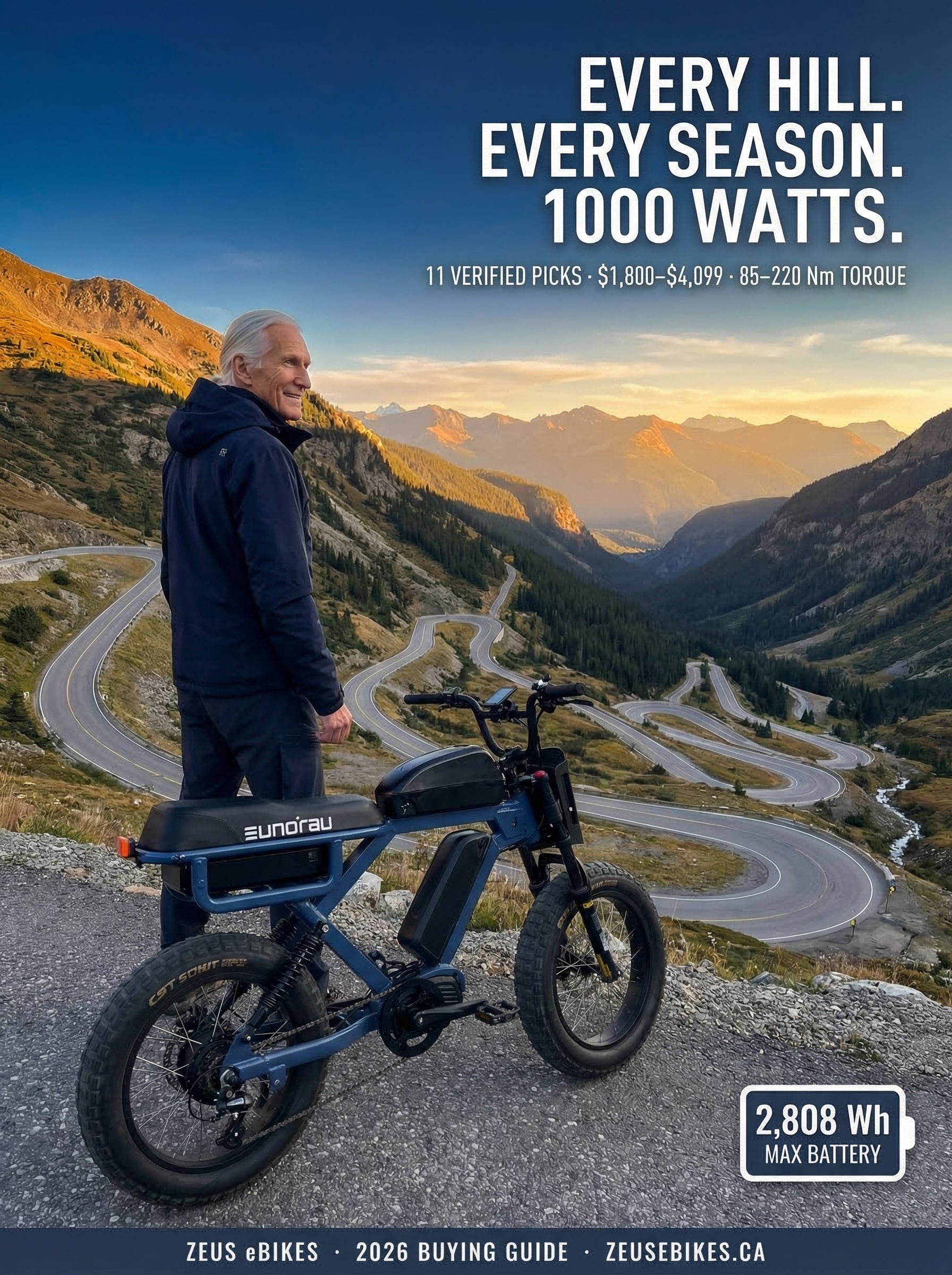
The right 1000W eBike depends on your terrain and budget. Maximum climbing torque: the Eunorau Flash 1000W mid-drive ($2,869) at 220 Nm with triple-battery capability (2,808 Wh). Best trail suspension: the Eunorau Specter-S 3.0 ($4,099) — 160 Nm Bafang M620 with 140mm inverted fork travel. Best step-thru: the Eunorau SPECTER-ST 2.0 ($4,099). Browse the full Zeus mountain eBike collection or the folding eBike collection.
A thousand watts changes the conversation. At 500W you negotiate with hills. At 1000W you end the negotiation. But raw wattage tells you almost nothing without knowing the motor type, the battery depth behind it, and the suspension designed to absorb what that power unleashes on the trail. We weighed the 1000W-class eBikes in the Zeus Canada catalogue on brake quality, battery capacity, suspension engineering and honest value. Nine made this guide: five Bafang mid-drives producing 160–220 Nm, three hub motors from budget folding to premium trail, and one electric trike.
Quick Picks — Find Your Match in 30 Seconds
Not sure where to start? Every rider has a different terrain, budget, and use case. These five picks cover the most common 1000W buying decisions. Click through to jump directly to that bike’s full section, or keep reading for the complete guide.
In This Guide
- Quick Picks — Find Your Match in 30 Seconds
- Why 1000W? What a Thousand Watts Actually Buys You
- Hub Motor vs Mid-Drive at 1000W
- Best 1000W eBikes Under $2,700
- Best 1000W Mid-Drive eBikes ($2,869–$4,099)
- Best Premium 1000W Hub Motor eBikes ($3,599–$4,099)
- All 9 Picks Compared — Master Spec Table
- Winter Range Data — What to Expect Below −10°C
- Frequently Asked Questions
- The Bottom Line
Why 1000W? What a Thousand Watts Actually Buys You
The difference between 500W and 1000W is not double the speed — it is double the confidence. A 500W motor strains on a 10% grade with a 90 kg rider and panniers. A 1000W motor takes the same hill at the same speed without dropping out of the highest pedal-assist level. The extra wattage shows up not as top-end velocity but as sustained power under load: hills, headwinds, heavy riders, cargo, and winter conditions where cold batteries deliver less current. When the temperature drops below −10°C and your pack is at 40% charge, that reserve wattage is the margin between arriving and pushing.
In this guide, “1000W” means the motor’s nominal continuous rating is 1,000W or higher. Two picks sit below that line: the Velotric Nomad 2X, rated 750W, and the CitiTri E-310, the guide’s only trike, which Addmotor’s own pages print at 500W (with a 1,100W peak) and at 750W, as our listing now does. The Swift Horse Ultra X-6E has no rated figure on Freesky’s Canadian page (4,000W peak only), so it is not shown to meet that line either. Peak wattage (the burst a motor delivers for 10–30 seconds under hard acceleration) is a separate figure, given per bike in the comparison table. Nominal and peak are not the same number, and any retailer who quotes only peak wattage is flattering the spec sheet.
The second factor is torque — measured in Newton-metres (Nm). Wattage is how much energy the motor consumes. Torque is how hard it pushes. In this guide, the hub motors are rated 90–140 Nm and the mid-drives 160–220 Nm, and a mid-drive also multiplies its force through the bike’s gears. If you ride hills regularly, torque matters more than wattage. Our 500W vs 750W vs 1000W wattage comparison breaks down the full spectrum with 13 models tested side by side.
 Hub Motor vs Mid-Drive — The 1000W Decision
Hub Motor vs Mid-Drive at 1000W — The Decision That Shapes Your Ride
This is the single most important choice in the 1000W category. It determines not just how the bike climbs but how it feels, what it costs to maintain, and how long the drivetrain lasts. Most buyers fixate on wattage numbers and overlook motor architecture — and most buyers end up underpowered on hills as a result. The two platforms are not interchangeable. At 1000W, the gap between hub and mid-drive is wide enough that choosing wrong means buying again within two years.
Hub Motor (4 bikes in this guide)
- Power goes direct to the rear wheel — no chain wear from motor torque
- 90–140 Nm torque across the hub picks
- Simpler: fewer moving parts, lower maintenance costs over time
- Less efficient on steep hills — no gear multiplication, works hardest in the wrong conditions
- $1,999–$3,599 in this guide
- Bikes: CitiTri E-310, Euybike K6 Pro, Freesky Swift Horse, Westridge 4T
Mid-Drive (5 bikes in this guide)
- Power goes through the chain and gears — multiplies torque on every downshift
- 160–220 Nm torque at 1000W nominal
- Better hill climbing, better weight distribution (motor centred at the cranks)
- Wears chains and cassettes 2–3× faster than hub motors — budget for annual drivetrain service
- $2,869–$4,099 in this guide
- Bikes: Eunorau FAT-HD 2.0, Flash 1000W, FAT-HS, Specter-S 3.0, SPECTER-ST 2.0
For a deeper technical comparison with real test data — including Canadian winter performance and drivetrain longevity numbers — see our mid-drive vs hub motor guide for Canadian riders.
Not sure which of the 9 fits? Call 1-866-938-7580.
Pay over 3–12 months with flexible financing — no credit check options available.
Compare All 9 Picks ↓ Financing OptionsBest 1000W eBikes Under $2,700
Three bikes. All hub motors. All under $2,700. This is where 1000W power becomes accessible — a folding frame, fat tires, and batteries large enough to make the wattage useful rather than decorative. None of these bikes are compromise machines. Each is purpose-built for a specific rider: the stability-first rider who needs three wheels, the apartment dweller who needs a folder that carries 400 lbs, and the range hunter who needs 1,440 Wh without touching $3,000.
CitiTri E-310
from $2,399 CADThe only three-wheeler in this guide. Its motor is printed two ways: Addmotor’s own pages print 500W (1,100W peak) and 750W, and our listing prints both. With 90 Nm of torque, 960 Wh of Samsung-cell battery, and a payload of 280 lb for the rider plus 80 lb of cargo (Addmotor’s figures) spread across three contact points, it solves the balance problem that keeps many riders off two-wheelers entirely. Seven levels of pedal assist give fine-grained power control for everything from gentle neighbourhood loops to loaded grocery runs. The trike format means genuine stability at low speeds, which matters for seniors, riders with mobility concerns, and anyone hauling heavy cargo on Canadian residential streets. Zeus has published a two-year, zero-warranty-call review of this exact trike — and it held up. For the full Canadian trike market, see our electric trikes guide.
Honest trade-off: on either reading (500W on one Addmotor page, 750W on another) its rated power is below the true 1000W bikes here, and the 1,100W peak that Addmotor prints on its 500W page is brief. Trike width means some bike lanes and pathway bollards will not accommodate it comfortably.
 CitiTri E-310 — Three-Wheel Stability
Euybike K6 Pro
$1,999 CADThe K6 Pro carries 400 lbs on a folding frame made of magnesium alloy. Its 1,200 Wh Samsung battery is a single pack with no dual-battery complexity, and the 1,000W hub motor peaks at 1,500W with 96 Nm of torque. The lockable front suspension lets you stiffen the ride on pavement and soften it for gravel without tools. IPX5 water resistance means Canadian rain, slush, and spring melt are handled without drama. The Shimano 8-speed drivetrain helps on moderate inclines.
Honest trade-off: Cadence sensor only — power delivery is less refined than a torque-sensor bike. Minimum rider height of 5′7″ excludes shorter riders. Single battery means no range extension without carrying a spare pack.
Freesky Swift Horse Ultra X-6E
$2,699 CAD $3,583The Freesky packs the biggest single battery in the budget tier: 48V 35Ah of LG cells (1,680 Wh) on Freesky’s Canadian page, with a claimed 87–140 miles (140–225 km) on pedal assist. A Bafang hub motor with 150 Nm — the highest torque figure of any hub motor in this guide’s table — sits in a full-suspension 6061 aluminium frame (120 mm oil-sprung fork, 150 mm air shock) on 26×4.0″ fat tires that float over the debris-strewn shoulders of Canadian spring roads. Four-piston hydraulic brakes (180 mm) provide stopping power that most bikes at this price match only with two-piston calipers. Freesky prints the motor at 4,000W peak and gives no rated figure, so nothing on its page shows the 1,000W rating this guide is built around.
Honest trade-off: At 38 kg it is heavy for its frame size. Freesky’s X-6E manual says it is not intended to be used or stored below 0°C (32°F).
 1000W Mid-Drive — 160–220 Nm of Trail Authority
Best 1000W Mid-Drive eBikes: $2,869–$4,099
Five Eunorau mid-drives. All Bafang motors. All 160 Nm or higher. This is where 1000W stops being about raw wattage and starts being about torque multiplication, drivetrain quality, and suspension design. A mid-drive motor turns the cranks through 9 or 11 gears — 160 Nm in low gear delivers far more force at the wheel than 160 Nm from a hub motor pulling directly against a single fixed ratio. If you’ve done any research into this segment, the Flash 1000W two-year review is essential reading — it documents how these Bafang powertrains hold up under real Canadian use over 24 months.
Eunorau Flash 1000W
$2,869 CADThe Flash is the most configurable 1000W eBike on Zeus — and the most powerful. The mid-drive configuration delivers 220 Nm of torque at 52V (higher voltage than every other bike in this guide), through an 8-speed Shimano drivetrain with full suspension (80mm front, double-spring rear). The headline feature is battery expandability: start with 832 Wh and add up to two more packs for a combined 2,808 Wh — the highest battery capacity in this entire guide. That is enough for 150+ km in Canadian winter conditions.
The 440 lb payload rating is the highest in this guide. The 52V system delivers approximately 8% more power than equivalent 48V setups at the same current draw. Read the Flash 1000W two-year review for long-term reliability data from Canadian ownership.
Honest trade-off: 80mm front fork travel is short — this is a road-tuned suspension, not a trail bike. The 20” wheels limit off-road tyre selection compared to 26” platforms. The base 832 Wh battery is modest; the triple-battery setup adds about $1,930 to the price ($2,869 for the mid-drive with its main battery, $4,799 with the second and third packs).
Eunorau FAT-HD 2.0 / Hunter X7
from $3,299 CADThe FAT-HD 2.0 is the entry point to serious mid-drive power — clean Bafang M615 output, 160 Nm, through Shimano 9-speed with push-button shifting. The 720 Wh base battery can be doubled to 1,440 Wh with a second pack. A hardtail 6061 aluminium frame keeps weight at 37 kg, and Kenda 26×4.0” fat tyres deliver the float over gravel, packed snow, and soft shoulders that riders coming from fat-tire eBike guides expect. The 375 lb payload is the highest of any mid-drive in this guide — significant for heavier riders or those carrying load.
Honest trade-off: Hardtail means no rear suspension — every bump transfers directly to the saddle. The single 720 Wh base battery limits range to 40–65 km before the second pack becomes necessary for longer rides.
Eunorau FAT-HS 1000W
$3,099 CADThe FAT-HS earns its place with one number: 35 kg. That is 5 kg lighter than the Specter-S models below — a meaningful difference over 80 km of riding. RST 75mm front fork and KS 48mm rear shock with preload adjustability deliver the full-suspension feel without the weight penalty of heavier linkage systems. Bafang M615, 160 Nm, Shimano 9-speed. Kenda 26×4.0” K-Shield puncture-protected fat tyres. Dual-battery capable. CDC6 LCD with walk assist and waterproofing throughout.
Honest trade-off: The 300 lb payload is the lowest of the mid-drive group — not a bike for heavier riders. The 75mm + 48mm suspension travel is conservative; this is a road-and-gravel platform, not a true trail bike. The single 720 Wh battery requires the optional second pack for rides beyond 65 km.
Eunorau Specter-S 3.0 / Hunter X9
$4,099 CADThe Specter-S 3.0 carries the most suspension travel in this guide: a 140mm inverted air fork — stanchions at the bottom, sliders at the top, the same configuration used on downhill mountain bikes that retail for $5,000 or more. Inverted forks are stiffer laterally under load, which matters when you are pushing 160 Nm through fat tyres on loose gravel. The Bafang M620 mid-drive is a step above the M615 in the bikes below it — the same platform used by European trail eBikes at comparable price points. 48V 17.5Ah (840 Wh) battery. 26×4.0” fat tyres. Hydraulic discs with motor-cutoff sensors on both ends. If you are comparing this to what you rode on a fat-tire versus regular-tire comparison guide, the Specter-S is the answer to “what does a proper fat-tire mid-drive look like.”
Honest trade-off: $4,019 is a premium price — justified by the suspension and motor combination, but not the right choice for pure road commuting. The 840 Wh single battery is adequate but not expansive at this price. Standard frame geometry only; no step-through option available.
Eunorau SPECTER-ST 2.0
$4,099 CADThe SPECTER-ST 2.0 trades the Specter-S’s 26×4.0” fat tyres for 27.5×3.0” plus-size rubber, and uses that trade-off to upgrade what matters most: the drivetrain. SRAM NX 1×11 is the widest gear range in this guide — 11 speeds of precise shifting, single-ring simplicity, zero front derailleur. Bafang M620, 160 Nm, 140mm front fork and 165mm DNM rear shock. The headline value is the included second battery: 1,632 Wh out of the box at $4,099 — effectively a free 816 Wh pack compared to buying separately. That translates to 120+ km of realistic Canadian range before a charge.
Honest trade-off: At 40 kg, this is the heaviest mid-drive in the guide. The 300 lb payload is shared with the Specter-S. The 27.5×3.0” plus-size tyre is narrower than a true 4.0” fat tyre — it will not float over deep snow or soft sand the same way. If winter conditions are your primary concern, the Specter-S or FAT-HD 2.0 deliver more tyre contact patch.
Every bike in this guide ships from Canada with Canadian warranty
Financing available — pay over 3–12 months with no credit check options.
View Full Mountain eBike Collection Financing OptionsBest Premium 1000W Hub Motor eBikes: $3,599–$4,099
Not everyone wants a mid-drive. Hub motors at this price tier come with torque sensors, premium suspension, and build quality that genuinely closes the gap. There is another advantage nobody talks about: zero drivetrain wear from the motor itself. A hub motor never touches your chain. A mid-drive at this price absolutely does — and that wear compounds at 1,000W. If you ride hard and often, the maintenance calculus matters.
Velotric Nomad 2X
$4,099 CADIf you need more payload than the 1000W bikes here carry (the Flash leads them at 440 lbs), look at the Velotric Nomad 2X. The motor is rated 750W nominal with a 1,400W peak, and its 105 Nm torque output shows on steep starts and loaded climbs.
Where the Nomad 2X separates itself is payload and suspension. 560 lb payload capacity is the highest in this entire guide — 27% more than the Eunorau Flash. The suspension is full air: a 120mm air fork with lockout and rebound adjustment up front, a DNM air rear shock behind. Air suspension is tunable — you dial in ride quality for your weight and terrain in a way coil springs do not allow. Tektro hydraulic brakes front (203mm) and rear (180mm). Kenda 26×4.0” fat tyres. Shimano 8-speed. SensorSwap™ technology lets you switch between torque sensor and cadence sensor modes from the display — unique in this guide.
The 801.6 Wh battery delivers approximately 80 km throttle-only and 120 km on pedal assist (manufacturer figures; expect 20–35% less in Canadian winter conditions). The battery is IPX7-rated and UL 2849/2271/2580 certified — the same safety certifications that matter for building access and insurance. USB-C charging port on the display for phone charging on the go.
Honest trade-off: 750W nominal sits below the 1,000W in this guide’s title — the peak and torque are strong, but the nominal rating matters under prolonged load. No dual-battery option: 801.6 Wh is the ceiling. For dedicated heavy-rider analysis, see the best eBikes for heavy riders Canada guide.
Taubik Westridge 4T
$3,599 CADThe Westridge 4T’s standout specification is its Maxxis Minion tyres. At 26×4.8”, these are the widest tyres of any bike in this guide. If grip on loose Canadian terrain is your primary concern, the decision is made for you at the tyre level before you evaluate anything else.
Power comes from a 1,000W Bafang hub motor with a torque sensor, delivering 95 Nm through a Shimano 8-speed Acera drivetrain. The 960 Wh Samsung 21700 battery is UL-certified — the safety certification that matters most in jurisdictions tightening eBike fire rules, and in apartment buildings that ask. Hardtail geometry with a Mozo front coil fork keeps the weight at 37 kg (37.1 kg in the manual; 82 lb on Taubik’s page).
Honest trade-off: Hardtail only — no rear suspension means every root and rock transfers through the seat on technical trail sections. Its load limit is the lowest in the entire guide, 286 lb on Taubik’s page and 120 kg (265 lb) in its manual, so plan around the lower — riders near this limit should see the best eBikes for heavy riders Canada guide. Taubik’s warranty is two years on the frame and one year on electrical components, versus two years for the Eunorau models.
All 9 Picks Compared — Side by Side
Every spec below was verified against the live Zeus product page at time of publication. No spec was taken from memory or third-party aggregators.
| Model | Motor | Torque | Battery | Range | Weight | Payload | Suspension | Gears | Price |
|---|---|---|---|---|---|---|---|---|---|
| CitiTri E-310 | 500W / 750W (two readings) | 90 Nm | 960 Wh | Up to 145 km | 39 kg | 360 lbs (280 + 80) | — | — | from $2,399 |
| Euybike K6 Pro | 1,000W / 1,500W peak | 96 Nm | 1,200 Wh | 70–130 km | 37 kg | 400 lbs | Lockable front | 8-speed | $1,999 |
| Freesky Swift Horse Ultra | 4,000W peak Bafang (no rated figure) | 150 Nm | 1,680 Wh | 140–225 km (Freesky) | 38 kg | 400 lbs | Full | 7-speed | $2,699 |
| Eunorau Flash 1000W | 1,000W Mid-Drive | 220 Nm | 832 Wh (2,808 Wh triple) | 60–200+ km | 37–42 kg | 440 lbs | Full (80mm) | 8-speed | $2,869 |
| Eunorau FAT-HD 2.0 | 1,000W M615 Mid | 160 Nm | 720 Wh (1,440 Wh dual) | 40–130 km | 37 kg | 375 lbs | Hardtail | 9-speed | from $3,299 |
| Eunorau FAT-HS | 1,000W M615 Mid | 160 Nm | 720 Wh (dual opt.) | 64–129 km | 35 kg | 300 lbs | Full (75mm + 48mm) | 9-speed | $3,099 |
| Westridge 4T | 1,000W Bafang Hub | 95 Nm | 960 Wh | Up to 100 km | 37 kg | 286 lb / 120 kg | Hardtail | 8-speed | $3,599 |
| Specter-S 3.0 | 1,000W M620 Mid | 160 Nm | 840 Wh | — | ~40 kg | — | Full (140mm inv.) | — | $4,099 |
| SPECTER-ST 2.0 | 1,000W M620 Mid | 160 Nm | 816 Wh (1,632 Wh dual) | Up to 128 km | 40 kg | 300 lbs | Full (140mm + 165mm) | 11-speed SRAM | $4,099 |
Every spec verified against the live Zeus product page. Range figures are manufacturer-stated — expect 20–40% less in Canadian winter conditions below −10°C.
Winter Range Data — What to Expect Below −10°C
Canadian winters are the real performance test. Lithium-ion cells slow their chemical reaction below 0°C — expect 10–20% range reduction at 0°C, 20–35% below −10°C, and 35–45% below −20°C. The figures below apply the 30% midpoint reduction to each bike’s manufacturer-stated range to produce a realistic Canadian winter estimate.
Three habits that protect winter range: charge indoors (never in an unheated garage overnight), pre-warm the battery by bringing it inside for 30 minutes before a cold-morning ride, and run the highest assist level on very cold days so the motor generates heat that warms the pack. For more, see the best eBikes for winter Canada guide and the long-range eBikes Canada guide.
| Model | Battery | Summer Range (Mfr.) | Winter Est. (−10°C) | Fat Tires |
|---|---|---|---|---|
| CitiTri E-310 | 960 Wh | Up to 145 km | Up to 102 km | 20×2.4″ / 18×2.4″ |
| Euybike K6 Pro | 1,200 Wh | 70–130 km | 49–91 km | 20×4.0” |
| Freesky Swift Horse Ultra | 1,680 Wh | 140–225 km | 98–158 km | 26×4.0” |
| Eunorau Flash (base) | 832 Wh | 60–80 km | 42–56 km | 20×4.0” |
| Eunorau Flash (triple) | 2,808 Wh | 160–200+ km | 112–140+ km | 20×4.0” |
| Eunorau FAT-HD 2.0 | 720 Wh base / 1,440 Wh dual | 40–130 km | 28–91 km | 26×4.0” |
| Eunorau FAT-HS | 720 Wh | 64–129 km | 45–90 km | 26×4.0” |
| Taubik Westridge 4T | 960 Wh | Up to 100 km | Up to 70 km (manual: not below 0 °C) | 26×4.8” |
| Eunorau Specter-S 3.0 | 840 Wh | Est. 60–100 km | 42–70 km | 26×4.0” |
| Eunorau SPECTER-ST 2.0 | 1,632 Wh dual | Up to 128 km | Up to 90 km | 27.5×3.0” |
All winter estimates apply a 30% reduction to manufacturer summer range — actual results will vary by rider weight, terrain, and assist level.
 The Verdict — 9 Picks, One Decision
The Bottom Line
A thousand watts is not a luxury — it is the point where an eBike stops negotiating with terrain and starts owning it. But the number on the spec sheet is the least important thing in this guide. Motor type, battery depth, and suspension quality determine what 1,000W actually delivers when you are 40 km from the trailhead in February.
Three clear use-case recommendations:
- Maximum climbing power: Eunorau Flash at $2,869 — 220 Nm, 52V architecture, triple battery option reaching 2,808 Wh
- Trail capability ceiling: Eunorau Specter-S 3.0 at $4,099 — Bafang M620 mid-drive with 140mm inverted fork, the closest thing to a purpose-built trail machine in the lineup
- Three-wheel stability: CitiTri E-310 at from $2,399 — a 1,100W peak on Addmotor’s 500W page and a 280 + 80 lb payload, the only trike in this guide
Returns: 15 days from delivery on unused, unopened bikes, with a 15% restocking fee. Questions before you order: 1-866-938-7580.
9 Picks. $1,999–$4,099. Every Spec Verified.
Hub motors and mid-drives. A folder, a trike, hardtails, and full-suspension trail machines. From 90 Nm to 220 Nm. From 720 Wh to 2,808 Wh.
Frequently Asked Questions
What is the difference between a 1000W hub motor and a 1000W mid-drive?
A hub motor drives the rear wheel directly, keeping the drivetrain simple and maintenance low. Hub motors in this guide are rated 90–140 Nm. A mid-drive motor sits at the crank, sending power through the bike’s gears — which multiplies effective torque to 160–220 Nm on the bikes above. That mechanical advantage is why mid-drives climb steeper grades more efficiently. The trade-off: mid-drives wear chains and cassettes faster than a hub motor at equivalent power, because the motor load passes through the drivetrain on every pedal stroke.
Can a 1000W eBike handle Canadian winters?
Yes — with the right preparation. Expect 20–40% range reduction below −10°C as lithium-ion chemistry slows. Fat tyres (4.0” and wider) are essential for snow and slush traction. Store and charge the battery indoors — never in an unheated garage overnight. Among the bikes in this guide, the Eunorau Flash triple-battery option (2,808 Wh) provides the most winter range insurance. For a full winter breakdown, see the best eBikes for winter Canada guide.
How far can a 1000W eBike go on one charge?
Range varies dramatically by configuration. In this guide: Freesky rates the Swift Horse Ultra at up to 140 miles (225 km) on pedal assist from 1,680 Wh. The Eunorau Flash with triple battery (2,808 Wh) exceeds 200 km. Real-world figures depend on rider weight, terrain gradient, ambient temperature, and assist level. Manufacturer figures are measured at moderate PAS on flat terrain — always plan for less. For dedicated range analysis, see the long-range eBikes Canada guide.
What is the best 1000W eBike under $2,000 in Canada?
One option sits at the $2,000 ceiling: the Euybike K6 Pro at $1,999, with a 400 lb payload capacity, a folding magnesium alloy frame and a single 1,200 Wh battery.
Do I need a torque sensor on a 1000W eBike?
A torque sensor delivers power proportional to how hard you pedal — the motor responds to effort, not just cadence. A cadence sensor switches power on when the cranks turn and off when they stop, regardless of effort. On trails and hills, torque-sensor bikes feel natural and controllable; cadence-sensor bikes can feel abrupt. Among the hub motor picks in this guide, the Westridge 4T uses a torque sensor and the Velotric Nomad 2X switches between torque and cadence sensing. Among the five Eunorau mid-drives, Eunorau prints torque sensors on the Flash, Specter-S 3.0 and SPECTER-ST 2.0 and cadence sensing on the FAT-HD 2.0 and FAT-HS. For a deeper comparison, see the pedal assist vs throttle guide.
Which 1000W eBike has the highest payload capacity?
Among the 1000W bikes, the Eunorau Flash leads at 440 lbs. The Euybike K6 Pro supports 400 lbs. The CitiTri E-310 carries 280 lb of rider plus 80 lb of cargo (Addmotor’s figures), with the added stability advantage of three wheels. Riders near or above 250 lbs should also read the best eBikes for heavy riders Canada guide for full frame and component analysis.
Is a 1000W eBike good for hills?
Yes — 160 Nm and above climbs any grade a Canadian road or trail will present. Mid-drive motors are more efficient on sustained steep climbs because torque multiplies through gears. The strongest climbers in this guide: the Eunorau Flash at 220 Nm, the FAT-HD 2.0 and Specter-S 3.0 each at 160 Nm. Hub motors at 90–96 Nm handle moderate grades confidently but lose efficiency advantage on grades above 10%. For a direct comparison, see the mid-drive vs hub motor guide.
- 500W vs 750W vs 1000W eBike Guide Canada
- Mid-Drive vs Hub Motor eBike: Real Tests, Real Data
- Best 500W Electric Bikes Canada (2026)
- Fat Tire Electric Bikes Canada (2026)
- Fat Tire vs Regular Tire eBike Canada
- Best eBikes for Heavy Riders Canada (2026)
- Best Folding Electric Bikes Canada (2026)
- Electric Trikes Canada (2026)
- Best eBikes for Winter Canada (2026)
- Long-Range Electric Bikes Canada (2026)
Published March 2026, updated March 17, 2026 by Zeus eBikes Canada. All products ship from Canadian inventory with Canadian warranty. For financing options, see our complete guide. Comparing pedal assist vs throttle? Looking for long-range eBikes? Need a bike that handles Canadian winters? We have guides for each.
📸 All photography by Playcut.ai — personalized AI actor technology



Share:
eBike Theft Protection Canada (2026): The 3-Layer System That Actually Works
Every Canadian's Guide for World War Three