
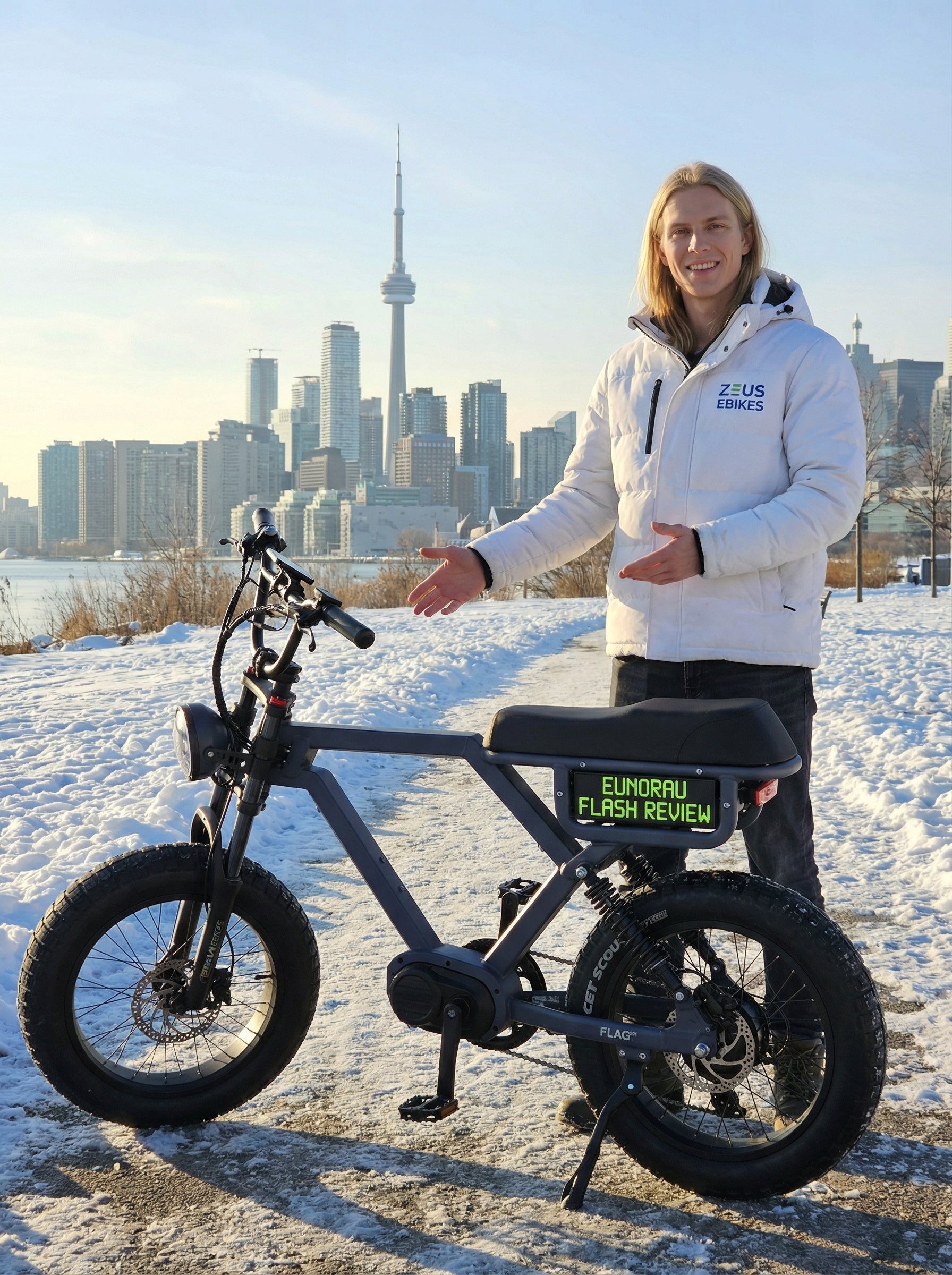
Flash 1000W Review Canada (2026): 2 Years Tested, AAA+ Rated, Full Accessories Guide
We bought the Eunorau Flash 1000W expecting it to break. Mid-drive motors at this price point have a reputation — chain derailments, controller failures, overheating on long climbs. Two years later, the Flash has not given us a single mechanical failure. Not one. We loaded it with 300+ lbs of rider and cargo, dragged it through spring mud that buried the bottom bracket, rode it at -15°C until the display fogged over, and hammered it up grades that made our 220 lb tester's quads burn before the motor even flinched.
The Flash is not one bike. It is a modular platform — the only eBike in Canada where you choose between a 1000W mid-drive producing 220 Nm of torque, a dual-motor AWD system, or a 750W rear-drive, all built on the same 6061 aluminium frame. Stack up to three batteries for over 200 km of range. Bolt on a rear rack, a mid-position cargo basket, fenders, foot plates, or a fast charger — all purpose-built for this frame. It is less a bicycle and more a LEGO set that happens to have a motor.
After two years: AAA+ reliability. Here is the honest breakdown.
In This Review
Real-World Test Footage
Performance, torque, and trail handling — filmed on Canadian terrain, not in a studio
Riding test • Performance test • Trail ride
Eunorau Flash 1000W: What You Need to Know
The Flash is a compact 20-inch eBike built around one idea: configure it once, upgrade it forever. The 6061 aluminium frame supports a 52V electrical system, a 440 lb (200 kg) maximum payload, and mounting points for every accessory Eunorau makes for this platform. You pick your drivetrain. You pick your battery count. You pick your accessories. You end up with a bike that fits your life instead of the other way around.
The heart of the platform is the mid-drive configuration: a 52V/1000W Truckrun motor producing 220 Nm of torque, mounted at the bottom bracket, driving through a Shimano 8-speed cassette. For context, the GT73 produces 126 Nm. The Flash produces 220 Nm — and because it is a mid-drive, that torque multiplies through the gears. Drop into first gear on a steep hill and the mechanical advantage is staggering. This is not a bike that struggles up hills. This is a bike that makes hills irrelevant.
The mid-drive is also the only Flash configuration with rear suspension (290mm double spring) and Shimano 8-speed gearing. The AWD and rear-drive versions are single-speed with no rear suspension — a real distinction that matters for off-road comfort and battery efficiency on varied terrain.
Full Specifications
Every spec below comes from the Flash 1000W product page on Zeus eBikes, verified against our test unit after two years of use.
| Spec | Mid-Drive | AWD | Rear-Drive |
|---|---|---|---|
| Motor | 52V/1000W Truckrun Mid-Drive | Dual 52V/750W (1,500W total) | 52V/750W Hub |
| Torque | 220 Nm | 184 Nm (combined) | 92 Nm |
| Battery | 52V/16Ah standard — expandable to 3 batteries: +21Ah down tube +17Ah top tube = 54Ah total | ||
| Range (Rated) | Up to 354 km (220 mi) with triple battery in ideal conditions | ||
| Winter Range (Est.) | 40–80 km (single) · 80–160 km (dual) · 120–180 km (triple) at -10°C to -15°C | ||
| Top Speed | 32 km/h (20 mph) | ||
| Sensor | Torque Sensor + Thumb Throttle | ||
| Suspension | 290mm rear double spring | None | None |
| Gearing | Shimano 8-speed | Single-speed | Single-speed |
| Brakes | Hydraulic Disc, 180mm rotors front & rear, motor cutoff | ||
| Wheels | 20-inch alloy, stainless steel spokes | ||
| Frame | 6061 Aluminium Alloy | ||
| Weight | 81–92 lbs (37–42 kg) depending on configuration | ||
| Max Payload | 440 lbs (200 kg) | ||
| Display | BC281 LCD | ||
| Pedal Assist | 0–5 levels | ||
| Charger | 4.0A smart charger included — 52V 4A fast charger available ($130) | ||
| Rider Height | 5'2"–6'4" | ||
| Warranty | 2 years on all parts including battery | ||
| Price (CAD) | From $2,869 | From $2,429 | From $2,169 |
Three Drive Configurations — Choose Your Power
No other eBike in Canada gives you three drivetrain choices on the same frame. This is not a marketing gimmick — each configuration creates a fundamentally different riding experience. We have ridden the mid-drive extensively, and our customer base covers all three. Here is what matters about each one.
Mid-Drive (1000W / 220 Nm) — The One We Recommend
The mid-drive is the Flash at its best. The Truckrun motor sits at the bottom bracket and drives through the Shimano 8-speed cassette — which means the motor's torque is multiplied by whatever gear you are in. In first gear on a steep hill, the effective force at the wheel is enormous. Our 220 lb tester rode sustained 12%+ grades without the motor bogging, overheating, or even sounding like it was working hard. We have seen hub motors on other bikes start thermal-throttling after 2–3 minutes of sustained climbing. The Flash mid-drive never did — not once in two years.
The torque sensor is the other half of this equation. It measures how hard you push the pedals and scales motor output proportionally. Light pedal pressure on a flat road gives gentle assist and conserves battery. Hard pushing into a grade gives maximum power exactly when you need it. Combined with 8-speed gearing, this is the most efficient and controllable drive system under $4,000 in Canada. If you want to understand why wattage alone does not tell the whole story, the Flash mid-drive is the proof: a well-tuned 1000W mid-drive with gearing destroys a 1500W single-speed hub motor on hills, in range, and in ride quality.
The mid-drive is also the only configuration with 290mm rear double spring suspension. It is not adjustable — but it does its job on gravel, rough pavement, and light trails. The 8-speed gearing also matters more than people realise — on a single-speed AWD or rear-drive, the motor has one gear ratio for every situation. The mid-drive lets you pick the right gear for the terrain. This means better battery efficiency, smoother acceleration, and less stress on the drivetrain.
AWD (Dual 750W / 184 Nm) — For When Traction Is Everything
Both wheels drive. That is the entire pitch, and for certain Canadian riders, it is enough. The AWD pairs a front and rear hub motor for 1,500W combined and 184 Nm of total torque. On packed snow, loose gravel, mud, and sand, having both wheels pulling means the bike finds traction where a single-motor bike would spin and lose momentum. For winter riding in Canada, the AWD Flash is one of the most capable options available.
The trade-offs are real: single-speed only (no gear range for hills), no rear suspension, and two motors drinking from the same battery. If your riding is mostly flat terrain in challenging conditions — prairie winter commuting, rural property access, hunting trails in shoulder season — the AWD makes sense. If you face steep hills regularly, the mid-drive's 220 Nm with gearing will outperform the AWD's raw wattage advantage every time.
Rear-Drive (750W / 92 Nm) — The $2,169 Entry Point
The rear-drive exists for one reason: to get you onto the Flash platform at the lowest possible price. At $2,169 CAD, you get the same aluminium frame, the same torque sensor, the same battery expansion, and the same accessory compatibility as the mid-drive. The 92 Nm hub motor handles flat to moderate terrain without complaint. It will not conquer steep hills like the mid-drive, but for urban commuting, errands, and flat trail riding, it is more than adequate. Think of it as buying the foundation — you can always add batteries, a rack, a basket, and fenders over time.
Buy the mid-drive. The 220 Nm torque, 8-speed gearing, and rear suspension make it the complete package — the version that justifies the Flash's existence. If budget is tight, the rear-drive gets you onto the platform for $700 less. If you live in the prairies and ride on snow six months a year, the AWD earns its keep. But for 80% of Canadian riders, the mid-drive is the right choice.
Real-World Performance — Two Years of Canadian Testing
The Flash never broke down. We need to lead with that because it is the single most important finding after two years. We have had other mid-drive bikes in our fleet — some costing more than the Flash — develop controller issues, chain problems, or sensor failures within the first year. The Flash just worked. Season after season, condition after condition.
Hill Climbing — 220 Nm in Practice
There is a hill near our test route in Ontario with a sustained 11–12% gradient that runs for about 400 metres. We use it to test every bike that comes through the shop. Most 750W hub motors slow to a crawl by the halfway point with our 220 lb tester on board. Some need throttle and pedalling combined just to avoid stopping. The Flash mid-drive in third gear climbed it at a steady 18 km/h without the motor sound changing pitch. The torque sensor held power delivery smooth and constant — no surging, no cutting out, no overheating. At the top, the motor was warm to the touch. Not hot. Warm. We have done this climb dozens of times over two years and the result is always the same.
For context: the torque sensor is not optional for this kind of performance. A cadence sensor on the same hill would deliver full power the instant you start pedalling and cut it the instant you stop — jerky, inefficient, and uncomfortable. The Flash's torque sensor scales with your effort. You control the bike. The bike does not control you.
Payload — We Loaded It Until We Ran Out of Stuff to Carry
The 440 lb maximum payload is the highest we have seen on any 20-inch eBike. We tested this deliberately: our 220 lb rider plus 80 lbs of hunting gear strapped to the rear rack and basket. Total: 300+ lbs. The frame did not flex. The steering did not wander. The brakes — 180mm hydraulic discs — stopped the loaded bike predictably every time. One customer uses the Flash for rural property maintenance with tools in both baskets. Another runs weekend errands with groceries in the mid-position basket and his kid's hockey bag on the rear rack. The Flash carries what you give it.
Winter — The Numbers That Matter
We tested the Flash mid-drive at -15°C with our 220 lb rider on PAS level 3 (moderate assist) on mixed flat and rolling terrain. Single battery (52V/16Ah): 52 km before the display showed empty. That is a 30–40% reduction from summer range, which is exactly what lithium batteries do in Canadian cold — no surprises there. The 52V system performs noticeably better in cold than 48V packs on competing bikes, because the higher voltage maintains power delivery as the cells cool and resistance increases.
The real winter advantage is the battery expansion. Stack a second 21Ah battery and that 52 km becomes 110–130 km. Add the third and you are looking at 150+ km at -15°C — enough for a full day of riding without thinking about range. No other bike in this price range lets you scale your winter range this way. You are not buying one fixed battery and hoping it is enough. You are building a system.
Triple-Battery System — Range Anxiety Does Not Exist Here
The Flash is the only eBike at this price in Canada that supports three batteries running simultaneously. Not one spare you swap in when the first dies. Three packs, all mounted, all feeding the system at once. The standard 52V/16Ah sits in the main position. The second battery (52V/21Ah, $1,050) mounts on the down tube. The third battery (52V/17Ah, $900) sits on the top tube. Together: 54Ah on a 52V system.
| Battery Setup | Capacity | Summer Range | Winter Range (-15°C) | Add-On Cost |
|---|---|---|---|---|
| Standard (included) | 52V / 16Ah | 60–110 km | 40–80 km | Included |
| + Second Battery | +21Ah (down tube) | 120–200 km | 80–160 km | From $1,050 |
| + Third Battery | +17Ah (top tube) | 200–354 km | 120–180 km | From $900 |
| All Three | 54Ah total | 200–354 km | 120–180 km | From $1,900 |
Every battery includes a BMS (Battery Management System) with short-circuit, overcharge, over-discharge, over-current, and cell-balancing protection. Rated cycle life: 500–800 full charges. The second battery weighs 13.9 lbs, the third weighs 10.5 lbs — spread across three mounting points on the frame rather than concentrated in one spot, which keeps the centre of gravity reasonable even fully loaded.
Flash Accessories — Six Purpose-Built Add-Ons
Most eBike accessories are universal-fit aftermarket parts held on by zip ties and prayer. The Flash has a dedicated ecosystem: six accessories designed specifically for the Flash frame, with bolt-on mounting points already built into the bike. No drilling. No adapters. No YouTube tutorials on how to make a generic basket fit. Here is each one, what it actually does, and whether we think it is worth the money after two years of use.
1. Foot Plates Pedals Set — $39
The first thing we changed. The stock pedals are functional but narrow. These aluminium foot plates give you a wider platform and better grip, which matters more than you think when you are standing on the pedals to navigate rough terrain or pushing into a steep hill. At $39, this is the highest-impact-per-dollar upgrade on the list. We put them on every Flash we test now.
2. Fender & Lampshade Kit — $119
Unless you ride exclusively in dry weather — and this is Canada, so you don't — you need fenders. The Flash does not include them from the factory, which is our single biggest complaint about this bike at this price. This kit is aluminium alloy, not cheap plastic, and it bolts directly to the Flash's factory mounting points. It also includes a lampshade for the headlight. After riding without fenders for the first month and arriving at destinations looking like we had been mud-wrestling, we bought this kit and never looked back. It should be included standard. It is not. Budget $119 and consider it part of the purchase price.
3. Rear Rack & Basket Kit — $159
This is what unlocks the Flash as a cargo platform. The rack bolts onto the frame and the basket sits on top with a 25 kg weight capacity and a 2-year warranty. We use ours for groceries, tools, and gear. One customer straps a cooler to it and rides to the lake. Another uses it for hunting gear. Combined with the 440 lb payload, this basket turns the Flash from an eBike into a utility vehicle. At $159 with a 2-year warranty, it is one of the better values in the accessory lineup.
4. 52V 4A Fast Charger — $130
The stock charger works. The fast charger works faster. The 58.8V output at 4A cuts charge time meaningfully — and if you are running two or three batteries, faster charging is not a convenience but a necessity. Available in US, AU, EU, and UK plug configurations. If you ride daily or commute, this pays for itself in time saved.
5. Mid-Position Storage Basket — $160
This aluminium basket mounts mid-frame between the seat and the handlebars — a spot that keeps weight low and centred. It is ideal for items you want to grab quickly: a water bottle, a phone, a bag lunch, small tools. We think the rear rack is the more important cargo upgrade for most riders, but if you are doing delivery work or daily commuting with two sets of cargo, the mid-position basket completes the package.
6. Second & Third Battery — $900–$2,025
Covered in detail above. The single biggest advantage the Flash has over every competitor. The second battery (21Ah, $1,050) roughly doubles your range. The third (17Ah, $900) takes it past 200 km in summer. Bundle both batteries with the fast charger for $2,025.
Month 1: Rear Rack & Basket ($159) — the moment you need to carry anything, you'll want this.
Month 3: Fast Charger ($130) — once you are riding daily, charging speed matters.
When ready: Second Battery ($1,050+) — when your rides outgrow the stock 16Ah.
For max range: Mid-Position Basket ($160) + Third Battery ($900+).
Full build total: $607 in accessories + $1,900–$2,025 in batteries.
Build yours. Configure the Flash 1000W — or shop all Flash accessories.
How It Compares — Flash vs GT73 vs Defender-S
The Flash does not compete with any single bike — it occupies its own niche as a modular utility platform. But buyers cross-shop, so here is an honest spec-for-spec comparison against two bikes our customers often consider alongside the Flash.
| Spec | Flash 1000W (Mid-Drive) | GT73 Motorbike | Defender-S 1500W |
|---|---|---|---|
| Price (CAD) | From $2,869 | $2,199 | $2,499 |
| Motor | 1000W mid-drive | 1200W hub (2400W peak) | Dual 750W (1500W) |
| Torque | 220 Nm | 126 Nm | — |
| Sensor | Torque | Cadence | Cadence |
| Battery | 52V 16Ah (expandable to 54Ah) | Dual 48V 18.2Ah | 48V 20Ah + optional 17.5Ah |
| Max Payload | 440 lbs | 400 lbs | 400 lbs |
| Suspension | 290mm rear double spring | Hydraulic fork | Front fork |
| Gearing | Shimano 8-speed | None (single-speed) | None (single-speed) |
| Frame | 6061 Aluminium | Carbon Steel | 6061 Aluminium |
| Weight | 81–92 lbs | 116 lbs | ~95 lbs |
| Accessories | 6 dedicated add-ons | Limited aftermarket | Some Eunorau accessories |
| Warranty | 2 years | 1 year | 2 years |
| Best For | Hills, cargo, range, modularity | Max speed, dual battery | Dual-motor traction, off-road |
The GT73 is the speed machine: 116 lbs of motorcycle-oriented hardware with dual batteries and 2400W peak output. It is faster, louder, and heavier. If top speed matters more than torque efficiency, the GT73 wins. If gearing, hill climbing, and cargo capacity matter, the Flash wins easily.
The Defender-S is the dual-motor Eunorau alternative for riders who want AWD traction with a more traditional mountain-bike frame. It shares some accessories with the Flash ecosystem but has its own frame geometry and a different riding character.
Who Is the Flash 1000W Best For?
After two years of riding the Flash and selling it to Canadian customers, we have identified the riders who love this bike — and the ones who should look elsewhere.
Buy the Flash If You:
- Climb real hills. The 220 Nm mid-drive with 8-speed gearing handles grades that make hub motors quit. If your commute, trail, or property has hills steeper than 8%, the Flash is the answer.
- Carry cargo. 440 lb payload + rear rack + mid basket = a genuine utility platform. Groceries, tools, hunting gear, delivery loads.
- Need expandable range. Triple battery support means you buy range as you need it. Start with 60–110 km. Grow to 200+ km without buying a new bike.
- Ride Canadian winters. The 52V system handles cold better than 48V, and multi-battery stacking eliminates winter range anxiety.
- Hunt. The payload, torque, and quiet torque-sensor delivery make it the best hunting eBike under $3,000. It carries your gear in and does not spook game on the way.
- Want to build over time. The accessory ecosystem means your Day 1 purchase is not your final bike. Add what you need, when you need it.
- Are between 5'2" and 6'4". The broadest rider height range in this segment.
Look Elsewhere If You:
- Want motorbike aesthetics. The Flash looks like what it is — a utility bike with a motor.
- Prioritise suspension quality above all. The mid-drive's 290mm rear spring is adequate, not exceptional; if suspension comes first, look at a full-suspension bike.
- Need strict street-legal compliance. The 1000W mid-drive exceeds the 500W limit Canada's provincial e-bike rules converge on. Legal on private property and off-road.
- Want a lightweight bike. 81–92 lbs before cargo. Add batteries and a loaded rack and you are pushing 120+ lbs. There is no getting around this.
- Need a folding bike. The Flash does not fold. See the Zeus folding collection instead.
Zeus eBikes Canada Verdict
Two years. Four Canadian seasons. Snow at -15°C. Spring mud that buried the bottom bracket. Summer gravel loaded with camping gear. Fall hunting trips at 300+ lbs combined weight. Zero breakdowns. AAA+ reliability.
The Flash 1000W is the Ford F-150 of eBikes: not the prettiest thing in the parking lot, but it carries more, tows more, and works harder than anything else at the price. And like the F-150, it is the platform you build on — start with the base truck and add what you need over time.
What we love: 220 Nm mid-drive torque that makes hills irrelevant. Triple-battery expansion that makes range anxiety irrelevant. 440 lb payload that makes cargo limits irrelevant. Torque sensor across all configurations. Six dedicated accessories that bolt on without a zip tie in sight. Two-year warranty. The broadest rider height range (5'2"–6'4") of any 20-inch eBike we sell. And the reliability — two years of hard Canadian riding without a single mechanical failure.
What could improve: Fenders should be included at this price — charging $119 for weather protection on a $2,900 bike feels wrong. The AWD and rear-drive versions need some form of suspension. The BC281 LCD display is functional but uninspiring next to colour displays on competitors. The aesthetic is purely utilitarian — some riders want their eBike to look like it cost $3,000, and the Flash looks like it means business rather than looking expensive. And at 81–92 lbs before accessories and cargo, carrying it up a flight of stairs is not happening.
Frequently Asked Questions
Is the Eunorau Flash 1000W legal in Canada?
The Flash 1000W mid-drive exceeds the 500W limit Canada's provincial rules set for power-assisted bicycles on public roads. It is legal on private property, off-road trails that permit motorised vehicles, and land with landowner permission. The rear-drive (750W) is closer to the limit but still exceeds it, so neither version is a power-assisted bicycle on public roads.
What is the real range of the Flash 1000W in Canadian winter?
We tested at -15°C with a 220 lb rider on PAS 3: the standard 52V/16Ah battery delivered 52 km. Add the second 21Ah battery for 110–130 km. With all three batteries (54Ah total), expect 150+ km at -15°C. Store batteries indoors overnight and start rides with warm packs. The 52V system holds voltage better in cold than the 48V systems on most competitors.
What are the three drive configurations?
Mid-Drive (1000W, 220 Nm, Shimano 8-speed, rear suspension) — the one we recommend for most riders. AWD (dual 750W, 184 Nm combined, single-speed) — for snow, mud, and loose terrain where traction matters most. Rear-Drive (750W, 92 Nm, single-speed) — the $2,169 entry point to the Flash platform. All three share the same frame, battery system, torque sensor, and accessories.
Can the Flash carry heavy loads?
Yes — 440 lbs (200 kg), one of the highest in its class. We tested it at 300+ lbs (rider + gear) with no frame flex or handling issues. Add the rear rack and basket ($159, 25 kg capacity) and the mid-position basket ($160) for serious cargo capability.
What accessories are available for the Flash?
Six dedicated accessories: Foot Plates ($39), Fender & Lampshade Kit ($119), 52V 4A Fast Charger ($130), Rear Rack & Basket ($159), Mid-Position Basket ($160), and Second/Third Battery ($900–$2,025). All bolt directly to Flash-specific mounting points.
Does the Flash have a torque sensor?
Yes — all three configurations. The torque sensor measures pedal pressure and adjusts motor output proportionally. This creates a natural, efficient ride and better battery life than cadence-sensor bikes. A thumb throttle is also included for pure motor power on demand.
The Bottom Line
The Eunorau Flash 1000W is the eBike equivalent of a well-built workshop — it does not look flashy, but it does everything you ask of it, and it does not break. Three drive configurations. Triple-battery expansion to 200+ km. 440 lb payload. Torque sensor. Six purpose-built accessories. Two-year warranty. A 6061 aluminium frame that has not flexed, cracked, or complained after two years of the hardest Canadian riding we could throw at it. Starting at $2,169 CAD, no other eBike in Canada gives you this combination of power, capacity, range, and upgradeability. The Flash is not the most exciting bike we sell. It might be the smartest.
Ready to build yours? Configure the Flash 1000W on Zeus eBikes or browse the full retro eBike collection.
Published: June 2025 | Last Updated: February 2026 | By: Zeus eBikes Canada Editorial Team
Zeus eBikes is a Canadian direct-to-consumer electric bike retailer. We own, test, and ride every product we sell — shipping nationwide across Canada.
Visuals created by Playcut.ai




Share:
QiOlor Tiger 2-Year Review in Canada | Most Reliable Retro Electric Bike We’ve Tested
How Much Does an Electric Bike Cost in Canada? (2026): Real Prices, Real Math