
Electric Bikes for Back Pain (2026): Choose by Condition — 15 Verified, Evidence-Graded Picks

Your back is not one condition, and "a comfortable bike" is not one bike. A herniated disc and spinal stenosis are close to opposites: the position that soothes one can provoke the other. Choosing an electric bike for back pain therefore starts with a diagnosis-shaped question, and this guide is built on exactly that fact. Instead of a list of soft saddles, you'll get the actual clinical logic: which spinal conditions are aggravated by bending forward, which by arching back, which by vibration, and which by the effort of pedalling itself, each claim linked to the peer-reviewed study it comes from. Then we map that logic onto the bikes, so you can choose the style that loads your spine the way your back can tolerate.
Zeus eBikes is a Canadian electric bike retailer, and yes, we sell several of the bikes below. The evidence sections stand on their own regardless: every study is linked so you can read past us.
How this guide was built — and what the evidence can and cannot say. The clinical sections draw on peer-reviewed sources: the WHO 2023 low back pain guideline, Cochrane and other systematic reviews, and classic spine-biomechanics studies, each linked where cited, with the study design and size named in the text. One honest limit up front: no clinical trial has directly tested e-bikes for back pain. What exists is strong evidence that exercise helps chronic back pain, strong biomechanics on how riding position loads the spine, and a systematic review showing e-cycling is genuine moderate-intensity exercise. We connect those; we tell you when a claim is mechanical reasoning rather than trial data. Product data is ours: every pick's price and stock were verified on August 21, 2026 and re-verified on September 4, 2026 through our store systems, prices were checked against each manufacturer's own Canadian listing where one exists, and specs come from the manufacturers' published sheets. This article is general information, not medical advice — your physician or physiotherapist knows your spine; we know bikes.
Evidence grades used in this guide: [A] randomized trials or systematic reviews in the relevant population · [B] systematic-review evidence from an adjacent population (sport cyclists, stationary cycling, occupational exposure) · [C] biomechanical or mechanistic studies (cadaveric loading, in-vivo pressure, EMG) · [D] clinical convention or classic case description. A note on statistical rigour: where a source publishes an effect size with a confidence interval, we print it; where it doesn't, we don't invent one. Certainty language ("low-certainty," "moderate-certainty") is the source's own GRADE rating, not ours. The two classic mechanism studies quoted are a cadaveric series and a single-volunteer in-vivo measurement, stated as such where cited, because a mechanism demonstrated is not an outcome guaranteed.
Plain-language summary. Most long-lasting back pain gets better with regular, comfortable exercise. That is what the World Health Organization and the largest medical reviews say. Riding a bike is one good way to get that exercise, but the riding position matters a lot. If bending forward is what hurts you, choose a bike that lets you sit up tall. If arching backward is what hurts you (for example, spinal stenosis — the "better leaning on a shopping cart" feeling), a slight lean forward usually feels better than sitting bolt upright. If bumps hurt you, choose a bike with suspension. If balance worries you, choose three wheels. An electric motor helps because it does part of the work, so you can keep riding on sore days, and time outdoors has its own measured pain-easing effect. No study has tested electric bikes for back pain directly, so this guide connects the best related research and tells you which claims are proven and which are reasoned. Ask your doctor or physiotherapist before starting, and stop riding if you get leg weakness, numbness where you sit, or lose control of your bladder or bowels; those need urgent medical care.
Quick answer: if your pain is disc-related or worse when you bend forward, ride nearly upright: a deep step-through like the Velotric Discover 3 ($3,199) with its suspension seatpost is the template. If you have spinal stenosis or facet-joint pain (worse when you arch back, better leaning on a shopping cart), a moderate forward lean is usually the comfortable one: the Taubik Blackburn 275T ($2,799) fits that geometry. Rough-road pain calls for full suspension: Eunorau Defender ($2,450). If balance is the limit, ride three wheels: Eunorau ONE-TRIKE 2.0 ($2,499). Browse the step-through collection and electric trikes — and clear your plan with your clinician first.
In this guide
- Is cycling good or bad for back pain? The honest evidence
- The six ways a bike loads your spine
- Match the bike to the condition: the directional map
- The outdoor advantage: nature is measurably analgesic
- Set up any e-bike to protect your back
- Best upright e-bikes for back pain (and when a lean beats upright)
- Best lightweight e-bikes for a bad back
- Picks: full suspension
- The deep step-through pick
- Picks: three wheels & the semi-recumbent question
- Pick: maximum-range touring (off-road class)
- Are e-bikes good for arthritis in the knees and hips?
- Frequently asked questions
- The bottom line
- Limitations of this guide
- Sources
Is Cycling Good or Bad for Back Pain? The Honest Evidence
In December 2023 the World Health Organization published its first-ever guideline for chronic low back pain, and its core message was to keep moving, recommending structured exercise while advising against passive fixes like lumbar-support belts. Deciding this wrong costs more than comfort: the wrong bike geometry can turn the most evidence-backed treatment available into the thing that flares you, and the right one has to fit a spine, a budget and a Canadian winter at the same time. This guide walks that exact decision — what the evidence supports, which loading direction your condition tolerates, and which bike style delivers it.
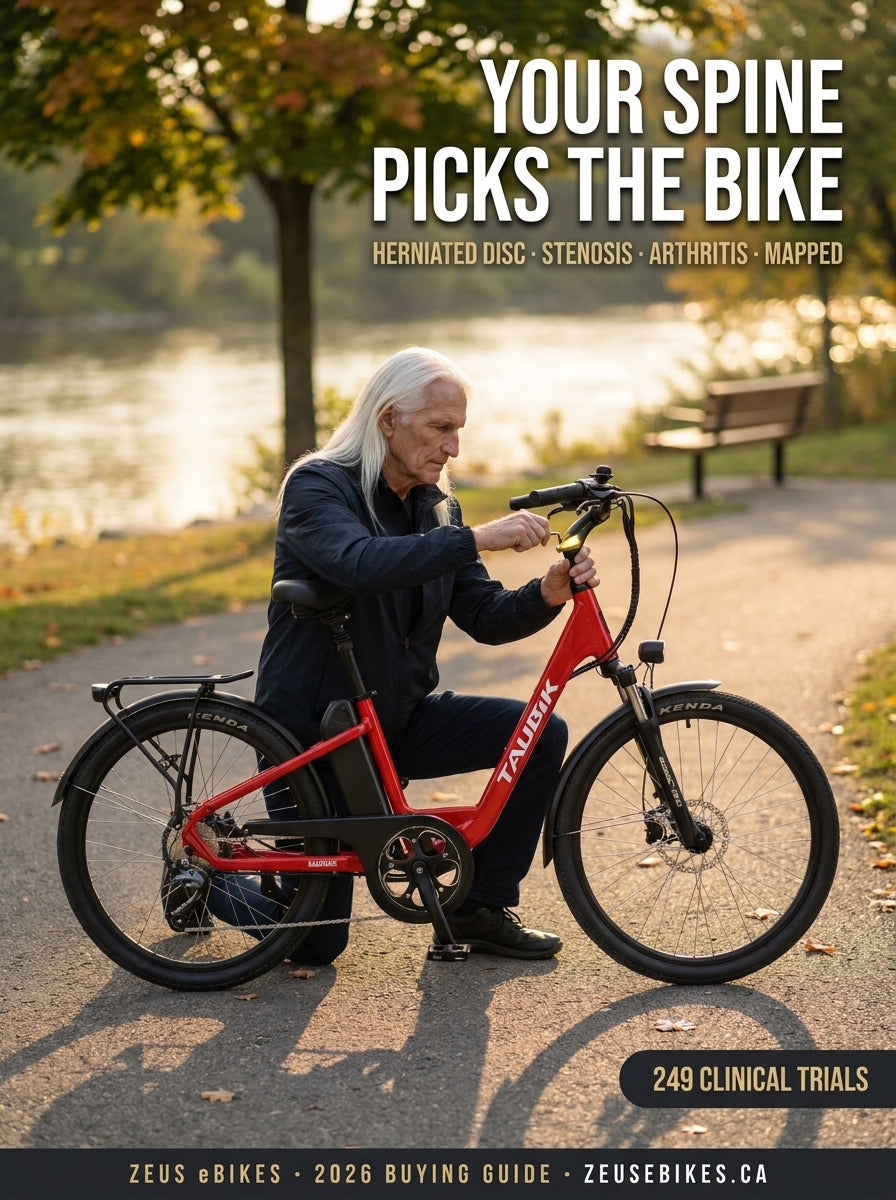
Start with the strongest evidence on the table. The 2021 Cochrane review of exercise therapy for chronic low back pain (249 randomized trials) found exercise improves pain and function versus other conservative care, and works better than advice or education alone. The effects are real but modest: pain improved by 7.3 points on a 100-point scale (95% CI 3.7–10.9; low-certainty evidence) and functional limitation by 2.5 points (95% CI 1.0–3.9; moderate-certainty evidence) at earliest follow-up. That is exactly why the details of how you exercise matter. A 2023 systematic review of aerobic exercise for chronic low back pain (17 studies, 1,146 participants) found aerobic work, cycling included, reduced pain intensity and disability, with the clearest gains in programmes running 12 weeks or longer.
The other side of the ledger is the part every affiliate listicle skips: cycling itself has a back pain problem. A systematic review in Sports Health reports low back pain in more than half of cyclists, and identifies the pattern behind it: riders with back pain show more lumbar flexion in the saddle, and lower handlebars produce more of it. A Belgian field study using wireless posture sensors found that cyclists with flexion-pattern back pain rode with their lower spine significantly more flexed than pain-free controls, and their pain climbed steadily across a 2-hour ride.
Put both halves together and the conclusion is not "cycling is good" or "cycling is bad." It's this: the exercise is medicine; the posture is the dosage. Sport cycling's low, stretched-out position (built for aerodynamics, not spines) is the documented problem. The bikes in this guide exist because geometry is a choice.
Takeaway: the strongest guideline (WHO 2023) and the largest review (Cochrane, 249 trials) both back exercise for chronic low back pain — and the cycling literature shows the pain problem lives in flexed, stretched-out sport posture, not in pedalling itself. Choose position first, bike second.
The Six Ways a Bike Loads Your Spine
Every bike loads your back through six controllable variables: trunk angle (set by handlebar height and reach), compressive load (set by muscle effort and seating), vibration (set by suspension and tires), the mounting motion (set by frame style), balance demand (two wheels or three), and pedalling torque (set by motor assist). Match these to your condition and most "comfort" questions answer themselves.
| Variable | What controls it | Why your spine cares |
|---|---|---|
| 1. Trunk angle | Handlebar height vs saddle, reach length, swept-back vs flat bars | Sets whether you ride flexed (bent forward) or extended (upright/arched) — the single most condition-specific variable, as the next section maps |
| 2. Compressive load | Muscle effort, body weight distribution, backrest (on trikes that have one) | In-vivo measurement shows trunk muscle activity itself raises the pressure inside the disc (Wilke 1999 — a single-volunteer study, but the classic direct measurement). Less effort, less internal load |
| 3. Vibration | Suspension fork, rear shock, suspension seatpost, tire volume and pressure | Occupational research links sustained whole-body vibration to low back pain and sciatica (meta-analysis, pooled risk ≈1.5) — evidence from drivers, not cyclists, so we apply it as a design principle, not a promise |
| 4. Mounting motion | Step-over height, frame style | Swinging a leg over a rear rack is single-leg standing plus flexion plus twist — the exact combination stiff and painful backs handle worst. A low step-through deletes it |
| 5. Balance demand | Two wheels vs three, parking brake | Every stop on two wheels is a one-legged "dab"; every slow manoeuvre is a train of micro-corrections. Trikes remove both — decisive for fall risk and asymmetric pain |
| 6. Pedalling torque | Motor assist level, sensor type, gearing | Assist caps the force your trunk must brace against and your knees and hips must produce — and it's adjustable ride by ride, which no ordinary bike offers |
One more thing assist does that no frame geometry can: it makes the exercise sustainable. A systematic review of e-cycling (17 studies) concluded electric-assisted riding delivers physical activity of at least moderate intensity (below a regular bike, above walking). On a flare day you turn the assist up and keep the habit alive; on a good day you turn it down and do more of the work. The dose-adjustability is what makes the exercise sustainable.
Match the Bike to the Condition: The Directional Map
Most spinal conditions have a directional intolerance: a movement direction that provokes them and an opposite that relieves them. Disc problems generally resent forward bending; stenosis and facet arthritis resent arching back; osteoporosis fears flexion, vibration and falls. Identify your direction, and the least painful bike geometry follows almost mechanically.
Direction-matching is itself tested medicine, not folklore. In a randomized trial of 312 back pain patients, Long and colleagues assessed each person's "directional preference," then randomized them to exercises matching it, opposing it, or neither. The matched group did dramatically better, including a three-fold drop in medication use, while a third of the mismatched groups withdrew because they were worsening. Matching direction matters, and the map below applies that logic to the conditions Canadian riders actually bring us:
| Condition | Direction it can't tolerate | Least painful geometry | Key evidence |
|---|---|---|---|
| Herniated / bulging disc, discogenic pain | Sustained forward flexion (+ compression) | Nearly upright; bars at or above saddle; suspension seatpost | Adams & Hutton 1982 — cadaveric series [C] |
| Spinal stenosis | Extension (arching back) | Moderate 15–30° forward lean — often better than bolt upright | Dyck & Doyle 1977 "bicycle test" — classic case description [D], mechanism established [C] |
| Facet joint arthritis | Extension / lordosis | Slight-to-moderate forward lean unloads the facets | Adams & Hutton 1980 — cadaveric loading [C] |
| Spondylolisthesis | Extension, jolts | Slight-flexion bias + suspension (clinical convention — ask your clinician) | — |
| Osteoporosis | Flexion + vibration + any fall | Neutral-upright, never slumped; suspension; low step-through; strongest trike case | Sinaki & Mikkelsen 1984 — prospective cohort, n=59 [B] |
| Sciatica / radiculopathy | Depends on the source | Match the direction that relieves your leg symptoms; clinician-guided | Long 2004 — RCT, n=312 [A] |
| Non-specific chronic low back pain | Disuse; long static postures | Whatever geometry you'll ride longest — comfort features buy duration | Cochrane 2021 — 249 trials [A] |
| Hip / knee osteoarthritis | Deep joint flexion; high torque | Pedal-forward or correct saddle height; motor assist caps joint torque | Luan 2021 — meta-analysis, n=724 [A adjacent] |
| Sacroiliac joint pain | Asymmetric single-leg loading | Step-through mounting; a trike removes the stop-and-dab entirely | Mechanical reasoning [C/D] |
| Saddle-area / tailbone pain | Contact-point pressure | Saddle choice first — see our comfortable e-bike seat guide | — |
Herniated disc and disc-related pain: stay tall
The lab evidence here is unusually direct. In the Volvo Award-winning cadaveric work of Adams and Hutton, lumbar joints compressed in a flexed (wedged) position failed by posterior disc prolapse in 26 of 61 specimens. Hyperflexion plus compression is the classic recipe for the injury. On a bike, that maps to the low, long, stretched position. If your pain is disc-flavoured (worse with sitting, bending or lifting), ride tall: swept-back handlebars at or above saddle height, short reach, and a suspension seatpost so road shocks don't arrive as compression spikes. The deep step-through pick below is built exactly this way.
Spinal stenosis: the counterintuitive one
If arching back is what bites you, and leaning on a shopping cart is relief, the fully upright "Dutch" position may actually be your worst option. Flexing the lumbar spine slightly enlarges the spinal canal; extension narrows it. This is reliable enough that neurosurgeons Dyck and Doyle formalized it in 1977 as the "bicycle test" (originally a case description, since adopted into standard clinical examination), because stenosis patients can typically pedal comfortably leaning forward even when walking is sharply limited, which distinguishes their claudication from a vascular one. Cycling is, quite literally, the textbook-tolerated exercise for stenosis. Choose a moderate 15–30° lean (flat bars near saddle height, the Blackburn geometry below) rather than a sit-up-straight cruiser, and let the motor keep the outing long.
Facet joint pain: unload the arch
The facet joints at the back of each vertebra share load most when the spine is arched. In cadaveric loading, Adams and Hutton (1980) measured the facets resisting about 16% of compressive load in a lordotic (standing-like) posture and essentially none in a slightly flexed one. If your pain is facet-flavoured (localized, worse standing and arching, eased sitting), the same moderate-lean geometry that suits stenosis suits you.
Osteoporosis: three threats, one bike answer
Osteoporosis changes the priorities completely, because the enemy isn't pain — it's fracture. The landmark data: in Sinaki and Mikkelsen's follow-up of 59 women with postmenopausal spinal osteoporosis (followed one to six years; a small cohort, but the finding reshaped rehabilitation practice), those prescribed flexion exercises suffered new vertebral fractures at an 89% rate, versus 16% in the extension group. Flexion loading wedges fragile vertebrae. Add two more threats (vibration spikes and, above all, falls) and the requirements write themselves: a neutral-to-upright position (tall, never slumped), real suspension plus high-volume tires, the lowest step-over you can get, and the strongest case in this whole guide for three wheels, because a trike removes the balance component of fall risk — our seniors trike-matching guide goes deeper on that decision. Get explicit clearance from your physician; this is the one condition where we'd insist.
Sciatica: follow the relieving direction
Sciatica is a symptom with two common, opposite sources. From a disc, it usually behaves flexion-intolerant: treat it like the herniated-disc row. From stenosis or foraminal narrowing, it's usually extension-intolerant: treat it like the stenosis row. The Long trial is your template: find the direction that eases your leg symptoms (a physiotherapist can assess this formally in one visit) and pick the geometry that keeps you there. One hard rule: leg symptoms that worsen while riding are a stop signal, not something to push through.
No diagnosis, just a sore back?
Most back pain is "non-specific": no single structure convicted. Here the evidence says the winning variable is adherence: the Cochrane and aerobic-exercise reviews found benefits build over 12+ weeks of regular activity. So optimize for the bike you'll actually ride in week ten: upright enough to be pleasant, suspension seatpost, step-through convenience, and assist generous enough that a tired Tuesday doesn't end the streak. Any pick below tagged "adherence" is chosen on exactly that logic.
Red flags — stop riding and get medical care promptly: new or progressive leg weakness · numbness in the groin/saddle area · loss of bladder or bowel control (emergency: same day) · back pain after a fall or impact · pain with fever or unexplained weight loss · night pain unchanged by position. And before the first ride: if you have osteoporosis, recent spine surgery, a recent fracture, or a progressive neurological condition, get your clinician's clearance first.
Takeaway: bend-intolerant conditions (disc) ride tall; arch-intolerant conditions (stenosis, facet) ride with a moderate lean; osteoporosis rides upright-neutral on suspension — ideally on three wheels; sciatica follows whichever direction relieves the leg. If that sentence just sorted you, the picks below are organized to match.
Not sure which direction your back prefers? Call 1-866-938-7580 and describe what makes it worse — bending or arching. A real person will shortlist the two or three geometries that fit, no purchase required. Or browse the step-through collection to see the upright end of the spectrum.
The Outdoor Advantage: Nature Is Measurably Analgesic
Riding outdoors isn't just nicer than a stationary bike: the setting itself has a measurable effect on pain. A 2025 systematic review and meta-analysis in Nature Mental Health found that nature exposure reduces self-reported pain with a small-to-moderate effect across dozens of studies, and 2025 neuroimaging work shows the effect registers in nociception-related neural processing — measurably different brain handling of painful input, not just pleasant distraction.
Then there's the adherence channel. A systematic review of "green exercise" found outdoor sessions consistently beat indoor equivalents on enjoyment and mood — with the honest caveat that evidence for superior physical outcomes is limited, so we won't claim it. But recall what the back pain literature said: the benefits arrive with 12+ weeks of regular activity. Enjoyment is what makes week twelve happen. An e-bike on a riverside path is a delivery mechanism for two evidence-backed inputs at once: the aerobic dose, sustained by the motor on the days you're sore, and the outdoor exposure that measurably turns pain down. A Canadian bonus: our rail-trails and river valleys are flat, and flat is exactly what a cautious back wants for the first month.
Set Up Any E-Bike to Protect Your Back
Whichever bike you choose, fit converts it from generic to yours — and fit is evidence-backed territory. Four adjustments, in order of payoff: saddle angle, handlebar height, suspension seatpost, and a graded start. Most take five minutes and an Allen key; together they're the cheapest back-protection upgrades in this article.
- Saddle angle. In a British Journal of Sports Medicine study, Salai and colleagues showed that inclining the saddle nose slightly downward reduced the incidence and magnitude of back pain in recreational cyclists, by relieving tension where the pelvis meets the spine. Start level; if you feel low-back tightness, tilt the nose down 10–15 degrees' worth of front-bolt turns and re-test. (Too far down and you'll slide onto your wrists.)
- Handlebar height. The cycling-biomechanics review is blunt: lower bars, more lumbar flexion. For lower back pain of the flexion-intolerant kind, set the bars at or above saddle height. Most picks below ship with adjustable stems or riser bars that allow it. Stenosis-pattern backs can run bars a few centimetres lower for that relieving lean.
- Saddle height and cadence. Set height with the heel method: heel on the pedal at its lowest point, leg dead straight. Pedalling on the forefoot then gives the slight knee bend that protects both knees and back. Then spin rather than grind: an easier gear at a brisk, light rhythm puts less force through each pedal stroke, so less bracing runs through your trunk — and on a torque-sensor bike the motor follows your effort automatically. On high-volume tires, running pressure toward the printed minimum on the sidewall adds real cushioning at no cost.
- Suspension seatpost. The single best dollars-per-comfort upgrade on any rigid-framed e-bike: it intercepts the vertical hits that otherwise arrive at L4–L5. Several picks below include one from the factory; for the rest we can fit one — ask when you order.
- Start graded, not heroic. The Belgian field data showed pain in flexion-pattern riders climbing over a 2-hour ride. Begin with 15–20 minutes on flat pavement at generous assist; extend by about 10% per week if you feel no worse the next day. Three short rides beat one epic — for the first month, boring is winning.
Two adjacent guides worth your time: our fit-first e-bike seat guide for the contact-point half of comfort, and the Canadian e-bike battery guide for making winter range predictable: cold-weather surprises are how new riders end up pushing a 30 kg bike home, which no back needs.
Takeaway: level-to-slightly-down saddle, bars set to your condition's direction, a suspension seatpost, and a 10%-a-week ramp. Fit adjustments have actual trial evidence behind them: they're load management, not accessories.
Best Upright Electric Bikes for Back Pain — and When a Moderate Lean Beats Upright
Every pick in this guide was verified on August 21, 2026 (in stock, specs from the manufacturer's published sheet, price checked against the manufacturer's own Canadian listing where one exists) and re-verified for stock and pricing on September 4, 2026. Each card names the condition-pattern it serves. Under Canadian rules, note that motors above 500 W nominal generally fall outside the power-assisted bicycle definitions provinces use; those picks carry an off-road note.

Best for: extension-intolerant backs (stenosis, facet pattern) that want the relieving moderate lean. A 500 W, 70 Nm hybrid-tire commuter with the moderate cockpit the stenosis section described, plus the rare ability to switch between a torque sensor (smooth, proportional, no surge) and cadence mode (steady help when you're tired) from the display mid-ride. 706 Wh Samsung battery (UL 2271), 80 mm front fork, 27.5×2.35" tires that roll fast on pavement. Honest limit: at 69.5 lbs it's no featherweight, and its "sport-oriented stance" is the point — flexion-intolerant riders should look at the step-through picks instead.

Best for: vibration-intolerant backs on rough Canadian pavement. Full air suspension front and rear, 20×4.0" fat tires you can run soft, four-piston hydraulic brakes, and a huge 35Ah (1,680 Wh) battery: the most vibration-absorbing hardware in this guide for the money. Motorcycle-style upright seating; 90 lbs, so it lives on the ground floor. 750 W motor with 1,100 W peak, above the 500 W convention, so treat it as an off-road/private-property machine; whether it belongs on public roads depends on your province’s rules. Yellow colourway in stock.

Best for: riders whose back pain coexists with real cargo needs: groceries, tools, a trailer. A 500 lb-payload step-through utility bike that specs the whole comfort checklist: RST hydraulic suspension fork, factory suspension seatpost, fat tires, torque-or-cadence SensorSwap, and an 801.6 Wh UL-certified battery. Hauling with a bad back is precisely when you want the motor doing the work: 85 Nm means standing starts under load without lumbar heroics. Ships in Canadian 32 km/h configuration; the app’s higher-speed unlock is for private property. Honest limit: it's a long, substantial bike — not the pick for tight condo elevators.
Best Lightweight E-Bikes for a Bad Back
An upright electric bike solves the riding half of the problem; weight decides the living-with-it half. Bike weight is a back issue before the ride and after it: lifting onto racks, up a porch step, around a garage. If your back protests handling more than riding, buy light. These four are the adherence specialists — the bikes that make week twelve happen.

Best for: riders whose worst moment is the lift (rack, stairs, trunk) and who want a 350 W bike with a real torque sensor. At 17.7 kg (39 lbs) this is the lightest bike here by a wide margin (everything else in this guide runs 57 to 148 lbs), with SensorSwap torque/cadence assist, hydraulic brakes and a 374 Wh battery. It ships at 350 W and 32 km/h; Velotric lists an adjustable range of 19–45 km/h, so whether it qualifies is not settled. Honest limits: a rigid fork, so pair it with the smooth-pavement routes it's built for, and budget for a suspension seatpost if your streets are rough; Mid-Step frame available for easier mounting.

Best for: flexion-intolerant riders who want the upright step-through template with smooth torque-sensor assist, under 65 lbs. A 64 lb step-through commuter with the same switchable torque/cadence system as its Blackburn sibling, 68 Nm, a 706 Wh UL 2271 Samsung battery, front suspension, hydraulic brakes and fenders included. The step-through frame plus upright cockpit is the disc-pattern geometry from the condition map, executed at a sane weight and price. Honest limit: 1.9" tires favour pavement — gravel-trail riders should look at the suspension section.

Best for: the lowest-cost credible entry for most heights: apartment dwellers testing whether e-biking helps their back before committing serious money (taller riders: the $1,099 folder below). A 350 W folding commuter with front fork and seat suspension, a 468 Wh battery that detaches with the seat for indoor charging, and a low, easy mount. As a first experiment in assisted riding for a sore back, the price of admission is the entire argument. Honest limits: cadence-sensor assist (help arrives a beat after you pedal), mechanical brakes, and manufacturer-claimed range: halve it for winter planning.

Best for: taller riders (to 6'4") who need a budget folder that doesn't force a hunch. The adjustable stem and suspension seatpost let a tall rider set genuinely upright geometry on a 20" folder: the configuration that usually forces the worst hunch is here the fix for it. 350 W, 480 Wh lockable battery, 57 lbs, 330 lb payload. Honest limits: cadence sensor and mechanical discs; this is the value pick rather than the refined one. Four units in stock at last check.
Want your fit checked before you buy? Tell us your height, your condition's direction (bend-hurts vs arch-hurts) and your streets, and we'll match the geometry — 1-866-938-7580. Free Canada-wide shipping; 15-day returns on unused, unopened items. Or browse all folding e-bikes and step-throughs.
The Picks: Full Suspension
If your pain spikes on cracked pavement, frost heave and gravel, suspension is your variable. The occupational vibration literature is the design rationale; the mechanism is simple: intercept the hit before it reaches the spine. Four ways in, from $2,450.

Eunorau Defender — full suspension at 500W
$2,450 CADBest for: vibration-intolerant backs that still want a bike inside the 500 W convention. This is the guide's default suspension recommendation. A genuine dual-suspension frame (100 mm fork + EXA air rear shock) around a 500 W / 60 Nm hub, 720 Wh removable battery, hydraulic brakes, 27.5×3.0" tires, 66 lbs, which is light for full suspension. It's the rare machine that solves the vibration problem at 500W and 32 km/h as shipped; Eunorau lists a 45 km/h unlock, and whether an unlockable cap qualifies is not settled. In stock in both frame sizes at writing. Honest limit: MTB-style cockpit means a moderate lean — ideal for stenosis/facet patterns, workable for disc patterns with the stem raised.

Best for: riders who want the smoothest possible power delivery on a step-through: the premium comfort-tech package. A 500 W-class VeloCore mid-drive (100 Nm, 130 Nm boost) with an 80 mm air fork, factory suspension seatpost, SensorSwap, and an 801.6 Wh UL-certified battery. Mid-drive power through the cranks feels like stronger legs rather than a push from behind (the least startling assist for a guarded back), and the 6-axis sensor smooths hills before you feel them. Ships at 32 km/h Canadian configuration. Honest limit: at $3,899, it is one of the three most expensive bikes in this guide, with the Urus and the Juliet Pro II; the Discover 3 below covers most of the same ground for $700 less.

Best for: experienced riders returning to real trails after back trouble, on a torque-sensor mid-drive that stays inside the 500 W class. Bafang M600 mid-drive (120 Nm peak) with a true torque sensor, linkage-driven full suspension, SRAM NX 11-speed, four-piston brakes, 840 Wh Samsung battery, 61.7 lbs. In Limited mode it runs at 32 km/h, but Eunorau prints two top speeds (32 and 45 km/h), so whether it qualifies is not settled; unlocked, it's an off-road machine. Honest limit: this is a trail bike with trail geometry: buy it for the riding you're returning to, not for errands.

Best for: off-road and hunting riders whose backs can't absorb trail chatter: maximum suspension travel and torque per dollar. Bafang BBSHD 1000 W mid-drive, 160 Nm, full suspension, fat tires, 720 Wh Samsung-cell battery (second-battery option doubles it), 9-speed drivetrain. At $3,099 it sits between the Defender and the Discover M on price; what it buys over the Defender is the BBSHD's 160 Nm and the fat-tire footprint. Honest limits: at 77.1 lbs, loading it solo into a truck bed is a two-person or ramp job; and at 1,000 W it’s off-road/private-land equipment rather than a power-assisted bicycle.
The Pick: Deep Step-Through
For flexion-intolerant and disc-pattern backs, one bike in our catalogue executes the whole “ride tall” checklist at once — mounting, cockpit, seatpost and assist. Our step-through and trike guide covers the wider category; this is the back-specific pick.

Best for: disc-pattern and flexion-intolerant backs — this is the "ride tall" geometry from the condition map, delivered as a single product. Deep step-through mounting (no leg swing, no twist), upright cockpit, air suspension fork, factory RTQ suspension seatpost, SensorSwap torque/cadence assist at 75 Nm, hydraulic brakes, and a 730 Wh UL-certified battery with a carrying handle. Independent testing by Electric Bike Report measured 139.5 km in Eco mode; range anxiety is not on the menu. Fits riders 4'11" to 6'7" across two sizes and two seatposts. Honest limit: 65 lbs as ridden; light it is not; the Vista 26 or Tempo carry easier.
The Picks: Three Wheels — and the Semi-Recumbent Question
Choose three wheels when balance, fall risk or the stop-and-dab is the real problem: osteoporosis, stenosis with unsteady legs, medication that affects balance, or simply the confidence to stop and rest anywhere. The trade-offs are width, weight and cornering manners; the payoff is that the bike stands still when you do.

Best for: riders for whom every stop, start and slow turn on two wheels is the painful part, and anyone whose fall risk makes two wheels unwise. A 500 W / 80 Nm trike inside the power-assisted conventions, 440 lb capacity, 40 mm suspension fork, hydraulic-lever brakes with motor cutoff, low step-in, 86 lbs. Mounting is a step instead of a swing, and stopping asks nothing of your legs or your nerve. Honest limits: single-speed drivetrain (the motor is your gearing) and trike cornering takes a parking-lot session to learn — take corners slow and flat.

Best for: trike riders who also need the vibration handled: suspension fork plus suspension seatpost, and a parking brake for dead-still mounting. A 750 W trike with MOZO hydraulic-lockout fork, suspension seatpost, 24×2.4" tires, 7-speed drivetrain, ~95 km claimed pedal-assist range, and the underrated back-saver: a true parking brake, so the trike cannot creep while you're getting on. Honest limits: 124 lbs, meaning driveway-and-shed equipment rather than apartment equipment; cadence-sensor assist; and at 750 W it sits above the 500 W convention most provinces use for pedal-assisted bicycles; check your local rules. High-Visibility Green in stock.
The semi-recumbent question. One geometry we haven't carried a pick for in this guide is the semi-recumbent trike — chair-style seat with a full backrest, pedals forward. Mechanically it's the deepest offload available: a comparison of exercise equipment measured lumbar erector spinae activity around 20% of maximum on a recumbent versus ~44% walking on a treadmill. The backrest genuinely shares the load your spinal muscles otherwise carry. The honest trade-off, from the same literature: reclined positions produce less power, so climbs lean harder on the motor. Zeus carries semi-recumbent electric trikes — see the trike collection for current models and pricing, and phone us for a fit conversation if a backrest sounds like your answer; for saddle-area and tailbone pain it's often the definitive one.
The Pick: Maximum-Range Touring (Off-Road Class)
One pick serves a different mission: riders whose pain budget, rather than fitness, decides the length of a backroad day — and who ride where motorized off-road bikes are permitted.

Best for: riders on permitted trails and rural properties who want all-day range with the motors doing nearly all of the work. A step-through touring machine with a 4,200 Wh battery, dual hub motors, front suspension and a low mount; realistic range is 130–280 km per charge (Zeus estimate; the manufacturer claims up to 354 km). For a rider managing pain on long backroad days, throttle-and-assist range of this order means the body budget, not the battery, sets the day. Honest limits, stated plainly: at 4,400 W combined this is not a power-assisted bicycle in any province: it's off-road/private-property equipment; it weighs 148 lbs; assist is cadence-based; and it charges overnight, not over lunch. Black colourway in stock.
Are Electric Bikes Good for Arthritis in the Knees and Hips?
For knee and hip osteoarthritis the cycling evidence is stronger than for backs — and the case for adding a motor is more mechanical still. A meta-analysis of 11 studies (724 participants) found stationary cycling relieved knee osteoarthritis pain and improved sport function, while a network meta-analysis ranked aerobic exercise best for pain and performance among exercise types for knee and hip OA.
For hips specifically, the UK's CHAIN programme of static cycling plus education produced better daily-living scores than standard physiotherapy in a randomized trial reported in 2025 (the CLEAT trial) (activities-of-daily-living scores improved from 60.8 to 73.5, versus 59.3 to 65.4 with usual physiotherapy). Full honesty: the trial's pain subscale itself did not significantly improve — function did. That's still the outcome most people with hip OA are actually chasing: stairs, walks, independence.
What the motor adds is torque relief. Joint loading peaks on starts and hills — precisely when an e-bike's assist surges. A torque-sensor bike (the Vista 26, Discover 3 or Discover M) scales help to your effort instantly, capping what your knees must produce. Set saddle height so your knee keeps a slight bend at the bottom of the stroke — too low is the classic knee-pain error. For hips, step-through mounting spares the biggest arc of motion the joint is asked to make all ride; if hip flexion itself is the painful arc, that's another argument for the pedals-forward seating discussed in the trike section.
Frequently Asked Questions
Is cycling good for back pain?
For most chronic low back pain, yes — with the right setup. The WHO's 2023 guideline and a 249-trial Cochrane review both support structured exercise, and aerobic exercise including cycling reduces pain and disability. The caveat: more than half of sport cyclists report back pain, driven by a low, stretched-out riding posture. The fix is geometry (an upright or moderately leaned position), not avoiding the bike.
Are electric bikes better than regular bikes for a bad back?
They remove the two biggest obstacles. Motor assist caps the muscular effort (trunk muscle force raises the pressure inside your spinal discs, so lower effort means lower spinal load) and it keeps you riding on days a regular bike would be too much. E-bike riding still delivers moderate-intensity exercise per a 17-study systematic review, so you get the exercise benefit at a spinal load you control.
What is the best riding position for lower back pain?
It depends on your condition's direction. Disc-related pain and flexion-intolerant backs do best nearly upright — handlebars at or above saddle height, short reach. Spinal stenosis and facet-joint pain are extension-intolerant and usually prefer a moderate 15–30° forward lean, which is why the diagnostic "bicycle test" for stenosis exists. If you don't have a diagnosis, ride the position that leaves you feeling best 30 minutes after a ride, and confirm with your clinician.
Can I ride an e-bike with a herniated disc?
Many people with disc herniations return to riding, but clear it with your clinician first. Lab research shows discs herniate under combined flexion and compression, so the priorities are: an upright position that avoids sustained lumbar flexion, a suspension seatpost or full suspension to cut compressive spikes, and motor assist to reduce strain. Stop if riding produces leg pain, numbness or weakness.
Is an e-bike good for spinal stenosis?
Cycling is the classic exercise for lumbar spinal stenosis. Flexing the spine slightly enlarges the spinal canal, which is why stenosis patients can often pedal comfortably while walking is limited; neurosurgeons formalized this as the "bicycle test" in 1977. A moderate forward lean is usually more comfortable than sitting bolt upright. Motor assist extends how long you can stay out. Confirm your plan with your clinician.
What about sciatica — can I ride with it?
It depends what's causing it. Sciatica from a disc problem usually behaves flexion-intolerant, favouring an upright position; sciatica from stenosis or foraminal narrowing is usually extension-intolerant, favouring a slight forward lean. A randomized trial found matching exercise to your relieving direction produced better outcomes and a three-fold drop in medication use, so identify your direction with a clinician and choose geometry to match. Worsening leg symptoms while riding means stop and get assessed.
Are e-bikes good for arthritis in the knees or hips?
The cycling evidence is genuinely strong here. A meta-analysis of 724 participants found stationary cycling relieves knee osteoarthritis pain and improves function, and a UK cycling programme for hip osteoarthritis improved daily-living scores versus standard physiotherapy in a randomized trial. An e-bike adds what arthritis needs most: the motor caps the torque your joints must produce on hills and starts.
Is an electric trike better for back pain than a two-wheeler?
For some riders, decisively. A trike removes balance corrections, removes the single-leg "dab" at every stop, and lets you stop and rest anywhere without dismounting — which matters for stenosis, osteoporosis and fall risk, and sacroiliac pain. The trade-offs are weight, width and turning behaviour. If pain or medication affects your balance, three wheels is the honest recommendation — start with the trike collection.
Does riding an e-bike count as real exercise?
Yes. A systematic review of 17 studies concluded e-cycling delivers physical activity of at least moderate intensity (lower than a regular bike, higher than walking) and can improve cardiorespiratory fitness in inactive people. For chronic back pain that's precisely the prescription: the WHO and Cochrane evidence supports regular, sustained activity, and assist is what makes "regular" realistic.
How long should I ride when starting with back pain?
Start short and progress gradually: many riders begin with 15–20 minutes on flat pavement at high assist, then extend by roughly 10% a week if the ride leaves them no worse 24 hours later. Field research on cyclists with flexion-pattern back pain found pain climbing over a 2-hour ride, so several short rides beat one long one early on. Aerobic-exercise studies in chronic back pain generally ran 12 weeks or more before full benefits appeared: give it a season, not a weekend.
When should I stop riding and see a doctor?
Stop riding and seek care promptly for: new or worsening leg weakness, numbness in the groin or saddle area, loss of bladder or bowel control (emergency: same day), pain from a fall or impact, unexplained weight loss or fever with back pain, or night pain that doesn't change with position. And if you have osteoporosis, a recent fracture, recent spine surgery or a progressive neurological condition, get clearance before your first ride.
The Bottom Line
Your back's direction chooses your bike. Bend-intolerant (disc pattern): ride tall — the Discover 3 or Vista 26. Arch-intolerant (stenosis, facet): take the moderate lean — the Blackburn 275T. Vibration-intolerant: full suspension — the Defender. Balance-limited: three wheels — the ONE-TRIKE 2.0 or Blazer. And whatever you choose, the evidence's real prescription is the twelve-week habit the motor makes possible.
A low-pressure way to start: talk it through with a human first. Call 1-866-938-7580 and tell us which direction hurts — we'll narrow it to two or three bikes and tell you honestly if none of ours fit your case. Every order ships free Canada-wide, financing can turn the price into a monthly decision, unused and unopened returns are accepted within 15 days of delivery, and if what you actually need is your clinician's opinion first, we'd genuinely rather you get that — the bike will still be here. Browse the step-through collection, electric trikes, or full-suspension e-bikes when you're ready.
More Zeus eBike guides: Electric bikes for seniors: the trike-matching guide · Best step-through e-bikes & trikes · The most comfortable e-bike seat, fit first · Best e-bikes for heavy riders · The Canadian e-bike battery guide
Limitations of This Guide
A guide that wants to be cited has to disclose what it cannot claim. Eight limitations, stated plainly:
- No direct trial evidence. No randomized or controlled study has tested electric bikes as an intervention for back pain. Every product-relevant conclusion here is an inference from adjacent evidence (exercise trials, cycling biomechanics, e-cycling physiology) and is labelled as such.
- Commercial interest. This guide is published by a retailer that sells the bikes it recommends. The clinical sections cite only independent, peer-reviewed sources, and every citation is linked so the evidence can be read without us, but the conflict is real and readers should weigh it.
- Single-author, no external peer review. This is an editorial synthesis by one author with a nursing degree, not a clinical practice guideline. It has not undergone independent expert review, GRADE panel assessment, or French translation.
- Mechanism studies are small and old. The disc-prolapse evidence is a 1982 cadaveric series; the in-vivo disc-pressure data come from one volunteer (and partially contradict earlier measurements by Nachemson — the disagreement is noted where cited); the facet-loading data are cadaveric. Mechanisms demonstrated in the laboratory do not guarantee outcomes on a bike path.
- The vibration evidence is occupational. The whole-body-vibration link to back pain comes from drivers and machine operators, with a 2020 evidence overview reporting inconsistency. We use it as a design rationale for suspension, not as proof that suspension treats pain.
- Most clinical evidence is not Canadian. Trial populations span many countries; the Canadian data cited directly are prevalence figures. We apply international evidence to Canadian riding conditions by reasoning, not by re-derivation.
- Effect sizes are modest and averaged. The Cochrane pain improvement (7.3/100) is a population average that individual experience will scatter around widely; directional-preference subgrouping (Long 2004) is one trial's finding, replicated imperfectly in later literature.
- Search-date bound. Literature and product data were verified August 20–21, 2026. Evidence, prices and stock all move; the date stamps in the text are load-bearing.
Sources
All sources accessed and verified August 20–21, 2026. Bibliographic details (volume, issue, pages) verified against the National Library of Medicine record where a PMID is linked. Study design and size are stated in the text where each is cited.
- World Health Organization. WHO guideline for non-surgical management of chronic primary low back pain in adults in primary and community care settings. Geneva: WHO; 2023. Full text (NCBI Bookshelf NBK599212).
- Hayden JA, Ellis J, Ogilvie R, Malmivaara A, van Tulder MW. Exercise therapy for chronic low back pain. Cochrane Database of Systematic Reviews 2021;9(9):CD009790. PMID 34580864.
- Sany SA, Mitsi M, Tanjim T, Rahman M. The effectiveness of different aerobic exercises to improve pain intensity and disability in chronic low back pain patients: a systematic review. F1000Research 2023;11:136 (version 2). PMID 37854288.
- Streisfeld GM, Bartoszek C, Creran E, Inge B, McShane MD, Johnston T. Relationship between body positioning, muscle activity, and spinal kinematics in cyclists with and without low back pain: a systematic review. Sports Health 2017;9(1):75–79. PMID 27784817.
- Van Hoof W, Volkaerts K, O'Sullivan K, Verschueren S, Dankaerts W. Comparing lower lumbar kinematics in cyclists with low back pain (flexion pattern) versus asymptomatic controls — field study using a wireless posture monitoring system. Manual Therapy 2012;17(4):312–317. PMID 22436688.
- Long A, Donelson R, Fung T. Does it matter which exercise? A randomized control trial of exercise for low back pain. Spine 2004;29(23):2593–2602. PMID 15564907.
- Adams MA, Hutton WC. Prolapsed intervertebral disc: a hyperflexion injury (1981 Volvo Award in Basic Science). Spine 1982;7(3):184–191. PMID 7112236.
- Adams MA, Hutton WC. The effect of posture on the role of the apophysial joints in resisting intervertebral compressive forces. Journal of Bone and Joint Surgery (British volume) 1980;62(3):358–362. PMID 6447702.
- Dyck P, Doyle JB Jr. "Bicycle test" of van Gelderen in diagnosis of intermittent cauda equina compression syndrome (case report). Journal of Neurosurgery 1977;46(5):667–670. PMID 845655.
- Sinaki M, Mikkelsen BA. Postmenopausal spinal osteoporosis: flexion versus extension exercises. Archives of Physical Medicine and Rehabilitation 1984;65(10):593–596. PMID 6487063.
- Wilke HJ, Neef P, Caimi M, Hoogland T, Claes LE. New in vivo measurements of pressures in the intervertebral disc in daily life. Spine 1999;24(8):755–762. PMID 10222525.
- Salai M, Brosh T, Blankstein A, Oran A, Chechik A. Effect of changing the saddle angle on the incidence of low back pain in recreational bicyclists. British Journal of Sports Medicine 1999;33(6):398–400. PMID 10597848.
- Burström L, Nilsson T, Wahlström J. Whole-body vibration and the risk of low back pain and sciatica: a systematic review and meta-analysis. International Archives of Occupational and Environmental Health 2015;88(4):403–418. PMID 25142739.
- Bourne JE, Sauchelli S, Perry R, Page A, Leary S, England C, Cooper AR. Health benefits of electrically-assisted cycling: a systematic review. International Journal of Behavioral Nutrition and Physical Activity 2018;15:117. doi:10.1186/s12966-018-0751-8.
- Luan L, Bousie J, Pranata A, Adams R, Han J. Stationary cycling exercise for knee osteoarthritis: a systematic review and meta-analysis. Clinical Rehabilitation 2021;35(4):522–533. PMID 33167714.
- Goh SL, Persson MSM, Stocks J, Hou Y, Welton NJ, Lin J, et al. Relative efficacy of different exercises for pain, function, performance and quality of life in knee and hip osteoarthritis: systematic review and network meta-analysis. Sports Medicine 2019;49(5):743–761. PMID 30830561.
- Southampton Clinical Trials Unit / Bournemouth University. CLEAT randomized controlled trial: cycling and education intervention versus standard physiotherapy for hip osteoarthritis — results announcement, August 2025 (published in The Lancet Rheumatology). Trial results summary.
- Nature exposure reduces self-reported pain: a systematic review and meta-analysis. Nature Mental Health 2025. doi:10.1038/s44220-025-00569-2.
- Steininger MO, White MP, Lengersdorff L, Zhang L, et al. Nature exposure induces analgesic effects by acting on nociception-related neural processing. Nature Communications 2025;16:2037. PMID 40082419.
- Lahart I, Darcy P, Gidlow C, Calogiuri G. The effects of green exercise on physical and mental wellbeing: a systematic review. International Journal of Environmental Research and Public Health 2019;16(8):1352. PMID 30991724.
- Bouillon L, Baker R, Gibson C, Kearney A, Busemeyer T. Comparison of trunk and lower extremity muscle activity among four stationary equipment devices: upright bike, recumbent bike, treadmill, and Elliptigo®. International Journal of Sports Physical Therapy 2016;11(2):190–200. PMID 27104052.
- Schopflocher D, Taenzer P, Jovey R. The prevalence of chronic pain in Canada. Pain Research and Management 2011;16(6):445–450. PMID 22184555.
Suggested citation: Ghobadibeygvand M. Electric Bikes for Back Pain (2026): Choose by Condition — 15 Verified, Evidence-Graded Picks. Zeus eBikes Canada; published 21 August 2026. Available at: https://zeusebikes.ca/blogs/news/electric-bike-for-back-pain
This guide was written by Milad Ghobadibeygvand, BScN (Western University, 2014), co-founder of Zeus eBikes Canada. It is general information, not medical advice; consult your physician or physiotherapist about your specific condition.
Visuals created by Playcut.ai

Share:
Best Electric Bikes in London, Ontario (2026): 21 Verified Picks for Potholes, Sprawl & the Thames Valley Parkway
Why Is Toronto Removing Its Bike Lanes — and Who Benefits?