
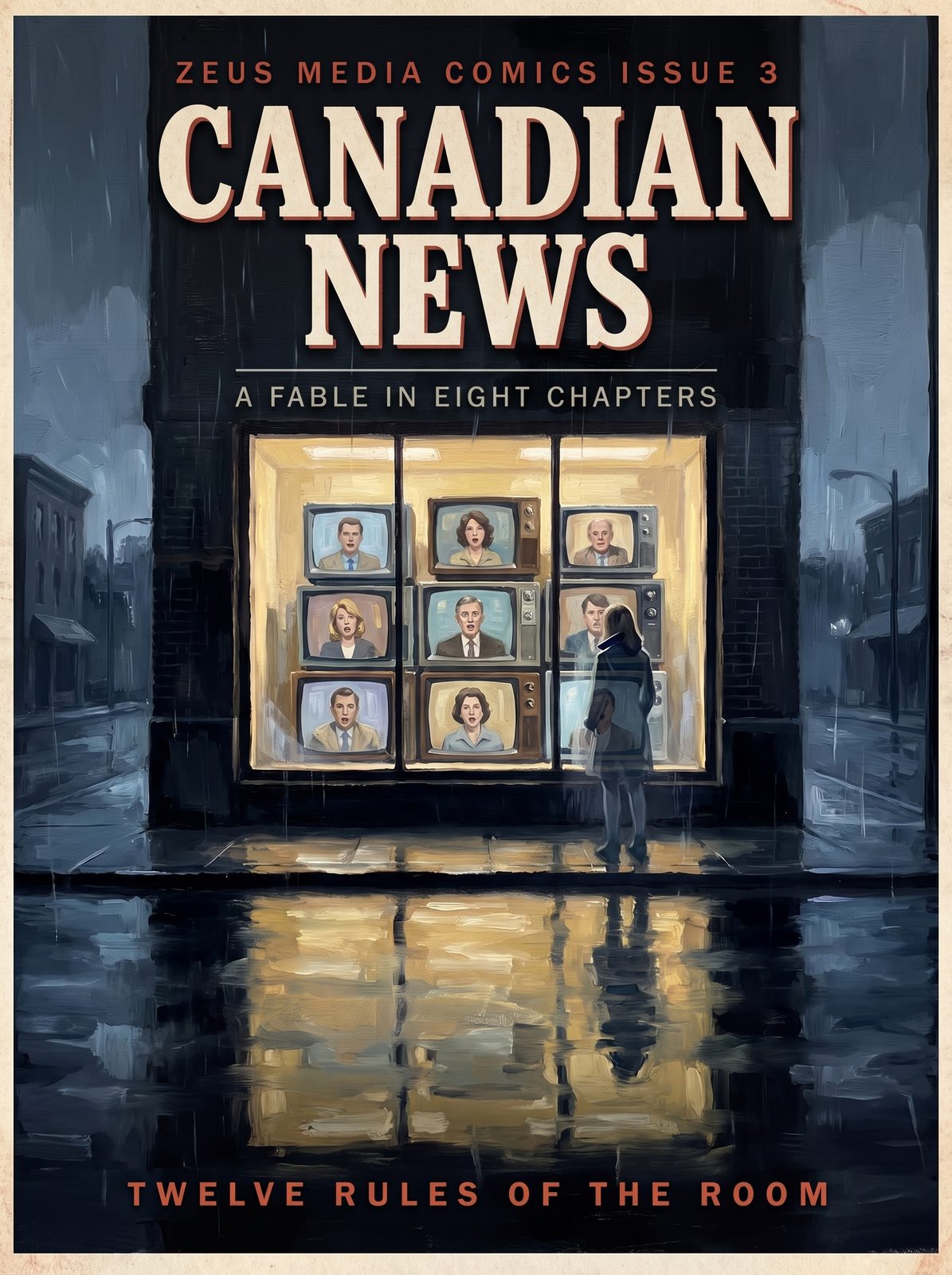

Two halves. The first is a fable. Nobody in it tells a lie — not once, anywhere, which is the point of it.
The second half is not fiction. It is the documented record of what Canadian news organizations published between the 18th and the 21st of August 2026, what the governments published in the same window, and what the tariff actually was before any of it started. Every claim in it carries a source.

A Very Good Room

KairosPhones in the basket. Not a rule. A courtesy, so nobody's put in the position.
PhemeWhose position.
KairosAnybody's, really.

EchoThere's no page from before.
DoxaBefore what?
EchoI don't know yet. Before this.
DoxaAsk him at the bell. He's good about it.

Eleven O'Clock

KairosEleven.
PhemeOn the nose.
KairosAlways on the nose.


A Man Who Rings a Bell

KairosYou're the one who remembers.
EchoI don't try to.
KairosNo, I know. That's what makes it a gift and not a hobby.
EchoCan I ask you something, and you can say it's a stupid question.
KairosThose are the only ones worth the time.
EchoWhat was it before?
KairosBefore fifty? Fifty was announced in March. Before March it was thirty-five.
EchoBefore all of it.
KairosAh. Well — that's a treaty question, and I'm not a treaty man. I'd be guessing and I'd be wrong, and then you'd be wrong, and it would be my fault.
KairosBut it's not a secret. None of it's a secret. That's the part people never believe. It's all bound, downstairs, going back to before either of us. Mnema's down there most days. Nobody's stopping you. Nobody's ever stopped anybody.
EchoRight.
KairosGo down. Honestly. Take an afternoon.

KairosWhat was your first morning? Do you know it?
EchoThe fourteenth. Of April.
KairosOf course you do.
KairosYou'll stop keeping those.
How the Room Was Built
The Minister has been misquoted four times this year. Beginning next session, the documents will be provided to the press one hour in advance, so that everyone may report accurately.
There is no obligation to attend.

One. Small and regional members who cannot send a correspondent may receive the same materials by wire, at no cost, so that they are not disadvantaged.
Four. To prevent error, a summary paragraph will accompany the materials.
Eleven. Materials are provided on the understanding that nothing is published before the hour.


The Basement


MnemaOh. Hello.
EchoAm I allowed —
MnemaYou're allowed. Everyone's allowed. Nobody comes, but everyone's allowed.
MnemaWhat year?
EchoThe bridge. All of it.
MnemaThat's nine mornings. Do you want the chair?

A FAIR SETTLEMENT · and the carts were counted at our end, by us, and the count was sent south
THE BRIDGE IS OPEN FOR GOOD · and the water goes south in the same proportion forever, which is in clause nine
PEACE ON THE BRIDGE · and we collected the toll ourselves and handed it over, which is not a toll
THE PANEL HAS RULED FOR US · and we paid
WE GOT MOST OF IT BACK · most
WE HELD THE LINE · and the line moved, and we held it there
A GESTURE OF GOOD FAITH · the tax we were owed, cancelled, the night before it was due
DE-ESCALATION · ours came off, theirs stayed on
THE TOLL HAS BEEN HALVED · from fifty

EchoHas anyone else read these? All nine, together?
MnemaTogether? No.
EchoEver?
MnemaWell. They're not filed together. They're filed by year. You'd have to want to.
Nobody Is Bought

EchoWhy is it always eleven?
DoxaBecause that's when he opens the door.
EchoAnd if we went at ten?
DoxaWith what? You'd have the number and not the folder. You'd be first with half of it and wrong about the other half, and the other ten would have all of it and be right, and you'd have taught the whole country not to believe you. For an hour.
DoxaI've got three people doing the work of nine. I have a licence to renew, and a credit against wages I can't run the desk without, and a fund I apply to in March like everybody else. Nobody has ever rung me up and told me what to write. Not once. Not ever.
EchoI know.
DoxaThen you know.


Digitization

First manYou on Saturday?
Second manI'm on Sunday. I swapped with Ivo.
First manIvo owes me a Sunday.
Second manIvo owes everyone a Sunday.

First manIs any of this from before?
Second manBefore what?
First manDunno.

The Fourth Day


DoxaDo we take yesterday's down?
EchoTake it down where?
DoxaNo. You're right.


KairosEleven.
EchoOn the nose.
KairosAlways on the nose.

The Bridge
| the sentence carried out of the Room | the toll before | the toll after | |
|---|---|---|---|
| 1 | A fair settlement | 0 | 0 |
| 2 | The bridge is open for good | 0 | 0 |
| 3 | Peace on the bridge | 0 | 15 |
| 4 | The panel has ruled for us | 15 | 15 |
| 5 | We got most of it back | 15 | 12 |
| 6 | We held the line | 12 | 12 |
| 7 | A gesture of good faith | 12 | 25 |
| 8 | De-escalation | 25 | 35 |
| 9 | The toll has been halved | 50 | 25 |
| 10 | Both sides say they have gained | 50 | 50 |
This half is not a fable
Everything below is sourced. Where a thing is a fact, it carries a link. Where a thing is my opinion, it says so in the sentence. Where the record contradicts what I expected to find, it is printed anyway, in the section it belongs in rather than a footnote at the end.
I went looking for cheerleading. I want to be straight about that, because it is not what I found, and the thing I did find is stranger.
Between the 18th and the 21st of August 2026, Canada and the United States negotiated over a 50 per cent tariff on roughly CAN$28 billion of Canadian goods. I read as much of the Canadian coverage of those four days as I could locate — several hundred pieces across the Canadian Broadcasting Corporation, Radio-Canada, CTV, Global, CityNews, La Presse, Le Devoir, the Quebecor papers, the wire services and a dozen independents.
1. Seventy-two hours
Here is what was said, against what existed in the public record at the moment it was said.
| When | What was said or done | Record |
|---|---|---|
| Aug 18, ~10:30 p.m. | Trump, on Truth Social: tariffs paused three days because Canada and the United States, “subject to the finalization of documents, have a DEAL!” | Reported |
| Aug 18 | A proclamation suspends the duties for three days, amending the effective date from Aug 19 to Aug 22. It is listed among the President's actions; as of this writing it had not yet appeared in the Federal Register, where the three underlying 50 per cent proclamations were published on 23 July. | Primary |
| Aug 18 | Carney: “Substantial progress has been made, although there is important work still to be done.” Full statement | Primary |
| Aug 19, 5:06 a.m. | The Canadian Press wire moves: “Canada, U.S. both say they made gains in new trade deal that averted tariffs.” | Wire |
| Aug 19 | Carney: the agreement “reinforces that Canadian advantage … securing the best terms in each of Canada's most important strategic sectors.” | Reported |
| Aug 19 | Premier Scott Moe: a “best-in-class trade agreement”, the “strongest of any country in the world.” CBC | Reported |
| Aug 20 | Dominic LeBlanc: “We're very close, we continue to make progress.” | Reported |
| Aug 21, 11:42 p.m. | CTV's live file carries the headline “New set of U.S. tariffs on Canada go into effect as midnight deadline passes” — nineteen minutes before the event it describes. | Captured |
| Aug 21, ~11:30 p.m. | US Trade Representative Jamieson Greer says Canada declined to finalize: Canada's late demands “have upended the careful balance reached in the past days.” Tariffs proceed “as planned” at 12:01 a.m. | Reported |
| Aug 21, ~11:54 p.m. | Carney recalls the negotiating team. Late American changes were “unfair, uneconomic, and called into question the reliability of any agreement.” Canada will not take a deal “at any price or on any deadline”, and will match the tariffs “dollar for dollar.” CBC live file | PMO statement |
Neither government published the terms. Not once, at any point, in any form. On the night of the 21st I checked the Federal Register, the White House presidential-actions index, pm.gc.ca, canada.ca and ustr.gov, twice, forty minutes apart. The most recent Canada item in any of them was the three-day suspension signed on the 18th.
Every specific figure in circulation that week — steel to 25 per cent, a four-million-tonne quota, cars to 15, dairy import licences reallocated — came from unnamed sources. They were not verifiable, because there was nothing to verify them against. Bloomberg reported aluminum at 25 per cent; BNN reported 15. The Globe reported relief on forest products; CP24 reported none. Nobody could adjudicate between them, and nobody could have.
Then it did not happen at all.
2. The number that was not in the folder
Here is the tariff on Canadian goods entering the United States, at three moments. The January 2025 column is the one that matters.
| Sector | 1 Jan 2025 | 18 Aug 2026 | “The relief” — reported, never published |
|---|---|---|---|
| Steel | 0% | 50% | 25% within a quota |
| Aluminum | 0% | 50% | 25% — or 15%, depending on the outlet |
| Automobiles | 0% | 25%, plus 50% pending | 15% headline, ~7.5% effective |
| Copper semis | 0% | 50% | no change reported |
| Softwood lumber | 14.54% | ~45% all-in | disputed between outlets |
| Compliant goods generally | 0% | 0% — but the pending 50% covered ~US$20bn regardless | — |
Steel, aluminum and cars crossed that border duty-free at the start of 2025, because there was a free trade agreement, and it was in force, and it still is. Softwood is the honest exception: it already carried 14.54 per cent.
So “fifty down to twenty-five” is a triumph measured against March, and a catastrophe measured against the year before last. Both readings are arithmetically correct. Only one of them was in front of the country.
Across the coverage I could locate, the pre-2025 rate appears in a Canadian journalist's own voice almost nowhere. It appears, repeatedly, inside quotation marks — in the mouths of politicians, industry lobbyists and premiers.
Pierre Poilievre: “Before we had basically no tariffs on goods coming to the United States.” Flavio Volpe of the auto parts association: “for 60 years we've been working at zero per cent.” Giles Gherson of the Toronto Region Board of Trade: “We've had free trade in automotive since 1965 … how much do we have to pay for the ceasefire?” Dennis Darby of Canadian Manufacturers & Exporters: these goods “had previously benefited from tariff-free access under CUSMA.” Premier Wab Kinew, via the wire: the reduced levels are “still much higher than before Trump started imposing tariffs.”
The Canadian Press published a full timeline of the trade war that walks through every escalation from November 2024 forward. It does not state the zero it escalated from.
Two outlets stated it plainly, and both deserve their names in print. The Globe and Mail's editorial board, on the 20th: “For the time being, most goods shipped from Canada into the U.S. remain tariff free under the provisions of USMCA.” And Blacklock's Reporter, a small reporter-owned Ottawa newsroom, describing a draft that would “end 61 years of tariff-free Canadian auto exports.”
Two. One of them an editorial rather than a news report, and one of them a subscription newsletter most Canadians have never heard of.
This is the finding. Not that anyone lied — nobody did. That the denominator was missing from the news, and a country cannot price a deal it is only shown the numerator of.
3. Where the sentence comes from
The Canadian Press states on its own site that it employs more than 180 journalists and serves more than 600 media companies. It is owned by Torstar, The Globe and Mail and La Presse.
That is not a scandal. It is a co-operative, and it exists because a paper in Moose Jaw cannot keep a bureau in Washington, and the alternative to a shared wire is no coverage at all. It is a good institution and the country is better for having it.
It does mean something specific about what agreement looks like on a screen. In that week:
- Nineteen of the twenty-two CityNews pieces located were wire copy — sixteen from CP, three from the Associated Press. Three were staff originals.
- The single CP story headlined “Canada, U.S. both say they made gains” ran on at least thirteen separate outlets, in several cases word for word, including one that reproduced its paragraphs inside an editorial newsletter.
- The identical concessions phrase — the booze bans, the dairy quotas, the auto tariffs — appears across roughly twenty surfaces in English and French, because it is one sentence, written once.
The newspapers work the same way, and it is verifiable by URL. Every national story originating at the National Post or Financial Post that week resolved under an identical slug, headline and byline on eight separate mastheads — the Post, the Ottawa Citizen, the Vancouver Sun, The Province, the Calgary Herald, the Edmonton Journal, the Toronto Sun and the Financial Post. The Ottawa Citizen and the Edmonton Journal, serving two capital cities between them, published no original reporting of their own on the deal at all. Their readers got the shared file.
One consequence worth sitting with. The same tariff package was described that week as US$20 billion by the Globe and the Financial Post, $28 billion by the Star and the Sun, and $29 billion by the National Post — a currency-conversion difference that nobody reconciled for readers, in a story whose entire subject was a number.
When a reader sees the same sentence on nine channels, the natural inference is nine confirmations. Often it is one. That is a fact about distribution, not about anybody's integrity, and it is invisible from the couch.
4. Where the coverage was good, and who was good in it
This section runs here, before the section on money, and not at the end, because it is the part that changed my mind and it would be dishonest to bury it.
The Canadian press was not cheerleading. On the CBC and Radio-Canada the single most repeated framing word of the week was concession. The words win, breakthrough and de-escalation appear in their journalists' own voice essentially never — only inside quotations, or as questions. Judged as adversarial coverage of a negotiation, much of this was good work, and some of it was excellent.
- CBC brought in Steve Verheul, Canada's former chief trade negotiator, to say Canada “risks trading away a long-term advantage” and that “getting to duty-free trade must still be among Canada's objectives.” That is the missing denominator, said out loud, by the right person.
- CBC carried Chrystia Freeland: “you can lose by winning if you've defined winning in a way which is self-mutilating.”
- CBC Manitoba ran a piece headlined “Accepting 25% tariff rate for steel a win for Trump, Manitoba businesses say” — a local desk refusing the national frame, on the record, with named steel executives and two mayors.
- Cross Country Checkup put the question to the country directly: “Is Canada giving up too much?”
- Le Devoir's editorial board called it «une entrée cher payée» — dearly paid, to end up back at the starting point — and printed the concessions ledger, including the softwood silence, on the 21st.
- La Presse hedged its own lede on the 18th — «Du moins, pour l'instant», at least for now — and by the 20th was asking where Captain Canada had gone.
- Blacklock's Reporter said it plainest of anyone, twice over: a draft deal that would “end 61 years of tariff-free Canadian auto exports.”
- The Hub ran the sharpest version from both directions in the same week — an economist arguing the concessions were good policy on their own merits, and a podcast calling the whole thing a shift “from free trade to managed trade with permanent tariffs.”
- The Toronto Sun's editorial board ran three pieces in four days, all critical, the last of them headlined plainly: “It's not the deal Canada wanted.” Brian Lilley asked the right question in a headline twice: “What did Carney give up to get tentative deal with Trump?” and “Carney's trade deal — all spin and few details.”
- The Toronto Star headlined its main file “critical trade details remain secret”, and later “a trade deal that leaves tariffs intact.” Its opinion page ran against concessions all week without a break.
- The Globe's Aug 20 story was the only one to publish the full ask, and it was much longer than alcohol and dairy: completing the F-35 purchase, buying American hardware through Golden Dome, granting the United States right of first refusal on critical minerals, and increasing oil exports.
- The Financial Post's Gabriel Friedman found the asymmetry nobody else printed — a structure that would tariff Canadian steel going south while leaving American steel coming north untouched. Bloomberg, on its pages, quoted Chrystia Freeland saying Carney was doing “what no previous Canadian leader has done by accepting that President Donald Trump can impose tariffs despite the terms of the North American trade pact.”
Narrower than I expected, and harder to dismiss. The coverage interrogated the negotiation relentlessly — who conceded, who blinked, whether Trump can be trusted, what the premiers would wear, whether the details were being hidden. Several outlets asked, in headlines, what Canada was giving up.
What almost none of them did was print the number that answers it. Across every newsroom named on this page, across hundreds of pieces in two languages over seven days, the pre-2025 rate was stated in an outlet's own voice twice. The scepticism was real and it was about process, secrecy and durability. The arithmetic went unstated.
And a story with no published terms was covered for three days in the grammar of a concluded agreement, because that is the grammar the sources were using, and there was nothing else to go on. In my view — and this is opinion, not a finding — the honest headline all week was “two governments say they have a deal; neither will show it to you.” Nobody ran it, because it is not a story, and being not-a-story is what it was.
5. Fifty years of the same morning
What follows is a ledger, not an argument. Documented terms in one column, the framing at the announcement in the other. Two entries are wins, and they are marked as wins, because a ledger that only records losses is not a ledger.
| Year | What the record shows | How the day sounded |
|---|---|---|
|
1987 Free Trade Agreement |
Canada's central objective was binding subsidy and countervail rules to stop US trade-remedy harassment. It did not get them. Article 1907 scheduled the real negotiation for five years later, then two more. It never happened; NAFTA demoted the obligation to a promise to “consult on the potential.” Canada paid in advance with energy proportionality, a thirty-fold loosening of takeover review, and a frozen Auto Pact. | On CBC's Sunday Report, the morning after: “On subsidies and regional development, there is no agreement on a new set of rules. Everything stays in place… That's good news for Canada.” |
|
1986 & 1996 Softwood |
Twice Canada answered a US industry petition by taxing or capping its own exports. The 1986 memorandum imposed a 15 per cent export tax on Canadian producers — about $600 million a year, described in the reference literature as the largest self-imposed penalty in the history of world trade. The 1996 quota deal was signed after binational panels had found no countervailable subsidy. | Toronto Star, April 1996: “U.S. pushes Canada into lumber tax deal; Eggleton says 5-year peace pact is the best Ottawa could get.” Ottawa's own defence of signing was that it proved NAFTA still needed the subsidies code from 1987. |
|
2001 Auto Pact dies |
The WTO struck it down because the 1988 agreement had frozen its membership list, converting an open regime into a discriminatory one. The concession made in 1987 killed it fourteen years later. | The 1988 government synopsis had said: “The free and secure access to the U.S. market provided by the Auto Pact remains intact.” At the funeral, the industry minister saw “little to fear”, and a Globe headline asked whether we should cry. |
|
2006 Softwood settlement |
Canada had won the final NAFTA appeal. The Congressional Research Service records about US$4 billion returned of roughly $5.3 billion collected — the United States kept about $1 billion, half of it going to the American industry coalition that had brought the case. A US court ordered full refunds with interest the day after the deal took force. | Harper, in the House: “Those are the things Canada wanted and those are the things Canada got.” CBC: “Canada, U.S. agree to softwood lumber deal.” |
|
2015 COOL — a win |
Canada completed the WTO process and obtained authorization to retaliate against $1.054 billion a year of US exports. Congress repealed the labelling law eleven days later. Canada never had to impose a dollar. | Reported accurately as what it was. This is the mechanism that works: finish the process, get the authority, hold it over something politically painful. |
|
2018 USMCA |
Dairy access, the abolition of Class 7 milk pricing, a US consultation right over Canadian milk-price changes, copyright extended by twenty years, a capped auto exemption, and a sunset clause. The steel and aluminum tariffs stayed on for seven more months after signing. Ottawa later paid dairy farmers up to $1.2 billion in compensation for the access the deal gave away. Genuine wins too: investor-state dispute settlement dropped, the energy proportionality clause finally gone. | Trudeau: “We insisted on getting a good deal – not just any deal … even when some were recommending we capitulate.” Freeland: “a victory for Canadians.” CBC also ran a dairy farmer: “It's death by 1,000 cuts.” |
|
2025 Digital Services Tax |
Ten days after his finance minister said the tax “is in force and it's going to be applied”, Canada rescinded it hours before the first payment — reported at about US$2 billion — came due. The talks it was meant to unlock produced no agreement for the next fourteen months. Including last night. | The government's own headline was that the move would “advance broader trade negotiations”, and the coverage adopted the same causal frame. |
|
2025 Counter-tariffs |
Canada removed retaliatory tariffs on roughly $30 billion of US goods while American tariffs stayed on. CBC later reported the government had quietly dropped more than it announced. | Framed as strategic sequencing: “85 per cent of trade with the U.S. is still tariff-free — which is a better deal than other countries have.” That the quiet part was reported at all is CBC doing its job. |
One promise runs through all of it. In 1987 Canada signed away permanent things in exchange for subsidy rules to be negotiated within five years, and seven at the outside, with a right to tear up the agreement if they never came. They never came. NAFTA turned the deadline into a conversation. Chrétien re-promised them in December 1993 on a fresh two-year clock. In 1996 Ottawa cited their absence as the reason it had no choice but to sign the softwood quota. They have still not been written.
That is thirty-nine years of a country being told that the thing it did not get is coming, each round reported as a resolution. It ended, last night, with a negotiating team on a plane home.
6. Who owns it, and who pays for it
Read this section as structure, not accusation. Everything in it is a published fact about how Canadian journalism is financed. I am making no claim — none, anywhere — that any of it has shaped a single editorial decision, and I have no evidence that it has. I am setting it down because a reader is entitled to know the shape of the room.
- CBC/Radio-Canada is a Crown corporation. Its parliamentary appropriation for 2025–26 stood at roughly $1.575 billion in estimates to date.
- The journalism labour tax credit pays 35 per cent of eligible newsroom salaries to a cap of $85,000 — up to $29,750 per journalist per year — through to the end of 2026. A consultation on extending it to broadcast news closed on 31 July 2026; the trade press estimates it would be worth $50–80 million a year to Bell, Rogers and Corus. The outcome had not been announced.
- The Online News Act brought $100 million from Google, distributed by the Canadian Journalism Collective under a formula capping broadcasters at 30 per cent and the CBC at 7.
- The Local Journalism Initiative committed $58.8 million for 2024–27.
- Postmedia, which owns the dominant paid daily in most large Canadian cities, is about 63 per cent owned by Chatham Asset Management, a US hedge fund that also holds its debt.
- Corus, which owns Global News, was awaiting a CRTC decision on a change-of-control application through this entire week. Its recapitalization hands 99 per cent of the new parent to its lenders.
On the 21st, the Canadian Press quoted Paul Deegan of News Media Canada on the possibility that the Online News Act was being used as a bargaining chip in this negotiation. If it were given up, he said, the effect on newsrooms across Canada would be “immediate and catastrophic.” Le Devoir, the same day, cited a Toronto Star report that the government was considering repealing the Act as part of the draft.
So the industry's own funding was, on its own lobby group's account, on the table in the deal the industry was covering. I am not alleging that this changed anyone's copy. I am observing that it is the sort of thing a reader would want disclosed inside the coverage, and I did not find it disclosed inside the coverage.
7. Rule Nine
There is no villain in this. That is what took me longest to accept, and it is why the first half of this page is a fable in which nobody lies.
Every reporter in that story is real and decent and filing three pieces a day with a third of the staff their desk had in 2010. The briefing is genuinely useful. The wire genuinely keeps small papers alive. The subsidies genuinely keep newsrooms open. The eleven o'clock embargo is genuinely fairer than letting the biggest outlet break everything first. Each individual thing is defensible, and the sum of the defensible things is a country that was told for three days that it had a deal, and did not have one, and was never once shown the number that would have let it judge.
So the only useful thing I can offer is the rule that got struck out.
Ask it of the next number anybody hands you. Twenty-five per cent, compared to what. A billion dollars, compared to what. A record year, compared to what. It is not cynicism and it is not media-bashing — half the journalists quoted on this page were asking sharp questions all week, and the good ones will not mind being asked it back.
It is just the question the folder has no slot for.
Frequently asked questions
What is Canadian News about?
It is a fable in eight chapters, followed by a sourced factual appendix. In the fable, a country's reporters are given a briefing folder in a warm room each morning and released at eleven o'clock to say the same true sentence at the same second. Nobody in the story tells a lie at any point. The appendix documents what actually happened in Canadian coverage of the Canada–United States trade negotiation between the 18th and 21st of August 2026.
Is this article accusing Canadian journalists of lying?
No, and the record does not support that accusation. Every quotation examined was accurately reported and correctly attributed. CBC and Radio-Canada reporters in particular used the word concession far more often than any word of celebration, and words like win and breakthrough appeared in their own voice almost never. The documented finding is narrower: a negotiation whose terms neither government ever published was covered for seventy-two hours in the register of a concluded agreement, and the tariff rate that applied before February 2025 appeared in Canadian reporters' own voice in almost none of the coverage.
What was the tariff rate on Canadian goods before the trade war?
For goods qualifying under the Canada–United States–Mexico Agreement, it was zero. Steel, aluminum and automobiles all entered the United States duty-free on 1 January 2025. By 18 August 2026 steel and aluminum carried 50 per cent under Section 232 and automobiles carried 25 per cent, with a further 50 per cent under Section 338 pending. Softwood lumber is the exception: it already carried 14.54 per cent in combined anti-dumping and countervailing duties at the start of 2025.
Did Canada and the United States sign a trade deal in August 2026?
No. Shortly after 11:30 p.m. Eastern on 21 August 2026, US Trade Representative Jamieson Greer said Canada had declined to finalize the deal. At about 11:54 p.m. the Prime Minister's Office released a statement in which Mark Carney said last-minute changes to the American terms were unfair and uneconomic, recalled Canada's negotiating team, and said Canada would match the 50 per cent tariffs dollar for dollar. Neither government published any agreement text at any point during the negotiation.
How much of Canadian news coverage comes from a single wire service?
A substantial share. The Canadian Press states on its own website that it serves more than 600 media companies with roughly 180 journalists. It is owned by Torstar, The Globe and Mail and La Presse. In this particular week, 19 of the 22 CityNews pieces located were wire copy, and a single Canadian Press story ran on at least 13 separate outlets, in some cases word for word.
Does the Canadian government fund Canadian news organizations?
Yes, through several published programs. CBC/Radio-Canada received a parliamentary appropriation of roughly $1.575 billion in estimates to date for 2025–26. The Canadian journalism labour tax credit pays 35 per cent of eligible newsroom salaries up to $85,000, a maximum of $29,750 per journalist, until the end of 2026. The Local Journalism Initiative committed $58.8 million for 2024–27. Google paid $100 million under the Online News Act, distributed by the Canadian Journalism Collective. These are structural facts about how the industry is financed, and this article makes no claim that any of them has influenced any editorial decision.
Why is an e-bike company publishing a fable about the news?
Zeus eBikes Canada runs a fiction and long-form shelf called The Bookshelf alongside its buying guides, because the company's stated mission is to educate and to tell the truth about the market Canadians actually live in. Pieces on that shelf carry no product recommendations and nothing is for sale inside them. This one mentions no bicycle of any kind.
How to Negotiate with the USA — Zeus Media Comics, Issue #1. The tariff negotiations as farce, written a fortnight before this week happened. Its appendix documents the legal sequence that produced the 50 per cent: the Supreme Court striking down one tariff authority, and the older one that replaced it.
How to Be a Good Chicken — Issue #2. A town of chickens, five fox families in chicken costume, and a morning that gets cancelled one amendment at a time.
For the tariffs themselves — the threat, the numbers and what they mean for Canada — that lane belongs to Will the USA Annex Canada? and Why Did Canada Drop Its Retaliatory Tariffs?. This page is about the coverage.
Beaver Berry: The Ungovernable and Welcome to Earth, Chapter One — the rest of the shelf. All free, none of them selling anything.
Method. Coverage was gathered on 21–22 August 2026 by direct retrieval of every located article from CBC, Radio-Canada, CTV, Global, CityNews, La Presse, Le Devoir, the Quebecor papers, the wire services and a dozen independents, plus the primary record from pm.gc.ca, canada.ca, whitehouse.gov, ustr.gov and the Federal Register. Where an outlet blocked automated retrieval, its pages were fetched directly and its text read from the page's own structured data. Paywalled outlets are represented by headline and standfirst only, and are marked as such in the working notes. Historical cases were verified against treaty text, Hansard, government releases and the Congressional Research Service rather than against later summaries.
Corrections. If anything here is wrong, I want to know and I will fix it and say that I did. milad@zeusebikes.ca. That includes any newsroom named on this page: if you covered the baseline in your own voice and I missed it, send me the link and it goes in.
Written by Milad Ghobadibeygvand, BScN (Western University, 2014), co-founder of Zeus eBikes Canada. Zeus Media Comics, Issue #3. The fable half is fiction, and nobody in it tells a lie — which is the only part of it the author would defend as reporting. Nothing on this page is for sale.
Visuals created by Playcut.ai

Share:
Why Is Toronto Removing Its Bike Lanes — and Who Benefits?
How Do Tariffs Affect Canada? Every Industry, Every Person