
The Most Comfortable eBike Seat (2026): 8 Picks, Fit First

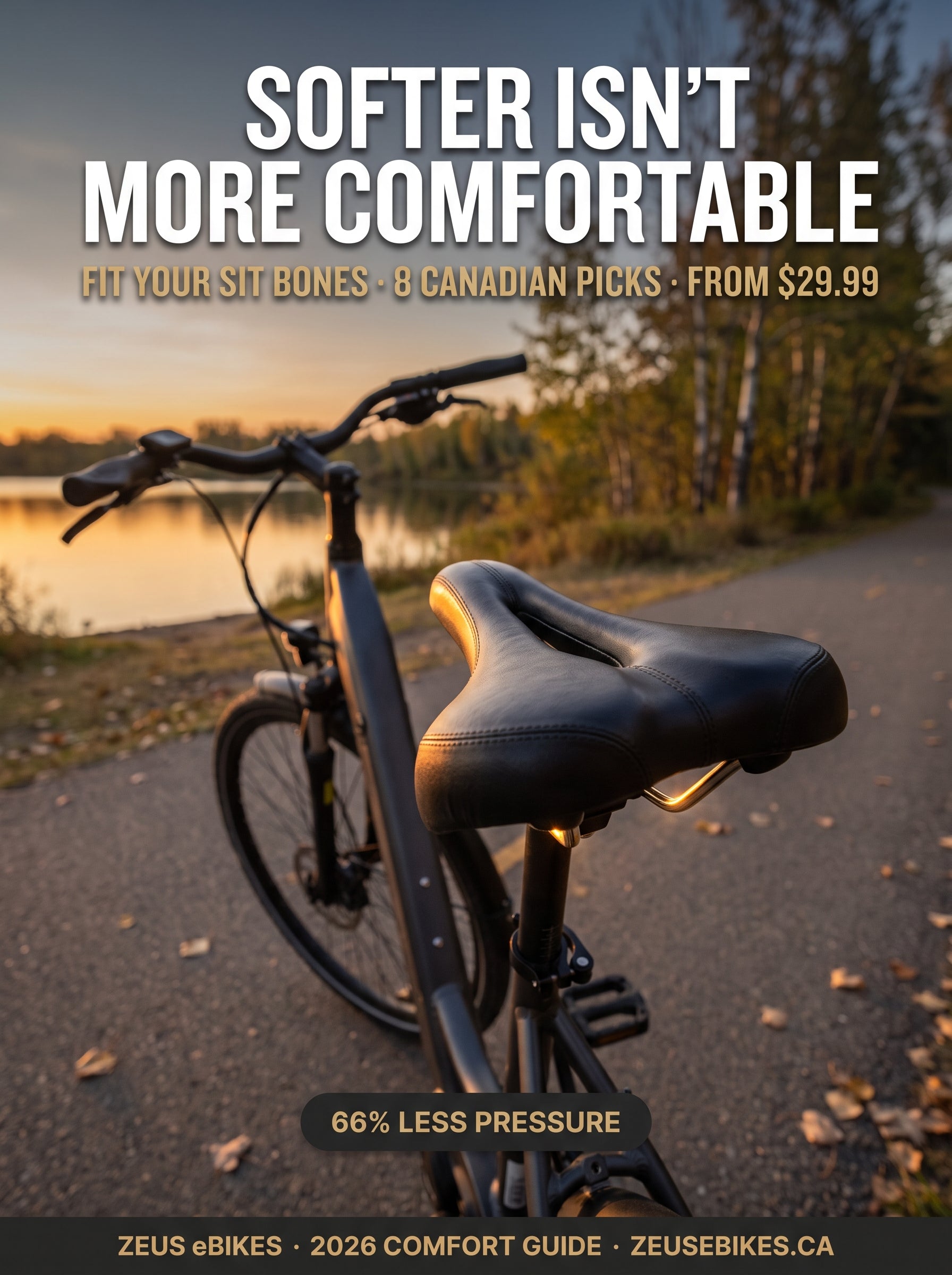
Fit first. The most comfortable eBike seat is the one that matches your sit bones — not the softest one on the shelf.
The most comfortable eBike seat is almost never the softest one on the shelf. It's the one that matches the width of your sit bones, keeps your weight on bone instead of soft tissue, and — on a heavier eBike — takes the buzz out of the road before it reaches your spine. Get those three things right and a sore backside usually stops being your problem. Get them wrong and no amount of gel will save you.
This is a fit-first guide, not a padding-first one, and every recommendation below is a real product you can buy today from a Canadian store — MEC, Biktrix, and one Amazon.ca pick. We'll show you the five-minute measurement that does most of the work, the counterintuitive reason a plush seat often hurts more, and the single upgrade that beats any saddle swap.
For most upright eBike riders, the most comfortable seat is a wide, moderately firm saddle matched to your sit-bone width — not a soft, deeply padded one. Measure your sit bones (a 5-minute test), then pick a saddle about 20–30 mm wider, with a central relief channel if you get numbness. A great all-round budget pick is the MEC Comfort Saddle ($34.95); the biggest comfort upgrade of all is a suspension seatpost like the Cane Creek Thudbuster under whatever saddle you already like. If your riding position is the real culprit, fix that first — it's free. See the full method and all 8 picks below.
What this guide covers
- Why your eBike seat hurts more
- The soft-seat myth, with evidence
- Step 1 — Measure your sit bones
- Step 2 — Match the shape to your problem
- Step 3 — Fix your position (free)
- The 8 most comfortable seats in Canada
- The upgrade that beats any saddle
- When a new seat won't fix it
- Frequently asked questions
Why does your eBike seat hurt more than a regular bike?
eBike sales have pushed millions of Canadians into far more saddle time than they've had since childhood — and an upright eBike puts more of your body weight straight down onto the seat than a leaned-forward road bike does. The stakes aren't just a sore ride: persistent pressure on the perineum is linked, in heavy cyclists, to genital numbness and sexual dysfunction. This guide walks you through the fix, in the order that actually works.
Three forces stack up on an eBike specifically. First, posture: sitting upright transfers weight off your hands and onto your sit bones and the soft tissue between them. Second, time and speed: an eBike makes 30–60 km rides effortless, so you sit longer, and you cover rougher ground faster. Third, weight: an eBike is heavier than an analog bike and transmits more road vibration up through the frame and seatpost into your body.
None of that is fixed by "more cushion." It's fixed by putting your weight where your skeleton can carry it, and by absorbing the buzz before it reaches you. That's the whole game, and the rest of this guide is how to win it.
eBike seat pain is a load-placement problem, not a padding problem. Your two sit bones are built to carry your weight; the soft tissue between them is not. Everything below is about getting the load onto the bones and the buzz out of the ride.
The counterintuitive truth: a softer, gel-loaded seat is usually less comfortable
Does a thick, pillowy gel saddle make long rides more comfortable? Usually not — and this is the single most important thing to understand before you spend a dollar. A very soft saddle feels wonderful for the first few minutes, then betrays you: your sit bones sink through the padding until the compressed foam or gel bottoms out and pushes upward against the soft tissue on either side of them. You've turned a bone-support problem into a soft-tissue-pressure problem.
The research bears this out. In the NIOSH studies of bicycle police officers, the variable that drove comfort and reduced harmful pressure was saddle shape and width — whether the saddle supported the sit bones and kept load off the perineum — not how soft the top felt. Pressure distribution, not padding volume, is what matters over a long ride. A moderately firm saddle of the right width spreads your weight across a broad, bony contact area. A plush one concentrates it in the wrong place.
Pressing a saddle with your thumb tells you nothing about how it carries your weight over 20 km. The saddles that win pressure-mapping tests are firmer and shaped than they are soft. If a product's whole pitch is "extra-thick memory foam" and "the softest seat ever," treat that as a yellow flag, not a green one.
This doesn't mean firmer is always better — a rock-hard racing saddle on an upright cruiser is its own kind of misery. It means moderate padding on a correctly shaped, correctly sized base. Width and shape first; padding is the finishing touch, not the foundation.
Softer ≠ more comfortable. Buy for width, shape, and a relief channel if you need one — then accept moderate padding, not maximum padding. The gel-cushion arms race is marketing, not ergonomics.
Step 1 — Measure your sit bones (the 5-minute test)
The right saddle width is set by your sit-bone width — the distance between your two ischial tuberosities, the bones you feel when you sit on a hard chair. It varies a lot between people and isn't tied to your height or waist size, which is exactly why a stock saddle is a coin-flip. Measuring takes five minutes and no tools.
Put a piece of corrugated cardboard or a doubled sheet of aluminium foil on a hard, flat surface like a stair. Sit on it squarely, lean your torso forward a little to mimic your riding posture, then stand up. You'll see two clear dents. Measure the distance centre-to-centre between them in millimetres — that's your sit-bone width.
Now pick a saddle roughly 20–30 mm wider than that measurement. Lean toward the wider end of that range if you ride very upright, as most eBike riders do, because an upright posture rotates your pelvis back and spreads the contact points. Too narrow and your sit bones hang off the edges onto soft tissue; too wide and you get inner-thigh chafing. This one number eliminates most of the guesswork that sends people through three or four saddles.
Most adults measure somewhere between roughly 100 mm and 150 mm across the sit bones, which points to a saddle in the ~130–175 mm width range for upright riding. Women, on average, have wider-set sit bones than men — which is the real reason women's-specific saddles exist, and why they're worth a look regardless of what the label says.
Step 2 — Match the saddle shape to your problem
Once the width is right, the shape solves the specific complaint you have. There are four shapes worth knowing, and your symptom tells you which one to buy.
Wide comfort saddle — for general soreness and upright riding
A broad, moderately padded saddle with a short nose. This is the default upgrade for cruiser, step-thru, and commuter eBikes ridden bolt-upright. It supports wide-set sit bones and doesn't demand any change to how you ride. If your only complaint is "my backside is sore," start here.
Relief-channel or cutout saddle — for numbness and pressure
A saddle with a groove or a hole down the centre removes material from exactly where a traditional saddle presses on the perineal nerves and blood vessels. If you get tingling, numbness, or "pins and needles," this is your shape. Pressure-mapping studies consistently show central cutouts cut peak perineal pressure substantially versus a solid-top saddle of the same size.
Women's-anatomic saddle — for wider sit bones
Typically a touch wider with a shorter nose and a relief channel positioned for female anatomy. Not a marketing gimmick — it reflects the average difference in sit-bone spacing. Plenty of women are comfortable on unisex saddles and plenty of men prefer a women's shape; treat "women's" as a shape category, not a rule.
Noseless (no-nose) saddle — for persistent numbness
The most effective fix for genital numbness, because it removes the part of the saddle that causes it. In the NIOSH study of police cyclists (Schrader et al., Journal of Sexual Medicine, 2008), switching to no-nose saddles cut perineal contact pressure by 66% and raised the share of riders reporting no genital numbness over the prior six months from 27% to 82%, with measured gains in sensation and erectile function. The trade-off is a short adjustment period — you steer and balance slightly differently without a nose between your thighs — which is why they suit upright, lower-speed eBike riding better than sporty riding.
Sore backside → wide comfort. Numbness or pressure → relief channel / cutout. Wider sit bones → women's-anatomic. Numbness that won't quit → noseless. Match the shape to the symptom and you'll rarely buy twice.
Not sure the seat is even the problem?
Sometimes the bike is fighting you — an aggressive posture, the wrong frame, a saddle mounted at the wrong height. Zeus builds comfort-first eBikes with upright geometry and easy step-over frames, and our team will talk you through it honestly at 1-866-938-7580.
Step 3 — Fix your position before you buy anything (it's free)
Before you spend a cent, spend ten minutes on your setup — a large share of "bad saddle" complaints are actually "bad position" complaints, and the fix costs nothing. Three adjustments do the work: height, tilt, and fore-aft.
Saddle height is the big one. Set it so your knee has a slight bend — roughly 25–35 degrees — at the very bottom of the pedal stroke. Too low and you grind your knees and shift weight rearward onto the saddle; too high and your hips rock side to side, sawing your soft tissue against the seat with every stroke. Our first-time eBike buyer checklist covers the setup basics for a new bike.
Tilt comes next. Keep the saddle level, or very slightly nose-down — never nose-up. A nose that points up drives the front of the saddle straight into the perineum; even a couple of degrees of downward tilt keeps your weight back on the sit bones where it belongs. Fore-aft position fine-tunes the rest: slide the saddle forward or back on its rails until, with the pedals level, your forward kneecap sits roughly over the pedal spindle.
1) Set height for a 25–35° knee bend. 2) Level the saddle (or a hair nose-down). 3) Adjust fore-aft. Ride for a week. Then, if you're still uncomfortable, buy a saddle matched to your sit-bone width. Doing it in this order stops you from throwing money at a problem a 5 mm seatpost adjustment would have solved.
The 8 most comfortable eBike seats you can buy in Canada (2026)
Here are eight upgrades that fit the method above, grouped by the job they do — all verified live at Canadian retailers, with exact prices where the retailer lists a fixed price. Nearly every one clamps onto standard 7 mm saddle rails, so they fit almost any eBike. Find your problem, pick your seat.
| Pick | Best for | Type | Price (CAD) | Store |
|---|---|---|---|---|
| MEC Comfort Saddle | All-round value, upright riders | Wide comfort | $34.95 | MEC |
| MEC Comfort Saddle (Women's) | Wider sit bones | Wide, women's | $34.95 | MEC |
| Selle Royal Vivo Ergo | Best budget ergonomic | Relief channel | $44.95 | MEC |
| Selle Royal Lookin | Numbness / pressure | Central cutout | $99.95 | MEC |
| Selle Royal Respiro (Women's) | Women, pressure relief | Women's cutout | $99.95 | MEC |
| Selle Royal Royalgel Cover | Cheapest first test | Slip-on gel cover | $29.99 | MEC |
| Bikeroo Oversized | Maximum-cushion cruiser feel | Extra-wide | ~$50 | Amazon.ca |
| Cane Creek Thudbuster ST | The real bump fix (any saddle) | Suspension seatpost | $269 | Biktrix |
Best all-round value
MEC Comfort Saddle (Unisex)
$34.95The honest default. A wide, moderately padded saddle from a Canadian retailer at a price that makes it a low-risk first upgrade for any cruiser, step-thru, or commuter eBike. It gets the fundamentals right — broad sit-bone support, a short nose, sensible padding — without the plush-but-punishing overstuffing that undoes cheaper "comfort" seats. If you're not sure where to start, start here.
Best budget ergonomic
Ten dollars more than the basic comfort saddle buys you a shaped, ergonomic profile with a central relief channel — the feature that takes pressure off soft tissue without a full cutout. Selle Royal is one of the largest saddle makers in the world, and the "Moderate" designation targets the semi-upright posture most eBike commuters actually ride in. The sweet spot for riders who want relief without spending $100.
Best for numbness & pressure
Selle Royal Lookin Moderate
$99.95If you get tingling or numbness, this is the pick. A pronounced central cutout removes material from directly over the perineum, which pressure-mapping research shows is where a solid saddle does its damage. The build quality and materials justify the price for anyone who rides often enough that comfort is a health issue, not a luxury. Pair it with a level or slightly nose-down tilt and most numbness complaints disappear.
Best women's-specific
Built around the wider average sit-bone spacing and the relief geometry female riders tend to need. The "Respiro" line adds ventilation channels on top of the central relief, which helps on longer summer rides. If you're a woman who has cycled through two or three unisex saddles without joy, the problem may simply be that they were the wrong shape — this is the shape worth trying next. It also pairs naturally with our guide to the best eBikes for women in Canada.
Cheapest fix & maximum cushion
The lowest-cost way to test whether a little more give helps, without replacing your saddle. It stretches over your existing seat in seconds. Be honest about its limits, per everything above: on longer rides the gel compresses and can shift pressure onto soft tissue, so treat it as a $30 experiment, not a cure. If it doesn't fix things within a couple of rides, the saddle underneath is the wrong size or shape — and that's your signal to move up this list.
For riders who genuinely want the big, plush cruiser feel — short, sit-way-back rides on a laid-back frame — the oversized Bikeroo is the popular Amazon.ca choice, with a very wide platform, gel top, and dual coil springs under the rear for a little give. It's the exception to our "firmer wins" rule, and it earns its place for casual, upright, lower-mileage riding. Just know the trade-off: on longer or faster rides the extra width can chafe and the soft top can transfer pressure. Amazon prices move constantly — confirm the live price before you buy.
The upgrade that beats any saddle: a suspension seatpost
If you only change one thing on a heavier eBike, make it this — a suspension seatpost does more for comfort than almost any saddle swap. It sits between your frame's seat tube and your saddle, and absorbs the bumps and high-frequency road buzz that an eBike's extra weight and speed transmit straight into your spine. Crucially, it works with whatever saddle you already like — so you keep your correctly fitted seat and simply stop feeling the road through it.
The Cane Creek Thudbuster is the reference design because of how it moves: a parallel linkage guides the saddle straight up and down as it compresses, instead of tipping it backward the way a simple telescoping post does. The short-travel ST version offers 50 mm of travel and is rated to a 150 kg (330 lb) rider, which makes it a strong match for the heavier riders an eBike often carries. It's the priciest pick here, and it's the one experienced riders wish they'd bought first.
Bought from Canadian eBike maker Biktrix, so it ships domestically. Before ordering, check your frame's seat-tube diameter — 27.2 mm is the most common, and shims are available to fit larger tubes — and confirm you have enough exposed seatpost for it to fit. Fit it under any of the saddles above and you get the best of both worlds: a seat shaped for your body, and a post that keeps Canadian potholes and gravel from reaching it.
On a heavy eBike, a suspension seatpost is often the highest-impact comfort dollar you can spend, because it fixes road buzz that no saddle can. Pair it with a correctly sized saddle and you've solved both halves of the problem — support and vibration.
When a new seat won't fix it — and what will
Be honest with yourself about when a saddle is not the answer. If you've matched the width, fixed your position, and added a suspension post and you're still uncomfortable, two possibilities remain — and both are worth taking seriously.
First, persistent numbness is a medical signal, not just a comfort one. The same NIOSH research that validates no-nose saddles also documented that ongoing perineal pressure is associated with genital numbness and sexual dysfunction in frequent cyclists. Numbness that doesn't resolve when you stop riding is worth raising with a doctor — don't ride through it and hope.
Second, sometimes the bike is the problem, not the seat. A frame that forces an aggressive lean, a saddle that can't be raised to the right height, or geometry that puts your weight in the wrong place will defeat any saddle you bolt on. If you find yourself fighting your bike's fit on every ride, the highest-value fix may be a bike built for comfort in the first place — upright bars, a relaxed frame, and an easy step-over. That's the whole design brief behind our comfort and senior-friendly eBikes, our step-thru range, and our heavy-rider picks, several of which ship with wide, well-shaped saddles and suspension posts as standard.
Frequently Asked Questions
Why does my eBike seat hurt so much?
Most eBike seat pain comes from three things working together: an upright riding position that puts more of your body weight straight down onto the saddle, more time in the saddle because eBikes make longer rides easy, and a stock saddle that doesn't match the width of your sit bones. When your weight lands on soft tissue instead of the two sit bones designed to bear it, you get numbness and soreness. Fixing your position and matching the saddle width to your sit bones solves the large majority of cases.
Are wider, softer bike seats more comfortable?
Wider often helps; softer usually doesn't. A very soft, deeply padded saddle feels great in the shop, but once you sit on it your sit bones sink through the padding and the compressed foam or gel pushes up against the soft tissue between them. Pressure distribution matters more than padding volume. A moderately firm saddle that is wide enough to support your sit bones spreads load better than a plush one that concentrates it. Aim for the right width and shape first, and only moderate padding.
What is the most comfortable type of eBike seat?
For most upright eBike riders, the most comfortable seat is a wide, moderately firm saddle that matches your sit-bone width, ideally with a central relief channel or cutout to take pressure off the soft tissue. If you experience genital numbness, a noseless (no-nose) saddle removes the part of the saddle that causes it. And a suspension seatpost fitted under any saddle absorbs the road buzz that a heavier eBike transmits, which is often the single biggest comfort upgrade of all.
How do I measure my sit bones for a saddle?
Sit on a piece of corrugated cardboard or aluminium foil placed on a hard, flat surface such as a step. Lean forward slightly to mimic your riding posture, stand up, and measure the centre-to-centre distance between the two deepest dents your sit bones left. That is your sit-bone width. Choose a saddle roughly 20 to 30 millimetres wider than that measurement, and toward the wider end if you ride very upright, so your weight rests on bone rather than soft tissue.
Do gel seat covers work?
A gel seat cover is the cheapest way to take the edge off a hard stock saddle, and for short, casual rides it can genuinely help. Its limits are the same as any soft padding: on longer rides the gel compresses and can transfer pressure to soft tissue, and covers can slip. Treat a gel cover as a low-cost first test, not a permanent fix. If discomfort continues past 20 to 30 minutes of riding, the saddle underneath is the wrong width or shape, and no cover will correct that.
Will a suspension seatpost make my eBike more comfortable?
For most riders, yes, and often more than any saddle swap. eBikes are heavier and are ridden longer and faster than analog bikes, so more road vibration reaches your body. A suspension seatpost sits between your seatpost clamp and the saddle and absorbs bumps and buzz before they reach your spine, and it works with whatever saddle you already like. A parallel-linkage post such as the Cane Creek Thudbuster is a common choice because it moves the saddle straight up and down rather than tipping it as you compress.
Is a noseless (no-nose) saddle better for numbness?
For genital numbness, the evidence is strong. A study of bicycle police officers published in the Journal of Sexual Medicine (2008) found that switching to no-nose saddles reduced perineal contact pressure by 66% and raised the share of riders reporting no genital numbness over the previous six months from 27% to 82%, with measured improvements in sensation and erectile function. The nose of a traditional saddle is the part that presses on the nerves and blood vessels in the perineum, so removing it removes the cause. The trade-off is a short adjustment period for balance and steering.
Can I put any bike seat on my eBike?
Almost always, yes. The large majority of eBike saddles clamp onto two standard 7 millimetre round rails, which fit the standard seatpost clamp on nearly every eBike, so most replacement saddles are cross-compatible. Check two things before buying: that the saddle uses standard round rails (not a proprietary or oversized oval rail), and, if you also want a suspension seatpost, that the post diameter matches your frame's seat tube — 27.2 mm is the most common, and shims are available to fit larger tubes.
The Bottom Line
The most comfortable eBike seat is the one that fits you — matched to your sit-bone width, shaped for your specific complaint, set at the right height and tilt, and, on a heavy eBike, backed by a suspension seatpost that kills the road buzz. Chase fit, not fluffiness. A $34.95 saddle that fits will beat a $90 pillow that doesn't, every single ride.
Start with the free step — dial in your position — then measure your sit bones and pick the shape that matches your problem from the list above. And if it turns out the bike itself is fighting you, that's worth solving too: Zeus ships comfort-first eBikes across Canada with a 15-day return window for unused, unopened bikes (15% restocking fee), and a team of real people at 1-866-938-7580 who'll tell you honestly whether a new seat or a new bike is what you actually need. Browse the Zeus accessories collection or the comfort step-thru range to keep going.
Keep going: the complete Canadian eBike guide · best eBikes for seniors · best eBikes for women · best eBikes for heavy riders · eBike battery safety guide.
Visuals created by Playcut.ai



Share:
What If Canada Owned Its Own Money? The Toll, the Chargeback Court, and the Bank We Built and Killed
Beaver Berry: The Ungovernable