
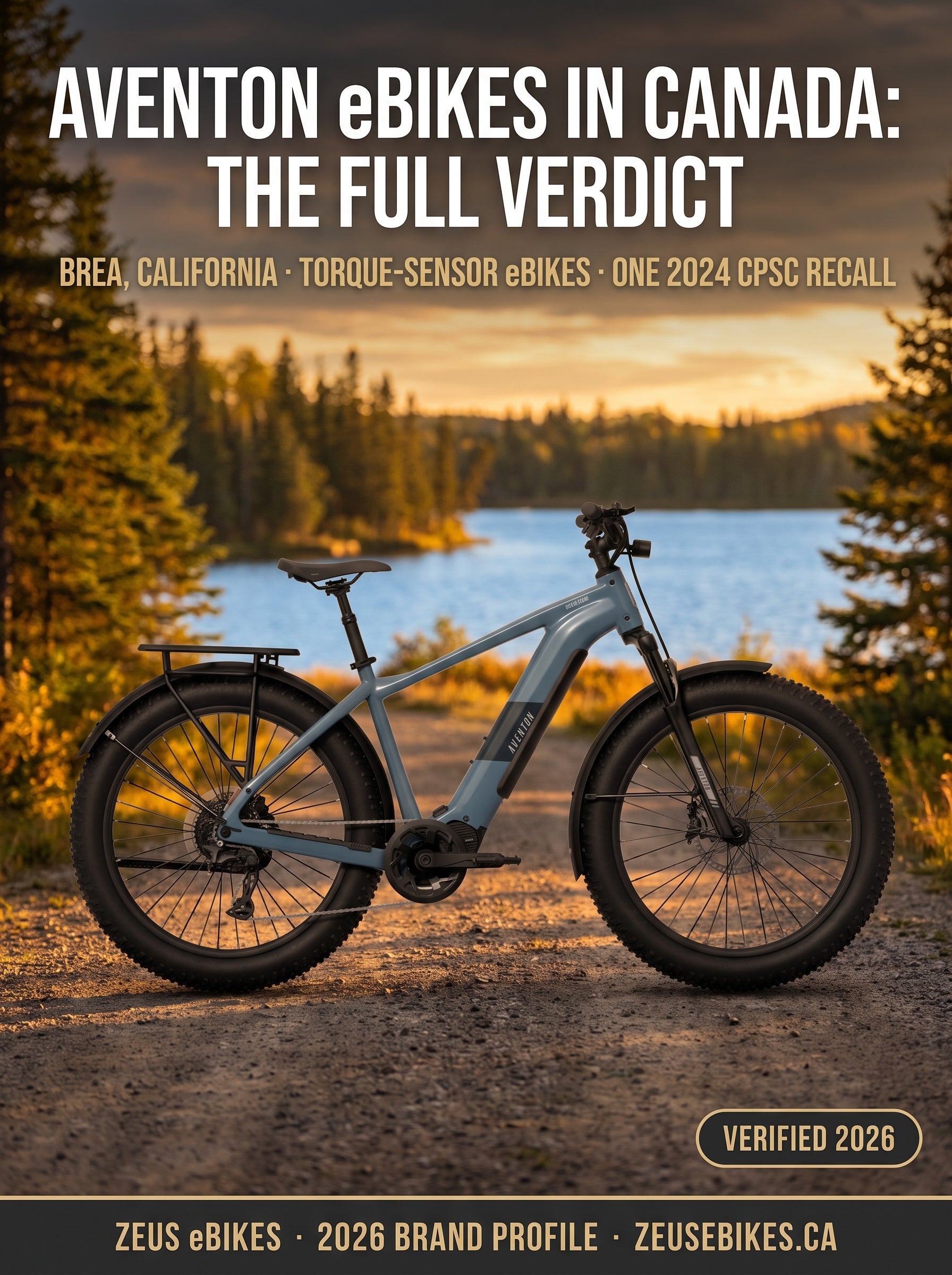
Aventon eBikes in Canada: The Verified Brand Profile (2026)

📸 Photography by Playcut.ai — personalised AI actor technology
Aventon is one of the most visible electric-bike brands in Canada — in bike-shop windows, in your feed, on the bike path. It is also one of the most misunderstood: shoppers can't always tell whether it's an American brand, a Chinese one, or something in between, and that confusion shapes what they expect from the warranty and from service. This profile settles it with sources.
This page is part of an independent directory of every eBike brand sold in Canada. It is not a sales pitch — Zeus does not sell Aventon. Every fact below is traced to a named primary source: the U.S. Consumer Product Safety Commission, Aventon's own warranty documentation, California's corporate registry, and independent teardowns. Where something is the company's own claim rather than independently verified, it says so plainly.
Every fact below was cross-checked against a named primary source and re-checked on June 13, 2026: the U.S. Consumer Product Safety Commission recall notice (#24-075), Aventon's own warranty and return-policy pages, the California Secretary of State registry (entity #C4841443, via OpenCorporates), Health Canada's recalls database, the TÜV Rheinland UL 2849 announcement, and reported court filings. Manufacturer claims that no third party has audited — factory ownership, cell brands, founding year, the 1,800-shop count — are labelled as claims, not facts. A lawsuit is reported only with its filing confirmed and its current status labelled unverified where no primary docket was located. Opinions are flagged as opinion. Aventon and any other company or person named in this profile has a standing right of reply: milad@zeusebikes.ca.
Aventon (Ride Aventon Inc.) is a U.S. company in Brea, California — a Delaware corporation registered in California in 2022; its founding is self-claimed as ~2012 by Jianwei "JW" Zhang. Its bikes are made in China and sold direct-to-consumer in Canada via aventon.com/en-ca, backed by a claimed network of 1,800+ independent shops for service and test rides. The lineup is UL 2849 certified (full-system, via TÜV Rheinland, 2023), carries a 2-year warranty covering Canadian purchases made on or after January 1, 2026, and has had one recall — the 2024 Sinch.2 software fix, with no injuries. The fine print to watch: a battery warranty capped at 300 charge cycles, no Canadian legal entity if a dispute escalates, a U.S. Pace 500 product-liability lawsuit (status unverified), and 750W-nominal models that exceed Canada's 500W PAB limit. Not sure how to vet any eBike seller? Read how to spot a legit eBike store in Canada.
What This Profile Covers
- Who owns Aventon, and where the bikes are made
- Is it sold in Canada — and is there real support?
- The warranty: strong on paper, with one catch
- The return policy: 14 days, with odometer limits
- Safety record: the 2024 Sinch.2 recall
- Litigation: the Pace 500 lawsuit
- Batteries, motors and repairability
- The honest ledger: green flags vs red flags
- Frequently asked questions
- The bottom line
Who Owns Aventon, and Where Are the Bikes Made?
Aventon is a U.S. brand owned by founder Jianwei "JW" Zhang and run from Brea, California; its bikes are designed there and made in China, in a factory the company says it owns about 200 miles southeast of Shanghai. The brand's founding is self-claimed as ~2012, but the only registry-confirmed entity is Ride Aventon Inc., a Delaware corporation registered in California in 2022.
Aventon's profile jumped the moment it landed on TIME magazine's "World's Best Brands 2024" list as the top-ranked eBike brand — and Canadian shoppers immediately started asking whether the brand they were buying was American or Chinese. Get that answer wrong and you misjudge everything downstream: who backs the warranty, where the parts come from, and who you'd actually be dealing with in a dispute. Here is the verified corporate picture.
Aventon is owned and run by Jianwei "JW" Zhang, who emigrated from China to study at California State University, Long Beach. The brand's narrative places its founding at 2012 (one source, The Velo Index, says 2013) — but that is a self-claimed, brand-story date with no independent registry record behind it. The only registry-confirmed legal formation is Ride Aventon Inc., a Delaware corporation foreign-registered into California on January 26, 2022 (California Secretary of State registration #C4841443, confirmed via OpenCorporates), headquartered at 3040 Saturn Street, Brea, CA. It is privately held by Zhang; press reports — not registry filings — describe outside investment from Gaorong Capital and HongShan (formerly Sequoia Capital China) and a reported ~US$590M valuation, which should be treated as unverified press claims. Zhang also personally acquired the British folding-bike brand GoCycle on May 28, 2025, per industry press.
The bikes themselves are made in China. Aventon's distinctive claim is that it owns its factory — stated as roughly 200 miles southeast of Shanghai — rather than buying from a third-party contract manufacturer, with final assembly and inspection at the California headquarters. That vertical-integration story is consistent across a decade of coverage and fits Zhang's family background in manufacturing, but no independent factory audit exists in the public record, and the exact city has never been disclosed. It's also only partly true at the component level: independent teardowns confirm Aventon sources hub motors from a third party (Shengyi), which sits awkwardly against a "fully integrated" framing.
Aventon is a genuine U.S. brand with a real founder and a clean corporate identity — designed in California, built in a China factory the company says it owns. Treat the "owns its factory" and "vertically integrated" claims as Aventon's position, not audited fact.
Is Aventon Sold in Canada — and Is There Real Support?
Yes. Aventon sells direct-to-consumer through aventon.com/en-ca with pricing in Canadian dollars, a toll-free line (866-300-3311), and — the part that matters most for a DTC brand — a network it cites at 1,800+ bike shops across North America for service and test rides. That dealer layer is a real advantage over online-only brands, because it means a physical shop can often handle warranty and repair work instead of you boxing a bike back to a warehouse.
The caveat is legal, not logistical: no Canadian corporate registration for Aventon could be located in public databases. It appears to sell into Canada as a foreign (California) corporation. In practice that's fine for buying and for routine warranty service — but if a dispute ever escalated beyond the company's goodwill, your recourse points at a U.S. entity, which is harder and costlier than pursuing a domestically registered seller.
Aventon labels its bikes by the U.S. "Class" system — the recalled Sinch.2, for example, is a Class 2 (throttle) e-bike. Canada doesn't use that system. Here, provincial power-assisted bicycle (PAB) rules govern, and they converge on a 500 W nominal motor, 32 km/h assisted top speed, and functional pedals. This is the single most important Canada-specific fact in the lineup: Aventon's 750 W-nominal models (Aventure, Abound) exceed the 500 W limit Canada's provincial rules converge on and are not power-assisted bicycles in any mode. The 500 W-nominal models (such as the Level.2 and Pace) can meet the PAB limit if speed-limited to 32 km/h. Before you buy any model, confirm it against Canada's eBike laws.
Aventon's Warranty: Strong on Paper, With One Catch
Aventon's warranty covers Canadian buyers — for purchases made on or after January 1, 2026 — with two years on the frame (lifetime if registered within 90 days), two years on electrical components including the motor, and two years on the battery or 300 charge cycles, whichever comes first. That last clause is the one catch daily riders need to read. Pre-2026 Canadian purchases are not clearly covered.
The terms are among the better ones in the direct-to-consumer segment. The headline coverage, grouped exactly as Aventon's warranty page defines it (aventon.com/pages/warranty), is:
- Frame: 2 years — extendable to a lifetime frame warranty for the original owner if the bike is registered within 90 days (non-transferable).
- Electrical components — 2 years: Aventon's warranty explicitly defines this group to include the motor, controller, display, ECU, charger, throttle, torque sensor, cadence sensor, harness, lights, and battery/terminal. (Note: the motor is warranted here, under "electrical components" — not under the drive-system clause.)
- Drive system — 2 years: this clause covers only the crankset, hanger, and pedals.
- Accessories (racks, fenders, lights, locks installed at purchase): 2 years.
- Excluded wear items: bearings, brake pads, chains, free-hub bodies, grips, rubber moving parts, shifter/brake cables and casings, sprockets, cassette/chain, derailleurs.
The catch is in the battery clause. Coverage is "two years from the date of original retail purchase or 300 charging cycles, whichever occurs first," with the pack "designed to retain up to 75% of its original capacity" during that period (verbatim from aventon.com/pages/warranty). For someone who charges daily, 300 cycles can arrive in under a year — meaning battery coverage can expire on the cycle count long before the two-year calendar date a buyer assumes they have. It is disclosed in the fine print, but it is the clause most likely to surprise a daily rider.
This is not unusual for a high-volume direct-to-consumer brand, and the wear-item exclusions above (chains, pads, cables, bearings) are standard. But it is the practical reality behind the strong printed terms: the calendar number a buyer remembers is not necessarily the number that governs the battery.
The 2-year battery warranty is also capped at 300 charge cycles. Charge once a day and you may hit that cap in well under a year. Register within 90 days, keep your proof of purchase, and don't assume "2 years" means two calendar years for the battery specifically.
Comparing warranty terms before you commit?
Zeus eBikes ships from Canada with Canadian warranty handling — no U.S. escalation path, real humans at 1-866-938-7580. Browse the full Canadian-stocked lineup or read how eBike financing works before you decide.
Browse Zeus eBikes → eBike Financing in CanadaThe Return Policy: 14 Days, With Odometer Limits
Aventon accepts returns within 14 days of delivery, but the odometer governs the refund: a new bike must read 0 miles for a full refund minus shipping, while a used bike under 20 miles is allowed with a 50% restocking fee. The buyer pays return shipping — about US$125 per bike. The terms are stricter than they first appear (per aventon.com/pages/return-policy).
That return-shipping charge is $15 per accessory and is waived only if the return is the result of an Aventon shipping error. There is a holiday extension for purchases made between November 21 and December 24, returnable to January 6. The important Canadian caveat: the published policy is written for U.S. residents, and Canada-specific 14-day terms are not separately defined. The policy notes only that residents of certain provinces have local-law cancellation rights Aventon says it will honour.
Ride a new Aventon even once and you lose the no-fee return — a "new" return requires 0 miles on the odometer. Past that, you are into used-return territory: under 20 miles, plus a 50% restocking fee and ~US$125 return shipping. For an online purchase you cannot test-ride first, that is a narrow margin for error.
Safety Record: The 2024 Sinch.2 Recall, Explained
Aventon has one recall on record, and the way it was handled tells you more than the fact of it. On January 4, 2024, the U.S. CPSC announced recall #24-075 of the Aventon Sinch.2 folding e-bike — about 2,300 units in the U.S. (no Canadian unit count was published in the CPSC notice or any coverage) — because the bike could accelerate unexpectedly or cause loss of control, posing a crash hazard. There were six reports and zero injuries. The bikes were sold April–August 2023 for about US$1,800, and the remedy was a free controller software update through an authorised dealer (CPSC #24-075; Bicycle Retailer, 2024).
Two things stand out. First, it was a voluntary recall with a software fix that Aventon had already begun pushing before the formal announcement — a controlled, low-drama response. Second, it was a control issue, not a battery-fire issue. That's a meaningful distinction in this market: some brands have been hit with CPSC battery-fire warnings involving dozens of fires and major property damage — the kind of failure that strands owners with no remedy. For a documented contrast, see what happened to Rad Power Bikes after its battery-fire warning and bankruptcy. Aventon's recall is not in that category.
Aventon's current lineup is certified to UL 2849 — the safety standard for the whole e-bike electrical system, not just the cells (a battery-only standard would be UL 2271) — via a TÜV Rheinland cTUVus mark recognised for U.S. and Canadian markets, announced November 9, 2023. Because the certifier is TÜV Rheinland rather than UL Solutions, there is no UL file number; the verifiable artifact is the TÜV cTUVus certificate. That made Aventon one of the earlier DTC brands to clear full-system certification. There is no CPSC battery-fire warning and no Health Canada recall or advisory against Aventon as of June 13, 2026. Older, pre-update models predate this certification.
One recall, fixed with a free software update and no injuries — and no battery-fire warning, which is the failure mode that actually strands owners. On safety, Aventon sits in the reassuring half of this market.
Litigation: The Pace 500 Lawsuit
Yes — one U.S. product-liability lawsuit is on record. It was filed over an Aventon Pace 500 in Hennepin County District Court, Minnesota (Case No. 27-cv-23-14258), on October 23, 2023, alleging the bike accelerated downhill when brake-handle motor-cutoff switches failed and that the rider suffered a traumatic brain injury. A buyer-facing directory has to disclose legal actions, not just recalls — so here is the verified detail.
The complaint, brought by the firm Pritzker Hageman for an injured Minnesota rider, attributes the failed motor-cutoff switches to Tektro of Taiwan. Reported defendants include Aventon, Tektro, and a retailer.
The important honesty here is about status. The filing itself is well-sourced (the plaintiff firm's own press release and multiple intake pages), but no primary court-docket source independently confirms the current disposition — whether it remains active, has settled, or has been dismissed. So the accurate statement is: filed October 23, 2023; current status not independently verified as of June 13, 2026. We found no certified class action against Aventon. (A separate 2025 Minnesota federal case that surfaces in searches, Judish v. City of Eden Prairie, is an unrelated civil-rights matter and is not connected to Aventon.)
A single filed product-liability suit naming a manufacturer is not, by itself, proof of a defect — claims must be proven in court, and a component supplier (Tektro) is also named. We report it because a buyer-facing directory must disclose known litigation; we do not call it "active" because no docket confirms that.
Batteries, Motors and How Repairable It Is
Aventon states it uses LG and Samsung cells (21700 and 18650 format), and third-party battery rebuilders corroborate that chemistry — though no public lab teardown has confirmed exact cell model numbers, so treat it as a well-supported manufacturer claim rather than an audited fact. The presence of named-brand cells is itself a positive signal; generic unbranded packs are a common red flag in this category, and Aventon teardowns don't show them.
Motors are where the picture gets mixed. Hub-motor models (Pace, Level, Sinch) use a third-party hub-motor supplier widely reported as Shengyi; newer bikes use Aventon's proprietary Ultro motor family. The wrinkle, in our assessment, is parts access: warranty work on Aventon-branded drive components routes through Aventon rather than the original motor supplier, and the proprietary Ultro motors are not openly supported by third-party shops. We have not independently verified individual shop accounts of parts availability, so we frame this as a repairability trade-off rather than a confirmed company policy. For a fat-tire buyer eyeing the Aventure, that repair-access question matters as much as the spec sheet — the same trade-offs we cover in the fat-tire eBike guide.
Named-brand cells and a broad service-dealer network are real plusses. The offset, in our assessment, is motor-parts dependency: drive-system work routes through Aventon's own channel and the proprietary newer motors are less openly supported, so you may be routed to Aventon rather than your corner shop for that work.
The Honest Ledger: Green Flags vs Red Flags
No brand is all one colour — here is the picture the sourced facts above actually support.
Green Flags
- UL 2849 certified (TÜV Rheinland, 2023) — early mover on full-system safety
- Its one recall (2024) was voluntary, software-fixed, zero injuries
- Consistent legal identity across CPSC, warranty, and California records — no shell-importer structure
- Among the stronger DTC warranties: 2-yr electrical, lifetime frame if registered
- Named-brand LG/Samsung cells reported; no battery-fire warning on record
- Claimed 1,800+ North American service/test-ride shops (company/press figure) — a post-purchase support layer
Red Flags
- Battery warranty capped at 300 cycles — can lapse in under a year of daily use
- 750 W-nominal models (Aventure, Abound) exceed the 500 W limit Canada's provincial rules converge on — not PABs in any mode
- Hub-motor warranty routes through Aventon, not the motor manufacturer — limits independent repair options
- Factory location publicly undisclosed beyond "200 mi SE of Shanghai"; ownership claim unaudited
- No Canadian legal entity — dispute recourse points to a U.S. (Delaware-origin) corporation
- Pace 500 product-liability lawsuit filed (MN 27-cv-23-14258, 2023; TBI injury) — current status unverified
- Proprietary Ultro motors have limited third-party repair support
- 14-day returns require 0 miles (new) / under 20 miles + 50% restocking (used), buyer pays ~US$125 shipping
In our assessment, Aventon reads as a legitimate, well-established U.S. brand: it pairs above-average warranty terms on paper with genuine UL 2849 safety certification, and it handled its one recall responsibly. The honest cautions are in the fine print — the 300-cycle battery clause, the 14-day / 0-mile return limits, motor-parts dependency, a thin Canadian legal footprint, a filed (status-unverified) Pace 500 product-liability lawsuit, and the fact that its 750 W-nominal fat-tire models exceed Canada's 500 W PAB limit. If you buy: register within 90 days, read the battery clause before you assume two calendar years, confirm the model is PAB-legal where you ride, and confirm your nearest service dealer before purchase, not after.
Still weighing your options?
Our eBike buying guide walks through every category — fat tire, step-thru, folding, mid-drive — so you can match the right bike to your actual use case, and our roundup of the best electric bikes in Canada shows Canadian-stocked picks across every price point. Or explore Zeus eBikes directly: Canadian-stocked, Canadian-supported, free shipping coast to coast.
Find Your eBike → eBike Buying GuideFrequently Asked Questions
Is Aventon a Canadian company?
No. Aventon (legal name Ride Aventon Inc.) is a U.S. company headquartered in Brea, California — a Delaware corporation registered in California on January 26, 2022 (California Secretary of State #C4841443), not a California-domestic incorporation. It sells direct-to-consumer in Canada via aventon.com/en-ca, but no separate Canadian legal entity is on public record — it operates here as a foreign corporation.
Where are Aventon eBikes made?
In China. Aventon states it owns its factory, located about 200 miles southeast of Shanghai, rather than using a third-party contract manufacturer, with final inspection in California. The exact location and the ownership claim have not been independently audited in any public source.
Does Aventon honour its warranty in Canada?
Yes, with a date caveat. The current terms apply to new e-bikes purchased in the United States or Canada on or after January 1, 2026, on the same terms as U.S. buyers: two years on the frame (lifetime if registered within 90 days), and two years on electrical components — which Aventon defines to include the motor, controller, display, charger, throttle, sensors and battery. The battery is two years OR 300 charge cycles, whichever comes first — a clause daily riders should note. Pre-2026 Canadian purchases are not clearly covered.
Was there an Aventon recall?
Yes. On January 4, 2024 the U.S. CPSC announced recall #24-075 of the Aventon Sinch.2 folding e-bike — about 2,300 units in the U.S.; no Canadian unit count was published in any source — because it could accelerate unexpectedly. Six reports, no injuries. The remedy was a free controller software update through an authorised dealer. No Health Canada recall or advisory against Aventon was found as of June 13, 2026.
Are Aventon batteries safe and UL certified?
Aventon's current models are certified to UL 2849 — the standard for the complete e-bike electrical system, not a battery-only standard — via a TÜV Rheinland cTUVus mark announced November 9, 2023 (so there is no UL Solutions file number). Aventon states the packs use LG and Samsung cells. There is no CPSC battery-fire warning and no Health Canada recall against Aventon as of June 13, 2026. Older, pre-update models predate the certification.
What is Aventon's return policy?
Returns are accepted within 14 days of delivery. A new, unused bike must show 0 miles on the odometer for a full refund minus shipping; a used bike must read fewer than 20 miles and is subject to a 50% restocking fee. The customer pays return shipping — about US$125 per bike — unless the return is due to an Aventon error. The published policy is written for U.S. residents; Canada-specific 14-day terms are not separately defined.
Has Aventon been sued?
A product-liability lawsuit over an Aventon Pace 500 was filed on October 23, 2023 in Hennepin County District Court, Minnesota (Case No. 27-cv-23-14258). It alleges the bike accelerated downhill when brake-handle motor-cutoff switches — which the complaint attributes to Tektro of Taiwan — failed, and that the rider suffered a traumatic brain injury; Aventon, Tektro and a retailer were reported as defendants. The filing is well-sourced (Pritzker Hageman press release), but no primary docket source independently confirms its current status — disposition is not independently verified as of June 13, 2026. The allegations have not been proven in court. No certified class action against Aventon was found.
Is Aventon legit?
In our assessment, yes. Aventon has a consistent legal identity across CPSC filings, its warranty, and California incorporation records, real UL 2849 certification, and it handled its one recall responsibly. The cautions are the fine print — the 300-cycle battery clause, the 14-day/0-mile return limits, motor-parts dependency for drive-system work, limited Canadian legal presence if a dispute escalates, and a filed (status-unverified) Pace 500 product-liability lawsuit.
Informed decision required. The sourced Green and Red Flags above tell the full picture. Every claim in this profile traces to a named primary source — none is opinion without evidence. Before purchasing, confirm the brand's Canadian warranty terms in writing, verify return logistics and costs, and pay by credit card for chargeback protection if buying cross-border. If you want a Canadian-backed eBike with domestic warranty support, no cross-border complications, and local recourse at 1-866-938-7580, see the Zeus lineup →
The Bottom Line
Aventon earns its visibility honestly: it's a real California brand with a verifiable history, safety certification ahead of much of the field, and a recall it managed the right way. The two things a Canadian buyer should do before clicking "buy" are unglamorous but decisive — register the bike within 90 days to unlock the lifetime frame warranty, and read the battery's 300-cycle clause so the coverage doesn't surprise you later. Vet it the way you'd vet any seller using our legit-eBike-store checklist, and make sure whatever model you choose is legal where you ride.
Related Zeus Guides
Cost & Financing
This Aventon profile is part of the Canadian eBike Brands & Shops directory — verified brand profiles and city-by-city shop listings, launching soon.
This profile was researched and written by the Zeus eBikes Canada editorial team as part of an independent directory of eBike brands sold in Canada. Zeus does not sell Aventon and has no commercial relationship with it. Last verified: June 13, 2026.
Primary sources: U.S. CPSC recall #24-075; Aventon warranty and return-policy pages (aventon.com); California Secretary of State registry entity #C4841443 (via OpenCorporates); Health Canada recalls database; the TÜV Rheinland / UL 2849 announcement (Bicycle Retailer, November 9, 2023); and the reported Pace 500 court filing (Hennepin County, MN, 27-cv-23-14258). Manufacturer claims that no third party has audited — factory ownership, cell brands, the 2012 founding year, the 1,800-shop count, and the reported investor list and valuation — are labelled as claims, not facts.
Visuals created by Playcut.ai

Share:
eBike Battery Guide Canada (2026): The Safety Gap Explained
eBike Shops in Montréal, QC (2026): 14 Verified Storefronts