
Ridstar Q20 Pro Review Canada (2026): The Fire Warning, the Range and the Law, Checked

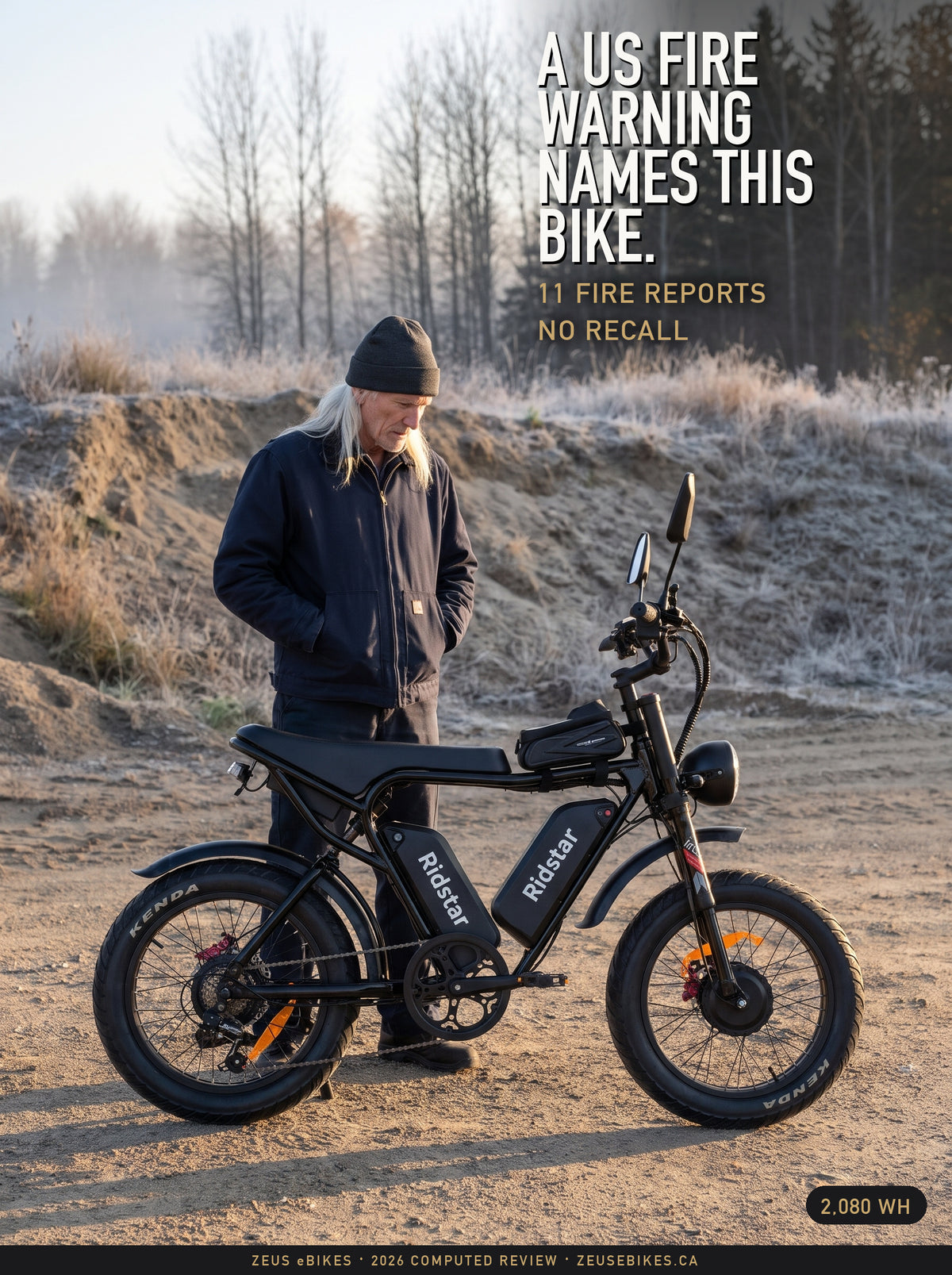
Zeus with a black Ridstar Q20 Pro in a private gravel pit in the Oak Ridges Moraine, Ontario: a Playcut.ai rendering made from the Q20 Pro photograph in ridstar.com’s gallery.
By Milad Ghobadibeygvand, BScN (Western University, 2014) · Every Ridstar page, safety record and provincial rule we cite re-read on 28 and 29 October 2026
We sell this bike. Zeus lists the Ridstar Q20 Pro at $2,499. We also sell Ridstar and YVY parts, and the YVY C20 Pro, which YVY prints with the same motors and battery capacity. This review prints the US safety warning first and our own service record as it stands, and the verdict says who should and should not consider the bike.
Zeus eBikes, a Canadian e-bike store that sells the Ridstar Q20 Pro, puts this first: on March 19, 2026 the US Consumer Product Safety Commission warned consumers to “immediately stop using Ridstar Q20 and Q20 Pro e-bikes” because their batteries and wires can ignite. It counts 11 reports of fire and says the maker refused a recall. Health Canada lists no recall or warning for Ridstar; UK and EU records from 2025 name three other Ridstar models and their chargers as a serious fire risk, in a shipment rejected at the border.
- What it is: a moped-style fat-tire bike with two 1,000 W hub motors and two 52 V 20 Ah batteries (2,080 Wh); ridstar.com prints a top speed of 34 mph (55 km/h), and Ridstar’s own infographic 37 mph (60 km/h).
- Range: about 123 km at 32 km/h for an 80 kg rider on level pavement at 25 °C, and 100 km at 0 °C (modelled).
- Fit: Ridstar prints a rider window of 5′4″ to 6′2″ (163 to 188 cm) but no seat height or standover; the saddle table of our US sister store, RedTail eBikes, built on 6,068 measured adults, puts the saddle top about 93 cm above the pedal axle for a typical 5′10″ rider. Under about 5′4″, sit on the bike before buying.
- On our ride: with a rider of about 100 kg it climbed a farm hill easily and handled rough ground; the suspension was its weak point.
- Law: its 2,000 W is outside every provincial e-bike rule, so no province lets it ride roads, bike lanes or paths as an e-bike.
- Verdict: in our view, a private-land machine for riders who have read the warning and accept it; for roads, a bike rated at 500 W or less, such as the Eahora DL2000.
- At Zeus: the Ridstar Q20 Pro is $2,499; the comparison sets it beside the Eahora DL2000, Eunorau Defender-S 2.0, Tesway X9 Ultra and YVY C20 Pro.
Milad rides the Q20 Pro on Ontario farm lanes in November in “Honest Review: Ridstar Q20 Pro Dual Motor 2000W Retro E-Bike”, published on our YouTube channel on September 27, 2025, nearly six months before the CPSC warning. The frame, weight and load figures in its description came from our listing at the time; this review follows Ridstar’s own pages, which print different ones or none.
- The bike’s figures: the Q20Pro page and product record on ridstar.com, a dealer by the statement on Ridstar’s official site that “Except ridstar.net, other similar websites are our dealers”; the 12 images in its gallery, read for the text they print; Ridstar’s official site, ridstar.net, through its product page as archived on August 30, 2026, because the product address now opens the shop’s home page; and a dealer guide on ridstar.eu with the display manual it links. Each read in a headless browser on 28 or 29 October 2026 and saved.
- Safety records: both CPSC warnings, read word for word on 28 October; Health Canada’s recall search, archived records included, on 29 October, beside a control search for “e-bike” that returned results; the CPSC site search for YVY, beside a control for Ridstar that returned both warnings; the EU Safety Gate and the UK’s product safety register on 29 October, each beside a control for “e-bike” that returned results and a nonsense word that returned none. Australia’s product safety site answered our request with “Access Denied”, so it is not in this check.
- Range: the range model behind the Ridstar Q20 Pro review of our US sister store, RedTail eBikes, run unchanged on Ridstar’s figures, in metric and at Canadian temperatures.
- Fit: RedTail’s saddle table, built on the US Army’s ANSUR II survey of 6,068 measured adults, set against Ridstar’s rider window.
- Law: 44 quoted passages from the statutes and regulator pages of 13 provinces and territories and the federal regulations, re-read on 29 October 2026 wherever the site allowed it (the method note under the law table names the exceptions).
- Our own record: our review video; every transcribed customer call that names the bike and three Zeus mailboxes, searched for fire, smoke or overheating.
- The questions: the ones answered here are those people type into Google and Bing, the ones our own Search Console records, and the ones four AI search engines were asked on 29 October 2026.
In this review
- Is the Ridstar Q20 Pro safe? The CPSC warning
- What Ridstar prints for the Q20 Pro
- What we noticed riding it
- How far the Q20 Pro goes on one charge
- Who the Q20 Pro fits
- Is the Ridstar Q20 Pro legal in Canada?
- How it compares with four bikes we sell
- Who should and should not consider it
- Buying it from us: price, terms and parts
- Ridstar Q20 Pro questions, answered
- Sources
Is the Ridstar Q20 Pro safe? The CPSC warning
The US Consumer Product Safety Commission told owners in March 2026 to “immediately stop using Ridstar Q20 and Q20 Pro e-bikes”, and we still sell the Q20 Pro in Canada. A battery fire at home is the cost of a wrong decision, so this review prints the warning first, then the bike’s range, fit and legal status.
The Commission has issued two warnings on the Q20 family. The March one, on fire, names the Q20 Pro; the June one, on front wheels, names the Q20 and the Q20 Lite but not the Pro. Both are warnings, not recalls: the Commission says the manufacturer refused a recall in March and did not answer it in June.
| March 19, 2026, No. 26-337 | June 25, 2026, No. 26-584 | |
|---|---|---|
| Models named | “Ridstar Q20 and Q20 Pro e-bikes” | “Ridstar Q20 and Q20 Lite e-bikes” |
| Hazard | “The e-bikes’ batteries and wires can ignite, posing a fire hazard to consumers.” | “The front wheel can detach without warning, posing a crash hazard to consumers.” |
| Reports | 11 reports of fire, including one burn injury, five reports of smoke inhalation and two reports of property damage totalling over US$40,000 | 32 reports of the front wheel detaching, including 31 reports of injuries |
| What it tells owners | “remove the battery from the e-bike immediately and dispose of the battery following local hazardous waste disposal procedures. Do not sell or give away these hazardous batteries.” | “stop using the e-bikes immediately and dispose of them” |
| The maker | “has refused to agree to an acceptable recall”; “The company objects to this press release.” | “has been unresponsive to CPSC’s requests for information about these products or a recall” |
| Sold at, in the US | Amazon.com, Ridstar.net, Walmart.com | AliExpress.us, Amazon.com, Ridstar.net, Walmart.com |
Both warnings read word for word on 28 October 2026: warning 26-337 and warning 26-584. The maker is named in both as Huizhou Xingqishi Sporting Goods Co., Ltd., of China.
If you own a Q20 Pro
The Commission’s instruction is to take the battery off the bike now and bring it to hazardous-waste disposal; the curb and store recycling boxes are the wrong place for it. In Canada that means your municipality’s household hazardous waste depot; the Commission itself advises calling the depot first to ask whether it accepts a defective lithium-ion battery. Call us at 1-866-938-7580 with your order number before you ride the bike again or order parts for it.
What the warning does not say
Neither warning mentions Canada; the bikes they describe were sold in the US. Health Canada’s recall database returned “No results found” for Ridstar, for Q20 and for the maker’s name on 29 October 2026, with archived records included, while the same search for “e-bike” listed three entries. With no recall at Health Canada or the CPSC, no refund, repair or replacement programme exists in either country.
Ridstar’s official site no longer lists the Q20 Pro: its product address now opens the home page. When the page was last archived, on August 30, 2026, it opened with two notes: “Non-professionals please do not adjust the controller circuit” and “Front tires must be securely installed”.
Records in the UK and the EU
Britain’s Office for Product Safety and Standards published Product Safety Report 2506-0011 on June 19, 2025, on “Ridstar E-Bikes Q20-Plus, Q20-Mini, E26 Pro and Chargers presenting a serious fire risk”. It found that “the charger has poor quality soldering, and the transformer does not meet the minimum requirements for creepage and clearance distances”, and it records that “The import has been rejected at the border.”
The EU Safety Gate alert SR/02883/25, notified by the UK in respect of Northern Ireland and published on July 31, 2025, records the same three models, fire and electric shock as the risks, and the same import rejected at the border. Neither record is a recall, and neither names the Q20 Pro.
| Register | Searched for | Control | Result |
|---|---|---|---|
| Health Canada, archived records included | “ridstar”, “q20”, the maker’s name | “e-bike”: three entries | No results |
| US CPSC | “Ridstar”, “YVY” | Ridstar: both warnings | Warnings 26-337 (fire: Q20, Q20 Pro) and 26-584 (front wheel: Q20, Q20 Lite); nothing for YVY |
| EU Safety Gate, 2005 to 2026 | “ridstar”, “ridestar”, “q20 pro”, “q20”, the maker’s and the trading company’s names | “e-bike”: 25 alerts; a nonsense word: none | One alert, SR/02883/25 (Q20-Plus, Q20-Mini, E26 Pro); none names the Q20 Pro |
| UK OPSS | the same six terms | “e-bike”: 171 reports; a nonsense word: none | One report, 2506-0011 (Q20-Plus, Q20-Mini, E26 Pro); none names the Q20 Pro |
| Australia, Product Safety | “ridstar” | none possible | Could not read: the site answered “Access Denied” (HTTP 403) |
Searched on 29 October 2026; the two CPSC warnings were read word for word on 28 October. A register counts as checked only when its control found results.
What our own records show
Our own service record holds no verified fire on a Ridstar Q20 Pro we sold. We reached that after reading, on 29 October 2026, every transcribed customer call that names the bike and searching three Zeus mailboxes for fire, smoke, melting, swelling or overheating. It counts only what we could read: our call transcripts are complete only from March 2026, and a caller may never name the model.
Takeaway: if you own a Q20 Pro, the Commission’s instruction comes before anything else on this page; if you are deciding whether to buy one, weigh the warning before the specifications.
Want to talk it through before you decide? Call 1-866-938-7580 and tell us where you ride, how far and how much you weigh with your gear; we will tell you whether the Q20 Pro or one of the bikes below fits, and why.
See the four bikes beside it →What Ridstar prints for the Q20 Pro
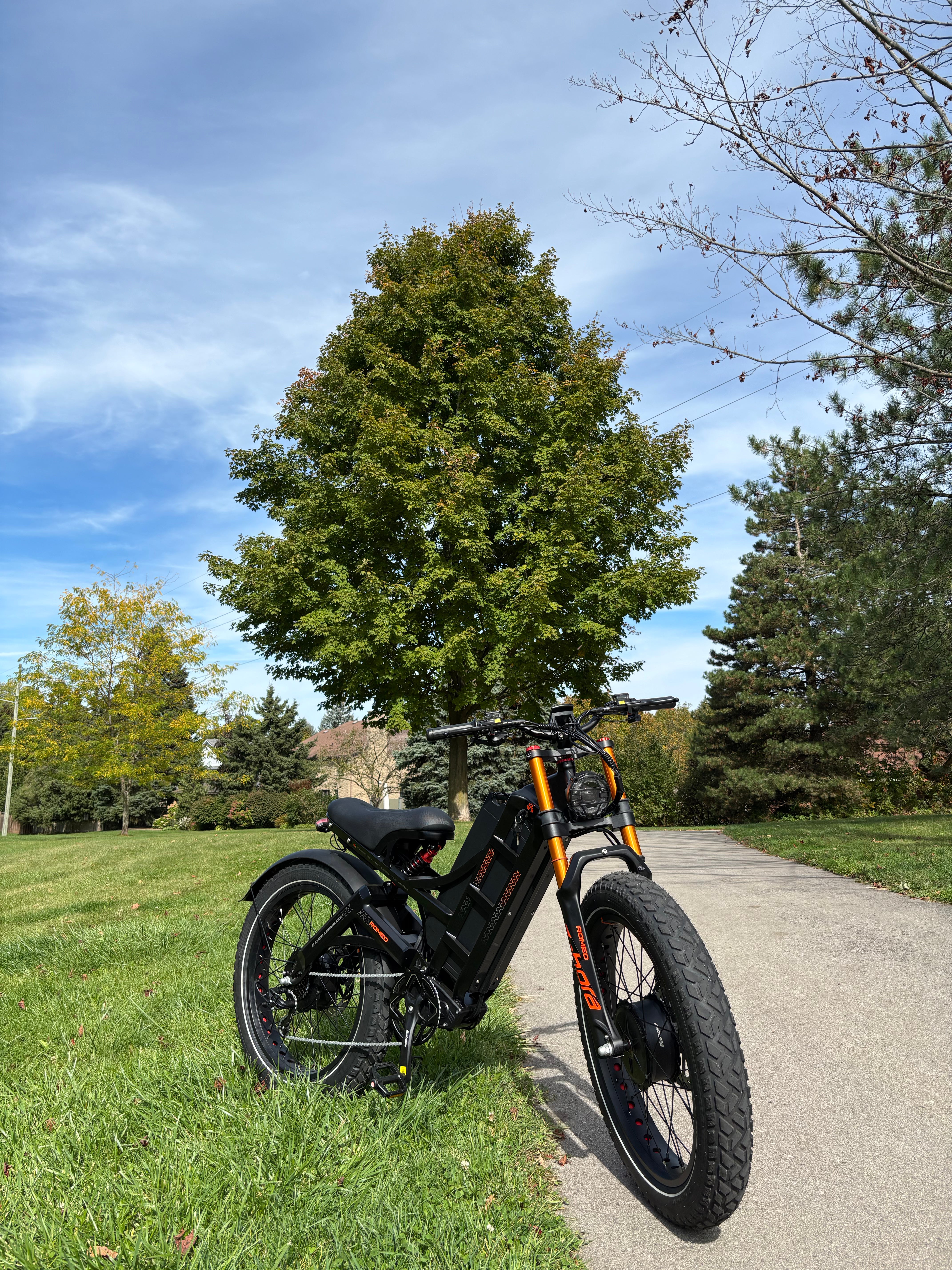
Ridstar prints two 1,000 W hub motors, 90 N·m of torque per motor, two 52 V 20 Ah batteries (2,080 Wh) and three top speeds from 28 to 37 mph (45 to 60 km/h). Its page, product record, gallery images, archived official page and the dealer-linked display manual print no bike weight, maximum load, seat height or water rating.

The Ridstar Q20 Pro in our studio: the photograph on our listing.
| What it measures | What Ridstar prints | In metric |
|---|---|---|
| Motors | “2000W (1000W*2)”, “dual front and rear motors, each with a power of 1000W” | Two 1,000 W hub motors, one in each wheel |
| Torque | “a powerful torque of 90NM x 2” | 90 N·m per motor |
| Battery | “52V 40AH (20AH*2)”; Ridstar’s own site: “two UL-certified 52V 20Ah batteries, totaling 40Ah” | 2,080 Wh (52 V × 40 Ah) |
| Top speed | “Max Speed 34 MPH” in ridstar.com’s specifications; “37MPH Top Speed” on Ridstar’s infographic on the same page; Ridstar’s own site printed “a top speed of 28+++mph” in August | 55, 60 and 45 km/h |
| Range claim | “Max Range 75 Miles(Throttle)/180 Miles(Assist Mode)” | 121 km on the throttle, 290 km with pedal assist |
| Rider height | “Recommended Height 5'4" -6'2"” | 163 to 188 cm |
| Tires | “20×4 Inch Fat Bike Tires” | 20 × 4.0 in |
| Brakes | “Dual Hydraulic Brakes Fron and Rear” [sic] | Hydraulic disc, front and rear |
| Suspension | “dual suspension (front fork and rear shock absorber)” | Front fork and rear shock |
| Gears | “7-speed Shimano Mechanical Shifting” | 7 speeds |
| Frame | “Frame Material Aluminum” | Aluminium |
| Charging | “4 to 6 Hours” | 4 to 6 hours |
| Bike weight | Not printed on any page, record, image or manual we read. ridstar.net’s product record carries a 39,916 g catalogue field that it does not label as the bike’s weight | 39.9 kg, if that field is the bike |
| Maximum load | Not printed on any page, record, image or manual we read | None published |
| Warranty | Ridstar’s official site: “One year warranty on all products” | One year |
Read on 28 October 2026 from ridstar.com’s Q20Pro page and its product record, and from ridstar.net’s Q20Pro page as archived on August 30, 2026; the warranty line is on ridstar.net’s home page; the infographic is image 3 of ridstar.com’s gallery. Our own listing printed different figures for frame, weight and load; this review follows Ridstar’s pages.
Q20 or Q20 Pro: what is the difference?
The Q20 1500W carries one 1,500 W motor and one 48 V 20 Ah battery (960 Wh). The Q20 Pro carries two 1,000 W motors, one in each wheel, and two 52 V 20 Ah batteries, for 2,000 W and 2,080 Wh. Both are named in the March fire warning; only the Q20 is also named in the June front-wheel warning. We no longer sell the Q20, and its page sets out both warnings.
Is the YVY C20 Pro the same bike?
YVY sells a C20Pro in Australia and a K20Pro in the US with the same printed motors and battery capacity: “2000W motor(2*1000W)” and “52V/40Ah(Dual Battery)”. Its Australian page repeats 16 of its 47 description sentences word for word from Ridstar’s archived Q20 Pro page, with only the model name changed.
Shared text does not show shared parts, and no YVY or Ridstar page we read says the two are the same bike. YVY calls its batteries UL-certified, and the CPSC’s site search returned “No Results.” for YVY on 29 October 2026. Our YVY C20 review covers YVY’s single-motor C20.
Takeaway: Ridstar’s figures for the Q20 Pro are claims from its own pages, and they print three top speeds, from 45 to 60 km/h; there is no published weight or load limit to plan around.
What we noticed riding the Ridstar Q20 Pro
In our own review video, filmed on Ontario farm lanes in November with a rider of about 100 kg (220 lb), the Q20 Pro climbed a farm hill easily and handled rough ground. Its weak point was the suspension, which made rough ground hard work. These are impressions from a single ride.
- Climbing: on a farm hill, Milad says on camera, “We’re just going up this hill like it’s nothing.”
- Rough ground: “I mean, guys, look at this terrain.” A moment later: “this is rough. And this is just eating it up.”
- Suspension: “I just wish it had better suspension,” and later, “It’s not very easy riding on this with this suspension especially.”
- Brakes: “I keep forgetting that my rear brake is the left one.” On this bike the left lever works the rear brake, so try both levers at a walking pace before you ride.
The quotes come from the video’s own captions. It was filmed before the CPSC warning, and nothing in it was measured: the speed, range and load figures on this page come from Ridstar’s pages and RedTail’s model.
Takeaway: on our ride the two motors were the Q20 Pro’s strength and the suspension its weakness; if your ground is rough, sit on the bike and ask us about its fork and shock before you order.
How far the Ridstar Q20 Pro goes on one charge
About 123 km at 32 km/h without pedalling, for an 80 kg rider on level pavement at 25 °C, and about 100 km at 0 °C, in the range model of our US sister store, RedTail eBikes, run on Ridstar’s figures. Ridstar’s 180-mile claim (290 km) is a pedal-assist figure: the model reaches it only with steady, firm pedalling.
The model is RedTail’s, built for its Ridstar Q20 Pro review: road-power physics from Martin and colleagues (1998), a hub-motor curve from Bafang, rolling resistance measured on fat tires, and battery capacity that falls with the cold. We ran it unchanged, in metric and at Canadian temperatures, on Ridstar’s two motors and 2,080 Wh. At 32 km/h it uses 16.9 Wh per kilometre.
| Speed | Rider 60 kg | Rider 80 kg | Rider 100 kg | Rider 118 kg | 80 kg, keeping 25 % in reserve |
|---|---|---|---|---|---|
| 20 km/h | 193 km | 182 km | 172 km | 164 km | 136 km |
| 25 km/h | 163 km | 155 km | 148 km | 142 km | 117 km |
| 32 km/h | 128 km | 123 km | 118 km | 115 km | 92 km |
| 40 km/h (private land only) | 97 km | 94 km | 91 km | 89 km | 71 km |
Level pavement, no wind, 25 °C, no pedalling, the full 2,080 Wh. With no maximum load from Ridstar, the rows stop at 118 kg (260 lb), where RedTail’s model stops.
Cold takes range in two ways: the battery holds less energy, and colder air and stiffer tires cost more to push through. At 32 km/h the 80 kg rider’s 123 km falls to 100 km at 0 °C and 72 km at −20 °C in the model. Ridstar’s pages, product records and gallery images that we read print no temperature range for the battery; the display manual that a dealer’s guide links rates the display from −20 to 60 °C.
| Air temperature | At 25 km/h | At 32 km/h |
|---|---|---|
| 25 °C | 155 km | 123 km |
| 10 °C | 136 km | 108 km |
| 0 °C | 127 km | 100 km |
| −10 °C | 115 km | 91 km |
| −20 °C | 91 km | 72 km |
80 kg rider, level pavement, no wind, no pedalling, the full pack. Snow and slush are not modelled and cost more.
Pedalling changes the answer more than anything else. At 25 km/h the model gives 155 km on the throttle, 206 km with an easy 75 W from the rider and 302 km with a firm 150 W, which is where Ridstar’s 290 km assist figure sits. Climbing costs about 41 to 45 Wh for every 100 m of height at 15 km/h, about 2 % of the pack; a ride held on a steady 4 % grade at 20 km/h would end after 76 km instead of 182.
The model does not price wind, stops and starts, soft ground, a hot battery or how the bike’s two controllers share the work between the motors. Read its figures as a planning range for steady riding.
Takeaway: in our model, plan on about 92 km at 32 km/h in summer with a quarter kept in reserve, and about 72 km at −20 °C on the full pack.
Who the Ridstar Q20 Pro fits
Ridstar prints a rider window of 5′4″ to 6′2″ (163 to 188 cm) and publishes no seat height, standover or reach, so no published number tells you whether your feet reach the ground. The table shows where the standard formula puts your saddle; sit on the bike, or call us with your inseam, before you decide.
| Your height | Typical inseam | Saddle top to pedal axle, at 109 % of inseam |
|---|---|---|
| 5′0″ (152 cm) | 27.1–29.7 in (69–75 cm) | 31.0 in (79 cm) |
| 5′2″ (157 cm) | 28.0–31.1 in (71–79 cm) | 32.2 in (82 cm) |
| 5′4″ (163 cm) | 29.1–32.2 in (74–82 cm) | 33.3 in (85 cm) |
| 5′6″ (168 cm) | 30.2–33.5 in (77–85 cm) | 34.5 in (88 cm) |
| 5′8″ (173 cm) | 31.1–34.3 in (79–87 cm) | 35.6 in (90 cm) |
| 5′10″ (178 cm) | 32.2–35.5 in (82–90 cm) | 36.8 in (93 cm) |
| 6′0″ (183 cm) | 33.2–36.7 in (84–93 cm) | 38.1 in (97 cm) |
| 6′2″ (188 cm) | 34.3–37.5 in (87–95 cm) | 39.3 in (100 cm) |
| 6′4″ (193 cm) | 36.3–39.1 in (92–99 cm) | 41.0 in (104 cm) |
From the saddle table in RedTail’s Ridstar Q20 Pro review: inseam bands are the middle 90 % of the US Army’s ANSUR II bodies at each height, and 109 % of inseam is the saddle height Peveler and colleagues (2005) set against the heel method. The figure runs from the pedal axle to the top of the saddle; a seat height is measured from the ground.
Ridstar’s window says nothing about inseam, and two riders of the same height can differ by about 8 cm in leg length. If you are near the bottom of the window, or your legs are short for your height, measure your inseam in socks against a wall and compare it with the table before you order.
No maximum load for the Q20 Pro appears on ridstar.com, its product record or its archived ridstar.net page, so there is no maker figure for how much rider and cargo it is built to carry.
Takeaway: if you are under about 5′4″, or your legs are short for your height, sit on the bike before you buy: Ridstar publishes nothing that answers whether your feet reach the ground.
Is the Ridstar Q20 Pro legal in Canada?
No province lets the Q20 Pro ride roads, bike lanes or paths as an e-bike. Ridstar prints two 1,000 W motors and up to 37 mph (60 km/h), and every provincial e-bike definition stops at 500 W and 32 km/h. Newfoundland and Labrador’s Act has no e-bike definition and, as written, makes it a motor vehicle.
| Jurisdiction | The words that decide it (read 28–29 October 2026) | The Q20 Pro as Ridstar prints it |
|---|---|---|
| Federal | Motor Vehicle Safety Regulations, s. 2: the power-assisted bicycle definition reads “Repealed, SOR/2020-22, s. 3”, effective February 4, 2021. | No federal e-bike definition applies to any bike. |
| Ontario | Highway Traffic Act s. 1(1) points at the federal definition repealed in 2021; O. Reg. 369/09 s. 1: “The unladen weight of a power-assisted bicycle must not be more than 120 kilograms”; ontario.ca lists “an electric motor not exceeding 500 watts” (Riding an e-bike). | Outside: Ridstar prints 2,000 W. The 39.9 kg catalogue weight is under 120 kg. |
| Québec | SAAQ: an electric bicycle must have “a maximum power rating of no more than 500 watts and must cease to generate power once the bicycle reaches a speed of no more than 32 km/h” (SAAQ). | Outside on power and speed. |
| British Columbia | B.C. Reg. 64/2024 s. 3: every motor assisted cycle needs motors with “a continuous power output rating that, in total, does not exceed 500 W” and no assistance past 32 km/h; s. 6 sets lower limits for its light e-bike class. | Outside. |
| Alberta | AR 304/2002 s. 1(1)(o): a “power-assisted bicycle under the Motor Vehicle Safety Regulations (Canada)”, the federal definition repealed in 2021. | Outside the referenced 500 W. Our Alberta e-bike law page explains the reference. |
| Saskatchewan | Registration Exemption and Reciprocity Regulations, 2014 s. 2(1)(f): “a total continuous power output rating of 500 watts or less when measured at the shaft of each motor”; SGI: e-bikes “larger than 500 watts or without pedals are considered motorcycles” (SGI). | Outside: a motorcycle on SGI’s reading. |
| Manitoba | Highway Traffic Act s. 1(1): a motor with a “continuous power output rating, measured at its shaft, of 500 W or less”. | Outside. |
| Nova Scotia | N.S. Reg. 221/2026 s. 3: “a total continuous nominal power output rating, measured at the shaft of each motor, of 500 W or less”, with no assistance once the bicycle “reaches a speed of 32 km/h on level ground”. | Outside on power and speed. |
| New Brunswick | No e-bike definition in the Motor Vehicle Act; Service New Brunswick treats a vehicle with a motor “equal to or less than 500W” that cannot assist past 32 km/h as a bicycle (GNB). | Not a bicycle on that guidance. |
| Prince Edward Island | Power-Assisted Bicycles Regulations: motors with “continuous power output ratings that in total do not exceed 500 watts”, and none “capable of propelling the power-assisted bicycle at a speed greater than 32 kilometres per hour on level ground”. | Outside on power and speed. |
| Newfoundland and Labrador | Highway Traffic Act has no e-bike definition: a vehicle “propelled, driven or controlled otherwise than by muscular power” is a motor vehicle, and a moped has “a power source that produces a maximum 1.5 k.w”, a speed “not exceeding 50 kilometres an hour” and “a maximum weight of 55 kilograms”. | Two readings. As written, a motor vehicle, which on a highway needs registration (s. 10(1)), insurance (s. 75(1)) and a driver’s licence (s. 43(1)); its 2,000 W is above the moped limit of 1.5 kW at any speed setting. Read the other way, the province “currently follows federal standards” (CBC News), meaning the definition repealed in 2021, whose 500 W the Q20 Pro is past. |
| Yukon | Motor Vehicles Act s. 1, electric power-assisted cycle: “500 W or less in total for the motor or combination of motors”. | Outside. |
| Northwest Territories | The All-terrain Vehicles Act counts a “pedal bicycle with motor attachment” among all-terrain vehicles; the Motor Vehicles Act defines a bicycle as “a cycle having any number of wheels that is propelled by human power”. | An all-terrain vehicle by that Act’s list. |
| Nunavut | The All-terrain Vehicles Act counts “a pedal bicycle with motor attachment”; the Traffic Safety Act defines a bicycle as propelled by “human muscular power” and a moped whose motor cannot let it “attain a speed greater than 70 kilometres per hour”. | Two readings: an all-terrain vehicle, or a moped, which is a motor vehicle. Ask the territory before riding near a road. |
Passages re-read on 29 October 2026. Québec’s French and FAQ pages and Nunavut’s legislation site refused automated reads that day; Québec is quoted from SAAQ’s English page, read the same day, and Nunavut’s two Acts were last read on 28 October from the territory’s consolidation downloads. The Northwest Territories’ Acts were read from Internet Archive copies.
Off public roads, the landowner, trail authority or track sets access; check the off-road vehicle rules where you ride. A dealer’s guide for this bike lists a display speed setting from 1 to 100 km/h, and a speed setting does not change the motors’ rating; Ontario says it is “also illegal to modify your e-bike’s electric motor to make it more powerful or to increase the assisted speed of the bike”. Our Canadian e-bike law guide and 500 W, 750 W and 1,000 W guide explain the provincial rules in full.
Takeaway: buy the Q20 Pro only for private land or a track you have permission to ride; for roads and bike lanes, pick a bike rated at 500 W or less.
How the Q20 Pro compares with four bikes we sell
None of the four bikes below is named in either 2026 CPSC warning, and only the Eahora DL2000 is rated within the provincial 500 W and 32 km/h figures on its maker’s Canadian page. The YVY C20 Pro prints the Q20 Pro’s motors and battery capacity under another brand; the Defender-S 2.0 and X9 Ultra are all-wheel-drive mountain bikes.
| Bike | Price at Zeus | Motors, as the maker prints them | Battery | Top speed (maker) | Weight, load (maker) | Certification claim (maker) |
|---|---|---|---|---|---|---|
| Ridstar Q20 Pro | $2,499 | 2 × 1,000 W hubs | 2,080 Wh (52 V 40 Ah) | 55 km/h (34 mph) in its specifications; 60 km/h (37 mph) on its infographic | Not printed | Batteries “UL-certified” (archived ridstar.net); no standard named |
| Eahora DL2000 | $3,799 | “2 x 250 Watt” rear hub | 1,560 Wh (52 V 30 Ah) | 32 km/h | 74.5 kg (164.2 lb) with battery; 150 kg (330 lb) | None printed |
| Eunorau Defender-S 2.0 | $3,799 | “Dual 48V 500W hub motors”; the same page: “1,500W of combined rated power” | 816 Wh (48 V 17 Ah) | 32 km/h, up to about 45 km/h by setting | 40.5 kg (89.3 lb); 136 kg (300 lb) with rider | “UL CERTIFIED Yes” |
| Tesway X9 Ultra | $2,999 | “4000W peak power and 240Nm max torque”, two motors | 1,800 Wh (60 V 30 Ah) | 70 km/h | 180 kg load | “UL 2849 certified by TÜV”, battery “UL 2271” |
| YVY C20 Pro | $2,599 | “2000W motor(2*1000W)” | 2,080 Wh (52 V 40 Ah) | 60 km/h (37 mph) | 150 kg (330 lb) load | Batteries “UL-certified”; no standard named |
Maker figures read on 28 and 29 October 2026 from Eahora Canada, Eunorau Canada, Tesway Canada, YVY Australia and Ridstar’s pages; prices from our store on 29 October 2026. The CPSC warnings name only Ridstar models.

Eahora DL2000
$3,799 CADWho it is for. Riders who want the Q20 Pro’s moped shape and a big pack on a bike whose maker rates it within the provincial 500 W and 32 km/h figures; read your province’s rules in our law guide before you ride it on a road.
What the maker prints. Eahora Canada prints “Motor Power 2 x 250 Watt”, “1,560 Watt·hour (52V 30Ah)”, “32km/h for both pedal-assist and throttle”, hydraulic disc brakes with 240 mm rotors and a 20 × 4.5 in tire.
The honest part. At 74.5 kg with its battery it is a heavy bike to lift or push, and Eahora prints its torque two ways on one page. Our DL2000 review covers it in full.

Eunorau Defender-S 2.0 / Hunter X6
$3,799 CADWho it is for. Riders who want two driven wheels and full suspension on loose ground, in a mountain-bike frame with a torque sensor.
What the maker prints. Eunorau Canada prints “Dual 48V 500W hub motors” and, on the same page, “1,500W of combined rated power”, a four-bar rear suspension, a torque sensor and “UL CERTIFIED Yes”.
The honest part. Eunorau prints its motor rating two ways and sells the bike as a pre-order; its Canadian page printed 750 W per motor when our Defender-S 2.0 review read it on 7 October and 500 W on 29 October. Ask us which applies to the bike you would receive.

Tesway X9 Ultra
$2,999 CADWho it is for. Riders who want more power than the Q20 Pro on a mountain-bike frame, with the whole system certified to a named standard.
What the maker prints. Tesway Canada prints “4000W peak power and 240Nm max torque”, a 60 V 30 Ah battery, 70 km/h and “The entire e-bike system is UL 2849 certified by TÜV, while the battery pack is UL 2271 certified”.
The honest part. Like the Q20 Pro, it is outside every provincial e-bike rule on power and speed: a private-land bike. Our X9 Ultra review covers range, fit and the law.

YVY C20 Pro
$2,599 CADWho it is for. Riders who want the Q20 Pro’s printed motors, battery capacity and moped shape from a brand no CPSC warning names, with a load limit the maker prints.
What the maker prints. YVY’s Australian page prints “2000W motor(2*1000W)”, “52V/40Ah(Dual Battery)”, “Max Load: 330lbs”, “Max Speed:37mph” and “two UL-certified 52V 20Ah batteries”.
The honest part. YVY’s page repeats a third of its description word for word from Ridstar’s Q20 Pro page, and no page we read says whether the two share parts. It is outside every provincial e-bike rule.
Takeaway: if roads are part of your riding, the DL2000 is the one bike here its maker rates within the provincial 500 W and 32 km/h figures; for private land, compare the certification lines before the power figures.
Who should and should not consider the Ridstar Q20 Pro
In our view, consider the Q20 Pro only for private land or a track, if you want two motors and 2,080 Wh at $2,499 and still want the bike after reading a US stop-use fire warning that has no recall behind it. Skip it for roads, paths and bike lanes, for teenagers, and if the warning settles it for you.
Consider it if you ride off public roads with the landowner’s permission, are inside Ridstar’s 5′4″ to 6′2″ window, want about 123 km at 32 km/h on level ground in summer in our model (less on soft ground and in the cold), and will follow the Commission’s battery instruction to the letter if you already own one.
Skip it if you commute on roads, paths or bike lanes, if the rider is a teenager, or if a CPSC fire warning with no recall remedy is reason enough for you to choose a bike neither CPSC warning names.
Strengths
- Two 1,000 W hub motors and two 52 V 20 Ah batteries, 2,080 Wh in all (Ridstar’s figures).
- About 123 km at 32 km/h on level pavement at 25 °C for an 80 kg rider (RedTail’s model, run on Ridstar’s figures).
- On our own ride, with a rider of about 100 kg, it climbed a farm hill easily and handled rough ground.
- Hydraulic disc brakes front and rear and 20 × 4.0 fat tires (Ridstar’s figures).
- Parts sold in Canada by us: a controller, brake pads and a crank arm with a Q20 Pro option.
Weaknesses
- A US CPSC warning of March 19, 2026 names it: its batteries and wires can ignite, 11 fire reports, and the maker refused a recall.
- Its 2,000 W is outside every provincial e-bike rule, so no province lets it ride roads, bike lanes or paths as an e-bike.
- On our own ride the suspension made rough ground hard work.
- Ridstar prints no bike weight, maximum load or seat height, and three different top speeds.
- Ridstar’s official site no longer lists the bike.
That verdict is our opinion, formed from the facts above, and the facts are printed so you can reach your own.
Buying it from us: price, terms and parts
We list the Ridstar Q20 Pro at $2,499 with free shipping across Canada; orders are “processed within 1-3 business days” and arrive in 2 to 7 business days depending on where you live. It carries Ridstar’s warranty, which Ridstar’s official site prints as “One year warranty on all products”, backed by Ridstar in full; we handle the claim for you.
Our refund policy accepts “unused and unopened items within 15 days of delivery”, with “a 15% restocking fee and any applicable shipping charges” unless the return is our error. Your first month of Zeus Care is included with every e-bike; Zeus Care is a service plan, and our warranty page says plainly that it “is not a warranty and does not add coverage”. Our financing guide shows what a monthly plan costs.
For owners, we sell Q20 Pro parts: the controller, brake pads and a crank arm, each with a Q20 Pro option. Call us before you order a part for a bike the warning names.
If you have read the warning and still want the Q20 Pro for private land, it is $2,499 at Zeus, shipped free across Canada. Call 1-866-938-7580 first if you would like to talk it through.
See the Ridstar Q20 Pro, $2,499 →Takeaway: before you pay, call 1-866-938-7580 with your height, inseam and where you ride; returns are accepted unused and unopened within 15 days of delivery, less a 15% restocking fee.
Ridstar Q20 Pro questions, answered
Has the Ridstar Q20 Pro been recalled?
No. The US Consumer Product Safety Commission’s March 19, 2026 notice is a warning telling owners to “immediately stop using Ridstar Q20 and Q20 Pro e-bikes”, and it says the maker refused an acceptable recall. Health Canada lists no recall or warning for Ridstar, so no refund, repair or replacement programme exists in either country. UK and EU records from 2025 cover a shipment of three other Ridstar models (Q20-Plus, Q20-Mini, E26 Pro) and their chargers, rejected at the border as a serious fire risk; neither record is a recall or names the Q20 Pro.
Is the Ridstar Q20 Pro safe?
The US Consumer Product Safety Commission says the Q20 and Q20 Pro “pose a risk of serious injury and death” and tells owners to stop using them: its March 2026 warning says the batteries and wires can ignite, counts 11 reports of fire, and tells owners to remove the battery immediately and dispose of it as hazardous waste. Our own service record holds no verified fire on a Q20 Pro we sold.
How fast does the Ridstar Q20 Pro go?
Ridstar prints three figures: “Max Speed 34 MPH” (about 55 km/h) in ridstar.com’s specifications, “37MPH Top Speed” (about 60 km/h) on its infographic, and “a top speed of 28+++mph” on its own site in August 2026. All three are above 32 km/h, where the provincial e-bike rules stop assistance, so that speed belongs on private land.
How many miles can the Ridstar Q20 Pro go?
Ridstar claims 75 miles (121 km) on the throttle and 180 miles (290 km) with pedal assist. RedTail’s model, run on Ridstar’s figures, gives about 123 km at 32 km/h for an 80 kg rider on level ground at 25 °C, 100 km at 0 °C and 72 km at −20 °C; it reaches Ridstar’s 290 km only with firm pedalling at 25 km/h.
How much does the Ridstar Q20 Pro weigh?
Ridstar prints no bike weight. Its ridstar.net product record carries a catalogue weight of 39,916 g (39.9 kg, 88 lb) without labelling it as the bike’s weight.
What is the Ridstar Q20 Pro’s weight limit?
Ridstar prints no maximum load for the Q20 Pro on ridstar.com, its product record or its archived ridstar.net page. YVY prints 330 lb (150 kg) for its C20 Pro, a different maker’s figure for a bike sold under another brand.
Is the Ridstar Q20 Pro legal in Canada?
Not as an e-bike. Ridstar prints two 1,000 W motors and top speeds of up to 37 mph (60 km/h), and every provincial e-bike definition stops at 500 W and 32 km/h, so no province lets it ride roads, bike lanes or paths as an e-bike. Newfoundland and Labrador’s Act has no e-bike definition and reads two ways; off public roads, the landowner sets access.
Does the Ridstar Q20 Pro have a speed limiter, and can I make it faster?
A dealer guide for the bike on ridstar.eu lists a display speed setting from 1 to 100 km/h; we do not publish how to change it. A setting does not change the motors’ 2,000 W rating, Ontario says it is “also illegal to modify your e-bike’s electric motor to make it more powerful or to increase the assisted speed of the bike”, and the Commission’s warning concerns the batteries and wires that a faster setting works harder.
What is the Ridstar Q20 Pro’s seat height?
Ridstar publishes no seat height, standover or reach for the Q20 Pro, only a rider window of 5′4″ to 6′2″ (163 to 188 cm). The standard formula puts your saddle top at 109 % of your inseam above the pedal axle, about 93 cm for a 5′10″ rider with a typical inseam.
What tire size does the Ridstar Q20 Pro use?
The tires are 20 × 4 inch fat tires, by Ridstar’s figures. Ridstar prints no tire pressure; use the range printed on the tire’s own sidewall.
Is the Ridstar Q20 Pro waterproof?
Ridstar prints no water or IP rating for the Q20 Pro on ridstar.com, its product record or its archived ridstar.net page. Keep it out of standing water and dry it before charging.
What is the difference between the Ridstar Q20 and the Q20 Pro?
The Q20 1500W has one 1,500 W motor and one 48 V 20 Ah battery; the Q20 Pro has two 1,000 W motors and two 52 V 20 Ah batteries (2,080 Wh). Both are named in the March 2026 fire warning, and only the Q20 is also named in the June front-wheel warning. We no longer sell the Q20; its page sets out both warnings.
Is the Ridstar Q20 Pro the same as the YVY C20 Pro or K20 Pro?
No page we read says so. YVY prints the same motors and battery capacity for its C20 Pro (K20 Pro in the US), and its Australian page repeats 16 of its 47 description sentences word for word from Ridstar’s Q20 Pro page. YVY calls its batteries UL-certified, and no CPSC warning names YVY.
How long does the Ridstar Q20 Pro battery take to charge?
Charging takes 4 to 6 hours, by Ridstar’s figure. The ridstar.com page we read prints no charger rating.
What do the Ridstar Q20 Pro error codes mean?
The dealer guide on ridstar.eu lists E001 controller failure, E002 communication failure, E003 Hall failure, E004 throttle failure, E005 brake failure and E006 motor phase failure. It says the bike starts only when both batteries are switched on and that each battery drives its own motor; in a reply under the guide, the dealer adds that when the front motor does not work, “95% of the time the connector is not fully connected”.
Where can I get Ridstar Q20 Pro parts in Canada?
We sell a controller, brake pads and a crank arm with a Q20 Pro option. Call 1-866-938-7580 before ordering a part for a bike the CPSC warning names; we will tell you whether the part suits your bike.
Is the Ridstar Q20 Pro good for kids or teenagers?
No. Its two 1,000 W motors and top speeds of up to 37 mph place it outside every provincial e-bike rule, and no provincial minimum age makes a 2,000 W machine a youth bike. For a teenager, our teen e-bike guide covers bikes rated at 500 W or less.
Is the Ridstar Q20 Pro good?
On our own ride it was strong: with a rider of about 100 kg it climbed a farm hill easily and handled rough ground, and two motors and 2,080 Wh are a lot of machine for $2,499. Its suspension made rough ground hard work, and a US CPSC warning names it for battery and wiring fires with no recall behind it, so in our view it suits private land only.
Is the Ridstar Q20 Pro worth it?
In our opinion, only for private-land riding by an adult who has read the US fire warning and still wants the bike: on paper it carries two motors and 2,080 Wh for $2,499. For roads, or if the warning settles it for you, the comparison sets four bikes beside it that neither 2026 CPSC warning names.
Can I buy the Ridstar Q20 Pro in Canada?
Yes, from us at $2,499 with free shipping across Canada. ridstar.com showed its Canada option sold out on 28 October 2026, and Ridstar’s official site no longer lists the bike.
Sources
- US Consumer Product Safety Commission, “CPSC Warns Consumers to Immediately Stop Using Ridstar E-Bikes Due to Fire Hazard; Risk of Serious Injury or Death”, warning 26-337, March 19, 2026 (read 28 October 2026).
- US Consumer Product Safety Commission, “CPSC Warns Consumers to Stop Using Ridstar E-Bikes Immediately Due to Crash Hazard; Risk of Serious Injury or Death”, warning 26-584, June 25, 2026 (read 28 October 2026).
- Health Canada, Recalls and safety alerts search: “ridstar”, archived records included (29 October 2026); the same search for “q20”, for the maker’s name and, as a control, for “e-bike”.
- US Consumer Product Safety Commission, site search: “YVY” (29 October 2026); control search “Ridstar”.
- Office for Product Safety and Standards (UK), Product Safety Report: Ridstar E-Bikes Q20-Plus, Q20-Mini, E26 Pro and Chargers (2506-0011), June 19, 2025; product safety alerts, reports and recalls: “ridstar” (29 October 2026), with “e-bike” as a control.
- European Commission, Safety Gate alert SR/02883/25, Electric bicycle, Ridstar Q20-Plus, Q20-Mini, E26 Pro, July 31, 2025; Safety Gate search for Ridstar, the Q20, the Q20 Pro and the maker’s names, 2005 to 2026 (29 October 2026), with “e-bike” as a control.
- ridstar.com, Ridstar Q20Pro 2000W Fat Tire Electric Bicycle, page, product record and its 12 gallery images (28–29 October 2026).
- ridstar.net, Ridstar Q20Pro 2000W Fat Tire Ebike, as archived by the Internet Archive on August 30, 2026 (read 28 October 2026); home page and Ridstar Official Statement (28 October 2026).
- ridstar.com, Ridstar Q20 1500W 48V 20AH Fat Tire Ebike (28 October 2026).
- ridstar.eu, Essential Guide to RIDSTAR Q20PRO, C20MAX, PRO30 E-Bikes Features, February 29, 2024, and the display manual it links (read 28–29 October 2026).
- YVY, YVY® Upgraded C20Pro 2000W Fat Tire Electric Bicycle (Australia) and YVY K20Pro 2000W 52V40Ah Fat Tire Electric Bicycle (US) (29 October 2026).
- Eahora Canada, Eahora DL2000; Eunorau Canada, DEFENDER S 2.0/Hunter X6; Tesway Canada, TESWAY X9 Ultra (29 October 2026).
- RedTail eBikes, our US sister store, Ridstar Q20 Pro 2026: 11 Fire Reports, No Recall: the range model and the saddle table used here (read 28 October 2026).
- Martin, J. C., Milliken, D. L., Cobb, J. E., McFadden, K. L. and Coggan, A. R. (1998), “Validation of a mathematical model for road cycling power”, Journal of Applied Biomechanics 14(3): 276–291, as implemented in RedTail’s model.
- Peveler, W. W., Pounders, J. D. and Bishop, P. A. (2005), saddle height by the heel method against 109 % of inseam, Journal of Exercise Physiology online 8(1), as cited in RedTail’s saddle table.
- The provincial and territorial statutes, regulations and regulator pages linked in the law table (read 28–29 October 2026).
- Cover: a Playcut.ai rendering made from the Q20 Pro photograph in ridstar.com’s gallery (a Ridstar dealer).
- Zeus eBikes, shipping policy, refund policy and warranty page (29 October 2026); our Ridstar Q20 Pro review video (September 27, 2025).
Corrections and questions about this review: milad@zeusebikes.ca.

Share:
598 E-Bike Websites Sell to Canadians: Who Runs Each
E-Bike Sale Canada 2026: 19 Picks From $1,000