
Richmond BC eBike Trails 2026: Dykes, Iona and the 15 km/h Rule

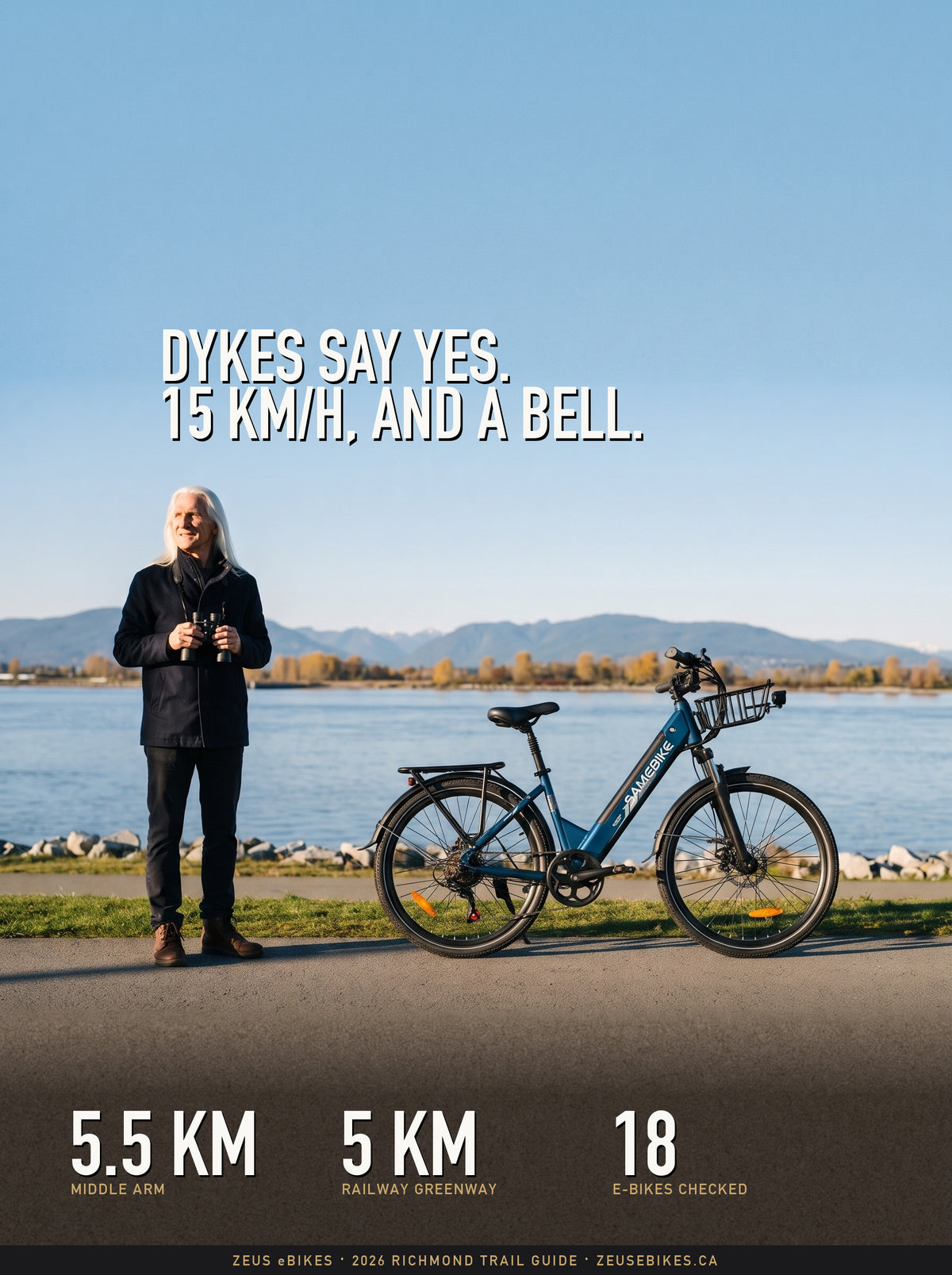
Zeus with the Samebike RS-A01 Pro-T on a riverside dyke path: a Playcut.ai rendering made from Samebike’s own photograph of the RS-A01 Pro-T.
An e-bike that meets B.C.’s rules (pedals, motors of 500 W or less in total, no assistance past 32 km/h, 2 or 3 wheels) may ride Richmond’s dykes, greenways and park paths at 15 km/h or less, the limit two City bylaws set for every bicycle. Sidewalks are off limits unless a sign allows them, and since 9 March 2026 a bike on a street, bike lane or shared path needs a bell. The Canada Line takes one bike per car at any hour. The Massey Tunnel is closed to bikes; the Province’s shuttle runs on weekdays from 1 November 2026 to 1 April 2027. Iona’s jetty trail reads two ways for e-bikes.
Where to buy: the fat tire e-bikes, folding e-bikes and electric trikes below, 18 bikes whose makers list them inside B.C.’s limits, from the $999 Samebike CY20 Pro folder to the $3,699 DWMEIGI Silverado HD.
Last updated: 4 November 2026. Every trail rule, bylaw section, crossing and bike spec below was read again on that date at its source, including each bike’s owner’s manual.
In this guide
- Can you ride an e-bike on Richmond’s trails?
- The 15 km/h rule, sidewalks, bells and fines
- The dykes: West Dyke, South Dyke and the Middle Arm
- Greenways and inland trails
- Iona Beach and Sea Island
- Crossing the water: bridges, the Canada Line and the Massey Tunnel
- Is it an e-bike? The test behind every rule
- 18 e-bikes listed inside B.C.’s limits
- Frequently asked questions
- References
Can you ride an e-bike on Richmond’s trails?
Yes, on the dykes, greenways and park paths, at 15 km/h or less. This year Richmond added a bell rule (in force 9 March 2026), and in one two-hour sidewalk operation at No. 3 Road and Ackroyd Road, police dealt with 39 offences (Richmond RCMP). Guess wrong and you risk a $95 ticket, or riding a machine that is not legally an e-bike. This guide maps each route to the rule its own land manager wrote.
Five rule-makers cover almost every ride. The City of Richmond runs the dykes, greenways, parks and shared paths; Metro Vancouver runs Iona Beach Regional Park; the Vancouver Airport Authority sets the cycling routes on Sea Island; the Province owns the big bridges and the Massey Tunnel; and TransLink sets the transit rules. What counts as an e-bike comes from the province, through B.C. Reg. 64/2024. For province-wide rules on roads, ages and fines, see our B.C. e-bike laws guide.
| Where | Who decides | E-bike that meets B.C.’s test | Source |
|---|---|---|---|
| West Dyke, South Dyke, Middle Arm, Railway Greenway, Shell Road and other City trails | City of Richmond | Allowed at 15 km/h or less | Bylaw 8771 s. 2.3.1(d); trail rules |
| Designated shared pathways beside City streets | City of Richmond | Allowed at 15 km/h or less | Bylaw 5870 s. 29.8 |
| City sidewalks | City of Richmond | Only where a sign allows it | Bylaw 5870 s. 29.7 |
| Iona Beach Regional Park jetty trail | Metro Vancouver | Two readings | Bylaw 1420 s. 29(f); staff report |
| Sea Island streets | Vancouver Airport Authority | Bike lanes and paved shoulders | YVR (December 2025 copy) |
| Oak, Knight, Alex Fraser and Queensborough bridges | Province of B.C. | Sidewalks only | Province; B.C. Reg. 513/2004 s. 4 |
| George Massey Tunnel, Highway 99 | Province of B.C. | No bikes: shuttle or bus | Province; B.C. Reg. 513/2004 s. 3 |
Richmond’s 15 km/h rule, sidewalks, bells and fines
On every City trail, dyke, greenway and park path, the limit is 15 km/h, for pedal bikes and e-bikes alike. Richmond’s parks bylaw bars anyone from operating “a bicycle or motor assisted cycle at a speed exceeding 15 km/h in any public park or school ground”, and its “public park” takes in “greenways, playgrounds, paths, trails, beaches” in the City’s care (Bylaw 8771, s. 2.3.1(d) and definitions).
The Traffic Bylaw sets the same 15 km/h on designated shared pathways, the paved, signed paths beside City streets (s. 29.8), and bars a bicycle or motor assisted cycle from a sidewalk “unless otherwise directed by a sign” (s. 29.7). Since 9 March 2026 every bicycle, e-bike and e-scooter on a street, bike lane or shared path needs a bell and reflectors (ss. 28.2, 28.3; Amendment Bylaw 10718). On the trails, the City’s rules ask: “Cyclists, e-bikes and e-scooters slow down and yield when approaching pedestrians” (trail rules).
| Offence | Rule | Fine |
|---|---|---|
| Over 15 km/h in a park, on a trail or greenway | Bylaw 8771 s. 2.3.1(d) | $150 bylaw notice: $125 if paid within 28 days, $175 after 60 days |
| Over 15 km/h on a designated shared pathway | Bylaw 5870 s. 29.8 | $95 police ticket |
| Riding on a sidewalk without a sign allowing it | Bylaw 5870 s. 29.7 | $95 police ticket |
Fines: Bylaw 7321, Schedule B 12A (police tickets under the Traffic Bylaw), and Bylaw 8122, the schedule for Bylaw 8771 (bylaw notices).
The City’s reading, and ours: its trail rules list e-bikes as shared-path users, and s. 2.3.1(d) sets a motor assisted cycle’s speed in parks, so a compliant e-bike may ride City trails at 15 km/h. The strict reading: s. 2.3.1(a) keeps any “other mode of transportation” that is not “a device designed to be moved by human power” off park blacktop and gravel that is not a road, and the Motor Vehicle Act lists a human-powered device and a motor assisted cycle separately. Against it, the Act requires pedals that “will allow for the cycle to be propelled by human power” (s. 182.1(2)(b)). A trailhead sign governs its trail.
Richmond RCMP put it plainly in May 2026: “Richmond welcomes legal e-bike and e-scooter use”, and a legal e-bike can be ridden “anywhere a regular bicycle is permitted”. A machine over 500 W or 32 km/h, or without working pedals, is a motor vehicle, “not legal on any Richmond street, sidewalk, bike lane, multi-use path, or dyke trail”, and parents who knowingly let an underage child ride face fines of up to $2,000 under provincial rules (Richmond RCMP). The detachment held its third outreach event of the season on the Railway Greenway at Granville Avenue on 9 September 2026 (Richmond RCMP).
The dykes: West Dyke, South Dyke and the Middle Arm
Richmond’s dyke trails are its signature rides, and every one is a City trail where a compliant e-bike rides at 15 km/h or less. The West Dyke runs beside Sturgeon Banks from Garry Point Park in Steveston to Terra Nova, the Middle Arm path links City Centre to the West Dyke and to Sea Island, and the South Dyke follows the Fraser east from the foot of No. 2 Road.
| Trail | Length | Runs | Surface |
|---|---|---|---|
| West Dyke | About 5.8 km mapped (our measurement) | Garry Point Park (12011 7th Avenue) to Terra Nova (2340 River Road) | Unpaved: “a crushed asphalt blend” (City, 2010); gravel (OpenStreetMap) |
| Middle Arm | 5.5 km (City) | City Centre to the West Dyke; the No. 2 Road Bridge to Sea Island | Crushed asphalt blend (City, 2010); a paved trail on the Oval West stretch |
| South Dyke | Not printed on the City’s page | From the foot of No. 2 Road east along the river | Not printed on the City’s page |
West Dyke
The City calls the West Dyke “one of the most popular sections of the Richmond Trail System”, with views west to the Gulf Islands and north to the Coastal Mountains (City West Dyke page). Its page prints no length. By our own measurement of OpenStreetMap’s mapped path on 4 November 2026, it runs about 5.8 km from the Garry Point end to the Terra Nova end. Terra Nova Rural Park at the north end has picnic tables, washrooms and parking, and Garry Point Park at the south end has washrooms and seasonal concession stands (City Garry Point page).
The surface is soft by design. The City’s 2010 Trail Strategy says the dyke trails’ surface “is a crushed asphalt blend”, chosen after a 1991 user survey, partly “to keep the speed of cyclists down to avoid conflicts” (2010 Trail Strategy). OpenStreetMap tags the West Dyke as gravel. In our view, tires of 2.35 inches or wider ride it more comfortably than narrow commuter tires.
Middle Arm and the South Dyke
The Middle Arm is a “5.5 km dyke path trail” past the Richmond Olympic Oval, linking City Centre to the West Dyke and “directly to Sea Island from the No. 2 Road Bridge” (City Middle Arm page). Its 1.9 km Waterfront Greenway, between Cambie Road and Hollybridge Way, has bike racks (City Waterfront Greenway page). The South Dyke starts at the foot of No. 2 Road and runs through farmland past London Heritage Farm, the No. 3 Road fishing pier and Finn Slough, then links inland to the Horseshoe Slough and Shell Road trails (City South Dyke page).
How long does it take to ride the whole dyke?
The City publishes eight scenic loops that combine its trails with on-street routes (City trails page):
| Loop | Distance | City’s time |
|---|---|---|
| Steveston / South Dyke | 6 km | 20 minutes |
| East Richmond South / North Arm River | 23.5 km | 75 minutes |
| Sea Island Drive / Middle Arm | 25 km | 85 minutes |
| West Dyke / South Dyke | 26.5 km | 90 minutes |
| West and South Dyke / Sea Island | 30 km | 1 hour 45 minutes |
| Middle Arm Trail / East and Central Richmond | 38 km | 2 hours |
| Middle Arm Trail / Shell Road Trail / West Dyke Trail | 43.5 km | 2 hours 30 minutes |
| Circumnavigate the Island | 47.5 km | 3 hours |
The City bases those times “on an assumed cycling speed of 18km/h”, which is faster than the 15 km/h limit on the trail sections, so allow more time. On 4 November 2026 the City listed the North Dyke Trail closed “between one kilometre east of No. 5 Road and No. 6 Road”, with signed detours on No. 5 Road, Vulcan Way and No. 6 Road.
Need a bike for the dykes?
The seven in our dyke group roll on 2.35-inch to 4-inch tires, and every one is listed inside B.C.’s limits on its maker’s Canadian site. Free shipping across Canada, and a real person on 1-866-938-7580.
See the dyke bikes →Greenways and inland trails
Away from the river, Richmond’s inland trails are shorter and closer to home: the paved, 5 km Railway Greenway, the 3.6 km Shell Road Trail and a handful of connectors. The 15 km/h park limit applies on all of them, and the Railway Greenway is the busiest: a City staff report in January 2026 said it “averages over 1,200 users a day” (City report).
- Railway Greenway: “an off-street, paved and accessible, 5km multi-use trail” from Britannia Shipyards to the Middle Arm dyke, with a beginner bike park at Granville Avenue (City page). Watch for traffic crossing River Road at the north end.
- Shell Road Trail: 3.6 km from Alderbridge Way to Athabasca Drive, through tall trees. The City treats it as a Dogs Off-Leash area and warns of falling branches in wind storms (City page). It prints no surface.
- Garden City Greenway: a 1.2 km section from Francis Road to Ryan Road, into South Arm Park.
- Bridgeport Trail: a 1.5 km rail trail from Shell Road to Van Horne Way, where trucks use the road (City page).
- Horseshoe Slough and Westminster Highway: a tree-lined link from the South Dyke to Shell Road, and a paved route from No. 6 Road to No. 8 Road beside a busy highway (Horseshoe Slough; Westminster Highway).
Richmond has two bike parks: the Railway Granville Bike Park for beginners and the Garden City Bike Terrain Park at 9071 Granville Avenue, opened on 30 July 2014, with jumps and pump tracks (City page). Richmond Nature Park is for walking: the City describes four walking trails totalling 5 km, “soft-surfaced with wood chips”, and asks visitors to stay on the marked trails (City page).
Iona Beach and Sea Island
Sea Island is open to riders: YVR describes its cycling routes as “mostly comprised of on-street bicycle lanes and paved shoulders” (YVR, December 2025 copy). Metro Vancouver’s Iona Beach Regional Park, at the island’s northwest tip, has a 4 km jetty with a lower trail open to cyclists. Whether that jetty trail is open to an e-bike reads two ways under Metro Vancouver’s park bylaw.
The jetty “features a trail on top that is open to walkers and leashed dogs as well as a lower trail that is open to walkers, cyclists and dogs on- or off-leash”, with wind shelters at the 1.3 km and 2.5 km marks. Metro Vancouver warns that the gravel “is fairly loose, however, and may be difficult with narrow tires”. From 3 November to 31 December the park is open 7 a.m. to 6 p.m., the viewing structure at the end of the jetty is closed after storm damage, and “No public transit is available to/from the park” (Metro Vancouver).
Metro Vancouver’s Bylaw 1420 bars an e-bike “except on and within a roadway or parking lot or in an area designated by posted notice as allowing that activity”, and it defines a cycle as “propelled by human power only” (Bylaw 1420, s. 29(f)). Metro Vancouver’s staff, presenting the bylaw in April 2025, said “e-bikes will be permitted on any trails or greenways that are currently designated by posted notice as allowing human-powered cycles” (staff report). The jetty’s lower trail is designated for cyclists. Read the posted signs at the gate before you ride it.
The road in is new. Metro Vancouver says its causeway work is nearing completion and lists “cycling shoulders on both sides of the road” and “a greenway for pedestrians and recreational cycling” among the finished work (Metro Vancouver Iona projects). The road shoulders are a roadway, which Bylaw 1420 opens to e-bikes on either reading. Elsewhere on Sea Island, the City lists McDonald Beach Park, with informal trails along the river, and Larry Berg Flight Path Park for plane watching (City Sea Island page). From Lulu Island, ride the Middle Arm to the No. 2 Road Bridge.
Crossing the water: bridges, the Canada Line and the Massey Tunnel
Every way off Lulu Island has its own rule. The Canada Line bridge has a bike and pedestrian lane of its own, the Arthur Laing has only shoulders, the Oak, Knight, Alex Fraser and Queensborough bridges send riders onto their sidewalks, and the George Massey Tunnel is closed to bikes, with a weekday shuttle until 1 April 2027.
| Crossing | To | Where a bike rides | Access on the Richmond side |
|---|---|---|---|
| Canada Line bridge | Vancouver | Its own lane, under the guideway on the west side | Van Horne Way or River Drive |
| Arthur Laing Bridge | Vancouver (from Sea Island) | Road shoulders (no sidewalks) | Russ Baker Way, or the path from the Airport Station bus loop or the Airport Connector bridge |
| Oak Street Bridge | Vancouver | Sidewalks only | West sidewalk from Bridgeport Road or Sea Island Way; east via Patterson Road |
| Knight Street Bridge | Vancouver | Sidewalks only | Bridgeport Road |
| Alex Fraser Bridge | Delta | Sidewalks only | West sidewalk from Dyke Road, west of Boundary Road; east by a ramp from Boundary Road |
| Queensborough Bridge | New Westminster | Sidewalks only | Pathways from Boyd Street |
| George Massey Tunnel | Delta | No bikes: shuttle or bus | Shuttle stop at the Highway 99 southbound on-ramp at Steveston Highway |
Routes and access: the City’s bridge crossings guide. Sidewalk rule: the Province’s cycling rules, which list the Alex Fraser as the “Annacis Bridge (Alex Fraser Bridge)”, and B.C. Reg. 513/2004 s. 4. The Province also bars cycling on Highway 99 from 1st Avenue in Surrey to the south approach of the Oak Street Bridge, which takes in its whole route through Richmond, and on Highways 91 and 91A, where it lists no exceptions. For the Vancouver side, see our Vancouver e-bike rules guide.
The Massey Tunnel shuttle
“Cyclists are not permitted to travel through the George Massey Tunnel”, says the Province, which runs a free shuttle instead. From 1 November 2026 to 1 April 2027 it runs on weekdays only: southbound from Richmond at 6, 7 and 8 a.m. and 4, 5 and 6 p.m., and northbound from Delta at 6:30, 7:30 and 8:30 a.m. and 4:30, 5:30 and 6:30 p.m. Its trailer carries up to eight bikes. The 24-hour line is 604-271-0337 (Province shuttle page).
The shuttle takes an e-bike only if it weighs less than 25 kg, its wheels fit the rack and its removable lithium battery rides inside with you; scooter-style e-bikes are refused. The Province adds that “TransLink buses that travel through the tunnel have racks for two bikes”, under the same weight rule. To ride to Delta instead, the Alex Fraser’s sidewalks are open to bikes.
The Canada Line and the bus
TransLink takes one bike per car on the Canada Line, e-bikes included, and “Bikes have always been allowed at all times on Canada Line.” Bikes must be under 185 cm long, stay off escalators and must be walked in stations and trains; staff may hold you back in heavy crowding (TransLink). Its table gives folding bikes “No restrictions when folded” in a row separate from e-bikes, without saying which row a folding e-bike falls under.
On a bus rack, an e-bike must weigh less than 25 kg, and “Customers must remove the battery and bring it onboard the bus.” The racks take tires up to 2.2 inches wide on the older Veloporter 2 and 2.6 inches on the Apex 2. The same page also says “Motor-assisted bikes are not permitted.” in its rack restrictions, so ask the driver if in doubt.
Riding the Canada Line with your bike?
Our folders tuck into a car trunk or a condo storage room, from $999. Call 1-866-938-7580 and tell us your route; we will say honestly which bike fits it.
See the city bikes →Is it an e-bike? The test behind every rule on this page
Every “yes” above depends on the bike being a motor assisted cycle under B.C. Reg. 64/2024. It needs motors rated 500 W or less “in total” (s. 3(1)), no assistance past 32 km/h on level pavement (s. 3(2)(a)), a motor that stops when you stop pedalling, release the throttle or brake (s. 3(2)(b)), and “only 2 or 3 wheels” (s. 4(a)).
A throttle needs a separate switch: either an on/off control the rider can reach from the seat, or one that keeps the motor off below 3 km/h (s. 3(2)(c)). The Motor Vehicle Act adds pedals that “will allow for the cycle to be propelled by human power” (s. 182.1(2)(b)). A rider must be 16 for a standard e-bike (s. 9) and 14 for a light one, which is pedal-only, 250 W and 25 km/h (ss. 6, 8), and a rider under 16 may not carry or tow a passenger (s. 10).
Helmets are the Motor Vehicle Act’s rule: riding without one is an offence for a rider and for a passenger (s. 184(1)), and a parent who lets a child under 16 ride without one commits an offence too (s. 184(2)) (Motor Vehicle Act). The Province’s set ticket is $29 (Province). Richmond RCMP’s own check for parents asks four questions: do the pedals propel the bike, does assistance stop by 32 km/h, is the motor 500 W or less, and is the rider old enough (Richmond RCMP).
Section 3(2)(a) says the motors “must not be capable of propelling the device at a speed exceeding 32 km/h” on a clean, paved and level surface. Read plainly, a bike set to stop assisting at 32 km/h meets it. Read most strictly, a motor that a speed setting can make go faster is capable of more than 32 km/h whatever it is set to, which would put the bike outside the definition. The regulation does not say which reading applies, and neither does the City. On either reading, a bike whose assistance is set above 32 km/h is not an e-bike under B.C. law.
18 e-bikes listed inside B.C.’s limits, grouped by where they ride best
These 18 are e-bikes we sell whose makers’ Canadian pages list a motor rated 500 W or less and a top speed of 32 km/h (20 mph) or less, read again on 4 November 2026. As listed, each is inside B.C.’s motor and speed limits, so each may ride Richmond’s dykes and greenways at the City’s 15 km/h. None of those pages sells an unlockable mode or lists a top speed above 32 km/h in its specifications.
In the owner’s manuals we read, eleven of the 18 have a speed setting the owner can change: five Samebikes (the RS-A01 Pro-T, CY20, CY20 Pro, C05 Pro and RS-A02 Pro), three Taubiks (the Vista 26, Escape S and Monaco S), DWMEIGI’s Zeus fat-tire trike and Silverado HD, and Meet One’s Breeze 2.0. Their cards link the manual: keep the setting at 32 km/h or less in B.C. The manuals for the Blackburn 275T, Westridge 29T, Tour S and Hera describe no such setting.
The RS-A01 Pro-T’s page does show a video thumbnail printing “40 Km/h”, and its card says so. Taubik’s FAQ, written for all its bikes, does list “Whether the bike's top speed has been adjusted beyond the 32km/h limit” among the things that change a bike’s range (Taubik FAQ). Samebike Canada links no manual for the 20LVXD30-II, and we found none from Addmotor for the CityPro E-43 or the Citytri E-310, so for those three we cannot say.
Each has a throttle, so each is a standard e-bike for a rider of 16 or older. None whose maker prints a weight is under the 25 kg limit for TransLink’s bus racks and the tunnel shuttle. On delivery, check that the motor stops when you brake (s. 3(2)(b)). The groups are our view of where each bike rides best.
Wider tires for the gravel dykes and the Iona jetty
The City describes its dyke trails’ surface as “a crushed asphalt blend” (2010 Trail Strategy), and Metro Vancouver warns that the Iona jetty’s gravel “may be difficult with narrow tires”. These seven roll on 2.35-inch to 4-inch tires.
Samebike C05 Pro
$1,399 CAD
A low step-through on 4-inch tires that also folds: steady on the dyke gravel and easy to step onto. Throttle: On the handlebar diagram in the C05 Pro manual, which lists a pure-electric mode. Specs from Samebike’s Canadian page, read 4 November 2026.
B.C. check: Samebike Canada prints 350 W in its specifications and 500 W in its description, and 32 km/h: both motor figures are inside B.C.’s 500 W limit. The owner can change the speed setting (Samebike’s C05 Pro manual), so keep it at 32 km/h or less in B.C.
Samebike RS-A02 Pro
$1,399 CAD
Front and rear suspension on 4-inch tires for the West Dyke and the loose gravel of the Iona jetty. Throttle: Samebike Canada quotes a “pure electric” range (motor without pedalling). Specs from Samebike’s Canadian page, read 4 November 2026.
B.C. check: Samebike Canada prints 500 W in its spec list and 250 W in a feature line, and 32 km/h: both motor figures are inside B.C.’s 500 W limit. The owner can change the speed setting (Samebike’s RS-A02 Pro manual), so keep it at 32 km/h or less in B.C.
Taubik Escape S
$2,599 CAD
A folding fat tire with a 500 W motor, for the gravel dykes and the trunk of a car parked at Garry Point. Throttle: Thumb throttle, in Taubik’s manual. Specs from Taubik’s Canadian page, read 4 November 2026.
B.C. check: Taubik lists 500 W and 32 km/h. The owner can change the speed setting (Taubik’s Escape S manual), so keep it at 32 km/h or less in B.C.
Taubik Monaco S
$2,899 CAD
Three-inch tires sit between a commuter and a fat tire: grip on the dyke surface without the full width of a 4-inch tire. Throttle: Thumb throttle, in Taubik’s manual. Specs from Taubik’s Canadian page, read 4 November 2026.
B.C. check: Taubik lists 500 W and 32 km/h. The owner can change the speed setting (Taubik’s Monaco S manual), so keep it at 32 km/h or less in B.C.
Taubik Tour S
$2,899 CAD
Full-size 26-inch fat tires and the highest torque figure among the Taubiks here (80 N·m), for long days on the dyke loops. Throttle: Thumb throttle, in Taubik’s manual and brochure. Specs from Taubik’s Canadian page, read 4 November 2026.
B.C. check: Taubik lists 500 W and 32 km/h.
Taubik Westridge 29T
$2,999 CAD
Big 29-inch wheels, 2.4-inch tires and a front suspension fork, for the dyke loops and the Iona causeway. Throttle: Thumb throttle, in Taubik’s manual and brochure. Specs from Taubik’s Canadian page, read 4 November 2026.
B.C. check: Taubik lists 500 W and 32 km/h, and its manual says “The maximum speed of this E-Bike is 32 km/h.”
Taubik Blackburn 275T
from $2,799 CAD
Bigger 27.5-inch wheels and 2.35-inch tires for riders who mix the paved greenways with the unpaved dykes. Throttle: Thumb throttle, in Taubik’s manual and brochure. Specs from Taubik’s Canadian page, read 4 November 2026.
B.C. check: Taubik lists 500 W and 32 km/h.
Commuters and folders for City Centre, No. 3 Road and the Canada Line
Paved greenways, bike lanes and the train: six bikes from $999, three of them folders for a car trunk or a condo storage room.
Taubik Vista 26
$2,399 CAD
A low step-through frame and the narrowest tires on our list suit the paved Railway Greenway, the Middle Arm’s Oval West stretch and City Centre bike lanes. Throttle: Thumb throttle, in Taubik’s manual and brochure. Specs from Taubik’s Canadian page, read 4 November 2026.
B.C. check: Taubik lists 500 W and 32 km/h. The owner can change the speed setting (Taubik’s Vista manual), so keep it at 32 km/h or less in B.C.
Samebike RS-A01 Pro-T
$1,199 CAD
A full-size step-through at $1,199 for a daily ride between Steveston and City Centre on the Railway Greenway. Throttle: Samebike Canada quotes a “pure electric” range, meaning the motor moves it without pedalling. Specs from Samebike’s Canadian page, read 4 November 2026.
B.C. check: Samebike Canada prints 350 W in its specifications and 500 W in its description, and 32 km/h: both motor figures are inside B.C.’s 500 W limit. The owner can change the speed setting (Samebike’s RS-A01 Pro-T manual), so keep it at 32 km/h or less in B.C. Its Canadian page also shows a video thumbnail printing “40 Km/h”.
Addmotor CityPro E-43
$1,399 CAD
A 26-inch commuter with 2.3-inch tires for daily rides from City Centre out to the Middle Arm and the West Dyke. Addmotor Canada’s page prints two batteries: 48V*15Ah in its spec table and a “48V*20Ah UL-certified Battery” in another line, so confirm the one you are buying. Throttle: Half-twist throttle. Specs from Addmotor’s Canadian page, read 4 November 2026.
B.C. check: Addmotor Canada lists a 500 W motor (907 W peak) and 32 km/h; B.C.’s 500 W limit applies to the continuous rating (s. 3(1)) rather than the peak.
Samebike 20LVXD30-II
$1,000 CAD
Folds for a car trunk or a condo storage room. At 25 kg it is the one bike here at TransLink’s rack limit, and Samebike’s 25 kg is not “less than 25 kg” (see the crossings section). Throttle: Half-twist throttle, in the handlebar photo on Samebike Canada’s page. Specs from Samebike’s Canadian page, read 4 November 2026.
B.C. check: Samebike Canada lists 350 W and 32 km/h.
Samebike CY20
$1,000 CAD
A folder with front and seat suspension for the paved greenways and the bumpier connectors between them. Throttle: On the handlebar diagram in Samebike Canada’s CY20 manual, which gives a pure-electric range. Specs from Samebike’s Canadian page, read 4 November 2026.
B.C. check: Samebike Canada lists 350 W and 32 km/h. The owner can change the speed setting (Samebike’s CY20 manual), so keep it at 32 km/h or less in B.C.
Samebike CY20 Pro
$999 CAD
The only folder in this group listed at 500 W, with a 624 Wh battery and 3-inch tires, for riders who start in City Centre and finish on the dykes. Throttle: Thumb throttle, per Samebike Canada’s page. Specs from Samebike’s Canadian page, read 4 November 2026.
B.C. check: Samebike Canada prints 500 W in its specifications and 250 W in one of its spec images, which also gives a 25 km/h default speed; both motor figures are inside B.C.’s 500 W limit. The owner can change the speed setting (Samebike’s CY20 Pro manual), so keep it at 32 km/h or less in B.C.
Trikes for Steveston and the flat loops
B.C. Reg. 64/2024 s. 4(a) allows “only 2 or 3 wheels”, so a trike that meets the motor and speed limits is a motor assisted cycle like any two-wheeler (BC Laws).
DWMEIGI Hera
$1,799 CAD
Three wheels and a 15 mph top speed suit Steveston’s waterfront and the South Dyke at an easy pace. Throttle: DWMEIGI quotes a range “under pure electric mode”. Specs from DWMEIGI’s Canadian page, read 4 November 2026.
B.C. check: DWMEIGI lists 350 W and a 15 mph (24 km/h) top speed.
Addmotor Citytri E-310
from $1,899 CAD
A trike that folds, rated by Addmotor for 127 kg plus 36 kg of cargo, for errands between Steveston Village and home. Throttle: Half-twist throttle. Specs from Addmotor’s Canadian page, read 4 November 2026.
B.C. check: Addmotor Canada lists a 500 W rear-drive motor and 32 km/h.
Meet One Breeze 2.0
from $2,599 CAD
Fat tires on a trike for the unpaved dykes, and cruise control and reverse for long flat runs and tight parking. Throttle: Riding modes per Meet One: throttle, pedal assist, cruise control, reverse. Specs from Meet One’s Canadian page, read 4 November 2026.
B.C. check: Meet One lists 32 km/h on the Breeze 2.0 page and 500 W in the comparison table on its Breeze Pro 2.0 page. The owner can change the speed setting (Meet One’s Breeze 2.0 display manual), so keep it at 32 km/h or less in B.C.
DWMEIGI Silverado HD
$3,699 CAD
A fat-tire trike with a 15 mph top speed for relaxed riding on the dyke loops. Throttle: DWMEIGI quotes a range “under pure electric mode”. Specs from DWMEIGI’s Canadian page, read 4 November 2026.
B.C. check: DWMEIGI lists 500 W and a 15 mph (24 km/h) top speed. The owner can change the speed setting (DWMEIGI’s MG2301 manual), so keep it at 32 km/h or less in B.C.
DWMEIGI Zeus fat-tire trike
$2,928 CAD
The biggest battery among the DWMEIGI trikes here, for the longer loops round the island. Throttle: DWMEIGI quotes a range “(pure electric mode)”. Specs from DWMEIGI’s Canadian page, read 4 November 2026.
B.C. check: DWMEIGI lists 500 W and a 20 mph (about 32 km/h) top speed. The owner can change the speed setting (DWMEIGI’s MG1703 manual), so keep it at 32 km/h or less in B.C.
Not sure which of the 18 fits your ride?
Call 1-866-938-7580 and tell us where you start and how far you go. An unused, unopened bike can be returned within 15 days of delivery (15% restocking fee), and you can spread the cost with e-bike financing.
Browse Zeus’s e-bike collection →Frequently asked questions
Are e-bikes allowed on the West Dyke Trail?
Yes, at 15 km/h or less. The West Dyke is a City trail, and Richmond’s parks bylaw bars anyone from riding “a bicycle or motor assisted cycle at a speed exceeding 15 km/h in any public park or school ground” (Bylaw 8771 s. 2.3.1(d)). The City’s trail rules add: “E-bikes and e-scooters maximum speed 15 km/h.” The bike must meet B.C.’s e-bike test.
How long is the West Dyke Trail?
The City’s page prints no length. It runs beside Sturgeon Banks from Garry Point Park in Steveston to Terra Nova. On OpenStreetMap’s mapped path it measures about 5.8 km: that figure is our own measurement of the map line, made on 4 November 2026.
Is the West Dyke Trail paved?
No. The City’s 2010 Trail Strategy says the surface of its dyke trails “is a crushed asphalt blend”, kept soft after a 1991 user survey, and OpenStreetMap tags the West Dyke as gravel. Wider tires ride it more comfortably, in our view.
How long does it take to cycle around Richmond?
The City’s “Circumnavigate the Island” loop is 47.5 km, which it times at 3 hours, and its West Dyke and South Dyke loop is 26.5 km in 90 minutes. Those times assume 18 km/h, faster than the 15 km/h limit on the trail sections.
Are bikes allowed on the Canada Line?
Yes. TransLink allows one bike per car on the Canada Line, e-bikes included, and says “Bikes have always been allowed at all times on Canada Line.” Bikes must be under 185 cm long, stay off escalators and must be walked in stations and trains.
Can you bike through the George Massey Tunnel?
No. The Province bars bicycles from the tunnel and runs a free shuttle instead. From 1 November 2026 to 1 April 2027 it runs on weekdays only, leaving Richmond at 6, 7 and 8 a.m. and 4, 5 and 6 p.m. An e-bike rides it only if it weighs under 25 kg and its lithium battery comes off and rides inside with you.
What is the best bike route from Vancouver to Richmond?
The Canada Line bridge, for most riders: it has a bike and pedestrian lane separate from traffic, reached from Van Horne Way or River Drive on the Richmond side. The Oak and Knight Street bridges require riders to use their sidewalks, and the Arthur Laing, which lands on Sea Island, has only shoulders.
Can you bike on the Arthur Laing Bridge?
Yes, on the shoulders. The City of Richmond says “As there are no sidewalks on the bridge, cyclists ride on the shoulders of the roadway.” The Arthur Laing is not one of the bridges the Province lists for its sidewalk rule.
Is there a bike path at Iona Beach?
Yes. The 4 km Iona Jetty has a lower trail Metro Vancouver opens to cyclists, and the causeway into the park now has cycling shoulders and a new greenway. Whether an e-bike counts as a cyclist on the jetty trail reads two ways under Metro Vancouver’s park bylaw, so read the signs at the gate.
What are the e-bike laws in Richmond, B.C.?
B.C.’s regulation decides what is an e-bike: motors of 500 W or less in total, no assistance past 32 km/h, pedals, 2 or 3 wheels, and a rider 16 or older on a standard e-bike. Richmond adds three rules of its own: 15 km/h on trails and shared paths, no sidewalks unless a sign allows it, and a bell.
Do I need a bell on my bike in Richmond?
Yes. Since 9 March 2026, Richmond’s Traffic Bylaw requires every bicycle, e-bike and e-scooter ridden on a street, bike lane or designated shared pathway to be “equipped with a bell, or similar device, capable of being used as a warning” (s. 28.3).
Can you ride an e-bike on the sidewalk in Richmond?
Not unless a sign allows it. Bylaw 5870 s. 29.7 says “A person may not operate a bicycle, motor assisted cycle or e-scooter on a sidewalk unless otherwise directed by a sign”, and the police ticket is $95.
Does Richmond have bike share or e-bike rentals?
Yes. The City’s shared program is run by Lime, which launched in May 2022 with e-scooters and e-bikes. The City says “Lime requires riders to be a minimum of 18 years old.”
Can you ride a bike in Richmond Nature Park?
Plan to walk it. The City describes four walking trails totalling 5 km, “soft-surfaced with wood chips”, and asks visitors to remain on the marked trails. We found no line on the City’s page that opens them to bikes or scooters.
Can a 14- or 15-year-old ride an e-bike in Richmond?
Not a standard e-bike: B.C. Reg. 64/2024 s. 9 sets 16 as the minimum on a highway, and Richmond RCMP say an under-age rider “cannot legally ride it on any public road or path”. A 14-year-old may ride a light e-bike (pedal-only, 250 W or less, 25 km/h) under s. 8. Every bike on our list has a throttle, so every one is a standard e-bike.
Before your first ride
Check four things and Richmond’s trails are yours: the bike passes B.C.’s test, you are 16 or older with a helmet, there is a bell on the bars, and you hold 15 km/h on the trails. Start with our 18 picks; our Richmond e-bike shop guide lists the stores in town, and our e-bike theft guide covers locks for the SkyTrain stations. Riding Victoria too? Our Victoria trails guide maps the Galloping Goose.
Zeus ships free across Canada, from Canada. An unused, unopened bike can be returned within 15 days of delivery (15% restocking fee). Call 1-866-938-7580 to talk it through with a person.
References
Every source below was read on 4 November 2026. Bike specifications come from each maker’s Canadian page, linked on its card, and each speed-setting line links the owner’s manual it comes from. The West Dyke’s length is our own measurement of OpenStreetMap’s mapped path.
- City of Richmond, “Rules & Etiquette” (recreational trails). Read the source. Read 4 November 2026.
- City of Richmond, “E-scooters & E-bikes” (pilot rules, Lime program, fines). Read the source. Read 4 November 2026.
- City of Richmond, “Trails System and Map” (scenic loops, North Dyke closure notice). Read the source. Read 4 November 2026.
- City of Richmond, “Cycling Routes and Maps” (bridge crossings, network length). Read the source. Read 4 November 2026.
- City of Richmond, Richmond Cycling Map (PDF, 2024 edition, © 2025). Read the source. Read 4 November 2026.
- City of Richmond, West Dyke Recreational Trail. Read the source. Read 4 November 2026.
- City of Richmond, Middle Arm Recreational Trail and Waterfront Greenway. Read the source. Read 4 November 2026.
- City of Richmond, South Dyke Recreational Trail. Read the source. Read 4 November 2026.
- City of Richmond, Steveston Greenways. Read the source. Read 4 November 2026.
- City of Richmond, Railway Greenway park page. Read the source. Read 4 November 2026.
- City of Richmond, Shell Road Recreational Trail / Garden City Greenway. Read the source. Read 4 November 2026.
- City of Richmond, Bridgeport Recreational Trail. Read the source. Read 4 November 2026.
- City of Richmond, Horseshoe Slough Recreational Trail. Read the source. Read 4 November 2026.
- City of Richmond, Westminster Highway Recreational Trail. Read the source. Read 4 November 2026.
- City of Richmond, East Richmond / Queen’s Canal Recreational Trail. Read the source. Read 4 November 2026.
- City of Richmond, Sea Island Recreational Trail. Read the source. Read 4 November 2026.
- City of Richmond, Garry Point Park. Read the source. Read 4 November 2026.
- City of Richmond, Terra Nova Adventure Play Environment (north end of the West Dyke Trail). Read the source. Read 4 November 2026.
- City of Richmond, Middle Arm Waterfront Greenway. Read the source. Read 4 November 2026.
- City of Richmond, Garden City Bike Terrain Park. Read the source. Read 4 November 2026.
- City of Richmond, Richmond Nature Park. Read the source. Read 4 November 2026.
- City of Richmond, 2010 Richmond Trail Strategy (section 4.1.2: dyke surface). Read the source. Read 4 November 2026.
- City of Richmond, Public Parks and School Grounds Regulation Bylaw No. 8771 (consolidated to Bylaw 10274, 26 July 2021): s. 2.3.1; definitions. Read the source. Read 4 November 2026.
- City of Richmond, Traffic Bylaw No. 5870 (consolidation listing amendments to Bylaw 10752, 13 July 2026): ss. 28.2, 28.3, 29.7, 29.8. Read the source. Read 4 November 2026.
- City of Richmond, Municipal Ticket Information Authorization Bylaw No. 7321 (consolidated to Bylaw 10667): Schedule B 12A. Read the source. Read 4 November 2026.
- City of Richmond, Notice of Bylaw Violation Dispute Adjudication Bylaw No. 8122 (consolidated to Bylaw 10717): Bylaw 8771 schedule. Read the source. Read 4 November 2026.
- City of Richmond, Traffic Bylaw Amendment Bylaw No. 10718 (bells; readings 23 February 2026). Read the source. Read 4 November 2026.
- City of Richmond, Report to Committee, “Review of Requirement for Bike Bells” (19 January 2026). Read the source. Read 4 November 2026.
- Metro Vancouver, Iona Beach Regional Park. Read the source. Read 4 November 2026.
- Metro Vancouver Regional District, Regional Parks Regulation Bylaw No. 1420, 2025: definitions; s. 29. Read the source. Read 4 November 2026.
- Metro Vancouver, Regional Parks Committee agenda, 2 April 2025 (staff report on Bylaw 1420, page 4). Read the source. Read 4 November 2026.
- Metro Vancouver, Iona Island Wastewater Treatment Plant Projects (causeway improvements). Read the source. Read 4 November 2026.
- Vancouver Airport Authority, “Bicycles and Cycling” (Internet Archive copy of 21 December 2025). Read the source. Read 4 November 2026.
- Province of B.C., “Bike and e-bike rules and safety” (last updated 12 June 2025). Read the source. Read 4 November 2026.
- Province of B.C., “George Massey Tunnel shuttle for cyclists” (last updated 29 September 2026). Read the source. Read 4 November 2026.
- B.C. Reg. 513/2004, Provincial Public Undertakings Regulation: ss. 1, 3, 4. Read the source. Read 4 November 2026.
- B.C. Reg. 64/2024, Motor Assisted Cycle (E-Bike) Regulation: ss. 3, 4, 6, 8, 9, 10. Read the source. Read 4 November 2026.
- Motor Vehicle Act, R.S.B.C. 1996, c. 318, s. 1 (definitions of “cycle”, “motor assisted cycle” and “vehicle”). Read the source. Read 4 November 2026.
- Motor Vehicle Act, R.S.B.C. 1996, c. 318, ss. 182.1, 183, 184. Read the source. Read 4 November 2026.
- TransLink, “Bikes on Transit”. Read the source. Read 4 November 2026.
- Richmond RCMP, “Know what you’re riding” (21 May 2026). Read the source. Read 4 November 2026.
- Richmond RCMP, “Road Report: Richmond RCMP target speeding and underage e-bike riding through the summer” (16 July 2026). Read the source. Read 4 November 2026.
- Richmond RCMP, e-scooter and e-bike safety outreach event (9 September 2026). Read the source. Read 4 November 2026.
- OpenStreetMap, map data for the West Dyke Trail (ways tagged highway=cycleway, surface=gravel; read through the OpenStreetMap API). Read the source. Read 4 November 2026.
- Taubik, “FAQ” (“How far can I go?”). Read the source. Read 4 November 2026.
- Meet One Canada, Breeze Pro 2.0 page (comparison table with the Breeze 2.0). Read the source. Read 4 November 2026.
Share:
Victoria, B.C. eBike Trails 2026: Where You Can Ride, Checked Rule by Rule