
How to Start a Petition in Canada That the Government Must Answer
By Milad Ghobadibeygvand, BScN (Western University, 2014) · Published August 14, 2026 · Zeus eBikes Canada

This is the hub of Petitions to Fix Canada, a Zeus Media series pairing the verified numbers behind Canada's hardest problems with ready-to-file petitions aimed at the people who legally own each lever. Arm one is live: How to Save Money in Canada (2026): nine claimable programs and six cost-of-living petitions. Arms on sovereignty and mobility are in drafting.
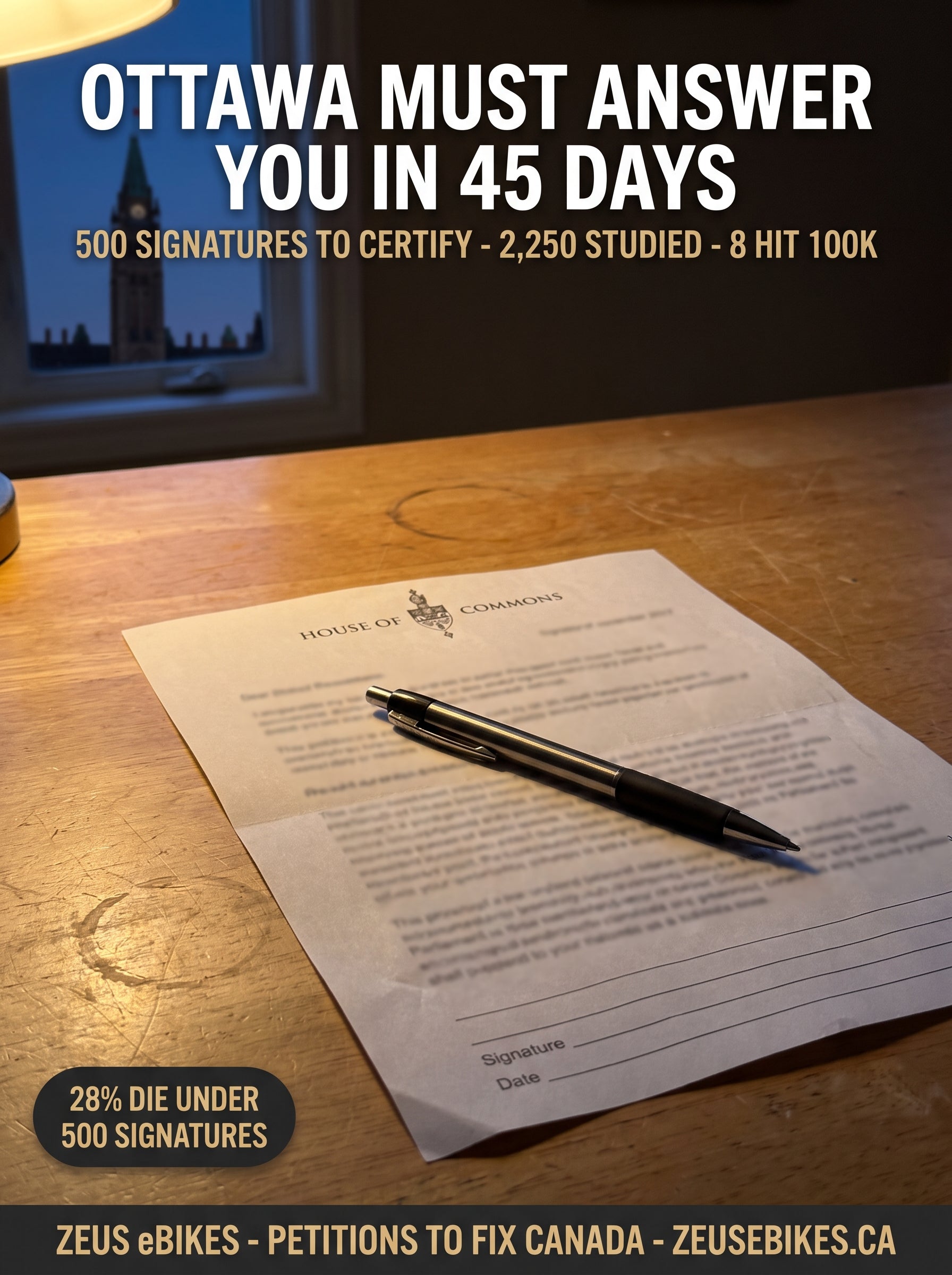
Quick answer — how to start a petition in Canada: create it free at the House of Commons petitions site, write the text in 250 words or fewer on a matter within federal jurisdiction, recruit 5–10 supporters, and invite an MP to sponsor it (any MP; they have 30 days). Once published, it needs 500 valid signatures for the Clerk of Petitions to certify it. After an MP presents it, the government must respond within 45 calendar days (Standing Order 36(8)), and if it misses the deadline, the matter is automatically referred to a committee whose chair must convene within five sitting days. Paper petitions need 25 signatures. Our analysis of all 2,250 closed e-petitions since 2015: the median closes at 791 signatures, 28% never certify, and only eight closed petitions have ever crossed 100,000, so this guide is equally about how to draft one that cannot be deflected.
How this was researched. The mechanics were taken from the primary rulebooks, not summaries: the House of Commons' Electronic Petitions Guide and Paper Petitions Guide, House of Commons Procedure and Practice on Standing Order 36(8), Ontario's Standing Orders, the consolidated Constitution Acts on Justice Laws, and Supreme Court judgment texts. The statistics are original: on August 14, 2026 we scraped every petition record of the 42nd through 45th Parliaments from the House's own petitions site: 7,069 records, including 2,337 e-petitions, using an archived, re-runnable script, and computed the distributions reported in section 4. Signature counts for petitions still open are point-in-time snapshots. One collection artifact is disclosed in the Limitations. Corrections: milad@zeusebikes.ca.
In this hub
- The machine most Canadians never touch
- The five instruments, compared
- How to start an e-petition in Canada: the nine-step chain
- What 2,250 petitions say about your odds
- The record: what petitions have and haven't done
- Drafting one that can't be deflected
- The constitutional ladder, with the real price tag
- The series: petitions to fix Canada
- Start today — or sign one already running
- Questions readers ask
- Limitations
- The bottom line
- References
1. The Machine Most Canadians Never Touch
On August 14, 2026, 163,404 signatures sat on e-7531, the Elizabeth May–sponsored petition to declare the US ambassador persona non grata (petition record). It stays open until November 18 — and already holds the sixth-largest count in the system's decade of operation. Meanwhile the median Canadian e-petition closes quietly at 791 signatures, and 28% never reach the bar that forces an answer at all. The gap between those two outcomes is not passion; it is knowing how the machine works. This hub is the manual: the five instruments, the exact chain, your real odds from the full dataset, and the honest record of what this tool has and has not achieved.
2. The Five Instruments, Compared
Canadians hold five distinct petition-shaped instruments, each with a different threshold and a different legal payoff. The federal e-petition is the workhorse: cheapest to run, hardest-edged response duty. The others matter when your issue lives provincially, or when you want more than an answer.
| Instrument | Threshold | What the law compels | Governing rule |
|---|---|---|---|
| House of Commons e-petition | 5–10 supporters to submit; MP sponsor; 500 valid signatures to certify | Government response tabled within 45 calendar days of presentation; missed deadline auto-refers to committee (chair must convene within 5 sitting days) | Standing Order 36(8), 36(8)(b); e-petitions guide |
| House of Commons paper petition | 25 original signatures with addresses; 3 on the first sheet; prayer on every sheet | Same 45-day response duty once presented | Paper petitions guide (PDF) |
| Provincial legislature petition (Ontario shown) | Varies; Ontario requires original signatures with the request on every sheet, presented by an MPP | In Ontario: "Within 24 sessional days of its presentation, the Government shall file a response … with the Clerk of the House" | Legislative Assembly of Ontario, Standing Orders |
| Citizen initiative (BC and Alberta only) | BC: 10% of registered voters in every electoral district within 90 days. Alberta: 10% of votes cast in the last general election | BC: a successful petition forces the proposal to a committee, then introduction of the bill or a province-wide initiative vote. It has succeeded once in fourteen attempts since 1995; that once ended a tax | Recall and Initiative Act, RSBC 1996, c. 398; Citizen Initiative Act, SA 2021, c. C-13.2 |
| Constitutional resolution (the ladder's top rung) | No citizen threshold: the ask is persuading one legislature to move a resolution | s. 46(1): amendment procedures "may be initiated either by the Senate or the House of Commons or by the legislative assembly of a province" | Constitution Act, 1982, Part V |
What about Change.org? Commercial petition platforms create publicity; no statute or standing order requires any Canadian government to read, acknowledge, or answer them. The House's own materials note that even for official petitions, no MP is obliged to sponsor or present one; the duty begins only after certification and presentation. If your goal is a mandatory answer on the parliamentary record, only the instruments in this table produce one.
3. How to Start an E-Petition in Canada: The Nine-Step Chain
From idea to mandatory answer, the chain has nine links. Every number below comes from the House of Commons' own guides, read on August 14, 2026, not from secondhand summaries.
| # | Step | The rule, exactly |
|---|---|---|
| 1 | Write the text | 250 words maximum. To petition the Government of Canada directly, address the text to the Government of Canada or a named minister; the rules also permit the House of Commons or an MP as addressee. Federal jurisdiction only — "must not concern a purely provincial or municipal matter." Not about a matter before the courts. "Respectful and moderate language." |
| 2 | Recruit supporters | At least 5, at most 10 potential supporters (citizens or residents). The first five become the petition's first signatories at publication. |
| 3 | Invite an MP sponsor | Any MP, not necessarily yours. They have 30 days to decide; on refusal or lapse you invite another. Sponsorship "does not necessarily endorse the views." |
| 4 | Publication | After authorization, "usually within five working days," first-come first-served. |
| 5 | Signature window | Your choice: 30, 60, 90 or 120 days. Take 120: the median petition needs every week of it. |
| 6 | Certification | Once the signature window closes with 500 valid signatures, the Clerk of Petitions, a non-partisan House official, validates and issues a certificate. No minimum age to sign; citizens abroad may sign; one email, one signature. |
| 7 | Presentation | Any member may present a certified petition in the House; the presentation is recorded in the Journals. |
| 8 | The mandatory answer | "Since 1986, the Standing Orders have provided that the Ministry shall respond within 45 calendar days to every petition referred to it" — S.O. 36(8), clock starting the day after presentation. |
| 9 | If they miss the deadline | The failure is automatically referred to the standing committee designated by the presenting member, and the chair must convene a meeting within five sitting days (S.O. 36(8)(b)). Choose your sponsoring MP partly for the committee they would pick. |
Two clock-killers to plan around, both from the official guides: prorogation carries outstanding response duties into the next session, but dissolution extinguishes them entirely: a petition still open when Parliament dissolves for an election is simply never answered. Section 5 shows the largest petition ever caught by that rule. File early in a Parliament's life, not late.
4. What 2,250 Petitions Say About Your Odds
Your odds, from the whole record: 72% of closed e-petitions clear the 500-signature bar, the median closes at 791 signatures, and only eight have ever crossed 100,000. We could not find that distribution published anywhere, so we built it. On August 14, 2026 we scraped every petition record of the four Parliaments of the e-petition era (the system opened in December 2015) from the House's own site: 2,337 e-petitions, of which 2,250 had closed with final counts (87 remain open). The script and CSVs are archived in our repository for audit. The whole population looks like this.
Source: full scrape of ourcommons.ca petition records, 42nd–45th Parliaments (n=2,250 closed e-petitions). Method and script published in the Zeus repository; snapshot date August 14, 2026.
The medians by Parliament: 726 signatures (42nd), 792.5 (43rd), 755 (44th), and 1,144.5 so far in the 45th: the current Parliament is running hotter than any predecessor, consistent with the past year's surge of six-figure petitions. The share of closed petitions clearing the 500-signature certification bar has ranged from 67.8% (42nd) to 79.0% (45th to date). And the ceiling is thin: in a decade, exactly eight closed petitions have crossed 100,000 signatures, with a ninth, e-7531, open and past that line now.
Zeus analysis of House of Commons petition records, all four parliaments of the e-petition era, retrieved Aug 14, 2026.
Here is the complete all-time 100,000-plus club, every row verified against the petition's own record page:
| Petition | Signatures | Subject | What happened |
|---|---|---|---|
| e-4701 (44th) | 387,487 — the record | Non-confidence in the government; called for an election | Government response tabled March 18, 2024. No election followed from it. |
| e-5353 (44th) | 376,994 | Revoke Elon Musk's Canadian citizenship | Closed June 20, 2025 — after Parliament dissolved. Never presented; no response was ever legally required. The biggest petition ever wiped out by the dissolution rule. |
| e-4649 (44th) | 286,719 | Calling for a ceasefire and humanitarian measures in the Israel–Palestine conflict | Response tabled by the Minister of Foreign Affairs. |
| e-2574 (43rd) | 230,905 | Opposing the May 2020 firearms prohibition order-in-council | Response tabled; the program proceeded. |
| e-2341 (43rd) | 175,310 | Opposing the same 2020 order-in-council | Response tabled; the program proceeded. |
| e-7531 (45th) | 163,404 and open | Declare US Ambassador Pete Hoekstra persona non grata | Open until November 18, 2026, on pace to climb this table. |
| e-4268 (44th) | 160,471 | Protections for transgender and non-binary people | Response tabled by the Minister of Immigration, Refugees and Citizenship. |
| e-616 (42nd) | 130,452 | Electoral reform | The first parliament's record-holder. |
| e-7025 (45th) | 111,158 | Require by-elections when MPs cross the floor | Response tabled July 22, 2026, declining the change: a textbook example of what "compels an answer, not an outcome" means. |
Skip the blank page. Six cost-of-living petitions — internal trade, groceries, housing money, the Bank of Canada's mandate, disclosure reform, and the constitutional option — are already drafted under the 250-word limit and timed to the September 8 and December 31 windows: take one and file it.
5. The Record: What Petitions Have and Haven't Done
The record has three tiers. Petitions reliably compel answers; they occasionally enter Parliament's own text; and once, at the provincial level with a stronger statute, a petition ended a tax. Anyone selling you more than that is selling.
Tier one, the guarantee: answers on the record
Every certified, presented petition produces a ministerial response within 45 calendar days, and the responses are substantive enough to quote, date, and hold against later decisions. When e-7025's 111,158 signatures asked for mandatory by-elections after floor-crossing, the government's tabled response of July 22, 2026 declined, on stated reasons, over a minister's name: a citable public position that did not exist before the petition (petition record). Multiply that across a decade of certified, presented petitions — roughly 1,600 cleared the bar in our dataset — and you have the system's real output: a standing archive of governments answering citizens on the record.
Tier two, documented: petitions entering Parliament's own text
In 2017 the House of Commons adopted Motion M-103, by a recorded division of 201 to 91 (recorded division, ourcommons.ca), by which the House resolved that the government should "take note of House of Commons' petition e-411," a petition that had gathered 69,742 signatures (petition e-411; motion text, ourcommons.ca). The mechanism is the point: a citizen-started document, cited by number, inside a decision of the House of Commons.
Tier three, once: a petition that killed a tax

British Columbia's Recall and Initiative Act sets a brutal threshold: signatures from 10% of registered voters in every electoral district, within 90 days. Elections BC has approved fourteen initiative applications since 1995; only one succeeded. The 2010 initiative against the Harmonized Sales Tax met the threshold in all 85 districts and set in motion the process that put the HST to a province-wide vote, which the tax lost, returning BC to the PST (Elections BC, initiative history). It remains the clearest case in modern Canada of a petition, as a legal instrument, ending a major policy.
The Canadians who did it, by name

Four campaigns put flesh on the three tiers, every one documented in the public record rather than legend.
Nellie McClung and the Political Equality League
Manitoba's premier promised in August 1915 that his government would move on women's suffrage if formally petitioned; the League — with McClung its most famous campaigner — presented its petition on December 23, 1915, and Manitoba women won the provincial vote in January 1916, first in Canada (The Canadian Encyclopedia). A petition, demanded by a premier as the price of action, delivered on schedule.
Kew Dock Yip, Irving Himel, and Wong Foon Sien
Yip — the first Chinese Canadian called to the bar — and lawyer Himel founded the Committee for the Repeal of the Chinese Immigration Act in November 1946; it grew to 79 members spanning labour councils, churches, and civil-liberties groups, and the Act was repealed in 1947 (Chinese Canadian Museum). Wong Foon Sien, whose earlier petitions pressed for the franchise Chinese Canadians also won in 1947, kept campaigning to Ottawa on family reunification for another decade — recognized today as a person of national historic significance (Parks Canada).
Bill Vander Zalm and the Fight HST volunteers
A former premier, out of office, and an army of volunteers ran the only initiative petition in British Columbia's history to clear the 10%-in-every-riding threshold — and the process it triggered ended the HST (Elections BC). Thirteen other applications since 1995 fell short; the one that succeeded removed a tax.
Samer Majzoub
The Canadian Muslim Forum president initiated e-petition e-411, which drew 69,742 signatures (petition e-411) and was subsequently cited by number in Commons motion M-103, adopted 201–91 in 2017 (recorded division; motion text). Whatever position a reader takes on that motion — this hub takes none — a citizen's filing entered the text of a decision of the House of Commons, which is the mechanism this entire guide teaches.
And the ceiling, in one case. The largest e-petition ever, e-4701's 387,487-signature non-confidence demand, received a tabled response and nothing else, because a petition cannot compel a confidence vote, only an answer. The second-largest, e-5353, got less than that: it closed after dissolution, so no response was ever owed. Size alone moved nothing here; design and timing are what convert signatures into leverage.
6. Drafting One That Can't Be Deflected
The 631 petitions in our dataset that died under 500 signatures share predictable drafting patterns. Five rules prevent nearly all of them.
Rule 1 — one ask, one owner

The House certifies only matters within federal authority, and a minister handed a file that belongs to another order of government can simply say so. Before writing a word, name the body that owns your lever. Our cost-of-living arm publishes a full division-of-powers map (groceries and competition federal, zoning provincial and municipal, the policy rate behind a five-year agreement), precisely because addressee error is the most common fatal flaw.
Rule 2 — every "whereas" a checkable fact
The preamble is your evidence, and the response will be written by officials who check it. A preamble of verified numbers with dates ("Statistics Canada reported X on Y") cannot be corrected; a preamble of adjectives can be dismissed in a sentence.
Rule 3 — name the deflection inside the text
If the standard answer to your ask is "that is provincial," or "we already did that in 2025," write that anticipated answer into the petition and ask for what remains. A petition that concedes what is done and asks for the dated, specific remainder forces the response past its first paragraph. This is the design principle we developed in our animal-law toolkit, and it transfers to any file.
Rule 4 — ask for decisions, not sentiments
"Take note," "recognize," and "consider" are granted for free and mean nothing. Ask for a report by a date, a stated position with reasons, a published inventory, a measure introduced. Verifiable verbs produce accountable answers.
Rule 5 — time it to a scheduled decision
An answer is most valuable while the decision is still being written. Two live examples: Budget 2026 consultations close September 8, 2026 (Finance Canada), and the Bank of Canada's inflation-control agreement must be renewed before it expires December 31, 2026 ("the agreement will run for another five-year period, ending December 31, 2026" — Joint Statement, Dec. 2021; renewal process underway per Bank of Canada). A petition presented inside such a window obliges the government to state its position while that position is still negotiable. Remember the closing rule from section 3: dissolution erases pending response duties, so early in a Parliament beats late.
The anatomy, from the House's own template: "PETITION TO [the House of Commons / the Government of Canada / a Minister] — We, the undersigned, [citizens or residents of Canada], draw the attention of [addressee] to the following: THAT [whereas clauses — each a verifiable fact]. THEREFORE, your petitioners call upon [addressee] to [numbered, concrete, owned asks]." Keep the whole text under 250 words, written as a request, in English or French. The official sample sheet is in the paper guide's Appendix A.
7. The Constitutional Ladder, With the Real Price Tag
"Fix Canada" talk eventually reaches the Constitution, so this series puts a real price tag on that rung instead of gesturing at it. Amending the Constitution requires no referendum and permits no shortcut: it runs on legislative resolutions under Part V of the Constitution Act, 1982. The general formula, s. 38(1), needs the Senate, the House of Commons, and the legislative assemblies of at least two-thirds of the provinces holding at least half the provinces' population, all within a window of one to three years (s. 39). Some subjects need every single province (s. 41); changes affecting only some provinces need only those provinces (s. 43); each order of government can amend its own machinery alone (ss. 44–45). The full text is three screens long and worth reading once in your life.
The track record since patriation, from the federal consolidation's own inventory of amending instruments: one amendment under the general formula, ever: the Aboriginal-rights proclamation of 1983. Seven bilateral s. 43 amendments (school systems in Newfoundland and Quebec, New Brunswick's linguistic equality, the Confederation Bridge). Four s. 44 federal statutes on seat counts.
The two great multilateral packages both died: Meech Lake ran out the s. 39 three-year clock in June 1990 after Elijah Harper's procedural stand in Manitoba and Newfoundland's revocation of assent under s. 46(2) (The Canadian Encyclopedia); the Charlottetown Accord lost a national referendum on October 26, 1992, 54.3% No (Elections Canada). Since 1996, an ordinary federal statute, the regional-veto Act, bars any federal minister from even proposing certain amendments without consent from Ontario, Quebec, BC, and regional blocks of the Atlantic and Prairie provinces (S.C. 1996, c. 1).
Three facts keep the top rung connected to the ground floor. First, s. 46(1): any single provincial legislature, or either federal House, may lawfully initiate an amendment, and the Supreme Court has held that this right of initiative carries "a corresponding duty on the participants in Confederation to engage in constitutional discussions" when a clear desire for change is expressed (Secession Reference, [1998] 2 S.C.R. 217, para 69). Second, referendums are advisory in this machinery (the federal Referendum Act obtains "the opinion of electors," nothing more), so the resolution path through legislatures is the only path.
Third, this rung has been reached for exactly this kind of material before: unemployment insurance entered federal jurisdiction by amendment in 1940, and pensions in 1951 and 1964. Petition five in arm one drafts the ask at this altitude, with the odds printed on it.
The constitutional ask is already drafted. Petition five of the six in arm one asks the House to study an economic-union amendment — with the 1983-only track record printed on its face: read it with the other five.
8. The Series: Petitions to Fix Canada
Each arm of this series takes one national problem, publishes the verified ledger behind it, maps who legally owns each lever, and drafts ready-to-file petitions aimed at live decision windows: every draft under the 250-word limit, every "whereas" sourced, every ask owned by its addressee.
| Arm | Status | What it contains |
|---|---|---|
| 1 — Cost of living: How to Save Money in Canada (2026) | Live | Nine claimable federal programs; the verified 2026 ledger (CPI, food, rent, renewals, food banks); the division-of-powers map; six petitions (internal trade, grocery competition, housing money, the Bank of Canada mandate renewal, disclosure reform, and the constitutional option) timed to September 8 and December 31, 2026 windows. Companion pillar: Why Is Canada So Expensive? |
| 2 — Sovereignty | In drafting | The 2026 tariff and interference file, what sovereignty levers Ottawa actually holds, and petitions aimed at them. The live demand is visible now: e-7531 (163,404 signatures and open) is already the sixth-largest petition count in the system's history. |
| 3 — Mobility | In drafting | Getting people and credentials moving: interprovincial licence recognition, the 30-day credential commitment, transit and active-transportation policy, and the legal patchwork Canadian riders navigate daily. |
| 4 — Housing (deep dive) | Planned | Beyond arm one's federal money petitions: the provincial and municipal instruments, where the real zoning power lives. |
| 5 — Democratic machinery | Planned | The instruments about the instruments: petition-system reform, initiative statutes beyond BC and Alberta, and what the 100,000-plus club tells us about demand for each. |
9. Start Today — or Sign One Already Running
Two ways to act inside twenty minutes. To sign: as of August 14, 2026, 87 e-petitions were open for signature — browse the current list at the House of Commons petitions site, read the full text (it is never longer than 250 words), and sign the ones whose asks you can repeat in your own words. To start: draft your text against the five rules in section 6, line up your five supporters, and send the sponsorship invitation; the 30-day MP clock only starts when you do. Our own drafts are free to take: six cost-of-living petitions, ready to file.
And a closing note on scale, from the numbers: the median petition clears the certification bar by fewer than 300 signatures — the margin between dying quietly and forcing an answer is a small community deciding something matters. The gap between an answer and a change is design and timing, which cost nothing but craft. For the long argument about why this kind of participation compounds over decades, our Canada 2076 essay is the widest lens we own.
10. Questions Readers Ask
How do I start a petition in Canada?
Create it free at the House of Commons petitions site: write a text of 250 words or fewer on a federal matter, recruit 5 to 10 supporters, and invite any MP to sponsor it within 30 days. Once published, 500 valid signatures certify it, and after presentation the government must respond within 45 calendar days. Provincial legislatures run parallel systems for provincial matters.
How many signatures does a petition need in Canada?
A House of Commons e-petition needs 500 valid signatures for the Clerk of Petitions to certify it for presentation; a paper petition needs 25 original signatures with addresses. There is no minimum age to sign, and signers may be Canadian citizens anywhere or residents of Canada.
How long does the government have to respond to a petition?
45 calendar days from presentation, under Standing Order 36(8) of the House of Commons. If the government misses the deadline, the failure is automatically referred to a standing committee chosen by the presenting MP, and the committee chair must convene a meeting within five sitting days. In Ontario's legislature, the government must file a response within 24 sessional days.
Do Change.org petitions count in Canada?
Not legally. Commercial petition platforms can demonstrate sentiment and attract press, but no law obliges any Canadian government to read or answer them. Only a petition certified under the House of Commons' rules — or a provincial legislature's equivalent — triggers a mandatory government response.
What is the biggest petition in Canadian history?
In the e-petition era, e-4701 — a 2023 non-confidence petition — holds the record at 387,487 signatures across every parliament since the system opened in December 2015, based on our full scrape of the House of Commons petitions site. It received a tabled government response on March 18, 2024, and nothing further, which is an honest measure of what signatures alone can and cannot do.
Can a petition change the Constitution?
Not directly. Constitutional amendments require resolutions under Part V of the Constitution Act, 1982 — for general amendments, the Senate, the House, and two-thirds of provinces holding half the population. But section 46(1) lets any single provincial legislature or either federal House initiate the procedure, so a petition's realistic role is persuading one legislature to start it. Only one general-formula amendment has ever passed, in 1983.
Does my MP have to sponsor my e-petition?
No. You invite an MP — any MP, not necessarily your own — and they have 30 days to agree or decline; if they decline or lapse, you invite another. The House's own guide states there is no obligation on any member to authorize publication or to present a petition. Sponsorship also does not mean the MP endorses your position.
Who can sign an e-petition in Canada?
Canadian citizens (including those living abroad) and residents of Canada, with no minimum age. Each person may sign a given petition once, and one email address supports only one signature. Signatures are validated before counting toward the 500-signature certification threshold.
Do petitions actually work in Canada?

They reliably produce one thing: a mandatory written answer. Outcomes beyond that are rarer and depend on timing and design. Documented chains exist — the House adopted motion M-103, whose text takes note of petition e-411 by number, and British Columbia's 2010 anti-HST initiative petition forced the process that ended that tax. Our dataset shows 28% of e-petitions never reach certification, which is why drafting and addressee choice matter.
11. Limitations
The data
1. The dataset is a snapshot. All counts were scraped from the House of Commons petitions site on August 14, 2026. Open petitions' totals change daily; closed petitions' totals are final. The collection script and CSVs are preserved in our repository so any figure can be re-derived.
2. One collection artifact. The site's own listing returned no paper-petition records for the 42nd Parliament (it returned 974–2,588 per later parliament), so cross-parliament statements about paper petitions are avoided here; our statistics concern e-petitions only.
3. "Certification" is inferred from counts. We treat closed petitions at or above 500 validated signatures as having cleared the certification bar; the House's validation process is reflected in the published counts, but we did not separately verify each certificate.
The method
4. Mechanism, not causation. Statements about what petitions "do" describe legal duties in the Standing Orders and documented sequences (a motion citing a petition; an initiative preceding a referendum). They are not causal-inference claims, and the M-103 and HST cases each sat inside broader campaigns.
5. Not legal advice. Rules are quoted from the official guides and statutes with links so you can verify them; admissibility decisions belong to the Clerk of Petitions and the House.
Author and scope
6. Authorship. Written by a single author and published by a commercial retailer; not peer-reviewed. Nothing is for sale in this article, and the series takes no position on any petition's subject beyond the affordability asks it drafts itself.
12. The Bottom Line
Canada hands every resident a lever most never touch: a free instrument that legally obliges the government to answer, in writing, within 45 days. The dataset says the median attempt barely clears the bar and the record says signatures alone reverse nothing, and the same record shows answers extracted on schedule, a petition cited inside a Commons motion, and one tax in one province ended outright. The difference was never volume. It was aim.
So aim: read the cost-of-living petitions in arm one, sign or file before the September 8 and December 31 windows close, and hold the answers you extract against the decisions that follow. This hub will be updated as each arm publishes and as the 45th Parliament's numbers move.
References
- House of Commons of Canada. "Electronic Petitions — Guide and Terms of Use." https://www.ourcommons.ca/petitions/en/Home/AboutContent?guide=PIElectronicGuide
- House of Commons of Canada. "Paper Petitions — Guide for the Public." https://www.ourcommons.ca/petitions/Documents/PI-Paper%20Petitions-Guide%20for%20the%20Public.pdf
- House of Commons of Canada. House of Commons Procedure and Practice, 3rd ed. (2017), Chapter 22, "Government Response to Petitions" (Standing Orders 36(8), 36(8)(b)). https://www.ourcommons.ca/procedure/procedure-and-practice-3/ch_22_6-e.html
- House of Commons of Canada. Petitions search and records. https://www.ourcommons.ca/petitions/en/Petition/Search
- Petition e-4701 (44th Parliament). https://www.ourcommons.ca/petitions/en/Petition/Details?Petition=e-4701
- Petition e-5353 (44th Parliament). https://www.ourcommons.ca/petitions/en/Petition/Details?Petition=e-5353
- Petition e-4649 (44th Parliament). https://www.ourcommons.ca/petitions/en/Petition/Details?Petition=e-4649
- Petition e-2574 (43rd Parliament). https://www.ourcommons.ca/petitions/en/Petition/Details?Petition=e-2574
- Petition e-2341 (43rd Parliament). https://www.ourcommons.ca/petitions/en/Petition/Details?Petition=e-2341
- Petition e-7531 (45th Parliament). https://www.ourcommons.ca/petitions/en/Petition/Details?Petition=e-7531
- Petition e-4268 (44th Parliament). https://www.ourcommons.ca/petitions/en/Petition/Details?Petition=e-4268
- Petition e-616 (42nd Parliament). https://www.ourcommons.ca/petitions/en/Petition/Details?Petition=e-616
- Petition e-7025 (45th Parliament). https://www.ourcommons.ca/petitions/en/Petition/Details?Petition=e-7025
- Motion M-103, 42nd Parliament, 1st Session (adopted March 23, 2017; recorded division 201–91). https://www.ourcommons.ca/members/en/88849/motions/8661986 · recorded division: https://www.ourcommons.ca/Members/en/votes/42/1/237
- Petition e-411, 42nd Parliament (69,742 signatures; cited by number in Motion M-103). https://www.ourcommons.ca/petitions/en/Petition/Details?Petition=e-411
- Legislative Assembly of Ontario. Standing Orders, "Petitions" (response within 24 sessional days). https://www.ola.org/en/legislative-business/standing-orders
- Recall and Initiative Act, RSBC 1996, c. 398. https://www.bclaws.gov.bc.ca/civix/document/id/complete/statreg/96398_02
- Elections BC. "Initiative" (history of applications since 1995). https://elections.bc.ca/recall-initiative/initiative/
- Citizen Initiative Act, SA 2021, c. C-13.2 (consolidated). https://kings-printer.alberta.ca/documents/Acts/C13P2.pdf
- Constitution Act, 1982, Part V (ss. 38–49). https://laws-lois.justice.gc.ca/eng/const/page-13.html
- An Act respecting constitutional amendments, S.C. 1996, c. 1. https://laws-lois.justice.gc.ca/eng/acts/C-36.7/FullText.html
- Referendum Act, S.C. 1992, c. 30, s. 3(1). https://laws-lois.justice.gc.ca/eng/acts/R-4.7/FullText.html
- Reference re Secession of Quebec, [1998] 2 S.C.R. 217. https://decisions.scc-csc.ca/scc-csc/scc-csc/en/item/1643/index.do
- Elections Canada. A History of the Vote in Canada, Chapter 4 (1992 referendum: 54.3% No; turnout 71.8% outside Quebec). https://www.elections.ca/content.aspx?section=res&dir=his/chap4&document=index&lang=e
- Historica Canada. The Canadian Encyclopedia, "Meech Lake Accord" (Elijah Harper's procedural stand in Manitoba; Newfoundland Premier Clyde Wells's revocation of assent). https://www.thecanadianencyclopedia.ca/en/article/meech-lake-accord
- Department of Finance Canada. "Government of Canada launches consultations ahead of Budget 2026." July 6, 2026. https://www.canada.ca/en/department-finance/news/2026/07/government-of-canada-launches-consultations-ahead-of-budget-2026.html
- Department of Finance Canada and Bank of Canada. "Joint statement of the Government of Canada and the Bank of Canada on the renewal of the monetary policy framework" (agreement ending December 31, 2026). December 13, 2021. https://www.canada.ca/en/department-finance/news/2021/12/joint-statement-of-the-government-of-canada-and-the-bank-of-canada-on-the-renewal-of-the-monetary-policy-framework.html
- Bank of Canada. "Renewing Canada's monetary policy framework" (2026 renewal process). https://www.bankofcanada.ca/core-functions/monetary-policy/renewing-canadas-monetary-policy-framework/
- Zeus Media. e-Petitions dataset, 42nd–45th Parliaments (full scrape of ourcommons.ca petition records, August 14, 2026; scripts epetitions_scrape.py / epetitions_analysis.py and four CSVs in the project repository).



Share:
How to Save Money in Canada (2026): 9 Programs + 6 Real Fixes
How to Save Money in Canada (2026): 9 Programs + 6 Real Fixes