
Rad Power Bikes Shut Down: 6 Best Canadian eBike Alternatives (2026)

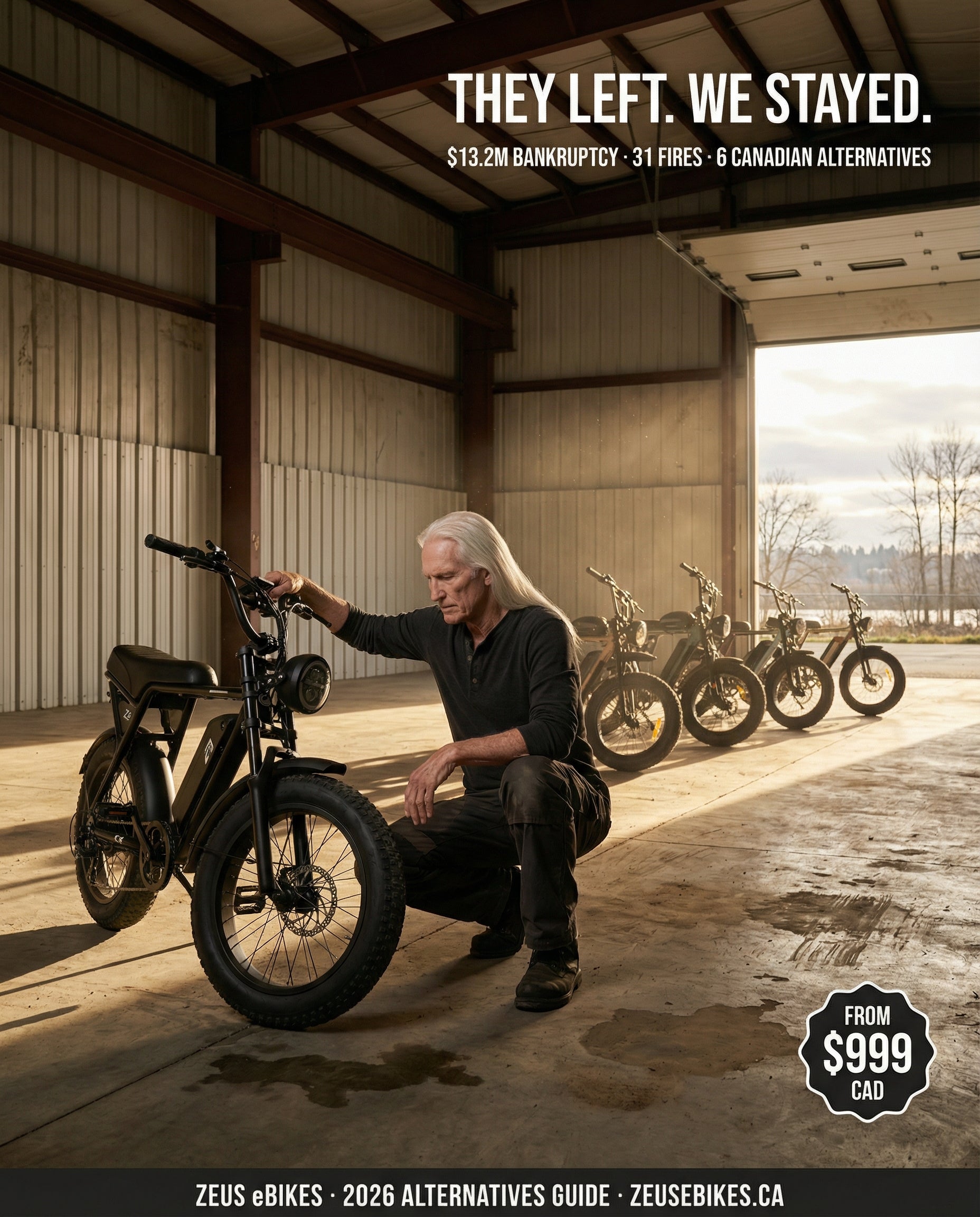
Rad Power Bikes the company did not survive. The company that once sold more e-bikes than anyone in North America — valued at $1.65 billion in October 2021 — filed Chapter 11 bankruptcy on December 15, 2025, and sold for $13.2 million at auction in January 2026. That is a 99.2% collapse (GeekWire). The brand now belongs to Rad Life Mobility, which sells new Rad bikes online in Canada.
For Canadian riders, the fallout is worse than the headlines suggest. The Vancouver store is permanently closed. Rad’s new owner says it has no obligation to provide warranty or service on bikes purchased before December 15, 2025. And in November 2025, the U.S. Consumer Product Safety Commission issued an urgent warning to immediately stop using certain Rad battery packs after 31 fire reports and $734,500 in property damage — covering nine models including the RadRunner 2, RadRover 5, RadWagon 4, RadCity, and RadExpand 5 (CPSC).
If you owned a Rad Power bike, you need a plan. If you were about to buy one, you need a redirect. This guide matches every major Rad Power model to a Canadian alternative that you can buy today from Zeus eBikes Canada — with better batteries, sensors Rad never offered, and a Canadian support team that will actually answer the phone.
In This Guide
What Happened to Rad Power Bikes
The timeline tells the story better than any summary. Rad Power Bikes went from the largest e-bike brand in North America to a $13 million fire sale in four years.
| Date | Event |
|---|---|
| October 2021 | Rad raises $154M Series D. Valuation hits $1.65 billion. 600+ employees. Over 600,000 e-bikes sold. Vancouver store opens. |
| 2022–2024 | Post-pandemic demand crashes. Revenue drops from $129.8M (2023) to $103.8M (2024). Seven rounds of layoffs across three years (GeekWire). |
| November 7, 2025 | Rad files WARN notice with Washington state — potential shutdown by January 9, 2026. 64 employees affected (GeekWire). |
| November 24, 2025 | CPSC issues urgent battery fire warning. 31 fires reported, $734,500 in property damage. Nine models affected. Rad refused to agree to an acceptable recall (CPSC). |
| December 15, 2025 | Rad files Chapter 11 bankruptcy. Assets: $32.1M. Liabilities: $72.8M (TechCrunch). |
| January 2026 | Vancouver store closes permanently. Florida store also closes (GeekWire). |
| January 22, 2026 | Auction: Life Electric Vehicles (Serial 1 owner) wins with a $13.2M bid. Backup bidder Retrospec offered $13M (Bicycle Retailer). |
| Post-sale | The brand’s new owner, Rad Life Mobility, says it has no obligation on bikes bought before December 15, 2025; its new limited warranty covers bikes bought in the USA or Canada after May 15, 2026, and radpowerbikes.ca sells new bikes. |
The numbers are stark: $1.65 billion to $13.2 million. More than 600,000 e-bikes sold across North America now have uncertain warranty support, a CPSC battery warning hanging over nine models, and no Canadian store. If you have seen Rad Power models listed as clearance at Walmart Canada or other big-box retailers, be aware: the new owner’s warranty covers only bikes bought after May 15, 2026, so check the purchase date, wherever you buy — we documented exactly how CPSC-flagged models continue to circulate without disclosure in our Walmart eBikes Canada 2026 audit.
Why Canadian Riders Need to Switch Now
This is not a brand having a bad year. The company collapsed, its assets were sold, and owners of bikes bought before December 15, 2025 were left without a safety net. Here is what it means for you:
Battery safety risk. The CPSC warning is not a recall: the CPSC says Rad “has refused to agree to an acceptable recall” and is unable to offer replacement batteries or refunds to all consumers. The affected battery packs (models RP-1304, RAD-S1304Y and HL-RP-S1304) have caused fires even when not charging — while in storage. The nine affected models represent the majority of Rad’s lineup: RadWagon 4, RadCity HS 4, RadRover 5, RadCity Step Thru 3, RadRover Step Thru 1, RadRunner 2, RadRunner 1, RadRunner Plus, and RadExpand 5. If you own one of these bikes, the CPSC advises you to immediately stop using the battery.
Parts will get harder to find. Most Rad components — Shimano gears, Tektro brakes, generic displays — are standard parts available from any bike shop. But Rad-specific proprietary parts like their battery packs, controllers, and integrated electronics for the older models may become scarce, because the new owner has no obligation on bikes bought before December 15, 2025.
Resale value has collapsed. A used Rad Power bike bought before December 15, 2025 carries no warranty obligation from the new owner and may carry a CPSC battery warning, which is why it is worth a fraction of what it was six months ago. If you are holding onto a Rad bike hoping the situation improves, plan as if it will not. For guidance on selling your current e-bike, see our Sell Your eBike Fast Canada guide.
6 Alternatives — Matched Model-by-Model
Every alternative below replaces a specific Rad Power model. Same use case, same form factor, better specs. All listed on Zeus eBikes Canada with free shipping and Canadian warranty support; stock changes, so call 1-866-938-7580 to confirm before you order.
1. RadRunner 2 Alternative: Z8 Moped-Style Electric Bike
Replaces: RadRunner 2 ($1,499 USD / ~$2,050 CAD)
Price: $1,199–$1,599 CAD
Why it wins: From about $850 less, same moped style, dual battery on Pro model gives double the range
| Spec | RadRunner 2 | Z8 / Z8 Pro |
|---|---|---|
| Motor | 750W, ~65 Nm | 500W rated, 1,500W peak, 80 Nm |
| Battery | 48V 14Ah (672 Wh) | 48V 15.6Ah (749 Wh) / Pro: dual 48V 15.6Ah×2 (1,498 Wh) |
| Range | 40–72 km | 40–80 km throttle · 80–97 km PAS / Pro: 80–121 km throttle · 161–193 km PAS (Riding Times) |
| Tires | 20×3.3″ | 20×4.0″ fat |
| Brakes | Mechanical disc | Mechanical disc + electronic brake |
| Weight | 65 lbs | 89 lbs (Z8) / 112 lbs (Pro) |
| Payload | 300 lbs | 330 lbs |
| CPSC Warning? | Yes — battery fire risk | No |
| Price (CAD) | ~$2,050 | $1,199 / $1,599 |
The RadRunner’s biggest appeal was price. The Z8 undercuts it — starting at $1,199 CAD, about $850 less than the RadRunner 2 cost in Canada. The Z8 adds wider 4.0″ fat tires for better grip and cushioning, and the Z8 Pro model doubles battery capacity with a dual 48V 15.6Ah system producing 1,498 Wh — more than double the RadRunner’s 672 Wh.
Honest trade-off: The Z8 is heavier (89–112 lbs vs 65 lbs). If light weight is your priority, this is not the bike. But if range and value per dollar are what drew you to the RadRunner, the Z8 delivers more of both for less money.
2. RadRunner Plus Alternative: Freesky Rocky Pro A-320
Replaces: RadRunner Plus ($1,799 USD / ~$2,450 CAD)
Price: $2,199 CAD (out of stock as of October 10, 2026)
Why it wins: 120 Nm torque (vs 70), 1,200 Wh Samsung (vs 624), full suspension, 4-piston hydraulic brakes
| Spec | RadRunner Plus | Freesky Rocky Pro A-320 |
|---|---|---|
| Motor | 750W, 70 Nm | 2,500W peak, 120 Nm |
| Battery | 48V 13Ah (624 Wh) | 48V 25Ah Samsung (1,200 Wh) |
| Range | Up to 88 km | 72–145 km |
| Suspension | Front only | Full suspension |
| Brakes | Hydraulic disc | 4-piston hydraulic 180mm |
| Payload | 350 lbs | 400 lbs |
| Weight | 101 lbs | 77 lbs |
| Tires | 20×3.3″ | 20×4.0″ fat |
| CPSC Warning? | Yes — battery fire risk | No |
| Price (CAD) | ~$2,450 | $2,199 |
The RadRunner Plus attracted riders who wanted utility with more power and comfort than the base model. The Rocky Pro A-320 outperforms it on every metric that matters. 120 Nm of torque is 71% more than the RadRunner Plus — you feel it on every hill. The 1,200 Wh Samsung battery is nearly double the RadRunner Plus’s 624 Wh, giving you genuine all-day range. Full suspension absorbs rough roads that the RadRunner’s front-only fork could not. And 4-piston hydraulic brakes deliver stopping power the RadRunner’s 2-piston system cannot match.
Honest trade-off: The Rocky Pro uses a cadence sensor, not torque — same as Rad. If torque sensor feel is important, look at the Meta 275 2.0 (#4) or Meta Foldable (#5) instead.
→ View the Freesky Rocky Pro A-320 on Zeus eBikes
Switching from Rad Power? Browse the full Zeus eBikes collection — free shipping across Canada, Canadian warranty, Canadian support team.
3. RadRover 6 Plus Alternative: Velotric Nomad 2
Replaces: RadRover 6 Plus ($1,999 USD / ~$2,700 CAD)
Price: $3,399 CAD
Why it wins: SensorSwap (torque + cadence), 505 lb payload, UL 2849 + UL 2271 certified, Apple Find My tracking
| Spec | RadRover 6 Plus | Velotric Nomad 2 |
|---|---|---|
| Motor | 750W, 68 Nm | 750W peak 1,300W, 90 Nm |
| Battery | 48V 14Ah (672 Wh) | 48V 14.7Ah Samsung/LG 21700 (706 Wh), IPX7 |
| Range | 40–72 km | 72–105 km |
| Sensor | Cadence only | SensorSwap — torque + cadence toggle |
| Suspension | 60mm spring fork | 100mm RST hydraulic fork + suspension seatpost |
| Brakes | Hydraulic 180mm | Tektro hydraulic 203mm front / 180mm rear |
| Payload | 275 lbs | 505 lbs + 1,000 lb towing |
| Tires | 26×4.0″ Kenda | 26×4.0″ Kenda puncture-resistant |
| Gears | 7-speed Shimano Altus | 8-speed Shimano 11–40T |
| Safety | No UL certification | UL 2849 + UL 2271 |
| CPSC Warning? | Yes — RadRover 5 affected | No |
| Price (CAD) | ~$2,700 | $3,399 |
The RadRover was Rad’s flagship — the fat-tire all-terrain bike that put the brand on the map. The Velotric Nomad 2 is its superior replacement. The feature that separates it from every other bike on this list is SensorSwap: press a button to toggle between torque sensor (natural pedal feel, proportional power) and cadence sensor (steady output for long flat rides). No Rad model ever offered a torque sensor, period. The Nomad 2 offers both in one bike.
The 505 lb payload capacity is nearly double the RadRover’s 275 lbs. Add the 1,000 lb towing rating and you have a legitimate utility vehicle, not just a trail bike. UL 2849 and UL 2271 certifications mean the bike and battery have been tested for fire, electrical, and mechanical safety by Underwriters Laboratories. Apple Find My tracking is built in, so if the bike is stolen, you can locate it. A 500-lumen auto-sensing headlight, turn signals, and Bluetooth app integration round out a package that makes the RadRover feel like it belongs in a previous generation. For a deeper dive into sensor types, see our Pedal Assist vs Throttle guide.
Honest trade-off: At $3,399, the Nomad 2 costs about $700 more than the RadRover did in Canada. You are paying a premium for UL certification, SensorSwap, and the payload capacity. If budget is tight, the RadRover’s true successor in value is the Rocky Pro A-320 (#2), which offers similar fat-tire capability for $2,199 (out of stock as of October 10, 2026).
→ View the Velotric Nomad 2 on Zeus eBikes
4. RadCity 5 Plus Alternative: Eunorau Meta 275 2.0
Replaces: RadCity 5 Plus ($1,999 USD / ~$2,700 CAD)
Price: $2,295 CAD
Why it wins: Torque sensor (Rad had none), 720 Wh with an optional second pack to 1,440 Wh (vs 672), wider 2.6″ tires, cheaper
| Spec | RadCity 5 Plus | Eunorau Meta 275 2.0 |
|---|---|---|
| Motor | 750W, 58 Nm | 500W, 55 Nm |
| Battery | 48V 14Ah (672 Wh) | 48V 15Ah (720 Wh); optional second pack to 1,440 Wh |
| Range | 45–100 km | Up to 160 km on both packs (Eunorau) |
| Sensor | Cadence only | Torque sensor |
| Gears | 7-speed Shimano Altus | Shimano (Eunorau lists a 7-speed shifter and a 9-speed freewheel) |
| Brakes | Hydraulic 180mm | Hydraulic 180mm |
| Tires | 27.5×2.0″ | 27.5×2.6″ |
| Payload | 275 lbs | 286 lbs |
| Weight | 63–65 lbs | 68.4 lbs |
| CPSC Warning? | Yes — RadCity affected | No |
| Price (CAD) | ~$2,700 | $2,295 |
The RadCity was the commuter — the bike for riding to work, running errands, replacing short car trips. The Meta 275 2.0 does everything the RadCity did, costs about $400 less in Canada, and adds the feature Rad never offered on any model, a torque sensor, with a second battery as an option.
A torque sensor reads how hard you push the pedals and delivers assist proportionally. Push harder, get more power. Back off, and the motor backs off with you. Cadence sensors — which every Rad model uses — deliver a fixed power level regardless of pedal pressure, creating surges and jerky acceleration. For urban commuting, where you constantly adjust speed around traffic, pedestrians, and stops, the difference in ride feel is immediate and irreversible: once you ride a torque sensor, cadence feels broken.
The optional second battery brings total capacity to 1,440 Wh, more than double the RadCity’s 672 Wh. For Canadian winters, where cold cuts lithium-ion battery range by 30–40%, that extra capacity is not a luxury. It is the difference between making your commute and calling a cab. The 27.5×2.6″ tires add cushion and grip the RadCity’s skinnier 2.0″ tires lacked on wet or rough roads. For more on long-range commuting, see our Long Range Electric Bikes Canada guide.
Honest trade-off: The Meta 275 2.0 is a 500W motor vs the RadCity’s 750W, and its 55 Nm is a little below the RadCity’s 58 Nm. Peak assist speed is 32 km/h on both. The lower wattage is a non-issue for commuting — see our complete 500W eBike guide for the options. It ships set to 500W / 32 km/h; Eunorau lists the cap as unlockable, and whether an adjustable cap qualifies is not settled. Eunorau sizes it for riders 5′6″ to 6′1″.
→ View the Eunorau Meta 275 2.0 on Zeus eBikes
5. RadExpand 5 Plus Alternative: Eunorau Meta Foldable
Replaces: RadExpand 5 Plus ($1,899 USD / ~$2,600 CAD)
Price: $2,295 CAD
Why it wins: Torque sensor, 9 lbs lighter, dual battery option (1,536 Wh vs 720), Eunorau GO app support
| Spec | RadExpand 5 Plus | Eunorau Meta Foldable |
|---|---|---|
| Motor | 750W, 64 Nm | 500W, 55 Nm |
| Battery | 48V 15Ah (720 Wh) | 48V 15Ah Samsung (720 Wh) + opt. 17Ah second (1,536 Wh) |
| Range | Up to 96 km | Up to 161 km (dual battery) |
| Sensor | Cadence only | Torque sensor |
| Folds? | Yes | Yes |
| Tires | 20×4.0″ fat | 20×3.0″ Kenda |
| Brakes | Hydraulic 180mm | Hydraulic 180mm |
| Gears | 7-speed Shimano | 7-speed Shimano |
| Weight | 72.5 lbs | 63.4 lbs |
| Payload | 315 lbs | 286 lbs |
| CPSC Warning? | Yes — RadExpand 5 affected | No |
| Price (CAD) | ~$2,600 | $2,295 |
Folding e-bikes exist for one reason: storage. Apartments, condos, RVs, boats, transit — anywhere a full-size bike does not fit. The RadExpand 5 Plus did this at 72.5 lbs. The Meta Foldable does it at 63.4 lbs — nine pounds lighter. Nine pounds matters when you are hauling a folded e-bike up apartment stairs or lifting it into a car trunk.
The Meta Foldable adds what Rad never offered: a torque sensor for smooth, natural pedal assist. The optional second battery (17Ah) brings total capacity to 1,536 Wh — more than double the RadExpand’s 720 Wh. Eunorau GO app support adds ride tracking and diagnostics that the RadExpand lacked. The 2-year Eunorau warranty compares with no warranty obligation at all on a pre-bankruptcy Rad.
Honest trade-off: The Meta Foldable runs 20×3.0″ tires vs the RadExpand’s 20×4.0″. You lose an inch of tire width, which means slightly less cushion on rough terrain. For pavement and smooth paths, the 3.0″ is lighter and rolls more efficiently. For off-road folding, the Rocky Pro A-320 (#2) is a better choice.
→ View the Eunorau Meta Foldable on Zeus eBikes
6. RadWagon 4 Alternative: CityTri E-310 Electric Trike
Replaces: RadWagon 4 ($1,999 USD / ~$2,700 CAD)
Price: from $2,399 CAD
Why it wins: Three-wheel stability (no balancing at stops), 280 + 80 lb payload, folds for transport, UL 2271 Samsung battery
| Spec | RadWagon 4 | CityTri E-310 |
|---|---|---|
| Motor | 750W, 80 Nm | 500W (1,100W peak) or 750W, 90 Nm (Addmotor prints both) |
| Battery | 48V 14Ah (672 Wh) | 48V 20Ah Samsung (960 Wh), UL 2271 |
| Range | 40–72 km | ~145 km |
| Wheels | 2 | 3 (trike) |
| Payload | 350 lbs | 360 lbs (280 + 80) |
| Cargo | Long rear deck | Rear basket + platform |
| Brakes | Mechanical disc 180mm | Triple mechanical disc 180mm |
| Folds? | No | Yes — fits in a car trunk |
| Stability | Tippy when loaded | Three-wheel — cannot tip |
| CPSC Warning? | Yes — RadWagon 4 affected | No — UL 2271 certified |
| Price (CAD) | ~$2,700 | from $2,399 |
The RadWagon was the family hauler — kids on the back, groceries in the panniers, school runs and Costco trips. The problem with a two-wheel cargo bike is physics: load 50 kg on the rear and it gets top-heavy. Stop on a hill and it tilts. Navigate a parking lot at low speed with a child on the back and you feel every gram of instability.
A trike solves this permanently. The CityTri E-310 needs no balancing under load — three wheels plant flat at a stop (take corners slowly: a loaded trike can still tip in a sharp turn). A rear differential lets it corner smoothly without dragging the inside wheel. A parking brake holds the loaded trike on any incline while you unload groceries or strap in a child seat. And the UL 2271-certified Samsung battery has been independently tested for fire and electrical safety. The E-310 also folds for car transport, something the RadWagon could never do. For a full trike breakdown, read our Electric Trikes Canada (2026) guide or the CityTri E-310 2-year review.
Honest trade-off: A trike is wider than a two-wheel cargo bike. It takes more space on pathways and in storage (though the E-310 folds to reduce this). It also cannot navigate narrow singletrack. If you need a narrow profile for tight urban lanes, a cargo-style two-wheeler is better. But if stability with heavy loads is the priority — and for RadWagon owners, it was — a trike is the honest upgrade.
→ View the CityTri E-310 on Zeus eBikes
Full Spec Comparison — Rad Power vs Zeus Alternatives
| Rad Model | Zeus Alternative | Battery Advantage | Torque Advantage | Sensor | UL Certified? | Price (CAD) |
|---|---|---|---|---|---|---|
| RadRunner 2 (672 Wh) | Z8 Pro | +826 Wh (1,498 total) | +15 Nm (80 total) | Cadence | — | $1,599 |
| RadRunner Plus (624 Wh) | Rocky Pro A-320 | +576 Wh (1,200 total) | +50 Nm (120 total) | Torque + cadence | UL2849 + UL2271 (TÜV) | $2,199 (out of stock) |
| RadRover 6 Plus (672 Wh) | Velotric Nomad 2 | +34 Wh (706 total) | +22 Nm (90 total) | SensorSwap | UL 2849 + 2271 | $3,399 |
| RadCity 5 Plus (672 Wh) | Meta 275 2.0 | +48 Wh (720; 1,440 w/ opt.) | −3 Nm (55 total) | Torque | — | $2,295 |
| RadExpand 5 Plus (720 Wh) | Meta Foldable | +816 Wh (1,536 w/ opt.) | −9 Nm (55 total) | Torque | — | $2,295 |
| RadWagon 4 (672 Wh) | CityTri E-310 | +288 Wh (960 total) | +10 Nm (90 total) | Cadence | UL 2271 | from $2,399 |
The pattern is clear: every Zeus alternative matches or beats the battery capacity of the Rad model it replaces, and three of the six reach double or more (two of them with an optional second pack). Three of six alternatives add torque sensors that Rad never offered on any model. Two carry UL safety certifications. And five of six cost less than the Rad model they replace at Canadian retail prices.
Why These Alternatives Beat Rad Power — Beyond Specs
Specs matter, but the Rad Power collapse exposed problems that go beyond motor wattage and battery size.
Canadian Support That Exists
Zeus eBikes ships from Canada, supports from Canada, and warranties from Canada. There is no American bankruptcy filing between you and your warranty claim. There is no closed Vancouver store. There is no corporate statement saying they “cannot support” your purchase. If your bike has a problem, you contact a Canadian team that has your order, knows your bike, and resolves the issue. For tips on identifying trustworthy e-bike retailers, read our How to Spot a Legit eBike Store in Canada guide.
Battery Safety Without CPSC Warnings
None of the six alternatives in this guide have any CPSC safety warnings. The Velotric Nomad 2 carries UL 2849 and UL 2271 certifications. The CityTri E-310 carries UL 2271. These are independent, third-party safety certifications.
Torque Sensors Rad Never Offered
Every Rad Power model shipped with a cadence sensor. Every single one. A cadence sensor delivers power at a fixed level based on whether you are pedalling, not how hard. A torque sensor reads your actual pedal pressure and adjusts assist proportionally — push harder uphill, get more power; coast downhill, get less. Three of our six alternatives (Meta 275 2.0, Meta Foldable, Velotric Nomad 2) include torque sensors. The Nomad 2 goes further with SensorSwap, letting you toggle between both. For the full breakdown, see our Pedal Assist vs Throttle guide.
Battery Capacity That Handles Canadian Winters
Rad’s entire lineup ran on 624–720 Wh batteries. In a Canadian winter at −15°C, those batteries lose 30–40% of their capacity — leaving you with 374–504 Wh of effective range. That is marginal for any commute over 15 km. The Zeus alternatives range from 706 Wh (Nomad 2) to 1,498 Wh (Z8 Pro), and four of them reach 1,200 Wh or more (the Meta 275 2.0 and Meta Foldable with their optional second packs). Even after a 40% winter loss, those four keep 720 Wh or more — as much as or more than a Rad bike had in summer. For financing options on any of these bikes, see our How to Finance an Electric Bike in Canada guide.
Frequently Asked Questions
What happened to Rad Power Bikes?
Rad Power Bikes filed Chapter 11 bankruptcy on December 15, 2025, listing $32.1 million in assets against $72.8 million in liabilities. The company was sold at auction on January 22, 2026, to Life Electric Vehicles Holdings Inc. (the company behind the Serial 1 e-bike brand) for $13.2 million — down 99.2% from the $1.65 billion valuation in October 2021. Revenue had dropped from $129.8 million (2023) to $63.3 million in the first 11 months of 2025 (GeekWire, TechCrunch). For the full breakdown — who owns the brand now, what happened to Canadian warranty support, and the CPSC battery fire warning — see our verified Rad Power Bikes Canada profile.
Is my Rad Power Bikes warranty still valid in Canada?
For bikes bought before December 15, 2025, no: the brand’s new owner says it has no obligation to provide warranty or other service on them, and claims go to the US bankruptcy case (No. 25-02183). Its new limited warranty covers Rad bikes bought in the USA or Canada after May 15, 2026. The Vancouver, B.C. retail store — Rad’s only Canadian location — closed permanently in January 2026.
What is the CPSC battery warning on Rad Power Bikes?
On November 24, 2025, the U.S. Consumer Product Safety Commission (CPSC) issued an urgent safety warning telling consumers to immediately stop using certain Rad Power battery packs (models RP-1304, RAD-S1304Y and HL-RP-S1304) due to fire hazard. There were 31 reports of fires, including 12 reports of property damage totalling approximately $734,500 USD. Some fires occurred while the battery was in storage — not even charging. The CPSC stated that Rad “refused to agree to an acceptable recall.” Affected models: RadWagon 4, RadCity HS 4, RadRover 5, RadCity Step Thru 3, RadRover Step Thru 1, RadRunner 2, RadRunner 1, RadRunner Plus, and RadExpand 5.
Can I still get parts for my Rad Power bike in Canada?
Standard components like Shimano gears, Tektro brakes, and generic throttles are made by major third-party suppliers and remain available through any bike shop or online retailer. However, Rad-specific proprietary parts — battery packs, controllers, integrated displays, and frame-specific brackets — may become harder to source for the older models, since the new owner has no obligation on bikes bought before December 15, 2025. If you plan to keep your Rad bike long-term, consider stocking replacement parts now while some aftermarket supply remains.
What happened to the Rad Power Vancouver store?
Rad Power Bikes closed its Vancouver, B.C. retail store in January 2026 during bankruptcy proceedings. The store had opened in October 2020 as Rad’s only Canadian retail location. The Florida store was also closed. Seven U.S. stores remained open at the time. Rad’s Canadian website sells new bikes online; the RadWagon 5 was listed there at $2,949 CAD on October 10, 2026.
Are these alternatives available with free shipping in Canada?
Yes. The alternatives in this guide ship free across Canada from Zeus eBikes Canada; stock changes (the Rocky Pro A-320 is out of stock as of October 10, 2026), so call 1-866-938-7580 to confirm before you order. Every bike comes with a Canadian warranty and is supported by a Canadian customer service team.
Why do these alternatives have better specs than Rad Power?
Rad Power Bikes prioritised volume and low price over specification depth. Every Rad model used cadence sensors (not torque), single batteries between 624 and 720 Wh, and no dual-motor or AWD options. The alternatives in this guide represent the current state of the market: torque sensors, dual-battery options (up to 1,536 Wh), UL-certified batteries, and stronger motors are now available at comparable or lower price points. Rad’s specs were competitive in 2021. By 2026, they had fallen behind. For a deeper comparison of motor wattages, see our 500W vs 750W vs 1000W guide.
The Bottom Line
RadRunner 2 rider? → Z8 ($1,199–$1,599) — same moped style, more battery, less money.
RadRunner Plus rider? → Rocky Pro A-320 ($2,199, out of stock as of October 10, 2026) — 120 Nm, 1,200 Wh Samsung, full suspension.
RadRover 6 Plus rider? → Velotric Nomad 2 ($3,399) — SensorSwap, UL certified, 505 lb payload.
RadCity 5 Plus rider? → Meta 275 2.0 ($2,295) — torque sensor, optional second battery, about $400 cheaper.
RadExpand 5 Plus rider? → Meta Foldable ($2,295) — torque sensor, 9 lbs lighter, dual battery option.
RadWagon 4 rider? → CityTri E-310 (from $2,399) — 3 wheels, 280 + 80 lb payload, folds, UL battery.
Rad Power Bikes built something real. More than 600,000 riders chose their bikes. But the company that introduced millions to e-bikes could not survive post-pandemic demand collapse, rising tariffs, and a CPSC battery warning issued after it refused to agree to an acceptable recall. What remains is a brand sold for $13.2 million, whose new owner sells new bikes in Canada but has no obligation on the bikes Canadians bought before December 15, 2025.
The alternatives above are not theoretical. They ship free across Canada and come with warranty support from a Canadian team; stock changes, so call 1-866-938-7580 to confirm before you order. Every spec in this guide was verified against the product page. Every honest trade-off was stated. Your Rad Power bike served you well. These six will serve you better.
Ready to switch? Browse all Zeus eBikes — free shipping across Canada, Canadian warranty, real support.
This guide was written by the Zeus eBikes Canada editorial team. All Rad Power timeline data sourced from GeekWire, TechCrunch, CPSC, and Bicycle Retailer. Zeus is a Canadian direct-to-consumer electric bike retailer shipping across Canada.
Pedal Assist vs Throttle eBikes Canada: Which Is Right for You?
500W vs 750W vs 1000W eBike Canada: Which Wattage Is Right?
Electric Trikes Canada (2026): 10 Best Picks by Price & Type
CityTri E-310 Trike Review Canada: 2 Years, Zero Warranty Calls
Electric Mopeds Canada (2026): Best Moped-Style eBikes
Sell Your eBike Fast Canada (2026)
How to Spot a Legit eBike Store in Canada (2026)
How to Finance an Electric Bike in Canada (2026)
Best eBike Deals Canada (2026)
Best Electric Bikes Canada (General)



Share:
Eahora Romeo Ultra II Review Canada (2026): AAAA Built, the Country-Road Throttle King
eBike Rebates Canada (2026): What's Still Real and What Ended, with the PST Exemption, Banff $1,000 and UBC $400