eBike Rebates Canada (2026): What’s Still Real and What Ended, with the PST Exemption, Banff $1,000 and UBC $400

A $2,000 e-bike still costs $1,000 in Banff. Twelve months ago a commuter also cost $500 less on Prince Edward Island and 25% less in Whitehorse, but those programs are gone, and half the pages ranking for this search haven't noticed. This guide is the audit: every program checked against its primary source, dated, and sorted into what still pays and what ended.
Canada has no federal e-bike rebate. But if you are searching for an e-bike rebate in Canada, one permanent provincial tax exemption and a handful of municipal programs will still hand you real money back when you buy one. This guide covers all 13 provinces and territories: which ones pay, how much, who qualifies, and, for every active program, a numbered step-by-step walkthrough of how to apply. We also calculated the after-rebate price on five Zeus e-bikes so you can see what you would pay.
Thirty Years of Smaller
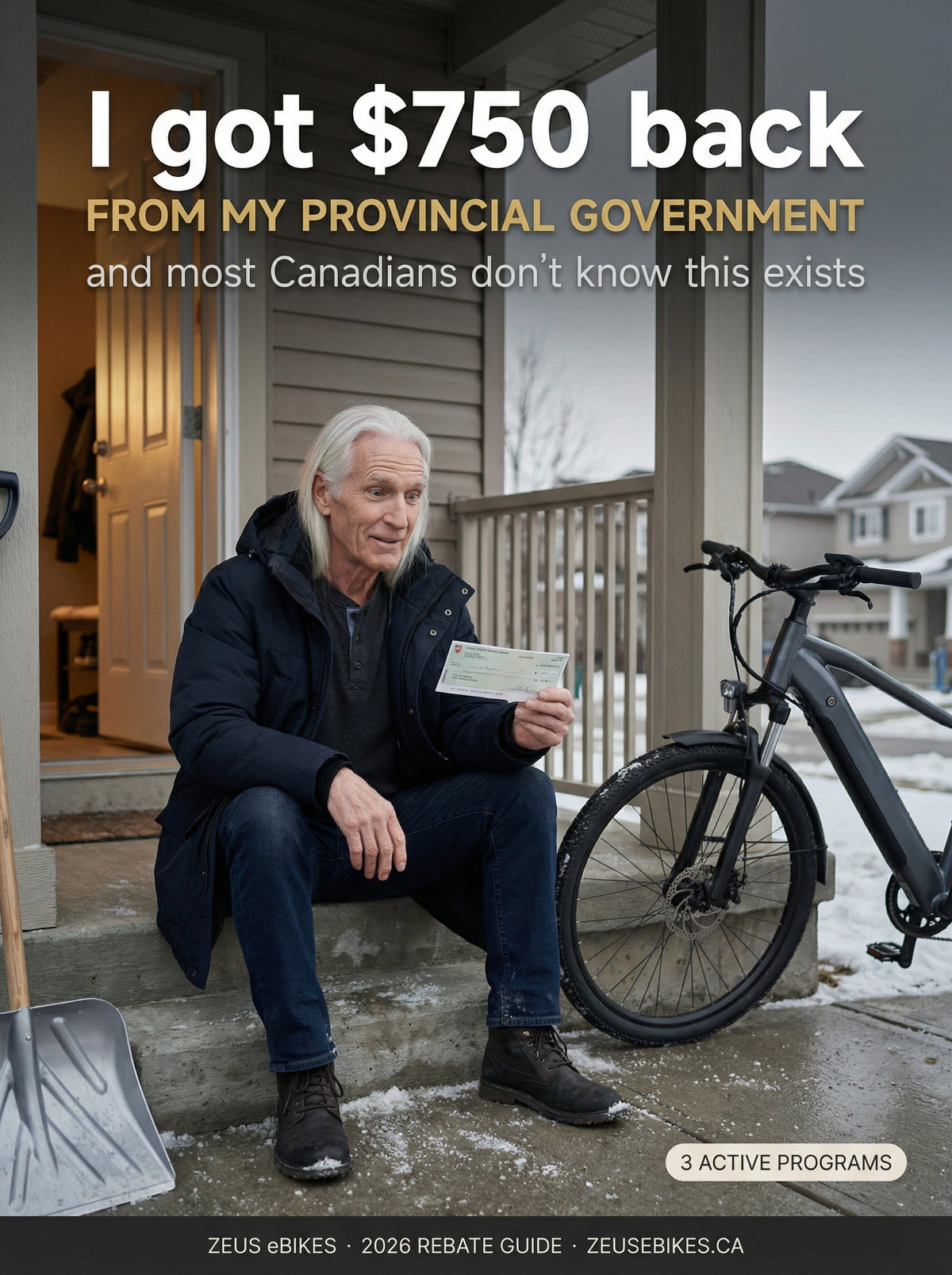
6 seconds. No music. No script. Just a man and a cheque he didn’t know was coming.
Visuals by Playcut.ai
BC: 7% PST exemption, automatic at checkout. No application. Details ↓
Yukon: Ended March 31, 2026: but pre-deadline buyers can still file within one year of purchase for 25% back, up to $750 ($1,500 cargo). Late applications ↓
PEI: Paused since April 15, 2026, in the province's words; the $500 incentive (500W-or-less motors) took its last claims at the end of April and no purchase today qualifies. Both readings ↓
Best bikes for rebate buyers: The Velotric Fold 1 Plus ($2,599) and Velotric Discover M ($3,899) both carry the UL 2849 certification Banff requires.
No program: Ontario, Quebec, Manitoba, Saskatchewan, NB, NL, NWT, Nunavut.
In This Guide
- Every Province at a Glance: Summary Table
- Can You Use These Programs on a Zeus Purchase?
- Yukon: Ended (Pre-April 2026 Buyers Can Still Apply)
- Prince Edward Island: Paused, Not Yet Restored
- British Columbia: 7% PST Exemption
- BC CleanBC Rebate: Ended Sept 2025
- Banff, Alberta: How to Get Up to $1,000 Back
- Scrap-It: What Changed ($750 E-Bike Option Gone)
- Other Municipal Programs
- “Free E-Bike From the Government”: The Honest Answer
- Provinces With No E-Bike Rebate
- CRA Business Expense: Writing Off an E-Bike
- After-Rebate Price Comparison: 5 Zeus E-Bikes
- Frequently Asked Questions
- The Bottom Line
Every Province at a Glance: Summary Table
As of October 2026, two savings are active province-wide or locally: BC’s permanent 7% PST exemption and Banff’s $500–$1,000 post-purchase rebate, plus smaller programs at UBC and Canmore. Yukon’s rebate ended this spring, PEI’s is paused, and CleanBC ended September 2025. Find your province in this electric bike incentive table, then jump to its step-by-step section.
| Province / Territory | Program | Max Rebate | Status |
|---|---|---|---|
| Yukon | Good Energy E-Bike Rebate | $750 ($1,500 cargo) | ENDED Mar 31, 2026 |
| Prince Edward Island | E-Bike Incentive | $500 | PAUSED since Apr 15, 2026 (province); last claims Apr 30 |
| British Columbia | PST Exemption (permanent) | 7% tax saved | ACTIVE |
| British Columbia | CleanBC E-Bike Rebate | $350–$1,400 | ENDED Sept 30, 2025 |
| British Columbia | Scrap-It (vehicle trade-in) | $300 cash (was $750 e-bike) | CHANGED: e-bike option no longer listed (Aug 3, 2026) |
| Alberta | Scrap-It (vehicle trade-in) | $500 (unverified) | UNVERIFIED: administrator lists Enhanced SCRAP-IT under past programs; no live Alberta page found Aug 3, 2026. Confirm before relying. |
| Alberta: Banff | Post-Purchase Rebate | $500–$1,000 | ACTIVE |
| Alberta: Canmore | E-Bike Rebate (lottery) | Varies | ACTIVE (limited) |
| BC: UBC (staff & faculty) | E-Bike Rebate | $400 | ACTIVE: Apr 1 to Dec 31, 2026, while supplies last |
| Nova Scotia | Electrify Nova Scotia | $500 (was) | ENDED April 4, 2025 |
| Ontario | None provincial | none | No program |
| Quebec | None for consumer e-bikes | none | No program |
| Manitoba | None | none | No program |
| Saskatchewan | None | none | No program |
| New Brunswick | None | none | No program |
| Newfoundland & Labrador | None | none | No program |
| NWT / Nunavut | None | none | No program |
Table last verified: October 8, 2026. Programs can close without notice when budgets are exhausted: always check the official link before purchasing.
Can You Use These Programs on a Zeus Purchase? (Yes: Here’s How)
Every remaining program except one works with a bike bought from any retailer, Zeus included. None of the active programs requires a local or “participating” store. The requirements attach to the bike, the buyer and the paperwork rather than the seller. Here is how each one works with a Zeus order:
- BC’s 7% PST exemption: automatic. Legal e-bikes are PST-exempt in BC, so a BC buyer pays no PST on a compliant e-bike no matter where they buy it. Nothing to apply for. If any retailer ever charges you PST on a legal e-bike, that is an error. You can recover it from the province with Form FIN 355.
- Banff post-purchase rebate: buy first, then apply. Banff’s program names no retailer restriction: you need a credit/debit receipt from the current or previous calendar year, proof of Banff residency, a bike certified to UL 2849 or EN 15194, and (for standard models) a pre-tax price under $5,000, which covers nearly the entire Zeus catalogue. Confirm your chosen model’s certification on the manufacturer’s site before ordering, and send eligibility questions to rebates@banff.ca before you buy rather than after.
- UBC $400: apply BEFORE you order. This is the one where sequence matters: UBC requires application and approval first, then gives you 60 days to purchase. Get the approval email, then place the order. UBC’s page names no retailer restriction. Confirm with UBC Transportation Planning if in doubt.
- SCRAP-IT $300: independent of the bike. The $300 cash is for scrapping a qualifying BC vehicle and arrives by EFT regardless of what you spend it on, so it stacks freely with any e-bike order.
- CRA business expense: keep the receipt. Self-employed riders using the bike for business can claim Capital Cost Allowance on a Zeus purchase like any business asset; the section below covers how.
- The one exception: Canmore. Its lottery rebate runs through the town’s Affordable Services Program. Confirm the current rules and any purchase requirements with the Town of Canmore before ordering from anyone.
Yukon: Program Ended (Bought Before April 2026? You Can Still Apply)
Yukon’s page, read 8 October 2026, says "Electric transportation rebates ended on March 31, 2026" and "You have 1 year from the date of the purchase to submit your rebate application" (yukon.ca). The point-of-sale discount is gone for new purchases, and only a rider who bought on or before March 31, 2026 can still file.
Key Details
- How much: 25% of the purchase price of a new e-bike, up to $750. Up to $1,500 for electric cargo bicycles.
- Who qualifies: Yukon residents and Yukon-registered businesses. Businesses can claim up to 10 rebates per year.
- What bikes qualify: Any new electric bicycle with functional pedals, purchased in Canada. No motor wattage restriction specified.
- What does NOT qualify: Used e-bikes, e-scooters without pedals, and conversion kits (verify directly with Yukon Energy Branch).
How to File a Late Application: Step by Step
These steps apply only to purchases made on or before March 31, 2026. The point-of-sale route is gone; no new purchase qualifies. If yours was made before the deadline, file this way:
- Find your receipt. It must show: the purchase price, the date, the retailer name, and a description of the e-bike.
- Go to yukon.ca/en/your-environment/energy-supply/get-rebate-purchasing-electric-bicycle (type this into your browser, or go to yukon.ca and click: Your Environment → Energy Supply → Get a rebate for purchasing an electric bicycle). If you cannot find the page, email energy@yukon.ca or call 867-393-7063 (toll-free: 1-800-661-0408) and say: “I want to apply for the e-bike rebate.”
- Fill out the e-bike rebate application form. Upload or attach your receipt.
- Submit the application within one year of your purchase date.
- Wait for processing. Payment arrives within 12 weeks by cheque or e-transfer.
Bought Before April 2026? What Your Application Is Worth
Because the program ended for new purchases on March 31, 2026, there is no such thing as "buying for the Yukon rebate" today. Recommending bikes for it would be selling you a rebate that no longer exists. What still matters: if you bought any e-bike with pedals before the deadline (the program had no motor-wattage limit), you can still file within one year of your purchase date at yukon.ca: 25% of the purchase price back, to a maximum of $750 ($1,500 for cargo models). Dig out your receipt and apply; a $2,000 pre-deadline purchase is a $500 cheque waiting on paperwork.
Prince Edward Island: Paused Since April 15, 2026, Last Claims April 30
Two sources, two words. The province's own incentive page, published 15 April 2026, says: "Funding and final program details for the 2026-2027 fiscal year are still being finalized. Because of this, the e-Bike Incentive is paused as of April 15, 2026. An update will be provided as soon as possible" (princeedwardisland.ca; the page refused our automated reads on 7 and 8 October 2026, so the sentence is quoted from the archived copy of 8 June 2026).
CBC reported the incentive cut in the 14 April 2026 budget (CBC, April 2026) and the government's decision days later to extend bike rebates to the end of April (CBC).
Key Details
- How much: $500 per e-bike, flat rate.
- Who qualifies: PEI residents, one rebate per person per calendar year. Non-profits, businesses, public agencies, and Indigenous organisations registered in PEI can receive up to five rebates per calendar year. Provincial, Crown, and federal government agencies do not qualify.
-
What bikes qualified (all of these had to be true):
- Retail price of $1,200 or higher. This is the price you actually paid for the bike itself. If it was on sale, the sale price counts. Do not include tax or shipping in this number. The bike’s sticker price (or discounted price) must be at least $1,200.
- Motor of 500 watts or less
- Maximum assisted speed of 32 km/h
- Two or three wheels (trikes qualify)
- Maximum vehicle weight of 120 kg (265 lbs). For context: most standard e-bikes weigh 20–35 kg (44–77 lbs), so this limit only excludes very heavy cargo e-bikes. All five Zeus bikes in this guide weigh well under 120 kg.
- What did NOT qualify: Private sales (buying from another person), conversion kits, regular bikes modified with conversion kits, and e-bikes priced under $1,200.
How Applications Worked: Preserved for Reference
These steps lead to no payment while the program is paused. They are preserved so you can see how a restored program would likely work:
Option A: Point-of-sale rebate (if retailer participated):
- Visit one of the nine participating PEI retailers listed on the PEI government website.
- The $500 rebate was applied at the point of sale. You paid the discounted price directly.
Option B: Online application (for any qualifying purchase):
- Buy a new e-bike that met all five requirements listed above, with a motor of 500W or less.
- Gather these documents:
- Purchase receipt (showing price, date, and retailer)
- E-bike details: make, model, and serial number. How to find your serial number: flip the bike upside down or tilt it. Look underneath the frame where the pedal cranks attach (the round area in the centre). You will see a string of letters and numbers stamped or stickered onto the metal. That is your serial number. Some bikes also print it on a sticker on the frame near the handlebars. If you cannot find it, check your purchase receipt or the product box. It is often listed there too.
- Your banking information for direct deposit
- Go to princeedwardisland.ca/en/service/e-bike-incentive.
- Click “Apply Online.”
- Fill in your personal information, e-bike details, and upload your receipt.
- Enter your banking information for direct deposit.
- Submit. The $500 rebate was deposited directly into your bank account.
Contact: EVIncentive@gov.pe.ca
Why There Is No "Best Bike for the PEI Rebate" Today
While the incentive is paused there is nothing to optimise a purchase around, and we will not pretend otherwise. Islanders shopping today still ride under PEI's power-assisted bicycle rules: a 500 W, 32 km/h model with working pedals needs no licence or registration on the Island. Browse the Zeus 500 W collection, and watch this page: if PEI restores the incentive, this section will come back with the maths done for you.
Shopping in BC or the Bow Valley? Those savings are still live, and every Zeus bike ships free across Canada · Browse the full collection
British Columbia: 7% PST Exemption (Automatic, No Application)
British Columbia exempts e-bikes from the 7% provincial sales tax at the till, automatically and with no application, under the conditions in PST Bulletin 204 (revised June 2026, read 8 October 2026); the 5% federal GST still applies.
Key Details
- How much: You save 7% of the purchase price. On a $2,000 e-bike, that is $140 saved. On a $3,000 e-bike, $210 saved.
- Who qualifies: Everyone buying an e-bike in British Columbia. No income cap, no residency requirement beyond being in BC at the time of purchase.
- What qualifies: E-bikes, e-trikes, e-bike conversion kits, and e-bike parts and repair services. All are PST-exempt.
How to Get the Savings: Step by Step
- Buy an e-bike in British Columbia, from any retailer, online or in-store.
- That is it. The 7% PST exemption is applied automatically at checkout. There is no form, no application, no waiting period. You simply do not pay the 7% PST.
Note: You still pay the 5% federal GST. The exemption applies only to BC’s provincial sales tax.
For the full breakdown of BC’s e-bike programs, see our dedicated BC E-Bike Rebate guide.
BC CleanBC Rebate: $350 to $1,400 (Ended September 30, 2025)
The administrator’s site, read 8 October 2026, says "This program ended September 30, 2025" (bcebikerebates.ca). The rebate paid up to $1,400 to households under roughly $39,000 while it ran, and the 2026 provincial budget funded no successor.
What the Program Offered (When Active)
The rebate amount depended on your household income (using your prior-year CRA Notice of Assessment):
| Household Income | Rebate Amount |
|---|---|
| Under $38,950 | $1,400 |
| $38,951 – $51,130 | $1,000 |
| Over $51,131 | $350 |
The e-bike had to cost $2,000 or more and be purchased from an approved retailer. BC residents aged 19 and over could apply.
What to Do Now
- Do not wait for this program. It has formally ended rather than paused, and nothing in the 2026 provincial budget revives it.
- The BC PST exemption (7% saved, see above) is permanent and applies to every purchase right now.
- If BC ever funds a successor program, we will update this article the day it is announced. (bcebikerebates.ca itself now redirects to the former administrator’s site, which lists the program under past programs.)
Banff, Alberta: How to Get Up to $1,000 Back (Step by Step)
The Town’s Post-Purchase Rebate Program page, read 8 October 2026, prints the tiers below and the UL 2849 or EN 15194 requirement (banff.ca). Tier 1 residents can get up to $1,000 back and other Banff residents $500, on a bike bought with a card and priced under the $5,000 cap.
Key Details
Banff’s rebate is tiered based on your income level:
| Resident Type | Max Rebate |
|---|---|
| Standard Banff resident | Lesser of 50% or $500 |
| Banff Access Program: Tier 2 | Lesser of 50% or $750 |
| Banff Access Program: Tier 1 | Lesser of 50% or $1,000 |
| Commercial (per bike, max 2 bikes) | Lesser of 25% or $500 |
- Who qualifies: Banff residents with proof of residency (lease, utility bill, property tax bill, homeownership proof, or employer housing agreement).
-
What bikes qualify (all must be true):
- Has operable pedals
- Meets UL 2849 or EN 15194 safety certification
- Conventional models must be priced under $5,000 before tax (cargo and adaptive e-bikes are exempt from this cap)
- Must be new, or ex-rental from a Banff rental business (purchased after December 9, 2024)
- Payment method: Must be purchased with credit or debit card. Cash purchases and invoices stamped “PAID” do not qualify.
How to Apply: Step by Step
- Confirm you are a Banff resident and gather one proof-of-residency document (lease, utility bill, property tax bill, or employer housing agreement).
- Buy a new e-bike that has UL 2849 or EN 15194 certification. This is a safety standard. Think of it like a safety seal of approval. How to check: go to the bike’s product page online and search the page for “UL 2849” or “EN 15194” (press Ctrl+F or Cmd+F on your keyboard, then type it). It is usually listed under “Certifications” or “Specifications.” If you do not see it on the product page, email the retailer and ask: “Does this bike have UL 2849 or EN 15194 certification?” If the answer is no or they do not know, that bike does not qualify for Banff’s rebate.
- Pay with a credit or debit card: not cash.
- Record the bike’s serial number. It is stamped or stickered underneath the frame, where the pedal cranks attach (the round area in the centre of the bike). Flip the bike upside down or tilt it to see. If you cannot find it there, check the frame near the handlebars, the product box, or your purchase receipt.
- Go to banff.ca/1353/Post-Purchase-Rebate-Program.
- Fill out the application form with: your residency proof, purchase receipt (showing credit/debit transaction), and bike make, model, and serial number.
- Submit the application to rebates@banff.ca.
- Wait for processing. Standard residents receive up to $500; Banff Access members receive up to $750 or $1,000.
Best Bikes for the Banff Rebate
Velotric Fold 1 Plus: $2,599 → as low as $1,599 for Banff Tier 1
Motor: 500W, torque sensor (SensorSwap) · Certifications: UL 2849, UL 2271 · Apple Find My · Folds for compact storage
Confirmed UL 2849 certification: meaning it qualifies for Banff’s rebate without any guesswork. Standard Banff residents get $500 back ($2,099 final). Tier 1 residents get $1,000 back ($1,599 final). It folds for storage in Banff’s compact housing and has Apple Find My built in for theft tracking in a tourist town. For other bikes in Banff, see our Calgary e-bike guide (90 min drive) and Alberta e-bike laws.
Velotric Discover M: $3,899 → as low as $2,899 for Banff Tier 1
Motor: 500W nominal VeloCore mid-drive, 100 Nm (130 Nm boost) · Certifications: UL 2849, UL 2271, UL 2580, ISO 4210 · Battery: 48V 16.7Ah / 801.6 Wh Samsung/LG · Payload: 440 lbs
The second Zeus model with confirmed UL 2849 certification, and the step-up pick: Velotric’s first mid-drive climbs mountain-town grades the way a hub motor can’t, ships with its speed capped at 32 km/h so it meets pedal-assist rules as-shipped, and arrives commute-ready with rack, fenders, and suspension. Standard Banff residents get $500 back ($3,399 final); Tier 1 residents get $1,000 back ($2,899 final), comfortably under Banff’s $5,000 price cap. Honest trade-off: Velotric publishes the 60 lb frame weight without fenders, kickstand, or pedals, so ride-ready weight is higher. This is not the bike to carry up stairs, and financing softens the bigger sticker.
Live in Banff or the Bow Valley? The Velotric Fold 1 Plus has confirmed UL 2849 certification · Ships free to Banff · Financing available
Scrap-It: What Changed (The $750 E-Bike Option Is Gone)
This is the section where most online advice is now wrong: including what this page said before August 2026. Scrap-It programs were never a standard subsidy: you traded in and permanently scrapped an old gas vehicle for money toward an e-bike. That e-bike-specific deal no longer exists.
As of August 5, 2026, the SCRAP-IT program’s own Rebate Choices page at scrapit.ca lists one option: a $300 cash rebate for scrapping a qualifying BC vehicle. The former $750 e-bike rebate (and the $850 retailer-credit structure) appears nowhere on the program’s site, and the administrator, EcoForward Sustainable Solutions Society (formerly the SCRAP-IT Society), files the “Enhanced SCRAP-IT Program,” the version that carried e-bike top-ups, under Past Programs. The Alberta $500 variant could not be verified as active anywhere; treat it as ended unless the administrator confirms otherwise in writing.
What scrapping a car still gets you: the $300 cash (paid by EFT after the scrap yard confirms, and cash can go toward anything, including an e-bike), plus the saving that always mattered more than the rebate: cancelled insurance premiums on the vehicle you scrapped, which repeat every year. Current process details are at scrapit.ca.
Other Municipal Programs Worth Knowing About
Two local programs still pay in 2026: Canmore\'s lottery-based e-bike rebate for residents enrolled in its Affordable Services Program (no 2026 application window was posted on canmore.ca when we looked on 8 October 2026), and UBC\'s $400 rebate for staff and faculty commuting to the Point Grey campus, which must be approved before the purchase and runs to December 31, 2026.
Canmore, Alberta: E-Bike Rebate (Lottery-Based)
Canmore runs a small e-bike rebate program for residents enrolled in the Canmore Affordable Services Program. Due to high demand (97 applicants for 25 spots in the pilot), recipients are selected by lottery. The Town’s own account of the pilot is on its blog (canmore.ca, September 2024), and the Rocky Mountain Outlook reported the finance committee’s recommendation to continue it in 2025 and 2026 (RMO). We found no 2026 application window on canmore.ca on 8 October 2026; contact the Town for the current window and amounts.
UBC, British Columbia: $400 for Staff & Faculty (Apply Before You Buy)
UBC pays a $400 rebate to eligible staff and faculty (minimum 50% FTE, 12-month contract, Vancouver Point Grey campus) for an e-bike used to commute. The 2026 pilot runs April 1 to December 31, 2026, first-come first-served while supplies last.
Three rules from UBC’s own page decide whether you get paid: apply and receive approval before purchasing (you then have 60 days to buy), the rebate is a taxable benefit, and the page currently also displays a conflicting “last day to submit an application is Dec 31, 2025” line. Confirm with UBC Transportation Planning before counting on approval. Verified August 5, 2026 and again October 7, 2026 at planning.ubc.ca/e-bike-subsidy.
Nelson, BC: E-Bike Loan Program (Not a Rebate)
Nelson Hydro offers a low-interest loan up to $8,000 for e-bike purchases: a financing option rather than a rebate. The loan is repaid monthly on your Nelson Hydro electric bill as a low-interest loan repaid over 2 or 5 years; the city’s page, read 8 October 2026, calls it "a low-interest loan" and prints no rate, so confirm the rate when applying. You must be a Nelson homeowner with Nelson Hydro, property tax, and utility accounts in good standing for two years. Details at nelson.ca, On-Bill Financing Program. For other financing options, see our guide to financing an e-bike in Canada.
Edmonton, Alberta: No Program
Edmonton’s Electric Vehicle Charger and E-Bike Rebate paid up to $750, or 30% of the price, on an e-bike in 2019 and 2020; council cancelled the remaining two years of it in June 2020 (Global News, 30 June 2020). A search of edmonton.ca for an e-bike rebate on 8 October 2026 returns the city’s shared-micromobility and transit pages and no rebate. Our earlier text named a "Change Your Ride" program closed in 2023; we could not find a record of it and have removed it. For bikes in the Edmonton area, see our best e-bikes for Edmonton guide.
Toronto, Ontario: No Program
Toronto has no e-bike purchase incentive. The City’s electric-bicycles page, re-read 7 October 2026, carries rules and no rebate, and the 2021 Cycling Network Plan Update council adopted in principle created none. A third-party listing has circulated a figure of up to $1,600; it is not on any City of Toronto page, and our earlier text calling the incentive "approved" rested on it, so it is withdrawn.
“Free E-Bike From the Government”: The Honest Answer
There is no federal or provincial program in Canada that gives away free e-bikes, and there never has been. Searches for “free e-bike program” and “free e-bike for low-income” have grown as budgets tighten, and that demand has attracted what you would expect: pages and social ads promising a government e-bike giveaway that does not exist. If an offer asks for a fee, a deposit, or your banking details to “claim your free e-bike,” it is a scam pattern. No legitimate Canadian program has ever worked that way.
What actually exists for lower-income riders:
- Income-tested rebates were the real version of this idea: CleanBC paid up to $1,400 for households under roughly $39,000, and it ended September 30, 2025. Any successor will be announced on a government domain rather than in a social ad.
- Canmore’s lottery rebate (below) is tied to the town’s Affordable Services Program, the closest thing in Canada to a targeted low-income e-bike subsidy, for Canmore residents only.
- BC’s 7% PST exemption requires no application and no income test, the one saving every BC buyer gets automatically.
- Financing spreads the cost without depending on a program that isn’t there. A $1,500 commuter is roughly $125/month over a year. Our e-bike financing guide covers every Canadian option with real numbers.
- Some cities and community bike organizations run small refurbished-bike or earn-a-bike programs; they are local and change frequently. Verify any program on the organization’s own website before providing personal information.
Provinces With No E-Bike Rebate Program (October 2026)
The following provinces and territories have no active e-bike subsidy, rebate, or tax exemption program as of October 2026. We checked each government website directly, and re-verified the recently ended programs in August and October 2026. If your province is on this list, there is no electric bicycle incentive available to you right now; skip to the CRA business expense section for your best path to savings.
| Province / Territory | What Exists Instead |
|---|---|
| Ontario | No provincial program and no Toronto program (City pages re-read 7 October 2026). |
| Quebec | The Roulez vert program covers electric cars, plug-in hybrids, and electric motorcycles, but not e-bikes. A separate Transport Green program offers up to $2,000 for Canadian-made electric cargo bikes for commercial use only (e-commerce, food delivery) and not consumer purchases. |
| Manitoba | Manitoba’s EV rebate ($4,000 new / $2,500 used) covered cars only and ended March 31, 2026. No e-bike program. See our Saskatchewan & Manitoba e-bike laws guide for riding rules. |
| Saskatchewan | No program at any level: provincial or municipal. |
| New Brunswick | The provincial EV incentive (for cars) ended July 1, 2025. It never included e-bikes. |
| Newfoundland & Labrador | NL’s EV rebate ($2,500 BEV / $1,500 PHEV) covered cars only and ended March 15, 2026. No e-bike program. |
| Nova Scotia | The Electrify Nova Scotia e-bike rebate ($500) ended on April 4, 2025 after its funding was exhausted; the end was posted as an update on the program site on March 24, 2025 (Halifax Examiner). 8,884 e-bikes were subsidised during the program’s run (2021 to 2025). No replacement has been announced. |
| Northwest Territories | No program. |
| Nunavut | No program. |
CRA Business Expense: Can You Write Off an E-Bike on Your Taxes?
The rules below follow the Canada Revenue Agency’s business-expenses guidance for sole proprietors and partnerships (canada.ca); a tax professional applies them to your return. There is no e-bike-specific credit; a bike used for delivery, self-employed commuting or client visits is a business asset, and only the business-use share is claimable.
If you use an e-bike for business purposes: delivery, self-employed commuting, client visits, you may be able to deduct part of the cost on your Canadian tax return. This works in every province, whether or not you have a rebate program. It is not a rebate. It is a tax deduction that reduces your taxable income.
How It Works
- An e-bike used for business can be claimed as a Capital Cost Allowance (CCA) deduction under CRA Class 8. In plain English: the CRA lets you deduct a portion of the bike’s cost from your business income each year, reducing how much tax you owe. “Class 8” is just the government’s category for this type of business equipment. “20% declining-balance” means you deduct 20% of the remaining value each year.
- What that looks like in real dollars: On a $2,000 e-bike, you deduct $400 in year one, $320 in year two, $256 in year three, and so on. You do not get $400 cash back. It lowers your taxable income by $400, which saves you roughly $80–$160 in tax depending on your bracket.
- Accessories attached to the bike (lights, fenders, racks) are also capital assets. Helmets, locks, and similar items can be claimed as direct “Supplies” expenses.
- If you use the e-bike for both personal and business, you can only claim the business-use percentage. Example: if 60% of your rides are for business, you claim 60% of the CCA.
What You Need to Do
- Keep your purchase receipt for the e-bike and all accessories.
- Maintain a usage log: record business trips versus personal trips. Include dates, destinations, and kilometres.
- Keep all records for at least six years (CRA requirement).
- Report the CCA deduction on your annual tax return (T2125 for self-employed, or through your accountant).
If you deliver for a living, see our guide to the best e-bikes for delivery in Canada: several Zeus models are built specifically for gig couriers.
After-Rebate Price Comparison: 5 Zeus E-Bikes
We did the math so you do not have to. This table shows the after-rebate price for five Zeus e-bikes across the three main programs. A dash (none) means the bike does not qualify for that program.
| Bike | Price | BC PST (7%) | Banff (up to) |
|---|---|---|---|
| Z8 (500W) | $1,199 | $1,115 | $699* |
| Eunorau Meta 24 (500W) | $2,295 | $2,134 | $1,795* |
| CITYTRI E-310 (500W / 750W, two readings) | from $2,399 | $2,231 | $1,899* |
| Fold 1 Plus (500W, UL 2849) | $2,599 | $2,417 | $1,599 |
| Discover M (500W mid-drive, UL 2849) | $3,899 | $3,626 | $3,399 |
Yukon and PEI columns removed: Yukon ended for new purchases on March 31, 2026 and PEI has been paused since April 15, 2026. BC PST: 7% of purchase price saved automatically. Banff: standard resident $500 max, Tier 1 up to $1,000: the Fold 1 Plus (shown at the Tier 1 figure) and Discover M (shown at the standard $500 figure) are the two models with confirmed UL 2849 certification. *Banff price shown assumes standard $500 rebate; models marked with * require UL 2849/EN 15194 certification verification before applying. Prices re-verified against live Zeus listings August 8, 2026.
For trike options beyond the CITYTRI E-310, see our electric trike guide. For bikes under $2,000, we have a dedicated guide with 12 picks.
Ready to buy? Browse all e-bikes at Zeus eBikes Canada · Free shipping across Canada · Financing available
Frequently Asked Questions
Which provinces in Canada offer e-bike rebates in 2026?
As of October 2026, no province or territory runs an active direct e-bike purchase rebate: Yukon’s ended March 31, 2026 (late applications open for pre-deadline purchases) and PEI’s has been paused since April 15, 2026. The main remaining program is the Town of Banff, Alberta ($500–$1,000 depending on income tier).
British Columbia has a permanent 7% PST exemption on all e-bikes, no application required. Scrap-It vehicle trade-in rebates have changed: BC’s e-bike-specific $750 was discontinued (a $300 generic cash rebate remains, verified Aug 3, 2026) and Alberta’s $500 could not be verified as active. Ontario, Quebec, Manitoba, Saskatchewan, New Brunswick, Newfoundland & Labrador, NWT, and Nunavut have no e-bike rebate programs as of August 2026.
How do I apply for the Yukon e-bike rebate?
The program ended March 31, 2026 for new purchases, but if you bought a qualifying e-bike on or before that date, you have one year from the purchase date to apply. For those late applications: apply online through the Yukon Energy Branch at yukon.ca (search “electric bicycle rebate”). You need your purchase receipt showing the price and date. The rebate is 25% of the purchase price, up to $750 for regular e-bikes and $1,500 for electric cargo bikes. Payment arrives within 12 weeks by cheque or e-transfer. Contact: energy@yukon.ca or 867-393-7063.
Can I get an e-bike rebate on an electric trike in Canada?
In the programs still running, mostly yes, though note that the Yukon rebate has ended and PEI’s is paused. (While they ran, Yukon covered any electric bicycle with pedals including trikes, and PEI covered two- or three-wheel vehicles.) Banff’s program covers any e-bike with operable pedals that meets UL 2849 or EN 15194 certification. The BC PST exemption covers all e-bikes and e-trikes automatically. Check the specific motor wattage and certification requirements for your province before purchasing. See our electric trike guide for model recommendations.
Is BC’s CleanBC e-bike rebate program coming back in 2026?
No. It has ended rather than paused. The program administrator states the CleanBC Go Electric e-bike rebate ended September 30, 2025, after roughly 7,000 rebates and over $10.4 million paid, and the 2026 BC budget contained no new e-bike rebate funding. When it ran, it paid $350 to $1,400 depending on household income. The permanent 7% PST exemption remains BC’s only universal e-bike saving, automatic at the till, no application.
Can I claim an e-bike as a business expense on my Canadian taxes?
If you use an e-bike for business purposes (delivery, self-employed commuting, client visits), it may qualify as a Capital Cost Allowance (CCA) deduction under CRA Class 8 at a 20% declining-balance rate. You must maintain accurate records of business versus personal use, keep receipts for at least six years, and claim only the business-use percentage. The CRA has not published specific guidance on e-bikes. This falls under general business asset rules. Consult a Canadian CPA for your specific situation.
Do I need to buy the e-bike before or after applying for a rebate?
It depends on the program. Banff accepts applications after purchase: buy the bike, gather your receipt and documentation, then apply for reimbursement. (The ended Yukon program worked the same way; purchases made on or before March 31, 2026 can still be submitted within one year of purchase.) BC’s PST exemption is fully automatic at every retailer, no application needed at all. Scrap-It’s current $300 cash rebate is paid for scrapping a qualifying BC vehicle and is yours to spend on anything. The former e-bike-specific option (with its 30-day purchase rule) no longer appears on the program’s site. Always confirm the specific program’s requirements before buying.
How much money can I get back on an e-bike in Canada?
With Yukon ended (March 31, 2026) and PEI paused (since April 15, 2026), the largest active cash-back is $1,000 (Banff, Tier 1 low-income residents). Yukon cargo-bike buyers who purchased on or before the deadline can still claim up to $1,500 within one year of purchase. BC saves you 7% PST automatically: on a $2,000 bike, that is $140. If you combine multiple savings (a provincial rebate plus the CRA business deduction plus current Zeus deals), total savings can exceed $1,500 on a single purchase.
Does Ontario have an e-bike rebate in 2026?
No. Ontario has no provincial e-bike rebate, incentive, or tax exemption as of March 2026. Toronto City Council approved a motion for an e-bike tax incentive, but no dollar amounts, program details, or application process have been officially published by the City of Toronto. Until the city announces specific terms, there is nothing to apply for. Ontario residents can still save through current Zeus deals, financing options, and the CRA business expense deduction if they use the e-bike for work.
Is there a free e-bike program in Canada?
No. No federal or provincial program gives away free e-bikes, and offers promising a “free government e-bike”, especially ones requesting a fee, deposit or banking details, follow a known scam pattern. The genuine version of this idea was income-tested rebates: CleanBC paid up to $1,400 for low-income households before ending September 30, 2025, and Canmore, Alberta ties a small lottery-based rebate to its Affordable Services Program. For everyone else, the real levers are BC’s automatic 7% PST exemption and financing.
Does Nova Scotia have an e-bike rebate in 2026?
No. The Electrify Nova Scotia rebate ($500) ended on April 4, 2025 when funding ran out, after subsidising 8,884 e-bikes since 2021, and no replacement has been announced. As of October 2026 no Atlantic province has an active e-bike rebate; PEI’s $500 incentive, the region’s last, has been paused since April 15, 2026.
Can I use these rebate programs if I buy my e-bike online from Zeus?
Yes, for every active program except possibly Canmore’s. BC’s PST exemption applies to the product rather than the store. A compliant e-bike carries no PST for a BC buyer wherever it is purchased. Banff’s post-purchase rebate accepts a credit/debit receipt from any retailer for a UL 2849 / EN 15194-certified bike under $5,000 pre-tax (cargo and adaptive models exempt from the cap). UBC’s $400 requires approval before purchase, then any qualifying receipt within 60 days. SCRAP-IT’s $300 is cash for the scrapped vehicle and stacks with any bike order. Only Canmore’s lottery, tied to its Affordable Services Program, needs direct confirmation with the town.
The Bottom Line
E-bike rebates in Canada are real, but in 2026 they are rarer than the internet suggests. One municipality still pays direct cash back (Banff, up to $1,000), one province saves you 7% automatically at checkout (BC), and smaller programs run at UBC and Canmore. Yukon ended its electric bike incentive this spring, only pre-deadline Yukon buyers can still file, PEI's is paused, and the Scrap-It e-bike top-up is gone, leaving a $300 generic cash rebate. The rest of Canada has no e-bike subsidy: yet.
Yukon: Closed to new purchases, but if you bought before March 31, 2026, apply at yukon.ca within one year of purchase for 25% back, up to $750.
PEI: The $500 incentive is paused since April 15, 2026 in the province's words, with last claims taken to April 30. No purchase today qualifies; keep the receipt.
BC: The 7% PST exemption is automatic: just buy. CleanBC ended September 30, 2025 with no successor funded; if BC ever revives it, this page will say so.
Banff: Apply at banff.ca after buying. Up to $1,000 back. Your bike needs UL 2849 or EN 15194 certification; the Velotric Fold 1 Plus ($1,599 for Tier 1 residents) and Velotric Discover M ($2,899 for Tier 1) are the confirmed-certified models on Zeus.
Everywhere else: No provincial rebate exists yet. Save with current deals, financing options, or a CRA business expense deduction if you ride for work.
Find your ride. Browse all e-bikes at Zeus eBikes Canada · Free shipping · Financing available
Published: March 2026 · Last updated: 8 October 2026 (every program page re-read and linked) · By: Milad Ghobadibeygvand, BScN (Western University, 2014) · Zeus is a Canadian direct-to-consumer electric bike retailer shipping across Canada. Questions before you buy? Real humans answer at 1-866-938-7580, and every order is covered by our return policy.
Visuals created by Playcut.ai
- BC E-Bike Rebate Program (2026 Update)
- How to Finance an Electric Bike in Canada (2026)
- Best eBike Deals Canada (2026)
- Best Electric Bikes Under $2,000 in Canada (2026)
- How Much Does an Electric Bike Cost in Canada? (2026)
- Electric Trikes Canada (2026): Best Picks
- Best Folding Electric Bikes Canada (2026)
- Electric Bike vs Car Canada (2026)
- 500W vs 750W vs 1000W eBike Canada
- Best Electric Bikes for Delivery Canada (2026)
Share:
Rad Power Bikes Shut Down: 6 Best Canadian eBike Alternatives (2026)
Buy Ridstar in Canada: We Called the Factory. 15 Sellers Exposed