

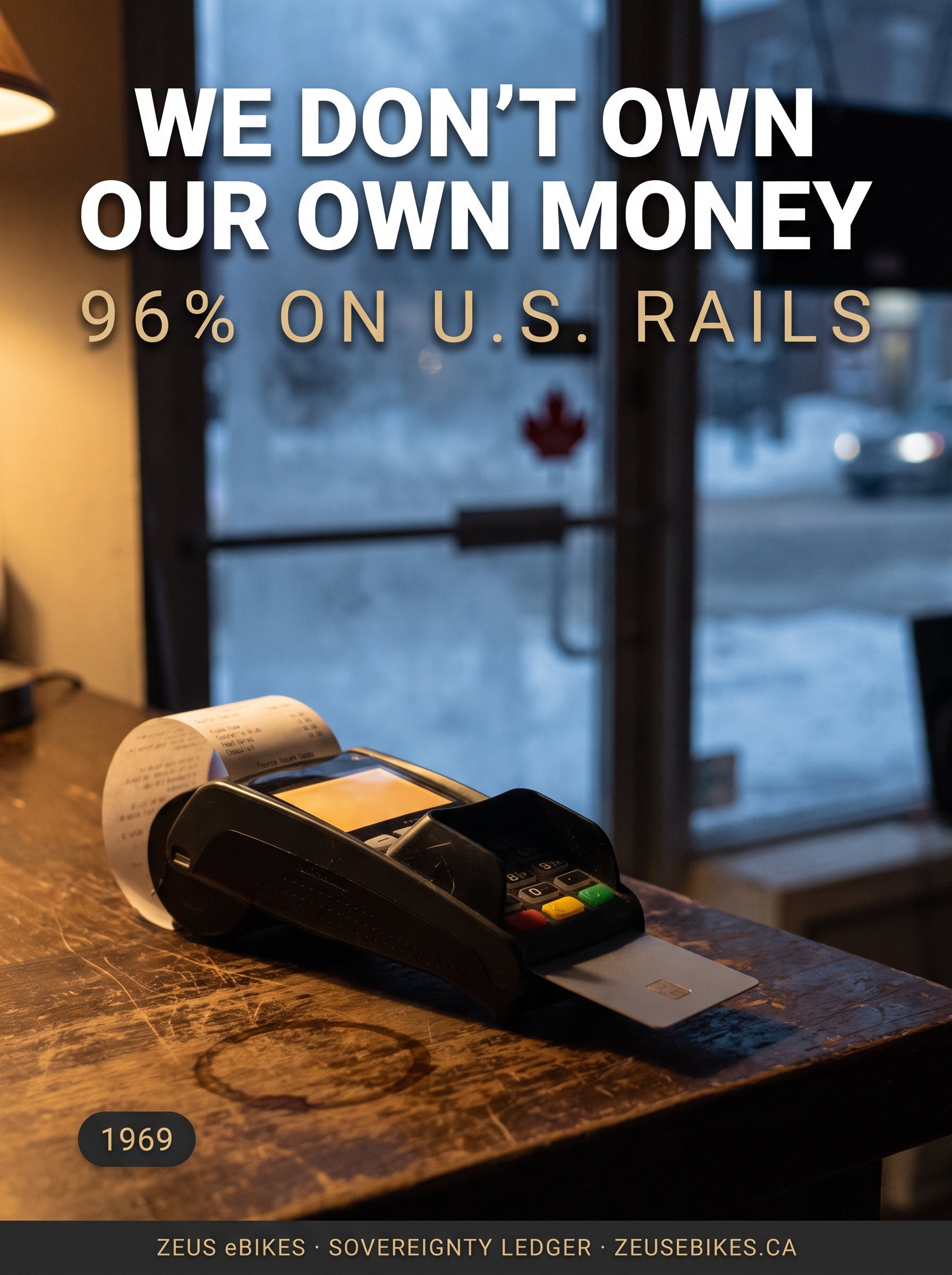
What If Canada Owned Its Own Money? The Toll, the Chargeback Court, and the Bank We Built and Killed
By Milad Ghobadibeygvand, BScN (Western University, 2014) · Published July 29, 2026 · Zeus eBikes Canada

In March 2022, two American companies switched off an entire country's money over a weekend. When Visa and Mastercard suspended operations in Russia, every card their networks touched went dark for cross-border use, and the world learned something most people had never thought to ask: the rails your economy runs on can be turned off by someone else's government (Mastercard corporate statement, March 2022). Three years later, the country whose companies own those rails spent a year taxing Canada, tearing up the trade agreement it signed with us, and musing aloud about absorbing us. Ninety-six percent of every credit purchase Canadians make rides on Visa and Mastercard (The Walrus, 2025). Suddenly a boring question about payment plumbing is a question about sovereignty.
Here is what that dependency costs, printed in full and sourced to the last line: the merchant fees, the interest, the foreign-exchange markups, the money that quietly leaves the country, and the one part almost no customer ever sees — the chargeback system, a private court run by the card networks in which a Canadian small business is guilty until proven innocent, and often guilty after. Then the other half of the question: Canada once owned a public bank and shut it down in 1969, and once used its own central bank to build the country nearly cost-free. This is the honest ledger of what we lost, what other countries built instead, what it would actually take to own our money again — and, because this publication prints both columns, every way that project can fail.
How this ledger was built — and our stake in it
This article was researched to a citable standard in July 2026. Sourcing follows a strict hierarchy: primary institutions first (the Bank of Canada, Payments Canada, the Competition Tribunal, the Department of Finance, Library and Archives Canada, the Canadian Federation of Independent Business, the central banks of Brazil and Russia, the Bank of North Dakota, ATB Financial), industry and scholarly data second, tier-one journalism only where no primary exists. Every volatile figure carries an as-of date. Contrary evidence is included by rule, not by mood: you will find the case against a Canadian public bank printed beside the case for it.
Interest disclosure — larger than usual, and load-bearing: Zeus eBikes Canada is a commercial retailer that accepts Visa and Mastercard, pays interchange fees, and has lost chargebacks. We are not neutral observers of this system; we are inside it, and one chapter draws on our own disputes. We disclose that here so you can weigh every word of it. We have also kept our catalogue out of these pages — this is the record, not a sales pitch, and it contains no product recommendations.
Quick answer: Canada has no nationwide public retail bank open to ordinary citizens — Alberta's ATB is the lone provincial exception — and no domestic credit card network. About 96% of the credit card market runs on American-owned Visa and Mastercard (American Express holds most of the small remainder), Canadian merchants pay roughly $5 billion a year in card fees among the highest rates on Earth, and the chargeback system lets a cardholder's bank reverse a payment with no Canadian public body ruling on the merits. Meanwhile Brazil, India, China, Russia, and the EU all built domestic payment rails, and Canada itself ran a public bank from 1868 to 1969 before shutting it. The case for owning our money is strong; the failure modes are real. Both are below, fully sourced — the same lens this publication brought to what Canada can and can't copy from China.
- The toll booth we don't own
- The two things Canada doesn't own
- The toll on everything: the money ledger
- The chargeback court with no judge
- We built this once — and killed it
- Who actually owns their money
- Does it help? The honest ledger
- Why Canada doesn't have one
- Four ways to own it
- How Canadians move this: the levers
- What it would mean at your front door
- FAQ · Sources · Limitations
The Toll Booth We Don't Own
Every time a Canadian taps a credit card, a toll is collected on a road Canada does not own, under operating rules Canada does not write, and settled — when something goes wrong — by a dispute process no Canadian court sees. Canada regulates the networks only at the edges, through a voluntary Code of Conduct the Financial Consumer Agency monitors (Payment Card Networks Act, 2010; FCAC). It does not own the rails, it does not write their global rules, and it has no public adjudicator for a disputed charge. For most of the last forty years nobody thought that was worth worrying about. Then March 2022 happened, and then February 2025, and the toll booth revealed itself to also be a gate.
The stakes are no longer theoretical. When Washington opened its 2025 tariff war on Canada and senior American figures began talking about Canada as a "51st state," a Toronto essayist did the arithmetic almost nobody had done: American-owned Visa and Mastercard control about 96 percent of Canada's credit card market — American Express and a few others share the small remainder — and a network that can be switched off, as both were in Russia within days of the invasion, is a national-security exposure, not just a line item (The Walrus, 2025; JP Koning, Moneyness, March 2025). Canada has a domestic debit network, Interac, but no domestic credit rail at all, and — outside Alberta's provincial ATB — no public bank a citizen can open an account with. The plumbing that moves the country's money is, in the part that matters most, foreign-owned and foreign-governed.
This article prices that exposure on every front, because the sovereignty argument only lands once you see the bill. What follows is the toll a country pays for renting its money: the fees merchants hand over, the interest households carry, the markups on every foreign purchase, the profit margin that leaves the country, and the chargeback system — the single most revealing piece of the whole machine, because it is where a Canadian business discovers, in writing, that it has no court of its own. Then the constructive half: who built the alternative, whether it worked, and what it would take here. The promise of this ledger is not outrage. It is a number, and a decision.
Takeaway: Two American companies process about 96% of Canadian credit purchases on rails Canada does not own, whose global rules Canada does not write, and that have been switched off elsewhere within days. The question this ledger answers is not whether that feels wrong — it's exactly what it costs, and what owning our money instead would cost and save.
The Two Things Canada Doesn't Own
Canada is missing two distinct pieces of financial infrastructure, and the confusion between them is why the conversation never goes anywhere. The first is a public retail bank — a bank owned by the public that ordinary people and businesses can actually bank with. The second is a domestic credit card network — a made-in-Canada set of rails to carry credit payments, the way Interac carries debit. Canada has neither at the national level — the one public retail bank it owns is provincial, and the one payment network it owns does only debit — and each gap costs in a different way.
Start with what Canada does have, because it is not nothing. The Bank of Canada is a central bank — it sets monetary policy and is a bank to the government, but you cannot open a chequing account there. "National Bank of Canada" exists, but confusingly it is a private commercial bank, the sixth of the Big Six. Ottawa runs Crown lenders for slices of the economy — the Business Development Bank for firms, Farm Credit Canada for agriculture, Export Development Canada for exporters, CMHC for mortgages — but none is a bank for the public. There is exactly one genuine public retail bank in the country, and it is provincial: ATB Financial, owned by Alberta, with about $64 billion in assets and more than 800,000 customers (ATB Financial, 2025). And there is Desjardins, the Québec cooperative, with $510 billion in assets and 5.8 million members — member-owned rather than state-owned, but proof at massive scale that Canadians will bank outside the Big Six when a real alternative exists (Desjardins, December 2025).
On the payment side, Canada has Interac — and this is the crucial, under-appreciated fact. Interac is a genuine Canadian success: a domestic debit network that moved 1.4 billion e-Transfer transactions worth $563 billion in 2024, cheaply, entirely inside the country (Interac, 2024). But Interac only does debit — moving money you already have. It has no credit product. And Interac is owned by a consortium of the very banks and credit unions whose credit card businesses a domestic credit network would undercut. When your card is "co-badged," the online and international transactions route to Visa or Mastercard, not Interac. Canada, in other words, built the hard part — a trusted national rail — and then left the profitable part, credit, to two foreign companies. The debit is ours. The credit, where the fees and the interest and the chargebacks live, is not.
Takeaway: Canada already owns and trusts a national debit rail (Interac) and already runs a working public bank (ATB). It has proven both models domestically. What it lacks is a public bank for the whole country and a domestic credit network — precisely the two places where the money is.
The Toll on Everything: The Money Ledger
The direct, measurable cost of renting Canada's payment system runs into the billions every year, and it arrives on four fronts: the fees merchants pay, the interest households carry, the markup on every foreign purchase, and the network profit that physically leaves the country. Here is each, sourced, with an honest note on how much is a transfer within Canada versus a true outflow — because printing the whole bill as "money America takes" would be exactly the kind of cherry-picking this publication refuses.
Front one: merchant fees
Canadian businesses pay roughly $5 billion a year to accept cards, and the Canadian Federation of Independent Business has documented for years that these are among the highest such fees in the world; 81 percent of small firms say they simply absorb the cost (CFIB, 2024). The reason is regulatory: Canada's average credit interchange is capped, voluntarily, at about 1.4 percent — versus a hard 0.3 percent legal cap across the European Union and about 0.5 percent in Australia (Clearly Payments; WalletHub, 2026). The EU's cap alone saves European merchants billions of euros a year (European Commission). A 2024 federal deal trimmed Canadian fees to about 0.95 percent — but only for small merchants under $300,000 in annual Visa volume, and the Canadian Federation of Independent Business reported that at least one major processor, Stripe, said it would keep the reduction rather than pass it to businesses (Department of Finance, October 2024; CFIB, 2024). For scale, all Canadian payments — every method, not just credit — totalled $12.2 trillion across 22.5 billion transactions in 2024, with credit cards making up one in three transactions by count (Payments Canada, 2025). Applied to Canada's credit-card dollar volume, the gap between Canadian and European interchange runs to billions of dollars a year that European rules would have kept in merchants' hands.
Front two: interest
Canadians carry about $124 billion in credit card balances, roughly two-thirds of it revolving month to month, at an average purchase rate around 20.5 percent (Clearly Payments, 2025; Bank of Canada). The average indebted cardholder pays on the order of $760 to $980 a year in interest depending on balance (money.ca, 2026). This is the largest single number in the ledger — but it is also the most honest to caveat: most of that interest flows to the Canadian issuing banks, not to the American networks. It is a cost of the system's design, and a driver of the Big Six's near-record $69.86 billion in combined fiscal-2025 profit (NAI500, December 2025), but it is not money leaving the country. It is money leaving households.
Front three: the foreign-exchange markup
Every time a Canadian buys in another currency, most cards add a foreign-transaction fee of about 2.5 percent on top of the exchange rate (Scotiabank; Ratehub, 2026). It is split between the network and the issuer, it is almost invisible, and on the tens of billions Canadians spend cross-border it is a steady, compounding drain that a domestic system could price at cost.
Front four: what actually leaves the country
This is the front the sovereignty argument really rests on, so it deserves precision. On top of interchange (which mostly goes to Canadian banks), Visa and Mastercard levy their own network assessments — Mastercard's Canadian schedule lists a 0.09 percent domestic acquirer assessment plus a cross-border assessment of 0.60 percent when a transaction settles in Canadian dollars and 1.00 percent otherwise, with Visa running a parallel structure (Mastercard Canada network-assessment schedule, 2025). That network layer is the part that genuinely flows out of the country. On several hundred billion dollars of annual Canadian credit volume, an assessment in the range of a tenth to a sixth of a percent puts the network's Canadian take on the order of a billion dollars a year — a conservative, arithmetic estimate, labelled as such, not a sourced figure. And roughly half of that revenue is profit: Visa's net profit margin runs around 50 to 51 percent and Mastercard's around 45 percent, margins both companies confirmed to a US Senate hearing exceed 50 percent for the pair (Macrotrends, 2025; CBS Austin, 2024). Profit is not a second toll stacked on the assessment; it is how much of that one toll never comes back. It is the toll on the toll.
| The front | Roughly what it costs Canada / year | Where the money goes |
|---|---|---|
| Merchant fees | ~$5B (CFIB); Canadian rate ~1.4% vs EU 0.3% | Mostly Canadian issuing banks (interchange); network layer to US |
| Card interest | on the order of ~$16B on the ~$80B carried revolving at ~20.5% (Zeus arithmetic) | Canadian issuing banks — leaves households, not the country |
| FX markups | ~2.5% on cross-border spend | Split network / issuer |
| Network assessments | ~0.1–0.15% of card volume — order of $1B+/yr (Zeus arithmetic), roughly half of it profit at Visa/MC margins ~45–51% | Visa & Mastercard — genuinely leaves Canada |
| Chargeback losses | See next section — global chargebacks $33.8B and rising | Merchants absorb; friendly fraud ~61% of disputes |
The honest read The $5 billion in merchant fees and the roughly $16 billion in card interest do not "leave Canada" — most flows to Canadian banks. What genuinely leaves is the network-assessment layer, on the order of a billion dollars a year, about half of it Visa and Mastercard profit. But "it stays with the Big Six" is cold comfort to the merchant or the household paying it: a toll is a toll whether the booth is domestic or foreign. The sovereignty case rests on the outflow; the affordability case rests on the whole bill.
This is the same fight as the price of everything else in Canada. If you want the wider picture of why Canadian households pay more across the board, this publication mapped it in why Canada is so expensive in 2026 and priced one everyday version of it in Canada's $300-billion car-dependency bill.
The Chargeback Court With No Judge
The most revealing cost of not owning our payment system is not a fee — it is a courtroom that isn't one. A chargeback is a forced reversal of a card payment, and when a cardholder disputes a charge, the case is decided by the cardholder's own bank and the card network under private rules, with the burden of proof placed on the merchant. Canada monitors those networks for compliance with a voluntary Code of Conduct (Payment Card Networks Act; FCAC), but no Canadian public body rules on the merits of an individual dispute or orders money returned to a wronged merchant. And by the industry's own estimates — from the chargeback-management firms that track this, using varying datasets and definitions — merchants recover in only about one in five of the disputes they contest (Chargeflow; Mass News, 2025). The system is not built to find the truth. It is built to move money back to cardholders quickly, and it does.
The scale is enormous and growing. By industry estimates, global chargeback value is set to rise from $33.79 billion in 2025 to $41.69 billion by 2028 (Chargebacks911, 2026). And much of it is not real fraud: "friendly fraud," or first-party misuse — a customer disputing a charge for something they actually bought and received — is estimated to make up about 61 percent of all e-commerce disputes and is tied to some $132 billion in losses, with first-party fraud reported to have climbed from 15 percent of all fraud in 2023 to 36 percent in 2024 (Chargeflow, 2025). These are vendor figures rather than official statistics, but the direction is not seriously in dispute. The asymmetry is baked in: surveys find 84 percent of customers think filing a chargeback is easier than asking a merchant for a refund, and 72 percent treat the two as the same thing (Mastercard State of Chargebacks, via Chargeback Gurus). Why email the store when your bank will just reverse it?
Here is what that feels like from inside a Canadian business — and this is the interest disclosure from the top of the page made concrete.
From our own files We are not writing this as neutral observers. In one dispute, we shipped a customer a part; the customer received it and told us, in writing, that the bike was broken. The cardholder's bank then reversed the payment on the stated ground that the product had never been received. Both cannot be true: you cannot fail to receive an item and complain that the item you received is defective. We sent the network the order record, the delivery confirmation, and the customer's own message. It took the money anyway. In a second dispute, we submitted a complete evidence package — and as far as we can tell, not one page of it was weighed before we lost. One of these is now headed to a provincial tribunal, which will be the first venue in the entire process where a neutral adjudicator actually reads what we sent. That tribunal is Canadian. The system that overrode it is not.

The merchant's side of a chargeback: the order record, a signed delivery confirmation, the customer's own messages — the file the card network is under no obligation to read the way a judge is.
Notice what that story is and isn't. It is not an accusation against a named person — we will not, and legally cannot, publish a customer's dispute data, and the point does not require it. It is an indictment of a process in which a demonstrable contradiction — received-but-broken versus never-received — does not stop the reversal, because no one in the chain is obligated to read the file the way a judge is. And the merchant's own payment processor cannot fix it: once the issuing bank and the network rule, the processor is as powerless as the merchant. There is no domestic appeal. The only recourse is to sue the customer in small claims court or a provincial tribunal — slow, expensive, and so rarely worth it that most merchants simply eat the loss and raise prices on everyone else to cover it.
But here is the part the scheme depends on you not knowing, and it is the turn in this whole story: the chargeback court has no judge — Canada does. A reversed payment does not extinguish the debt. It creates one. And the same evidence file the network waved through unread is the file a Canadian court is obligated to actually read.
Before you dispute a charge for something you kept — read this First, the part that matters most: if you were the victim of real fraud, never received your order, or were sold something defective the seller will not make right, you should absolutely use your chargeback rights — that is exactly what they exist for, and nothing here is meant to discourage a genuine dispute. This is about a different act: reversing payment for something you ordered, received, and kept. In Canada that can carry two separate liabilities. Civilly, the reversed amount is a debt the merchant can sue to recover in small claims court, plus filing costs and interest; the seller would put forward the ordinary record it keeps by default — order, IP address, delivery confirmation, and your own messages — and you could still raise a genuine defence such as a real defect or a broken promise, but "I received it and charged it back anyway" is not one of them. A judgment is a public record that can follow you into collections. Criminally, knowingly making a false claim to reverse a legitimate payment while keeping the goods — where dishonest intent and a resulting loss can be proven — can be fraud under section 380 of the Criminal Code of Canada, carrying up to two years for amounts of $5,000 or less and up to fourteen years above it (Criminal Code, s.380; Kazandji Law, Ontario). Losing a dispute is not a crime; deliberately lying to a bank to keep goods for free can be. We keep every record, we pursue the cases we can prove, and where a reversal is flatly contradicted by our own delivery file and the customer's own written words, we treat the tribunal or the courtroom — the first place in this process with a neutral adjudicator — as our advantage, not our last resort.
That is the sovereignty argument in its most human form, and it cuts both ways. A Canadian small business, wronged inside a system it is required to use, has no Canadian public body that will weigh the merits of its case: the financial regulator monitors the networks' conduct against a voluntary code, but it does not judge an individual dispute or order money returned. What the merchant has instead is the slow, expensive backstop of the ordinary courts — which is exactly where a payment rail with fair rules and a real appeal would have kept the honest disputes in the first place. Canada does not write those dispute rules today, and it owns no rail on which to write them; that is the gap a domestic system, or a determined regulator, could close.
Takeaway: The chargeback system is a private court where the Canadian merchant is guilty until proven innocent and often guilty after — merchants recover in only about one in five contested disputes, much of it friendly fraud. No Canadian public body rules on the merits, and no domestic appeal exists. Owning a rail is the strongest way to fix that — though Parliament could also legislate evidence standards, written reasons, and an independent appeal without owning anything.
We Built This Once — and Killed It
The strangest fact in this entire story is that Canada is not a country that never tried public banking — it is a country that built it, ran it for a century, and dismantled it. Twice, actually: a public savings bank for citizens, and a central bank that financed the country almost for free. Understanding why both ended is most of the answer to why Canada has neither today.
The Post Office Savings Bank opened in 1868, the year after Confederation, and used the post office as a branch network for ordinary people's savings. It grew fast — from 81 offices to 343 by 1884, holding millions in deposits across tens of thousands of accounts (Library and Archives Canada). It also made enemies. The chartered banks, wanting those small depositors for themselves, lobbied against it for decades; in 1898 they successfully pushed the government to cut the interest the postal bank could pay (Canadian Union of Postal Workers, historical record). As private branches spread, official enthusiasm faded, and in 1969 the Pierre Trudeau government closed the system outright, shutting hundreds of thousands of accounts. Canada had a public bank for the people for 101 years, and then it didn't.

Canada ran a public savings bank out of its post offices from 1868 to 1969 — then closed it. The same 6,300-outlet network still reaches roughly 1,200 communities that have no bank branch (Canadian Union of Postal Workers).
The second dismantling is more technical but just as consequential. After it was nationalized in 1938, the Bank of Canada held large amounts of federal debt and, because a central bank remits its profits to the treasury, financed a great deal of wartime and postwar building at very low net public cost — a practice that wound down in the mid-1970s as Canada shifted to borrowing on private markets. Advocacy groups overstate this history — the popular claim that "interest-free Bank of Canada loans built the Seaway and the highways" is looser than the record supports — but the core is real: for decades the public's own bank carried the public's debt cheaply, and then stopped. A lawsuit by the Committee on Monetary and Economic Reform to revive the practice was dismissed, and the Supreme Court declined to hear it in 2017 (CBC, 2015; Canadian Unitarians for Social Justice, 2017).
And the idea keeps trying to come back. In 2013, Canada Post completed a secret four-year internal study on postal banking. Its conclusion, in the corporation's own words, was that banking would be "a win-win strategy" and "a proven money-maker." The study was shelved just before a round of service cuts, and when it was pried loose under access-to-information law, 701 of its 811 pages were redacted (Blacklock's Reporter; rabble.ca, 2014). A 2022 attempt — a Canada Post loan product run with TD Bank — was paused within a month of launch and dead within a year (CBC, 2023). Today Canada Post has about 6,300 outlets, the largest retail network in the country, reaching — by the postal union's count — roughly 1,200 communities that have a post office but no bank branch (Canadian Union of Postal Workers), and it is, in the words of a 2025 federal commission, "effectively insolvent" (CP24, November 2025). The one institution positioned to be a public bank for underserved Canada is dying for want of the revenue a public bank would have given it. That is not irony. It is a policy choice, made repeatedly.
Takeaway: Canada ran a public savings bank from 1868 to 1969 and used its central bank to finance the country cheaply until the mid-1970s. It killed both. It then buried a 2013 study showing postal banking would be profitable. The absence of a public bank is not a gap history left — it is one policy filled in and then erased.
Who Actually Owns Their Money
While Canada dismantled its public banking, much of the world was building domestic payment systems — and the results are now measurable, dramatic, and impossible to dismiss as theory. More than 90 domestic card schemes exist worldwide (Primer, 2025). Here are the ones that matter, and what they prove.
Brazil — Pix is the example that should keep Visa and Mastercard executives awake. Launched by Brazil's central bank in November 2020, this instant-payment rail reached about 93 percent of Brazilian adults within five years and, by the first half of 2025, carried 50.9 percent of all payment transactions in the country — more than cards and cash combined (EBANX; Brazilian central bank data, 2025). The merchant cost is roughly 0.22 percent, against up to 2.2 percent for credit cards, and the money settles instantly instead of in thirty days (PagBrasil, 2025). A central bank built it, mandated the big banks onto it, and gave an entire country cheap instant payments in half a decade.

Brazil's Pix reached about 93% of adults in five years and by mid-2025 carried 50.9% of all payments in the country, at roughly 0.22% merchant cost — a public rail that bypassed the card networks entirely (Brazilian central bank data via EBANX).
India — RuPay and UPI proves the same point at even larger scale. India's domestic card network, RuPay, passed 60 percent of all cards issued in the country by 2020, and its instant-payment system UPI now carries tens of billions of transactions with zero merchant fee on most of them (Reserve Bank of India; NPCI). China — UnionPay, created by state directive in 2002, is now the largest card scheme on Earth, with more than 9 billion cards (Finextra). Russia — Mir, built after the 2014 Crimea sanctions, is the proof of the sovereignty point: when Visa and Mastercard suspended Russia in March 2022, domestic cards kept working because the country had built its own processor, and Russia had issued 476.5 million Mir cards by January 2026 (PYMNTS, 2022; Izvestia, 2026). Europe — Wero, the banks-and-central-banks answer to the same fear, reached 53 million users by 2026 and, through the EuroPA alliance, is building toward a 130-million-user network across 13 countries, with the European Central Bank openly framing it as ending Visa and Mastercard "gatekeeping" (European Business Magazine, 2026).
And the public-bank half of the question has proof too, including on Canadian soil. The Bank of North Dakota, the only US state-owned bank, holds about $10 billion in assets, earned a record $191 million in 2022, and transfers profit into the state treasury — $140 million every two years in recent budgets (Bank of North Dakota; Bismarck Tribune). New Zealand's Kiwibank, state-owned and built out of the post office, is exactly what New Zealand's competition regulator now wants capitalized as a "maverick" to break the Australian-bank oligopoly that earns roughly NZ$1,400 per citizen a year (Bloomberg, 2024). And ATB Financial — Alberta's own public bank — has returned nearly $7 billion to the province since 1997 and paid its first $100-million dividend in fiscal 2025 (ATB Financial). The model is not exotic. One province over, it already works.
| Country | What they built | The result |
|---|---|---|
| Brazil | Pix — central-bank instant rail (2020) | 50.9% of all payments; ~0.22% merchant cost; 93% of adults |
| India | RuPay + UPI — domestic card + instant rail | >60% of cards; zero merchant fee on most transactions |
| China | UnionPay — state-created (2002) | World's largest card scheme, 9B+ cards |
| Russia | Mir / NSPK — post-sanctions (2014) | Domestic cards kept working when Visa/MC left in 2022 |
| Europe | Wero + EuroPA alliance | Toward 130M users, 13 countries |
| US (North Dakota) | Bank of North Dakota — state-owned (1919) | ~$10B assets; profits to state treasury |
| Canada (Alberta) | ATB Financial — provincial public bank (1938) | ~$64B assets; ~$7B returned to Alberta since 1997 |
Takeaway: Domestic payment rails and public banks are not utopian — they are operating at national scale in Brazil, India, China, Russia, Europe, North Dakota, and Alberta. The question for Canada is not "can it be done." It is "why haven't we."
Does It Help? The Honest Ledger
A public bank and a domestic payment network would help Canadians in specific, evidenced ways — and this publication would be failing its own no-cherry-picking rule if it did not also print, at equal strength, the ways the idea can fail. Both columns, one table.
The case for
The benefits are concrete. Merchant costs collapse under domestic rails: 0.22 percent on Pix versus over 2 percent on cards, and the EU's 0.3 percent cap saving merchants billions a year. Profits recycle to the public instead of to shareholders: North Dakota's bank funds its state; ATB has returned $7 billion to Alberta. Competition improves even without winning — New Zealand's entire regulatory remedy is to fund a public "maverick," and in India, Visa and Mastercard are visibly losing share to RuPay. Financial inclusion expands: Pix banked most of Brazil in five years, and Canada Post's 6,300 outlets reach the roughly 1,200 communities — and, by the postal union's count, the large majority of Indigenous communities — that have no bank branch, where the fallback today is a payday loan, still legal at effective rates far above the 35 percent criminal ceiling thanks to a carve-out (Canadian Union of Postal Workers; Department of Justice, 2025). And a domestic rail could write fairer chargeback rules with a real Canadian appeal — the reform the previous section showed is impossible today.

The place the banks left. Roughly 1,200 Canadian communities have a post office but no bank branch; where the branch is gone, the fallback is often a payday loan (Canadian Union of Postal Workers).
The case against
Now the failure modes, printed plainly. Politically directed lending has produced some of the most expensive disasters in banking history. France's state-owned Crédit Lyonnais required a bailout of roughly US$35 billion in the 1990s — a world record for a single bank at the time (Institutional Investor). Germany's public WestLB accumulated €77 billion in toxic assets and was wound down in 2012, a cautionary monument to what happens when a public bank becomes a patronage machine (Wikipedia; Institutional Investor). A Canadian public bank steered by politicians toward favoured projects could burn public money at exactly that scale. Cheaper interchange can shrink rewards — the points and cashback funded by those fees — and Canadians are heavy rewards users who would feel the loss before they felt the savings, as Australia's own regulator openly forecasts for its 2026 fee cuts. Building it is hard: Canada promised instant payments in 2019 and still has not shipped them. And the incumbent it would need to run on — Canada Post — is itself insolvent, which is why the Globe and Mail argued the country should be "thankful it's not a bank" (Globe and Mail, 2025). The counter, of course, is that Kiwibank was built precisely to save a declining postal service by giving it new revenue — the thing Canada Post's own buried 2013 study said banking would do.
There is one more risk, and it is not economic. The United States retaliates against countries that build these systems — and it is documented, not hypothetical. Visa formally complained to the US Trade Representative that India was unfairly favouring RuPay; Mastercard did the same in 2018; and the USTR called India's actions against Mastercard "draconian" (Reuters, 2021; Al Jazeera, 2021). Doing this to two US networks that hold 96 percent of the Canadian market, in the middle of a tariff war, is not a decision without consequences. It is a decision with a price — which is exactly why it belongs in the sovereignty column, not against it. Some tolls you pay to be free of a bigger one.
The balanced finding Done as boring, commercial, arm's-length institutions — the ATB, Bank of North Dakota, Kiwibank, Pix model — a public bank and domestic rail cut costs, return profit to the public, and expand access, with strong evidence behind every claim. Done as a politician's chequebook — the Crédit Lyonnais, WestLB model — they destroy money at spectacular scale. The design decision is the whole decision.
Why Canada Doesn't Have One
If the model works, the history is Canadian, and the world has proof, the obvious question is why Canada still has neither a public bank nor a domestic credit rail. The answer is not that it is illegal or impossible — banking is exclusive federal jurisdiction under section 91 of the Constitution, so Parliament could act tomorrow. The answer is a stack of political facts, and they are worth naming.

The incumbents. Interac — the one domestic rail Canada owns — belongs to the same banks whose credit-card profits a national network would cut, which is why the institution best placed to extend into credit has every reason not to.
Canada killed both and never rebuilt. The 1969 closure and the mid-1970s wind-down were not accidents; they reflected a settled preference for leaving retail banking to the chartered banks. The banking lobby has resisted a public option for over a century — from the 1898 interest cut on the postal bank to the buried 2013 study to the one-month death of the 2022 Canada Post loan. The obvious rail is owned by the incumbents: Interac belongs to the banks and credit unions whose credit card profits a domestic credit network would cut, so the institution best placed to extend into credit has every incentive not to. Ottawa regulates by handshake, not statute: where the EU and Australia capped interchange by law, Canada negotiated a voluntary discount for small merchants only.
And when a Canadian regulator did try, it lost. In 2013, the Competition Bureau took Visa and Mastercard to the Competition Tribunal over the rules that stopped merchants from steering customers to cheaper cards. The Tribunal dismissed the case — and even where it found an adverse effect on competition, it declined to act, ruling that "a regulatory, rather than competition, response" would be better suited (Competition Tribunal, CT-2010-010, July 2013; Globe and Mail). It punted to Ottawa, and Ottawa did little that was binding for a decade. The eventual class-action settlement in 2021 — $188 million split among the banks, Visa, Mastercard, and Desjardins, with no admission of wrongdoing — was a rounding error against the fees at stake (Top Class Actions Canada, 2021).
There is also a myth worth puncturing, because it is used to defend the status quo. The story Canadians tell is that our banks are so sound they needed no help in 2008, so why disturb them? In fact the Canadian Centre for Policy Alternatives documented about $114 billion in government support flowing to Canadian banks at the 2009 peak — roughly 7 percent of GDP, with three banks receiving support that at points exceeded their own market value (CCPA, 2012). The oligopoly is stable, but "it never needs the public's help" is not true. It needed a great deal of it, quietly.
The last reason is the newest: until 2025, there was no sovereignty shock to force the question. Russia built its system after being sanctioned; Europe built its after watching Russia; Canada's wake-up call — the tariff war, the "51st state" talk, the switch-off precedent — is barely eighteen months old. The idea is early here because the fear is early here. That is changing fast.
Takeaway: Canada lacks a public bank and a domestic card network not because it can't build them — Parliament has the constitutional power — but because it killed the ones it had, the bank lobby has won for a century, Interac is owned by the incumbents, regulators lost in 2013, and the sovereignty fear is only now arriving.
Four Ways to Own It
There is no single "national bank and credit card" switch to flip; there are four distinct paths, of increasing ambition, and Canada could take any combination of them. Naming them precisely is how the conversation stops being a slogan and starts being a policy.
Path one — the postal bank. Turn Canada Post's 6,300 outlets into a public bank for the underserved, exactly as the corporation's own 2013 study recommended and as New Zealand did with Kiwibank. It solves two problems at once: banking deserts and Canada Post's insolvency. It is also the hardest politically, because it most directly threatens the Big Six.
Path two — the public rail. Build a Pix. Canada's Real-Time Rail — an instant account-to-account payment system — is finally scheduled to launch in late 2026, with its governing rules coming into force in August 2026 (Payments Canada, 2026). A Canadian instant-payment system with mandated bank participation, running on that rail, could do for Canada what Pix did for Brazil: near-free instant payments that bypass the card networks entirely. The timing is the opportunity — the infrastructure is being finished right now.
Path three — the provincial model. Copy ATB. Alberta's public bank works; other provinces could charter their own, incrementally, without a federal fight. It is the slowest to scale but the most proven and the least contentious.
Path four — regulate instead of build. The cheapest option is to build nothing and simply cap fees by law, as the EU did at 0.3 percent and as Australia is doing — banning surcharges and cutting the credit interchange cap to 0.3 percent from October 2026 (Reserve Bank of Australia, 2026). It captures much of the affordability benefit with none of the sovereignty benefit, and none of the failure risk. It is the reform a cautious Canada is most likely to reach for first.

Banking is exclusive federal jurisdiction under section 91 of the Constitution. The barrier to a public bank or a domestic rail is political, not legal — which makes it a decision Parliament, not a platform, will make.
The through-line of this whole series. Owning your money, owning your movement, owning your supply chains — it is one argument in several movements. Read this beside what Canada can and can't copy from China, whose payment-sovereignty chapter is the sister to this one, and the 2026 tariff and price guide that shows what the trade map already means at the till.
How Canadians Move This: The Levers That Actually Exist
A Canadian who agrees with this ledger has more power than the fee schedule suggests — and using it takes a few minutes and, in most cases, no money at all. The levers already exist: some sit in your wallet, three sit in Parliament's own machinery, one belongs to every merchant, and the oldest campaign already has hundreds of municipal councils behind it. Here is the verified toolkit.
Start with your wallet — today, no politics required
Every credit tap routes roughly 1.4 percent and up through the card system; a debit tap moves on Interac's Canadian rails for a few cents flat. Paying debit where you can is the most direct vote available — with the honest trade printed beside it: debit earns no rewards points, so you are giving up the very perk the interchange system funds. The second wallet lever is where you keep your money. Credit unions and caisses populaires already serve some 11 million Canadians — Desjardins, the largest financial co-operative in North America, among them (Investment Executive, 2026) — and ATB outranks the Big Six on its home turf. In banking, deposits are the raw material; where you hold yours is the vote that counts.
Move Ottawa: three federal levers, all free
A letter to any MP needs no stamp. Mail addressed to a Member of Parliament at House of Commons, Ottawa, K1A 0A6 travels postage-free by law (Canada Post). One sentence is enough: "Why does Canada still not own its own payment system?"
An e-petition puts the question on the record, on a clock. Any Canadian with five supporters and a sponsoring MP can open one on the House of Commons petitions site; at 500 valid signatures it is certified for presentation in the House, after which the government must respond within 45 days (House of Commons, e-petitions guide). A response is not action — but it is the question asked officially, and answered in writing, for the first time.
The finance committee reads briefs from anyone. The Commons finance committee's pre-budget consultations accept written briefs of up to 2,000 words from any individual or business every budget cycle, through the committee's website (House of Commons, FINA). It is the same channel the bank lobby uses — and it is open to you.
If you run a business, you hold the sharpest lever
Since October 6, 2022, merchants outside Quebec may lawfully surcharge credit cards up to 2.4 percent — or their actual acceptance cost, whichever is lower — a right won in the class-action settlement, subject to the disclosure and notice requirements the networks attach (CFIB; Mastercard merchant surcharge FAQ). Quebec's Consumer Protection Act bars consumer surcharging there; a discount for debit or cash is the lawful equivalent everywhere, Quebec included. Disclosed surcharging is not customer-hostile — it is the single most effective way to make card costs visible, and visibility is what turned card fees into a national issue in Australia, where two decades of visible surcharges ended with the regulator cutting the underlying fees and retiring the surcharge itself. Beyond pricing: document network conduct and file Code of Conduct complaints through your acquirer under FCAC oversight — the regulator will not judge your individual dispute, but complaints build the enforcement record that justifies harder rules — and lend your voice to the CFIB fee campaigns already carrying this fight.
And the oldest campaign is already running. By the postal union's own count, more than 600 municipal councils — Toronto among them — have passed resolutions supporting postal banking under the Delivering Community Power campaign (CUPW). If your council hasn't, a delegation request is a form on your municipality's website — and the business case is the corporation's own buried 2013 study, quoted, redactions and all, earlier in this ledger.
Takeaway: The lever map is real and free: pay debit, move your deposits, one stamp-free letter, a 500-signature e-petition with a 45-day response clock, a 2,000-word committee brief, a lawful and disclosed 2.4% surcharge, a municipal resolution. None of them binds Ottawa on its own. Together, they are how a question stops being fringe — the way it stopped being fringe in Brazil, India, and Europe.
What It Would Mean at Your Front Door
Strip away the sovereignty language and the policy paths, and this comes down to a simple daily fact: a Canadian who owned their money would keep more of it, and would have somewhere to turn when the system got something wrong. The merchant would pay 0.3 percent instead of 1.4, and would stop quietly raising prices to cover the chargebacks it can't win. The household would carry its balance at a rate a public competitor kept honest, and would buy in a foreign currency without a hidden 2.5 percent skim. The person in a town with a post office but no bank would have a bank. And the small business wronged by a reversed payment would have a Canadian door to knock on — because the rules would have been written in Canada.
None of that requires becoming Russia or China. It requires copying the boring, democratic versions — Alberta's bank, Brazil's rail, Europe's cap — that already run inside free countries, and refusing the political-chequebook version that bankrupted Crédit Lyonnais. The evidence that it works is a province away and an ocean away in equal measure. The reason it hasn't happened here is not economics. It is that the people who profit from the current arrangement have won every round for a hundred and thirty years, and the fear that might finally change the math only arrived last winter.
The permission this article asks for is small and civic. The Real-Time Rail's legal framework takes effect this August, with the system itself launching in the fourth quarter; open banking is being designed right now; and the sovereignty conversation is, for the first time in a generation, live. The toolkit is one section up — start with the stamp-free letter — because letters and petitions remain the levers that moved this country before any feed existed, and this is a decision Parliament, not a platform, will make. Read the sister ledger on what Canada can and can't copy from China beside this one; they are one argument, in two movements, about who owns the roads our money and our movement travel on. The country's decision is the one that matters.
FAQ: What Canadians Ask About a National Bank and Credit Card
Does Canada have its own credit card network?
No. Canada has Interac, a domestic debit network owned by the banks, but no domestic credit card network. As of 2025, American-owned Visa and Mastercard controlled about 96% of Canada's credit card market. Every credit purchase you make rides rails owned outside the country, and the network layer of every fee flows to two US companies with net profit margins around 45 to 51%.
Did Canada ever have a public bank?
Yes, twice over. The Post Office Savings Bank operated from 1868 to 1969 and at its peak held hundreds of thousands of accounts; it was closed outright in 1969. Separately, the Bank of Canada financed federal, provincial, and municipal spending at low net cost from 1938 until the mid-1970s. And Alberta still runs ATB Financial, a provincial Crown bank with about $64 billion in assets, proof the model works on Canadian soil today.
How much do credit card fees cost Canadian businesses?
The Canadian Federation of Independent Business estimates merchants pay roughly $5 billion a year in card acceptance fees, among the highest rates in the world. Canada's average credit interchange sits near 1.4%, versus a 0.3% legal cap in the European Union and about 0.5% in Australia. A 2024 federal deal cut fees for small merchants to about 0.95%, but only for businesses under $300,000 in annual Visa volume, and one major processor kept the savings instead of passing them on.
Why do merchants lose chargebacks even when they have proof?
Because the chargeback system puts the burden of proof on the seller and is decided by the cardholder's own bank and the card network, not a neutral court. Industry data shows merchants win only about 20% of contested disputes while issuers win around 75%. First-party or friendly fraud now accounts for about 61% of e-commerce disputes. A merchant can submit order records, delivery confirmation, and the customer's own messages and still lose, with no Canadian authority to appeal to short of a provincial tribunal or court.
Is chargeback fraud illegal in Canada?
Genuine disputes are not — if you were defrauded, never received your order, or got a defective item the seller will not fix, using a chargeback is exactly right. But knowingly reversing a legitimate charge to keep a product for free is a different act, and it can carry two liabilities. Civilly, the reversed amount is a debt the merchant can recover in small claims court for the full sum plus costs, showing the order, delivery, and your own messages (you can still raise a real defect or breach as a defence). Criminally, doing it knowingly — with dishonest intent and a resulting loss — can be fraud under section 380 of the Criminal Code, carrying up to two years for amounts of $5,000 or less and up to fourteen years above. Losing a genuine dispute is not a crime; deliberately lying to a bank to keep goods is.
Which countries have their own national payment network?
Many. Brazil built Pix, a central-bank instant-payment rail that by 2025 carried more than half of all payments in the country at roughly 0.22% merchant cost. India built RuPay and UPI with zero merchant fees on most transactions. China created UnionPay, now the world's largest card scheme. Russia's Mir kept domestic cards working when Visa and Mastercard left in 2022. Europe is building Wero toward a 130-million-user network. There are more than 90 domestic card schemes worldwide; Canada has none for credit.
What is a chargeback and who actually decides it?
A chargeback is a forced reversal of a card payment, initiated when a cardholder disputes a charge with their bank. The decision is made by the cardholder's issuing bank and the card network under private rules, not by a Canadian court. Canada's financial regulator monitors those networks for compliance with a voluntary Code of Conduct, but it does not rule on the merits of an individual dispute or award redress, and the merchant's payment processor cannot overturn the outcome either. So the only way to challenge a wrong result is to sue in small claims court or a provincial tribunal — slow, costly, and rare.
Would a Canadian public bank actually lower fees and interest?
The international evidence points that way, with real caveats. Public and domestic systems consistently cut merchant costs: Pix runs at about 0.22% versus up to 2.2% for cards, and the EU's 0.3% cap saves merchants billions a year. Public banks like the Bank of North Dakota and Alberta's ATB return profits to the public and pressure private rates. But politically directed lending has also produced catastrophic failures, France's Crédit Lyonnais and Germany's WestLB among them, and cheaper interchange can shrink credit card rewards. The benefit is real; so are the failure modes.
Is Canada building a national payment system?
Partly. Payments Canada's Real-Time Rail, an instant account-to-account payment system first promised for 2019, is now scheduled to launch in late 2026, with its governing rules coming into force in August 2026. Open banking, officially Consumer-Driven Banking, has no firm launch date as of mid-2026. Neither is a credit card network. But the Real-Time Rail is the infrastructure a Canadian instant-payment or public-card system could run on, the way Brazil's Pix runs on its central bank's rail.
What is the difference between Interac and Visa or Mastercard?
Interac is Canada's domestic debit network, owned by a group of Canadian banks and credit unions. It moves money you already have, at low cost, and stays inside the country. Visa and Mastercard are American credit and payment networks that together hold about 96% of Canada's credit card market. Interac has no credit product, and its co-badged cards route online and international transactions to the US networks, which is why Canada has domestic debit but no domestic credit.
Why doesn't Canada just build one?
Canada built both a public bank and a public-financing practice and dismantled both, in 1969 and the mid-1970s. The banking lobby has resisted a public option for over a century. The obvious domestic rail, Interac, is owned by the same institutions whose credit card profits a national card would cut. Ottawa has preferred voluntary fee deals over statutory caps, and the Competition Bureau lost its 2013 case against Visa and Mastercard, with the tribunal punting the issue to regulators who did little for a decade. The barrier is political, not constitutional: banking is exclusive federal jurisdiction.
What can Canadians actually do to push for a national bank or payment system?
Several free levers exist today. Pay with Interac debit where you can — it keeps the transaction on Canadian rails at a few cents instead of a percentage — and consider a credit union, Desjardins, or ATB, which already serve millions. Federally, a letter to any MP at House of Commons, Ottawa, K1A 0A6 needs no stamp; an e-petition with 500 signatures is certified for presentation in the House and the government must respond within 45 days; and the Commons finance committee accepts 2,000-word pre-budget briefs from any Canadian. Merchants outside Quebec may lawfully surcharge credit cards up to 2.4% with disclosure, which makes card costs visible. And more than 600 municipal councils have already passed postal-banking resolutions.
Sources & Further Reading
Primary institutions, industry data, and tier-one reporting used in this ledger, grouped by chapter. All links verified live July 29, 2026.
Payment sovereignty & the toll: The Walrus – Should Canada Build Up Alternatives to Visa and Mastercard? (96% figure) · JP Koning, Moneyness – Trump-proofing Canada means ditching Mastercard and Visa · Mastercard – suspension of Russian operations (March 2022) · Payments Canada – $12.2 trillion in payments, 2024
Merchant fees & interchange: CFIB – credit card fees for small business · Department of Finance – interchange fee reduction (Oct 2024) · Clearly Payments – interchange fees by country · Top Class Actions Canada – $188M interchange settlement (2021) · Competition Tribunal – CT-2010-010, Commissioner v. Visa/Mastercard (2013) · Globe and Mail – why the Tribunal threw out the case
Chargebacks & the law: Chargebacks911 – global chargeback statistics · Chargeflow – friendly fraud and the $132B threat · Chargeback Gurus – Mastercard State of Chargebacks · Mastercard Canada – network assessment fee schedule (2025) · Criminal Code of Canada – s.380 (fraud) · Kazandji Law – friendly-fraud charges in e-commerce (Ontario) · FCAC – payment card network operators & the Payment Card Networks Act · FCAC – Code of Conduct for the Payment Card Industry (merchant protections)
Interest, FX & bank profit: Clearly Payments – Canadian credit card statistics 2025 · money.ca – average balance and interest cost · Scotiabank – foreign transaction fees · NAI500 – Big Six banks' 2025 profit
Canada's own history: CUPW – postal banking fact sheet (1868–1969 history) · rabble.ca – the redacted 2013 postal-banking study · CBC – Canada Post / TD loan program paused · CP24 – Canada Post "effectively insolvent" · CBC – the COMER Bank of Canada case · CCPA – Canada's $114B bank support (2009)
Who owns their money: EBANX – Pix five-year data · PYMNTS – Russia's Mir after the Visa/Mastercard exit · Finextra – UnionPay, world's largest card scheme · European Business Magazine – Wero · Bank of North Dakota – 2022 annual report · ATB Financial – first $100M dividend · Desjardins Group – scale and membership
Failure modes & retaliation: Institutional Investor – the Crédit Lyonnais scandal · WestLB – rise and collapse · Reuters – Visa complains to USTR about RuPay · Al Jazeera – USTR calls India's Mastercard action "draconian"
What Canada is building: Payments Canada – Real-Time Rail · The Logic – open banking has no committed date · Reserve Bank of Australia 2026 reforms – surcharge ban and 0.3% interchange cap (explainer)
The levers: House of Commons – e-petitions portal and rules · Canada Post – mail to Parliament free of postage · House of Commons – Standing Committee on Finance (pre-budget briefs) · CFIB – credit card surcharging in Canada · Mastercard – Canadian merchant surcharge FAQ · CUPW – 600+ municipal resolutions for postal banking
Limitations — read before citing
(1) Single-author editorial published by a commercial retailer that accepts Visa and Mastercard, pays interchange, and has lost chargebacks; that interest is disclosed in the methodology box and drawn on directly in the chargeback chapter. (2) Two figures in the money ledger — the interest total and the network outflow — are explicitly labelled as Zeus arithmetic built from sourced inputs, not single sourced numbers; they are estimates. (3) The Bank of Canada 1938–1974 financing history is real but is frequently overstated by advocacy groups; this article uses the conservative version and flags the overstatement. (4) Volatile figures (interchange rates, balances, launch dates, tariff context) are accurate as of July 29, 2026 and dated in-text; several will change. (5) The chargeback account is our own experience, described without identifying any customer, and one matter it references is before a provincial tribunal. (6) This is journalism and policy analysis, not legal, financial, or investment advice.
The Bottom Line
Canada is not a country that never imagined owning its money. It is a country that owned it, on two fronts, and let both go — a public bank for the people that ran for a century, and a central bank that carried the public's debt cheaply for a generation. In their place it rents: 96 percent of its credit market from two American companies, a chargeback court with no Canadian judge, and roughly $5 billion a year in some of the world's highest merchant fees. The rest of the world spent the last two decades building the alternative — Brazil in five years, India at a billion-person scale, Alberta one province over — and proved it is neither exotic nor impossible, only resisted.
The finding of this ledger is not that a public bank is a miracle; the Crédit Lyonnais column is printed at full strength beside the Pix column. The finding is that the choice is real, the model is proven in free countries, the history is Canadian, and the only thing that has kept the question closed is that the people who profit from the current arrangement have won every round for 130 years — and that the fear finally large enough to reopen it arrived only last winter. After a ledger like this one, "that's just how payments work" explains nothing about why the alternative exists everywhere but here.
Visuals created by Playcut.ai



Share:
It's Not an Accident. It's a Blueprint. — Why Cyclists and E-Bike Riders Die on Canadian Roads
The Most Comfortable eBike Seat (2026): 8 Picks, Fit First