
Canada's eBike Laws Aren't Enforced. Here's Why That Matters More Than the Watts.

📸 All photography by Playcut.ai — personalized AI actor technology
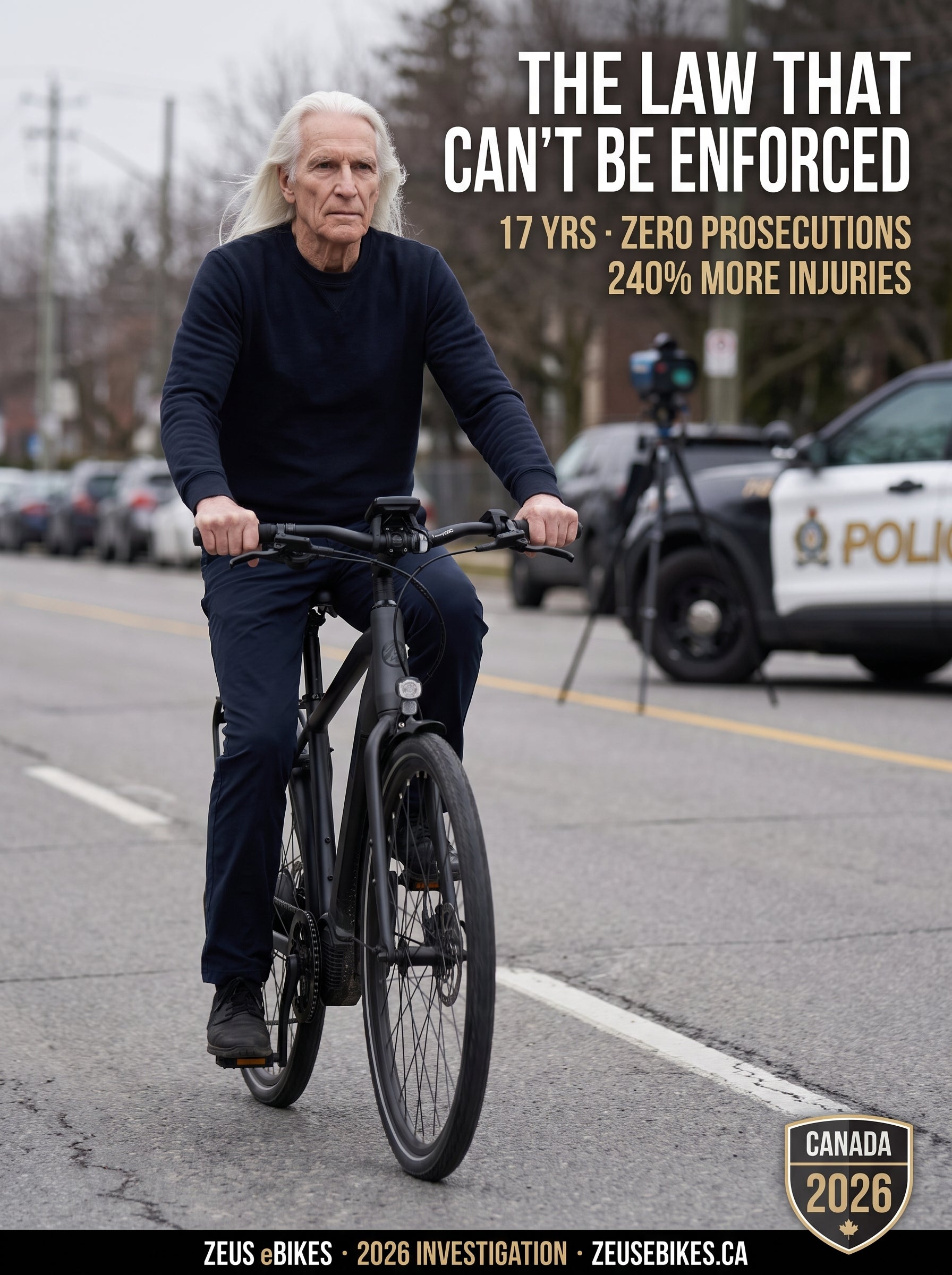
Canada's 500W eBike wattage limit was in full effect while Ontario eBike ER injuries climbed 240% (2020–2024, Unity Health Toronto institutional data, Oct 2025) and 25 operators died in e-bike-related traffic incidents between 2012 and 2021 (Ontario Chief Coroner's E-Bike Death Review, Nov 27, 2025). The law existed. It wasn't enforced. Now Ontario is changing the law again — but still hasn't answered the enforcement question. A retired Hamilton engineer's phone call puts the missing piece in plain language: the variable that determines crash severity is speed, not wattage — and speed, unlike wattage, can actually be measured at roadside. Browse the Zeus 500 W collection, read the Canadian eBike laws guide, or see Ontario eBike laws 2026 for province-specific rules.
In This Article
- The Call That Started This
- Who Is Dave — A Portrait
- Dave Is Not Alone: The Confusion Is Systemic
- Who Makes These Laws — and What Do They Know?
- What the Data Actually Shows
- The Enforcement Paradox No One Is Answering
- How Every New Vehicle Technology Starts Exactly Like This
- The Countries That Already Solved This — and What They Did Differently
- Who Benefits From the Proposed Change?
- Which Law Applies Where You Live?
- Can These Laws Be Challenged? Charter Rights
- Frequently Asked Questions
- The Question That Deserves an Answer
The Call That Started This
Canada's 500W eBike wattage limit has been in force since 2009. Between 2020 and 2024 — while the rule was fully in force — injuries at one Toronto trauma centre climbed 240%. Twenty-five Ontario operators died in eBike incidents during the years the rule was active, and the public record holds zero documented prosecutions specifically for exceeding 500W nominal. A retired power-transmission engineer from Hamilton identified why in three sentences: the law set the wrong variable, and a wrong variable cannot be enforced regardless of how long it stays on the books.
On June 24, 2026 — seventeen days after Ontario's Ministry of Transportation closed its public consultation on proposed eBike law reforms — a retired engineer from Hamilton called Zeus eBikes. He had been reading articles on the site for months, cross-checking them against the government's own consultation document, and he had arrived at a question he couldn't find a clean answer to anywhere.
The consultation, listed on the Environmental Registry of Ontario as ERO 026-0422 ("Modernizing Ontario's Framework for Power-Assisted Bicycles"), had been triggered by the Ontario Office of the Chief Coroner's E-Bike Death Review, released November 27, 2025. That review documented 25 e-bike-related traffic fatalities in Ontario between 2012 and 2021, and by emergency-room data from Unity Health Toronto showing that eBike trauma cases at St. Michael's Hospital had climbed 240% between 2020 and 2024 — from 15 cases to 51. Ontario's regulators had decided the law needed to change.
The caller — Dave — listened to the situation being explained and then said something that cut through the regulatory language like a blade: "Shouldn't you just treat it like cars? A speed limit. Who cares what the motor is — if you're going at 32 kilometres an hour, you're not speeding. If you're going at 50, you are. Why are we measuring the engine?"
The stakes for riders like Dave are not abstract. If ERO 026-0422 passes as proposed, a moped-style 750W eBike bought in good faith — ridden within the 32 km/h limit, insured as a bicycle — may not have a legal registration pathway in Ontario. It would need a VIN it was not manufactured with, and motor vehicle insurance that no Canadian insurer currently offers for bikes without VINs. Dave is not an edge case. Tens of thousands of Canadian riders own similarly classified bikes. This article delivers the same clear analysis Dave asked for in three sentences — starting with why the law was wrong before it was changed, and what a real fix actually requires.
This article delivers that reasoning — along with what the government's own data reveals, who actually writes these regulations, and what the proposed change does and doesn't fix.
Who Is Dave — A Portrait
Dave's question — why does Canada measure the motor instead of the speed — does not come from confusion about how eBikes work. It comes from four decades in power-transmission equipment: DC motors, variable-frequency drives, controller current limits. He understands exactly what nominal wattage is, what it measures, and why it cannot be verified at a roadside stop without laboratory equipment. His question is an engineer's observation, not a layman's complaint.

📸 All photography by Playcut.ai — personalized AI actor technology
Dave is in his mid-seventies. He lives in Hamilton, Ontario, in the lower city below the Niagara Escarpment — what everyone there calls "the Mountain." He is not young, not reckless, and emphatically not interested in going faster than the law allows. He spent his working life in environments where misunderstanding electricity had immediate, physical consequences.
For five or six years, he sold power-transmission equipment: Reliance DC motors, variable-frequency drives, the mechanical infrastructure that keeps factories running. He could explain, fluently and from first principles, the relationship between voltage, amperage, and wattage; why a cadence-sensor motor behaves differently from a torque-sensor motor under load; why a controller's current limit — not the battery size — determines how much power a motor can actually draw before it shuts itself down. He moved from sales into plant engineering at a company that made wire rope and perforated metals. They hired him, he says, because of the knowledge. He wound down his sales career in the mid-1980s to focus on plant engineering full-time. The fundamentals haven't changed.
He also rode motorcycles for years. He knows what happens when you brake hard in a turn — specifically, he knows you don't. He knows the front wheel locks before the rear, that a soft front fork under emergency braking becomes a lever that flips the bike forward, that road speed at any meaningful velocity is not something you treat casually. He is the opposite of a thrill-seeker. He is a person who has spent seven decades thinking carefully about mechanical systems and their failure modes.
He bought a moped-style eBike from Zeus and uses it to ride the Hamilton Rail Trail below the Escarpment, and to commute up the Mountain when the weather is right. He stays at 32 km/h on trails because the trail says 32. On hot summer days above 30°C, the motor sometimes cuts out mid-climb on the Escarpment. It returns within seconds. Dave knows exactly why — the thermal protection threshold tripped. The system is protecting itself from overheating. He finds this reassuring. It means the protection is working. He has never tried to bypass it.
He adapted his bike with the same methodical economy he applied to every engineering problem in his career. The rear rack was too long for him to step over comfortably — he couldn't get his foot high enough to clear the back. He didn't buy an expensive alternative. He bolted saddlebags directly to the frame's mounting holes under the seat, with a piece of stainless steel behind each bag to prevent contact with the tire. Cost: thirty to forty dollars. He also took the GPS from his car, plugged it into the bike's USB port, and mounted it on the handlebars with a bracket from Canadian Tire. It gives him his position, route, and speed. It charges from the bike's battery while he rides and holds charge at home between uses. "I just plugged it in," he said. "It works perfectly." He was surprised anyone thought it was clever. To him it was obvious.
He is in a lawn bowling club. His wife also rides an eBike — a smaller, lighter model she bought separately. He reads the Zeus eBikes articles. Not for entertainment. For information. When the articles about new provincial legislation appeared, he read them carefully and began calling with questions.
His questions were never about speed. They were about compliance. Am I still legal? If not, what are my options? Can I get insurance? What does the proposed change actually mean for a bike like mine? He had already called Pedal Power Insurance himself to ask about coverage for a 750W bike. He had emailed Rona to ask whether the GoTiger eBike they had started selling carried a PAB compliance sticker for road use. Rona never responded. He noted the non-response and filed it as data.
When the conversation on June 24 arrived at the car analogy, Dave didn't borrow it from anywhere. He reasoned to it independently, the same way he reasons to everything — from fundamentals, without drama. "Who gives a damn what the motor sensor says? Control it by the speed people are travelling." He wasn't asking for permission to go faster. He was asking why the law was measuring the wrong thing.
Dave Is Not Alone: The Confusion Is Systemic
The confusion about Canada's eBike laws is not individual — it is structural. Four gaps in how these rules were written and administered produce the same question from riders in British Columbia, Alberta, Ontario, and Quebec every week: which law applies to my bike, who actually enforces it, and how am I supposed to know whether what I bought is legal? Dave asked these questions more precisely than most, but he did not ask anything unusual.
At Zeus eBikes, we take calls from customers across Canada every week. The questions vary in technical sophistication, but the underlying concern is almost always the same as Dave's: Is my bike legal? Was I sold something that puts me at risk? What am I supposed to do now? Most callers don't have Dave's vocabulary — they can't explain the difference between nominal and peak wattage, or why a cadence sensor can't tell a motor how hard the rider is working. But they're asking the same question, driven by the same anxiety: the rules are unclear, the information they were given at point of sale may not have been accurate, and nobody in authority is explaining what happens next.
The confusion is systemic, not individual. It has at least four structural causes.
The PAB sticker problem. Dave noticed in his lawn bowling club that a member's brand-new eBike carried a manufacturer's PAB (Power-Assisted Bicycle) compliance sticker — but his wife's older eBike, which clearly fits the same description, has no such sticker. Both are ridden on the same paths, in the same province. One has documentation, one doesn't. The sticker exists partly as an honour system — no roadside inspector checks it against a technical spec sheet. Its absence on an older bike doesn't change the bike's physics, but it does change a rider's legal exposure if stopped.
The "electronically limited" marketing trick. A growing number of eBike retailers — particularly those selling Chinese-manufactured bikes — advertise 750W or higher motors as "road legal" because they can be electronically limited to 32 km/h via the display. Milad raised this in the June conversation: what they're really selling is a bike with the capability to exceed 500W nominal, which under current law makes it a motor vehicle regardless of how the display is set. Dave had originally believed the same thing — that setting the speed to 32 km/h was sufficient for compliance. He later learned it may not be. The retailers selling that message are not necessarily lying; many of them believe it. The law's ambiguity makes honest communication almost impossible.
The insurance gap. Dave called Pedal Power Insurance directly about his bike. Their answer was unambiguous: they provide liability coverage for eBikes up to 500W nominal. Over 500W, they won't insure it — not because of an arbitrary rule, but because a bike that exceeds 500W is technically classified as a motor vehicle under existing law, requiring registration, a licence, and standard automobile insurance. Standard automobile insurance requires a VIN number. His bike has a serial number, not a VIN. There is therefore no legal pathway to insure a 750W eBike as a road vehicle in Canada under current rules — unless the rider is willing to ride it as an uninsured, unregistered motor vehicle, which carries its own significant legal exposure. Dave is not willing to do that. Neither are most of our customers.
The GoTiger problem. Rona and Walmart began selling a 500W moped-style eBike called GoTiger in spring 2026. It is advertised for road use. Dave emailed Rona asking whether it carries a PAB compliance sticker from the manufacturer. No response. The bike's 500W rating technically puts it within the nominal limit — but Dave's point stands: a 500W motor can still exceed 32 km/h if the controller isn't properly configured. A major national hardware retailer is now selling eBikes without apparently being able to answer a basic compliance question from a prospective customer.
Confused about what's legal in your province?
Our Canadian eBike Laws guide covers every province, and the Ontario eBike laws 2026 page goes into the HTA specifics. For bikes with a 500W motor and a factory 32 km/h limit, see our 500 W collection.
Canadian eBike Laws Guide The 500 W collectionWho Makes These Laws — and What Do They Know?
Ontario's eBike regulations are written by Ministry of Transportation policy staff — public servants trained in policy development, not necessarily in engineering, medicine, or traffic biomechanics. That distinction matters more than it sounds: the people deciding which safety variable to regulate are not always the people who study what kills you in a collision. And the answer to "who, exactly?" turns out to be more complicated than it should be for something that affects hundreds of thousands of riders.
The federal government used to be responsible. Until February 4, 2021, eBikes in Canada were defined at the federal level. The "Power-Assisted Bicycle" category was set out in the federal Motor Vehicle Safety Regulations and administered by Transport Canada. The federal definition established the 500W motor limit and the 32 km/h maximum assisted speed that most Canadians still associate with eBike law. That standard applied nationally, with provinces layering their own Highway Traffic Act rules on top.
Then, via SOR/2020-22 — an Order-in-Council passed February 3, 2020, published in the Canada Gazette and in force February 4, 2021 — Transport Canada quietly removed eBikes from its federal regulatory framework entirely. The stated rationale, in the Canada Gazette's own language, was to exclude "vehicles not designed for use on public roads, such as power-assisted bicycles, scooters and electric or low-speed all-terrain vehicles, from the Vehicle Regulations." In other words: Ottawa decided that eBikes were more like bicycles than motor vehicles, handed the regulatory question to the provinces, and stepped back.
The problem is that most provinces defaulted to something close to the old federal standard anyway — 500W, 32 km/h — without the infrastructure to enforce it at the provincial level. The result was a patchwork: each province technically responsible for its own rules, most of them using a number inherited from a federal framework that no longer exists, with no coordinated national enforcement approach. The Canadian eBike Legal Access Atlas maps every province's current rules and where they diverge.
In Ontario, it falls to the Ministry of Transportation (MTO). ERO 026-0422 — the reform proposal that closed for public comment on June 7, 2026 — was authored by MTO policy staff and posted on the Environmental Registry of Ontario. The Ministry does not publicly disclose the specific educational backgrounds of the regulatory analysts who draft these proposals. What the process does include is multi-stakeholder consultation: cycling advocacy groups, municipalities, law enforcement agencies, and the general public could all submit comments during the April 23–June 7 consultation window.
That consultation process is not nothing — it is more transparent than regulatory development in many jurisdictions. But it raises a question worth sitting with: the people writing Canada's eBike safety regulations are, in general, public policy professionals. Not electrical engineers. Not eBike riders. Not trauma surgeons reviewing the injury data from the front line. The Coroner's report that triggered the review came from the medical and forensic community — the people actually seeing the consequences. The regulatory response is written by people whose primary expertise is administrative law and transportation policy.
That expertise gap matters because the proposed reform (two speed-weight-based classes, moped-style bikes reclassified as motor vehicles) is structurally more sensible than the old 500W-only rule — it acknowledges that different vehicle types carry different risk profiles. But it still doesn't answer the question Dave asked, which is also the question the Coroner's data implies: what is the enforcement mechanism?
What the Data Actually Shows — and What It Implies
Ontario's injury data tells a single story: 25 eBike-related deaths (2012–2021) and a 240% rise in ER trauma cases at St. Michael's Hospital (2020–2024) — all while the 500W wattage limit was fully in force. The Ontario Office of the Chief Coroner's E-Bike Death Review (November 27, 2025) documented that pattern. Its findings triggered ERO 026-0422. They deserve to be stated precisely, because they have been somewhat lost in the subsequent debate about how to rewrite the classification system.
Twenty-five people died in Ontario eBike-related traffic incidents between 2012 and 2021 — all of them operators, not pedestrians or other cyclists. Within that figure, 17 met a stricter definition of collision-specific operator fatalities between 2012 and 2020. The demographics of those deaths are specific and important: 96% were male; 76% were over 45 years old; 88% of incidents occurred on public roads. The demographic most likely to die in an Ontario eBike incident is not a teenager on a modified Shuron or a delivery rider running red lights. It is a middle-aged or older man — someone like Dave — who may have bought a bike that performs beyond what they expected, or who underestimated the consequences of a collision at what felt like a manageable speed.
Important national context: Transport Canada's Canadian Motor Vehicle Traffic Collision Statistics: 2023 reported 47 total bicyclist fatalities across Canada in 2023. That national dataset does not break out e-bikes separately — all bicycles, motorised or not, are reported as "bicyclists." There is no federal Canadian statistic for e-bike deaths specifically. The Ontario Coroner's 25-death figure over nine years (2012–2021) is the most granular primary data available from any Canadian government source.
At St. Michael's Hospital in Toronto, eBike-related trauma cases climbed from 15 in 2020 to 51 in 2024 — a 240% increase over four years (Unity Health Toronto institutional data, October 2025). This is not a minor uptick. It is a tripling of serious eBike injuries at a single urban trauma centre in four years, announced by the hospital as the motivation for a new research study.
Here is what both data points share: they occurred while Canada's 500W wattage limit was fully in effect. The 500W rule was not repealed, not paused, not amended during 2012–2024. The law was in place. The injuries and deaths happened anyway.

📸 All photography by Playcut.ai — personalized AI actor technology
There are two possible explanations, and both are almost certainly partially true. First: the 500W limit was not being enforced at roadside, so it had no deterrence effect on the behaviour that caused the injuries. Second: wattage was never the right variable — a properly speed-limited 750W bike may be no more dangerous than a 500W bike at the same speed, while an improperly configured 500W bike can still cause a fatal collision at 50 km/h. Probably both are true simultaneously.
Our companion analysis on the wattage limit question covers the physics in detail: kinetic energy scales with the square of velocity (KE = ½mv²), which means that the variable determining crash severity is overwhelmingly speed, not motor rating. A 750W bike cruising at 25 km/h carries less crash energy than a 250W bike doing 45 km/h. The Coroner's report focused on classification and licensing. The physics points at speed. Both the classification reform and speed enforcement are needed. The ERO proposal addresses classification. Enforcement of speed — the mechanism that would actually create deterrence — is still missing from the conversation.
The Enforcement Paradox No One Is Answering
The 500W wattage limit is structurally unenforceable at roadside — nominal motor wattage cannot be measured without laboratory equipment. Toronto Police Service reportedly conducted targeted enforcement operations aimed at eBikes and e-scooters in 2026 using compliance checklists; the Ontario Provincial Police issued public warnings about modified eBikes. Those operations happened. But what does not appear in the public record, as of mid-2026, is a documented prosecution specifically for exceeding 500W nominal. There are warnings. There are compliance checks. There are no confirmed wattage prosecutions.

📸 All photography by Playcut.ai — personalized AI actor technology
The academic literature on deterrence is unambiguous about why this matters. Gary Becker's foundational 1968 paper in the Journal of Political Economy established that a person's decision to comply with a law is a function of the perceived probability of being caught multiplied by the severity of the penalty (Becker, 1968, "Crime and Punishment: An Economic Approach," 76(2):169–217, DOI 10.1086/259394). Daniel Nagin's comprehensive 2013 review of the deterrence literature found that "the evidence in support of the deterrent effect of the certainty of punishment is far more consistent than that for the severity of punishment" — it is the likelihood of getting caught, not the size of the fine, that drives compliance (Nagin, 2013, "Deterrence in the Twenty-First Century," Crime and Justice 42(1):199–263, DOI 10.1086/670398). Applied specifically to road safety, Davey and Freeman's 2011 review of road-safety deterrence research found that "the most powerful deterrent effects on offending behaviour are produced by the perceived threat of the certainty of apprehension" and that effectiveness requires "highly visible, sustained and widespread" enforcement (Davey & Freeman, 2011, "Improving Road Safety through Deterrence-Based Initiatives," Sultan Qaboos University Medical Journal 11(1):29–37, PMC3074684).
The Numbers That Define the Enforcement Paradox
Sources: Ontario Chief Coroner E-Bike Death Review (Nov 27, 2025) · Unity Health Toronto institutional data (Oct 2025) · Ontario public record search
The structural enforceability problem is not Ontario-specific — it is a property of the regulatory variable itself, and it applies to every province that inherited the old federal framework. Alberta, Quebec, Manitoba, and most other provinces continue to use provincial rules that mirror the pre-2021 federal PAB standard. British Columbia stands apart: under B.C. Reg. 64/2024 (in force April 5, 2024), BC formally adopted a two-class system — Light eBike (250W/25 km/h) and Standard eBike (500W/32 km/h). But the enforceability problem persists: both BC classes still use nominal wattage as the primary classification variable. And nominal wattage cannot be measured at a roadside stop anywhere in Canada, by any provincial police service, using any equipment currently deployed in the field. Ontario's data is the most granular available from a Canadian government source. The enforcement gap it reveals is national.
What this means in plain language: a law that no one is enforcing has no deterrence effect. Zero probability of apprehension × any fine = zero expected cost of non-compliance. The theoretical penalty for riding an unregistered 750W bike in Ontario can exceed $5,000 — Ontario's Compulsory Automobile Insurance Act sets a minimum first-offence fine of $5,000 for operating without insurance. If that penalty has never been applied, the effective deterrence is zero.
This is not a criticism of police. It is a structural problem with the law itself. Here is why the 500W wattage limit is essentially unenforceable on the road: nominal wattage cannot be measured during a roadside stop. Nominal wattage is a manufacturer's specification for continuous-rated output — not a real-time reading you can obtain from a running motor. A power meter connected to the motor while stationary gives you peak draw, not nominal rating. A sticker on the motor casing can be replaced. Without dismantling the bike and testing it in a laboratory against manufacturer specifications, there is no reliable roadside method to confirm whether a given motor is rated at 499W nominal or 750W nominal.
Dave made exactly this observation in the June conversation: "How is anybody going to check the motor?" The answer, at a practical level, is that they mostly don't. The law theoretically requires a PAB sticker from the manufacturer — a label in English and French certifying the bike meets the federal (now provincial) standard. But as Dave noted, his wife's eBike, purchased years ago, has no such sticker. Many imported bikes don't. And a sticker is not the same as verification — it is a manufacturer's declaration, not a tested compliance result.
Contrast this with speed enforcement. Speed is measurable in real time, at roadside, with equipment every police service already operates. A radar gun reads 50 km/h. A laser speed detector reads 48 km/h. The officer doesn't need to dismantle the vehicle. The reading is objective, immediate, and legally defensible. Fines can be issued. Points can be applied. Deterrence can be created — the same way deterrence is created for cars, which are not regulated by horsepower.
Consider what a horsepower-based car law would look like: a 600-horsepower Dodge Challenger can park legally in any school zone. A 90-horsepower Honda Civic driven at 140 km/h on a highway kills people. The variable that determines crash severity is not the engine — it is the speed. Canada figured this out for cars about a century ago. The eBike regulatory framework has not yet caught up.
Dave's summary is the cleanest version of this argument: "You control it by the speed people are travelling. Who gives a damn what the motor is?" That is not a radical position. It is the position Ontario's own ERO 026-0422 is implicitly moving toward — by adding speed as a classification variable for the first time. But moving in the right direction and building an enforcement mechanism around that variable are two different things. The ERO proposal addresses the first. It does not yet address the second.
The comparison below is as plain as this can be made — two models for the same safety objective, one of which can be enforced at roadside and one of which cannot.
Current Model: Regulate Watts
What it measures: Nominal motor wattage (500W limit)
Enforcement mechanism: PAB sticker (self-declared by manufacturer) + theoretical roadside check
Roadside measurability: Essentially impossible without lab equipment
Deterrence effect: Minimal — no documented prosecutions for exceeding 500W specifically
Result (2020–2024): eBike ER injuries up 240% while rule was in force
The Car Model: Enforce Speed
What it measures: Speed at the moment of travel
Enforcement mechanism: Radar gun, speed camera, laser detection
Roadside measurability: Immediate, objective, legally defensible
Deterrence effect: High — widely understood, regularly enforced, fine structure creates behaviour change
Variable that matters for crash severity: KE = ½mv² — speed squared, not motor rating
How Every New Vehicle Technology Starts Exactly Like This
Ontario's first legislative instinct after 25 documented eBike deaths and a 240% injury surge was to update the classification system — not the enforcement mechanism. That instinct is understandable. It is also, historically, the same first move that governments across the developed world have made with every new vehicle technology since the 1800s. And it has never been sufficient on its own. The question is not whether Canada will eventually land on the right regulatory variable. The question is how many injuries accumulate while it gets there.
The history of vehicle safety regulation follows a consistent pattern: regulate the novelty of the machine first, discover that the novelty was never the actual safety variable, iterate toward something enforceable. The timeline from "wrong variable" to "right variable" is measured in decades. Cars took roughly 60 years from widespread adoption to a functioning mandatory safety standards regime. Motorcycles took 80. eBikes are 17 years into the same arc. Knowing the pattern is the only way to compress it.
The Red Flag Laws — Regulating the Novelty
The United Kingdom's Locomotive Acts, culminating in the Red Flag Act 1865, required any self-propelled road vehicle to be preceded by a person on foot carrying a red flag — at no more than 4 mph in the country and 2 mph in towns. The law was not written to prevent crashes. It was written to prevent horses from being frightened. The safety variable Parliament chose was not the actual danger the machine posed — it was the threat its novelty represented to existing transportation. The regulation targeted what the machine was rather than what it did.
The Red Flag Act was finally repealed in 1896 — 31 years after passage. Britain celebrated with the Emancipation Run: 33 vehicles, no longer required to be preceded by a flag-bearer, drove 60 miles from London to Brighton. By then, the French and German automobile industries had a 31-year head start. The cost of regulating the wrong variable was not merely slower cars on British roads. It was an entire industrial advantage conceded while the regulation stayed on the books.
Cars — How Speed Became the Variable
No serious proposal was ever made to cap automobile horsepower as a primary road safety mechanism. Engineers and regulators grasped from the beginning that a powerful car driven slowly is not dangerous, and a weak car driven recklessly is. Ontario's Motor Vehicle Act, first enacted in 1903, set speed limits in cities and towns as the primary safety instrument — not engine displacement, not brake horsepower, not fuel tank capacity. The variable that defined legal behaviour was what the car was doing, not what its engine was rated at.
What took decades to arrive was not identification of the right variable but the political will to build safety infrastructure around it. The three-point seatbelt was perfected by Nils Bohlin at Volvo in 1959. Ontario did not make seatbelts mandatory until 1976 — 17 years after the technology existed. The enforcement mechanism (a seatbelt is visible through a car window) was available from day one. Ralph Nader's Unsafe at Any Speed (1965) forced the policy question. The U.S. National Traffic and Motor Vehicle Safety Act followed in 1966. Canada's Motor Vehicle Safety Act came in 1971 — 85 years after Benz built the first production automobile. The enforcement infrastructure came decades after the safety variable was correctly identified. That gap cost lives.
Motorcycles — The Helmet Gap
The first production motorcycles appeared in the 1890s. Helmets were available to motorcyclists by the 1910s and in widespread use among competitive racers by the 1930s. Ontario did not make motorcycle helmets mandatory until 1980. That is approximately 85 years from first production to mandatory protective equipment — and approximately 50 years from widespread helmet availability to legislation requiring it. The variable that eventually won: visible, roadside-verifiable safety equipment. An officer can confirm helmet compliance in three seconds from a patrol vehicle. No laboratory required. The classification of motorcycles as motor vehicles (which happened much earlier) raised the barrier to entry but did not directly address crash survivability. The equipment mandate is what moved the injury numbers.
Where eBikes Are in This Arc
Canada's 500W wattage limit for power-assisted bicycles is the modern equivalent of the Red Flag Act: a regulation targeting what the machine is (a 500W motor) rather than what it does (travel at speed on shared public infrastructure). The metric was chosen in the early 2000s when the modern eBike industry barely existed, and was derived from earlier federal Power-Assisted Bicycle definitions that predate torque sensors, dual-motor configurations, and the current generation of 750W–1,500W hub-drive platforms. It was a starting point, not a destination.
Seventeen years in, the pattern is repeating. The injury data exposed the gap — exactly as auto fatalities exposed the seatbelt gap, and motorcycle deaths exposed the helmet gap. Ontario's ERO 026-0422 is the first sign the arc is bending. It adds weight and frame criteria as classification variables for the first time, and would shift moped-style bikes to full motor vehicle status. But it still retains the 500W motor cap in both proposed classes. Ontario is catching up — but not all the way. The question history poses is how long the remaining catch-up takes, and what the injury count looks like in the interim.
Not sure if your current eBike would qualify under the proposed new rules? The Ontario eBike laws 2026 guide explains exactly what ERO 026-0422 changes — and the province-by-province Canadian eBike laws overview covers every other province. If you're not sure where your bike stands, call us at 1-866-938-7580 — we've helped hundreds of riders understand their legal position before buying or modifying.
The Countries That Already Solved This — and What They Did Differently
While Canada's 500W wattage limit was generating 25 documented fatalities and a 240% injury surge in Ontario alone, the European Union was running a field-tested speed-based eBike classification system that had been in operation for over two decades. The United States had implemented a speed-based Class framework with no wattage limit in the classification itself. Japan regulates by assistance ratio and speed cutoff. Three different approaches, all arriving at the same conclusion: speed is the enforceable variable, and power output is not. Canada has not independently discovered this. It is waiting to adopt something that already works.
The stakes of the comparison are not about national pride. They are about engineering. When Dave asked why Canada measures the engine instead of the speed, he was not proposing something untested. He was describing the operating standard for several hundred million eBike riders in jurisdictions that have already run the experiment — and whose injury frameworks are more developed than Ontario's because they got the variable right first.
The European Union — Speed as the Functional Limit

📸 All photography by Playcut.ai — personalized AI actor technology
The European standard for power-assisted cycles (EN 15194, currently in its 2017 revision) defines a cycle legally eligible to use bicycle infrastructure without registration, insurance, or a mandatory helmet as follows: the motor's maximum continuous rated output must not exceed 250W, and motor assistance must cut out completely when the rider reaches 25 km/h. The 250W figure sets a manufacturing baseline. The 25 km/h cutoff is the functional safety limit — the speed at which the motor stops helping, returning the bike to human power above that threshold.
Bikes that assist up to 45 km/h — "speed pedelecs" in EU terminology — are classified separately and require a type-approval plate, liability insurance, a helmet, and in most member states a minimum driving licence category. The classification line between these two tiers is drawn at speed, not watts — the 250W manufacturing baseline applies to EPACs, but what determines whether a bike is a bicycle or a moped at roadside is whether the motor cuts out at 25 km/h or continues assisting above it. A 500W motor electronically limited to cut assistance at 25 km/h is legally a bicycle in the EU. A 250W motor with assistance continuing at 40 km/h is legally a moped. The regulatory system targets what the machine does in public space — not the nameplate rating on its motor casing. For the full physics of why speed is the governing variable, see the 500W vs 750W vs 1000W eBike guide.
The United States — No Wattage Limit in the Classification
The U.S. federal Consumer Product Safety Act (15 U.S.C. § 2085) defines a "low-speed electric bicycle" as a vehicle with pedals, a motor of no more than 750W, and a top motor-assisted speed not exceeding 20 mph (approximately 32 km/h). Individual states have largely adopted the three-class system: Class 1 (pedal-assist, assistance cuts at 20 mph), Class 2 (throttle permitted, also 20 mph), and Class 3 (pedal-assist, assistance cuts at 28 mph / approximately 45 km/h). The classification is entirely speed-based. There is no wattage criterion in the state-level Class definitions. A Class 1 eBike with a 1,000W motor, electronically governed to cut assistance at 20 mph, is legal in states that have adopted the Class framework. A 499W motor that can be unlocked to 100 km/h is not a Class 1 eBike — it is a motor vehicle. The variable is speed. Always speed. The state-by-state texture — which states allow 45 km/h Class 3 bikes, which mandate helmets, which require licences — is mapped in our 50-state Canada vs USA comparison.
Germany — Built for Roadside Enforcement
Germany's implementation of the EU standard is the clearest example of what a designed-for-enforcement eBike framework looks like in practice. Below 25 km/h assistance cutoff: the bike is a Fahrrad (bicycle). No registration, no licence, no mandatory helmet, no insurance. The rider uses bicycle infrastructure and follows bicycle traffic law. Between 25 km/h and 45 km/h assistance: the bike is a Pedelec 45 (speed pedelec). It requires a small moped-style insurance plate (Versicherungskennzeichen), mandatory helmet, and minimum rider age of 15. Above 45 km/h: full motor vehicle classification.
At a German roadside, an officer can determine an eBike's legal category in under 60 seconds: check for an insurance plate or its absence, test the assistance cutoff electronically or by observation, verify a helmet. No power meter. No current clamp. No manufacturer sticker authentication. The classification system was designed for field enforcement — not for specification sheets and trade shows.
Japan — The Assistance Ratio
Japan's approach is technically precise. An "assisted bicycle" (電動アシスト自転車) under the Japanese Road Traffic Act must satisfy two conditions: the motor's output must not exceed the rider's own pedalling force (up to a 2:1 assistance ratio at low speeds, tapering progressively to zero as speed approaches 24 km/h), and motor assistance must cease entirely above 24 km/h. There is no stated wattage ceiling. A theoretically powerful motor that is electronically constrained to provide assistance proportional to the rider's own effort, cutting out at 24 km/h, qualifies as an assisted bicycle with no further licensing requirement. A bike whose motor continues to assist above 24 km/h is classified as a moped. The system regulates behaviour and physics — not the motor's nameplate rating.
How Four Jurisdictions Define a Legal eBike: The Variables That Matter
| Jurisdiction | Primary Variable | Power Reference | Speed Cutoff | Roadside-Enforceable? |
|---|---|---|---|---|
| Canada (current) | Wattage (nominal) | 500W nominal cap | 32 km/h | ✗ Requires lab |
| Canada (ERO 026-0422) | Weight + frame + wattage | 500W still retained | 32 km/h | Partial |
| European Union | Speed cutoff | 250W continuous rated | 25 km/h / 45 km/h | ✓ Observable + tested |
| United States (Class) | Speed cutoff | 750W (federal floor) | 32 km/h / 45 km/h | ✓ Radar measurable |
| Germany (StVZO/eKFV) | Speed + plate | 250W (EU standard) | 25 km/h / 45 km/h | ✓ Plate visible + radar |
| Japan (Road Traffic Act) | Ratio + speed cutoff | No cap stated | 24 km/h | ✓ Speed measurable |
Sources: EU EN 15194:2017 · U.S. Consumer Product Safety Act 15 U.S.C. § 2085 · German StVZO §1a, eKFV · Japanese Road Traffic Act Article 2(1)(11-2) · Ontario O. Reg. 369/09 · Ontario ERO 026-0422 (2026)
The column that matters most is the last one. Every jurisdiction that has built an eBike classification system since 2000 designed it around a variable that an officer can verify at roadside without bringing the bike to a laboratory. Canada's 500W nominal limit is the only primary classification variable among peer nations that requires engineering equipment to verify. The proposed Ontario reform adds weight and frame criteria — both of which are roadside-verifiable. But it does not remove the 500W limit. Canada's framework will be partially enforceable when ERO 026-0422 takes effect. It will not be fully enforceable until the wattage criterion is either replaced or deprioritised.
The fix is not unknown. It does not need to be invented. What it needs is the same thing seatbelts needed in 1976 and motorcycle helmets needed in 1980: regulatory will to adopt what the evidence already shows works, before another decade of injury data forces the question a second time.
Who Benefits From the Proposed Change — and What It Still Doesn't Fix
ERO 026-0422 ("Modernizing Ontario's Framework for Power-Assisted Bicycles") proposes two new eBike classes. Class 1 covers pedal-assist-only bikes under 55 kg, with a 32 km/h assisted speed limit and a 500W motor cap. Class 2 covers heavier bikes (up to 120 kg) with either pedal-assist or throttle, requiring an exposed bicycle frame (no body panels) and functional pedals, also capped at 500W and 32 km/h. Critically: both proposed classes retain the 500W motor limit. The reform adds weight thresholds and frame requirements as new classification variables — it does not remove the wattage limit. Moped-style and motorcycle-style eBikes — bikes with body panels, throttle-only operation, or incapable of meeting the 120 kg weight and frame requirements — would be moved out of the eBike category entirely, requiring registration, an M or M2-L motorcycle licence, and insurance as motor vehicles.
Understanding who benefits from this framework is useful for evaluating whether the motivation is purely safety or whether market dynamics are also in play.
Who benefits: Cargo bike manufacturers and operators benefit significantly from the Class 2 category — a 120 kg weight allowance is purpose-built for heavy cargo bikes and trikes, which Ontario was already running a separate pilot program to accommodate. Riders of PAB-legal step-thru bikes and lighter commuter models benefit from clearer classification. Speed-based enforcement (if it ever materialises) benefits law-abiding riders of any wattage, since it creates a level playing field where legal behaviour is defined by speed, not the number on a motor sticker.
Who doesn't benefit: Riders like Dave — owners of moped-style eBikes with 750W motors — face a difficult outcome under the ERO proposal. If the moped-style category is moved out of the eBike classification, those bikes require registration, a VIN number (which they don't have), and full motor vehicle insurance (which Pedal Power doesn't offer for bikes without VINs). That is not a minor administrative adjustment. It is a multi-step process with significant cost, or it means the bike can no longer be legally ridden. Dave bought his bike in good faith, was told by the retailer that riding at 32 km/h would keep him legal, and is now looking at a law change that potentially makes his bike impossible to legalise without a government-issued VIN — a process that doesn't currently exist for pre-owned imported eBikes in Ontario.
The VIN gap: Dave identified this problem himself in the June call. Standard vehicle insurance in Canada requires a VIN — no insurer will issue a licence plate policy without one. No licence plate can be issued without registration. No registration can occur without a VIN. His bike has a serial number, not a VIN. The ERO proposal does not appear to include a grandfather clause for existing owners of moped-style bikes, nor does it include a VIN issuance pathway for imported bikes that were sold legally before the rule change. This is not a minor gap in the proposal. It is a gap that will leave thousands of existing owners of legally purchased bikes in an undefined legal status the moment the new rules take effect.
The question of who benefits is also worth asking about the broader eBike market. A speed-based classification opens the door for manufacturers who build bikes with wattage above 500W nominal but robust electronic speed limiters — including many Chinese manufacturers who have been marketing the "limit it to 32 km/h = legal" message. Under a speed-based framework, that message would actually be accurate. Whether that is a public safety improvement (speed-limited high-wattage bikes are genuinely no more dangerous than speed-limited low-wattage bikes) or a market expansion for manufacturers who were previously skirting the rules depends on whether the speed limiting can be verified and enforced. Which brings us back to enforcement.
Want to understand exactly where eBike laws stand in your province right now?
The Canadian eBike Legal Access Atlas maps trail access, provincial laws, and enforcement realities across every province. And our 500W vs 750W vs 1000W guide explains the wattage question in plain terms.
Canadian eBike Legal Atlas 500W vs 750W GuideWhich Law Actually Applies to You? Federal, Provincial, and Municipal eBike Rules
Three levels of Canadian law may govern your eBike simultaneously — federal, provincial, and municipal — but each governs a different question and a different surface. Provincial law (your province's Highway Traffic Act or equivalent) determines what your eBike must be to ride legally on public roads: motor limit, speed limit, and whether pedals are required. Municipal bylaws govern access to city-owned trails, parks, and recreational paths — separate surfaces, separate authority. Federal law, since Transport Canada repealed the Power-Assisted Bicycle definition in February 2021, covers manufacturing and import standards only; Ottawa no longer sets riding rules. Understanding which level answers which question is what keeps a rider legal across all three simultaneously.
Here is the hierarchy, from highest to lowest authority in Canada's constitutional order:
Canada's eBike Law Hierarchy — Who Governs What
Supreme law. Every piece of legislation — federal, provincial, or municipal — must comply with it. No eBike-specific Charter rights have been established in court as of mid-2026, because enforcement has been so sparse that few riders have faced consequences giving them legal standing to challenge.
Federal government repealed its Power-Assisted Bicycle definition. eBike riding rules are now entirely provincial. Ottawa still governs manufacturing and import standards — but not how or where you ride.
A compliant PAB (≤500W nominal / ≤32 km/h / functional pedals) is legal on any Ontario road where bicycles are permitted. The HTA does not govern off-road recreational trails — that question lives one level down.
Cities can ban eBikes from their own property even when the province says they're legal on roads. Brantford, Brampton, Vaughan, Windsor: all eBikes banned from trails. Toronto, Richmond Hill: throttle banned, pedal-assist allowed. Hamilton, Mississauga: no ban.
GRCA (Brantford-Hamilton Trail, Cambridge-Paris Rail Trail): all eBikes banned — "motorized vehicles of any kind, including e-bikes." Hamilton CA: pedal-assist allowed. No provincial standard. Verify directly with the CA before riding any CA-managed trail.
Level 1: The Canadian Charter of Rights and Freedoms (1982)
The Charter is the supreme law of Canada. Every piece of legislation — federal, provincial, or municipal bylaw — must comply with it or risk being struck down. We come back to the Charter's implications for eBike riders in the next section. For now, note its position: it sits above everything else.
Level 2: Federal Legislation — Relevant, But Largely Stepped Back
The federal government's role in everyday eBike riding rules is now minimal. Before February 4, 2021, the Power-Assisted Bicycle definition lived in federal Motor Vehicle Safety Regulations (C.R.C., c. 1038) and set the national baseline: 500W, 32 km/h, pedals required. Transport Canada repealed that definition via SOR/2020-22, handing the regulatory question to provinces.
What Ottawa still governs: the manufacturing and import of electric motor vehicles, including eBikes at the point of manufacture. A bike entering Canada must meet federal import and safety standards. But how, where, and at what speed you ride it on public roads is now entirely a provincial matter. The federal 500W figure still exists informally in most Canadians' understanding of "what's legal" — but as of 2021, it is no longer a federal rule. It is a provincial rule that happens to match the old federal one.
Level 3: Provincial Legislation — The Primary Law Governing Riding
Every question about what your eBike must be, and where and how you may ride it, is answered at the provincial level. The specific statute varies:
| Province | Governing Statute | Motor Limit | Speed Limit | Notes |
|---|---|---|---|---|
| Ontario | Highway Traffic Act (HTA) | 500W nominal | 32 km/h | Pedals required; no licence for PAB; ERO 026-0422 reform pending |
| British Columbia | Motor Vehicle Act | 500W nominal | 32 km/h | Pedals required; helmet mandatory all ages; no licence for PAB |
| Alberta | Traffic Safety Act | 500W nominal | 32 km/h | Bikes over 500W reclassified under motor vehicle provisions |
| Quebec | Code de la sécurité routière | 500W nominal | 32 km/h | Throttle permitted; distinct provincial approach; helmet at every age |
| Manitoba | Highway Traffic Act (MB) | 500W nominal | 32 km/h | Helmet mandatory all ages |
| Nova Scotia | Motor Vehicle Act (NS) | 500W nominal | 30 km/h | Helmet mandatory |
| PEI | Highway Traffic Act (PEI) | 500W nominal | 32 km/h | Minimum age 16 for operators |
Source: Provincial Highway Traffic Acts / Motor Vehicle Acts as of mid-2026. Verify current rules with your province before riding. Full provincial guide: Canadian eBike Laws 2026.
The practical result: if you live in Hamilton, the 500W rule you follow is Ontario's HTA — not a federal rule (which no longer exists for riding) and not a Hamilton bylaw (which can't override the HTA). The province is the primary authority on your eBike's classification and how you may ride it.
Level 4: Municipal Bylaws — The Layer That Determines Where
Municipalities are "creatures of provincial statute" in Canada's constitutional order — they exist because provinces created them and have only the powers provincial law grants. This means a municipal bylaw cannot override a provincial statute. If Ontario's HTA says a PAB-legal eBike may be ridden on a public road, no municipal bylaw can remove that right on a provincially-classified road.
But municipalities do have genuine authority to restrict eBike access to city-owned property: parks, recreational trails, pedestrian zones, and waterfront paths. A city can lawfully say "no eBikes on the waterfront boardwalk" even though the same eBike is permitted on the adjacent street. These are not conflicts with provincial law — they are valid exercises of the municipality's authority over its own land.
The practical rule for riders: provincial law sets the standard for what your bike must be and how fast you may ride it on public roads; municipal bylaws set the additional restrictions for specific city spaces. You must comply with both simultaneously. Being PAB-legal under Ontario's HTA does not automatically give you access to every Hamilton trail.

📸 All photography by Playcut.ai — personalized AI actor technology
Ontario eBike Trail Access: City by City
| City / Trail Authority | Pedal-Assist eBike | Throttle eBike | On Public Roads |
|---|---|---|---|
| Brantford city trails | ✗ Banned | ✗ Banned | ✓ Legal |
| GRCA rail trails (Brantford–Hamilton) | ✗ Banned | ✗ Banned | CA land — n/a |
| Brampton city trails | ✗ Banned | ✗ Banned | ✓ Legal |
| Windsor city pathways | ✗ Banned | ✗ Banned | ✓ Legal |
| Vaughan park trails | ✗ Banned | ✗ Banned | ✓ Legal |
| Toronto park paths | ✓ Allowed | ✗ Banned | ✓ Legal |
| Richmond Hill park trails | ✓ Allowed | ✗ Banned | ✓ Legal |
| Hamilton city trails | ✓ Allowed | ✓ Allowed | ✓ Legal |
| Mississauga city trails | ✓ Allowed | ✓ Allowed | ✓ Legal |
| Ottawa (NCC Capital Pathway) | ✓ Allowed ≤20 km/h | ✗ Banned | ✓ Legal |
Sources: Official city bylaw pages · GRCA regulations · NCC pathway rules · Zeus eBikes research, June 2026. Rules change — verify with local authority before riding.
Can These Laws Be Challenged? eBike Regulations and Your Charter Rights
Yes — constitutional arguments against Canada's eBike wattage limits exist under the Charter of Rights and Freedoms, though as of mid-2026 none have been tested in a Canadian court. The two most credible are a Section 15 equality rights argument (the 500W limit may disproportionately burden riders with disabilities, with no accommodation pathway available) and a Section 1 Oakes test argument (a law that cannot be enforced at roadside and presided over a 240% rise in injuries may not satisfy the minimal impairment prong). The barrier to litigation is not the legal theory — it is the near-absence of documented enforcement, which limits the pool of riders with standing to bring a challenge.
Important: This section is public legal education, not legal advice. The arguments below are the constitutional framework a lawyer would analyse — not predictions of what a court would decide. If you face legal consequences from eBike regulations, consult a lawyer licensed in your province.
Yes, these laws can theoretically be challenged — and the constitutional framework for doing so is more developed than most riders realise. Canada's legal system provides several distinct avenues. None are simple. All require someone to have faced actual legal consequences before a court will hear the challenge. That last fact explains a great deal: because enforcement has been so sparse, very few riders have standing to launch a constitutional challenge. The law has been unenforced, therefore untested.
The Charter Arguments That Could Be Made
Section 15 — Equality Rights (the strongest angle). Section 15 of the Charter guarantees every Canadian equal benefit of the law without discrimination based on, among other grounds, mental or physical disability. The most credible eBike challenge under s.15 involves riders who use higher-powered eBikes as mobility aids — people for whom a 500W motor is physically insufficient on hilly terrain, who cannot pedal a standard bicycle due to health conditions, and for whom the eBike is a genuine access-to-community tool, not a recreational choice.
A blanket 500W limit that makes no accommodation for a disabled rider's legitimate mobility need could be argued as facially neutral discrimination that has a disproportionate and adverse impact on people with disabilities — which courts have recognised as a form of s.15 discrimination since Eldridge v. British Columbia (Attorney General) (1997), 3 SCR 624. The strength of this argument would depend on the specific facts: how dependent is the rider on the eBike, what terrain must they cover, and is there any accommodation process available? Ontario's proposed ERO 026-0422 framework still does not include a disability accommodation pathway for higher-powered bikes. That gap is both a policy failure and a potential s.15 vulnerability.
Section 7 — Life, Liberty, and Security of the Person. Section 7 protects against state action that deprives a person of life, liberty, or security of the person contrary to the principles of fundamental justice. The bar here is higher than s.15. Courts have generally found that transportation regulations — even burdensome ones — do not engage s.7 because there is no fundamental right to use a specific vehicle type on public roads. A s.7 argument would require showing that the regulation deprives a specific person of physical security (not merely an inconvenience) in a manner contrary to fundamental justice. Possible in extreme facts — the disabled-rider scenario again — but hard to establish as a general principle.
The Oakes Test — Why Enforcement Failure Makes the Law Constitutionally Vulnerable. Even if a court found a Charter right engaged, the government could still justify the limitation under s.1 of the Charter using the R. v. Oakes [1986] 1 SCR 103 framework. The government must show: (1) the limit has a "pressing and substantial" objective — eBike safety qualifies; and (2) the limit is proportionate — meaning there is a rational connection between the 500W cap and safety, the cap minimally impairs Charter rights, and its effects are proportionate.
This is where the enforcement data becomes constitutionally significant. The Oakes test requires not just that the law aims at safety, but that it achieves it in a way that is well-tailored. A law that cannot be measured at roadside, that has produced no documented prosecutions, and that presided over a 240% rise in ER injuries may struggle to satisfy the "minimal impairment" prong — because a speed-based limit with actual enforcement would arguably achieve the same safety objective with fewer restrictions on rider freedom. Whether a court would accept that argument is untested. That it is arguable is not in doubt.
The Division of Powers Question
There is also a constitutional argument about jurisdiction itself. When Transport Canada repealed the PAB definition in 2021, it did so on the theory that eBikes are more like bicycles than motor vehicles. But if eBikes are increasingly capable of highway speeds and are being involved in fatalities and serious injuries, an argument exists that they fall more naturally within federal jurisdiction over "trade and commerce" or "federal works and undertakings" — or more directly, within the federal government's authority over motor vehicle safety (which produced federal motor vehicle safety standards for decades). If a court found that eBikes genuinely require national regulation, the patchwork provincial framework could be challenged as constitutionally insufficient. This argument has not been tested and would be an uphill case — Ottawa voluntarily retreated; courts are generally reluctant to force the federal government to act. But the argument exists.
Why No One Has Challenged These Laws Yet
The simplest answer is standing. To launch a Charter challenge, you generally need to have been harmed by the law — charged, fined, or otherwise subject to state action based on it. Because the 500W limit has been enforced so rarely, almost no rider in Canada has faced actual legal consequences from it. No consequences → no standing → no charter challenge. The law has been protected from constitutional scrutiny by the very enforcement failure that makes it ineffective as a safety measure. That is a remarkable situation: the law has escaped judicial review precisely because it doesn't work.
How to Actually Change These Laws — Without Going to Court
Litigation is not the only channel. And for most riders, it's not the right one. Several practical routes exist:
- Environmental Registry consultations. ERO 026-0422 was exactly this kind of channel — Ontario's public consultation process for regulatory change. It closed June 7, 2026. The next reform cycle will open a similar window. Cycling advocacy groups and individual riders who submit comments on record shape these proposals directly.
- Provincial cycling advocacy organisations. In Ontario: Share the Road Cycling Coalition, Toronto Cyclists Union. In BC: HUB Cycling, BC Cycling Coalition. These organisations have legal and policy capacity and actively lobby for regulatory reform. They are the most effective non-litigation channel for most riders.
- MPP/MLA contact. Every provincial riding has a sitting member. A constituent call or letter from a credible, technically informed rider — like Dave — lands differently than an advocacy group submission. Politicians respond to constituents with concrete, reasonable, well-argued cases.
- Industry engagement. eBike manufacturers, retailers, and importers have standing in regulatory consultations that individual riders don't. Zeus eBikes participates in these conversations. If your concern about a specific law is concrete and well-reasoned, sharing it with the retailer adds it to the industry voice in the consultation record.
If you're not sure how the legal arguments above apply to your specific situation — or what your options are before a law change takes effect — call Zeus at 1-866-938-7580. We're not lawyers, and this is not legal advice. But we've talked to hundreds of riders navigating this exact situation and can point you toward the right questions to ask a lawyer licensed in your province.
Frequently Asked Questions
Is it illegal to ride a 750W eBike on Ontario roads?
Under Ontario's current Highway Traffic Act rules, a power-assisted bicycle must have a motor of 500W or less. A 750W nominal motor technically makes the bike a motor vehicle, not a PAB, and would require registration, insurance, and a driver's licence. That said, as of mid-2026, documented roadside prosecutions specifically for exceeding the 500W nominal limit are extremely rare. This article is public information, not legal advice — confirm your situation with MTO or a licensed lawyer before riding on public roads.
What does Ontario's ERO 026-0422 propose to change about eBike rules?
ERO 026-0422 ("Modernizing Ontario's Framework for Power-Assisted Bicycles") was an Ontario Ministry of Transportation proposal that closed for public consultation June 7, 2026. It proposes two new classes: Class 1 (pedal-assist only, max 55 kg, 32 km/h, 500W) and Class 2 (pedal-assist or throttle, max 120 kg, exposed frame, functional pedals required, 32 km/h, 500W). Both classes retain the 500W motor limit. Moped-style eBikes would be reclassified as motor vehicles requiring an M licence, registration, and insurance. The proposal was triggered by the Ontario Chief Coroner's E-Bike Death Review (November 27, 2025), which documented 25 e-bike-related traffic fatalities in Ontario between 2012 and 2021 (17 in a narrower collision-specific definition, 2012–2020), and by Unity Health Toronto data showing a 240% rise in St. Michael's Hospital eBike trauma cases (2020–2024).
Have police actually enforced the 500W eBike limit in Canada?
Enforcement has been inconsistent and largely advisory. Toronto Police conducted targeted eBike operations in 2026. The OPP issued public warnings about modified eBikes. As of this article, no publicly documented prosecutions specifically for exceeding the 500W nominal motor limit have been confirmed in Canadian news records. The reason is structural: nominal wattage cannot be reliably measured at a roadside stop without laboratory equipment. The sticker-based compliance system is self-declared by manufacturers and cannot be field-verified.
Why did Canada remove the federal Power-Assisted Bicycle definition in 2021?
Transport Canada repealed the federal PAB definition via SOR/2020-22, effective February 4, 2021. The stated rationale was to exclude "vehicles not designed for use on public roads" — including eBikes, e-scooters, and low-speed ATVs — from federal Motor Vehicle Safety Regulations, realigning with US standards and devolving regulation to provinces. Each province now sets its own rules, producing an inconsistent national patchwork. Ontario, British Columbia, and most provinces still use a framework close to the old federal 500W/32 km/h standard, but without coordinated national enforcement.
Who writes Ontario's eBike regulations — and what's their expertise?
Ontario's eBike rules fall under the Highway Traffic Act, administered by the Ministry of Transportation Ontario (MTO). Proposals like ERO 026-0422 are developed by MTO policy staff — public policy and transportation professionals — and posted on the Environmental Registry of Ontario for public consultation. The specific backgrounds of regulatory authors are not publicly disclosed. The reform proposal was informed by the Ontario Chief Coroner's E-Bike Death Review (led by forensic and clinical staff), cycling advocacy groups, municipalities, and the public consultation record.
What happened to Ontario eBike injury rates while the 500W law was in effect?
They increased sharply. Unity Health Toronto reported that eBike trauma cases at St. Michael's Hospital climbed from 15 (2020) to 51 (2024) — a 240% increase — while the 500W limit was in force (Unity Health Toronto institutional data press release, October 2025). The Ontario Chief Coroner's E-Bike Death Review (November 27, 2025) documented 25 e-bike-related traffic fatalities in Ontario from 2012–2021, 96% male, 76% over 45 years old, all operators. Transport Canada's national bicyclist fatality count for 2023 was 47 total — no e-bike breakdown exists in federal data. The Ontario Coroner's figure is the most granular primary data available. The injury increase despite the 500W law being in effect is the central data point of the enforcement debate.
What does the proposed reform mean for people who already own a 750W moped-style eBike?
ERO 026-0422 is not yet law. If implemented, moped-style bikes may be reclassified as motor vehicles, requiring registration, a VIN number, and full insurance. The challenge is that imported eBikes have serial numbers, not VINs — and no existing provincial process issues VINs to pre-owned imported bikes. There is currently no grandfather clause in the proposal for existing owners. If the reform passes in its proposed form, owners of 750W moped-style bikes would need to either modify their bikes to qualify under a new class, or navigate a registration process that doesn't yet clearly exist for their vehicle type. This is an active policy gap. Zeus recommends confirming your situation with MTO directly and monitoring the Ontario Gazette for the final regulation text.
In my city, which law actually governs my eBike — federal, provincial, or the municipal bylaw?
All three layers of law may apply, but they govern different questions. Federal law: since SOR/2020-22 took effect February 4, 2021, Ottawa no longer sets the rules for riding eBikes on public roads — federal law governs manufacturing and import standards but not how, where, or how fast you ride. Provincial law (your province's Highway Traffic Act or equivalent) governs what your eBike must be (motor limit, speed, pedals required), where you may ride it on public roads, and whether you need a helmet or licence. Municipal bylaws govern access to city-owned spaces — parks, recreational trails, waterfront paths. A city can restrict eBike access to its own trails even if the province permits the bike type generally. You must comply with both provincial and municipal rules simultaneously; they typically govern different surfaces, not the same question. If a municipal bylaw attempted to set a motor limit lower than the province's on public roads, it would likely be struck down as ultra vires — motor vehicle standards are provincial, not municipal.
Can I legally challenge Canada's eBike wattage regulations under the Charter?
The constitutional arguments exist, though none have yet been tested in a Canadian court — largely because enforcement is so rare that almost no rider has standing to launch a challenge. The strongest angle is Section 15 (equality rights): a rider with a physical disability who relies on a higher-powered eBike for mobility could argue that a blanket 500W limit, with no accommodation pathway, disproportionately burdens people with disabilities — a recognised form of s.15 discrimination under Canadian jurisprudence (see Eldridge v. British Columbia, [1997] 3 SCR 624). An Oakes test argument (s.1) is also intellectually credible: a law that cannot be enforced at roadside and that presided over a 240% rise in ER injuries may struggle to satisfy the "minimal impairment" prong, since a speed-based limit with actual enforcement would achieve the same safety objective with fewer restrictions. For most riders, practical channels — provincial regulatory consultations, cycling advocacy organisations, and MPP contact — are faster and more accessible than litigation. If you face actual legal consequences from an eBike regulation, consult a lawyer licensed in your province. This FAQ is education, not legal advice.
The Question That Deserves an Answer
Speed kills. Wattage doesn't, by itself, kill anyone. A 500W bike doing 55 km/h through a school zone is more dangerous than Dave's 750W bike climbing a mountain at 18 km/h in 35-degree heat with the thermal protection tripping out. The law hasn't reflected that reality. Ontario's proposed reform moves toward it — which is credit to the MTO and the Coroner's office for doing the work. But the reform still doesn't answer Dave's question about enforcement: if nobody is measuring speed at roadside now, what changes after the reclassification?
Dave will ride his bike up Hamilton Mountain again this summer. On a hot afternoon, the motor will cut out somewhere on the Escarpment, reset in a few seconds, and carry him to the top. He will check his GPS — plugged into the USB port, mounted on a Canadian Tire bracket — and note his speed. He will not be going fast. He will be going carefully, the way a person does when they understand the consequences of not being careful.
He is exactly the demographic the Ontario Chief Coroner's Death Review is trying to protect: male, over 45, a regular eBike rider on shared infrastructure. He is asking the same question the review's data implies: why did injury rates triple while the law was already in place? And his answer — the same answer the physics delivers, and the same answer the car model has operated on for a century — is that the variable being regulated was never the right one.
That question deserves a public answer. Not from Zeus eBikes — from the people writing the law.
What the Evidence Points Toward
The historical record and the international evidence converge on the same framework. Speed-based classification — the variable every other peer jurisdiction has chosen — is the first necessary step. Ontario's ERO 026-0422 is moving in that direction. But classification is not enforcement. A speed-based class means nothing without officers using radar the same way they do for cars.
The second step, which neither Ontario's proposal nor any other Canadian province has yet addressed, is operator competency. Cars require a licence. Motorcycles require a licence. Speed pedelecs in Germany require a minimum age of 15 and an insurance plate. The EU's 45 km/h category requires type approval and often a licence category. The argument that eBikes are "just bicycles" and therefore require no operator screening applies to 250W urban commuters travelling at 25 km/h. It applies less convincingly to 750W moped-style bikes being ridden by people with no mechanical background — like Dave's neighbour, who bought the same category of bike but without Dave's four decades of power-transmission experience.
A tiered system addresses this without banning anything. Under a model analogous to what Germany and the EU already operate: low-power, low-speed eBikes (under 32 km/h assisted speed) remain licence-free — the current status quo. Higher-speed or heavier bikes require a basic competency test: traffic rules, safe distances, hand signals, what to do when the motor cuts out at speed. Not a full motorcycle licence. A two-hour theory course and a practical test that could be administered at a Service Canada or provincial licensing kiosk, the way G1 learner tests work. The licence is visible at roadside. It is verifiable in seconds. It creates accountability that a motor sticker never could.
Dave would pass that test without difficulty. He already knows more about his bike's electrical systems than most people who design them. The licensing argument is not that Dave should be stopped — it is that the system should be able to distinguish between Dave and a rider with no operational knowledge, the way it distinguishes between a licensed G-class driver and someone who has never touched a car. Licensing does not prevent riding. It creates the competency baseline that turns "they shouldn't have been on this bike" from a tragic observation into a preventable outcome.
This is not a radical position. It is the position the cars-and-motorcycles arc eventually arrived at. eBikes are 17 years into the same arc. The data, the history, and the international comparison all point to the same destination. The only question is how long it takes Canada to get there — and how many injury reports it takes to force the question.

📸 All photography by Playcut.ai — personalized AI actor technology
Not sure where your eBike stands legally — or what changes when the new rules take effect? The Canadian eBike Laws guide maps every province. Call us directly at 1-866-938-7580 — we answer the phone and we'll tell you honestly whether your bike qualifies under current and proposed standards. If you're looking for a replacement, the Zeus 500 W collection is the place to start; read each bike's motor rating and factory speed limit against the rule in your province. And if financing is part of the conversation, the eBike financing guide breaks down every Canadian option, including monthly payment math.
Disclaimer: This article is editorial opinion and public information — not legal advice. eBike laws vary by province and are subject to change. Confirm your bike's classification and legal status with MTO or a licensed lawyer before riding on public roads.
- Canada's eBike Wattage Limit: Speed Kills, Not Watts — the physics companion to this article
- Canadian eBike Laws: Every Province, Every Rule (2026)
- Ontario eBike Laws 2026: What's Legal, Where You Can Ride
- Canadian eBike Legal Access Atlas — Trail, Road & Province Guide
- 500W vs 750W vs 1000W eBike Canada: Which Wattage Is Right?
- eBike Rebates & Incentives: Every Canadian Province (2026)
Share:
Canada's eBike Wattage Limit: Speed Kills, Not Watts
Amego eBikes in Canada: The Verified Brand Profile (2026)