
Why Is Toronto Removing Its Bike Lanes — and Who Benefits?

On 14 August 2026 the Court of Appeal for Ontario handed Premier Doug Ford's government the legal power to tear out 19 kilometres of protected bike lanes on Bloor Street, Yonge Street and University Avenue. The premier's response on X was two words: "Common sense wins."
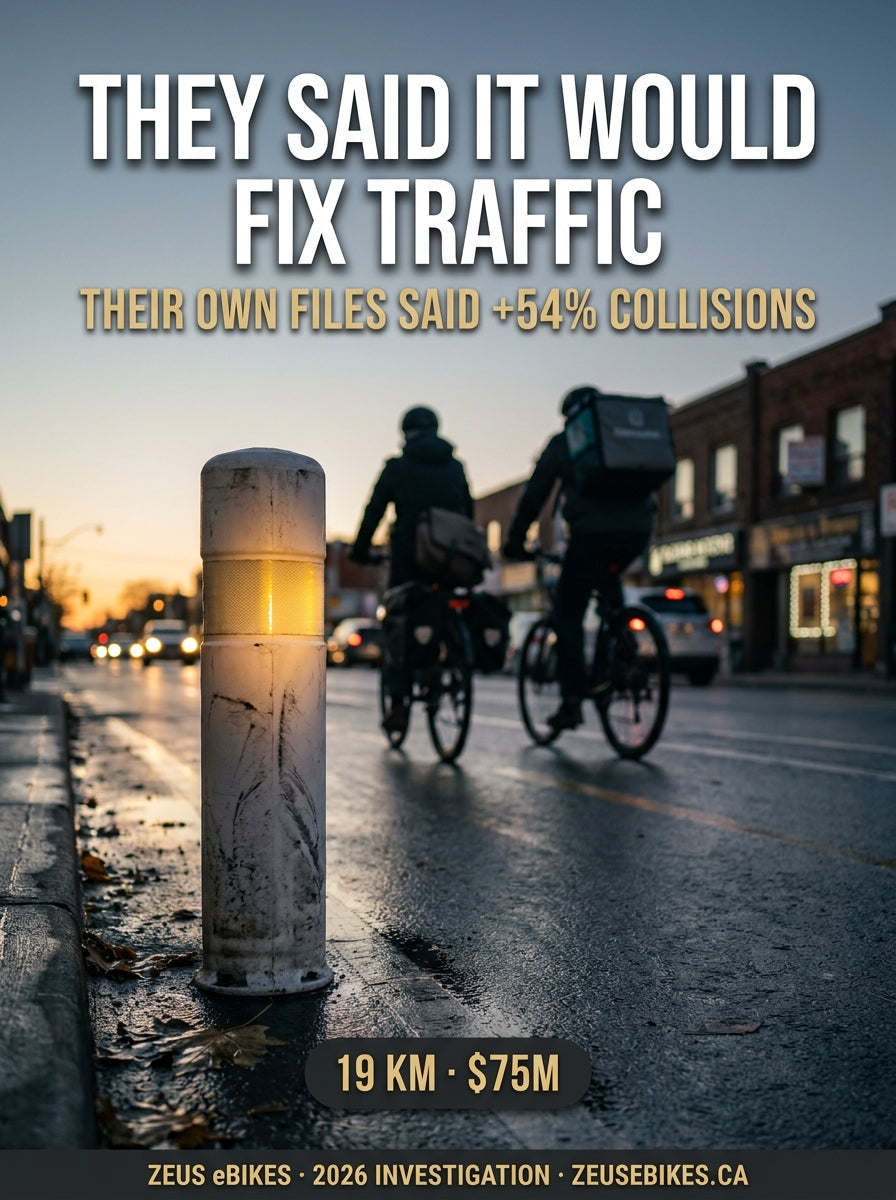
Toronto spent more than $27 million building those lanes. Removing them is costed at more than $48 million. The Ministry of Transportation's own consultants warned that removal could raise collisions for everyone on those roads by as much as 54 per cent. A cabinet briefing note conceded the evidence did not show removal would ease congestion. And in October 2025, on a 500-metre stretch of Bloor West, the province itself proved you can put a car lane back without touching the bike lane.
So we went looking for the answer to a simple question: if it does not fix traffic, does not save money and does not make anyone safer, who is this for?
The answer turned out to be traceable. It starts with a petition posted by a real estate agent in October 2023, runs through a pool hall in Etobicoke where the Premier and his late brother were regulars, and ends in a set of construction contracts whose money leaves the country. Along the way it passes a set of government documents that say, in the government's own words, that none of this will work.
Cost, ridership, collision and corridor-population figures are extracted directly from the City of Toronto's 28-page staff report to Council, Impact of Bill 212: Bike Lanes Framework (13 November 2024), which we downloaded and read in full rather than taking from coverage. Statutory language is quoted from Bill 212 and Bill 60 on the Legislative Assembly of Ontario's site. Internal Ministry of Transportation documents were disclosed through the court challenge and reported by CBC News in March 2025; we quote CBC's reproduction and say so. The origin story is built on Jack Hauen's reporting for The Trillium (14 November 2024), read in full. Contract awards are taken from government announcements and the contractors' own press releases; ownership is traced through corporate parents' published filings and statements. The Court of Appeal's full reasons were not retrievable by us, both CanLII and the court's own portal refused automated requests, so every quotation from the ruling is attributed to the outlet that published it.
Three things we could not establish, stated plainly because their absence matters: (1) who owns Fermar Paving Limited, which won the first Highway 413 construction contract, no owner is named on the company's website, in the aggregate-licence registry, or in any source we retrieved; (2) any construction contract on Highway 413 or the Bradford Bypass awarded to the developer families named in the 2021 Toronto Star / National Observer land investigation, we looked, and found none; (3) whether any director of the group that started this campaign owns property on the affected corridors. Where a political donation is cited, it is a name match in Elections Ontario records, which is how the reporting we rely on characterises it, and not proof of identity.
Toronto's bike lanes are being removed because Bill 212 orders the Minister of Transportation to remove them, and on 14 August 2026 the Court of Appeal ruled the Charter does not stop a legislature from making that choice. The campaign began with a petition started on 23 October 2023 by four Etobicoke businessmen trading as Balance on Bloor, a real estate agent, a former PC candidate who runs a real estate investment firm, a Canaccord Genuity managing director, and the owner of a bar where the Premier and his late brother were regulars. Eight days after that petition went up, Ford publicly demanded the lanes come out. A year later his transportation minister announced province-wide bike-lane restrictions standing inside that same bar. The province's own documents say removal probably will not cut congestion and could raise collisions 54 per cent. Ontario taxpayers pay the $48 million to remove them; Toronto taxpayers lose the $27 million they already spent building them.
In this investigation
- What the court actually decided
- Who started it: a petition, a pool hall, the Premier's street
- What the lanes do, in Toronto's own numbers
- Who rides, and who drives
- The case for removal, stated fairly
- What the province's own documents say
- The 1.2% problem
- Who is footing the bill
- Who gets paid: the contracts and their owners
- The other beneficiaries: land, not contracts
- The wedding, the Greenbelt, and what a party can prove
- The pattern this fits
- "Put them on side streets" — not the same road
- Where else this has been tried
- Bill 60: the sequel almost nobody noticed
- A rider who understands the other side
- The $750,000 compromise Ontario already built
- How to fight this — petition included
- Frequently asked questions
- The bottom line
- Sources
What the court actually decided
On 14 August 2026 a three-judge panel of the Court of Appeal for Ontario reversed the ruling that had protected Toronto's bike lanes for a year and cleared the province to remove all 19 kilometres. If you ride Bloor, Yonge or University, the lane you used this morning now exists at the discretion of a minister. The decision is worth understanding precisely, because almost everyone is describing it wrongly.
The court did not find that removing bike lanes is sensible, safe or supported by evidence. It found something narrower and, on its own terms, quite orthodox: that the Canadian Charter of Rights and Freedoms has nothing to say about the matter. "The legislature is free to legislate to remove a bicycle lane from a road — indeed, it may remove a road entirely — without implicating the Charter," the panel wrote, as reported by CBC News. CP24 quoted the decision more bluntly: "There is no Charter right to bicycle lanes — neither specifically nor as inference."
In July 2025, Ontario Superior Court Justice Paul Schabas had held the opposite. He found that forcing the lanes out engaged section 7 of the Charter, the right to life and security of the person, because it would predictably put people at greater risk of injury and death, and he called the decision arbitrary, made against the government's own internal advice. The Court of Appeal took that reasoning apart on a point of law. Governments, it held, are entitled to ignore their experts:
And, in a second passage quoted by CBC: "Legislation is not unconstitutional for failing to satisfy the preferences of experts whose advice the government was not required to accept."
That is the hinge of this entire story. The Court of Appeal did not decide that removal is safe or effective — no court has — and it discounted the harm findings below, writing that the lower court's ruling spoke of "injuries and deaths that will occur only if the bicyclists choose to ride on the roads that have no bicycle lanes." What it held is that the legislature's policy choice does not violate section 7 of the Charter, whatever the evidence says about its wisdom. Constitutionally that is defensible: courts that strike down every policy they consider unwise stop being courts. But it leaves a specific conclusion standing. The province may proceed with a plan its own advisers told it would not work, and no judge can stop it.
Ford's reaction to losing the first round, a year earlier, is on the record and worth keeping in view. "These judges that are bleeding hearts, I can't wait until they retire," he said. "Matter of fact, I'll pay them to retire earlier. I'll pay you out, for two, three, four years. Just get out of the system."
Transportation Minister Prabmeet Sarkaria called the August ruling "a victory for common sense and for respecting the appropriate division of roles between duly elected legislatures and the courts." Michael Longfield, executive director of Cycle Toronto, said: "I want to be clear that bike lanes do not cause traffic congestion. Removing them will put people's lives at risk."
The constitutional law, for people who want it straight
Because this case will be taught, it is worth being precise about what was actually argued. Section 7 of the Charter protects life, liberty and security of the person against deprivation "except in accordance with the principles of fundamental justice." Two of those principles matter here: a law cannot be arbitrary (no rational connection between what it does and what it is for) and cannot be grossly disproportionate (effects on life and safety wildly out of scale with its objective).
Justice Schabas's 2025 ruling was careful on the point everyone assumed would sink it. Section 7 is a negative right: under Gosselin, it imposes no positive obligation on the state to provide anything, bike lanes included. He did not find a right to a bike lane. He found that actively removing an existing safety measure is state action that creates risk, a deprivation rather than a failure to provide, and that on the government's own disclosed evidence the removal was arbitrary (it would not fix congestion) and grossly disproportionate (marginal travel-time claims against predictable injury and death). Law firm commentary on both sides recognized the distinction; one appellate blog called it an expansion of section 7, another called the case genuinely novel terrain.
The Court of Appeal reversed on both hinges. It held the provision, section 195.6 of the Highway Traffic Act, was not arbitrary because it was rationally connected to the legislature's view that removal would reduce congestion, whether or not that view was correct: the legislature "is not required to accept" expert advice, and policy is not arbitrary "just because some or even many advisors, experts, and citizens predict that it will not work." And it recast the claim as a demand for a positive right: "there is no constitutional obligation to build bicycle lanes or to retain any that have been built." Between those two sentences sits the whole disagreement, one court measured the law against the government's evidence, the other against the government's stated belief.
What remains open: an application to the Supreme Court of Canada for leave to appeal, which is discretionary and granted mainly on questions of public importance. This one qualifies on its face (whether legislated removal of life-safety infrastructure engages section 7 at all is a question with no square SCC answer), but leave is granted in less than one case in ten, and the Court's most relevant recent word, Toronto (City) v. Ontario in 2021, upheld provincial power over that city's council mid-election. Nobody should promise riders a rescue from Ottawa's direction. The honest read is that the constitutional road has narrowed to a single uphill lane, and the political road is wide open.
As of 21 August 2026 no removal work had begun that we could verify, and the government had not said when, or whether, it would start. CBC Toronto asked the Ministry of Transportation for a start date and did not receive one. Cycle Toronto and its co-applicants, Eva Stanger-Ross and Narada Kiondo, had not said whether they would seek leave to appeal to the Supreme Court of Canada. The lanes are still on the ground.
The ruling is about the limits of judicial power, not the merits of the policy. No court has ever found that removing these lanes is a good idea. One court found it arbitrary and dangerous; the higher court reversed that constitutional conclusion without deciding that removal is sound policy, and left the merits to voters. That hands the question back to you, and makes the question of who wanted this a political one.
Who started it: a petition, a pool hall, and the Premier's own street
Provincial legislation removing 19 kilometres of city infrastructure did not begin at Queen's Park. It began on 23 October 2023, when a Toronto real estate agent named Cody MacRae posted a petition objecting to the newest stretch of the Bloor Street bike lane in Etobicoke. The sequence from that petition to a statute is short, documented, and largely the work of one reporter: Jack Hauen of The Trillium, whose November 2024 investigation established the timeline we follow here.
MacRae's petition gathered thousands of signatures and made three arguments: scarce cyclist usage, reduced traffic flow, and lost business revenue. Every one of the three would later appear in the Ford government's case for Bill 212.
Eight days after the petition went up, the Premier weighed in. Ford publicly called on Mayor Olivia Chow to "get rid of those bike lanes on Bloor in Etobicoke," adding: "I think we see one bicycle come through there every single year, with thousands of cars." Ford is the MPP for Etobicoke North and lives in Etobicoke. A few days later, as The Trillium noted, a bike counter at Bloor and Keele recorded 415 cyclists by that afternoon, and 189,587 since the counter had been installed that summer.
From petition to statute: the documented timeline
Four dates, one straight line. Sources: The Trillium (14 Nov 2024); Legislative Assembly of Ontario.
The four directors
The group behind the petition calls itself Balance on Bloor and describes itself, in MacRae's words, as "a non-partisan group of local volunteers from across the political spectrum." Its board has four directors. Here is who they are, as reported by The Trillium.
| Director | Who they are | PC donations (name match, Elections Ontario) |
|---|---|---|
| Cody MacRae | Founder; started the petition. A real estate agent who, in The Trillium's phrase, "boasts of an extensive network across the political sphere." | — |
| Simon Nyilassy | Progressive Conservative candidate in 2011. Longtime real estate executive; founder and CEO of Marigold & Associates Inc., a real estate investment firm. | $18,827 since 2014, including $1,500 in the month before publication |
| Ron Sedran | Managing director at Canaccord Genuity, a financial services company. | $5,935, in two donations (2015 and 2018) |
| Sam Pappas | Owner of The Crooked Cue, an Etobicoke bar The Trillium described as "a gathering place for bike lane opponents." | — |
Source: Jack Hauen, The Trillium, 14 November 2024. Donation figures are name matches in Elections Ontario records, as characterised in that reporting, and are not proof of identity. Combined, they total roughly $24,762.
How it reached the Premier
Pappas described the path himself. The group lobbied everyone it could reach. "We went to everybody," he told The Trillium. "But initially, nobody really responded, to be honest." He had what he called a productive meeting with Mayor Chow, and nothing came of it.
Then, he said, Etobicoke–Lakeshore MPP Christine Hogarth, whose riding contains the Etobicoke portion of the lane and who opposed it, reached out. Hogarth met MacRae and Sedran in December 2023. "From there," Pappas said, "it kind of took steam."
He heard little more until CBC broke the story in September 2024. Then Hogarth called again:
On 15 October 2024, Transportation Minister Prabmeet Sarkaria announced province-wide restrictions on new bike lanes. He made the announcement standing inside The Crooked Cue, Pappas's bar, flanked by Hogarth and Scarborough–Rouge Park MPP Vijay Thanigasalam. The photograph of that event distributed with The Trillium's story is credited to the Ontario Ministry of Transportation. Sarkaria called the bar "one of the best places in the city to hang out and play some pool" and called Pappas "a tireless advocate, not only for this community, but for small businesses across this province."
Days later, Ford announced he would rip out Bloor, Yonge and University. On 21 October 2024, Bill 212 was introduced.
The Ford connection, in the owner's own words
Asked about the bar's political history, Pappas told The Trillium that Doug Ford and his late brother Rob "were there all the time." Hogarth has held two election-night victory parties there. The Ministry of Transportation chose it as the venue for a provincial policy announcement.
Pappas's own qualification belongs here in full, because it is the fairest thing in the record and it cuts against the tidy version of this story. Over more than thirty years in business he says he has hosted "scores of politicians of all political stripes." Former governor general Adrienne Clarkson held a book signing at the Crooked Cue. Olivia Chow and the late Jack Layton played pool there during their time on city council. "I don't actually get involved or support anybody," Pappas said. "I just provide the venue."
Take him at his word, and the point does not go away, it sharpens. A neighbourhood bar being a place where politicians of all stripes drink is unremarkable. A provincial ministry choosing that specific bar, owned by a director of the specific lobby group whose specific talking points are being adopted, as the backdrop for the announcement, is a choice somebody made. It is the difference between a coincidence and a decision.
The talking points that made the trip
The clearest evidence that this group set provincial policy is not a meeting log. It is the language.
- A Balance on Bloor member wrote an op-ed noting the group had counted 10 snowplows and nine cyclists on one winter day. Weeks later Sarkaria posted a video to X: "In winter, bike lanes see more snowplows than cyclists."
- Pappas told a June 2023 city meeting that emergency vehicles could not get through: "If you come through right now during rush hour, anytime between 3 and 6 o'clock, it's already bumper-to-bumper." Ford went on to say first responders were "pulling their hair out," calling the lanes "an absolute disaster, it's a nightmare." According to Toronto's deputy fire chief, response times have improved since the Bloor bike lanes were installed.
- The petition's three complaints — usage, traffic flow, business revenue — became the government's three complaints. Asked for comment for The Trillium's story, Sarkaria's office reiterated the 1.2 per cent figure that is examined further down this page.
Not every business agrees. Further east on Bloor, the local BIA told the province to leave the lane alone, reporting that "the sky didn't fall, and sales went up."
Albert Koehl, a founder of the Toronto Community Bikeways Coalition, put the structural point this way: it is not unusual for bike lanes to attract pushback, but it is unusual for a provincial government to intervene in a local street fight. "Obviously, they've got the premier's ear," he said. And on the wider pattern: "The average person gets bribes — you know, fantastical proposals like the 401 tunnel — whereas the wealthy are the ones that get action."
MacRae stressed his group's non-partisanship and told The Trillium, "I'm the furthest thing from a conservative." His statement credits "the united voices of residents from towns and neighbourhoods throughout the province" for the government's decision. Nyilassy declined an interview and pointed to MacRae's statement. Sedran did not respond to several requests for comment. Christine Hogarth did not respond to a request for comment. Pappas says he provides a venue and does not support anyone. Nothing in the record establishes that any of them did anything unlawful, and nothing here alleges it. Organising a petition, meeting your MPP, donating within legal limits and hosting a press conference are all entirely lawful acts. The finding is simpler and harder to argue with: a campaign begun by four men with a local grievance and political access travelled, in twelve months, from a neighbourhood petition into a provincial statute — and the government adopted their arguments almost verbatim while its own officials were writing that those arguments were wrong. Whether the campaign caused the law or merely arrived at the moment a premier wanted it is the one thing the record cannot settle. Either answer should trouble you.
This did not come from a transport study. It came from a petition on the Premier's home turf, travelled through his local MPP, and was announced from the bar owned by one of the four men who started it, eight days from petition to premier, twelve months from petition to legislation.
What the lanes do, in Toronto's own numbers
Before asking who gains from removal, establish what is being removed. Here the record is unusually good. In November 2024 the City Manager delivered a 28-page report to City Council setting out exactly what these corridors carry and what they cost. We read the full report rather than the coverage of it.
Together, the bikeways on Bloor, Yonge and University sit within 250 metres of roughly 300,000 people and jobs and bring 36 schools within that distance of a protected lane. This is not a recreational amenity at the edge of the city. It runs through the densest employment and residential land in the country.
| Corridor | Length | Population within 250 m | Jobs within 250 m | Schools | Average daily cycling volume |
|---|---|---|---|---|---|
| Bloor St (Kipling–Sherbourne) | 13.4 km | 65,376 | 44,028 | 21 | 620–6,330 (Oct 2024) |
| Yonge St (Bloor–Davisville) | 3.2 km | 23,834 | 23,149 | 8 | 1,200–2,500 (May 2024) |
| University Ave / Queen's Park (Wellington–Bloor) | 3.6 km | 17,937 | 129,699 | 12 | 1,300–3,700 (Spring/Fall 2024) |
Source: City of Toronto, Impact of Bill 212: Bike Lanes Framework, 13 November 2024, Table 2 (2021 population and employment data).
The growth is the part that gets left out. On Bloor at Dufferin, average daily cycling volumes went from 2,060 in October 2019 to 5,670 in September 2024. At Kingscourt Drive in Etobicoke, the contested stretch, counts rose from 90 to 680. On Yonge at Davenport, from 350 riders a day to 2,460, an increase of 603 per cent. Bike Share trips beginning or ending on these three corridors passed 750,000 in 2024 alone.
Then the safety record, which should end the argument and somehow never does. On Bloor between Avenue Road and Shaw Street, the City compared the eight years before the lanes went in with the years after.
Bloor Street: injuries before and after the bike lane
Average injury collisions per year on Bloor St between Avenue Rd and Shaw St. "Before" = 2008–2015. "After" = 2017–2024, a period in which cycling volumes on the corridor rose 40–90%.
Before the laneAfter the lane
Source: City of Toronto, Impact of Bill 212: Bike Lanes Framework, 13 November 2024, pp. 11–12.
Cyclist injuries fell from an average of 20 a year to 15, and because ridership climbed 40 to 90 per cent over the same period, the collision rate dropped 56 per cent. Pedestrian injuries fell from 13 a year to five. And motorist injuries fell from 29 a year to 21.
That last line deserves its own sentence. Drivers on Bloor got measurably safer after the bike lane went in. Not because paint protects a car, but because narrowing lanes, removing conflict points and slowing turns reduces the crashes that hurt everyone. Independent work supports it: researchers at Toronto Metropolitan University studying separated bike lanes across Toronto between 2000 and 2016 found 2.57 times more people cycling afterwards, a 38 per cent drop in cyclist collision rates on the lanes and a 35 per cent drop in the surrounding area (Ling et al., Accident Analysis & Prevention, Vol. 135, February 2020).
One more figure. Between 2015 and 2024, 28 people were killed and 380 seriously injured while cycling in Toronto. 68 per cent of those collisions happened on streets without safe cycling accommodations. We laid out the national version of that pattern in our investigation into why cyclists and e-bike riders die on Canadian roads.
These lanes serve 300,000 people and jobs, pass 36 schools, carry up to 6,330 riders a day, and on the City's own before-and-after data reduced injuries for cyclists, pedestrians and drivers at the same time. Whatever removal is for, it is not for safety.
Who rides, and who drives
Every argument in this fight is really an argument about whose trip counts. So it is worth asking directly: who actually uses the lanes being removed, and who uses the highway being built with the same law? The two groups are not the same people, and they are not in the same income bracket.
The people on the bikes
Cycling in Canada skews poorer than the population, not richer. Statistics Canada's 2021 census found that of Canadians aged 25 and over who were in low income in 2020, 10.4 per cent walked or biked to work, against 5.5 per cent of all other commuters. Nearly double the rate. Peer-reviewed work tracking national bicycle commute mode share from 1996 to 2016 found the same skew toward lower incomes, persistently, across two decades.
Who cycles or walks to work in Canada
Share of commuters aged 25+ who walked or biked to work in 2021, by income. The bicycle is the budget option, not the luxury one.
Source: Statistics Canada, 2021 Census ("Bicycle commuters: the hardy one-percenters").
That is not the stereotype, and the stereotype is doing a lot of political work. The image being sold is a recreational cyclist in expensive Lycra taking a lane away from a working driver. The data describes something closer to the opposite: for a large share of the people using these lanes, the bicycle is the affordable option, not the leisure one. A 2019 City of Toronto study found 44 per cent of residents cycle for utilitarian purposes, work, school, errands.
The City's own report is blunter still, in its equity section: "The absence of bikeways has a disproportionately negative impact on low-income communities and Indigenous, Black and other communities of people of colour."
The people in the cars — and where they are coming from
Highway 413, accelerated by the same statute, is designed as a northern bypass for cross-regional freight and commuter traffic across York, Peel and Halton. Its users, by construction, are not making local Toronto trips. The province projects it will divert up to 70,000 vehicles a day. The much-quoted 30-minute saving applies to the full-length trip; reported analysis of the province's own numbers found that of roughly 22,400 users between 6 and 9 a.m., about 1,200, around five per cent, would drive the whole route and collect the full half hour. CBC has reported that PC internal polling found the highway popular in 905 ridings, where commuters are a significant voting bloc.
The point Milad raised, and the data behind it
Here is the asymmetry, and it is the most under-discussed fact in this entire debate. A bicycle trip on Bloor is almost by definition local traffic. It starts or ends within a few kilometres. The people making those trips live and work inside the 250-metre band that holds 300,000 people and jobs, they are residents of the street being changed. Highway traffic is the opposite: it originates outside the city entirely and passes through.
And the City's report contains the number that closes the loop: about half of all car trips made by Toronto residents are under five kilometres. Half of the driving Torontonians do is a distance a bicycle covers comfortably. The infrastructure being removed is the infrastructure that serves the shortest, most local, most substitutable trips in the city.
| The lanes being removed | The highway being accelerated | |
|---|---|---|
| Trip type | Local. Starts or ends on the corridor. | Cross-regional. Originates outside Toronto. |
| Who is served | ~300,000 people and jobs within 250 m; 36 schools | Commuters and freight across York, Peel, Halton |
| Income skew | Low-income Canadians walk or cycle to work at 10.4% vs 5.5% for others (StatsCan, 2021) | Requires car ownership: roughly $9,500/yr for an average compact (CAA-based estimates) |
| Cost to the user | A bicycle, once | A vehicle, insurance, fuel, and depreciation, every year |
| Public cost | $48M+ to remove; $27M already spent to build | Officially undisclosed; third-party estimates $6–10B to $14–18B |
Sources: City of Toronto (Nov 2024); Statistics Canada 2021 Census; CAA driving-cost estimates; Environmental Defence Transit Over Traffic. Highway 413's cost has never been officially published; all figures are third-party estimates.
Transportation is already the third-largest household expense in Canada at roughly 15 per cent of spending, behind shelter and food. For very low-income households it ran past a quarter of before-tax income in 2023. A GTA family of four spends somewhere between $11,706 and $16,099 a year getting around, depending on how many vehicles they run.
So here is the inference, and we label it as inference rather than dressing it up as fact: removing the cheapest way to cross the densest part of the city, in order to add capacity for trips that begin outside it, moves public space away from people who cannot afford a car and toward people who already own one. That is a defensible reading of the numbers. It is not a documented intention, and we are not claiming anyone sat in a room and said it. But a policy does not need an intention to have a distribution.
The lanes serve short, local, low-cost trips made disproportionately by lower-income residents of the very streets in question. The highway serves long, imported, car-dependent trips. One law does both.
The case for removal, stated fairly
An argument you cannot state in its strongest form is an argument you have not beaten. So here is the case for taking the lanes out, made as well as we can make it.
Toronto's congestion is genuinely brutal and genuinely expensive. Ford's position is that gridlock costs Ontario's economy billions as goods and services sit in traffic "because they have one lane of traffic in the most congested city in North America." Nobody who drives a van for a living in this city thinks that complaint is invented.
Some businesses believe the lanes hurt them. More than 40 Etobicoke businesses sued the City of Toronto in February 2025 for $10 million, alleging negligence and nuisance over the Bloor West lanes, and separately suing Councillor Amber Morley and the City's general manager of transportation services, Barbara Gray, for misfeasance of public office. Their revenue is real and they are entitled to be heard.
The constitutional point is legitimate. If section 7 obliged governments to keep every piece of infrastructure that reduces risk, courts would be running transport policy. The Court of Appeal's instinct, that this is what elections are for, is not a fringe position.
And there is a serious empirical objection buried in the injunction ruling. When Justice Stephen Firestone refused to pause the removals in March 2025, he accepted cyclists faced irreparable harm but noted evidence that three to four per cent of trips within Toronto are made by bicycle, and that if the lanes went, "the volume of cyclists using these roads will decrease significantly, such that the raw total of cyclist collisions will be largely unaffected." Fewer riders means fewer riders to hit. It is not a stupid point. It is also, sat with for a moment, an argument that the policy works by discouraging people from cycling rather than by making cycling safer.
All four deserve an answer rather than a sneer. The answer was written by the Ontario government itself.
What the province's own documents say
During the court challenge, hundreds of pages of internal Ministry of Transportation records (briefings, consultant reports, staff emails, heavily redacted) were disclosed and made public. CBC News reported on them on 12 March 2025. They are the most damaging documents in this story, and they were written by the people who wanted the lanes gone.
Start with congestion, the stated purpose of the exercise. A 2024 cabinet office committee briefing note, quoted by CBC:
Excerpts published by Cycle Toronto from the same disclosure go further: "Cycling has been shown to have a positive impact on congestion in North American cities," and "the net result of bike lane removals could simply be more vehicles queued along already congested streets without significant reductions in travel times."
An October briefing noted that the Ministry did not hold the "data required to support a decision to remove a bike lane." Read that twice. The department drafting a law to remove three named bike lanes recorded that it lacked the data to decide which bike lanes to remove.
Then safety. The Ministry commissioned the engineering and urban planning firm CIMA+ to review the evidence. Its first-phase report found that removing protected bike lanes "suggests more than 54% increase in the total number of collisions (i.e., for all road users, not just those involving cyclists)," and that cycling infrastructure reduces collisions by 35 to 50 per cent. It also warned that riders pushed off the road may move onto sidewalks, raising risk to pedestrians.
In fairness, and this matters: the province's lawyer, Padraic Ryan, argued in court that the CIMA+ phase-one work was high-level commentary with no original analysis, a literature review rather than a site-specific study. That is a fair description of what phase one was. Phase two, with site-specific analysis, was not in the released batch and we could not obtain it. So the honest statement is this: the province's own consultants, reviewing the published research, warned of a collision increase of up to 54 per cent for all road users, and the province's response was that its consultants had not done original work.
Next, the promise that made the policy politically survivable. Ford said in November 2024: "I want to make sure that the bikers are safe. I have always believed that you don't put [bike lanes] on main arterial roads, you put them on secondary roads." Here is a Ministry staff member on that promise, in a mid-December email:
And the economic argument. An August 2024 Ministry briefing states plainly: "Evidence shows that bike lanes have a positive economic impact on local retail businesses."
One more detail tells you how the file was understood inside government. Among the documents is a presentation on a legislative plan for a "pro-driver package." Not a congestion package. Not a safety package. A package for a constituency.
When Justice Schabas struck the removal provisions down in July 2025, he summarised the disclosure in a sentence: "records produced by the government in this litigation show that the internal advice prior to passing Bill 212 was that protected bike lanes can have a positive impact on congestion and that removing them would do little, if anything, to alleviate gridlock, and may worsen congestion."
Publicly: removal will cut congestion, and cyclists will get safer parallel routes. Internally, in the same government's own files: congestion relief is unconfirmed, collisions may rise 54 per cent for all road users, the parallel routes are "unknown/unlikely," bike lanes help local retail, and the Ministry lacks the data to justify removing any specific lane. Both sets of statements were produced by the same ministry in the same year.
The 1.2% problem
The single most repeated justification for removal is a number: only 1.2 per cent of people in Toronto commute by bicycle, so why should they get a lane? It is persuasive. It is also measuring the wrong place.
The 1.2 per cent figure comes from the census, but from the Toronto Census Metropolitan Area, a region running from Lake Ontario to Lake Simcoe that includes Richmond Hill, Oakville and Vaughan. It averages downtown Toronto together with suburbs where the nearest bike lane may be a half-hour drive away. Then it is used to make decisions about Bloor, Yonge and University.
Look at the same census data where the lanes actually run, as CBC News and The Trillium both did:
| Area | Lane it contains | Share commuting by bike |
|---|---|---|
| Toronto Census Metropolitan Area | the figure quoted by the minister | 1.2% |
| University–Rosedale | two bike lanes | 8.3% |
| Parkdale–High Park | Bloor | ~6% |
| Spadina–Fort York | University | ~5% |
| Toronto–St. Paul's | Yonge | ~3% |
Source: Statistics Canada census data as reported by CBC News (November 2024) and The Trillium. Riding-level figures are commuting mode share, which excludes errands, school trips and deliveries.
In University–Rosedale, nearly one worker in twelve rides to work, seven times the figure being used to justify taking their lane away. Commuting share is itself conservative, since it counts only the trip to work, not the school run, the grocery run, or the courier making forty drops a shift.
There is a deeper problem no better data fixes. Cycling mode share is not a fixed property of a population; it is a response to infrastructure. The City's counts show it: 90 riders a day at Kingscourt Drive became 680. On Yonge at Davenport, 350 became 2,460. Using low ridership to justify removing the thing that raises ridership is a circle, and the province's consultants said so.
The 1.2 per cent is real, but it describes a region stretching to Lake Simcoe, not the streets being changed. Where these lanes exist, cycling commute share runs three to eight per cent, and it rose sharply after the lanes were built.
Who is footing the bill
Two different sets of taxpayers, and the split matters. The City of Toronto's report is explicit about which pot each cost comes from.
The ledger: public money in, public money out
Money already spent building the lanes versus the estimated cost of removing them. Both figures are the City of Toronto's; the removal figure is a stated minimum.
Source: City of Toronto, Impact of Bill 212: Bike Lanes Framework, 13 November 2024, summary and p. 12.
The report's summary lists "$48 million in additional costs to provincial taxpayers" for the removal, and separately a "lost investment of $27 million in city costs" for the lanes already built. So Toronto residents lose the money they already paid; every Ontario taxpayer, from Kenora to Cornwall, pays for the demolition.
Two further costs have no number attached at all. The report lists "as yet unknown additional costs to identify, design, and construct" replacement cycling routes, and "as yet unknown additional staff resources and infrastructure costs." The $48 million also excludes whatever it costs to change or cancel existing construction and maintenance contracts. And the removal work itself will make traffic worse for years: rebuilding Bloor between Spadina and Avenue Road, reconstructed only two years ago, would mean roughly four months with one vehicle lane in each direction, four more with a single lane one way, and four weeks of full intersection closure at St. George, spilling across multiple construction seasons.
Ford has called the $48 million figure "hogwash." The province has not published a competing estimate.
Who gets paid: the contracts, and who owns the companies
Follow the physical money. Bill 212's projects are now under construction, the contracts are public, and the corporate chains above them can be traced. Here is every award we could document, with the ultimate owner of each company.
| Project | Contract | Company | Ultimate owner |
|---|---|---|---|
| Highway 413 — early works #1 (announced 28 Aug 2025) | Embankment at the 401/407 interchange | Fermar Paving Limited (Rexdale, est. 1964) | Not publicly disclosed — see below |
| Highway 413 — early works #2 | Resurfacing Highway 10, Caledon | Pave-Al Limited (Mississauga) | The Miller Group → Colas Canada → Colas SA → Bouygues SA, Paris (publicly listed, France) |
| Bradford Bypass — west section, 6.5 km | Construction management general contractor, reported by the parent at roughly €345 million | The Miller Group and its division Brennan Construction | Colas Canada → Colas SA → Bouygues SA (France) |
| Highway 400 — lane connecting to the Bypass (July 2024) | Highway construction | Dufferin Construction Company | CRH Canada → CRH plc (Ireland, publicly listed) |
| Bradford Bypass — central & east design (Nov 2025) | Design | WSP Canada Inc. · Stantec Consulting Ltd. | WSP Global (TSX: WSP) · Stantec Inc. (TSX/NYSE: STN) |
| Bradford Bypass — program management (Nov 2025) | Full-project oversight | Jacobs Consultancy Canada Inc. & Egis Canada Ltd. | Jacobs Solutions (NYSE: J, United States) · Egis (France) |
| Bill 212 evidence base | Bike-lane safety review for MTO | CIMA+ | Canadian engineering firm |
| Bike-lane removal, Bloor/Yonge/University | $48M+ of reconstruction | Not yet tendered, as far as we could verify | — |
Sources: Government of Ontario announcements (28 Aug 2025; Nov 2025); Colas SA press release on the Bradford Bypass CMGC award; Daily Commercial News / ConstructConnect; company ownership per each parent's published corporate structure.
Two findings come out of this table, and the first one cuts against the tidy version of the story, so it goes first.
Finding one: the construction money is mostly leaving the country. The largest awards documented so far flow to subsidiaries of Bouygues SA of Paris, CRH plc of Dublin, Jacobs of Dallas and Egis of France, alongside two large publicly traded Canadian engineering firms. These are not the developer families from the land investigations. We searched specifically for any Highway 413 or Bradford Bypass construction contract awarded to Condrain, TACC, Metrus, DG Group, Arista, Cortel, Melrose, Rosehaven, Lormel, Argo, Fieldgate or any other company named in the 2021 land reporting, and found none. Contract benefit and land benefit are two separate mechanisms flowing to two separate groups, and an honest exposé keeps them separate.
Finding two: one winner's ownership is a closed book. Fermar Paving Limited, which took the first physical construction contract on the most controversial highway project in Ontario, names no owner on its website, no directors in the provincial aggregate-licence registry entry we retrieved, and no principals in any business profile we could reach, only operating managers. There is nothing improper about a private company being private. But when public money of this scale flows to a firm whose beneficial ownership the public cannot see, that opacity is itself a finding. We could resolve it with a paid Ontario Business Registry corporate profile search, and would.
The removal work on Bloor, Yonge and University, the $48 million itself, has not yet been publicly tendered as far as we could verify. Which means the specific answer to "which company gets paid to rip out the lanes" does not exist yet. When it does, it will be a public record, and this page will be updated with the names.
The removal dollar, specifically
Because we were asked directly, who makes a dollar from tearing out these lanes, here is the state of that ledger, stone by stone.
- The demolition contract: not yet awarded. We searched the government's announcements and the construction trade press for any tender or award covering the Bloor/Yonge/University removals and found none as of 21 August 2026. The winner does not exist yet. When the award is published it will be a public record, and we commit to updating this page with the company, its owners, and its donation history within days of the announcement. A contractor bidding on this work should price in that scrutiny.
- The legal work: done by salaried Crown counsel. The province's courtroom defence of Bill 212 was argued by government lawyers — Padraic Ryan appeared for Ontario at the injunction hearing. No outside-counsel retainer for the province surfaced in any reporting we retrieved. The private firms in this litigation, Paliare Roland and the charity Ecojustice, acted against the removal.
- The one physical job completed so far — the Bloor West compromise — cost $750,000 for the 500-metre reconfiguration, per the minister's own October 2025 announcement. The contractor for that work was not named in any government release or news report we could retrieve; a freedom-of-information request would produce it.
- The class of likely bidders is the class already winning Bill 212's road work — the provincial paving and reconstruction contractors of the GTA, the same pool that produced Fermar, Pave-Al/Miller and Dufferin on the highway side. We name no expected winner, because guessing would be exactly the kind of claim this piece exists to avoid.
The contracts so far enrich multinational road-builders, not local developers, and the single biggest early-works winner has ownership the public cannot see. The bike-lane demolition contract itself is still unawarded: whoever wins it will be named here.
The other beneficiaries: land, not contracts
If the contract money leaves the country, the land money does not. This is where the 2021 investigation by the Toronto Star and Canada's National Observer, reported by Emma McIntosh, becomes the spine of the answer.
That investigation searched land registry documents and corporate profiles within five kilometres of Highway 413's proposed route. It found eight of Ontario's most powerful developers holding 39 properties totalling roughly 3,300 acres, conservatively valued at nearly half a billion dollars: the Cortellucci, DeGasperis, Guglietti and De Meneghi families, John Di Poce, Benny Marotta, Argo Development and Fieldgate Homes. Three-quarters of the parcels had been held more than a decade; more than half were bought before 2004. The play is patience: buy farmland at farmland prices, wait for infrastructure. A former provincial planner, Victor Doyle, put the mechanism on the record: "The profit margins are astronomical … if any developer speculatively bought land in Caledon and Vaughan, then developers are going to be pushing for the highway to no end." One worked example from the investigation: a 98-acre Caledon lot at 14275 The Gore Road sold for $3.8 million in 2008; in May 2019, four kilometres from a proposed 413 interchange, a company connected to Argo's principals bought it for $40 million.
The political wiring documented in the same investigation:
- John Di Poce — for years employed Tony Miele as a contract consultant. Miele is simultaneously chair of the PC Ontario Fund, the party's fundraising arm. Miele stated his consulting role ended in 2016 and "did not involve any discussions whatsoever on the proposed Highway 413." Remember his name; he returns below.
- TACC (DeGasperis), Argo Development and a Fieldgate-associated company — all employ former federal Conservative minister Peter Van Loan as a registered Ontario lobbyist. His registered purpose for TACC: "Impact of proposed highway on Client's lands." Van Loan chaired Caroline Mulroney's 2018 PC leadership campaign; Mulroney was transportation minister when the investigation ran. Her spokesperson said Van Loan never lobbied the minister on the 413.
- Michael DeGasperis hosted Ford and MPP Stephen Lecce in the family's luxury box at a Florida Panthers game in Miami in December 2018, shortly after the government revived the highway. Spokespeople for both said they paid for their own tickets and no government business was discussed.
- Donations: at least $813,000 to the PC side since 2014 — about $753,000 to the party and $60,000 to Ontario Proud — against roughly $350,000 to the Liberals and $28,000 to the NDP, most of the non-PC money predating 2018. The DeGasperis family alone: $332,265 to the PCs. The investigation's own caveat, which we repeat: donation records are name matches the developers did not dispute, not proof of identity.
- Since April 2020, the government issued three minister's zoning orders expediting development on properties owned by these developers near the route.
Most of the developers declined to comment or did not respond. And the required sentence, which is not a formality: owning land near a proposed highway, donating lawfully, and hiring registered lobbyists are all legal. No court has found wrongdoing by anyone named above, and none is alleged here. What the record supports is narrower and, frankly, sufficient: the same statute that orders Toronto's bike lanes destroyed also accelerates, de-assesses and expropriates for a highway whose route runs past half a billion dollars of politically connected land.
The wedding, the Greenbelt, and what a party can and cannot prove
There is a version of this story people half-remember: Ford threw a party, developers came, and afterwards people said Greenbelt land had been promised across the tables. Because that memory does a lot of work in this debate, we ran it down properly. Here is what is true, what is documented, and what the officers who investigated it actually found, all of it, including the parts that help Ford.
The events themselves
On 11 August 2022, the Ford family home in Etobicoke hosted a $150-a-ticket stag-and-doe for the premier's daughter and her fiancé, roughly 750 people invited, and Global News reported one guest's invitation suggested a donation to the couple of up to $1,000. The wedding followed on 25 September 2022. Prominent developers attended both. Ford has described the attendees as personal family friends.
Eight weeks after the wedding, in November 2022, the government announced the removal of 15 sites: 7,413 acres, from the Greenbelt for development.
What the Auditor General found
Auditor General Bonnie Lysyk's August 2023 report found the selection process was driven by political influence and privileged access. The land's assessed value went from $240 million to $8.5 billion, an uplift of more than $8.3 billion to the owners of the 15 sites. The selection ran through one political staffer, Minister Steve Clark's chief of staff Ryan Amato, who received developer packages at a September 2022 industry dinner hosted by BILD, the residential builders' lobby. Principal beneficiaries included TACC Developments, owned by the DeGasperis family, the same family from the Highway 413 land table above, and Michael Rice of the Rice Group, who had bought a Bathurst-and-King site for roughly $80 million weeks before its protection was lifted.
The guests, and what came to them
No full guest list was ever published; what follows are the attendees documented by journalists and the Integrity Commissioner, compiled by the civic-transparency project Open Council from Trillium, Global News, CBC and NDP records. Every benefit listed is a matter of public record.
| Documented guest | Who they are | Documented benefit under this government |
|---|---|---|
| Shakir Rehmatullah (Table 12) | President, Flato Developments; a self-described friend of the premier | 9 minister's zoning orders 2020–2022. Stakes in two parcels (~23 acres) removed from the Greenbelt. Flato's 102-acre Markham parcel — bought for $15M in 2017 — was among the 15 removals; 29.5 hectares of it sold for $62M in April 2023. His lawyer emailed the staffer running site selection two days after the wedding (CBC). |
| Mario Cortellucci (Table 10, seated with the premier) | President, Cortel Group — also ~600 acres near the Highway 413 route | Family companies received 6 MZOs (Vaughan, Innisfil, Caledon). Family members donated more than $12,000 to Ford's leadership campaign. Appointed to the York Region Police Services Board within a month of the wedding. |
| Carmine Nigro (Table 10, seated with the premier) | President/CEO, Craft Development Corp; former vice-chair of the PC Ontario Fund | One MZO (Lindsay, 2020). Appointed chair of the LCBO (2019, renewed 2022) and chair of Ontario Place Corporation (March 2022) — at the time its only director. |
| Sergio Manchia | Developer | Owned a Hamilton property that was one of the 15 Greenbelt removals. Bought his stag-and-doe tickets from Tony Miele. |
| Matt Johnston | Planner; Manchia associate | Requested removal of a 78-acre Grimsby parcel and Manchia's property; both made the 15. |
| Nico Fidani-Diker | Former executive assistant to Doug Ford; former aide to Rob Ford; registered lobbyist for the Rice Group and Lakeview Community Partners | Two MZOs to his development enterprises. His lobbying client Rice Group was an AG-named principal Greenbelt beneficiary. |
| Madeleine Bodenstein (premier's table) | Realtor and funeral director | Appointed to the Death Investigation Oversight Council about six months after the wedding, and to the York Regional Police Services Board ($9,869 honorarium in 2023). $15,363 in donations since 2014. |
| Ron Taverner | Toronto police superintendent; longtime Ford family friend | Appointed OPP Commissioner in 2018; withdrew after reporting that the job qualifications had been lowered to allow him to apply. |
| Chris Bratty | Remington Group | Documented attendee. |
Source: Open Council, "Ford wedding guests received appointments, zoning orders, Greenbelt land removals" (29 Oct 2024), compiling The Trillium, Global News, CBC and Ontario NDP records, and the Integrity Commissioner's published findings. Table positions per the reported seating chart.
The NDP's count, tabled in October 2023: developers who attended the wedding events had received 18 minister's zoning orders, by the NDP's arithmetic, as many as the previous Liberal government issued in fifteen years.
What the investigations concluded — including the part that favours Ford
This is where the half-remembered version has to be corrected, because the strength of everything above depends on being exact here.
Integrity Commissioner J. David Wake investigated. His finding on the party theory was blunt: he called it "fanciful" to suggest Rehmatullah learned of the Greenbelt plan from Ford simply by being a wedding guest. In the Clark inquiry he found that "Premier Ford did not participate in the selection of properties to be removed from the Greenbelt and was not briefed until immediately before Minister Clark presented the matter to cabinet." On the stag-and-doe itself he found insufficient grounds for a full inquiry, while noting, in passing, a detail that matters to this story: the tickets Manchia bought had been sold by Tony Miele, chair of the PC Ontario Fund, who told Wake he sold about 20 of them as a family friend, unrelated to his party role. Green Party Leader Mike Schreiner's response entered the record too: "What the heck is the head of the PC fundraising arm doing selling tickets to Doug Ford's wealthy elite developer friends to a stag and doe party for his children?"
So: no finding, by anyone, that land was promised at a party. What the record does establish is the shape of the machine around the party. Minister Clark's chief of staff resigned. Clark resigned. Ford reversed the entire removal in September 2023 and apologized, calling it "a mistake." The OPP referred the matter to the RCMP, which opened a criminal investigation in October 2023 into, among other things, possible breach of public trust. As of the most recent reporting, that investigation is still open, no charges have been laid against anyone, and Ford has not been asked for an interview.
Not because the wedding proves anything about Bloor Street. It doesn't, and the Integrity Commissioner's findings stand. It belongs here because it is the closest-studied episode of how this government's decisions and its social circle interact, examined by the Auditor General, the Integrity Commissioner and the RCMP, and because the names repeat. The DeGasperis family appears in the Greenbelt beneficiary list and the Highway 413 land table. Tony Miele appears selling stag-and-doe tickets and consulting for a 413-corridor landowner while chairing the party's fundraising arm. Mario Cortellucci appears at Table 10 and in the 413 land registry. When the same government then passes a law removing bike lanes against its own evidence, bundled with a highway serving some of the same landowners, the burden of "trust us, this one's different" sits with the government. That is fair comment on a documented record, and it is all we claim.
The pattern this fits
Milad's instruction for this piece was not to treat absence of a document as proof of innocence, and there is a lawful, rigorous way to honour that: pattern evidence. Not one decision, but the run of them, as found by the province's own independent officers.
- Greenbelt (Auditor General, August 2023): a process "biased" toward certain developers with privileged access; an $8.3-billion windfall; reversed under pressure; RCMP investigation open since October 2023.
- Ontario Place (Auditor General, December 2024): the selection of Therme for the waterfront lease was "not fair, transparent or accountable"; costs up by more than $1.8 billion; an Infrastructure Ontario vice-president exchanged nine emails and a phone call with Therme's counsel during the process. The chair of Ontario Place Corporation through part of this era: Carmine Nigro, Table 10.
- Bill 212 (the courts, 2025–26): a statute passed against the government's own internal advice — advice a Superior Court judge summarized as showing removal "would do little, if anything, to alleviate gridlock, and may worsen congestion" — with a liability shield written in, an Environmental Assessment Act exemption attached, and a Court of Appeal ruling that none of that is a judge's business.
Three files, three independent examinations, one repeated finding: decisions made first, evidence handled after, and access concentrated in a small circle. The bike-lane file has had no auditor of its own — no independent officer has examined how these three streets were chosen, which is a fact about oversight, not proof of anything. What the documented origin of Bill 212's bike-lane schedule shares with the files that were audited (a decision preceding its evidence, access running ahead of process, four businessmen, one MPP, one bar) is exactly what those audits found. Whether it belongs in the same column is a question for an officer with subpoena powers, and the petition below asks the government to open the file.
No single document proves intent, and we do not claim one does. What exists is a pattern, established by the Auditor General across multiple files, of process bending toward access — and a bike-lane decision whose documented origin fits that shape while never having been independently audited at all. The strongest thing we can say is also the fairest: this file has not had its Bonnie Lysyk yet, and everything in it says it needs one.
"Put them on side streets" — why that is not the same road
The government's answer to every safety objection is relocation: bike lanes belong "on side streets or in quieter neighbourhoods," as Sarkaria wrote, not on "major thoroughfares." It sounds like a compromise. It is worth spelling out why, on the government's own documents, it is not one.
The Ministry's staff did not believe it. The mid-December email quoted earlier says the secondary-road plan for Toronto is "an unknown/unlikely." That is the government's own assessment of the government's own promise.
The geography does not cooperate. The CIMA+ report notes that cyclists choose the most direct routes, the same way drivers do, and that Toronto's ravines, rail corridors, bridges and hills mean the main streets exist precisely where continuous flat routes exist. Bloor, Yonge and University are desirable, in the City report's words, "for their shorter distances and travel times." A parallel route that adds distance, hills and crossings is not the same trip; for a courier or a commuter it is a pay cut measured in minutes.
Nobody has costed it. Bill 212 prices the removal at $48 million and the replacement network at nothing, because none has been designed. The City lists replacement routes as "as yet unknown additional costs," and notes that building them would come at the expense of the rest of the planned cycling network. The lanes come out on a statutory command; the side streets exist in a press release.
And a demoted route is a demoted person. This is the part Milad flagged, and it deserves to be said plainly, labelled as our view: infrastructure allocates dignity as well as space. Moving cycling off the main street and into the leftovers tells the person on the bike, disproportionately the person who could not afford the car, that their trip is a tolerated hobby rather than transportation. The 10.4 per cent of low-income Canadians who bike or walk to work are not on Bloor for recreation. They are on Bloor because that is where the jobs, schools and shops are. So is everyone else; that is what a main street is.
The side-street alternative was called "unknown/unlikely" by the Ministry's own staff, has no design and no budget, and fails the basic test of a transport network: it does not go where people are going.
Where else this has been tried — and how it went
Toronto is not the first city to tear out a bike lane. The experiment has been run, in enough places that the pattern is now data. We pulled every documented case we could find.
| Place | What happened | How it ended |
|---|---|---|
| Sydney — College Street | Built 2010 for A$5M; carried ~2,000 riders a day. The NSW state government removed it in 2015, over the city's objection, to make room for buses and cars. | Rebuilt and reopened in February 2023 at ~A$4M — fully funded by the same state government that removed it. Roughly A$9M of public money to end up where the street started. |
| Toronto — Jarvis Street | Painted lanes installed for $86,000; council under Rob Ford voted to remove them in 2011. | Removal cost $272,000 — more than three times the installation — mostly re-hanging signal hardware for the reversible fifth lane. Cyclists staged a sit-in as crews scraped the lines in 2012. |
| London — Kensington High Street | Temporary protected lane installed October 2020 for ~£320,000 by the local council; removed seven weeks later for up to £40,000, citing traffic up 25–30% and local opposition (the council said 69% of permanent residents were against it). | The council declined to reinstate; a High Court challenge to the removal failed. This is the strongest case on the removal side anywhere in the record — and note what makes it different: a local council removing its own temporary lane, with local opinion behind it. |
| Berlin | In 2023 a CDU-led city government moved to freeze cycle-lane projects that cost car parking or car lanes. | Of 19 reviewed projects, 16 proceeded; three were cancelled. A partial retreat, heavily contested, not a demolition of existing protected lanes. |
| The wider wave | Cycling press and planning outlets in 2025 documented protected-lane removals, cancellations or reversal campaigns in Baltimore, San Diego, Milwaukee, Boston, Atlanta, Oakland, Dublin, Providence, New York, Melbourne and others. | Ontario's move is part of an international backlash — but no other case we found involves a provincial or state legislature ordering specific city lanes destroyed by statute, against the city's objection, with a liability shield attached. |
Sources: City of Sydney media releases and Bicycle Network (College St); CBC and Spacing Toronto (Jarvis, 2011–12); Royal Borough of Kensington & Chelsea statements, road.cc and SW Londoner (Kensington); Clean Energy Wire and The Berliner (Berlin); Momentum Mag and Planetizen (2025 surveys).
Read the two clean precedents against each other. In Sydney, a higher-order government overrode its city, removed a working lane, and eight years later paid to put it back. In Kensington, a local government removed its own unpopular lane and the removal stuck. The variable is not the bike lane. It is whether the people who use the street made the decision. Toronto is the Sydney case, decided from above, against the city, against the evidence. Sydney tells you how it ends: with taxpayers buying the same infrastructure twice.
The price of changing your mind
Documented costs of removing working bike lanes versus building or keeping them. Log-scale story told at honest scale: each pair, same street.
Build / keepRemove
Sources: Spacing Toronto (Jarvis); City of Sydney and Bicycle Network (College St); Ontario Ministry of Transportation announcement, Oct 2025 ($750,000); City of Toronto staff report, Nov 2024 ($48M+). Bars scaled within each pair, not across pairs.
The Jarvis numbers are worth keeping within reach for another reason. Install $86,000, remove $272,000: a 3:1 penalty for changing your mind. Bloor, Yonge and University: install $27 million, remove $48 million. The ratio is smaller; the tuition is five hundred times higher.
Bill 60: the sequel almost nobody noticed
While the Toronto case was before the Court of Appeal, the government finished the job for the rest of the province, and it did so on a template you can trace to a lobby document.
In February 2025 the Toronto Region Board of Trade, one of the largest business lobby groups in the country, published Breaking Gridlock: Congestion Action Plan for Toronto. One of its five recommendations, titled "Unclog the Arteries," called for moving bike lanes off "priority connector roads." Reporting by The Breach noted who sits around that organization: Enbridge among its highest-tier partners, and a Congestion Task Force including representatives of the 407 toll route, the CAA and Uber, three businesses whose revenue rises with driving.
Nine months later, on 27 November 2025, Bill 60, the Fighting Delays, Building Faster Act, 2025 (S.O. 2025, c. 14) received royal assent. Buried in it is a new Highway Traffic Act prohibition: municipalities across Ontario may no longer reduce motor-vehicle lanes to build a bike lane, or for "any other prescribed purpose", unless a provincial regulation permits it. Where Bill 212 required Toronto-area municipalities to ask permission, Bill 60 replaced asking with a default no, province-wide, and the open-ended "prescribed purpose" language reaches, on its face, anything that takes a car lane: bus rapid transit, curb-lane patios, widened sidewalks.
The lobby asked for bike lanes off "priority" roads. The statute delivered a ban on every road in every municipality, subject to provincial exception. Whatever else that is, it is not a Toronto story any more. A council in Ottawa, Hamilton, London or Thunder Bay now needs Queen's Park's leave to reallocate its own asphalt.
Bill 212 removed three lanes in one city. Bill 60 removed every Ontario municipality's default authority to build one. The escalation tracked a business-lobby recommendation within nine months, and it reaches far beyond bikes.
A rider who understands the other side
It would be easy to end there, and dishonest. The strongest argument against bike lanes does not come from a premier or a briefing note. It comes from people who ride, and who are tired of what riding has started to look like in their city.
On 20 August 2026, one of our customers, Amin in Montréal, spent twenty minutes on the phone with Zeus co-founder Milad Ghobadibeygvand. He gave his recorded consent, twice, to have this published. He is not a cycling activist. He rides for pleasure, drives for everything else, and he is currently planning a four-day trip with his partner along Québec's car-free trail network toward Sherbrooke and Magog, roughly 250 kilometres, stopping at the cafés and motels strung along the route.
Asked about Montréal, he described a city rebuilt around the bicycle under former mayor Valérie Plante: "She changed all the city. Even the people that have cars, they were very pissed, because there was a lot of parking that they took off. They did, like, bicycle roads. They've changed all the city. Now everything is related by bike." His verdict on the traffic that came with it was not diplomatic: "For traffic, it's really bad. For people that work — oh my god. That's so bad."
So he was asked directly whether he supports what Toronto is about to do.
That single sentence is the most accurate description of Canadian public opinion on this subject that we have heard from anyone, in or out of government. And what he said next explains the gap between the evidence and the politics better than the evidence does:
"What's the real problem is the people that drive the bikes. When people drive like normal people, with rules, there's no problem. But there's a lot of different kind of people, and everybody drives the way they feel like they need to drive. That's the problem down here in Montréal. That's why people are so pissed — because there's so many accidents down here with bicycles." He was blunt about delivery riders in particular: "They use those bikes and they drive the way they want. They don't follow rules or lights."
He is describing something real, and it is not measured by any study in this article. A protected lane changes the geometry of a street. It does not change the behaviour of the person in it. When a resident watches someone run a red light at speed through a crosswalk, no collision statistic reaches them, because the thing they are reacting to is not risk in aggregate. It is disorder in front of their house. A government offering to remove the lane is offering to remove the disorder, whether or not that is what removal actually does.
Amin's diagnosis also points at the fix that is missing from Bill 212 entirely. There is nothing in that statute about enforcement, rider education, courier working conditions, or the speed and power limits that separate a bicycle from a small motorcycle. That is the gap we examined in our piece on Canada's e-bike enforcement problem. The province had a genuine grievance available to it, one that riders themselves raise, and legislated against concrete instead.
The public frustration behind bike-lane removal is mostly about behaviour, not infrastructure. Removing the lane addresses the visible symptom while removing the thing that reduced injuries for cyclists, pedestrians and drivers alike. If the complaint is that some riders behave badly, the remedy is enforcement and education, neither of which appears anywhere in Bill 212 or Bill 60.
The compromise already exists — Ontario built it, and it cost $750,000
The entire debate is framed as a choice: a lane for cars or a lane for bikes, pick one. That framing is false, and the proof was built by the Ontario government itself, with a price tag attached.
On 9 October 2025, Minister Sarkaria announced that construction would begin on 20 October on a roughly 500-metre stretch of Bloor West between Resurrection Road and Clissold Road, between Kipling and Islington stations: the existing concrete median would come out, a lane of vehicle traffic would be restored in each direction, and the protected bike lanes would stay, behind barrier curbs and bollards. The announced cost: $750,000. Mayor Olivia Chow's office called it a "win-win," and after the Court of Appeal ruling her spokesperson said she would keep pursuing solutions that "restore car lanes while maintaining safe cycling infrastructure."
Hold the two provincial numbers next to each other. Coexistence, engineered and delivered by this government: $750,000 for half a kilometre. Demolition, ordered by the same government: more than $48 million for nineteen kilometres. Even scaled naively, the compromise design costs a fraction of the removal, keeps the safety record, and returns the car lane the government says drivers need. The province has already proven its own law unnecessary, in concrete, on the very street the law names.
Montréal took the other road entirely. The Réseau express vélo is a planned 191-kilometre network of protected, year-round-maintained bike routes: 17 corridors when complete, plowed through the winter. That is the city Amin describes as one where "everybody down here has a bicycle," and it is worth being precise about scale: the island's cycling mode share was 3.3 per cent in 2020 against a municipal target of 15 per cent, so this is a city mid-transition, not at the end of one. Plante left office in November 2025 and was succeeded by Soraya Martinez Ferrada. The network she built is still there, and still being extended.
Two Canadian cities, the same decade, opposite directions. One is heading into an election in which a leading candidate is running on demolition; the other is arguing about how fast to build.
How to actually fight this — including the petition, ready to print
Ontario's highest court has said the Charter will not decide this, which leaves the ordinary machinery. That machinery is slower than a courtroom and considerably more effective than most people assume — Bloor's lanes exist at all because a campaign that began with activists rolling a tar-paper lane onto the street in 2005 kept at it for twelve years, through counts, deputations and councillor meetings, until Council made the pilot permanent in 2017 and voted 21–1 to extend it in 2023.
And remember what actually wounded this policy: disclosure. The most damaging material in this entire fight, the "medium risk" briefing, the 54 per cent consultant finding, the "unknown/unlikely" email, the "pro-driver package" deck. All of it came out because litigation forced the government's own records into the open. Governments behave differently when they know the file will be read. Every tool below is a way of making the file readable.
1. The petition — the only format Queen's Park must answer
Ontario has no official e-petitions. A petition to the Legislative Assembly must be on paper, with original signatures (no photocopies, no printouts of online petitions), each signer printing their name and address, and signers must be Ontario residents. Any MPP except a cabinet minister or the Speaker can present it, opposition MPPs table petitions routinely, and several represent the affected ridings. Once presented, the government is required to respond within 24 sitting days. That response becomes a public document.
Here is a petition drafted to the Assembly's format. Print it, gather original signatures, and deliver it to the constituency office of any non-cabinet MPP — University–Rosedale, Spadina–Fort York, Toronto Centre and Davenport all contain or border the affected corridors.
To the Legislative Assembly of Ontario:
WHEREAS section 195.6 of the Highway Traffic Act, enacted by Bill 212, directs the removal of protected bicycle lanes on Bloor Street, Yonge Street and University Avenue in the City of Toronto, over the objection of the City; and
WHEREAS the Government of Ontario's own disclosed records state that removal is not confirmed to reduce congestion, that its consultants advised collisions for all road users could rise by more than 54 per cent, and that replacement routes on secondary streets are "unknown/unlikely"; and
WHEREAS City of Toronto data shows injuries fell for cyclists, pedestrians and motorists after these lanes were installed, and removal is estimated to cost provincial taxpayers more than $48 million after $27 million of municipal investment; and
WHEREAS in October 2025 the Government itself demonstrated, on Bloor Street West, that a vehicle lane can be restored while retaining a protected bicycle lane, at a cost of $750,000;
WE, the undersigned, petition the Legislative Assembly of Ontario as follows: to repeal section 195.6 of the Highway Traffic Act and the bicycle-lane prohibition enacted by Bill 60; to direct that any restoration of vehicle capacity on Bloor Street, Yonge Street and University Avenue be achieved through designs that retain protected bicycle lanes; and to table in the Assembly, before any removal work is tendered, the complete cost-benefit analysis, safety analysis and all records of third-party representations relied upon in selecting these lanes for removal.
Note what the third request does. It does not ask the government to change its mind. It asks the government to show the file, every analysis and every representation behind the choice. Asking for the record is the demand that costs a signature nothing and a government the most.
2. Freedom of information — the tool that already worked once
Anyone can file a request under Ontario's Freedom of Information and Protection of Privacy Act for $5, online, to the Ministry of Transportation. Requests that would put real pressure on this file, phrased for the form: all records of the tender and award for the Bloor/Yonge/University removals; the CIMA+ Phase 2 site-specific safety analysis that was never released; all correspondence between the Ministry and the directors of Balance on Bloor; all correspondence between the Ministry and the Toronto Region Board of Trade regarding bike lanes; the contractor and costing records for the October 2025 Bloor West reconfiguration. Redactions can be appealed to the Information and Privacy Commissioner. Litigation pried the first tranche loose; FIPPA is how citizens pry loose the rest, and every request logged tells the ministry the file is being watched.
3. The rest of the toolkit
- Vote on 26 October. Toronto's municipal election is the nearest ballot on which this question actually sits. Both leading mayoral candidates have stated clear, opposite positions; ward councillors matter at least as much.
- Depute. Any resident can register to speak at a City committee. One sentence from the City's own report is enough: 68 per cent of Toronto's cycling deaths and serious injuries in the past decade happened on streets without safe cycling infrastructure.
- Write your councillor and your MPP, street-specifically. A dozen emails from one street opens a project file. Name the intersection. Copy the mayor's office.
- Quote their own documents. The cabinet "medium risk" note, the 54 per cent finding, the "unknown/unlikely" email, the retail briefing — all public, all theirs. Governments move fastest when their own paper is read back to them.
- Point at the $750,000. When anyone frames this as cars versus bikes, the answer is a street address: Bloor West between Resurrection and Clissold, where Ontario built both, last October.
- Join the organizations already carrying the file. Cycle Toronto, Ecojustice and the Toronto Community Bikeways Coalition ran this challenge for two years. Whether a Supreme Court leave application follows was undecided as this was published; the 60-day clock points to roughly mid-October 2026.
- Ride well. The political case for removal is built on the worst-behaved rider on the street. Amin, who rides and does not support removal, said it best. Every red light run in front of a family writes a line of someone else's campaign literature.
A petition Queen's Park must answer on the record. A $5 FOI request for the files they have not shown. A ballot on 26 October. A standing promise, on this page, to publish the name and ownership of whichever company takes the demolition contract. None of these is dramatic. Together they are the thing this file has been missing: an audience the government cannot dismiss.
Frequently asked questions
Why is Toronto removing its bike lanes?
Because a provincial law requires it. Bill 212, the Reducing Gridlock, Saving You Time Act, 2024, added section 195.6 to Ontario's Highway Traffic Act, stating that "the Minister shall remove the bicycle lanes located on Bloor Street, University Avenue and Yonge Street, in the City of Toronto." The City of Toronto opposed it; the decision was made at Queen's Park, not City Hall. The stated reason is traffic congestion, though the province's own internal briefings said the evidence did not confirm that removal would ease it.
Who started the campaign to remove Toronto's bike lanes?
The documented origin is Balance on Bloor, a four-director group formed around a petition posted on 23 October 2023 by Toronto real estate agent Cody MacRae, with directors Simon Nyilassy (a 2011 PC candidate and real estate investment CEO), Ron Sedran (a Canaccord Genuity managing director) and Sam Pappas (owner of The Crooked Cue, an Etobicoke bar where Doug Ford and his late brother were, in Pappas's words, "there all the time"). Eight days after the petition launched, Ford publicly demanded the lanes come out. The provincial restrictions were announced from Pappas's bar on 15 October 2024, and Bill 212 was introduced six days later, adopting the petition's three arguments.
Do bike lanes reduce traffic, or cause congestion?
The Ontario Ministry of Transportation's own internal documents, disclosed in court, state that "cycling has been shown to have a positive impact on congestion in North American cities" and that removing lanes "could simply be more vehicles queued along already congested streets without significant reductions in travel times." A 2024 cabinet briefing note assessed a "medium risk" that removal would not achieve its goal, because "current data and research does not confirm" that it would significantly ease congestion.
Who profits from removing the bike lanes?
On the record so far: whichever contractor wins the $48-million-plus removal work, which had not been tendered as of 21 August 2026; the highway program accelerated by the same statute, whose early contracts went to Fermar Paving and to subsidiaries of Bouygues SA (France) and CRH plc (Ireland); landowners along Highway 413's route, where a 2021 Toronto Star/National Observer investigation traced roughly 3,300 acres held by eight politically connected developers; and the province itself, which wrote an amendment barring lawsuits against it over the removals. The government's own documents show no confirmed benefit to commuters, safety, taxpayers or local retail.
Is this connected to the Greenbelt scandal?
Not directly, and precision matters. The Greenbelt removals were reversed after the Auditor General found the process favoured certain developers with an $8.3-billion land-value windfall; an RCMP criminal investigation opened in October 2023 remains ongoing with no charges laid, and the Integrity Commissioner found Ford did not participate in selecting the sites. The connection to the bike-lane file is a pattern, not a document: repeated Auditor General findings of process bending toward access — Greenbelt, Ontario Place, and recurring names, including the DeGasperis family (Greenbelt beneficiary TACC; Highway 413-corridor landowner) and PC Ontario Fund chair Tony Miele, who appears in both the wedding-ticket record and the 2021 Highway 413 land reporting.
When will Toronto's bike lanes actually be removed?
No date has been announced. The Court of Appeal cleared the legal path on 14 August 2026, but as of 21 August 2026 the Ontario government has not said when or whether work will begin, no removal tender has surfaced, and CBC Toronto's request to the Ministry of Transportation for a start date went unanswered. Any removal requires design, tendering and reconstruction; the City estimates that rebuilding a single recently reconstructed section of Bloor would occupy most of a construction season.
How much will removing Toronto's bike lanes cost, and who pays?
More than $48 million, according to City of Toronto staff, a stated minimum that excludes staff time and contract-cancellation costs, paid by provincial taxpayers. Toronto taxpayers separately lose the more than $27 million the City spent installing the lanes since 2016. Replacement cycling routes carry "as yet unknown additional costs" and have never been designed or budgeted. Total public spending to build and unbuild the same infrastructure exceeds $75 million.
Did the court rule that removing bike lanes is safe or a good idea?
No. The Court of Appeal ruled only that the Charter does not prevent a legislature from removing bike lanes, holding that "legislative policy is not arbitrary just because some or even many advisors, experts, and citizens predict that it will not work." The 2025 lower-court finding that the removals were arbitrary and would increase risk of injury and death was reversed on constitutional grounds; the appeal court did not re-weigh the evidence, though it said the lower court had overstated the harms. No court at any level has found removal to be safe or effective.
Can the decision be appealed to the Supreme Court of Canada?
Cycle Toronto and its co-applicants can apply for leave to appeal, but as of 21 August 2026 they have not said whether they will. Leave is discretionary, granted mainly on public importance, and succeeds in a small minority of cases. Applications generally run on a 60-day clock from the decision, pointing to roughly mid-October 2026. The Supreme Court's most relevant recent ruling, Toronto (City) v. Ontario (2021), upheld provincial power over Toronto's council, so no rescue should be assumed.
Is biking in Toronto safe?
It depends almost entirely on the street. Between 2015 and 2024, 28 people were killed and 380 seriously injured while cycling in Toronto, and 68 per cent of those collisions occurred on streets without safe cycling accommodations. On Bloor between Avenue Road and Shaw Street, after the protected lane was installed, cyclist injury collisions fell from an average of 20 a year to 15 despite a 40–90 per cent increase in riders, a 56 per cent lower collision rate, while pedestrian injuries fell from 13 a year to five and motorist injuries from 29 to 21.
Who actually uses these bike lanes?
Local residents and workers, disproportionately lower-income ones. The three corridors sit within 250 metres of roughly 300,000 people and jobs and 36 schools. Statistics Canada's 2021 census found 10.4 per cent of low-income Canadians aged 25 and over walked or biked to work, nearly double the 5.5 per cent of all other commuters, and a 2019 City study found 44 per cent of Toronto residents cycle for utilitarian purposes. About half of all car trips by Toronto residents are under five kilometres, the same short local trips the lanes serve.
Has removing bike lanes worked anywhere else?
The record is poor for governments that tried it over their city's objection. Sydney's state government removed the College Street cycleway in 2015 against the city's wishes and paid to rebuild it by 2023, roughly A$9 million spent to end where it started. Toronto's own Jarvis Street lanes cost $86,000 to paint and $272,000 to remove in 2012. The one removal that stuck — London's Kensington High Street in 2020, was a local council removing its own temporary lane with local opinion behind it, the opposite of the Toronto situation.
Can e-bikes use Toronto's bike lanes?
In general, a legal power-assisted bicycle in Ontario (pedals fitted, motor cutting out at 32 km/h, maximum 500 W) may use bike lanes and cycle tracks, but Toronto layers on its own restrictions, and cargo e-bikes and larger e-scooters are treated differently. The rules are specific enough to be worth reading in full; we maintain a current guide to Toronto's e-bike laws and a provincial guide to Ontario's rules.
If a car lane is what's wanted, does the bike lane have to go?
No, and the Ontario government itself proved it. In October 2025 it reconfigured roughly 500 metres of Bloor Street West, between Resurrection Road and Clissold Road, restoring a vehicle lane in each direction while keeping the protected bike lane behind barrier curbs and bollards, for an announced $750,000. Mayor Olivia Chow's office called it a "win-win." Coexistence is an engineering problem the province has already solved; demolition is a choice.
The bottom line: every argument, against its own record
Strip away the noise and the case for removal was made by a handful of identifiable people. Here is each claim, set against the record its own side produced. Nothing in this table is our opinion.
| The claim, and who made it | The record |
|---|---|
| "I think we see one bicycle come through there every single year" — Premier Ford, Oct 2023 | A counter at Bloor and Keele logged 415 cyclists that afternoon and 189,587 since the summer (The Trillium). |
| Removal will fix gridlock — the government's stated purpose | Its own cabinet note: "medium risk" of failure; research "does not confirm" relief; removals could mean "more vehicles queued" (disclosed MTO records). |
| First responders are "pulling their hair out" — Premier Ford | Toronto's deputy fire chief: response times improved after the Bloor lanes went in (The Trillium). |
| "In winter, bike lanes see more snowplows than cyclists" — Minister Sarkaria, on X | The line originated in a Balance on Bloor member's op-ed; the corridors carried up to 6,330 riders a day in City counts. |
| Only 1.2% of Torontonians bike to work — Minister Sarkaria | That figure describes a census region stretching to Lake Simcoe. Where the lanes run: 3–8.3% (StatsCan, via CBC/The Trillium). His office repeated the figure even after reporting showed it describes a census region reaching Lake Simcoe, not these streets. |
| Bike lanes are "hurting local businesses" — the Etobicoke lawsuit group | The Ministry's own August 2024 briefing: bike lanes have "a positive economic impact on local retail businesses." The BIA further east: "the sky didn't fall, and sales went up." |
| Cyclists will get parallel routes on side streets — Premier Ford and Minister Sarkaria | MTO staff email: "unknown/unlikely." No route designed, no dollar budgeted, two years on. |
| "Non-partisan group of local volunteers" — Balance on Bloor | A 2011 PC candidate, two name-matched PC donors totalling ~$24,800, and the announcement of provincial policy staged in the fourth director's bar (The Trillium). |
| "Common sense wins" — Premier Ford, 14 Aug 2026 | The court he was praising held only that the Charter permits the policy. That his government legislated against its own internal advice comes from the government's own disclosed documents, and no court has said otherwise. |
Toronto is not ripping out its bike lanes because they failed. On the City's own measurements they succeeded at the only thing infrastructure can be asked to do: they moved more people and injured fewer of them, including the people in cars.
The campaign to remove them was started by four connected men with a petition, and reached a premier who lives on their street within eight days. The government wrote the demand into a statute, attached a liability shield, bolted it to a highway bill serving half a billion dollars of well-connected land, and ignored every warning its own officials filed. Ontario's highest court has now confirmed that none of that is a judge's business. Each link in that chain is documented; the private conversations between them are not, and we do not pretend otherwise. The bill for the demolition goes to every taxpayer in the province. The bill for the injuries, if the government's own consultants are right, goes to the people on the street.
Amin, who rides, who does not support the removals and who understands why people do, gave the sentence this entire fight keeps missing: it's always the person behind the wheel the problem, it's not the bike the problem. That is true of riders who run reds, and it is true of the people who decide what gets built. The road is not an accident. Somebody signs it. This piece is the list of who signed this one, and the petition above is where you sign back.
This investigation names real people and real companies, and it holds itself to the standard it demands of government: show the file. Every factual claim above is sourced to a public document or named reporting, opinions are labelled as opinions, and no unlawful conduct is alleged against any person or company named. If you are named in this piece and believe any fact is wrong or incomplete, or you wish to add a statement, write to milad@zeusebikes.ca with documentation. Substantiated corrections will be made promptly and noted on this page; statements from named parties will be added in full.
Visuals created by Playcut.ai
· It's Not an Accident. It's a Blueprint. — Why Cyclists and E-Bike Riders Die on Canadian Roads
· The Canadian Mobility Bill of Rights
· Canada's E-Bike Enforcement Problem
· Toronto eBike Laws 2026
· Ontario eBike Laws 2026
Sources
- Court of Appeal for Ontario, Cycle Toronto v. Ontario (Attorney General), released 14 August 2026. Decision page, Court of Appeal for Ontario. Quotations as reproduced by CBC News and CP24; the full reasons were not directly retrievable at the time of writing.
- Legislative Assembly of Ontario, Bill 212, Reducing Gridlock, Saving You Time Act, 2024, S.O. 2024, c. 25.
- Legislative Assembly of Ontario, Bill 60, Fighting Delays, Building Faster Act, 2025, S.O. 2025, c. 14.
- City of Toronto, Respecting Local Democracy and Cities — Supplemental Report: Impact of Bill 212 Bike Lanes Framework, City Manager to City Council, 13 November 2024.
- Jack Hauen, "How a handful of Toronto businessmen got their way on bike lanes provincewide", The Trillium, 14 November 2024.
- Lane Harrison, "Ontario Court of Appeal says Ford can rip out Toronto bike lanes", CBC News, 14 August 2026.
- Lane Harrison, "Ontario aware bike lane removals may not reduce congestion, could make people less safe: internal documents", CBC News, 12 March 2025.
- Rochelle Raveendran, "Court denies injunction to stop Ontario removing Toronto bike lanes before legal challenge", CBC News, 14 March 2025.
- Cycle Toronto, "Province's internal documents reveal province knows Bill 212 not in the public interest".
- Cycle Toronto, "Cycle Toronto v. Ontario," case page and timeline.
- Ecojustice, "Cycling advocates vow to defend bike lanes after Court of Appeal ruling on bike lane law", 14 August 2026.
- WeirFoulds LLP, "When Bicycle Lanes Engage the Charter" (case comment on the section 7 analysis).
- "Ontario's transport minister says 1.2% of people in Toronto commute by bike. Data shows otherwise", CBC News, November 2024.
- "Injured cyclists can't sue province under amendment to new Ontario bike lane bill, NDP says", CBC News, November 2024.
- "Etobicoke businesses file lawsuit against city, bureaucrat and councillor over Bloor Street bike lanes", CBC News, February 2025.
- "Bradford vows Bloor Street W. bike lanes are 'coming out' if he's mayor", CBC News, 11 August 2026.
- "Ontario moving ahead with Toronto compromise on bike lanes despite appeal", CBC News, October 2025; and The Trillium on the $750,000 Bloor West reconfiguration.
- Emma McIntosh, "Developers with ties to Ford government stand to cash in on Hwy. 413", Canada's National Observer / Toronto Star, April 2021.
- The Narwhal, "With Bill 212 passed, Highway 413 is in and bike lanes are out", November 2024.
- Saima Desai, "Ontario's plan to ban bike lanes is ripped from the business lobby's wish list", The Breach, October 2025.
- Government of Ontario, Highway 413 first construction contracts announcement, 28 August 2025 (Fermar Paving; Pave-Al); and Daily Commercial News/ConstructConnect reporting on the awards.
- ReNew Canada, award report: Bradford Bypass west-section CMGC contract to The Miller Group/Brennan (contract value ~€345M per Colas Group); Colas Canada corporate structure pages (Miller Group ownership; Bouygues parent).
- "Contracts awarded for Bradford Bypass central, east sections and program management" (WSP, Stantec, Jacobs/Egis), Daily Commercial News, November 2025; and Dufferin's Highway 400 connection award, July 2024.
- Office of the Auditor General of Ontario, Special Report on Changes to the Greenbelt, August 2023; summarized by CBC News and The Narwhal.
- Open Council, "Ford wedding guests received appointments, zoning orders, Greenbelt land removals", October 2024 (compiling The Trillium, Global News, CBC, Ontario NDP records and the Integrity Commissioner's findings).
- "How Premier Doug Ford's self-described friend got land removed from the Greenbelt", CBC News, 2023.
- "RCMP investigating Ontario government's plan to open Greenbelt land for development", CBC News, October 2023; and Global News, "RCMP's 'thorough' Greenbelt investigation reaches 2-year mark" (no charges laid).
- "Ontario Place redevelopment not 'fair, transparent or accountable,' auditor general finds", CBC News, December 2024.
- Statistics Canada, "Bicycle commuters: the hardy one-percenters" (2021 census: low-income active-commuting rates); and Active Travel Studies, national bicycle commute mode-share portrait 1996–2016.
- Rebecca Ling et al., "Cyclist-motor vehicle collisions before and after implementation of cycle tracks in Toronto, Canada", Accident Analysis & Prevention, Vol. 135, February 2020.
- City of Sydney, "College Street cycleway back connecting riders" (2023 reinstatement); Spacing Toronto, "Removal of Jarvis bike lane to cost $272,000"; Royal Borough of Kensington & Chelsea, Kensington High Street decisions; Clean Energy Wire on Berlin's 2023 review.
- Legislative Assembly of Ontario, "Petitions" — rules for petitioning the Assembly.
- Ville de Montréal, "The EBN: Montréal's Express Bike Network".
- Interview with Amin, Zeus eBikes customer, Montréal, conducted by Milad Ghobadibeygvand, 20 August 2026. Published with the subject's recorded consent.



Share:
Electric Bikes for Back Pain (2026): Choose by Condition — 15 Verified, Evidence-Graded Picks
Canadian News