
Canada's eBike Wattage Limit: Speed Kills, Not Watts

📸 All photography by Playcut.ai — personalized AI actor technology
In early 2026, Ontario's Ministry of Transportation published ERO 026-0422 — a proposal to modernise Ontario's power-assisted bicycle framework by adding speed, weight, throttle use, and physical design as classification criteria alongside the existing motor limit. The consultation closed June 7, 2026. The reform hasn't passed yet, but the fact that regulators are proposing it reveals something important: the current 500W wattage limit was never a precise safety standard. It was a pragmatic boundary. And pragmatic boundaries, it turns out, have a flaw.
The flaw is this: wattage measures motor power. Speed determines how badly things go wrong in a collision. These are different variables, and Canada's eBike law conflates them. This article explains the physics, examines how other countries approach the same problem, and gives you an honest picture of where Canadian law is today and where it's heading.
Canada limits eBike motors to 500W nominal and maximum assisted speed to 32 km/h. The wattage cap is a legacy regulatory proxy — wattage alone does not determine an eBike's danger. Speed does. Collision severity grows with the square of impact speed (kinetic energy = ½mv²), making the 32 km/h speed limit the actual safety constraint. A 250W motor limited to 32 km/h is no safer than a 750W motor limited to 32 km/h from a pedestrian-impact standpoint. Ontario's 2026 reform proposal (ERO 026-0422, not yet law) signals a formal shift toward speed-based classification. Until any reform passes: 500W nominal and 32 km/h assisted speed is the law in every Canadian province. See our complete Canadian eBike laws guide for every province's current enforceable rules, fines, and helmet requirements. Browse the Zeus 500 W collection: Canadian-supported, and ships free.
This analysis draws on three sources: (1) verified Canadian provincial law texts and the history of the federal PAB framework (SOR/2020-22, effective Feb 4, 2021); (2) comparative regulatory review of the EU's EN 15194 EPAC standard and the US CPSC Class 1/2/3 speed-based framework; and (3) the physics of kinetic energy, which is verifiable mathematics, not a survey or estimate. All legal claims reference the current status of ERO 026-0422 as a proposal — not yet enacted legislation. This is an editorial opinion piece grounded in verified facts. It is not legal advice.
In This Article
Canada's 500W Rule — What It Actually Measures
Canada's 500W nominal motor limit specifies a motor's continuous-rated power output under standard test conditions — not its peak output, not how hard it can push on a steep hill, and not how fast the assisted bike will actually go. The speed and the wattage are separate variables. That distinction matters because on June 7, 2026, Ontario closed consultation on ERO 026-0422, a proposed regulation that would add speed, weight, throttle use, and physical design criteria to Ontario's eBike classification system — the first Canadian province to formally acknowledge that a motor label alone is a poor proxy for road safety. Whether the 500W limit remains, is modified, or is applied differently across the proposed classes depends on the final regulation text. For a rider choosing between a 499W eBike and a 750W eBike today, the stakes of misunderstanding that admission are real: the bike that looks "legal" on paper may not be safer, and the one that looks "illegal" may pose the lower actual risk on a shared pathway.
What "500W nominal" actually means: a motor rated for 500 watts of continuous power output under standard test conditions. In practice, eBike motors routinely produce 1,000–1,500W peak during hard acceleration or steep hill climbs — even while carrying a "500W nominal" label. Canada's law specifies nominal power, not peak power. A 500W nominal motor is not limited to 500W in any instantaneous sense.
The current legal standard applies in every Canadian province. After the federal Power-Assisted Bicycle (PAB) definition was repealed effective February 4, 2021 (SOR/2020-22), rule-setting devolved to provinces — but all provinces have maintained identical thresholds: ≤500W nominal motor output, max 32 km/h assisted speed, and functional pedals required.
Canada's law therefore already contains two separate constraints: wattage AND speed. That dual structure is the first clue that something is off. If wattage alone determined danger, why set a speed limit? If speed alone determined danger, why set a wattage limit? The answer is in the section below.
Speed Is the Real Safety Variable — The Physics
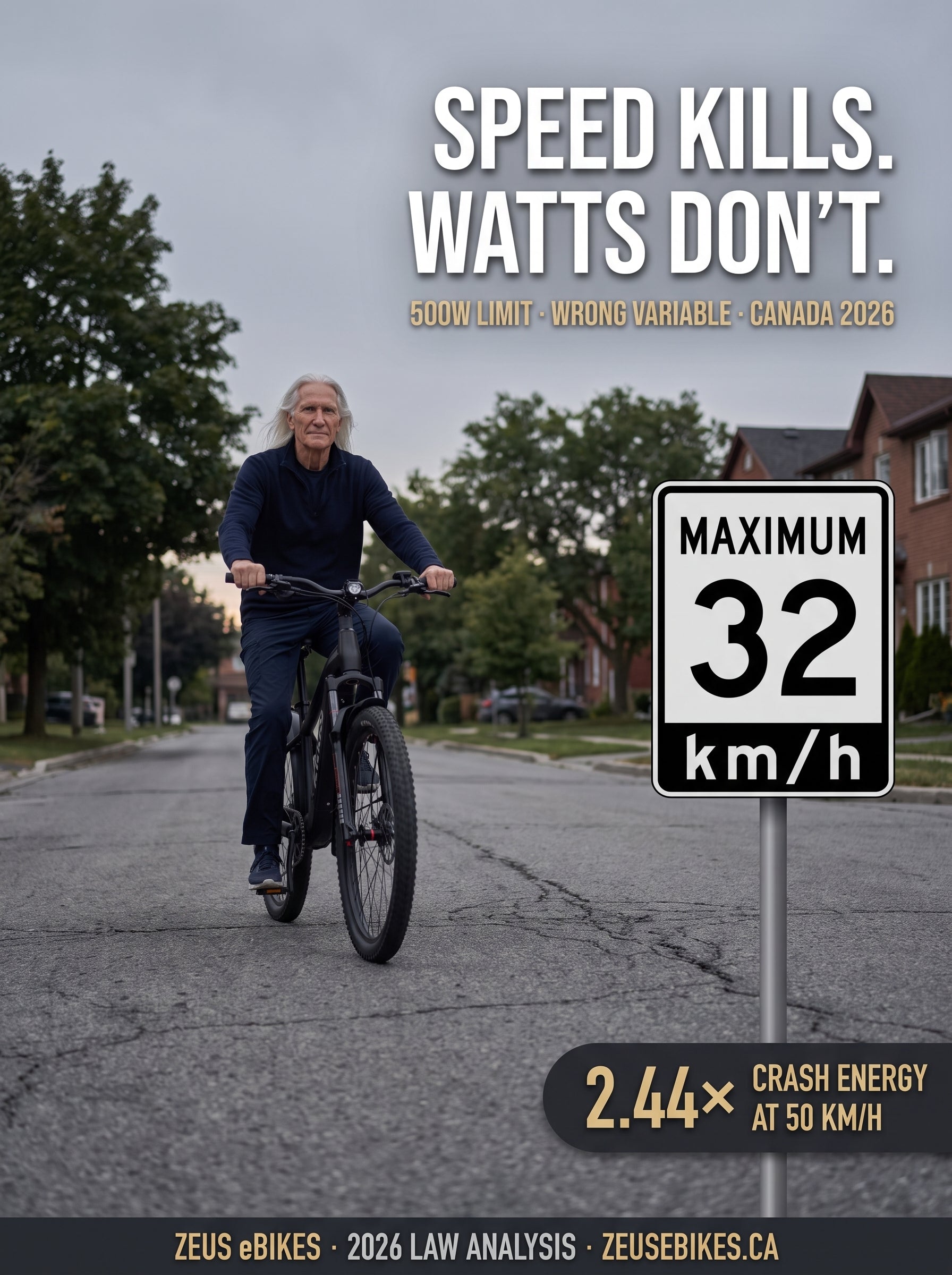
Speed is the primary determinant of crash severity because collision energy grows with the square of impact speed — not linearly. This is basic Newtonian mechanics, and it changes the risk calculation dramatically. At 32 km/h (Canada's legal assisted speed), the kinetic energy carried by a 100 kg combined rider-and-bike is approximately 3,950 joules. At 50 km/h, that same rider-and-bike carries approximately 9,645 joules — 2.44 times more destructive energy — regardless of what wattage motor is propelling them. At 25 km/h (the EU's EPAC speed cap), kinetic energy falls to approximately 2,411 joules.
| Speed | Kinetic energy (100 kg mass) | Multiplier vs 32 km/h | Regulatory context |
|---|---|---|---|
| 25 km/h | ~2,411 J | 0.61× | EU/UK EPAC assisted speed cap |
| 32 km/h | ~3,951 J | 1.0× (baseline) | Canada's assisted speed cap |
| 45 km/h | ~7,813 J | 1.98× | US Class 3 PAS speed cap (28 mph) |
| 50 km/h | ~9,645 J | 2.44× | Typical urban road speed limit |
The World Health Organization's Speed Management Manual (2008) identifies vehicle impact speed as the principal variable determining pedestrian fatality risk — a relationship confirmed across decades of road safety research globally. The same physics apply whether the vehicle is a car, a cargo eBike, or a road cyclist: faster means more destructive on impact.
Wattage matters only insofar as it affects how quickly a motor can accelerate a bike toward its final speed. But two bikes with dramatically different wattage ratings can reach the same assisted top speed — and at that top speed, their collision risk is identical. A 250W mid-drive motor correctly geared assists a rider to 32 km/h just as effectively as a 500W hub motor. At 32 km/h, both carry the same kinetic energy into a hypothetical collision. Our 500W vs 750W vs 1000W guide breaks down what these wattage differences actually mean in the real world — on hills, loaded, in winter — beyond what the law specifies.
The wattage debate doesn't change your buying decision — a PAB-legal 500W eBike is enough for hills, headwinds, and loaded cargo on Canadian roads. Our guides help you choose the right legal eBike for your use case.
Best 500W eBikes Canada → Browse the 500 W collection →The Regulatory Paradox: Two Constraints, One Real Variable
Here is the contradiction at the heart of Canadian eBike law: if wattage were the true safety variable, the 32 km/h speed cap would be redundant. If speed were the true safety variable, the 500W wattage cap would be redundant. Canada has both because neither alone does the job regulators need done — for a practical reason that has nothing to do with safety physics.
The Case for Wattage Limits
Motor wattage labels are easy to verify at point-of-sale and on product imports. Customs officers can check a specification sheet. Retailers can read a label. No dynamic testing required. Wattage limits are administratively convenient, even if they're an imperfect safety proxy.
Higher-powered motors also accelerate faster, reaching dangerous speeds more quickly — relevant for riders on shared paths near pedestrians. Wattage indirectly constrains acceleration, not just top speed.
The Case for Speed Limits Only
Speed is what kills pedestrians — not the motor's nameplate rating. A 250W motor with aggressive gearing and no speed limiter can reach 50+ km/h. A 1,000W motor electronically limited to 25 km/h is objectively slower and lower-risk. What a bike actually does on a road matters more than what the motor can theoretically produce.
The US and EU both regulate primarily by speed. Modern tamper-proof speed limiters make speed caps verifiable, not just nominal.
The real-world paradox is that Canada's dual constraint produces absurd regulatory outcomes. A 250W mid-drive motor with no speed limiter and performance gearing can assist a rider to 50 km/h — it passes the wattage test but violates the 32 km/h speed cap, and is genuinely more dangerous than a 750W motor electronically capped to 25 km/h. The 750W bike, meanwhile, is "illegal" despite being slower than a typical road cyclist. See our Canadian eBike Legal Access Atlas for how this plays out across different provinces and trail types.
What Canada's law is actually trying to enforce is a 32 km/h assisted speed cap. The 500W wattage cap is the enforcement shortcut — a label-readable proxy for a dynamic outcome. The shortcut is imperfect. The US and EU recognised this and moved toward speed-based systems. Canada is beginning to follow.
How Other Countries Regulate eBikes — And What Canada Can Learn
The EU, UK, and US all regulate eBikes primarily by speed, not motor wattage — and every one of them arrived at that conclusion years before Canada. The comparison table below shows how each jurisdiction defines a legal eBike and what variable they actually enforce at roadside.
| Jurisdiction | Motor cap | Assisted speed cap | Primary safety variable | Classification approach |
|---|---|---|---|---|
| Canada (current) | 500W nominal | 32 km/h | Dual (wattage + speed) | Single class: PAB |
| European Union | 250W nominal | 25 km/h | Speed (dominant) | Single class: EPAC (EN 15194) |
| United Kingdom | 250W nominal | 25 km/h (15.5 mph) | Speed (dominant) | Single class: EAPC |
| United States | ≤750W (CPSC, 15 U.S.C. § 2085) | 32 km/h (Class 1/2) or 45 km/h (Class 3) | Speed (primary) | Three speed-based classes (state-level) |
| Ontario (proposed) | TBD (ERO 026-0422) | Speed-based (two classes) | Speed (primary) | Two speed-based classes |
The EU's EN 15194 standard classifies compliant eBikes (EPACs) by their maximum assisted speed — 25 km/h — with a motor nominal power ceiling of 250W. Canada uses 500W nominal plus a separate 32 km/h assisted speed cap. The EU's lower wattage cap is offset by a more conservative speed limit, and in both systems it is the speed ceiling that constitutes the real safety constraint.
The United States is the most instructive comparison. The federal CPSC definition (15 U.S.C. § 2085) sets a ceiling of 750W for a bike to qualify as a "low-speed electric bicycle" — exempt from motor vehicle regulation. Above that threshold, it becomes a motor vehicle. Within that ceiling, most states use a three-class speed-based framework: Class 1 (pedal-assist only, max 20 mph / 32 km/h), Class 2 (throttle-capable, max 20 mph / 32 km/h), and Class 3 (pedal-assist only, max 28 mph / 45 km/h). The Class 1/2/3 distinctions are made entirely by speed — wattage does not differentiate between classes. States manage access by speed class, not motor output. We have mapped that entire framework — power ceilings, speed classes, helmet and licence rules for all 50 states plus DC — against Canada’s standard in Canada vs USA: every state compared.
Ontario's 2026 Reform Proposal — What ERO 026-0422 Actually Says
Ontario's Ministry of Transportation published ERO 026-0422 for public consultation in 2026 as a proposal to modernise Ontario's power-assisted bicycle framework — adding classification criteria based on speed, weight, throttle use, and physical design. The proposed PAB classes would retain a 500W motor limit and 32 km/h speed cap; moped-style and motorcycle-style designs that don't fit those parameters would be reclassified as motor vehicles. The consultation closed June 7, 2026.
If Ontario enacts the speed-based two-class framework, the practical consequences would be significant. Ontario has a population of approximately 15.3 million — roughly 38% of all Canadians (Statistics Canada Q1 2024 estimate). A regulatory framework adopted in Ontario carries substantial weight in any future federal harmonisation conversation and typically influences other provinces. British Columbia — which has operated a formal two-class system since April 5, 2024 (B.C. Reg. 64/2024: Light eBike 250W/25 km/h vs. Standard eBike 500W/32 km/h, documented in our BC eBike laws guide) — would likely align. Provinces with smaller eBike markets often wait for Ontario to move first.
The broader implication is straightforward: Canadian eBike law is moving toward speed-based classification. The question is not whether this transition will happen but when it will be formalised and how provinces will handle the transition period for existing wattage-labelled bikes.
What Canadian eBike Riders Should Do Right Now
Choose a motor rated ≤500W nominal for public road use across Canada, and respect the 32 km/h assisted speed cap — those two rules reflect what the law actually enforces today. Understanding why they exist doesn't change them, but it does help you make a better buying decision and avoid the frustration of the apparent contradiction between the wattage limit and the speed limit.
The practical guidance is simple:
- Choose an eBike with a motor rated at ≤500W nominal if you want to ride legally on public roads, bike lanes, and multi-use paths across Canada.
- Respect the 32 km/h assisted speed cap — that limit is the actual safety mechanism the law is trying to enforce.
- Understand that a 500W PAB-legal eBike can be high-performance. Many 500W mid-drive bikes deliver more practical capability than overspec'd hub-motor bikes with motors twice the power.
- If Ontario's reform passes, watch for implementation details — particularly how existing over-500W bikes registered before the new law might be grandfathered (or not).
- If you want to ride an over-500W bike legally: off-road, private property, or closed-course use remains available in every province.
Our buying guides cover every PAB-legal eBike category — from 500W commuters to mid-drive mountain bikes to step-through commuters. Every pick is verified in-stock and Canadian-supported.
eBike Laws Canada — Full Guide Best 500W eBikes CanadaFrequently Asked Questions
Why is the eBike motor limit 500W in Canada?
Canada's 500W nominal motor limit originated in the federal Power-Assisted Bicycle (PAB) framework, which was repealed effective February 4, 2021 (SOR/2020-22). All provinces have since maintained the same 500W nominal and 32 km/h max assisted speed standard. The 500W figure was a pragmatic regulatory boundary — not a precision safety calculation — chosen to distinguish eBikes from mopeds and limit top-speed capability in a way that was enforceable at the point of sale via motor specification labels.
Is it wattage or speed that determines how dangerous an eBike is?
Speed is the primary determinant of crash severity. Kinetic energy — the force transferred in a collision — grows with the square of speed (KE = ½mv²). A collision at 50 km/h delivers approximately 2.44 times more destructive energy than one at 32 km/h, regardless of the motor's wattage rating. Wattage determines how quickly a motor can accelerate a bike, but not its final assisted speed, which is separately constrained by law. At identical speeds, a high-wattage bike and a low-wattage bike carry identical collision energy.
Is a 750W eBike illegal in Canada?
Yes — on public roads in every Canadian province, an eBike with a motor rated above 500W nominal is not classified as a Power-Assisted Bicycle and cannot legally be ridden on bike lanes, multi-use paths, or roads where PABs are permitted. A 750W bike is legal on private property, off-road trails where motorised vehicles are permitted, and closed courses. Rules are set provincially; enforcement approaches and penalties vary by jurisdiction. See our complete Canadian eBike laws guide for province-by-province details.
What is Ontario's ERO 026-0422 eBike reform proposal?
ERO 026-0422 is Ontario's 2026 proposed regulation to introduce a two-class speed-based eBike framework — replacing the single wattage-based PAB classification with something closer to the US Class 1/2/3 speed-based system. The public consultation closed June 7, 2026. As of June 2026, it is NOT yet law. If enacted, it would represent Canada's first formal provincial shift away from wattage-only eBike classification and toward speed-based classification. Read our Ontario eBike laws guide for current enforceable rules.
How do EU eBike laws compare to Canada's?
The EU's EN 15194 standard classifies compliant eBikes (EPACs — Electrically Power Assisted Cycles) by assisted speed, with a maximum of 25 km/h, and a motor nominal power ceiling of 250W. Canada uses 500W nominal plus a separate 32 km/h assisted speed cap. The EU's approach uses a lower wattage cap (250W vs Canada's 500W) paired with a lower speed cap (25 km/h vs 32 km/h). In both frameworks, the speed ceiling is the dominant practical safety constraint. The EU and UK have operated on this speed-first model for years; Canada is a generation behind in formalising that logic.
Does a higher wattage motor automatically mean a faster eBike?
No. An eBike's top assisted speed depends on motor power, gear ratios, wheel diameter, speed-limiter settings, and rider weight — not wattage alone. A 250W mid-drive motor correctly geared can assist a rider to 32 km/h as effectively as a 500W hub motor. Conversely, a 1,000W motor electronically limited to 25 km/h produces a lower assisted top speed than a 250W motor with no speed limiter. Wattage determines acceleration capability and hill-climbing ability — both real-world performance factors — but not maximum assisted speed, which is set by the limiter and the mechanical system, not the motor rating.
When might Canadian eBike wattage laws change?
Ontario's ERO 026-0422 is the first concrete Canadian provincial reform proposal as of 2026. If Ontario enacts the two-class speed-based framework following the consultation period that closed June 7, 2026, other provinces may align their regulations accordingly — though provincial regulatory timelines are independent. Regulatory implementation has historically followed consultation closure by one to three years, depending on political priority and technical complexity — though this is an editorial estimate, not a fixed rule. Until any reform is enacted and in force, the 500W nominal limit remains the enforceable legal standard across all Canadian provinces. British Columbia already operates a formal two-class system under B.C. Reg. 64/2024 (in force April 5, 2024) — Light eBike 250W/25 km/h vs. Standard eBike 500W/32 km/h — that may accelerate provincial harmonisation.
The Bottom Line
Canada's 500W wattage limit is the wrong safety variable — but it is still the law. Speed determines how badly things go wrong in a collision. The 32 km/h assisted speed cap, buried alongside the wattage limit in every province's eBike framework, is the constraint that actually protects pedestrians. The 500W cap is a proxy that trades regulatory precision for administrative convenience: wattage is readable on a label; speed requires a dynamometer. That convenience has a cost — it creates absurd outcomes where a 750W bike limited to 25 km/h is "illegal" and a 250W bike with no limiter is "legal."
Ontario knows this. ERO 026-0422 is the formal acknowledgment. Whether the reform becomes law in 2026, 2027, or later, the direction is clear. Every major eBike market — the US, the EU, the UK — has already moved toward speed-based classification. Canada is following.
In the meantime: ride legal. Choose a ≤500W nominal motor for public road use. Respect the 32 km/h assisted speed cap. And know that those two constraints, imperfect as they are, keep Canadian bike lanes and pathways genuinely safe — not because of the wattage number, but because of the speed one.
If you're unsure which eBike fits Canadian law and your riding needs, you can call our team directly at 1-866-938-7580 — real humans answer and will tell you honestly whether a bike is right for you and legal in your province. There's no pressure to buy; we sell better by educating first. An unused, unopened Zeus eBike can also be returned within 15 days of delivery (15% restocking fee). And if the price gives you pause, our eBike financing guide breaks down monthly payment options for every budget.
- Electric Bike Laws Canada (2026): Every Province, Fines & the PAB Framework
- Ontario eBike Laws 2026: HTA Rules, the ERO 026-0422 Proposal & Legal Picks
- 500W vs 750W vs 1000W eBike Canada: Which Wattage Is Right?
- Best 500W Electric Bikes Canada (2026): 15 Verified PAB-Legal Picks
- Canadian eBike Legal Access Atlas 2026: Where You Can Ride by Province
- Browse the Zeus 500 W collection →
Visuals created by Playcut.ai
About the Author: Milad Ghobadibeygvand, BScN (Western University, 2014) is co-founder of Zeus eBikes Canada. This article is editorial opinion and public information — not legal advice. For your province's current enforceable rules, consult the applicable legislation or a licensed legal professional.

Share:
eBike Shops in Newfoundland and Labrador (2026): St. John's, Every Store Verified
Canada's eBike Laws Aren't Enforced. Here's Why That Matters More Than the Watts.