
Who Is Raising Our Kids? The Measured Answer, and the Six Things That Bring a Canadian Teen Back
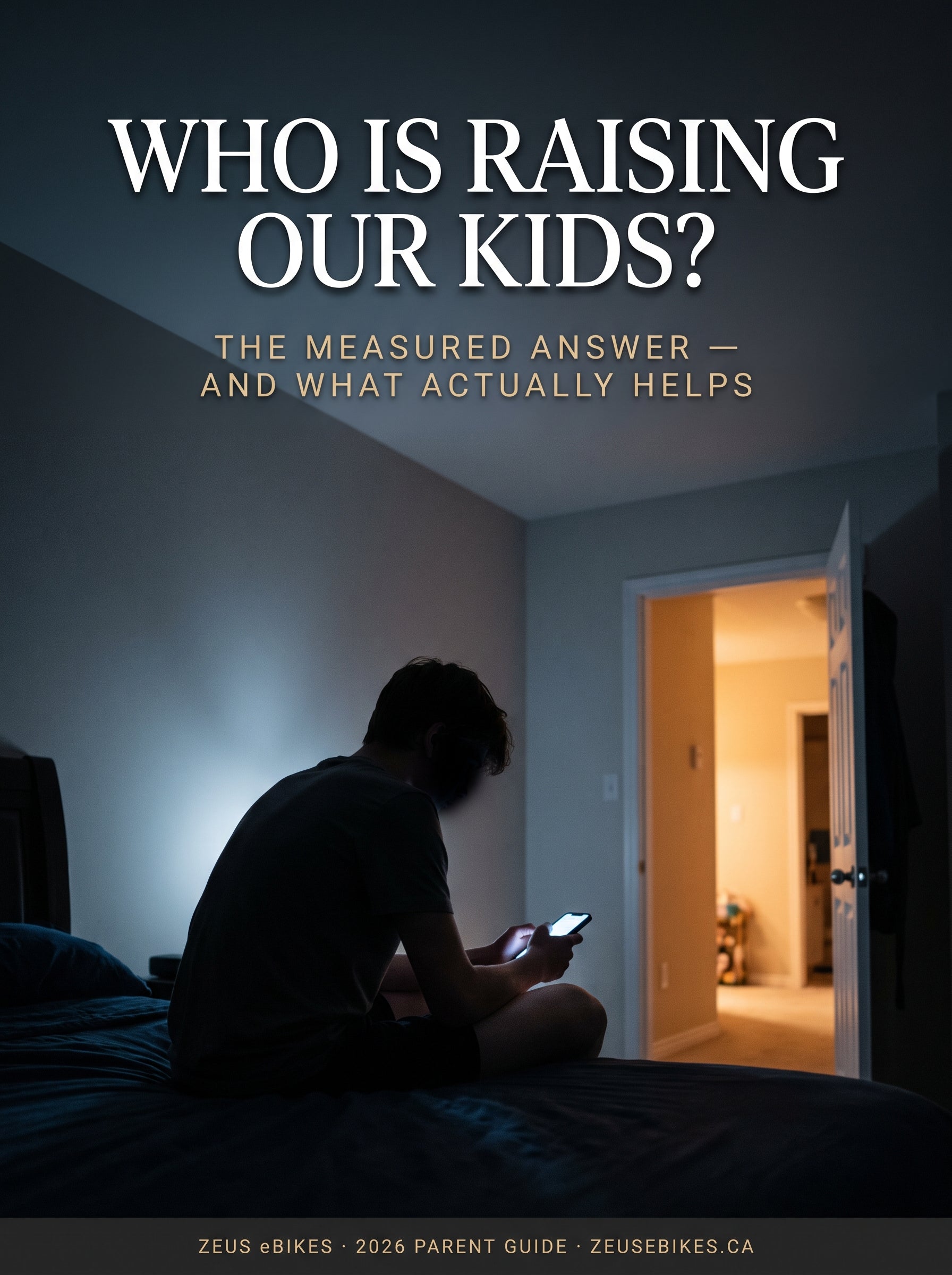
It's eleven at night, and a parent is standing in a hallway, listening to the faint blue hum of a screen under a bedroom door. Their kid hasn't said more than a few words since dinner — and dinner itself happened at different times, in different rooms. If that keeps being the shape of the evening, a house stops being a place two generations actually share, and a teenager's steadiest audience becomes an algorithm with no stake in how they turn out. This article will not tell that parent they're failing. It will show them, in verified Canadian numbers most have never seen assembled in one place, exactly what changed in a single generation — and then hand over six specific, ordinary, evidence-backed things a family can start this week.
If that hallway moment sounds like your house, you are not alone — you are in very large company. The in-person social fabric of Canadian life has thinned dramatically in a single generation, by the country's own official measurement — and the numbers below are not a scare tactic. They are the reason "just tell them to put the phone down" stopped working for almost everyone, and they are the starting point for something that actually does.
Only 19.3% of Canadians see a friend on an average day in 2022, down from 47.9% in 1986 — the deepest decline Statistics Canada's Time Use Survey has ever recorded (StatCan, June 2025). Ontario's CAMH survey finds 38% of teens now report fair or poor mental health, up from 11% less than twenty years ago, and 46% rarely or never talk to a parent about their problems. None of this means your teenager is broken, and none of it means you're failing. This guide explains what actually changed, how to tell ordinary teenage withdrawal from something that needs real help, and six specific, evidence-informed things that help draw a teen back into the room — including a right-sized first bike like the Eunorau EKIDS-20 and a step-through commuter built for riding side by side.
Every statistic here traces to a named primary source: Statistics Canada's Time Use Survey, the Ontario Student Drug Use and Health Survey (OSDUHS/CAMH, the longest-running student survey in Canada), and the Health Behaviour in School-Aged Children Canada report (HBSC, Public Health Agency of Canada). Where a claim about e-bikes and wellbeing specifically is made, it's tied to a named peer-reviewed study, not a general assumption — and named in the linked Sources section so you can check it yourself. One disclosure: this article is published by a Canadian e-bike company, and it recommends four Zeus e-bikes as one part of the answer. Weigh every word with that in view — which is exactly why each recommendation here is tied to a specific, cited piece of evidence, not just offered as a fix.
A note on scope: every figure above is Canadian, and most are Ontario-specific, since OSDUHS surveys only Ontario students — though it is the longest-running instrument of its kind in the country. This piece establishes a national and Ontario-weighted baseline, plus a documented sex split and an income gradient. It does not yet break the data down by province beyond the legal age table in the FAQ, by parental employment status, or by immigration and racial background — each is a real, measured axis of difference that deserves its own treatment rather than a flattening compression into this piece. Where we could not independently verify a claim to the standard the rest of this piece holds itself to — including an initial physical-health trend line we ultimately could not confirm — we left it out rather than imply a certainty we do not have.
What This Article Covers
- The moment every parent recognizes
- The numbers behind the feeling
- Is this normal, or something more?
- Who's actually filling the room
- The six things that help (and the evidence)
- What the first week actually looks like
- When it's more than disconnection
- Questions parents are actually asking
- Sources & further reading
The Moment Every Canadian Parent Recognizes
You know the moment even if you've never described it out loud: the door stays closed a little longer than it used to, the answers get shorter, and the blue light under the door becomes the most reliable thing in the house. It doesn't arrive as a crisis. It arrives as a Tuesday, and then another Tuesday, until one night you're standing in a hallway wondering when exactly you became a guest in your own kid's life. That moment is not a parenting failure. It is one of the most common experiences Canadian parents of teenagers are living through right now, and it has a measured, national shape.

Here is the honest reason this guide exists. Somewhere between the school run and the mortgage and the actual, real demands of a full life, most parents don't have time to read a 40-page CAMH mental-health trend report or cross-reference a Statistics Canada time-use table. So this article did that instead — pulled the primary data, checked it against itself, and turned it into something a tired parent can actually use before bed tonight.
The disconnection you're noticing is real, it's measured, and it is happening in a great many Canadian homes with a teenager in it — not just yours. That single fact changes what this problem is. It is not a referendum on your parenting. It is a generational shift with identifiable causes, which means it has identifiable ways back.
The Numbers Behind the Feeling
Friend time has collapsed across Canada — for every age group, the young included. Only 19.3% of Canadians saw a friend on an average day in 2022, down from 47.9% in 1986 — the deepest single decline anywhere in the Time Use Survey's 36-year record — and among those who do still see friends, the time together fell too, from 5.0 hours a day to 3.8. One honest nuance the data insists on: teenagers are still, comparatively, the age group most likely to see a friend on a given day. But they are the most social people in a country that has largely stopped seeing its friends — carrying that sociability off a baseline that fell out from under everyone. The sharpest drop of all landed on adults aged 25 to 64, whose odds of seeing a friend on a given day fell from 42% to just 14% — which means the disconnection isn't only happening to teenagers. It's happening to the parents standing outside their doors, too.
The Vanishing Friend
The share of Canadians who saw a friend on an average day, 1986 versus 2022. This is the single deepest decline in the 36-year history of Statistics Canada's Time Use Survey — the anchor statistic behind everything else in this guide.
Source: Statistics Canada, The Daily, June 17 2025, "Time pressure and time spent with friends over the last 30 years" (Time Use Survey, 1986–2022).
Screens filled a large part of the gap. In Ontario's CAMH-run OSDUHS survey — the longest-running student survey in the country, tracking students since 1977 — 78% of teens now report three or more hours of recreational screen time a day, up from 55% in 2009 and peaking at 83% during the pandemic year of 2021. Nearly a quarter, 23%, spend five or more hours a day on social media specifically, and 94% use it daily. None of that is a moral judgment on any one teenager. It's simply where the missing hours went.
The mental-health lines moved together with startling consistency, and they share an almost eerie coincidence: three different measures, tracked from three different starting years, all began at roughly 11% — and all climbed to very different, and much higher, places by 2023.
Three Different Starting Points, One Direction
Ontario students' self-reported mental health, tracked by CAMH's Ontario Student Drug Use and Health Survey. Three separate indicators, three different first-measured years — and each one started near 11% before climbing to a very different place by 2023.
Source: CAMH, "The Mental Health and Well-Being of Ontario Students, 1991–2023" (OSDUHS, N=10,145, grades 7–12), 2023 report.
Two more numbers matter as much as any chart. First, 46% of Ontario students say they rarely or never talk to their parents about their problems or feelings — arguably the single most important statistic in this entire guide, because it's the one that describes the specific silence a parent hears through a bedroom door. Second, daily physical activity meeting the recommended 60 minutes sits at just 26% — only one in four Canadian teens — while active sports time fell from 39 minutes a day in 2010 to roughly 24 minutes by 2022. The body went quiet at the same time the conversation did. It shows in how teens rate their own bodies, too: in the 2021 cycle of the same survey, one in five Ontario students — 19.8% — rated their own physical health as fair or poor.
None of this lands evenly, either — and the clearest documented gradient in this entire dataset is economic, not generational. Statistics Canada's 2008 analysis of organized-sport participation, drawn from 2005 survey data on children aged 5 to 14, found participation at 68% among kids in the highest income quintile against 44% in the lowest. More recent numbers move in the same direction: the Canadian Fitness and Lifestyle Research Institute's 2022 Parent Survey puts household participation at 73% for families earning $100,000 or more, against 60% for families under $60,000 — and Canadian Tire Jumpstart Charities' 2023 State of Sport Report found 44% of parents say cost alone keeps their child out of organized sport entirely. This is data about organized sport specifically, not about e-bikes — no comparable income-stratified study of e-bike adoption among Canadian teens exists, and none is claimed here. But the mechanism generalizes without much strain: anything that costs money gates itself, by construction, against exactly the families most affected by everything measured above.
The Clearest Gradient in This Data
Three separate Canadian surveys, spanning 18 years, all find the same thing: kids from richer households play organized sport more often — and cost is the specific reason poorer households don't. Here it is three different ways.
Sources: Statistics Canada, "Kids' Sports," Canadian Social Trends (2008), using 2005 General Social Survey data; Canadian Fitness and Lifestyle Research Institute, 2022 Parent Survey; Canadian Tire Jumpstart Charities, State of Sport Report (2023).
This isn't a story about a "bad generation" or "lazy kids." It's a measured, national shift in how much in-person time, physical movement, and open conversation fill an average Canadian day — for teens and for the adults raising them. Every one of the six things later in this guide targets one of these specific, measured gaps.
Is This Normal, or Something More?
Some withdrawal is genuinely ordinary. Wanting a closed door, shorter answers, and more time with a private inner world has been part of adolescence for as long as adolescence has existed — it's a teenager practising the separate adult they're becoming, not a symptom on its own. The question worth asking isn't "does my teen want privacy," because almost every teen does. It's whether room-time has quietly become the only time — whether it has replaced friendships, movement, sleep, and conversation almost entirely, rather than simply supplementing them.
A useful, non-alarmist way to think about it: normal adolescent withdrawal tends to be selective and stable — closed off from parents in some ways, but still texting friends, still able to laugh at something, still sleeping roughly on schedule. A pattern worth a closer, gentler look tends to be total and worsening — pulling back from friends too, not just parents; sleep collapsing in either direction; things they used to genuinely enjoy going flat. Neither of those, on its own, is a diagnosis. Both are worth a conversation, and if either has lasted more than two weeks, worth a conversation with a doctor. We'll return to the specific warning signs that should never wait, later in this guide.
Usually just growing up
- Still texting or seeing friends
- Still laughs at something, somewhere
- Sleeping roughly on a normal schedule
- Closed off in some ways — not all of them
Worth a gentle closer look
- Pulling back from friends too, not just you
- Sleep collapsing — far too much or too little
- Things they used to love going flat
- Withdrawal that's total, and getting worse
Who's Actually Filling the Room
Ask the question in this article's title literally, and here is the most honest answer — offered as an interpretation of the data, not as a measured fact: for a growing number of Canadian households, the hours once held by people and institutions are increasingly held by an algorithm nobody elected, hired, or trained, running twenty-four hours a day, with no stake whatsoever in who your kid becomes. What is measured is the raw allocation of time — with 94% of teens using social media daily and civic or community participation sitting at just 1.9% on a given day, the team, the club, the congregation, and the neighbourhood now hold a far smaller share of a teenager's day than a single, private, algorithmically curated feed. The count of the hours is the country's own; the conclusion about what that feed is doing with them is ours, and you should read it as a claim to weigh, not a proven finding.

And the room isn't filled evenly. The measured patterns split sharply by sex — co-occurring patterns, not proven causes, but different enough to suggest that different risk environments may deserve different conversations. Among girls, the numbers cluster around the feed: serious psychological distress at 40.5%, against 14.8% for boys; self-harm at 27.6% versus 10.0%; and far heavier social-media use. Among boys, they cluster around the game and the bet: video-gaming problem symptoms at 24.5%, against 11.5% for girls, and in-game gambling — loot boxes, keys, skins, bought with real money — at 34.5% versus 11.8%. The data does not prove the feed causes a daughter's distress or the game causes a son's; it shows where each concentrates. But a single, generic "get off your phone" plainly doesn't fit both — and a daughter pulling away into a curated feed of comparison and a son pulling away into a competitive, monetized game likely need different conversations, even if the underlying move — more real hours, together, doing something else — is the same for both.
Her Crisis, His Crisis
Ontario teens, split by sex — two different patterns, both real, both measured. Girls' distress clusters around the feed; boys' around the game and the bet. These are co-occurring patterns, not proven cause and effect.
Source: CAMH, "The Mental Health and Well-Being of Ontario Students, 1991–2023" (OSDUHS 2023, sex-split findings).
The algorithm isn't malicious in any conscious sense — it's simply the most available, most rewarding thing in the room, and it fills a vacuum left by the shrinking of everything else: friend-time, sports, sleep, and conversation. Filling that vacuum with something else, deliberately, is the entire logic of the six things that follow.
Not sure where to start?
Call 1-866-938-7580 and talk to a real person about which of the six things below actually fits your family — your teen's age, your street, your budget. No pressure, no script.
The Six Things That Help — and the Evidence Behind Each
None of these are secrets, and none require a therapist, a new app, or a family meeting with an agenda. A word on what follows, because the title of this article makes a promise: each of the six is an evidence-informed mechanism — every one individually tied to real research — but no single study has tested the six together as a package, and none proves that an e-bike "brings back" a withdrawn teenager. What the evidence supports are the ingredients; assembling them into an ordinary family habit is the reasonable, honest bet this guide makes. Four of the six are exactly why an e-bike, of all things, keeps turning up in this kind of research.
One honest caveat before the list begins: the data just shown demonstrates that cost already gates participation for lower-income families, and four of the six things below cost money. Naming that tension does not resolve it. It seemed more honest than pretending it away.
1. Movement, full stop
Only 26% of Canadian teens meet the recommended 60 minutes of daily physical activity, and active-sport time has fallen from 39 minutes a day in 2010 to roughly 24 by 2022. Movement doesn't have to mean organized sport. It has to mean the body doing something other than sitting — and the research on e-cycling specifically is stronger than most parents assume: a systematic review in the International Journal of Behavioral Nutrition and Physical Activity found e-cycling reliably delivers moderate-intensity physical activity, well above walking (Bourne et al., 2018). It isn't "cheating" exercise. It's exercise a reluctant teenager will actually do twice. That same calibration cuts the other way, too: it is often what makes cycling possible at all for a teenager whose stamina, weight, or a diagnosed health condition would make an unassisted ride difficult. If a health condition affects your teen's activity tolerance, that's a conversation for their doctor, not this article — but for many families, pedal-assist is not a lesser version of cycling. It's the version that includes their kid.
2. Independence that isn't surveillance
Writing in the Journal of Pediatrics in 2023, the psychologist Peter Gray and colleagues linked the long decline in children's independent, unsupervised activity directly to rising rates of anxiety and depression — arguing that a low sense of control over one's own life is one of the most reliable predictors of both. A teenager's first bike that's genuinely theirs — sized right, capable of getting them somewhere on their own — is a small, controlled dose of exactly the independence that decline took away.
This is the "start smaller than you think" pick — junior-sized, lower-powered, built for a younger or first-time teen rider rather than scaled down from an adult trail bike. The point isn't speed or range. It's a bike that's genuinely theirs, that they can be trusted to ride to the end of the block and back without a parent hovering at the curb.
3. A shared, novel activity — not a direct conversation
In a now-classic set of experiments published in the Journal of Personality and Social Psychology, the psychologist Arthur Aron and colleagues found that couples who did something new and mildly exciting together — not just talked — showed measurably greater closeness afterward than couples who did something familiar and routine (Aron et al., 2000). The finding has since become foundational in relationship research generally, not just for couples: shared novelty builds connection in a way that sitting across a table asking "how was your day" rarely does. A ride, side by side, facing forward instead of facing each other, is exactly that kind of low-pressure, novel, shared activity — which is precisely why 46% of Ontario teens rarely opening up to a parent at the dinner table doesn't mean the same teen won't talk on a ride.
This is the bike built for the "shared novel activity" itself — a step-through frame comfortable enough that either parent or teen can throw a leg over it, which matters if the plan is a family that trades bikes rather than one person always riding "the kid's bike." Easy on, easy off, easy to ride side by side down a street with nothing in particular to talk about — until, somewhere around the second block, there usually is.
4. Real responsibility, with real stakes
Teen employment in Canada sits at 37.6% — the lowest level in the 50-year Labour Force Survey series outside the 2020 pandemic floor of 36.7%, down from a 1989 peak of 51.6%. That's not because today's teens don't want responsibility. Jobs simply dried up, and with them went one of the oldest, most reliable sources of a teenager's sense of competence: something that depends on them showing up. A bike built to actually carry things — groceries, a delivery, a friend's forgotten backpack — hands a teenager a small, real job with a real cargo deck behind the seat.
Built as a genuine load-carrier — a cargo platform behind the seat and a 440 lb payload rating, not a cosmetic basket — this is the pick for the older teen ready for an actual job: grocery runs, a delivery shift, hauling a crew's gear to the field. Three wheels means it stands up on its own with the load still on it, which is most of what makes carrying real weight feel manageable rather than precarious. It turns "get a summer job" from a wish into something with an actual vehicle attached to it.
The honest trade-off: at 86 lb it is a heavy machine. This is a trike that lives in a garage or a shed, not one that goes up an apartment stairwell.
5. A reason to leave the neighbourhood
Active commuting is linked to better psychological wellbeing than driving, in longitudinal research that followed nearly 18,000 British adults across eighteen years (Martin, Goryakin & Suhrcke, Preventive Medicine, 2014). Two honest caveats belong in the same breath: that study found active travel and public transit both beat driving — not that cycling beats the bus — and it looked at adults commuting to work, not teenagers riding for pleasure, a group the direct study simply hasn't covered. But the through-line is intuitive: for a teenager whose world has quietly shrunk to a bedroom and a screen, range matters, and a bike capable of an actual trail, not just a sidewalk, turns "go outside" into somewhere worth going.

Full suspension and fat tires built for actual trail, not just pavement — the pick for the restless teen who needs distance and a change of scenery more than a gentle cruise around the block. This is the bike that turns a Saturday into somewhere new instead of another day indoors.
6. Non-confrontational time, on repeat
The last thing isn't a product, which matters given everything just said about cost. The mechanism behind it — movement, shared novelty, low-pressure repetition — has no price tag of its own. A walk has the same structure as a ride. Doing a chore together, badly, on purpose, has the same structure as a ride. The four bikes above are one vehicle for the first five things on this list, chosen because they happen to deliver several at once — they are not a precondition for any of them. What the discipline itself requires is doing one of the above more than once, without turning it into a referendum on screen time. The moment a ride becomes an ambush — "so let's talk about your grades while we pedal" — it stops being the low-pressure, novel shared activity that builds closeness and starts being one more thing to avoid. The evidence above works because it's repeated, ordinary, and doesn't demand anything of the conversation. Sometimes nothing gets said for twenty minutes. That's not a failure. That's often the whole point.
Movement, independence, shared novelty, responsibility, range, and repetition — none of these require a difficult conversation to start. They require showing up with a bike and an open Saturday afternoon. The conversation, when it comes, tends to arrive on its own.
Not sure which bike fits your family?
Call 1-866-938-7580 and a real person — Canadian company, Canadian support — will help you match age, budget, and use case to the right pick. See the warranty policy before you decide.
What the First Week Actually Looks Like
Keep it small on purpose. Let your teen pick the first ride — the destination, the time of day, whether it's just the two of you or a friend comes along. Aim for twenty to thirty minutes, no set agenda, and leave the phone at home or in a pocket, powered off, for both of you. Do it twice in the first week if you can, but once is a real start. Resist the urge to narrate the benefits ("see, isn't this nice, you should do this more") — let the ride be the whole point, not a lesson wrapped in a bike ride. If the first outing produces ten minutes of real conversation, that's a win. If it produces silence and fresh air, that's still a win. The research above doesn't require a breakthrough on day one. It requires it happening again next week.
The First Ride — the whole plan
You're not chasing a breakthrough on day one. You're chasing next week.

When It's More Than Disconnection
Everything in this guide is built for ordinary teenage withdrawal — the kind that responds to more movement, more shared time, and less surveillance. Some patterns are not that, and deserve to be named plainly rather than folded into a general wellness message.
Talk of hopelessness, worthlessness, or being a burden to others. Any mention of self-harm or suicide, however casual it sounds. A sudden, dramatic change in sleep, eating, or energy that lasts more than two weeks. Giving away possessions or saying goodbye in ways that feel final. Complete withdrawal from everything they used to enjoy — not just screens, but friends, food, and activities too. Any of these warrants a conversation with your family doctor. If your teen is in immediate danger, call 911 or go to the nearest emergency room — do not wait.
One disparity deserves to be named plainly here, because a generic list would understate it. Statistics Canada's own research (2011–2016) found the suicide rate among First Nations youth aged 15 to 24 more than six times the non-Indigenous rate; among Inuit youth in Inuit Nunangat specifically, the rate for young men was more than thirty times higher, and for young women thirty-three times higher, than their non-Indigenous peers of the same age. The same research offers an important counterpoint at the community level: just over 60% of First Nations bands recorded no suicides of any kind during that same six-year period — evidence that points toward community-level protective factors as the more accurate story, not a single undifferentiated crisis.
Real, immediate, confidential help exists in Canada right now, for both teens and the parents supporting them:
- Kids Help Phone — 24/7, free, national, multilingual, built specifically for youth. Call 1-800-668-6868, or text CONNECT to 686868. Online chat and resources at kidshelpphone.ca.
- Hope for Wellness Helpline — 24/7, toll-free, for all Indigenous people across Canada, in English and French. Call 1-855-242-3310, or connect to online chat at hopeforwellness.ca.
- 9-8-8: Suicide Crisis Helpline — Canada's national suicide-crisis line, available to everyone in Canada, including Quebec, 24/7 in English and French. Call or text 988. (Quebec is covered by 988 and also keeps its own longstanding service: 1-866-APPELLE / 1-866-277-3553, or suicide.ca.) More at 988.ca.
- In immediate danger: call 911 or go to the nearest emergency room.
None of this article's six things are meant to substitute for that kind of help when it's genuinely needed. They're meant for the much larger, quieter, more common problem sitting underneath most of that hallway at 11 p.m. — ordinary disconnection, not crisis. Knowing the difference, and knowing exactly who to call either way, is the whole point of this section.
Questions Parents Are Actually Asking
Is it normal for a teenager to spend most of their time alone in their room?
Some withdrawal is a normal part of adolescence — teens have always wanted more privacy and independence. But the scale has changed: only 19.3% of Canadians see a friend on an average day in 2022, down from 47.9% in 1986, and 78% of Ontario teens report 3+ hours of daily recreational screen time. If room-time has replaced almost all in-person contact, that's a pattern worth noticing, not panicking about.
How much screen time is too much for a teenager?
There's no single hard line, but Ontario's OSDUHS survey found 78% of teens report 3+ hours of recreational screen time daily in 2023, up from 55% in 2009, and 23% report 5+ hours on social media alone. A more useful question than "how many hours" is often "what did the screen time replace" — sleep, friend-time, and outdoor activity are the ones worth protecting first.
Why won't my teenager talk to me anymore?
You're not imagining it and you're not alone: 46% of Ontario students say they rarely or never talk to their parents about their problems or feelings (OSDUHS 2023). It's rarely about you specifically. A research-backed alternative to questioning is shared, novel activity — doing something new side by side rather than talking face to face. The classic experiments (Aron et al., Journal of Personality and Social Psychology, 2000) were run with couples, not parents and teens, so this is a reasonable extension rather than a directly proven one — but a low-pressure ride is a natural way to put it to the test in your own family.
What are the warning signs I should never ignore?
A persistent change lasting more than two weeks — sleeping far more or less than usual, withdrawing from everything they used to enjoy (not just screens), talk of hopelessness or being a burden, or any mention of self-harm or suicide — should always be taken seriously and discussed with a doctor. If your teen is in immediate danger, call 911 or go to the nearest emergency room.
Can an e-bike actually help with teen isolation, or is that a stretch?
It's one tool, not a cure — and it's worth being precise about the evidence, because it's easy to overstate. E-cycling reliably provides real, moderate-intensity physical activity (Bourne et al., 2018); the direct evidence for its psychological effects specifically is still limited. Separately: physical activity in general is one of the best-established supports for mental health; active commuting is associated with better wellbeing than driving in adults (Martin et al., 2014); and shared novel activity builds closeness in couples research (Aron et al., 2000). None of those studies tested a parent-and-teen e-bike ride directly. An e-bike is a reasonable bet not because a trial proved it, but because it stacks several of those evidence-informed ingredients — movement, daylight, autonomy, unstructured time together — into one thing a teenager will actually do, without it turning into a fight about phones.
What age can my teen start riding an e-bike in Canada?
It depends on the province — Alberta allows age 12+, Saskatchewan and Manitoba 14+, British Columbia splits by class (14+ for the lighter Class 1, 16+ for Class 2 with throttle), and Prince Edward Island requires 16+. Our full province-by-province breakdown, plus safety data by age, is in our companion parent's guide to e-bikes and e-scooters for kids and teens.
Is riding together really better than just telling my teen to go outside?
The evidence suggests so. In Statistics Canada's own data on children's sports participation, only 24% of kids play when no parent is involved at all, compared with 69% when a parent plays alongside them — the single strongest lever in that dataset, and it's the parent, not the program. "Go outside" is a command; riding together is an invitation.
Sources & Further Reading
Every major statistic in this guide is linked below so you can read it in its original context — not our summary of it.
The core Canadian data
- Statistics Canada, "Time pressure and time spent with friends over the last 30 years" (The Daily, June 17, 2025) — the friend-time collapse, 1986–2022.
- CAMH, "The Mental Health and Well-Being of Ontario Students, 1991–2023" (OSDUHS 2023 trend report) — screen time, mental health, distress, and family-communication figures.
- Public Health Agency of Canada, "The Health of Young People in Canada: Focus on Mental Health" (HBSC Canada 2022 national report) — family support and friendship data.
The evidence behind the six things
- Bourne et al., "Health benefits of electrically-assisted cycling: a systematic review" (International Journal of Behavioral Nutrition and Physical Activity, 2018).
- Gray, Lancy & Bjorklund, "Decline in Independent Activity as a Cause of Decline in Children's Mental Well-being" (The Journal of Pediatrics, 2023).
- Aron, Norman, Aron, McKenna & Heyman, "Couples' Shared Participation in Novel and Arousing Activities and Experienced Relationship Quality" (Journal of Personality and Social Psychology, 2000).
- Martin, Goryakin & Suhrcke, "Does active commuting improve psychological wellbeing?" (Preventive Medicine, 2014).
The income gradient
- Statistics Canada, "Kids' Sports" (Canadian Social Trends, 2008, using 2005 General Social Survey data).
- Canadian Fitness and Lifestyle Research Institute, Sport Participation Among Children and Youth (2022 Parent Survey).
- Canadian Tire Jumpstart Charities, State of Sport Report (2023).
Crisis resources
- Kids Help Phone — 1-800-668-6868, or text CONNECT to 686868.
- Hope for Wellness Helpline — 1-855-242-3310, for all Indigenous people across Canada.
- 9-8-8: Suicide Crisis Helpline — call or text 988.
- Statistics Canada, "Suicide among First Nations people, Métis and Inuit" (CanCHEC 2011–2016) — the source for the Indigenous youth statistics above.
This guide is one part of a larger picture: the full research on the teen loneliness crisis itself, the province-by-province safety and legal guide to e-bikes and e-scooters for kids and teens, our full roundup of e-bikes for teens, and how a Canadian teen can build real income and responsibility in 2026.

Let this guide be honest about its own promise, right at the end: an e-bike cannot treat a mental-health condition, and nothing here has claimed it can. What the evidence and plain experience both point to is smaller and truer — that repeated movement, a little autonomy, and unpressured time beside a parent may reopen a door that direct questioning kept closing. That is not a cure. On the evenings it works, it is something quieter and better than a cure: a way back into the same room.
Both the hallway at 11 p.m. and the ride at 5 p.m. are the same story, told two ways. One of them, most Canadian families can start this week.
One practical note before you decide anything: if a bike turns out to be the wrong fit — wrong size, wrong personality for your street, wrong call for your family — Zeus accepts returns on unused, unopened items in original packaging within 15 days of delivery. Call 1-866-938-7580 first if you're unsure which of the four fits; a five-minute conversation with a real person often solves the fit question before you'd ever need the return window.
Visuals created by Playcut.ai
Share:
100 Lies That Changed the World
eBike Wattage in Canada (2026): How Many Watts You Actually Need — and What's Legal