
Sur-Ron Canada (2026): The Honest Review + 16 Zeus Alternatives

Sur-Ron Light Bee X, Hyper Bee, Storm Bee, and Ultra Bee are electric off-road motorcycles, not eBikes. They exceed the limits Canada's provincial e-bike rules converge on (500W, 32 km/h of assistance, working pedals) on every axis, and no Canadian province or territory treats a stock Sur-Ron as a bicycle. DIAN Motors Ottawa is the only authorized Canadian distributor. The 12-month manufacturer warranty inside the DIAN dealer network applies only to authorized-dealer purchases — Alibaba, AliExpress, and Amazon units are explicitly excluded from DIAN-network service. Zeus's research did not identify any Canadian insurer writing a standard road motorcycle policy on a stock Sur-Ron. If a minor on a parent's Sur-Ron injures someone, the parent — as owner — can face substantial personal liability that no provincial Parental Responsibility Act limits. Zeus doesn't sell Sur-Ron. We offer 16 alternatives across three buyer paths: high-power off-road dirt bikes, 1,000W off-road trail and hunting, and e-bikes rated 500W or less, built for road use by teens and families. For a parent looking for a road-use starting point, the Samebike CY20 ($1,199 CAD) is the most accessible entry, or browse the full 500 W collection.
Which describes you?
This editorial was built from eight parallel primary-source research passes conducted May 12, 2026: (1) DIAN Motors and Sur-Ron Canada dealer-network and warranty research; (2) Canadian Sur-Ron accident, injury, and RCMP enforcement data; (3) Ontario law, including Desrochers v. McGinnis, 2024 ONCA 63; (4) Quebec law, including Ministerial Orders 2024-15 (in force July 30, 2024) and 2024-24 (permanent from January 26, 2025); (5) BC law, including R. v. Ghadban, 2021 BCCA 69; (6) Alberta law; (7) Atlantic provinces, including Edmondson v. Edmondson, 2022 NBCA 4 and Pender v. Squires, 2013 NLCA 37 (the Hannam family's insurance case); (8) Prairies and territories. Every statute, case citation, fine, dealer location, and price was sourced to a named primary document (CanLII, gouvernement publications, RCMP releases, hospital trauma registries, manufacturer pages, or named news outlets). Where Canadian data does not exist on a point, we say so explicitly rather than fabricating it. Zeus does not sell Sur-Ron — this review carries no sales relationship with the manufacturer or its Canadian distributor. Zeus product picks were confirmed in stock on zeusebikes.ca on May 12, 2026, and re-checked against live stock and prices on October 10, 2026, when the out-of-stock Eunorau Urus was removed.
Not legal advice. This article is published for informational and editorial purposes only. It summarises statutes, regulations, and reported case law as they appeared on the dates cited, but it does not constitute legal advice and does not create a solicitor-client relationship. Laws, fine amounts, and regulatory positions change. For guidance specific to your situation — whether you are buying, selling, registering, insuring, or facing a claim involving any electric two-wheel vehicle — consult a lawyer licensed in your province or territory.
In This Guide
- Why We Wrote This (Zeus Doesn't Sell Sur-Ron)
- What a Sur-Ron Actually Is (2025/2026 Lineup)
- The Provincial Legality Matrix — 13 Jurisdictions
- Real Canadian Accident & Enforcement Data
- The Parent + Teen Liability Reality (Per Province)
- Who Gets the Ticket. Who Pays the Bill.
- Maintenance & Parts Costs in Canada
- Warranty: What's Covered, What Isn't
- Three Buyer Paths — 16 Zeus Alternatives
- Sur-Ron vs Zeus — 16-Bike Comparison Table
- For Parents Specifically — The Honest Recommendation
- FAQ

Why We Wrote This (Zeus Doesn't Sell Sur-Ron)
This article exists because of a pattern Zeus's phone team has heard repeatedly through 2025 and into 2026: "We bought our son a Sur-Ron for his birthday. We thought it was an eBike. Now we're hearing it isn't legal on the road. What do we do?"
The honest answer to that question requires a lot of information that no Sur-Ron dealer is contractually obligated to provide and that almost no Canadian retailer has bothered to write down in one place. So Zeus wrote it down. We are publishing this as a third-party editorial because Zeus does not sell Sur-Ron and never has — we have no Sur-Ron inventory, no Sur-Ron sales relationship, no Sur-Ron commission to defend. What we do have is a Canadian customer base that keeps asking the same questions, and a duty to answer them straight.
Sur-Ron Tech (the Chinese manufacturer, Surring Technology Co.) built a genuinely impressive product. The Light Bee X is fast, well-engineered, and one of the lower-priced full-power electric dirt bikes available in Canada at $6,499 CAD. The Storm Bee and Ultra Bee are serious machines whose published specs compete with much more expensive gas dirt bikes on raw performance. None of that is in dispute. The problem isn't the bike. The problem is the gap between what the bike actually is in Canadian law — a closed-course electric off-road motorcycle — and the impression many Canadian families form when they encounter it. In our customer conversations, parents have described seeing "Light Bee," seeing the price tag, seeing foot pegs that resembled pedals, and concluding they were buying an eBike. They are not.
This editorial is the long version of what a careful Canadian salesperson would tell you in a four-hour conversation. We will tell you what a Sur-Ron actually is. We will tell you, province by province, why no Canadian jurisdiction treats it as a bicycle. We will tell you what real Canadian fire-service, hospital, and RCMP data shows about high-power e-mobility in 2025–2026. We will tell you, with named appellate case law, what happens when a teenager on a parent's Sur-Ron injures someone on a Canadian street. And then we will give you twelve Zeus alternatives sorted into three honest buyer paths: for the person who still wants Sur-Ron-class power, for the person who wants something slower but similar, and for the parent who simply wants their kid to have a legal, insurable eBike that doesn't end with a lawsuit.
Zeus's position throughout this article is the same as our position in our how to spot a legit eBike store in Canada guide: buyers deserve to know what they're buying before they pay for it. Zeus could not locate a consolidated Canadian legal explainer covering provincial classification, insurance availability, and parental liability for Sur-Ron-class vehicles in the public-facing materials we reviewed during this research pass. So we have written one.
Zeus does not sell Sur-Ron. This is a third-party honest review. Where Canadian data does not exist on a question, we say so plainly rather than invent it. Every legal claim is cited to a statute, named appellate decision, RCMP release, or government publication. Every Sur-Ron technical spec is sourced to surron.ca or the manufacturer's published spec sheet.
The single most common Sur-Ron call I take is from a Canadian who bought one believing it was an eBike — and is now learning it isn't. This article exists to prevent that call on both ends.
Sur-Ron builds impressive machines. The Light Bee X at $6,499 is one of the best value-per-performance off-road electric motorcycles on the Canadian market. Zeus sells bikes in the same power category — the Eunorau R1 ($6,299) and R1+ ($6,499) in Bucket A of this article — and I have a lot of respect for what this product category does. If you want Sur-Ron-class power for off-road use on private property or designated trails, there is a legitimate path to get there — properly registered, properly insured, properly disclosed. This article shows you that path.
The gap isn't in the product. The gap is in how it gets sold in Canada. Every piece of information in this article — the provincial legal framework, the off-road registration requirements, the insurance reality, the liability structure — is information any buyer of any off-road motorcycle in this country deserves before they pay for it. This article exists because that information wasn't easy to find consolidated in one place.
— Milad Ghobadibeygvand, BScN, Western University · Co-Founder, Zeus eBikes Canada · 1-866-938-7580
What a Sur-Ron Actually Is (2025/2026 Lineup)
The single most important sentence in this article: a stock Sur-Ron is an electric off-road motorcycle. It is not a bicycle, not an eBike, not a power-assisted bicycle, and not a moped. That classification is established by the physics of the machine before it is established by any law, and the law follows the physics in every Canadian jurisdiction.
The 2025/2026 Lineup, In Plain Numbers
Here is what the official Sur-Ron Canada storefront — operated by DIAN Motors Inc. of Ottawa, the exclusive authorized Canadian distributor — actually publishes on its product pages, with every figure verified to surron.ca:
| Model | Motor (Peak) | Top Speed | Battery | Weight | Pedals | Canadian MSRP |
|---|---|---|---|---|---|---|
| Hyper Bee (2026) | 8 kW max | ~64 km/h (40 mph) | 58V × 22Ah ≈ 1,276 Wh | ~39 kg | None (foot pegs) | $3,999 |
| Light Bee X (2025/26) | 8 kW max | ~75 km/h (46.6 mph) | 60V × 40Ah ≈ 2,400 Wh | 57 kg | None (foot pegs) | $6,499 + $200 PDI (surron.ca; dealer freight varies) |
| Ultra Bee (2025/26) | 21 kW peak (18 kW continuous) | ~95 km/h (59 mph) | 74V × 60Ah ≈ 4,440 Wh | ~88 kg (195 lbs) | None | $7,999 (surron.ca; dealer freight/PDI varies) |
| Storm Bee (2023 listing) | 22.5 kW peak (10 kW continuous) | ~110 km/h (68 mph) | 104V × 55Ah ≈ 5,720 Wh | 127 kg (280 lbs) | None | $11,999 USD (surron.ca, CAD pricing via dealer) |

The Hyper Bee is the model most often marketed to families with younger riders. At 64 km/h it is twice as fast as the 32 km/h of assistance Canada's provincial e-bike rules converge on. The Light Bee X — the most common Sur-Ron variant in Canadian driveways — peaks at sixteen times their 500W motor figure and travels at 2.4 times that speed line. The Storm Bee and Ultra Bee are not bicycles in any vocabulary. They are full-sized electric motorcycles in motocross form factor.
The Pedal Question
This is the most-misunderstood detail in the entire conversation. Earlier Sur-Ron Light Bee variants shipped with vestigial pedal cranks that pivoted but did not connect to a drivetrain — they were foot pegs that resembled pedals. Current production variants have abandoned the pretense and ship with proper foot pegs. No Sur-Ron has ever shipped with a functional pedal drivetrain capable of propelling the bike under human power alone. This matters legally because the provincial e-bike rules converge on working pedals, and a Sur-Ron has none. It fails that test on the showroom floor before any other rule is consulted.
The Canadian Dealer Reality
DIAN Motors operates the consumer-facing storefronts at surron.ca and surrontm.com, and lists approximately 50–70 authorized dealers across Canada (different surfaces report different totals — the live dealer map returns inconsistent counts). Authorized dealers Zeus verified by name during this research include Honda Centre Burnaby, International Motorsports Langley, VI Powersports Parksville, Cycle Works Calgary, Cycle Works Motorsports Edmonton, Voltage Cycles in the GTA, the surroncanada.ca Vaughan storefront, SM Sport Valcartier (Quebec), Centre du sport Lac-St-Jean (Alma, Quebec), Liberty CC Motorsports (Dartmouth NS), The Shack (Truro NS), and Steele Recreation (Hebbville NS).
Notable gaps: no verified authorized dealer in Winnipeg, no verified authorized dealer in Montreal proper (Quebec coverage is regional — Valcartier and Alma, not Montreal-metro). DIAN Motors has also published dealer-network updates on its own storefront, including a May 8, 2026 notice stating that, effective April 10, 2026, No Limits Motorsports is no longer an authorized seller of DIAN Motors' SURRON-branded products and naming Squamish Motorsports as the BC replacement. Zeus takes no position on the underlying business reason; we cite the notice only because it confirms that authorised-dealer status changes from time to time, and buyers should verify a seller's current status with DIAN before purchase.
The Gray-Market Reality
A single sweep of Kijiji Canada on May 12, 2026 surfaced approximately nine active Sur-Ron listings, including two flagged-as-new units from a Western Canada reseller pricing the Light Bee X at $6,399 CAD with the line "We can ship anywhere in Western Canada." Used listings ranged from $3,200 (a 2023 Light Bee X with 2,000 km out of Fort McMurray) to $7,000 (a 2025 Ultra Bee out of Williams Lake BC). Critically, the gray-market "new" price of $6,399 does not undercut the authorized MSRP of $6,499 — the buyer saves $100 and loses the entire 12-month manufacturer warranty. Sur-Ron Canada's FAQ is explicit on the point: "Units sold by unauthorized resellers (i.e., Alibaba, AliExpress, Amazon) cannot be serviced by dealers within our network."
For Canadians considering Alibaba or AliExpress imports of "Sur-Ron-compatible" or "Sur-Ron-clone" bikes at $2,500–$3,500 USD plus shipping, the math gets worse: under Transport Canada's "Importing non-regulated vehicles" guidance, an e-bicycle with scooter- or motorcycle-like features is assessed as that kind of vehicle whatever its speed limit, and one with off-road characteristics that can exceed 32 km/h is subject to import compliance requirements as a restricted-use vehicle, enforced at the border by CBSA under Memorandum D19-12-1. There is no public CBSA seizure-statistics breakout for Sur-Ron specifically, but the regulatory framework is clear: every Sur-Ron variant except (in principle) the smaller Light Bee S exceeds the threshold.
The Provincial Legality Matrix — 13 Jurisdictions
Canada has thirteen jurisdictions that regulate motorized two-wheel vehicles: ten provinces and three territories. E-bike rules in Canada are provincial. The federal power-assisted bicycle definition was repealed effective February 4, 2021 (SOR/2020-22, amending the Motor Vehicle Safety Regulations), and the provincial rules converge on a motor of 500 watts or less, assistance that stops at 32 km/h (Nova Scotia's 30 km/h ended on 19 October 2026), and working pedals. A Sur-Ron fails every one of those tests before any off-road rule is consulted.
The Master Matrix
Here is how each Canadian jurisdiction classifies a stock Sur-Ron as of May 2026, with citations to the controlling statute or appellate authority where one exists.
| Jurisdiction | Classification | Road Use? | Off-Road Regime | Controlling Authority |
|---|---|---|---|---|
| Ontario | Motor vehicle / off-road motorcycle | Not legal in stock form (no CMVSS label) | Off-Road Vehicles Act, R.S.O. 1990, c. O.4 | MTO position; Desrochers v. McGinnis, 2024 ONCA 63 |
| Quebec | Véhicule hors route (off-road vehicle) | Barred from public highways without a compliance label; Québec.ca adds bikeways and sidewalks | Loi sur les véhicules hors route, RLRQ c. V-1.3 | Ministerial Order 2024-15 (Jul 30, 2024), made permanent by Order 2024-24 (Jan 26, 2025) |
| British Columbia | Motorcycle (not MAC) | Cannot be ICBC-plated as stock | Off-Road Vehicle Act, S.B.C. 2014, c. 5 | R. v. Ghadban, 2021 BCCA 69 (binding) |
| Alberta | Motor vehicle / off-highway vehicle | Not legal in stock form | Off-Highway Vehicle Regulation, Alta Reg 319/2002 | TSA s. 1(1); s. 187(2) owner liability |
| Saskatchewan | Motorcycle (on road) / OHV (off-road) | SGI will not register without CMVSS | All Terrain Vehicles Act, SS 1988-89, c A-18.02 | SGI Motorcycle Handbook (published policy) |
| Manitoba | Off-road motorcycle | Not legal on roadway except at right-angle crossings | Off-Road Vehicles Act, CCSM c O31 | MPI ORV brochure; ORVA s. 17 (no under-16 operators) |
| Nova Scotia | Motorcycle / off-highway vehicle | Not legal in stock form | Off-highway Vehicles Act, RSNS 1989, c. 323 | OHV Act s. 11 (parental direct supervision under 16) |
| New Brunswick | Motorcycle / off-road vehicle (dirt bike) | Not legal in stock form | Off-Road Vehicle Act, SNB 1985, c. O-1.5 | Edmondson v. Edmondson, 2022 NBCA 4 |
| PEI | Off-highway vehicle (dirt bike) | Charlottetown Police: "illegal vehicle" on road | Off-Highway Vehicle Act, RSPEI 1988, c. O-3 | Charlottetown Police Service PAB Q&A (Jul 2021) |
| Newfoundland & Labrador | Off-road vehicle (dirt bike) | Not legal in stock form | Off-Road Vehicles Act, SNL 2021, c. O-5.1 (eff. May 19, 2022) | Pender v. Squires, 2013 NLCA 37 (insurance coverage) |
| Yukon | Motor vehicle / motorcycle | Not legal in stock form | Motor Vehicles Act, RSY 2002, c 153 | Whitehorse Bylaw 2021-22 (e-bike Class 1/2/3 — Sur-Ron exceeds all) |
| NWT | Motor vehicle / ATV | Not legal in stock form | All-terrain Vehicles Act, RSNWT 1988, c A-3 | MVA bicycle definition: human muscular power only |
| Nunavut | Motor vehicle / ATV | Not legal in stock form | All-Terrain Vehicles Act, RSNWT (Nu) 1988, c A-3 | Inherited NWT pre-1999 legislation |

There is no Canadian jurisdiction where you can ride a stock Sur-Ron Light Bee, Hyper Bee, Storm Bee, or Ultra Bee on a public road, sidewalk, bike path, or laneway lawfully. Québec bars them from its public highways under Ministerial Order 2024-24, which made the July 2024 order permanent. Ontario's MTO treats them as motor vehicles requiring registration, insurance, and a licence — and stock units cannot be registered. BC's Court of Appeal applied the same human-power test to a pedal-equipped scooter in R. v. Ghadban. The other provinces and territories, in the sources listed in the matrix, treat it the same way. Off-road, on private property, or on designated off-road vehicle trails — yes, with provincial registration and insurance. On a road, anywhere in Canada — no.
The Quebec Ban — Ministerial Orders 2024-15 and 2024-24
Quebec went furthest, fastest. Ministerial Order 2024-15, made July 26, 2024 and in force July 30, 2024, barred from Québec's public highways any two- or three-wheeled motor vehicle, with or without pedals, that looks like a motorcycle or moped, carries no Transport Canada compliance label or national safety mark, and has at least one of four features: footrests or a platform, motorcycle- or moped-style wheels, a body over the frame with no height-adjustable saddle, or a motor that exceeds 32 km/h or 500 W. Order 2024-24 made the prohibition permanent from January 26, 2025, and Québec.ca says such vehicles are not allowed on public roads, bikeways or sidewalks. The SAAQ puts the fine at $300 to $600. A Sur-Ron without a compliance label meets those tests on its looks, its footrests and its speed. Our Québec e-bike laws guide links both orders.
The BC Authority — R. v. Ghadban
British Columbia's leading appellate case is R. v. Ghadban, 2021 BCCA 69. The Court of Appeal, two judges to one, upheld the convictions of the rider of a pedal-equipped Motorino XMr scooter for driving without a licence and without insurance. The majority held that the scooter was not a motor assisted cycle because its motor could not run while it was being pedalled and it was not designed to be operated primarily by human power; a motor assisted cycle may run on electric power without pedalling, the Court added, but it must be designed to be human-powered first. The judicial justice whose reasoning the Court quoted put it this way: "its primary mode of propulsion is an electric motor. The functions of the pedals, while not decorative are limited in application." If a Motorino XMr — which had pedals — failed the BC test, a Sur-Ron — which has no pedals at all — fails it by a wider margin. Ghadban binds the BC courts below the Court of Appeal.
The Ontario Position — and the Desrochers Case
The Ontario MTO position, published on ontario.ca, is short and explicit: "Removing the pedals makes the e-bike a motor vehicle, which requires a licence, insurance and registration to operate." A Sur-Ron never had functional pedals to remove. The 2024 Ontario Court of Appeal decision Desrochers v. McGinnis, 2024 ONCA 63, then applied Ontario Highway Traffic Act s. 192(2) — the owner-liability section — to an ATV: the owner's son let his girlfriend drive his father's ATV, she crashed and suffered a brain injury, and the Court held the father liable as owner, reading "negligence in the operation" of a vehicle to include handing control to an inexperienced driver (Law Times' report of the decision). The same logic applies cleanly to a parent who buys a Sur-Ron for a teen.
For the deep provincial law layer — including the Ontario eBike laws guide, the BC eBike laws guide, the Quebec eBike laws guide, the Alberta laws guide, and the SK/MB laws guide — Zeus has published the underlying provincial primary research. The single best one-stop overview is the Canadian eBike Legal Access Atlas 2026, which maps where six kinds of e-bike can ride across ten kinds of ground in all 13 jurisdictions. Its row for electric dirt bikes and moped-styled machines, the row a Sur-Ron sits in, marks public roads "barred unless registered" and every path, park and trail network barred.
Canada's federal power-assisted bicycle definition was repealed in 2021; the provincial e-bike rules that govern today converge on 500W, assistance to 32 km/h and working pedals. A Sur-Ron fails on power, on speed, and on pedals. We found no province that treats it as an e-bike. The off-road regimes (Off-Road Vehicles Act, Off-Highway Vehicle Regulation, ATV Act, etc.) all require registration, insurance, and operator-age compliance, and prohibit road use except in narrow right-angle-crossing scenarios.
Real Canadian Accident & Enforcement Data
Zeus pledged at the top of this article that we would only cite verified Canadian data and label international comparisons as such. Here is the honest picture.
The Notable Absence: No Verified Canadian Sur-Ron Fatality
As of May 12, 2026, no Canadian fatality has been verifiably reported in which a Sur-Ron is named as the specific vehicle involved. Zeus's research pass swept CBC, CTV, Global News, La Presse, Postmedia outlets, the BC Coroners Service inquest verdicts, Ontario Coroner's inquest schedules, and provincial RCMP releases. Nothing surfaced. This finding is editorially important in its own right — the absence of a named Canadian fatality does not mean Sur-Ron is safe; it most likely reflects (a) Canadian Sur-Ron market penetration being more recent than US or UK penetration, and (b) police releases describing fatal crashes as "dirt bike" or "e-bike" without naming the make. Two recent Manitoba dirt-bike fatalities involving 15-year-old boys were reported by CBC and CTV in 2025; neither outlet specified the make/model, so we do not call them Sur-Ron incidents.
Verified Canadian Sur-Ron Enforcement (2024–2026)
British Columbia is the documented epicentre of Sur-Ron enforcement in Canada. The pattern across 18 months:
- Kelowna, BC — June 6, 2025: Kelowna RCMP Municipal Traffic Unit (Const. Tyler Hug) published an advisory naming "Surron and Talaria brand bikes" as targets of an enforcement crackdown, citing Motor Vehicle Act fines of $598 for no insurance, $276 plus three demerits for no licence, $138 plus two demerits for riding a motorcycle without a helmet, $368 plus six demerits for driving without due care and attention, and $196 plus six demerits for driving without consideration.
- North Vancouver, BC — July 3, 2025: RCMP issued a formal public bulletin: "These dirt bikes are strictly for off-road use only and are not permitted to be operated on roads, sidewalks, bike lanes, or any public space." The release names "the Sur-Ron and Talaria brand bikes" by manufacturer.
- Vernon, BC — April 10, 2026: Vernon North Okanagan RCMP advisory (Inspector Neil Kennedy) naming Sur-Ron and Talaria specifically as not street-legal under BC law and warning parents about the legal restrictions on youth use.
- North Vancouver, BC — April 17, 2026: RCMP (Cpl. Mansoor Sahak) reported a weekend of complaints about youths riding Sur-Ron / Talaria e-dirt bikes dangerously, including at the Delbrook Recreation Centre turf field. Officers seized a 2026 Sur-Ron outside a Lynn Valley fast-food restaurant; the youth's guardian retrieved it from the detachment the following day.
- West Kelowna, BC — April 30, 2026: RCMP issued a public warning about a "surge in illegal e-bike use," noting hot spots at Shannon Lake, Glenrosa, and Hudson Road.

Outside BC, enforcement coverage is thinner in the public record but real. In Toronto, an August 25 to September 13, 2025 Toronto Police Service micromobility enforcement blitz resulted in 179 tickets — though that blitz used the broad category "low-speed compact vehicles" rather than naming Sur-Ron specifically. In Quebec, the Val-Morin May 2024 case ($1,878 in stacked fines, six demerits) targeted "a modified electric bike" without specifying the brand. In Fredericton on August 28, 2025, police arrested two youths operating dirt bikes at Willie O'Ree Place under the Motor Vehicle Act and Off-Road Vehicle Act. No Sur-Ron-specific seizure has been published by Calgary Police, Edmonton Police, Toronto Police, OPP, SPVM, SQ, Halifax Regional Police, or any Atlantic or territorial detachment as of May 2026. The pattern of enforcement is clearly visible in BC; whether the rest of Canada catches up in coverage or simply hasn't pushed press releases is something the next twelve months will clarify.
Verified Canadian Hospital Trauma Data — High-Power E-Mobility
Three Canadian institutions have published the strongest available pediatric and adult trauma data on high-power electric two-wheel devices. None of them name Sur-Ron specifically (hospital trauma registries rarely segment by model), but all three describe injury patterns directly relevant to the speed and mass profile a Sur-Ron sits at:
- Hospital for Sick Children (SickKids), Toronto: "Since 2020, the SickKids Trauma Registry has seen a significant increase in serious injuries relating to battery-powered devices." June–July 2024: 16 e-scooter injuries vs. five in June–July 2023 (a 220% YoY surge). E-scooters accounted for 85% of battery-powered device injuries 2021–2024. 56% of e-scooter ED cases involved a rider not wearing a helmet. SickKids pediatric emergency physician Dr. Daniel Rosenfield: "80% of children are not wearing helmets."
- St. Michael's Hospital, Toronto (Unity Health) Adult Trauma Registry: E-bike trauma cases jumped from 15 (2020) to 51 (2024) — a 240% increase over five years. E-scooter trauma cases: 4 (2020) to 28 (2024), a ~600% increase. Injury profile: head, facial, extremity; "minor scrapes to open fractures and traumatic brain and spinal cord injuries." A new three-year study funded by the Ontario Ministry of Transportation's Road Safety Research Partnership Program is underway.
- Canadian Paediatric Society — August 2024 e-bike and e-scooter warning: "Unlike bicycles, these electric-powered rides can reach speeds that are too high for young riders to handle safely." The Injury Prevention Committee position statement specifically notes increased severity, more hospital admissions, more surgery, and persistent helmet non-use.
Two pediatric trauma research papers add specificity to the speed-severity relationship. Hagel et al. (Brent E. Hagel, University of Calgary, Injury Epidemiology 2019) examined 423 youth bicycle-motor-vehicle collisions in Calgary and Edmonton 2010–2014; 10.2% resulted in major or fatal injury. Flyer, Goodman et al. (Injury, published December 4, 2025; Rady Children's Hospital led, with researchers across multiple US trauma centres) analyzed five years of US NEISS data (2019–2023) representing an estimated 15,121 pediatric e-bike-related injuries and found that pediatric e-bike speed-related injuries vs. other-cause injuries had: head/neck/facial injury rate 49.1% vs. 28.7% (p<0.001); internal organ injury rate 24.1% vs. 10.4% (p<0.001); hospitalization 7.3% vs. 4.7% (p<0.001). The frequency of e-bike injuries across the five-year sample rose from 4.2% in 2019 to nearly 50% in 2023. The Flyer/Goodman study is the strongest published evidence connecting speed and pediatric injury severity in high-power e-mobility.
Lithium-Ion Battery Fires — Toronto Fire Services
Toronto Fire Services has tracked lithium-ion battery fires annually since 2020. The numbers, verified through CBC and the City of Toronto:
| Year | Total lithium-ion fires | E-bike / e-scooter specific |
|---|---|---|
| 2020 | 11 | 3 |
| 2022 | 29 | — |
| 2023 | 55 | — |
| 2024 | 76 | 25 |
| 2025 (through July) | 43 | 29 |
Toronto Fire Chief Jim Jessop has called e-bike and e-scooter batteries "the largest growing fire safety risk in the city" and formally requested tighter federal regulation. None of this data names Sur-Ron specifically — but Sur-Ron's 60V 40Ah (2,400 Wh) Light Bee X battery and the much larger 5,720 Wh Storm Bee battery are well above the 500–700 Wh battery sizes that dominate the e-bike category Toronto Fire is documenting. The data does not say Sur-Ron is responsible; it says the category of high-capacity lithium-ion two-wheel-vehicle batteries is the fastest-growing fire risk in Canada's largest city.
International Context (Labelled As Such)
The single most-cited international Sur-Ron fatality remains the UK case of Saul Aiden Cookson, age 15, Salford, on June 8, 2023. Cookson was riding a black Sur-Ron Light Bee electric motorcycle — named specifically by the Warrington Coroner's Court inquest — when he collided with a moving ambulance at the Langworthy Road / Lower Seedley Road junction shortly after 2 p.m. He died in hospital. The four-day inquest, held November 11–15, 2024 before HM Area Coroner Victoria Davies and a jury, found that — according to police policies — the Greater Manchester Police follow of Cookson was not a pursuit. The IOPC found officers acted appropriately. Cookson's case is the most authoritative named Sur-Ron youth fatality on the public record in the English-speaking world.
In the United States, the CPSC's September 2023 Micromobility Products report (covering 2017–2022) documented 104 confirmed e-bike fatalities and 233 total micromobility deaths, with an estimated 53,200 e-bike emergency-department visits. The CPSC found e-bike injuries doubled every year 2017–2022, with 46% of all e-bike injuries in the six-year period occurring in 2022 alone. Children 14 and under represented approximately 36% of micromobility injuries — versus 18% of population. Several US cases involving children and Sur-Ron-class e-motorcycles have been criminally charged: in Orange County, California, Tommi Jo Mejer of Aliso Viejo was charged with involuntary manslaughter after her 14-year-old son, doing wheelies on a Sur-Ron Ultra Bee in Lake Forest on April 16, 2025, struck and ultimately killed 81-year-old Ed Ashman — a substitute teacher and Marine Corps captain who flew combat missions in Vietnam. Per the Orange County District Attorney, Mejer admitted on bodycam that she purchased the e-motorcycle and knew her son rode it recklessly; deputies had warned her she could face criminal charges if she continued to permit the use. In Walnut Creek, California, parents were charged with child abuse after a teen e-motorcycle crash following years of warnings. These are US cases. Canadian liability follows different statutory paths — covered in the next section — but the factual pattern is the same: a parent puts a high-power electric motorcycle under a minor, and a death follows.
The strongest verified Canadian story is the BC RCMP enforcement wave (Kelowna, North Vancouver, Vernon, West Kelowna) specifically naming Sur-Ron and Talaria, combined with documented Canadian pediatric trauma surges at SickKids (220% YoY in 2024) and St. Michael's (240% over five years), and Toronto Fire's lithium-ion battery fire data calling e-bike batteries Toronto's largest growing fire risk. No Canadian Sur-Ron fatality has been verifiably named in news or coroner reports as of May 12, 2026 — an absence Zeus reports honestly rather than fills with speculation.
The Parent + Teen Liability Reality (Per Province)
This is the section Zeus's research effort focused on most, because this is the section that costs Canadian families the most money and the most sleep. The summary up front, before any province-specific detail: buying a Sur-Ron for your teenager is, in Canadian law, the practical equivalent of giving them an unregistered motorcycle without insurance. If they injure someone, the parent — as owner — is the only solvent defendant standing between the injured third party and the family's home equity.

Why the Provincial Parental Responsibility Acts Don't Save You
Three provinces have enacted standalone parental civil liability statutes: Manitoba (CCSM c P8, 1996 — the first in Canada), Ontario (Parental Responsibility Act, 2000, S.O. 2000, c. 4), and British Columbia (Parental Liability Act, S.B.C. 2001, c. 45). All three statutes share the same critical limitation: they cover intentional property damage only, not personal injury caused by negligent acts. Manitoba's Act caps liability at $10,000. BC's Act caps at $10,000. Ontario's Act effectively caps at the Small Claims Court limit of $35,000 (raised from $25,000 effective January 1, 2020). All three include a parental defence based on reasonable supervision and reasonable efforts to prevent the conduct.
A teenager who runs over a pedestrian on a Sur-Ron is not within any of these statutes. The injury is not "property damage." The act is most likely negligent, not "deliberate." The injured party must sue at common law.
Alberta, Saskatchewan, Quebec, the Atlantic provinces, the Yukon, NWT, and Nunavut have no Parental Responsibility Act at all. Parental liability in those nine jurisdictions runs entirely through the common law (or, in Quebec, through the Civil Code).
Ontario — HTA s. 192(2) and Desrochers v. McGinnis
The strongest tool an Ontario plaintiff has is Highway Traffic Act s. 192(2): "The owner of a motor vehicle or street car is liable for loss or damage sustained by any person by reason of negligence in the operation of the motor vehicle or street car on a highway, unless the motor vehicle or street car was without the owner's consent in the possession of some person other than the owner or the owner's chauffeur."
Two features of this section are devastating for parents:
- Consent is presumed and conditions on use don't defeat liability. Once a parent consents to the child possessing the bike, restrictions ("only at the cottage," "never on the road") do not save the parent — see Finlayson v. GMAC Leaseco Ltd. (2007), 86 O.R. (3d) 481 (C.A.).
- The Court of Appeal applied s. 192(2) to an off-road vehicle. Desrochers v. McGinnis, 2024 ONCA 63 — the owner's son let his girlfriend drive his father's ATV; she crashed and suffered a brain injury, and the Court of Appeal held the father liable as owner under s. 192(2), reading "negligence in the operation" to include handing control to an inexperienced driver (as reported by Law Times).
Applied to a Sur-Ron parent in Ontario: parent owns bike; child operates with consent; child crashes into pedestrian or vehicle on a public road or any place captured by the HTA definition of "highway"; parent is vicariously liable with no effective cap, subject only to insurance — and there is no insurance, because no Ontario insurer writes a Sur-Ron road motorcycle policy.
Off-road, the parent faces common-law negligent entrustment (under the Canadian common-law line including Hempler v. Todd, 1970, Floyd v. Bowers, 1978, and Lelarge v. Blakney, 1978 NBCA — well-established) and negligent supervision, judged against the standard of a reasonable parent in the circumstances. As of May 2026, no reported Ontario decision has applied negligent entrustment specifically to a parent who supplied a Sur-Ron to a minor — the doctrine is well-established; the precise fact pattern is untested. Zeus reports this honestly rather than padding the article with cases that don't exist.
Quebec — Civil Code Articles 1457 and 1459
Quebec's parental liability framework is among the most direct in Canada. Article 1459 CCQ creates a rebuttable presumption of parental fault when a minor causes injury: "A person having parental authority is bound to make reparation for injury caused to another by the act, omission or fault of a minor under his authority, unless he proves that he himself did not commit any fault with regard to the custody, supervision or education of the minor."
Applied to a Sur-Ron scenario: a parent who purchases a 6–22 kW electric motorcycle for a minor and permits operation on public roads — knowing the vehicle is illegal on public roads and unregistered — would face a difficult rebuttal under the article 1459 presumption. The foreseeability of harm is high. The parent's own act of providing the vehicle is itself the alleged fault. Whether SAAQ's no-fault regime (Loi sur l'assurance automobile, A-25 article 1) applies to a particular crash is fact-specific; it generally turns on whether the vehicle is "adapted for transport on public roads," and a stock Sur-Ron's status under that test is not settled. To the extent the no-fault regime does not respond, the bodily and material claim sits under articles 1457 and 1459 of the Civil Code, against the minor and the parents. Standard Quebec home-insurance policies typically exclude motorized vehicles required to be registered. Off-road vehicles in Quebec are subject to civil liability insurance requirements under the Loi sur les véhicules hors route and its current regulations; coverage is conditional on lawful off-road operation, not road operation, which is banned for non-compliant units. Consult a Quebec lawyer for case-specific application.
BC — R. v. Ghadban Plus the Negligent Entrustment Framework
British Columbia's regime is the cleanest combination of statutory clarity and common-law exposure. R. v. Ghadban, 2021 BCCA 69 shows how BC treats a powered two-wheeler that is not designed to be human-powered first: as a motor vehicle that needs a licence and insurance on the road. The civil layer is then a textbook application of Floyd v. Bowers (Ontario, 1978 — leading Canadian negligent entrustment authority) and Hatfield v. Pearson (1956 BCCA — confirming there is no parental vicarious liability without proof), against the standard of a reasonable parent in the circumstances applied generally in Canadian negligence law. Lelarge v. Blakney, 1978 NBCA — a 16-year-old who struck an oncoming vehicle on the wrong side of the highway — held that the parental duty of care is a duty personally imposed upon the parent irrespective of the wrongdoing or the liability of a child.
For BC plaintiffs, the financial path goes: the injured pedestrian or driver claims under the Insurance (Vehicle) Act s. 20 uninsured-motorist fund — ICBC pays up to $200,000. ICBC then subrogates against the uninsured operator. Underinsured Motorist Protection (UMP) under s. 148.1 of the Insurance (Vehicle) Regulation provides up to $1,000,000 to a household member injured by an at-fault underinsured driver. Anything above the available coverage, and anything off-highway, falls on the parents personally under the common-law framework above.
Alberta — TSA s. 187(2) and Edmondson Persuasive Authority
Alberta has no Parental Responsibility Act. Traffic Safety Act s. 187(2) deems a consensual driver to be the agent of the owner; owners are vicariously liable for damage caused by anyone driving with consent. Combined with the common-law framework of Floyd v. Bowers and the persuasive Atlantic appellate authority Edmondson v. Edmondson, 2022 NBCA 4 — where the New Brunswick Court of Appeal granted summary judgment against a father who carried his 5-year-old on a Harley with a Styrofoam improvised seat, holding that "the principles could apply to parents in Alberta and most other provinces of Canada" — an Alberta parent's exposure is direct and well-established. The Motor Vehicle Accident Claims Act caps the MVAC fund at $200,000 per accident; anything beyond is the parents' personal responsibility.
Manitoba — The PRA That Doesn't Help
Manitoba is the only one of these jurisdictions with a statutory parental liability regime. The Parental Responsibility Act, CCSM c P8 (in force 1996), s. 3 creates a cause of action where a child "deliberately takes, damages or destroys the property of another person." The cap is $10,000. It does not cover personal injury. It does not cover negligent acts. A minor on a Sur-Ron who runs over a pedestrian is therefore outside the statute — the injured party must sue at common law. MPI's Personal Injury Protection Plan (PIPP) covers the injured party's bodily injury regardless of fault, but MPI then has a subrogated claim against the uninsured operator, and parents face common-law negligent supervision exposure.
Atlantic Canada — Edmondson, Hannam, and the Pattern
Two Atlantic appellate authorities frame this region. Edmondson v. Edmondson, 2022 NBCA 4 — the father with the Styrofoam Harley seat carrying his five-year-old son — held that violating a provincial motor-vehicle safety statute when transporting a child is prima facie evidence of parental negligence, sufficient to support summary judgment on liability. Binding in NB; highly persuasive in NS, PE, and NL. Pender v. Squires, 2013 NLCA 37 — the Hannam family ATV case in Newfoundland — is an insurance-coverage decision, not a tort-liability finding. The family's homeowner policy excluded the ownership, use or operation of motorized vehicles, so the insurer, Dominion, owed no defence to the father who owned the ATV; the Court read the policy's wording as possibly covering the son and the mother, so Dominion had to defend them (Stewart McKelvey's summary of the decision). Read your own policy's motorized-vehicle exclusion before relying on it. Substantive vicarious and negligent-supervision liability in Atlantic Canada flows from the general common-law framework set out earlier in this section. The Charlottetown Police Service's July 2021 Power-Assisted Bicycle Q&A described a pedal-less e-bike on a PEI road as an illegal vehicle.
Prairies and Territories
Saskatchewan's SGI Motorcycle Handbook is the most direct statement in any Canadian jurisdiction: "Any gas-powered cycles, electric cycles larger than 500 watts or without pedals are considered motorcycles and all motorcycle licensing requirements and equipment standards apply." SGI's no-fault automobile insurance under The Automobile Accident Insurance Act extends to anyone injured by a motor vehicle in Saskatchewan whether or not the at-fault vehicle is registered — but SGI subrogates against uninsured operators. Saskatchewan has no Parental Responsibility Act; common-law negligent supervision and entrustment apply. The Yukon, NWT, and Nunavut all operate Motor Vehicle Accident Claims Funds under their respective Motor Vehicles Acts; the same fund/subrogation pattern applies. None of the three territories have a Parental Responsibility Act. Caselaw on this specific intersection is essentially non-existent in the territories — Zeus reports this honestly.
The Mejer Case — Why US Prosecutions Matter
The most-cited US case in current Canadian e-motorcycle parental liability conversations is the Orange County prosecution of Tommi Jo Mejer of Aliso Viejo, California. Her 14-year-old son, doing wheelies on a Sur-Ron Ultra Bee in Lake Forest near El Toro High School on April 16, 2025, struck 81-year-old Marine Corps Vietnam-veteran captain Ed Ashman, who died of his injuries weeks later. Mejer was charged with involuntary manslaughter, child endangerment, and being an accessory after the fact — not civil negligence, criminal manslaughter — after Orange County Sheriff's deputies had warned her on bodycam, during a 28-minute interaction, that she could face criminal charges if she continued to permit her son's use of the e-motorcycle. The case is binding nowhere in Canada. But it is a vivid demonstration of what the fact pattern looks like when it lands: an uninsured electric motorcycle, a minor at the controls, an older pedestrian, a fatality, and a parent answering to a criminal court. In Canada the equivalent route is civil, but the parental exposure is real, named, and well-supported by existing appellate authority.
If your teen on your Sur-Ron injures someone in Canada: (1) Your homeowner policy typically will not respond (standard policies exclude motorized vehicles required to be registered). (2) Because no road motorcycle policy is available on a stock Sur-Ron, no insurer is on the hook. (3) The injured third party recovers from the provincial uninsured-motorist fund (typically capped around $200,000), which then subrogates against you. (4) Damages above the fund cap are not capped by any provincial Parental Responsibility Act and may be recovered from the parent personally under common-law negligent entrustment and negligent supervision. (5) Provincial Parental Responsibility Acts (where they exist) cover intentional property damage only. (6) Where the crash is on a road, statutory owner vicarious liability (Ontario HTA s. 192(2), Alberta TSA s. 187(2), Quebec CCQ art. 1459, equivalent provisions elsewhere) attaches automatically. RRSPs typically receive a level of creditor protection in bankruptcy that home equity does not — speak to a lawyer in your jurisdiction about your specific risk profile.
Want the road-use alternative?
Skip directly to Bucket C — six e-bikes rated 500W or less that Zeus recommends for teenage Canadian riders, from $1,199 to $3,899. Each can be insured and carries Canadian warranty support; your province sets the minimum age (16 in Ontario and Prince Edward Island, 12 in Alberta, 14 in Saskatchewan and Manitoba, 14 or 16 in British Columbia by e-bike class, and in Québec 18, or 14 to 17 with a Class 6D moped licence).
See the Road-Use PicksWho Gets the Ticket. Who Pays the Bill. The Answer Nobody Tells You.
Over two and a half years of talking to thousands of Canadian parents and teenagers, this is the question that almost never gets asked before the purchase — and almost always gets asked after the incident. So Zeus is answering it plainly, in the order it actually happens.
The teenager gets the traffic tickets. The parent pays the damages. These are two separate legal events happening simultaneously, and the numbers on both sides are larger than most families expect.
Step 1 — The Police Arrive. Tickets Are Issued to the Teenager.
Traffic tickets in Canada go to the operator — the person riding the bike. A minor as young as 12 can receive a provincial offence ticket in every Canadian province. The teenager riding without a driver's licence on an unregistered, uninsured vehicle on a public road faces this stack of charges simultaneously. These are Ontario figures under the Highway Traffic Act and the Compulsory Automobile Insurance Act; every province has its own schedule, but the offence structure is consistent across Canada:
| Offence | Ontario Fine | What It Means |
|---|---|---|
| Operating without a driver's licence (HTA s. 32) | $260 set fine | First offence — never held a licence. Statutory range $200–$1,000. Separate from expired or suspended. |
| Operating an unregistered vehicle (HTA s. 7) | ~$125 | No plates, no permit. A Sur-Ron on a public road has neither. |
| Operating without insurance (CAIA) | $5,000–$25,000 | First offence. Minimum $5,000. This is the one that stops parents mid-sentence. |
The no-insurance fine is the number that ends the conversation. A minimum $5,000 fine on a first offence — on a teenager with no income and no assets. In practice, that fine is collected from the household.
The parent does not typically receive the traffic ticket. However, the parent can face a separate regulatory charge for permitting an unlicensed person to operate an unregistered vehicle. Where the parent's knowledge is documented — they bought the bike, they knew it was not registered, they knew their teenager had no licence — the Crown has a clear path. This is a lower threshold than criminal negligence and a realistic exposure, not a theoretical one.
Step 2 — The Injured Person's Lawyer Calls.
This is the civil track. It runs simultaneously with the ticket process and is materially more expensive. The chain of liability:
- The teenager caused the injury — they are legally liable in negligence for the damages they caused.
- The parent owns the bike — under owner vicarious liability (Ontario HTA s. 192(2), Alberta TSA s. 187(2), Quebec CCQ art. 1459, equivalent provisions in every other province), the owner is liable for damages caused by anyone operating the vehicle with consent. Instructions placed on the teenager ("don't ride on the road," "only at the cottage") do not defeat this liability once possession is consented to — confirmed in Finlayson v. GMAC Leaseco Ltd., 2007, 86 O.R. (3d) 481 (C.A.).
- There is no insurance. No insurer receives the claim. No insurer negotiates a settlement. The injured party's lawyer goes directly after the parent.
Step 3 — The Bill Arrives. There Is No Ceiling.
The provincial uninsured motorist fund covers the injured party's bodily injury up to a statutory cap — typically $200,000 in most provinces, up to $1,000,000 in BC under ICBC's Underinsured Motorist Protection. The fund then exercises its right of subrogation: it recovers what it paid from the uninsured owner — the parent. Everything above the fund cap is the parent's personal responsibility under common-law negligent entrustment and negligent supervision, uncapped.
What the parent is looking at out of pocket:
- Subrogation claim from the provincial uninsured motorist fund — potentially the full fund cap coming back at the parent
- Civil damages above the fund cap — no ceiling; depends entirely on the severity of the injury
- The teenager's no-insurance fine — $5,000–$25,000, effectively a household expense
- Legal defence costs on both tracks — civil action plus any regulatory proceedings
The provincial Parental Responsibility Acts — where they exist — cap liability at $10,000–$25,000. Those caps apply to intentional property damage only. They do not apply to a personal injury caused by a negligent accident. The uncapped common-law tort claim is what applies here. Home equity, savings, investments — all exposed. RRSP creditor protection is the only shelter most Canadian parents have in this scenario.
No published Canadian appellate case gives a dollar figure for the exact fact pattern of a minor on an unregistered Sur-Ron-class bike injuring a third party on a public road — these cases settle before trial. Zeus reports this gap honestly. What the existing framework tells us is that the liability is real, uncapped, and no insurance policy exists to absorb it.
Teenager crashes on a public road and injures someone: the teenager gets traffic tickets totalling $5,000–$25,000+ (the no-insurance fine alone). The parent faces a subrogation claim from the provincial uninsured motorist fund, personal civil liability for every dollar above that fund's cap, and legal costs on both tracks simultaneously — with no insurer, no cap, and no shelter except their RRSP. That is the honest answer to the question nobody asks before the purchase.
The only eBike that eliminates all of the above for a teenage rider:
An e-bike rated 500W or less, with assistance that stops at 32 km/h: no registration, no licence outside Québec (where riders aged 14 to 17 need a Class 6D moped licence), insurance from about $168 a year, and public roads once the rider meets the province's minimum age and helmet rule. Jump to Bucket C — six picks Zeus recommends for teenagers, from $1,199 to $3,899.
See the Road-Use Picks — From $1,199Maintenance & Parts Costs in Canada
The Sur-Ron owner cost curve in Canada has three steep steps: battery, controller, and parts wait times.
Battery replacement: An OEM Light Bee X 60V 40Ah replacement battery from surron.ca is listed at $1,899.99 CAD (currently shown as sold out at time of research, suggestive of supply constraints). Third-party Canadian options through Spider Battery Systems (spiderbatterysystems.ca) range from $2,200–$3,200 for 60V Sur-Ron-compatible packs, $2,100–$3,800 for 72V upgrades, and $4,000–$6,400 for the larger Ultra Bee 72V upgraded battery sizes. This means a battery failure on a $6,499 bike costs between 29% and 49% of the original purchase price to replace — without any other component failure.
Controller replacement: The OEM Light Bee Sine Wave Controller (60V / 85A, dual power mode) is listed at $1,329.99 CAD. The most-reported failure modes in owner forums (Endless Sphere, voltviper.co.uk, ebikedelight.com, the electricbike.com forum) are controller thermal cutout under load, Error 30 throttle signal faults (often misdiagnosed as controller failure), and the single most common reason for complete power loss: a loose main power connector — the thickest cable from the battery. This is fixable for free if the owner knows where to look; if they ship the bike to a dealer expecting a battery replacement, they may be quoted $1,800+ for the wrong fix.
Parts wait times: Zeus did not locate documented Canadian wait-time data, but the OEM 60V 40Ah battery being out of stock on surron.ca at time of research is suggestive. Owners report waiting weeks to months for parts during high-demand periods, particularly post-spring-thaw when seasonal repairs spike.
For comparison, every Zeus alternative in this article ships from Canadian inventory, has parts available from Canadian distributors, and offers Canadian phone support at 1-866-938-7580 with technical staff who answer the phone.
Warranty: What's Covered, What Isn't
Sur-Ron Canada and DIAN Motors publish identical warranty language on their respective FAQ pages: 12-month limited warranty in the US and Canada, covering chassis, swing arm, motor, controller, and battery for 12 months. (One third-party source cited 6 months on the battery with a 70% capacity floor — conflicting, and not verified as current DIAN policy. The 12-month number is the published policy.)
The disqualifying language is the part that matters most: "Units sold by unauthorized resellers (i.e., Alibaba, AliExpress, Amazon) cannot be serviced by dealers within our network." And: "If I don't buy from an authorized Surron dealer, do I still get a warranty? No."
This is an unusually direct warranty exclusion. The practical implication: if you bought your Sur-Ron from Alibaba or AliExpress at a price that seemed too good to pass up, or from an Amazon third-party seller, you have no DIAN-network warranty service. If your battery dies in month four, you pay approximately $1,899.99 CAD plus shipping plus installation labour. If your controller dies in month seven, you pay approximately $1,329.99 CAD plus labour. The DIAN dealer network will not service the bike under warranty unless you can show an authorized-dealer purchase receipt.
Combined with the gray-market price reality — the Kijiji "new" Light Bee X at $6,399 vs. the authorized $6,499 — buying outside the authorized network saves $100 and loses approximately $3,000 of warranty coverage. This is not a sensible economic trade-off, and Zeus does not recommend it under any circumstance.
If you have already bought a gray-market Sur-Ron, the practical path forward is honest acceptance: you have an out-of-warranty off-road motorcycle that requires owner self-service or paid-shop service for every repair, and you should budget accordingly. Zeus's how to spot a legit eBike store in Canada checklist is the framework we recommend for any future high-ticket eBike or e-motorcycle purchase, regardless of brand.
Three Buyer Paths — 16 Zeus Alternatives
If you have read this far and still want a Sur-Ron, that is a legitimate choice — buy it from an authorized DIAN dealer, register it as an off-road vehicle under your province's ORV legislation, insure it for off-road use, and ride it on private property or designated off-road trails only. Zeus has nothing further to offer that buyer; we are not in the Sur-Ron business.
If you are still reading because you want an electric two-wheel vehicle and the Sur-Ron framework has now revealed costs and risks you did not previously appreciate, Zeus has organized our 2026 above-500W and ≤500W inventory into three clear buyer paths. Each path is internally consistent — every bike in the path matches the same legal and use-case framing. Choose your path first; choose the specific bike second.
Every bike in Buckets A and B is rated above the 500W line Canada's provincial e-bike rules converge on. They are sold by Zeus for off-road use, private property, designated off-road vehicle trails, and jurisdictions where higher-wattage operation is legally permitted. Confirm your provincial Off-Road Vehicle / Off-Highway Vehicle Act registration and insurance requirements before purchase. Public road use is not legal in most Canadian jurisdictions without registration as an off-road vehicle (where permitted) or full motorcycle compliance. Bucket C is the road-use path.
Bucket A — High-Power Off-Road Dirt Bikes (Above 500W)
Who this is for: Riders who came to this article wanting Sur-Ron-class off-road performance and want the closest Zeus equivalents — same dirt-bike form factor, comparable power, off-road framing with explicit provincial legal notices.
Who this is for: The Sur-Ron buyer who actually wanted off-road AWD traction more than they wanted a motocross form factor. The Tesway X5 is an AWD dual-motor step-thru — both wheels driven for stability in mud and loose gravel (Tesway's manual says the X5 AWD is not intended to be used or stored below 0°C) — built around an accessible step-thru frame rather than a dirt-bike silhouette. Honest disclosure: this is not a Sur-Ron-shape bike. It is a different answer to the same question, at less than half the Light Bee X price.
Zeus's long-form review covers the model's history and predecessor: the Tesway X5 AWD review for Canada. Off-road, private property, and permitted-trail use only. Canadian warranty, Canadian phone support at 1-866-938-7580, explicit provincial legal disclosure attached to the listing.
Who this is for: Sur-Ron Hyper Bee shoppers — the entry off-road dirt-bike form factor at less than 60% of the Hyper Bee's price. Dirt-bike geometry, dual hydraulic disc brakes, full suspension, off-road performance positioning. As with every above-500W bike, this is an off-road vehicle, not a child's bicycle — provincial off-road registration and insurance rules apply.
Zeus's long-form GT73 review walks the full spec sheet, the warranty case file from a real customer pickup, and Canadian warranty service expectations: the GT73 review for Canada. Off-road / private property / permitted-trail use only. Canadian warranty. Canadian phone support at 1-866-938-7580.

Who this is for: Sur-Ron Storm Bee shoppers who want comparable peak power and battery in a heavy-cruiser silhouette rather than a pure motocross profile — at roughly a third of the Storm Bee's price. Dual 1,500W motors, 3,120 Wh battery, 68 kg curb weight (vs. 127 kg for the Storm Bee).
Zeus's companion editorial on the sister model: the Eahora Romeo Ultra II review. Off-road / private property / permitted-trail use only. Canadian warranty. Canadian phone support at 1-866-938-7580.
Who this is for: Sur-Ron Light Bee X shoppers who want dirt-bike form and trail capability at less than half the Light Bee X price. High-power off-road performance build, dirt-bike geometry, full suspension. Zeus's review of the predecessor model — the Smarttravel Raptor ST201 review — covers the family's design philosophy in depth.
Off-road / private property / permitted-trail use only. Canadian warranty. Canadian phone support at 1-866-938-7580.
The R1 is Zeus's direct Canadian answer to the Sur-Ron Light Bee X — same price class ($6,299 vs Sur-Ron's $6,499 + $200 PDI), same 8,000W peak power envelope, same off-road dirt-bike form factor, same off-road use case. The difference is in the warranty and the disclosure. The R1 carries a 2-year Eunorau limited warranty serviced through Zeus. Every R1 listing ships with an explicit provincial legal notice: this is an off-road / private-property / permitted-trail machine. No gray-market risk. No CBSA seizure on import. No DIAN-dealer dependency for service.
The 4,000W PMSM mid-drive delivers 330 Nm of torque — motor-positioned at the bottom bracket, not at the wheel hub — which translates to more linear power delivery on technical terrain than a hub-motor Sur-Ron. FASTACE 203mm travel front fork. 4-piston hydraulic disc brakes with 203mm rotors both ends. 72V 35Ah LG cell removable battery (2,520 Wh, 4-hour fast charge). Top speed 85 km/h. Two riding modes: Sports and Eco. 130 lbs / 59 kg. Recommended rider height 5'2"–6'4". IP65 water resistance. Free Canada-wide shipping.
⚠ Off-road / private property / permitted trail use only. The R1's 85 km/h top speed and 4,000W motor far exceed the 500W / 32 km/h line the provincial e-bike rules converge on and all provincial Limited-Speed Motorcycle frameworks. This bike is not street-legal in any Canadian province in stock configuration. Canadian warranty. Canadian phone support at 1-866-938-7580.
The R1+ is the flagship — and the most direct Zeus competitor to the Sur-Ron Ultra Bee. At $6,499 it lands at the same price as the Sur-Ron Light Bee X (before PDI and dealer freight), but with more than double the peak power: 17,000W vs 8,000W. The 5,000W Advanced LPMSM mid-drive produces 500 Nm of torque — a number that exceeds most 250cc–450cc gas dirt bikes. For riders whose skill and terrain have outpaced the R1's ceiling, the R1+ adds high-and-low-speed compression damping on the front fork (200mm travel), a 220mm front rotor with 4-piston caliper, and an asymmetric tyre layout (CST 70/100-19 front, 90/90-18 rear) tuned for aggressive trail geometry.
72V 40Ah Samsung cell removable battery (2,880 Wh, 4-hour fast charge). 95 km/h top speed. Three riding modes: Eco / Sports / Sports+ — Sports+ unlocks the full 17,000W peak. 150 lbs / 68 kg. Two colours: Maple, Black. 2-year Eunorau limited warranty. IP65 water resistance. Free Canada-wide shipping.
⚠ Off-road / private property / permitted trail use only. The R1+'s 95 km/h top speed and 5,000W (17,000W peak) motor exceed the provincial e-bike limits and all provincial Limited-Speed Motorcycle frameworks (typically capped at 70 km/h). Not street-legal in any Canadian province in stock configuration. Sports+ mode is reserved for skilled riders on terrain that justifies it — not a beginner setting. Canadian warranty. Canadian phone support at 1-866-938-7580.
Six off-road performance picks across Sur-Ron Light Bee, Hyper Bee, and Storm Bee classes — including the Eunorau R1 and R1+, Zeus's direct Canadian competitors to the Sur-Ron lineup at the same price points. All above 500W, all off-road / private-property / permitted-trail use only, all with explicit provincial legal disclosure. The difference between Zeus's Bucket A and a gray-market Sur-Ron purchase is not the type of bike — it is the disclosure, the Canadian warranty, the Canadian phone support, and the absence of a CBSA seizure risk on import.
Bucket B — Slower But Similar (1,000W Off-Road eMTB Form)
Who this is for: Riders who want serious off-road capability — torque, suspension, fat tires, full-day battery — without the closed-course motocross form factor of a Sur-Ron. These are 1,000W off-road eBikes with pedal drivetrains, mid-drive or hub motors, and trail or hunting positioning rather than dirt-bike positioning.
The Bafang M615 BBSHD is one of the most field-proven high-power mid-drives in the eBike world — 160 Nm of torque sent through a Shimano 9-speed drivetrain, so the motor multiplies through the gears the way a dirt bike's engine does. Full suspension (RST 75mm fork, 48mm rear shock), Kenda Krusade 26×4.0″ fat tires, hydraulic disc brakes with 180mm rotors and motor cutoff, a 720 Wh Samsung-cell battery with a dual-battery option (~1,440 Wh total), and a 300 lb payload. For Sur-Ron buyers who realize they want trail capability rather than motocross capability, this is the strongest Zeus answer — at under half the Light Bee X price. Honest trade-off: assist is cadence-sensing per Eunorau's published spec — the motor reads that you are pedalling, not how hard — so pedal feel is less natural than a torque-sensor system.
Off-road and private property use only under Canadian law.
The Bafang hub motor (4,000W peak on Freesky’s Canadian page, no rated figure printed) delivers 150 Nm — enough to pull serious inclines on loose terrain — paired with one of the largest single-battery configurations available at this price (1,680 Wh, LG cells). Full suspension handles technical terrain. For riders prioritising battery capacity and pedal-drive form factor over Sur-Ron’s pure throttle profile, this is the value pick of Bucket B.
Eunorau Fat HD 2 Hunter X7
From $3,299 CADEunorau's page names the Hunter X7's 1,000W Bafang mid-drive both "BBSHD" and "M615"; it lists 160 Nm and cadence-sensing assist, so the motor responds to whether you pedal rather than how hard. The 170 kg payload accommodates hunting gear plus a heavier rider. For Sur-Ron buyers whose actual use case is hunting property or rural private land, the Hunter X7 is purpose-built for that application — see Zeus's best hunting eBikes Canada guide for the full segment analysis.
Eunorau Fat AWD 3.0
From $2,299 CADThe Fat AWD 3.0 runs both front and rear 500W hub motors — combined 1,000W, 110 Nm of torque to all four tire contact patches. In ice, packed snow, loose gravel, and wet clay, AWD delivers stability that single-drive bikes (including Sur-Ron, which is rear-drive only) cannot replicate. Optional second Samsung 15Ah battery doubles capacity to 1,440 Wh. For Canadian winter off-road riders specifically — a use case Sur-Ron's narrow tires and rear-drive geometry handles poorly — this is the strongest pick.
Four 1,000W off-road eBikes in trail / fat-tire / hunting form rather than motocross form. All have functional pedal drivetrains, mid-drive or hub-drive systems, and pedal-bike geometry. All exceed 500W and are off-road / private-property use under Canadian law. For Sur-Ron buyers who realize they want trail capability rather than dirt-bike capability, Bucket B is where you actually land.
Unsure whether Bucket A or Bucket B fits your situation?
Call 1-866-938-7580 or email milad@zeusebikes.ca — real humans answer. We will tell you honestly which bike matches your terrain, your rider's experience level, and your provincial off-road registration requirements.
Browse All Zeus eBikesBucket C — 500W or Less, Built for Road Use (For Teens & Family)
Who this is for: Parents who came to this article wanting their teenager to have an eBike — not an off-road motorcycle dressed as one. Every pick below is rated 500W or less and has working pedals; ridden with assistance set to stop at 32 km/h, it sits inside the line Canada's provincial e-bike rules converge on, and each card says where a maker documents a faster setting. Every pick carries a Canadian warranty through Zeus, and our insurance guide found dedicated cover from about $168 a year on a $2,000 bike (Sundays Insurance, which carries no third-party liability), Pedal Power Insurance quoting with liability in every province except Québec, and scheduling on a home policy at roughly $50 to $200 a year. No registration required, and no licence required outside Québec, where riders aged 14 to 17 need a moped licence (Class 6D). Your province sets the minimum age (16 in Ontario and Prince Edward Island, 12 in Alberta, 14 in Saskatchewan and Manitoba, 14 or 16 in British Columbia by e-bike class, and in Québec 18, or 14 to 17 with a Class 6D moped licence), the helmet rule and which paths are open, so check them before the first road ride.
Seven picks spanning $1,199–$4,999. Different price points, different use cases, one constant: the parent hands over the keys without handing over their home equity.
At $1,199, this is where the math becomes hard to argue with for every family watching the budget. The CY20 is 350W — well under the 500W line the provincial rules converge on — and its listing gives a 32 km/h top speed. The folding frame is not a marketing feature: folded, it stores in an apartment entryway or a school storage room and slides into the back of a hatchback — though at ~28 kg this is a bike you roll and fold, not one you carry up a flight of stairs. Shimano 7-speed gearing, mechanical disc brakes, reflective tyre sidewalls, and a removable 36V 13Ah battery that charges at a standard wall outlet. 45–90 km of real-world range covers most school commutes with margin to spare.
Parent angle: The CY20 is the least expensive road-use pick in this article. No registration, and no licence outside Québec's Class 6D rule for riders aged 14 to 17; check your province's minimum age and helmet rule before the first ride to school.

For the teenager who will push every bike until it finds its limits — and still come home safe — the XD26-II channels that energy into the right machine. Full suspension front and rear absorbs the daily punishment of Canadian urban infrastructure: expansion joints, frost heaves, gravel shoulders, unpaved trail shortcuts. Hydraulic disc brakes with 160mm rotors give a teenager stopping power that keeps pace with the terrain. 500W rated hub motor, 720 Wh removable battery, 55–110 km of range depending on assist level and conditions.
Parent angle: The speed figures for this bike do not agree: Samebike's Canadian page lists a 32 km/h top speed and also a 28 mph (45 km/h) throttle setting. Because the speed is printed two ways, we make no road-legal claim for it, and whether an adjustable cap qualifies is not settled; call us at 1-866-938-7580 and check your province's rules before a road ride. The XD26-II is the pick for a teenager who wants real capability across terrain types and the suspension geometry that makes every road condition forgiving.
Zeus's most-recommended pick when a teenager needs an eBike as primary daily transportation — not a weekend toy, but a vehicle for school, work, and building independence. The Discover M is the only mid-drive in Bucket C: a 500W VeloCore mid-drive delivering 100 Nm of torque (130 Nm in boost) through a Shimano CUES 9-speed drivetrain, Tektro hydraulic disc brakes with 180mm rotors, and a 48V 16.7Ah (801.6 Wh) battery built on Samsung/LG cells with UL 2271 and UL 2580 certification. Velotric rates range at up to 153 km on pedal assist; budget roughly 25–35% less in Canadian winter (Zeus estimate). Honest trade-off: it runs $1,400–$2,700 more than the hub-motor picks in this bucket, and there is no dual-battery upgrade path — 801.6 Wh is the ceiling.
Parent angle: The SensorSwap system toggles between cadence assist (predictable and forgiving for a newer rider) and torque assist (natural, effort-proportional) from the display — the bike grows with the rider's skill instead of being outgrown. Apple Find My and Android Find Hub tracking are built in with no subscription, the rear rack integrates a brake-actuated stop light with turn signals, and the full system carries UL 2849 certification on top of the battery's UL 2271/2580. 500W nominal, 32 km/h assist cap, 440 lb total payload — inside the line the provincial e-bike rules converge on.
The standover height that makes every other bike on this list irrelevant for a shorter or beginning rider: 15 inches. The Vista 26's ultra-low step-thru frame eliminates the mounting barrier that turns first-time riders into hesitant ones — a teenager who has never ridden a full-sized bike reaches the ground with confidence from day one. 500W Sutto rear hub motor, 706 Wh Samsung battery with UL 2271 certification, Zoom hydraulic disc brakes with 180mm rotors, and a dual-sensor system that starts in cadence mode for learning and switches to natural torque-sensor assist as confidence builds. 68 Nm torque. 75 km real-world summer range. Zoom 60mm suspension fork absorbs Canadian pothole and frost-heave reality.
Parent angle: UL 2271 is the battery safety standard that eBike fire coverage frequently comes back to. It means the cells passed third-party thermal runaway, vibration, shock, and water-ingress testing — the certification that distinguishes a battery engineered for safety from one rated only for performance. Combined with the step-thru geometry that minimises tip-over risk during the learning period, the Vista 26 carries the highest safety margin of any Bucket C pick for a rider who is new to eBikes.
For the teenager whose life happens primarily outside city limits — gravel back roads, rural cottage paths, provincial trail networks, weekend backcountry exploration — the standard commuter geometry misses the point. The Eunorau Defender is designed from the ground up for variable Canadian terrain: 100mm front fork, 165mm rear shock, 27.5" × 3.0" wide-contact tyres, Shimano 7-speed drivetrain, and hydraulic disc brakes with motor cutoff. 500W rear hub rated at 60 Nm. Secondary battery option available for extended range beyond the standard 720 Wh.
Parent angle: Ride the Defender with assistance set to stop at 32 km/h on public roads and paths; a faster setting takes it outside the provincial e-bike rules, so keep any higher setting for private land. For a teenager whose daily commute is in town but whose weekends are on gravel and trail, the suspension and wide tyres cover both.

For the longest range and the heaviest daily use. The FT-01 Max carries the largest battery in all of Bucket C: 48V 30Ah (1,440 Wh) — more than double the Vista 26 and nearly 80% more than the Discover M. The moped-style frame is stable and comfortable for daily loads. In Québec, read the moped-style test first: Ministerial Order 2024-24 bars moped-looking machines with footrests, moped-style wheels or body panels and no compliance label from public highways even at 500W, so ask the SAAQ in writing before you buy one there. Eahora also prints the motor three ways (500W in Eahora Canada's title, 250W in its spec table, 1,500W on Eahora's global page), so until the Canadian motor is confirmed we make no power-assisted-bicycle claim for it.
Parent angle: If a teenager commutes 40+ km round-trip, lives somewhere with limited mid-day charging access, or needs a bike that handles a full school week on a single charge in most conditions, the FT-01 Max has the energy reserve to do it reliably. Check your province's minimum age and helmet rule before road use.
Six picks spanning $1,199–$3,899 with working pedals and a Canadian warranty through Zeus; five list a motor rated 500W or less, and Eahora prints the FT-01 Max's motor three ways. This is the only bucket in this article with bikes a teenager can ride on Canadian roads with no registration (the CY20, Discover M, Vista 26 and Defender ship at 32 km/h; the XD26-II and FT-01 Max carry the caveats on their cards), once they meet their province's minimum age (16 in Ontario and Prince Edward Island, 12 in Alberta, 14 in Saskatchewan and Manitoba, 14 or 16 in British Columbia by e-bike class, and in Québec 18, or 14 to 17 with a Class 6D moped licence). Liability cover is still worth confirming for any teenage rider; the For Parents section below lists the insurers and their published prices.
Sur-Ron vs Zeus — 16-Bike Comparison Table
The single comparison view, with all 16 Bucket A, B, and C picks measured against the Sur-Ron Light Bee X (the most-bought Canadian variant). Read across to see how each Zeus pick replaces or differs from a Sur-Ron.
| Bike | Price (CAD) | Motor | Top Speed | Pedals | Inside the 500W e-bike line? | Use Case |
|---|---|---|---|---|---|---|
| Sur-Ron Light Bee X (reference) | $6,499 + $200 PDI (surron.ca; dealer freight varies) | 8 kW peak | ~75 km/h | None (foot pegs) | No | Off-road motorcycle |
| Tesway X5 AWD Step-Thru (Bucket A1) | $2,999 (was $3,299) | AWD dual-motor | Off-road performance | Yes (step-thru frame) | No (above 500W) | Off-road AWD utility |
| GT73 Electric Motorbike (Bucket A2) | $2,199 | Dirt-bike DNA | Off-road performance | None / pegs | No | Entry off-road dirt bike |
| Eahora Romeo Pro II (Bucket A3) | $4,299 | 2 × 1,500W (3,000W peak) | Off-road performance | None / pegs | No | Heavy dual-motor cruiser |
| Smarttravel Raptor ST202 Pro (Bucket A4) | $2,599 (was $2,799) | High power | Off-road performance | None / pegs | No | Mid-tier off-road dirt bike |
| Eunorau R1 (Bucket A5) | $6,299 | 4,000W PMSM / 8,000W peak / 330 Nm | 85 km/h | None / pegs | No | Off-road / private property |
| Eunorau R1+ (Bucket A6) | $6,499 | 5,000W LPMSM / 17,000W peak / 500 Nm | 95 km/h | None / pegs | No | Off-road / private property |
| Eunorau Fat HS / Hunter X8 (Bucket B1) | $3,099 (was $4,199) | 1,000W Bafang M615 BBSHD / 160 Nm | 32 km/h assist cap | Yes | No (above 500W) | Off-road eMTB / trail |
| Freesky Swift Horse Ultra X-6E (Bucket B2) | $2,699 | 4,000W peak Bafang / 150 Nm | 38 mph (61 km/h) printed, pedal assist and throttle | Yes | No (above 500W) | Off-road eMTB / trail |
| Eunorau Hunter X7 (Bucket B3) | From $3,299 | 1,000W Bafang mid-drive (Eunorau: BBSHD / M615) · cadence | 32 km/h assist cap | Yes | No (above 500W) | Off-road hunting / rural |
| Eunorau Fat AWD 3.0 (Bucket B4) | From $2,299 | Dual 500W / 1,000W AWD | 32 km/h assist cap | Yes | No (above 500W) | Off-road winter / AWD |
| Samebike CY20 (Bucket C1) | $1,199 | 350W hub | 32 km/h cap | Yes | Yes (500W or less) | Budget folder entry |
| Samebike XD26-II (Bucket C2) | $1,499 | 500W rated hub | 32 km/h (maker) / 45 km/h (our listing) | Yes | Yes (500W or less) | Full-suspension adventure |
| Velotric Discover M (Bucket C3) | $3,899 | 500W VeloCore mid-drive · 100 Nm | 32 km/h assist cap | Yes | Yes (500W or less) | Daily commuter |
| Taubik Vista 26 (Bucket C4) | $2,399 | 500W Sutto hub · 68 Nm | 32 km/h assist cap | Yes | Yes (500W or less) | Step-thru, new riders |
| Eunorau Defender (Bucket C5) | $2,450 | 500W hub · 60 Nm | 32 km/h (road mode) | Yes | Yes (500W or less) | Trail-capable adventure |
| Eahora FT-01 Max 2025 (Bucket C6) | $2,099 (was $4,300) | Hub · 70 Nm (Eahora: 500W / 250W / 1,500W) | 32 km/h cap | Yes | Unconfirmed | Max range, moped-style |
Bucket A bikes match Sur-Ron's off-road capability with Canadian warranty and disclosure. Bucket B bikes offer 1,000W trail performance with functional pedals at lower price points. Bucket C bikes are the only category in this article built to the 500W line the provincial e-bike rules converge on.
The Real 3-Year Cost: Sur-Ron Light Bee X vs. Zeus Bucket C
Every number in this table is sourced directly from this article. Sur-Ron prices from surron.ca (May 2026). Zeus prices from zeusebikes.ca (re-read October 10, 2026). Insurance figures from our insurance guide, as cited in the parent liability section above.
| Cost Category | Sur-Ron Light Bee X | Velotric Discover M (C3) | Eunorau Defender (C5) |
|---|---|---|---|
| Purchase price | $6,499 | $3,899 | $2,450 |
| OEM battery replacement if needed within 3 yrs | $1,899 (OEM surron.ca — currently sold out) | Replacement pack pricing not published — call 1-866-938-7580 | ~$400–$700 (Zeus replacement battery if needed) |
| Insurance product available (3 yrs) | Road motorcycle policy: not available on stock units we surveyed | Dedicated cover from ~$168/yr (Sundays, no liability) or a Pedal Power quote with liability | Dedicated cover from ~$168/yr (Sundays, no liability) or a Pedal Power quote with liability |
| ORV registration | Required — varies by province | Not required | Not required |
| Built to the provincial 500W e-bike line? | No | Yes | Yes |
| Insurable as a bicycle for road use? | No (not a bicycle) | Yes (dedicated cover; liability varies by insurer) | Yes (dedicated cover; liability varies by insurer) |
| 3-year purchase-price floor (excludes battery, ORV reg, insurance, labour) | $6,499+ | $3,899 | $2,450 |
Purchase-price floor only. Battery and controller replacement timing depends on use, charging habits, and storage; not all owners will replace either within 3 years. The Sur-Ron and Zeus rows compare different insurance products (road motorcycle vs standalone bicycle liability), not the same product. ORV registration applies to Sur-Ron off-road use under provincial law; Zeus Bucket C e-bikes do not require ORV registration. Common-law tort liability exposure is not included.
For Parents Specifically — The Decision Framework
If you arrived at this article because you were considering buying a Sur-Ron for your teenager, the decision comes down to one question: where will your teen ride it?
Off-road — private property, closed trails, designated OHV terrain: A Sur-Ron is a legitimate choice. Buy it from an authorized DIAN dealer, register it as an off-road vehicle under your province's ORV legislation, get an off-road insurance policy, and ride within provincial age requirements (Alberta 14+ with supervision, Manitoba 16+ with licence, New Brunswick 14–15 only with training + adult supervision, Newfoundland and Labrador under-16 supervised by adult 18+). That is a fully defensible path. Zeus also sells equivalent machines in Bucket A — the Eunorau R1 ($6,299) and R1+ ($6,499) — if you want Canadian warranty and Canadian phone support alongside the Sur-Ron-class capability.
On public roads, bike paths, or sidewalks: A Sur-Ron is not legal for that use in any Canadian province, and Zeus's research did not identify any Canadian insurer willing to write a road motorcycle policy on a stock unit. If your teen needs a bike for that purpose — commuting, riding to school, errands — the answer is Bucket C. Specifically:
- Budget around $1,200: Samebike CY20 ($1,199) — folding, Shimano 7-speed, 350W, with a 32 km/h top speed on its listing.
- Budget $1,500–$2,500: Samebike XD26-II ($1,499) for full-suspension adventure capability (read the speed caveat on its card); Eahora FT-01 Max 2025 ($2,099) for maximum range (1,440 Wh battery, moped-style frame; read the motor-rating and Québec caveats on its card); or Taubik Vista 26 ($2,399) for step-thru accessibility and UL 2271 battery safety.
- Budget $2,500: Eunorau Defender ($2,450) — the trail-capable pick for teenagers whose eBike is also an adventure bike. Full suspension, 27.5" × 3.0" tyres, 32 km/h road mode; ride it in that mode on public roads.
- Budget $3,900: Velotric Discover M ($3,899) for daily commuting on the only mid-drive in Bucket C — SensorSwap torque/cadence assist, 801.6 Wh Samsung/LG battery (UL 2271 + UL 2580), Tektro hydraulic brakes, 440 lb payload.
And independent of which bike you buy, our universal recommendation for parents of teenage eBike riders: buy standalone bicycle liability insurance. Our insurance guide compared the dedicated insurers we could verify: Sundays Insurance publishes cover from $14 a month ($168 a year) on a $2,000 bike in Alberta, BC, Ontario, Manitoba and Nova Scotia but carries no third-party liability; Pedal Power Insurance quotes on request in every province except Québec and offers liability; BrokerLink's own guidance puts e-bike cover at roughly $1,000 a year. Your home or tenant policy's liability section may extend to e-bike riding; ask your insurer in writing. This is a layer of protection a Sur-Ron rider cannot get and that closes the loop on the parental liability gap. For the full breakdown, see Zeus's Canadian eBike insurance guide.
Off-road use: Sur-Ron or Zeus Bucket A — both work. Register it, insure it for off-road, follow provincial age rules. Road use: Bucket C only — the six picks need no registration, riders need no licence outside Québec's Class 6D rule for ages 14 to 17 (Newfoundland and Labrador's Act reads two ways on this), insurance starts at about $168 a year, and each province sets its own minimum age and helmet rule. Add a standalone cycling liability policy regardless of which path you take.
Frequently Asked Questions
Is the Sur-Ron Light Bee street-legal in Canada?
No. The Sur-Ron Light Bee X (8 kW peak motor, 75 km/h top speed, no functional pedals) fails the provincial e-bike rules on every axis: power, speed, and pedals. Those rules converge on a 500W motor, assistance that stops at 32 km/h and working pedals; the federal definition they once pointed to was repealed in 2021. In every jurisdiction, a stock Sur-Ron is either an off-road motorcycle, a limited-speed motorcycle, or an off-road vehicle requiring registration, licensing, and insurance to operate on a public road — and a stock Sur-Ron in Canada lacks the Transport Canada CMVSS compliance label required for road registration.
Can I get a Sur-Ron registered for road use in Ontario, BC, or Quebec?
Not in stock form. Stock Sur-Rons do not carry the Transport Canada Motor Vehicle Safety Standards compliance label required to register a motorcycle for road use. Ontario's MTO treats an e-bike without functional pedals as a motor vehicle, and a Sur-Ron has none. BC's leading appellate case on this is R. v. Ghadban, 2021 BCCA 69. Québec's Ministerial Order 2024-24, permanent since January 26, 2025, bars moped- or motorcycle-looking vehicles without a compliance label from its public highways, Québec.ca adds bikeways and sidewalks, and the SAAQ's fine is $300 to $600.
Will any Canadian insurer write a Sur-Ron policy?
For road use, Zeus's research did not identify any Canadian insurer writing a standard road motorcycle policy on a stock Sur-Ron. For off-road use, some specialty brokers will write a recreational vehicle policy conditional on registration as an off-road vehicle under provincial law and operated off-road. Standard homeowner policies typically exclude motorized vehicles required to be registered. ICBC, SGI, and MPI will not register or insure a stock Sur-Ron as a road motorcycle. Because no road policy is available on a stock unit, road-use Sur-Ron operation in Canada is generally uninsured for road purposes.
What happens if my teen hits someone on a Sur-Ron in Canada?
In every Canadian jurisdiction, the parent who owns the Sur-Ron faces personal civil liability. Ontario HTA s. 192(2) imposes vicarious owner liability on a public road, applied to an ATV in Desrochers v. McGinnis, 2024 ONCA 63. Quebec Civil Code articles 1457 and 1459 create a rebuttable presumption of parental fault. New Brunswick's Edmondson v. Edmondson, 2022 NBCA 4 treats a parent's breach of a motor-vehicle safety statute while carrying a child as prima facie evidence of negligence. Provincial Parental Responsibility Acts cover intentional property damage only — not personal injury. An injured third party may be able to claim against a provincial uninsured-motorist fund, which has limits, and can then sue the parent personally for the balance.
Is the Sur-Ron Hyper Bee legal for a child or teen to ride?
Not on a public road in any Canadian province. On private property or designated off-road vehicle trails, provincial operator-age rules apply: Alberta 14+ with adult supervision, Manitoba 16+ with driver's licence, NB 14–15 only with completed safety training and direct adult supervision, NL under-16 must be supervised by adult 18+. The Hyper Bee is an off-road motorcycle, not a youth bicycle.
How does Quebec's 2024 ban affect Sur-Ron riders?
Québec's Ministerial Order 2024-15 (in force July 30, 2024), made permanent by Order 2024-24 from January 26, 2025, bars from public highways any two- or three-wheeled motor vehicle that looks like a motorcycle or moped, carries no Transport Canada compliance label, and has footrests, motorcycle-style wheels, body panels, or a motor above 32 km/h or 500W. A Sur-Ron without a compliance label meets those tests; Québec.ca adds bikeways and sidewalks, and the SAAQ's fine is $300 to $600. Off-road riding falls under the Act respecting off-highway vehicles, which our Québec e-bike laws guide covers.
What's the warranty reality for a Sur-Ron bought on Alibaba or Amazon?
No DIAN-network warranty service. DIAN Motors (the exclusive authorized Canadian distributor) publishes the policy on its FAQ page: "Units sold by unauthorized resellers (i.e., Alibaba, AliExpress, Amazon) cannot be serviced by dealers within our network." The Sur-Ron 12-month limited warranty applies only to authorized-dealer purchases. Gray-market units are explicitly excluded from DIAN-network service — the buyer has no warranty recourse against the distributor or the Canadian dealer network. A battery failure (~$1,899.99 CAD OEM cost on surron.ca) becomes the owner's full responsibility.
Why doesn't Zeus eBikes sell Sur-Ron?
Zeus's catalogue is built around eBikes made to the provincial e-bike rules (500W nominal or less, assistance to 32 km/h, working pedals) plus a clearly-disclosed off-road tier of above-500W bikes sold with explicit provincial legal notices. Sur-Ron sits outside both — it is a closed-course electric motorcycle. Zeus's phone team has heard recurring calls from Canadian families who, on encountering the product naming and form factor, formed the impression they were buying a bicycle. Zeus's editorial position is that, given the legal-classification gap, our standard is to attach an explicit legal-use disclosure to every above-500W bike we sell — and to publish articles like this one for buyers researching the category.
What's the closest Zeus alternative to a Sur-Ron Light Bee X?
The Tesway X5 AWD is the closest direct Zeus analogue — a dual-motor AWD off-road performance bike (2,000W rated together, 3,600W peak, in Tesway's figures) with similar use-case framing (off-road, private property, permitted trail). Zeus has published a dedicated review. For Storm Bee-class power, the Eahora Romeo Pro II runs dual 1,500W motors (3,000W peak on Eahora Canada’s card) and a 52V / 60Ah battery (3,120 Wh) at 68 kg curb weight. All Zeus above-500W bikes carry explicit provincial legal notices for off-road and private property use only.
What's the safest legal eBike for a teenager in Canada?
For a teen who needs an eBike for road and bike-path use, start with the Bucket C picks that ship with a motor rated 500W or less, set to 32 km/h: Samebike CY20 ($1,199 CAD) for budget entry; Taubik Vista 26 ($2,399 CAD) for step-thru accessibility; Eunorau Defender ($2,450 CAD) for trail-capable riding; or Velotric Discover M ($3,899 CAD) for mid-drive daily commuting. Two more Bucket C picks carry caveats: Samebike prints the XD26-II ($1,499 CAD) at 32 km/h in its spec table and up to 28 mph with the throttle in its copy, and Eahora prints the FT-01 Max 2025 ($2,099 CAD) at three motor ratings (500W, 250W and 1,500W), so we make no road-legal claim for either. Where a cap can be raised, whether it qualifies is not settled, and your province sets the minimum age and helmet rule. For liability, our insurance guide lists the insurers: dedicated cover starts at about $168 a year, and only some policies include third-party liability.

The Bottom Line
A Sur-Ron is a well-engineered electric off-road motorcycle. The Light Bee X at $6,499 delivers 8,000W peak power, 75 km/h top speed, and one of the best value-per-performance ratios in the Canadian electric dirt bike market. The Storm Bee and Ultra Bee are serious machines that compete on raw specs with gas dirt bikes costing significantly more. If off-road performance riding on private property or designated trails is what you're after, the Sur-Ron earns its reputation.
What it is not, in any Canadian province or territory, is a bicycle. Canada's federal power-assisted bicycle definition was repealed in 2021, and the provincial rules that govern e-bikes converge on a 500W motor, assistance that stops at 32 km/h and working pedals. A stock Sur-Ron fails all three. Québec bars moped- and motorcycle-looking machines without a compliance label from its public highways under Ministerial Order 2024-24. BC's Court of Appeal applied the same human-power test to a pedal-equipped scooter in R. v. Ghadban. The remaining provinces follow the same analysis. Off-road, on private property, or on designated ORV trails with proper registration and insurance — yes. On a public road — no.
Zeus's 16 alternatives in this article are organized around three honest buyer paths. Bucket A is for riders who want Sur-Ron-class off-road performance — including Zeus's own Eunorau R1 and R1+ at the same price points as the Light Bee X, with Canadian warranty and explicit legal disclosure. Bucket B is for riders who want 1,000W off-road capability in pedal-bike form rather than motocross form. Bucket C is the road-use path — six e-bikes rated 500W or less that a Canadian can ride to work, to school, or to the store with no registration and no ORV compliance requirement, and with no licence outside Québec's rule for riders aged 14 to 17.
If you are still comparing options, our complete guide to the best eBike for every rider type in Canada covers 14 picks across every category and use case. Our Canadian eBike Legal Access Atlas maps which bikes you can ride where, by bike type and province. Our best electric dirt bikes Canada guide covers the off-road segment in depth. And our why buy a Canadian eBike guide explains the broader thesis behind Zeus's editorial position.
If you want to talk through your specific situation with someone who knows the Canadian eBike market, call us at 1-866-938-7580. Real humans answer during business hours. Or email milad@zeusebikes.ca directly.
Best Buy Canada eBikes (2026): Every Brand Audited — Battery Recalls, Hidden Fees & 17 Better Canadian Picks
Walmart eBikes Canada (2026): The Honest Audit — Movelo Is Walmart's, and 29 Zeus Alternatives
Canadian Tire eBikes (2026): The Honest Audit — $1.29M Quebec Conviction & 5 Zeus Alternatives
Amazon eBikes Canada (2026): CPSC Recalls, UL Certification & 16 Better Picks
Rad Power Bikes Alternatives Canada (2026): Every Model Mapped to a Zeus Pick
How to Spot a Legitimate eBike Store in Canada (2026): 12-Point Checklist
📸 All photography by Playcut.ai — personalized AI actor technology
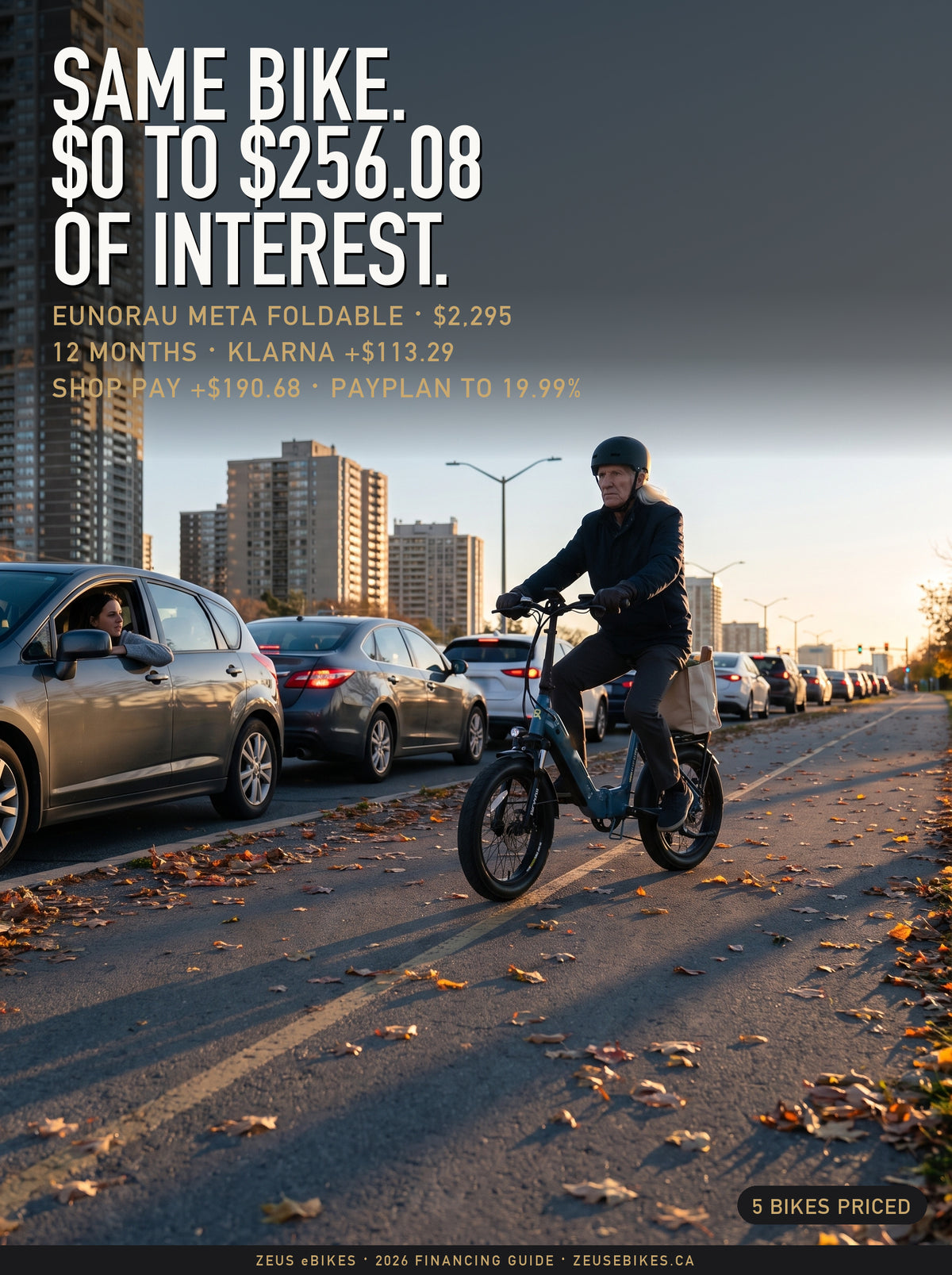


Share:
Mental Health Help Canada (2026): The Honest 25-Condition Atlas — Every Free Program, Every Defunct One, Every Phone Number That Actually Works
The Canadian Tax Atlas (2026)