The Oil Lottery: Sixteen Lives Born in 1989 in the World's Petro-States — and What They Reveal About Canada

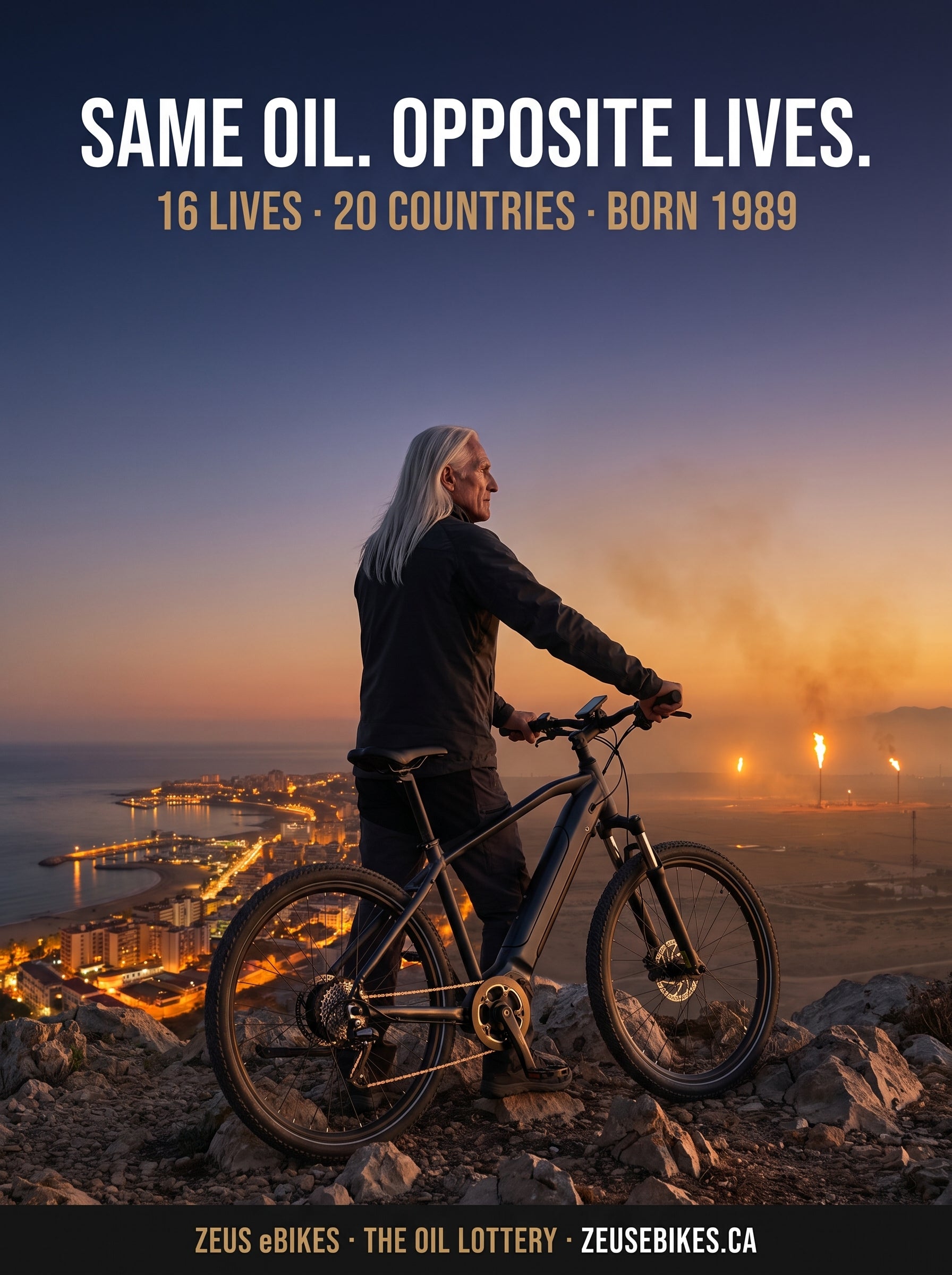
One substance, two horizons. Photo: Playcut AI for Zeus Media.
Quick answer: Oil does not decide whether a country thrives — policy does, and the proof is sixteen lives. Two babies born the same 1989 morning inherit the same resource and opposite futures: the Norwegian grows up alongside a sovereign fund now worth more than Norway's entire GDP; the Venezuelan grows up inside a 74% collapse in living standards — same barrel, opposite lives. This atlas compares all twenty of the world's top oil producers, follows a man and a woman from birth to 80 in eight of them, and ends where it must: with Canada, the fourth-largest producer on Earth, whose story rhymes with more of these than we'd like. Companion reading: the 2026 trade-war playbook and Why Is Canada So Expensive?
How this was researched: Every factual claim in this essay carries its own inline citation to a named source — the U.S. Energy Information Administration for production, the UNDP and World Bank for human development, each sovereign fund's own reports for fund sizes, Amnesty International and Human Rights Watch for rights findings, declassified government records for the coups, and the founding academic literature — Sachs & Warner (1995), Ross (2001), Beblawi & Luciani (1987) — for the theory. Where a figure is contested (Iraq's sanctions-era child deaths, Iran's 2019 protest toll), we print the range and name each source rather than choosing the convenient number. The sixteen lives are composites — no real individuals — but every event in them is a documented event of their country and cohort, cited at the point it appears. Nothing here recommends a vote, a party, or a revolution; it documents outcomes. The photographic images are AI-generated editorial illustrations (Playcut AI), credited as such beneath each one — they depict representative scenes of documented conditions, not photographs of real individuals or events; the documentary record lives in the linked sources.
In this atlas:
- The same morning, 1989
- The curse with a bibliography
- The atlas: 20 producers, one table
- Norway: the escape
- Venezuela: the collapse
- Iran: the intervened
- Iraq: the custody
- Saudi Arabia: the bargain
- Libya: the meme and the morgue
- United States: the uneven giant
- The fiscal contract: who fears whom
- The third fate: wealth without a shield
- Canada: the sleepwalker
- FAQ
The Same Morning, 1989
What actually decides whether oil makes a nation's people rich, free, poor, or dead? Not geology — sixteen lives are about to prove it. Imagine one morning in 1989: in eight different countries, in eight maternity wards, a boy and a girl are born. Each pair will live their entire life — birth to age eighty — without ever leaving the country of their birth. Beneath every one of those hospitals lies the same substance, worth the same world price. By the time these children are thirty-seven — which is now, 2026 — their lives will have diverged so far that the word "lottery" is the only honest name for what happened to them. This essay is the record of that lottery: who rigged it, who won it, who was never allowed to hold a ticket — and why the fourth-largest oil producer on Earth, the one you live in, should read its own chapter last and most carefully.
The year matters. 1989 is the year the Berlin Wall falls and the modern world begins — and in the oil states it is a year of hinges. In Venezuela, the babies are born weeks after the Caracazo — austerity riots over fuel and food prices in which security forces killed hundreds. In Iran, they are born the month Ayatollah Khomeini dies, months after an eight-year war ends. In Iraq, they arrive in the fourteen-month pause between the Iran–Iraq war and the invasion of Kuwait. And in Norway, they are born one year before their parliament passes the act creating the Government Petroleum Fund — a piece of paper that will quietly become the difference between every Norwegian life and every other life in this essay. Same oil. Same morning. Watch what policy does next.

The same morning, 1989: two beginnings, one substance under both. Editorial image: Playcut AI.
The Curse With a Bibliography
Is "the resource curse" a real thing, or a story we tell? It is one of the most replicated findings in development economics. In 1995, Jeffrey Sachs and Andrew Warner published the foundational study — Natural Resource Abundance and Economic Growth — showing that resource-rich economies grew slower than resource-poor ones from 1971 to 1989, even after controlling for everything else that should matter. In 2001, political scientist Michael Ross demonstrated the darker half in Does Oil Hinder Democracy? — oil wealth measurably impedes democratic development — and expanded it in The Oil Curse (Princeton, 2012): petro-states have less democracy, less economic stability, and more civil war than their oil-free neighbours.
The mechanisms have names. Dutch disease — coined by The Economist in 1977, formalized by Corden and Neary in 1982 — is the economics: resource exports inflate your currency until every other industry you have suffocates. And the rentier state — Beblawi and Luciani, 1987 — is the politics, and it is the single most important idea in this essay: a government that funds itself from oil instead of taxes stops needing its citizens' money — and a government that does not need your money never has to ask your permission for anything. Hold that thought through all sixteen lives. It explains almost everything you are about to read, including the parts about Canada.
Takeaway: The resource curse is not fate — it is a documented tendency with documented escapes. The question for each of the twenty countries below is never "did they have oil?" It is: did the state need its people, or merely tolerate them?
The Atlas: Twenty Producers, One Table
Here are the twenty largest oil producers on Earth — 2025 output per the U.S. Energy Information Administration — with the one-line version of what the barrel bought their people. Eight of the twenty get their full story told below; the table holds the whole landscape. Note who sits where: the country with the largest proven oil reserves on the planet has fallen to the very edge of the table — the 20th chair is contested by the country that should, by geology alone, own the entire table.
| # | Country | Output 2025 (mb/d) | What the barrel bought the citizen — one honest line |
|---|---|---|---|
| 1 | United States | 13.58 | The biggest producer in history — where a citizen can still go bankrupt from a hospital bill. Full story below. |
| 2 | Russia | 9.87 | Oil revenue used to consolidate an oligarchy: state oil giants swallowed the free press and the opposition's funders. The classic petro-authoritarian case. |
| 3 | Saudi Arabia | 9.51 | The rentier bargain in full: free university, free healthcare, a state job — and no vote. Full story below. |
| 4 | Canada | 4.94 | Comfortable, taxed, democratic — and quietly exporting most of its oil profits while saving almost none. Full story below, read it last. |
| 5 | Iraq | 4.39 | Fifth-largest reserves on Earth; daily blackouts; revenues held in New York. Full story below. |
| 6 | China | 4.34 | Produces in the top six and still imports more than anyone — its oil feeds industry, not a welfare bargain. |
| 7 | Iran | 4.19 | A century of foreign hands on the taps, then sanctions that reach the pharmacy shelf. Full story below. |
| 8 | UAE | 3.82 | Gulf-bargain welfare for citizens — free healthcare, education, housing — built atop a majority workforce with few rights. |
| 9 | Brazil | 3.74 | The deep-water newcomer: pre-salt fields made it a top-ten producer inside two decades, inside a noisy democracy. |
| 10 | Kuwait | 2.58 | So rich and so undefended it was overrun in hours in 1990 — the proof case that wealth without a shield is a target. |
| 11 | Kazakhstan | 2.06 | Post-Soviet petro-state: a sovereign fund on paper, one ruling circle in practice. |
| 12 | Norway | 1.85 | The escape. The twelfth-largest producer built the largest sovereign fund on Earth. Full story below. |
| 13 | Mexico | 1.72 | Nationalized oil as identity — state-run Pemex dominates, and the barrel funds the budget more than the citizen. |
| 14 | Nigeria | 1.61 | The Delta produced the wealth and got the pollution and the poverty — nearly half its people below the poverty line while the crude sailed away. |
| 15 | Libya | 1.36 | Africa's top human-development score in 2011; militia rule and a cautionary disarmament tale after. Full story below. |
| 16 | Qatar | 1.31 | The gold-plated rentier state: stipends, land grants, free everything for citizens — kafala for the workforce that builds it. |
| 17 | Algeria | 1.14 | Hydrocarbon rents sustaining a security state; the young emigrate across a sea the oil money never crossed. |
| 18 | Angola | 1.03 | Post-civil-war producer where the barrels left and the elite kept the ledger. |
| 19 | Oman | 1.00 | The quiet rentier: modest reserves spent on genuine development — and the same unspoken bargain as its neighbours. |
| 20 | Venezuela | ~1.0 | The contested 20th chair. The holder of Earth's largest proven reserves now produces about as much as Oman. Full story below. |
One number before the lives begin, because it hangs over the whole table: among these petro-states, being born on top of oil in 2024 meant a life expectancy of 83.1 years in Norway and 72.6 in Venezuela — a gap of more than a decade — and an infant's odds of dying before age one ranged from 1.65 per thousand in Norway to roughly 24 per thousand in Venezuela — fourteen times higher, over the same oil. Now, the lives.
Born on Oil, 1989: What the Lottery Paid
Life expectancy at birth (2024) across the eight countries whose lives this essay follows — with each country's infant-mortality rate beside it. Same resource under every bar.
Sources: World Bank / UN (life expectancy at birth, 2024; infant mortality per 1,000 live births); bars scaled from a common origin for comparison. Saudi infant-mortality omitted where the 2024 series is incomplete.
Norway: The Escape
How does a country beat the most documented curse in economics? The Norwegian pair — call them Lars and Ingrid, born 1989 in Trondheim — never think about the answer, which is itself the answer. They are born into a country whose infant mortality will fall to 1.65 per thousand, the safest place on Earth to draw a first breath. When they are one, parliament passes the 1990 act creating the Petroleum Fund; when they are seven, the first krone is actually deposited. The fund is built on one rule so boring it sounds like nothing and so powerful it rearranged this entire essay: the state may spend only the fund's investment returns — never the oil money itself. The principal belongs to Lars's and Ingrid's grandchildren.

Trondheim: wealth so complete it looks like nothing at all. Editorial image: Playcut AI.
So their lives are ordinary, in the way a lottery winner's life is ordinary if the winner never touches the prize. Free university — no debt at graduation. When Ingrid has her first child at 31, she and her husband split roughly a year of paid parental leave. When Lars is laid off at 40, the safety net holds him without humiliation. By their 37th birthday — this year — the fund holds more than the country's entire GDP: on the order of half a million Canadian dollars for every single Norwegian, Lars and Ingrid included, arithmetic they have never once done because no politician can touch it to buy their votes. Projected forward on the fund's own withdrawal rule, they retire at 67 into a pension system pre-paid by a resource that ran out of relevance long before it ran out of money. They die, statistically, at 83-plus — the top of the human development table — never having felt the oil once.

Paid by his country to walk his child. The fund did this. Editorial image: Playcut AI.
Three honest footnotes, because Norway's escape is always romanticized and the record is more useful than the romance. First: Norway was a functioning democracy with a welfare state and real industries before the oil came — the IMF's own post-mortem is blunt that institutions preceded petroleum, not the reverse. Second: the state kept control — Statoil, majority state ownership, taxation of oil profits near 78% — so the wealth had nowhere to leak. And third, the footnote that should be famous in two countries: the civil servant who substantially designed Norway's oil governance was Farouk al-Kasim — an Iraqi geologist who emigrated in 1968 for his son's medical care and wrote the memo that became the Norwegian model. Iraq's own son built Norway's escape. Remember him when you reach Iraq's chapter, four lives from now.

Age eighty, on two wheels — the quiet dividend of a state that saved. Editorial image: Playcut AI.
Takeaway: Norway did not escape the curse by having better oil. It escaped by having institutions before the money arrived, keeping ownership of the resource, and — above all — forbidding itself from spending the principal. Every rule was a policy choice available, in principle, to every country in this essay.
Venezuela: The Collapse
What does the opposite policy buy? The Venezuelan pair — Andrés and Mariana, born Caracas, 1989 — arrive weeks after soldiers finished shooting their way through the Caracazo, the fuel-price riots that killed hundreds and cracked the old order. They are born in what was, within living memory, the richest country in Latin America — sitting on the largest proven oil reserves on the planet, larger than Saudi Arabia's.

Caracas, the before: when the abundance was on the street. Editorial image: Playcut AI.
They are nine when Hugo Chávez wins power on the rage the Caracazo planted. And here the policy fork opens. In 2002, the government fires roughly 18,000 workers from the state oil company PDVSA — the engineers, the geologists, the people who knew where the valves were — and staffs it with loyalists. Oil money is spent as it arrives, gloriously, on subsidies and programs, with gasoline nearly free; nothing is saved, nothing else is built. Andrés and Mariana are in their mid-twenties when the oil price breaks in 2014 and the machine stands revealed: production falls from about 3 million barrels a day toward 800,000, the central bank prints 20–30% more money per month, and hyperinflation arrives like weather. Between 2013 and 2023, living standards collapse 74% — among the steepest declines ever recorded in a country not at war.

The largest reserves on Earth, queuing for fuel with a sleeping child. Editorial image: Playcut AI.
Nearly eight million Venezuelans leave — the largest exodus in the hemisphere's modern history. Andrés and Mariana, by this essay's one iron rule, stay: they are the lives of those who stayed. Mariana delivers her daughter in 2016 in a maternity ward without antibiotics, in the country with the world's largest oil reserves; the infant-mortality rate around that crib is fourteen times Norway's. Andrés queues for subsidized gasoline that is nearly free and nearly nonexistent — the purest image in this whole atlas: the cheapest gas on Earth, and no one can find it. By 2026 the country has fallen off the very table it should own — hovering around one million barrels a day, the contested 20th chair. Projected to 80, Andrés and Mariana's lives end statistically a full decade before Lars's and Ingrid's. The difference was never the oil. Venezuela's reserves exceed Norway's several times over. The difference was that one state saved and answered to its people, and the other spent and silenced them — and when the money stopped, only one of them had anything left.

A birth by lantern light, in a ward the oil never reached. Editorial image: Playcut AI.
The Machine They Broke
Venezuela's crude production, 2013 to 2026 — the world's largest reserves, run through a purged, politicized state company. The line is also the story of Mariana's maternity ward.
Sources: Council on Foreign Relations and Economics Observatory (production trajectory and collapse mechanism); Statista (2025–26 monthly production ~1.0 mb/d); Visual Capitalist (reserves rank). Curve schematic between cited endpoints.
How a petro-collapse cascades into gas prices half a world away — the 2026 trade-war playbook has the machinery →
Iran: The Intervened
What happens when the oil is yours but the hands on the taps never are? The Iranian pair — Arash and Leila, born Tehran, June 1989, the month millions buried Khomeini and an eight-year war's rubble still smoked — inherit a story that began 88 years before their birth, and it is impossible to understand their lives without it. In 1901, a British speculator bought the D'Arcy Concession — the oil rights to most of Persia. In 1907, Britain and Russia divided Iran into spheres of influence without asking Iran. In 1941, British and Soviet armies invaded and occupied the country to secure its oil and supply lines. And in 1948 came the number that explains everything after: Britain collected more in taxes from Anglo-Iranian Oil than Iran received in total royalties from its own oil.
So in 1951 an elected prime minister, Mohammad Mossadegh, nationalized it — through parliament, unanimously. Britain refused the 50–50 split it could have had, blockaded instead, and in August 1953 the CIA and MI6 overthrew him — a role the CIA formally admitted when the documents were declassified in 2013. A consortium of five American companies, Shell, and BP's predecessor took the oil back. The Shah the coup empowered ruled by secret police for 26 years; the revolution that answered him in 1979 built the theocracy Arash and Leila are born under. Draw the line plainly, because the record does: no D'Arcy, no 1953; no 1953, no Shah's police state; no police state, no 1979; no 1979, none of what follows.

Tehran, late 1990s: the sky — the one unrationed thing. Editorial image: Playcut AI.
What follows is their lives. Arash is 20 in 2009 when the Green Movement fills the streets and is crushed. Leila is 33 in 2022 when Mahsa Amini dies in morality-police custody and women lead the biggest uprising in a generation — Leila's hijab is not just cloth; the state has made it an economic instrument, tying employment, banking, and services to compliance. And over their entire adulthood hangs the sanctions wall — aimed at their government, landing on their pharmacy. The documented record, and it must be stated exactly: US banking sanctions blocked the delivery of two million flu vaccines; patients with thalassemia and epidermolysis bullosa died as foreign suppliers cut ties; and Human Rights Watch found that the humanitarian exemptions written into the sanctions fail in practice, because banks fear secondary sanctions more than they trust exemptions. When Leila's son needs a specialty drug in 2026 — a year when food inflation touches 99% and the middle class dissolves beneath her — the reason the shelf is empty was decided in Washington, London, and Moscow across a century, one intervention at a time. Sitting on the world's third-largest gas and top-ten oil reserves, Arash's purchasing power at 37 — a minimum wage that fell from roughly $400 a month in 2010 to below $100 by 2026 — is the price of a barrel he was never allowed to own.

The shelf emptied by decisions made oceans away. Editorial image: Playcut AI.
Takeaway: Iran is the cleanest documented case of the chain this essay exists to map: oil attracts intervention, intervention deforms politics, deformed politics invites sanctions — and the sanctions reach the crib. Every link is declassified, admitted, or documented by rights investigators. The barrel decided which medicines a child in Tehran can get in 2026.

2022: a generation's quiet declaration, one silhouette carrying it. Editorial image: Playcut AI.
Iraq: The Custody
Can a country pump four million barrels a day and still not control its own money? The Iraqi pair — Omar and Zainab, born Basra, 1989 — are born into the only quiet year their generation will get: the war with Iran ended months before their birth; the invasion of Kuwait comes months after their first birthday. They are one when the world's armies arrive, and two when the sanctions begin — and the sanctions are their childhood. The record must be handled exactly, because it is both horrifying and contested: UN agencies found that Iraqi child mortality, which had been falling fast, reversed — UNICEF's surveys implied that around half a million more children under five died in the 1990s than the pre-war trend predicted, with under-five mortality in the south rising from 56 to 131 per thousand as water, sanitation, and vaccine systems failed; asked about that figure on 60 Minutes in 1996, US Secretary of State Madeleine Albright answered, "we think the price is worth it." Honesty requires the counter-finding too: later survey work published via the BMJ disputes the size of the mortality spike — but not that the sanctions decade froze a child-survival miracle in progress, in the country with Earth's fifth-largest oil reserves. Omar and Zainab survived it. Classmates did not.

The sanctions decade as childhood: one lamp, one shared book, the fifth-largest reserves on Earth. Editorial image: Playcut AI.
They are fourteen when the 2003 invasion comes, and here enters the arrangement almost no one — Iraqi or Western — knows exists. The occupation authority routed Iraq's oil income into the Development Fund for Iraq, held at the Federal Reserve Bank of New York — and to this day, Iraq's oil revenues sit in a Central Bank of Iraq account at the New York Fed, under a US executive order renewed by every president since 2003. The United States does not own Iraq's oil. It holds the pipe the money flows through — which, as Reuters' explainer documents, is leverage: when Iraq's parliament voted to expel US troops in 2020, Washington reportedly threatened Iraq's access to its own account, and Baghdad backed down.
And the lived texture of all this, at 37? Omar is an electrical engineer in a country of chronic blackouts — OPEC's second-largest producer cannot keep its own lights on, and in the summer of 2026 the grid's deficit at peak is projected at tens of gigawatts as the Iran war severs the gas imports Iraq's plants depend on. Zainab teaches school in 45-degree heat; the families who can afford private diesel generators endure, and the families who cannot — most, in the south — simply cook, sleep, and grieve in the dark. Corruption and under-investment are Baghdad's own documented failures; the custody of the money and the wars that broke the grid were not Baghdad's choices. Between them, Omar and Zainab's Iraq at 37 has a life expectancy of 73 years and an infant mortality of 21 per thousand — and its most famous geological gift remains the one thing its people have never once been allowed to simply have. The man who could have written it differently — Farouk al-Kasim, remember — wrote it for Norway instead, because Iraq had no room for him.

Basra sleeps in the dark while the wealth burns on the horizon. Editorial image: Playcut AI.
Saudi Arabia: The Bargain
Why does a Saudi student pay nothing for university while a Canadian graduates owing tens of thousands? Because the two students live under opposite fiscal contracts, and the Saudi pair — Fahad and Noura, born Riyadh, 1989 — are the bargain's children. The Saudi state does not live on its citizens' taxes; it lives on oil, and it spends the oil on its citizens: free education through university and generous study-abroad scholarships, free healthcare, subsidized fuel, and a strong likelihood of a comfortable public-sector job. Fahad takes the whole ladder: state scholarship, engineering degree, ministry position, villa. His life is materially enviable — and contains not one political sentence. That is not an accident of culture; it is the design Beblawi and Luciani named in 1987: a state that needs no taxes needs no consent. The benefits are not in addition to Fahad's political rights. They are in place of them.

The palace provides. The palace decides. Editorial image: Playcut AI.
Noura's life is the sharper document. Born the same year as Fahad, she cannot legally drive a car until the ban lifts in June 2018 — the year she turns 29 — and cannot obtain a passport or travel without a male guardian's permission until the 2019 reforms, which UN experts welcomed while noting the guardianship system's core survives. Here is the paradox worth an entire dissertation: Gulf women are among the most educated on Earth — women outnumber men in higher education across the region, with Saudi women more than half of university students and Qatari women enrolled at over twice the male rate — and among the least free to convert that education into independent lives. The rentier state educates brilliantly and empowers narrowly, because an educated dependent is still a dependent.

2018, age twenty-nine: her hands on the wheel — finally. Editorial image: Playcut AI.
And beneath both lives, the bargain's basement: the entire gleaming machine — Fahad's ministry tower, Noura's university — is built and cleaned by a workforce of some 23 million foreign workers across the Gulf under the kafala sponsorship system, which rights investigators characterize as enabling conditions up to and including modern slavery. The oil-welfare state so admired from abroad covers citizens only — a minority of the people actually standing in the country. Projected to 80: Fahad and Noura live comfortable, provided-for lives to a mid-70s life expectancy, their benefits intact exactly as long as the oil price and the ruler's disposition hold — because everything they have was granted, and as the oil wealth tightens, the cushy jobs are already thinning. What is granted can be repriced. Ask the next chapter.

The best-educated women in oil's history, in a palace built to contain them. Editorial image: Playcut AI.
Libya: The Meme and the Morgue
Was Gaddafi's Libya the paradise the internet remembers? Both halves of the answer are true, and the Libyan pair — Khaled and Amal, born Benghazi, 1989 — live both halves. The documented half first: their education from kindergarten through university is free, in a country whose literacy rate rose from roughly 20% to 83% under the oil state; their healthcare is free, in a system whose physician count quadrupled in a decade; and by 2011, Libya stands first in all of Africa on the Human Development Index. The famous newlywed housing grant — the "free house" of a thousand social-media posts — is commonly cited at around 50,000 dinars; the honest note is that it is widely reported but thinly documented in independent sources, so this essay states it at exactly that strength and no more. Khaled marries in 2010 and does, in fact, receive state help with a home. The meme is not a lie.

Benghazi, 2010: the famous promise, briefly flesh. Editorial image: Playcut AI.
It is half of one. The same state that paid for Khaled's degree disappeared people for a sentence spoken carelessly; 42 years of one man's rule allowed no party, no press, no parliament worth the name. And the pair are 22 in 2011 when the second half arrives: uprising, NATO intervention, the ruler killed in a ditch — and then not freedom but collapse. The state that gave everything had been engineered so that nothing could function without it; when it fell, everything fell. Militias divide the cities. The dinar rots. By 2017, CNN journalists film open-air markets where human beings were sold — the bottom of the fall, in the country holding Africa's largest proven oil reserves. Amal, a teacher, spends her thirties teaching in a school with no glass in the windows, in the country that a decade earlier led Africa in human development.

The classroom that led Africa in human development, returned to the desert. Editorial image: Playcut AI.
Libya's chapter carries the atlas's harshest lesson, and it is not about Gaddafi's virtues or crimes — it is about what his 2003 disarmament taught every ruler watching. He surrendered his weapons programs in December 2003 in exchange for normalization; eight years later, Western-backed forces ended him. North Korea's state media cited Libya by name as the reason it will never disarm. File that lesson — it returns, with a Ukrainian stamp on it, in the defence chapter. The oil gave Khaled and Amal real schools, real hospitals, and a real house; the politics gave them no way to protect any of it — not from their ruler, and not from what replaced him.
Takeaway: Iran, Iraq, Saudi Arabia, and Libya are four variations of one sentence: the oil was never allowed to simply belong to the people living on it. Foreigners took it (Iran), custodians held it (Iraq), rulers traded it for silence (Saudi), or a strongman spent it well and guarded it so jealously that his fall took the whole house down (Libya). In none of the four did a citizen ever hold the barrel with both hands.
United States: The Uneven Giant
What does oil buy the citizen of the largest producer in the history of the world? It depends — more than anywhere else in this atlas — on which citizen. The American pair — Tyler, born Anchorage, and Ashley, born Houston, 1989 — live in the country that pumps 13.58 million barrels a day, more than any nation ever has, and their two lives barely rhyme.

Alaska: the only place in this atlas where the oil writes to you. Editorial image: Playcut AI.
Tyler's Alaska is the closest thing America has to a Norwegian experiment. In 1976, Alaskans amended their constitution to create the Alaska Permanent Fund, whose principal cannot be spent — and since 1982 it has mailed every resident an annual dividend cheque, in recent years between $1,000 and $2,000, and at its peak over $3,000. Tyler has received a cheque every year of his life — including as a child — the only person in this essay whose government pays him for the oil under his feet. Ashley's Texas holds a quieter version: since 1876, oil revenue from state land has fed the Permanent University Fund, which made the University of Texas one of the best-endowed schools on Earth — oil paying for university, in miniature, inside the country that mocks the idea. But Ashley graduates with student debt anyway, because the American oil bounty was never nationalized into a citizen's bargain: it belongs to whoever drilled it. And when her husband's cancer arrives at 43 in the projection, the family meets the statistic that separates America from every other rich country in this table: roughly two-thirds of US bankruptcies are linked to medical costs — a phenomenon essentially unknown in Norway or Canada. The largest oil producer in history has a life expectancy of 79 years — a record high for it, and four years behind Norway and Canada.

Oil built the school. She graduates owing money anyway. Editorial image: Playcut AI.
The American chapter matters to this atlas for one precise reason: it proves the resource curse and the resource blessing can run simultaneously in one country — Alaska's dividend and Ashley's medical debt, the Texas fund and the uninsured oil-patch roughneck — because the United States never made a single national choice about what the barrel owes the citizen. It made fifty small ones, and where you were born decides which one you got. Remember that when Canada's chapter asks what choice we made. The answer, mostly, is that we didn't.

The richest producer in history: where the bill arrives. Editorial image: Playcut AI.
The Fiscal Contract: Who Fears Whom
Now stop the lives for a moment, because eight countries in, a pattern needs naming — the one that answers the question every Canadian traveller has asked at a foreign pump: why was gas pennies a litre there, and why do I pay property tax here? The answer is the most important mechanism in this essay, and it comes down to the direction the money flows.
In Canada and Norway, money flows from the citizen to the state. That is annoying in April — and it is also the citizen's leverage, the reason parliaments exist at all: a state that lives on your taxes must keep you willing to pay them, which means courts that work, budgets you can read, and governments you can fire. In the rentier states, the money flows the other way: the state, funded by oil, gives — cheap fuel, free degrees, stipends, jobs. It feels like generosity. It is a change in the power relationship: the citizen stops being the state's creditor and becomes its dependent, and what a ruler grants, a ruler can revoke. The cheap gas is not a gift on top of your rights; in these states it arrived instead of your rights.
Iran ran the experiment that proves it. Iranian gasoline was among the most subsidized on Earth — until midnight on November 15, 2019, when the state, strangled by sanctions, raised fuel prices as much as 200% without warning. Within days, protests erupted in over 200 cities; the government cut the entire country's internet and answered with live fire. The death toll is contested and this essay prints the range: the government eventually admitted 230; Amnesty International documented 321 dead, by name; Reuters, citing interior-ministry officials, reported about 1,500. One week revealed what the subsidy had been all along: not the people's wealth, but the state's tranquilizer — withdrawable the moment the state's needs changed, defended by gunfire when the people objected to the withdrawal.
One honest boundary, so this argument stays true instead of merely satisfying: subsidized fuel and bread genuinely feed poor families — nothing here sneers at that — and a heavy tax bill does not by itself buy good government, as taxed-and-collapsed Venezuela proved. The precise claim is narrower and harder: a benefit you fund and control leaves you stronger before your state; a benefit your state grants leaves you weaker before it. The direction of the money decides who, ultimately, fears whom. Canadians grumbling at the pump and Iranians grateful at theirs are living the same trade from opposite ends — one pays and may therefore demand, the other receives and may therefore be silenced.
The Direction of the Money Decides Who Fears Whom
Two fiscal machines. On the left, the state depends on its citizens and must answer to them. On the right, the citizens depend on the state — and the cheap gas arrived instead of the vote, not beside it.
Framework: Beblawi & Luciani, The Rentier State (1987); Ross, Does Oil Hinder Democracy? (2001). The Iranian proof case: Amnesty International (MDE 13/2308/2020); Al Jazeera; Human Rights Watch — November 2019.
The Third Fate: Wealth Without a Shield
There is one more pattern the sixteen lives keep brushing against, and history is unambiguous about it: resource wealth without the means to defend it is not a blessing — it is bait. The record offers the resource-rich exactly three fates. You can build your own deterrence and alliances, as Norway did inside NATO. You can buy protection: the Gulf monarchies host thirteen major US bases and some 40–50,000 American troops and purchase their shield outright — the US supplied 77% of Saudi Arabia's arms imports, 62% of Kuwait's, and 48% of Qatar's over 2021–25 — security as a subscription, which works precisely as long as the landlord honours the lease. Or you can go without, and history shows what happens: Kuwait — fabulously rich, barely defended — was overrun by Iraq in a matter of hours in August 1990, its 20% of world reserves seized until a superpower coalition took them back.

Wealth beyond counting, guarded by an open gate. Editorial image: Playcut AI.
And for rulers who held a deterrent and traded it away for promises, the record is darker still. Gaddafi surrendered his weapons programs in 2003; Western-backed forces ended him in 2011, and Pyongyang took the lesson in writing. Ukraine — not an oil state, but the controlling precedent — gave up the world's third-largest nuclear arsenal in 1994 for written security assurances, and learned in 2014 and 2022 that assurances are not guarantees. Every resource-rich government on Earth has absorbed the same three-line syllabus: wealth attracts hunger; paper does not stop hunger; only cost does. Hold that syllabus in one hand, and Canada's file in the other.
Canada: The Sleepwalker
So — the last pair. Liam, born Calgary, and Emma, born Halifax, 1989: citizens of the fourth-largest oil producer on Earth. Their lives are, by every measure in this atlas, among the luckiest told here: infant mortality under 4 per thousand, public healthcare that will never bankrupt them, real courts, real elections, life expectancy tied with Norway at 83. They pay for it — income tax, sales tax, and the property tax that never stops startling immigrants from the rentier world — and by this essay's own argument, that tax bill is not the scandal. It is the receipt for a state that must answer to them. Canada's fiscal contract is the healthy one.

The sleepwalker's evening — comfort in front, the source unexamined behind. Editorial image: Playcut AI.
The scandal is quieter, and it has two parts. Part one: Canada took the Venezuela-sized gift and saved the Alberta-sized fraction. Alberta created its Heritage Savings Trust Fund in 1976 — the same year as Alaska's, fourteen years before Norway's. Today the score reads: Norway, on the order of C$2.7 trillion; Alaska, roughly C$100 billion, paying every resident an annual dividend; Alberta, about $27 billion. The Fraser Institute's audit of the failure is arithmetic, not ideology: had Alberta followed Alaska's constitutional deposit rule, contributions from 1982–2011 alone would have been $42.4 billion instead of the $9.1 billion actually deposited — the rest was withdrawn and spent by successive governments of every stripe. Liam has never received a resource dividend in his life. Tyler in Anchorage has received one every year since birth. Same continent, same industry, same 1976 starting gun.
Part two: much of the profit was never Canada's to save. Research into the four largest oil-sands producers — 80% of production — found them roughly 73% foreign-owned, and of the $79.7 billion they paid out in dividends and buybacks during the record years 2021–24, about 62% went to American shareholders — six of every ten profit dollars crossing the border, never to return. The full-fairness caveat belongs in the same breath: royalties, corporate taxes, and tens of thousands of good wages do stay in Canada, and the ownership research comes from advocacy-affiliated economists — the direction is documented, the precise decimals deserve the scrutiny we give every number. But the shape survives every caveat: Canada runs the world's fourth-largest oil industry as a pass-through — profits south, savings negligible, dividend to citizens: zero.

He works in it, lives beside it, and holds no share of it. Editorial image: Playcut AI.
And now set Liam and Emma's country against the defence syllabus, because this is where their chapter stops being comfortable. Canada is resource-rich beyond any nation in this table — the oil, the potash, the uranium, the fresh water, the opening Arctic — and for eighty years it has held the smallest shield of any resource state in this essay, defended in practice by its neighbour's military. That was the Gulf model with better weather: outsource the deterrence, enjoy the savings. Then 2025–26 arrived, and the landlord changed the terms: annexation rhetoric aimed at Canada, a trade war escalating to 50% tariffs and "without us, there's no way they can survive". Kuwait's lesson, Ukraine's lesson, the Gulf's growing doubt — even the states that pay full price now question the umbrella — all converge on the one country in this atlas that assumed the question would never apply to it. Liam and Emma are 37. Their projection to 80 — pension solvency, the value of the passport, whether the water and minerals under their feet remain theirs to mismanage — depends on choices Canada has, on the evidence of this essay, not yet seriously begun to make: what to save, who owns the barrel, and what stands between a very rich, very pleasant, very lightly defended country and a century that has started reading old maps again. The full sovereignty file is in The Canadian Shield; the household version in Every Canadian's Guide for World War Three.
Three Funds, One Starting Gun
Alberta and Alaska founded their oil funds in the same year, 1976; Norway followed in 1990 and out-saved them both a hundredfold. The bars are the compounding price of the withdrawals Alberta's governments made and Norway's forbade.
Sources: NBIM (Norway fund); Alaska Permanent Fund Corporation and CNN (Alaska fund and dividends); The Narwhal and Alberta Treasury (Heritage Fund, March 2025); Fraser Institute (deposit arithmetic). Bars to scale; Alberta's is not a rendering error.
Takeaway: Canada got the healthy fiscal contract and skipped everything else on the syllabus: it saved almost nothing, let the profits migrate, pays its citizens no dividend, and rented its defence from the one country now squeezing it. The sixteen lives in this atlas are not foreign curiosities. They are the menu of what happens next, depending on what Canada chooses while it still holds the pen.
What Canada should actually do with the hand it holds — the sourced five-move playbook: read The Trade-War Playbook →
FAQ: Oil, Wealth, and the Lives It Buys
Why is Norway rich from oil while Venezuela collapsed?
Policy, not luck. Norway had strong institutions and a welfare state before oil, then locked its oil income in a sovereign fund it never spends — only the investment returns — now worth more than the country's entire GDP. Venezuela spent the oil directly, purged 18,000 skilled oil workers for political loyalty in 2002, printed money to cover deficits, and never built anything else. Living standards fell 74% between 2013 and 2023 — one of the steepest collapses ever recorded.
Why don't Saudi students pay for university?
Because the Saudi state funds itself from oil rather than taxes, and offers citizens free education, healthcare, and public-sector employment as part of the rentier bargain: generous benefits in exchange for political silence. The trade is real — and so is its price. Scholars call this the rentier state: a government that does not need its citizens' money never has to answer to them.
Where does the money from Canadian oil actually go?
Royalties, taxes, and wages stay in Canada — but the profits largely leave. Research on the four largest oil-sands producers, which account for 80% of production, found them roughly 73% foreign-owned, with about 62% of the $79.7 billion paid out in dividends and buybacks from 2021–24 going to American shareholders. Meanwhile Alberta's Heritage Fund, started in 1976, holds about $27 billion — Alaska's fund, started the same year, holds roughly $100 billion and pays every resident an annual dividend.
Does the United States really control Iraq's oil revenues?
In a precise sense, yes: since 2003, Iraq's oil revenues have been held in a Central Bank of Iraq account at the Federal Reserve Bank of New York, under a US executive order renewed by every president since. The US does not own the oil — it controls the financial system that turns Iraqi crude into usable dollars, and has used that leverage: when Iraq's parliament voted to expel US troops in 2020, Washington reportedly threatened to cut access to the account, and Baghdad backed down.
What is the resource curse?
The documented pattern in which resource-rich countries often grow more slowly, develop weaker institutions, and suffer more autocracy and conflict than resource-poor ones — established in economics by Sachs and Warner in 1995 and in political science by Michael Ross. Its mechanisms include Dutch disease (resource exports inflate the currency and kill other industries), rent-seeking, and the rentier dynamic: a state that lives on resource money instead of taxes stops needing its citizens' consent.
Was life in Libya under Gaddafi really good?
Both halves of the story are true. Free education raised literacy from about 20% to 83%, healthcare was free, and by 2011 Libya led all of Africa on the Human Development Index; the famous newlywed housing grant is commonly cited but weakly documented. And it was a 42-year police state with no political freedom. After the 2011 NATO-backed intervention, the state collapsed into militia rule — by 2017, journalists documented open-air slave markets. The benefits were real, the repression was real, and what followed was worse than both.
Why do oil-rich countries have such cheap gasoline?
Governments that fund themselves from oil subsidize fuel as part of the bargain with their citizens: cheap gas instead of political rights. The subsidy is real material help — and a political tripwire. When Iran raised fuel prices 200% overnight in November 2019, protests erupted in over 200 cities and were met with an internet blackout and a crackdown whose death toll ranges from 230 (the government's figure) to 321 documented by Amnesty International to about 1,500 reported by Reuters from officials. A benefit the state grants, the state can revoke.
Why is Alberta's oil fund so much smaller than Norway's?
Rules, not oil. Alberta founded its Heritage Fund in 1976 — fourteen years before Norway's — but deposited only $9.1 billion from 1982 to 2011, where Alaska-style constitutional rules would have required $42.4 billion, and governments of every stripe routinely withdrew the fund's income to spend. Norway's fund is untouchable by law: the state may spend only investment returns, never principal. Result: Norway holds roughly C$2.7 trillion, Alaska about C$100 billion with an annual citizen dividend, Alberta about $27 billion with no dividend.
The Bottom Line
Sixteen people were born on one morning in 1989, on top of one substance, and by thirty-seven their lives had spread across the entire distance between a half-million-dollar sovereign inheritance and a maternity ward without antibiotics. Nothing in the geology explains it. Everything in the policy does: whether the state saved or spent, owned or leased, answered to its people or purchased their silence, defended its wealth or assumed no one would ever come for it. That is, finally, why this essay was written in Canada, about Canada, for Canadians who have been told their whole lives that these are other people's stories. We hold the fourth-largest production on Earth, the healthiest fiscal contract in this atlas, a fund a hundred times smaller than it should be, profits that leave, a dividend that never arrived, and a defence arrangement whose guarantor now openly wonders aloud whether we should exist. Every life in this atlas began exactly where we are standing: on top of the prize, holding the pen, sure there was time. We will keep this page updated as the record moves.

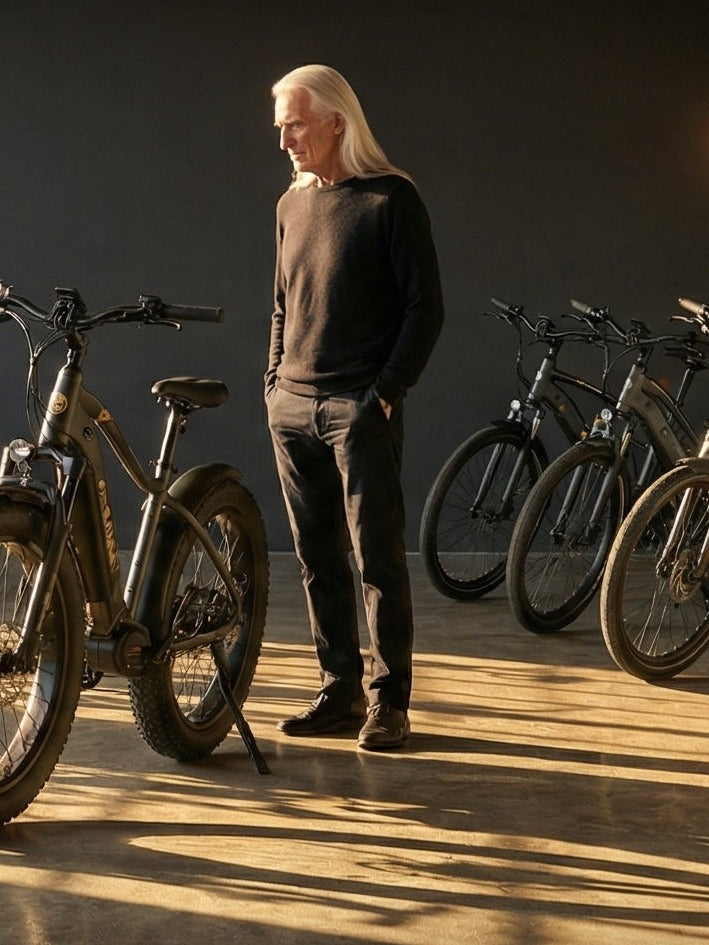
Every life in this atlas began exactly here — before the lottery was drawn. Editorial image: Playcut AI.
Keep reading: The 2026 Trade-War Playbook — what actually works against economic coercion · The Canadian Shield: 14 Threats to Sovereignty — the defence file in full · Why Is Canada So Expensive? — the domestic cost machine · Every Canadian's Guide for World War Three — household preparedness, calmly.
Share:
The Trade-War Playbook: What 18 Months and 9 Countries Prove Actually Works — and the Hand Canada Still Holds
Why Is Gas So Expensive in Canada Right Now? The Hormuz Effect, Explained (2026)