

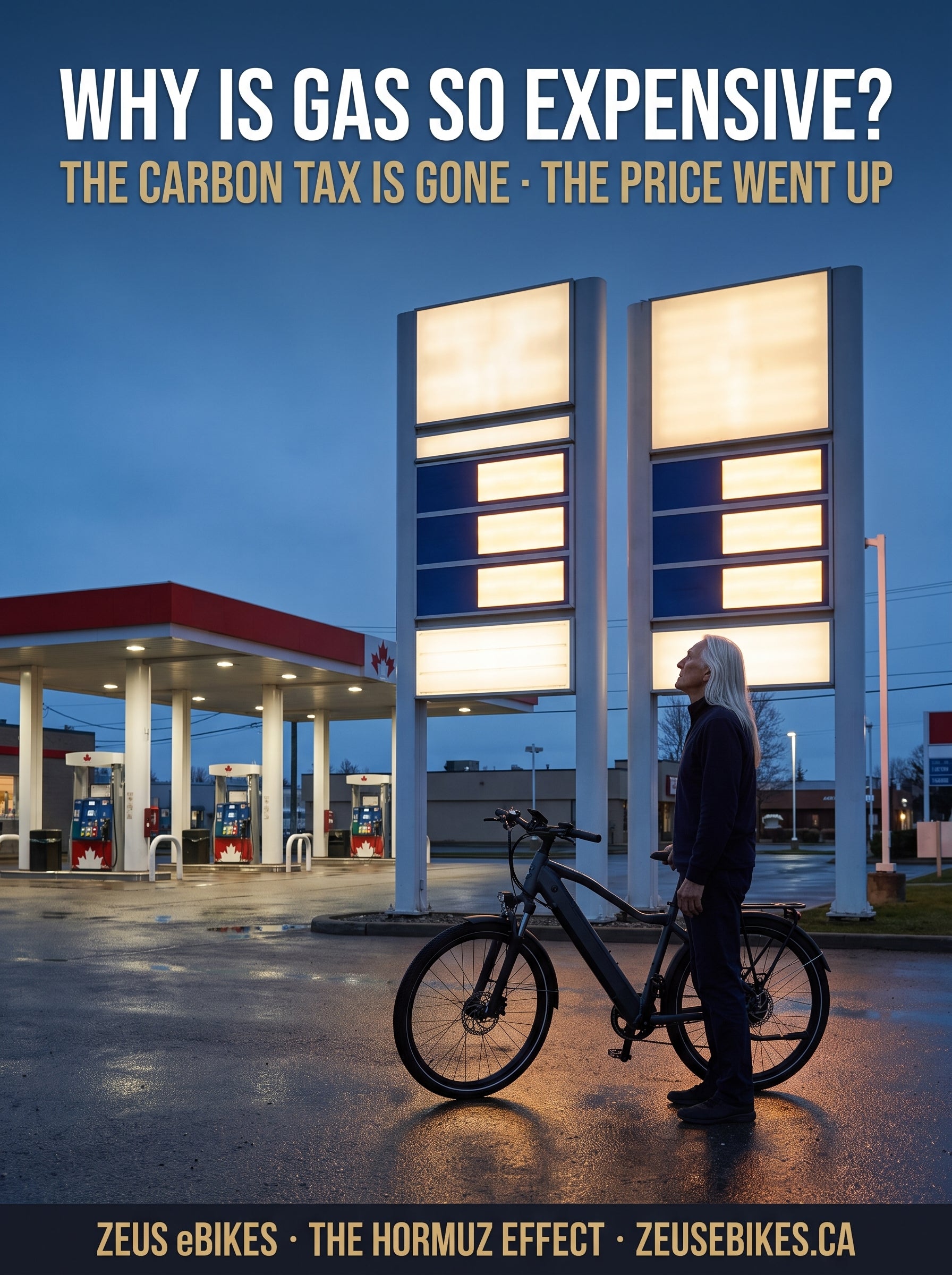
Why Is Gas So Expensive in Canada Right Now? The Hormuz Effect, Explained (2026)

The number on that sign is set an ocean away. Photo: Playcut AI for Zeus Media.
Quick answer: Canadian gas is expensive in July 2026 for three reasons, and the carbon tax is not one of them — that came off in April 2025, and the federal fuel excise tax is suspended until September. What is left is the real cause: a risk premium from the contested Strait of Hormuz (the passage for about a fifth of the world's oil), a refining bottleneck that keeps pump prices high even as crude falls, and Canada's own pipeline geography, which leaves the east buying oil at world prices. The one thing a household can actually control is how many of those litres it needs to buy — the math is in the cost-of-ownership guide at the end.
How this was researched: Every price, volume, and date below is drawn from a named primary source — the U.S. Energy Information Administration and IEA (oil flows and the strait), the Bank of Canada–adjacent price trackers CAA and Finder (pump prices), the Prime Minister's Office and Canada.ca (the tax measures), and the World Bank and peer-reviewed refining-margin data (the crack spread). Every figure was verified live in July 2026, and where the situation is genuinely unstable — the strait's status changes week to week — this article says so and date-stamps the claim rather than pretending to a certainty that does not exist. This is an explainer, not a forecast; where it looks ahead, it labels the projection and its source. The photographic images are AI-generated editorial illustrations (Playcut AI), credited beneath each — representative scenes, not documentary photographs of specific events.
In this guide:
- The tell: your tax went down and your price went up
- The chokepoint: one narrow strait, a fifth of the world's oil
- Is the Strait of Hormuz open or closed right now?
- Why gas stays high even though crude fell
- Why Canada — an oil superpower — pays so much
- The carbon-tax myth, killed with the receipts
- What comes next: diesel, groceries, and the forecast
- What a household can actually do about it
- FAQ
The Tell: Your Tax Went Down and Your Price Went Up
Here is the fact that unlocks the whole story, and almost no one has connected it: the tax on a litre of Canadian gasoline is lower today than it was a year ago, and the price is higher. The consumer carbon price came off on April 1, 2025 — in British Columbia that alone removed about 17 cents a litre — and on top of that the federal government suspended the fuel excise tax on gasoline and diesel from April 20 to September 7, 2026. Two separate charges that used to sit on every litre are gone or paused right now. And yet the national average rose to about $1.73 a litre by mid-July, up roughly three per cent in a single week, with Vancouver near $1.99.
That single contradiction tells you where the pressure is actually coming from. If prices are climbing while the taxes on them are being cut, then the climb is not about tax — it is about the price of the oil itself and what happens to it between the ground and your tank. The rest of this article is the anatomy of that pressure: a strait you have probably never sailed through, a refining bottleneck most drivers have never heard of, and a quirk of Canadian pipeline geography that makes an oil superpower pay retail. Understanding it will not lower your bill this week. But it will tell you which parts are weather and which parts are permanent — and that is the difference between panic and a plan.
Takeaway: If the reflex answer in your head was "carbon tax," the receipts say otherwise — that charge has been gone since April 2025 and the excise tax is paused on top of it. The price is up because of the oil, not the levy on it.
The Chokepoint: One Narrow Strait, a Fifth of the World's Oil
Why does a conflict thousands of kilometres away move the price at a Saskatoon pump? Because oil is a single global pool, and a startling share of it flows through one gap in a coastline. The Strait of Hormuz — the only sea entrance to the Persian Gulf — carries about 20 million barrels a day, roughly a fifth of the world's oil supply, and it is the primary export route for Saudi Arabia, the UAE, Kuwait, Qatar, Iraq, and Iran. At its narrowest the shipping lane is only about 39 kilometres wide. There is no real substitute: the UAE's Fujairah bypass pipeline moves only about 1.5 million barrels a day, a small fraction of the flow, and the IEA notes the logistics of large-scale re-routing have never been robustly tested.
That is the mechanism in one sentence: because a fifth of the world's oil funnels through a passage a competent swimmer could nearly see across, any threat to that passage adds a "risk premium" to the price of all oil everywhere — including the Canadian crude that never goes anywhere near the Gulf. Traders do not price the barrel that shipped; they price the barrel that might not. When Hormuz is dangerous, every barrel on Earth costs a little more, and four to eight weeks later that little-more shows up on the illuminated sign at your corner station.
The Whole Story Is a Gap in a Coastline
A schematic of the Strait of Hormuz — not to scale, drawn to show one thing: how much of the world's oil funnels through a passage roughly 39 kilometres wide at its narrowest. Threaten this gap, and the risk premium reaches your gas tank on a schedule you can write down.
Schematic, not to scale. Figures: U.S. Energy Information Administration (oil volume and share); IEA (bypass-route limits). The strait's narrowest width is roughly 21 nautical miles.

The 39-kilometre gap, kept open by warships — a fifth of the world's oil threads through here. Editorial image: Playcut AI.
This is the same global-pressure story we mapped for the whole economy — read the 2026 trade-war playbook →
Is the Strait of Hormuz Open or Closed Right Now?
Honestly? It depends on the day — and any article that gives you a clean one-word answer is lying to you. As of late July 2026 the strait is best described as contested and intermittently open under military escort, not cleanly closed and not back to normal. Here is the sourced sequence, because the twists are the whole point. The U.S.–Israel air war on Iran began February 28, 2026, and Iran's Revolutionary Guard responded by forbidding passage, attacking merchant ships, and laying sea mines. Oil briefly topped $126 a barrel in April. Then, on June 17–18, Washington and Tehran signed a memorandum to end the fighting and reopen the strait, and tankers rushed to exit; crude fell back toward pre-war levels.
And then it frayed again. Through July, at least nine ships were attacked after July 6 as Iran pressed vessels to route through its territorial waters, and traffic fell to a three-week low — with the U.S. reporting that more than eight million barrels transited on a single Sunday only with active U.S. military assistance. So the accurate picture is a passage that opens and closes in fits, kept flowing by warships, running far below its roughly 130-crossings-a-day peacetime norm. For your gas tank, that in-between state is almost worse than a clean closure: a clean closure would spike prices once and then resolve; a permanently uncertain strait keeps a risk premium baked into every barrel for months, which is exactly what you are paying now.
Status check — dated on purpose. As of late July 2026: the Strait of Hormuz is contested and intermittently open under U.S. naval escort, with traffic well below normal and periodic attacks on shipping. Brent crude sits near US$88 a barrel, down sharply from April's ~$126 peak but still carrying a war premium. If you are reading this later, the one-line status will have changed — the mechanism in this article will not.
Why Gas Stays High Even Though Crude Fell
Here is the part that makes drivers feel gaslit: Brent crude fell from about $126 in April to roughly $88 by late July, and yet pump prices did not fall to match — they rose. That is not your imagination, and it is not simple gouging. Two well-documented mechanisms explain it, and both are worth knowing because they tell you when relief will actually come.
The first is the refining bottleneck. The price you pay is not the price of crude oil; it is the price of refined gasoline, and the gap between the two is called the crack spread. The war did not only threaten crude — it disrupted Middle Eastern refined-product and diesel exports, and that broke the refining side of the market. The U.S. Energy Information Administration found that gasoline, diesel, and jet-fuel refining margins were all elevated through the second quarter of 2026 — the gasoline crack spread up about 60% from a year earlier, and the diesel and jet-fuel spreads more than double their year-ago levels — meaning refineries' margins, not the oilfield, are where much of your money is now going. Crude can fall all it likes; if the world cannot turn it into gasoline fast enough, the pump stays high.
The second is "rockets and feathers," the economists' name for a pattern proven across decades of data: pump prices rise like a rocket when crude climbs and drift down like a feather when it falls, with the up-speed running three to four times the down-speed in volatile conditions. It is not a conspiracy theory; it is one of the most replicated findings in energy economics, and the Wall Street Journal documented it happening again in 2026 — a ceasefire signed, crude retreating, and pump prices still climbing for weeks afterward. The EIA points to the cause directly: with the Strait of Hormuz disrupted, international buyers scrambled for alternative refined-product supply, which drove refinery margins up worldwide. Put the two forces together and you get the summer of 2026 exactly: a refining squeeze holding the floor up, and rockets-and-feathers making sure any crude relief reaches you last and slowest.

You pay for refined gasoline, not raw crude — which is why the pump stays high while oil falls. Editorial image: Playcut AI.
Why the Pump Didn't Follow Crude Down
Crude oil fell hard from its April peak. Your pump price did not. The gap is the refining squeeze plus "rockets and feathers" — the up-fast, down-slow asymmetry proven across decades of gasoline data.
Schematic of the documented 2026 trajectory. Brent figures: TradingEconomics / IEA. Pump behaviour: the "rockets and feathers" asymmetry (peer-reviewed energy economics) and 2026 refining-margin data (U.S. EIA). Lines are illustrative of direction, not tick-by-tick values.
Takeaway: Falling crude does not mean a falling pump price — not for weeks, and not fully. The refining squeeze holds the floor up, and "rockets and feathers" makes sure you are the last to feel any relief. Watch refining margins, not just the crude headline, if you want to know when prices will actually ease.
Why Canada — an Oil Superpower — Pays So Much
It is the question every Canadian driver asks at least once: we are one of the largest oil producers on Earth, so why is our gas among the pricier in the developed world? The answer is not greed or taxes — it is pipeline geography, and it is the same physics that runs through our trade-war explainer. Canada's oil is in the west. No pipeline carries western crude past Ontario, so the refineries of Quebec and Atlantic Canada run mostly imported crude, brought in by tanker and priced at the international Brent benchmark.
That is the trap. Western Canada burns its own cheaper domestic oil; eastern Canada buys at the world price, tanker logistics included — which is precisely why a Gulf crisis hits a Montreal or Halifax pump harder than a Calgary one, and why "we produce our own oil" is cold comfort east of the Ontario–Quebec line. The country produces heavy western crude that many eastern refineries were never built to process, and imports lighter crude it can. It is the mirror image of the story in the trade-war piece, where U.S. Midwest refineries are physically configured for Canadian heavy oil: refineries are built around a specific grade, and geography decides who gets the cheap barrel and who pays retail. In Canada, the east pays retail.

Eastern Canada buys its crude by tanker at world prices — an oil superpower paying retail. Editorial image: Playcut AI.
Takeaway: Being an oil superpower does not make gas cheap if your pipelines and your people are on opposite sides of the country. Eastern Canada buys imported, Brent-priced crude — so a strait on the other side of the planet lands directly on an Atlantic-Canadian fill-up.
The Carbon-Tax Myth, Killed With the Receipts
Because it comes up at every gas station and every dinner table, it deserves a section of its own: no, the carbon tax is not why your gas is expensive right now — and this is not an opinion, it is a paper trail. The federal consumer carbon price was set to zero on April 1, 2025, and repealed in law in March 2026. British Columbia dropped its own consumer carbon tax the same day, taking roughly 17 cents off every litre. And the federal fuel excise tax — a separate charge entirely — is suspended from April 20 to September 7, 2026.
Add it up and the tax on a Canadian litre has fallen materially over the past fifteen months, while the pump price climbed. One honest caveat, because this article does not shade facts in either direction: the industrial carbon price on large emitters remains, and provincial motor-fuel taxes still vary — British Columbia's are the highest, which is part of why Vancouver tops the national price table. But the consumer carbon charge that dominated the political argument is simply not on your receipt anymore. Anyone still blaming it for the 2026 price is reading a bill from a year ago.
Taxes Came Off. The Price Went Up Anyway.
The two consumer charges that used to sit on every litre are gone or paused in 2026 — yet the pump price rose. That is the whole proof that today's pain is crude, refining, and geography, not tax.
Sources: Canada.ca and the Prime Minister's Office (carbon-price removal and excise suspension); Province of British Columbia (BC carbon tax); Finder / CAA (national average pump price).
What Comes Next: Diesel, Groceries, and the Forecast
Where does this go from here, and what should a household brace for? The honest answer has two parts — one you feel now, one that is coming. The one you feel now is diesel, and it matters more than gasoline for the cost of everything else. Diesel and jet fuel were the sharpest-hit products in the whole crisis, and Canadian diesel is forecast to hold in the $1.62–$1.78 a litre range nationally through the third quarter of 2026, higher in B.C. Diesel is what moves every truck, and every truck moves the food, building materials, and goods you buy — so a diesel premium is a quiet surcharge on the entire shelf.

Diesel moves every truck, and every truck moves the shelf — the quiet surcharge on everything. Editorial image: Playcut AI.
The part that is coming is groceries. Food inflation trails an oil shock by roughly six to nine months, and historically every major oil spike has added one to three percentage points to Canadian food inflation as fuel, fertilizer, and freight costs work their way to the till. That means the spring-2026 shock is scheduled to arrive at your grocery bill in late 2026 and into 2027 — a lag we will map in full in the next article in this series, on fertilizer and food. As for the pump itself, forecasters are split precisely because the strait is: some see crude easing back if the ceasefire holds, others model $100-a-barrel oil into late 2026 if it does not. That fork is the single biggest variable in your 2026 fuel budget, and no honest writer can call it for you — which is the strongest possible argument for reducing how exposed your household is to it in the first place.
The structural side of Canadian affordability — housing, groceries, telecoms — is its own deep-dive: read Why Is Canada So Expensive? →
What a Household Can Actually Do About It
You cannot move the Strait of Hormuz, reconfigure an Atlantic refinery, or repeal rockets-and-feathers. What you can change is the one variable entirely inside your control: how many litres your life requires. And here the numbers are genuinely striking, which is why this section exists at all. The average Canadian driver spends roughly $231 a month on fuel alone, and fuel is only about a tenth of the true per-kilometre cost of running a car once insurance, maintenance, and depreciation are counted — comprehensive estimates land near 67 cents a kilometre.
Against that, an e-bike is almost absurdly cheap to feed: charging one costs on the order of $13 to $30 a year in electricity — cents per full charge — which works out to roughly a dime a kilometre all-in, versus that 67-cent car figure. For a rider who replaces even part of a car commute, the swing runs into the low thousands of dollars a year, and none of it is exposed to a strait on the other side of the planet: electricity is domestic, and Canadian power prices do not move when a tanker is attacked in the Gulf. This is not a pitch to sell your car — winters are real and distances are long. It is a pitch to move the marginal trip off the most globally-exposed fuel on Earth and onto the least. If that math is worth exploring for your household, the honest full breakdown — sticker prices, real running costs, and what to look for — lives in our cost-of-ownership guide and our under-$2,000 buyer's guide. No pressure and no urgency — the strait will still be volatile next week, and a good decision is better than a fast one.

The one cost you control: the litres your week doesn't need. Domestic electricity, no strait attached. Editorial image: Playcut AI.
The One Number You Control
You cannot set the price of a litre. You can decide how many litres your week needs. Fuel cost per kilometre — the most globally-exposed dollar in your budget — against the least.
Sources: Ratehub (car ownership and monthly fuel cost); Natural Resources Canada (per-km fuel cost); Zeus cost-of-ownership guide (e-bike charging cost). Figures are national averages; your mileage varies.
Takeaway: The pump price is set in Vienna, Houston, and the Strait of Hormuz — none of which take your call. The number of litres your week needs is set entirely by you. Shifting even the short, frequent trips onto domestic electricity is the one move that a Gulf crisis cannot reach.
FAQ: Canadian Gas Prices in 2026
Why is gas so expensive in Canada right now?
Three reasons, and the carbon tax is not one of them. First, a risk premium from the contested Strait of Hormuz, which carries about a fifth of the world's oil. Second, a refining bottleneck — the crack spread hit multi-decade highs in 2026 — that keeps pump prices high even as crude falls. Third, Canada's pipeline geography, which leaves eastern refineries buying imported, world-priced crude. The consumer carbon tax came off in April 2025 and the fuel excise tax is suspended until September 2026.
Is the Strait of Hormuz open or closed right now?
As of late July 2026, it is contested and intermittently open under U.S. naval escort — not cleanly closed, not back to normal. After the February 2026 war and an April price spike, a June ceasefire briefly reopened it, then frayed with renewed attacks on shipping in July. Traffic is running well below its roughly 130-crossings-a-day norm. This status changes week to week; the date stamp on it matters.
Does the carbon tax make gas expensive in 2026?
No. The federal consumer carbon price was set to zero on April 1, 2025 and repealed in law in March 2026, and British Columbia dropped its consumer carbon tax the same day, removing about 17 cents a litre. The federal fuel excise tax is also suspended from April to September 2026. Consumers pay less fuel tax than a year ago, so the 2026 price increase is driven by crude, refining, and geography — not the consumer carbon charge.
Why is gas still high when oil prices dropped?
Because you pay for refined gasoline, not raw crude, and two forces keep the pump high while crude falls. The refining margin (crack spread) hit multi-decade highs in 2026 as the war disrupted refined-product supply, and "rockets and feathers" — the proven pattern where pump prices rise fast and fall slowly — means any crude relief reaches you last and only partially, typically over four to eight weeks.
Why is gas more expensive in eastern Canada than the west?
Pipeline geography. Canada's oil is in the west, and no pipeline carries it past Ontario, so refineries in Quebec and Atlantic Canada run mostly imported crude priced at the international Brent benchmark and shipped in by tanker. Western Canada burns cheaper domestic oil. That is why a Gulf crisis lands harder on a Montreal or Halifax pump than a Calgary one.
Will gas prices go up or down for the rest of 2026?
It depends on the Strait of Hormuz, and honest forecasters are split. If the ceasefire holds, crude could ease and pump prices soften slowly. If the strait stays contested, some analysts model $100-a-barrel oil into late 2026. Diesel is forecast to hold in the $1.62–$1.78 range through the third quarter, and because food inflation trails oil by six to nine months, grocery prices are the delayed effect still to come.
What is the cheapest way to beat high gas prices?
Reduce the litres your household needs, since you cannot control the price per litre. Fuel is roughly a tenth of a car's true per-kilometre cost, and the average driver spends about $231 a month on it. Shifting short, frequent trips onto an e-bike — which costs about $13 to $30 a year to charge and is powered by domestic electricity insulated from global oil — is the single move a Gulf crisis cannot reach. The full cost math is in our cost-of-ownership guide.
How does a conflict in the Middle East affect Canadian gas prices?
Oil is a single global market, so a threat to the Strait of Hormuz — the route for about a fifth of the world's oil — raises the price of every barrel on Earth, including Canadian crude that never goes near the Gulf. Traders price the barrel that might not ship, not just the one that did. That risk premium reaches Canadian pumps about four to eight weeks later, amplified by the refining squeeze.
The Bottom Line
Canadian gas is expensive in the summer of 2026 for reasons that are almost the opposite of the usual talking point: not because of a carbon tax that no longer exists on your receipt, but because a fifth of the world's oil moves through a strait that warships are keeping open by the day, because the world's refineries cannot keep up, and because Canada's own oil is stranded on the wrong side of the country from the people who need it. Two of those three forces are weather — they will pass when the Gulf settles. The third, the geography, is permanent. Knowing which is which is the whole point of an explainer: it tells you when to wait and when to adapt. And the one lever entirely in your hands — how many litres your week actually requires — is also the only one no crisis in the Gulf can ever touch. We will keep this page current as the strait, and the price, move.
Keep reading: The 2026 Trade-War Playbook — the same global pressure, mapped across the whole economy · Why Is Canada So Expensive? — the structural cost-of-living story · How Much Does an E-Bike Cost in Canada? — the real running-cost math · Every Canadian's Guide for World War Three — household preparedness, calmly.



Share:
The Oil Lottery: Sixteen Lives Born in 1989 in the World's Petro-States — and What They Reveal About Canada
100 Lies That Changed the World