
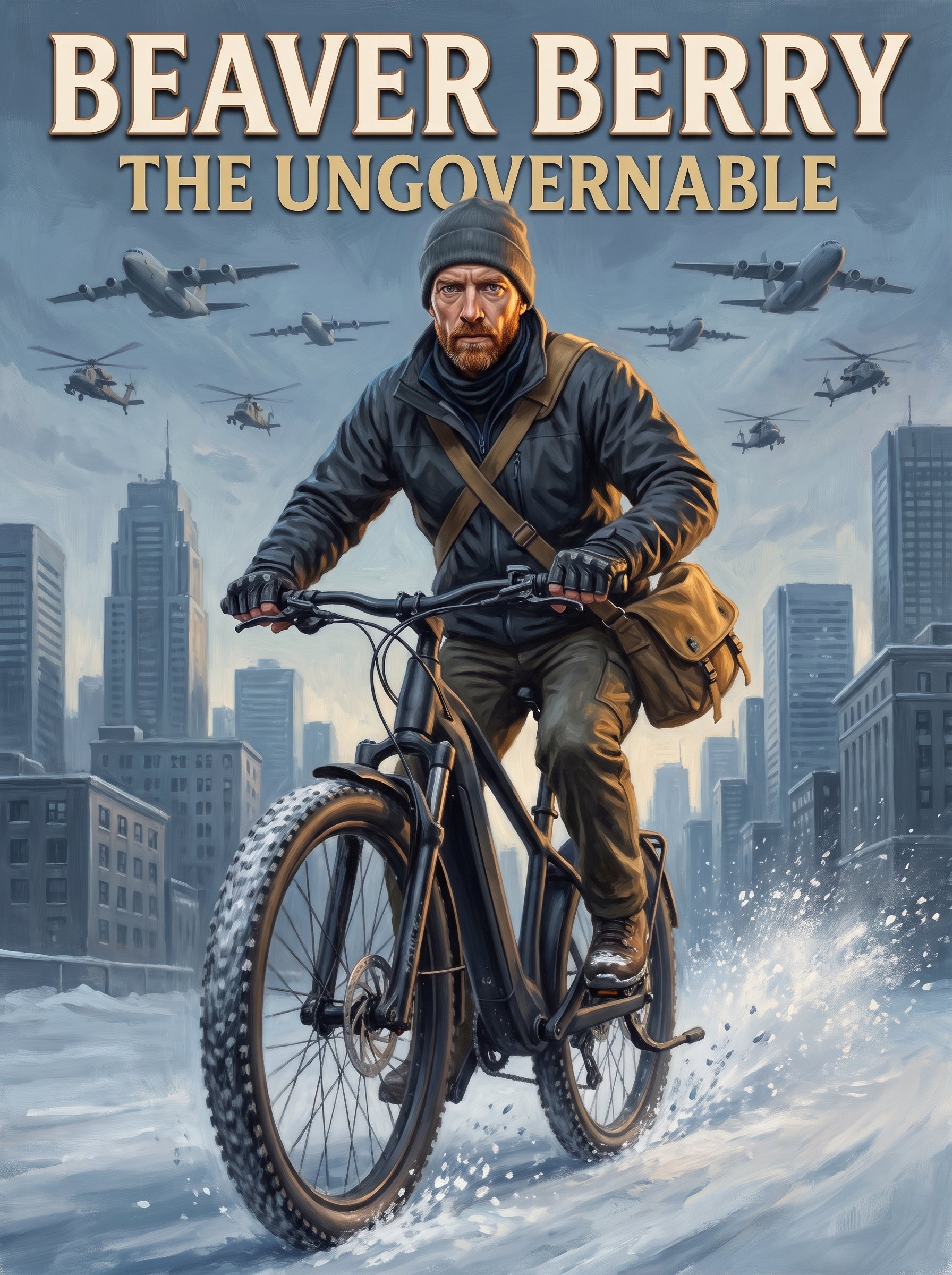

BEAVER BERRYTHE UNGOVERNABLE
A work of fiction. The events in this story are imagined; the real-world facts it draws on are sourced in "The Real Part," below. It dramatises a worst case — it is not a prediction of anything.

The night they switched off a country, the fastest man in it was out carrying a letter.
A Guy on a Bike

Before any of it, he was nobody you'd notice. A courier. The best rider in a country that doesn't clap for riders.
No powers. Just the one thing: on two wheels, nobody alive gets there faster. He gets through. That's the whole résumé.

For a year it had been a punchline. The fifty-first state. Tariffs one week, "protection" the next. It'll never happen, everyone said.
Not invented: through 2025, annexing Canada as the "51st state" was openly floated in U.S. politics, tied to tariffs and "protection." The real-world pressure was economic — this story imagines the darker turn, a worst case, not a prediction.
The Takeover

It didn't start with a shot. It started with a squeeze — tariffs into a wall, the border thickening, then shut.
Two of every three of us live within a hundred kilometres of that line. Choke it, and you choke the country in weeks.

Then the wires died. No phones. No banking. No maps. No word from the next town.
The country's nervous system was rented — cloud, payments, satellites. The landlord just turned it off.
About one hour before the 2022 invasion of Ukraine, the ViaSat KA-SAT satellite network was wiped across Europe. Cutting communications first is the modern opening move. Viasat · Council of the EU

And when the country was blind, broke, and afraid — they took it. Whole. Intact. In one grey morning.
You don't burn down the house you're moving into.
Old doctrine: Prague's airport fell to paratroopers at 1:30 a.m. (1968). Armour drove into central Baghdad (2003). Crimea was annexed almost without a shot (2014). Capitals get taken, not destroyed. Warfare History Network · Zucchino · Reuters

Our soldiers fought. Sixty-eight thousand of them, against a million-three and eleven carrier groups.
It was arithmetic that ran out. Not courage.

In days, the uniform war was over. Then came the slow thing — checkpoints on ordinary corners, a scanner for every plate, a country that still looked exactly like itself. And wasn't.
The Silence

The cruelty wasn't the tanks. It was the not-knowing.
Somewhere south of her, a clinic still had insulin. She couldn't even ask.

So people did the human thing. Basements. Back rooms. A list of the missing. A map of who had medicine. A letter from a mother that had to go north.
The nurse: "It's no good on paper if it can't move. Everything that moves gets stopped."
Beaver: "Which town's dark the longest?"
The Courier
Here is the whole of his power: he is the best there has ever been at riding a bicycle — and his bicycle doesn't need the things they took away.
No engine to hear. No fuel to seize. No plate to scan. Nine hundred and sixty watt-hours of quiet. He didn't beat the patrols — he went where patrols can't be built.

The nurse: "You actually came."
Beaver: "Roads were quiet."
The insulin made the clinic by six. The list of the missing. Her letter — two hundred kilometres from the kitchen it was written in.

The idea moved faster than he did. One rider stitched two towns together. A hundred stitched a country.
At Dien Bien Phu (1954), some 60,000 reinforced bicycles hauled the artillery and supplies 500 km through jungle that defeated a Western army. Logistics, not firepower, decided it. Air & Space Forces Magazine · HistoryNet

Not every rider got through.
He learned their names. He kept riding.
The Ungovernable

This is the part tanks were never built for. You can win every battle and still not rule — if the ruled will not cooperate.
Across 323 campaigns (1900–2006), nonviolent resistance succeeded about twice as often as armed resistance — and no movement that mobilised 3.5% of its population at its peak ever failed. Chenoweth & Stephan, Why Civil Resistance Works (2011)

He never led anything. He was the one you handed the letter that had to arrive.
They started calling him Beaver Berry — half a joke, the way we do. The rider who always gets through. He hated it. He kept it. The nights were cold, and it worked.

The footage went out on bicycles, to the coast, onto the one boat with a working transmitter. Then everywhere.
Occupations don't end when the occupier is beaten. They end when the bill comes due — in money, in soldiers, in pictures the whole world is watching.
The Last Mile

The last run was the longest, in the worst of it — carrying the hour the whole country would stop at once.

The battery gave out under him. He walked it up the last hill.
The message doesn't care how it arrives. Only that it does.

It worked the way the real ones always work. Not a battle — a morning nobody showed up for.
There aren't enough soldiers on earth to make a people pretend.

Nobody surrendered to us. Nothing was signed on a deck. It just stopped being worth it.
The war ended in a weekend. The occupation ended the slow way — the only way that lasts.
The Real Parts

He went back to being a guy on a bike. It was all he'd ever wanted to be.

Everything the invader did in this story has been done, somewhere, to someone. That part is not a comic.
Everything the rider did is real too. No powers. Just the oldest Canadian idea there is — that a country is free exactly as far as it can move, power, and speak for itself without asking anyone's permission.
Elbows up.
The Real Part — the footnotes
The story and the hero are fiction. The playbook is not. Here is every claim the comic leans on, and where it comes from.
- Economic pressure, not tanks. The real 2025–26 friction between the U.S. and Canada was economic — tariffs and "51st state" annexation talk — not a military threat. This comic dramatises a worst case; it does not predict one. Widely reported, 2025–26.
- Cut the wires first. ~1 hour before Russia's 24 Feb 2022 invasion of Ukraine, the ViaSat/KA-SAT satellite network was disabled by "AcidRain" wiper malware across Europe; ~20 states, incl. Canada, attributed it to Russia. Viasat; Council of the EU.
- A shared sky. NORAD is the world's only binational military command — a U.S. commander, a Canadian deputy — and Canada's aerospace early-warning is run jointly with the U.S. Canada.ca (DND); Britannica.
- Seize the capital. Soviet airborne troops took Prague's Ruzyně airport at ~1:30 a.m., 21 Aug 1968; U.S. armour ran into central Baghdad in April 2003. Warfare History Network; Zucchino, Thunder Run.
- Take it whole. Russia annexed Crimea in 2014 with almost no shots fired — seizing airports and the parliament with unmarked troops. You don't destroy what you intend to keep. Reuters; Carnegie.
- The border is the country. 66% of Canadians live within 100 km of the U.S. border. Statistics Canada, 2016 Census.
- The arithmetic. ~68,000 CAF regulars and zero carriers vs. ~1.35 million U.S. active troops and eleven carrier strike groups. Canada.ca; USNI, 2026.
- Bicycles beat an army. At Dien Bien Phu (1954), ~60,000 reinforced bicycles hauled the artillery and supplies 500+ km that defeated the French. Air & Space Forces Magazine; HistoryNet.
- The ungovernable rule. Across 323 campaigns (1900–2006), nonviolent resistance succeeded ~2× as often as violent, and none that reached 3.5% peak participation failed. Chenoweth & Stephan, Why Civil Resistance Works (2011).
Questions
Is any of this real, or is it just a story?
The story and the hero are fiction. The invasion playbook is not — every "Real Part" note is sourced to the record above: the "51st state" annexation talk, the ViaSat blackout, the Prague and Baghdad seizures, Crimea 2014, the force numbers, Dien Bien Phu, and the Chenoweth & Stephan civil-resistance research.
Would the U.S. really invade Canada militarily?
On the real-world record the friction has been economic — tariffs and annexation talk — not a military threat. This comic deliberately dramatises a worst case to make a point about dependence; it is not a prediction.
Could a bicycle actually matter against a modern army?
Not as a weapon — Beaver never fights. As logistics and communication, yes: bicycles carried the supplies that beat a Western army at Dien Bien Phu, and couriers have kept blacked-out populations connected in real conflicts. When the network is cut, the thing that needs no network wins.
What is the "3.5% rule"?
In Erica Chenoweth and Maria Stephan's study of 323 campaigns (1900–2006), no nonviolent movement that mobilised at least 3.5% of its population at its peak failed to reach its goals — and nonviolent campaigns succeeded about twice as often as violent ones.
Is the bike a real thing?
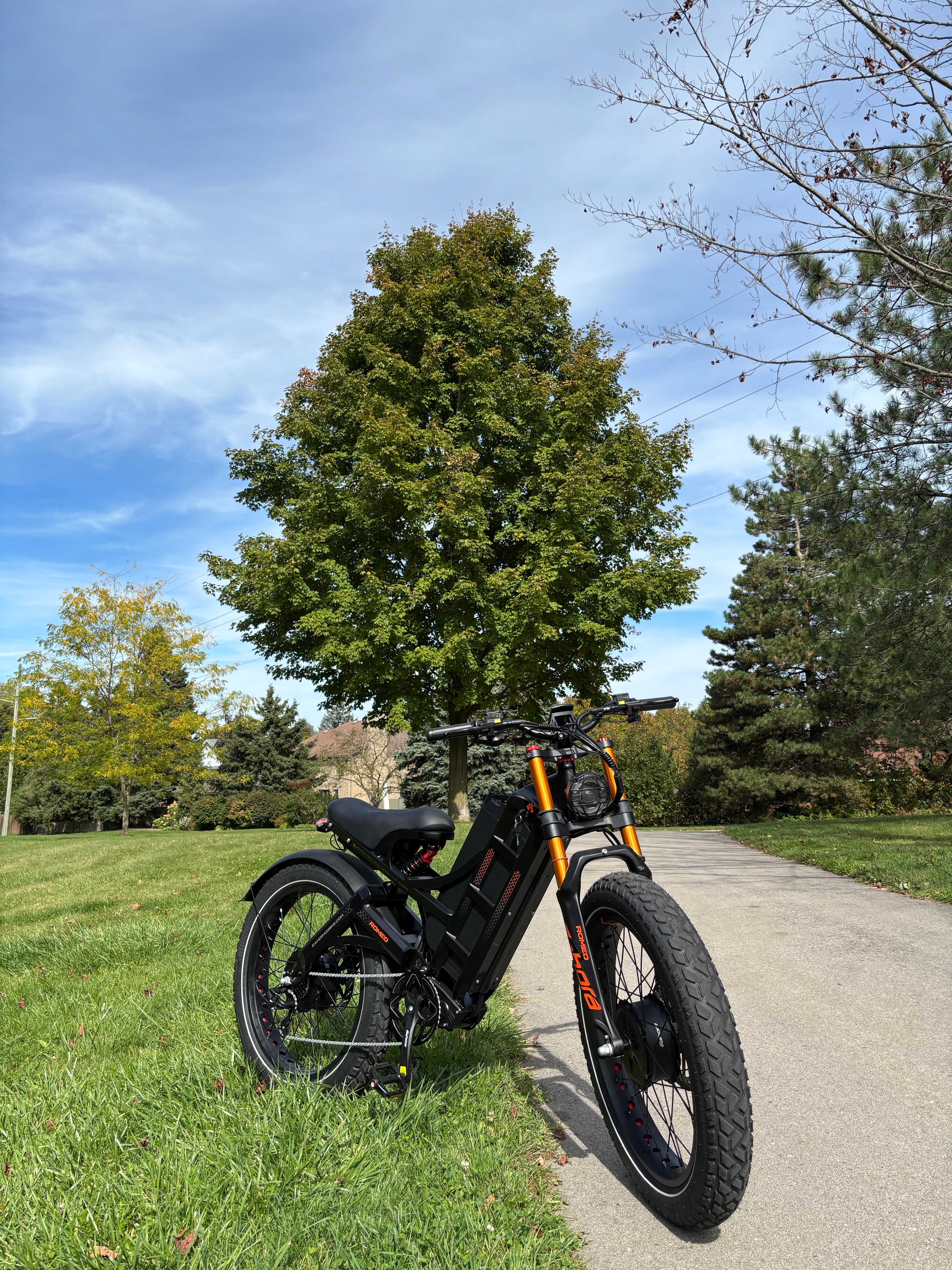
The hero rides an electric hardtail with a 960 Wh battery — the kind of self-powered, no-fuel machine the whole story is really about. Zeus is a Canadian company that sells and supports bikes like it here at home: the Canadian-supported lineup and the hardtail trail bikes.
So what's the point?
Independence isn't a bike with a rifle. It's not needing anyone's permission — or grid, or fuel, or network — to move, power, and talk to each other. And the e-bike is proof it's within reach: unlike a car, it's simple enough that a country can build it at home. That's the quiet argument under the whole thing.
And here is the quiet beauty of the e-bike — the part the whole story is really about. It is simple enough that a country can build it at home: no foreign supply chain to sever, no one's grid to borrow, no one's permission to ask. That is what independence actually looks like. Zeus is a Canadian company betting on exactly that. See the Canadian-supported lineup.


Share:
The Most Comfortable eBike Seat (2026): 8 Picks, Fit First
Ridstar Left Canada — It's YVY Now: How to Buy the Real Bike