

Are We Civilized? What Canada Lets Happen to Dogs — and Who Pays for Saving Them

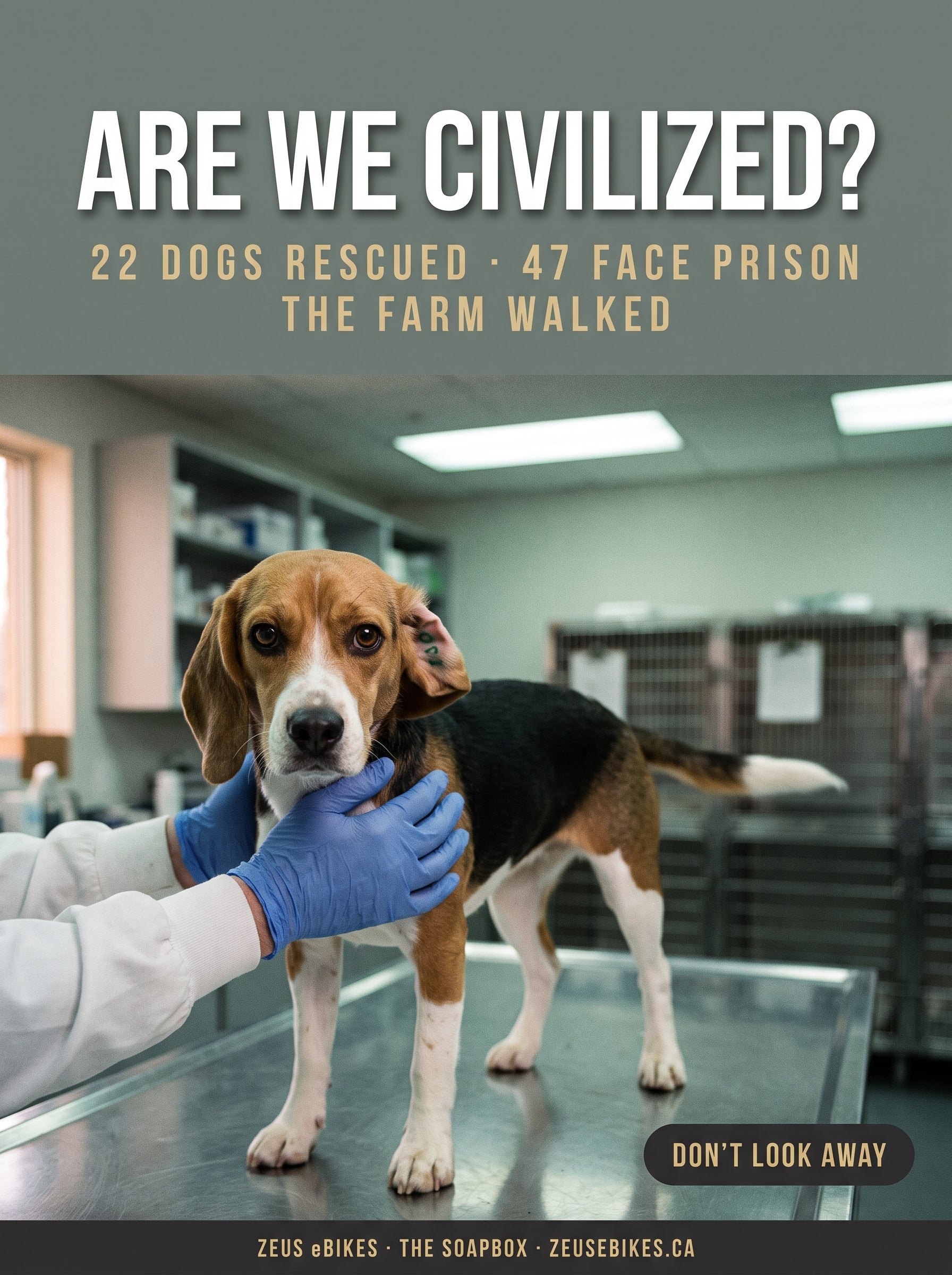
She wags her tail at the people holding her. Beagles are used in laboratories precisely because they trust us. Photo illustration — created with Playcut AI; not a photograph of any named facility.
By Milad Ghobadibeygvand · Published July 31, 2026 · Every claim in this article is linked to a court record, statute, government inspection, peer-reviewed study, or named news source.
On July 3, 2026, a district attorney in Wisconsin filed felony charges against 47 people. The charge: walking into a beagle-breeding facility and carrying 22 dogs out into the daylight, on camera, unmasked. They face up to 12 years and 6 months in prison. The facility they took the dogs from — where state investigators confirmed employees had spent years performing eye surgery on conscious dogs without anesthesia — was never prosecuted. It negotiated its way out by handing in its licence.
I sell electric bikes for a living. This article has nothing to do with bikes. It exists because the same affordability crisis flooding Canadian shelters with surrendered dogs is also turning unlicensed breeding into untraceable income — and because when I went looking for the law that protects the mother dog in the cage, I found out there isn't one. What follows is everything I could verify: what Canadian law actually permits, what the evidence says the dogs experience, who has been held accountable by name, and — because rage without tools is just noise — the exact legal levers any Canadian citizen can pull.
Quick answer: Breeding and selling dogs requires no licence, no registration, and no inspection in most of Canada — Ontario included. Canada scores a D on World Animal Protection's global index, two tiers below the UK, where England requires breeder licences and banned third-party puppy sales in 2020. The largest dog seizure in Canadian history — 500+ dogs at Paws 'R Us, Quebec, 2011 — ended in a fine of over $10,000 and a two-year kennel ban. And in Wisconsin, 47 people face up to 12.5 years in prison for removing 22 beagles from a breeding facility that itself avoided prosecution by surrendering its licence. This article documents all of it, names the parties on court record, and gives you six verified legal tools to fight back — starting with a phone number you can call today.
How this was researched. Every claim traces to a primary or named source, verified July 31, 2026: statutes (CQLR c. B-3.1, S.O. 2024, c. 14, the UK's licensing regulations), a U.S. Department of Justice plea agreement, a peer-reviewed study (McMillan, Duffy & Serpell 2011), World Animal Protection's Animal Protection Index, and court reporting from CTV, CBC, Wisconsin Public Radio and others. Where a widely repeated number could not be traced to a primary source, it was cut. Every person named either pleaded guilty in court or is a company whose violations are government inspection record. Named parties may respond: milad@zeusebikes.ca.
In this article
- Is dog breeding actually regulated in Canada?
- The receipts: we already asked Ottawa, and enforcement by the numbers
- The votes on the record: who did what, by name
- What a breeding mother's life does to her — the evidence
- The beagle cases: rescue the dog, face the decade
- Which country treats dogs best — and where Canada ranks
- The wins prove fighting works
- The citizen's legal toolkit — six steps
- The economy is making all of it worse
- Frequently asked questions
- The bottom line
Is Dog Breeding Actually Regulated in Canada?
Mostly, no. There is no federal law governing commercial dog breeding, and in most provinces — Ontario included — anyone can breed and sell dogs with no licence, no registration, no inspection, and no limit on how many litters a female carries (Animal Justice). The Criminal Code punishes cruelty after it is documented. Almost nothing in the law is designed to prevent it before it happens.
Think about what that means in practice. The person cutting your hair needed a licence. The person who breeds the dog your family will love for fifteen years did not. Enforcement only ever arrives after the suffering — after a neighbour calls, after a seizure, after the evidence is already lying on a wire cage floor.

No licence, no inspections, no litter limits: in most of Canada, nobody with authority ever sees her. Photo illustration — created with Playcut AI.
Two partial exceptions deserve their names. Quebec declared animals "sentient beings" in its Animal Welfare and Safety Act (CQLR c. B-3.1), requires a government permit at 15 or more cats and dogs, and caps ownership at 50 (Mission Mayday). Ontario passed the Preventing Unethical Puppy Sales Act in June 2024, prohibiting defined puppy-mill conditions with minimum $10,000 fines — and enacting bans on breeding females under twelve months and separating puppies before 56 days. Then look closer: those breeding provisions come into force only "on a day to be named by proclamation," and as of this writing they have never been proclaimed — more than two years after royal assent, the province has adopted no regulations to activate them (CBC; Ontario SPCA). The Act also created no licensing and no inspection regime, which is why Animal Justice and The Pointer's investigation both concluded it will not end puppy mills: a law with no inspection regime cannot prevent what it cannot see.
Now look at what a country two grades better does. In England, breeding three or more litters a year for sale requires a local-authority licence with welfare inspections covering housing, health checks and care standards. Since April 2020, Lucy's Law has banned third-party puppy sales outright — you buy from the breeder who shows you the puppy with its mother, or you adopt. Selling without a licence risks an unlimited fine or six months in prison. None of this is exotic. It is a photocopy-ready legal framework Canada has simply never bothered to adopt.
Takeaway: Outside Quebec's permit system, Canada has no universal breeder licensing — and no province requires routine inspection before suffering is reported. Ontario's 2024 law defined the offence, left its key breeding rules unproclaimed, and inspects nobody. The UK model (licence + inspections + third-party sales ban) already exists and works. That is the ask to bring to your MPP — see the toolkit below.
The Receipts: We Already Asked Ottawa — and What Enforcement Actually Looks Like
Canadians have already asked the federal government to ban puppy mills, formally, through Parliament's own petition system — and the answer is on the record. Petition e-2997 (December 2020 – March 2021, 8,386 validated signatures, sponsored by MP Nathaniel Erskine-Smith) called on the Government of Canada to ban puppy mills nationwide. The government's written response: "Canadian provinces have the primary responsibility for protecting the welfare of animals, including pets." Ottawa points at the provinces. The provinces, as documented above, mostly require no licence. That circle — each level of government pointing at the other while nobody inspects the barn — is the machine this article exists to break.
And when a province does take over enforcement, watch the numbers. After Ontario replaced the OSPCA with the government-run PAWS system in 2019, CBC Hamilton's freedom-of-information investigation found investigations were producing far fewer orders and charges than under the OSPCA — and the Ministry of the Solicitor General offered no explanation for the decline. To be fair to the current record: the province's own 2024 Animal Welfare Services annual report shows the trend turning — 43,326 calls received, 26,565 inspections and investigations, 3,531 animals removed from distress, and 678 charges laid, up from 296 in 2023. Progress, worth naming.
Now do the arithmetic the report doesn't do for you. Forty-three thousand calls became six hundred and seventy-eight charges — about 1.6%. And the report proudly records the first convictions in PUPS Act history (January 2025): two individuals convicted; one fined a total of $5,000 and ordered to pay $11,486.66 in restitution for the dogs' care. Fourteen years after Paws 'R Us taught us that 500 dogs cost $10,000, the new law's first conviction fine came in at five thousand dollars. The number changed. The message to anyone running dogs for profit did not.
One caveat the report itself makes, and honesty requires repeating: not every call is in Animal Welfare Services' jurisdiction — some are triaged to police or municipal bylaw — and a single investigation can produce many charges, so the funnel below is not a one-to-one case count. The distance between reporting and prosecution is still the point.
Ontario animal-welfare enforcement, 2024 — from call to charge. Bar lengths are true to scale. The last bar is not a rendering error.
Source: Government of Ontario, 2024 Animal Welfare Services Annual Report. Chart: Zeus eBikes, drawn to scale; stage counts are not one-to-one (see caveat above).
Takeaway: The federal government has answered, in writing: this is provincial. The provinces don't license breeders. And when charges do land, first-conviction fines run $5,000. Every claim in this paragraph is a government document — which is exactly why the toolkit below aims at legislatures, not sympathy.
The Votes on the Record: Who Did What, By Name
Parliament has been asked — repeatedly — to modernize the Criminal Code's animal-cruelty provisions. The record of who tried, who voted no, and where each bill died is public, permanent, and linked below. These are recorded votes and sponsorships from Hansard and LEGISinfo, stated exactly as the record shows; what any individual vote says about any individual politician is for you to judge with the record open in front of you.

Six bills in six years died in rooms like this one. She was not on the agenda. Photo illustration — created with Playcut AI; a conceptual image, not a photograph of any real chamber.
| Year | Bill | What it would have done | Who | What happened |
|---|---|---|---|---|
| 1999–2005 | C-17 · C-15B · C-10 / C-10B · C-22 · C-50 | Six bills in six years to modernize the Criminal Code's cruelty-to-animals provisions | Successive federal justice ministers; the final attempt, Bill C-50, sponsored by Justice Minister Irwin Cotler | None became law. C-10B passed the Commons and stalled in the Senate; C-50's last activity was a referral debate on November 21, 2005 — it died with the Parliament |
| 2016 | C-246, Modernizing Animal Protections Act | Stronger cruelty penalties — including for operations running dogs for profit — plus a shark-fin import ban | Sponsored by Liberal MP Nathaniel Erskine-Smith (the same MP who later sponsored petition e-2997) | Defeated at second reading, 84–198 (October 5, 2016). The recorded division shows Prime Minister Justin Trudeau voting no, Justice Minister Jody Wilson-Raybould voting no, ministers Marc Garneau and Stéphane Dion voting no, and the Conservative caucus voting no near-unanimously; most NDP MPs and 8 of 9 Bloc MPs voted yes |
| 2019 | C-84 | Narrower government bill: expanded bestiality and animal-fighting offences | Government of Canada | Passed — proof Parliament can act when it chooses to |
| 2021 | Petition e-2997 | Asked the federal government to ban puppy mills | 8,386 Canadians; sponsored by MP Nathaniel Erskine-Smith | Government's written answer: provinces have primary responsibility |
| 2024 | Ontario Bill 159, PUPS Act | Banned specific breeding abuses; minimum $10,000 fines | Sponsored by Solicitor General Michael S. Kerzner | Passed (royal assent June 6, 2024) — credit where due — but its key breeding restrictions still await proclamation, and it created no licensing or inspection regime |
Every MP's vote on Bill C-246, by name, riding and party, is permanently public: House of Commons Vote No. 120 (42-1), October 5, 2016. Look up your own MP. That page — not this article — is the full list of names.
A quarter-century of asking. Federal and provincial attempts to strengthen protection for dogs, 1999–2024.
Sources: LEGISinfo; House of Commons Vote No. 120 (42-1); Library of Parliament legislative summaries; Legislative Assembly of Ontario. Chart: Zeus eBikes.
Takeaway: Between 1999 and today, federal animal-protection modernization died at least seven times — six bills and one petition — under governments of both parties, while the narrow bills passed. The pattern isn't one villain; it's a Parliament that acts only when pressure makes inaction more expensive than action. That is what the toolkit below is for.
What a Breeding Mother's Life Does to Her — the Evidence
The damage is permanent, and it is peer-reviewed. The landmark study of former breeding dogs — McMillan, Duffy & Serpell (2011), published in Applied Animal Behaviour Science — compared ex-breeding dogs from commercial establishments against matched pet dogs. Years after adoption into loving homes, the ex-breeding dogs still showed significantly elevated fear of strangers, elevated non-social fear, and heightened touch sensitivity, alongside more health problems and reduced trainability.
Read that middle finding again: heightened touch sensitivity. A dog that flinches from the hand that feeds her — years after the last cage. The study describes the life that builds this: females housed for their entire reproductive lives in cages or runs, with minimal or no positive human contact and no enrichment. The suffering is not an episode she recovers from. It is rewired into her.

Wire floor, no bedding, litter after litter: the McMillan study documented what this life leaves behind — fear that persists years after rescue. Photo illustration — created with Playcut AI.
Canada has its own case study, and its ending tells you everything. In September 2011, Humane Society International raided the Paws 'R Us facility in Clarendon, Quebec, and seized more than 500 dogs across thirty-plus breeds — living without sufficient food or water, in what the rescue team called some of the worst conditions it had ever encountered (CBC News). It remains the largest dog seizure in Canadian history. The operators — Charlene Labombard and her daughter Nicole, named in court reporting — pleaded guilty to 17 animal-cruelty charges and forfeited more than 600 dogs (CBC News; CBC).
The sentence: a fine of over $10,000 (CBC), and a two-year ban on operating a kennel. Roughly twenty dollars per seized dog, and permission to start again in twenty-four months. That number — not the seizure, not the headlines — is the truest statement of what a breeding mother is worth under Canadian law.

Paws 'R Us held over 500 dogs. The penalty worked out to about $20 per dog. Photo illustration — created with Playcut AI.
How we name names on this page: every person named here pleaded guilty in open court, and every company named is on a government inspection record or federal plea agreement. Each fact is stated at exactly the strength of its source, no stronger. Opinions are framed as opinions. Named parties may respond: milad@zeusebikes.ca.
The Beagle Cases: Rescue the Dog, Face the Decade
Two beagle-rescue prosecutions are unfolding right now, and the difference between them is the whole argument. In the UK, nobody went to prison. In the US, 47 people face sentences longer than many violent offenders serve — while the facility they exposed walked away.
United Kingdom. In December 2022, Animal Rising activists entered MBR Acres, a beagle-breeding facility in Cambridgeshire, and removed puppies bred for laboratory testing. They faced burglary charges carrying up to ten years. The outcome: three received 18-month suspended sentences with unpaid work, one a conditional discharge — no one imprisoned — and in March 2026 a second jury unanimously acquitted the remaining defendants after two hours of deliberation. Twelve ordinary citizens looked at people who carried dogs out of a breeding facility and said: not guilty.
United States. On March 15, 2026, activists walked into Ridglan Farms in Blue Mounds, Wisconsin — a facility breeding beagles for biomedical research — and carried out 22 dogs, unmasked and on camera. On July 3, the Dane County District Attorney charged 47 people with felonies carrying up to 12 years and 6 months (Wisconsin Public Radio). Among them: an actress, a professor, retirees.
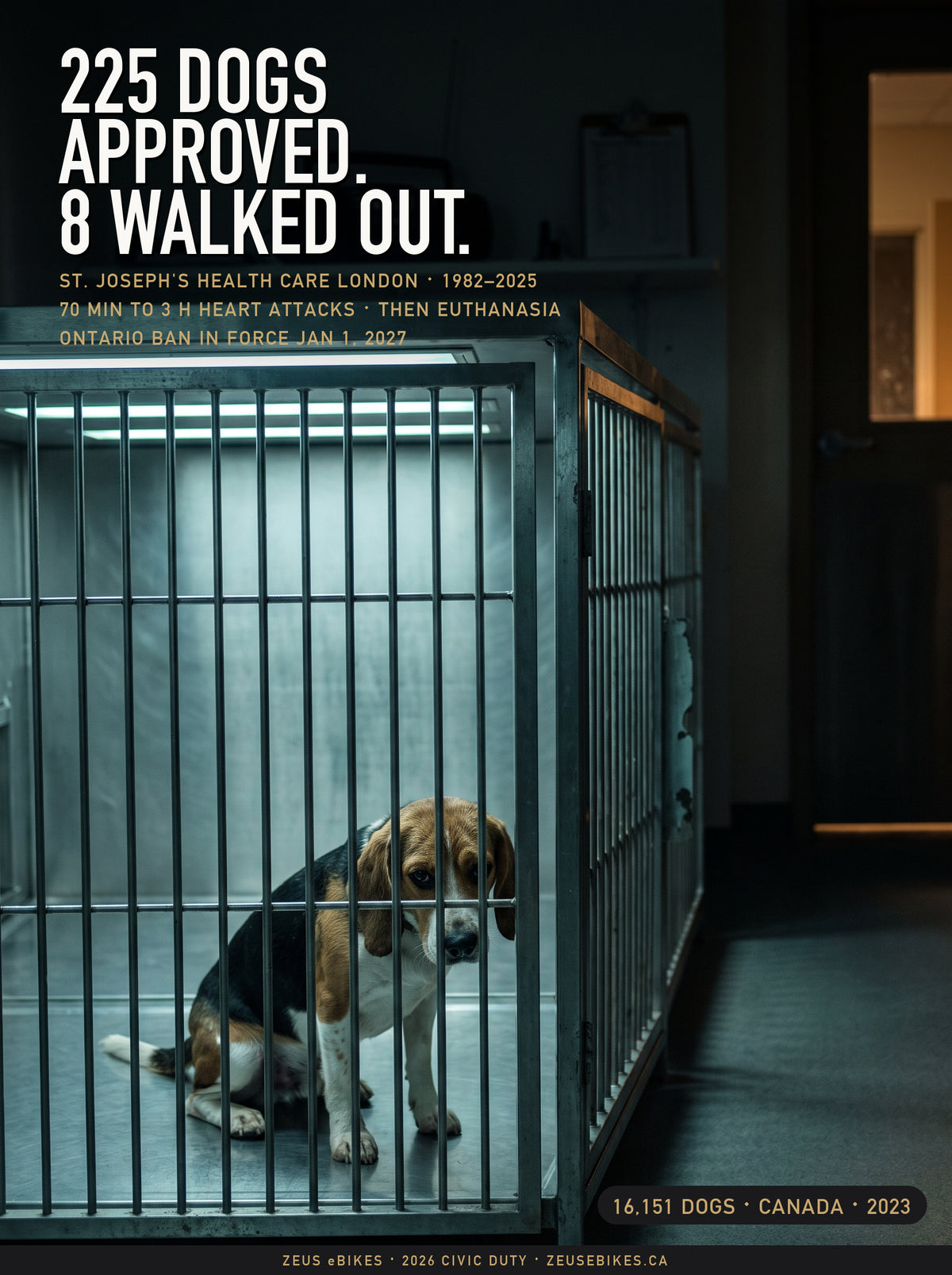
Here is what the same court system did with the facility. A February 2025 state investigation confirmed that Ridglan employees — not veterinarians — had for years routinely performed cherry-eye surgery without anesthesia: cutting a gland from a conscious dog's eyelid (FOX6). Complaints had been piling up for years without charges (Wausau Pilot & Review). In October 2025, Ridglan agreed to surrender its breeding licence to avoid criminal charges; it stopped selling beagles on July 1, 2026, and welfare groups bought out its remaining ~1,500 dogs (Wisconsin Examiner).
Hold both outcomes in your head at once. The organization that cut into conscious dogs' eyes: no prosecution. The people who carried 22 dogs into daylight: up to 12.5 years each. Whatever that is, it is not what any of us mean by justice — and it is the question on the cover of this article.

First daylight. In the UK, a jury acquitted — and no one convicted was imprisoned. In Wisconsin, the charges carry up to 12.5 years. Photo illustration — created with Playcut AI.
The industry these dogs come from is not a rumour; it is a federal court record. At Envigo in Cumberland County, Virginia, USDA inspectors documented over 70 Animal Welfare Act violations in nine months: nursing mother beagles deprived of food; food contaminated with maggots, mould and feces; 25 puppies dead of cold exposure in eight weeks; more than 300 puppy deaths recorded without established cause (Animal Welfare Institute). On June 3, 2024, Envigo RMS LLC pleaded guilty to conspiring to violate the Animal Welfare Act; its parent company guaranteed more than US$35 million — the largest fine in the Act's history — and roughly 4,000 surrendered beagles were released for adoption (U.S. Department of Justice; Science).
Takeaway: These were licensed, inspected facilities — and this is what inspectors still found. Canada's commercial breeders operate with less oversight than Envigo or Ridglan had. The evidence for what happens in unlicensed darkness is, by definition, never collected.
Which Country Treats Dogs Best — and Where Canada Ranks
No country earns an A. On World Animal Protection's Animal Protection Index — a rigorous global grading of animal-welfare law across 50 countries — the best grade ever awarded is a B, held by six countries: Austria, Denmark, the Netherlands, Sweden, Switzerland and the United Kingdom. Canada scores a D, in the same tier as the USA, Russia, Tanzania and Turkey, dinged specifically for weak pet protection and for refusing to recognize animal sentience in law (World Animal Protection Canada).
| Grade | Countries | What the tier means |
|---|---|---|
| A | None — never awarded | — |
| B | Austria · Denmark · Netherlands · Sweden · Switzerland · UK | Licensing, sentience in law, real enforcement |
| C | France · Germany · India · Italy · Malaysia · Mexico · New Zealand · Poland · Spain | Substantial protections, uneven enforcement |
| D | 🍁 CANADA · Australia · Brazil · Chile · Colombia · Korea · Peru · Philippines · Romania · Russia · Tanzania · Thailand · Turkey · Uruguay · USA | Failing tier — no sentience recognition, weak companion-animal law |
| E | Argentina · China · Indonesia · Japan · Niger · Nigeria · Pakistan · South Africa · Ukraine · Venezuela | Minimal protection |
| F | Algeria · Belarus · Egypt · Ethiopia · Morocco · Myanmar · Vietnam | Near-absent protection |
| G | Azerbaijan · Iran | Lowest grade awarded |
Source: World Animal Protection, Animal Protection Index, 2020 edition (legislation-based grades; the closest available proxy for "dog quality of life by country" — no index measures it directly). Accessed July 31, 2026.
The best life for a dog, by law, is lived in northern Europe. The Netherlands is widely reported — a claim originating in a 2016 Dutch report, not an official census — to be the first country with no stray dogs, the product of decades of high sterilization rates, fines and potential jail for abandonment, taxes steering buyers toward shelter adoption, and a dedicated animal-crimes police force, with no euthanasia campaign (DutchReview). The UK pairs its B grade with breeder licensing, Lucy's Law, and statutory sentience recognition under the Animal Welfare (Sentience) Act 2022. Canada sits two full tiers below every one of these countries — not because Canadians love dogs less, but because our legislatures have never been made to care.
The Wins Prove Fighting Works
Everything in this article so far is enraging, so here is the part that matters most: pressure works, and the record proves it. Canada banned cosmetic animal testing in June 2023 under Bill C-47 — after years of campaigning by Humane Canada, Animal Justice and the Be Cruelty-Free coalition — and began phasing out animal toxicity testing. Quebec rewrote its civil law in 2015 to make animals sentient beings. Ontario passed the PUPS Act in 2024. Lucy's Law began as one grassroots campaign named after one rescued breeding spaniel. Envigo's 4,000 beagles are in homes right now. Ridglan is out of the beagle business because activists, journalists and one state investigation refused to let it alone. A UK jury — ordinary citizens, not activists — unanimously acquitted the remaining rescuers, and those convicted earlier were spared prison.

The first lawn of her life. Every win in this section started with people who refused to look away. Photo illustration — created with Playcut AI.
Takeaway: Not one of these victories happened on its own. Every single one was forced — by complaints, petitions, investigations, campaigns, and citizens who documented what they saw. Which brings us to the tools.
The Citizen's Legal Toolkit — Six Steps, All Verified
Every mechanism below is real, current, and available to any Canadian — verified against the governing statute or official guide on July 31, 2026. They run from something you can do in the next ten minutes to changing international law.

The entire enforcement system starts with one phone call that most people never make. Photo illustration — created with Playcut AI.
1. Report what you see — today
Suspected puppy mill, overbred females, sick litters: inspectors can enter, seize and lay charges — but only if someone calls. In Ontario, call 1-833-9-ANIMAL (1-833-926-4625), the province's 24/7 enforcement line under the PAWS Act; first-offence penalties reach $130,000 for individuals. Elsewhere, call your provincial SPCA, humane society, or local police. It is not anonymous, but your identity is kept confidential.
2. Document, then escalate to Animal Justice
Animal Justice — Canada's national animal-law organization — files regulatory complaints, pushes prosecutions and drafts legislation. Dates, photographs, online listings and vet records turn an anecdote into a case file they can act on.
3. Launch a parliamentary e-petition
This is the formal mechanism for forcing Ottawa to answer on the record. Under the House of Commons rules: draft your petition at petitions.ourcommons.ca, secure one MP as sponsor, gather signatures for up to 120 days — and at 500 valid signatures it is certified and presented in the House, after which the government must respond within 45 calendar days or the failure is automatically referred to a standing committee. The ask writes itself: national breeder licensing, modelled on the UK.
4. Push your province for a real licensing law
Breeding regulation is largely provincial jurisdiction. Ontario's PUPS Act proves the door opens under pressure — and its missing piece, licensing plus inspection, is a precise, winnable demand. Write your MPP or MLA with that single ask. Municipally, push your council for breeding permits — Winnipeg already requires one.
5. The heavy tool: a private prosecution
Under section 504 of the Criminal Code (R.S.C. 1985, c. C-46), any person who on reasonable grounds believes an indictable offence has been committed — animal cruelty qualifies — may lay an information under oath before a justice, and a judge decides whether to compel the accused to answer. It is rarely used, entirely real, and best attempted with counsel or Animal Justice; the Crown can take it over or stay it. This is the citizen's court-access mechanism of last resort for documented cruelty that authorities decline to act on.
6. Hold the world accountable
There is no binding international animal-welfare treaty — that is the global gap. The proposed UN Convention on Animal Health and Protection (UNCAHP), drafted in 2018 by the Global Animal Law Association, targets adoption by the UN General Assembly by 2029. Support the campaign, and use step 3 to demand Canada champion it — a D-grade country co-sponsoring a global animal-protection convention is exactly the on-record contradiction e-petitions are built to expose.
Copy-paste tools — use them today.
① E-petition text, ready for an MP to sponsor (petitions.ourcommons.ca — improve on e-2997 by asking for a framework, not a ban Ottawa can deflect):
"We, the undersigned, residents of Canada, call upon the Government of Canada to work with the provinces and territories to establish a national framework for mandatory licensing and inspection of commercial dog breeders — modelled on England's Animal Welfare (Licensing of Activities Involving Animals) Regulations 2018 and Lucy's Law — including a ban on third-party puppy sales, and to champion the proposed UN Convention on Animal Health and Protection."
② Letter to your MPP/MLA (90 seconds — find your member on your legislature's website):
"As your constituent, I'm asking you to close the gap in [province]'s animal-welfare law: breeders currently need no licence and face no proactive inspection. Ontario's PUPS Act shows legislatures respond to this issue — but bans without inspections don't reach the barn. I'm asking you to support mandatory breeder licensing with welfare inspections, as the UK has required since 2018. Ontario's own 2024 enforcement report shows 43,326 welfare calls produced 678 charges. Will you commit to raising breeder licensing in the legislature?"
Where your hours count most: Animal Justice (law and lobbying) · Humane Canada (the national federation) · your provincial SPCA — Ontario, Montreal, BC — where fostering is the single highest-impact volunteer role in the surrender crisis · World Animal Protection Canada (the index-keepers) · Animal Alliance of Canada (the cosmetic-ban campaigners) · Right to Rescue (supporting the 47 Ridglan defendants).
The Economy Is Making All of It Worse
The affordability crisis is squeezing dogs from both ends. Surrenders are surging — the Montreal SPCA took in 32% more animals in the first half of 2025 than a year earlier, with 1 in 6 given up over cost, and an Edmonton rescue reports surrender calls at roughly triple pre-pandemic volume (CBC News; Humane Canada). At the same time, the same squeeze makes unlicensed breeding attractive as untraceable income — no licence, no inspector, no tax trail. Falling demand and rising desperate supply is the worst possible market for dogs, and the breeding females absorb it invisibly. That is why this article exists now, and not someday.
Frequently Asked Questions
Are puppy mills illegal in Canada?
Not in most of Canada. No federal law regulates commercial dog breeding, and most provinces require no licence, registration or inspection to breed and sell dogs. Ontario's PUPS Act (2024) prohibits defined puppy-mill conditions with minimum $10,000 fines, but its key breeding restrictions — no breeding under twelve months, no separating puppies before 56 days — have not been proclaimed into force, and it created no licensing regime. Quebec is the main exception: a permit is required at 15 or more cats and dogs, capped at 50.
Do dog breeders need a licence in Canada?
In most provinces, no. Ontario breeders need no licence and face no proactive inspections. Quebec requires a MAPAQ permit at 15+ cats/dogs. By contrast, in England anyone breeding three or more litters a year for sale needs a local-authority licence with welfare inspections, and Lucy's Law bans third-party puppy sales entirely.
What happened to the activists who rescued beagles from breeding facilities?
In the UK, Animal Rising activists who removed beagle puppies from MBR Acres were either acquitted by a unanimous jury (March 2026) or received suspended sentences — nobody went to prison. In the US, 47 people face felony charges carrying up to 12.5 years for the March 2026 removal of 22 beagles from Ridglan Farms in Wisconsin, while the facility itself surrendered its licence to avoid prosecution. No rescuer has been sentenced.
Which country treats dogs best?
By legislation, the top tier of World Animal Protection's Animal Protection Index (2020 edition) is Austria, Denmark, the Netherlands, Sweden, Switzerland and the United Kingdom — all grade B; no country has earned an A. Canada scores a D, the same tier as the USA and Russia. The Netherlands is widely reported to be the first country with no stray dogs.
How do I report a puppy mill or animal cruelty in Canada?
In Ontario, call 1-833-9-ANIMAL (1-833-926-4625) — the province's 24/7 animal welfare enforcement line under the PAWS Act, with penalties up to $130,000 for a first individual offence. In other provinces, contact your provincial SPCA or humane society, or local police. Document what you saw: dates, photos, listings and locations make the difference between a call and a case.
Has animal advocacy actually changed any laws in Canada?
Yes. Canada banned cosmetic animal testing in June 2023 under Bill C-47 after years of campaigning, and began phasing out animal toxicity testing. Quebec declared animals sentient beings in 2015 and built a breeding permit system. Ontario passed the PUPS Act in 2024. Each followed sustained public pressure — none happened on its own.
The Bottom Line
Are we civilized? A civilization is measured by what it does when cruelty is profitable and the victim cannot testify. Right now, Canada's honest answer is a D — a country where the breeding mother has no inspector, the largest seizure in our history cost her owners twenty dollars a dog, and the international record shows rescuers facing more prison time than the facilities they exposed. But every win in this article was forced by ordinary people, and the tools are sitting there: a 24/7 phone line, a petition mechanism that compels the government to answer, a court door any citizen can open. Pick one this week. She cannot call anyone. You can.
Do one thing today. Save the number (1-833-926-4625, Ontario), sign up for Animal Justice's action alerts, or apply to foster at your local SPCA — a foster home is a freed kennel.

A foster application is a key. Photo illustration — created with Playcut AI.
Sources & Notes
All sources verified July 31, 2026. Statutes and government documents are cited to their official publishers. Where a claim rests on journalism, the outlet is named; where a repeated public claim could not be traced to a primary source, it was excluded from this article.
- World Animal Protection, Animal Protection Index (grades A–G, 50 countries) — api.worldanimalprotection.org. Canada's D grade: World Animal Protection Canada, "Canada gets a failing grade in global test of animal welfare leadership."
- Animal Justice, "Canada's Puppy Mill Problem" and "New Ontario Law Doesn't Go Far Enough to Protect Dogs from Puppy Mills" — animaljustice.ca.
- Preventing Unethical Puppy Sales Act, 2024, S.O. 2024, c. 14 (Bill 159; royal assent June 6, 2024) — Legislative Assembly of Ontario. Key breeding provisions (breeding under 12 months; 56-day separation) come into force only by proclamation and remain unproclaimed as of August 1, 2026, with no regulations adopted — CBC News, "Puppy mills now illegal in Ontario, but advocates say little will change for dogs" (2024); Ontario SPCA, "Change for Animals." Critical analysis: The Pointer, "The PCs claim their new law will end puppy mills in Ontario — it won't even come close" (2024).
- Animal Welfare and Safety Act, CQLR c. B-3.1 (Québec) — legisquebec.gouv.qc.ca; permit thresholds: Mission Mayday, "Domestic animal legislation in Quebec."
- UK DEFRA, "Dog breeding licensing: statutory guidance for local authorities" (Animal Welfare (Licensing of Activities Involving Animals) (England) Regulations 2018) — gov.uk. Lucy's Law: GOV.UK news, "Lucy's Law spells the beginning of the end for puppy farming" (in force April 6, 2020). Sentience: Animal Welfare (Sentience) Act 2022, c. 22.
- McMillan, F.D., Duffy, D.L. & Serpell, J.A. (2011), "Mental health of dogs formerly used as 'breeding stock' in commercial breeding establishments," Applied Animal Behaviour Science 135: 86–94, doi:10.1016/j.applanim.2011.09.006.
- Paws 'R Us (Clarendon, Que., 2011–2012): CBC News, "Puppy-mill dog rescuers say laws too weak"; "Quebec kennel owners get 2-year pet ban" (operators named; guilty plea to 17 charges); "Quebec agency keeps 600 dogs seized from puppy mill" (fine over $10,000).
- Petition e-2997 (2020–2021, 8,386 signatures) and the Government of Canada's response — ourcommons.ca. E-petition mechanics: House of Commons, "Electronic Petitions — Guide and Terms of Use."
- Ontario enforcement: Government of Ontario, 2024 Animal Welfare Services Annual Report (43,326 calls; 26,565 inspections; 3,531 animals removed; 678 charges; first PUPS Act convictions, January 2025, $5,000 fines). Decline under PAWS: CBC Hamilton, "'Shocking' drop in charges and orders from Ontario animal welfare investigations" (freedom-of-information data).
- Ridglan Farms (Blue Mounds, Wis.): Wisconsin Public Radio, "Felony charges brought against 47 animal rights activists after Ridglan Farms raid" (July 2026); FOX6 Milwaukee, "Wisconsin dog breeder to give up license to avoid criminal charges" (2025 DATCP investigation; cherry-eye surgeries without anesthesia); Wausau Pilot & Review, "Before the Ridglan beagle raids, there were years of complaints and no charges" (May 2026); Wisconsin Examiner, "1,500 Ridglan beagles purchased by animal welfare groups" (May 2026).
- Envigo (Cumberland County, Va.): U.S. Department of Justice, W.D. Va., "Animal Breeder Pleads Guilty to Animal Welfare and Pollution Crimes and Will Pay More than $35M" (June 3, 2024); Animal Welfare Institute, "Envigo/Inotiv Dog Breeder" (USDA inspection findings); Science (AAAS) news coverage (2024).
- UK beagle trials: Real Media, "No prison for Animal Rising beagle-rescuers"; UK Human Rights Blog, "Activists cleared of 'burglary' after rescuing beagle puppies bred for laboratory testing" (March 10, 2026).
- Cosmetic-testing ban: Health Canada, "Health Canada announces the end of cosmetic animal testing in Canada" (Bill C-47, June 2023); Animal Justice; BC SPCA (toxicity-testing phase-out).
- Surrender crisis: CBC News, "Some shelters are seeing more pet surrenders" (Montreal SPCA +32% H1 2025; 1 in 6 for affordability; Edmonton ~3× pre-pandemic); Humane Canada, "Struggling shelters in the throes of a 'perfect storm.'"
- Netherlands stray-dog claim: DutchReview (secondary; the claim originates in a 2016 Dutch report — no official census exists; reported here at that strength).
- Private prosecutions: Criminal Code, R.S.C. 1985, c. C-46, s. 504; Criminal Law Notebook, "Private Prosecutions." UNCAHP: Global Animal Law GAL Association, uncahp.org.
- Legislative record: LEGISinfo, Bill C-50 (38-1, sponsor Minister of Justice Irwin Cotler; died November 2005) and Bill C-246 (42-1, sponsor Nathaniel Erskine-Smith); Library of Parliament legislative summaries (six-bills-in-six-years history: C-10, C-10B, C-15B, C-17, C-22, C-50); House of Commons Vote No. 120 (42-1), October 5, 2016 — full recorded division, 84 yea / 198 nay, by name (openparliament.ca mirror consulted for party breakdown); Legislative Assembly of Ontario, Bill 159 (sponsor Solicitor General Michael S. Kerzner).
- Methodological note: the images in this article are AI photo illustrations (Playcut), captioned as such, and depict no named facility. Every named person pleaded guilty in open court; every named company is on a government inspection record or federal plea agreement. Legal framework for fair comment and responsible communication: WIC Radio Ltd. v. Simpson, 2008 SCC 40; Grant v. Torstar Corp., 2009 SCC 61.


Share:
Atlantic Canada eBike Laws (2026): Nova Scotia, New Brunswick, PEI and Newfoundland, Read in Each Act, 14 Bikes Checked
Welcome to Earth — Chapter Two: The Chassis