
E-Bike News Canada, Week of Nov. 14, 2026: Montreal Moves to Regulate E-Bike Batteries
Montreal’s fire department put rules before the city on how lithium batteries may be charged, sold and repaired. The TTC’s winter ban on e-bikes and e-scooters began, a 14-year-old e-bike rider died after a crash in Essex, Ont., and courts in Saanich, B.C., and Winnipeg sentenced two people in cyclists’ deaths. 48 records, each read at its source.
Weekly edition · Published November 15, 2026; updated the same morning (additions and corrections) · Covers November 7 to 14, 2026 · Zeus Media is published by Zeus eBikes Canada, which sells e-bikes

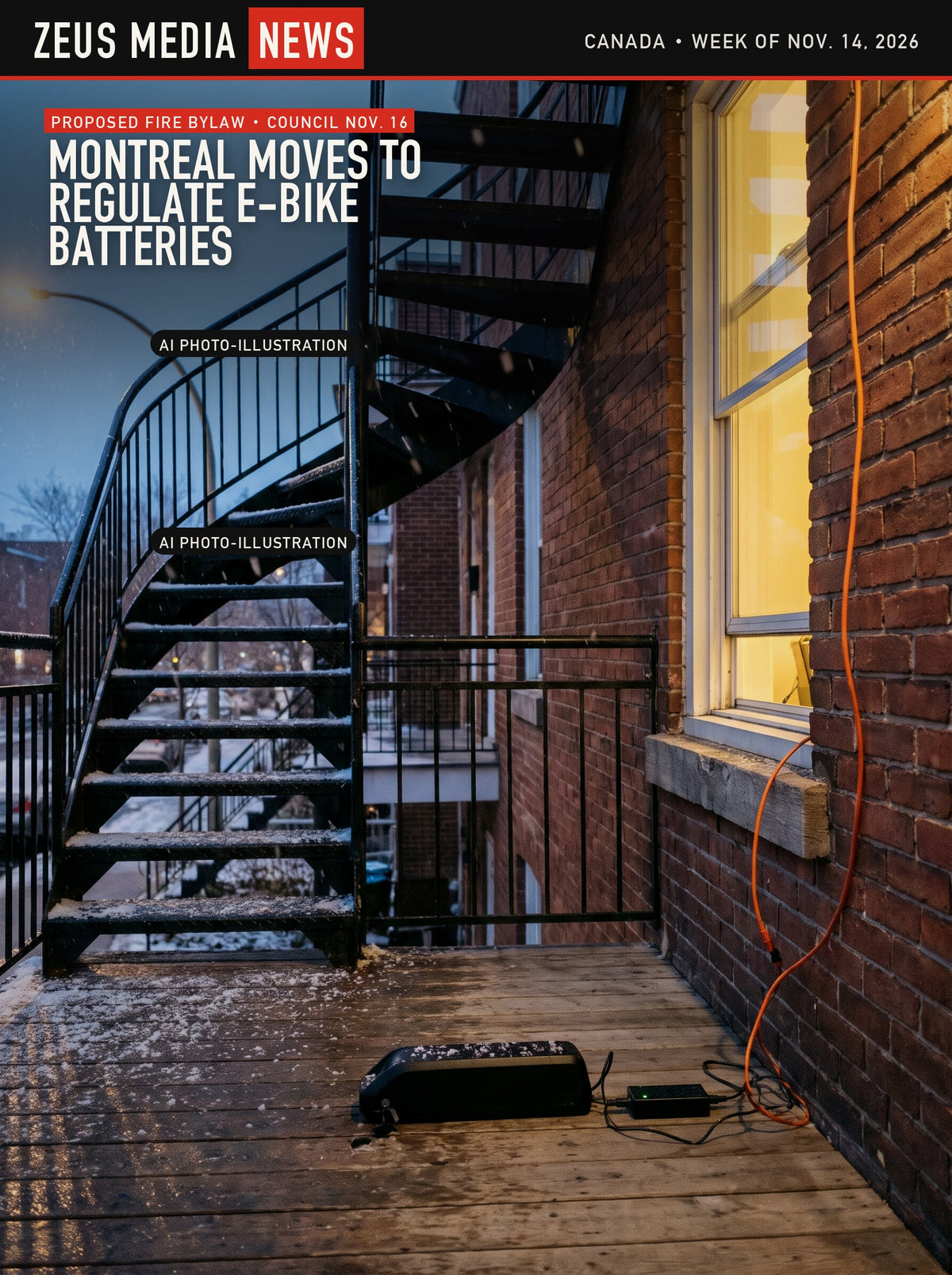
AI-generated photo-illustration (Playcut.ai): an e-bike battery charging on an outdoor stair landing through an extension cord. Montreal’s draft bylaw would bar charging lithium batteries in a means of egress and with an extension cord. No real building, battery or person is shown.
On November 11, Montreal’s executive committee received a draft fire-prevention bylaw from the city’s fire department, the Service de sécurité incendie de Montréal (SIM), that would replace rules written in 2012. Among the eight rules in its battery article: batteries, chargers and cables certified by a Canadian accreditation body, no power bars or extension cords for charging, repairs or modifications only in industrial premises, no charging in a building’s evacuation routes, and no sale of uncertified products (City of Montreal decision file).
The city’s own file calls the draft “l'un des encadrements municipaux les plus complets au Canada”, one of the most complete municipal frameworks in Canada, for lithium-battery safety. It is still a proposal: city council’s agenda for Monday, November 16, lists a notice of motion and tabling, and adoption would come at a later meeting (council agenda). La Presse reported that fines under the revised bylaw would double, to as much as $2,000 for a first offence (La Presse).
If you ride an e-bike in Montreal, the draft reaches the stairwell, the charger and the battery itself. In Toronto, the TTC’s winter ban on e-bikes and e-scooters began November 15, and Ontario’s comment period on its own battery proposal closes November 16. This edition sets out those rules first, then the rest of the week across Canada: a rider’s death, injuries, court decisions, three building fires involving batteries, police campaigns and changes to paths and bike share.
In the week of November 7 to 14, 2026, Montreal’s fire department put a draft bylaw before the city with eight lithium-battery rules, among them certified batteries and chargers only and no charging in evacuation routes; it goes to council for a notice of motion on November 16. The TTC barred e-bikes and e-scooters from November 15 to April 15. OPP said a 14-year-old e-bike rider died after a crash in Essex, Ont., and a charging e-scooter caused a house fire in St. John’s.
Health Canada recalled no e-bike, e-scooter, battery or charger this week. To check what applies where you ride, see the e-bike rules of every province and territory.
This is a weekly record of Canadian news about people on e-bikes, bicycles and e-scooters, and the rules they ride under. We searched Google News in English and French 1,558 times, ran 62 targeted searches, among them for battery fires, deaths and injuries, read the sitemaps of 468 Canadian newsrooms, police services and governments, and opened 1,801 leads, 1,573 of which we read in full.
Each record below was read in its own report or official record and is dated by the event, not by the search. Montreal’s draft bylaw was read in the city’s own decision file, inside the 792-page executive committee package. We do not print the names of people killed, hurt or charged. The full method and its limits are under How We Built This Edition.
Written and verified by Milad Ghobadibeygvand, BScN (Western University, 2014), Zeus eBikes Canada, from sources read November 15, 2026. News tips and corrections: milad@zeusebikes.ca.
In This Edition
- The Week in 13 Records
- Battery Rules: Montreal’s Draft, the TTC Ban and Ontario’s Deadline
- Battery Fires
- A Rider’s Death in Essex, Ont.
- Injuries Reported This Week
- Courts
- Councils, Bylaws and Proposals
- Police Campaigns and Warnings
- Paths, Trails and Bike Share
- Federal Records: No Recall
- Where Reports Differ
- Dates to Watch
- Before You Buy or Ride
- Frequently Asked Questions
- How We Built This Edition, and Its Limits
- Sources
The Week in 13 Records
Two of this week’s records reach riders soonest. In Toronto, e-bikes stay off the TTC through April 15; in Montreal, a draft bylaw would change where and how a battery may be charged, and it reaches council on November 16. These 13 records are the week’s essentials, each linked to its source.
| Date | What happened | Record |
|---|---|---|
| Nov. 9 | Two new charges were laid against the 17-year-old accused in the Oct. 30 death of a cyclist in Montreal’s Ahuntsic-Cartierville; he stays detained until at least a Dec. 2 hearing | Radio-Canada |
| Nov. 9 | A Saanich, B.C., driver who killed a cyclist in July 2025 received the maximum for driving without due care: a $2,000 fine and a two-year driving ban | CHEK News |
| Nov. 9 | Vancouver police launched Project Vigilance, a dark-season traffic campaign; police told CityNews that officers wrote 100 tickets in its first two days, most for riding without a helmet | Vancouver Police |
| Nov. 9 | A lithium-ion battery fire in a Sarnia, Ont., rowhouse: four residents escaped and a dog died | Sarnia News Today |
| Nov. 9 | BIXI said its winter service runs Nov. 16 to April 14, with 267 stations and more than 2,600 bikes | BIXI Montréal |
| Nov. 10 | OPP said the 14-year-old e-bike rider struck by a vehicle in Essex, Ont., on Nov. 4 has died | CBC |
| Nov. 11 | Montreal’s executive committee received a draft fire bylaw with eight lithium-battery rules; it goes to city council for notice of motion on Nov. 16 | Ville de Montréal |
| Nov. 11 | Windsor’s mayor-elect said he would consider a ban on e-bikes and e-scooters | AM800 |
| Nov. 11 | Waterloo police said they expect to lay charges after an e-bike rider was hurt in a collision with a car | CityNews Kitchener |
| Nov. 13 | The TTC said e-bikes and e-scooters are barred from its vehicles and property from Nov. 15 to April 15 | TTC |
| Nov. 13 | Toronto’s police chief said e-scooters are not allowed on roadways, sidewalks or bike lanes | CP24 |
| Nov. 13 | A charging e-scooter caused a fire that gutted a home in St. John’s and displaced five people | The Telegram |
| Nov. 13 | A passenger convicted in a 2024 hit-and-run that killed a Winnipeg cyclist received a conditional sentence, with no jail | CBC |
Battery Rules: Montreal’s Draft, the TTC Ban and Ontario’s Deadline
Three sets of battery rules stand at three different stages this week. Montreal’s fire department sent its city a draft bylaw that would govern how batteries are charged, stored, sold and repaired. The TTC’s annual winter ban took effect November 15. And Ontario’s Fire Code proposal reaches the end of its comment period on November 16.
Montreal: what the draft bylaw says
The draft Règlement sur la prévention des incendies would replace a bylaw adopted in 2012 and partly amended in 2017. The city’s decision file says the rise of lithium batteries and electric micromobility devices created risks the old rules only partly covered (City of Montreal). Its battery article, 2.4.15, reads, in our translation:
| Article | What the draft says |
|---|---|
| 2.4.15.1 (1) and (2) | Every lithium battery in use, and every charger and cable used to charge one, must be certified by a Canadian accreditation body. |
| 2.4.15.1 (3) | Batteries must be charged according to the maker’s directions. |
| 2.4.15.1 (4) | No power bar or extension cord may be used to charge a lithium battery. |
| 2.4.15.1 (5) | A lithium battery may be repaired or modified only in an industrial establishment. |
| 2.4.15.2 (1) | No lithium battery may be charged in a common area that can be used for evacuation, or in a means of egress. |
| 2.4.15.3 (1) | A damaged battery, or one whose integrity is compromised, must be stored right away outside the building or in a container or cabinet designed for it. |
| 2.4.15.4 (1) | No one may sell a lithium battery, charger or cable that is not certified by a Canadian accreditation body. |
The rule on shared spaces, in the draft’s own words: « Aucune batterie au lithium ne peut être rechargée dans une aire commune pouvant être utilisée pour l’évacuation ou dans un moyen d’évacuation. » The draft defines electric micromobility devices to include e-bikes, scooters, skateboards and electric unicycles, as well as mobility aids such as three- and four-wheel mobility scooters and power wheelchairs.
The bylaw is a proposal. The executive committee’s November 11 agenda carried the fire department’s recommendation that council adopt it (executive committee agenda), and the November 16 council agenda lists a notice of motion and tabling, the first step before any adoption vote (council agenda).
La Presse reported that fines would double, to as much as $2,000 for a first offence, $5,000 for a repeat and up to $10,000 for a corporation, and that lithium-battery fires rose 195 per cent in two years in Montreal (La Presse). Jim Beis, the executive committee member responsible for security and prevention (City of Montreal), told La Presse the changes would be phased in, with guidance and voluntary compliance first.
Robert Rousseau, the SIM division chief named as the file’s lead, told CTV News the fire department sees roughly 36 fires a year from lithium-ion batteries used incorrectly. On repairs he was direct: “If you want to modify or repair a battery, you need to do it in an industrial building.” CTV News reported that Montreal is the second Canadian city, after Vancouver, to seek such a bylaw (CTV News).
Nothing changes in Montreal until council adopts the bylaw and it takes effect. If it passes as drafted, a rider would need a certified battery and charger, could not charge on a power bar or extension cord, and could not charge in a hallway or stairwell that serves as an exit.
Toronto: the TTC’s winter ban begins
From November 15, 2026, to April 15, 2027, e-bikes and e-scooters are not permitted on TTC vehicles or property, the TTC said on November 13. The board approved the annual ban in December 2024, after a battery explosion and fire on a subway train in December 2023, to reduce the fire risk of lithium-ion batteries, which the TTC says are more prone to short circuits and fires in cold months. The rule also answers concerns about the size of the devices, “which can obstruct seating areas and create tripping hazards”, the TTC said (TTC).
Electric wheelchairs and other mobility devices used by people with disabilities are exempt, and conventional bikes, non-electric folding bikes and non-electric scooters remain allowed under the usual rules. E-bikes may be parked at or near most subway entrances (TTC rules page), and the TTC says riders who do not comply may be asked to leave the system (TTC).
Ontario: comments on the battery proposal close November 16
Ontario’s Fire Code proposal, 26-SOLGEN021, would among other things prohibit, in residential buildings, “the charging, parking, and storing of lithium-ion battery-powered micromobility devices and their batteries in lobbies serving as an access to an exit, public corridors or exits”. The registry text we saved on October 28 lists “Comment Due Date: Nov 16, 2026” (Ontario Regulatory Registry). It remains a proposal, and the registry page refused our automated reader again on November 15, so we cite the saved text.
Fire chiefs spoke to the proposal this week. Ottawa Fire Chief Paul Hutt told Postmedia: “We are definitely seeing an increase in these types of fires,” and Postmedia reported that Ottawa’s count of battery fires this year reached 25 four months after a May report to council that counted 10.
Marla Friebe of the Toronto fire department told Postmedia her colleagues have found workshops inside homes where batteries were being modified, and welcomed the hallway rule, telling Postmedia: “In a fire, you could potentially have 100 residents pass through that hallway.” Not every chief reports a surge. Barrie Fire Chief Kevin White told OrilliaMatters: “We’re not having a surge in calls specific to lithium-ion batteries,” adding that Toronto’s counts reflect much denser housing (Postmedia, OrilliaMatters).
The cause is also disputed. Solicitor General Michael Kerzner has said he believes the root cause of the fires is people modifying batteries for better speed or torque, Postmedia reported. The general manager of a Toronto e-bike shop that repairs battery packs told Postmedia that, in six years, he has not seen anyone add cells to boost performance; the problem he sees is owners replacing worn cells themselves, often with cheap cells bought online that cannot be traced to a maker (Postmedia).
Battery Fires
Lithium-ion batteries figured in three building fires this week. Two were blamed on them, one of those on a charging e-scooter; in the third, fire officials said batteries were found in the area of origin but have not confirmed that they caused it. We searched for every Canadian battery fire in the week with eleven English and French queries, checked that they found two of these reports, and then read every Canadian fire report in our census, which is how the third was found.
| Date | Place | What fire officials or reporters said | Source |
|---|---|---|---|
| Nov. 9 | Sarnia, Ont. | At about 3 a.m., a lithium-ion battery caught fire in a rowhouse near Vidal and George streets. Smoke alarms woke the four people inside and they escaped; firefighters could not save the family dog. Damage was about $50,000. The fire service did not say what device the battery powered. Public education officer Mike Otis said: “It's instantaneous fire and almost like an explosion.” | Sarnia News Today, The Sydenham Current |
| Nov. 13 | Windsor, Ont. | Firefighters were called just before 1 p.m. to a fire in one unit of the Glengarry Avenue apartment complex and kept it to that unit; on-site security evacuated residents, and one person was taken to hospital for smoke inhalation and released the next day. Windsor Fire & Rescue Services said lithium-ion batteries were identified in the area of origin; fire officials say there is no confirmation that they sparked the fire, WindsorNewsToday reported. Damage was estimated at about $50,000, and the Ontario Fire Marshal’s Office sent investigators. | Windsorite, WindsorNewsToday |
| Nov. 13 | St. John’s, N.L. | A fire caused by a charging e-scooter gutted a home just after noon and displaced five people. A resident smelled smoke and found the scooter burning in the garage. The resident was not hurt; a cat died. | The Telegram |
Sarnia Fire Rescue’s advice after its fire: buy products certified by CSA or ULC, use the maker’s approved charger, unplug devices once charged, and never charge a damaged, swollen or overheating battery (The Sydenham Current).
A Rider’s Death in Essex, Ont.
The 14-year-old e-bike rider struck by a vehicle in Essex on November 4 has died, Ontario Provincial Police said on November 10. The crash happened at about 9:11 p.m. at Maidstone Avenue East and Cameron Avenue; the driver was not hurt. Police are investigating and have asked anyone with information or dashcam video to contact them (CBC News). Our last edition reported the crash and his life-threatening injuries.
Apart from the e-scooter rider killed in Vancouver on November 7, reported in our last edition, we found no other death of a cyclist or micromobility rider in Canada between November 7 and 14. Our search for rider deaths, in English and French, found that Vancouver report 27 times, our check that it works. Two other deaths it surfaced, in Burlington, N.C., and Middlesex County, N.J., were in the United States.
Injuries Reported This Week
Four riders were reported hurt in collisions in Montreal, Mississauga, Waterloo and Toronto: two cyclists, one e-bike rider and one e-scooter rider. These are only the collisions that reached a report we could read, so this is a floor, not a count.
| Date | Place | What happened | Outcome | Source |
|---|---|---|---|---|
| Nov. 9 | Rosemont–La Petite-Patrie, Montreal | A 65-year-old cyclist on a bike path near Saint-Zotique Street and 16th Avenue was struck at about 3:30 p.m. by a vehicle that was parking, La Presse reported. | Serious upper-body injuries; life not in danger, Montreal police said | La Presse |
| Nov. 9 | Mississauga, Ont. | A vehicle hit a cyclist at Burnhamthorpe Road East and Robert Speck Parkway at about 11 p.m.; the driver remained at the scene, Peel police said. | Injuries downgraded to non-life-threatening | insauga |
| Nov. 11 | Waterloo, Ont. | A 46-year-old e-bike rider and a car collided at University Avenue West and Countrystone Drive at about 6:45 p.m.; police said they expect to lay charges. | Taken to a hospital outside the region | CityNews Kitchener |
| Nov. 13 | Moss Park, Toronto | A car hit a woman riding an e-scooter near Sherbourne and Shuter streets at about 6:40 p.m.; the driver remained at the scene, police said. | Rushed to hospital; no other details released | CityNews Toronto |
Three of the four happened between 6:40 and 11 p.m. Vancouver police launched their campaign for what they called “the longer hours of darkness this season”.
Update to our last edition: Belleville police said on November 9 that the November 7 collision with a cyclist on Herchimer Avenue was a hit-and-run. The cyclist’s injuries are not life-threatening, and police found part of the suspect vehicle’s bumper and believe the vehicle is black (Quinteist).
Reported this week, dated earlier
Eight reports published this week describe events before November 7, or on a date the report does not give.
| Date of event | Place | What happened | Source |
|---|---|---|---|
| Oct. 1, 2023 | Victoria | A cyclist hit on the Richardson Street bikeway at Cook Street by a driver who ran a red light told the Times Colonist the driver received only a traffic ticket; he needed nearly a year to walk again. | Times Colonist |
| Oct. 14 | Toronto | The City of Toronto updated the Bloor Street West bike-lane removal contractor’s hours at 12:14 p.m. on Oct. 14 to allow the work at any point in the day, hours after protesters had halted the overnight work, Canada’s National Observer reported; the outlet received a copy of the original permit, which limited work to 8 p.m. to 6 a.m. Its headline credits the province, while its report says the city sent the updated permits. Cycle Toronto’s executive director said he has “zero doubt” the change answered the protest, and the outlet reported that province-commissioned documents estimated the removal would raise collisions by 54 per cent. | Canada’s National Observer |
| Oct. 26 | Ottawa | A cyclist struck by a pickup truck in south Ottawa blacked out on the pavement; CBC reported on Nov. 9 that the driver received a $110 fine and two demerit points. | CBC |
| Oct. 31 | Delta, B.C. | A teen broke a knee in a bicycle crash on Halloween night; a local Shrine club is helping the family, the Delta Optimist reported on Nov. 14. | Delta Optimist |
| Nov. 2 | Notre-Dame-de-Grâce, Montreal | The borough council voted to proceed with removing one side of the Terrebonne Street bike path for the winter; borough officials estimate it frees about 60 parking spaces, and residents opposed to the change say there was no public consultation. | The Suburban, The Rover, CityNews Montreal |
| Nov. 3 | Red Deer, Alta. | A man out on his daily walk was badly injured when an e-bike hit him, the Red Deer Advocate reported on Nov. 13. | Red Deer Advocate |
| Nov. 6 | Peterborough, Ont. | Police said a man with a knife demanded a 15-year-old’s bicycle near Simcoe and Aylmer streets; a 41-year-old man was arrested nearby and charged with robbery, and the bike was returned. The allegation has not been tested in court. | PTBO Today |
| Date not given | Newmarket, Ont. | A 66-year-old man told Village Report that teens on electric dirt bikes, whom he had honked at for riding across both lanes, followed and tackled him after he took a rider’s phone as evidence. York Regional Police said investigators reviewed the video, cautioned the man about his own behaviour and closed the case. | Village Report |
Courts
Three courts moved on cyclists’ deaths this week: two new charges in Montreal against the teen accused in the Ahuntsic-Cartierville death, the maximum penalty for driving without due care for a Saanich driver, and a conditional sentence in Winnipeg for a passenger in a fatal hit-and-run. We do not name the people killed or the accused.
- Montreal, Nov. 9: the 17-year-old accused in the October 30 death of an 18-year-old cyclist in Ahuntsic-Cartierville appeared on two new charges, dangerous driving and fleeing police, for an earlier event that prosecutors declined to date, bringing the total to seven. He remains detained until at least a December 2 hearing; the defence is seeking his release and the Crown opposes it. He cannot be named under the Youth Criminal Justice Act, and the allegations have not been tested in court (Radio-Canada, CBC News).
- Saanich, B.C., Nov. 9: a driver who ran a red light and killed a cyclist crossing Quadra Street on the Lochside Trail on July 28, 2025, received the maximum penalty for driving without due care and attention: a $2,000 fine and a two-year driving ban. Provincial court Judge David Silverman acknowledged some may see the sentence as “grossly inadequate,” CHEK News reported (CHEK News).
- Winnipeg, Nov. 13: a passenger who told the driver to keep going after a June 6, 2024, hit-and-run that killed a cyclist on Wellington Crescent, and who later took the wheel, received a one-year conditional sentence to be served in the community and a year of probation from Judge Catherine Carlson. He was convicted at trial last year of leaving the scene of a collision resulting in death; the driver was earlier sentenced to three years in prison (CBC News, Winnipeg Free Press).
Councils, Bylaws and Proposals
Beyond Montreal’s fire bylaw, one incoming mayor floated a ban, residents pressed a Montreal borough council on cyclists’ safety, and two Quebec cities took up cycling questions. Windsor’s mayor-elect, Fred Francis, told WindsorNewsToday in a report published November 11: “Anything we can do to increase the safety of our roadways and pathways for our residents would be the responsible thing to consider,” adding that any new bylaw would be for the incoming council. Nothing has been proposed to council.
| Where | What | Stage | Source |
|---|---|---|---|
| Montreal | Draft Règlement sur la prévention des incendies (eight lithium-battery rules; higher fines), recommended by the fire department to council through the Nov. 11 executive committee. | Proposal; notice of motion and tabling at council on Nov. 16 | Ville de Montréal, La Presse |
| Ahuntsic-Cartierville, Montreal | At a packed November 9 borough council, residents asked for measures to protect cyclists and pedestrians after the October 30 death of a cyclist, and a teacher brought a petition against the winter closure of the Chabanel-sector bike paths, which close November 16. Borough Mayor Maude Théroux-Séguin agreed the borough had not told residents in time: « Vous avez 100 % raison. C’est inadéquat. Cela aurait dû être fait au début novembre » | Raised at council, Nov. 9 | Journal des voisins, La Presse |
| Windsor, Ont. | Mayor-elect Fred Francis said he would consider a ban on e-bikes and e-scooters and is not sure yet what is legally possible; any new bylaw would be enacted by the incoming council. | Statement; no motion yet | AM800, WindsorNewsToday |
| Saint-Georges, Que. | Two residents told council of their concern about a planned access road that would take 53-foot trucks across a bike path on 35th Avenue to a business site. | Raised at council question period, Nov. 9 | EnBeauce.com |
| Shawinigan, Que. | A pump track at Sainte-Flore park won the city’s 2026 participatory budget vote with 2,418 points. | Winner announced, Nov. 11 | Info Mauricie |
| Montreal | Council will vote on a 12-month sole-source contract, worth $1,724,625 with taxes, with PBSC Solutions Urbaines for equipment compatible with the BIXI system. | On the council agenda for Nov. 16 | Ville de Montréal |
Police Campaigns and Warnings
Police in Vancouver and Toronto spoke to e-scooter riders this week: tickets in Vancouver, where officers say most went to riders without helmets, and a warning to parents in Toronto, where police say e-scooters are not legal on public streets. Chilliwack’s RCMP reported its October ticket count, and Halton police a bike-shop theft.
| Where | What police said or did | Source |
|---|---|---|
| Vancouver | Police launched Project Vigilance on Nov. 9 for the dark, rainy season. Sgt. Adam Donaldson told CityNews: “In the first two days of the project, they handed out 100 tickets. Most of those tickets were for not wearing helmets.” He said the second most common offence was riding on the sidewalk, and that this campaign brings fewer warnings and more tickets than September’s. | Vancouver Police, CityNews Vancouver |
| Chilliwack, B.C. | The RCMP detachment said it issued 401 violation tickets in October during a month focused on e-scooter safety and school zones; it did not say how many went to e-scooter riders. | Fraser Valley Today |
| Toronto | Police Chief Myron Demkiw asked parents to think hard before giving children e-scooters. “To be clear, e-scooters are not allowed on roadways, sidewalks, or bike lanes at all,” he said on CP24, adding that “there is no regulatory framework for e-scooters.” He said e-bikes are allowed in bike lanes but not on sidewalks. | CP24 |
| Milton, Ont. | Halton police said two bicycles worth more than $5,000 were stolen in an early-morning break-in at a Main Street bike shop on Nov. 10. | MiltonToday |
In Toronto, police say e-scooters are not allowed on roads, sidewalks or bike lanes, and the TTC bars them from its vehicles and property all winter. In Vancouver, police are ticketing e-scooter riders, mostly for riding without a helmet and on sidewalks.
Paths, Trails and Bike Share
Montreal’s bike share keeps 267 stations open this winter, while shared e-scooters stop for the season in Regina on November 15 and in Kamloops at the end of the month. Vancouver reopened a stretch of the Stanley Park seawall without its speed gates. Elsewhere the week brought path closures in Drummondville and St. Catharines, a bike path to be rebuilt in Montreal’s Hochelaga-Maisonneuve, path openings in two Quebec regions and new hours on the Gordie Howe bridge path.
| Where | What changed | Source |
|---|---|---|
| Greater Montreal | BIXI’s winter service runs Nov. 16 to April 14 with 267 stations and more than 2,600 bikes, its fourth winter, the company said. | BIXI Montréal |
| Regina | The city’s shared e-scooter season ends Nov. 15 and returns in spring 2027; privately owned scooters can still be used. | SaskToday |
| Kamloops, B.C. | The city’s shared e-scooters, run by Bird in their first season since March, come off the streets at the end of November and return in spring, the city said. | Castanet |
| North Bay, Ont. | The Laurentian Escarpment community trails could become the first mapped network of adaptive mountain-bike trails in Northern Ontario, Radio-Canada reported; a two-day assessment by adaptive mountain bikers and their companions examined the routes’ accessibility and possible improvements. | Radio-Canada |
| Hochelaga-Maisonneuve, Montreal | Part of a nearly new bike path on Hochelaga Street must be rebuilt because a lamp post got in the way of fire trucks, TVA Nouvelles reported. | TVA Nouvelles |
| Drummondville, Que. | The sidewalk and bike path on the Traverse bridge close from Nov. 16 for about five days of repairs; pedestrians and cyclists detour by the Curé-Marchand bridge. | L’Express de Drummondville |
| St. Catharines, Ont. | The multi-use path beside the Welland Canals Parkway closes from Nov. 16 to April 2027 for work on the Garden City Skyway twinning, with cyclists detoured by Eastchester Avenue East, Cushman Road and Queenston Street; a temporary route that closely follows the original path is to be put in place in spring 2027, the project’s closure notice says. The parkway itself closes to through traffic for about three construction seasons. | project notice, Niagara This Week, 101.1 More FM |
| Beauharnois-Salaberry, Que. | The regional park’s bike path reopened in full after October work in the Sainte-Martine and Beauharnois sectors. | Néomédia |
| Disraeli, Que. | The first phase of an intermunicipal bike path on the former railway line is complete. | Courrier Frontenac |
| Vancouver | The Stanley Park seawall between Lumberman’s Arch and Third Beach reopened Nov. 13 after work that removes the speed gates, also called maze gates, near Lumberman’s Arch, Prospect Point and Third Beach; the city says intermittent closures may follow in spring 2027. | City of Vancouver |
| Windsor, Ont. | New hours for the Gordie Howe International Bridge path took effect Nov. 9: 10 a.m. to 4 p.m. on weekdays and 10 a.m. to 6 p.m. on weekends. | Kingsville Times |
Federal Records: No Recall
Health Canada posted no recall or alert for an e-bike, e-scooter, battery or charger between November 7 and 14. Two consumer-product recalls fell in the week, a fuel and a vaping device, neither related to riding.
We read its full open-data export, whose newest entry was dated November 13 (Health Canada export), and the recall site on November 15, where the only newer posting was a food recall dated November 14 (Recalls and Safety Alerts). The classifier found three known e-bike recalls in the same file, our check that it works.
In the Canada Gazette, Part I’s only issue in the week was the regular edition of November 14, with no extra edition, and Part II published no issue between November 7 and 14. The 7 item pages of the November 14 issue do not mention bicycles, batteries or scooters (Canada Gazette).
Where Reports Differ
Four facts this week were reported differently by different outlets: the date of the Essex crash, the year of the subway fire behind the TTC’s ban, the day e-bikes return to the TTC, and whether one battery or several was found at the Windsor fire. Where a primary record exists we use it and say so, and we link every version so you can check.
- The date of the Essex crash. CTV News’s video summary dates it November 3; Ontario Provincial Police, as reported by CBC News, gave November 4 at about 9:11 p.m. We use the police date (CTV News, CBC News).
- The year of the subway fire behind the TTC ban. The TTC’s release says December 2023; TorontoToday says New Year’s Eve 2023 and Postmedia dates the subway fire December 31, 2023; NOW Toronto says 2024. We use the TTC’s date (TTC, TorontoToday, Postmedia, NOW Toronto).
- When e-bikes return to the TTC. TorontoToday says April 15, 2027. The TTC’s release says the ban runs to April 15, and its rules page says e-bikes are permitted again from April 16. We use the TTC’s rules page (TorontoToday, TTC, TTC rules page).
- The batteries at the Windsor fire. Windsorite wrote: “Investigators say a lithium-ion battery was found at the area of origin.” Windsor Fire & Rescue Services’ own post, embedded by WindsorNewsToday, says: “Lithium-ion batteries identified in the area of origin.” We use the fire service’s wording (Windsorite, WindsorNewsToday).
Dates to Watch
The dates that follow from this week’s records run from the TTC ban that began November 15, through Montreal’s council meeting and Ontario’s comment deadline on Monday, November 16, and a youth-court hearing in Montreal on December 2, to the spring, when BIXI’s winter service ends and e-bikes return to the TTC.
- Nov. 15: the TTC’s ban on e-bikes and e-scooters begins (TTC); Regina’s shared e-scooters stop for the winter (SaskToday).
- Nov. 16: Montreal council takes notice of motion on the fire-prevention bylaw and votes on the BIXI equipment contract (council agenda); Ontario’s comment period on its battery proposal closes (Ontario Regulatory Registry); BIXI’s winter service starts (BIXI); Drummondville closes the Traverse bridge path for about five days (L’Express); Ahuntsic-Cartierville closes its Chabanel-sector bike paths until March 31 (La Presse); the multi-use path beside the Welland Canals Parkway in St. Catharines closes until April 2027 (project notice).
- Dec. 2: the next hearing for the teen accused in the Ahuntsic-Cartierville death (Radio-Canada).
- April 14, 2027: BIXI’s winter service ends (BIXI).
- April 16, 2027: e-bikes and e-scooters are allowed back on the TTC, according to its rules page (TTC).
Before You Buy or Ride
This section is ours, and it is the only part of this edition about what we sell. Two of this week’s records apply to anyone choosing an e-bike now. Montreal’s draft would require batteries, chargers and cables certified by a Canadian accreditation body, and Sarnia’s fire service advises products certified by CSA or ULC with the maker’s own charger. Whatever you buy, from us or anyone else, ask which certification the battery and charger carry, and keep the charger that came with the bike.
If you are shopping, start with our e-bike collection or 500 W e-bike collection, then check any model against your province’s rules and our e-bike battery safety guide. Questions about a model, or about charging it safely where you live, go to a person at 1-866-938-7580.
Frequently Asked Questions
What is the latest e-bike news in Canada?
In the week of Nov. 7 to 14, 2026, Montreal’s fire department put a draft bylaw before the city with eight rules for lithium batteries, including certified batteries and chargers only and no charging in evacuation routes; it goes to council for a notice of motion on Nov. 16. The TTC barred e-bikes and e-scooters from Nov. 15 to April 15, OPP said a 14-year-old e-bike rider died after a crash in Essex, Ont., and courts sentenced two people in cyclists’ deaths in Saanich, B.C., and Winnipeg. This edition holds 48 records, each read at its source.
Are e-bikes allowed on the TTC?
Not from Nov. 15, 2026, to April 15, 2027. The TTC says e-bikes and e-scooters are not permitted on its vehicles or property during that period, an annual winter rule its board approved in December 2024 to reduce lithium-ion battery fire risk. Mobility devices used by people with disabilities are exempt, and riders can park e-bikes at or near station entrances.
Can I charge my e-bike in my apartment?
Inside your own unit, nothing in this week’s records bans it. What the rules target are shared spaces and how you charge. Montreal’s draft bylaw would bar charging a lithium battery in a common area that can be used for evacuation and would ban power bars and extension cords for charging. Ontario’s Fire Code proposal would bar charging, parking and storing e-bikes and their batteries in residential lobbies, public corridors and exits. Neither is law yet.
What is Montreal’s new fire bylaw on lithium batteries?
It is a draft Règlement sur la prévention des incendies that would replace the city’s 2012 bylaw. Its battery article requires certified batteries, chargers and cables, charging as the maker directs, no power bars or extension cords, repairs or modifications only in industrial premises, no charging in evacuation routes, safe storage of damaged batteries and no sale of uncertified products. It reaches city council for a notice of motion on Nov. 16; adoption would come at a later meeting.
Is it illegal to modify an e-bike battery?
Not yet in Montreal or Ontario. Montreal’s draft bylaw would allow a lithium battery to be repaired or modified only in an industrial establishment, and Ontario’s Fire Code proposal would prohibit unauthorized modification of lithium-ion batteries. Both are proposals; Ontario’s comment period closes Nov. 16.
Are e-scooters legal in Toronto?
Not on public streets, according to Toronto police and the TTC. Police Chief Myron Demkiw said on Nov. 13 that e-scooters are not allowed on roadways, sidewalks or bike lanes, and the TTC’s rules page says e-scooters are illegal to ride on Toronto streets and are banned from TTC vehicles and property each winter.
What are the e-scooter rules in Vancouver?
Vancouver police list a maximum speed of 25 km/h, front and rear lights, no sidewalk riding unless a sign allows it and no doubling. In the first two days of the police’s Project Vigilance in November, officers wrote 100 tickets, most to riders without helmets.
Is BIXI open in winter?
Yes. BIXI says its winter service runs from Nov. 16, 2026, to April 14, 2027, with 267 stations and more than 2,600 bikes.
What happened to the cyclist killed in Montreal?
An 18-year-old cyclist was struck and killed on Oct. 30 at Henri-Bourassa Boulevard West and Jeanne-Mance Street in Ahuntsic-Cartierville. On Nov. 9 the 17-year-old accused faced two new charges, dangerous driving and fleeing police, for an earlier event prosecutors did not date, bringing the total to seven. He remains detained until at least a Dec. 2 hearing; the allegations have not been tested in court.
How We Built This Edition, and Its Limits
We searched Canadian news published November 7 to 15, 2026, in Google News, in English and French: daily searches for e-bikes, e-scooters, other micromobility devices, cyclists, bike lanes, bylaws and battery fires; week-long searches for every province, territory and 315 cities and towns; and splits of any search that hit Google’s 100-result cap (one did). That made 779 requests, none of which failed, and returned 6,984 results and 3,825 distinct headlines, of which 417 named a Canadian place, institution or outlet.
A second full run on November 15 made the same 779 requests, also without a failure, and returned 40 headlines the first had not, because the index returns a different set each time; we read them all.
We also read the sitemaps of 468 newsrooms, police services and governments (336 answered), which added 526 leads, and ran 62 targeted searches; the fire and death searches each had to find reports we already knew existed before we believed their results. A gazetteer of 2,857 Canadian place names and a check of each unfamiliar publisher’s home page sorted the rest, and location was confirmed from each article’s text.
In all, 1,801 leads were opened: 1,573 were read in full and 228 could not be read (159 refused or failed, 69 came back as empty or thin pages), most of them on foreign sites.
654 of the reads were judged Canadian. We first reviewed the 524 that mentioned riding at least twice; after first publication we reviewed the other 130, and 40 more from Canadian outlets or of unclear origin. We read the in-scope reports in full, merged copies of the same report, and set aside stories outside this beat or outside the week, which left 48 records. Health Canada’s recall export and the week’s Gazette issue were read whole.
Five limits apply to this record.
- The counts are a floor. They include only events that reached a report we could read.
- Unreadable and paywalled pages. Of the 228 leads our reader could not open, 25 had a Canadian outlet or place in the headline; we reached every in-scope story among them another way, through another outlet’s copy of the same report or in our browser. The Trillium’s November 10 report on Ontario Transportation Minister Prabmeet Sarkaria’s Empire Club speech, which its headline says included a joke about bike lanes, is paywalled; we could read only the headline, so it is not in this record. Cornwall Newswatch’s November 9 report of a February sentencing date in a County Road 2 crash involving a cyclist is for subscribers only, and we found no other outlet carrying it.
- Search dates. Search indexes sometimes date old stories as new; we checked every date against the report itself and set aside three published before the week.
- The registry. Ontario’s Regulatory Registry refused automated access; the proposal’s text is cited from our October 28 copy.
- One verifier. Each record was read and checked by the author named above, against saved copies of every source.
Additions, November 15, 2026. After first publication at 2:31 a.m. Eastern, we reviewed every Canadian report in our census that our first sort had set aside. At 2:57 a.m. that review added a Windsor apartment fire where lithium-ion batteries were found in the area of origin, the end of Kamloops’s shared e-scooter season, the Ahuntsic-Cartierville council meeting of November 9, a National Observer report on the Bloor removal permit and a North Bay trail assessment. Later the same morning it added the closure of the Welland Canals Parkway path in St. Catharines.
Corrections, November 15, 2026. The same review corrected four passages. The Windsor row and the fires summary said one battery where the fire service reported batteries; the row also gave the time firefighters were called as the time of the fire, and said security evacuated the building where one report says the unit. The Bloor row credited a permit copy with the time of the change, but the copy the outlet received is the original permit. The North Bay row tied the first-network prospect to the assessment, which Radio-Canada did not do. Saint-Georges and Shawinigan are cities, not towns.
If you see an error, write to milad@zeusebikes.ca and we will correct it here, dated.
More Zeus guides on the rules: Montreal e-bike rules · Quebec e-bike laws · Toronto e-bike laws · Ontario e-bike laws · B.C. e-bike laws · e-bike battery safety · last week’s e-bike news
Sources
Government, police and agency records (read November 15, 2026, unless noted):
- Ville de Montréal, Conseil municipal, ordre du jour de l’assemblée ordinaire du 16 novembre 2026 (version 2), item 41.09 and item 20.22
- Ville de Montréal, Comité exécutif, séance du 11 novembre 2026, documents (dossier 1262559002, Règlement sur la prévention des incendies, art. 2.4.15)
- Ville de Montréal, Comité exécutif, ordre du jour adopté, 11 novembre 2026, item 40.005
- Ville de Montréal, Comité exécutif, members and roles (read Nov. 15, 2026)
- Toronto Transit Commission, TTC reminds customers of winter ban on e-bikes and e-scooters starting November 15, news release, Nov. 13, 2026
- Toronto Transit Commission, Bikes on TTC vehicles (read Nov. 15, 2026)
- Ontario Regulatory Registry, proposal 26-SOLGEN021, Fire Code and administrative penalties for lithium-ion batteries (posted Oct. 21, 2026; text read Oct. 28; the page refused automated access on Nov. 15)
- Vancouver Police Department, VPD launches traffic safety campaign during dark and rainy season, news release, Nov. 9, 2026
- Health Canada, Recalls and Safety Alerts (site read Nov. 15, 2026)
- Health Canada, Recalls and Safety Alerts open-data export (downloaded Nov. 15, 2026; newest entry Nov. 13)
- Canada Gazette Part I, Nov. 14, 2026 (7 item pages read)
- BIXI Montréal, BIXI Ends Its 2026 Season on a Positive Note and Keeps 267 Stations Open This Winter, release via CNW, Nov. 9, 2026
- Ville de Disraeli and partners, release via Courrier Frontenac, Nov. 10, 2026
- Ville de Drummondville, release via L’Express de Drummondville, Nov. 14, 2026
- City of Vancouver, Stanley Park Seawall safety and accessibility upgrades (read Nov. 15, 2026)
- QEW Garden City Skyway Bridge Twinning Project, Notice of Road Closure: Welland Canals Parkway, November 2026 (read Nov. 15, 2026)
News reports, all 2026, by outlet and author where the report names one:
- La Presse (Henri Ouellette-Vézina), Les amendes imposées par le SIM vont doubler, Nov. 12
- CTV News Montreal (Christine Long), Montreal fire department urges city to revise bylaw due to risk posed by e-bike batteries, Nov. 12
- TorontoToday staff, E-bikes, e-scooters banned on TTC vehicles and property starting Sunday, Nov. 13
- NOW Toronto, Starting Sunday, Toronto commuters will face a seasonal ban on e-bikes and e-scooters on the TTC, Nov. 14
- Postmedia via Toronto Sun (Alan S. Hale), Ontario eyes ban on e-bike, e-scooter battery modifications to prevent fires, Nov. 10
- OrilliaMatters (Bob Bruton), ‘Here to stay’: New regulations coming for lithium-ion batteries, Nov. 13
- Sarnia News Today (Melanie Irwin), Lithium-ion battery, unattended cooking spark Sarnia fires causing $100K in damage, Nov. 9
- The Sydenham Current, Dog dies in Sarnia lithium-ion battery fire; all four residents escape, Nov. 10
- Windsorite staff, Fire at 333 Glengarry Avenue, Nov. 13
- WindsorNewsToday via CK News Today (Mark Brown), Fire at Glengarry unit causes $50K in damage, Nov. 14
- The Telegram via SaltWire (Keith Gosse), E-scooter fire causes extensive damage to St. John’s home, Nov. 13
- CBC News Windsor (Heather Kitching), Teen severely injured in Essex e-bike collision has died, police say, Nov. 10
- CTV News Windsor (Rob Hindi), Teen dies in Essex e-bike crash (video), Nov. 10
- La Presse (William Thériault), Un cycliste de 65 ans gravement blessé lors d’une collision, Nov. 9
- insauga (Karen Longwell), Cyclist hit by vehicle in Mississauga’s City Centre, Nov. 10
- CityNews Kitchener (Erin Anderson), Charges anticipated after crash involving e-bike in Waterloo, Nov. 12
- CityNews Toronto (Denio Lourenco), E-scooter rider hit by car near Moss Park, Nov. 13
- Radio-Canada Info, Nouvelles accusations contre le chauffard qui a tué un cycliste de 18 ans dans Ahuntsic, Nov. 9
- CBC News Montreal, More charges for teen accused in fatal hit and run of Montreal cyclist, Nov. 9
- CHEK News (Kori Sidaway), Driver who fatally struck cyclist in 2025 handed 2 year driving ban, Nov. 9
- CBC News Manitoba (Caitlyn Gowriluk), No jail for passenger who told driver to flee scene of Winnipeg crash that killed cyclist, Nov. 13
- Winnipeg Free Press (Dean Pritchard), Man gets house arrest for role in Wellington Crescent collision that killed cyclist, Nov. 13
- PTBO Today (Freq 90.5 / 96.7 WOW FM News staff), Peterborough man charged with robbery, Nov. 9
- AM800 CKLW (Rusty Thomson), Windsor mayor-elect Francis open to e-bike ban to improve safety, Nov. 11
- WindsorNewsToday via Sarnia News Today (Adelle Loiselle), New Windsor Mayor open to banning e-scooters, Nov. 11
- EnBeauce.com (Germain Chartier), Saint-Georges: des citoyens s’inquiètent des camions sur la piste cyclable, Nov. 10
- Info Mauricie, Budget participatif à Shawinigan : dévoilement du projet gagnant, Nov. 11
- CityNews Vancouver (Marija Robinson), 100 e-scooter riders already ticketed during latest VPD project blitz, Nov. 11
- Fraser Valley Today (Mike Vanden Bosch), Chilliwack RCMP issue hundreds of tickets during enforcement blitz, Nov. 9
- CP24 (Codi Wilson), Parents should think ‘long and hard’ about buying e-scooters for kids: Toronto’s police chief, Nov. 13
- MiltonToday staff, Bicycles stolen from downtown Milton shop, Nov. 11
- SaskToday, Regina’s e-scooter season rolls to a stop this weekend, Nov. 13
- TVA Nouvelles (Marie-Laurence Delainey), Un lampadaire nuisait aux pompiers, Nov. 9
- Néomédia (Marie-Claude Pilon), Réouverture complète de la piste cyclable, Nov. 10
- Kingsville Times, New hours for Gordie Howe Bridge multi-use path now in effect, Nov. 11
- Niagara This Week (Kevin Werner), Skyway twinning work starting next week; Welland Canal Parkway, multi-use path to be closed, Nov. 12
- 101.1 More FM (Geoff Waterfield), Parts of Welland Canals Parkway Closing, Nov. 13
- CBC News Ottawa (Rebecca Zandbergen), This cyclist was hit by a pickup truck. It cost the driver $110 and 2 demerit points, Nov. 9
- Red Deer Advocate (Paul Cowley), Nov. 13
- Delta Optimist (Phil Melnychuk), Shriners trying to help family after bad bicycle crash on Halloween, Nov. 14
- Times Colonist (Roxanne Egan-Elliott), Cyclist hit by Victoria red-light runner calls for more consequences for drivers, Nov. 12
- Quinteist (Hollie Pratt-Campbell), Cyclist injured in Belleville hit-and-run, police looking for suspect, Nov. 9
- The Rover (Isaac Peltz), Battle Over NDG Bike Lane Heats Up at Borough Council, Nov. 13
- The Suburban (Dan Laxer), Terrebonne bike path vote divides council, NDG residents, Nov. 11
- CityNews Montreal (Zachary Cheung), Montreal NDG borough to remove half of Terrebonne Street bike lane in winter, Nov. 8
- Castanet (Tim Petruk), Kamloops e-scooter rentals slated to wrap up for winter at end of November, Nov. 13
- Radio-Canada, Vélo de montagne adapté : North Bay teste ses sentiers, Nov. 9
- Journal des voisins (Amine Esseghir), « Protégez-nous! » Cyclistes et piétons interpellent les élus, Nov. 11
- La Presse (Henri Ouellette-Vézina), Des pistes cyclables seront fermées pour l’hiver, Nov. 4 (the closure dates)
- Canada’s National Observer (Cloe Logan), Province changed bike lane removal permit hours after Toronto protesters halted work, Nov. 10
- Village Report (Alex Hunt), ‘It’s outrageous’: Man questions police response after he reports assault by e-bike riders, Nov. 11



Share:
Best Dual Motor eBikes in Canada (2026): 13 AWD Picks, $2,049–$6,499