
Is a 750W E-Bike Limited to 500W Legal? What the Law Counts

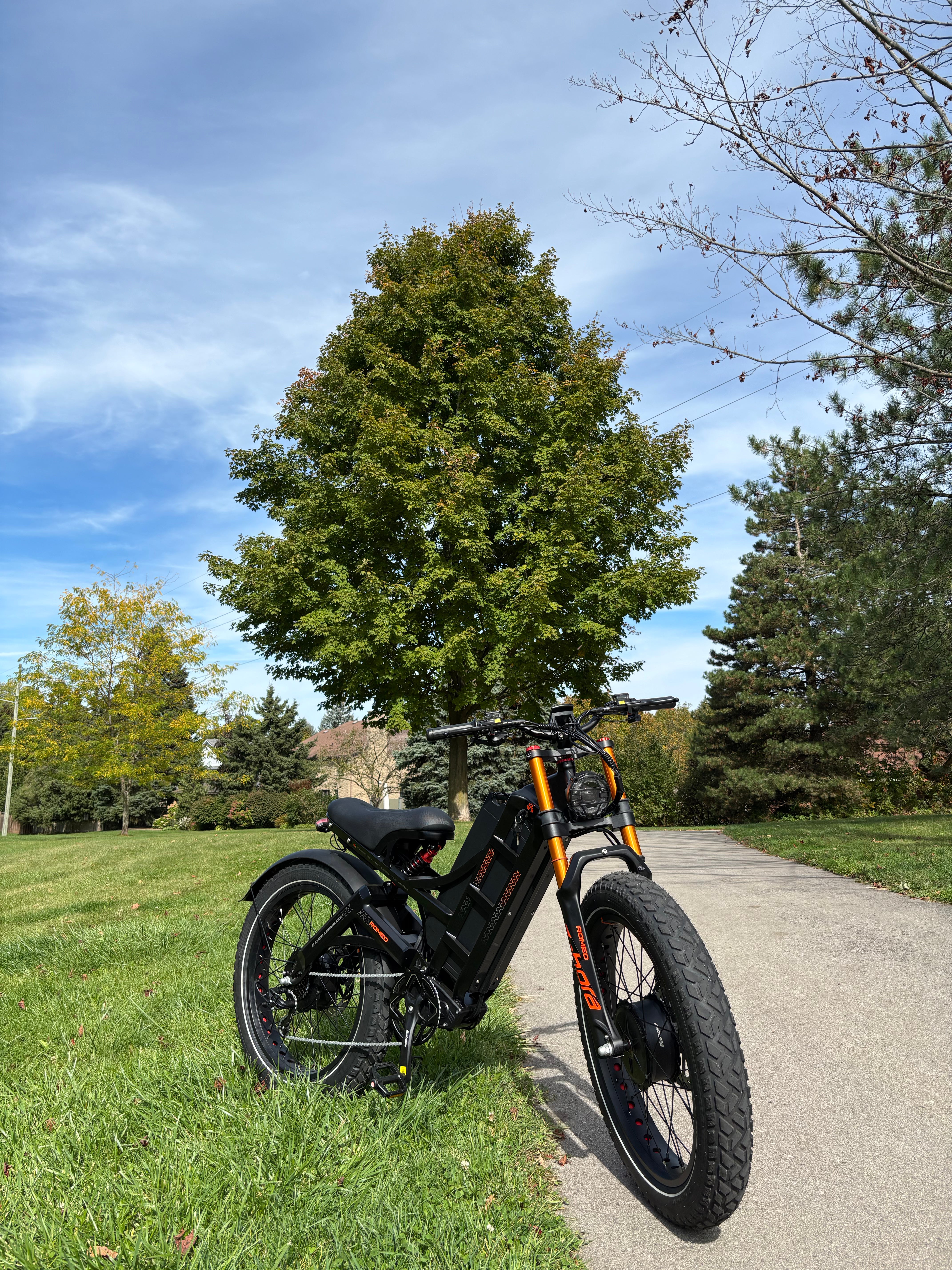
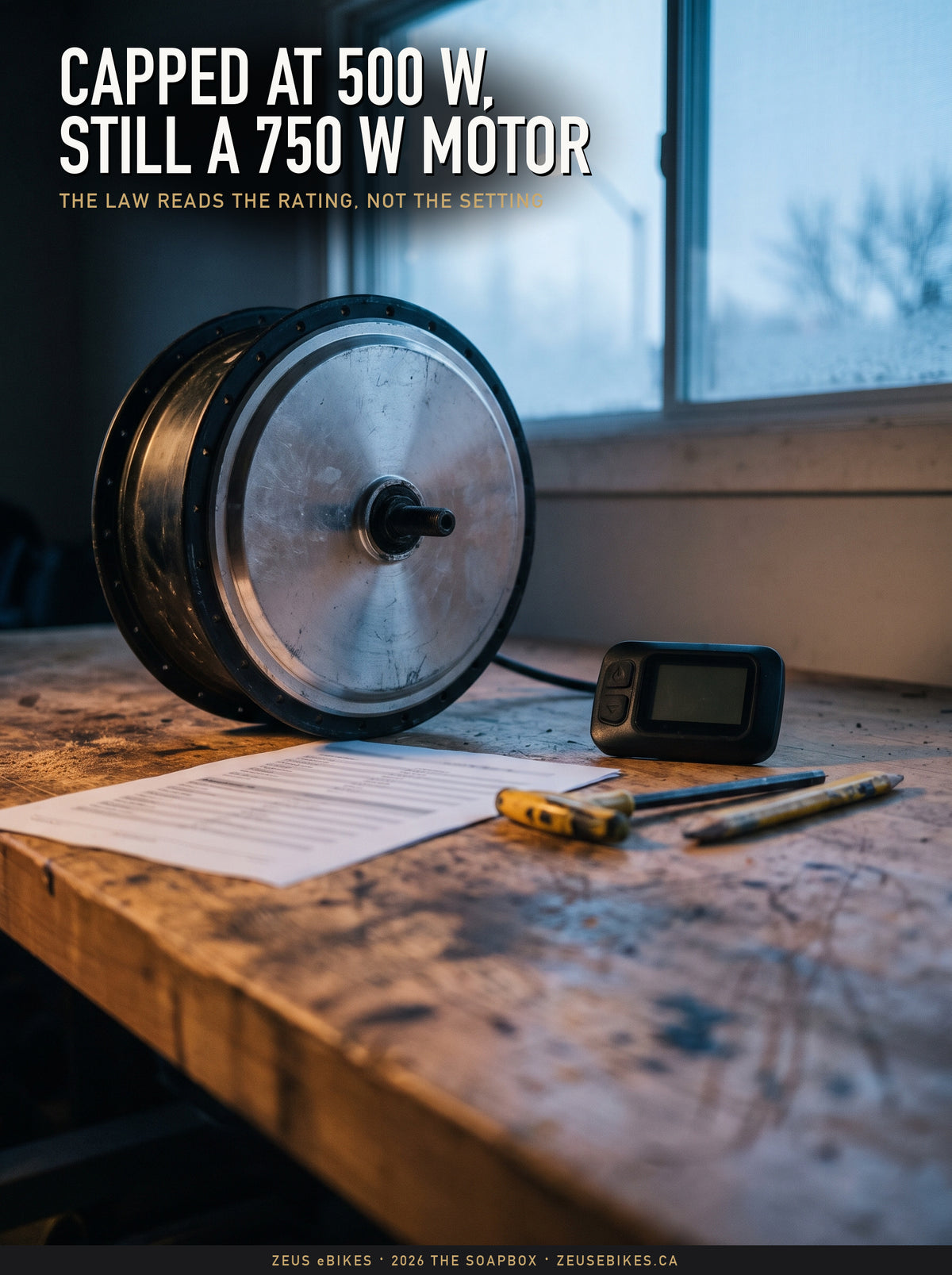
A Playcut.ai rendering, made for this piece: an unbranded hub motor and a handlebar control pad on a garage workbench. The motor carries the rating; the pad holds the settings. No bike, brand or maker is shown.
If a spec sheet says 750 watts and the bike ships limited to 500 watts, is it a legal e-bike in Canada? Read the way the provincial rules are written, a 750W e-bike limited to 500W still has a 750 W motor, because the definitions count the motor's rating, and a limit is a setting. Zeus eBikes Canada, an online e-bike retailer, read the e-bike wording of ten provinces and two territories on 25, 26 and 27 October 2026, with the court decisions we could find, to answer that question, the peak-watts question and the speed-button question a longtime customer put to us in October 2026.
Written by Milad Ghobadibeygvand, BScN, co-founder of Zeus eBikes Canada. On 25 October 2026 we opened, in a browser, the e-bike definitions of ten provinces and two territories and the federal text two of them still point to, and saved each one with the date we read it. On 26 October, and again on 27 October, we opened every one again and checked each quotation against the new copy; none of the quoted wording had changed:
- British Columbia's B.C. Reg. 64/2024 (current to 20 October 2026) and Nova Scotia's N.S. Reg. 221/2026 (in force 19 October 2026)
- Ontario's Highway Traffic Act, O. Reg. 369/09 and Legislation Act, 2006 (e-Laws currency date 22 October 2026)
- Manitoba's Highway Traffic Act (current as of 23 October 2026), Québec's Highway Safety Code (updated to 15 October 2026) and its Ministerial Order 2024-24 (current to 1 July 2026, read on 26 and 27 October), with the SAAQ's pages in English and French
- Alberta's AR 304/2002, Saskatchewan's 2014 regulations, Prince Edward Island's regulations and Service New Brunswick's page
- Newfoundland and Labrador's Highway Traffic Act, and the Yukon and Northwest Territories texts
Every quotation below is copied from a saved copy of its source, and the customer's words from the call's transcript. We re-read the news reports we cite and searched for Canadian court decisions on capped motors and adjustable speed limits. CanLII, the main case-law database, refused our browser, so that search ran on the open web and on the courts' own sites: we found no decision on either question, and the nearest ones we did find are in the speed section.
We also put twelve of the questions readers ask to three free AI chatbots; the questions come from what Canadians type into Google and Bing, from Reddit threads and from the customer's call. We name no bike, brand or store.
Quick answer: Not under the wording. Canada's provincial e-bike rules limit the motor's power rating to 500 W, counting the motors together where they address more than one, so a motor its maker rates at 750 W is still a 750 W motor when a controller holds it to 500 W.
- Peak power: a peak above 500 W does not fail the statutory definitions, which count the continuous rating. Québec's regulator writes "maximum power rating" on its English pages and "puissance nominale", nominal power, on its French pages, so read that province carefully.
- Speed: most definitions require the motor to be incapable of assisting past 32 km/h. A bike that ships at 32 km/h but can be switched to 45 km/h fails the strict reading, and whether an adjustable cap qualifies is not settled.
- Modification: Ontario and Prince Edward Island also bar riding a bike modified to raise its power or speed.
In this piece
- Why a "500W" label does not settle it
- What Canada's e-bike rules measure, province by province
- Is a 750W e-bike limited to 500W legal?
- Does peak wattage count?
- Are e-bikes speed limited, and what "capable" means
- What happens if you unlock or modify one
- How police check an e-bike's power
- Compliance stickers and labels
- Why so many answers get this wrong
- How to check a rating before you buy
- Frequently asked questions
- The bottom line
Why Doesn't a "500W" Label Settle It?
On 15 October 2026 a longtime Zeus customer called with a spec sheet that did not add up: by the customer's account, the maker's website printed a 500 W nominal rating, a support email said 750 W, and a button on the display changed the top speed. A bike outside the wording sits outside every provincial e-bike rule, and in October 2026 Ontario police charged a rider on a modified one and impounded it for 45 days. So we read each province's words and answer the customer's questions in order.
The customer, who asked us to leave out anything that could identify them, put the problem plainly: "the specifications are very confusing to me." The answers from the maker's support team were, in the customer's words, "not the same as what they're publishing." The customer has not bought, and said why: "I'm uncomfortable whether the bike is actually road legal or not". Three questions came out of that call, and the wording of the law is where each answer starts.
- If the maker caps a bigger motor at 500 W, does the cap count?
- If the spec sheet shows a peak far above 500 W, is the bike over the limit?
- If a button can raise the top speed, is the bike legal at its factory setting?
What Do Canada's E-Bike Rules Actually Measure?
Two things about the motor, and neither one is a setting. Wherever a province or territory writes power and speed limits for e-bikes, in a statute, a regulation or a regulator's page, its standard e-bike class limits the motor's power rating to 500 W and requires the motor to stop assisting at 32 km/h, in most texts by saying the motor must be incapable of more.
The table puts the words side by side, copied from the texts and checked again on 27 October 2026.
| Province or territory | Power: the words used | Speed: the words used | Where it is written |
|---|---|---|---|
| Ontario | "total continuous power output rating, measured at the shaft of each motor, of 500 W or less" | "incapable of providing further assistance when the bicycle attains a speed of 32 km/h on level ground" | The federal definition the Highway Traffic Act, s. 1(1) points to, as it read before its 2021 repeal (Legislation Act, 2006, s. 60(3)) |
| Alberta | No wording of its own: the regulation points to the federal definition repealed in 2021 | The same pointer | AR 304/2002, s. 1(1)(o): "a power-assisted bicycle under the Motor Vehicle Safety Regulations (Canada)" |
| British Columbia | "a continuous power output rating that, in total, does not exceed 500 W" | "must not be capable of propelling the device at a speed exceeding 32 km/h" | B.C. Reg. 64/2024, s. 3; Light e-bikes: 250 W and 25 km/h, s. 6 |
| Nova Scotia | "a total continuous nominal power output rating, measured at the shaft of each motor, of 500 W or less" | "no capability of providing further assistance when the bicycle reaches a speed of 32 km/h on level ground" | N.S. Reg. 221/2026, s. 3, in force 19 October 2026 |
| Saskatchewan | "a total continuous power output rating of 500 watts or less when measured at the shaft of each motor" | "further power assistance cannot be provided when the bicycle attains a speed of 32 kilometres per hour" | Registration Exemption and Reciprocity Regulations, 2014, s. 2(1)(f) |
| Manitoba | "a continuous power output rating, measured at its shaft, of 500 W or less" | "cannot provide the vehicle with motive power when it is travelling at more than 32 km/h" | Highway Traffic Act, C.C.S.M. c. H60, s. 1(1) |
| Prince Edward Island | "a total continuous power output rating, measured at the shaft of each motor, of 500 watts or less" | "power assistance ceases when the bicycle attains a speed of 32 kilometres per hour on level ground" | Power-Assisted Bicycles Regulations, s. 1(1)(d) (current to 23 September 2023) |
| Yukon | "a continuous power output rating, measured at the shaft of each motor, of 500 W or less in total for the motor or combination of motors" | "incapable of providing further assistance when the vehicle attains a speed of 32 km/h on level ground" | Motor Vehicles Act, s. 1 (the Internet Archive's 18 September 2026 copy; the Yukon's server refused our browser) |
| Québec | SAAQ, English page: "a maximum power rating of no more than 500 watts"; French page: "puissance nominale de 500 watts ou moins". Moped-style machines without a safety mark are barred if, among other grounds, the motor "has a power rating greater than 500 W" (French text: "puissance nominale") | SAAQ: "must cease to generate power once the bicycle reaches a speed of no more than 32 km/h". The same order bars a motor that "makes it possible to reach a speed of over 32 km/h" | The Highway Safety Code, s. 4 defines the bike only as "a bicycle that has an electric motor"; the figures are the SAAQ's (French page) and, for moped-style machines, Ministerial Order 2024-24, s. 1 |
| New Brunswick | Service New Brunswick: "a motor equal to or less than 500W" | "the motor is not capable of assisting when the vehicle is travelling at a speed greater than 32km/h" | Service New Brunswick; the Motor Vehicle Act has no e-bike definition |
Two jurisdictions write no e-bike definition and publish no e-bike figures. Newfoundland and Labrador's Highway Traffic Act names a power-assisted bicycle once, in a list of exemptions (s. 111.1(2)(b)), and reads two ways on what an e-bike is; our Atlantic Canada e-bike law guide sets out both. The Northwest Territories counts "a pedal bicycle with motor attachment" as an all-terrain vehicle (All-terrain Vehicles Act, s. 1(1)).
We could not read Nunavut's Act. On 25 and 26 October 2026 its site served a page without the text and then refused our browser, and we found no Internet Archive copy of the file, so Nunavut is not covered here.
Takeaway: Every power limit written into a statute or regulation here is a limit on a continuous or nominal rating; none counts a peak, and none says a setting can stand in for the rating. Québec's SAAQ is the one wording to read with care: its English pages say "maximum power rating", its French pages "puissance nominale", nominal power.
Is a 750W E-Bike Limited to 500W Legal?
Not under the wording. The texts limit the motor's rating, and a controller limit is a setting the maker applies on top of it. When a maker's own page rates the motor at 750 W and describes the Canadian bike as limited to 500 W, the maker has told you both numbers: the rating is 750 W, the setting is 500 W, and the rules measure the first.
Nothing in the wording lets a setting stand in for a rating. British Columbia counts the motors' continuous power output rating "in total"; Nova Scotia's new regulation asks for a "total continuous nominal power output rating"; and the federal text Ontario still points to reads "total continuous power output rating". A factory cap changes what the motor is allowed to deliver, while the rating stays where the maker set it.
Québec's SAAQ frames its own example the same way, by the motor fitted: a bicycle "equipped with a 1,000-watt motor" is still a bicycle, but it "is not authorized for use on a public road, including roadways and bike paths" (SAAQ FAQ).
The strongest reading against ours. It rests on four words most of the texts share: "measured at the shaft". A rating measured at the shaft, the argument runs, is whatever the motor delivers there as the bike is built, so a controller that holds the motor to 500 W yields a 500 W rating. Makers do set their own ratings, which is how one model can be sold as 500 W in one country and 750 W in another.
The argument is weakest where the maker itself publishes the higher rating, and where the rider can lift the cap: a cap that can be removed holds the motor to 500 W only until someone removes it, and Ontario and Prince Edward Island bar riding a bike modified to raise its power past the limits.
We did not find a Canadian court decision on a factory-capped motor, so we cannot tell you how a judge would rule on one. What you can control is the paperwork. If a maker's pages or emails give two ratings for the same bike, as they did for our customer, ask which one applies to the bike you are buying and keep the written answer; until you have it, you do not know the rating.
Takeaway: A cap is a setting, and the rules measure the rating. If the maker's own page shows a higher rating than the cap, the higher number is the one the wording reads.
Does Peak Wattage Count Toward the 500W Limit?
Not in the statutory definitions. Every one of them measures a continuous rating, and none mentions peak power, so a motor rated 500 W that peaks higher for a few seconds on a hill start fits the power wording. Our customer said as much on the call: "it's based on nominal wattage." Two cautions follow, one about Québec's wording and one about how far the peak sits above the rating.
Québec's Code defines a power-assisted bicycle only as "a bicycle that has an electric motor", so the 500 W figure is the SAAQ's, and its two languages differ. Its English page says "a maximum power rating of no more than 500 watts" (SAAQ, updated 25 May 2026); its French page, updated the same day, says "puissance nominale de 500 watts ou moins", nominal power (SAAQ, French page). Québec's 2024 order on moped-style machines also says "puissance nominale" (Ministerial Order 2024-24, s. 1). Only the English "maximum" could be read to count a peak; our Québec e-bike law guide covers that province's other rules.
The second caution is arithmetic. A battery's voltage multiplied by the controller's current limit gives the most power the system can draw: a 52 V battery on a 30 A controller can draw about 1,560 W at its nominal voltage, more than three times a 500 W rating. Some gap between the two is expected, because a motor can briefly draw more than it can sustain. A system that can draw several times its rating is a reason to ask the maker how the rating was set, and to keep the answer in writing.
Takeaway: The continuous rating is in the wording and the peak is not. Ask for the rating, the controller's current limit and the battery voltage, and do the multiplication yourself.
Are Electric Bikes Speed Limited? What "Capable" Means
Yes. On a public road the motor must stop helping at 32 km/h, and you may pedal faster on your own. Most definitions write the limit as a limit on what the motor can do: the federal text Ontario relies on says "incapable of providing further assistance", British Columbia says the motors "must not be capable", and Nova Scotia says "no capability".
A bike that ships at 32 km/h but changes speed at a button is the hard case.
Read strictly, a bike whose display, app or password can raise the assistance to 45 km/h is capable of assisting past 32 km/h, whatever it is set to today. Québec has written that reading into law for moped-style machines: its 2024 order bars those whose motor "makes it possible to reach a speed of over 32 km/h". CBC Marketplace found such bikes at the counter: salespeople at six of the twelve Greater Toronto stores its journalists visited undercover "told us or showed us how to bypass built-in speed limits", and one employee called bypassing the limiter "just like a toggle switch" (CBC, 2 October 2026).
"All you have to do is push a button on their controller to change the setting."
Our customer, on the call that started this piece
The other reading is that the test applies to the bike as it is configured and ridden: shipped at 32 km/h and left there, the motor stops where the rule says. Prince Edward Island's regulation and Québec's SAAQ lend that reading their own words, since both describe assistance that "ceases" or must "cease" at 32 km/h.
Canadian judges have applied the word "capable" to scooter-style machines ridden as e-bikes, though not, in any decision we found, to a speed setting a rider can change. One British Columbia judge looked past a spec sheet to what the motor did on the road, and two Ontario judges split over machines ridden without working pedals:
| Decision | The machine | What the court held |
|---|---|---|
| R. v. Wojtkiw, 2021 BCSC 194, British Columbia | A scooter-style machine whose spec sheet said its speed was "governed to 32 km/hr"; an officer's laser clocked it at 48 km/h on flat ground | "regardless of whether the speed governor was disabled or malfunctioned", its motor "could and did propel him over 32 km/hr on level ground", against the rule that the motors "not be capable of propelling" the cycle past 32 km/h; the Crown's appeal was allowed and a new trial ordered |
| R. v. Pizzacalla, Ontario Court of Justice (a 2010 stop), as reported in Canadian Lawyer, 11 February 2013 | Ridden with no pedals fitted; the pedals were readily available and could be re-attached | Still a power-assisted bicycle, "capable of being propelled solely by muscular power" by "simply re-attaching the pedals which were readily available"; the charges of driving uninsured and without plates were dismissed |
| R. v. Pizzacalla, 2014 ONCA 706 (a 2011 stop) | One pedal attached but unable to drive it, the other in a storage compartment | "not capable of being propelled by muscular power", so a motor vehicle under the Criminal Code; the conviction for driving while disqualified stood, and the Court of Appeal dismissed his application for leave to appeal |
None of these decisions deals with a working cap that the rider can change, and the British Columbia case applied the regulation in force in 2018, whose speed rule also used "capable". So the honest description of a bike that ships at 32 km/h with a faster mode is that it ships set to 32 km/h, and whether an adjustable cap qualifies is not settled.
CBC's report adds a fact buyers often miss: "Stores are allowed to sell the e-bikes no matter how fast they go". The prohibitions we read are on riding and operating, so the risk sits with the rider. For the speed rule province by province, our national e-bike law guide has the full table.
Takeaway: A bike with a speed menu above 32 km/h fails the strict reading of "incapable", whatever it ships set to, and a British Columbia court has already looked past a spec sheet to what a motor did on the road. If you buy one for public roads, leave the setting alone.
What Happens If You Unlock or Modify an E-Bike?
It takes the bike out of the rules. Ontario's regulation says a power-assisted bicycle "must not be ridden on, driven or operated if it has been modified after its manufacture" in a way that may raise its power or maximum speed past the limits (O. Reg. 369/09, s. 6), and Prince Edward Island's regulation says the same (s. 14).
Ontario's ministry puts it more bluntly on its own page:
"It is also illegal to modify your e-bike's electric motor to make it more powerful or to increase the assisted speed of the bike."
Ontario Ministry of Transportation, Riding an e-bike, updated 19 July 2024
Transport Canada told CBC News in a statement that modifying an e-bike or similar device "to make it faster or more powerful can create additional risks" (CBC News, 7 July 2026). Outside the definition, the machine is judged as what it is: in Ontario, a rider whose pedals could not drive his machine was convicted of driving a motor vehicle while disqualified (see the table above). On 7 October 2026, CTV News reported that Nottawasaga OPP found an Alliston rider's e-bike with its pedals removed, running on its motor alone, and impounded it for 45 days after laying charges (CTV News).
In Ontario the cost of riding a motor vehicle uninsured is set in statute: an owner who operates one on a highway without insurance faces a fine of "not less than $5,000" on a first conviction (Compulsory Automobile Insurance Act, s. 2(1) and (3)). The safety record points the same way. A review of five Ottawa-area e-bike deaths, prepared by Ontario's office of the chief coroner and other stakeholders, found that all the e-bikes appeared to have been modified "to increase their speed beyond design specifications" (CBC News, 27 November 2025).
Takeaway: On a bike you ride on public roads, do not raise the power, defeat the speed cap or remove the pedals. Each one takes the bike outside the definition.
How Do Police Check an E-Bike's Power?
We found no Canadian police procedure for measuring a motor's continuous rating at the roadside, and none of the definitions asks for one. The Canadian cases we read turned on the machine itself, such as pedals that could not move it or a speed clocked by laser, and on the paperwork a motor vehicle needs. For the rating, the evidence is documentary: the maker's published figures, the label where a province asks for one, and anything the seller put in writing.
Our customer reached the same point on the call: "I don't totally understand how the police are supposed to regulate this", and, a moment later, "The only option they have is to check back with the manufacturer." That makes the maker's published rating the document that matters, for the rider who buys the bike and for anyone who stops one.
The roadside tests we found measure speed. In the Netherlands, officers lock an e-bike's front wheel into a portable roller and pedal it up to its top speed, "checking when the motor cuts out" (Electrek, 13 February 2024). Police in Zurich use a suitcase-sized dynamometer that measures "the peak speed of a vehicle without needing a full test track or lab" and, Electrek adds, does not appear to measure power output (Electrek, 29 October 2025). In Wojtkiw, the evidence was a laser reading. We found no Canadian police service that publishes a roller or dynamometer test.
Takeaway: The roadside tests we found measure speed; for the rating, the evidence is on paper. Save the maker's product page as it read on the day you bought, and keep any email that states the rating.
Does an E-Bike Need a Compliance Sticker?
In some provinces, yes, and none of them asks the label to show the wattage. Ontario, Québec, Prince Edward Island and the Yukon write a manufacturer's label into their rules; British Columbia, Nova Scotia and Saskatchewan write none into their definitions, and Manitoba repealed its label clause in 2021. The table gives each one's words.
| Province or territory | What the rule asks for | Where it is written |
|---|---|---|
| Ontario | "a label affixed by the manufacturer in compliance with" the federal definition the Act points to | Highway Traffic Act, s. 1(1), "power-assisted bicycle", clause (b) |
| Québec | "the manufacturer's label required by the regulations made pursuant to the Motor Vehicle Safety Act", for a bike sold to its first user as a power-assisted bicycle; the SAAQ adds that the bikes "must bear an identification number", which need not have 17 characters | Highway Safety Code, s. 492.2(3); SAAQ |
| Prince Edward Island | a label "permanently affixed by the manufacturer" stating, "in both official languages, that the device is a power-assisted bicycle" | Power-Assisted Bicycles Regulations, s. 1(1)(d)(vi) |
| Yukon | a label "permanently affixed by the manufacturer" stating "that the vehicle is an electric power-assisted vehicle" | Motor Vehicles Act, s. 1, "electric power-assisted cycle", clause (e) |
| British Columbia, Nova Scotia, Saskatchewan | No label clause in the definition | B.C. Reg. 64/2024, s. 3; N.S. Reg. 221/2026, s. 3; the 2014 Saskatchewan regulations, s. 2(1)(f) |
| Manitoba | None since 2021: power-assisted bicycles "no longer require a manufacturer's label that references the federal regulations" | S.M. 2021, c. 30, s. 16 and its note |
The label those rules describe came from the federal definition, which required a label "permanently affixed by the manufacturer" stating, in both official languages, that the vehicle is a power-assisted bicycle. Ottawa repealed that definition in 2021, so federal law no longer requires makers to apply the label, yet Ontario's Act still asks for one; our Ontario e-bike law guide treats that clause as the weakest part of Ontario's definition.
Takeaway: A label is not a rating, and a missing one does not tell you the rating either. Where your province asks for one, ask the seller whether the bike carries it before you buy.
Why Do So Many Answers Get Canada's E-Bike Rules Wrong?
Because many answers still repeat a federal rule that Ottawa repealed. The federal power-assisted-bicycle definition was repealed effective 4 February 2021, and Transport Canada's regulatory notice said these vehicles "will now fall under provincial or territorial jurisdictions" (SOR/2020-22, ss. 3(2) and 35(2)). AI chatbots still describe a federal limit as current, as our test below shows.
On 25 October 2026 we put twelve of the questions in this piece to three free AI chatbots that answer a Canadian visitor without a login. Thirteen of their 33 answers described the repealed federal definition, or a federal limit, as current law. On the speed-button question they split: one said a bike that can be set to 45 km/h is not strictly legal even when it ships at 32 km/h, while the others said only that it must stay at 32. Treat a chatbot's answer as a lead, and check it against the provincial text in the table above.
Two more sources of confusion are worth naming:
- US class labels. US listings sell bikes as Class 1, 2 or 3, and the figures behind those labels are American. A US statute, 15 U.S.C. § 2085(b), defines a "low-speed electric bicycle" by a motor of "less than 750 watts" and a motor-only top speed under 20 mph, and our US sister store, RedTail eBikes, counted 42 states that define the three classes as of 6 October 2026, with Class 3 assisting to 28 mph, about 45 km/h and well past 32 km/h (RedTail's state-by-state guide to US e-bike law). Canada's provinces do not use that system as their statutory classification, so a Class label says nothing about the 500 W rule (our Canada versus USA e-bike law comparison explains the difference).
- Ratings that differ by country. The same bike can carry different ratings on a maker's pages for different countries, which is why the rating has to be confirmed for the unit sold here.
How Do You Check an E-Bike's Rating Before You Buy?
Ask for four answers in writing and read them against your province's words: the motor's continuous rating with every motor added, which rating applies to the bike sold in Canada if the maker's pages give more than one, the top assisted speed in every mode and what unlocks it, and whether the bike carries the label your province asks for.
The table translates the phrases spec sheets use.
| The spec sheet says | How the wording reads it |
|---|---|
| 750W motor, limited to 500W | A 750 W rating with a 500 W setting; the definitions read the rating |
| 500W nominal, 1,000W peak | Fits the statutory power wording, which counts the continuous rating; Québec's SAAQ writes "maximum power rating" in English and "puissance nominale" in French, so ask for both figures there |
| 500W, with nothing after it | Could be the continuous rating or the peak |
| Dual motor | Every text that addresses more than one motor adds the ratings together; Manitoba's definition describes "an electric motor" |
| Unlockable, NFC unlock, or a speed setting in an app | Capable of assisting past 32 km/h on the strict reading; not settled |
| A battery voltage and a controller current, such as 52V, 30A | About 1,560 W, the most the system can draw at nominal voltage; several times the rating is a reason to ask how the rating was set |
| Class 2 or Class 3 | A US category that the provinces do not use as their statutory classification |
- The continuous rating, every motor added. "Peak" or "max" is not the rating. If a page shows only a peak, ask for the continuous figure.
- One rating for the bike sold here. If the maker's pages or emails give two, ask which applies to the bike you are buying and keep the written answer.
- Every speed mode, and what unlocks it. A mode above 32 km/h, reached by a menu, an app, a card or a password, makes the bike the hard case described above.
- The label, where your province requires one: Ontario, Québec, Prince Edward Island and the Yukon.
- Pedals that work and can move the bike on their own.
- Your province's extras: British Columbia's Light e-bike class (250 W, 25 km/h), Ontario's 120 kg limit on the bike's unladen weight (O. Reg. 369/09, s. 1), and Nova Scotia's rule that at least one wheel has a rim of 350 mm or more.
As the customer put it at the end of the call, you have to "start asking and taking questions before you get the answers from any of them." The answers are worth having in writing, because the rating is the number a dispute over power would turn on. For how wattage relates to hills, loads and speed, our e-bike wattage guide walks through the tiers, and our editorial on Canada's e-bike wattage limit argues that speed matters more than watts.
Send us a spec sheet. Any bike, from any seller: we will read its rating and speed settings against your province's wording and tell you what we find. Call 1-866-938-7580 or email sales@zeusebikes.ca.
Frequently Asked Questions
Is a 750W e-bike limited to 500W legal in Canada?
Not under the wording. The provincial rules limit the motor's power rating to 500 W, and a controller limit is a setting. When a maker rates a motor at 750 W and caps it at 500 W, the rating stays 750 W. We found no Canadian court decision on a capped motor.
Does peak wattage count toward the 500W limit?
The statutory definitions count a continuous rating and never mention peak power, so a motor rated 500 W that peaks higher on a hill start fits the power wording. Québec's SAAQ writes "maximum power rating" on its English pages, which a careful reader can take to include the peak, but "puissance nominale", nominal power, on its French pages, as Québec's 2024 order on moped-style machines does; ask the seller for both figures there.
What does nominal wattage mean on an e-bike?
Nominal, rated or continuous wattage is the power a maker rates the motor to deliver continuously; peak is the short burst above it. Canada's provincial definitions use the continuous figure, and Nova Scotia's regulation in force since 19 October 2026 says "total continuous nominal power output rating".
Are electric bikes speed limited in Canada?
Yes. Where a province or territory defines an e-bike, the motor must stop assisting at 32 km/h, and British Columbia's Light e-bike class stops at 25 km/h. You may pedal faster on your own. Most definitions require the motor to be incapable of assisting past the limit.
Can I unlock or derestrict my e-bike?
Not for public roads. Ontario and Prince Edward Island bar riding a bike modified after its manufacture to raise its power or speed past the limits, and a modified bike sits outside every provincial e-bike rule. Whether a bike that ships at 32 km/h with an adjustable cap qualifies is not settled.
How do police check an e-bike's power?
We found no Canadian police procedure that measures a motor's continuous rating at the roadside. The Canadian cases we read turned on the machine itself, such as pedals that could not move it or a speed clocked by laser, and on the paperwork a motor vehicle needs. For the rating, the evidence is the maker's published figures.
Does an e-bike need a compliance sticker in Canada?
In some places. Ontario, Québec, Prince Edward Island and the Yukon still ask for a manufacturer's label; British Columbia, Nova Scotia and Saskatchewan write none into their definitions, and Manitoba repealed its label clause in 2021. None of the label clauses asks for the wattage to be printed.
Can I reprogram a 750W e-bike down to 500W to make it legal?
Reprogramming changes the setting, and the definitions read the rating, so a 750 W motor stays a 750 W motor. Setting it back up later is a modification, which Ontario and Prince Edward Island bar on public roads. A bike its maker rates at 500 W or less is the straightforward route.
What happens if police stop me on an e-bike outside the definition?
An e-bike outside the definition is judged as the machine it is. In Ontario that means a motor vehicle, which needs a licence, a permit and insurance; an uninsured owner faces a fine of at least $5,000 on a first conviction. In October 2026 Ontario police impounded a rider's pedal-less e-bike for 45 days.
The Bottom Line
Canada's e-bike rules read a motor by its rating and its capability, and a setting changes neither. A 750 W motor capped at 500 W is still a 750 W motor under the wording; a 500 W motor with a higher peak fits it; and a speed button that reaches 45 km/h is the case on which we found no Canadian court ruling. Buy the rating you need, and leave the settings alone.
If you are unsure about a bike, from us or from anyone else, send us its spec sheet before you buy. Call 1-866-938-7580 or write to sales@zeusebikes.ca, and we will read its rating and speed settings against your province's text with you. The province-by-province rules are in our British Columbia, Alberta and Saskatchewan and Manitoba guides, along with the Ontario, Québec and Atlantic guides linked above.
About this piece
This piece began with a phone call on 15 October 2026 from a longtime Zeus eBikes customer who is shopping for another e-bike. On that call the customer agreed to let us write about the questions raised and asked us to leave out background that could identify them, so we have not named the customer, the bike or its maker. The quotations come from the call's transcript. The legal reading is ours, and it is not legal advice: confirm the rule with your province before you rely on it.
About the author
Milad Ghobadibeygvand, BScN (Western University, 2014), is a co-founder of Zeus eBikes Canada.
Last updated: 27 October 2026 (every statute, regulation, court decision and news report cited was re-read that day).
Sources
- Government of Canada, Motor Vehicle Safety Regulations, C.R.C., c. 1038, s. 2, version in force 1 July 2020 to 3 February 2021 (the power-assisted bicycle definition), and the current s. 2 ("[Repealed, SOR/2020-22, s. 3]"), read 27 October 2026.
- Canada Gazette, Part II, SOR/2020-22, ss. 3(2) and 35(2), and the Regulatory Impact Analysis Statement, 19 February 2020, read 27 October 2026.
- British Columbia, Motor Assisted Cycle Regulation, B.C. Reg. 64/2024, ss. 3 and 6, current to 20 October 2026, read 27 October 2026.
- Nova Scotia, N.S. Reg. 221/2026, Schedule A, s. 3, effective 19 October 2026, read 27 October 2026.
- Ontario, Highway Traffic Act, R.S.O. 1990, c. H.8, s. 1(1); O. Reg. 369/09, ss. 1 and 6; Legislation Act, 2006, s. 60(3); Compulsory Automobile Insurance Act, s. 2, e-Laws currency date 22 October 2026, read 27 October 2026.
- Ontario Ministry of Transportation, Riding an e-bike, updated 19 July 2024, read 27 October 2026.
- Alberta, Use of Highway and Rules of the Road Regulation, AR 304/2002, s. 1(1)(o), current as of 8 August 2025, read 27 October 2026.
- Saskatchewan, The Registration Exemption and Reciprocity Regulations, 2014, s. 2(1)(f), read 27 October 2026.
- Manitoba, The Highway Traffic Act, C.C.S.M. c. H60, s. 1(1), current as of 23 October 2026, and S.M. 2021, c. 30, s. 16 and its explanatory note, read 27 October 2026.
- Québec, Highway Safety Code, ss. 4 and 492.2, updated to 15 October 2026; SAAQ, On an electric bike (updated 25 May 2026) and FAQ on non-compliant vehicles (updated 16 April 2026), and the same two pages in French, En vélo électrique (25 mai 2026) and Foire aux questions sur les motocyclettes et les cyclomoteurs non conformes (16 avril 2026), read 27 October 2026.
- Québec, Ministerial Order 2024-24 concerning the use on public highways of certain 2- or 3-wheeled motor vehicles that have the appearance of a motorcycle or moped, CQLR c. C-24.2, r. 0.1.3, s. 1, English and French texts, current to 1 July 2026, read 27 October 2026.
- Prince Edward Island, Highway Traffic Act Power-Assisted Bicycles Regulations, ss. 1(1)(d) and 14, current to 23 September 2023, read 27 October 2026.
- Service New Brunswick, Motor vehicle registration, and New Brunswick's Motor Vehicle Act, R.S.N.B. 1973, c. M-17 (no e-bike definition), read 27 October 2026.
- Newfoundland and Labrador, Highway Traffic Act, s. 111.1(2)(b), read 27 October 2026.
- Yukon, Motor Vehicles Act, RSY 2002, c. 153, s. 1, Internet Archive copy of 18 September 2026, read 27 October 2026.
- Northwest Territories, All-terrain Vehicles Act, R.S.N.W.T. 1988, c. A-3, s. 1(1), read 6 November 2026.
- Court of Appeal for Ontario, R. v. Pizzacalla, 2014 ONCA 706, read 27 October 2026.
- Supreme Court of British Columbia, R. v. Wojtkiw, 2021 BCSC 194, 9 February 2021, read 27 October 2026.
- Canadian Lawyer, "Ruling confirms e-bikes are not motor vehicles", 11 February 2013, a report of Justice Donald Dudar's Ontario Court of Justice decision in R. v. Pizzacalla (CanLII, which would hold the decision, refused our browser), read 27 October 2026.
- CBC Marketplace, hidden-camera investigation of e-bike and e-scooter stores, 2 October 2026, read 27 October 2026.
- CTV News Barrie, "How modifications to an e-bike landed a rider criminal charges", 7 October 2026, read 27 October 2026.
- CBC News, coroner's review of Ottawa-area e-bike deaths, 27 November 2025, read 27 October 2026.
- CBC News, e-bike alterations on Prince Edward Island, 7 July 2026, read 27 October 2026.
- Electrek, "Dutch police found a way to test e-bike power on the side of the road", 13 February 2024, read 27 October 2026.
- Electrek, "Revealed: The tiny device police use to catch illegally fast e-bikes and e-scooters", 29 October 2025, read 27 October 2026.
- United States, 15 U.S.C. § 2085(b), definition of "low-speed electric bicycle", United States Code, 2024 edition, read 27 October 2026.
- RedTail eBikes, our US sister store, "Electric Bike Laws by State (2026): All 50, One Table", state count as of 6 October 2026, read 27 October 2026.
- AI chatbot answers: twelve questions put to three free chatbots on 25 October 2026; the classified answers are kept in our research file for this piece.
- Phone call with a longtime Zeus eBikes customer (name withheld at the customer's request), conducted by Milad Ghobadibeygvand, 15 October 2026. Quoted with the consent the customer gave on the call.
Visuals created by Playcut.ai
More from Zeus Media
Share:
Eahora Romeo Pro II Review Canada (2026): Real Range 85–178 km Computed, 3,120 Wh, $4,299
Tesway X9 Ultra Review Canada (2026): Real-World Range, Computed