
Canada vs USA E-Bike Laws (2026): All 50 States Compared

The rules that decide whether your electric bike is legal look almost identical across the Canada–US border, and then diverge in ways that can turn a perfectly legal bike into an illegal one the moment you cross. Canada runs a single, tidy standard. The United States runs a three-class system layered on top of a federal power cap, and every state fills in the details differently. This guide compares the two systems from the statute up, so you know where a Canadian e-bike stands in the US, where a US e-bike stands in Canada, and what each country actually enforces.
Every legal claim below is sourced to a named statute or government authority: the US federal e-bike law (15 U.S.C. § 2085), the PeopleForBikes model legislation, individual state vehicle codes, and Canada's provincial power-assisted-bicycle framework. Where a rule is shifting in 2026, that is flagged with its date. Last updated: 10 October 2026. The US statute texts and 2026 acts were re-read on 8 and 9 October 2026, and no state entry now rests on the July 6, 2026 reading.
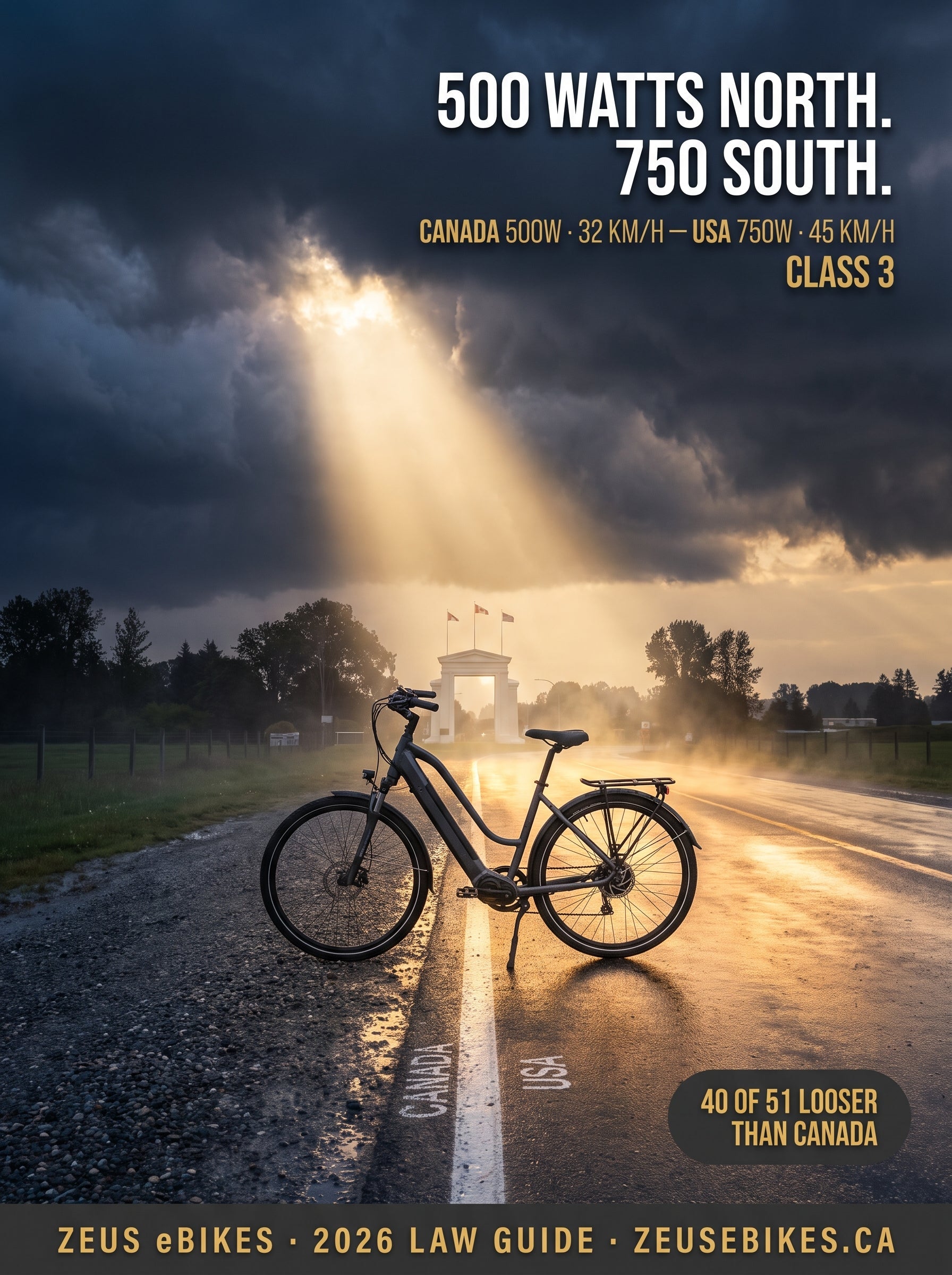
Canada limits an e-bike to 500W nominal and 32 km/h assisted speed under a single "power-assisted bicycle" (PAB) category used in every province. There is no Class 1/2/3 system. The United States allows motors under 750W (federal cap, 15 U.S.C. § 2085), and our reading of the statute texts on 8 October 2026 found 42 states run the full three-class system, letting Class 3 pedal-assist bikes reach 28 mph (45 km/h), about 40% faster than any legal Canadian e-bike. 47 of 50 states require no licence, registration or insurance, the same as every Canadian province. The practical upshot: a Canadian 500W bike is generally legal to ride in the US, but a US 750W or Class 3 bike is not legal as a PAB in Canada. For the full Canadian side, see our complete Canadian eBike laws guide, and browse the Zeus 500 W collection.
In July 2026, Zeus eBikes Canada verified the e-bike law of all 50 US states plus the District of Columbia: not by copying one aggregator, but by cross-referencing four independent authorities (the NCSL legislative primer, PeopleForBikes' model-law records, and two current state-law directories) and then resolving every disagreement against the state's own statute. That conflict pass mattered: it caught twelve stale or wrong entries in widely-cited tables, including five states falsely listed as requiring licences, one state credited with a class system it never enacted, and two states listed under laws they replaced in 2022–2024.
Anchor citations include the federal statute (15 U.S.C. § 2085 via Cornell LII), California (CalBike/SB 1271), Texas (Transp. Code Ch. 664), Florida (Fla. Stat. § 316.20655), Arizona (A.R.S. § 28-819), Washington (RCW 46.61.710), Colorado (C.R.S. § 42-4-1412), Rhode Island (§ 31-19.7-1), New Mexico (NMSA § 66-3-709), Minnesota (§ 169.222) and Kansas (KSA 8-1489). Canadian figures come from our re-verified provincial law files (federal PAB repeal SOR/2020-22, effective Feb 4, 2021). This is public information and not legal advice. Confirm your own state or province before you ride.
Re-verified 8 and 9 October 2026: for 44 states and DC we read the class definition and the operating section in the statute text or the enacted 2026 act, with Tennessee's helmet subsection read on a published mirror of the code (each state entry links the text it was read from); Arkansas, Indiana, Nevada, New Jersey and Pennsylvania rest on an official agency document or a published code mirror, and Nevada's age and helmet sections could not be read; Kansas's state-park rule rests on the Legislature's research department; North Carolina's December change was read in the ratified bill through an Internet Archive copy of the legislature's PDF.
That pass corrected six July statements: Mississippi (classes since 2021) and Nebraska (classes since 2023) do use the three classes, the District of Columbia has no Class 3 tier, Louisiana's Class 3 minimum age is 16 rather than 12, and neither Montana nor Kentucky prints the 750 W figure we had attributed to them. It also brought in the 2026 changes in Hawaii, Tennessee, Utah, Washington and North Carolina.
In This Article
- Canada vs USA: The Short Version
- The Scorecard: Canada vs All 50 States
- Two Countries, Two Ways of Splitting the Rules
- The US Three-Class System
- Power & Speed: 750W vs 500W, 45 vs 32 km/h
- E-Bike Laws by State: All 50 vs Canada
- 7 Big States in Depth
- Helmets, Licences & Where You Can Ride
- What's Changing in 2026
- Riding Across the Border
- Frequently Asked Questions
Canada vs USA E-Bike Laws: The Short Version
On January 19, 2026, New Jersey scrapped the three-class e-bike system that still governs most of the United States; three months earlier, on October 24, 2025, New York City imposed a 15 mph ceiling on every e-bike in the five boroughs. US e-bike law is moving fast and moving in different directions at once.
Ride the wrong bike across the border, or buy a US-spec 750W Class 3 assuming it's "just an e-bike", and you can find yourself on an unregistered motor vehicle that's illegal where you're riding it. This guide maps every verified difference between the two countries so that never happens to you.
The single most important thing to understand: Canada regulates one kind of e-bike; the US regulates three. Canada's power-assisted bicycle is capped at 500W and 32 km/h, full stop. The US sets a federal manufacturing ceiling of 750W, then lets each state sort bikes into Class 1, Class 2 and Class 3 by speed and throttle behaviour. Here is the whole picture at a glance.
| Dimension | 🇨🇦 Canada | 🇺🇸 United States |
|---|---|---|
| Who makes the rules | Provinces (federal PAB definition repealed Feb 4, 2021, SOR/2020-22) | Federal product cap (15 U.S.C. § 2085) + each state's road rules |
| Classification | One category: "power-assisted bicycle" (PAB) | Three classes (1 / 2 / 3) in 42 states (statute texts read 8 October 2026); DC, Massachusetts (Class 1 and 2 only), four single-category states, Kentucky and Alaska (no definition) and New Jersey (its own 2026 regime) sit outside it |
| Max motor power | 500W nominal | Under 750W (federal) |
| Max assisted speed | 32 km/h (all e-bikes) | 20 mph / 32 km/h (Class 1 & 2); 28 mph / 45 km/h (Class 3) |
| Throttle | Province-dependent (e.g. Québec & BC permit it with conditions) | Class 2 = throttle to 20 mph in most states |
| Licence / registration / insurance | Not required for a compliant PAB | Not required in 47 states; Alaska (motor-vehicle licensing by default), Hawaii ($30 registration) and New Jersey (registration, licence, insurance) require paperwork |
| Helmet | Province-dependent (most provinces require, some all ages) | State/local-dependent (often under-18, or all Class 3 riders) |
The Scorecard: Canada vs All 50 States, by the Numbers
We scored the e-bike law of every US state and DC against Canada's national baseline, first in July 2026 and again from the statute texts on 8 October 2026, and the scorecard comes out lopsided: on power and speed, almost the entire United States is looser than Canada; on paperwork, the two countries are nearly identical; and only three states are stricter than anywhere in Canada. These are Zeus eBikes Canada's own computed numbers.
Scored against Canada's 500W / 32 km/h power-assisted bicycle standard by Zeus eBikes Canada across all 50 states and the District of Columbia; statute texts re-read 8 October 2026.
- 42 states run the full Class 1/2/3 system (New York in a modified form: its Class 3 is 25 mph and legal only in New York City), so a pedal-assist e-bike can legally do 45 km/h (28 mph) in most of America while every Canadian province stops assistance at 32 km/h. Hawaii joined on July 15, 2026; Mississippi (2021) and Nebraska (2023) were in all along and our July count of 39 missed them; North Carolina joins on December 1, 2026.
- 750W is the standard US motor ceiling: 50% more power than Canada's 500W cap: in every state that prints a limit. Georgia's definition says 1,000 W; Montana, Kentucky and the District of Columbia print no wattage figure at all.
- 47 of 50 states require no licence, registration or insurance for a standard e-bike, functionally identical to Canada, where no province requires any. The three exceptions: Alaska (no e-bike definition, so motor-vehicle licensing applies by default), Hawaii (a permanent $30 registration for every electric bicycle, HRS § 249-14, kept by Act 259 of 2026), and New Jersey (registration, an e-bike licence and insurance for motorized bicycles under its January 2026 law).
- Nine jurisdictions have no Class 3 tier. Montana, Pennsylvania and South Carolina run a single category capped at 20 mph on motor power; North Carolina does the same until December 1, 2026; Kentucky has no e-bike statute at all and rides e-bikes as bicycles; Alaska has no definition; the District of Columbia defines a 20 mph "motorized bicycle"; Massachusetts stops at Class 2; and New Jersey replaced the classes with its own categories. Those are the closest things America has to Canada's single rule.
- Roughly half of US states have no statewide e-bike helmet rule beyond the child bicycle-helmet laws. The strictest is Connecticut (headgear on every e-bike rider of any age); Rhode Island covers riders and passengers under 21 on all classes, and Utah joined it on May 6, 2026 for anyone under 21 operating an e-bike on a highway; Hawaii raised its bicycle helmet age to under 18 in July 2026. Most Canadian provinces require helmets more broadly than most US states.
- Minimum ages are all over the map: 16 for Class 3 is the US near-standard, and Tennessee moved from 14 to 16 on July 1, 2026; Texas, Georgia and Indiana allow Class 3 at 15 and Michigan at 14; Louisiana's limit is 16 (an earlier version of this page said 12); Minnesota bars anyone under 15 from any e-bike, New York anyone under 16, and Hawaii anyone under 16 from a Class 2 or 3 without a supervising adult; Florida, Arizona and South Carolina set no statewide minimum at all. Canadian provinces range from 12 (Alberta, with parental consent) to 16 (BC Standard, PEI).
Two Countries, Two Ways of Splitting the Rules
Both countries split e-bike authority between a national government and sub-national governments, but they split it along different lines. In the US, the federal government defines what an e-bike is as a product, and the states decide how it may be used. In Canada, there is no longer a federal e-bike product definition at all; the provinces do almost everything. This split is why one US number (750W) applies everywhere while another (where you can ride) changes every time you cross a state line.
The US federal layer is narrow and specific. Under 15 U.S.C. § 2085: enacted by Public Law 107-319 in 2002: a "low-speed electric bicycle" is a two- or three-wheeled vehicle with fully operable pedals and a motor of less than 750 watts whose top speed under motor power alone (with a 170 lb rider) is less than 20 mph. Critically, this is a consumer-product law: it governs how e-bikes are built and sold nationwide and places them under the Consumer Product Safety Commission. It does not decide where, when or by whom an e-bike may be ridden. That is left entirely to state vehicle codes.
Canada used to have a similar federal definition, the "power-assisted bicycle" in the Motor Vehicle Safety Regulations, but it was repealed effective February 4, 2021 (SOR/2020-22). Since then, road rules have been set province by province. In practice the provinces converge on the same three thresholds: ≤500W nominal, 32 km/h maximum assisted speed, and operable pedals. So Canada and the US arrive at a structurally similar place (sub-national governments control who rides where), but Canada reaches it without any federal e-bike category, while the US keeps a federal product cap sitting above the states.
The US Three-Class System: and Why Canada Doesn't Use It
The three-class system is the framework most US states use to regulate e-bike use, and it sorts bikes by speed and throttle behaviour rather than by wattage. It was drafted by PeopleForBikes and the Bicycle Product Suppliers Association as model legislation, first adopted by California in 2015. As of its 2024 policy report, PeopleForBikes counted 43 states that had written the three classes into law. Here is how the classes are defined.
| Class | Assist type | Motor cuts out at | Notes |
|---|---|---|---|
| Class 1 | Pedal-assist only (no throttle) | 20 mph (≈32 km/h) | Widest path and bike-lane access; treated most like a regular bicycle |
| Class 2 | Throttle and pedal-assist | 20 mph (≈32 km/h) | Throttle can propel the bike without pedalling |
| Class 3 | Pedal-assist only (no throttle in the model law) | 28 mph (≈45 km/h) | Speedometer required; usually 16+; frequently barred from multi-use paths |
Two things stand out for a Canadian reader. First, the classes are defined entirely by speed and throttle: motor wattage does not separate a Class 1 from a Class 3; all three sit under the same 750W federal ceiling. Second, Class 1 and Class 2 both cut out at 20 mph, which converts to 32.2 km/h: effectively the same speed Canada allows. It is only Class 3, at 28 mph, that goes meaningfully beyond anything legal in Canada.
Canada uses none of this. There is no Class 1, 2 or 3 north of the border, just the single power-assisted bicycle. A Canadian rider choosing a bike thinks about one number (500W) and one speed (32 km/h); an American rider has to know which class a bike is, which class their state allows where, and what the local helmet and age rules layer on top. Our analysis of Canada's wattage limit explains why Canada has stuck with a power-based rule while the US went speed-based, and why Ontario is now proposing to move toward the US-style approach.
Power and Speed: 750 Watts vs 500, 45 km/h vs 32
The two headline numbers, motor power and top speed, are where Canada and the US diverge most, and the gap is smaller on speed than most people assume. On power, the US allows 50% more: under 750W federally versus Canada's 500W nominal. On speed, the base limit is nearly identical. Only the US Class 3 tier pulls ahead.
🇨🇦 Canada: one ceiling
Power: 500W nominal, every province.
Speed: motor must stop assisting at 32 km/h (~20 mph).
Result: a single, predictable performance envelope. Every legal Canadian e-bike behaves the same way at the top end, whether it's a commuter or a cargo hauler.
🇺🇸 USA: a ceiling plus a fast tier
Power: under 750W federally, 50% more headroom.
Speed: 20 mph (32 km/h) for Class 1 & 2; 28 mph (45 km/h) for Class 3.
Result: a Class 3 commuter can legally sustain 45 km/h, a speed that is illegal on any Canadian bike path, and one that carries roughly twice the crash energy of a 32 km/h impact.
The power difference is real but often overstated in its practical effect. A "500W nominal" motor routinely produces 1,000W or more of peak output on a hard climb; nominal ratings describe continuous output under a test standard rather than a real-time ceiling. So a Canadian 500W bike is not half as capable as an American 750W one. The gap on hills and under load is narrower than the labels suggest. Our 500W vs 750W vs 1000W guide breaks down what those wattage numbers actually deliver in the real world, on hills, loaded and in winter.
The speed difference is the one that genuinely changes safety and legality. Canada's 32 km/h cap and the US Class 1/2 cap of 20 mph are the same speed to within a rounding error. But US Class 3, at 45 km/h, is running on different physics: kinetic energy rises with the square of speed, so a 45 km/h impact carries close to double the energy of a 32 km/h one. That is why so many US states, as the state tables below show, hedge Class 3 with helmet mandates, minimum ages and path bans they never apply to Class 1.
Each province sets its own e-bike rule. Read yours in the national guide, then check a bike's motor rating and factory speed limit against it before public-road use.
Canadian eBike Laws: Full Guide Browse the 500 W collection →E-Bike Laws by State: All 50 States (and DC) vs Canada
Every US state and the District of Columbia, scored against Canada's 500 W / 32 km/h baseline. For 44 states and DC the definition and operating section were read in the statute or enacted act on 8 and 9 October 2026; five states (Arkansas, Indiana, Nevada, New Jersey and Pennsylvania) rest on an official agency document or a published mirror of the code, and Nevada's age and helmet sections could not be read; North Carolina's coming change was read in an archived copy of its ratified bill.
"Looser" means faster or more powerful e-bikes are legal than in Canada; "Similar" means a single category near 20 mph on motor power, or no Class 3 tier; "Stricter" means paperwork no Canadian province requires. Where an age or helmet detail could not be re-read, the entry says so. The rules are statewide only; cities and counties add their own. Jump to your state:
West: AK · AZ · CA · CO · HI · ID · MT · NV · NM · OR · UT · WA · WY | Midwest: IL · IN · IA · KS · MI · MN · MO · NE · ND · OH · SD · WI | South: AL · AR · DE · DC · FL · GA · KY · LA · MD · MS · NC · OK · SC · TN · TX · VA · WV | Northeast: CT · ME · MA · NH · NJ · NY · PA · RI · VT
West

Alaska E-Bike Laws
Alaska still has no e-bike definition in its vehicle code. The three-class bill the legislature passed in 2023, HB 8, was vetoed on July 20, 2023, and AS 28.90.990 as printed in the 2025 statutes lists it only as a bill that would modify the section.
An e-bike therefore falls under the general wording: a "motor-driven cycle" includes a "motorized bicycle" (AS 28.90.990(22)), 13 AAC 02.422 applies the motorcycle rules to a motorized bicycle, and AS 28.15.011 requires a driver's licence to drive a motor vehicle on a highway. In practice, the DMV told the legislature in its 2023 fiscal note on HB 8 that it "has not registered these bicycles"; its own licensing pages refused our automated requests.
Verdict: Stricter than Canada. Source: AS 28.90.990 (Alaska Statutes 2025); HB 8 (2023) bill detail, vetoed July 20, 2023; 13 AAC 02.422; HB 8 fiscal note, Department of Administration (DMV), 2023 (statute and regulation text read 8 October 2026; fiscal note read 9 October 2026).

Arizona E-Bike Laws
Arizona defines Class 1, 2 and 3 electric bicycles with motors under 750 W (A.R.S. section 28-101(29)); Class 3 assists to 28 mph (45 km/h), Class 1 and 2 to 20 mph, the same speed as Canada's 32 km/h cut-off. Section 28-819 exempts e-bikes from title, registration, licence tax, driver licences and insurance, lets Class 1 and 2 use bicycle and multi-use paths unless a local authority says otherwise, and keeps Class 3 off those paths unless the path runs within or beside a road or the local authority allows it. Neither section sets a statewide helmet rule or minimum age.
Verdict: Looser than Canada. Source: A.R.S. § 28-101; A.R.S. § 28-819 (statute or act text read 8 October 2026).

California E-Bike Laws
California wrote the first three-class law and has tightened it since. Vehicle Code section 312.5 caps an electric bicycle at 750 W, defines Class 1 and 2 at 20 mph and Class 3 at 28 mph (45 km/h) with a speedometer, and bars the sale or labelling of any bike meant to be modified past 20 mph on motor power alone or past 750 W.
Section 21213 keeps riders under 16 off a Class 3 and requires a helmet on every Class 3 rider and passenger; the general bicycle helmet rule covers riders under 18. No licence or registration. SB 1167, signed September 30, 2026, adds labelling for electric motorcycles from January 1, 2027; that bill rests on cycling-industry reporting, since the Legislature's site refuses automated reads.
Verdict: Looser than Canada. Source: Vehicle Code § 312.5; Vehicle Code § 21213 (Wayback copy, 28 September 2026) (statute or act text read 8 October 2026).

Colorado E-Bike Laws
Colorado's definition (C.R.S. section 42-1-102(28.5)) sets the three classes with Class 3 cutting out at 28 mph (45 km/h). Under section 42-4-1412, no one under 16 may ride a Class 3 on a street, highway or path, every Class 3 rider or passenger under 18 must wear a helmet, and a Class 3 stays off bike and pedestrian paths unless the path is within a street or the local authority permits it. Class 1 and 3 must cut power when pedalling stops, and Class 3 needs a speedometer. No licence or registration.
Verdict: Looser than Canada. Source: Colorado Revised Statutes 2024, Title 42 (PDF) (statute or act text read 8 October 2026).

Hawaii E-Bike Laws
Hawaii changed in July 2026 with Act 259 (HB 2021 CD1, effective on approval, July 15, 2026). The act added Class 1, 2 and 3 definitions to chapter 291C with a 750 W cap and a 28 mph (45 km/h) Class 3. It kept the permanent $30 registration for every electric bicycle under section 249-14 and made riding an unregistered one on a road, sidewalk or bicycle facility a citable offence with possible impoundment.
It barred riders under 16 from a Class 2 or 3 unless a parent or guardian is directly supervising, raised the bicycle helmet age in section 291C-150 from under 16 to under 18, and created a traffic infraction for operating a high-speed electric device.
Verdict: Stricter than Canada. Source: HB 2021 CD1 (Act 259, 2026) (statute or act text read 8 October 2026).

Idaho E-Bike Laws
Idaho Code section 49-106(1) defines an electric-assisted bicycle as under 750 W in Class 1, 2 or 3, with Class 3 assistance ending at 28 mph (45 km/h); section 49-114 excludes it from the motorcycle and motor-driven cycle definitions, so no licence or registration applies. H 500 (effective July 1, 2026) only added electric-assisted bicycles to the due-care and passing sections. The sections we read set no statewide helmet rule, and the minimum age of 15 printed here in July came from a directory rather than a section we have read.
Verdict: Looser than Canada. Source: Idaho Code § 49-106; Idaho Code § 49-114; H 500 (2026) (statute or act text read 8 October 2026).

Montana E-Bike Laws
Montana never adopted the classes. MCA 61-8-102(7) defines an "electrically assisted bicycle" as a two-wheeled vehicle whose motor cannot push a 170 lb rider faster than 20 mph on a paved, level surface, and the bicycle definition includes it, so it rides as a bicycle. The definition sets no wattage figure at all; our July text claimed a 750 W allowance, and that figure is not in the section. No licence or registration, and no statewide helmet or age rule in the sections read. On speed, a Montana e-bike and a Canadian 32 km/h bike are near twins.
Verdict: Similar to Canada. Source: MCA 61-8-102 (statute or act text read 8 October 2026).

Nevada E-Bike Laws
Nevada (NRS 484B.017) defines an electric bicycle as a device with fully operable pedals, a seat and a motor of not more than 750 W in one of three classes: Class 1 and Class 2 stop assisting at 20 mph, and Class 3, pedal assist only, at 28 mph (45 km/h). The Legislature's own site refuses automated reads, so the section was read on a published mirror of the NRS; Nevada's age and helmet sections could not be read by any route we tried, so this entry prints no Nevada age or helmet rule.
Verdict: Looser than Canada. Source: NRS 484B.017 (nevada.public.law mirror); NRS chapter 484B (leg.state.nv.us; refused automated reads); NRS 484B.017 (FindLaw mirror) (published code mirrors read 8 and 9 October 2026; the legislature's own site refused automated reads).

New Mexico E-Bike Laws
New Mexico's SB 69 (2023, in force July 1, 2023) defines the three classes with motors not exceeding 750 W and a 28 mph (45 km/h) Class 3, keeps riders under 16 off a Class 3, puts e-bikes inside the Child Helmet Safety Act so minors under 18 must wear a helmet, and bars Class 2 and 3 from bicycle and pedestrian paths unless the path runs within a street or the local jurisdiction permits them. No licence or registration.
Verdict: Looser than Canada. Source: SB 69 (2023), enrolled (statute or act text read 8 October 2026).

Oregon E-Bike Laws
Oregon's ORS 801.258 defines Class 1, 2 and 3 electric assisted bicycles, with Class 3 ending assistance at 28 mph (45 km/h). An e-bike may not be ridden on a sidewalk (ORS 814.410(1)(e)), and the bicycle helmet rule for riders under 16 (ORS 814.485) applies to bicycles generally. We did not find a statewide minimum age in the sections read; the age of 15 printed here in July came from a directory. No licence or registration applies to a bicycle.
Verdict: Looser than Canada. Source: ORS chapter 801 (801.258); ORS chapter 814 (statute or act text read 8 October 2026).

Utah E-Bike Laws
Utah's three classes (Utah Code 41-6a-102) put Class 3 at 28 mph (45 km/h). H.B. 381, passed in the 2026 session and effective May 6, 2026, requires anyone under 21 to wear a helmet while operating an electric assisted bicycle on a highway (rented Class 1 bikes excepted), lets an officer hold a minor's device for a parent, and adds point-of-sale disclosures for high-power electric devices that are motor vehicles rather than e-bikes. Utah Code 41-6a-1115.5(4) bars anyone under 16 from operating a Class 3; our July reading of 14 was wrong. No licence or registration.
Verdict: Looser than Canada. Source: H.B. 381 (2026), enrolled; Utah Code 41-6a-1115.5 (act text read 8 October 2026; § 1115.5 read 9 October 2026).

Washington E-Bike Laws
Washington's RCW 46.04.169 defines the three classes with Class 3 at 28 mph (45 km/h). ESSB 6110 (chapter 159, Laws of 2026, effective June 11, 2026) rewrote the definition to exclude any vehicle that can exceed 20 mph on its motor alone and any vehicle designed to be easily reconfigured past the limits by a switch, button or software setting. RCW 46.61.710 keeps riders under 16 off a Class 3 and keeps Class 3 off shared-use paths unless a local authority allows it; no statewide helmet rule. No licence or registration. The session law was read on 8 October 2026 and RCW 46.61.710 as read in July.
Verdict: Looser than Canada. Source: ESSB 6110, chapter 159, Laws of 2026; RCW 46.61.710 (statute or act text read 8 October 2026).

Wyoming E-Bike Laws
Wyoming's W.S. 31-5-102(a)(xxxiv) defines an electric bicycle with a motor under 750 W in three classes, Class 3 to 28 mph (45 km/h), and excludes it from the motor-vehicle and motorcycle definitions. In the whole of Title 31 as read on 8 October 2026 we found no helmet rule, minimum age or path restriction for electric bicycles, and no licence or registration requirement. That makes Wyoming one of the loosest states against Canada's 32 km/h rule.
Verdict: Looser than Canada. Source: Wyoming Statutes, Title 31 (PDF) (statute or act text read 8 October 2026).
Midwest

Illinois E-Bike Laws
Illinois (625 ILCS 5/1-140.10) defines low-speed electric bicycles under 750 W in three classes, Class 3 to 28 mph (45 km/h), and treats anything faster as a motor-driven cycle. The operating section, 625 ILCS 5/11-1517(h), lets a person operate a Class 3 only at 16 or older; a younger rider may be a passenger on one built for passengers. Public Act 104-0854, signed August 26, 2026 and effective January 1, 2027, titles devices over 750 W or 28 mph and leaves low-speed e-bikes untouched. No licence or registration.
Verdict: Looser than Canada. Source: 625 ILCS 5/1-140.10; 625 ILCS 5/11-1517 (statute text read 8 and 9 October 2026).

Indiana E-Bike Laws
Indiana defines an electric bicycle with a motor not greater than 750 W (IC 9-13-2-49.2) in three classes (IC 9-13-2-26.6 to 26.8), Class 3 to 28 mph (45 km/h). IC 9-21-11-13.1 keeps riders under 15 off a Class 3, requires a helmet on every Class 3 rider or passenger under 18, and exempts e-bikes from driver's licences, financial responsibility, titles and registration. Read 8 October 2026 on code mirrors (FindLaw and vLex); the General Assembly's site serves its code through an app that returned only section titles to our reader.
Verdict: Looser than Canada. Source: IC 9-21-11-13.1 (FindLaw mirror); IC 9-13-2 (Indiana General Assembly) (published code mirror read 8 October 2026; the legislature's own site refused automated reads).

Iowa E-Bike Laws
Iowa Code section 321.1(36A) defines low-speed electric bicycles under 750 W in three classes, Class 3 to 28 mph (45 km/h). Section 321.235B keeps riders under 16 off a Class 3, requires a speedometer, caps a Class 3 on bike lanes and multi-use paths at the posted limit or 20 mph, and removes e-bikes from the vehicle provisions on registration and licensing. No statewide helmet rule appears in the sections read.
Verdict: Looser than Canada. Source: Iowa Code § 321.235B; Iowa Code § 321.1 (statute or act text read 8 October 2026).

Kansas E-Bike Laws
Kansas (K.S.A. 8-1489, as amended in 2022) defines electric-assisted bicycles under 750 W in three classes, Class 3 to 28 mph (45 km/h). K.S.A. 8-1592b(g) bars anyone under 16 from operating a Class 3, and the Legislature's research department reports that in state parks only e-bikes whose assistance stops at 20 mph may use trails approved for bicycles, which leaves Class 3 off them. No statewide helmet rule was found. No licence or registration.
Verdict: Looser than Canada. Source: K.S.A. 8-1489; K.S.A. 8-1592b; Kansas Legislative Research Department, January 2026 (statute text read 8 and 9 October 2026).

Michigan E-Bike Laws
Michigan's MCL 257.13e defines the three classes (Class 3 to 28 mph, 45 km/h) and MCL 257.662a adds the rules: no one under 14 may ride a Class 3, every Class 3 rider or passenger under 18 wears a helmet, a motor over 750 W takes a device out of the definition, Class 1 may use paved linear and rail trails unless the authority says otherwise, and Class 2 and 3 only where the authority allows. Mackinac Island and car-free cities need a permit or resolution. No licence or registration.
Verdict: Looser than Canada. Source: MCL 257.13e; MCL 257.662a (statute or act text read 8 October 2026).

Minnesota E-Bike Laws
Minnesota (section 169.011) defines the three classes plus a "multiple mode" bike that can switch between them, and requires the battery or drive system to be tested to a safety standard by a third-party lab. Section 169.222 bars anyone under 15 from operating any electric-assisted bicycle, lets Class 1 and 2 use paths and trails unless prohibited, allows Class 3 unless the authority prohibits it, and requires a speedometer on Class 3. No statewide helmet rule in the sections read. Class 3 assists to 28 mph (45 km/h).
Verdict: Looser than Canada. Source: Minn. Stat. § 169.222; Minn. Stat. § 169.011 (statute or act text read 8 October 2026).

Missouri E-Bike Laws
Missouri (RSMo 301.010(15)) defines electric bicycles under 750 W in three classes, Class 3 to 28 mph (45 km/h), and excludes them from the vehicle definition. Section 307.194 keeps riders under 16 off a Class 3, lets the path authority bar Class 3, and sets no statewide helmet rule. No licence or registration.
Verdict: Looser than Canada. Source: RSMo 301.010; RSMo 307.194 (statute or act text read 8 October 2026).

Nebraska E-Bike Laws
Nebraska adopted the classes in LB 138, approved June 1, 2023: Class I, II and III electric bicycles with motors not exceeding 750 W, Class III to 28 mph (45 km/h). Our July text said Nebraska had never adopted classes; that was wrong. The slip law text read on 8 October 2026 sets no minimum age or e-bike helmet rule (its helmet section covers motorcycles and mopeds), and no licence or registration applies.
Verdict: Looser than Canada. Source: LB 138 (2023), slip law (statute or act text read 8 October 2026).

North Dakota E-Bike Laws
North Dakota (N.D.C.C. 39-01-01 and 39-10.1-09) defines electric bicycles of 750 W or fewer in three classes, Class 3 to 28 mph (45 km/h), requires a label, a speedometer on Class 3 and a motor that cuts out when pedalling stops or the brakes are applied, and requires a safety helmet on any Class 3 rider under 18. No minimum age appears in the sections read; the 14 printed in July rests on a directory. No licence or registration.
Verdict: Looser than Canada. Source: N.D.C.C. chapter 39-10.1; N.D.C.C. chapter 39-01 (statute or act text read 8 October 2026).

Ohio E-Bike Laws
Ohio's R.C. 4511.01(SSS) to (VVV) define electric bicycles under 750 W in three classes, Class 3 to 28 mph (45 km/h), and R.C. 4511.522 keeps riders under 16 off a Class 3, requires a helmet on every Class 3 rider and passenger, lets Class 1 and 2 use bike and shared-use paths unless the authority prohibits them, keeps Class 3 off those paths unless the path is beside a highway or the authority allows it, and keeps all classes off natural-surface trails unless allowed. Read on 8 October 2026 from archived copies of the Ohio code's pages and its authenticated PDF; codes.ohio.gov itself timed out from our network.
Verdict: Looser than Canada. Source: R.C. 4511.01; R.C. 4511.522 (statute or act text read 8 October 2026).

South Dakota E-Bike Laws
South Dakota (SDCL 32-20B) defines electric bicycles of 750 W or less in Class I, II and III, Class III to 28 mph (45 km/h). Class III riders must be at least 16; any operator under 18 and every passenger of any age wears a helmet; Class III needs a speedometer and stays off bike and multi-use paths unless the path is beside a road or the authority permits it. No licence or registration.
Verdict: Looser than Canada. Source: SDCL chapter 32-20B (statute or act text read 8 October 2026).

Wisconsin E-Bike Laws
Wisconsin (Wis. Stat. 340.01(15ph)) defines electric bicycles with motors of 750 W or less in three classes, Class 3 to 28 mph (45 km/h), and 346.806(4) keeps riders under 16 off a Class 3. On state trails, NR 45.05(3)(em) and the DNR's trail page allow Class 1 and Class 3 e-bikes with the motor engaged, at no more than 15 mph, on the listed trails, and no other e-bikes. No licence or registration, and no statewide helmet rule in the sections read.
Verdict: Looser than Canada. Source: Wis. Stat. 340.01(15ph); Wis. Stat. 346.806; Wis. Admin. Code NR 45.05; DNR bicycle trails page (statute text read 8 October 2026; trail rules read 9 October 2026).
South

Alabama E-Bike Laws
Alabama's HB 99 (2021) added the three classes to section 32-1-1.1 with motors under 750 W and Class 3 at 28 mph (45 km/h), and section 32-5A-267 keeps riders under 16 off a Class 3, requires a helmet on every Class 3 rider and passenger, requires a speedometer, and exempts e-bikes from licence, registration and insurance. The enrolled act was read on 8 October 2026 on the Legislature's site; the code itself is served through an app our reader could not open.
Verdict: Looser than Canada. Source: HB 99 (2021), enrolled (statute or act text read 8 October 2026).

Arkansas E-Bike Laws
Arkansas runs the three classes, Class 3 to 28 mph (45 km/h). The Department of Transportation's e-bike law handout states that e-bikes are regulated like bicycles with no registration, licensing or insurance, that riders under 16 may not ride a Class 3, and that Class 3 riders under 21 must wear a helmet; State Parks regulations (233.01.20 Ark. Code R. section 001) bar Class 2 and 3 from park trails. The Arkansas Code itself is published through LexisNexis and refused our automated read, so these facts rest on the state agency documents read 8 October 2026.
Verdict: Looser than Canada. Source: ArDOT e-bike law handout; Arkansas State Parks e-bike regulation (Cornell LII) (official agency document read 8 October 2026).

Delaware E-Bike Laws
Delaware (21 Del. C. section 101(18)) defines electric bicycles of 750 W or less in three classes, Class 3 to 28 mph (45 km/h), and chapter 41 adds the rules: no one under 16 may operate a Class 3, every Class 3 rider and passenger wears a helmet, riders under 18 wear one on any bicycle, Class 3 needs a speedometer, and e-bikes are exempt from licence, registration, title and insurance.
Verdict: Looser than Canada. Source: 21 Del. C. § 101; 21 Del. C. chapter 41, subchapter XII (statute or act text read 8 October 2026).

Washington, DC E-Bike Laws
The District of Columbia does not use the three classes. D.C. Code section 50-2201.02(11A) defines a "motorized bicycle" as a two- or three-wheeler with operable pedals and a motor incapable of more than 20 mph on level ground, and excludes it from the motor-vehicle definition. DDOT's E-Bike Guide presents Class 1, 2 and 3 as an industry framework recognised by other states rather than as District law. On speed the District's 20 mph ceiling matches Canada's 32 km/h; our July text that put Class 3 at 45 km/h in DC was wrong.
Verdict: Similar to Canada. Source: D.C. Code § 50-2201.02; DDOT E-Bike Guide (PDF) (statute or act text read 8 October 2026).

Florida E-Bike Laws
Florida (Fla. Stat. section 316.003(23) and section 316.20655) defines electric bicycles under 750 W in three classes, Class 3 to 28 mph (45 km/h), exempts them from licence, registration, title and insurance, lets local governments set minimum ages and ID requirements, and leaves path access to the local authority. The bicycle helmet rule covers riders under 16. SB 382 (2026) would have added rules and was vetoed on June 25, 2026.
Verdict: Looser than Canada. Source: Fla. Stat. § 316.20655; Fla. Stat. § 316.003 (statute or act text read 8 October 2026).

Georgia E-Bike Laws
Georgia's HB 454 (2019) created Class I, II and III electric assisted bicycles (O.C.G.A. section 40-1-1 and 40-6-300 to 40-6-303): Class III assists to 28 mph (45 km/h), riders under 15 may not operate one, every Class III rider and passenger wears a helmet, Class III needs a speedometer, and Class III stays off bicycle and shared-use paths unless beside a highway or allowed locally. Georgia's definition carries a 1,000 W motor ceiling with a 20 mph motor-only limit, higher than the 750 W used elsewhere. No licence or registration.
Verdict: Looser than Canada. Source: HB 454 (2019), signed act (statute or act text read 8 October 2026).

Kentucky E-Bike Laws
Kentucky has no e-bike statute. The bicycle safety regulation, 601 KAR 14:020, defines a bicycle as a device "propelled primarily by human power" and says nothing about motors, classes or wattage, so a pedal-assist e-bike rides as a bicycle: no licence, no registration, no statewide helmet rule and no class system. The 750 W figure in our July text is not in any Kentucky rule we read.
Verdict: Similar to Canada. Source: 601 KAR 14:020 (statute or act text read 8 October 2026).

Louisiana E-Bike Laws
Louisiana (La. R.S. 32:1(95) and 32:204.1 to 204.4, as enacted by the 2020 act) defines electric-assisted bicycles under 750 W in Class one, two and three, Class three to 28 mph (45 km/h). No one under 16 may operate a Class three (our July text said 12; the act says 16), every Class three operator and passenger wears an approved helmet, Class three needs a speedometer and stays off shared-use trails unless beside a road or allowed locally, and e-bikes are exempt from licence, registration and insurance.
Verdict: Looser than Canada. Source: 2020 act text, Louisiana Legislature (ViewDocument 1159303); HB 514 (2020) engrossed text (ViewDocument 1169291) (statute or act text read 8 October 2026).

Maryland E-Bike Laws
Maryland (Transp. section 11-117.1) defines Class 1, 2 and 3 electric bicycles, Class 3 to 28 mph (45 km/h). The bicycle helmet law (section 21-1207.1) covers riders and passengers under 16. The sections read on 8 October 2026 set no Class 3 minimum age, and no licence or registration applies.
Verdict: Looser than Canada. Source: Md. Transp. § 11-117.1; Md. Transp. § 21-1207.1 (statute or act text read 8 October 2026).

Mississippi E-Bike Laws
Mississippi has had a three-class statute since HB 1195 took effect on July 1, 2021 (Miss. Code section 63-3-1315): electric bicycles under 750 W, Class 3 to 28 mph (45 km/h), no one under 16 on a Class 3, a speedometer on Class 3, labels from January 1, 2022, and an exemption from licence, registration, title and plates. Our July text said Mississippi had no e-bike statute at all; that was wrong. No statewide helmet rule in the act.
Verdict: Looser than Canada. Source: HB 1195 (2021), enrolled (statute or act text read 8 October 2026).

North Carolina E-Bike Laws
North Carolina still runs a single category, the electric assisted bicycle of 750 W or less and 20 mph on motor power, with no licence or registration. Section 19 of Session Law 2026-46 (HB 1094), signed July 7, 2026, takes effect December 1, 2026: it rewrites G.S. 20-4.01(7a) into the three classes, Class 3 to 28 mph (45 km/h), allows e-bikes on all roadways, bike lanes and multiuse paths unless local or state-park rules restrict them (new G.S. 20-171.3), and requires a helmet on any Class 3 rider or passenger under 18. We read the ratified bill and its history in Internet Archive copies, since ncleg.gov blocks automated reads.
Verdict: Similar to Canada. Source: House Bill 1094, ratified text (Internet Archive copy of ncleg.gov, 16 July 2026); H 1094 history: signed 7 July 2026, S.L. 2026-46 (Internet Archive copy, 8 July 2026); UNC School of Government, Coates' Canons, 2 September 2026; N.C. General Assembly, H 1094 (ratified text and history read 9 October 2026 in archived copies; the legislature's site blocks automated reads).

Oklahoma E-Bike Laws
Oklahoma's HB 1265 (2019) defines electric-assisted bicycles of not more than 750 W in three classes (47 O.S. section 1-104), Class 3 to 28 mph (45 km/h). No one under 16 may operate a Class 3, Class 3 needs a speedometer, e-bikes are exempt from licence, registration, title and insurance, and Class 3 stays off paths unless beside a road or allowed locally. No statewide helmet rule in the act.
Verdict: Looser than Canada. Source: HB 1265 (2019), enrolled (statute or act text read 8 October 2026).

South Carolina E-Bike Laws
South Carolina uses one category. S.C. Code section 56-1-10(29) defines "electric-assist bicycles" and "bicycles with helper motors" as pedal-equipped bikes with a motor of no more than 750 W and a motor-powered top speed under 20 mph, and section 56-5-3520 (2020) applies the bicycle rules to them; they are not mopeds and need no licence or registration. No Class 3 tier, no statewide minimum age and no e-bike helmet rule in the sections read. On speed that is Canada's 32 km/h rule with a 750 W motor.
Verdict: Similar to Canada. Source: S.C. Code § 56-1-10; S.C. Code chapter 56-5 (§ 56-5-3520) (statute or act text read 8 October 2026).

Tennessee E-Bike Laws
Tennessee's three classes (T.C.A. section 55-8-101) put Class 3 at 28 mph (45 km/h). Public Chapter 651, effective July 1, 2026, raised the Class 3 minimum age in section 55-8-307(a) from 14 to 16. Section 55-8-307(b) requires the operator and all passengers of a Class 3, regardless of age, to wear a helmet; the official code publisher refuses automated reads, so subsection (b) was read on the FindLaw mirror. No licence or registration.
Verdict: Looser than Canada. Source: Public Chapter 651 (2026); T.C.A. § 55-8-307 (FindLaw mirror) (act text read 8 October 2026; § 55-8-307 read 9 October 2026).

Texas E-Bike Laws
Texas (Transp. Code section 664.001) defines electric bicycles with motors of fewer than 750 W in three classes, Class 3 to 28 mph (45 km/h), and section 551.106 lets anyone 15 or older ride a Class 3. The Department of Motor Vehicles may not require registration, and no statewide helmet rule appears in the chapters read (some cities require one for minors). Local authorities may not bar e-bikes from roads or from areas where bicycles are allowed, except natural-surface trails.
Verdict: Looser than Canada. Source: Transp. Code chapter 664; Transp. Code chapter 551 (§ 551.106) (statute or act text read 8 October 2026).

Virginia E-Bike Laws
Virginia (Va. Code section 46.2-100) defines electric power-assisted bicycles with a motor input of no more than 750 W in Class one, two and three, Class three to 28 mph (45 km/h). Section 46.2-904.1 requires a helmet on every Class three operator and passenger and lets localities bar Class three from shared-use paths; section 46.2-906.1 lets localities require helmets for riders 14 and under on any bicycle or e-bike. No statewide minimum age appears in the sections read; the 14 printed in July rests on a directory. No licence or registration.
Verdict: Looser than Canada. Source: Va. Code § 46.2-100; Va. Code § 46.2-904.1; Va. Code § 46.2-906.1 (statute or act text read 8 October 2026).

West Virginia E-Bike Laws
West Virginia (W. Va. Code section 17C-1-70 and 17C-11-8) defines electric bicycles under 750 W in three classes, Class 3 to 28 mph (45 km/h). E-bikes are exempt from registration, title, licence and financial responsibility; Class 2 may use a throttle; Class 3 needs a speedometer and stays off paths and trails unless beside a road or allowed locally; riders under 15 wear a helmet under the Child Bicycle Safety Act.
Verdict: Looser than Canada. Source: W. Va. Code § 17C-1-70; W. Va. Code § 17C-11-8 (statute or act text read 8 October 2026).
Northeast

Connecticut E-Bike Laws
Connecticut (C.G.S. section 14-1) defines electric bicycles under 750 W in three classes, Class 3 to 28 mph (45 km/h). Section 14-286d requires protective headgear on every rider or passenger of any electric bicycle, at any age, keeps riders under 16 off a Class 3, and requires a speedometer on Class 3. Looser than Canada on speed, stricter than any province on helmets. No licence or registration.
Verdict: Looser than Canada. Source: C.G.S. chapter 246 (§ 14-1); C.G.S. chapter 248 (§ 14-286d) (statute or act text read 8 October 2026).

Maine E-Bike Laws
Maine (29-A M.R.S. section 101) defines electric bicycles under 750 W in three classes, Class 3 to 28 mph (45 km/h), and excludes them from the motorized bicycle definition. Section 2063(14)(H) bars riders under 16 from operating a Class 2 or Class 3 (they may ride as passengers on one built for passengers) and requires every operator and passenger under 16 on any electric bicycle to wear a helmet. No licence or registration.
Verdict: Looser than Canada. Source: 29-A M.R.S. § 101; 29-A M.R.S. § 2063 (statute text read 8 and 9 October 2026).

Massachusetts E-Bike Laws
Massachusetts (M.G.L. c. 90 section 1) defines an electric bicycle of 750 W or less as a Class 1 or Class 2 bicycle only, both cutting out at 20 mph; there is no Class 3. A faster or stronger bike is a "motorized bicycle": a 25 mph limit, a driver's licence or permit, a minimum age of 16 and a helmet. Senate bill S.3077, the Ride Safe Act, was sent to study on July 22, 2026, so nothing changed. On speed, Massachusetts matches Canada's 32 km/h.
Verdict: Similar to Canada. Source: M.G.L. c. 90 § 1; M.G.L. c. 90 § 1B (statute or act text read 8 October 2026).

New Hampshire E-Bike Laws
New Hampshire (RSA 259:27-a) defines electric bicycles under 750 W in three classes, Class 3 to 28 mph (45 km/h). Under chapter 265, no one under 16 may operate a Class 3, every Class 3 rider or passenger under 18 wears a helmet, Class 3 needs a speedometer, Class 1 and 2 may use bicycle and multi-use paths unless the town or agency prohibits them, and Class 3 stays off those paths unless beside a road or allowed. E-bikes are exempt from licence, registration, title and financial responsibility.
Verdict: Looser than Canada. Source: RSA chapter 259 (259:27-a); RSA chapter 265 (statute or act text read 8 October 2026).

New Jersey E-Bike Laws
New Jersey left the three classes behind. The MVC's e-bike page, read 8 October 2026, now describes two categories: a low-speed e-bike (assist or throttle to 20 mph) and a motorized bicycle (throttle above that, or pedal assist between 21 and 28 mph).
E-bikes must be registered with the MVC (form BA-49EB, plate stickers on the fork), riders need an e-bike licence after a knowledge, vision and road test (the $5 permit fee is waived until January 2027), motorized bicycles need insurance before registration, rented low-speed e-bikes may be ridden from 16 without a licence, and out-of-state visitors must be at least 15 with a valid licence. The July 19, 2026 compliance deadline has passed. No Canadian province asks for any of this.
Verdict: Stricter than Canada. Source: New Jersey MVC, e-bike requirements (official agency document read 8 October 2026).

New York E-Bike Laws
New York (VTL section 102-c) defines bicycles with electric assist under 750 W in three classes: Class one and two cut out at 20 mph, and Class three, a throttle bike capped at 25 mph, is legal only in a city of one million or more, which means New York City. VTL section 1242 bars anyone under 16 from operating any e-bike and caps Class one and two at 20 mph, and VTL section 1238(5-c) requires a helmet on every Class three rider. New York City added a 15 mph citywide limit on October 24, 2025. No licence or registration.
Verdict: Looser than Canada. Source: VTL § 102-c; VTL § 1242; VTL § 1238 (statute or act text read 8 October 2026).

Pennsylvania E-Bike Laws
Pennsylvania never adopted the classes. 75 Pa.C.S. section 102 defines a "pedalcycle with electric assist" as a bike of not more than 100 lb with a motor rated at not more than 750 W and a motor-only speed of not more than 20 mph; PennDOT's bulletin states that it needs no title, registration, insurance or driver's licence and that the operator must be at least 16. On speed that is Canada's rule with a 750 W motor. The statute page refused our automated read on 8 October 2026; the PennDOT bulletin (14-21) was read that day.
Verdict: Similar to Canada. Source: PennDOT Driver and Vehicle Services bulletin 14-21; 75 Pa.C.S. § 102 (site refuses automated reads) (official agency document read 8 October 2026).

Rhode Island E-Bike Laws
Rhode Island adopted the three classes on July 1, 2024 (R.I. Gen. Laws section 31-19.7-1), Class 3 to 28 mph (45 km/h), and section 31-19.7-3 requires anyone under 21 operating or riding as a passenger on an electric bicycle on a public highway, path, park, school property or any other public right-of-way to wear a strapped helmet meeting the US Consumer Product Safety Commission standard, the only under-21 rule we found outside Utah's 2026 change. Looser than Canada on speed, stricter on helmets. No licence or registration.
Verdict: Looser than Canada. Source: R.I. Gen. Laws § 31-19.7-1; R.I. Gen. Laws § 31-19.7-3 (statute text read 8 October 2026; § 31-19.7-3 read 9 October 2026).

Vermont E-Bike Laws
Vermont (23 V.S.A. section 4(46)) defines electric bicycles under 750 W in three classes, Class 3 to 28 mph (45 km/h), and section 1136a governs them as bicycles: exempt from registration, inspection and title, no one under 16 may operate a Class 3, Class 3 needs a speedometer, and a municipality or agency may bar Class 3 from a path. A faster or stronger bike is a "motor-assisted bicycle" with its own rules. No statewide helmet rule in the sections read.
Verdict: Looser than Canada. Source: 23 V.S.A. § 4; 23 V.S.A. § 1136a (statute or act text read 8 October 2026).
Statute texts, enacted acts, official agency documents, code mirrors and archived copies of legislature pages read 7, 8 and 9 October 2026; each entry names its own. The earlier July 2026 basis (the NCSL legislative primer, PeopleForBikes model-law records and two state-law directories) no longer carries any entry.
State by State: How 7 Big US States Differ in Depth
Because the US leaves road use to the states, the same Class 3 e-bike can be a bike-lane commuter in one state and a path-banned near-moped in the next. The table below checks seven of the largest e-bike markets against their own vehicle codes (re-read 8 October 2026; Washington's definition as amended June 11, 2026), covering the three-class question, helmets, the Class 3 minimum age, path access and whether any licensing applies.
| State | 3-class? | Helmet | Class 3 min. age | Class 3 path access | Licence / reg / ins. |
|---|---|---|---|---|---|
| California | Yes (since 2015) | All Class 3 riders; anyone under 18 on any e-bike | 16 | Roads & bike lanes; off Class-1 paths unless locally allowed | No |
| Texas | Yes (Transp. Code Ch. 664) | No state law (some cities require under-18) | 15 | Per Ch. 664 & local rules | No |
| New York | Yes: but Class 3 = 25 mph & throttle allowed | Class 3 riders, any age (VTL § 1238(5-c)); children's bicycle helmet rules apply to any e-bike | 16 (to ride any e-bike) | Class 3 legal only in cities of 1M+ (i.e. NYC) | No |
| Florida | Yes (Fla. Stat. § 316.20655) | Under 16 | None statewide (local option) | Roads & bike lanes; local rules on paths | No |
| Arizona | Yes (A.R.S. § 28-819) | None statewide (varies by city) | None statewide (local) | Barred from multi-use paths unless adjacent to a road or locally allowed | No |
| Washington | Yes (RCW 46.04.169 as amended by ESSB 6110, June 11, 2026; RCW 46.61.710) | None statewide (locals may require) | 16 | Barred from shared-use paths by default | No |
| Colorado | Yes (C.R.S. § 42-4-1412) | Under 18 on Class 3 | 16 | Off bike/ped paths unless within a street or locally allowed | No |
The pattern holds across all seven: Class 1 and Class 2 are treated roughly like bicycles, while Class 3 is fenced in. Sixteen is the near-standard minimum age for Class 3, helmets attach most often to Class 3 or to minors, and Class 3 is the tier repeatedly pushed off multi-use paths. New York is the outlier that proves the rule: it allows a throttle on Class 3, caps it at 25 mph rather than 28, and confines Class 3 to New York City. None of these seven states require a driver's licence, registration or insurance for a class-compliant e-bike.
Helmets, Licences, and Where You're Allowed to Ride
On the everyday rules (helmets, paperwork and path access), Canada and the US are more alike than different, with one important exception emerging in 2026. Neither country generally requires a driver's licence, registration or insurance for a standard e-bike. Helmets and path access are set locally in both. The real divergence is throttle rules and the brand-new New Jersey regime.
Throttles. In the US, a throttle to 20 mph is a defining, legal feature of a Class 2 bike in most states. Throttle e-bikes are mainstream and explicitly permitted. In Canada, throttle legality is province-specific: Québec permits the motor to be engaged by an accelerator control, and British Columbia's "Standard" e-bike allows a throttle with a separate activation mechanism, while other provinces expect pedal-assist. The US treatment of throttles is more uniform and permissive; the Canadian picture requires checking your province. Our Canadian eBike laws guide lays out each province's throttle stance, and our pedal assist vs throttle comparison explains what the difference means when you're choosing a bike.
Licensing and insurance. For a compliant bike, the answer in both countries is normally "none required." A Canadian PAB needs no licence, plate or insurance; the same is true for class-compliant e-bikes in California, Texas, New York, Florida, Arizona, Washington and Colorado. The exceptions are New Jersey, which since 2026 registers e-bikes, issues rider licences and requires insurance for motorized bicycles, Hawaii, which registers every electric bicycle for a one-time $30 fee, and Alaska, which has no e-bike definition and so applies its motor-vehicle licensing by default. No other state asks for any of it.
Where you can ride. Both countries push their fastest bikes off shared paths. In Canada that pressure falls on over-500W bikes (which lose PAB status entirely); in the US it falls on Class 3, which numerous states bar from multi-use paths by default. Class 1 e-bikes, pedal-assist to 20 mph, enjoy the widest access on both sides of the border, which is why a Canadian 500W pedal-assist bike travels so well into the US.
What's Changing in 2026
US e-bike law moved more in 2026 than in any year since the classes launched, and most of the movement was tightening. Canada's provinces, by contrast, floated class systems and then sat with them. Every item below was read in its enacted text or on the official status page on 7 or 8 October 2026 unless the entry says otherwise.
New Jersey replaced the three classes (January 19, 2026) and its compliance deadline has passed. P.L. 2025, c. 177 (S4834/A6235) replaced Class 1/2/3 with a low-speed e-bike category and a motorized bicycle category. The MVC's e-bike page now sets out registration (form BA-49EB and fork stickers), an e-bike licence after a knowledge, vision and road test, insurance for motorized bicycles, and a minimum age of 15 with a valid licence for visitors. Full compliance was required by July 19, 2026; that date is behind us. It is the first state to leave the PeopleForBikes model outright.
Hawaii adopted the classes and kept its registration (Act 259, July 15, 2026). HB 2021 CD1 added Class 1, 2 and 3 definitions with a 750 W cap, kept the permanent $30 registration under HRS § 249-14 and made riding unregistered a citable offence, barred riders under 16 from a Class 2 or 3 without a supervising adult, and raised the bicycle helmet age to under 18.
Tennessee raised the Class 3 age (July 1, 2026). Public Chapter 651 changed "under fourteen" to "under sixteen" in T.C.A. § 55-8-307(a). This, with New Jersey's deadline, is the whole of the "July 1 e-bike law" that circulated online; there was no national change.
Utah put helmets on everyone under 21 (H.B. 381, May 6, 2026). Anyone under 21 operating an electric assisted bicycle on a highway must now wear a helmet (rented Class 1 bikes excepted), officers may hold a minor's device for a parent, and sellers of high-power electric devices that are not e-bikes must disclose it at the point of sale.
Washington closed the unlock loophole (ESSB 6110, June 11, 2026). RCW 46.04.169 now excludes any vehicle that can exceed 20 mph on its motor alone and any vehicle designed to be easily reconfigured past the class limits by a switch, button or software setting. The class speeds themselves did not change.
North Carolina joins the classes on December 1, 2026. Session Law 2026-46 (HB 1094), signed July 7, 2026, brings the three classes and a helmet rule for Class 3 riders under 18 to the last large single-category state, and lets cities and counties restrict e-bike classes on paths and sidewalks and require helmets for riders under 18 on Class 1 and 2. We read the ratified bill in an Internet Archive copy of the legislature's PDF, because its site blocks automated reads.
Illinois and California title the fast machines rather than the e-bikes, from January 1, 2027. Illinois Public Act 104-0854 (signed August 26, 2026) titles devices over 750 W or 28 mph and leaves low-speed e-bikes untouched; California's SB 1167 (signed September 30, 2026, reported by cycling-industry outlets because the Legislature's site refuses automated reads) adds labelling for electric motorcycles. California's 2025 law, SB 1271, had already fixed a hard 750 W cap and barred the sale of bikes built to be modified past it.
New York City capped all e-bikes at 15 mph (October 24, 2025). The city's limit sits below the state's 20 and 25 mph class speeds, a reminder that a US city can override state class speeds within its own limits.
What did not change. Florida's SB 382 was vetoed on June 25, 2026; Massachusetts sent the Ride Safe Act (S.3077) to study on July 22, 2026; Idaho's H 500 (July 1, 2026) only added e-bikes to the due-care and passing sections; Alaska's HB 8 was vetoed in July 2023 and nothing has replaced it.
Canada is still deciding. Ontario consulted on ERO 026-0422, a speed-based two-class proposal, and the consultation closed June 7, 2026 without a law; our Ontario eBike laws guide tracks it, and our Toronto guide covers City Council's May 2026 decisions. British Columbia has run its own two-class system since April 2024, a "Light" e-bike (250 W, 25 km/h) and a "Standard" e-bike (500 W, 32 km/h), detailed in our BC eBike laws guide. Canada edges toward classes as New Jersey abandons them.
Riding Across the Border: What Canadians Actually Need to Know
For a Canadian rider, the whole comparison collapses into two practical facts. Your Canadian e-bike is almost certainly fine to ride in the US, but a US-spec bike you buy or borrow may not be legal back home. The direction of travel matters, because the two countries' ceilings are asymmetric.
Taking a Canadian bike south. A compliant Canadian PAB (500W nominal, 32 km/h, pedal-assist) sits comfortably under the US federal 750W cap, and its top speed matches the US Class 1/2 limit of 20 mph. In the 42 three-class states it rides as a Class 1 bike, with the widest path and lane access available; in DC and the single-category states it is simply an e-bike under the 20 mph rule.
Hawaii still wants its $30 registration, and New Jersey its registration and licence. You should still check the specific state and city for helmet and age rules, but the bike itself is legal. Snowbirds heading to Florida or Arizona for the winter can generally bring their Canadian e-bike without a compliance problem.
Bringing a US bike north. This is where riders get caught. A US 750W bike, or any Class 3 bike built to reach 45 km/h, exceeds Canada's 500W and 32 km/h limits: so it is not a power-assisted bicycle in any province, and cannot legally be ridden on the bike lanes, paths and roads where PABs are allowed. A Class 2 throttle bike capped at 20 mph is closer to Canada's speed rule, but still has to meet your province's power and throttle rules. The lesson: a bike being "street-legal" in the US tells you nothing about whether it is legal in Canada.
If you're shopping in Canada, the cleanest way to avoid all of this is to buy a bike that was specified for Canadian law in the first place. Start with the Zeus 500 W collection, read the motor rating and factory speed limit on the product page, and check them against the rule in your province before public-road use. Zeus ships from within Canada with Canadian support. For the province-by-province detail behind everything above, our complete Canadian eBike laws guide is the companion to this comparison.
A Canadian 500W / 32 km/h e-bike is generally legal to ride across the US: it behaves as a Class 1 bike in the 42 three-class states. A US 750W or Class 3 (45 km/h) bike is not legal as a power-assisted bicycle in Canada. Legal in one country never means legal in both. When in doubt, the Canadian ceiling (500W / 32 km/h) is the stricter of the two. Build to it and you're covered on both sides of the border.
Frequently Asked Questions
Is a 750W e-bike legal in Canada?
No. Canada limits a power-assisted bicycle to 500W nominal motor output and 32 km/h assisted speed in every province. A 750W e-bike, the US federal ceiling under 15 U.S.C. § 2085, exceeds Canada's 500W cap, so it is not classified as a PAB and cannot legally be ridden on bike lanes, multi-use paths or roads where PABs are permitted. It remains legal on private property and off-road where motorised vehicles are allowed. Rules are set provincially, and enforcement varies.
Is a Canadian 500W e-bike legal to ride in the USA?
Generally yes. A compliant Canadian PAB (500 W nominal, 32 km/h) sits under the US federal 750 W ceiling, and its 32 km/h top speed matches the US Class 1 and Class 2 limit of 20 mph. In the 42 states that run the three-class system (statute texts read 8 October 2026), a pedal-assist Canadian e-bike rides as a Class 1 bike, the tier with the widest path and bike-lane access; in DC and the single-category states it is simply an e-bike under the 20 mph rule.
Hawaii still requires its $30 registration, New Jersey its registration and licence, and Alaska treats it as a motor-driven cycle. Confirm the state and city, since helmet and age rules vary.
What is the difference between Class 1, Class 2 and Class 3 e-bikes?
Under the US three-class model drafted by PeopleForBikes, Class 1 is pedal-assist only with the motor cutting out at 20 mph (32 km/h); Class 2 adds a throttle but still cuts out at 20 mph; and Class 3 is pedal-assist only up to 28 mph (45 km/h) and must have a speedometer. The classes are defined by speed and throttle behaviour rather than motor wattage. All three sit under the same 750W federal cap. Canada does not use these classes at all.
Does Canada use the Class 1, 2, 3 e-bike system?
No. Canada regulates a single category, the power-assisted bicycle (PAB), capped at 500W nominal and 32 km/h in every province. The federal PAB definition was repealed effective February 4, 2021 (SOR/2020-22), and road rules are now set provincially, but they converge on the same 500W and 32 km/h thresholds rather than splitting bikes into speed classes. Ontario has proposed (but not enacted) a two-class framework that would move closer to the US model.
How fast can an e-bike legally go in the USA versus Canada?
In Canada, a PAB's motor must stop assisting at 32 km/h (about 20 mph). In the US, Class 1 and Class 2 bikes also cut out at 20 mph (32 km/h), but Class 3 bikes may be pedal-assisted up to 28 mph (45 km/h), roughly 40% faster than any legal Canadian e-bike. Some US cities go the other way: New York City capped all e-bikes at 15 mph effective October 24, 2025, below the state's own class speeds.
Do you need a licence or insurance for an e-bike in the USA?
In 47 of 50 states, no: a class-compliant e-bike needs no driver's licence, registration or insurance, the same as every Canadian province. The three exceptions, each read in its own source on 8 October 2026: Alaska, which has no e-bike definition and treats a motorized bicycle as a motor-driven cycle under the general licensing rule; Hawaii, where every electric bicycle must carry the permanent $30 registration under HRS § 249-14 (kept by Act 259 of 2026); and New Jersey, where the MVC now registers e-bikes, issues rider licences and requires insurance for motorized bicycles.
Which US state has the strictest e-bike laws?
New Jersey, since January 19, 2026: registration, an e-bike licence after a road test, plates, age rules and insurance for throttle or faster bikes, a regime no other state and no Canadian province matches. Alaska is the other outlier, with no e-bike definition at all and motor-vehicle licensing by default. Hawaii's $30 registration is the mildest of the three. On helmets alone, Connecticut (every rider, any age), Rhode Island (under 21) and Utah (under 21 on a highway since May 6, 2026) are the strictest.
What is the minimum age to ride an e-bike in the US?
There is no national rule. Sixteen for Class 3 is the near-standard, and Tennessee moved from 14 to 16 on July 1, 2026. Texas, Georgia and Indiana allow Class 3 at 15, and Michigan's statute says 14. Minnesota bars anyone under 15 from any e-bike, New York anyone under 16, and Hawaii anyone under 16 from a Class 2 or 3 without a supervising adult. Louisiana's limit is 16 (an earlier version of this page said 12; the act says 16). Florida, Arizona and South Carolina set no statewide minimum. Canadian provinces range from 12 (Alberta, with parental consent) to 16.
Can you ride an e-bike without a helmet in the US?
In many states yes, for an adult on a Class 1 or 2. The common pattern is a helmet for Class 3 riders (all ages in Alabama, California, Delaware, Georgia, Louisiana, New York, Ohio and Virginia; under 18 in Colorado, Indiana, Michigan, New Hampshire, North Dakota and South Dakota) plus a child bicycle-helmet rule on any e-bike (under 16 in Florida, Maryland and Oregon, under 18 in Hawaii since July 2026, under 15 in West Virginia).
Connecticut requires headgear on every e-bike rider of any age, Rhode Island on riders and passengers under 21, and Utah on anyone under 21 operating one on a highway since May 6, 2026. Most Canadian provinces require helmets more broadly than most US states.
How many US states use the Class 1, 2, 3 e-bike system?
Forty-two, by our reading of the statute texts on 8 October 2026 (New York in a modified form, with a 25 mph Class 3 confined to New York City). Hawaii joined on July 15, 2026, and Mississippi and Nebraska have had classes since 2021 and 2023; an earlier version of this page counted 39 and missed those two. North Carolina's classes take effect December 1, 2026, which will make 43. Kentucky, Montana, Pennsylvania and South Carolina keep a single category, Alaska has no definition, Massachusetts stops at Class 2, the District of Columbia defines a 20 mph motorized bicycle, and New Jersey left the system in 2026.
Can you ride a Class 3 e-bike on a bike path in the US?
Often not. Many states that allow Class 3 e-bikes on roads and in on-street bike lanes bar them from shared-use and multi-use paths unless a local authority permits it. Arizona (A.R.S. § 28-819), Washington (RCW 46.61.710) and Colorado (C.R.S. § 42-4-1412) all restrict Class 3 from off-street paths by default. Class 1 and Class 2 bikes usually have the same path access as regular bicycles.
Which US states do not use the three-class e-bike system?
Nine jurisdictions, as of 8 October 2026: Kentucky (no e-bike statute at all), Montana, Pennsylvania and South Carolina (a single category capped at 20 mph on motor power), North Carolina (single category until December 1, 2026), Alaska (no e-bike definition; motor-vehicle rules by default), the District of Columbia (a 20 mph motorized bicycle), Massachusetts (Class 1 and 2 only) and New Jersey (its own licensing regime since January 2026). Mississippi and Nebraska, listed here in July, do use the classes.
The Bottom Line
Canada and the US started from the same idea (keep e-bikes bicycle-like and off the motor-vehicle track) and built two different machines to enforce it. Canada chose simplicity: one category, 500W, 32 km/h, set by the provinces.
The US chose granularity: a 750W federal product cap, three speed-based classes, and fifty states' worth of local variation stacked on top. Score all fifty-one jurisdictions against the Canadian baseline and it reads: 41 looser than Canada, 7 similar, 3 stricter. Neither system is obviously "better," but they are genuinely different, and the difference is invisible until it costs you.
The one rule that keeps you legal on both sides of the border is the stricter of the two: 500W nominal and 32 km/h. Build to Canada's ceiling and your bike rides legally as a Class 1 e-bike across most of the US. Build to the US Class 3 ceiling and you own a bike that's illegal the moment it comes home. That asymmetry is the whole story.
If you ride in Canada and want to be certain a bike is legal in your province before you buy, you can call the Zeus team directly at 1-866-938-7580: real people answer, and we'll tell you honestly whether a bike is right for you and legal where you live. There's no pressure to buy; we'd rather educate first. An unused, unopened Zeus e-bike can also be returned within 15 days of delivery (15% restocking fee). And if the price gives you pause, our eBike financing guide lays out monthly-payment options for every budget.
- Electric Bike Laws Canada (2026): Every Province, Fines & the PAB Framework
- Atlantic Canada eBike Laws (2026): NS · NB · PEI · NL
- Canada's eBike Wattage Limit: Speed Kills, Not Watts
- Ontario eBike Laws 2026: HTA Rules & the ERO 026-0422 Proposal
- 500W vs 750W vs 1000W eBike Canada: Which Wattage Is Right?
- Browse the Zeus 500 W collection →
Visuals created by Playcut.ai
About the Author: Milad Ghobadibeygvand, BScN (Western University, 2014) is co-founder of Zeus eBikes Canada. This article is public information and editorial comparison: not legal advice. E-bike laws change and vary by state, province and municipality. For the current enforceable rules where you ride, consult the applicable legislation or a licensed legal professional.

Share:
MATE Bike Canada (2026): Danish Folding Fat-Tire eBike — Verified Review & Verdict
GT Bicycles eBikes Canada (2026): BMX & MTB Heritage — Verified Review & Verdict