
What Happened to Afghan Women — and What Canada Did About It

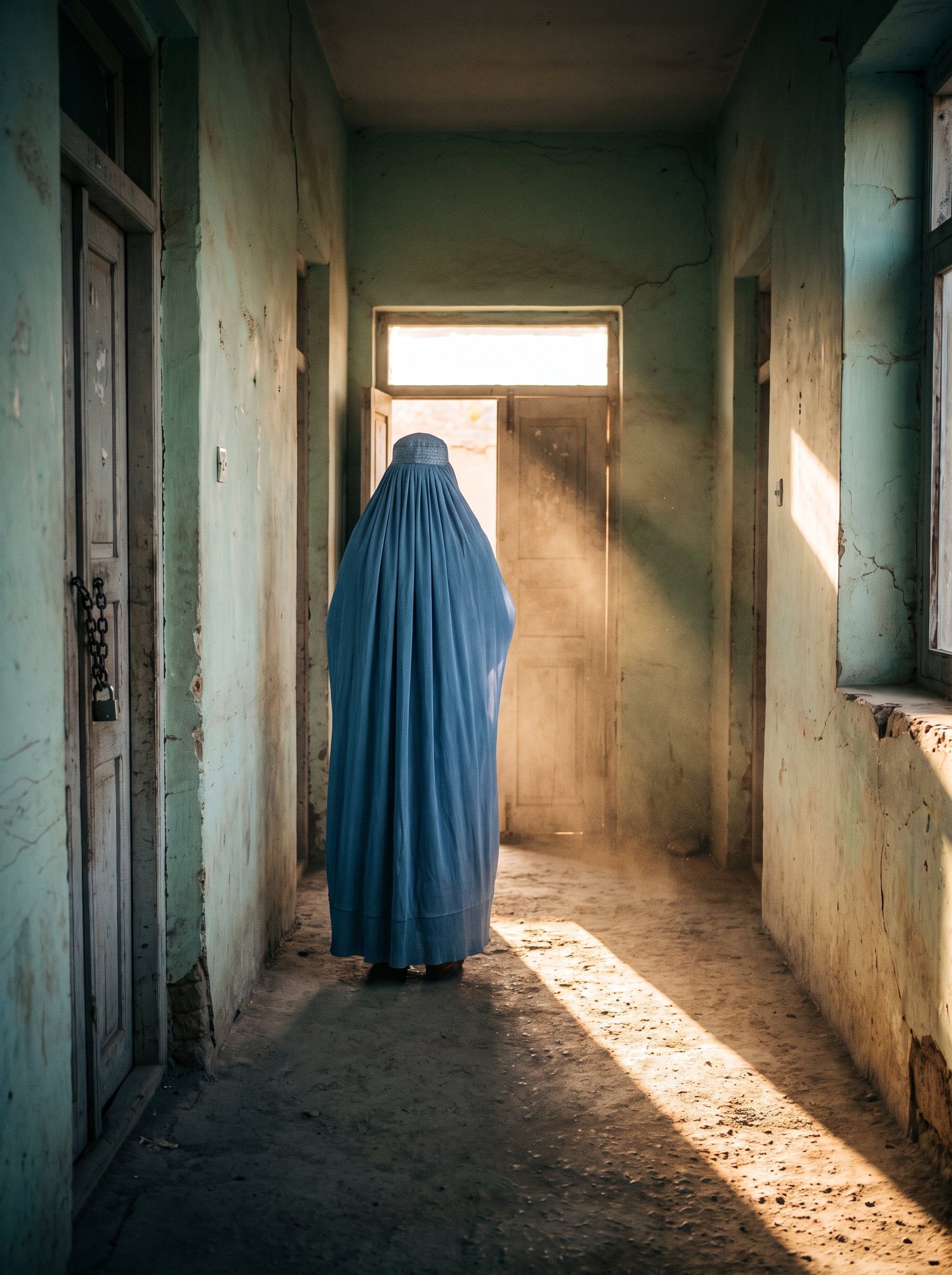
The last open door. The World Health Organization counted more than 200 Afghan clinics closed after the 2025 US funding cuts. Editorial illustration created for this essay — not a documentary photograph. Playcut AI.
Before anything else
This essay is going to ask hard questions of powerful people. It does not get to do that until it has paid what is owed.
One hundred and fifty-eight Canadian soldiers left a hometown, a kitchen, a driveway with a truck parked in it, a mother who worried, a kid learning to skate — and flew to the far side of the world to stand between strangers and the people who preyed on them. There was no going home at the end of a patrol. No calling your wife, your mom, your dad whenever the day got heavy. No picking your own child up when he fell, because you were half a planet away picking up somebody else's child, in a country that did not speak your language — held there by nothing except love of this country and of what your parents, grandparents and great-grandparents built it to stand for: the side of light, held no matter the cost.
Each of the 158 has a name, an age and a hometown, and every one of them is named in the roll of honour that closes this essay — because the last word here belongs to them, not to the argument.
And then they did it again. Rotation after rotation. They stood on the tarmac as friends went home in flag-draped caskets, and they boarded for the next tour anyway. No strikes. No sick days. No Sunday drive to see a buddy two towns over. They served, and served, and served. That is not a job description. It is the truest definition of love of country — and on missions like Canada's, of love for people they would never meet.
Before you read another word, stop and give them a moment of silence. Imagine what it costs to leave everything you love to protect someone you will never meet — and to keep going back. One hundred and fifty-eight Canadians did not come home from it.
Now we can talk about what was done with what they gave.
Quick Answer
On 4 February 2025, an Afghan journalist named Nazira Karimi stood in the White House and asked the President of the United States what his plan was for the Afghan people. He told her she had a beautiful accent, said he could not understand a word she was saying, wished her "good luck, live in peace," and took the next question. Two months later his administration shut down USAID, cutting more than US$560 million destined for Afghanistan. The World Health Organization counted over 200 Afghan clinics closed. The UN Population Fund projects 1,200 additional maternal deaths by 2028. It happened nine weeks after the Taliban banned women from studying midwifery and nursing — the last classroom door left open to them.
Canada buried 158 soldiers in that country. We counted how often the Parliament of Canada has spoken the words "Afghan women" or "women in Afghanistan" since 1996. In 2008 it was 66 times. In 2023, 41. In 2024, six. In 2025, once — and not by a minister. By a backbench MP reading a petition that ordinary Canadians had signed.
What this essay covers
- Before anything else
- The question nobody answered
- How the Taliban got Afghanistan back
- What 166 decrees do to a woman's body
- The second betrayal: the year the clinics closed
- What he talks about instead
- What Canada paid
- We counted how often Parliament said their name
- Europe voted 480 to 5
- The case Canada started and stopped talking about
- The people still doing the work
- What actually helps
- Questions readers ask
- Limitations of this essay
- The 158 — the roll of honour
- References
How this essay was researched
Every factual claim here is traced to a named primary source with a date and a working link. Where a source is a government, we cite the government. Where a claim is contested, we say so and give the strongest version the evidence actually supports — not the strongest version available.
One dataset in this essay is our own. To find out whether Canada's Parliament had gone quiet on Afghan women, we did not guess and we did not rely on impressions. We searched the full-text index of the official House of Commons record for the exact phrases "Afghan women" and "women in Afghanistan", walked every page of results with no sampling, and individually fetched and dated all 110 committee meetings the results pointed to, because committee records carry no date in their address. The result is 365 unique statements from 1996 to September 2026, with zero gaps. The method, the raw data and the scripts are described in full under Limitations, including what these numbers cannot tell you.
We validated the instrument before trusting it: a search tool that showed no spike during Canada's Kandahar combat years would be broken, not revealing. It showed the spike. Two claims we set out to verify did not survive contact with the record, and we report both against ourselves below.
The question nobody answered
On 4 February 2025, at a joint press conference with the Israeli Prime Minister, an Afghan journalist was called on in the White House. She began by saying who she was — an Afghan journalist, a woman from Afghanistan, and, in her words, someone with "high expectation from you." Then she asked her question.
"Do you have any plan to change the Afghanistan situation? Are you able to recognize Taliban… Any comment about Afghanistan? What's your future plan for Afghan people, especially Afghan—"
Nazira Karimi, White House press conference, 4 February 2025 (transcript, 30:31)She did not finish the sentence. The transcript records her being cut off mid-word. What followed is on the record in two independently produced transcripts — Rev’s timecoded record and the Times of Israel’s full text — and they agree:
TRUMP (30:51): "I have a little hard time understanding you. Where are you from?"
KARIMI (30:54): "From Afghanistan."
TRUMP (30:57): "Actually, it's a beautiful voice and a beautiful accent. The only problem is I can't understand a word you're saying, but I just say this, good luck. Live in peace. Go ahead, please."
He took the next question. Hers was never answered.
We want to be precise about what that exchange is and is not, because precision is the only thing that makes an essay like this worth reading. Karimi did not ask about maternal mortality. She did not ask about midwives. She asked what would happen to her country and her people, she identified herself as an Afghan woman, and the President of the United States responded by assessing her voice. That is the whole of it. It requires no embellishment.
Nine weeks earlier, on 3 December 2024, the Taliban's supreme leader had ordered Afghanistan’s midwifery and nursing institutes closed to women — shutting the last form of higher education Afghan women were still permitted to pursue. Eleven days before Karimi asked her question, on 24 January 2025, the new administration had reinstated the expanded global gag rule. Within weeks of it, USAID would be dismantled and more than half a billion dollars destined for Afghanistan would stop moving. Then the clinics started closing.
This essay is written for the Canadians who served in that country, and for the families of the 158 who did not come home. You were told what the mission was for. Part of what you were told was Afghan women and girls. This is an accounting of what has happened to them, who did it, and what Canada has done since — measured, not asserted.
The short version: The claim that the President has never said anything about Afghan women is not quite right, and the truth is worse. He was asked, in his own house, by an Afghan woman — and he talked about her accent.
How the Taliban got Afghanistan back
The Taliban entered Kabul in August 2021, during Joe Biden's presidency. Any honest accounting says that plainly. But the question of how they got there has an answer that is documented, and it does not begin in 2021.
On 29 February 2020, the United States signed an agreement with the Taliban in Doha titled “Agreement for Bringing Peace to Afghanistan”. It was negotiated by the Trump administration. The elected government of Afghanistan, the government the United States and its allies had spent nineteen years and thousands of lives building, was not a party to it. It committed the United States to withdrawing all forces. And it committed the United States to working toward the release of up to 5,000 Taliban prisoners held by the Afghan government, a decision the Afghan president said was his to make and not Washington's.
Five months before that, in September 2019, the President had invited Taliban leaders to Camp David for secret talks days before the anniversary of the 11 September attacks. The Secretary of State confirmed it had been the President's own decision. It was cancelled after a bombing in Kabul killed an American soldier.

The table at Doha had two sides. The elected government of Afghanistan was not at either of them. Editorial illustration created for this essay — not a documentary photograph. Playcut AI.
What the deal did to the Afghan army is not a matter of opinion. It is the finding of the Special Inspector General for Afghanistan Reconstruction — the United States government's own watchdog, created by Congress to audit that war.
SIGAR’s finding: the decision to withdraw United States forces was the most important immediate factor in the collapse of the Afghan security forces. Afghan security officials described the Doha agreement to SIGAR as "a catalyst for the collapse." General Sami Sadat, who commanded Afghanistan's Joint Special Operations Command, told SIGAR that "overnight… 98% of U.S. airstrikes had ceased."
An army that had been built for two decades around American air support was told its air support was leaving, on a published timetable, by an agreement its own government had not been allowed to sign. Then five thousand of the fighters it had captured were released.
There is a version of this argument that overreaches, and we are not going to make it. The withdrawal was executed under the next administration, and that execution has its own accounting. But the frame in which one president handed over a war another president had already sold is not a partisan reading. It is the reading of the inspector general whose job was to audit it.
What the record supports: not "he was president when Kabul fell" — he wasn't. What it supports is that the agreement he signed, without the Afghan government at the table, was identified by America's own auditor as the catalyst. That claim is stronger because it cannot be argued with.
What 166 decrees do to a woman's body
Since taking power the Taliban have issued, by the Georgetown Institute for Women, Peace and Security’s count as of June 2026, 264 decrees affecting human rights, of which 166 target the rights of women and girls specifically. That number is worth sitting with. This is not a policy. It is an administrative project, sustained over five years, whose subject is half the population.
The shape of it is by now familiar in outline: girls barred from school beyond grade six, women barred from university, from most employment, from public spaces, from travelling any real distance without a male guardian. What is less understood outside Afghanistan is how those rules convert, in practice, into a medical emergency — because they are not separate from health care, they are the health care system.
Afghanistan is a country where custom and Taliban rule both hold that a woman should be treated by a woman. Remove women from medicine and you have not inconvenienced Afghan women. You have removed their access to doctors.

Girls are barred beyond grade six; a generation has now been denied secondary school. In December 2024 the last classroom — midwifery and nursing — closed too. Editorial illustration created for this essay — not a documentary photograph. Playcut AI.
3 December 2024. The Taliban's supreme leader ordered midwifery and nursing institutes closed to women. Because secondary school and university were already closed to them, these courses were the last route by which an Afghan woman could be trained to treat another Afghan woman. The pipeline that produces female medical staff was shut at the source.
Layered on top of that: women turned away from hospitals over their clothing, or for arriving without a male guardian. Since 7 September 2025, Taliban forces have barred women, including United Nations staff and contractors, from entering UN premises.
The arithmetic of this is brutal and well documented. By a December 2023 statement from the UN Secretary-General's spokesman, a woman dies of birth-related complications in Afghanistan roughly every two hours, and the UN Population Fund reports the country needs at least 18,000 more trained midwives to ensure basic maternal care. UNFPA also reports that only one pregnant woman in four receives the recommended four or more antenatal-care visits, and projects that 1.2 million pregnant and breastfeeding women will be acutely malnourished in 2026. Those numbers can now only worsen, because the schools that made midwives are shut.

A woman dies of birth-related complications in Afghanistan roughly every two hours — the UN's arithmetic, one household at a time. Editorial illustration created for this essay — not a documentary photograph. Playcut AI.
On 8 July 2025 the International Criminal Court issued arrest warrants for the Taliban's supreme leader, Haibatullah Akhundzada, and its chief justice, Abdul Hakim Haqqani, for the crime against humanity of persecution on gender grounds. Human rights organizations and a growing number of states now use the term "gender apartheid" as a legal description rather than a rhetorical one.
Why healthcare is the hinge: in a country where women may only be treated by women, banning women from medical training decides who is allowed to survive childbirth.
The second betrayal: the year the clinics closed
The least-reported part of this story is also the reason this essay exists. After August 2021 the Taliban governed, but Afghan women were not left with nothing. They were left with a humanitarian system funded largely from Washington. In 2025 that system was switched off, and the consequences were measured in closed buildings and uncounted deaths.
After August 2021, most Western governments stopped funding the Afghan state. What continued, what kept clinics open and midwives paid and food moving, was humanitarian assistance routed around the Taliban through UN agencies and NGOs. And the largest single source of that money, by a wide margin, was the United States.
Between 2021 and early 2025 the United States provided US$3.83 billion — 36% of all international assistance to Afghanistan, making it the single largest donor to a country it had just left.
In early 2025 that ended. USAID was shut down. According to Refugees International's January 2026 report on the consequences, the administration cut off more than US$560 million slated for Afghanistan in 2025 alone, with no alternative donor stepping in. Programmes that had been planned to reach more than six million people that year stopped.
Globally (and we want to be exact that these next figures are global cancellation shares, not Afghanistan-only) the 2025 cuts eliminated 88% of maternal and child health funding, 94% of sexual and reproductive health funding, and nearly 80% of gender-based violence prevention and response funding. Whatever else that is, it is not a neutral budget exercise. Those are the line items that exist because women exist.
What it meant on the ground in Afghanistan:
- The World Health Organization reported more than 200 clinics closed in Afghanistan as a result of the American funding cuts.
- The UN Population Fund projects the cessation of US support could cause approximately 1,200 additional maternal deaths and 109,000 unintended pregnancies between 2025 and 2028.
- Safe spaces for women, gender-based violence case management, referral networks and women-led organizations closed, in the words of the report, "with little warning."
- The national maternal mortality survey was abandoned — meaning the true toll is now, by design or by accident, unmeasurable.

UNFPA says Afghanistan needs at least 18,000 more trained midwives. The training schools are closed to women; the clinics that employed them lost their funding. Editorial illustration created for this essay — not a documentary photograph. Playcut AI.
That last point deserves emphasis, because it is the quietest kind of harm. When you defund the survey, the deaths do not stop. Only the counting stops. Any future claim that things were not so bad will rest on data that was cancelled.
Sequence the year and the shape of it is hard to miss:
Afghan women lost the right to train as nurses in December, and lost the clinics themselves by spring. One of those decisions was made in Kandahar. The other was made in Washington.
The finding: the Taliban closed the door to the profession. The United States withdrew the money that staffed the buildings. Afghan women did not need both to happen in the same six months, but both did.
What he talks about instead
It would be inaccurate to say the President stopped talking about Afghanistan. He has returned to the subject repeatedly through 2025 and 2026, in press conferences and on social media, with threats attached. What he returns to is not the women, the clinics or the schools. It is an airfield.
Through September 2025 he pressed publicly for the return of Bagram Airfield, the airbase north of Kabul that the United States held for two decades. He told reporters in London: “We’re trying to get it back.” He explained the interest plainly — "one of the reasons we want that base is, as you know, it's an hour away from where China makes its nuclear weapons." When the Taliban refused, he posted on Truth Social:
"If Afghanistan doesn't give Bagram Airbase back to those that built it, the United States of America, BAD THINGS ARE GOING TO HAPPEN!!"
Truth Social, 20 September 2025We are not going to speculate about what is in anyone's heart; that is not evidence and it is not our business. We will simply set two records beside each other, both public, both dated.
Asked by an Afghan woman what would become of the Afghan people, he answered in nineteen words, none of which addressed the question. Asked about a piece of real estate an hour from the Chinese nuclear programme, he threatened a government with consequences in capital letters.
The record on how this president speaks about and treats women is not a matter of interpretation either; it has been adjudicated. In May 2023 a New York jury found him liable for sexually abusing and defaming the writer E. Jean Carroll. In January 2024 a second jury awarded her US$83.3 million. The Second Circuit affirmed it. In 2026 the Supreme Court declined to hear his appeal and then refused to reconsider that refusal. In July 2026 he paid Carroll US$5.6 million on the earlier verdict.
In a sworn deposition in that case, shown his 2005 remarks about grabbing women, he did not disown them. He said: "historically, that's true with stars. If you look over the last million years, I guess that's been largely true." Then: "Unfortunately or fortunately."
Kept narrow on purpose: every claim in this section is either a court finding, a sworn deposition, or a dated public statement in his own words. None of it requires anyone to trust our characterisation of him.
What Canada paid
More than 40,000 members of the Canadian Armed Forces served in Afghanistan. 158 of them were killed. So were seven Canadian civilians — a diplomat, four aid workers, a government contractor and a journalist. Every one of the 158 is named, with age, hometown and their family's words, in the roll of honour that closes this essay. More than 2,000 were wounded or injured. Canada commanded the international effort in Kandahar province from 2005 to 2011, the hardest ground in the country.
The money was on the same scale. By the Canadian Encyclopedia's accounting, Canada spent an estimated $18 billion fighting in Afghanistan and trying to reconstruct it (a figure the government itself projected as high as $18.1 billion), including $2.2 billion in development assistance between 2001 and 2014, which made Afghanistan the largest recipient of Canadian aid anywhere in the world in that period.

158 Canadian soldiers and seven Canadian civilians died in Afghanistan. Canada commanded Kandahar province for six years. Editorial illustration created for this essay — not a documentary photograph. Playcut AI.
A great deal of that was spent explicitly on Afghan women and girls. That was not incidental to how the mission was explained to Canadians — it was central to it. Schools, clinics, literacy programmes, maternal health. Canadian soldiers were told, and Canadian families were told, that this was part of what the deaths were for.
That framing has been criticized, then and since, and some of the criticism is fair. But the promise was made. The question this essay asks is a narrow and answerable one: what has Canada done since?
The ledger, before we go further: 158 Canadian soldiers dead. Seven civilians. 2,000+ wounded. Roughly $18 billion. Six years commanding Kandahar. That is the standing this country has to speak on Afghan women. Almost no other nation has more.
We counted how often Parliament said their name
It is easy to say a country has gone quiet. It is harder, and more useful, to measure it. So we did, using the same approach we took when we counted how Canadian news actually covers the country and found the denominator missing.
We searched the full-text index of the official record of the House of Commons, Hansard plus committee evidence, for the exact phrases "Afghan women" and "women in Afghanistan". We walked every page of results rather than sampling. Committee records do not carry a date in their web address, so we fetched and dated all 110 committee meetings individually. The result is 365 unique statements spanning 1996 to 3 September 2026, with no unresolved gaps.
Mentions of "Afghan women" / "women in Afghanistan" in the Parliament of Canada, 1996–2026
Source: Zeus analysis of the full-text index of the official House of Commons record (Hansard and committee evidence), retrieved 3 September 2026. 365 unique statements; every result page walked; all 110 committee meetings individually dated. 2026 is a partial year. Commons only — the Senate is not included. Exact-phrase matching, so these totals are a floor, not a ceiling.
| Year | Total mentions | In debates | In committee |
|---|---|---|---|
| 1996 | 1 | 1 | 0 |
| 1997 | 0 | 0 | 0 |
| 1998 | 0 | 0 | 0 |
| 1999 | 0 | 0 | 0 |
| 2000 | 1 | 1 | 0 |
| 2001 | 15 | 15 | 0 |
| 2002 | 9 | 9 | 0 |
| 2003 | 8 | 8 | 0 |
| 2004 | 0 | 0 | 0 |
| 2005 | 3 | 3 | 0 |
| 2006 | 37 | 36 | 1 |
| 2007 | 40 | 35 | 5 |
| 2008 | 66 | 55 | 11 |
| 2009 | 41 | 24 | 17 |
| 2010 | 15 | 7 | 8 |
| 2011 | 9 | 7 | 2 |
| 2012 | 11 | 7 | 4 |
| 2013 | 1 | 1 | 0 |
| 2014 | 10 | 1 | 9 |
| 2015 | 4 | 2 | 2 |
| 2016 | 9 | 2 | 7 |
| 2017 | 0 | 0 | 0 |
| 2018 | 0 | 0 | 0 |
| 2019 | 2 | 1 | 1 |
| 2020 | 2 | 0 | 2 |
| 2021 | 8 | 6 | 2 |
| 2022 | 21 | 8 | 13 |
| 2023 | 41 | 21 | 20 |
| 2024 | 6 | 5 | 1 |
| 2025 | 1 | 1 | 0 |
| 2026 (partial year, to 3 Sept) | 4 | 2 | 2 |
The full series, so the chart can be checked line by line. Totals are unique statements containing either exact phrase, deduplicated where a statement contains both. Years absent from the record (for example 1997–1999 and 2004) are shown as zero: the index covers those years and returned nothing.
The shape is the story. Attention peaks at 66 mentions in 2008, when Canadians were fighting and dying in Kandahar. It rises again to 41 in 2023, in the aftermath of the fall and the resettlement debates. Then it collapses.
2024: six mentions. 2025: one.
2025 is the year the Taliban's ban on women studying nursing and midwifery took effect, the year American funding was cut, and the year the World Health Organization counted more than 200 Afghan clinics closing. In that year, the Parliament of Canada spoke the words "Afghan women" or "women in Afghanistan" on one occasion.
And it is worth knowing what that one occasion was. It was not a minister, and it was not a government statement, an emergency debate or a foreign policy address. On 16 June 2025, during Routine Proceedings, Green Party MP Elizabeth May rose to present a petition — a petition brought to her by members of the public, titled "Gender apartheid in Afghanistan." She read what the petitioners had asked for:
"The petitioners ask the Government of Canada to formally and publicly declare Canada's support to include gender apartheid as a crime against humanity and international law… to sanction senior Taliban officials under Canada's Magnitsky laws and to make every possible effort to protect our sisters in Afghanistan from a cruel, misogynistic, illegal regime."
House of Commons, Petitions, 16 June 2025In the whole parliamentary year, the subject reached the floor of the House of Commons because ordinary Canadians signed a piece of paper and asked an MP to read it aloud.
For completeness, here is every member who raised either phrase in the Commons or in committee between 2024 and September 2026 — the full list, not a selection: Elizabeth May (twice), Leah Taylor Roy (twice), Salma Zahid, Yasir Naqvi, Alex Ruff, Ali Ehsassi, Alexis Brunelle-Duceppe and Paul Chiang, plus committee witness Ghazaal Habibyar. Nine names across nearly three years.
We should be fair about what this measures, because we would rather undersell a real finding than oversell it. This counts exact phrases, so a speech about Afghanistan that never used those words is invisible to it. It covers the Commons and not the Senate. And a mention is only speech — saying the words is not the same as doing anything, which cuts both ways. These numbers are a floor. Even as a floor, the floor fell out.
Measured, not asserted: in the year Afghan women lost their clinics and their last classroom, Canada's Parliament said their name once, and only because voters asked it to.
Europe voted 480 to 5
We began this research expecting to find that the whole Western world had gone silent together. That is not what the record shows, and reporting it accurately makes Canada's position worse rather than better. It is the same discipline we applied to what Canada and the United States actually spend telling each other who they are: check the assumption before you build on it.
In May 2026 the European Parliament adopted a resolution condemning the Taliban's new criminal procedure code and its treatment of women, describing the situation as gender apartheid and calling for sanctions on Taliban leaders to be extended and for the ICC's arrest warrants to be enforced. The vote, recorded as resolution TA-10-2026-0186 of 21 May 2026, was 480 in favour, 5 against, 83 abstentions (official vote record). The EU extended human rights sanctions, travel bans and asset freezes, to Taliban leaders.
And since late 2022 and early 2023, Denmark, Sweden and Finland have granted Afghan women refugee status on the grounds of gender alone, a position the European Parliament's own research service documents, and one that says, in law, that being a woman in Afghanistan is itself persecution.
Set that beside our own count and the comparison makes itself. The European Parliament, whose member states did not command Kandahar and did not bury 158 soldiers in Afghan ground, voted 480 to 5. The Parliament of Canada, which did both, managed one mention in 2025.
The correction that matters: "everyone went quiet" is not true. Europe legislated. That is precisely what makes Canada's quiet difficult to explain.
The case Canada started and stopped talking about
Canada's record is not one of pure absence, and the truth is more frustrating than absence would be. This country did not merely issue statements. It helped launch the most serious legal action ever taken on behalf of Afghan women anywhere in the world, and then, on the public record at least, went quiet about it.
In September 2024, Canada, together with Germany, Australia and the Netherlands, formally invoked Article 29 of the Convention on the Elimination of All Forms of Discrimination Against Women against Afghanistan, the treaty's dispute mechanism, which can carry a matter all the way to the International Court of Justice. Somewhere between 22 and 25 other states declared support. It was the first time in the history of that convention that one state had moved against another under it. It was, genuinely, a landmark, and Canada was among the four countries that made it happen.
Nearly two years later, it is not possible to establish from the public record that the case is still moving. Legal observers reviewing it in 2026 have asked openly whether it is progressing at all.
In November 2025, Prime Minister Mark Carney announced that his government would no longer describe Canada’s foreign policy as a “feminist foreign policy”, while saying Canada would continue to support gender equality abroad without the branding.
We are going to be careful here, because there is a version of this paragraph that assumes a motive, and we cannot evidence one. We do not know why the CEDAW case slowed. We do not know why the designation was dropped, beyond the reasons given. We are not going to tell you it was traded for anything, because we cannot show you a document that says so, and an essay that demands evidence of others has to hold itself to it. What we can put in front of you is the sequence: the case was filed in 2024; the label was dropped in November 2025; the case cannot be shown to be advancing in 2026; and Parliament said the words once in the intervening year.
Canada has not been mute, and the money has not stopped. In August 2026, Foreign Affairs Minister Anita Anand and Secretary of State Randeep Sarai issued a joint statement condemning the Taliban's "extreme repression" and noting that "millions of Afghan girls remain barred from education." By the Government of Canada’s own published figures, Canada has contributed more than $143 million for basic needs such as healthcare and education, and more than $315 million in life-saving humanitarian assistance, since 2021 — roughly $458 million in all.
That is real and it should be said plainly. It is also about one dollar for every forty this country spent on the war itself.
The honest verdict: Canada did not do nothing. Canada did something historic, and then stopped talking about it. Statements are not the same as a case that moves.
The people still doing the work
On 3 September 2026, the day this essay was researched, Canadian newsrooms carried a story about virtual classrooms being run out of Canada for Afghan girls locked out of school under Taliban rule. Volunteers. Diaspora women. Teachers on video calls across nine and a half time zones, holding open the one door that can still be opened remotely.

The classrooms that still exist for Afghan girls are Canadian kitchen tables after dark. Editorial illustration created for this essay — not a documentary photograph. Playcut AI.
It is worth saying that this is what rebuilding trust actually looks like in practice — unglamorous, local, and carried by people with no budget.
They are not funded at the scale of a government programme, and they are not a foreign policy. They are people who decided that "nothing can be done" was not accurate and acted accordingly.
And we should be precise about who is doing it, because a piece like this can quietly cast Afghan women as the helped and Canadians as the helpers — and the record refuses that framing. Adeena Niazi came to Canada as a refugee in 1988, founded the Afghan Women's Organization in Toronto in 1990, and has helped sponsor and settle thousands of refugees since — work for which the Governor General awarded her the Meritorious Service Cross in May 2025, alongside her Order of Ontario. Friba Rezayee, widely recognized as Afghanistan's first female Olympian, has run Women Leaders of Tomorrow from Vancouver since arriving as a refugee, putting Afghan girls the Taliban locked out of classrooms into online ones. And one of the nine names in our own 2024–2026 parliamentary count belongs to Ghazaal Habibyar, an Afghan human rights advocate who sat before a Canadian committee in April 2026 and carried the file the ministers were not carrying. Afghan women are not simply the subject of Canada's Afghanistan file. They are among the few people still working it.
We want to end the descriptive half of this essay there deliberately, because a piece like this can leave a reader with the impression that everyone failed, and that is not what we found. Petitioners in Canadian ridings gathered signatures. An MP read them into the record. Four governments including our own filed a case no one had ever filed before. Volunteers in Canadian cities are teaching Afghan girls algebra on Zoom this week.
The failure is not that Canadians stopped caring. On the available evidence, Canadians did not stop caring. The failure is that the institutions those Canadians fund and elect stopped carrying it, and left it to volunteers and petitioners — in a file that cost this country 158 lives.
Who is still holding the line: unpaid volunteers, diaspora organisers, and the people who signed a petition. Not the institutions that sent the soldiers.
What actually helps
This essay has no product to sell you and nothing to ask you to buy. It is published under our Civic Duty section, which exists for that reason. What follows are things a Canadian can verify and act on this week, each one checked and live at the time of writing.
Ask where the case went. Canada is one of four states that invoked CEDAW Article 29 against Afghanistan in September 2024 — the first action of its kind ever brought. It is a fair and specific question to put to your Member of Parliament in writing: what is the current status of Canada's CEDAW proceeding against Afghanistan, and what resources are assigned to it? You can find your MP at ourcommons.ca/members. Specific questions are harder to deflect than general concern.
The petition route demonstrably works. The single time Afghan women reached the floor of the House of Commons in 2025, it was because members of the public signed a petition and an MP read it. That is not a symbolic act — on the measured record, it was the only act. E-petitions to the House of Commons are at petitions.ourcommons.ca.
Support the Canadians already doing it. Right to Learn Afghanistan, formerly Canadian Women for Women in Afghanistan, has worked on education for Afghan women and girls since 1998. By its own published figures it runs an online high school with 700+ students, has provided 4,000+ scholarships and devices, trained 10,000+ teachers, and established 300+ libraries and science labs. When Afghan girls were locked out of classrooms, an online school is one of the few things that still reaches them.
We are not going to pretend any of this reverses gender apartheid. It does not. But the gap between "nothing can be done" and "something specific can be done today" is the whole distance between a country that abandoned a promise and one that is still keeping a smaller version of it.
Questions readers ask
What happened to Afghan women after the Taliban returned?
By the Georgetown Institute for Women, Peace and Security's count as of June 2026, the Taliban have issued 264 decrees affecting human rights, of which 166 target women and girls specifically. Girls are barred from school beyond grade six and from university. Women are barred from most employment and from moving freely without a male guardian. In December 2024 they were barred from studying midwifery and nursing — the last higher education open to them. In July 2025 the International Criminal Court issued arrest warrants for the Taliban's supreme leader and chief justice for the crime against humanity of gender persecution.
Did Trump give Afghanistan back to the Taliban?
Kabul fell in August 2021, under President Biden, and that is a fact any accurate account has to state. But the agreement that set the terms was signed by the Trump administration in Doha on 29 February 2020, without the elected Afghan government as a party, and it committed the United States to the release of up to 5,000 Taliban prisoners. The US government's own auditor, the Special Inspector General for Afghanistan Reconstruction, found the withdrawal decision was the most important immediate factor in the collapse of the Afghan forces, and recorded Afghan officials describing the agreement as "a catalyst for the collapse."
Why did Afghanistan fall so quickly?
SIGAR's account is the most authoritative available: an army built around American air support learned that the support was leaving on a published timetable, under a deal its own government had not signed. General Sami Sadat told SIGAR that "overnight… 98% of U.S. airstrikes had ceased." Morale collapsed ahead of the lines.
How did US aid cuts affect Afghan women's healthcare?
Between 2021 and early 2025 the United States was the largest single donor to Afghanistan, providing US$3.83 billion — 36% of all international assistance. In early 2025 USAID was shut down and more than US$560 million slated for Afghanistan was cut with no replacement donor. The World Health Organization reported more than 200 clinics closed as a result. The UN Population Fund projects the disruption could cause 1,200 additional maternal deaths by 2028. The national maternal mortality survey was also abandoned, meaning the full toll can no longer be measured.
How many Canadian soldiers died in Afghanistan?
158 Canadian Armed Forces members were killed. Seven Canadian civilians also died — a diplomat, four aid workers, a government contractor and a journalist. More than 40,000 Canadians served and more than 2,000 were wounded or injured. Canada commanded operations in Kandahar province from 2005 to 2011.
Who were the first and last Canadian soldiers killed in Afghanistan?
The first were Sgt. Marc D. Léger, Cpl. Ainsworth Dyer, Pte. Richard Green and Pte. Nathan Smith, killed near Kandahar on 18 April 2002 when an American fighter jet mistakenly bombed their night training exercise at Tarnak Farm. The last was Master Cpl. Byron Greff of Lacombe, Alberta, killed in Kabul on 29 October 2011. All 158 are named in the roll of honour on this page.
What is Canada doing for Afghan women now?
By the Government of Canada's published figures, Canada has contributed more than $143 million for basic needs such as healthcare and education, and more than $315 million in humanitarian assistance, since 2021. Canada is also one of four states that invoked CEDAW Article 29 against Afghanistan in September 2024 — though it cannot be established from the public record that the case is currently advancing. In November 2025 the government stopped describing its foreign policy as "feminist."
Has the rest of the world gone quiet too?
No, and this surprised us. In May 2026 the European Parliament passed a resolution condemning Taliban gender apartheid by 480 votes to 5, called for extended sanctions and enforcement of the ICC warrants, and the EU applied travel bans and asset freezes to Taliban leaders. Denmark, Sweden and Finland recognize Afghan women asylum-seekers as refugees on the basis of gender alone.
Who is actually helping Afghan women right now?
Largely volunteers, diaspora organizations and NGOs rather than governments. Canadian-run virtual classrooms are teaching Afghan girls barred from school. Right to Learn Afghanistan, a Canadian organization working on this since 1998, runs an online high school for Afghan students. UN agencies continue operating under severe restriction — including a Taliban ban, in force since September 2025, on women entering UN premises.
Limitations of this essay
We think you are entitled to know where this piece is weakest.
Our parliamentary count measures words, not conscience. It searches two exact phrases in the House of Commons record. A speech about Afghanistan that never used either phrase is invisible to it. It excludes the Senate. It counts mentions, not debates, and a mention is not advocacy — an MP who says "Afghan women" once while arguing against helping them counts the same as one who says it while arguing for it. The figures are a floor, not a ceiling, and we would rather you treated them that way. The complete year-by-year table is published above; the underlying per-statement records and the collection scripts are archived, and researchers or journalists who want them can write to milad@zeusebikes.ca. 2026 is a partial year and should not be compared with a full one. The index we searched reports a slightly higher headline count than its own paginator will serve (301 against 262 retrievable for one phrase); we counted what could actually be retrieved and disclose the gap rather than smoothing it.
Two things we set out to establish did not survive checking, and we report them against ourselves. The first: it is commonly said that this president has never said anything about Afghan women. We could not sustain that, and the record is worse than the claim — he was asked directly and answered about the questioner's accent. The second: we expected to find that Western governments had gone quiet as a bloc. Europe had not. Both corrections weaken a simpler story and we have kept them in.
We do not know why Canada went quiet. We can show that it did. We cannot show you why, and we have deliberately not speculated about trade negotiations or any other motive, because we have no document that establishes one. Anyone who tells you they know the motive should be asked what they are reading.
We have not spoken to Afghan women for this piece. Everything here about their lives is drawn from UN bodies, court filings, medical journals and reporting by others — much of it by Afghan journalists at considerable risk. This essay is an accounting of what Canadian and American institutions did. It is not, and should not be mistaken for, Afghan women speaking for themselves.
The bottom line
An Afghan journalist stood in the White House on 4 February 2025 and asked what would happen to her people. She was told she had a beautiful accent. Within months the clinics closed.
Canada buried 158 soldiers in that country and spent something like $18 billion, and part of what Canadians were told it was for was Afghan women and girls. In the year those women lost their nursing schools and their clinics, the Parliament of Canada spoke their name once — because voters signed a petition and asked an MP to read it out.
The European Parliament, with far less blood in that ground, voted 480 to 5.
None of this is beyond fixing, and the people already fixing pieces of it are mostly unpaid. But it should be recorded plainly, because the families of the 158 were promised something specific, and the record of what happened to that promise should exist somewhere they can read it.
And so this essay does not end with a conclusion. It ends with a roll call.
Corrections. Every factual claim in this essay is sourced and dated above. If any of it is wrong, we want to fix it rather than defend it. Write to milad@zeusebikes.ca with the claim and the source that corrects it, and we will amend the piece and note the change. That offer extends to anyone named here.
Every image in this essay is an editorial illustration created with Playcut.ai. None is a documentary photograph, and none depicts a real, identifiable person. We label them because a piece built on verified fact must not pass rendered images off as reportage.
The 158
The last word in this essay does not belong to the argument, and it does not belong to us. It belongs to them. All 158, from the first morning at Tarnak Farm to the last flight home. The youngest here was 20 years old; the average age was 28; the four years Canada held Kandahar took 130 of them. This roll has no argument to make. Read slowly.
About this roll
The roll below lists every Canadian Armed Forces member killed in the Afghanistan war — all 158, from the four soldiers of Tarnak Farm on 18 April 2002 to Master Cpl. Byron Greff on 29 October 2011. It was compiled on 3 September 2026 from the coalition casualty database maintained at icasualties.org, cross-checked for count and boundary against Veterans Affairs Canada (158 members; seven Canadian civilians also died — a diplomat, four aid workers, a government contractor and a journalist) and spot-verified against the public record. The source database's cause-of-death field was found unreliable and is deliberately omitted rather than published wrong.
Two promises. First: nothing in this roll is invented — where we could not verify a detail, it is absent, not guessed. Names, ranks and spellings — accents included — are taken from each soldier's official page on the Canadian Virtual War Memorial. Second: the line beneath each name is drawn, verbatim or near-verbatim, from that soldier's page on the Canadian Virtual War Memorial — the Government of Canada's official memorial, much of it written and submitted by the families themselves — and each name links to that official page. For three soldiers whose official pages carry no personal biography, the line is quoted instead from cited CBC coverage or the Minister of National Defence's official statement, linked beside it. If you knew one of them and want their words here — or see anything to correct — write to milad@zeusebikes.ca. Corrections are made and noted.
Seven Canadian civilians also gave their lives in Afghanistan — a diplomat, four aid workers, a government contractor and a journalist. They will be named here with the same care, as each entry is verified.
2002
4 Canadians did not come home.
-
Private Richard Anthony Green, 21, of Mill Cove — 18 April 2002, Kandahar.
Son of Mrs. Doreen Janet Coolen ( 2002 National Memorial (Silver) Cross Mother ) of Hubbards, Nova Scotia. Graduate of Forest Heights Community School in Chester Grant, Nova Scotia. A plaque bearing the names of Sgt. Marc Léger, Cpl. Ainsworth Dyer, Pte. -
Private Nathan Lloyd Smith, 26, of Tatamagouche — 18 April 2002, Kandahar.
Son of Lloyd and Charlotte Lynn Smith ( 2003 National Memorial (Silver) Cross Mother ) of Tatamagouche, Nova Scotia. Private Smith grew up in the Musquodoboit area of the province and attended many schools in the area, including Gatez Brook Junior High School and Eastern Shore District High School. -
Corporal Ainsworth Dyer, 24, of Montreal — 18 April 2002, Kandahar.
Son of the late Paul and Agatha (née Dawkins) Dyer (2004 National Memorial (Silver) Cross Mother) of St. Laurent, Quebec. Brother of Carolyn. -
Sergeant Marc Daniel Léger, 29, of Lancaster, Ottawa — 18 April 2002, Kandahar.
Son of Richard and Claire Léger ( 2005 National Memorial (Silver) Cross Mother ) of Stittsville, Ontario. Husband of Marley (née McIntyre) Léger of Edmonton, Alberta. Brother of Sophie and Albert. Grandson of Alice Léger of Lancaster, Ontario.
2003
2 Canadians did not come home.
-
Sergeant Robert Alan Short, 42, of Fredericton — 2 October 2003, Kabul.
Husband of Susan Dawn Short, father of Charissa and Joshua of Fredericton, New Brunswick. Son of Murray Donald Short of Fredericton, New Brunswick. -
Corporal Robbie Christopher Beerenfenger, 29, of Ottawa — 2 October 2003, Kabul.
Son of Wilhelmina Beerenfenger-Koehler (2007 National Memorial (Silver) Cross Mother) of Embrun, Ontario.
2004
1 Canadian did not come home.
-
Corporal Jamie Brendan Murphy, 26, of Conception Harbour — 27 January 2004, Kabul.
Son of Norman and Alice Murphy ( 2006 National Memorial (Silver) Cross Mother ) of Conception Harbour, Newfoundland.
2005
1 Canadian did not come home.
-
Private Braun Scott Woodfield, 24, of Eastern Passage — 24 November 2005, Kandahar.
Son of Daniel and Beverley Woodfield. Brother of Lyndi Woodfield. Grandson of Richard and Christine Woodfield of Cambridge, Ontario and nephew of Richard and Steven Woodfield.
2006
36 Canadians did not come home.
-
Corporal Paul James Davis, 28, of Bridgewater — 2 March 2006, Kandahar.
Son of Connie Elizabeth Davis and Jim Davis. Stepson of Sharon Davis. Husband of Melanie Julie Dyck. -
Master Corporal Timothy James Wilson, 30, of Grande Prairie — 5 March 2006, Landstuhl Reg. Med. Center, Landstuhl, Germany.
Son of Dale Albert and Jane Wilson of Longbow Lake, Ontario. Husband of Daphne Jane Wilson of Brandon, Manitoba. -
Private Robert Howard Costall, 22, of Thunder Bay — 29 March 2006, Helmand.
Son of Bonnie Costall. Husband of Chrissandra Rose Costall, father of Colin. -
Lieutenant William Montague Turner, 45, of Toronto — 22 April 2006, Shah Wali Khot district.
At his visitation, colleagues that served with him in the 11th Field Regiment Reserve Unit in Guelph, said "he was just a good human being and a great friend. He always had time for the junior rank members". -
Corporal Matthew David James Dinning, 23, of Richmond Hill — 22 April 2006, Shah Wali Khot district.
Son of Lincoln and Laurie Grace Dinning of Wingham, Ontario. Brother of Brendon Dinning. Grandson of Jim and Rhelda Stockall of Richmond Hill, Ontario and Eileen and the late Sidney Dinning. -
Corporal (Bombardier) Myles Stanley John Mansell, 25, of Victoria — 22 April 2006, Shah Wali Khot district.
Son of Alan and Nancy Mansell. Husband of Lindsay Sullivan. Brother of Matthew and Michael. -
Corporal Randy Joseph Payne, 32, of Gananoque — 22 April 2006, Kandahar.
Son of Dave and Nancee Payne of Peterborough, Ontario. Husband of Jody Payne and father of Jasmine and Tristan. Brother of Christopher Payne of Ottawa, Ontario. -
Captain Nichola Kathleen Sarah Goddard, 26, of Calgary — 17 May 2006, Panjwa’i District.
"She loved her job, loved what she did," her husband, Jason Beam said from their home in Shilo, Manitoba. "She was glad to be in Afghanistan." Captain Goddard was known as a reader and dog lover who volunteered with the Girl Guides. -
Corporal Anthony Joseph Boneca, 21, of Thunder Bay — 9 July 2006, Panjwa’i District.
Son of Antonio and Shirley Boneca of Thunder Bay, Ontario. -
Corporal Francisco Oliver Gomez, 44, of Edmonton — 22 July 2006, Kandahar.
Son of George and Joan Gomez of Edmonton, Alberta. -
Corporal Jason Patrick Warren, 29, of Quebec City — 22 July 2006, Kandahar.
Son of Gerald and Deborah Warren of Kanata, Ontario. Corporal Warren also had seen service in Bosnia in 2002. He also left a brother and a sister to mourn his loss. Corporal Warren attended Quebec High School, graduating in 1994. The Alumni Foundation confirmed that the School would be commemorating the life of Cpl Warren. -
Private Kevin Yves Royal Dallaire, 22, of Calgary — 3 August 2006, Pashmul.
Son of Gaétan and Diane Dallaire of Calgary, Alberta. Brother of Private Mikael Dallaire. -
Sergeant Vaughan Ingram, 35, of Burgeo — 3 August 2006, Pashmul.
Son of Clayton and Linda Ingram (née Foote). Husband of Ann-Marie Dodge and father of Brooke Ashley of St. John's, Newfoundland and Samantha McCoubrey. -
Corporal Bryce Jeffrey Keller, 27, of Regina — 3 August 2006, Pashmul.
"On 3 August 2006, while exposed to intense enemy fire in Afghanistan, Cpl Keller demonstrated courage and leadership in order to allow his comrades to attend to a critically wounded soldier. -
Corporal Christopher Jonathan Reid, 34, of Truro — 3 August 2006, Kandahar.
Son of Thomas and Angela Reid of Truro, Nova Scotia. -
Master Corporal Raymond Friedrich Arndt, 31, of Edson, Alta — 5 August 2006, Kandahar.
Son of Walter and Shirley Arndt of Peers, Alberta. Husband of Darcia Arndt. Brother of Juanita, Amanda and Trish Arndt. Cousin of Jennifer, Mike, Emma and Abby Thibodeau of Edmonton, Alberta. -
Master Corporal Jeffrey Scott Walsh, 33, of Regina — 9 August 2006, Kandahar.
Son of Benjamin Morris and Margie Walsh of Regina, Saskatchewan. Common-law spouse of Julie-Ann Catherine Mason of Sprucewoods, Manitoba. -
Corporal Andrew James Eykelenboom, 23, of Comox — 11 August 2006, Kandahar Airfield.
Son of Hans and Maureen Eykelenboom of Comox, British Columbia. Brother of Steven and Gordon Eykelenboom. -
Corporal David Robert William Braun, 27, of Raymore — 22 August 2006, Kandahar.
Corporal David Braun was killed by a suicide bomber while on patrol in Kandahar, Afghanistan, on August 22, 2006. He was a member of the 2nd Battalion Princess Patricia’s Canadian Light Infantry based out of Shilo, Manitoba. Born in 1979, he graduated from Raymore School and worked at Westland Rec-Creation in Watson, Saskatchewan. -
Warrant Officer Richard Francis Nolan, 39, of Mount Pearl — 3 September 2006, Panjwa’i District.
Son of Maureen Agnus Nolan. Common-law of Kelly Anne Dove. Father of Richard Ryan, Jamie David and Rodney Thomas and stepdaughter Kristen. He arrived six weeks before his death, in Afghanistan. Served in Kosovo. Grew up in Mount Pearl, Newfoundland -
Private William Jonathan James Cushley, 21, of Port Lambton — 3 September 2006, Southern Afghanistan.
Son of Errol and Elaine Stephanie Cushley. -
Sergeant Shane Hank Stachnik, 30, of Waskatenau — 3 September 2006, Southern Afghanistan.
Sergeant Shane Hank Stachnik was thirty years old when he was killed in Afghanistan on September 3, 2006 while serving with the Canadian Armed Forces as a combat military engineer. He was originally from Waskatenau, Alberta and at the time of his death was serving his second tour in Afghanistan. -
Warrant Officer Frank Robert Mellish, 38, of Truro — 3 September 2006, Panjwa’i District.
Son of Barry and Sandra Lynne Mellish of Truro, Nova Scotia. Husband of Kendra Helen (née Stordy) Mellish. Father of Matthew and Koven Mellish. Warrant Officer Mellish served 18 years with the military and this was his seventh overseas deployment, the second to Afghanistan. -
Private Mark Anthony Graham, 33, of Hamilton — 4 September 2006, Panjwa’i District.
Son of Albert and Linda Joyce Learn Graham of Hamilton, Ontario. -
Corporal Glen Harold Arnold, 32, of McKerrow — 18 September 2006, Kandahar.
Son of George and Leona (nee Lanthier) Arnold of McKerrow, Ontario. Husband of Kerry-Lynn Arnold of Petawawa, Ontario. Father of Jessica, Katherine, Samantha, and Connor. -
Private David Robert James Byers, 22, of Espanola — 18 September 2006, Kandahar.
Son of John Leslie and Katherine Jane Byers of Espanola, Ontario. Fiancee of Chantal Roy. Father of Layla Roy-Byers. Brother of Nathan and Alan. -
Corporal Shane Patrick Keating, 30, of Dalmeny — 18 September 2006, Kandahar.
Son of Judith Anne Budd of Saskatoon, Saskatchewan. Brother of Kenneth Michael Keating. -
Corporal Keith Ian Morley, 30, of Winnipeg — 18 September 2006, Kandahar.
Son of the late Russel Morley and Della Marie Morley ( 2009 National Memorial (Silver) Cross Mother ) of St. Paul, Manitoba. -
Private Joshua James Klukie, 23, of Shuniah — 29 September 2006, Panjwa’i District.
Son of Carol Klukie of Thunder Bay, Ontario. -
Sergeant Craig Paul Gillam, 40, of South Branch — 3 October 2006, Kandahar.
Son of Graham and Agnes Bishop. Husband of Maureen Jessica Gillam. -
Corporal Robert Thomas James Mitchell, 32, of Owen Sound — 3 October 2006, Kandahar.
Son of Robert and Carol Mitchell of Owen Sound, Ontario. Husband of Leanne Theresa Mitchell of Petawawa, Ontario. -
Private Mark Andrew Wilson, 39, of London — 7 October 2006, Kandahar.
Son of Carl and Carolyn Margaret Anne Wilson. Husband of Dawn Anne Wilson. -
Sergeant Darcy Scott Tedford, 32, of Calgary — 14 October 2006, Panjwa’i District.
Son of Robin and Paulette Tedford of Truro, Nova Scotia. Husband of Charmaine Tedford, Petawawa, Ontario. Sergeant Tedford was a 14 year Veteran of the Canadian Forces. -
Private Blake Neil Williamson, 23, of Ottawa — 14 October 2006, Panjwa’i District.
Son of Heather Anderson. Pte Williamson attended North Grenville District High School in Kemptville, Ontario. -
Chief Warrant Officer Robert Michel Joseph Girouard, 46, of Bouctouche, New Brunswick — 27 November 2006, Kandahar.
Son of Mabel Girouard ( 2010 National Memorial (Silver) Cross Mother ). -
Corporal Albert Hugh Storm, 36, of Niagara Falls, Ontario — 27 November 2006, Kandahar.
His brother George, to CBC News: "We feel that his life and his service was for the country." A father of two from Fort Erie, three years from a retirement he had planned to spend fishing; Afghanistan was to be his last tour. (CBC News)
In 2006 Canada took responsibility for Kandahar province, the Taliban's heartland. Thirty-six Canadians died that year — more than four times the first four years of the war combined.
2007
30 Canadians did not come home.
-
Corporal Ronald Kevin Megeney, 25, of New Glascow — 6 March 2007, Kandahar.
Son of Ronald and Karen Anne Megeney of Stellarton, Nova Scotia. Brother of Sherie Anne Lawand and Lisa Dawn Megeney. -
Sergeant Donald Jason Lucas, 31, of St-John's — 8 April 2007, Southern Afghanistan.
Son of Fred and Ella Ross Lucas of St. John's, Newfoundland. Husband of Natasha Joy Lucas and father of Matthew and Mackenzie. -
Master Corporal Christopher Paul Stannix, 24, of Dartmouth — 8 April 2007, Southern Afghanistan.
Son of Lieutenant-Colonel Ken Stannix and Kate Stannix. Husband of Candice Patricia Ziolkowski. -
Corporal Aaron Edward Williams, 23, of Perth-Andover — 8 April 2007, Southern Afghanistan.
A sniper regarded as one of the best shots on the base, "a soldier's soldier" — "just a real quiet professional guy… he did everything well," a master corporal told CBC News. He left his fiancée Jennifer and daughter Kayla. (CBC News) -
Private Kevin Vincent Kennedy, 20, of St-John's — 8 April 2007, Southern Afghanistan.
Son of Catherine Ann and Myles Michael Kennedy. -
Private David Robert Greenslade, 20, of Saint John — 8 April 2007, Southern Afghanistan.
Son of Donald and Lauren Gail (nee Lester) Greenslade. Don and Laurie Greenslade planted a red oak along Harbour Passage, an interconnected system of walking and biking trails, lookouts, and heritage sites extending from the boardwalk at Market Square to the HMCS Brunswicker Naval Reserve Facility, Saint John, New Brunswick. -
Corporal Brent Donald Poland, 37, of Brampton — 8 April 2007, Southern Afghanistan.
Son of Donald Eldridge and Patricia Evelyn Poland. Brother of Mark Thomas Poland. -
Master Corporal Allan Maurice James Stewart, 31, of Newcastle — 11 April 2007, Afghanistan.
Son of John Stewart of Miramichi, New Brunswick and Edith Blanche Gilks of South Esk, New Brunswick. Husband of Christa Dawn Stewart of Petawawa, Ontario. Father of Brittany and Sarah Stewart of Petawawa, Ontario. -
Private Patrick James Pentland, 23, of Geary — 11 April 2007, Afghanistan.
Son of James and Gabel Pentland. -
Master Corporal Anthony Mark Klumpenhouwer, 25, of Listowel — 18 April 2007, Afghanistan.
Son of Theo and Joy Klumpenhouwer of Gowanstown, Ontario. -
Corporal Matthew Jonathan McCully, 25, of Orangeville — 25 May 2007, Kandahar.
Son of Valerie McGrady and Ron McCully. Brother of Shannon and Daniel McGrady. -
Master Corporal Darrell Jason Priede, 30, of Burlington — 30 May 2007, Upper Sangin Valley.
Son of Roxanne Marie Priede ( 2012 National Memorial (Silver) Cross Mother ) of Grand Forks, British Columbia. Brother of Denise Priede. Husband of Angela Dawn Priede. -
Private Darryl James Caswell, 25, of Bowmanville — 11 June 2007, Kahkrez.
Son of Paul Caswell and Darlene Cushman. Step Mother Christine Caswell. Brother of Jolene Cushman and step brother of Logan Caswell. -
Private Joel Vincent Wiebe, 22, of Edmonton — 20 June 2007, Southern Afghanistan.
Son of Joe Wiebe and Sherry Lynn Clark of Edmonton, Alberta. Brother of Amanda Wiebe, Marcie Beech, Michelle Beech, Ben Claluna and Lance Wiebe. Fiancé of Anna Marie Thede of Edmonton, Alberta. -
Corporal Stephen Frederick Bouzane, 26, of Springdale — 20 June 2007, Southern Afghanistan.
Son of Maureen and Fred Bouzane. -
Sergeant Christos Karigiannis, 31, of Montreal — 20 June 2007, Southern Afghanistan.
Son of Anastios Karigiannis and Niki Psiharis ( 2013 National Memorial (Silver) Cross Mother ). Brother of Spiros and Peter Karigiannis. Uncle of Anastasia Karigiannis. -
Captain Jefferson Clifford Francis, 36, of Not reported yet — 4 July 2007, Panjwa’i District.
Son of Russel Francis and Marion Murray of Halifax, Nova Scotia. Brother of Mica Francis of Antigonish, Nova Scotia. -
Private Lane William Thomas Watkins, 20, of Clearwater — 4 July 2007, Panjwa’i District.
Son of Charles and Wanda Jean Watkins. Brother of Leigh Watkins. -
Corporal Cole Daniel Bartsch, 23, of Not reported yet — 4 July 2007, Panjwa’i District.
Son of Dennis and Juanita (nee Stepp) Bartsch of Whitecourt, Alberta. Brother of Tara, Jolene and Eric. -
Master Corporal Colin Stuart Francis Bason, 28, of Abbotsford — 4 July 2007, Panjwa’i District.
Son of Gary and Ann Patrica Bason. -
Corporal Jordan James Anderson, 25, of Iqaluit — 4 July 2007, Panjwa’i District.
Son of James and Shelia Anderson (2015 National Memorial (Silver) Cross Mother). Husband of Amanda (nee McGrath) Anderson. Brother of Ben, Matt and Sam. -
Captain Matthew Jonathan Dawe, 27, of Kingston — 4 July 2007, Panjwa’i District.
Son of Reine Judith Dawe ( 2019 National Memorial (Silver) Cross Mother ) of Perth, Ontario. Husband of Tara Christina Dawe of Kingston, Ontario. -
Private Simon Maurice Serge Longtin, 23, of Longueuil — 19 August 2007, Panjwa’i District.
Son of Maurice and Joanne Longtin. -
Master Warrant Officer Mario Michel Christian Mercier, 43, of Weedon — 22 August 2007, Zhari District.
"Master Warrant Officer Mercier was deployed as regimental sergeant major from September 2006 to August 2007. Displaying leadership and devotion to duty, he prepared his soldiers for the challenges they would face in Afghanistan, and inspired them as they went into battle. -
Master Corporal Christian Joseph Thomas André Duchesne, 34, of Montreal — 22 August 2007, Zhari District.
Husband of Gina Bourque. Father of Camille, Ariane and Justine Duchesne. -
Major Raymond Mark Ruckpaul, 42, of Hamilton — 29 August 2007, Kabul.
Husband of Natasa Jovanovic and father of Benjamin Eric and Mila Rae Ruckpaul of St. Jean-Rot, Germany. -
Corporal Nathan Hornburg, 24, of Calgary — 24 September 2007, Panjwa’i District.
Son of Michael and Mary Hornburg. Brother of Rachel Herbert. -
Corporal Nicolas Raymond Beauchamp, 28, of Pont-Rouge — 17 November 2007, Kandahar.
Son of Nicole and Robert Beauchamp. Common law partner of Dolores Crampton of Pont-Rouge, Québec. -
Private Michel Richard Lévesque, 25, of Riviere-Rouge — 17 November 2007, Kandahar.
Son of Elizabeth and Michel Lévesque of Rivière Rouge, Quebec. Brother of Eric. Fiancé of Shany Duchainy and father of Zoée Duchainy. -
Private Jonathan Joseph Jacques Dion, 27, of Not reported yet — 30 December 2007, Zhari district.
Son of Lise Marcil of Gatineau, Québec. Brother of Guylaine Dion of Gatineau, Québec.
2008
32 Canadians did not come home.
-
Corporal Éric Labbé, 31, of Rimouski — 6 January 2008, Nangalam.
Son of Gertrude Hupe and Normand Labbé. Brother of Judith Labbé. -
Warrant Officer Hani Massouh, 41, of Alexandria, Egypt — 6 January 2008, Nangalam.
Son of Pauline Nader. Partner of Nathalie Chapados of Québec City, Québec. Father of Laila Massouh - Fortin. Brother of M. Selim Massouh of Québec City, Québec. -
Corporal Richard Joseph Gaetan Renaud, 26, of Alma — 15 January 2008, Arghandab district.
Son of Johanne Tremblay of Alma, Quebec. Husband of Cynthia Blais of Corcelette, Quebec. -
Corporal Étienne Gonthier, 21, of St-George-de-Beauce — 23 January 2008, Panjwa’i District.
Son of France Poulin and Bernard Gonthier. -
Private Michael Yuki Hayakaze, 25, of Not reported yet — 2 March 2008, Panjawayi.
Son of Machiko Inoue. Brother of David Hayakaze. -
Corporal Jérémie Ouellet, 22, of Matane — 11 March 2008, Kandahar Airfield.
Son of Denis and Marlène Ouellet of Matane, Quebec. Brother of Michael Ouellet. -
Sergeant Jason James Boyes, 32, of Lake Lynn — 16 March 2008, Panjawayi.
Son of Mary Elizabeth Lakins and Step son of Gary Lakins of Napanee, Ontario. -
Private Terry John Street, 24, of Gatineau — 4 April 2008, Panjwa’i District.
Son of Diane Rose and William James Street of Surrey, British Columbia. Brother of Nick Street. -
Corporal Michael Gunter Starker, 36, of Calgary — 6 May 2008, Pashmul region, Zhari district.
Son of Gunter and Helen (nee Wasiutek) Starker of Calgary, Alberta. Brother of Carolyn. Husband of Nicole Starker of Calgary, Alberta. -
Captain Richard Steven Leary, 32, of Brantford — 3 June 2008, Panjwa’i District.
The Minister of National Defence, in his official statement: "Today we are united in our grief for Captain Richard (Steve) Leary who died in the line of duty in Afghanistan. To his family, friends and loved ones, we extend our deepest sympathies." (National Defence) -
Captain Jonathan Sutherland Snyder, 26, of Penticton — 8 June 2008, Zhari District.
Star of Military Valour (SMV) "Capt J. Snyder (Posthumous) For valourous actions and extraordinary courage under fire that saved the lives of dozens of Afghan and Canadians, Joint Task Force Afghanistan, 4 June 2008". -
Corporal Brendan Anthony Downey, 37, of Montreal — 4 July 2008, Camp Mirage (Theatre Support Element).
Son of Neil William Downey. Spouse of Vanessa Dawn Downey. Brother of Andrew Downey. -
Private Colin William Wilmot, 24, of Not reported yet — 7 July 2008, Panjwa’i District.
Step-son of Eric Paul Craig of Petawawa, Ontario. Fiancée of Laura Lee English. Brother of Kathleen Mary Kingston of Fredericton, New Brunswick. -
Corporal James Hayward Arnal, 25, of Kelvington — 18 July 2008, Panjwa’i District.
Son of Wendy Hayward-Miskiewicz and Raymond Arnal of Winnipeg, Manitoba. Brother of Andrew Arnal. -
Master Corporal Joshua Brian Roberts, 29, of Saskatoon — 9 August 2008, Zhari District.
Son of Bethanne and stepson of Gene Figley of Dalmeny, Saskatchewan. Brother of Addrienne Roberts. -
Master Corporal Erin Melvin Doyle, 32, of Legal — 11 August 2008, Panjwa’i District.
Son of Melvin and Kathleen Doyle. Stepson of Bob Mitchell and Barb Loucks Brother of Sean and step-brother of Keari. Spouse of Corporal Nicole Josephine Doyle and father of Zarine Joan Tygra Krawchuk of Legal, Alberta. -
Private Stephan John Stock, 25, of Campbell River — 20 August 2008, Zhari District.
Son of David John and Leona Irene Stock of Medicine Hat, Alberta. Brother of Bryan. -
Corporal Dustin Roy Robert Joseph Wasden, 25, of Leoville — 20 August 2008, Zhari District.
Son of Kenneth Wayne and Bonnie Wasden of Spiritwood, Saskatchewan. Husband of Shannon Leanne Wasden and father of Makayla Dawn Walsh of Lancaster Park, Alberta. -
Sergeant Shawn Allen Eades, 33, of Hamilton — 20 August 2008, Zhari District.
Son of Beverly Joan McCraw of Hamilton, Ontario and brother of David Michael Eades of Hamilton, Ontario, Tamara Friesen of Chilliwack, British Columbia and step-brother of Jessica McCraw of St. Catharines, Ontario. Father of Neala Eades of Edmonton, Alberta. -
Corporal Michael James Alexander Seggie, 21, of Winnipeg — 3 September 2008, Zhari district.
Son of Hamish and Shirley Seggie of Winnipeg, Manitoba. -
Private Chadwick James Horn, 21, of Not reported yet — 3 September 2008, Zhari district.
Son of Anita Horn and stepson of Jim Bowes of Calgary, Alberta. Son of James Alexander Horn. Brother of Tiffany. -
Corporal Andrew Paul Grenon, 23, of Windsor — 3 September 2008, Zhari district.
Son of Theresa Charbonneau of Windsor, Ontario and cousin of Mark Oleynik. -
Sergeant Prescott Shipway, 36, of Saskatoon — 7 September 2008, Panjwa’i District.
Son of Charles and Susan Shipway of Churchbridge, Saskatchewan. Father of Hayden Scott and Rowan Reese. -
Private Demetrios Diplaros, 25, of Scarborough — 5 December 2008, Arghandab District.
Son of Jerry Diplaros of Scarborough, Ontario. Fiancée of Ms. Brittany Obront. -
Corporal Mark Robert McLaren, 23, of Peterborough — 5 December 2008, Arghandab District.
Spouse of Ms. Michelle Anne Shaw of Petawawa, Ontario. Son of Robert Alan McLaren of Peterborough, Ontario. Originally enlisting in late 2001, Mark Robert joined the Hastings and Prince Edward Regiment as a Reserve soldier, in early 2002. A new Canadian Coast Guard patrol vessel will be named after Mark Robert. -
Warrant Officer Robert John Wilson, 27, of Keswick — 5 December 2008, Arghandab District.
Son of Doug and Anne Wilson of Keswick, Ontario. Brother of Patrick Wilson. Spouse of Master Corporal Starr Hendrickson. Robert also leaves behind his daughter Emily Wilson and son Owen Wilson along with their mother Anne Pritchard. -
Corporal Thomas James Hamilton, 26, of Truro (or Upper Musquodoboit) — 13 December 2008, Arghandab District.
Son of Mrs. Cindy Higgins of Upper Stewiacke, Nova Scotia. Father of Ms. Annabella Josephine Marie Hamilton of Fredericton, New Brunswick. -
Private John Michael Roy Curwin, 26, of Mount Uniacke — 13 December 2008, Arghandab District.
Son of Michael and Danita Curwin. Brother of Joshua Curwin. Spouse of Mrs. Laura Mae Curwin. Father of Makayla Lynn Curwin, Jenna Georgina Grace Curwin and Michael Barron Bruneau Curwin. -
Private Justin Peter Jones, 21, of Baie Verte — 13 December 2008, Arghandab District.
Son of Mr. Anthony Jones and Mrs. Rowena Jones of Baie Verte, Newfoundland and Labrador. -
Private Michael Bruce Freeman, 28, of Peterborough — 26 December 2008, Zhari district.
Son of Mark Freeman and Gail Freeman of Peterborough, Ontario. -
Warrant Officer Gaétan Joseph Francis Maxime Roberge, 45, of Hanmer — 27 December 2008, Panjwa’i District.
Spouse of Mrs. Joanne Littlejohn. Father of Francis and Natasha Roberge of Sudbury, Ontario. -
Sergeant Gregory John Kruse, 40, of Campbelltown — 27 December 2008, Panjwa’i District.
Spouse of Mrs. Jessica Jill Gerarda Kruse. Father of Kari-Anne, Megan Elizabeth and Victoria Maria Kruse of Pembroke, Ontario.
2009
32 Canadians did not come home.
-
Private Brian Richard Good, 42, of Ottawa — 7 January 2009, Shah Wali Khot district.
Son of Mrs. Jeanne Pusztai of Ottawa, Ontario. Brother of David Good, Daniel Good, Stephen Good and Mark Pusztai. Spouse of Sandra-Lee (nee Legault) Good and father of Kayla and Jessica of Nepean, Ontario. -
Private Sean David Greenfield, 25, of Pinawa — 31 January 2009, Zhari district.
Son of Keith and Penny-Lee Greenfield of Petawawa, Ontario. -
Corporal Joseph Dany Olivier Fortin, 29, of Baie-Comeau — 3 March 2009, Arghandab District.
Son of Mrs. Christine Morin de Chicoutimi, Quebec and of Mr. Laval Fortin of Dolbeau-Mistassini, Québec. -
Corporal Kenneth Chad O'Quinn, 25, of Happy Valley-Goose Bay — 3 March 2009, Arghandab District.
Son of Kenneth Gerard and Rhonda O'Quinn. -
Warrant Officer Dennis Raymond Brown, 38, of St. Catharines — 3 March 2009, Arghandab District.
Husband of Mishelle Leigh Brown (nee Chaloner) and father of Mackenzie, Owen, Benjamin and Jenna of St. Catharines, Ontario. -
Private Marc Hani Diab, 22, of Mississauga — 8 March 2009, Shah Wali Khot district.
Son of Hani and Jihan Falah. -
Corporal Tyler Crooks, 24, of Port Colborne — 19 March 2009, Zhari District.
Son of Alfred and Karen Crooks. -
Master Corporal Scott Francis Vernelli, 28, of Sault Ste. Marie — 19 March 2009, Zhari District.
Son of Mr. Charles Vernelli of Sault-Ste-Marie, Ontario. Spouse of Corporal Marcie Ila Lane of Petawawa, Ontario. -
Private Jack Bouthillier, 20, of Hearst — 19 March 2009, Shah Wali Khot district.
Son of Raynald and Elaine Bouthillier of Jogues, Ontario. -
Private Corey Joseph Hayes, 22, of Ripples — 19 March 2009, Shah Wali Khot district.
Son of Officer Cadet Donna Beek. -
Corporal Karine Marie Nathasha Blais, 21, of Les Méchins — 13 April 2009, Shah Wali Khot district.
Daughter of Gino Blais and Josée Simard of Les Méchins, Quebec. Sister of Billy and granddaughter of Laurette Gendron. -
Major Michelle Linda Mendes, 30, of Wicklow — 24 April 2009, Kandahar.
Daughter of Carla Dianne Knight of Grafton, Ontario. Wife of Victor Manuel Mendes of Kingston, Ontario. -
Private Alexandre Jacques Péloquin, 20, of Brownsburg-Chatham — 8 June 2009, Nakhoney.
Son of Monique Chevrier and nephew of Lucille Chevrier. -
Corporal Joseph Robert Martin Dubé, 35, of Quebec City — 14 June 2009, Southern Afghanistan.
Son of Roger Dubé. Brother of Corporal Vincent Dubé. -
Corporal Nicholas Ashley Bulger, 30, of Peterborough — 3 July 2009, Zhari district.
Son of Mrs. Kathleen Mary Frances Bulger of Peterborough, Ontario. Brother of Jessica, Christopher and Sheldon. Spouse of Rebeka Angela (nee Ohm) and father of Brooke-Lynn and Elizabeth Ashley Bulger of Edmonton, Alberta. -
Master Corporal Charles-Philippe Michaud, 28, of Edmundston — 4 July 2009, Zabul Province.
Son of Conrad Michaud and Gisèle Michaud ( 2014 National Memorial (Silver) Cross Mother ) of Edmundston, New Brunswick. Brother of Denis Michaud. Common-law spouse of Alexandra Gagné-Couture, of L'Ancienne-Lorette, Quebec. -
Master Corporal Patrice Yvon Audet, 38, of Not reported yet — 6 July 2009, Zabul Province.
Son of Gilles Audet et Micheline Lefebvre. Husband of Katherine Potvin of Quebec City, Quebec. Nephew of Diane Marcil of Mascouche, Quebec. -
Corporal Martin Mario Joannette, 25, of Not reported yet — 6 July 2009, Zabul Province.
Son of Claude Joannette and Manon Gibeau of St-Calixte, Quebec. Brother of Sébastien. Spouse of Marie-Eve Dionne of Quebec City, Quebec. -
Private Sébastien Joseph Gérard Omer Courcy, 26, of St-Hyacinthe — 16 July 2009, Panjwa’i District.
Son of Mrs. Ginette Fecteau of Saint-Basile-le-Grand, Quebec. Brother of Julie Courcy of Saint Basile-le-Grand, Quebec. -
Corporal Christian Bobbitt, 23, of Sept-Îles — 1 August 2009, Zhari district.
Son of Ivan Bobbitt et Lilianne Guillmette of Sêpt-Îles, Quebec. Brother of Jonathan Bobbitt. Spouse of Felicia Labadie of Quebec City, Quebec. -
Corporal Matthieu Joseph Pierre Gilbert Allard, 21, of Val d'Or — 1 August 2009, Zhari district.
Son of René Allard and Christine Jobidon of Val d'Or, Quebec. -
Major Joseph Yannick François Stephane Pépin, 36, of WarwickArthabaska — 6 September 2009, Dand District.
Son of Serge and Claudette Pépin of Victoriaville, Quebec. Spouse of Annie (nee Roberge) and father of Alexandra and Charles Pépin of Québec City, Québec. -
Corporal Jean-François Drouin, 23, of Beauport — 6 September 2009, Dand District.
Son of Marc Drouin and Mac Commeau. Common-law spouse of Audrey Marie-Françoise Beaucage of Quebec, Quebec. -
Corporal Patrick Joseph Lormand, 21, of Not yet reported — 13 September 2009, Kandahar.
Son of Jacques and Sylvie Lormand of Chute à Blondeau, Quebec. Brother of André. -
Corporal Jonathan Joseph Sylvain Couturier, 23, of Loretteville — 17 September 2009, Panjwa’i District.
Son of Yvan Couturier of Quebec City, Quebec. Spouse of Andréanne Thivierge of Val Belair, Quebec. -
Lieutenant Justin Garrett Boyes, 26, of Saskatoon — 28 October 2009, Panjwa’i District.
Son of Brian David and Angela Laurel (nee Heagy) Boyes. Brother of Curtis and Lindsay Knox. Spouse of Alanna Elizabeth Boyes and father of James Alexander of St-Jean-sur-Richelieu, Quebec. -
Private Steven Henry Marshall, 24, of Calgary — 30 October 2009, Panjwa’i District.
Brother of Misty Lyttle of St. Albert, Alberta and friend of Evan Matthew McDade. -
Lieutenant Andrew Richard Nuttall, 30, of Prince Rupert — 24 December 2009, Nakhoney, Panjwaii district.
Son of Richard Norris and Ethel Jane (nee Pickering) Nuttall of Victoria, British Columbia. Brother of John of Victoria, British Columbia. -
Private Garrett William Chidley, 21, of Cambridge — 30 December 2009, Kandahar city.
Son of Cameron Philip Chidley and Sian Elyn Jones LeSueur of Langley, British Columbia. -
Corporal Zachery Wilfrid McCormack, 21, of Edmonton — 30 December 2009, Kandahar city.
Son of Robin and Armande McCormack of Sherwood Park, Alberta. Fiancé of Nicole Brisson of Edmonton, Alberta. -
Sergeant Kirk Garret Taylor, 28, of Yarmouth — 30 December 2009, Kandahar city.
Son of Christina Marie Smith of Kingman, Arizona, United States of America. Friend of Felicia Dawn Raymond of Digby County, Centreville, Nova Scotia. -
Sergeant George Rudolf Miok, 28, of Edmonton — 30 December 2009, Kandahar city.
Son of Illes and Anna Miok of Sherwood Park, Alberta and brother of Michael Matthew, Les and John Miok.
By the end of 2009, 138 of the 158 were gone. The repatriation route from CFB Trenton to Toronto had by then been officially named the Highway of Heroes, for the Canadians who lined its overpasses in silence.
2010
16 Canadians did not come home.
-
Sergeant John Wayne Faught, 44, of Sault Ste. Marie — 16 January 2010, Nakhoney.
Son of Donna Marie Crosson of Sault Ste. Marie, Ontario and brother of Shawna Faught and cousin of Corey Evans. -
Captain Francis Cecil Paul, 53, of Badger — 10 February 2010, Canada.
Son of John and Madonna Paul of Badger, Newfoundland. Spouse of Jane Rose Mary "Jeannie" (nee Dugal) Paul and father of David and Marisa Paul of Nepean, Ontario. Brother of Bernadette, Joan, Carol Ann, Perry, Coleen and half-brother of Kevin Kelly. -
Corporal Joshua Caleb Baker, 24, of Edmonton — 12 February 2010, Kandahar.
Son of Janet Baker of Ajax, Ontario. Grandson of Lillian Baker of Scarborough, Ontario. -
Corporal Darren James Fitzpatrick, 21, of Prince George — 20 March 2010, University of Alberta Hospital, Edmonton CA.
Son of James Neil and Colleen Rose Fitzpatrick ( 2016 National Memorial (Silver) Cross Mother ) of Prince George, British Columbia. Brother of Michael and Sean. -
Private Tyler William Todd, 26, of Bright — 11 April 2010, Belanday.
Son of Bryan and Beverley Anne (nee Doan) Todd of Bright, Ontario. Brother of Samantha and Jenna Anne. Grandson of Jackie Grimes. -
Petty Officer 2nd Class Douglas Craig Blake, 37, of Simcoe — 3 May 2010, Panjwa’i District.
Son of Brent Blake and Judith Louise Klages of Woodstock, Ontario. Brother of Christopher. Spouse of Priscilla Yvonne and father of Tie Maddox and Cain Daley Blake of Dartmouth, Nova Scotia. -
Private Kevin Thomas McKay, 24, of Richmond Hill — 13 May 2010, Panjwa’i District.
Son of Frederick Charles and Elizabeth Clare McKay of Barrie, Ontario. Brother of Riley James McKay. -
Colonel Geoffrey Stephen Parker, 42, of Oakville — 18 May 2010, Kabul.
Son of Edna Parker of Oakville, Ontario. Husband of Mary Jane Parker and father of Alexandria and Charles of Maple, Ontario. -
Trooper Larry John Rudd, 26, of Not yet reported — 24 May 2010, Kandahar.
Son of Helen Zuidema and grandson of Toni Zuidema, of Brantford, Ontario. -
Sergeant Martin Rene Goudreault, 35, of Sudbury — 6 June 2010, Panjwa’i District.
Son of Aurel and Micheline Goudreault of New Liskeard, Ontario. Brother of Chantal Rohovick and Valerie Malinowski. Spouse of Grace Goudreault of New Liskeard, Ontario. -
Sergeant James Patrick MacNeil, 28, of Glace Bay — 21 June 2010, Panjwa’i District.
Son of James Patrick MacNeil of Glace Bay, Nova Scotia and Velma Dianne MacNeil of Dartmouth, Nova Scotia. -
Master Corporal Kristal Lee-Anne Giesebrecht, 34, of Wallaceburg — 26 June 2010, Panjwa’i District.
Daughter of Daniel Brant and Angela Mercer and step-daughter of Bill Mercer of Chatham, Ontario. Spouse of Trevor Matthew Giesebrecht of Petawawa, Ontario and step-mother of Jonathan Matthew Conway. -
Private Andrew Christopher Alexander Miller, 21, of Sudbury — 26 June 2010, Panjwa’i District.
Son of Raymond Ealdama and Wendy June Miller of Chelmsford, Ontario. -
Private Brian James Collier, 24, of Bradford — 20 July 2010, Panjwa’i District.
Son of James Edward and Carol L. Collier of Bradford, Ontario. Brother of Lauren, Shannon and Jennine Collier. -
Corporal Brian Neil Calvin Pinksen, 21, of Corner Brook — 30 August 2010, Landstuhl Military Hospital in Germany.
Son of Debbie Hazel Pinksen and brother of Brandon and Blair of Corner Brook, Newfoundland. Nephew of Ramona and Kerry Pittman of Paradise, Newfoundland. -
Corporal Steve Joseph Léo Martin, 24, of St-Cyrille-de-Wendover — 18 December 2010, Panjwa’i district.
Son of Eloi Martin and Chantale (nee Gauthier) of Saint-Cyrille de Wendover, Quebec. Brother of Patrick Martin of Saint-Cyrille de Wendover and Stéphan Martin of Saint-Samuel.
2011
4 Canadians did not come home.
-
Corporal Yannick Scherrer, 24, of Victoriaville — 27 March 2011, Panjwa’i District.
Son of Guy Scherrer and Josée Belisle. -
Corporal Karl Manning, 31 — 28 May 2011, Zangabad area.
Son of Jasmine Desbiens of Chicoutimi, Quebec. Nephew of Carole Desbiens of Lévis, Quebec. -
Francis Reginald Roy, 32, of Rimouski — 25 June 2011, Kandahar.
Son of Rosanne Roy of Ste. Angele de Merici, Quebec. Common-law spouse of Mrs. Melanie Tremblay of Petawawa, Ontario. -
Master Corporal Byron Garth Greff, 26, of Lacombe — 29 October 2011, Kabul.
Byron’s mother Candy highlights his positive personality as a key part of who he was. “He could tell jokes for hours, that boy! He was just hilarious, full of fun but also serious,” she says. “When he had a job to do, he did it and was very focused.”
References
Every link below was checked on 3 September 2026. Four hosts — Crisis Group, the UN human rights office, The Lancet and The Times of Israel — and the International Criminal Court block automated access; each of those pages was confirmed live by hand, via its archived copy, an independent index, or by reading it directly, rather than assumed.
- Agreement for Bringing Peace to Afghanistan — U.S. Department of State, signed 29 February 2020 (full text; prisoner-release and withdrawal provisions).
- SIGAR 23-16-IP, Why the Afghan Security Forces Collapsed — Special Inspector General for Afghanistan Reconstruction, February 2023: archived official PDF · mirror copy.
- Behind Trump's Taliban Debacle — International Crisis Group, September 2019 (the Camp David invitation).
- Transcript: Trump and Netanyahu speak to press — Rev, 4 February 2025 (Karimi exchange, timecoded 30:31–31:16).
- Full text: Trump at press conference with Netanyahu — The Times of Israel, 4 February 2025 (second, independent transcript).
- Afghanistan: UN condemns Taliban ban on women attending medical classes — UN News, 4 December 2024.
- The devastating impact of the Taliban's ban on midwifery and nursing schools — The Lancet Global Health, 2025.
- Taliban bars Afghan women from studying nursing and midwifery — NPR, 4 December 2024 (Dujarric "every two hours" statement; UNFPA's 18,000-midwife estimate).
- Five Years of Taliban Rule: The Normalization of Gender Apartheid and the International Community's Failure — Georgetown Institute for Women, Peace and Security, 25 June 2026 (source of the 264 / 166 decree count).
- Afghanistan: UN experts warn against normalisation of Taliban rule — OHCHR, August 2026 (hospital turn-aways; UN-premises ban).
- Afghanistan: Taliban Repression Intensifies — Human Rights Watch, 4 February 2026.
- Situation in Afghanistan: ICC Pre-Trial Chamber II issues arrest warrants for Haibatullah Akhundzada and Abdul Hakim Haqqani — International Criminal Court, 8 July 2025.
- Gender Persecution at the International Criminal Court — EJIL: Talk!, 2025 (analysis of the warrants).
- "No One Cares About Us Anymore": How U.S. Aid Cuts Have Intensified the Crisis for Women and Girls in Afghanistan — Devon Cone, Refugees International, 29 January 2026 ($3.83B / 36%; $560M cut; 88 / 94 / 80% global cancellation shares; 1,200 additional maternal deaths and 109,000 unintended pregnancies, 2025–2028; terminated mortality survey).
- A midwife says of the aid cuts in Afghanistan: "No one prioritizes women's lives" — NPR, 31 March 2025 (WHO statement: over 200 clinics closed).
- "All Our Hopes Have Been Destroyed": Afghanistan's Maternal Mortality Crisis Under Taliban — RFE/RL, August 2026 (UNFPA: one-in-four antenatal coverage; 1.2 million malnourished projection).
- The Mexico City Policy: An Explainer — KFF (expanded global gag rule reinstated 24 January 2025).
- Taliban rejects Trump's bid to retake Bagram Air Base — Military Times, 22 September 2025.
- Trump warns Afghanistan of "bad things" if it does not return Bagram base — Al Jazeera, 21 September 2025 (Truth Social post).
- Court turns down Trump's request to reconsider its refusal to hear Carroll suit — SCOTUSblog, August 2026.
- E. Jean Carroll receives $5.6 million from Trump in sexual abuse and defamation case — NPR, 14 July 2026.
- Trump, in deposition, doubles down on "Access Hollywood" remarks — ABC News, May 2023.
- Ministers mark 10th anniversary of the end of Canada's combat mission in Afghanistan — Veterans Affairs Canada, July 2021 (158 CAF members; seven civilians; 40,000+ served).
- Canada and the War in Afghanistan — Canadian War Museum (Kandahar command, 2005–2011).
- Canada and the War in Afghanistan — The Canadian Encyclopedia ($18 billion estimate; 2,000+ wounded; $2.2 billion development assistance, 2001–2014, largest recipient of Canadian aid).
- Canada's Afghan mission could cost up to $18.1B — CBC News (parliamentary budget officer projection).
- Canada marks five years since Afghanistan fell to the Taliban — Global Affairs Canada, August 2026 (Anand/Sarai statement; $143M basic needs and $315M humanitarian since 2021).
- Canada among countries seeking to hold Taliban legally accountable — The Globe and Mail, September 2024 (CEDAW Article 29 action).
- A Groundbreaking Move: Challenging Gender Persecution in Afghanistan at the ICJ — EJIL: Talk!, 2024.
- For Women and Girls in Afghanistan, Now Is the Moment to Make CEDAW's Promise Meaningful — Just Security, 2026 (on whether the case is still advancing).
- Carney Shelves Canada's Feminist Foreign Policy But Little Has Changed — Open Canada (November 2025 decision).
- European Parliament adopts resolution condemning repressive laws against women under the Taliban regime — Agence Europe, May 2026 (resolution TA-10-2026-0186; 480–5–83).
- Vote record: Situation of women and girls in Afghanistan following the Taliban's adoption of the Criminal Procedure Code — HowTheyVote.eu, 21 May 2026.
- Denmark, Sweden Offer Protection to All Women, Girls from Afghanistan — Human Rights Watch, 9 February 2023.
- Refugee status for all female Afghan asylum-seekers — European Parliamentary Research Service, 2023.
- Petitions — Gender apartheid in Afghanistan — House of Commons, 16 June 2025 (the sole 2025 debate mention).
- Virtual classrooms organized in Canada offer lifeline to girls under Taliban rule — The Canadian Press via CP24, 3 September 2026.
- Ms. Adeena Niazi — Meritorious Service Cross (Civil Division) — Office of the Governor General of Canada, awarded 1 May 2025.
- Afghanistan's first female Olympian says sportswomen are still fearing for their lives — CNN, 23 December 2021 (Friba Rezayee; Women Leaders of Tomorrow).
- Testimony of Ghazaal Habibyar, Human Rights Advocate — Subcommittee on International Human Rights, House of Commons, 27 April 2026.
- Right to Learn Afghanistan — formerly Canadian Women for Women in Afghanistan; education for Afghan women and girls since 1998 (programme figures from its own site).

Share:
Michael Cooper's Trade-War Video, Fact-Checked Line by Line
Canada Is a Handshake: Two Albertans, $5,000, and 1,000 Miles of Proof