
Michael Cooper's Trade-War Video, Fact-Checked Line by Line
On September 2, 2026, six days before Canada's counter-tariffs against the United States were due to take effect, the Conservative MP for St. Albert—Sturgeon River posted a 108-second video to X declaring that the Prime Minister had "SCREWED CANADA FOR BEIJING." By the next morning it carried 3,245 likes and 1,063 replies. Every sentence of its caption makes a checkable claim, and this piece checks all of them. Then it goes further, because a fact-check that stops at the quotes does half the job.
We pulled Michael Cooper's complete public itemized contribution record from Elections Canada's database, every registered lobbying communication that has named him in ten years, his House of Commons expense filings ranked against all 342 active MPs, his legislative record, and the census trajectory of the riding he has represented since 2015. What follows is the video against the record, and then the record on its own, including the places where it runs in Mr. Cooper's favour. A fact-check that hides those is just a different video.

Two kinds of light: the records, and the video. Every photograph in this piece is an editorial illustration, declared as such. Every number beside them is not.
Quick answer: Checked against primary records, Michael Cooper's viral trade-war video splits down the middle. Substantially true: the RCMP did sign a police-cooperation agreement with China's Ministry of Public Security in January 2026 and refuses to release the text; both the Conservatives and the NDP have demanded it. Rhetoric around a real policy: the "flood" of "spy cars" is a hard-capped quota of 49,000 Chinese EVs a year at a 6.1 per cent tariff. False: "he got NOTHING in return." China cut its canola-seed tariff from roughly 84 to 15 per cent and dropped tariffs on canola meal, lobster, crab and peas, and shipment data shows one million tonnes of canola exported in March 2026 alone, 369,000 tonnes of it to China. Unsupported: the claim that the China deal compromised US trade talks. Trump's own trade representative said in January it was not a concern, and Washington collapsed the talks seven months later over its own demands. The money audit behind the video finds nothing: local and family donors, no US lobbying contact in a decade, below-average expenses. Underneath all four sits an unargued premise — that Canada's trade policy should answer to Washington's strategic preferences — advanced by the MP whose own parliamentary file is defending Canadian democracy from foreign interference. The record's real story is what the video never mentions.
How this was researched. Built September 3, 2026, from primary records retrieved directly: the post itself via X's syndication API (text, timestamp, engagement); Elections Canada's reviewed contributions database (bulk open-data export, filtered to every itemized contribution to Mr. Cooper's campaigns, nomination race and riding associations; 175 rows, saved with provenance); the Office of the Commissioner of Lobbying's Monthly Communication Reports bulk export (523,895 DPOH rows, filtered to the 88 communications naming him); the House of Commons Members' Expenditures Report for the quarter ending March 31, 2026 (459 rows, ranked with vacant seats and departed members excluded); Statistics Canada's 2021 Census profile and its 2022 income release; the openparliament.ca API for his sponsored bills; and news, NGO and government sources for the China agreement, the RCMP memorandum and the trade-talks timeline, each linked where cited. Where a claim could not be established (most importantly, any statement by Mr. Cooper on the US boat strikes or the Maduro capture) this piece says "not found" and names the routes searched rather than converting absence into assertion. Two figures in this piece come from single sources and are labelled at the point of use. Six of the eight FAQ questions correspond to query clusters observed in our own Search Console data; the remaining two are editorial additions. The photographs in this piece are editorial illustrations created for this article, declared as such in their captions; none depicts a real person, place of business, or event, and no real person's likeness appears anywhere in them.
In this fact-check
- What he said, verbatim
- Claim 1: the "secret police deal" — true, and worse than the video says
- Claim 2: the "flood" of "spy cars" — a quota is not a flood
- Claim 3: "NOTHING in return" — the shipping manifests disagree
- Claim 4: the China deal killed the US talks — Washington's own trade rep disagrees
- The video's fuller versions: hedged, argued, and still short
- The premise nobody argues out loud
- The two ledgers: what Canada gave and got, per country
- Following his money: donors, lobbyists, expenses
- The outrage that points one way
- The riding, by the numbers
- The Smith parallel — and where it breaks
- What this adds up to
- Questions people are asking
- Limitations, corrections and right of reply
- Bibliography
What he said, verbatim
On August 22, US-Canada trade talks collapsed and 50 per cent tariffs hit roughly $20 billion of Canadian exports; on September 8, Canada's dollar-for-dollar retaliation was set to begin. Get the next week's arguments wrong and Canadians would be choosing sides in a trade war on bad information. This fact-check walks through the one viral argument an Alberta MP put in front of a national audience, claim by claim, against the records that already exist.
The post, published from Michael Cooper's verified government account at 4:16 p.m. UTC on September 2, 2026, reads in full:
"CARNEY SCREWED CANADA FOR BEIJING. He SOLD OUT our security to a brutal dictatorship with a SECRET police deal. Invited China to FLOOD Canada with SPY CARS. He got NOTHING in return, while compromising trade talks with our BIGGEST trade partner. TOTAL FAILURE."
At retrieval the next morning it carried 3,245 likes and 1,063 replies, with a vertical video attached. verified The caption makes four checkable claims: a secret police deal exists; Chinese "spy cars" will "flood" Canada; Canada received nothing in return; and the deal compromised trade talks with the United States. We also transcribed the video's audio, locally, with an open-source speech model (proper names normalized; the audio and raw transcript are retained). Spoken at length, the claims soften in revealing places: "NOTHING in return" becomes "next to nothing, other than some modest temporary tariff relief on a handful of agricultural products that expires in December," and the US-talks claim gains two supporting arguments, one about CUSMA's non-market-economy clause and one about Mexico. The four caption claims each get a section below; the video's fuller versions get their own after that.
Claim 1: the "secret police deal" — true, and worse than the video says
The core of this claim is accurate. In January 2026 the RCMP signed a memorandum of understanding with China's Ministry of Public Security, the ministry that runs China's police and internal-security apparatus, covering, per the RCMP's own description, information exchange, investigative assistance and training. The RCMP refuses to release the text without Beijing's consent, and that refusal has held for eight months.
What the video does not say is who else is demanding the document. This is not a Conservative grievance: the Conservative Party and the NDP have both demanded its release, per Global News's reporting. A former senior Mountie calls the arrangement a counterintelligence danger, and Hong Kong diaspora organizations told Hong Kong Watch the secrecy makes community members afraid to engage with Canadian police. No community has more direct experience of the ministry on the other side of the memorandum. The RCMP's defence, that the arrangement supports "limited cooperation" on counter-narcotics and organized crime within Canadian law, is the government's own characterization of a document nobody outside government can read. analysis A security agreement whose reassurances cannot be checked against its text is precisely what parliamentary scrutiny exists for, and on this point Mr. Cooper is doing his job.
Verdict — substantially true. The agreement exists, it is with China's internal-security ministry, and it is being withheld from the public and Parliament. "Sold out our security" is opinion; the secrecy it stands on is fact, and the demand to publish the text is shared by the NDP, a former senior Mountie and the diaspora communities most exposed.
Claim 2: the "flood" of "spy cars" — a quota is not a flood
The policy behind this claim is real; the word "flood" is not. Under the agreement announced January 16, 2026, Canada cut its tariff on Chinese electric vehicles from 100 per cent to 6.1 per cent, for a hard-capped quota of 49,000 vehicles per year, growing to 70,000 over five years. Vehicles beyond the cap do not get the rate. A ceiling written into the agreement is the structural opposite of a flood: Canadians bought 1,918,861 new motor vehicles in 2024 (Statistics Canada), so even the five-year maximum quota of 70,000 is under four per cent of a single year's sales. verified
The "spy cars" half of the phrase compresses a genuine debate. Connected vehicles carry cameras, microphones and cellular links, and the security question about Chinese-made connected cars is taken seriously in allied capitals; the United States moved to restrict Chinese connected-vehicle software on national-security grounds. analysis Whether Canada's agreement carries software or data safeguards for the quota vehicles is a fair and open question this piece did not resolve, It is a better question than the slogan, because it has an answer, and the answer belongs in public just as the police memorandum does.
Verdict — rhetoric wrapped around a real policy. The tariff cut and the quota are real and worth debating; a capped 49,000 vehicles is not a flood, and calling them "spy cars" asserts as fact a security assessment nobody has published. The legitimate version of this concern is a transparency demand, not a slogan.
Claim 3: "NOTHING in return" — the shipping manifests disagree
This is the claim that fails outright, because the return side of the agreement is enumerated in the agreement and confirmed by cargo that has already sailed. In exchange for the EV quota, China cut its tariff on Canadian canola seed from roughly 84 per cent to about 15 per cent effective March 1, 2026, and removed its tariffs on Canadian canola meal, lobster, crab and peas — the retaliatory measures that had shut Canadian farmers and fishers out of a market worth billions to them. The terms were reported identically by CBC, the Globe and Mail and CTV News, and documented from the American side in a US Department of Agriculture GAIN report.
Because a government can announce anything, we checked delivery rather than announcements. Independent trade analytics show Canadian canola exports hit a 17-month high of one million tonnes in March 2026 — 369,000 tonnes of it to China, the most in 11 months — with first-quarter exports up 10 per cent year over year and April shipments of 0.9 to one million tonnes mostly China-bound. The Canola Council of Canada tracks the reopened access on its own China page. Whether the exchange was a good trade is a judgment Parliament should argue about. Whether Canada got "NOTHING" is a factual claim, and the tonnage answers it.
Verdict — false. The return is written into the agreement and confirmed by independent shipment data: an 84-to-15 tariff cut on canola seed, four other tariff removals, a 17-month export high, and 369,000 tonnes to China in a single month. An MP is free to argue the price was too high. "Nothing in return" is not argument; it is a false statement of fact, broadcast publicly during a trade crisis.
Claim 4: the China deal killed the US talks — Washington's own trade rep disagrees
Did the China agreement compromise trade talks with the United States? The strongest witness against this claim works for Donald Trump. On January 17, 2026, the day after the deal was announced, US Trade Representative Jamieson Greer told reporters he was not concerned that the deal would hurt US automakers: "We have an enormous market share in Canada."
The talks did not collapse then. They collapsed seven months later, on August 21–22, after President Trump had publicly announced a "very fair" deal as done on August 19, and after Washington changed its terms hours before the deadline. Prime Minister Carney's account: the US "asked too much and offered too little"; the US Trade Representative blamed Canadian "walk backs"; the result was 50 per cent tariffs on roughly $20 billion of Canadian goods and a suspension of talks. No published account of the collapse — American or Canadian — cites the China agreement as a cause. verified The reported US demands on the table were about American priorities: defence procurement and first refusal on critical minerals among them, per reporting in The Hill.
Verdict — unsupported. The causal chain in the video runs backwards through the calendar. The administration that supposedly took offence said on day one it was not concerned; the talks it supposedly poisoned continued for seven more months and died over Washington's own eleventh-hour demands. An inference stated as fact is still just an inference.

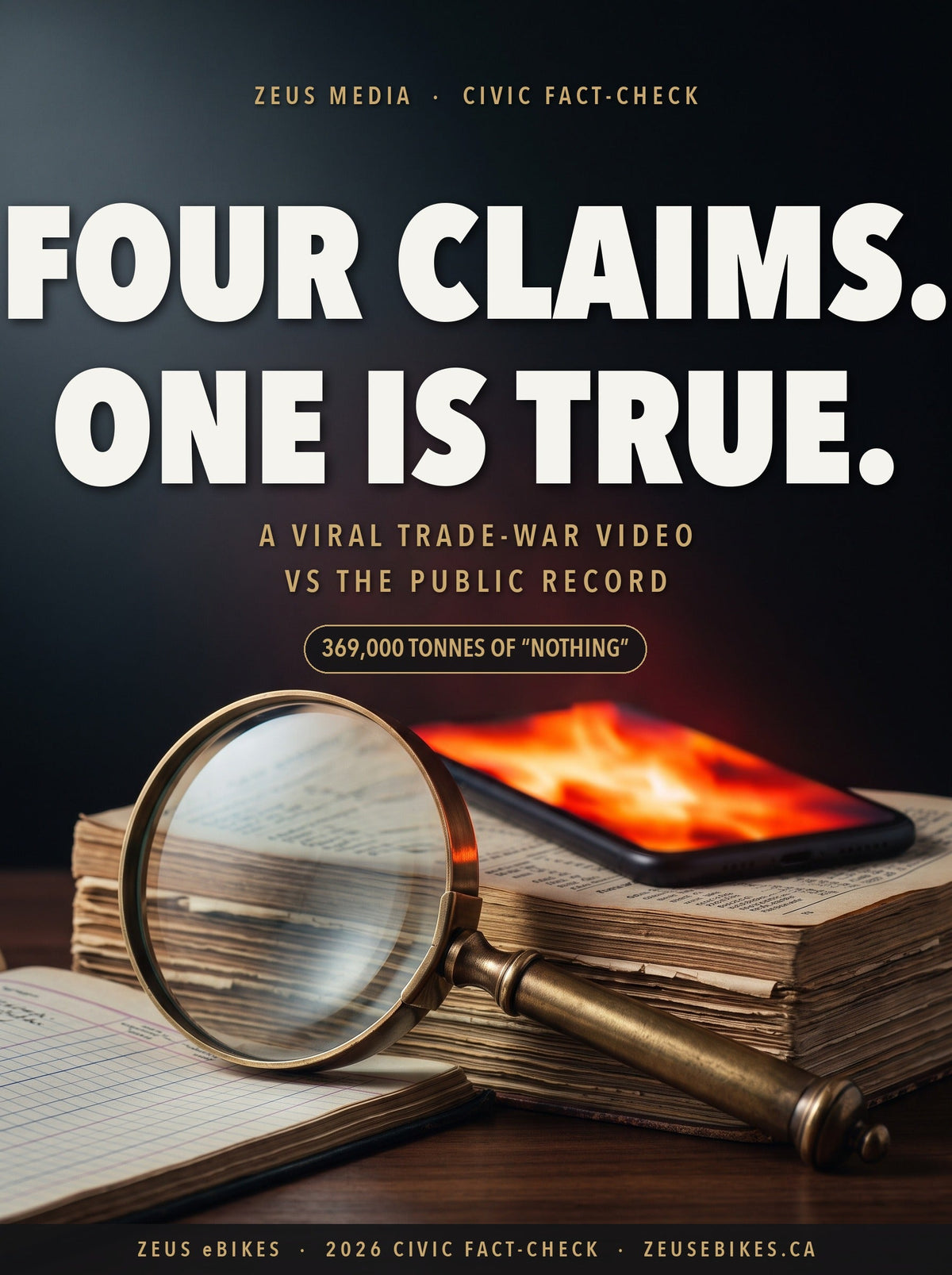
The "nothing": 369,000 tonnes of canola left for China in March 2026 alone, at a tariff cut from roughly 84 to 15 per cent. The seed is real; the scene is our editorial rendering.
The video's fuller versions: hedged, argued, and still short
Does the 108-second video hold up better than its caption? In places, yes, and a fact-check that ignored the stronger version would be checking a straw man. The transcript makes three moves the caption does not, and each deserves its own verdict.
"Expires in December." In the video, "NOTHING in return" becomes "next to nothing, other than some modest temporary tariff relief on a handful of agricultural products that expires in December." That hedge quietly concedes the caption was false, and it stands on something real: CBC's report of the deal states that Beijing removes tariffs on canola meal, lobster, crab and peas "as of March until at least the end of 2026." But "until at least the end of 2026" is the floor of a commitment, not its scheduled death; the canola-seed cut to roughly 15 per cent carries no published expiry; and "next to nothing" still has to argue with 369,000 tonnes shipped in a single month. He is on firmer ground noting that Chinese tariffs on Canadian pork stayed in place, which the same CBC report confirms. Verdict: a real limitation, stated as if the concession were already dead. analysis
"Flouts CUSMA." The video argues the China agreement violates CUSMA's non-market-economy safeguards. The clause is real: Article 32.10 requires three months' notice before free-trade negotiations with a non-market country, text-sharing before signature, and gives the other parties the right to terminate the pact. But the trade-law reading cuts against him: analyses in Canadian Affairs and the CSIS review of the agreement conclude the tariff-quota arrangement did not cross the Article 32.10 tripwire, because it is not a free-trade agreement and the 6.1 per cent rate is the ordinary most-favoured-nation rate, and Carney has said on the record that Canada is not pursuing an FTA with China. "Flouts" converts a real clause into a violation no authority has found. And no US official on the record has cited the China agreement as a reason the August talks collapsed; the closest, USTR Greer's August 26 remark that "Canada is the only country to retaliate against us besides China," is about retaliation, not the deal. verified
The Mexico comparison. "Mexico is doing the opposite, slapping tariffs on Chinese vehicles, steel, and other goods." True, and worth saying plainly: effective January 1, 2026, Mexico raised tariffs to 50 per cent on vehicles, including EVs, and on steel and hundreds of other categories from countries without a free-trade agreement, China foremost among them. This is the video's best material, and it frames a genuine policy debate Canada should have. It is also the material the caption threw away in favour of "SPY CARS" in capital letters. The pattern of the video, read whole, is an argument downgraded into a slogan for distribution, and the slogan is what 3,245 people liked. analysis
What the transcript changes: the video is more honest than its caption, and the caption is what circulated. The hedged "next to nothing... expires in December" concedes the return exists while overstating its fragility; the CUSMA argument is real law read past what experts say it does; the Mexico comparison is simply true. None of it rescues the two caption claims that fail, and all of it sharpens the question of why the accurate version stayed inside the video while the false version went in the text.
The premise nobody argues out loud
Strip away the capital letters and the video's deepest claim is not about canola or quotas at all. Its stated reason Canada should not have dealt with Beijing — in Mr. Cooper's own spoken words — is that "the US views Beijing as the biggest strategic threat," and that the agreement put Canada "offside" with Washington. Not that the deal failed Canadians. That it displeased the United States. Followed honestly to its end, that logic places the pen that writes Canada's trade policy in another country's capital, and calls the arrangement friendship.
Name what that is. A sovereign country weighs its own interests — its farmers' markets, its consumers' prices, its security, its alliances — and decides. The video's framework replaces that arithmetic with a single question: what does Washington prefer? And it asks it at the precise moment Washington's preference has taken the form of 50 per cent tariffs on the constituents Mr. Cooper represents, a lapsed CUSMA, and a US defence secretary mocking Canada's youth cadets. Deference to an ally is a choice nations sometimes make, openly, and price. Deference to an ally that is actively tariffing you is something else. And the one person in this story who should see the danger most clearly is the Shadow Minister for Democratic Reform — the MP whose own parliamentary file, by his office's description, is defending Canada's democracy from interference by foreign regimes. The principle does not change when the capital does. analysis
And there is nothing free-market about it. The agreement the video condemns cut tariffs in both directions — China's canola tariff fell 69 points, Canada's EV tariff fell 94 on a hard-capped lane — which is, whatever one thinks of Beijing, what markets call trade. The alternative the video prefers is commerce managed by bloc allegiance: buy from whom your ally approves, sell where your ally permits, and absorb the tariffs your ally imposes as the price of membership. A conservative may argue that security overrides markets; his own party makes exactly that case about connected vehicles, and the transparency version of it is endorsed above. But that argument concedes the market principle and must be made openly, with its costs on the table. Carried silently inside "TOTAL FAILURE," it amounts to the least capitalist idea in this whole affair: that the invisible hand should hold a pen only where Washington countersigns. analysis
The two ledgers: what Canada gave and got, per country
What do Canada's 2026 dealings with Washington and Beijing actually add up to? Line the two relationships up as ledgers — concessions out, returns in, each row sourced — and 2026 produced a natural experiment no columnist could have designed. Here is each ledger, and what each returned.
Canada and the United States
| Canada gave | Canada got |
|---|---|
| Removed most of its own counter-tariffs on CUSMA-compliant US goods during negotiations | No deal — announced by President Trump August 19, dead by August 22 |
| Reached NATO's two per cent defence benchmark; kept the F-35 purchase alive | 50 per cent tariffs on roughly $20 billion of exports; CUSMA lapsed unrenewed |
| Held its tongue through the "51st state" rhetoric and retaliation threats over a television ad | A threatened extra 10 per cent over that ad |
| Stayed in joint operations while US strikes in the Caribbean drew international legal condemnation | Procurement ultimatums: F-35 completion, missile-shield radar purchases, first refusal on critical minerals |
Canada and China
| Canada gave | Canada got |
|---|---|
| EV tariff cut from 100 to 6.1 per cent — hard-capped at 49,000 vehicles a year, rising to 70,000 | Canola-seed tariff cut from ~84 to ~15 per cent; tariffs removed on canola meal, lobster, crab, peas |
| The RCMP–Ministry of Public Security memorandum — unpriced, because it is secret | One million tonnes of canola exported in March 2026, 369,000 to China; Q1 exports up 10 per cent |
| A diplomatic reset legitimizing Beijing after years of rupture | De-escalation of China's 2024–25 retaliatory tariffs; a closed market reopened |
analysis Read together, the ledgers say something the video cannot afford to say: in 2026, Canada's measurable gains came from the adversary, and its measurable losses came from the ally it deferred to. Every Canadian concession to Washington preceded the tariffs, the lapsed CUSMA and the ultimatums, so "Canada provoked it" fails on sequence alone. The one row that genuinely cuts against Ottawa is the police memorandum's secrecy, and that is a transparency scandal, not an orientation scandal. The pattern is not new; it is the same one traced in our two-year record of how Washington negotiates: concessions pocketed, pressure renewed.
Following his money: donors, lobbyists, expenses
Foreign money is a stock allegation in trade-war politics, thrown in every direction and proved in almost none. So rather than imply anything from rhetoric, we tested the public records — all of them that Canadian law makes public — and we report what we found even though it makes the dullest section of this piece. Especially because it does.
Who funds his campaigns
Elections Canada's reviewed contributions database, which itemizes every donation over $200, holds 175 rows for Mr. Cooper's campaigns, his 2014 nomination race and his riding associations. verified The 2015 campaign's itemized donors are St. Albert and Edmonton residents and members of his own family, in amounts from $200 to $1,500, plus $7,220 in small contributions; the nomination race was substantially family-funded. His 2021 campaign's only itemized donor was himself, at $300. His 2025 campaign reported $200 in itemized-threshold contributions — it ran on party and riding-association funds, which is normal for a safe Conservative seat. The riding association's itemized donors, 2015 through 2017, were 113 Albertans out of 119 donors giving $86,204 in total. Foreign contributions are illegal under the Canada Elections Act, and none appear. The full extract is on file, sourced to Elections Canada's open-data exports.
Who lobbies him
The federal lobbying registry's communication reports record 88 registered communications naming Mr. Cooper as the office holder contacted since 2015. The most frequent: a Reformed Christian advocacy group, Cystic Fibrosis Canada, the Canadian Real Estate Association, an Alberta credit union, health charities, universities and local industry. verified Zero rows involve any US entity, and zero touch the trade war. The registry captures registered lobbying only — diplomacy is not registrable — but as far as the instrument can see, the "who is his American contact" question has an answer: nobody has registered one, ever.
What his office spends
The House of Commons publishes every MP's quarterly expenditures. For the quarter ending March 31, 2026, the most recent published, Mr. Cooper's office spent $197,938 in total, ranking 102nd of 342 active members. His travel, $41,708, sits below the $49,069 average for the 37 Alberta MPs, who necessarily out-travel Ottawa-area members. His hospitality spending was $251.57, which ranks 295th of 342. verified Source: the Members' Expenditures Report, one quarter, labelled as such.
Office travel spending, quarter ending March 31, 2026
House of Commons Members' Expenditures Report, Q4 2025–26 (Jan 1–Mar 31, 2026). Active members = salaries over $50,000 in the quarter; vacant seats and departed members excluded.
The forensic verdict: the money is boring. Local donors, family donors, no foreign dollar, no registered American contact in a decade, below-average expenses, near-bottom hospitality. There is no paymaster in these records. Whatever explains the video, it is not hidden money. Saying so plainly is what earns the right to say what the record does show.

Where the money actually is: local donors and family donors, $200 to $1,500 at a time, counted in rooms like this one. No foreign dollar appears in the record.
The outrage that points one way
So what does the record show? A pattern of attention. Since September 2025, US forces have struck more than 60 boats in the Caribbean and eastern Pacific, killing more than 200 people by PolitiFact's count, without trials and on disputed evidence; reporting by The Hill and NPR described a defence secretary's order to "kill everybody" aboard one vessel, including a follow-up strike on survivors. In January 2026, US forces seized Venezuela's sitting president and jailed him in New York. France's foreign minister said the boat strikes violate international law — at a G7 meeting hosted on Canadian soil. Canada's government stayed publicly silent, and Canada was tariffed anyway, a silence whose full cost we tallied in the ledgers above.

Outrage has a direction. For the deal that reopened a market to Prairie farmers: capital letters. For more than 200 people killed without trial by the ally tariffing his constituents: nothing we could find.
We searched for any statement by Mr. Cooper on any of it — press coverage, news archives, his public output. We found none. analysis Not-found is not proof of never-said, and his office is welcome to correct us; the routes searched are listed below, and this piece will be updated if a statement surfaces. But on the retrievable record, the arithmetic of his outrage stands as follows: for a trade agreement that reopened China's market to Canadian farmers, capital letters and "TOTAL FAILURE"; for two hundred people killed without trial and a captured head of state — by the government whose tariffs are aimed at his own constituents — nothing we could find. The point is not that an MP owes commentary on every American action; it is that inside this one Canada-US confrontation, his scrutiny runs entirely one way — maximal for the counterparty that reopened a market to his province's farmers, absent for the ally tariffing his constituents. An MP's attention is a finite public resource. Where it goes, and where it never goes, is part of his record too, and it is fair for the voters of St. Albert—Sturgeon River to read both columns.
The riding, by the numbers
How has life changed for the people Mr. Cooper has represented since 2015? The honest frame first: a backbench opposition MP does not steer a regional economy, and no serious accounting blames him for oil prices or a pandemic — or credits him for recoveries. What can be measured is the trajectory of the place, and what he controls: his output. Both, from the records.
The place
Statistics Canada's census puts St. Albert's median after-tax household income at $100,000 in 2020 — down 7.4 per cent in real terms from $108,000 in 2015, a steeper decline than Alberta's own 4.6 per cent drop, in a five-year window when most provinces grew. St. Albert remains far wealthier than the provincial median; the direction, not the level, is the finding. Population grew 4.0 per cent to 68,232, below Alberta's 4.8 and Canada's 5.2, while Sturgeon County, the rural half of his renamed riding, shrank 2.1 per cent. 2020 is the latest census income year; no claim is made here about 2021 onward.
Real median after-tax household income, 2015 → 2020
Statistics Canada, 2021 Census income release (July 13, 2022), 2020 constant dollars. Most provinces recorded growth over the same window; declines concentrated in Alberta, Saskatchewan and Newfoundland and Labrador.

St. Albert at dusk: prosperous, ordinary, and 7.4 per cent poorer in real household income across his first five years in office. A decline no backbencher caused, and no backbencher reversed.
His output
In ten years, the openparliament.ca record shows three private member's bills under his own name: the juror-secrecy bill C-417 (2018, died on the order paper) and the Canada-Taiwan Relations Framework Act, introduced twice (C-315 and C-343), never passed. His signature cause for his own community — Wynn's Law, the bail-disclosure bill named for Constable David Wynn, killed in St. Albert in 2015 — passed the Senate and was defeated 166–127 in the House in June 2017. His one legislative win is real and deserves its due: he carried the juror mental-health cause for four years, from C-417 to House sponsorship of Senate bill S-206, which received royal assent in October 2022 and lets traumatized former jurors speak to health professionals. The House applauded him for it, across party lines, and former jurors thanked him by name.
The rest of his national profile is the China file, and Taiwan, where he is genuinely famous: the MP who spelled out "T-a-i-w-a-n" in Question Period in 2020, met President Tsai Ing-wen with a cross-party delegation in July 2023, and belongs to the Inter-Parliamentary Alliance on China. analysis That decade-long record is the simplest explanation for the September 2 video: a China hawk attacking a China deal, as he would have with or without a US trade war. It is also the ledger's quiet irony: the parliamentary energy that made an Alberta MP a household name in Taipei has no equivalent line item for St. Albert. His constituents appear to accept the trade: they have re-elected him four times with rising shares, 63.95 per cent in 2025. That verdict is theirs to give, and this ledger exists so it can be given with both columns visible.
The Smith parallel — and where it breaks
Is Cooper part of a broader Alberta front against Ottawa's trade position? The comparison to Premier Danielle Smith is being made, so we tested it. The documented commonalities: both are Alberta conservatives who went public against the federal position inside the same two-week escalation window: Smith as the sole holdout among premiers on retaliation, urging a return to the table before September 8, her office calling counter-tariffs a "knee-jerk" reaction; Cooper with the September 2 video. Both aim every criticism at Ottawa and none at Washington. The divided front is real, whatever its intent — we examined Smith's own record at length in our documented profile of her trade-war conduct.
But the parallel breaks on the evidence, and saying so matters. Smith holds the file: she is Alberta's premier and its minister of intergovernmental and international relations, meets US officials directly, and her statements circulate in US conservative media. Cooper is a backbencher with, on the retrievable record, no US contacts at all: no registered lobbying, no reported meetings, no American media amplification we could find, and a foreign-policy network pointed at Taipei rather than Mar-a-Lago. analysis Two Alberta politicians undercutting the same federal position at the same moment is a documented pattern. A coordinated operation is a different claim, and nothing in the records supports it. The distinction is exactly the kind this piece exists to keep, the same discipline about evidence and inference we argued for in our essay on what happens when Canadians stop believing each other.
What this adds up to
Here is our assessment, offered as fair comment on a public official's public statements, with every factual footing linked above. Michael Cooper is not a foreign agent, and the records this piece pulled (donors, lobbying, expenses) actively rebut the accusation; we publish that finding as prominently as any other. What the record does establish is this: a member of Parliament, trained as a litigator, broadcast publicly during a national trade crisis a statement in which one claim of four was true, and the falsest claim, "NOTHING in return," was checkable in an afternoon against shipping data. Whatever the intent, the caption achieved reach at the expense of accuracy, at a moment when his own constituents, staring at 50 per cent American tariffs, needed accuracy more than they needed capital letters.
The remedies are small and specific, which is what makes their absence notable. Correct the record on "nothing in return"; the tonnage is public. Convert the two legitimate grievances into the transparency demands they actually are: publish the RCMP–MPS memorandum, and publish whatever security assessment was done on connected-vehicle imports. And spend one sentence of that formidable attention on the 200 people killed without trial by the government currently tariffing St. Albert's economy. Not because a backbencher's sentence changes American policy, but because an MP's outrage is a public record, and right now his reads one way. Our own government's silence on those same events costs Canada credibility it will want back, as a country whose civic sensors still work should be able to say out loud. The counter-tariffs arrive September 8. Canadians deciding what to think about them deserve arguments that survive contact with the records. This one, mostly, did not.
Questions people are asking
What did Michael Cooper say about Mark Carney and the China deal?
In a video posted to X on September 2, 2026, Cooper wrote that Carney "SCREWED CANADA FOR BEIJING," sold out Canadian security "with a SECRET police deal," invited China to "FLOOD Canada with SPY CARS," "got NOTHING in return," and compromised trade talks with the United States — calling the January 2026 Canada-China agreement a "TOTAL FAILURE." Checked against primary records, one claim is substantially true, one is rhetoric around a real policy, and two fail.
Is it true Canada got nothing in return from the China deal?
No. In exchange for admitting up to 49,000 Chinese electric vehicles per year at a 6.1 per cent tariff, China cut its canola-seed tariff from about 84 per cent to about 15 per cent effective March 1, 2026, and removed tariffs on Canadian canola meal, lobster, crab and peas. Independent shipment data confirms delivery: canola exports hit a 17-month high of one million tonnes in March 2026, 369,000 tonnes to China, with first-quarter exports up 10 per cent year over year.
What is the secret RCMP police agreement with China?
In January 2026 the RCMP signed a memorandum of understanding with China's Ministry of Public Security covering information exchange, investigative assistance and training. The RCMP has refused to release the text without Beijing's consent, despite demands from both the Conservatives and the NDP. A former senior Mountie has called the arrangement a counterintelligence danger, and Hong Kong diaspora organizations say the secrecy makes community members afraid to engage with Canadian police. This is the one claim in Cooper's video that is substantially true.
How many Chinese electric vehicles will enter Canada under the deal?
The agreement admits up to 49,000 Chinese electric vehicles per year at a 6.1 per cent tariff — down from the previous 100 per cent tariff — with the quota growing to 70,000 vehicles over five years. Vehicles beyond the quota do not receive the reduced rate. A hard cap is the structural opposite of the "flood" described in the video.
Did the China deal cause the collapse of Canada-US trade talks?
No evidence supports that link, and the Trump administration's own trade representative contradicts it. On January 17, 2026, USTR Jamieson Greer said the Canada-China deal was not a concern for US automakers because "we have an enormous market share in Canada." The US-Canada talks collapsed seven months later, on August 22, 2026, after Washington changed terms hours before the deadline — in Prime Minister Carney's words, the US "asked too much and offered too little."
Who funds Michael Cooper's campaigns?
Elections Canada's published returns show his itemized donors are almost entirely St. Albert and Edmonton locals plus members of his own family, in amounts of $200 to $1,500; his 2025 campaign reported just $200 in itemized-threshold contributions and ran on party and riding-association funds. Foreign contributions are illegal under the Canada Elections Act, and none appear. Ten years of federal lobbying-registry records show 88 registered communications naming him — none from any US entity.
What is on Canada's counter-tariff list and when did it start?
After the United States imposed 50 per cent tariffs on roughly $20 billion of Canadian goods on August 22, 2026, Canada announced dollar-for-dollar retaliation effective September 8, 2026, targeting US steel, furniture, dairy and other goods — roughly $28 billion in coverage by one published estimate. Ottawa had earlier removed most of its counter-tariffs on CUSMA-compliant American goods during negotiations; the September list reinstates retaliation at matching scale.
Has Michael Cooper commented on the US boat strikes or the Maduro capture?
We could find no statement. Searches of press coverage, his public feeds and news archives surface no comment from Cooper on the US strikes on alleged drug boats — more than 200 people killed since September 2025 by PolitiFact's count — or on the January 2026 US capture of Venezuela's sitting president. Absence from these routes is not proof he never spoke, and his office is welcome to point us to any statement; the routes searched are documented in the methodology section.
Limitations, corrections and right of reply
What this piece could not establish, stated so silence is not mistaken for verification. First: the video transcript comes from a local open-source speech model (whisper, base English); proper names were normalized by hand (the model rendered "Carney" as "Cardi" and "CUSMA" as "Khuzma") and the audio is retained for checking, but a mis-heard word would escape us. Second: the expense analysis covers one quarter — the most recent published — and is labelled as such; it is a snapshot, not a career audit. Third: the "no statement found" findings on the boat strikes and the Maduro capture are bounded to the routes searched — news-indexed press coverage, his public feeds as retrievable by API, and parliamentary records through June 2026 — and an untranscribed remark would escape them. Fourth: Mr. Cooper's personal asset disclosure exists in the Conflict of Interest and Ethics Commissioner's public registry, which resists automated retrieval; we state only that it exists and have not characterized its contents. Fifth: the vehicle-market denominator behind "a quota is not a flood" uses 2024 sales, the latest full year Statistics Canada has published; the quota's later years will run against later markets. Sixth: whether Canada's EV quota carries connected-vehicle security safeguards is an open question this piece raises and does not answer. If you hold evidence bearing on any of these — above all, any statement by Mr. Cooper on the strikes or the seizure — write to milad@zeusebikes.ca. Corrections are published, not buried. The same address stands as a right of reply for Mr. Cooper and his office, and any reply will be appended to this piece in full.
Bibliography
- Michael Cooper, MP — the September 2, 2026 post (retrieved via syndication API, September 3, 2026)
- Global News — RCMP won't release China policing pact despite Conservative, NDP pressure (2026)
- Conservative Party of Canada — Liberals Must Release Secret RCMP–PRC Policing Agreement; statement on the imposition of unjustified tariffs
- The Bureau — Former senior Mountie: the RCMP–Chinese police cooperation deal is a counterintelligence danger (2026)
- Hong Kong Watch — Hong Kong diaspora groups raise concerns over RCMP–MPS MoU (February 12, 2026)
- CBC News — Canada reaches tariff-quota deal with China on EVs, canola; What's in the Canada-China deal; Carney: deal became untenable when US "asked too much and offered too little"; Canada "continues to monitor" US boat strikes as allies squirm; French foreign minister says US boat strikes violate international law; New law allows jurors to share deliberation details with health providers; Dane Lloyd wins Sturgeon River–Parkland byelection (2017); Smith wants Ottawa back at the table before counter-tariffs begin
- The Globe and Mail — What to know about the Canada-China tariff deal; As premiers rally behind Carney, Alberta's Smith questions retaliation plan
- CTV News — Carney reaches "landmark" tariff-quota deal with China (January 2026)
- Prime Minister of Canada — strategic partnership announcement (January 16, 2026)
- USDA Foreign Agricultural Service — GAIN report CA2026-0001: Canada strikes deal with China on canola, seafood, peas and beef
- UkrAgroConsult — Canada significantly increased canola exports to China after normalization (2026); Canola Council of Canada — China trade update
- The Detroit News — Key Trump official says Canada-China deal not a concern for US autos (January 17, 2026)
- NBC News — Carney suspends trade talks; 50% tariffs take effect; NPR — Carney says Canada is "at war" with the US (August 22, 2026); The Hill — Carney suspends trade talks with US
- The Hub — Smith rules out oil export tax as Ottawa unveils $28 billion in counter-tariffs (August 26, 2026)
- PolitiFact — What to know about US military boat strikes as death toll passes 200 (June 2, 2026); The Hill — GOP divided over US boat strikes; PBS NewsHour — US captures Maduro and his wife (January 2026); The Walrus — Is Canada helping identify boats the US is blowing up?
- Elections Canada — political financing open-data downloads (reviewed contributions database, retrieved September 3, 2026)
- Office of the Commissioner of Lobbying — Monthly Communication Reports bulk export (rows through September 2025)
- House of Commons — Members' Expenditures Report, quarter ending March 31, 2026; Michael Cooper member profile
- Statistics Canada — Focus on Geography, St. Albert (2021 Census); income declines 2015–2020 concentrated in Alberta, Saskatchewan and Newfoundland and Labrador (July 13, 2022)
- openparliament.ca — Michael Cooper: speeches, votes and sponsored bills; Global News — Wynn's Law announcement coverage (2017); openparliament.ca — Bill S-206 history and status
- Office of the President, Republic of China (Taiwan) — President Tsai meets Canadian parliamentary delegation (July 2023); IPAC — member listing; Focus Taiwan — delegation coverage
- Canadian Affairs — Carney, CUSMA and the perils of calling everything a "deal" (David Collins, January 29, 2026); CSIS — USMCA Review 2026
- Automotive Logistics — Mexico introduces new tariffs on cars and auto parts for countries without a trade agreement (January 2026)
- Mexico Business News — Mexico imposes 50% tariffs on non-FTA imports
- VoteMate — St. Albert—Sturgeon River 2025 result; Ethics Canada — public registry (disclosure summaries)
Milad Ghobadibeygvand is co-founder of Zeus eBikes Canada. This article carries no product recommendations and no commercial content; it is published in the Civic Duty section because the writer is a Canadian citizen first and a merchant second. The datasets behind every figure — the donor extract, the lobbying extract, the expense rankings and the trade ledger — are retained with retrieval dates and are available on request.
Visuals created by Playcut.ai
Share:
The Boycott Stops at the Living Room: U.S. Media’s Bill to Canada
What Happened to Afghan Women — and What Canada Did About It