
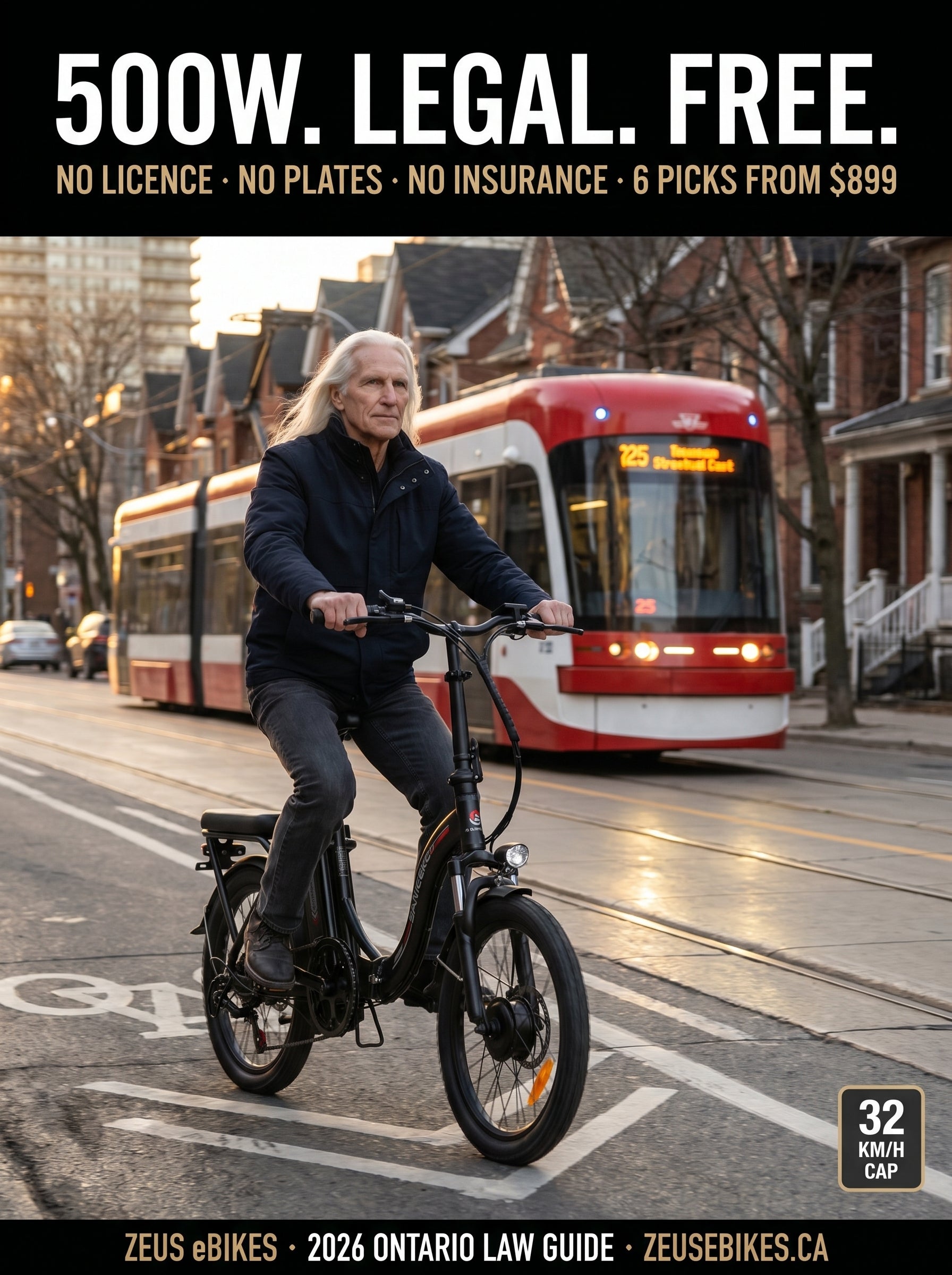
Ontario eBike Laws 2026: What’s Legal, What’s Changing & 9 Verified Legal Picks

A legal e-bike in Ontario (a “power-assisted bicycle”) has: a motor rated 500W or less, motor assist that stops at 32 km/h, working pedals, total weight under 120 kg, two independent brakes, and insulated terminals. Riders must be 16+ and wear a helmet at every age. No licence, no registration, no insurance.
The mistake that catches people: buying a 750W bike and assuming a 32 km/h speed limiter makes it legal. It does not. The motor’s rated output is what counts — a 750W motor is a motor vehicle in Ontario no matter how the software is set.
Nine street-legal picks, $1,199–$5,999: Samebike 20LVXD30-II ($1,199), Taubik Vista 26 ($1,999), ONE-TRIKE 2.0 ($2,599), Eunorau Meta 26 ($2,899), Velotric Discover M ($3,499) and four more below.
Ontario e-bike rules at a glance (2026) — the whole rulebook in one screen:
| Question | Ontario rule (2026) |
|---|---|
| Maximum motor | 500W rated (continuous) |
| Assist cuts off at | 32 km/h |
| Licence / plate / registration / insurance | None required |
| Minimum age | 16 |
| Helmet | Required — all ages |
| Pedals | Required (must work) |
| Max weight (bike + battery) | 120 kg |
| Sidewalks | Banned (by municipal by-law) |
| 400-series highways / QEW | Banned |
| Is a 750W bike legal? | No — not on public roads |
| 2026 status | Class system proposed, not yet law |
In This Guide
- Why this guide exists (and what just changed)
- What makes an e-bike legal — the 6 rules
- Licence, insurance & plates — what you don’t need
- Age & helmet
- Where you can and can’t ride
- Fat tire, throttle, mopeds, trikes & e-scooters
- What’s changing in 2026
- What invalidates your legal status
- Ontario vs Québec
- The 7-point compliance checklist
- 9 verified legal picks ($1,199–$5,999)
- FAQ — 13 questions answered
1. Why This Guide Exists (And What Just Changed)
On June 7, 2026, Ontario quietly closed public comment on the biggest rewrite of its e-bike rules in years — a Ministry of Transportation proposal to split e-bikes into classes (Environmental Registry notice 026-0422). Nothing is law yet, but the most-typed Ontario e-bike question on Google and AI search has never been more urgent: is my bike actually legal?
Get the answer wrong and the cost is real: a $3,000 bike that turns out to be an unplated, uninsured motor vehicle the moment you ride it on a public road — with provincial fines and no path to register it. This guide gives you Ontario’s rules exactly as they stand today, what the 2026 proposal would change, and the bikes that stay legal either way.
Here is the reassuring part. Ontario’s rules for a compliant e-bike are among the friendliest in Canada — no licence, no registration, no insurance, no plates. “Friendly” comes with one condition: the bike has to meet the definition. The line between a legal e-bike and a motor vehicle is a single number on the spec sheet.
If you already own an e-bike, run the 7-point checklist in Section 10. If you’re shopping, jump to the nine verified picks — or read straight through, because the rule that trips up the most buyers is the very first one.
2. What Makes an e-Bike Legal in Ontario — The 6 Rules
Ontario regulates e-bikes under its own law — the Highway Traffic Act and O. Reg. 369/09, summarised in the Ministry of Transportation’s “Riding an e-bike” guidance at ontario.ca — which treats a compliant “power-assisted bicycle” (PAB) exactly like a regular bicycle. (The old federal e-bike definition was repealed in 2020 and the responsibility handed to the provinces, so Ontario’s rules are the ones that matter now.) Meet the definition and you ride licence-free. Fail any single part of it and the bike becomes a motor vehicle.
There are six requirements, and all six must be true at once.
| Requirement | The rule | What it actually means |
|---|---|---|
| Motor output | Not more than 500W | The motor’s continuous rated output — the nameplate figure — not the higher number it hits in a short burst (peak). A 500W motor that briefly peaks higher is fine. A 750W-rated motor is not. |
| Assisted speed | Cuts off at 32 km/h | The motor must stop assisting at or before 32 km/h. You can pedal faster on your own — just without motor help. |
| Pedals | Working pedals, always | The bike must be rideable by pedalling alone. Remove or disable the pedals and it becomes a motor vehicle. |
| Total weight | Under 120 kg (bike + battery) | Rider weight is not counted. This is an Ontario-specific limit — most e-bikes weigh 25–45 kg, so it only matters for extreme multi-battery or cargo builds. |
| Brakes | Two independent braking systems | Front and rear, each working on its own. Ontario’s standard: able to stop from 30 km/h within 9 metres on level asphalt. |
| Electrical safety | Insulated electrical terminals | No exposed wiring or terminals on the motor or battery. Any reputable manufacturer builds to this. |
What a compliant bike looks like: the Taubik Vista 26 ($1,999) lists a 500W motor and a 32 km/h top speed on its product page — both halves of the Ontario definition, met off the shelf. Torque, hydraulic brakes, a UL-certified Samsung battery, and a step-through frame. All nine picks in Section 11 clear the same bar.

East of Peterborough. The number on the motor is the number that decides everything. 500W. · Playcut.ai
3. Do You Need a Licence, Insurance or Plates? What You Don’t Need
No — not for a compliant power-assisted bicycle. Because the Highway Traffic Act treats a legal e-bike as a bicycle rather than a motor vehicle, none of the paperwork that comes with a car or scooter applies.
- Driver’s licence: not required, at any age (you do have to be 16+).
- Vehicle registration: not required.
- Licence plates: not required.
- Insurance: not required — though some home or tenant policies add optional personal-liability coverage for a few dollars a month, and dedicated e-bike insurance in Canada is worth a look on a pricier bike. Worth checking.
That — no licence, no plates, no registration, no insurance — is exactly why a 500W e-bike is one of the simplest vehicles you can legally own in Ontario. The catch is the flip side: the moment a bike stops qualifying as a PAB (an over-rated motor, no pedals, a defeated speed limiter), every one of those requirements snaps back into place, and riding without them becomes a provincial offence. We cover exactly what triggers that in Section 8.
Curious how the no-insurance, no-registration math compares to running a car for short trips? Our e-bike vs car cost breakdown and the financing guide put real Canadian numbers on it.
Browse Ontario street-legal e-bikes at Zeus
Every pick in this guide is verified against the 500W + 32 km/h rule. Canadian warranty, ships Ontario-wide, and real people answer the phone at 1-866-938-7580.
Browse Step-Thru eBikes → Browse Folding eBikes →4. Age & Helmet — The Two Rider Rules
Ontario asks just two things of the rider: be old enough, and wear a helmet. That’s the whole list.
Minimum age: 16
You must be 16 or older to ride a power-assisted bicycle on Ontario public roads. There’s no maximum age, and no driver’s licence is required at any age. Unlike Québec, Ontario offers no younger-rider pathway — 16 is a hard floor.
Helmet: required for every rider, every age
Ontario’s Highway Traffic Act requires an approved bicycle or motorcycle helmet for all e-bike riders, regardless of age (per ontario.ca). This is the rule people get wrong most often: for a regular bicycle, Ontario only mandates helmets for riders under 18 — but for an e-bike, a 45-year-old needs one just as much as a 16-year-old. A standard bike helmet certified to CSA, CPSC, ASTM, or EN 1078 qualifies; so does a motorcycle helmet.
5. Where You Can and Cannot Ride
A compliant e-bike has the same road access as a regular bicycle in Ontario — most public roads are open. There are two firm prohibitions and one grey zone that catches riders every summer.
| Location | Status | Notes |
|---|---|---|
| Public roads & streets | ✓ Permitted | Same as conventional bicycles. Obey all signals and signs. |
| Painted bike lanes | ✓ Generally permitted | Compliant e-bikes belong in on-road painted bike lanes across Ontario. |
| Cycle tracks & multi-use trails | ↔ Varies by city & bike type | Toronto gives lighter pedal-assist e-bikes the widest access; throttle-style and heavier bikes are restricted. Conservation areas and provincial parks each set their own rule. |
| Sidewalks | ✗ Prohibited where municipalities say so | No single province-wide ban, but the HTA lets cities prohibit it by by-law — and in practice they do, including Toronto. Treat sidewalks as off-limits. |
| Controlled-access highways | ✗ Prohibited | All 400-series highways, the QEW, the Queensway (Ottawa), and the Kitchener-Waterloo Expressway are closed to e-bikes. |
The multi-use trail grey zone
Can you ride your e-bike on a trail? It depends who manages it. Ontario’s thousands of kilometres of multi-use trails are run by municipalities, conservation authorities, and Ontario Parks, with no single provincial rule — each authority sets its own. A growing number of cities also split access by e-bike type: in Toronto, a light pedal-assist bike is treated like a bicycle on most paths, while a throttle-style or heavier one is kept to painted lanes and roads. The practical rule: if there’s posted signage about motorised vehicles, assume your e-bike is included until the trail authority tells you otherwise. A compact, conventional-looking bike like the Eunorau Meta Foldable reads as a bicycle on shared paths — a moped-style frame invites more questions.
6. Fat Tire, Throttle, Mopeds, Trikes & e-Scooters — Which Are Legal?
Most “is this type legal?” questions have the same answer: the specs decide, not the shape. Here’s the rundown on the bike types Ontarians ask about most.
Are fat-tire e-bikes legal in Ontario?
Yes — if the motor is rated 500W or less and assist cuts at 32 km/h. Tire width is irrelevant to the law. The catch is the market: most fat-tire bikes sold online are 750W or more, which is not road-legal here. Choose a fat-tire model with a verified 500W rating, like the Taubik Tour or the Eahora FT-01 Max below.
Are throttle e-bikes legal in Ontario?
Yes. A throttle is fine on a compliant PAB as long as the bike keeps working pedals, the motor stays at 500W or less, and assist cuts off at 32 km/h. Most legal Ontario e-bikes include a throttle for pulling away from a stop. A throttle-only machine with no usable pedals, though, is a motor vehicle.
Are electric mopeds legal in Ontario?
A moped-style e-bike is legal if it keeps the pedals, the 500W motor, and the 32 km/h cap — the cruiser frame doesn’t change anything, the specs do. The trap is that many moped-style imports ship with bigger motors or no real pedals, which puts them in motor-vehicle territory. If you want the look, verify the numbers.
Are electric trikes legal in Ontario?
Yes. Ontario’s power-assisted bicycle definition covers vehicles with two or three wheels, so a 500W e-trike like the Eunorau ONE-TRIKE 2.0 is fully road-legal. Our electric trikes guide covers the category in depth.
Are e-scooters and electric dirt bikes legal in Ontario?
Different rules. Standing e-scooters (no pedals, no seat) aren’t e-bikes at all — they fall under a separate provincial pilot (O. Reg. 389/19, running to November 27, 2029) that only applies where a municipality has opted in by by-law. Several cities, Toronto included, have not opted in, so confirm your local rule. Electric dirt bikes and Sur-Ron-style machines almost always exceed 500W and have no pedals — they’re off-road / private-property vehicles in Ontario, not street-legal e-bikes.
7. What’s Changing in 2026
Nothing has changed yet — the 500W / 32 km/h rule still governs today. But two 2026 developments are worth knowing before you buy: one proposed (Ontario e-bike classes), one already in effect (the 1,000W cargo-bike pilot).
The proposed e-bike classes (not law yet)
In April 2026 the Ministry of Transportation posted a proposal to “modernize” Ontario’s e-bike framework — including the power to create distinct classes of e-bikes with their own operator, vehicle, and safety rules (Environmental Registry notice 026-0422). The 45-day public comment window ran from April 23 to June 7, 2026 and is now closed. The early direction would separate lighter pedal-assist bikes from heavier, throttle-driven, moped-style machines — the latter likely facing motor-vehicle-style requirements.
What this means for a buyer today: nothing has changed yet. A proposal on the registry is not a regulation, and these typically take many months to become law. Until a regulation is enacted and in force, the current rules — 500 watts, 32 km/h, age 16, helmet for all — still govern. The smart move is to buy a bike that is unambiguously a pedal-assist PAB now, so that whichever way the classes land, it stays on the friendly side of the line. (Beware any retailer page that presents “Class 1 / Class 2” as Ontario’s current law — it isn’t. Those are a proposal, distinct from the US Class 1/2/3 system.)
The cargo e-bike pilot (in effect, to 2031)
Ontario also runs a separate large cargo e-bike pilot that allows two- and three-wheeled cargo bikes with motors up to 1,000 watts (still capped at 32 km/h), within set dimension limits, on the roads of municipalities that opt in by by-law. It runs from March 1, 2021 to March 1, 2031. If you’re hauling kids or freight, that’s a higher-power legal pathway than the standard 500W PAB — but only in participating cities. Our cargo e-bike guide covers the category.
8. What Invalidates Your Legal Status
A bike that qualified as a PAB the day you bought it can lose that status if it’s changed. It can also lose it without any change at all — if it simply ships in the wrong mode. Riding a reclassified vehicle on public roads without the registration, insurance, and licence a motor vehicle needs is a provincial offence.
- Boosting the motor past 500W rated — controller chips, rewinds, or motor swaps that raise sustained output.
- Defeating the speed limiter — unlocking the controller so the motor assists past 32 km/h on public roads.
- Removing or disabling the pedals — a bike that can’t be pedalled is not a PAB.
- Exceeding 120 kg total — piling on batteries, cargo rigs, or accessories until the bike (minus rider) tops 120 kg.
Operate a reclassified bike on the road without registration and insurance and you face fines and possible licence suspension — even if you don’t hold a licence, because operating an uninsured, unregistered motor vehicle is its own offence.
The mode trap most buyers miss: some powerful-but-legal bikes ship in a fast mode out of the box. The Eunorau URUS 2.0 is a genuine 500W PAB — but it arrives set to a 45 km/h “Class 3” mode meant for off-road use, and you have to switch it to Limited (32 km/h) mode on the display to be road-legal in Ontario. Same bike, two legal identities, decided by a setting. Always confirm your bike is in its 32 km/h road mode before you ride public roads.
The smarter path is to buy right and leave it alone. If you want more power for trails or private land, our 500W vs 750W vs 1000W guide covers the off-road spectrum — higher-wattage bikes are legal to own and ride on private property; the restriction is public-road use only.
What happens if you’re caught?
For a compliant 500W e-bike, very little — it is treated like a bicycle. The enforcement risk lands on the other side of the line: riding a reclassified bike (over 500W, no working pedals, or de-restricted past 32 km/h) on a public road without registration, insurance, and a licence is a provincial offence under the Highway Traffic Act, and a no-helmet or ride-where-prohibited ticket can apply to any e-bike. Enforcement is also tightening — in May 2026 Toronto Council asked staff to report back in December 2026 on options including keeping moped-style e-bikes out of bike lanes and giving police power to seize e-bikes from repeat offenders (a study direction, not yet law). A clearly-compliant bike keeps you clear of all of it.

Dundas Peak, Hamilton. Set to 32 km/h, the roads and trails below open up. · Playcut.ai
9. Ontario vs Québec — Side-by-Side
If you ride in both provinces, or you’re comparing before a move, here’s what actually differs. The two share more than they disagree on — but the gaps matter at the point of purchase.
| Rule | Ontario | Québec |
|---|---|---|
| Motor limit | 500W | 500W |
| Speed cut-off | 32 km/h | 32 km/h |
| Helmet | Mandatory (all ages) | Mandatory (all ages) |
| Minimum age | 16 (no licence) | 14 (with Class 6D) |
| Licence | None at any age | Class 6D for ages 14–17 |
| Weight limit | 120 kg (incl. battery) | Not specified |
| Highway use | Prohibited | Prohibited |
| Registration / insurance | Not required | Not required |
| Moped-style enforcement | Less aggressive | Stricter — SAAQ flags moped-style vehicles |
The practical differences: Ontario has a 120 kg weight cap that Québec doesn’t; Québec lets 14-year-olds ride with a Class 6D licence while Ontario’s rule is simply 16 and no licence; and Québec polices moped-style frames harder, especially on Montréal paths. A bike that’s 500W, capped at 32 km/h, and under 120 kg is legal in both. For the full breakdown, read our Québec eBike Laws 2026 guide and Montréal eBike Rules.
10. The 7-Point Compliance Checklist
Before you buy — or before your next ride — run this. Every line must be true for the bike-and-rider combination to be legal under Ontario’s Highway Traffic Act.
- ✓ Motor is rated 500W or less (the nameplate figure — not peak, not the speed setting)
- ✓ Motor assist cuts off at 32 km/h (and the bike is in its road mode, not an off-road speed mode)
- ✓ Pedals work — you can ride it by pedalling alone
- ✓ Bike + battery weighs under 120 kg
- ✓ A helmet is worn (CSA, CPSC, ASTM, or EN 1078)
- ✓ Rider is 16 or older
- ✓ Route avoids sidewalks and all 400-series highways and expressways
All seven true? You’re riding a legal power-assisted bicycle in Ontario. Any box fails — resolve it before your next ride. Every one of the nine picks below passes the bike-side items off the shelf (the URUS once you set it to 32 km/h mode), verified against the live product pages in June 2026.
11. 9 Verified Legal Picks — $1,199 to $5,999
Each bike below has a motor rated at 500W or less and a 32 km/h assisted cut-off — the two halves of Ontario’s definition — and each one is built for a different rider — the budget-watcher, the senior who wants stability, the condo commuter, the range-chaser. Specs verified against current Zeus product pages, June 2026, ordered by price. For the full national field, our best 500W e-bikes in Canada guide compares the wider lineup.
| Model | Price | Motor | Torque | Brakes | Frame | Best for the rider who wants… |
|---|---|---|---|---|---|---|
| Samebike 20LVXD30-II | $1,199 | 350W | 35 Nm | Mechanical | Folding | the cheapest legal e-bike |
| Taubik Vista 26 | $1,999 | 500W | 68 Nm | Hydraulic | Step-through | the best value commuter |
| Eunorau ONE-TRIKE 2.0 | $2,599 | 500W | 80 Nm | Hydraulic | 3-wheel | maximum stability |
| Eunorau Meta 26 | $2,899 | 500W | 55 Nm | Hydraulic | Step-through | a natural torque-sensor ride |
| Eunorau Meta Foldable | $2,899 | 500W | 55 Nm | Hydraulic | Folding | condo & GO Transit storage |
| Velotric Discover M | $3,499 | 500W mid | 100 Nm | Hydraulic | Step-thru | top safety certification |
| Eahora FT-01 Max | $3,499 | 500W | 70 Nm | Hydraulic | Moped-style fat | the longest range |
| Taubik Tour | $3,699 | 500W | 80 Nm | Hydraulic | Fat step-through | fat-tire comfort |
| Eunorau URUS 2.0 | $5,999 | 500W mid | 120 Nm | Hydraulic | Full-suspension | the most power for hills |

Samebike 20LVXD30-II · Toronto Union Station · Playcut.ai
Samebike 20LVXD30-II
$1,199 CADWant the lowest-risk way to find out if an e-bike fits your life? At 350W this sits comfortably under the 500W limit — the gentlest, most clearly-legal power delivery in the guide — with a twist throttle that pulls you away from a stop. It folds into a condo hallway, a car trunk, or a GO Transit luggage area, and at roughly 26 kg most riders can carry it up a flight of stairs. Mechanical brakes and a 480 Wh battery are the honest trade-offs at this price. Ride it a month, learn what you actually want, and you’re out far less than a wrong $3,000 guess.

Taubik Vista 26 · Rideau Canal, Ottawa · Playcut.ai
Taubik Vista 26
$1,999 CADIf your search was “is my bike legal — just give me one that obviously is,” this is the answer at the friendliest price. A 500W motor and a 32 km/h cap straight off the page, 68 Nm for real-world hills, and a sensor you can switch between cadence and torque from the display. The Samsung battery is UL 2271-certified, the brakes are dual-piston hydraulic, and the 15-inch step-through is the easiest mount here. At $1,999 it’s the value pick of the lineup — and it’s in our step-thru guide for the same reason.

Eunorau ONE-TRIKE 2.0 · Niagara Parkway · Playcut.ai
Eunorau ONE-TRIKE 2.0
$2,599 CADWorried about balance — for yourself or a parent? Three wheels remove the balance demand entirely, which is why this is the pick for older riders, anyone recovering from injury, and grocery hauls on the rear platform. Ontario’s PAB definition explicitly covers three-wheelers, so it’s fully road-legal. 80 Nm climbs hills, the hydraulic brakes need little hand force, and the 440 lb payload swallows heavier riders and cargo. It anchors our electric bikes for seniors guide, too.

Eunorau Meta 26 · Toronto Waterfront · Playcut.ai
Eunorau Meta 26
$2,899 CADThe torque sensor is the upgrade you feel every ride: assist that responds to how hard you push, smooth and natural instead of the on/off surge of a cadence sensor. The 720 Wh LG battery is dual-battery-ready for longer days, the 26×3.0″ tires soak up Ontario’s spring frost-heave, and the step-through clears streetcar tracks easily. It ships road-legal at 32 km/h out of the box — the 45 km/h private-property mode is there if you want it, but you never have to touch it to stay legal. Also featured in our urban e-bikes guide.

Eunorau Meta Foldable · Distillery District, Toronto · Playcut.ai
Eunorau Meta Foldable
$2,899 CADThe Meta’s torque-sensor ride in a folding frame — no drivetrain compromise for the fold. It tucks into a condo elevator, a closet, or the back of a hatchback, and the 20×3.0″ tires handle transition-season roads without drama. Same 180mm hydraulic brakes and Samsung pack as the full-size Meta, expandable with a second battery. It’s the practical choice if storage or a transit leg is part of your commute — see how it stacks up in our folding e-bikes guide.

Velotric Discover M · High Park, Toronto · Playcut.ai
Velotric Discover M
$3,499 CADIf battery-fire headlines made you cautious, this is the reassurance pick. The Discover M carries full UL 2849 system certification plus UL 2271 (battery) and UL 2580 — about as documented as e-bike safety gets — on an 801 Wh removable pack. It’s a 500W mid-drive with 100 Nm, a switchable cadence/torque sensor with an auto mode, and Tektro hydraulic discs. It ships at 32 km/h, road-legal as delivered — leave it there and you never think about it again. And the removable throttle lets you run pedal-assist-only on the paths that require it.

Eahora FT-01 Max · Muskoka · Playcut.ai
Eahora FT-01 Max
$3,499 CADNeed range without leaving the legal zone? The FT-01 Max keeps a verified 500W rated motor and 32 km/h cap, then pairs them with a huge 1,440 Wh battery — the longest legs in this guide — on plush 20×4.0″ fat tires with a front-fork and rear-spring suspension setup. One honest caveat: it’s a moped-style cruiser. The numbers are road-legal, but the look can draw extra scrutiny on shared-use trails, so it’s happiest on roads and bike lanes. If maximum comfort and distance matter more than trail access, nothing here goes farther.

Taubik Tour · Sandbanks, Prince Edward County · Playcut.ai
Taubik Tour
$3,699 CADThe fat-tire ride in an easy-mount step-through — 26×4.0″ Kenda Juggernaut Pro tires for sand, snow edges and rough shoulders, with a 500W Bafang and 80 Nm to push them. The Samsung battery is UL 2849 full-system certified and the Shimano Acera 8-speed gives a real mechanical range beyond the motor. It ships PAB-compliant at 32 km/h on the road, with an off-road mode for private land — keep it in road mode for the street. Note: currently pre-order, shipping end of August. Worth the wait if you want fat-tire comfort without a high standover.

Eunorau URUS 2.0 · Dundas Peak, Hamilton · Playcut.ai
Eunorau URUS 2.0
$5,999 CADThe most capable bike here — a 500W nominal Bafang M600 mid-drive with 120 Nm, full suspension, and four-piston Tektro brakes, built for Hamilton’s escarpment, Ottawa’s climbs, and cottage-country trails (see our best e-bikes for hills guide). Read this before you ride the road: the URUS ships in a 45 km/h “Class 3” mode meant for off-road use. To be street-legal in Ontario you must switch it to Limited (32 km/h) mode on the display — it’s the same bike, legal on the road in one setting and off-road only in the other. Set correctly, it’s a fully compliant 500W PAB with mountain-bike muscle. See the wider field in our electric mountain bikes guide.

6:02 AM, a Toronto lobby. 500W. Legal. Gone. · Playcut.ai
Ride Ontario with confidence — $1,199 to $5,999
Every pick is verified against Ontario’s 500W + 32 km/h rule. Canadian warranty, ships Ontario-wide, real humans at 1-866-938-7580. Not sure which fits? Call and we’ll tell you honestly.
Browse Urban eBikes → Browse Step-Thru eBikes →Frequently Asked Questions
What wattage of e-bike is legal in Ontario?
A motor rated 500 watts or less, under Ontario’s Highway Traffic Act and O. Reg. 369/09, with assist cutting off at 32 km/h. The 500W figure is the motor’s continuous rated (nameplate) output, not peak. A 750W-rated motor is a motor vehicle on public roads even with a 32 km/h speed limiter.
Do I need a licence, insurance, or licence plates to ride an e-bike in Ontario?
No. A compliant power-assisted bicycle (500W or less, 32 km/h cap, working pedals, under 120 kg, two brakes, insulated terminals) is treated as a bicycle, not a motor vehicle. No driver’s licence, no registration, no plates, no insurance. You must be 16+ and wear a helmet.
What is the minimum age to ride an e-bike in Ontario?
16 years old. Riders must be 16 or older to operate a power-assisted bicycle on Ontario public roads. There’s no maximum age and no licence required at any age 16 and over.
Do I need a helmet to ride an e-bike in Ontario?
Yes — for every rider, at every age. Ontario’s Highway Traffic Act requires an approved bicycle or motorcycle helmet for all e-bike riders. That’s stricter than the bicycle rule, which only applies under 18. A helmet certified to CSA, CPSC, ASTM, or EN 1078 qualifies.
Can I ride an e-bike on the sidewalk in Ontario?
No, wherever a municipality prohibits it — which in practice is effectively everywhere, including Toronto. There’s no single province-wide sidewalk ban in the HTA; instead the Act lets cities prohibit e-bikes on sidewalks (and bike paths and trails) by by-law, and they do. Use the road or a bike lane.
Can I ride an e-bike in bike lanes in Ontario?
Generally yes in painted on-road bike lanes. Access to separated cycle tracks and multi-use trails varies by city and by e-bike type — in Toronto, lighter pedal-assist bikes get the widest access, while throttle-style and heavier bikes are restricted to painted lanes and roads. Check the local rule before riding cycle tracks or trails.
Can I ride an e-bike on the highway in Ontario?
No. Power-assisted bicycles are banned from controlled-access highways — all 400-series highways, the QEW, the Queensway in Ottawa, and the Kitchener-Waterloo Expressway. E-bikes are allowed on most other public roads where bicycles can go.
Are 750W or fat-tire e-bikes legal in Ontario?
A fat-tire e-bike is legal if its motor is rated 500W or less and it cuts assist at 32 km/h — tire width is irrelevant. The problem is that most fat-tire models sold online are 750W or more, which is not road-legal in Ontario regardless of any speed limiter. Choose a fat-tire bike with a verified 500W rated motor for street use.
Are throttle e-bikes legal in Ontario?
Yes. A throttle is allowed on a compliant power-assisted bicycle as long as the bike keeps working pedals, the motor is 500W or less, and assist cuts off at 32 km/h. Most legal Ontario e-bikes offer a throttle for starting from a stop. A throttle-only machine with no usable pedals is treated as a motor vehicle.
Are electric mopeds and e-scooters legal in Ontario?
A moped-style e-bike is legal if it keeps working pedals, a 500W motor, and the 32 km/h cap — the frame shape doesn’t matter, the specs do. E-scooters (standing kick-scooters, no pedals or seat) are a separate vehicle under a different provincial pilot (O. Reg. 389/19, to November 27, 2029) and are only legal where a municipality has opted in. Many cities, including Toronto, have not, so confirm your local rule.
What happens if I modify my e-bike beyond 500W or 32 km/h?
Boosting the motor, defeating the speed limiter, or removing the pedals reclassifies the bike as a motor vehicle under the Highway Traffic Act. Riding it on public roads then requires registration, insurance, and a driver’s licence — and doing so without them is a provincial offence, even if you don’t hold a licence, because operating an unregistered, uninsured motor vehicle is a separate charge.
Is Ontario changing its e-bike laws in 2026?
A change is proposed but not yet law. In April 2026 the Ministry of Transportation posted a plan to modernize Ontario’s e-bike framework, including the ability to create distinct classes of e-bikes (Environmental Registry notice 026-0422). Public comment ran April 23–June 7, 2026 and is now closed; no new regulation is in force. Until one is enacted, the current rules — 500W, 32 km/h, age 16, helmet for all — still apply.
Are e-bikes legal in Toronto?
Yes. A compliant 500W power-assisted bicycle is legal on Toronto roads and in painted bike lanes. Toronto layers its own rules on top of provincial law: lighter pedal-assist e-bikes get the widest access to cycle tracks and multi-use trails, while throttle-style and heavier bikes are restricted, sidewalk riding is banned, and e-scooters are not permitted. See our Toronto Electric Bike Laws guide for the full city breakdown.
Can police seize or impound an e-bike in Ontario?
There is no general power to seize a compliant e-bike. The risk attaches to a bike that has become a motor vehicle — over 500W, no working pedals, or de-restricted past 32 km/h — ridden uninsured and unplated, which is a provincial offence. In May 2026 Toronto Council asked staff to study seizure powers for repeat offenders; that is a proposal, not yet law.
Does Ontario use the Class 1, 2, 3 e-bike system?
No. Ontario regulates e-bikes under the Power-Assisted Bicycle framework — 500 watts, 32 km/h, working pedals — not the US Class 1/2/3 system. 'Class' labels are manufacturer mode names, not Ontario law. A separate Ontario class system is proposed for 2026 but is not yet in force.
Will my e-bike become illegal under Ontario's 2026 changes?
Not today. The 2026 class framework (Environmental Registry notice 026-0422) closed public comment on June 7, 2026 and is not yet law — no regulation is in force, so nothing changes right now. A compliant 500W power-assisted bicycle remains legal under the current rules. We will update this guide if a regulation is enacted.
Bottom Line
A compliant 500W e-bike is one of the most legally uncomplicated vehicles you can own in Ontario. No registration. No insurance. No licence. No plates. Be 16, wear a helmet, stay off sidewalks and highways, keep the motor at 500W and the assist at 32 km/h. That’s the entire list.
Where buyers get burned: buying a bike with a motor rated above 500W and assuming a speed limiter fixes it. It doesn’t — Ontario reads the rating, not the software. And in 2026, with a class system proposed but not yet law, the safest buy is an unambiguous pedal-assist PAB that stays legal whichever way the rules land. Verify the rating; that five-minute spec-sheet check is what keeps you on the right side of the line.
Nine verified picks above, from $1,199 to $5,999. Still deciding? Call 1-866-938-7580 — real humans, honest answers — or read the complete Canada-wide e-bike laws guide for every other province.
Published: January 2026 | Last Updated: June 17, 2026 | By Milad Ghobadibeygvand, BScN (Western University, 2014), Co-founder, Zeus eBikes Canada
Québec eBike Laws (2026) — SAAQ guide: moped enforcement, Class 6D, legal picks
Montréal eBike Rules (2026) — city enforcement and bike-path regulations
BC eBike Laws (2026) — British Columbia PAB rules and trail access
Alberta eBike Laws (2026) — Alberta PAB rules and rebate eligibility
Electric Bike Laws Canada (2026) — the complete national guide across every province
Best 500W eBikes in Canada (2026) — 15 street-legal picks across every riding style
Electric Bikes for Seniors Canada (2026) — trike and step-through picks with a clinical guide
Canadian eBike Legal Access Atlas (2026) — where you can ride across Canada
eBike Theft Protection Canada (2026) — locks, registration & recovery
All photography by Playcut.ai — personalized AI actor technology
Share:
Best Electric Bikes for Women in Canada (2026): 11 Verified Picks — No Pink Tax
BC eBike Laws 2026: Standard vs Light Rules, Where to Ride & 7 Legal Picks ($899–$2,569)