
The School in Minab, and the Word Canada Won't Say
On the morning of February 28, 2026 — the first morning of the war — American cruise missiles destroyed an elementary school in Minab, a farming and fishing town in Iran's Hormozgan province. Estimates of the children inside run from about 170, by the rights monitor Hengaw's count, to 264, by the town's own officials. By Iran's consolidated count (the figure most organizations relay, and one Amnesty International could not independently verify), 156 people died, at least 120 of them schoolchildren, and the counting took so long that families were still holding funerals in July.
Six months later, we know a remarkable amount about what happened, because journalists, weapons researchers, forensic investigators and human-rights organizations did the work of finding out. We know the type of missile from its debris. We know the production contract it came from. We know the targeting database warned the intelligence was stale, and that the warning was bypassed. We know the site was struck again while parents and rescuers were digging through the rubble.
And we know one more thing, verified by the routes the methodology section describes: no Government of Canada statement on canada.ca or pm.gc.ca contains the word "Minab" — and in the entire history of Canada's parliamentary record, the word appears once, in 1994, in a sentence about a tourism conference. Six months, and the town has not been named.
This piece reconstructs the strike from the full public record — official and unofficial, American, Iranian, and independent — assesses the hardest claims against that record, and then examines Canada's response, what it was traded for, and what the trade returned. A dataset of every figure and every statement cited here, with retrieval dates, accompanies this article; the methodology section explains how to read it.

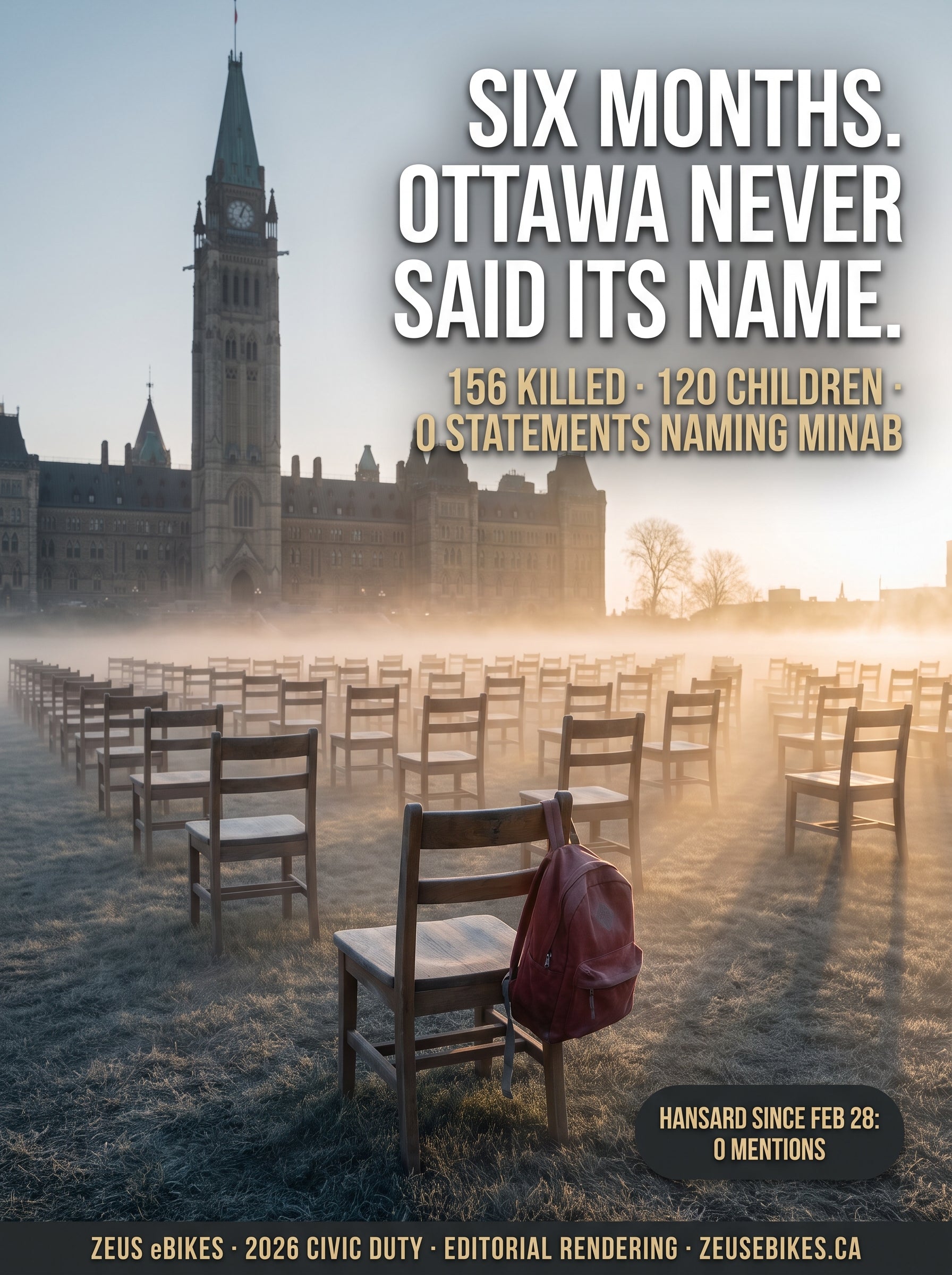
One hundred and fifty-six chairs, one for each of the dead of Shajareh Tayyebeh Elementary. The installation is ours — an editorial rendering, like every photograph in this piece. The number is not.
Quick answer: US Tomahawk cruise missiles destroyed Shajareh Tayyebeh Elementary School in Minab, Iran on February 28, 2026 (at least three striking the compound in Just Security's reconstruction; Human Rights Watch counts seven or more impact sites) in the deadliest civilian incident of the 2026 Iran war. By the consolidated Iranian count, which Amnesty International could not independently verify, 156 people died, at least 120 of them children; independent floors start at 147, and a US congressional letter says at least 175. Debris analysis, geolocated video, and the Pentagon's own reported preliminary inquiry all point to a US targeting error built on decade-old intelligence, with embedded database warnings bypassed "for expediency," and the neighbourhood was struck again while rescuers worked the rubble. Italy and China condemned the strike by name; France condemned the operations as "outside international law"; Canada has never publicly mentioned it — a silence repeated from the Maduro seizure in January. The caution bought nothing: trade talks collapsed into 50 per cent tariffs in August, the Pentagon walked out of the 86-year-old joint defence board, and US officials spent early September mocking the Canadian military: one that has fought beside America's in eight major wars and against it once, in 1812.
In this investigation
- Thirty-one minutes in Minab
- Counting the dead honestly
- What the debris said
- The missile that phones home: testing the "they knew" claim
- The second wave
- "For expediency": the warnings that were bypassed
- Minab was not an exception
- What other US allies said
- What Canada said, word for word
- The deal that never came
- Then they started mocking the cadets
- The ledger they are mocking
- What accountability would look like
- Questions people are asking
- Methodology and dataset
- Limitations and corrections
- Bibliography
Thirty-one minutes in Minab
In July 2026, the research agency Forensic Architecture published a full reconstruction of the strike, and the President of the United States told Fox News that the images of the destroyed school might be "AI-generated". The official investigation, meanwhile, remains unpublished. That is the fog this section was written against — so it walks the record the way an investigator would: what happened, minute by minute, on the strength of who observed it.
The war began at 9:45 a.m. local time, by Amnesty International's reconstruction, as the United States and Israel opened their campaign against targets across Iran — roughly 900 strikes in the first twelve hours, per a UK House of Commons Library briefing. At 10:23 a.m., satellite imagery shows Shajareh Tayyebeh Elementary School still standing: a two-storey building with a walled yard, a playground, and the painted markings of a football pitch visible from orbit. At 10:45 a.m., the governor of Hormozgan announced that the school had been hit. The destruction of a school full of children fits inside that 22-minute gap.
Inside the gap, the sequence is grimmer. According to the legal reconstruction published at Just Security, after the first impact the school's principal moved surviving students into an interior prayer room and began calling parents. The second missile hit that room directly. A third landed close by. Forensic Architecture counts nine missiles in the opening volley across roughly 90 seconds, the first landing 130 metres from the school, with the school itself hit seconds later; PBS NewsHour, reporting from Minab, describes two direct hits minutes apart. The sources disagree on the spacing of the impacts — a real discrepancy, logged in our dataset — but agree completely on the shape of the event: multiple precision missiles, one civilian school, no warning.
The school was next to an Islamic Revolutionary Guard Corps naval facility, and had once sat inside its perimeter. That fact is the seed of everything that followed. Satellite imagery reviewed by Human Rights Watch and CNN shows the school was fenced off from the base between 2013 and 2016, repainted, given playgrounds, and converted entirely to civilian use — with its football-pitch markings visible from space by August 2017, and its own public website carrying photographs of uniformed schoolchildren. For roughly a decade before the missiles arrived, anyone who looked could see it was a school. The question this article keeps returning to is who looked, when, and what they did about it.
What the record establishes: a civilian school, visibly civilian for about ten years, was destroyed by multiple precision missiles in the war's opening minutes, and the surviving children were killed in the room they had been gathered in for safety. Every load-bearing fact in that sentence carries a source, and the sources are independent of each other.

A morning stopped where it stood. At 10:23 a.m. the satellite record shows the school in Minab standing; at 10:45 the governor announced it was gone.
Counting the dead honestly
No single death toll for Minab is "the" number, and pretending otherwise would repeat the sin this article documents: treating stale or convenient data as settled fact. The counts below are every figure in the public record, who produced it, and when. The consolidated Iranian toll — 156 dead, 95 injured — is the one most organizations relay, and Amnesty International states plainly that it could not independently verify the numbers because Iran's internet blackout blocked on-site work.
| Source | Figure | Breakdown | Date |
|---|---|---|---|
| Iranian authorities (consolidated) | 156 killed, 95 injured | 120 students, 26 teachers, 7 parents, a bus driver, a pharmacy technician, one unborn child | Mar 1, 2026 |
| Mizan (Iran's judiciary news agency) | 120 students | 66 boys, 54 girls, plus 26 teachers and 4 parents | Mar 3, 2026 |
| Iranian judiciary | 165 implied | 140 identified, 25 unidentified | Mar 2026 |
| Forensic Architecture / Sky News | 147+ (floor) | At least 121 children and 26 teachers | Jul 2026 |
| PBS NewsHour, from Minab | 168 | 120 students aged 6–11; one victim still unidentified at airtime | 2026 |
| US congressional letters | "at least 175 civilians" | Not broken down | Mar 2026 |
Two details in this table deserve more attention than they have received. The first: much of the world's press called Shajareh Tayyebeh a girls' school, and some reconstructions describe the victims as mostly girls aged 7 to 12 — yet Mizan's official breakdown counts 66 boys among the 120 dead children. They cannot both be fully right. We flag the contradiction rather than resolve it, because nobody in the public record has resolved it, and a detail this basic remaining contested is itself evidence of how little verified ground truth has been allowed out of Minab.
The second: the counting took months. Iran's judiciary reported 25 sets of remains unidentified in March; Al Jazeera filmed funerals for Minab's children in July, nearly five months after the strike. When a munition designed to destroy hardened military targets lands on a classroom, identifying who was inside becomes forensic work measured in seasons.
The dead have names, and ten of them were spoken to PBS NewsHour's cameras by their families: Sepehr Karimi. Motahareh Ahmadzadeh. Attareh Zarei. Khadijeh Darvishi. Mohammad Taha Jaffari. Hami Sadeghi. Mohammad Sadegh Gholami. Ali Hafizi. Amirhossein Jaffari. Hannaneh Mehdi-Khah. An eleven-year-old survivor named Reyhandeh, who lost her younger sister, told PBS: "It's just the government that's cruel and dirty. Most people in America are good."
And the record gives back more than ten. Middle East Eye compiled the names and ages of 61 of the dead — from Iran's Gymnastics Federation, a handwritten list, and the state-run Tasnim agency — 25 boys, 26 girls, eight women, one man, and a two-month-old baby. Spellings vary between outlets; we print the list as its source gave it. These are the people the missiles found:
The 61 names the record has given back
Hana Dehqani, 8 · Fatemeh Salari, 34 · Reza Habashian, 7 · Arya Bahadori, 9 · Ali Asghar Zaeri, 8 · Zahra Bahrami, 7 · Ahmad Soltani, 8 · Hamed Par-ashegh-nezhad, 7 · Fatemeh Yazdan-panah, age unknown · Mahdis Nazari, 7 · Athena Chamani-nezhad, 6 · Amirghasem Zaeri, 7 · Fatemeh Dorazehi, 10 · Arad Ahmadizadeh, 8 · Saman Karimzadeh, 7 · Fatemeh Shahdadi, age unknown · Nadia Shahmiri, 9 · Parham Ranjbari, 9 · Mahmoud Gholamyani, 35 · Fatemeh Rahdar, 10 · Amir-Hassan Rasouli, 8 · Zahra Behrouzi, 8 · Mohammadhatam Raisi, 10 · Asna Raisi, 12 · Benyamin Jangjou, 8 · Mohammad-Sadra Zarei, 8 · Maryam Pazark, 10 · Liana Mohammadi, 7 · Mandana Salari, 29 · Sara Shayesteh, 5 · Zoha Pasand, 8 · Esra Zakeri, 9 · Salma Zakeri, 6 · Fatemeh Taherifard, 29 · Zahra Ansari, 7 · Fatemeh Fadavi, 10 · Mahna Zarei, 2 months · Athareh Zarei, 10 · Alireza Zarei, 9 · Mohammadreza Shahsavari, 8 · Samira Basarde, 38 · Ehsan Saleminia, 6 · Fatemeh Zahra Karimi, 7 · Zeynab Bahrami, 10 · Mohammad Shah-dousti, 8 · Reza Barani, 7 · Athena Ahmadzadeh, 10 · Khadijeh Darvishi, 9 · Roqayyeh Karimi, 42 · Reza Ranjbar, 6 · Marzieh Bashiri-far, 38 · Mohammad-Mehdi Chegini, 10 · Mohammadian Bahrami, 17 · Ali-Akbar Karyani Pak, 8 · Hananeh Mehdikhah, 7 · Fereshteh Sangarzadeh, 44 · Mohammad-Ali Karyani Pak, 7 · Parsa Mokhtari-nasab, 12 · Arina Arab-Kish, 8 · Makan Nasiri, 12 · Esra Farahi-Zadeh, age unknown.
Sixty-one of at least 156. The others have not been returned by any record we could retrieve; a community memorial at minab.net is gathering them.

Sixty-one of the dead have names in the public record — ten spoken to PBS by their families, the rest compiled by Middle East Eye, from an eight-year-old to a two-month-old. The others are still only a number.
What the debris said
The physical evidence answers the attribution question, and it answers it in layers, each one independently retrieved. Within days of the strike, video published by Iran's Mehr News agency and geolocated by Bellingcat showed a missile in a near-vertical terminal dive over the site. Arms-control expert John Gilbert, describing its black body and fin configuration for TIME, identified it as a Tomahawk; Sam Lair of the James Martin Center for Nonproliferation Studies concurred — a weapon that, among the belligerents of this war, only the United States fires. Photographs of fragments at the school, reviewed by munitions experts for the New York Times and CNN, showed components consistent with a Tomahawk.
Then the debris got specific. The London-based charity Action on Armed Violence, with Byline Times, identified among the fragments a satellite data link antenna — the component that lets the missile communicate in flight — carrying the markings of Ball Aerospace & Technologies Corp. and a legible contract number: N00019-14-C-0075. US Naval Air Systems Command records show that contract was awarded to Raytheon in 2014 for production of Tomahawk Block IV missiles. A serial trail now runs from a classroom in Hormozgan to a specific American production contract.
Attribution stopped being contested among investigators well before the debris trail was complete. On March 5, Reuters reported two US military officials privately assessing the strike as likely American. On March 11, the New York Times reported the Pentagon's preliminary inquiry had concluded US forces were responsible, the school having been placed on a strike list using outdated Defense Intelligence Agency coordinates. CBC News ran its own visual investigation reaching the same shape of conclusion, and Sky News sent a correspondent to Minab itself for a documentary whose finding is in its coverage line: all evidence points to the US.
The missiles came from the sea. Open-source tracking of the February 28 Tomahawk launches, compiled by Naval News and defence reporting on the opening salvo, names four Arleigh Burke-class destroyers firing that day: USS Delbert D. Black, USS Spruance, USS Thomas Hudner, and USS Frank E. Petersen Jr. By the end of March, Stars and Stripes reported more than 850 Tomahawks fired into Iran — a record expenditure. (Destroyers, cruisers and submarines fire Tomahawks; aircraft carriers, contrary to a version of this story in circulation, do not.)
What the record establishes: the weapon was a US Tomahawk, identified independently by video analysis, by munitions experts reading the debris, and by a contract number stamped on a recovered antenna — and the Pentagon's own reported preliminary finding agrees. The attribution question is closed everywhere except in the President's public statements.
The missile that phones home: testing the "they knew" claim
A widely shared account of Minab holds that the missiles carried cameras, that their operators watched the first impact through them, and that follow-on missiles were then deliberately steered onto the school to finish what the first had started. Because this is the single most serious version of the story — it converts a catastrophic error into something closer to murder — it deserves the most careful treatment in this article. Here is what the evidence supports, and where it stops.
The capability is real, and the US Navy has demonstrated it in public. The Block IV Tomahawk carries a two-way satellite data link, and in a Navy–Raytheon demonstration reported in 2015, a Block IV fired from the destroyer USS Gridley photographed a target with its onboard camera, transmitted the battle-damage image to fleet headquarters over UHF satellite link, entered a loiter pattern, and was then redirected by strike controllers onto an entirely different target, which it hit. The missile that destroyed a classroom in Minab came from the same Block IV production line — we know because the data-link antenna itself was found in the rubble. Janes further identified a newer Block Va variant in this war carrying the standardized Block V two-way datalink for real-time communication with launch platforms.
So the missiles could photograph what they were about to hit, report home, and be redirected. Whether that happened at Minab turns on a fact the reconstructions do not agree on: how far apart the hits on the school came. Forensic Architecture's count has the school struck about ten seconds into a 90-second, nine-missile volley — spacing that fits aimpoints programmed before launch.
But Just Security's reconstruction and PBS's reporting from Minab describe the hits on the school arriving minutes apart: long enough, on the record, for the principal to gather surviving children into the prayer room and telephone parents before the second missile arrived. The second missile struck that room. Human Rights Watch counts at least seven distinct impact sites inside the compound: sites, not missiles; the two counts measure different things, and we log the difference rather than force the numbers to agree. Under the minutes-apart account, a Tomahawk arriving behind the first, against the same small building, striking the room where survivors had collected, flew its final approach inside the window where the two-way datalink existed and the legal duty to reassess was live.
Two cautions belong beside that, and we state them plainly. Whether the spacing reflects staggered launch times or something else is a launch-side fact only the unpublished investigation holds. And the Navy's demonstrated redirect used a loitering missile against a pre-planned alternate target, so whether a divert was even practically executable inside the Minab gap is itself unestablished. No published investigation asserts that operators viewed imagery between impacts or steered later missiles in response, and none rules it out. The Just Security analysis identifies operator awareness between strikes as precisely the unresolved factual question on which criminal liability turns: unresolved because the Pentagon's investigation, which could answer it, remains unpublished six months on.
Three verdicts, then, stated at their honest strength. Established: the missiles carried the hardware to see and be redirected, and their crews' command structure had a demonstrated procedure for doing so. Not established, and not ruled out: that anyone watched and chose to continue — the contested minutes between impacts are exactly where that answer lives, and only the unpublished investigation has seen them from the launch side. And documented in a different, worse form: the question of what commanders knew does not actually depend on a missile's camera at all — because of what happened next.
| Claim | Verdict | Basis |
|---|---|---|
| The missiles had cameras and two-way links | Established as capability | Navy's 2015 Gridley demonstration; SDL antenna in the Minab debris; Janes on Block V datalink in theatre |
| Follow-on missiles were redirected onto the school mid-flight | Not established — and not ruled out | No investigation asserts it, but the impact spacing itself is contested: ~10 seconds per Forensic Architecture, minutes per Just Security and PBS. Under the minutes-apart account the retargeting window was open and the second missile hit the room where survivors had gathered; whether a divert was practically executable in that gap (the Navy's demonstrated redirect used a loitering missile against a pre-planned alternate) is also unestablished. The unpublished 15-6 holds the answer |
| Operators watched a live video feed | Overstated in the popular account | Block IV transmits battle-damage still imagery, not continuous video; imagery goes to fleet strike controllers |
| The strike zone was hit again after the hit was public knowledge | Established | Forensic Architecture; Sky News; see next section |
The second wave
At 10:45 a.m., the governor of Hormozgan publicly announced that a school in Minab had been struck. From that minute, the hit was not a secret the missile's camera alone could have revealed; it was on the news. Red Crescent crews, IRGC personnel and civilian volunteers were digging through the rubble. Parents were arriving. Amnesty's reconstruction places smoke still rising on video between 11:49 a.m. and noon.
Between 12:30 and 1:15 p.m., at least ninety minutes after the world had been told a school was under the rubble (roughly two hours, if the two reconstructions' clocks align), Forensic Architecture documents a second wave of strikes on the same neighbourhood, with families and rescue workers visible on site in the footage, and the profile of a Tomahawk visible in the second-wave video. Sky News, reporting independently from Minab, describes the neighbourhood being "bombed a second time while families and rescuers were still on the ground." What the second wave's aimpoints were — the school compound itself, the adjacent naval facility, or other targets nearby — is not resolved in the public reporting, and we say so because the weight of this section must rest only on what is on film: the wave, the timing, and the rescuers. Forensic Architecture's conclusion is measured and devastating in the same sentence: between the first reports and the second wave, US forces had "ample opportunity to reassess," and the strikes came anyway.
This is where the popular "they knew" account and the documented record converge on the same moral ground by different routes. The documented version requires no camera in a nosecone. It requires only a television, a wire service, or the targeting cell's own routine monitoring — and a decision cycle that kept launching into a neighbourhood the whole world had just watched become a mass-casualty rescue site. International humanitarian law, as the Just Security analysis lays out, imposes a duty of constant care that runs through the entire execution of an attack — customary law binding on the United States, which never ratified Additional Protocol I — and a legal obligation to suspend strikes when it becomes apparent the target is civilian. Whether that duty was breached knowingly or through a targeting apparatus that nobody paused is the difference between a war crime and dereliction, and both are chargeable under the US military's own law. (The International Criminal Court offers no practical venue here: neither the United States nor Iran is a party to the Rome Statute.)
What the record establishes: the strongest version of "they knew what they hit" does not rest on missile cameras. The second wave itself is on film, from two independent investigations — at least ninety minutes after the school hit was publicly announced, landing in a neighbourhood full of rescuers. What its aimpoints were, and whether anyone in the targeting chain knew what the site had become when those launches proceeded, is the question the unpublished investigation must answer.
"For expediency": the warnings that were bypassed
The strike was preventable at the database level, before a single missile flew. That is the finding of CNN's July 7 exclusive, sourced to officials familiar with the targeting process: the military's own target-development system carried embedded warnings that the intelligence behind a set of Iran targets (including the site that turned out to be Shajareh Tayyebeh Elementary) was years old and required re-vetting before use. Adding such a site to a strike list required a senior officer's approval. Commanders granted it, bypassing the warnings "for expediency," in CNN's sourcing: a rush to generate targets for the war's opening night.
Read that against the satellite record and the failure acquires its full shape. The Defense Intelligence Agency classification dated from the era when the school sat inside the IRGC base perimeter. The fence went up between 2013 and 2016. The playground and pitch markings were visible from orbit by 2017. The school had a public website with photographs of children in uniform. A decade of freely available evidence sat between the stale coordinates and the launch order, and the system flagged the staleness itself — the machine, at least, tried. The bypass was human.
The official American response has run in one direction while the evidence ran in the other. On March 1, CENTCOM acknowledged "reports concerning civilian harm" and promised investigation. On March 4, Secretary of State Marco Rubio said the United States "would not deliberately target a school." On March 7, President Trump asserted Iran had conducted the strike; by March 9 this had softened to "Iran or somebody else"; later still, to "mistakes are made" and "nobody did that on purpose" — an arc that travelled from denial to something close to accidental confession, without pausing at accountability. On March 13, Defence Secretary Pete Hegseth promised a "thorough probe," widely read as tacit acknowledgement. The probe, a 15-6 administrative investigation, remains unpublished as of September 2, 2026. In July, shown the aftermath, the President suggested the images might be "AI-generated." The children buried in July were not.
Congress has not been silent. Letters signed by senators and by Representative Jason Crow cite "at least 175 civilians" killed; Representative Gabe Vasquez demanded answers from Secretary Hegseth directly; and a Republican member told CBC the United States "must admit responsibility" if at fault. The UN opened an independent investigation on March 17; UNESCO called the strike "a grave violation of humanitarian law." The machinery of accountability exists and is turning, slowly, in many places at once. One G7 capital has contributed nothing to it.
Minab was not an exception
The school was the worst single incident of the war's opening, and it was one entry in a documented pattern of strikes on things civilians cannot live without. The Human Rights Activists News Agency counted 1,097 confirmed civilian deaths in the war's first five days, 181 of them children under ten, with 880 more under review, figures relayed by TIME with the caveat that it could not independently verify them. Amnesty International's running count, as retrieved on September 2, 2026, stands at at least 2,362 civilians killed, including at least 383 children.
The pattern has named entries. On April 2, two missiles hit the unfinished B1 bridge at Karaj, where families were picnicking for Sizdah Be-dar, the thirteenth day of the Persian New Year: eight dead, more than 95 injured. Iran's Fars agency, a state outlet whose claim we label as such, reported a second strike after first responders arrived. The President of the United States posted about it on Truth Social with a promise: "Bridges next, then Electric Power Plants." The same day, airstrikes destroyed roughly all of the buildings of the Pasteur Institute of Iran, the country's oldest medical research institution, a century of Iranian public-health infrastructure gone in a morning, with the World Health Organization voicing concern.
By July, Al Jazeera's survey of struck civilian sites read like a utilities bill: the Shahid Baghaei hospital in Ahvaz rendered inoperable, more than 200 patients evacuated; the desalination plant serving the village of Bonji, cutting off drinking water for about 10,000 people; wheat storage in two Khuzestan counties; the Bandar Abbas wastewater plant; communications towers; six bridges in one Hormozgan county; the provincial power grid. International law's rule here is not obscure, and the experts Al Jazeera consulted state it plainly: objects normally dedicated to civilian purposes are protected unless their military use provides a definite advantage, and objects indispensable to civilian survival — water, food, power — carry special protection.
Both ledgers stay open on this count too. Iran has struck civilian infrastructure in Kuwait and Qatar, including a power and desalination plant, and tankers in the Strait of Hormuz; Human Rights Watch documented Israel's strike on Evin prison as an apparent war crime; and the Iranian regime's own record of killing its citizens is documented in the same HRW reporting this article draws on. Canada condemned the Iranian entries in that ledger, by name, within days. Every entry above from the American column — the schools, the bridges, the hospitals, the water — not a word, from February to September.
What other US allies said
Silence has a control group. Canada was not the only close US ally navigating this war with an economy exposed to American retaliation, so the honest way to judge Ottawa's choices is against the choices of governments in the same position. The record, country by country:
| Ally | Position on the US–Israeli strikes | Named Minab? |
|---|---|---|
| France | President Macron, on television, March 3: military operations "conducted outside international law, which we cannot approve of" — while deploying the carrier Charles de Gaulle to protect regional stability (TRT, Naharnet) | Condemned the strikes' illegality directly |
| Italy | PM Meloni called the school strike a "massacre"; the defence minister said the attack violated international law (per Wikipedia's compendium and Sayer) | Yes |
| Spain | FM Albares refused US use of jointly operated bases for strikes "not covered by the United Nations' charter"; Trump, on camera: "We're going to cut off all trade with Spain"; Madrid's reply: "We will not be complicit in something that is bad for the world… simply out of fear of reprisals" (CNBC, Al Jazeera) | — |
| Germany | Chancellor Merz declined to judge legality; Germany "not participating in this war" (per Sayer) | No |
| United Kingdom | Denied involvement in the initial strikes; later allowed base use for defensive operations (per Sayer) | No |
| China | Foreign ministry, March 13: Minab "constitute[d] an even graver violation of international humanitarian law" | Yes |
| Canada | PM Carney, day one: "Canada supports the United States acting to prevent Iran from obtaining a nuclear weapon" (CBC) | Never — verified below |
| Australia / New Zealand | Joined Canada in public support — the only two allies to do so, per Sayer's comparison | No |
Where a row above rests on a single secondary source, the dataset accompanying this article labels it, and the Germany and UK entries are attributed to Derek Sayer's documented comparison rather than to our own primary retrieval. The Spain row was re-verified against CNBC, Al Jazeera and PBS reporting on September 2; the France, China, Italy and Canada rows are multiply sourced. The pattern survives any single row: allies with economies as exposed as Canada's, or more so, found words for what happened. France condemned illegality on television and remained an ally in good standing. Spain was threatened on camera with total trade cutoff, refused anyway, and remains inside the alliance.
What Canada said, word for word
Canada's record on Minab consists of three documents and an absence, and because the absence is the story, we verified it the way an absence must be verified: by looking, and by saying how we looked.
Document one. On February 28 — the day the school was destroyed — Prime Minister Mark Carney told an audience in Mumbai: "Canada supports the United States acting to prevent Iran from obtaining a nuclear weapon and to prevent its regime from threatening international peace and security." He added that Canada was not participating militarily and was "not party to the military buildup or planning." An endorsement of the operation's stated goal, on its first day, while the rubble in Minab was still being cleared.
Document two. On March 2, two days after the strike, Foreign Affairs Minister Anita Anand issued Canada's civilian-protection statement of record. We retrieved it in full from canada.ca. It calls on "all parties to prioritize the protection of civilians and civilian infrastructure." It then condemns, by name, one party: "Canada condemns the strikes carried out by Iran on civilian infrastructure across the Middle East, including the Gulf States… an unacceptable escalation and a blatant attempt to further destabilize the region." The statement does not contain the word Minab. It does not contain the word school. It does not contain the words United States. Two days after American missiles killed more than a hundred children at their desks, Canada's foreign ministry published a civilian-protection statement whose only named offender was Iran.
Document three. In the days that followed, under questioning, the Prime Minister conceded ground he never converted into policy: the war was "a failure of the international order"; the US had acted "without engaging the United Nations or consulting allies, including Canada"; the attack was "prima facie inconsistent with international law." Anand later expressed regret — as Wikipedia's compendium paraphrases it — over certain U.S. strikes that appeared inconsistent with international law. Certain strikes, unnamed. Ottawa's furthest reach, six months on, is a lawyer's phrase with no noun in it.
And the absence. As of September 2, 2026, a site-scoped search of canada.ca and pm.gc.ca for the word "Minab" returns nothing. The parliamentary record is emptier still: a full-text search of Hansard, run the same day through openparliament.ca, finds exactly one occurrence of "Minab" in its history: November 1994, a Liberal MP describing a tourism conference in Japan. Wikipedia's compendium of international reactions to the strike, which records statements from China, Italy, Thailand and the UN system, records none from Canada. The historian Derek Sayer, writing in August, put it flatly: "Neither Carney nor foreign minister Anita Anand have yet uttered a word of regret about the Minab slaughter. In fact, they haven't mentioned it at all." Four independent routes to the same finding, and we state it bounded by them: across its written federal channels and the entire searchable record of its Parliament, the Government of Canada has not acknowledged the deadliest civilian incident of a war it publicly endorsed on day one.
And this was not a lapse. It was the second run of a pattern, executed with the same drafting technique. On January 3, 2026, hours after US forces seized a sitting foreign head of state, the Prime Minister's Office released a statement on Venezuela that condemns "Maduro's brutally oppressive and criminal regime," welcomes "the opportunity for freedom, democracy, peace, and prosperity for the Venezuelan people," and "calls on all parties to respect international law" — without once naming the American operation it was responding to, neither condemning nor endorsing the abduction of a head of state. France's foreign minister called that operation a violation of international law the same week; Canadian analysts called Ottawa's version "weak." Set the two statements side by side, January's and March's, and the architecture is identical: name the villain everyone already condemns, invoke "all parties" and "international law" as abstractions, and write around the American action at the centre of the event. Once is caution. Twice, two months apart, with the same drafting architecture, looks less like caution than method — our reading of the two texts, offered as comment.
Canadians noticed, even if their government hoped otherwise. In the March polling compiled in Wikipedia's survey of the war, Ipsos found 61 per cent of Canadians disapproving of the strikes, Angus Reid found 74 per cent wanting the military kept out and measured support for the Prime Minister's position among past Liberal voters at 17 per cent, and Leger found 70 per cent preferring neutrality. The spectrum split from Conservative Leader Pierre Poilievre's outright support — for the United States, Israel, and "the courageous people of Iran in toppling this terror regime" — to the Greens' day-one condemnation, with the NDP condemning the bombings and the Bloc calling the endorsement "premature." The sharpest sentence came from former foreign minister Lloyd Axworthy: "You cannot embed Canadian officers in U.S. war-fighting headquarters, plug Canadian intelligence into targeting processes, then wash your hands when missiles fly."
What the record establishes: Canada endorsed the operation on the day the school was destroyed, condemned only Iran in its civilian-protection statement two days later, and has never once said the word "Minab" — a silence verified by direct search of government channels, by the international-reaction record, and by independent Canadian commentary. Among major allies, only Australia and New Zealand kept Canada company.

Six months of federal statements on this war. The number that contains the word “Minab” is zero — verified on canada.ca, on pm.gc.ca, and across the entire searchable record of Hansard.
The deal that never came
Every silence has a theory behind it, and Ottawa's was not mysterious: Canada entered 2026 in a trade war with Washington, with tariffs strangling exports and a renegotiation perpetually one meeting away. No official has stated the rationale on the record. The theory most consistent with the government's hedged texts — and the one its critics allege — is that a country negotiating for its economic life could not afford to name the nation whose missiles had just destroyed a school. Say nothing, bank the goodwill, get the deal. Six months later the results of that wager are in, and they are measurable.
There is no deal. On August 19, President Trump publicly touted a "very fair" agreement with Canada as done. On August 21 and 22, the talks collapsed — Carney's account: Washington changed terms hours before the deadline, "asked too much, offered too little"; the US Trade Representative blamed Canadian "walk backs." The United States then imposed 50 per cent tariffs on roughly $20 billion of Canadian goods — hockey sticks among them, in case the symbolism needed underlining. Carney, who had spent the spring declining to say "Minab," now says Canada is "at war" economically with the United States, with dollar-for-dollar retaliation beginning September 8. USMCA lapsed unrenewed in July. Ontario's premier, less lawyerly than the federal cabinet, told the President he could "kiss my ass."
Set the two timelines side by side and the wager judges itself. February 28: Canada endorses the operation's goal within hours. March 2: Canada's civilian-protection statement names only Iran. March through July: not one word about Minab, while France condemns illegality on television and Spain refuses bases under explicit trade threats. August 22: Canada gets the tariffs anyway — steeper than before, on more goods, with the deal Trump himself had announced days earlier dissolving overnight. Spain said no out loud and its alliance survived; Canada said nothing and was tariffed all the same.
Here is our assessment, and we label it as such: an editorial judgment built on the verified record above, offered as fair comment on a matter of profound public interest. The silence was a payment, and the goods never shipped. A government that mutes its own foreign ministry to protect a negotiation has made a bet that the counterparty rewards deference. This counterparty demonstrably does not: the two-year record we documented separately shows concessions pocketed and pressure renewed, allies threatened and then threatened again. What the silence purchased was the worst of both ledgers: Canada absorbed the moral cost of complicity-by-endorsement (Axworthy's phrase, "wash your hands when missiles fly," will follow this government into the histories) and then absorbed the tariffs too. A principled "no," priced in advance, would have cost no more and left the country's word intact. And when a government's stated values detach this visibly from its behaviour, the damage lands at home as well — the same corrosion of civic trust we traced in our essay on what happens when we stop believing each other.

What the silence was supposed to buy, priced in August: 50 per cent tariffs on roughly $20 billion of Canadian goods — hockey sticks among them.
Then they started mocking the cadets
If deference were a currency, September should have been the payout. Instead, the same week the 50 per cent tariffs took hold, the Trump administration turned to open mockery of the Canadian military — including its children's program — while the structural machinery of the defence relationship kept coming apart. Here is the recent record, item by item, each sourced; the characterizations along the way are ours.
The Secretary of Defense of the United States, the same official who promised a "thorough probe" of Minab that has produced nothing public in six months, posted an image of Royal Canadian Army Cadets, a young person in a red beret beside another in uniform, captioned with a Canadian flag emoji and the words "this is real." The cadets are a youth program for Canadians aged 12 to 18; that program is what he held up for ridicule. The Pentagon stood behind the post; British Columbia's premier called it "amateur-hour, distracted, bizarre leadership." Days earlier, Treasury Secretary Scott Bessent had dismissed Canada on television ("What, they're going to take their two submarines from the Edmonton Mall and sic them on us?") and called its economy thirteen times smaller. The President signed an executive order renaming Lake Ontario "Lake America"; Carney's reply, for the record: "naming reality means calling it Lake Ontario — then, now and always." The Prime Minister's summary of the week, at a moment when global defence chiefs were gathering in British Columbia: the Americans should "stop doing memes, stop posturing, stop trying to be tough and start being serious."
The memes sit on top of structure. In May, US Undersecretary of War Elbridge Colby announced the Pentagon was "pausing" its participation in the Permanent Joint Board on Defence — the advisory body Franklin Roosevelt and Mackenzie King created in 1940, when Canada was at war with Germany and the United States was not yet in it. "Canada has failed to make credible progress on its defense commitments," Colby wrote, months after Canada had in fact reached NATO's two per cent benchmark on a $9.3-billion boost. A former US defence adviser, Imran Bayoumi, called the walkout "a needless provocation that sends the wrong message to Ottawa and other U.S. allies." Alongside it sit the demands reported by The Hill: complete the F-35 purchase, buy American radar aircraft for the Golden Dome missile shield, grant the United States first refusal on Canadian critical minerals. Buy our planes, join our shield, reserve us your minerals — while we tariff your lumber and meme your children.
Note what none of this is: retaliation for Canadian criticism. Ottawa never criticized. The silence on Minab, the silence on Maduro, the day-one endorsement, the lawyered statements — all of it preceded the tariffs, the board walkout, the cadet post. Whatever the silence was supposed to buy, the buyer can now inspect the goods: Canadians answered, for what it is worth, by sweeping three by-elections behind the leader being mocked, in Chicoutimi–Le Fjord, Beaches–East York and North Vancouver–Capilano, on September 1.
What the record establishes: six months of Canadian silence about American strikes on civilians was followed by 50 per cent tariffs, a US walkout from the 86-year-old joint defence board, procurement ultimatums, and the US Defence Secretary publicly mocking Canada's youth cadet program. Deference was tried. This is what it purchased.

The Royal Canadian Army Cadets are a youth program for Canadians aged 12 to 18. That program is what the United States Secretary of Defense aimed a meme at, and what the Pentagon defended it over.
The ledger they are mocking
Since the mockery aims at Canada's military record, the record deserves to be read into evidence. Canadians and Americans have fought against each other in one war, more than two centuries ago, before Canada existed as a country. Since 1914 they have fought side by side in eight major ones. In the two largest, Canada arrived years before the United States did.
| Conflict | Canada | United States | Together? |
|---|---|---|---|
| War of 1812 | The invasions were repelled by British regulars, Indigenous allies under Tecumseh, and colonial militia (as British North America) | Invaded Canada; the invasions failed; recorded outcome: inconclusive, borders unchanged | Against each other — the only time |
| First World War | In from August 1914; Vimy Ridge; victory | In from April 1917 — 32 months later | Together from 1917 |
| Second World War | Declared war on Germany September 10, 1939, by its own vote of Parliament; Juno Beach was one of the five D-Day beaches; victory | In from December 1941 — 27 months later | Together |
| Korea | 26,791 served; 516 died | Armistice in 1953; no peace treaty to this day | Together |
| Vietnam | Declined | Withdrawal 1973; Saigon fell 1975 | — |
| Gulf War | Coalition member; victory | Victory | Together |
| Kosovo | NATO campaign | NATO campaign | Together |
| Afghanistan | 158 dead — Canada's heaviest losses since Korea | Taliban retook Kabul, August 2021 | Together — Canada went because America was attacked |
| Iraq 2003 | Declined (no UN authorization) | Withdrawal 2011; returned against ISIS 2014 | — |
| Libya 2011 | A Canadian general commanded the NATO operation | NATO campaign; Gaddafi fell; the state collapsed after | Together |
| Anti-ISIS campaign | Coalition member | Territorial caliphate destroyed 2019 | Together |
Read the two columns honestly, and honesty cuts every way here. Wikipedia's index of American conflicts runs to 204 non-colonial entries against Canada's 26 since Confederation. Of America's biggest wars since 1945, the Gulf War ended in clear victory, and Korea preserved South Korea at the price of a stalemate that still has no peace treaty; Vietnam ended with helicopters off a Saigon roof, Iraq with a withdrawal that had to be reversed, and Afghanistan with the Taliban back in Kabul before the last transport left. Canada declined Vietnam and Iraq on its own judgment, owns its share of Libya's collapse into failed statehood, and carries one long grief of its own choosing: Afghanistan, the war it entered because its neighbour had been attacked: the only invocation of NATO's Article 5 in the alliance's history, honoured with 158 Canadian dead.
The shared history is not abstract. The First Special Service Force (roughly 900 Americans and 900 Canadians in one Second World War unit, the ancestor of the US Green Berets) took Anzio's line and led the liberation of Rome, and received the Congressional Gold Medal in 2015 from the same Congress whose administration now memes Canadian cadets; NORAD has had a Canadian deputy commander watching American skies since 1958.Gander, Newfoundland — population about 10,000 — took in 38 diverted planes and roughly 6,600 stranded people, and fed and housed them in its schools and legion halls. That is who the "two submarines from the Edmonton Mall" line is aimed at.
The verdict is ours, and it is fair comment on a record every line of which is cited above. Ottawa's silence on Minab was not neutrality, because Ottawa endorsed the operation's goal on day one and condemned the other side's strikes by name. It was not prudence, because the tariffs, the walkout and the mockery came anyway. What the silence communicated — to Washington, and to every capital watching — is that Canada's objections to the killing of children are conditional on the exchange rate; that a country which once declared war on Hitler two years ahead of America, and declined Vietnam and Iraq on principle when it mattered, now waits to see the trade file before locating its conscience. Whether Washington read it that way cannot be proven from outside; what the record shows is that six months of deference coincided with escalation, not reward. That is our inference from the sequence, and labelled as one. Canada's own history proves the backbone exists; it stormed a beach at Juno and said no to Vietnam. The current government's record, from January's Venezuela statement to this September's silence, shows that backbone in storage, held against a payment that August proved is never coming.

Juno. Of the five D-Day beaches, one belonged to Canada — a country that had by then been at war twenty-seven months longer than the United States. The backbone exists.
What accountability would look like
The demands on the table are specific, public, and largely ignored. Amnesty International calls for an impartial, independent and transparent US investigation — examining intelligence gathering, targeting decisions and the role of AI in the process, with results published, criminal prosecution where responsibility is found, and full reparation to victims' families. Human Rights Watch calls for a war-crimes investigation by the Department of Defense, reinstatement of the civilian-harm-mitigation programs dismantled under the current administration, and (this row concerns Ottawa directly) for allied countries to demand accountability through international mechanisms. The UN's independent investigation, opened March 17, continues. The Pentagon's 15-6 remains unpublished; the officers who bypassed the staleness warnings remain unnamed; no reparations program has been announced.
Amnesty's demands run to Tehran as well, and honesty requires printing them: allow independent monitors into the country, restore the internet access whose blackout blocked verification, stop coercing bereaved families over funerals, and stop conscripting traumatized child survivors into propaganda. A regime that blacked out the internet investigators needed, coerced bereaved families over funerals, and pressed traumatized child survivors into propaganda bears its own account, and no part of this article should be read as absolving it. Both ledgers stay open. Neither cancels the other.
For Canada, the accountability gap is narrower and entirely self-inflicted, because the asks are so small. Say the name. State that Canada expects the US investigation to be published, as Human Rights Watch asks of allies. Support the UN inquiry with the forensic and intelligence resources Canada routinely offers such bodies. None of this requires condemning an ally in advance of facts; the facts have long since arrived, carried by the Pentagon's own leaked findings. A country that lectures the world on the rules-based international order — the Prime Minister's Davos phrasing, not ours — either believes the rules apply to friends, or it believes nothing and merely says things. The past six months of a media and political system optimized to look away have shown which; the next six could still show otherwise.
The war is not waiting for anyone's deliberations: after a month of quiet, US strikes on Iran resumed on September 1. What Canada's silence withholds is smaller than any of that, and entirely its own to give: the town's name, said out loud by a G7 government whose soldiers have fought beside America's in eight major wars since 1917. The children of Minab are owed at least the word.

What the silence withholds is entirely Canada’s to give: the town’s name, said out loud. The children of Minab are owed at least the word.
Questions people are asking
Who bombed the school in Minab, Iran?
Every independent investigation points to the United States: geolocated video of a Tomahawk in terminal dive, debris including a data-link antenna traced by contract number to Raytheon Block IV production, and the Pentagon's own reported preliminary conclusion that US forces struck the school using outdated DIA targeting coordinates. No investigation attributes the strike to Iran or Israel.
Did Iran bomb the Minab school, as President Trump claimed?
No evidence supports it. The claim originated with the President on March 7 and softened within days to "Iran or somebody else," then to "mistakes are made" and "nobody did that on purpose." The physical debris, the video record, and the Pentagon's reported preliminary findings all contradict the Iran attribution.
How many people were killed in the Minab school strike?
The consolidated Iranian toll is 156 dead — at least 120 schoolchildren and 26 teachers — with 95 injured. Public counts range from Forensic Architecture's documented floor of 147 to the "at least 175 civilians" in US congressional letters. Identification of remains took months; funerals were still being held in July 2026.
Was the Minab school strike a war crime?
Unresolved, and the question is precise: Amnesty says the strike breached international humanitarian law and must be investigated as a war crime if all feasible precautions were skipped — and the record shows database warnings were bypassed. Legal analysts note a Rome Statute war crime requires intent, while dereliction-of-duty prosecution under Article 92 of the UCMJ requires only a culpably neglected duty. The unpublished Pentagon 15-6 investigation holds the decisive facts, and the realistic venue is US military law: neither the United States nor Iran is a party to the Rome Statute, so the International Criminal Court has no practical route.
Could the missiles that hit Minab really be redirected in flight?
The capability exists and the US Navy has demonstrated it publicly: a Block IV Tomahawk can photograph a target, transmit imagery to fleet headquarters via two-way satellite link, loiter, and accept a new target from strike controllers. A satellite data-link antenna from Block IV production was recovered in the Minab debris. Whether the capability was used at Minab is not established by any published investigation — but the documented second wave, at least ninety minutes after the school hit was public news, did not need a missile camera to raise the same legal question.
What has Canada said about the Minab school strike?
Nothing, in six months. As of September 2, 2026, no written Government of Canada statement mentions Minab — verified by direct search of canada.ca and pm.gc.ca — and a full-text search of Hansard finds the word exactly once in the parliamentary record's history, in a 1994 sentence about tourism. Prime Minister Carney endorsed the US operation's goal on the war's first day; Minister Anand's March 2 civilian-protection statement condemned Iran's strikes by name and never mentioned the school or the United States. France, Italy and China condemned the strike or its illegality on the record.
How many wars have Canada and the United States fought together — and against each other?
Against each other: one, the War of 1812, before Canada existed as a country, and the American invasions of Canada failed. Side by side: eight major conflicts since 1914 — both world wars (Canada entered each years earlier: 1914 versus 1917, and September 10, 1939 versus December 1941), Korea, the Gulf War, Kosovo, Afghanistan, Libya, and the anti-ISIS campaign — plus a shared unit, the First Special Service Force, whose 900 Canadians and 900 Americans became the ancestor of the US Green Berets. In Afghanistan, the only war ever triggered by NATO's Article 5, 158 Canadians died in a war Canada joined because America had been attacked.
What has the Trump administration done to the Canada–US defence relationship in 2026?
In May the Pentagon "paused" its participation in the Permanent Joint Board on Defence, the advisory body created by Roosevelt and Mackenzie King in 1940, claiming Canada had "failed to make credible progress" on defence spending — after Canada reached NATO's two per cent benchmark. Washington has demanded Canada complete its F-35 purchase, buy American radar aircraft for the Golden Dome missile shield, and grant first refusal on critical minerals. In early September, with 50 per cent tariffs in force, Defence Secretary Hegseth posted a mocking image of Royal Canadian Army Cadets captioned "this is real," the Pentagon defended the post, and the Treasury Secretary ridiculed Canada's military on television.
Methodology and dataset
How this was researched. This investigation was built on September 1–2, 2026 from 45+ live retrievals across official, NGO, forensic, media and unofficial sources: Iranian state and judiciary outlets (Mizan, Mehr), opposition-aligned monitors (Hengaw), Western investigations (CNN, New York Times via contemporaneous reporting, Sky News, CBC, PBS, TIME, Reuters via compendium), forensic and legal analyses (Forensic Architecture, Bellingcat, AOAV, Just Security), human-rights investigations (Amnesty International, Human Rights Watch), US Navy and defence-industry technical records, and verbatim Government of Canada texts retrieved directly from canada.ca. Every casualty figure, timeline entry, allied statement, weapons claim, infrastructure strike and military-history entry in this article is logged in a six-table dataset with per-row sourcing and retrieval dates; conflicts between sources (impact spacing, gender breakdown, clock references) are recorded as conflicts rather than resolved by preference. Claims resting on a single secondary source are labelled as such in the text. Canada's silence was verified as an absence by four routes — site-scoped searches of canada.ca and pm.gc.ca, a full-text search of the parliamentary record via openparliament.ca (one occurrence of "Minab" in Hansard's history, from 1994, about tourism), Wikipedia's international-reaction compendium, and six months of press coverage — and the silence claim in this piece is bounded to those routes. Where a claim could not be established (most importantly, the claim that operators watched imagery between impacts), this article says so plainly rather than printing it. The photographs in this piece are editorial illustrations created for this article — a staged memorial vocabulary, declared as such — and none depicts Minab, its school, or any real event; no documentary imagery of the strike has been recreated or simulated.
Limitations and corrections
What this article could not establish, stated so nobody mistakes silence for verification. First: whether anyone in the US targeting chain viewed missile-transmitted or any other imagery between the first impact and the strikes that followed; the unpublished 15-6 investigation is the only place that answer exists. Second: the precise spacing of the initial impacts, on which Forensic Architecture (seconds), Just Security and PBS (minutes) differ; our timeline table carries both. Third: Forensic Architecture's clock references sit later than Amnesty's satellite-anchored window, a discrepancy we log but cannot reconcile from public material. Fourth: the "girls' school" framing against Mizan's official count of 66 boys among the dead: contradictory, and left contradictory. Fifth: casualty totals are a range (147–175), and we lead with the consolidated 156 while showing every count. Sixth: the war-record comparison deliberately avoids a "wins and losses" tally — no such census survives honest scrutiny, since the two countries' conflict lists (204 non-colonial entries for the US, 26 post-Confederation for Canada) count different kinds of things; we compare named wars and their documented endings instead, and Karaj's reported second strike on responders rests on a single Iranian state outlet, labelled as such where cited. Seventh: the silence finding covers Canada's written federal channels and the searchable parliamentary record as of September 2, 2026; an untranscribed ministerial remark in a scrum or interview would escape those routes, which is why the claim is bounded to them. If you hold primary evidence bearing on any of these, or believe any fact here is wrong, write to milad@zeusebikes.ca; corrections are published, not buried. The same address stands as a right of reply for any person or institution named in this piece.
Bibliography
- Amnesty International — USA/Iran: Those responsible for deadly and unlawful US strike on school must be held accountable (March 2026)
- Human Rights Watch — Was the Attack on an Iranian Primary School a War Crime? (April 20, 2026)
- Just Security — When Intelligence Fails: A Legal Targeting Analysis of the Minab School Strike (2026)
- Democracy Now / Forensic Architecture — Study Confirms U.S. Killed 140+ in Strike (July 22, 2026)
- CNN — US commanders bypassed warnings about outdated intelligence (July 7, 2026); new footage analysis (March 9); Tomahawk fragments (March 10)
- TIME — Evidence Points to a U.S. Missile Strike (March 11, 2026)
- Sky News — Children of Minab (July 2026)
- PBS NewsHour — At Iranian school devastated by airstrike, grieving families say they will never forget (2026)
- CBC News — Who bombed a girls' school in Iran? A visual investigation; Canada supports U.S. actions, Carney says (Feb 28, 2026); U.S. must admit responsibility if at fault, says Republican
- Action on Armed Violence — UK-linked components identified in US Tomahawk missile (March 2026); Byline Times — companion investigation (March 20, 2026)
- Government of Canada — Statement by Minister Anand on hostilities in the Middle East (March 2, 2026, retrieved verbatim September 1, 2026)
- UN News — Deadly bombing of Iran primary school 'a grave violation of humanitarian law': UNESCO (March 2026)
- Middle East Eye — Names and ages of children killed in strike on Iranian school (61 names; retrieved September 2, 2026); Minab Angels — community digital memorial
- Al Jazeera — Calls grow for independent probe (March 6); Iran holds funerals for children killed in Minab school strike (July 21, 2026)
- Raytheon / US Navy — Block IV Tomahawk two-way datalink and battle-damage-imagery demonstration; Arizona Daily Star — Tomahawk takes pic, retargeted in mid-flight (2015); NAVAIR — Tomahawk product page
- Janes — US forces employ suspected new variant of Tomahawk cruise missile (2026)
- Stars and Stripes — US fires record number of Tomahawks in Iran campaign (March 30, 2026); Naval News — An Open-Source Counter (March 2026)
- Rep. Gabe Vasquez — press release demanding answers from Secretary Hegseth (2026)
- NBC News — Carney calls new U.S. tariffs 'a miscalculation' after trade talks collapse (August 2026); NPR — Carney says his nation is 'at war' with U.S. (August 22, 2026)
- Derek Sayer — Elbows Up or Hands Up? (August 2026, commentary)
- Spain and the Trump trade threat — CNBC: 'No to war': Spain PM hits back at Trump threat (March 4, 2026); Al Jazeera: Spain baulks at Trump's threat (March 3, 2026); PBS NewsHour: Spain denies cooperating with US operations
- CP24 — Ford says Trump can 'kiss my ass' (August 24, 2026); openparliament.ca — Hansard full-text search for "Minab" (run September 2, 2026; one occurrence, 1994)
- Prime Minister of Canada — Statement by Prime Minister Carney on the situation in Venezuela (January 3, 2026); CTV News — What analysts say about Carney's statement on Venezuela
- TIME — Civilian Death Toll in Iran Passes 1,000, Rights Group Says (March 2026); Amnesty International — Iran country report page (running toll as retrieved September 2, 2026)
- Al Jazeera — What are 'civilian' sites in international law and where have US, Iran hit? (July 20, 2026); Why is the US attacking southern Iran's civilian infrastructure? (July 17, 2026)
- Associated Press (via CTV News) — US strikes targets in Iran as hostilities flare again (September 1, 2026); Human Rights Watch — World Report 2026: Iran
- Wikipedia compendia (aggregation and cross-referencing, not primary authority; retrieved September 1–2, 2026) — 2026 Minab school attack; Canada and the 2026 Iran war; 2026 Karaj B1 bridge attack; 2026 Pasteur Institute of Iran airstrikes; List of wars involving the United States; List of wars involving Canada
- Canada–US defence relationship, 2026 — CBC News: Pentagon walks away from Canada-U.S. defence board (May 18, 2026); Newsweek: Trump Admin Mocks Canada's Military As Voters Give Carney Backing (September 2026); CTV News: Pentagon defends Hegseth's post about Canadian cadet program (September 1, 2026); CP24: Trump officials mock Canadian military as defence chiefs gather in B.C.; The Hill: US defense firms may pay the price; The Walrus: The Pentagon Just Made It Official
- Military history — Veterans Affairs Canada: Korean War and Canada Remembers the CAF in Afghanistan; PBS NewsHour: Congress awards First Special Service Force gold medal (2015); Military Times: 'Devil's Brigade' receives Congressional Gold Medal; Historica Canada: Gander on September 11, 2001; Britannica: Korean War, Vietnam War, War of 1812
Milad Ghobadibeygvand is co-founder of Zeus eBikes Canada. He was born in Iran and came to Canada as a child. This article carries no product recommendations and no commercial content; it is published in the Civic Duty section because the writer is a Canadian citizen first and a merchant second.


Share:
Sheep Hunting in Alberta: The Man Who Walks 25 km In Alone — and What It Actually Takes
The Boycott Stops at the Living Room: U.S. Media’s Bill to Canada