Sheep Hunting in Alberta: The Man Who Walks 25 km In Alone — and What It Actually Takes

The animal that organizes a man’s entire year. 25 kilometres past the last road — and he walks it.
What does sheep hunting in Alberta actually take? On the record, from a hunter who has done it alone since 2009: a 25-kilometre walk in with an 80-pound pack, stream crossings, bears you warn rather than fear, weeks of solitude, and a law that requires you to carry the meat out — the four quarters, loins and neck — over multiple trips. Seasons vary by Wildlife Management Unit, so the current Alberta Guide to Hunting Regulations is the only authority worth planning from. Tony Fogarty called us about a hunting eBike for that walk. The honest answer surprised both of us.
This article is built from a 41-minute recorded phone call between Tony Fogarty and Zeus co-founder Milad Ghobadibeygvand on 31 August 2026. Tony consented on the recording — twice — to his name, his companies and the conversation being published in this series. Every quotation below is taken from the call transcript, lightly trimmed for readability, never for meaning. His personal history is his own account, presented as such. Everything checkable was checked against primary sources: Alberta's hunting regulations at albertaregulations.ca, the Government of Alberta's public-land recreation rules, Alberta Parks, Micro-Blaze Environmental's published pages, and Zeus's own product documentation. One deliberate omission: we name the country he hunts loosely, the way he did. Nobody's sheep spot gets burned on this page.
What’s in this piece
- The call that turned into this story
- Nova Scotia, the oil patch, and “We Can Do That”
- The other company: Micro-Blaze Environmental
- What sheep hunting in Alberta actually takes
- The rules that keep it honest
- Bear sense, from a man who talks to himself in the willows
- The eBike question: 25 km, stream crossings, and −25 °C
- “Just be happier” — a message from the Ram country
- The quiet men’s-health story inside all of this
- Questions readers ask
- The bottom line
- Sources
The Call That Turned Into This Story
On the last afternoon of August, a man in Alberta called our line about a promotion that was ending at midnight, and stayed on the phone for forty-one minutes. He took the call in his truck — “I just parked… I have to go into here anyway” — on speakerphone, partway through a workday errand. He was on the fence about a bike for one specific job: a 25-kilometre walk down a valley and up a mountain, with stream crossings, that he makes on foot to hunt bighorn rams. Get that decision wrong and it isn’t a return-shipping problem — it’s a hundred-pound machine dead in October snow, 25 kilometres from his truck. This piece is what came out of that call: what his kind of hunting actually asks of a person, the businesses he built after he walked away from the oil patch, and what an honest answer to “which bike?” sounds like when the honest answer costs the store a sale.
This is a Soapbox piece — Zeus’s on-record lane, where a real person who talked to us is the source. Tony Fogarty, 43, of Alberta, spoke with Zeus co-founder Milad Ghobadibeygvand by phone on 31 August 2026, knowing an article would be written. Asked directly — “do I have your consent in using your name, your company’s name, and what we have discussed in this call for our soapbox series?” — he answered: “For sure.” Corrections and additions from Tony are welcome and will be published: milad@zeusebikes.ca.

Where the drive ends and the work begins: two hours of gravel past the city, then 25 kilometres on foot.
Nova Scotia, the Oil Patch, and “We Can Do That”
Tony Fogarty is a 43-year-old general contractor and environmental-products distributor in Alberta, and he got there the way a lot of Alberta got there: “I’m from Nova Scotia, and I moved to Alberta when I was 18 to chase oil.” What kept him wasn’t the oil. “I love it. Good work. I love the mountains. I really like sheep hunting. I really like fly fishing. I like the country here. I really do.”
The oil field itself he describes with no romance at all. “The oil has to come out of the ground yesterday. Everybody’s in a rush, and that mentality kinda gets to everyone.” He includes himself in the diagnosis: “Ten years ago, I was a pissed-off asshole too, and I quit the oil field… I feel like I’m in jail. I could buy anything I wanted, but I wasn’t happy.”
The plan after quitting was modest: renovate his house, sell it, downsize to a life he could afford without patch money. The renovation became an audition he didn’t know he was giving. “A friend was like, hey, can you do this for me? And I’ve been a contractor ever since.” When customers kept asking whether he could handle this job or that one, the answer became the company name: We Can Do That — his general-contracting business, focused on interiors and rentals in Alberta. No website. No ads. “I’ve been busy for over ten years without advertising. Just word-of-mouth and people talking… because I do good work.”
He has a theory about why word-of-mouth alone can carry a trade for a decade, and it is not a flattering theory about his industry. “There’s a hundred bad contractors for every good one, and that’s why I don’t need to advertise… people are like, hey — I know a guy who did what he said, finished what he said, and he was transparent with everything that was going on.” He works alone, on purpose, after trying it the other way. “I’ve tried employees, and I’m happy without employees. I just do my thing… and I walk around smiling all day.” And underneath the smile, a discipline: “I’m always trying to become better at what I do.” Milad’s reply went into the record too: that’s “a secret not to success, but to a good life… You get better at exercising. You get better at hunting. You get better at being a husband, better at being a dad.”
Tony’s whole post-oilfield economy runs on one input: do what you said, finish what you said, be transparent while you do it. Ten years of full books with zero advertising is what that compounds into. It is also, not coincidentally, the standard this article series holds itself to.
The Other Company: Micro-Blaze Environmental
Tony’s second business came through his wife’s work, four years ago, when a division of the company she worked for was closing as its owner retired. They bought it, and they run it as a husband-and-wife operation — she leads the company, he runs Canadian sales and technical support. Micro-Blaze Environmental Inc. is a family-owned Alberta business and, per its own published pages, the Master Canadian Distributor of Micro-Blaze microbial products — a non-toxic line formulated and manufactured by Verde Environmental Inc. in the USA. Tony is its VP and owner-operator.
What the products do, in his words from the call: “I sell microbial products for oil fields, firefighting, restaurants, concrete cleaning — for fats, oils, greases, hydrocarbons, things like that.” Translation for the rest of us: engineered microbes that eat the stuff nobody else wants to deal with — spilled hydrocarbons on a lease site, grease in a restaurant’s lines, residue in concrete — a non-toxic alternative to harsher chemistry, in the company’s own framing. The fire-suppression side of the line carries the name Blaze-Out. It is the kind of quietly useful company Alberta is full of and the rest of the country never hears about: microblaze.ca is the door, and the About page, his wife’s work, opens on a photograph of the mountains.
What Sheep Hunting in Alberta Actually Takes
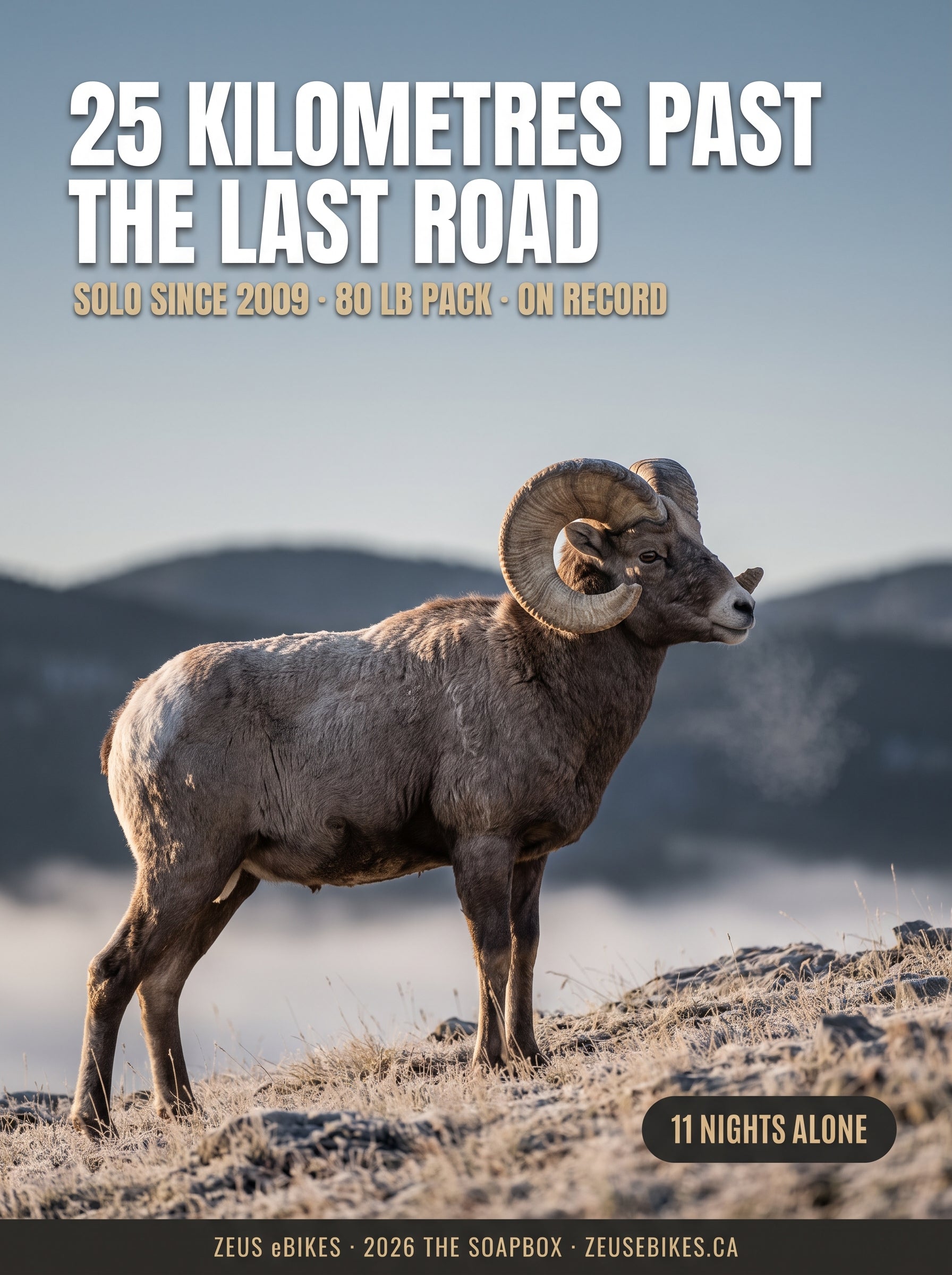
Sheep hunting in Alberta means bighorn rams — and it is nothing like most hunting. There is no driving to a stand. Tony walks 25 kilometres from a dirt road, down a valley and up a mountain, through what he counts as “a bunch of stream crossings,” carrying everything: food, shelter, rifle, and the capacity to carry a ram back out. His trailhead is already a two-hour drive from the city. Then the walking starts.
“So what I do is I sheep hunt, and I’m getting older. The walk sucks,” is how he opened the subject — and the second sentence is the honest half. He had just come home from eleven nights in the mountains, alone, no cell phone. “I go out and solo hunt and just hang out in the mountains. It’s a lot of fun.”
His first sheep season, 2009, read like a cautionary tale right up until it became an addiction. “The first time I did it, I was like, how can anyone like doing this?… The walk back, I didn’t think I could do it. My feet hurt so bad. My body hurt so bad. I had so many blisters. And after I got home and I healed up, I just couldn’t stop thinking of the mountains and how fun the pursuit was… I’ve been addicted ever since.” He was serious enough, for a stretch, that gear and optics companies put him on pro staff — his account — before he stepped back from the industry side of it.

Eleven nights, no cell phone, everything on his back. “I just couldn’t stop thinking of the mountains.”
What separates sheep from everything else, he says, is the animal. “Sheep hunting, to shoot a ram, is very hard. It’s not like shooting a deer or [an elk]. It’s a totally different thing.” He has taken rams over the years, including one in 2017 he describes as “a very, very old, nice one — big, big ram” — and two of them entirely alone, which matters for a reason that has nothing to do with bragging rights and everything to do with physics: “I’ve shot two rams solo, all by myself, and it’s a lot of work. I’m not big enough and strong enough to take one off a mountain [in one load].”
The logistics he has evolved for the fall would read as eccentric anywhere but the sheep mountains, where they read as craft. This trip, he walked in with 80 pounds; when the short days come, the whole plan is speed. “When October comes, we have a lot less daylight, so it’s more important to get back there fast, so you have time to set your camp up before the sun goes down.”
| The problem | His answer |
|---|---|
| 25 km approach, each way | On foot, from a dirt road two hours past the city. He has done it since 2009. |
| Everything on his back | 80 lb in this August: food, shelter, rifle — “everything you need to harvest an animal.” |
| October’s short days | Plan the fall trip to move in fast and light, and have camp up before dark. |
| A ram is too heavy for one load | Multiple pack-out trips — the law requires the meat comes out (next section). |
| Weeks alone, no cell signal | “Pay attention. It doesn’t cost nothing.” And tell the bears you’re coming. |
Asked how a person trains for this, his answer disappoints everyone looking for a program: you don’t fake it. He is in “really, really good shape” from two decades of physical work and from racing hard enduro — mountain dirt-bike racing — where, in his words, “I race 40 A… I push pretty hard”: AMSA and Second Gear Club events, a Western Conference season behind him. There are metal plates in him from those years — “for being an adrenaline junkie,” as he files it — and “some mornings, I feel like I’m 80.” The blisters of 2009 were the mountain’s entrance exam, and the mountain grades the same way every year.
Fitness you cannot cram, logistics you build over seasons, comfort with being genuinely alone — and the humility to plan for the walk out before you take the shot. Everything else is gear.
The Rules That Keep It Honest
Two rules shape everything Tony does out there, and both are worth knowing before anyone romanticizes the pursuit. The first is the meat law. Alberta’s Wildlife Act makes it an offence to let the edible flesh of big game be wasted, destroyed or spoiled, and the Alberta Guide to Hunting Regulations spells out the minimum that must come off the mountain if fit for consumption: the four quarters, the loins and the neck. Tony’s version is shorter: “You have to harvest the meat. You’re not allowed to waste it. So it’s a couple trips.” A solo hunter who kills a ram 25 kilometres in has signed up, at the moment of the shot, for days of carrying.
The second is where machines can and cannot go. The country he hunts is horse country — the trails are cut by equestrian traffic, and his own framing on the call put compliance first: the machine’s whole job is “to get me and my gear or my harvest off the mountain and just be legal — I’m not allowed to have a combustion motor.” For bicycles and e-bikes, the Government of Alberta’s published rule for public land is this, verbatim: “Use of bicycles is permitted. Some designated trails may restrict biking, or specific types of biking (e-bikes or fat bikes) as indicated by signs or publications.” (alberta.ca)
West-country foothills fall under Public Land Use Zones with their own access rules, and those rules are set by brochure and by trail sign, not by what a retailer tells you. Before taking any eBike onto public land, read the current PLUZ brochure for the zone you are entering — the Bighorn Backcountry pages at alberta.ca are the model — and obey the signage. On roads and highways getting there, Alberta’s power-bicycle rules apply: our Alberta eBike laws guide covers them in full.
Neither rule struck Tony as a burden. Both are the reason there are still old rams on those mountains and quiet on those trails — a point he makes without any prompting when he talks about why the place matters to him at all.
Bear Sense, From a Man Who Talks to Himself in the Willows
How dangerous is it out there alone? Tony’s answer starts with the cheapest piece of safety equipment ever made: “Pay attention. It doesn’t cost nothing. Pay attention.” The predators themselves worry him less than the surprise. “I’m not worried about a cougar, wolf, bear. I’m worried about scaring a bear.”
So he narrates his own walking. “When I’m walking and it’s dark, or it’s high willows and you can’t see, I talk to myself, make noises… I want them to know I’m coming. That way I’m not surprising them, because that’s when you’re probably gonna be getting yourself into a bad situation.” It is standard bear-country doctrine, delivered by a man who has stress-tested it in bear country since 2009, and it comes with a warning label for the inspired: “I wouldn’t recommend anyone [who’s] never gone hunting or camping go out and try it… All you have is what’s in your backpack to survive.”

What the willows keep. “I want them to know I’m coming.”
The eBike Question: 25 km, Stream Crossings, and −25 °C
Can an eBike replace that 25-kilometre walk? That was the question Tony actually called about, and the honest answer took half the call, because his trail is close to the hardest case in Canada: horse-cut single-track, stream crossings, riverbed rock “bigger than softballs, smaller than soccer balls,” and a machine that would then sit, untended, for up to two weeks in weather that can swing from summer heat to “two feet of snow… minus 10” — his memory of late October last year — with “minus 25” a live possibility.
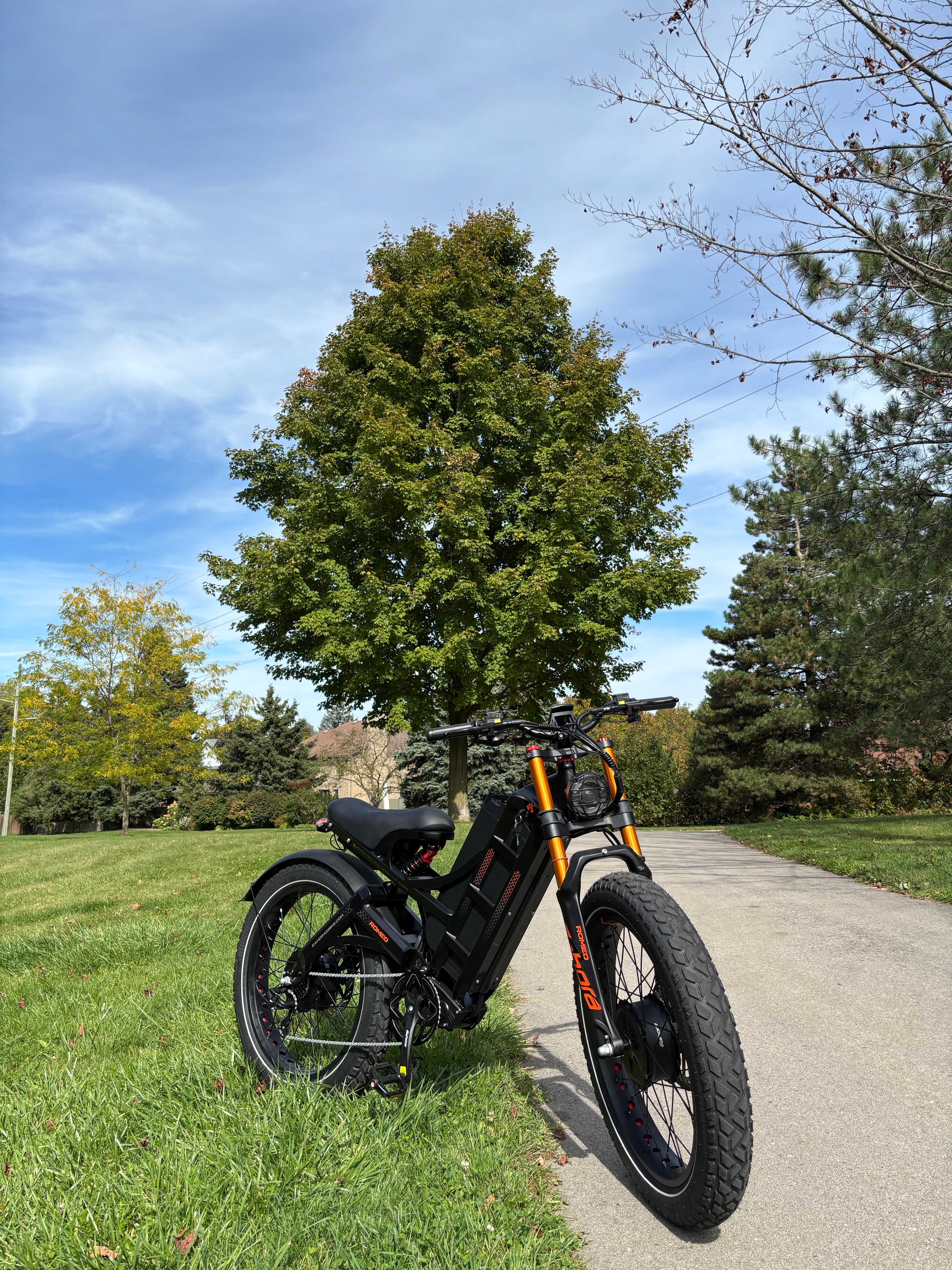
He arrived asking about the bike he’d been reading about — the Smartravel Raptor ST202 Pro, a dual-motor, dual-battery fat bike. Milad’s first answer was enthusiasm, earned the slow way: “I really loved how it handled. Climbing ability was unbelievable… For me, it was one of the easiest-handling bikes on snow and ice… I put a thousand kilometres on it.” The published spec sheet backs the appeal for a hunter staring at range anxiety: a 52V 50Ah dual-battery system totalling 2,600 Wh, 3,000W combined peak from two hub motors, full suspension.
Then came the part a salesman would have skipped. Of the first batch of twenty sold, Milad told him, about half broke down with controller failures — overheated controllers, in a pattern he says involved hard summer riding; the current batch is newer, “so maybe they worked out the bugs,” and the sealed controller design that protects it from water is exactly what makes it intolerant of heat. “You cannot be running this thing hot.” His verdict sharpened as Tony’s trail came into focus: at 123.7 lb with both batteries, a dead bike is not walking out with you. “It’s a high-risk bike… if this bike dies on you up there… it’s very heavy.” And its rear rack mounts aren’t built for a ram: “It’s a fun bike. It’s not a useful bike… It’s like a Porsche. It’s like a Lambo.” Riverbed rock settled it: “The Smartravel would not survive this environment. It’s too much of a fancy bike.”
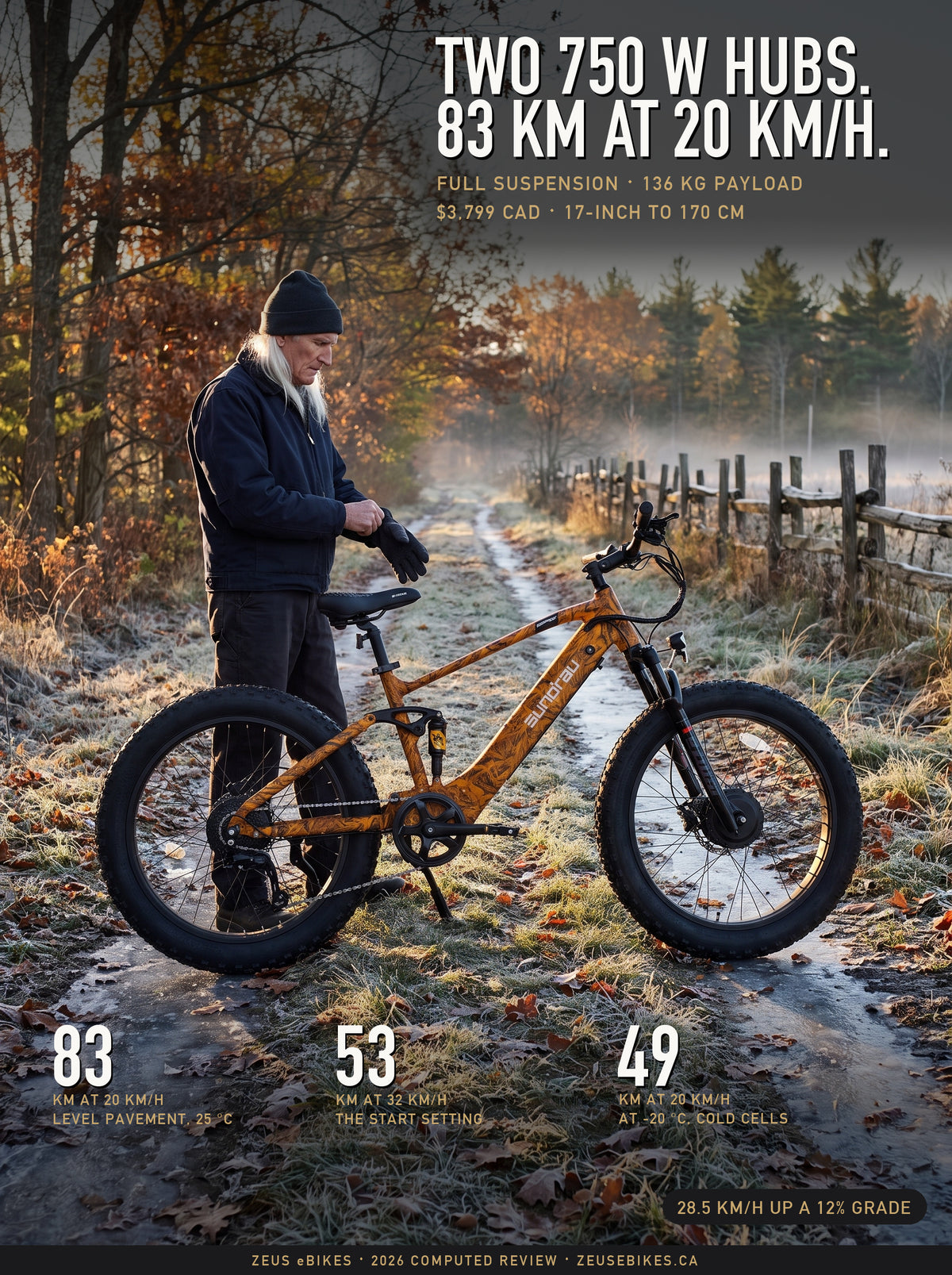
The useful answer, for a load-hauling hunter, pointed elsewhere in the catalogue. The Freesky Ranger Plus M-540 runs dual hub motors at 4,000W combined peak with 220 N·m of torque, a 48V 30Ah (1,440 Wh) battery, full suspension, a step-thru frame, and — the part that matters with 150 pounds of ram and gear — a factory rear rack mounted on the frame — plus, as Milad flagged on the call, bolt points on the front of the frame for adding a heavy-duty front rack. It even comes in camouflage. The trade Tony spotted instantly: barely over half the Raptor’s watt-hours. For sheer survivability, Milad’s pick was blunter still: “The toughest actually would be the Flash. The Eunorau Flash is the toughest one” — an 82–92 lb dual-750W AWD machine whose 52V battery system expands to roughly 2,808 Wh with second and third packs, built as an off-road machine rather than a showpiece.
| Smartravel Raptor ST202 Pro | Freesky Ranger Plus M-540 | Eunorau Flash AWD | |
|---|---|---|---|
| Drive | Dual hub motors, 3,000W peak | Dual hub motors, 4,000W peak, 220 N·m | Dual 750W hub motors, 184 N·m |
| Battery | 52V 50Ah dual — 2,600 Wh | 48V 30Ah — 1,440 Wh | 52V 16Ah, expandable to ~2,808 Wh |
| Weight | 123.7 lb with both batteries | 106 lb | 82–92 lb |
| Cargo | Not rated for heavy rear loads | Factory rear rack + fenders included | 440 lb max payload |
| The call’s verdict | “The most fun… not a useful bike” for this trail | “The most useful” for hauling | “The toughest one” |

The trail that eats machines: stream crossings and riverbed rock “bigger than softballs, smaller than soccer balls”.
And then the call did something rare in retail: it talked itself out of the sale. Two problems had no clean answer. The trail itself — “horsebacking can cut a very tight trail into the ground… trenches, like, almost dirt bike trenches that are knee height or even better” — is cut wide enough for a bike’s wheels in single file and nothing more, which rules out the cargo trailers that solve hauling everywhere else; that observation answers a question a lot of hunters type into Google about trailers, and the answer on horse-cut single-track is no. And the battery problem is physics, not shopping: a battery cached with the bike for two October weeks faces cold that Milad refused to sugar-coat. “Minus 25 is a battery killer.” Batteries left long in deep cold can drop into a protective sleep that, in his experience, “usually involves a technician” to wake. Tony gamed out the failure case without flinching: “Then you gotta walk back to the truck, go to town, get another battery, and walk it back out there to recover your bike.”
“I think it was wrong of me to question your instincts,” Milad conceded partway through — and by the end he wasn’t selling anything: “This is a tough one. I can’t sell you [on] all of it.” Tony’s sign-off, unprompted, is the reason this exchange is printed here at all:
For Tony’s specific trail — trenched single-track, big river rock, two unattended weeks in real cold — the right answer was to slow down, not to buy the flashiest thing in the catalogue. If your hunting access is a forestry road or wider double-track, the calculus changes completely, and that homework is done in our hunting eBike guide and the hunting eBikes collection. Wherever you land: buy for the walk out, not the ride in.
“Just Be Happier” — a Message From the Ram Country
Near the end of the call, Milad handed him the political microphone on purpose, and by name: “What would be your message to the rest of Canada, including Mister Carney? And since you live in Alberta, including [Danielle] Smith… you could be very careful, or you could skip this one.” An open invitation to be furious, extended to a man from the province the feeds keep insisting is furious, with a free exit attached.
He declined the fury and kept the microphone. “My message to Canada is probably just be happier. We don’t all need to be pissed off all the time, right?… Be nice to each other, and karma’s real, and you get what you get.” Pushed toward politics, what came out was Canada.
It would be easy to file that under prairie pleasantness, except that he earned it the hard way and says so. The angry Alberta of the comment sections is a place he has lived: “I’ll admit, I used to be one, and I wasn’t happy. And I tried to make a change to be happy. As soon as I stopped chasing money and just kinda fell into the contracting — I’m always smiling, man. Life’s good. I just got back from a two-week vacation on a mountain, all by myself. How can you complain?” When Milad offered his own theory — that fear is how the worst gets into people — Tony didn’t hesitate: “Absolutely.”
Milad heard something bigger in it than niceness. Canadians get told, constantly, that Canada has no culture. “It took me a long time to think and think and think and realize — that is our culture. This is it… being nice works,” he told Tony. Tony took the compliment the way he seems to take everything, with a shrug and a qualifier: “Compared to a lot of places, we might be a little more nicer.”
And here is the part that makes his message more than a greeting card: nothing in it is advice he doesn’t cash himself. “Karma’s real” is not a sentiment on his books — it is his entire business model, ten years busy on word-of-mouth because he did what he said. “Be happier” is not a mood — it is a decision he paid for with an oilfield salary. The message and the man audit clean against each other, which is precisely what the angriest corners of the feed cannot say.
We know you get your Canada from the same feeds we do. The algorithm samples our angriest few and sells them to you as a country, because anger is what pays the people doing the sampling. It is a lie of sampling. Forty-one minutes on the phone with one Albertan is a bigger truth about this place than a year of scrolling it — and this country is stocked with men like this one in numbers no engagement metric will ever show you.
There is a whole argument about the country buried in that exchange, and it is the same one we made in our essay on what happens when Canadians stop believing each other: the feeds show us each other’s worst day, on purpose, and the antidote is contact. Forty-one minutes on the phone with a stranger from the Ram country did more for our picture of Alberta than a year of scrolling it. “This is actually a part of Canada that I didn’t know about,” Milad told him near the end, “and I think a lot of people don’t.” “I enjoy talking to people in all different lives,” Tony said — and his reason for saying yes to all of it was simpler still: “If it can help one person be in a better mood, then perfect.”
The Quiet Men’s-Health Story Inside All of This
Strip away the rams and the river crossings and this is what the call was actually about: a man who, at the peak of his earning power, was angry and unhappy — “I could buy anything I wanted, but I wasn’t happy” — and who changed his life instead of numbing it. He never said the words mental health once in forty-one minutes. He didn’t have to. He described the whole arc in builder’s language: tore it down, rebuilt it, walks around smiling.
The backdrop is why his arc deserves staring at. In Canada there are approximately 4,750 deaths by suicide per year; the rate among men runs roughly three times the rate among women, and men account for three of every four of those deaths — the Public Health Agency of Canada’s own figures. Tony is not a statistic, a spokesperson or a program. He is something rarer and more useful: an existence proof that the rebuild is real. That reading is ours, not his — but every piece of it is on the tape.
Look at what he actually built, because it is an architecture of independence before it is a career. No boss since the patch. No employees, by choice, after trying them. No advertising, no website, no audience to perform for — ten years of work arriving on reputation alone. “No kids. That’s how I can do all this,” he says of the racing and the mountains, cheerfully, a man taking inventory of his own freedom. And once or twice a year, weeks of deliberate solitude in country that does not care who is angry online: “I just got back from a two-week vacation on a mountain, all by myself. How can you complain?”

Two weeks where the feed can’t follow. “How can you complain?”
There is an old word for the register he talks in — courteous, self-contained, competent, allergic to drama — and the word is cowboy, in the sense it carried before it became a costume. Worth saying plainly, too: a man whose natural habitat is two silent weeks with the bears gave a stranger from a bike shop forty-one minutes of a working day, invited him to call if he’s ever in Alberta, and asked for nothing back but the link. For a solitary man, that might be the larger act of generosity.
Canada’s 9-8-8 Suicide Crisis Helpline is call or text, 24/7. For the longer road — movement, daylight, reasons to be outside — our essay on riding and mental health in Canada walks the evidence. Tony’s version is shorter: stop chasing what makes you miserable, build something with your hands, and go where the feed can’t follow.
Questions Readers Ask
When does sheep hunting season open in Alberta?
It depends on the Wildlife Management Unit. Alberta sets sheep seasons zone by zone, and they change, so the only safe answer is the current Alberta Guide to Hunting Regulations at albertaregulations.ca. Tony plans his fall around his own zone’s dates — and they are his zone’s business, not this article’s. Check the Guide for yours before planning anything.
Can you hunt sheep in Alberta without a guide?
Tony has done it as an Alberta resident since 2009 — solo, unguided, on public land. Rules differ for non-residents, and guiding, licensing and draw requirements are set out in the Alberta Guide to Hunting Regulations. If you are not an Alberta resident, read the Guide’s non-resident sections before assuming anything.
How do you train for a sheep hunt?
Tony’s honest answer: you don’t fake it. He carried 80 pounds for 25 kilometres in August, and he is fit from a working life in the trades and from hard enduro racing. His first hunt in 2009 left him so blistered he doubted he could walk out. The mountain is the filter — build up with loaded hiking long before the season, or it will filter you.
What do you have to pack out of a sheep kill in Alberta?
The law requires the edible meat. Alberta’s Wildlife Act makes it an offence to let the edible flesh of big game be wasted, destroyed or spoiled, and the Alberta Guide to Hunting Regulations lists the minimum portions that must be recovered if fit for consumption: the four quarters, the loins and the neck. For one man and one ram, that means multiple trips.
Can you use an eBike for hunting in Alberta?
On Alberta public land, the province says use of bicycles is permitted, and that some designated trails may restrict biking or specific types of biking — e-bikes or fat bikes — by signs or publications. Check the Public Land Use Zone rules for the area you are entering, and on roads, Alberta’s power bicycle rules apply — see our Alberta eBike laws guide.
Can you leave an eBike battery in the cold?
Not for long, and not in deep cold. Lithium batteries lose capacity in freezing temperatures, and Milad’s blunt words on the call were that minus 25 is a battery killer — a battery left out for weeks can go into a protective sleep state that needs a technician to wake. Remove the battery and keep it warm and partly charged whenever you can.
What is the best eBike for hunting in the mountains?
The one that survives your trail — which is a different question from the most fun one. For horse-cut single-track with stream crossings and cold, the call pointed to dual-motor traction, frame-mounted racks, and expandable batteries, and against anything fragile or too wide. Our full hunting eBike guide covers the picks; this article covers the reasoning.
What does Micro-Blaze Environmental do?
Micro-Blaze Environmental Inc. is a family-owned Alberta business and the Master Canadian Distributor of Micro-Blaze microbial products, manufactured by Verde Environmental Inc. in the USA. The non-toxic microbial line treats fats, oils, greases and hydrocarbons — oil-field spills, firefighting foam, restaurant grease and concrete cleaning. Tony Fogarty runs Canadian sales and technical support.
Where is Ram Falls?
Ram Falls Provincial Park sits on the Ram River in Clearwater County, Alberta — about 65 km south of Nordegg on the gravel Forestry Trunk Road (Highway 734), at roughly 1,570 m elevation in the Rockies foothills. It is a two-plus-hour drive from the nearest cities, much of it on gravel.
The Bottom Line
Sheep hunting in Alberta takes what Tony Fogarty has been assembling since 2009: legs that can carry 80 pounds for 25 kilometres, systems for food and daylight and bears, respect for a meat law that turns every ram into days of work, and a temperament that finds eleven silent nights restorative instead of frightening. No machine on our floor shortcuts any of that — and when one man’s trail made the honest answer “not yet, not this one,” saying so out loud cost us a sale and earned us this story.
If a hunting eBike is a live question for your country — wider trails, shorter caches, kinder cold — do it the way Tony did: describe your actual trail, your actual load, your actual worst-case week, and make somebody answer to that. You can start with the homework in our hunting eBike guide, and when you want a human, call 1-866-938-7580 — real people answer, and as Tony can now attest, they will talk you out of the wrong bike before they sell you one. And if you need a spill eaten or a renovation finished in Alberta by a man whose entire business model is doing what he said: microblaze.ca.
He asked us to email him the link when this went live. Tony — check your inbox. Go get your ram.
Sources
Retrieved and verified 1 September 2026.
- Recorded call — Tony Fogarty with Milad Ghobadibeygvand, 31 August 2026, 41 minutes, on the Zeus eBikes line; full transcript on file. Consent to publish name, companies and contents given on the recording. All quotations are from this transcript, lightly trimmed for readability.
- Alberta Guide to Hunting Regulations — General & game regulations and the Big Game Regulations section (PDF): the offence of allowing edible flesh of big game to be wasted, destroyed or spoiled, and the minimum recoverable portions (four quarters, loins, neck).
- Government of Alberta — Non-motorized recreation on public land (bicycles permitted; e-bike and fat-bike restrictions possible by trail sign or publication) and the Bighorn Backcountry Public Land Use Zone pages.
- Alberta Parks — Ram Falls Provincial Park: location on Highway 734 south of Nordegg, Clearwater County, Ram River valley.
- Micro-Blaze Environmental Inc. — About / Our Story: Master Canadian Distributor of Micro-Blaze microbial products manufactured by Verde Environmental Inc.; leadership including Tony Fogarty, VP, Owner Operator, Canadian Sales & Technical Support.
- Zeus eBikes product documentation — published spec pages for the Smartravel Raptor ST202 Pro, Freesky Ranger Plus M-540 and Eunorau Flash AWD, as live on 1 September 2026.
- Best Hunting eBikes Canada — the full buying homework this article deliberately doesn’t do.
- Alberta eBike Laws — where you can legally ride, and at what power.
- Canada’s eBike Laws Aren’t Enforced — another Soapbox conversation that started with one caller’s question.
- What Happens When We Stop Believing Each Other? — the trust essay this call kept proving.
Visuals created by Playcut.ai
Share:
Why Canadians Can’t See News on Facebook. I Read Every Word Meta Told Parliament to Find Out Who Decided.
The School in Minab, and the Word Canada Won't Say