
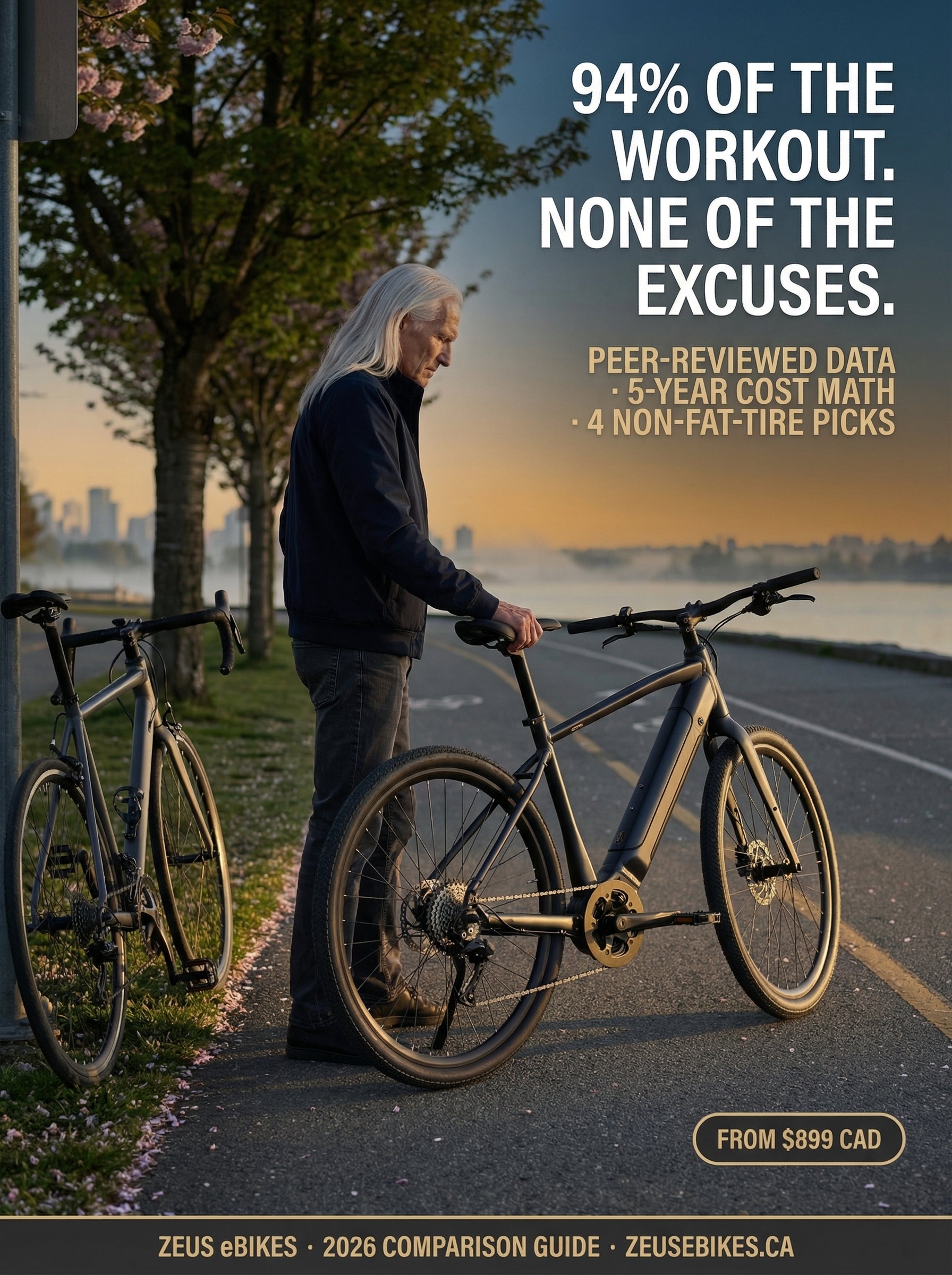
eBike vs Regular Bike in Canada (2026): The Honest Answer — Exercise, Money & 13 Picks

(BYU Study, 2018)
Flip the 5-Year Math
No Licence Needed
9 Street-Legal · 4 Off-Road
You own a bicycle. It works. So the eBike question is really three questions wearing one jacket: do you lose the exercise, is it worth the money, and what do you actually gain that your current bike cannot give you? This guide answers all three with sources — peer-reviewed exercise research, cost math anchored to CAA’s published car-ownership figures, and thirteen picks whose prices we verified against the live store on August 8, 2026 — plus the two sections most comparisons skip: the honest disadvantages, and where not to buy one.
Exercise data comes from the two primary studies named inline — the 2018 Brigham Young University study in the Journal of Medical Internet Research and the 2018 University of Basel study in the Clinical Journal of Sport Medicine — not from trade-press summaries of them. Cost math uses current Zeus pricing (live-verified August 8, 2026), typical Canadian maintenance ranges, and CAA’s published per-kilometre car-ownership framework. Regulatory statements reflect the 500W / 32 km/h power-assisted bicycle standard as the provinces apply it (Canada’s federal PAB definition was repealed in February 2021 — provincial rules govern) and current CPSC/Health Canada activity, each dated in the text. All 13 recommended machines were price-checked on the live store on August 8, 2026; specs come from each product’s published page, and where a manufacturer does not publish a spec we write “not published” rather than guess. Corrections: milad@zeusebikes.ca.
Exercise: you do not lose the workout. Riders on e-mountain-bikes averaged roughly 94% of the heart rate of conventional riders on the same trail (Brigham Young University, JMIR, 2018), and four weeks of eBike commuting improved VO2max comparably to regular-bike commuting (University of Basel, CJSM, 2018). The realistic fitness outcome is more total riding, because hills, headwinds and sweat stop cancelling trips.
Money: an eBike costs more to own than a regular bike, every year — honestly. The math flips when it replaces car trips: 2–3 short trips a week recovers the cost gap within 1–2 years against CAA-framework driving costs. Legality: 500W nominal + 32 km/h assist + pedals = a Power-Assisted Bicycle: no licence, no plate, no insurance requirement, in every province.
The short list: the Taubik Vista 26 ($2,399, 64 lbs, switchable torque/cadence) is the closest thing to your current bike with a motor; the Samebike RS-A01 Pro-T ($1,199) is the budget way to find out; the Velotric Discover M ($3,899 mid-drive) rides most like a real bike of anything we sell. All 13: jump to the picks ↓
The 13 Picks — Scan by Type
Every pick price-verified against the live store on August 8, 2026. Nine meet the 500W / 32 km/h power-assisted bicycle standard every province applies (✔); four are honestly-labelled off-road machines (✘) that exist precisely because a regular bicycle has limits.
1. Who This Guide Is For — Three Rider Situations
This June, Canada’s e-bike question changed shape: the US regulator proposed its first mandatory e-bike battery rule while marketplace listings kept flooding Canadian search results with $400 machines — and the “is it cheating?” debate kept parking perfectly good bicycles in garages. Decide wrong here and you either spend $2,000 you didn’t need to, or keep driving trips a bike should own. This guide walks the decision with sources. It is built for three riders:
The fitness cyclist who worries a motor means cheating. You ride for cardiovascular health and you have heard eBikes “don’t count.” You want peer-reviewed data, not forum opinions. → Section 2 settles it, and the Meta 26 and Westridge 4T Off-Road are your torque-sensor picks.
The commuter whose bike collects dust. You own a regular bike. The 12 km route with a 6% grade means arriving drenched — so you drive. → Section 3 runs your math, Section 4 runs your clock.
The rider whose bicycle hit its ceiling. Backcountry distance, real cargo, balance concerns, deep-country access — things no amount of fitness solves. → Part B of the picks is the territory beyond what any regular bike can do, honestly labelled where it leaves road legality behind.
2. The Exercise Question: Do You Actually Lose the Workout?
No — and the research is not close. A 2018 Brigham Young University study published in the Journal of Medical Internet Research had participants ride the same mountain trail on conventional and electric mountain bikes: the eBike riders averaged heart rates roughly 94% as high as the conventional riders. Effort per pedal stroke was lower; the total cardiovascular workout was nearly identical, because riders went farther and took on terrain they would otherwise have walked.
A separate 2018 study from the University of Basel, published in the Clinical Journal of Sport Medicine, tracked sedentary adults who began commuting by conventional bike or eBike. After four weeks, both groups showed comparable improvements in VO2max — the gold-standard measure of cardiovascular fitness. The eBike riders were not getting a lesser workout. They were getting a different one: longer duration, lower peak intensity, similar total energy expenditure.
The calories question resolves the same way. Per minute, an eBike burns less — the motor absorbs part of the load. Per week, the gap closes and often reverses, because the behavioural effect dominates the mechanical one: when hills, headwinds and sweat stop cancelling rides, you ride more often and farther. The machine matters less than the pattern it unlocks.
One hardware spec decides how much of your effort stays in the loop: the sensor. A torque sensor reads how hard you push and amplifies it proportionally — regular-bike feel, effort required, fitness preserved by design. A cadence sensor delivers fixed power whenever the pedals turn — easier, less participatory. For fitness-first riders, torque sensing is the spec to insist on; Section 5 covers it fully.
3. The Money Question: Honest 5-Year Math
An eBike costs more than a regular bike to own — every single year, and this section will not pretend otherwise. A decent regular bike costs $500–$2,000 and asks almost nothing after that. Our thirteen picks run $1,199–$3,899 and add electricity, electrical service exposure and an eventual battery replacement. On pure cost, the regular bike wins. The question that actually decides purchases is different: what is the eBike replacing?
| Cost Factor | Regular Bike (5 Years) | eBike (5 Years) |
|---|---|---|
| Purchase price | $500–$2,000 | $1,199–$3,899 (this guide’s picks) |
| Annual maintenance | $100–$200 (tubes, pads, chain) | $200–$400 (same, plus electrical exposure) |
| Electricity | $0 | ~$30–$60/year |
| Battery replacement | N/A | $0–$800 (if needed, typically year 4–5) |
| 5-year total | $1,000–$3,000 | $2,349–$6,999 |
| Car trips it can replace | Some — limited by hills, distance, sweat | Many — 32 km/h assist, no-sweat arrival, cargo options |
Most Canadians are not choosing between an eBike and a bicycle — they are choosing between an eBike and the car trips it absorbs. A short urban car trip costs roughly $3–$5 in fuel, insurance amortization and wear when costed against CAA’s published annual ownership figures. Replace 2–3 such trips a week across a Canadian riding season and you recover $360–$600 a year — enough to cover the eBike’s entire annual cost premium, which is why the honest verdict is conditional: if the car stays parked either way, keep your regular bike. If the eBike parks the car, it pays for the difference in 1–2 years. Financing spreads the upfront cost; our deals guide tracks the price floor.
Prefer monthly numbers? Financing spreads any pick here into monthly payments — the $1,199 entry pick works out to roughly $100/month over a year. How eBike financing works in Canada →
1-866-938-7580 — talk your math through with a real human on a Canadian line.
4. Speed, Range, Hills & the Canadian Commute
The eBike’s commuting advantage is not raw speed — it is consistency. A compliant eBike assists to 32 km/h, a pace most riders touch only downhill on a regular bike and cannot hold on the flat. More decisively: hills flatten, headwinds shrink, and tired-legs days stop existing. A 10 km urban commute becomes a reliable 20–30 minute door-to-door ride — every day, in work clothes, without arriving soaked. That last point converts more drivers than any spec sheet: the sweat problem is the real reason most Canadian commuter bikes gather dust between May long weekends.
Range on the street-legal eight runs from the Velotric Tempo’s 374 Wh (the deliberate lightness trade) through the 720 Wh Samsung packs on the Escape and Meta 26 to the Discover M’s 801.6 Wh — a commuting week per charge for most riders, with dual-battery options on three of the eight when ambitions grow. Hills are where the architecture splits: hub motors (most of Part A) handle rolling terrain well and fade on long steep grades; the Discover M’s mid-drive multiplies through the gears like your legs do and is the honest answer for genuinely hilly cities. Cold costs range — plan 25–35% less below −5°C and store batteries indoors; our battery guide covers winter practice in full.
5. Torque vs Cadence: The Spec That Decides the Feel
If you remember one spec from this entire page, make it this one — the sensor decides whether an eBike feels like your bike or like a scooter. A torque sensor measures how hard you press the pedals and scales assist proportionally: push harder, get more; ease off, get less. It preserves the connection between effort and speed that makes cycling feel like cycling — and it is why fitness researchers keep finding real workouts on eBikes. A cadence sensor detects that the pedals are turning and delivers a fixed level of power: simpler, cheaper, more moped-like — and for pure utility riding, perfectly fine.
Four of our thirteen go further with switchable dual sensing — the Vista 26, Velotric Tempo, Blackburn 275T and Discover M toggle between modes from the display, which is the honest way to answer the debate: ride both, keep the one your legs vote for. Fitness-first riders should insist on torque (or dual); errand-and-utility riders lose nothing meaningful with cadence. The comparison table below lists the sensor on every pick, because most retailers bury it.
6. The Honest Disadvantages
Every “eBike vs regular bike” page you have read was written by someone selling eBikes — including this one. So here is the section the others skip. Six real disadvantages, with what actually mitigates each:
- Weight. Our street-legal two-wheel picks run 39–69.5 lbs against 20–35 for regular bikes — and the bottom of that range is new: the 39 lb Velotric Tempo sits inside regular-bike territory outright. Weight still matters on stairs, car racks (check your rack’s per-bike rating) and dead-battery pedalling. Mitigation: pick light — the Tempo, RS-A01 and Vista 26 exist precisely for weight-sensitive lives — and removable batteries drop 7–15 lbs more.
- Price. Covered honestly in Section 3 — the math is conditional, not automatic.
- Charging discipline. A regular bike never has 20% battery at the exact wrong moment; an eBike asks for the same habit as a phone.
- Theft appeal. A $2,400 machine invites better thieves than a $400 one — budget for a serious lock and read our theft-protection guide.
- Cold-weather care. Lithium hates deep cold: 25–35% range loss below −5°C and indoor battery storage are the price of winter riding.
- Service exposure. More systems means more possible faults — which is why every pick here uses standard drivetrains local shops will touch, and why we tell you to buy only from sellers whose batteries are catalogue items today.
7. Where NOT to Buy One — Temu, Marketplaces & Conversion Kits
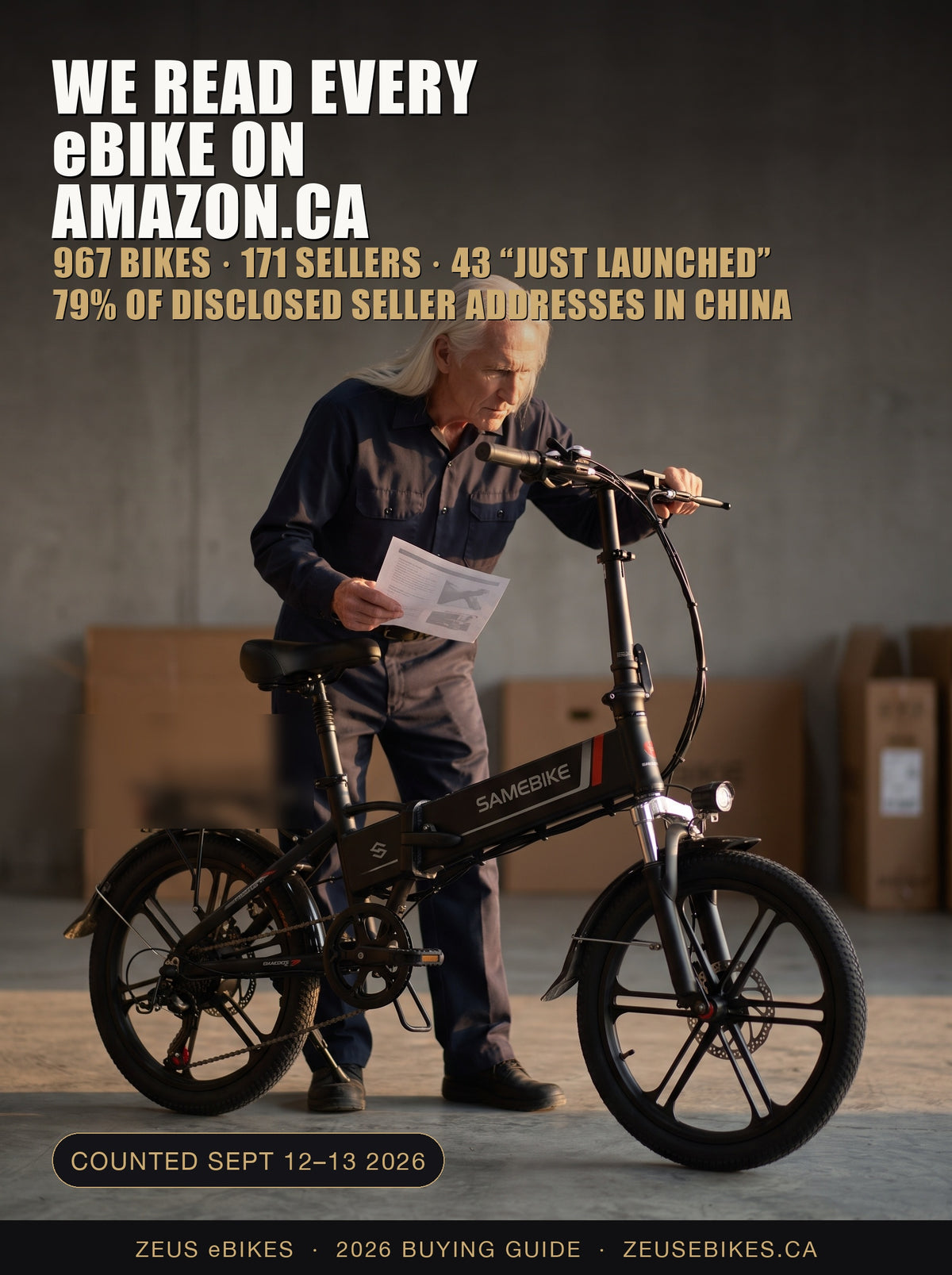
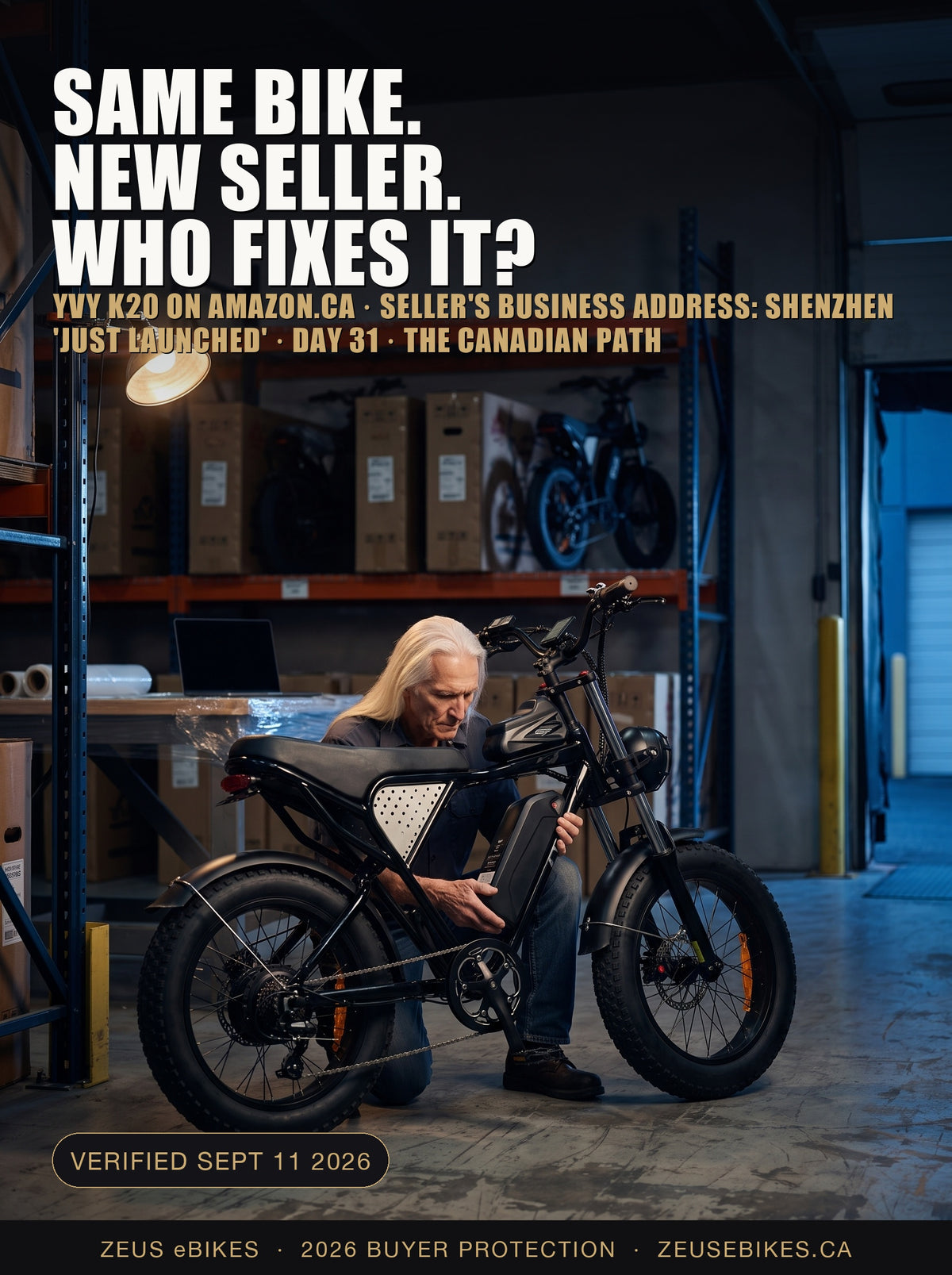
Canadian autocomplete now asks “should I buy an ebike from Temu” unprompted — so here is the direct answer: do not buy a lithium-battery vehicle from any listing you cannot trace to an accountable seller with a parts pipeline. The reasoning is regulatory, not snobbery. Canada has no federal e-bike battery certification requirement — Health Canada’s lithium-battery consultation (closed February 2026) explicitly excluded e-bikes — which means the seller is your entire safety system. Meanwhile the US CPSC proposed its first mandatory e-bike battery standard on June 24, 2026 (Federal Register 2026-12749) against a documented pattern of marketplace-channel fires, unresponsive offshore manufacturers and unrecallable products.
The same logic covers conversion kits, with an engineering layer added: a kit puts motor torque and battery load into a frame, fork and brakes never designed for either, usually with a no-name pack — and the CPSC’s proposed rule explicitly covers aftermarket kits and chargers because that is where the fire reports live. A $700 kit on a tired frame is not the budget version of a $1,199 purpose-built eBike with a warranty; it is a different risk class. We audit the big-box and marketplace channels in depth — Walmart, Best Buy, Costco, Canadian Tire — and the pattern across all four is the same: the Sold By field and the battery paperwork are worth more than any spec on the page.
8. The 13 Picks — Your Bike, Assisted · and Beyond It
Thirteen machines, two honest halves. Part A is for the rider who wants their bicycle back with the hard parts deleted — eight street-legal picks from $1,199 to $3,899, every one inside the 500W / 32 km/h power-assisted bicycle rules every province applies. Part B is for the rider whose bicycle hit its ceiling — four off-road machines and one street-legal cargo trike that do things no pedal-only bike ever will, with the legality of each printed in amber where it belongs. Free Canada-wide shipping and a Canadian support line (1-866-938-7580) on all thirteen; financing available.
Part A — The Assisted Version of Your Bike (Street-Legal, $1,199–$3,899)

Verified pick. Taubik Vista 26 — $2,399, live-checked August 8, 2026.
Taubik Vista 26
$2,399 CADIf your fear is losing the feel of your current bike, the Vista 26 is the fully-equipped answer. At 64 lbs on 1.9″ tires it rolls, leans and handles remarkably close to a conventional commuter — and its display-switchable sensor lets you ride torque mode (motor mirrors your effort, regular-bike feel) or cadence mode (steady push) and decide for yourself which argument wins. Fenders, suspension fork and a UL 2271 Samsung pack come standard — the equipment the barer, lighter Tempo below asks you to add.
Who it fits: The fitness rider and the sceptic: you want your bike, your effort, your handling — with the hills and headwinds deleted. Also the stairs-and-hallway crowd, because 64 lbs is carryable.
Skip it if: you need to haul heavy cargo or ride unploughed snow — that is Part B territory below.

Verified pick. Velotric Tempo — $2,599, live-checked August 8, 2026.
Velotric Tempo
$2,599 CADEvery disadvantage section on every eBike page starts with weight — and the Tempo simply deletes the entry. At 39 lbs it weighs what a regular commuter bike weighs, carries like one, and racks like one, while keeping a 350W PAB-compliant motor, switchable torque/cadence sensing, Shimano hydraulic discs, an 8-speed 11–40T drivetrain and the full UL 2849 + 2271 + 2580 certification stack. The honest trade printed plainly: the 374 Wh pack and 45 Nm are flat-terrain, moderate-distance specs — that is what the weight costs.
Who it fits: The rider who carries their bike daily — stairs, transit, car racks — the gravel-path commuter, and the purist whose whole requirement is “my bike, exactly, with the wind deleted.”
Skip it if: your commute is long or hilly — 374 Wh and 45 Nm are the lightness tax; the Taubik Escape carries nearly double the battery and 85 Nm for $200 more.

Verified pick. Samebike RS-A01 Pro-T — $1,199, live-checked August 8, 2026.
Samebike RS-A01 Pro-T
$1,199 CADThe cheapest defensible way to find out what assist does for your riding. 500W and 540 Wh in a 57 lb step-thru with a 330 lb payload and a hidden frame battery. The honest economies: cadence sensing and mechanical discs. If the eBike experiment works, you will know within a month; if it doesn’t, you spent $1,199 finding out, not $3,000.
Who it fits: First-timers hedging the decision, second-bike households, and anyone whose entire riding is flat city pavement.
Skip it if: you already know you ride daily — spend up once for hydraulics and a bigger pack instead of upgrading twice.

Verified pick. Taubik Escape — $2,799, live-checked August 8, 2026.
Taubik Escape
$2,799 CADThe 5-year math section above turns on one question: how many car trips can the eBike actually absorb? The Escape attacks the reasons trips don’t get replaced — no bike room in the condo, no rack on the car, no storage at work — by folding, while giving up little of the commuting hardware: a UL-certified 48V 15Ah Samsung 21700 pack (720 Wh), a Bafang geared hub making 85 Nm through a Shimano Altus 7-speed, Zoom dual-piston hydraulics on 180 mm rotors, and 20×4″ Kenda rubber that shrugs off potholes. Designed in Canada, and it ships speed-limited to 32 km/h — PAB-compliant out of the box (the 41 km/h unlock is for off-road use only). The honest trades: cadence sensing, and at 66.8 lbs it folds small but does not lift light.
Who it fits: The commuter doing the cost math from a condo, an apartment or a car trunk: 8–20 km each way, groceries on the rack, the bike stored inside where Canadian winters and thieves can’t reach it.
Skip it if: your route climbs hard and you want effort-proportional assist — cadence sensing and a hub motor prefer rolling terrain; see the Discover M.

Verified pick. Eunorau Meta 26 — $2,399, live-checked August 8, 2026.
Eunorau Meta 26
$2,399 CAD $2,899The exercise research above has a practical conclusion: if fitness is why you ride, buy a torque sensor. The Meta 26 is the affordable way to own one — a true strain-gauge torque sensor that reads your pedal force and scales assist proportionally, so the bike works exactly as hard as you do. Samsung cells, hydraulic discs with motor cutoff, a step-through frame for the dozen daily dismounts, and every wear part a standard any Canadian shop will service.
Who it fits: The rider who chose an eBike because of the BYU data, not despite it: effort in, amplification out, heart rate where you want it.
Skip it if: you want throttle-and-forget cruising — a torque sensor makes you participate; that is its entire point.

Verified pick. Taubik Blackburn 275T — $2,799, live-checked August 8, 2026.
Taubik Blackburn 275T
$2,799 CADRoad and hybrid riders lose the most in a typical eBike conversion — fat rubber, upright tanks, dead handling. The Blackburn 275T is the counter-offer: 27.5″ hybrid tires that roll fast and lean honestly, 70 Nm through a switchable torque/cadence sensor, and an integrated mount that takes the Samsung UL 2271 pack to roughly 1,411 Wh for century ambitions. It is the pick for the rider whose regular bike is a good bike — and who intends the electric one to be, too.
Who it fits: Riders coming off road or fitness-hybrid bikes who care about rolling speed, handling and sensor feel more than plushness.
Skip it if: your streets are potholed gravel — the Defender’s suspension earns its keep there.

Verified pick. Eunorau Defender — $2,450, live-checked August 8, 2026.
Eunorau Defender
$2,450 CAD $2,569Canadian pavement is its own terrain. If your regular bike beats you up — wrists, lower back, the works — the Defender adds what no regular bike at this price carries: real dual suspension at a rideable 66 lbs, shipping speed-limited to 32 km/h with a 500W nominal motor, PAB-compliant out of the box. Two frame sizes fit 5’3″ to 6’4″. Eunorau doesn’t publish the sensor type, so neither do we.
Who it fits: Comfort-first riders on rough streets and easy trails, and anyone whose body vetoed their old hardtail.
Skip it if: you are chasing minimum weight and maximum bike-feel — the Vista 26 is 2 lbs lighter than this bike’s frame alone feels.

Verified pick. Velotric Discover M — $3,899, live-checked August 8, 2026.
Velotric Discover M
$3,899 CADA mid-drive motor powers the crank — the same place your legs do — so the bike accelerates, climbs and shifts like a bicycle rather than a scooter. The Discover M pairs that architecture with SensorSwap (torque or cadence, switchable), Shimano’s CUES 9-speed, the full three-layer UL certification stack, and a 440 lb payload — all while staying at 500W nominal and 32 km/h. For the rider replacing a good regular bike with the least compromise available.
Who it fits: Hill commuters, bigger riders, and anyone whose answer to “what do you miss from your regular bike” is everything about how it rode.
Skip it if: budget is the constraint — the Meta 26 delivers the torque-sensor experience for $1,500 less.
Between two of the eight? Tell us your route, your hills and your budget — we’ll make it a one-bike answer on the phone, and if your regular bike is honestly still the right tool, we’ll say that instead.
1-866-938-7580 — real humans, Canadian line.
Part B — What Your Regular Bike Could Never Do
No amount of fitness gives a bicycle a 375 lb payload, 1,680 Wh of range, or a third wheel. These five exist beyond the comparison — four of them beyond road legality too, which we print in amber on every one.

Verified pick. Eunorau Fat HS / Hunter X8 — $2,199, live-checked August 8, 2026.
Eunorau Fat HS / Hunter X8
$2,199 CAD $4,199Here the comparison stops being a comparison: no regular bicycle takes you 30 km up a soft logging cut with gear and gets you back before dark. The Fat HS runs Bafang’s BBSHD mid-drive — 160 Nm through a 9-speed cassette, the gear-multiplying climb architecture — over full suspension and fat rubber, with a Samsung pack that doubles when your range does. At 1,000W nominal it is not a PAB: private property, Crown land and permitted trails only, printed here and on the product page.
Who it fits: Backcountry access, camp runs, remote fishing lakes — the rider whose destinations were never reachable by pedal power alone.
Skip it if: any part of the plan involves a public road — choose from the street-legal eight above.

Verified pick. Eunorau FAT-HD 2.0 / Hunter X7 — $3,239, live-checked August 8, 2026.
Eunorau FAT-HD 2.0 / Hunter X7
$3,239 CADA hunter’s problem is weight, distance and noise — three things a regular bike answers with suffering. The FAT-HD 2.0 answers with a whisper-quiet Bafang mid-drive at 160 Nm, torque-sensing through nine real gears, and a 375 lb payload that carries you, the stand, and the cooler out again. Hardtail by design — lower weight, nothing to maintain at the rear — with the second-battery option for the deep trips. Off-road classification, stated plainly.
Who it fits: Hunters and land-access riders hauling real loads deep and quiet — the use case regular bikes surrendered long ago.
Skip it if: you want plush over rocks at speed — the full-suspension Fat HS above is the same drivetrain with rear travel.

Verified pick. Freesky Swift Horse Pro X-6E — $2,699, live-checked August 8, 2026.
Freesky Swift Horse Pro X-6E
$2,699 CAD $3,583A 48V 35Ah Samsung pack — 1,680 Wh in one battery — is more stored energy than most dual-battery setups, hung in a downhill-suspension frame with four-piston braking. That is all-day mountain range no pedal-powered bike has ever offered anyone. Two disclosures, both in bold: it is a pre-order (confirm the current shipping window before you buy — call us), and at 3,500W peak it is an off-road machine, never a road bike.
Who it fits: The all-day trail rider who has been carrying two batteries and wants to stop, and patient buyers comfortable with a pre-order window.
Skip it if: you need the bike this week, or you want the assist to mirror your effort — it is cadence-sensing and it is worth knowing that.

Verified pick. Taubik Westridge 4T Off-Road — $3,599, live-checked August 8, 2026.
Taubik Westridge 4T Off-Road
$3,599 CAD $3,749Most 1000W fat bikes deliver power in cadence-triggered surges that spin the rear wheel loose on exactly the terrain you bought them for. The Westridge 4T Off-Road is the rare exception: a 1000W Bafang hub governed by a true torque sensor, so power arrives in proportion to your pedal force — traction on loose climbs, 20–30% better battery efficiency, and the ride-hard-still-exercise character this article’s research runs on. Samsung 21700 cells, UL 2271. Off-road only, and its street-legal 500W sibling exists if that’s the dealbreaker.
Who it fits: The fitness-minded off-road rider: big power that still answers to your legs, on Crown land, gravel and sled trails.
Skip it if: you need road legality — the standard Westridge 4T (500W) is the same idea inside the law.

Verified pick. Eunorau ONE-TRIKE 2.0 — $2,499, live-checked August 8, 2026.
Eunorau ONE-TRIKE 2.0
$2,499 CAD $2,900Some things a two-wheeler cannot do at any price: stand still while loaded, carry 440 lbs, and stay upright when your balance has an off day. The ONE-TRIKE 2.0 does all three, folds into a hatchback, and stays speed-locked at 32 km/h with a 500W motor — fully inside the PAB envelope, so it is as road-legal as any bicycle. The weekly grocery run, the garden centre, the case of water: this is the errand vehicle the car has been covering for.
Who it fits: Riders who carry real cargo weekly, and anyone whose balance — not their legs — retired their two-wheeler.
Skip it if: you pedal unassisted often — the single-speed drivetrain leans on the motor, and hills in pedal-only mode will say so.
9. All 13 Compared
The four columns that decide the purchase — sensor, weight, battery and legality — side by side, because they are the four most retailers bury.
| # | Pick | Price (Aug 8) | Motor | Battery | Sensor | Weight | Payload | Road-Legal? |
|---|---|---|---|---|---|---|---|---|
| 1 | Taubik Vista 26 | $2,399 | 500W hub | 706 Wh | Dual (switchable) | 64 lb | — | ✔ PAB |
| 2 | Velotric Tempo | $2,599 | 350W hub (650W pk) | 374 Wh | Dual (SensorSwap) | 39 lb | 330 lb | ✔ PAB |
| 3 | Samebike RS-A01 Pro-T | $1,199 | 500W hub | 540 Wh | Cadence | 57 lb | 330 lb | ✔ PAB |
| 4 | Taubik Escape | $2,799 | 500W hub (1,000W pk) | 720 Wh | Cadence | 66.8 lb | 286 lb | ✔ PAB |
| 5 | Eunorau Meta 26 | $2,399 | 500W hub | 720 Wh (opt. 1,440) | Torque | 68.4 lb | 286 lb | ✔ PAB |
| 6 | Taubik Blackburn 275T | $2,799 | 500W hub | 706 Wh (opt. ~1,411) | Dual (switchable) | 69.5 lb | — | ✔ PAB |
| 7 | Eunorau Defender | $2,450 | 500W hub | 720 Wh (dual-ready) | Not published | 66 lb | 300 lb | ✔ PAB |
| 8 | Velotric Discover M | $3,899 | 500W mid-drive | 801.6 Wh | Dual (SensorSwap) | — | 440 lb | ✔ PAB |
| 9 | Eunorau Fat HS / Hunter X8 | $2,199 | 1,000W mid-drive | ~720 Wh (dual-ready) | Not published | 77.1 lb | — | ✘ Off-road |
| 10 | Eunorau FAT-HD 2.0 / Hunter X7 | $3,239 | 1,000W mid-drive | ~720 Wh (dual design) | Torque-sensing | ~80 lb | 375 lb | ✘ Off-road |
| 11 | Freesky Swift Horse Pro X-6E (pre-order) | $2,699 | 1,000W hub (3,500W pk) | 1,680 Wh | Cadence | 83 lb | 300 lb | ✘ Off-road |
| 12 | Taubik Westridge 4T Off-Road | $3,599 | 1,000W hub | 960 Wh | Torque | — | 286 lb | ✘ Off-road |
| 13 | Eunorau ONE-TRIKE 2.0 | $2,499 | 500W hub | 48V 14.5Ah | Not published | 86 lb | 440 lb | ✔ PAB |
10. Who Should Stay on a Regular Bike (Honest Answer)
Some riders should keep the bike they own, and an honest comparison says so out loud. Stay on your regular bike if: your riding is under ~8 km on flat terrain and you arrive fine; cycling is your workout and you want maximum intensity per minute rather than more total riding; your budget ceiling is genuinely under $1,100 — a well-maintained regular bike beats a corner-cut eBike every time; or your storage involves daily stair-carries that make 60 lbs a dealbreaker. The eBike case is built on hills, distance, sweat, cargo and car-replacement. If none of those describe your riding, the cheapest correct answer is a tune-up, not a motor — and we would rather tell you that here than in a return conversation.
11. Frequently Asked Questions
Do you still get exercise on an eBike?
Yes — and the research is not close. A 2018 Brigham Young University study in the Journal of Medical Internet Research measured e-mountain-bike riders at roughly 94% of the heart rate of conventional riders on the same trail. A 2018 University of Basel study in the Clinical Journal of Sport Medicine found four weeks of eBike commuting improved VO2max comparably to regular-bike commuting. Lower peak effort, longer rides, similar total workout.
How many calories do you burn on an eBike compared to a regular bike?
Per minute, fewer — the motor absorbs part of the load. Per ride, the gap closes: the same research pattern shows eBike riders ride farther, longer and more often, because hills, headwinds and sweat stop cancelling rides. If calorie burn is the goal, choose a torque-sensor model (it only amplifies effort you actually make) and use a lower assist level. Total weekly energy expenditure is a behaviour question more than a hardware one.
Is an eBike worth it over a regular bike in Canada?
If it replaces car trips, usually yes. An eBike costs more to own than a regular bike every year — that is honest. But replacing even 2–3 short car trips a week (fuel, insurance amortization and wear run roughly $3–$5 per 8 km trip against CAA’s published ownership figures) recovers the difference within one to two years. If your regular bike already covers your riding and the car stays parked either way, the regular bike wins the math.
What are the disadvantages of an eBike vs a regular bike?
Weight (39–86 lbs across our thirteen picks vs 20–35 for regular bikes), purchase price, charging discipline, higher theft appeal, battery care in deep cold, and more components that can need service. None of these are dealbreakers; all of them are real. The honest-disadvantages section above covers each one and what actually mitigates it.
Can you ride an eBike like a regular bike if the battery dies?
Yes — every pick here has functional pedals and standard gearing, and a dead battery simply makes it a heavy bicycle. The weight is the catch: pedalling 60–80 lbs unassisted is a workout you did not order. Plan charge level like fuel, and if frequent unassisted riding is genuinely your plan, choose the lightest options (39–64 lbs) in Part A.
Do I need a licence or insurance to ride an eBike in Canada?
Not for a compliant power-assisted bicycle: 500W nominal or less, assist cutting out at 32 km/h, functional pedals. Nine of our thirteen picks meet that definition and are flagged PAB-compliant; the four off-road machines in Part B are not road vehicles at all. Provincial rules add details (ages, helmets) — check our provincial law guides before riding.
Should I buy an eBike from Temu, AliExpress or Amazon?
We recommend against buying any lithium-battery vehicle from a marketplace listing you cannot trace to an accountable seller. The US CPSC’s 2025–2026 e-bike warnings — and its June 2026 proposed mandatory battery rule — centre on exactly that channel: offshore sellers, no certification trail, no recall path. Canada has no federal e-bike battery certification rule at all, so the seller IS your safety system. Our marketplace audits (Walmart, Amazon, Best Buy, Costco) document the pattern in detail.
Is a conversion kit cheaper than buying an eBike?
Upfront, usually. Fully costed, rarely as good: you are adding motor load to a frame, brakes and wheel never engineered for it, with a battery of unknown provenance — the exact aftermarket category the CPSC’s proposed 2026 battery rule explicitly covers. A converted bike also has no system warranty. If budget is the driver, a $1,199 purpose-built eBike with a warranty beats a $700 kit on a tired frame.
How much heavier is an eBike than a regular bike?
Anywhere from near-parity to double: our street-legal two-wheel picks run 39–69.5 lbs against 20–35 lbs for typical regular bikes — the 39 lb Velotric Tempo sits in regular-bike territory, while bigger-battery commuters run 57–70 lbs. Weight matters for stairs, car racks (check your rack’s per-bike rating) and dead-battery pedalling — and stops mattering the moment the motor is on. Removable batteries drop 7–15 lbs for carrying.
How long do eBike batteries last, and what does replacement cost?
Quality lithium packs are typically rated for 500–1,000 full charge cycles — three to five years of normal use — before capacity fades noticeably. Replacements for the bikes here are catalogue items in the hundreds of dollars, which is precisely why we tell you to buy from brands that sell their batteries separately today. Our Canadian battery guide covers care, winter storage and the certification landscape.
How fast is an eBike compared to a regular bike?
A compliant eBike assists to 32 km/h — a pace most riders only touch downhill on a regular bike and cannot hold on the flat. The practical difference is consistency: hills, headwinds and tired legs stop deciding your arrival time. On a typical 10 km urban commute, that reliably converts to a 20–30 minute door-to-door ride without arriving soaked.
Can I ride a standard-tire eBike through a Canadian winter?
On cleared, ploughed routes — yes, thousands of Canadians do, with cold-rated expectations: store the battery indoors, expect 25–35% less range below −5°C, and fit appropriate tires. For unploughed snow, that is what the fat-tire machines in Part B (and our fat-tire guide) exist for. The sensible winter answer is route-dependent, not category-dependent.
12. The Bottom Line
The exercise objection is settled by the research: roughly 94% of the heart rate, comparable VO2max gains, and more total riding. The money question is conditional and honest: an eBike costs $1,300–$4,000 more over five years and recovers it in 1–2 years only if it replaces 2–3 weekly car trips. The capability question is the quiet one nobody frames: payloads, distances, terrain and stability no regular bicycle offers at any fitness level. And the purchase-channel question has one rule — certifications, catalogue batteries and a Canadian phone number, or walk away.
Take the low-pressure path: call 1-866-938-7580 and describe your week — if a $150 tune-up on your current bike is the honest answer, that is the answer you will get. Read how financing works if monthly numbers decide it, or start where the research points: the full lineup, free shipping Canada-wide →
Written by Milad Ghobadibeygvand, BScN (Western University, 2014) — Co-founder, Zeus eBikes Canada.
Visuals created by Playcut.ai
The 21-pick urban guide · Verified 500W eBikes · The Canadian battery guide · Fat-tire eBikes · Electric trikes · Hunting eBikes · Ontario eBike laws · the retailer audits: Walmart · Costco · Best Buy · Canadian Tire.

Share:
Best 500W eBikes Canada (2026): 16 Verified Picks & Hub vs Mid-Drive
eBike Canada (2026): Buyer's Guide — Commuter, Mountain, Budget, Premium, Senior, Winter & Comfort