
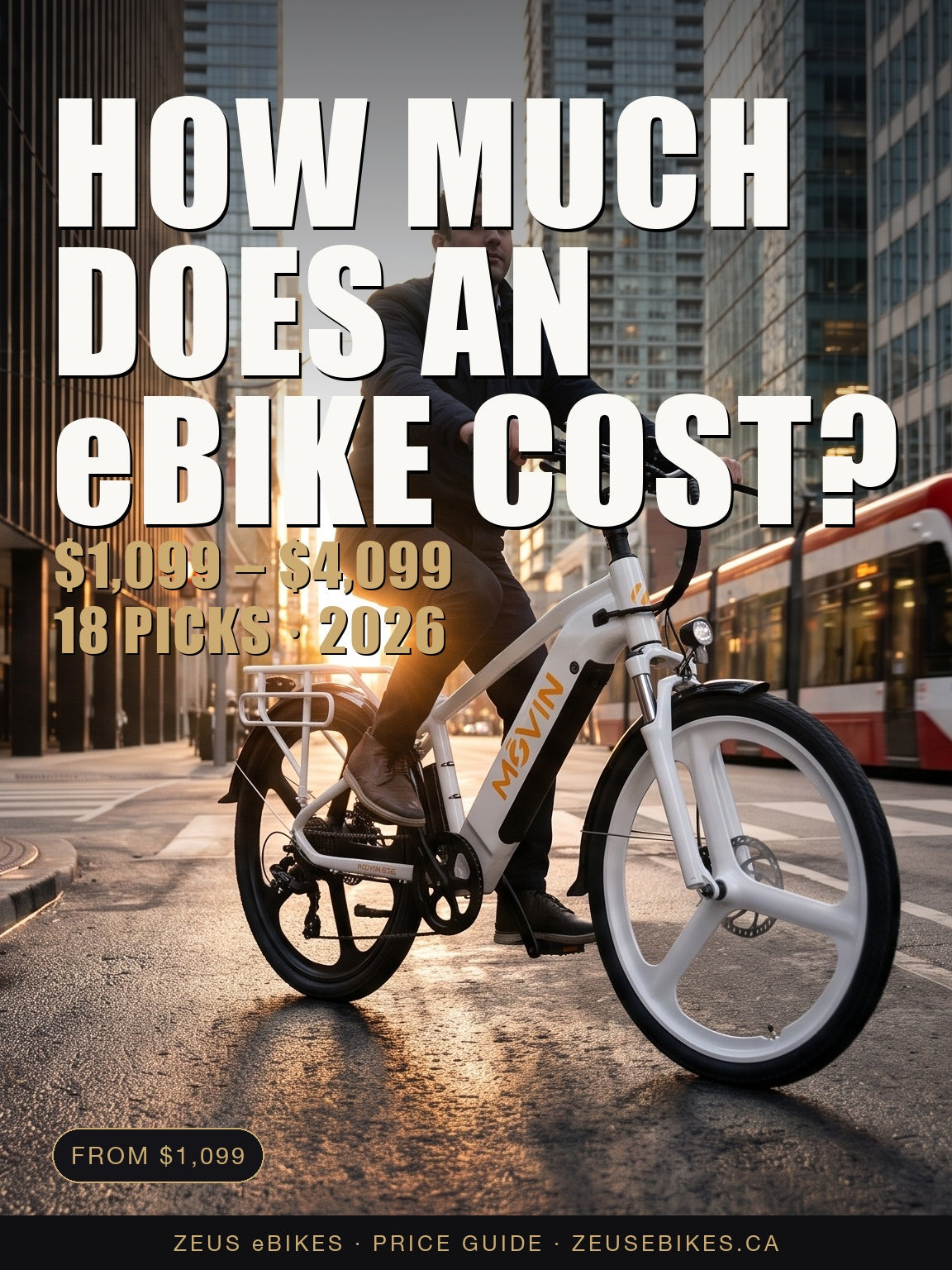
How Much Does an Electric Bike Cost in Canada? (2026)
By Milad Ghobadibeygvand, BScN (Western University, 2014) · First published February 2026 · Verified and updated August 8, 2026

$1,099 to $3,499 — 17 verified picks across the price ladder. Editorial image: Playcut AI.
In This Guide
- Price by eBike Type (2026)
- Best eBike at Each Price Point
- What Your Province Adds to the Price
- The Cost Per Kilometre
- What Actually Drives the Price
- Where Canadians Buy (and the Trade-Offs)
- The 4 Price Tiers
- 3-Year Total Cost of Ownership
- The Used eBike Market
- When to Buy
- How to Lower the Price
- FAQ
- The Bottom Line
How Much Does an eBike Cost by Type in Canada?
Electric bike prices in Canada in 2026 range from about $1,199 to over $5,000, and the single biggest factor is the type of bike. A compact folder and a mid-drive trail machine are different tools built to different budgets. Here is what each category actually costs, with a verified in-stock Zeus example for each.
| eBike Type | Price Range (CAD) | Verified Zeus Example | Shop |
|---|---|---|---|
| Folding | $1,099–$4,399 | Samebike CY20: $1,199 | Browse |
| Step-Thru / Commuter | $1,199–$6,899 | Samebike XD26-II: $1,499 | Browse |
| Retro / Moped-Style | $1,199–$4,499 | GT33 Cafe Racer: $1,599 | Browse |
| Dual Motor (AWD) | $1,899–$6,899 | FAT-AWD 3.0: from $2,299 | Browse |
| Full-Suspension / Mountain | $1,199–$5,700 | — | Browse |
| Electric Trikes | $1,699–$6,899 | Meigi Hera: $1,699 | Browse |
| Mid-Drive | $3,099–$5,700 | Eunorau Fat HS / Hunter X8: $3,099 | Browse |
| Electric Dirt Bikes | $1,799–$6,499 | GT73 Motorbike: $2,399 | Browse |
| Kids | $1,099–$1,299 | Eunorau EKIDS-20: $1,299 | Browse |
The Best eBike at Each Price Point in Canada (2026)
The cheapest real, warrantied eBike in Canada starts at about $1,099, and the value concentrates between $1,099 and $2,000 — that's where a Canadian buyer gets the most bike per dollar. Below is every price point on the Zeus ladder with a verified pick — one of them a disclosed pre-order — and its true cost-per-watt-hour, so you can see exactly what your money buys at each step. Prices re-read from the Zeus store on October 10, 2026.
| eBike | Price | Battery · $/Wh | Best for |
|---|---|---|---|
| Samebike 20LVXD30-II | $1,099 | 480 Wh · $2.29 | The cheapest real eBike — torque sensor + suspension fork, rare this low |
| Samebike CY20 | $1,199 | 468 Wh · $2.56 | Compact folding commuter for condos and transit |
| Samebike RS-A01 Pro-T | $1,199 | 540 Wh · $2.22 | Budget step-thru commuter with a torque sensor |
| Samebike XD26-II | $1,499 | 720 Wh · $2.08 | Full-suspension fat tire at a budget price |
| GT33 Cafe Racer | $1,599 | 1,296 Wh · $1.23 | The most battery per dollar under $1,600 |
| Meigi Hera (trike) | $1,699 | n/p | The most affordable trike — three-wheel stability, no balance needed |
| Freesky Ranger M-540 | $1,999 | 1,200 Wh · $1.67 | The best all-wheel drive under $2,000 — 200 N·m, full suspension |
| Raptor ST202 GPS | $1,999 | 1,296 Wh · $1.54 | Biggest battery + GPS anti-theft under $2,000 |
| Eunorau Meta Foldable | $2,295 | 720 Wh · $3.19 | Folding step-thru with a true torque sensor and Samsung cells |
| Eunorau Meta 26 | $2,295 | 720 Wh · $3.19 | True torque sensor for a natural commuter feel |
| FAT-AWD 3.0 | from $2,299 | 720 Wh · $3.19 | AWD winter traction; 1,440 Wh with the optional $679 second battery |
| GT73 Motorbike | $2,399 | 1,747 Wh · $1.37 | Moto styling + a huge dual battery for long range |
| Eahora Juliet 2026 | $2,499 | 2,880 Wh · $0.87 | The best value on this ladder — the lowest cost-per-watt-hour here |
| Taubik Tour | $2,899 | 720 Wh · $4.03 | Comfort step-thru fat, Bafang motor + Samsung cells (pre-order) |
| Eunorau Fat HS / Hunter X8 | $3,099 | 720 Wh · $4.30 | Bafang mid-drive muscle — off-road/private land only |
| Velotric Summit 2 | $3,399 | 801 Wh · $4.24 | Performance hardtail rated to 440 lb — the co-founder's own bike |
| Meet One Breeze Pro 2.0 (trike) | $3,499 | 960 Wh · $3.64 | Premium full-suspension trike, torque sensor, 450 lb payload |
The 17 Picks, Photographed — $1,099 to $3,499
Every pick below, in price order, photographed in the Canadian setting it is built for. The heading over each photo carries its price and cost-per-watt-hour so the number sits right beside the bike.
1. Samebike 20LVXD30-II — $1,099 · $2.29/Wh
Cheapest real bike; torque sensor + suspension fork rare at this price.

Samebike 20LVXD30-II — editorial image by Playcut AI.
2. Samebike CY20 — $1,199 · $2.56/Wh
Compact folding commuter.

Samebike CY20 — editorial image by Playcut AI.
3. Samebike RS-A01 Pro-T — $1,199 · $2.22/Wh
Budget step-thru commuter, torque sensor.

Samebike RS-A01 Pro-T — editorial image by Playcut AI.
4. Samebike XD26-II — $1,499 · $2.08/Wh
Full-suspension fat at budget price.

Samebike XD26-II — editorial image by Playcut AI.
5. GT33 Cafe Racer — $1,599 · $1.23/Wh
1,296 Wh + 258 Nm wheel torque for $1,599.

GT33 Cafe Racer — editorial image by Playcut AI.
6. Meigi Hera — $1,699
Accessible budget trike, 24 km/h, step-thru.

Meigi Hera — editorial image by Playcut AI.
7. Freesky Ranger M-540 — $1,999 · $1.67/Wh
Dual-motor AWD under $2,000, 200 Nm, full-sus.

Freesky Ranger M-540 — editorial image by Playcut AI.
8. Raptor ST202 GPS — $1,999 · $1.54/Wh
1,296 Wh + GPS anti-theft, torque sensor.

Raptor ST202 GPS — editorial image by Playcut AI.
9. Eunorau Meta Foldable — $2,295 · $3.19/Wh
Folding step-thru, true torque sensor, 720 Wh Samsung, hydraulic 180 mm brakes.

Eunorau Meta Foldable — product photo.
10. Eunorau Meta 26 — $2,295 · $3.19/Wh
True torque sensor, dual-battery ready.

Eunorau Meta 26 — editorial image by Playcut AI.
11. FAT-AWD 3.0 — from $2,299 · $3.19/Wh
AWD, 110 Nm, 720 Wh (1,440 Wh with the optional $679 second battery).

FAT-AWD 3.0 — editorial image by Playcut AI.
12. GT73 Motorbike — $2,399 · $1.37/Wh
1,747 Wh dual battery, 126 Nm, moto styling.

GT73 Motorbike — editorial image by Playcut AI.
13. Eahora Juliet 2026 — $2,499 · $0.87/Wh
2,880 Wh — lowest cost-per-watt-hour on this ladder.

Eahora Juliet 2026 — editorial image by Playcut AI.
14. Taubik Tour — $2,899 · $4.03/Wh (Pre-Order)
Bafang + Samsung UL cells — Pre-Order: ships out end of August.

Taubik Tour — editorial image by Playcut AI.
15. Eunorau Fat HS / Hunter X8 — $3,099 · $4.30/Wh
Bafang M615 mid-drive, 160 N·m, full suspension — off-road/private land only, cadence assist.

Eunorau Fat HS / Hunter X8 — product photo.
16. Velotric Summit 2 — $3,399 · $4.24/Wh
Hybrid hardtail, 440 lb payload; Milad's own bike.

Velotric Summit 2 — editorial image by Playcut AI.
17. Meet One Breeze Pro 2.0 — $3,499 · $3.64/Wh
Full-suspension fat trike, torque sensor, differential, folding.

Meet One Breeze Pro 2.0 — editorial image by Playcut AI.
Read the $/Wh column honestly: a low number (the Eahora Juliet's $0.87, the GT33's $1.23) means raw energy per dollar; a high number on a premium bike (the Eunorau Fat HS, the Velotric Summit 2) means you're paying for the suspension, certification, and build quality, not more range. Both are legitimate — the metric just shows you which.
Cheapest real eBike — Samebike 20LVXD30-II, $1,099 CAD
If your question is literally "what's the cheapest eBike I can trust," this is it: a 350W folding bike with a torque sensor and a lockout suspension fork — features that usually start $400 higher. In Canada a genuine warrantied eBike starts around $1,099; anything cheaper online is the red flag our "too-cheap" investigation is about. 🇨🇦 Ships free from Canada, warranty included.
Best value on the whole ladder — Eahora Juliet 2026, $2,499 CAD · or about $208/mo with financing
A 2,880 Wh moped-scale battery for $2,499 works out to $0.87 per watt-hour — the lowest on this ladder, roughly a third of what a premium mid-drive charges. A 1,000W motor, 175–190 km rated range, and a 330 lb payload make it the pick for riders who want the most machine per dollar. 🇨🇦 Ships free from Canada, warranty included, 1-866-938-7580.
Best all-wheel drive under $2,000 — Freesky Ranger M-540, $1,999 CAD
Two motors (3,500W peak combined, 200 N·m), a 1,200 Wh battery, full suspension, and a 400 lb payload for under two thousand dollars — the cheapest genuine AWD winter setup on the ladder, and the answer to "best electric bike under $2,000" for anyone who rides through Canadian snow. 🇨🇦 Ships free from Canada, warranty included.
What Your Province Adds: The Real "Out-the-Door" Price
The sticker price is not the final price — your province's sales tax is added at checkout, and it varies enough to matter. On the same $2,500 eBike, an Albertan pays $250 less in tax than someone in New Brunswick. No other Canadian eBike guide shows you this, so here it is in full.
| Province / Territory | Tax Type | Rate | Tax on $2,500 eBike | Total Out-the-Door |
|---|---|---|---|---|
| Alberta / Yukon / NWT / Nunavut | GST only | 5% | $125 | $2,625 |
| Saskatchewan | GST + PST | 11% | $275 | $2,775 |
| British Columbia | GST + PST | 12% | $300 | $2,800 |
| Manitoba | GST + RST | 12% | $300 | $2,800 |
| Ontario | HST | 13% | $325 | $2,825 |
| Nova Scotia | HST | 14% | $350 | $2,850 |
| Quebec | GST + QST | ~14.975% | ~$374 | $2,874 |
| New Brunswick / NL / PEI | HST | 15% | $375 | $2,875 |
All Zeus prices are shown pre-tax, with tax calculated at checkout from your shipping address. If you're in a province with a rebate, that can more than cancel the tax — see every provincial eBike rebate.
The Cost Per Kilometre: Why eBikes Are Absurdly Cheap to Ride
The purchase price gets the attention, but the running cost is where an eBike quietly wins. After the first year, an electric bike costs roughly 2 cents per kilometre to operate — electricity plus light maintenance. Here's the math on a real, in-stock example.
Bike: Samebike XD26-II ($1,499)
Battery: 48V 15Ah = 720 Wh (0.72 kWh)
Range per charge: ~55–90 km real-world (manufacturer 55–110 km)
Cost per full charge: 0.72 kWh × $0.17/kWh = $0.12
Annual riding: 5,000 km (3–4 rides/week, ~25 km each) ≈ 70 charges
| Year 1 | Year 2+ | |
|---|---|---|
| eBike purchase | $1,499 | $0 |
| Electricity (~70 charges) | $9 | $9 |
| Maintenance | $100 | $100 |
| Total | $1,608 | $109 |
| Cost per km | $0.32/km | $0.022/km |
After year one, you're riding for about 2.2 cents per kilometre. The CAA estimates driving a car costs $0.60–$0.85/km — 27 to 39 times more. Spread the purchase over five years and 25,000 km and the eBike still comes in around 8 cents per kilometre all-in (~$2,044 total) versus roughly $15,000–$21,250 for a car over the same distance.
Full side-by-side: Electric Bike vs Car in Canada (2026).
Want the numbers for your exact situation? Call 1-866-938-7580 — tell us your city, commute distance, and whether you'll ride through winter, and we'll tell you honestly which price tier fits, including if the cheapest one is enough.
Browse in-stock eBikes by price →What Actually Drives the Price of an eBike?
1. Battery size (the biggest factor)
The battery is the gas tank, and it's typically 30–40% of the bike's cost. Bigger capacity means longer range and a higher price. In Canada, cold weather cuts usable range by 20–40%, so it's worth buying more capacity than you think you need if you'll ride in winter.
| Battery Size | Range | Price Impact | Canadian Winter Range |
|---|---|---|---|
| 250–400 Wh | 30–50 km | Lower cost | 20–35 km |
| 500–750 Wh | 50–80 km | Mid-range | 35–55 km |
| 750–1,000 Wh | 80–120 km | Premium | 55–80 km |
| 1,000+ Wh / dual battery | 100–200+ km | Top tier | 70–140+ km |
The metric nobody else shows you: price per watt-hour ($/Wh)
Savvy buyers compare value with one number: price divided by battery capacity in watt-hours — lower means more energy per dollar. The price-ladder table above computes it for every pick, from the verified July 2026 price and real battery capacity. The spread is dramatic and instructive: the Eahora Juliet 2026 delivers a 2,880 Wh battery at $0.87/Wh — the lowest on the ladder — while a premium full-suspension fat bike like the Eunorau Fat HS runs $4.30/Wh, the highest. That roughly five-fold gap isn't a bargain at the bottom or a rip-off at the top: it's the difference between paying for raw range and paying for full suspension, a UL-certified pack, and premium components. $/Wh simply shows you which part of the bike your money bought — it doesn't tell you which bike is right for you.
2. Motor type
Hub motors (the majority of the Canadian market) are affordable, reliable, and simple. Mid-drive motors climb hills and handle ice better and typically add $1,000–$2,000. Dual motors (AWD) put a hub motor in each wheel for winter and hill traction. Most provinces limit road-legal eBikes to 500W and 32 km/h assisted — details in Electric Bike Laws in Canada (2026) and the deeper mid-drive vs hub motor comparison.
3. Brakes
Mechanical disc brakes appear on budget bikes under about $1,300 and work fine in dry conditions. Hydraulic disc brakes are standard above $1,500 — self-adjusting, stronger, and safer in wet or snowy weather. For year-round Canadian riding, they're worth the upgrade.
4. Frame design and after-sale support
Step-thru, folding, and full-suspension frames each add cost for a specific benefit (easy mounting, condo storage, rough-road comfort). And the quietest line item is support: a $1,200 marketplace eBike can look identical to a $1,800 bike from a Canadian retailer until something breaks and there's no warranty, no parts, and no one to call. The difference is often the service after the sale — see "too-cheap" eBikes on Amazon.ca and how to spot a legit eBike store in Canada.
Samebike CY20 — $1,199 CAD · or about $100/mo with financing
One of the most affordable eBikes on Zeus and the cleanest way to test whether eBike commuting fits your life: 350W motor, 468 Wh removable battery, Shimano 7-speed, folds for a condo or car trunk. 🇨🇦 Ships free from Canada, warranty included.
Where Canadians Buy eBikes (and the Trade-Offs)
The same bike costs different amounts depending on where you buy it, and each channel trades price against selection and support. Here's the honest landscape.
| Channel | Price Range | Pros | Cons |
|---|---|---|---|
| Costco | $1,000–$2,000 | 90-day returns, bundled accessories, trusted | 5–8 models, no specialist advice, limited parts |
| Amazon.ca | $600–$3,000+ | Huge selection, fast shipping | Unreliable quality, no Canadian warranty on many brands |
| Canadian Tire | $800–$2,500 | Physical test rides, local returns | Limited selection, limited eBike expertise |
| Local bike shops | $2,500–$10,000+ | Expert fitting, test rides, full service | Highest prices (30–50% more), 1–3 brands |
| Online Canadian retailers (Zeus, Rize, Biktrix) | $1,199–$5,000+ | Widest selection, competitive pricing, Canadian warranty, free shipping | No test rides; ships partially assembled (final setup required) |
About 40% of Canadians now prefer shopping online for major purchases (up from 34% in 2024). For eBikes specifically, online Canadian retailers tend to offer the best balance of selection, price, and after-sale support. Deeper dives: Costco eBikes, Canadian Tire eBikes, and Amazon eBikes.
The 4 Price Tiers: What Each One Buys
$1,100–$1,500: Entry
A basic folder or commuter with a serviceable battery and, at the low end, mechanical brakes. Good for testing whether eBiking fits your life and for short, flat commutes. The Samebike CY20 ($1,199) anchors this tier. Watch the battery: a smaller pack may need replacing ($400–$700) in a few years of heavy use.
$1,500–$2,500: The value sweet spot
Hydraulic brakes, a usable 48V 15–20Ah battery, and a capable motor. This tier holds the largest share of the Canadian market (Mordor Intelligence, 2025) and is where most riders should look — the best balance of price and daily usability. See the best eBikes under $2,000.
$2,500–$3,500: Performance & all-season
Full suspension, dual batteries, all-wheel drive, torque sensors, and Samsung or LG cells. This is the "car replacement" tier that works 8–12 months a year — the FAT-AWD 3.0 (from $2,299) sits right at its doorstep.
$3,500–$5,000+: Premium / specialty
Mid-drive motors, 100+ N·m of torque, and purpose-built frames for hills, ice, and trails — the big mid-drives in the Zeus mid-drive collection run to $5,700. Mid-drive muscle itself starts lower, though: the off-road-only Eunorau Fat HS / Hunter X8 ($3,099, Bafang M615, 160 N·m) is the cheapest bike in that collection. If your riding is flat and urban, a hub motor at $1,500–$2,500 does the same job for less.
Total Cost of Ownership: A 3-Year Comparison
Purchase price is just the start. Here's what each tier actually costs over three years of regular riding (5,000 km/year), using verified anchor bikes and the same electricity and maintenance assumptions throughout.
| Entry (CY20) |
Value (FAT-AWD 3.0) |
Performance (Summit 2) |
Premium (a $3,499 bike) |
|
|---|---|---|---|---|
| Purchase price | $1,199 | $2,399 | $3,399 | $3,499 |
| Accessories (year 1) | $200 | $200 | $200 | $200 |
| Electricity (3 years) | $27 | $40 | $40 | $40 |
| Maintenance (3 years) | $300 | $300 | $350 | $400 |
| Battery replacement? | Unlikely ($0) | Unlikely ($0) | Unlikely ($0) | Unlikely ($0) |
| 3-year total | $1,726 | $2,939 | $3,989 | $4,139 |
| Cost per km | ~12¢/km | ~20¢/km | ~27¢/km | ~28¢/km |
| Monthly cost | ~$48/mo | ~$82/mo | ~$111/mo | ~$115/mo |
Key insight: Even the premium tier lands around $115 a month over three years. The CAA pegs car ownership at roughly $1,373 a month — so the most expensive eBike here still costs about 92% less per month than a car. Moving up a tier buys capability (AWD, suspension, mid-drive), not a meaningfully higher cost of living.
The Used eBike Market in Canada
Yes, you can buy used — Kijiji and Facebook Marketplace list thousands of eBikes across Canada. But used eBikes carry two traps that used regular bikes don't.
| Condition | Typical Price vs New | What to Watch For |
|---|---|---|
| Like-new (under 200 km) | 30–50% off retail | Verify purchase date; check if warranty transfers |
| Lightly used (1 season) | 40–60% off retail | Battery health — ask total charge cycles |
| Well-used (2+ seasons) | 50–70% off retail | Battery may need replacing ($400–$700) — factor it in |
The battery trap: eBike batteries degrade with age and charge cycles. A $2,000 bike selling for $900 with a worn battery is really a $1,300–$1,600 bike once you replace the pack. Always ask battery age, cycles, and current real range.
The warranty trap: most manufacturer warranties are non-transferable, so used means no coverage on the motor, controller, or battery — the three most expensive parts. Our take: used can be smart for testing eBike commuting, but for a primary ride, buying new with warranty and parts support often costs less over three years than a cheap used bike that needs a battery.
When to Buy: Seasonal Pricing in Canada
| Season | Pricing | Selection | Verdict |
|---|---|---|---|
| Jan–Mar | Best deals — winter clearance + spring pre-orders | Good (some models sold out from holidays) | Best value |
| Apr–Jun | Prices firm up with demand | Best — full spring inventory | Best selection |
| Jul–Sep | Full price; popular models sell out | Declining | Buy early or wait |
| Oct–Dec | Black Friday deals on remaining stock | Limited | Good deals, limited choice |
The 2026 wrinkle: it's not tariffs — Canada's eBike import duty is 0%. But a weak Canadian dollar (about $1.40 per US dollar) and component costs mean restocked inventory can arrive priced higher than what's on the shelf today. Current in-warehouse stock is the most price-stable. Full analysis: eBike Tariffs & Prices in Canada (2026).
How to Lower the Price
Provincial rebates
Rebates can more than cancel your sales tax. British Columbia offers up to about $1,000 based on income; Nova Scotia has point-of-sale discounts on qualifying eBikes; other programs come and go. The full, current list: every provincial eBike rebate (2026) and the BC rebate update.
Financing
Spreading the cost turns a $2,000 purchase into a manageable monthly figure. Zeus supports interest-free instalments and longer-term plans — the honest math on each option is in how to finance an eBike in Canada (2026).
Buy from current-cost inventory
Many bikes are listed below MSRP right now, and in-warehouse stock was landed before recent cost pressure. See what's discounted: best eBike deals in Canada (2026).
FAT-AWD 3.0 — from $2,299 CAD · or about $192/mo with financing
One of the strongest all-round values in this guide: dual 500W hub motors (all-wheel drive for Canadian winters), a torque sensor, 180 mm hydraulic brakes and a 720 Wh pack, with an optional $679 second battery for 1,440 Wh. 🇨🇦 Ships free from Canada, warranty included, 1-866-938-7580.
How Much Does an eBike Cost in Canada? Your Questions, Answered
How much does a good electric bike cost in Canada?
$1,500–$2,500 CAD for daily commuting. That range gets you hydraulic brakes, 50–80+ km of real range, quality Samsung or LG battery cells, and a build that lasts multiple seasons. You can start lower — Zeus's lineup opens around $1,099–$1,199 for a folding commuter such as the Samebike CY20 ($1,199) — but $1,500–$2,500 is where most Canadians land.
Why are electric bikes expensive in Canada?
It's not tariffs — Canada charges 0% import duty on complete eBikes (tariff item 8711.60.00) and on their main lithium battery. The real cost drivers are the battery (30–40% of the bike's price), shipping heavy 30–40 kg packages across the country, and quality components like hydraulic brakes and brand-name cells. Compared with running a car at roughly $16,000 a year, a $2,000–$3,000 eBike is remarkably cheap. Full detail: eBike tariffs & prices.
What is the cheapest electric bike on Zeus eBikes?
The cheapest is the Samebike 20LVXD30-II at $1,099 — a 350W folding bike that, unusually for the price, includes a torque sensor and a lockout suspension fork. The next step up is the Samebike CY20 at $1,199. In Canada a genuine, warrantied eBike starts around $1,099; anything advertised much cheaper online is a red flag.
How much does it cost to charge an electric bike in Canada?
About $0.08–$0.20 per full charge, depending on battery size and your provincial electricity rate. Annual cost for a regular rider is roughly $10–$30 — under $30 a year in every province. A 720 Wh battery costs about 12 cents to fill at the Canadian average of $0.17/kWh.
How much does an electric bike cost per kilometre in Canada?
About 2 cents per kilometre after the first year (electricity plus routine maintenance). All-in over five years, including the purchase price, it works out to roughly 8 cents per kilometre. The CAA estimates driving a car costs 60–85 cents per kilometre — 25 to 40 times more.
Do I need insurance for an electric bike in Canada?
No. An eBike that meets your province's power-assisted bicycle definition (generally 500W, 32 km/h assisted, functional pedals) needs no insurance, registration, or licence for public roads and paths — roughly $2,000 a year saved versus insuring a car. If you want theft or liability coverage, our eBike insurance guide covers the options.
Is a $1,000 electric bike worth it?
For casual, flat-terrain riding, an entry bike around $1,100–$1,300 can be fine. For daily commuting, hills, or Canadian winters, it usually isn't — smaller batteries and mechanical brakes struggle, and a battery replacement ($400–$700) can erase the savings within a few years. Most riders are better served in the $1,500–$2,500 range.
Are electric bikes cheaper at Costco or Canadian Tire?
Big-box stores carry a small selection (often 5–8 models) in the $1,000–$2,000 range, with perks like Costco's 90-day returns and in-store pickup. The trade-offs are limited choice, no specialist fitting advice, and thinner after-sale parts support than a dedicated eBike retailer. See the full comparisons: Costco eBikes and Canadian Tire eBikes.
Are electric bike prices going up in Canada in 2026?
Not from tariffs — Canada's eBike import duty is 0%. The real pressures are a weak Canadian dollar (about $1.40 per US dollar) and component and freight costs, which nudge restock prices up gradually rather than in spikes. Current in-warehouse inventory was landed at known costs, so it's the most price-stable stock available.
Is an electric bike worth it compared with a regular bike?
A decent regular bike costs $500–$1,500; an eBike costs $1,500–$2,500. The roughly $1,000 premium buys the ability to ride 2–3 times farther without exhaustion, arrive without needing a shower, handle hills and headwinds, and ride year-round with fat tires. For riders replacing car trips it pays for itself in months. For fitness-only riding on flat terrain, a regular bike may be enough — the honest breakdown is in eBike vs regular bike.
When is the best time to buy an electric bike in Canada?
January–March for the best deals (winter clearance and spring pre-orders) and April–June for the widest selection. Late summer is the worst window — popular models sell out and restocks can arrive at higher costs. Buying before mid-summer usually means the most predictable pricing.
The Bottom Line: What Should You Spend?
$1,199–$1,500: Test eBiking with a folder or commuter like the Samebike CY20. Upgrade later once you know what you actually need.
$1,500–$2,500: The sweet spot. A good daily commuter that lasts — where most Canadians should look and where most land.
$2,500–$3,500: Car-replacement territory. All-wheel drive, dual battery, full suspension — for year-round serious use.
$3,500–$5,000+: Premium mid-drive or specialty builds. You already know what you want.
Whatever tier you choose, the running cost is the same near-zero ~2¢/km, every Zeus eBike ships free across Canada with warranty support from a real human, and there's no tariff between you and the price you see — Canada charges 0% duty on eBikes.
Not sure where to start? Tell us your city, height, weight, commute distance, and whether you'll ride in winter — call 1-866-938-7580 or message us and we'll match you to the right price tier honestly, cheapest option included.
Shop every in-stock eBike by price →Visuals created by Playcut.ai

Share:
Flash 1000W 2-Year Review in Canada | Modular 400 lb Payload E-Bike (AAA+ Rated)
eBike Tariffs in Canada (2026): 0% Duty, Real Prices, Key Dates