
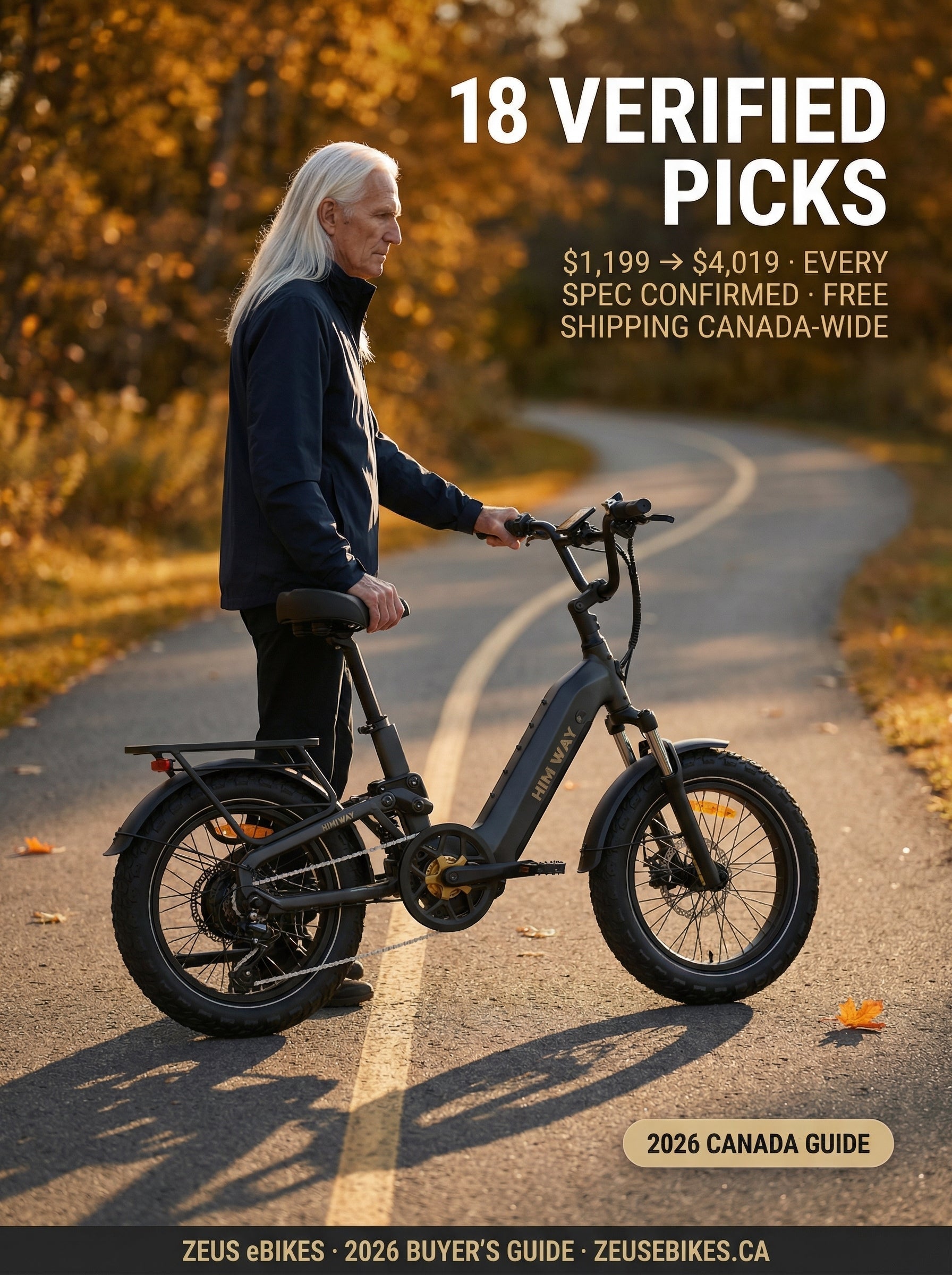
Best Electric Bikes in Canada (2026): 18 Picks by Price, $1,199–$4,019

📸 Photography by Playcut.ai — personalised AI actor technology
The best electric bike in Canada for most riders in 2026 is the Himiway D5 2.0 20" ($2,799) — full suspension, UL2271-certified battery, switchable torque sensor, and 400 lb payload at a price point that punches well above its class. Best budget pick under $1,500: Samebike XD26-II ($1,199). Best mid-drive: Eunorau Specter-S ($4,019, Bafang M620, 160 Nm). Best for seniors: CityTri E-310 Trike ($1,999). All ship free nationwide. Every spec below has been independently verified.
30-Second Decision: Which Bike Is for You?
| Category | Our Pick | Price | Best For |
|---|---|---|---|
| Best Overall | Himiway D5 2.0 20" | $2,799 | All-rounder — trails, commutes, winter |
| Best Budget | Samebike XD26-II | $1,199 | First e-bike, tight budget, full suspension |
| Budget Power | Freesky Eurostar Ultra M-410 | $1,887 | Heavy riders, hills, TÜV-certified battery |
| Budget AWD | Freesky Ranger Air M-540 | $1,928 | AWD step-thru under $2,000 |
| Best Commuter | Movin' Tempo Max | $1,899 | Daily urban commuter, Samsung battery |
| Best Folding | Eunorau Meta Foldable | $1,994 | Apartments, transit, trunk storage |
| Best Long-Range | Freesky Nova B-360 | $2,373 | 121–193 km, dual 720Wh Samsung packs |
| Long-Range Value | Eunorau Meta275 | $1,979 | Dual battery included, torque sensor |
| Fat Tire Value | Eunorau FAT-AWD 3.0 | $2,390 | AWD fat tire + torque sensor under $2,400 |
| High-Power AWD | TESWAY X9 AWD | $2,399 | 4,000W peak, 240 Nm, 400 lb payload |
| Fat Tire Lightweight | Velotric Nomad 2 | $2,899 | 75 lbs, Apple Find My GPS, 505 lb system capacity |
| Fat Tire Full-Feature | Himiway D5 2.0 26" | $2,799 | Maxxis tubeless, Maxxis Minion, WiFi OTA |
| Best Trail | Taubik Westridge 29T | $2,899 | 29" wheels, torque sensor, Canadian-designed |
| Mid-Drive Step-Thru | Himiway A7 Pro | $2,999 | ANANDA 130 Nm, full suspension, step-thru |
| Mid-Drive Fat Tire | Himiway Zebra D5 Pro | $2,999 | 130 Nm mid-drive, 400 lb, fat 26" |
| Best Mid-Drive | Eunorau Specter-S | $4,019 | Bafang M620, 160 Nm, SRAM NX 11-speed |
| Best for Seniors | CityTri E-310 Trike | $1,999 | 3-wheel stability, 145 km range, 380 lb |
| Most Distinctive | Eahora DL2000 | $3,699 | Retro moped, 2,000W peak dual-hub, 1,560 Wh |
Every bike on this list was evaluated against four criteria: verified specifications (cross-referenced against manufacturer data sheets and Zeus product pages — no spec was taken from marketing copy alone); real-world Canadian suitability (cold-weather battery performance, payload for Canadian rider averages, tyre choice for mixed-surface paths); value density at price point (what do you actually get per dollar compared to similarly priced alternatives?); and safety certifications (battery cell provenance, UL/TÜV certification status, hydraulic vs cable disc brake specification). Products were not paid to be featured. No affiliate relationships exist. Bikes were ranked by independent editorial judgement. Prices are in Canadian dollars as of March 2026.
What's In This Guide
1. Best Overall E-Bike in Canada

📸 Photography by Playcut.ai — personalised AI actor technology
The wrong e-bike in a Canadian context is not a minor inconvenience — it is a $1,500–$3,000 mistake that most buyers only discover after the first winter. Cold kills uncertified lithium cells faster than the spec sheet admits. Narrow tyres turn packed-snow pathways into a liability. Cadence sensors waste battery on the uphills that define Prairie and mountain-town commutes. And a payload rating that doesn't account for winter gear, a backpack, and a full grocery run leaves riders stranded mid-bridge.
The Himiway D5 2.0 20" solves all of this at $2,799. It is the only bike in this price class that combines UL2271-certified Samsung/LG battery cells, a switchable torque/cadence sensor, full suspension front and rear, and a 400 lb payload — plus WiFi OTA firmware updates so the bike improves after you buy it. The 20" wheels and 17" standover height make it one of the easiest e-bikes to mount and dismount in the catalogue, regardless of rider height or mobility.
Himiway D5 2.0 20"
$2,799 CADThe 20" wheel format hits a sweet spot that most riders don't appreciate until they're on it: lower centre of gravity than 26" fat builds, faster acceleration from stops, and a 17" standover that virtually every rider can mount without stretching. The 100mm front coil fork paired with a 130mm multi-link rear shock absorbs both pothole-riddled urban streets and compacted gravel trails without the wallowing feel of cheaper suspension designs.
What genuinely separates this bike from $2,799 alternatives is the 3.5" TFT colour display with WiFi OTA updates — the bike's firmware can be improved over time, the same as a smartphone. Turn signals are built-in. The UL2271 battery certification means the cells have been independently tested for thermal runaway containment — a meaningful consideration given that post-Rad Power battery safety awareness has raised Canadian buyer scrutiny. The 2-year warranty is the longest in this price class.
Who it's for: The rider who wants one bike that handles the morning commute, the weekend trail, the grocery run, and the February slush — without compromise. Low standover makes it accessible for riders of most heights and mobility levels.
2. Best Budget E-Bikes Under $2,000

📸 Photography by Playcut.ai — personalised AI actor technology
The biggest mistake Canadian budget e-bike buyers make is comparing sticker prices without comparing what the sticker price actually buys. A $900 Amazon bike and a $1,200 quality-sourced e-bike are not competing products — one has mechanical disc brakes, unverified generic cells, and will corrode by its second winter; the other has hydraulic brakes, certified Samsung or LG cells, and a manufacturer warranty worth something. The three picks below represent the best you can buy at three distinct budget tiers under $2,000 — and none of them cut corners on the spec that actually keeps you safe.
For a complete deep-dive on what separates great from dangerous at the sub-$2,000 tier, read our Best Electric Bikes Under $2,000 Canada guide, which stress-tested 12 options against each other.
Samebike XD26-II
$1,199 CADAt $1,199, the XD26-II is the only full-suspension e-bike in Canada with hydraulic disc brakes at this price. Most bikes at this tier use mechanical discs — the XD26-II's 160mm hydraulic setup gives consistent stopping power regardless of temperature or mud, which matters on Canadian autumn commutes when wet leaves appear overnight. The 397 lb payload is exceptional at this price point. Cadence sensor is expected at $1,199 — but the suspension and brakes more than compensate.
Who it's for: First-time e-bike buyers, cost-conscious commuters, and riders who want full suspension without spending $2,500+. Not ideal for steep hills where a torque sensor makes a meaningful difference.
Freesky Eurostar Ultra M-410
$1,887 CADThe Eurostar Ultra M-410 occupies a category that almost doesn't exist: a TÜV dual-certified battery (both UL2849 system and UL2271 pack certifications) with a 3,000W peak motor, 120mm full suspension, and 4-piston hydraulic brakes — at $1,887. That dual certification is significant: post-Rad Power, Canadian buyers increasingly understand that UL2271 pack certification is a baseline, not a luxury. The Eurostar Ultra M-410 passes both tests. Turn signals are built in. The 1,200 Wh capacity delivers real-world range that most $2,500+ bikes can't match.
Who it's for: Heavier riders (up to 400 lb), aggressive commuters who need range and power on hilly routes, and buyers who won't compromise on battery certification regardless of price.
Freesky Ranger Air M-540
$1,928 CADAll-wheel drive on a step-thru e-bike for under $2,000 should not exist — but the Ranger Air M-540 does it. Two 1,750W motors, 200 Nm of combined torque, TÜV dual-certified battery, 4-piston hydraulic brakes, full suspension, and NFC lock. The step-thru frame makes it accessible for riders with limited mobility or who frequently stop and start. This is the pick for any Canadian rider who lives near hills, snow, or gravel and needs a bike that actually grips the surface regardless of conditions.
Who it's for: Winter riders, hill commuters, step-thru buyers who don't want to give up power, and anyone who has watched a single-motor bike spin its rear wheel on ice and decided never again.
3. Best Commuter E-Bike

📸 Photography by Playcut.ai — personalised AI actor technology
The average Canadian driver spends $350–$500 per month on fuel and insurance combined. An e-bike commuter spending $0.02–$0.05 per km on electricity — and nothing on insurance, nothing on parking — recoups the cost of a $1,899 Movin' Tempo Max in under six months on a typical 15 km round-trip urban commute. That math is why urban e-bike demand in Canadian cities has grown faster than any other segment in 2025–2026.
A commuter e-bike has specific requirements that differ from trail or recreation bikes: step-thru frame for quick dismounts, lightweight enough to carry upstairs, hydraulic brakes for wet-weather confidence, and a battery large enough for a full week of 15 km commutes without daily charging. The Movin' Tempo Max hits all four criteria — and does it with a Canadian-designed frame geometry optimised for urban riding posture.
Movin' Tempo Max
$1,899 CADThe 960 Wh Samsung battery is the standout spec here: at a typical commuter pace (assist level 2–3, 25 km/h average), it delivers 80–120 km of real-world range — four to eight days of 15 km round-trip commuting without plugging in. The optional dual-battery upgrade doubles this to 1,920 Wh, making it one of the longest-range commuter e-bikes available at any price. At 27 kg, it is light enough to carry up two flights of stairs without needing to stop midway.
The Tektro 160mm hydraulic brakes perform consistently in rain, slush, and freeze-thaw cycling — which characterises every major Canadian city from October to April. The step-thru frame means no high leg lift at traffic stops. This is the bike for riders who use an e-bike as genuine car replacement, not weekend recreation.
4. Best Folding E-Bike

📸 Photography by Playcut.ai — personalised AI actor technology
One-bedroom apartments in Toronto, Vancouver, and Calgary average under 600 square feet. There is no room for a full-size e-bike. Transit systems that allow folding bikes but not standard e-bikes create a second constraint. A folding e-bike that fits in a car boot — or under a desk — is not a compromise for most urban Canadian riders. It is the only practical option. Our complete folding e-bike guide for Canada goes deeper on this category.
Eunorau Meta Foldable
$1,994 CADThe Meta Foldable's torque sensor is what separates it from every budget folding bike on the market. Torque sensors read how hard you are pedalling and match assist proportionally — which means more efficient battery use, a more natural riding feel, and longer range per charge. At $1,994 with a torque sensor, 3.0" semi-fat Kenda tyres (wide enough for light gravel and snow-packed paths), and an optional dual-battery configuration that extends range to 161 km, this is the folding e-bike for Canadian riders who need the bike to work as hard as they do. The fold takes under 20 seconds and the footprint fits in most Toronto apartment elevator corners.
5. Best Long-Range E-Bikes

📸 Photography by Playcut.ai — personalised AI actor technology
Canadian range anxiety is real — and it's worse than US range anxiety because the temperature drop is greater. A 720 Wh battery that delivers 90 km in July will deliver 55–60 km in January at –10°C. Lithium cells slow their chemical reaction in cold, losing capacity temporarily. The fix is more battery: 1,200 Wh and above gives you meaningful summer range and acceptable winter range without requiring you to charge at a coffee shop mid-commute.
Both picks below use dual-battery systems as standard, not upsell accessories. The Nova B-360 targets riders who want maximum range in a step-thru format. The Meta275 targets riders who want dual-battery capacity at the lowest possible price — and it is the only bike in this guide that ships with dual batteries included in the base price.
Freesky Nova B-360
$2,373 CADTwo Samsung 15Ah packs totalling 1,440 Wh, a Bafang hub motor, and a torque sensor in a step-thru frame. Real-world range for Canadian riders: 80–120 km in summer at assist level 2, 60–80 km in winter at –5°C to –10°C. The 193 km figure is manufacturer-claimed at minimum assist and optimal conditions — factoring in assist level 2–3, hills, wind, and winter temperature, 100–130 km is a realistic daily ceiling. That still makes it the longest-range step-thru e-bike in this catalogue. The Bafang motor's 1,000W peak handles the hills that would reveal the limits of a standard 500W hub. The torque sensor ensures every pedal stroke is harvested efficiently — critical when you are carrying 1,440 Wh of capacity that you actually want to use in full.
Eunorau Meta275
$1,979 CADThe Meta275's headline spec is one that every competitor in this price range qualifies with an asterisk: 1,296 Wh dual battery is included in the base price. No upgrade fee, no option package — two batteries ship in the box. At $1,979, this makes it one of the best value-per-watt-hour propositions in the Canadian market. The 27.5" × 2.6" tyres and 9-speed drivetrain make it significantly more efficient on pavement than a fat-tire build, extending real-world range per charge. The torque sensor ensures that efficiency is captured at the pedalling stage, not just the motor stage. Choose the Meta275 if maximising real-world range per dollar spent is the primary objective.
Not sure which category is right for you?
Browse the full Zeus eBikes catalogue — fat tire, folding, step-thru, mid-drive, and trikes — all with free shipping across Canada and direct Canadian support.
Browse All E-Bikes → Financing Options6. Best Fat Tire & AWD E-Bikes

📸 Photography by Playcut.ai — personalised AI actor technology
Fat tyres — 4.0" wide — are not a Canadian gimmick. They are an engineering solution to terrain that most of the world doesn't have to think about: packed snow, ice-dusted gravel paths, frost-heaved asphalt, and the 5 cm of slush that appears on every Canadian bike lane from November to March. The 4.0" contact patch distributes weight across a larger surface area, reducing sinking into soft surfaces and improving traction on slippery ones. For a complete breakdown of when fat tyres are worth it versus when standard tyres perform better, see our fat tire e-bikes Canada guide.
This section covers four distinct fat-tire builds: an AWD torque-sensor value pick, a raw-power AWD machine, the lightest premium fat-tire on the market, and the most feature-complete fat-tire build available.
Eunorau FAT-AWD 3.0
$2,390 CADAWD with a torque sensor under $2,400 is the FAT-AWD 3.0's singular achievement. Most AWD fat-tire bikes use cadence sensors — which means the assist kicks in at a fixed rate regardless of how hard you're pedalling. The FAT-AWD 3.0's torque sensor reads pedalling effort and allocates power to both wheels proportionally, which on ice and packed snow makes a tangible difference in traction control and energy efficiency. The LG cell base battery (720 Wh) is upgradeable to 1,440 Wh for winter riding where range matters most. Kenda Krusade tyres are a specific callout: they are a purpose-designed e-bike fat tyre with a reinforced sidewall that handles the additional load of the dual-motor system without premature wear.
TESWAY X9 AWD
$2,399 CADThe TESWAY X9 AWD's 240 Nm of combined torque is the highest in this entire guide — and it arrives at $2,399, which makes it one of the most aggressively priced high-power AWD builds available in Canada. The 4,000W peak figure is the system maximum: both 2,000W motors at full load simultaneously on a steep climb. Real-world riding uses a fraction of this. At 105 lbs, it is not a bike you carry upstairs — it is a bike you ride hard on terrain that would strand a lesser machine. Samsung 1,440 Wh battery, full suspension front and rear, 4-piston hydraulic discs. This is the pick for riders who prioritise raw capability over portability.
Velotric Nomad 2
$2,899 CADThe Velotric Nomad 2 is the fat-tire option for riders who value refinement over raw power. At 75 lbs, it is 17–30 lbs lighter than most comparable fat-tire builds — which translates to easier apartment storage, simpler transit handling, and less rolling resistance on flat urban surfaces. The IPX7-rated battery (submersion-proof to 1 metre) is the highest waterproofing rating in this section. The 203mm front rotor — the largest in this guide — provides braking confidence that oversized rotors deliver on steep descents. Apple Find My GPS integration is built in, not a clip-on accessory. Note the 505 lb figure is total system capacity (rider + cargo + bike); the Nomad 2's rider payload is approximately 330 lbs when accounting for the bike's own 75 lb weight.
Himiway D5 2.0 26"
$2,799 CADThe 26" sibling to the Best Overall pick above, the D5 2.0 26" adds the Maxxis Minion FBF/FBR tyre package — the same tyre spec used on high-end mountain bikes — in a tubeless-ready setup. Tubeless means no tube pinch flats on rocks and roots, a capability that the 20" variant doesn't offer. The full RST 100mm front + 130mm multi-link rear suspension is identical between both models. MIK HD rear rack is included for cargo. The switchable torque/cadence sensor and WiFi OTA updates are present on both. Choose the 26" version if you ride technical trails, prefer larger wheels, or want the option of running tubeless. Choose the 20" if you prioritise low standover height and faster urban acceleration.
7. Best Trail Hardtail E-Bike

📸 Photography by Playcut.ai — personalised AI actor technology
Fat-tire bikes excel at traction on soft and loose surfaces. But on Canadian forest singletrack — packed dirt, exposed roots, light rocks, switchbacks — 29" wheels roll over obstacles more efficiently and maintain momentum through technical sections where a 20" or 26" wheel loses speed. A torque-sensor drivetrain on a hardtail trail bike is not a luxury: it is the spec that allows a rider to modulate power precisely through switchbacks, loose corners, and rock gardens where cadence sensors' on/off assist delivery causes rear wheel break-away. For more context on Canadian trail riding, see our electric mountain bikes Canada guide.
Taubik Westridge 29T
$2,899 CADThe Westridge 29T is the lightest bike in this entire guide at 65.5 lbs — a meaningful advantage on trail climbs where every kilogram costs watts. The Kenda Booster Pro 29"×2.4" is a purpose-designed mountain bike trail tyre with a centre-ridge for rolling efficiency and aggressive side knobs for cornering grip on loose Canadian dirt. The geared hub motor — rather than a direct-drive hub — provides motor braking on descents and regenerative-style resistance, which extends range on trail riding profiles that have significant descents. The Shimano Acera 8-speed drivetrain allows the rider to keep the motor in its efficient RPM band regardless of gradient.
At 65.5 lbs and $2,899, the Westridge 29T is the Taubik brand's case for Canadian-designed e-bikes — built to Canadian trail conditions, not spec-sheeted for a US market demographic. The torque sensor means power delivery on Canadian singletrack is precise, not jarring.
8. Best Mid-Drive E-Bikes

📸 Photography by Playcut.ai — personalised AI actor technology
A mid-drive motor multiplies its torque through the bike's gearset. In first gear on a 15% hill, a 130 Nm mid-drive delivers effectively double that torque to the rear wheel compared to a hub motor of the same rated output. In top gear on flat ground, it operates at high RPM efficiently where hub motors lose efficiency. This gear-multiplication effect is why mid-drive bikes outperform same-wattage hub motors on hills, outperform on technical terrain, and preserve battery capacity on long mixed-terrain routes. For a full technical breakdown, read our mid-drive vs hub motor Canada guide.
The three mid-drive picks below cover three distinct buyer profiles: the step-thru rider who wants full suspension and trail capability, the fat-tire rider who wants mid-drive torque without giving up cargo capacity, and the performance rider for whom only Bafang's flagship motor will do.
Himiway A7 Pro
$2,999 CADFull suspension, a dropper seat post, Schwalbe Super Moto-X tyres, and the ANANDA M100 mid-drive motor — all on a step-thru frame. The A7 Pro is the only full-suspension mid-drive step-thru in the catalogue, making it the definitive pick for riders who need easy mounting and dismounting but also want the trail performance that mid-drive full suspension delivers. The 4-sensor system (cadence + torque + speed + inclination) allows the motor to adapt its output to gradient automatically — when the trail tilts up, the assist increases proportionally without the rider needing to adjust the assist level manually. The dropper post is a genuine trail component, not a commuter accessory, confirming this bike's intended use.
Himiway Zebra D5 Pro
$2,999 CADThe Zebra D5 Pro's 960 Wh battery is the highest capacity of the three mid-drive picks — which makes it the best choice for riders who prioritise range alongside mid-drive performance. The 400 lb payload is the highest of the three, opening the mid-drive category to heavier riders who have historically been limited to hub-motor options. The TRAMA thru-axle fork adds stiffness precision to the front end that conventional QR forks can't match — relevant when 130 Nm of torque is being delivered through the drivetrain on loose terrain. The Kenda 26"×4.0" fat tyres plus mid-drive torque multiplied through 7 gears means this bike handles winter snow, summer gravel, and everything between.
Eunorau Specter-S
$4,019 CADThe Bafang M620 is the motor that defines the mid-drive category. 1,000W rated, 160 Nm of peak torque, and a gear ratio multiplied through an 11-speed SRAM NX 11-42T cassette — the Specter-S delivers more usable torque at the rear wheel than any other bike in this guide. The 140mm inverted fork (inverted legs add rigidity and reduce unsprung weight) combined with a rear shock gives this bike full-suspension trail capability that the hardtail Westridge 29T cannot match on technical descents. At $4,019, it is the highest-priced bike in this guide — and the performance justifies it for riders who will use that performance. This is not a commuter. It is a tool for riders who take trails seriously.
Choose the A7 Pro ($2,999) if: you need a step-thru frame, you want full suspension for trails and rough commutes, and the ANANDA M100's 130 Nm is sufficient for your terrain.
Choose the Zebra D5 Pro ($2,999) if: you are a heavier rider (up to 400 lbs), you want more battery (960 Wh vs 720 Wh), and fat-tyre all-season traction is the priority over full suspension.
Choose the Specter-S ($4,019) if: you ride technical trails, the extra 30 Nm of Bafang M620 torque versus the ANANDA M100 is meaningful for your terrain, and you want the best-in-class 140mm full suspension + SRAM NX 11-speed combination that no bike in this guide can match.
Ready to experience mid-drive performance?
The Himiway A7 Pro, Zebra D5 Pro, and Eunorau Specter-S all ship free to your door across Canada. Compare specs side-by-side in the full table below, or browse the mid-drive collection now.
Browse Mid-Drive E-Bikes → Mid-Drive vs Hub Motor Guide9. Best E-Bike for Seniors & Adaptive Riders

📸 Photography by Playcut.ai — personalised AI actor technology
Balance confidence, mounting ease, and stability under braking are the three criteria that separate a genuinely senior-appropriate e-bike from a step-thru bike that happens to be marketed to seniors. A trike — three wheels — eliminates the balance equation entirely. The rider does not need to put a foot down at stops. There is no tipping risk on loose gravel. There is no wobble when loading a basket. For riders managing balance issues, lower-body conditions, or simply looking for the most confidence-inspiring ride possible, a quality electric trike is not a compromise — it is the correct answer. See our full electric trikes Canada guide for all available options.
CityTri E-310 Electric Trike
$1,999 CADThe CityTri E-310 pairs an Addmotor 750W motor (1,400W peak) with a 960 Wh Samsung battery in a three-wheel frame that requires zero balance skill to operate. The 145 km claimed range is exceptional — and at typical senior riding speeds (assist level 1–2, 15–20 km/h), 90–110 km of real-world range is realistic in summer conditions. The half-twist throttle means the rider can move without pedalling when joints make pedalling uncomfortable. The 380 lb payload accommodates grocery loads, mobility aids, or a companion basket with weight to spare.
At $1,999, the CityTri E-310 is one of the most affordable quality electric trikes in Canada. It charges fully in 9–10 hours from a standard outlet. The three-wheel platform means the rider never needs to dismount at a traffic light, never fears a balance wobble on loose gravel, and never loads groceries while simultaneously holding the bike upright. For any rider where balance or confidence is the primary concern, this is the correct pick — at any age.
10. Most Distinctive: The Eahora DL2000

📸 Photography by Playcut.ai — personalised AI actor technology
Every bike above is selected because it solves a practical problem better than the alternatives. The Eahora DL2000 is selected because it is the only e-bike in this catalogue — and arguably in Canada — that looks like a 1950s Douglas Dragonfly motorcycle and performs like a modern dual-motor electric machine. This is not a bike you choose because it's the rational answer. You choose it because you want mechanical art, and you want it to move.
Eahora DL2000
$3,699 CADThe DL2000's 1,560 Wh battery (52V 30Ah) is the largest capacity in this guide. Its selectable drive mode — front only, rear only, or dual AWD — is a feature not found on any other bike here. The 2,500-lumen headlight with integrated horn, the 20"×4.5" super-fat tyres (the widest in this guide), the 240mm hydraulic disc brakes, and the Douglas Dragonfly-inspired bodywork together create a machine that stops people on streets before the motor has even turned.
Be clear-eyed about the trade-offs: at 164 lbs, the DL2000 does not come upstairs. The 64–80 km Canadian range (the 52V system is derated to meet Canadian specifications) is lower than dual-battery commuter bikes half the weight. Single-speed drivetrain means the motor does all the efficiency management the gears would otherwise handle. But for the rider who wants something nobody else will ever arrive on — something that sits between mechanical sculpture and functional transport — the DL2000 is in a category entirely its own.
All 18 E-Bikes: Full Spec Comparison
| Model | Price | Motor | Battery | Payload | Sensor | Suspension | Key Differentiator |
|---|---|---|---|---|---|---|---|
| Himiway D5 2.0 20" | $2,799 | 750W Hub / 1,100W pk | 720Wh UL2271 | 400 lbs | Switchable T/C | Full (100+130mm) | WiFi OTA, turn signals, 17" standover |
| Samebike XD26-II | $1,199 | 500W Hub | 720Wh | 397 lbs | Cadence | Full Susp. | Hydraulic discs at $1,199 |
| Freesky Eurostar Ultra M-410 | $1,887 | 3,000W Peak Hub | 1,200Wh TÜV Dual-Cert | 400 lbs | Cadence | Full 120mm | TÜV UL2849+UL2271 dual-certified |
| Freesky Ranger Air M-540 | $1,928 | AWD 2×1,750W / 3,500W pk | 1,200Wh TÜV Dual-Cert | 400 lbs | Cadence | Full Susp. | AWD step-thru under $2,000 |
| Movin' Tempo Max | $1,899 | 500W Hub | 960Wh Samsung (1,920Wh opt) | 300 lbs | Cadence | Front Suntour | Largest battery in commuter class |
| Eunorau Meta Foldable | $1,994 | 500W Hub | 720Wh (161km opt dual) | 286 lbs | Torque | Rigid | Folding + torque sensor |
| Freesky Nova B-360 | $2,373 | Bafang 500W / 1,000W pk | 1,440Wh (2×Samsung 15Ah) | 400 lbs | Torque | Step-thru rigid | 121–193 km range, step-thru |
| Eunorau Meta275 | $1,979 | 500W Hub | 1,296Wh (dual — included) | 286 lbs | Torque | Rigid | Dual battery included in base price |
| Eunorau FAT-AWD 3.0 | $2,390 | AWD 2×500W / 1,000W comb | 720Wh LG (1,440Wh opt) | 375 lbs | Torque | RST Fork 95mm | AWD torque sensor fat tire |
| TESWAY X9 AWD | $2,399 | AWD 2×2,000W / 4,000W pk | 1,440Wh Samsung | 400 lbs | Cadence | Full Susp. | Highest torque (240 Nm) in guide |
| Velotric Nomad 2 | $2,899 | 750W Hub / 1,300W pk | 705.6Wh IPX7 Samsung/LG | 505 lbs (system) | SensorSwap T/C | RST Hydro 100mm + Susp Seatpost | Apple Find My GPS, lightest fat-tire |
| Himiway D5 2.0 26" | $2,799 | 750W Hub / 1,100W pk | 720Wh UL2271 | 400 lbs | Switchable T/C | Full (RST 100mm + multi-link 130mm) | Maxxis Minion tubeless-ready |
| Taubik Westridge 29T | $2,899 | 500W Geared Hub / 1,000W pk | 720Wh Samsung 21700 UL | 286 lbs | Torque | Mozo Coil Hardtail | Lightest in guide (65.5 lbs), 29" wheels |
| Himiway A7 Pro | $2,999 | ANANDA M100 500W Mid-Drive | 720Wh Samsung/LG | 300 lbs | 4-Sensor Torque | SR-Suntour 120mm + DNM + Dropper | Mid-drive full suspension step-thru |
| Himiway Zebra D5 Pro | $2,999 | Himiway 500W Mid-Drive | 960Wh Samsung/LG | 400 lbs | Torque | TRAMA 100mm Thru-Axle Hardtail | Mid-drive + 400 lb payload + 960Wh |
| Eunorau Specter-S | $4,019 | Bafang M620 1,000W Mid-Drive | 840Wh LG 48V 17.5Ah | — | Torque | 140mm Inverted + Rear Shock | 160 Nm, SRAM NX 11-speed |
| CityTri E-310 Trike | $1,999 | Addmotor 750W / 1,400W pk | 960Wh Samsung | 380 lbs | Cadence | 3-Wheel Trike | Zero balance, 145 km range |
| Eahora DL2000 | $3,699 | Dual Hub 2,000W Peak | 1,560Wh (52V 30Ah) | 330 lbs | Cadence | Hydro Fork + FASTACE Rear | Selectable F/R/AWD drive, retro moped |
- eBike Canada Buyer's Guide (2026) — complete methodology: how to choose, buying checklist, 16 picks across commuter, mountain, budget, senior, winter, and premium
- Best eBike for Every Rider Type in Canada (2026): 21 Picks — want picks matched to your lifestyle instead of your budget? 11 categories, Power Pick + Legal Pick per rider type
- Fat Tire Electric Bikes Canada (2026): 11 Verified Picks — deep-dive on every fat-tire build and how to choose for your terrain
- Long Range Electric Bikes Canada (2026): 10 Best by Battery — if range is the primary objective, start here
- Electric Trikes Canada (2026): 10 Best Picks by Price & Type — every trike option in Canada, ranked and compared
- Mid-Drive vs Hub Motor eBike Canada — the technical case for each, with real-world test data
- eBike Rebates & Incentives: Every Canadian Province (2026) — save $500–$1,400 before you buy
- How to Finance an Electric Bike in Canada (2026) — 7 options, real math, no spin
Frequently Asked Questions
What is the best electric bike in Canada right now?
The Himiway D5 2.0 20" is our top pick for 2026 — full suspension, switchable torque/cadence sensor, UL2271-certified Samsung/LG battery, 400 lb payload, and WiFi OTA firmware updates at $2,799 CAD. For budget buyers, the Samebike XD26-II at $1,199 delivers full suspension and hydraulic disc brakes. For mid-drive performance, the Eunorau Specter-S with its Bafang M620 160 Nm motor leads the category at $4,019.
How much should I budget for a quality e-bike in Canada?
Quality starts at $1,199 (Samebike XD26-II) with full suspension and hydraulic brakes. The $1,800–$2,400 range delivers UL-certified batteries, torque sensors, and stronger motors. Premium mid-drive and full-suspension builds run $2,800–$4,100. Avoid anything under $800 — at that price point, battery safety certifications and hydraulic brakes are almost always absent.
How far can an e-bike travel on one charge in Canada?
Real-world Canadian range depends heavily on temperature. In summer, a 720 Wh battery delivers 60–90 km in pedal-assist. In winter at –10°C, expect 30–40% less — roughly 40–60 km. The Freesky Nova B-360's dual 1,440 Wh system claims 121–193 km under ideal conditions. The Eunorau Meta275 includes dual batteries (1,296 Wh) as standard. For cold-weather range, torque-sensor bikes are more efficient than cadence-only models.
What is the difference between a hub motor and a mid-drive motor?
A hub motor sits inside the wheel hub and pushes the bike forward directly — simpler, lower maintenance, and less expensive. A mid-drive motor (like the Bafang M620 in the Specter-S) sits at the bottom bracket, drives the chain through the bike's gears, and multiplies its torque with every gear shift. Mid-drives climb hills more efficiently, preserve battery on long rides, and deliver a more natural pedal feel. For flat commuting, a quality hub motor is sufficient. For trails, steep hills, and heavy loads, mid-drive is worth the premium. Read the full comparison in our mid-drive vs hub motor guide.
Which electric bikes handle Canadian winters best?
Fat-tire bikes with 4" tyres are the winter standard — the wide contact patch floats over packed snow and handles icy patches better than narrow tyres. Look for IPX4 or better water resistance, a TÜV or UL2271-certified battery (cold degrades uncertified cells faster), and hydraulic disc brakes (cable disc brakes lose feel in freezing temperatures). The Himiway D5 2.0 series, Velotric Nomad 2, and Eunorau FAT-AWD 3.0 all meet these criteria. For winter riding tips, see our best e-bikes for winter Canada guide.
Are there government rebates available for e-bikes in Canada?
Yes — several provinces offer rebates. British Columbia's CEVforBC program offers up to $1,400 for qualifying e-bikes. Quebec has offered rebates up to $500 through Roulez vert. PEI has offered $500 rebates. Program availability changes annually — check our complete provincial rebate guide for current details before purchasing.
What is the best electric bike for a heavier rider in Canada?
For riders over 250 lbs, look for bikes with a rated payload of 300 lbs or more. The Freesky Eurostar Ultra M-410, Freesky Ranger Air M-540, TESWAY X9 AWD, CityTri E-310 Trike, and Himiway D5 2.0 all support 375–400+ lb total weight capacities. For a deeper breakdown, see our best e-bikes for heavy riders Canada guide.
How long does an e-bike battery last before it needs replacing?
A quality lithium-ion e-bike battery rated at 500–1,000 charge cycles will last 3–7 years with proper care. Samsung and LG cells (used by Himiway, Velotric, and Freesky) typically last longer than generic cells. UL2271-certified batteries have been independently tested for thermal runaway protection. To maximise lifespan: charge to 80% for daily use, store at 50% charge in cold months, and avoid leaving the battery fully discharged for extended periods. One full charge cycle per day = 500 cycles in under two years; most Canadian riders charge every 2–3 days, extending battery life to 4–7 years.
📸 All photography by Playcut.ai — personalised AI actor technology.


Share:
Best Urban Electric Bikes Canada (2026): 6 Verified Picks for Every Commuter
Best Electric Bikes for Delivery in Canada (2026): 10 Picks for Gig Couriers