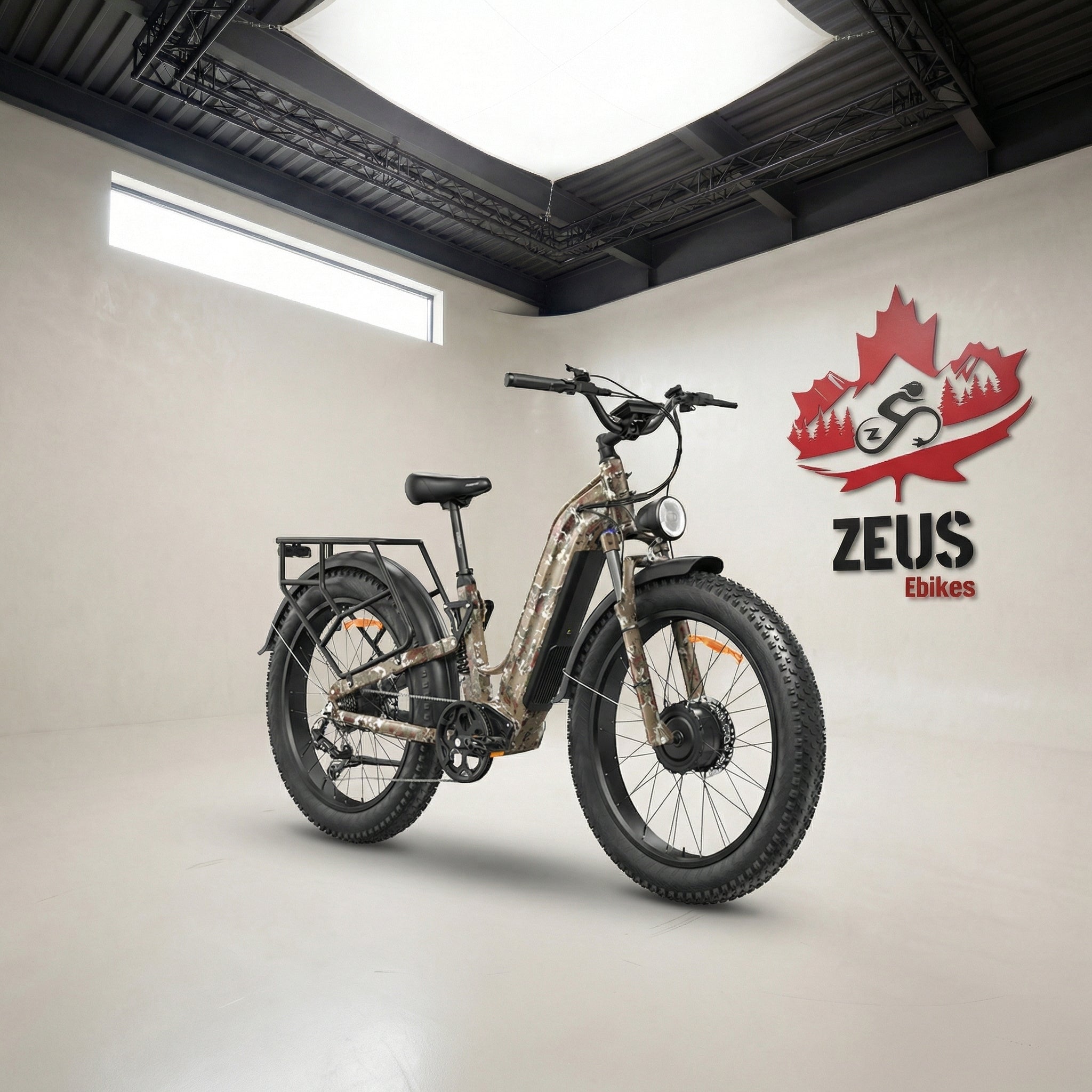
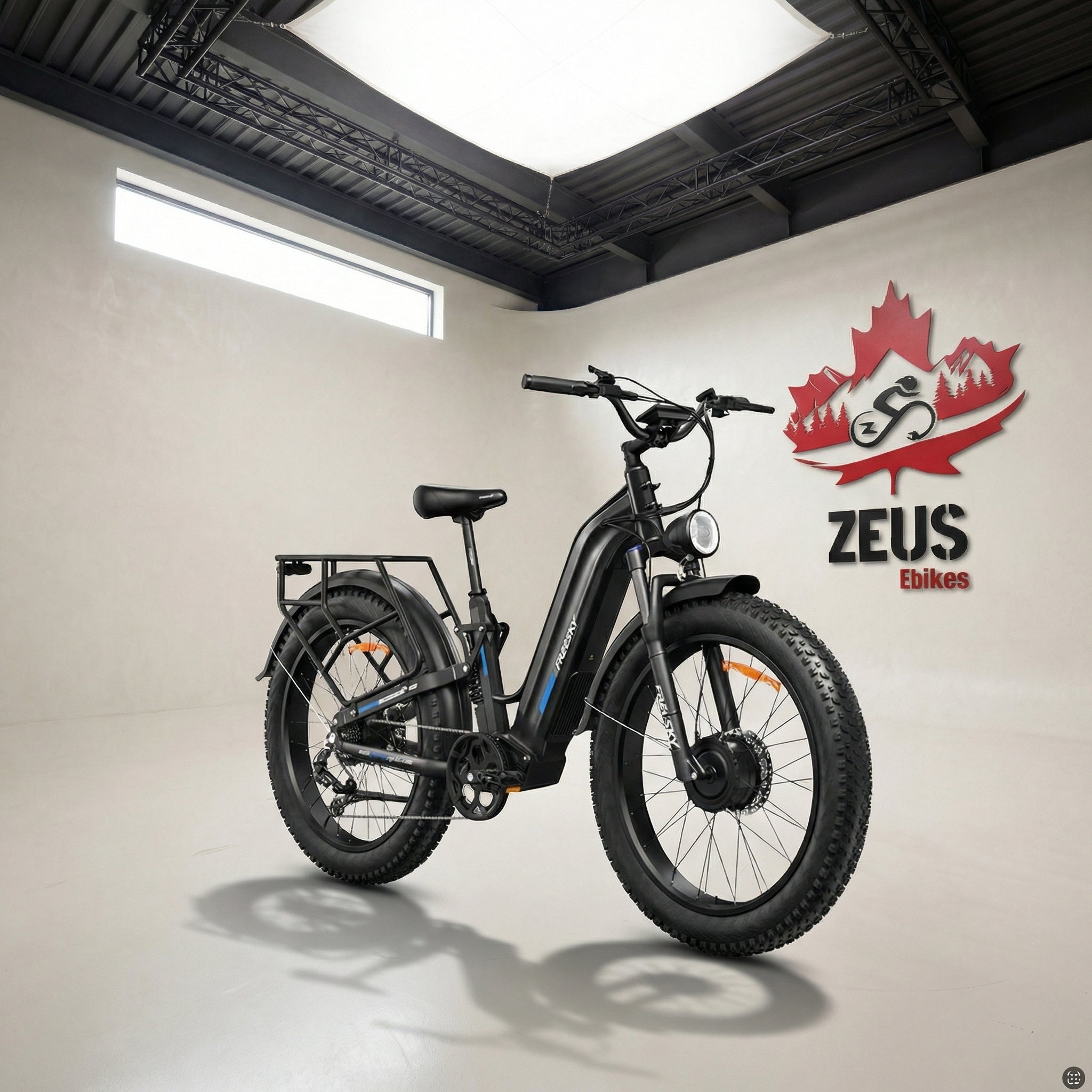
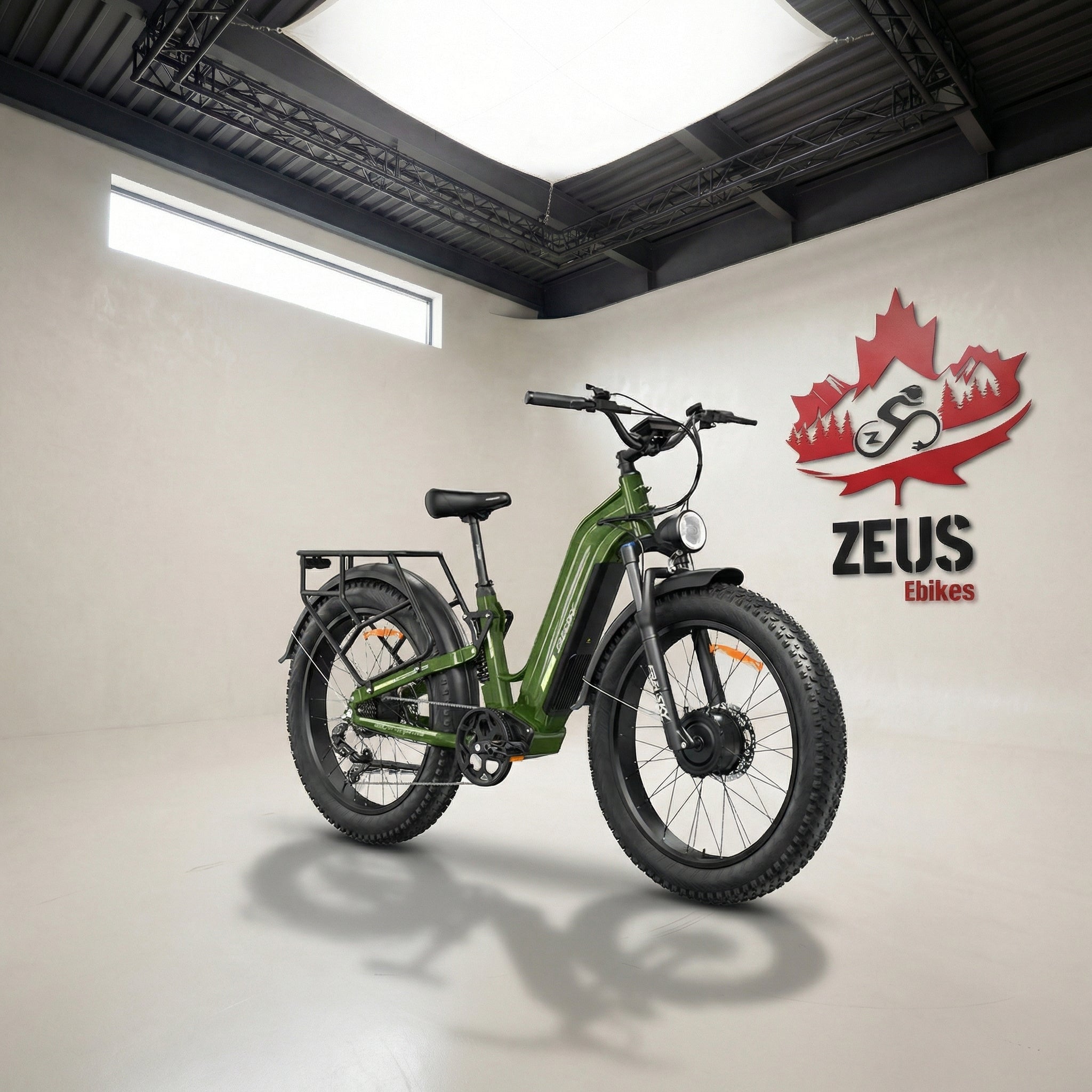
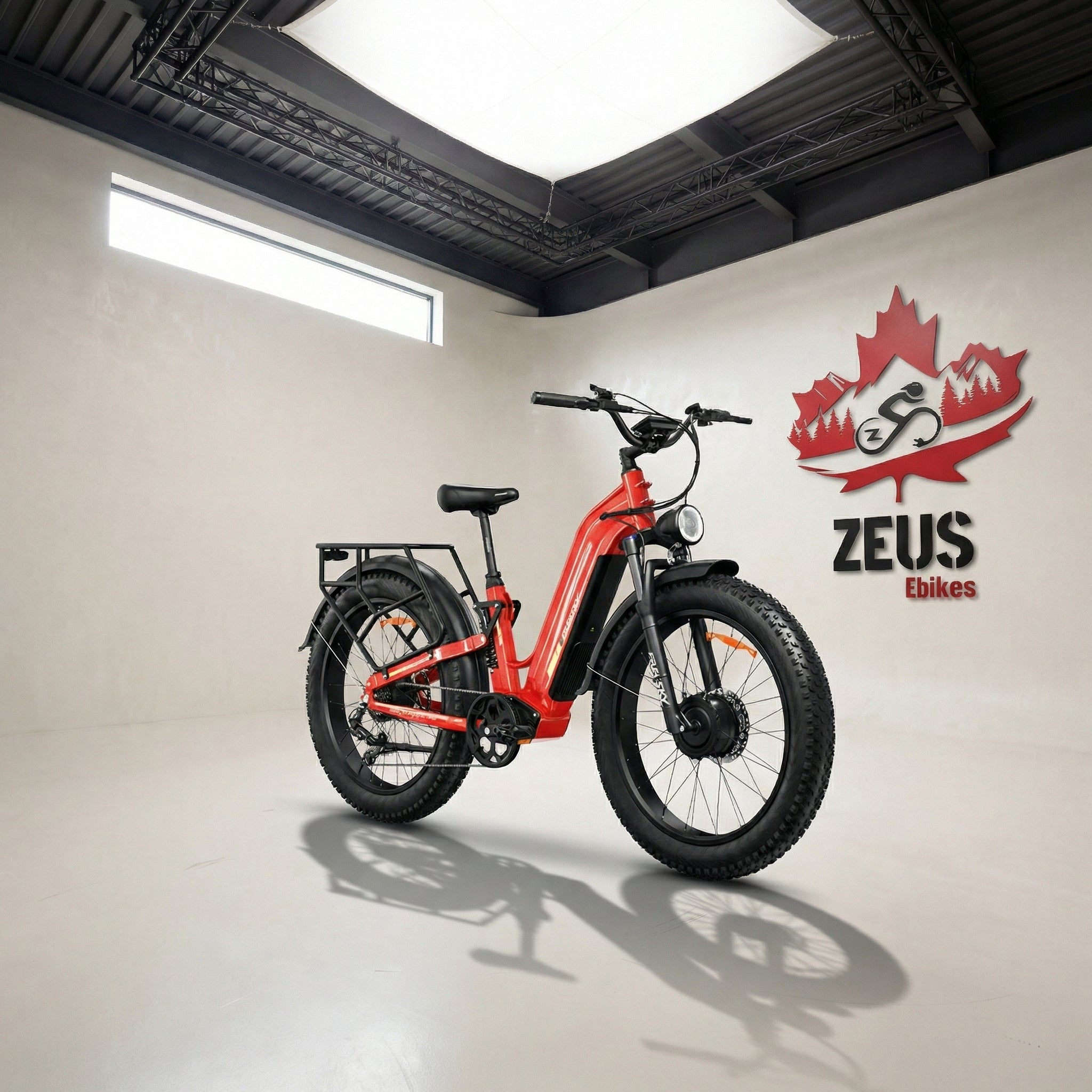

Freesky Ranger Plus M-540
Every Zeus e-bike includes a free 1-month warranty plus manufacturer coverage. Add the Zeus Extended Warranty for dedicated support from our Canadian team — remote diagnostics, manufacturer claim handling & return-shipping coordination — for up to 5 years.
Your selected plan is added automatically when you tap Add to Cart. No extended warranty is added by default.
A support & service plan — it does not cover physical repairs or replacement parts. See full warranty details →
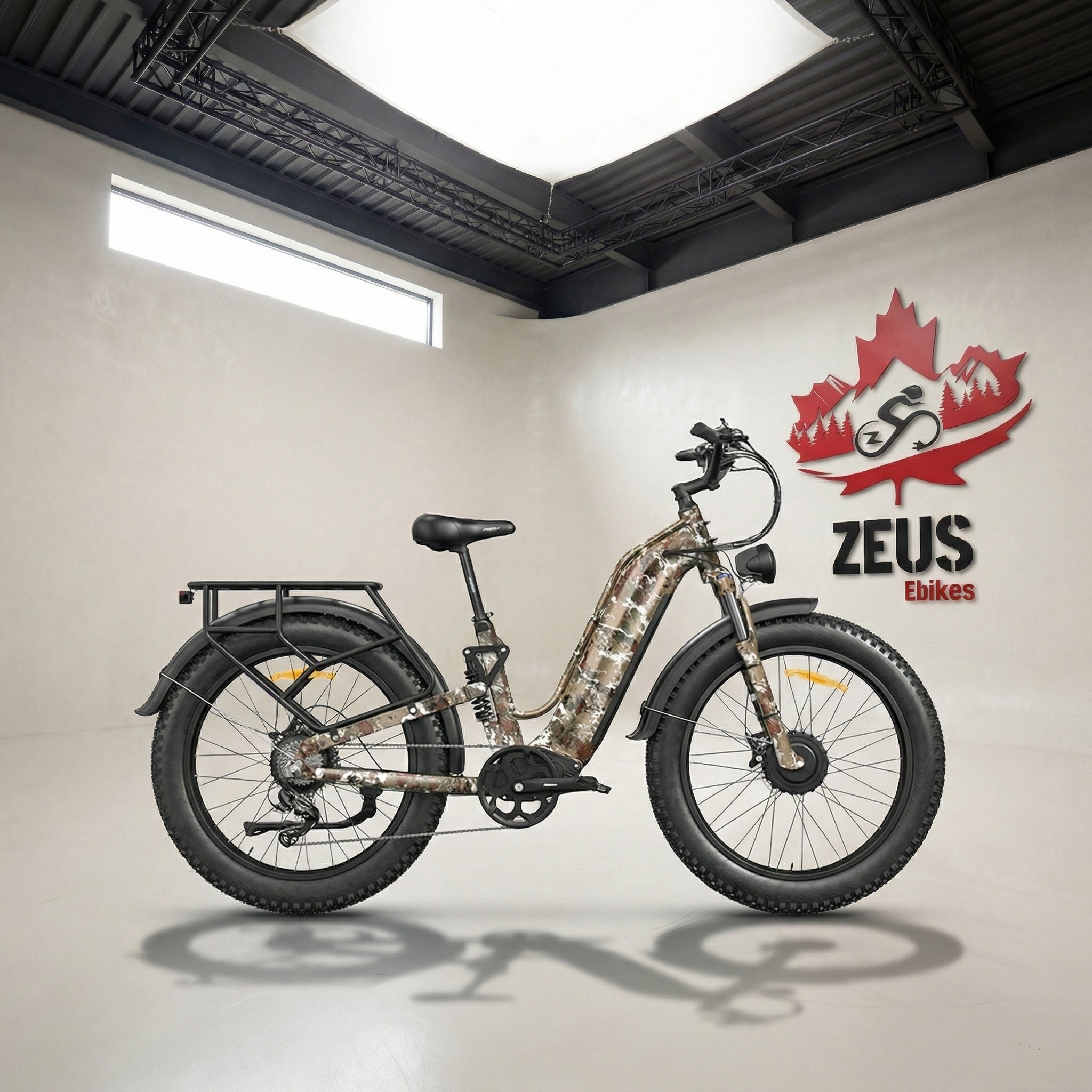
Freesky Ranger Plus M-540
The Ranger Air’s Bigger Sibling — 4,000W AWD, 1,440 Wh, Same Step-Thru You Can Actually Mount
The Freesky Ranger Air M-540 was already the only step-thru AWD fat-tire eBike in our catalogue. The Ranger Plus M-540 takes the same platform and turns every dial up 20%. 4,000W peak dual-motor AWD (up from 3,500W). 220 N·m of combined torque (up from 200). 1,440 Wh battery (up from 1,200). And you still step through an 18″ opening to ride it. For riders who looked at the Ranger Air and thought “I want more headroom before I commit,” Freesky just answered.
The math is straightforward. 1,440 Wh is 20% more battery than the Ranger Air’s 1,200 Wh. That translates to roughly 20% more range on both single-motor and AWD modes. In Canadian winter at −10°C — where lithium-ion cells lose 20–30% capacity — the Plus starts from a higher baseline, which means the cold takes a smaller bite out of your usable day. The 220 N·m torque increase matters on steep terrain: steeper grades that bogged the Ranger Air at PAS 3 resolve at PAS 2 on the Plus, which also conserves battery. More torque and more battery are not independent upgrades — they compound.
The trade-off is weight: 106 lbs (up from the Ranger Air’s 95 lbs). Eleven more pounds of battery, motor copper, and frame reinforcement. Everything we said about the Ranger Air’s weight applies here, plus eleven. Ground-level storage. Two-person vehicle loading. No stairs. If that is a dealbreaker, the Ranger Air delivers 83% of the power at 89% of the weight.
$2,686 CAD with free Canada-wide shipping. Rack and fenders included. Finance from ~$112/month →
Assembly, Manual & Setup
The Ranger Plus ships ~85% pre-assembled in a reinforced carton. Two adults recommended for unboxing — the bike weighs 106 lbs in the box. Final assembly takes 30–45 minutes:
- Unbox and inventory all parts against the printed checklist
- Install the front wheel (align the front brake disc between the caliper pads)
- Mount and align the handlebars (tighten stem bolts evenly)
- Thread in both pedals (right clockwise, left counter-clockwise)
- Adjust the seat height (34″–39″ range)
- Charge the battery fully before the first ride (~10 hours from empty with the included 3A charger)
- Set up NFC security: tap the included NFC card to the display to pair it
- Test both brakes, all three drive modes (front/rear/AWD), and all 5 PAS levels before your first real ride
Printed Owner’s Manual: Included in the box. Covers assembly, display operation, PAS levels (0–5), NFC security pairing, drive mode selection (front/rear/AWD), charging procedures, and maintenance schedules.
Watch Before You Buy
The Ranger Plus M-540 is new to the Freesky lineup (March 2026). Independent reviews are forthcoming. The assembly process follows the same M-540 platform as the Ranger Air — see the assembly guide below:
Freesky M-540 Platform — Assembly & Installation Guide:
Why 1,440 Wh + 220 N·m in a Step-Thru Changes the Equation
The Ranger Air solved the access problem. A 250 lb rider with a stiff hip could get real AWD power through a step-thru frame. The Ranger Plus solves the endurance problem: what happens when that rider wants to ride all day, or commute in February, or haul cargo on gravel for 80+ km without thinking about the battery.
1,440 Wh is not just “more.” It crosses a threshold. At typical Canadian mixed riding consumption of 15–20 Wh/km on single motor, the Ranger Plus delivers 72–96 km before the battery drops below 50%. For most riders, that is a full day of practical use without ever seeing a low-battery warning. On AWD, which consumes roughly 30–40% more energy, the same rider gets 50–70 km before half-charge. That is enough for a morning trail session plus an afternoon errand run — on both motors.
The torque increase matters independently. 220 N·m across two motors means each wheel delivers 110 N·m — 10% more than the Ranger Air per motor. On loose gravel climbs where AWD already keeps you moving, the extra torque lets you maintain speed at a lower PAS level. Lower PAS = lower current draw = more range from the same battery. The power and battery upgrades are not just additive — they multiply.
| Scenario | Ranger Air (1,200 Wh) | Ranger Plus (1,440 Wh) | Difference |
|---|---|---|---|
| Summer — single motor | 96–153 km | 115–184 km | +20% |
| Summer — AWD | 64–97 km | 77–116 km | +20% |
| Winter (−10°C) — single motor | 58–92 km | 69–110 km | +20% |
| Winter (−10°C) — AWD | 38–58 km | 46–70 km | +20% |
| Charge time (3A charger) | ~8 hours | ~10 hours | +2 hrs |
| Price | $2,373 | $2,686 | +$313 |
$313 buys you 240 more Wh, 20 more N·m, and 500 more watts of peak power. That is $1.30 per additional Wh — a better upgrade ratio than buying a second battery on most other platforms. For riders who plan to use AWD regularly or ride in Canadian winter, the Plus pays back the premium in range margin alone.
For a detailed breakdown of how watt-hours translate to real-world range across Canadian terrain and weather, see our long-range eBike guide →
AWD Explained — Two Motors, One Job
All-wheel drive on an eBike solves a traction problem that single-motor bikes cannot. When the rear wheel breaks loose on wet grass, packed snow, loose gravel, or icy patches, a single-motor bike fishtails or stalls. The Ranger Plus puts a motor in each wheel — front pulling, rear pushing — and the effect is immediate: the bike claws forward where other bikes spin.
The Ranger Plus offers selectable drive modes:
- Rear only — conserve battery on dry pavement. Use this for paved commutes and clear roads.
- Front only — rare use case, but available for specific traction situations.
- Full AWD — both motors at full output. Snow, gravel, mud, steep climbs, wet terrain.
On dry pavement, run rear-only and save your battery. When the surface gets loose or slippery, engage AWD and the front motor provides the traction insurance that single-motor bikes simply cannot offer. This flexibility means you are not running both motors (and consuming 30–40% more energy) when you do not need to.
For a full comparison of single-motor vs dual-motor performance across Canadian terrain, see our dual-motor eBike guide →
Key Features
- Dual 2,000W Peak Hub Motors — 4,000W Combined — 220 N·m — AWD — One motor per wheel. 2,000W peak per motor is a step up from the Ranger Air’s 1,750W per motor — that is 500W more peak power system-wide, visible as faster acceleration from a stop and more sustained power on long climbs. 110 N·m per motor means the front wheel pulls with real authority on surfaces where hub motors typically struggle. Top speed: 40 mph (64 km/h) on full PAS. Default is limited to 20 mph (32 km/h) — adjustable through display settings. Wattage guide →
- 48V 30Ah Battery — 1,440 Wh — UL2271 — The largest battery in any Freesky model, and 20% more than the Ranger Air’s 1,200 Wh. Single-motor mode: 115–184 km summer. Dual AWD: 77–116 km summer. In Canadian winter below −10°C, expect 20–30% capacity loss — the Plus still yields 69–110 km single motor or 46–70 km AWD in cold. UL2271 certification covers thermal runaway, impact, and overcharge testing. The battery is frame-integrated and removable for indoor charging — critical for lithium longevity in Canadian winters. Charges in approximately 10 hours with the included 3A charger. Full range guide →
- 18″ Step-Thru Frame — 6061 Aluminium — The reason this platform exists. An 18″ clearance means you step through, sit, and ride. No crossbar to clear. No wrestling 106 lbs over your leg. Aircraft-grade 6061 aluminium maintains the frame stiffness required for dual-motor torque loads — 220 N·m through both axles demands a frame that does not flex. Fits 5’4″–6’8″ (163–203 cm). See the full Step-Thru collection →
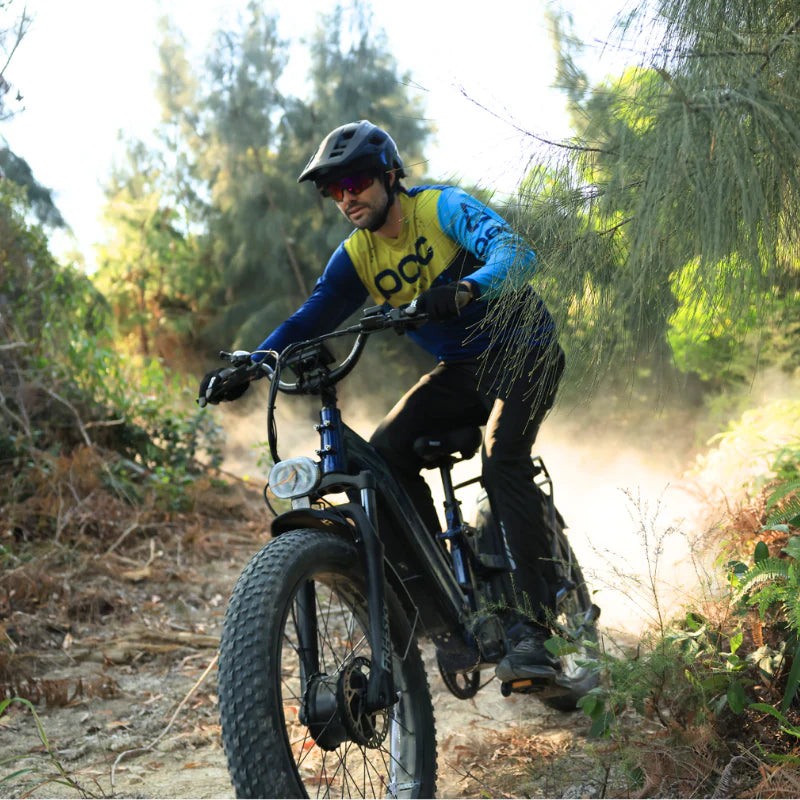
- Full Suspension — Front Fork + Rear Shock — The front fork absorbs roots, rocks, and the pothole craters that Canadian freeze-thaw cycles leave behind every April. The rear shock handles sustained trail chatter and rough terrain. Combined with 4″ fat tires, the system keeps a 106 lb machine comfortable for hours on gravel trails, packed earth, and frost-heaved pavement. The Plus benefits from the upgraded suspension tuning to handle the additional 11 lbs over the Ranger Air.
- 4-Piston Hydraulic Disc Brakes — 180 mm Rotors — Four pistons per caliper generate substantially more clamping force than the two-piston units standard on most eBikes. At 106 lbs of bike, 400 lbs of payload, and 40 mph top speed, four-piston brakes are the minimum responsible spec. Consistent feel in rain, snow, and mud without cable stretch or fade on long descents.
- 26″ × 4.0″ Fat Tires — Four inches of contact width floats over sand, snow, mud, and loose gravel. The 26″ wheel diameter rolls over obstacles more smoothly than 20″ fat-tire bikes and gives the Ranger Plus a taller, more stable ride height. The larger wheel also improves rolling efficiency on pavement compared to smaller-diameter fat tires. Fat tire eBike guide →
- Colour LCD Display with NFC Lock/Start — Tap the included NFC card (or a programmed phone) to unlock the electrical system. Without authentication, motors and display stay locked — the bike becomes a 106 lb paperweight to anyone without the card. The display shows speed, battery percentage, PAS level, trip data, drive mode, and headlight status. NFC anti-theft at this level is typically a $3,000+ feature. Keep the spare NFC card in a separate location — if you lose both, you are locked out until you contact Freesky for a replacement.
- 800-Lumen LED Headlight — Most eBike headlights run 200–400 lumens — enough to be visible, not enough to illuminate trail ahead of you at 30+ km/h. 800 lumens throws a usable cone of light for genuine after-dark riding. Rear LED tail light provides visibility from behind.
- Shimano 7-Speed — KMC Chain — Seven mechanical gears layer on top of five PAS levels. Low gear for comfortable pedalling on climbs; high gear for efficient cruising. KMC chain is globally serviceable at any bike shop. The 7-speed is functional, not refined — see our honest take below for why Freesky should have gone to 8 or 9.
- 400 lb Payload — A 280 lb rider still has 120 lbs of cargo margin. AWD distributes drive force across both wheels, eliminating the rear-wheel spin that single-motor bikes suffer under heavy loads on loose terrain. The rear rack handles panniers, bungee cargo, or a rear basket. Heavy rider guide →
- UL2849 + UL2271 — TÜV Verified — UL2849 certifies the complete eBike system (electrical, mechanical, functional). UL2271 certifies the battery (thermal runaway, impact, overcharge). Both verified by TÜV, an independent testing body. Dual UL certification is increasingly required by Canadian insurers and building managers. Most eBikes under $3,000 carry no independent safety certification at all.
- Rear Rack + Front & Rear Fenders — All Included — Factory-installed rear rack for panniers, bungee cargo, or a basket. Front and rear fenders keep road spray, mud, and slush off you and the drivetrain. Not aftermarket add-ons — they ship on the bike.
Everything Included
Ships ~85% pre-assembled. Expect 30–45 minutes: pedals, seat post, handlebars, front wheel. Two adults recommended for unboxing — the bike weighs 106 lbs in the box.
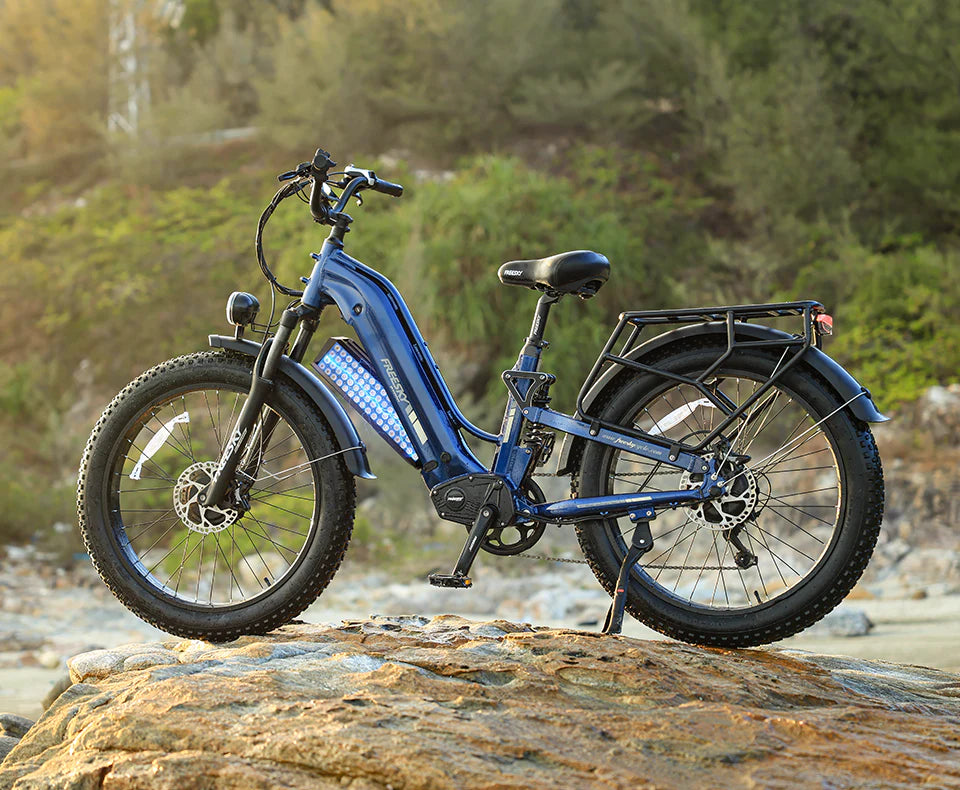
- Freesky Ranger Plus M-540 eBike — Black, Blue, Green, or Camouflage
- 48V 30Ah (1,440 Wh) lithium-ion battery — UL2271 (frame-integrated, removable)
- 3A smart charger (~10 hours 0–100%)
- Colour LCD display with NFC (pre-installed)
- NFC card for lock/start
- 800-lumen LED headlight (pre-installed)
- Rear LED tail light (pre-installed)
- Front and rear fenders (pre-installed)
- Rear rack (pre-installed)
- Heavy-duty adjustable aluminium kickstand (pre-installed)
- Pedals
- Assembly tool kit
- Owner’s manual
No hidden required purchases. Free Canada-wide shipping — Zeus coordinates delivery to your door.
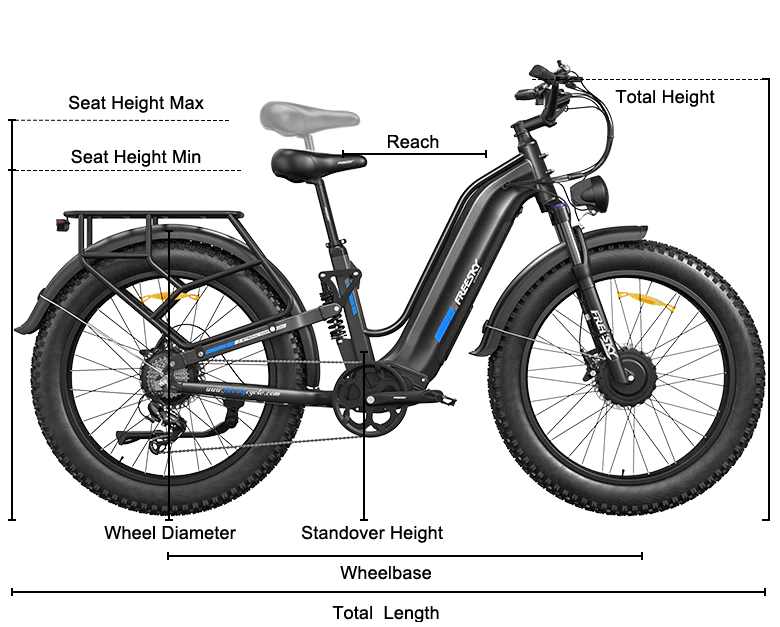
Dimensions & Fit Guide
| Frame Geometry | |
|---|---|
| Frame Type | Step-thru — 18″ (46 cm) step-through height |
| Total Length | ~78″ / ~198 cm |
| Wheelbase | ~51″ / ~130 cm |
| Total Height | ~46″ / ~117 cm |
| Seat Height (Min–Max) | 34″–39″ / 86–99 cm |
| Recommended Rider Height | 5’4″–6’8″ / 163–203 cm |
Fit notes: The Ranger Plus shares the M-540 step-thru platform with the Ranger Air. The 18″ step-through height provides generous clearance for mounting and dismounting — you are not swinging over a high bar, even at 106 lbs. The 34″ minimum seat height suits riders around 5’4″ who want to flat-foot at stops. The ~51″ wheelbase is long for a 26-inch-wheel bike; combined with the 106 lb mass, this creates a planted, stable ride at speed that resists crosswinds and road irregularities. The trade-off is manoeuvrability — tight U-turns require more room than a lighter, shorter-wheelbase bike. Riders at 5’4″–5’6″ will tippy-toe at stops — the step-thru frame makes this manageable since you can lean the bike and step through to dismount.
The 106 lb Reality — Let’s Talk About It
106 lbs is not normal. Most eBikes weigh 55–85 lbs. The Ranger Plus weighs 11 lbs more than the Ranger Air, which was already heavy at 95 lbs. Here is where the weight comes from and why it exists:
- Battery: the 1,440 Wh pack is physically larger and heavier than the Ranger Air’s 1,200 Wh pack. More cells = more weight. There is no way around this.
- Dual motors: two hub motors, each with its own stator, magnets, and housing. The Plus’s 2,000W-peak motors are slightly beefier than the Air’s 1,750W units.
- Frame reinforcement: The frame must handle 220 N·m of torque through both axles without flexing — especially in a step-thru design where the missing crossbar means the frame works harder.
- Full suspension adds weight over a hardtail design. Front fork + rear shock = more hardware.
- Fenders, rack, 4-piston brakes, 203 mm rotors: Every included accessory and brake component adds incremental weight.
Do not buy this bike if you need to carry it. Up stairs, onto a car rack without a ramp, through a narrow hallway — at 106 lbs, every one of those scenarios is a two-person job. You need ground-level storage: a garage, a shed, a ground-floor lock-up. A loading ramp for vehicle transport is not optional. If you chose step-thru for ease of handling beyond just mounting, the weight may surprise you. The step-thru makes getting ON easy — it does not make 106 lbs lighter to push, lift, or manoeuvre at walking speed.
Once you are riding, the weight disappears. The 220 N·m motors move 106 lbs like it is not there. The low centre of gravity (26-inch fat tires + heavy frame) makes the bike feel stable and planted at speed, not top-heavy. In crosswinds, on gravel, over bumps — heavier bikes track straighter. The weight that is a problem in your hallway becomes an advantage on the trail.
If weight matters more than power, the Ranger Air M-540 delivers 87% of the power at 11 lbs less. Single-motor step-thrus in our Step-Thru collection weigh 35–65 lbs.
The Honest Take — What We’d Change
Zeus sells this bike because the step-thru AWD combination with 1,440 Wh and dual UL certification does not exist anywhere else in our catalogue — or anyone else’s. That said:
- Cadence sensor, not torque sensor. Same compromise as the Ranger Air, and it matters more at 4,000W. The cadence sensor detects whether you are pedalling, not how hard. Assist is binary per PAS level: on when spinning, off when stopped. No proportional, natural-feeling pedal response. For throttle-dominant off-road riding, cadence sensing is adequate. For shared-pathway riding near pedestrians where precise speed control matters, the difference is real. The Himiway D5 Pro ST ($2,699) offers a genuine torque sensor with mid-drive efficiency — though it sacrifices AWD to do it. Torque vs cadence explained →
- 106 lbs contradicts the step-thru promise even more than the Air’s 95 lbs did. Riders choose step-thru frames because they want easy handling. At 106 lbs, you step through easily — then manoeuvre a bike that weighs more than most step-over AWD competitors. Ground-level storage is mandatory. A loading ramp is not optional. If you chose step-thru for handling ease beyond just mounting, this weight will test that assumption.
- 7-speed Shimano is undergunned for a 4,000W machine. A bike with 40 mph top speed and 220 N·m deserves 8- or 9-speed gearing. The wider cassette spread would better match the Plus’s terrain range and speed envelope. The Himiway D5 Pro ST runs 9-speed Shimano Altus. The Eunorau FAT-HD 2.0 runs 9-speed Shimano. Both are more appropriate for this power class. Freesky chose to invest in the NFC display, 4-piston brakes, and UL dual certification instead. Defensible trade-off, but the gearing is where you feel the budget decision.
- 10-hour charge time with the included 3A charger. The Ranger Air charges in ~8 hours with the same 3A charger and a smaller battery. The Plus’s 30Ah pack needs ~10 hours from empty — that is an overnight charge, not an afternoon top-up. At this battery size, Freesky should have included a 5A charger. Budget for an aftermarket fast charger if same-day recharging matters to your riding pattern.
- No turn signals. At 106 lbs capable of 40 mph, the Ranger Plus has the road presence of a moped. Turn signals should be standard. Budget $30–$50 for aftermarket. The Velotric Discover 3 ($2,699) includes integrated turn signals with handlebar controls — at this price tier, it should be expected.
- Not street-legal in Canada. 4,000W combined peak far exceeds the federal 500W limit for power-assisted bicycles. This bike is sold for off-road trails, private property, and routes that permit motorised vehicles. No public roads, no bike lanes, no pathways.
Those trade-offs acknowledged: a step-thru frame with genuine 4,000W AWD, 1,440 Wh, full suspension, 4-piston brakes, NFC security, UL dual certification, rack, fenders, and 400 lb payload does not exist anywhere else. The Ranger Plus M-540 is the Ranger Air with the headroom that serious riders asked for.
Full Specifications
| Motor & Performance | |
|---|---|
| Motor Configuration | Dual hub motors — All-Wheel Drive (AWD) |
| Combined Peak Power | 4,000W (2,000W per motor) |
| Combined Torque | 220 N·m (110 N·m per motor) |
| Sensor Type | Speed sensor (cadence-based) |
| Pedal Assist Levels | 5 (PAS 0–5) |
| Throttle | Thumb throttle |
| Top Speed | 40 mph (64 km/h) |
| Default Speed Limit | 20 mph (32 km/h) — adjustable via display |
| Drive Modes | Rear only · Front only · AWD (selectable) |
| Battery & Range | |
| Battery | 48V 30Ah (1,440 Wh) — lithium-ion, advanced BMS |
| Battery Certification | UL2271 (TÜV verified) |
| System Certification | UL2849 (complete eBike system, TÜV verified) |
| Battery Mounting | Integrated into frame, removable for indoor charging |
| Charger | 3A smart charger — ~10 hours full charge |
| Range — Single Motor (Summer) | 115–184 km (72–114 miles) |
| Range — Dual Motor AWD (Summer) | 77–116 km (48–72 miles) |
| Winter Range (−10°C, 20–30% loss) | 46–110 km depending on drive mode |
| Frame & Geometry | |
| Frame | 6061 aluminium — step-thru |
| Step-Thru Height | 18″ (46 cm) |
| Total Length | ~78″ (~198 cm) |
| Wheelbase | ~51″ (~130 cm) |
| Total Height | ~46″ (~117 cm) |
| Seat Height | 34″–39″ (86–99 cm) |
| Rider Height | 5’4″–6’8″ (163–203 cm) |
| Colours | Black · Blue · Green · Camouflage |
| Weight | 106 lbs / 48 kg |
| Maximum Payload | 400 lbs (181 kg) |
| Suspension & Brakes | |
| Suspension | Full — front fork + rear shock absorber |
| Brakes | 4-piston hydraulic disc — 180 mm rotors front & rear |
| Drivetrain | |
| Gears | Shimano 7-speed |
| Chain | KMC |
| Tires | 26″ × 4.0″ fat |
| Electronics | |
| Display | Colour LCD with NFC lock/start |
| Headlight | 800-lumen LED |
| Rear Light | LED tail light |
| Turn Signals | Not included (aftermarket recommended) |
| Included Accessories | |
| Fenders | Front & rear — included |
| Rear Rack | Included (pre-installed) |
| Kickstand | Heavy-duty adjustable aluminium |
| Shipping & Warranty | |
| Shipping | Free Canada-wide |
| Assembly | ~85% pre-assembled — 30–45 min |
| Motor & Battery Warranty | 24 months |
| Other Parts Warranty | 12 months |
Who Buys the Ranger Plus M-540?
- Riders who looked at the Ranger Air and wanted more headroom — The Air is a capable bike. The Plus is the Air without compromise. 20% more battery means 20% more range in every mode. 10% more torque per motor means steeper climbs at lower PAS. If you ride AWD regularly — winter, gravel, trails — the Plus’s larger battery pays for itself in reduced range anxiety. The $313 premium buys real capability, not cosmetic upgrades.
- Riders with mobility constraints who need real power — Hip replacement recovery. Arthritic knees. Reduced flexibility after 60. A back that does not bend the way it used to. These are not reasons to accept a 350W step-thru cruiser — they are reasons to need a 4,000W AWD machine with a frame you can actually mount. The 18″ step-thru and throttle-only mode mean you never have to pedal if you cannot. Seniors guide →
- Heavy riders up to 400 lbs — 400 lb payload. AWD traction prevents the rear-wheel spin that single-motor bikes suffer under heavy loads on gravel and grass. A 280 lb rider still has 120 lbs of cargo margin. The Plus’s extra torque (220 vs 200 N·m) is most noticeable under heavy riders on inclines. Heavy rider guide →
- Canadian winter riders — AWD + fat tires + full suspension is the correct configuration for November–March riding. The Plus’s 1,440 Wh battery delivers 46–70 km on AWD in winter — enough for a real day of cold-weather riding. The Ranger Air’s 1,200 Wh delivered 38–58 km in the same conditions. That 20% margin is the difference between making it home comfortably and watching the battery percentage with anxiety. Winter guide →
- Rural riders, acreage owners, property workers — 115–184 km of single-motor summer range means you check fences, ride to the back 40, commute to town, and return without thinking about charging. The 400 lb payload handles rider plus gear plus tools. AWD handles the unpaved roads that connect rural properties to everything else. The rear rack carries what you need.
- Throttle-first riders — If you ride primarily on throttle (not pedal assist), the cadence-vs-torque sensor distinction matters less. The Plus with throttle control is a powerful, responsive machine regardless of sensor type. 4,000W on throttle is genuinely fun. Pedal assist vs throttle guide →
Who it is NOT for:
- Riders who prioritise light weight — 106 lbs requires ground-level storage, a ramp for vehicle loading, and is genuinely heavy to push uphill with no motor. The Ranger Air at 95 lbs or single-motor step-thrus in the Step-Thru collection at 35–65 lbs are better options.
- Apartment dwellers above ground level — 106 lbs. Stairs. No.
- Riders who want torque-sensor precision — The Himiway D5 Pro ST ($2,699) offers a true torque sensor with mid-drive efficiency in a step-thru fat-tire frame, though it trades AWD to get there.
- Street commuters — At 4,000W, the Plus is off-road only in Canada. If you need a legal commuter with step-thru and premium tech, the Velotric Discover 3 ($2,699) is the better choice.
- Budget-conscious buyers who do not need the upgrade — If the Ranger Air’s 1,200 Wh and 3,500W cover your use case, save $313. The Plus is for riders who will genuinely use the extra capacity.
How It Compares — Cross-Brand
| Spec |
Ranger Plus M-540 This bike |
Velotric Discover 3 View → |
Himiway D5 Pro ST View → |
Eunorau FAT-HD 2.0 View → |
|---|---|---|---|---|
| Price | $2,686 | $2,699 | $2,699 | From $3,239 |
| AWD / Dual Motor | Yes (4,000W) | No — single 1,100W | No — single 1,300W | No — single 1,500W+ |
| Torque | 220 N·m | 75 N·m | 130 N·m | 160 N·m |
| Battery | 1,440 Wh | 730 Wh | 960 Wh | 720 Wh (dual to 1,440) |
| Motor Type | Dual hub | Single hub | Mid-drive | Mid-drive (Bafang) |
| Sensor | Cadence | SensorSwap (torque + cadence) | Torque | Torque |
| Frame | Step-Thru | Step-Thru | Step-Thru | Step-Over |
| Tires | 26×4.0″ fat | 27.5×2.4″ | 26×4.0″ fat | 26×4.0″ fat |
| Suspension | Full (front + rear) | 80 mm air fork + seatpost | Full (230 mm total travel) | Front fork only (hardtail) |
| Brakes | 4-piston hyd. 180 mm | 2-piston hyd. 180 mm | 2-piston hyd. 180 mm | 2-piston hyd. 180 mm |
| Gears | Shimano 7-speed | Shimano 8-speed | Shimano 9-speed Altus | Shimano 9-speed |
| Weight | 106 lbs | 65 lbs | 79 lbs | 80 lbs |
| Payload | 400 lbs | 440 lbs | 400 lbs | 375 lbs |
| NFC Security | Yes | Yes | No | No |
| Turn Signals | No | Yes | No | No |
| UL Certified | UL2849 + UL2271 | UL2849 + UL2271 | — | — |
| Rack + Fenders | Both included | Both included | Rack only | Neither |
Choose the Ranger Plus M-540 if: You need step-thru + AWD. That combination exists nowhere else in our store — or anyone else’s. The Plus leads in raw power (4,000W vs 1,500W max for the others), torque (220 N·m vs 160 N·m max), battery capacity (1,440 Wh standard — the Eunorau only matches it with an optional second battery), and braking (4-piston vs 2-piston). It also carries dual UL certification and NFC security. If your riding involves snow, gravel, hills, and variable terrain where AWD traction is the difference between riding and walking, this is the only step-thru answer.
Choose the Velotric Discover 3 if: You do not need AWD or fat tires and prioritise ride quality and technology. The Discover 3 has the best sensor in this group (SensorSwap toggles between torque and cadence on the fly), the best electronics (Apple Find My + Android Find Hub, 3.5″ colour display), the lightest weight (65 lbs — 41 lbs lighter than the Plus), integrated turn signals, and a 3-hour fast charger. It is the premium commuter. The trade-off: single motor, regular tires, no AWD — it will not handle the terrain the Ranger Plus was built for.
Choose the Himiway D5 Pro ST if: You want the best pedal feel in a step-thru fat-tire frame. The mid-drive motor with true torque sensor provides natural, proportional pedal response that the Ranger Plus’s cadence sensor cannot match. 230 mm of total suspension travel (100 mm front + 130 mm rear) is the most published travel on this table. Shimano 9-speed Altus gearing matches the power class better than the Plus’s 7-speed. The trade-off: single motor (no AWD traction rescue), less battery (960 Wh vs 1,440 Wh), and no NFC security.
Choose the Eunorau FAT-HD 2.0 if: You are a hunter or off-road rider who needs whisper-quiet Bafang mid-drive power, torque-sensor precision, and the option to expand to 1,440 Wh with a second battery. The 160 N·m torque multiplies through the 9-speed gears for devastating climbing power. The trade-off: step-over frame only (no step-thru option), hardtail (no rear suspension), $553 more expensive, and the dual-battery option costs extra on top of that.
Frequently Asked Questions
Is the Ranger Plus M-540 street-legal in Canada?
No. 4,000W combined peak exceeds the federal 500W limit for power-assisted bicycles. The Ranger Plus is sold for off-road trails, private property, and motorised-vehicle-permitted routes.
What is the difference between the Ranger Plus M-540 and the Ranger Air M-540?
Same step-thru AWD platform. The Plus upgrades three core specs: battery (1,440 Wh vs 1,200 Wh — 20% more), peak power (4,000W vs 3,500W), and torque (220 N·m vs 200 N·m). It also weighs 11 lbs more (106 vs 95 lbs) and costs $313 more ($2,686 vs $2,373). Both share the same frame geometry, 4-piston brakes, NFC security, UL dual certification, and Shimano 7-speed gearing. The Ranger Air is the lighter, more affordable entry point. The Plus is the no-compromise version.
What range should I expect in Canadian winter?
Lithium-ion cells lose 20–30% capacity below −10°C. From the Plus’s 1,440 Wh: 69–110 km single motor or 46–70 km on AWD in winter. Maximise cold-weather range by storing the battery indoors overnight, installing it just before riding, and running single-motor mode on cleared roads. Even the winter low end (46 km on AWD) exceeds most riders’ daily needs. Winter eBike guide →
Does it have a torque sensor?
No. The Ranger Plus uses a cadence sensor (speed sensor). Assist delivers a fixed power level based on PAS setting (0–5) regardless of how hard you push the pedals. For throttle-dominant and off-road riding, this is functional. For shared pathways where proportional speed control matters near pedestrians, a torque sensor is noticeably better. Torque-sensor alternatives: Himiway D5 Pro ST ($2,699 — step-thru fat tire with torque sensor + mid-drive) or Velotric Discover 3 ($2,699 — SensorSwap with both torque and cadence modes). Sensor guide →
How heavy is it, and how do I handle it?
106 lbs. Practical reality: (1) Ground-level or garage storage is mandatory — do not plan to carry this up stairs. (2) Use a loading ramp for truck or van transport — two people lifting without a ramp risks injury. (3) The step-thru frame makes mounting and dismounting easy, but does not reduce the weight you are manoeuvring at walking speed. (4) The battery is removable — removing it drops the bike to roughly 75–80 lbs, which is more manageable for single-person handling in a pinch.
What rider heights fit this bike?
Freesky rates it for 5’4″–6’8″ (163–203 cm). The seat adjusts from 34″ to 39″. The 18″ step-thru height is accessible for most riders including those with limited hip or knee mobility. Riders at 5’4″–5’6″ will tippy-toe at stops — the step-thru frame makes this manageable.
What certifications does it have?
UL2849 + UL2271, both TÜV verified. UL2849 certifies the complete eBike system. UL2271 certifies the battery (thermal runaway, impact, overcharge). Dual UL certification at this price point is uncommon — most eBikes under $3,000 carry no independent safety certification. The Velotric Discover 3 also carries UL2849 + UL2271 at a similar price. Neither the Himiway D5 Pro ST nor the Eunorau FAT-HD 2.0 list UL certifications.
How long does the battery take to charge?
Approximately 10 hours from empty to full with the included 3A charger. That is an overnight charge. The battery is 30Ah; at 3A charging current, 30 ÷ 3 = 10 hours theoretical. For same-day recharging or multi-ride days, consider an aftermarket 5A charger to cut charge time to ~6 hours.
Can I finance this bike?
Yes. Zeus eBikes offers financing across Canada at checkout. At $2,686, biweekly Klarna payments are approximately $672. Monthly financing from ~$112/month depending on term. Financing guide with lender options and payment examples →
Zeus eBikes Canada — Free Canada-wide shipping. Canadian-based team handling every warranty claim, service question, and pre-purchase consultation. Contact us →
More from Zeus:
- Fat Tire Electric Bikes Canada (2026) →
- Best Dual Motor eBikes Canada (2026) →
- 500W vs 750W vs 1000W: Which Wattage Is Right? →
- Long Range eBikes Canada (2026) →
- Best eBikes for Heavy Riders Canada (2026) →
- Best eBikes for Winter Canada (2026) →
- Pedal Assist vs Throttle eBike Explained →
- How to Finance an eBike in Canada (2026) →
If you have any questions, you are always welcome to contact us. We'll get back to you as soon as possible, within 24 hours on weekdays.
-
Shipping Information
Use this text to answer questions in as much detail as possible for your customers.
-
Customer Support
Use this text to answer questions in as much detail as possible for your customers.
-
FAQ’s
Use this text to answer questions in as much detail as possible for your customers.
-
Contact Us
Use this text to answer questions in as much detail as possible for your customers.
Free Shipping Canada Wide

Exceptional Service
At Zeus Ebikes, we go beyond just selling ebikes. We're dedicated to offering the best customer service and support to ensure you're fully satisfied. Your happiness is our priority, and we're here to make your experience as smooth as your ride.
Blog posts