
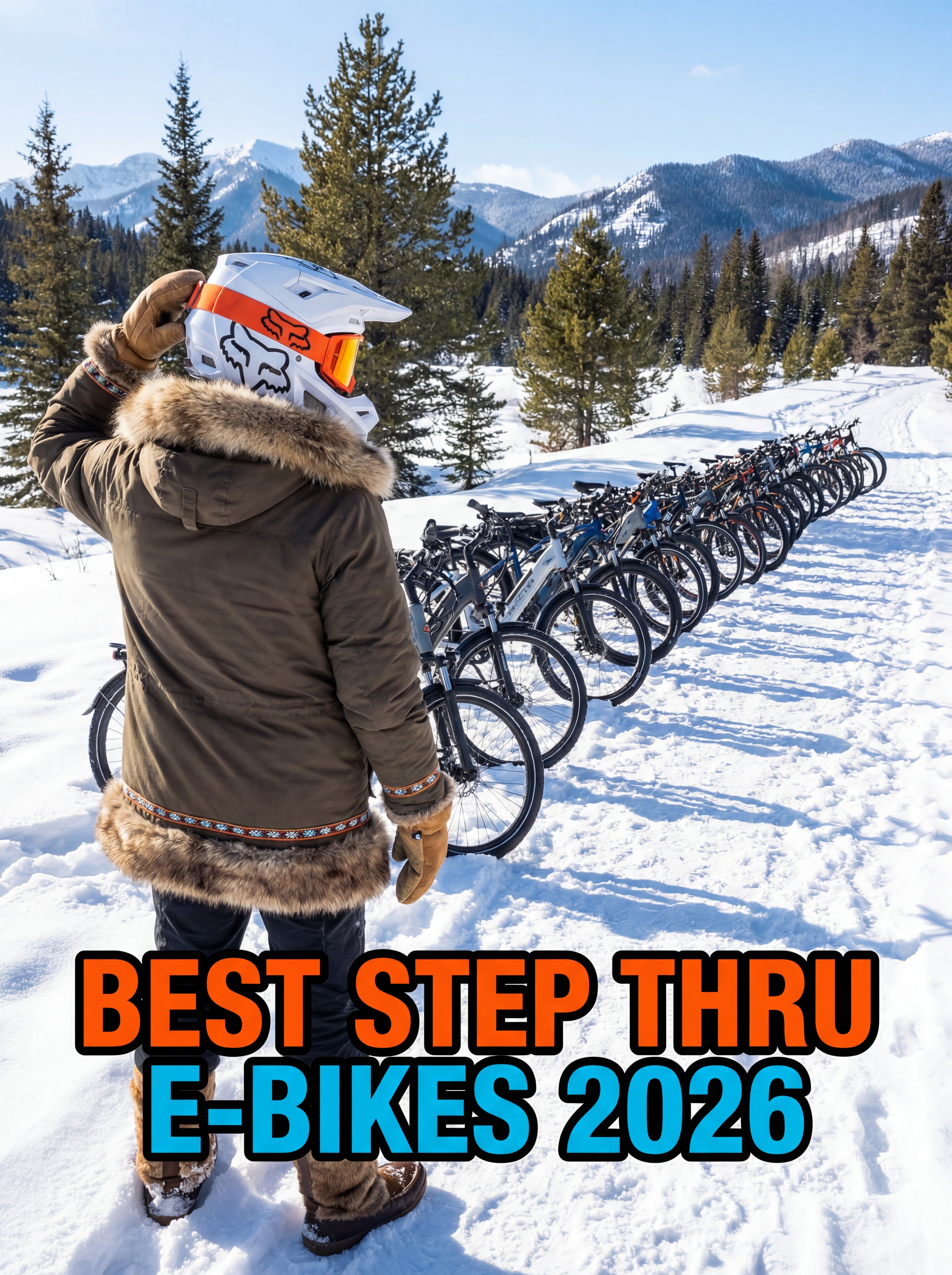
Best Step-Thru eBikes Canada (2026): 10 Verified Picks, $1,049–$3,399

Step through — and keep moving. 10 verified picks from $1,049 to $3,399. | Photography by Playcut.ai
What is the best step-thru eBike in Canada? It depends on your budget and terrain. For the best all-around value under $2,500: Himiway Zebra D5 ST ($2,299 — 960 Wh, 400 lb payload, torque sensor). For the most range: TESWAY X5 AWD ($2,399 — 3,120 Wh, 200 Nm). For hills: Himiway A7 Pro ($2,999 — 130 Nm mid-drive). For maximum power: Eunorau FAT-HD 2.0 ($3,239 — 160 Nm mid-drive). Budget entry: Samebike RS-A01 Plus ($1,049).
The Zeus step-thru collection contains 43 products. We evaluated each against four criteria: (1) Spec integrity — every wattage, torque, and battery figure verified against Zeus product pages and manufacturer data sheets; (2) Category distinction — each pick must solve a problem no other pick solves, with no redundant use cases; (3) Value density — does the price-to-spec ratio justify this spot over a cheaper or better-equipped alternative?; (4) Stock status — only in-stock products considered. We cross-checked winter range estimates using the Bosch eBike Systems cold-weather battery degradation benchmark (20–30% at 0°C). Brands with 3+ picks were reviewed for genuine differentiation before inclusion.
In This Guide
Why Step-Thru Isn’t Just for Seniors — and Why It Matters Here
The biggest misconception in the Canadian eBike market is that step-thru frames are a seniors’ concession. This is wrong — and it costs riders money by steering them away from a frame style that is genuinely superior for most urban and mixed-use riding.
The evidence is in the data. In the Netherlands and Denmark — the two most bike-centric nations on earth — step-thru frames are the default for working adults under 40. Not because those riders are less capable, but because the step-thru is the more practical choice when you are commuting in real clothes, carrying panniers, stopping frequently, and mounting from curbs and narrow corridors.
In Canada, the case is even stronger. Consider what you actually do before riding in winter: you’re wearing insulated pants, a heavy jacket, possibly work trousers with zero stretch. Throwing a leg over a 27″ top tube while wearing all of that, while standing on packed snow, while holding a coffee — is a daily inconvenience that adds up. A step-thru eliminates it completely. You step in from either side and go.
For commuters who make 10–20 stops per ride (traffic lights, pedestrian crossings, destination arrivals), the difference in mounting speed over a year is genuinely meaningful. For riders who carry cargo — a backpack, side bags, rear rack loads — lower centre of gravity and easier dismount reduces the chance of a balance-loss drop, which is the most common minor eBike accident in urban riding.
Step-Over Frame
- Traditional cycling aesthetic
- Marginally stiffer under aggressive pedalling
- Requires leg swing to mount — height-dependent
- Preferred by off-road riders (lower standover on trails)
- More difficult in bulky winter gear
Step-Thru Frame
- Mount from either side in any clothing
- Same motor, battery, and specs as step-over versions
- Faster stops and starts in urban riding
- Lower centre of gravity for loaded cargo
- Several models carry 400–560 lb payloads — no strength penalty
The frame shape changes nothing about capability. The Velotric Nomad 2X in this guide is a step-thru that carries 560 lbs on full air suspension. The Eunorau FAT-HD 2.0 is a 160 Nm mid-drive step-thru that tops out at 45 km/h. These are not compromised bikes. They are just easier to get on.
Step-thru eBikes are for anyone who rides in real conditions — winter gear, cargo, frequent stops, or limited flexibility. The frame change costs nothing in performance. It gives back time, comfort, and safety on every single ride. If you have been avoiding step-thru because it “looks like a seniors’ bike,” you are leaving a better daily ride on the table. Browse the full step-thru collection →
Find Your Step-Thru eBike in 30 Seconds
Match your situation to the right pick. Skip to the section you need.
| Your Situation | Best Pick | Price |
|---|---|---|
| Tightest budget | Samebike RS-A01 Plus | $1,049 |
| Budget + full suspension + fat tyre | FREESKY Wild Cat Pro A-340 | $1,928 |
| Daily commuter, torque sensor, natural feel | Eunorau Meta | $1,994 |
| Fat tyre all-around sweet spot | Himiway Zebra D5 ST | $2,299 |
| Maximum range, zero battery anxiety | Freesky Nova B-360 | $2,373 |
| Extreme power & the most battery of any step-thru | TESWAY X5 AWD | $2,399 |
| Full suspension compact fat tyre | Himiway D5 2.0 20″ | $2,799 |
| Best ride quality, hills daily, mid-drive feel | Himiway A7 Pro | $2,999 |
| Off-road, trails, 160 Nm mid-drive | Eunorau FAT-HD 2.0 | $3,239 |
| Best premium step-thru, full air suspension | Velotric Nomad 2X | $3,399 |
All 10 bikes ship across Canada — free shipping on most orders
Browse the Full Step-Thru Collection →Budget Step-Thru eBikes: $1,049–$1,994
The step-thru market in Canada starts at $1,049 — but what that money buys varies enormously. A $1,049 bike and a $1,994 bike are not interchangeable. The difference is not “worse vs better” — it is a specific trade-off in specs that maps directly to how and where you ride. These three picks are the honest choices in this price band.
1. Samebike RS-A01 Plus — $1,049
Samebike Step Thru Fat Tire eBike
$1,049 CADAt $1,049, the Samebike RS-A01 Plus answers a specific Canadian question: what is the minimum I need to spend to get a real step-thru eBike that works year-round? The answer is here. A 750W motor, 26″ × 3.0″ fat tyres, a 48V 14Ah (672 Wh) removable battery, Shimano 7-speed, 5-level pedal assist, and a half-twist throttle. 330 lb payload, 35 km/h, and a frame that mounts from either side without a leg swing. For a first-time buyer, a second household bike, or someone whose primary concern is daily convenience rather than performance specs, this is the honest entry point.
The removable battery is a genuine practical advantage at this price: you carry it inside overnight — which in Canadian winter conditions recovers 15–25% of cold-weather battery loss — without rolling the bike to a plug. Most budget eBikes at this price mount the battery to the frame with no clean removal. The RS-A01 Plus gets this right. For more on how battery management affects winter range across all 10 picks, see the Canadian winter section below.
Honest trade-off: Mechanical disc brakes (180mm), not hydraulic. In dry conditions this is irrelevant. In wet autumn or early-season snow, hydraulic brakes provide meaningfully more stopping confidence. If you commute year-round through rain and slush, the FREESKY Wild Cat Pro A-340 at $1,928 upgrades to 4-piston hydraulic brakes and adds 528 Wh of battery for $879 more. If you ride spring through autumn on dry urban pavement, that additional spend is unnecessary. Budget doesn’t mean compromised — it means matched to actual use.
2. FREESKY Wild Cat Pro A-340 — $1,928
For under $2,000, the Wild Cat Pro A-340 delivers a spec sheet that punches far above its price: a 48V 25Ah Samsung battery (1,200 Wh), 130 Nm of torque, 4-piston hydraulic disc brakes (180mm), full suspension, 26″ × 4.0″ fat tyres, and a 400 lb payload capacity. That is more battery than most bikes in the $2,500–$3,000 range. The 4-piston hydraulic brakes are a spec you normally see at $2,500+.
For Canadian winter riding, the 1,200 Wh battery provides meaningful cold-weather headroom — at 0°C with a 30% loss, you still have ~840 Wh effective capacity. That covers a 50–80 km winter commute comfortably. The fat 4.0″ tyres add traction on snow, slush, and sand that narrower tyres cannot match.
Honest trade-off: At 83 lbs, this is a heavy bike for its price bracket. It rides well but is not a bike you’ll carry up stairs. Cadence sensor (not torque) — the assist is delivered in fixed increments rather than proportionally. For a torque sensor at this price, see the Eunorau Meta below.
3. Eunorau Meta — $1,994
Eunorau Meta Step-Thru
$1,994 CADThe Eunorau Meta is the most important bike in the budget section for one reason: torque sensor at $1,994. Every other bike in this price band uses a cadence sensor. The torque sensor reads how hard you push the pedals and scales power proportionally — the result is a riding experience that feels like a natural extension of your body rather than a motor switching on and off. It also delivers 10–20% better range than the same motor with a cadence sensor, because power is applied only when you actually need it.
The rest of the spec sheet supports that premium: full suspension (Zoom 100mm front fork + EXA 165mm rear shock), hydraulic disc brakes (180mm front and rear), Samsung cells, available in both 24″ and 26″ frame sizes. An optional second 15Ah battery doubles capacity to 1,440 Wh for long-range riders or winter use. The 24″ frame suits riders from 5′0″ up; the 26″ frame fits 5′4″ to 6′2″.
Honest trade-off: 286 lb payload is the lowest in this guide. If you weigh over 130 kg or plan to carry significant cargo, the Wild Cat Pro A-340 or Himiway D5 ST (400 lb payload each) are more appropriate. Also, 55 Nm is modest torque — hills above 8–10% grade will slow you. For steep daily climbs, the mid-drive picks in the premium section are the correct choice. For flat-to-rolling urban terrain, the Meta’s torque sensor feel is the best riding experience at this price point.
Tightest budget: Samebike RS-A01 Plus ($1,049) — fat tyres, 7-speed, removable battery. Winter + performance value: FREESKY Wild Cat Pro A-340 ($1,928) — 1,200 Wh, 130 Nm, 4-piston hydraulic, 400 lb payload. Best daily feel: Eunorau Meta ($1,994) — the only torque-sensor step-thru under $2,000. If you plan to ride every weekday, the torque sensor on the Meta transforms the experience. If you’re riding occasionally or in rough terrain, the Wild Cat Pro’s battery and tyre advantage wins.
Mid-Range Step-Thru eBikes: $2,299–$2,399
The $2,299–$2,399 band is where Canadian step-thru eBikes cross into genuinely capable machines. Every pick here has hydraulic brakes, fat tyres, and enough battery to handle a full Canadian day without charging anxiety. The three bikes at these price points solve three distinct problems — and choosing the wrong one means leaving a significant capability on the table.
4. Himiway Zebra D5 ST — $2,299
Himiway Zebra D5 ST
$2,299 CADThe Zebra D5 ST hits a spec combination that is hard to fault at $2,299: torque sensor, 960 Wh Samsung/LG battery, 86 Nm hub motor, Tektro hydraulic brakes (180mm), 26″ × 4.0″ Kenda fat tyres, and a 400 lb payload. It is one of only two bikes in this guide with a torque sensor under $2,400 — the other being the Eunorau Meta at $1,994, which carries 114 fewer lbs and has 240 Wh less battery.
For heavier riders who want a torque-sensor step-thru without reaching into the $3,000 range, this is the pick. The 960 Wh battery with 30% cold-weather loss still delivers ~67–90 km at 0°C — enough for a full day of Canadian winter riding. The 3.5″ colour TFT display with Wi-Fi connectivity is a premium feature at this price point. The Zebra D5 ST is also available in a switchable torque/cadence mode, letting riders toggle between the natural pedal feel of a torque sensor and the consistent-assist cadence mode depending on terrain.
Honest trade-off: Hardtail (no rear suspension). For potholed urban streets, a rear suspension adds comfort. If you ride rough surfaces daily, the Himiway D5 2.0 20″ ($2,799) adds full suspension for $500 more. For mixed pavement and gravel, the D5 ST’s fat tyres absorb enough to make rear suspension unnecessary for most riders.
5. Freesky Nova B-360 — $2,373
1,440 Wh for $2,373. That is the headline. The Nova B-360 ships with two 15Ah Samsung batteries integrated into the frame — more total capacity than most 750W bikes and more than double the battery of any bike in the budget section. For riders who experience battery anxiety, who commute 50–80 km daily, or who live in northern Canada where winter temperatures push battery losses toward 40–50%, the dual-battery architecture solves the problem permanently.
Even at −18°C with a 50% cold-weather battery loss (Battery University data), the Nova B-360’s effective capacity of ~720 Wh still delivers a full day’s urban riding. The torque sensor ensures that every watt-hour is used efficiently — power scales with effort rather than applying at full blast from every pedal stroke. Hydraulic brakes, 27.5″ × 2.2″ tyres, and a 400 lb payload round out the package. See our long-range eBikes Canada guide for full context on how this battery stacks up across the Zeus catalogue.
Honest trade-off: 55 Nm is the lowest torque in the mid-range section — this is not a hill bike. The 27.5″ × 2.2″ tyres are commuter-spec, not fat tyres; they handle light gravel but will not float on packed snow or deep slush the way a 4.0″ tyre does. This bike is a range machine on urban and mixed pavement. For fat-tyre winter traction at similar battery capacity, see the Wild Cat Pro A-340 ($1,928 / 1,200 Wh) or the TESWAY X5 AWD ($2,399 / 3,120 Wh) below.
6. TESWAY X5 AWD — $2,399
The TESWAY X5 AWD is an outlier in Canadian eBike retail. 3,120 Wh — that is 52V × 60Ah, more than twice the battery of the Nova B-360, more than four times the Samebike. At a 30% winter loss, the X5 still holds 2,184 Wh effective capacity. At 50% loss in extreme cold, it retains 1,560 Wh. In practical terms: this bike does not run out of power in a single day under any Canadian winter condition. You charge it every 3–5 days.
The 2,000W nominal / 3,600W peak dual motor produces 200 Nm of torque — the same figure as the FREESKY Ranger M-540, delivered through 20″ × 4.0″ Kenda fat tyres. Front hydraulic fork and rear spring suspension, 4-piston hydraulic brakes front and rear, 5-level pedal assist. This is not a performance sport bike; it is a go-anywhere utility machine that never needs to worry about running out of power. For riders who have been avoiding eBikes specifically because of range anxiety or winter battery loss, the X5 permanently removes both objections at $2,399 — a price significantly below comparable-battery electric bikes from specialty vendors.
Honest trade-off: At 54 kg (119 lbs), the X5 is the heaviest step-thru in this guide by a wide margin. This is not a bike you carry up stairs or lift onto a transit rack. It also lacks a torque sensor — assist delivery is cadence-based, which is appropriate for a bike of this power output. The 350 lb payload is lower than several lighter bikes in this guide; the weight of the bike itself accounts for much of the structural loading.
Best all-day step-thru value: Himiway D5 ST ($2,299) — torque sensor, 960 Wh, 400 lb payload, fat tyres. Range maximiser: Nova B-360 ($2,373) — 1,440 Wh dual battery, torque sensor, best for long commutes on smooth surfaces. No-compromise power and battery: TESWAY X5 AWD ($2,399) — 3,120 Wh and 200 Nm for riders who want the problem solved permanently, not managed. If weight matters: choose D5 ST or Nova B-360. If range and power matter above everything else: choose the TESWAY.
Step-Thru eBikes and Canadian Winter: What You Actually Need to Know
Canadian winter riding separates capable eBikes from compromised ones faster than any other test. The step-thru frame itself is winter-agnostic — what matters is the battery architecture and the tyre width. Here is what the data shows.
Battery degradation in cold temperatures (Bosch eBike Systems, Battery University):
- 0°C: 20–30% capacity loss
- −10°C: 30–40% capacity loss
- −18°C: up to 50% capacity loss
A 720 Wh battery rated at 80 km in summer delivers approximately 56–64 km at 0°C. A 1,440 Wh battery delivers 100–115 km under the same conditions. The TESWAY’s 3,120 Wh delivers 188–218 km. Battery sizing is the single most important winter decision.
The practical fix: store your battery indoors overnight and install it just before riding. A warm battery loses 5–8% instead of 20–30% in the first 10 minutes of riding. This single habit recovers more winter range than any battery upgrade.
Tyre width for winter surfaces: 4.0″ fat tyres provide enough contact patch and flotation for packed snow and light powder. They do not replace studded winter tyres on ice. If you ride on icy surfaces regularly, winter-specific tyres (Schwalbe Marathon Winter, 45NRTH Dillinger) are the correct upgrade regardless of frame style. For slush and compressed snow — the daily Canadian urban condition — any 4.0″ fat tyre in this guide provides adequate traction at safe speeds.
For a complete winter riding breakdown, read our best electric bikes for winter in Canada guide.
| Pick | Battery | Winter Range (0°C est.) | Tyre Width |
|---|---|---|---|
| Samebike RS-A01 Plus | 672 Wh | ~42–63 km | 26″ × 3.0″ |
| FREESKY Wild Cat Pro A-340 | 1,200 Wh | ~67–117 km | 26″ × 4.0″ |
| Eunorau Meta | 720 Wh | ~42–70 km | 26″ × 3.0″ |
| Himiway Zebra D5 ST | 960 Wh | ~67–90 km | 26″ × 4.0″ |
| Freesky Nova B-360 | 1,440 Wh | ~84–135 km | 27.5″ × 2.2″ |
| TESWAY X5 AWD | 3,120 Wh | ~188–224 km | 20″ × 4.0″ |
| Himiway D5 2.0 20″ | 720 Wh | ~30–73 km | 20″ × 4.0″ |
| Himiway A7 Pro | 720 Wh | ~39–56 km | 27.5″ × 2.4″ |
| Eunorau FAT-HD 2.0 | 720 Wh | ~28–45 km | 26″ × 4.0″ |
| Velotric Nomad 2X | 801 Wh | ~56–84 km | 26″ × 4.0″ |
Best winter battery: TESWAY X5 AWD (3,120 Wh, ~188+ km at 0°C). Best fat tyre + range balance: FREESKY Wild Cat Pro A-340 (1,200 Wh, 4.0″ fat tyres, $1,928). Best budget winter pick: Himiway Zebra D5 ST (960 Wh, 4.0″ fat tyres, $2,299). The non-negotiable rule: store your battery indoors overnight. No bike in this guide is too good to follow that rule.
Premium Step-Thru eBikes: $2,799–$3,399
At $2,799 and above, the step-thru market shifts from “good enough” to “genuinely better.” Full suspension, mid-drive motors, and premium suspension components become the norm. These four picks serve riders who have a specific use case that demands premium specs — full suspension comfort, mid-drive hill climbing, or the most refined overall ride quality available in a step-thru frame.
7. Himiway D5 2.0 20″ — $2,799
Himiway D5 2.0 20″
$2,799 CADThe D5 2.0 20″ is the only step-thru in the Zeus catalogue with full suspension at this price and a compact 20″ fat tyre form factor: 100mm front coil fork plus 130mm rear multi-link suspension. That rear multi-link is significant — most full-suspension eBikes at this price use a basic pivot system; multi-link geometry tracks bumps more accurately and maintains better tyre contact through uneven surfaces. For riders who commute on roads where potholes, rail crossings, and cracked asphalt are daily obstacles, the rear suspension delivers comfort that fat tyres alone cannot.
90 Nm hub motor, 400 lb payload, switchable torque/cadence sensor mode, and a 3.5″ colour TFT display with Wi-Fi app connectivity. The 20″ × 4.0″ fat tyres provide excellent winter traction in a compact, manoeuvrable package — the shorter wheelbase of a 20″ frame is notably easier to navigate tight urban spaces and bike racks than a 26″ or 27.5″ step-thru.
Honest trade-off: 720 Wh is a smaller battery than the Zebra D5 ST ($2,299, 960 Wh) — the extra $500 buys full suspension and more torque (90 Nm vs 86 Nm) but not more range. For riders in flat cities with reliable charging access, this is not a meaningful limitation. For riders who want maximum range without charging flexibility, the D5 ST or Nova B-360 are better choices.
8. Himiway A7 Pro — $2,999
The A7 Pro is the most refined step-thru in Canada at its price point. The ANANDA M100 mid-drive motor sits at the cranks and uses your gears to multiply torque — 130 Nm at the motor becomes substantially more climbing force at the rear wheel on low gears than any hub motor in this guide can produce. For riders with regular steep hills on their route, the A7 Pro climbs grades that make 750W hub motors slow to a frustrated crawl.
Four sensors (torque, shifting, speed, brake) create the smoothest assist delivery in this guide. The motor cuts instantly on a brake sensor input, responds proportionally to your pedalling effort via the torque sensor, and adjusts power during gear changes to protect the drivetrain. Full suspension: SR Suntour 120mm front fork plus DNM AO-06 rear shock (165mm), with a 100mm travel dropper seatpost. Schwalbe Super Moto-X 27.5″ × 2.4″ tyres, Shimano 9-speed, hydraulic disc brakes (180mm front and rear). Comes with anti-theft alarm, U-lock, phone holder, and mirrors included. Read the full Himiway A7 Pro 2-year review for long-term ownership data.
Honest trade-off: Mid-drives wear drivetrain components faster than hub motors — chains and cassettes require more frequent replacement (budget $50–80/year). 720 Wh is the smallest battery in the premium section; winter range of 39–56 km at 0°C makes this a charge-nightly winter bike. For riders who want more winter range, the TESWAY X5 AWD at $2,399 carries 4× the battery at lower cost — but without the mid-drive refinement or the suspension quality of the A7 Pro.
9. Eunorau FAT-HD 2.0 / Hunter X7 — $3,239
Eunorau FAT-HD 2.0 / Hunter X7
$3,239 CAD160 Nm from a Bafang M615 1,000W mid-drive. That is the number that separates this bike from every other step-thru in Canada. Where the A7 Pro produces 130 Nm through a refined commuter drivetrain, the FAT-HD 2.0 produces 160 Nm through a 26″ × 4.0″ Kenda Krusade Sport fat tyre — the combination that defines off-road mid-drive performance. Top speed of 45 km/h, Shimano 9-speed with 42T chainring and chain guard, RST front fork, and the option to add a second 15Ah battery for 1,440 Wh total and 130 km dual-battery range.
This is the correct step-thru for riders who genuinely venture off pavement: gravel, hardpack trails, forest service roads, packed snow. The low-step frame makes it easier to dismount quickly on technical terrain — a real advantage over step-over frames when you need to put a foot down unexpectedly. For heavier riders who want a step-thru that actually climbs, the 160 Nm output at the cranks multiplied through Shimano gearing is the strongest climbing tool in this guide.
Honest trade-off: Hardtail only (no rear suspension), which is surprising for a $3,239 off-road-oriented bike. Single battery range (40–65 km) is the shortest in the premium section — the dual battery option ($400+ accessory) is strongly recommended for any ride over 40 km or any winter use. Bafang mid-drives require more drivetrain maintenance than hub motors; this cost is real and ongoing.
10. Velotric Nomad 2X — $3,399
Velotric Nomad 2X
$3,399 CADThe Nomad 2X carries the highest payload in this guide: 560 lbs (254 kg). That is not a misprint. It also carries the most premium suspension architecture: full air suspension — 120mm air fork front, rear air shock — both pressure-tuneable to the rider’s weight and terrain. The result is a ride quality that coil-spring suspension in cheaper bikes cannot replicate. Air suspension is lighter, more precise, and adjustable without tools in the field.
105 Nm, 750W/1,400W peak, 48V 16.7Ah (801 Wh), 26″ × 4.0″ fat tyres. Available in both step-thru and step-over frame options. For riders who want the best-equipped step-thru fat tyre eBike available in Canada without moving into custom or specialty territory, the Nomad 2X is the definitive answer. It is also the right pick for larger or heavier riders who want a step-thru — 560 lbs of payload means the frame is engineered for real-world Canadian loads, not just catalogue figures.
Honest trade-off: 801 Wh is a smaller battery than some cheaper picks in this guide (Wild Cat Pro 1,200 Wh, TESWAY 3,120 Wh). At $3,399, riders expecting the biggest battery at the highest price will be surprised. The Nomad 2X invests its premium in suspension quality, payload engineering, and refinement — not battery size. For maximum battery at any budget, the TESWAY X5 AWD at $2,399 is the rational choice. For maximum ride quality and the most capable fat-tyre step-thru frame in Canada, the Nomad 2X earns its price.
Best full suspension for rough surfaces: Himiway D5 2.0 20″ ($2,799). Best ride quality + hills + mid-drive feel: Himiway A7 Pro ($2,999). Most torque for off-road: Eunorau FAT-HD 2.0 ($3,239 — 160 Nm). Best premium payload + air suspension: Velotric Nomad 2X ($3,399 — 560 lb capacity). Each of these bikes does something the others cannot — there is no single “best.” Match the spec to your actual riding.
Need help choosing between mid-drive and hub motor?
Read: Mid-Drive vs Hub Motor — The Full Engineering Comparison →Step-Thru vs Step-Over: What the Data Shows
The structural question buyers ask most: is there a real-world performance trade-off? The data says no, with one narrow exception.
| Factor | Step-Thru | Step-Over |
|---|---|---|
| Frame strength | Equal for all payload specs in this guide (up to 560 lbs) | Equal |
| Motor/battery options | Identical to step-over variants of same models | Identical |
| Urban commuting speed | Faster — no swing-over mount delay | Slower per stop |
| Aggressive off-road (drops, technical) | Higher standover clearance advantage for step-over | Slight advantage |
| Winter mounting | Significantly easier in bulky gear | Awkward |
| Cargo carrying | Lower dismount centre of gravity — safer with loads | Neutral |
| Rider height range | Wider — accommodates shorter inseam riders | Height-limited by top tube |
The one scenario where step-over has a genuine advantage: aggressive mountain bike descents where a low standover clearance limits the rider’s ability to shift their weight behind the seat. For urban, commuter, recreational, and even most trail riding — step-thru frames have no performance deficit and meaningful daily-use advantages.
Frequently Asked Questions
What is a step-thru eBike?
A step-thru eBike has a frame with no top tube between the handlebars and seat. You mount by stepping through the open frame space rather than swinging a leg over a top bar. The motor, battery, and drivetrain are identical to step-over versions. The only difference is the frame geometry — which affects ease of mounting, not riding performance.
Are step-thru eBikes only for seniors?
No. Step-thru eBikes are ridden by commuters, women, urban riders, heavier riders, and anyone who values fast mounting over a traditional frame aesthetic. In the Netherlands and Germany — the world’s leading cycling nations — step-thru frames are the default for adults of all ages. In Canada, bulky winter gear, cargo bags, and frequent stopping make step-thru frames the more practical choice for most urban riding scenarios. The frame style has nothing to do with capability.
Are step-thru eBikes as strong as step-over eBikes?
Yes. Modern aluminium alloy step-thru frames carry the same loads as step-over frames — several models in this guide carry 400 lb payloads; the Velotric Nomad 2X carries 560 lbs. The absence of a top tube changes the mounting experience, not the structural capacity under normal riding conditions.
What is the best step-thru eBike for hills in Canada?
For hills, choose a mid-drive motor. Mid-drives use your gears to multiply torque — a 500W mid-drive with 130 Nm outclimbs most 750W hub motors on steep grades because it multiplies force at low speeds via gearing. The Himiway A7 Pro (130 Nm, $2,999) is the best mid-drive commuter step-thru. The Eunorau FAT-HD 2.0 (160 Nm, $3,239) is the strongest hill-climbing step-thru in Canada. For a hub-motor option with extreme torque, the TESWAY X5 AWD (200 Nm, $2,399) is compelling.
Can step-thru eBikes handle Canadian winter?
Yes, with the right tyre and battery. Fat tyres (4.0″) provide traction on packed snow and slush. Lithium-ion batteries lose 20–30% capacity at 0°C and up to 50% at −18°C — store the battery indoors overnight and install it just before riding to recover 15–25% of that loss. Picks with the best winter battery headroom: TESWAY X5 AWD (3,120 Wh), FREESKY Wild Cat Pro A-340 (1,200 Wh), Freesky Nova B-360 (1,440 Wh).
What is the weight limit on a step-thru eBike?
It varies by model. Budget step-thrus carry 286–330 lbs. Most mid-range and fat-tyre models carry 400 lbs. The Velotric Nomad 2X carries 560 lbs — the highest payload in this guide. If you weigh over 100 kg, choose a model rated to 400 lbs minimum and pair it with a fat-tyre frame for stability. Our best eBikes for heavy riders in Canada guide covers this in detail.
What is the difference between a torque sensor and a cadence sensor on a step-thru eBike?
A torque sensor reads how hard you push the pedals and scales power proportionally — it feels like a natural tailwind. A cadence sensor detects that your pedals are turning and applies fixed power — it feels like an on/off switch. Torque sensors deliver 10–20% better range and smoother acceleration. Models with torque sensors in this guide: Eunorau Meta ($1,994), Himiway Zebra D5 ST ($2,299), Freesky Nova B-360 ($2,373), Himiway A7 Pro ($2,999), Eunorau FAT-HD 2.0 ($3,239). Read our pedal assist vs throttle guide for the full comparison.
- Fat Tire Electric Bikes Canada (2026) — 11 verified picks across all frame types
- Best eBikes for Winter Canada (2026) — cold-weather picks, battery data, tyre guide
- Mid-Drive vs Hub Motor eBike — the full engineering comparison
- Electric Bikes for Seniors Canada (2026) — comfort, stability, and easy-mount picks
- Best eBikes for Heavy Riders Canada — payload-rated picks from $1,199
- Best eBikes for Women Canada (2026) — step-thru, comfort, and performance picks
- Long Range eBikes Canada — 10 best by battery capacity
- Best eBikes Under $2,000 Canada — every category under $2K
📸 All photography by Playcut.ai — personalised AI actor technology


Share:
Best Dual Motor eBikes in Canada (2026): 11 AWD Picks, 35–93 kg, $1,800–$5,599
Best Urban Electric Bikes Canada (2026): 6 Verified Picks for Every Commuter