
The Canadian Mobility Bill of Rights (2026): 10 Articles, the Verified Evidence, and the Constitutional Case for Movement as a Right

Canada has no domestic constitutional right to daily mobility. Section 6 of the Charter protects only inter-provincial movement — its drafting purpose was preventing economic walls between provinces, not guaranteeing access to work, school, healthcare and family. The path to a real right runs through Charter s. 7 (life, liberty, security of the person), opened by Justice Schabas in Cycle Toronto v. Ontario on July 30, 2025; Charter s. 15 equality protections; UN CRPD Article 20 (personal mobility), to which Canada is bound by ratification; and UNDRIP Articles 21 and 24, now domestic law via Bill C-15. This manifesto enumerates ten articles tied to verified Canadian violations: transport poverty for ~1 million Canadians in our eight largest cities; ~70 fly-in-only Indigenous communities; the 70:1 ratio between Stellantis-Volkswagen battery subsidies ($28.2B) and the federal Active Transportation Fund ($400M / 5 years); the cancellation of Greyhound Canada (2018-21) without a national replacement; the $232M TTC operating shortfall for 2026. The central remedy is the Canadian Mobility Voucher — a $3,500 state-funded entitlement, triggered when the state has demonstrably failed to provide reliable transit access, modelled on France's LOM allowance, Ontario's Assistive Devices Program, and BC's SCRAP-IT precedent. Estimated cost ~$800M / 4 years — thirty-five times smaller than the Stellantis-VW battery package. We name what twelve other countries have tried, including the failures and rollbacks. Counter-arguments are surfaced honestly. The piece is drafted to be cited and to be implementable from day one.
The Sections
- Preamble — Why a Canadian Mobility Bill of Rights, Why Now
- I. The Charter Reality — Why s. 6 Is Not the Hook (and What Is)
- II. The Crisis — The Verified Canadian Evidence
- III. What Twelve Other Countries Tried — and Where They Failed
- IV. The Patterns — What Successful and Failed Jurisdictions Share
- V. The Ten Articles
- VI. The Canadian Mobility Voucher — How the State Pays What It Owes
- VII. The Path Forward — Federal, Provincial, Municipal, Constitutional
- VIII. What This Manifesto Does Not Pretend
- IX. How to Use This Document
- Frequently Asked Questions
- Citations & Further Reading
Preamble — Why a Canadian Mobility Bill of Rights, Why Now
Three things are true about Canada in the spring of 2026. The first is that approximately one million people across our eight largest cities live in transport poverty as defined by Mobilizing Justice and the IRPP — meaning the basic act of getting to work, to a clinic, to a grocery store, to a parent or a child requires either a private car they cannot afford, or a transit network that does not reach them, or it does not happen at all. The second is that the federal government in 2024 committed up to $28.2 billion in performance-tied subsidies to two foreign-owned electric-vehicle battery plants — Stellantis-LGES at $15B and Volkswagen at $13B — through 2032, against a single $400 million Active Transportation Fund spread across the entire country and five years. That is a 70-to-1 ratio of public money flowing to private vehicles versus the infrastructure that allows people to move without one. The third is that on July 30, 2025, an Ontario Superior Court judge ruled that an Ontario government statute ordering the removal of installed bicycle lanes infringed Charter s. 7 rights to life and security of the person.
The collision of those three facts is the reason this document exists. Canada is, on paper, a country that values freedom of movement. In practice, the only freedom of movement most provinces protect is the freedom to cross a border at the wheel of a car. Try to move within a province without one and you discover, very quickly, that the freedom you thought existed is conditional on income, age, ability, geography, and increasingly, on the political weather of whichever government you happen to live under.
This is not a partisan complaint. Mobility failure in Canada is bipartisan. The Greyhound bus network — the connective tissue that linked rural and northern Canada for almost a century — collapsed under the Liberals (Western Canada operations ended October 31, 2018; total Canadian shutdown May 13, 2021) and was not replaced under the Liberals or the Conservatives. The Ontario bike-lane removal law was passed in November 2024 by a Progressive Conservative government, but the political reluctance to defend installed cycling infrastructure cuts across every governing party in every province. Toronto's transit operating shortfall ($232M for 2026) is the result of choices made by a Liberal federal government, an NDP-then-Conservative provincial sequence, and municipal administrations of every stripe. The pattern is structural, not partisan.
This manifesto is a response. Not a policy paper, not a five-point plan, not a list of bike-lane wishes. A bill of rights — drafted as a constitutional document — that enumerates the rights Canadians already implicitly possess in international law and increasingly in domestic case law, and that names the violations now standing between those rights and the people meant to hold them. Every statistic is sourced. Every legal claim is checked. Every international comparator is reported with its failures alongside its wins. The piece is written to be quoted by journalists, used by advocates, cited in factums, and read by any Canadian whose grandmother lost her driver's licence and her social life in the same year.
It is also written by a former Canadian RN — seven years across acute psych, public health, prison, and rehab — who runs an electric-bike retailer because the bike was the first piece of independent transportation he owned coming out of recovery. The author is not a constitutional lawyer. The constitutional argument here was reviewed against published case law and the relevant statutes; lawyers will refine it. What the author can attest to, from clinical experience, is the mechanism by which the absence of mobility kills people slowly: the senior who stops driving and becomes depressed within twelve months; the patient discharged from psychiatry who cannot get to outpatient appointments because the bus does not run that line on weekends; the teenager in a fly-in community who has never seen a city. None of these are abstractions. They are the texture of Canadian life in 2026 for a country that mostly does not see them.

I. The Charter Reality — Why s. 6 Is Not the Hook (and What Is)
Any honest mobility-rights argument in Canada starts by conceding what Section 6 of the Charter actually says. The text is short:
(1) Every citizen of Canada has the right to enter, remain in and leave Canada.
(2) Every citizen of Canada and every person who has the status of a permanent resident of Canada has the right (a) to move to and take up residence in any province; and (b) to pursue the gaining of a livelihood in any province.
The drafting purpose was national unity. Section 6 exists to prevent provinces from erecting economic walls — restricting who can work, who can settle, who can move across the country — and it does that work well. The Supreme Court reaffirmed the scope in February 2026, in its decision on the Canadian Civil Liberties Association's challenge to Newfoundland's COVID-era inter-provincial entry ban: the ban infringed s. 6, but was saved under s. 1 as a justified pandemic limit. The pre-Charter foundation goes further back, to Winner v. S.M.T. (Eastern) Ltd. (1951), in which an implied national mobility right was first recognized.
What s. 6 is not, and what no Canadian court has ever held it to be, is a guarantee of daily intra-provincial mobility. The right to move from Halifax to Calgary in pursuit of a job is constitutionally protected. The right to get from a Calgary suburb to a Calgary clinic without owning a car is not. That gap — which most Canadians do not realize exists — is the constitutional reality on which every Mobility Bill of Rights argument has to be built.
The honest legal hooks are elsewhere, and they are stronger than s. 6 because they are about the substance of daily life rather than the technicality of borders.
The Live Hook: Charter s. 7 and the Schabas Ruling
Cycle Toronto et al. v. Ontario (Attorney General), decided July 30, 2025 in the Ontario Superior Court of Justice by Justice Paul Schabas, is the most important Canadian mobility-rights ruling of this generation. The case challenged sections of Ontario's Bill 212 — the Reducing Gridlock, Saving You Time Act, 2024 — which ordered the removal of installed bike lanes on Bloor Street, Yonge Street, and University Avenue in Toronto. Justice Schabas found that the bike-lane removal provisions violated Charter s. 7, the right to life and security of the person, because the evidence before the court established a real and significant risk of cyclist death and injury caused by the removal. The Province has announced its intention to appeal and the original ruling remains in force as of publication; the Ontario Court of Appeal is expected to hear the matter through 2026.
What the ruling does — even before any appellate confirmation — is establish that a Canadian court has treated safe daily mobility as constitutionally protected. That is precedent. That is the spine on which a Mobility Bill of Rights can stand: not a freestanding "right to mobility," but mobility infrastructure protected because its absence threatens life and bodily integrity, which the Charter already guarantees. Every Article in this manifesto that touches on physical safety on roads, accessibility for people with disabilities, or the survivability of fly-in communities under climate stress can be argued in s. 7 terms.
The International Hook: CRPD Article 20
Canada ratified the United Nations Convention on the Rights of Persons with Disabilities on March 11, 2010. Article 9 of the Convention obliges States Parties to ensure access to transportation. Article 20 goes further — it explicitly creates a right to "personal mobility with the greatest possible independence," including affordable assistive devices and trained personnel.
The Convention is an instrument of international law to which Canada is bound. It is not directly enforceable in Canadian courts without legislative implementation, and Canada has not signed or ratified the Optional Protocol, which means individual Canadians cannot bring complaints to the CRPD Committee. But Article 20 is the strongest positive mobility-rights language Canada has ever bound itself to, and it is the framework most likely to drive future Canadian disability litigation. The Council of Canadians with Disabilities and other accessibility advocates have been pressing for full domestic implementation since 2010.
The Equality Hook: Charter s. 15
Section 15 of the Charter prohibits discrimination on the basis of, among other grounds, age, disability, and ancestry. Mobility deprivation in Canada is not evenly distributed. It is concentrated on people with disabilities (CRPD Article 20 territory), on seniors who lose driving licences in suburbs designed only around cars, on Indigenous communities reliant on shrinking ice roads, on lower-income households spending 13.3% of consumption on transport (Statistics Canada Survey of Household Spending, 2023). Each of those distributions is a candidate for an s. 15 challenge.
The Statutory Floor: ACA, AODA, and the Provincial Acts
The Accessible Canada Act (S.C. 2019, c. 10), in force July 2019, sets a legislative goal of a barrier-free Canada by 2040. Its transportation provisions — which generated the federal Accessible Transportation for Persons with Disabilities Regulations in force June 2020 — apply only to federally regulated carriers: domestic and international air travel; rail across provincial borders; intercity bus across provincial or international borders; marine transport. Municipal transit, paratransit, taxis, ride-share, and almost all provincial transportation are outside the federal Act's jurisdiction.
The Accessibility for Ontarians with Disabilities Act, 2005 contains a Transportation Standard covering Ontario municipal transit and taxis. Its 2025 deadline for full accessibility was not met province-wide. British Columbia's Accessible British Columbia Act (2021) is at an earlier stage of regulation-making. Quebec, Manitoba, and Nova Scotia have their own legislation; the Atlantic provinces and the Prairies vary. The result is a country where the right to accessible transportation depends on which province's accessibility regime applies to the specific carrier on the specific day.
The Indigenous Hook: UNDRIP
The United Nations Declaration on the Rights of Indigenous Peoples Act (Bill C-15) received royal assent on June 21, 2021. The Act requires the federal government to bring Canadian law into consistency with UNDRIP. UNDRIP does not contain a single dedicated "mobility" article, but Article 21 protects the right of Indigenous peoples to "the improvement of their economic and social conditions," Article 24 protects the right to health, and Article 36 protects cross-border movement of Indigenous peoples whose territories straddle international borders. Combined, these create an obligation on the federal government that is now domestic law and is directly engaged by the all-season-road and ice-road crisis described later in this document.
II. The Crisis — The Verified Canadian Evidence
Every claim in this section is sourced. No vibes. No assumptions. The point is not to alarm but to establish, in one place, the empirical floor on which the Articles in Section V stand.
Transport Poverty
Approximately one million people across Canada's eight largest cities live with measurable transport-poverty risk, according to the foundational analysis by Allen and Farber published through the Institute for Research on Public Policy. Sixty-five percent of dissemination areas in those eight cities show some level of transport-poverty risk. The 2024-25 Mobilizing Justice National Survey on Transport Poverty — the first national-scale Canadian dataset on the issue — collected 27,000+ responses across 41 Census Metropolitan Areas and rural and territorial Canada, and found transport poverty as widespread in suburban and rural Canada as in core cities, often hitting people the urban-focused literature missed.
The Senior Mobility Cliff
Driving cessation in older adults — typically forced by vision changes, cognitive decline, mobility loss, or physician advice — roughly doubles the risk of depression, according to a meta-analysis of longitudinal studies including the Canadian Longitudinal Study on Aging (Chihuri et al., 2016, n > 30,000 across pooled studies). The CLSA driving-transitions study found cessation predictors included older age, female sex, lower household income, urban residence, vision problems, and lower self-rated health. The cliff is not an abstraction: every Canadian senior who loses a licence in a suburb without bus service has lost not only convenience but, in a measurable way, the social network that protects against depressive illness.

The Indigenous Mobility Crisis
Approximately seventy northern Indigenous communities are fly-in only for most of the year. About fifty communities, totalling roughly 56,000 people, depend on a roughly 6,000 km network of winter ice roads for annual deliveries of food, fuel, building materials, and medical supplies. Manitoba alone has more than twenty such communities; northern Ontario has thirty-one. The ice-road network is destabilizing as permafrost retreats and freezing seasons shorten. Of the fifty-three northern Ontario First Nations dependent on winter roads, thirty-two have requested all-season-road funding from Indigenous Services Canada; those requests have not been answered with a coordinated all-season replacement program. This is not an old colonial problem. It is a current and worsening one.

The Greyhound Hole
Greyhound Canada ceased operations in Western Canada on October 31, 2018, citing a fifty-year ridership decline. The remaining Canadian operations were terminated permanently on May 13, 2021. No coordinated federal replacement was ever stood up. Provincial backfills — BC Bus North, Saskatchewan Transportation Company's earlier 2017 closure not having been reversed, Ontario's GO bus network covering only the south of the province — leave large stretches of inter-community Canada without scheduled bus service of any kind. The town of Hearst, Ontario can no longer be reached from Toronto by bus. Neither can most of northern Manitoba. This is the inter-community equivalent of the s. 7 right Justice Schabas described — except no court has yet been asked to rule on it.
The Subsidy Asymmetry
The federal government, in partnership with the Government of Ontario, committed up to $28.2 billion in production subsidies to two electric-vehicle battery plants — Stellantis-LGES (up to $15B) and Volkswagen (up to $13B) — through 2032. The Parliamentary Budget Officer's break-even analysis estimated approximately twenty years for those subsidies to recover their costs in tax revenue. Against that, the federal Active Transportation Fund, announced in 2021, allocated $400 million over five years across the entire country. The ratio is 70 to 1 in favour of private-vehicle manufacturing capacity over walking, cycling, wheeling, and rolling infrastructure. In British Columbia, the active-transportation grant program represents less than 1% of the Ministry of Transportation budget, while a single kilometre of Highway 1 widening in the Lower Mainland costs roughly $130 million.
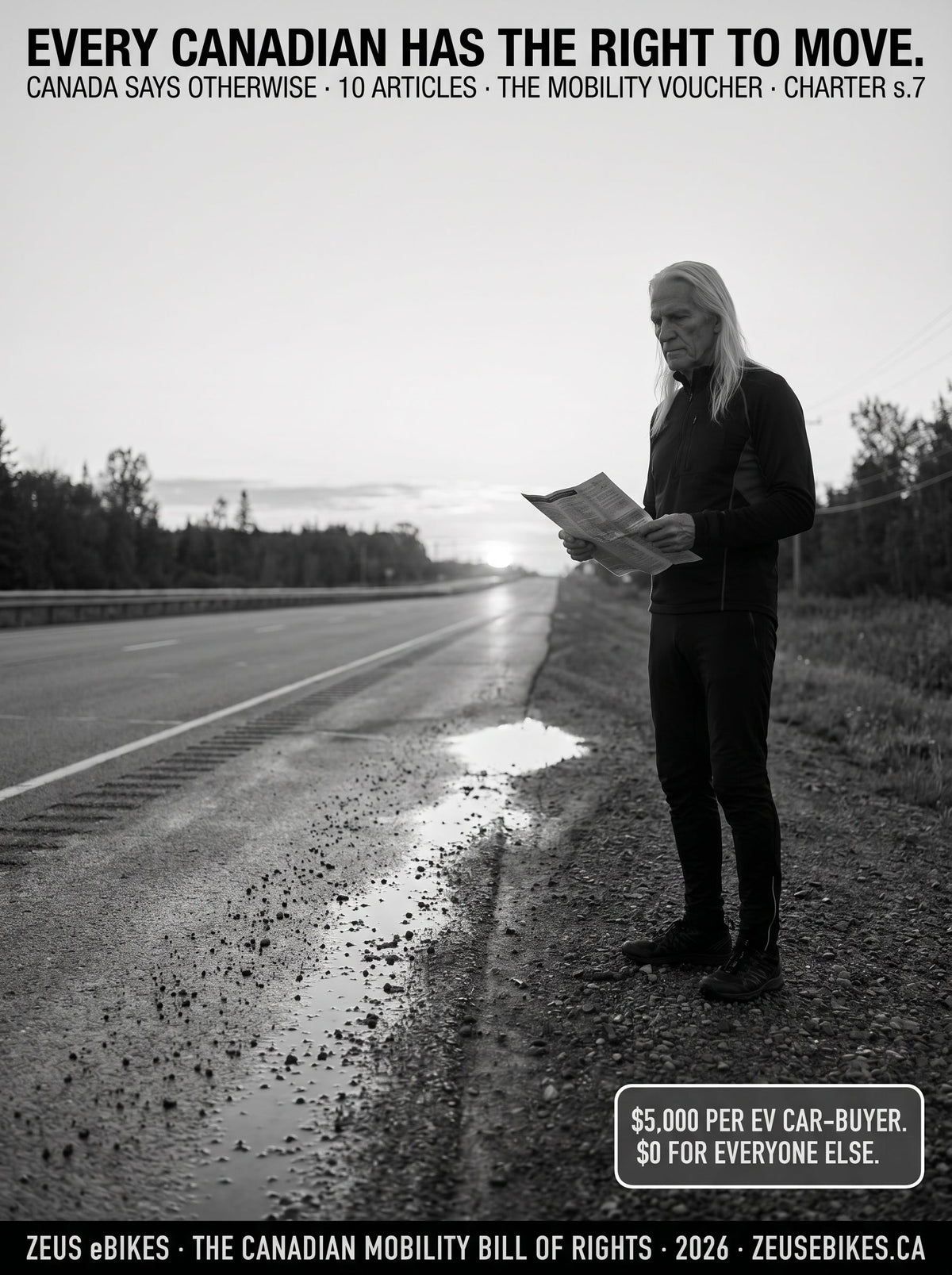
The asymmetry is not only on the manufacturing side. The federal Incentives for Zero-Emission Vehicles (iZEV) program, launched May 2019, delivered up to $5,000 per qualifying battery-electric vehicle and up to $2,500 for plug-in hybrids — a direct consumer-side purchase subsidy on top of the manufacturing subsidy. By the time iZEV was formally closed by Transport Canada in 2025 after fund exhaustion in early that year, hundreds of thousands of Canadian households had received it. The federal commitment to consumer-side EV purchase subsidy did not end with iZEV. It has been continued through the successor Electric Vehicle Affordability Program (EVAP), which provides purchase and lease incentives of up to $5,000 — the same headline rebate amount, under a renamed wrapper. Provincial programs (Quebec's Roulez Vert, British Columbia's CleanBC Go Electric) layer on additional thousands per vehicle. There is no equivalent federal consumer subsidy for the mobility tools available to Canadians who cannot afford or cannot operate a private car. Neither iZEV nor EVAP exist for the senior whose licence has been pulled by her optometrist, for the disabled rider whose paratransit response time has degraded to ninety minutes, or for the household in a fly-in First Nation where no road exists for an EV to drive on. The federal government has accepted, by seven years of continuous practice across two successive programs, that consumer-side mobility-purchase subsidy is a legitimate federal expenditure. It has just chosen not to extend the principle to anyone whose mobility solution is not a car.

Public Transit, 2026
The Toronto Transit Commission, North America's third-largest urban transit system, entered the 2026 fiscal year facing an operating shortfall on the order of $232 million. According to TTCriders' January 10, 2026 analysis of the finalized Toronto budget, that gap was plugged through a one-time draw of $35 million from the TTC Stabilization Reserve, $87.3 million in efficiency cuts, a new municipal land transfer tax increase generating roughly $13.8 million in additional revenue, and $1.48 billion required from the City overall. As TTCriders observed, "without long-term funding from higher orders of government, future budgets will continue to rely on one-time fixes." Meanwhile, the federal Canada Public Transit Fund, originally announced in 2024 as a permanent $3 billion-per-year transit envelope, was cancelled in the 2026 federal budget and folded into a generic infrastructure programme called Building Communities Strong, removing approximately $5 billion of programmed transit funding. British Columbia's active-transportation grant program was paused in late summer 2025. None of these decisions were taken under emergency conditions; all were made in fiscal good times by governments that expressed verbal commitments to climate, accessibility, and equity.
Active Transportation, in Numbers
Statistics Canada's most recent commute-mode data (May 2024) reported that 6.0% of Canadians walked or biked to work — a number that has barely moved in a decade. The pandemic-era 2021 census recorded a steep cycling-commute drop (from ~222,130 cyclist-commuters in 2016 to ~139,000 in 2021), but that decline is partly an artifact of work-from-home: people who used to bike to an office stopped commuting at all. Montreal's cycling commute share rose from 3.6% (2016) to 4.6% (2021); Toronto's from 2.7% to 3.0%. Where infrastructure is built, commuting modal share goes up. Where it is not, it does not.
The Burden of Transport on Households
The Statistics Canada Survey of Household Spending (2023) found Canadian households spent an average of $12,090 per year on transportation, up 19.7% from 2021. The lowest income quintile spends 13.3% of consumption on transportation; the highest quintile, 15.9%. (The numerator is similar across the income spectrum, but the denominator — total consumption — is so much smaller for low-income households that the proportional burden hits them hardest in absolute terms.) Alberta households spent the most ($14,539); Quebec the least ($11,022).
The eBike Patchwork
The fragmentation of provincial eBike law is itself a mobility-rights violation, because it makes the lowest-cost, most accessible motorized mobility tool available to Canadians legal in one province and not the next. Minimum age to ride: none in Nova Scotia, New Brunswick or Newfoundland and Labrador; 12 in Alberta; 14 in Saskatchewan, Manitoba and BC's Light category (since April 2024); 16 in Ontario, PEI and BC's Standard category; 18 in Quebec, or 14 with a Class 6D licence. Power caps: 250W in BC's Light category, 500W in most provinces' standard category, and up to 1,000W for cargo bikes over 55 kg on the Ontario cargo eBike pilot (paragraph below), only on roads in opted-in municipalities. Throttle rules: permitted on Standard in BC and Ontario; banned on Light in BC; permitted in Quebec. Trail access: BC Recreation Sites and Trails permits eBikes by default; BC Parks does not; Ontario's Provincial Parks vary by park; municipal multi-use paths each have their own bylaws. The Ontario cargo eBike pilot (O. Reg. 141/21), in force since March 2021, allows up to 1,000W and 1.3m widths on opted-in roads — a partial precedent. The patchwork itself is the violation.
An aside, for the reader living the evidence rather than studying it.
If you are reading this because you, or someone in your household, has been priced out, locked out, or aged out of Canadian mobility — the rights argument continues below, but the practical companions to this manifesto are the Honest Car-Free Canada Handbook (2026), the eBike vs Car (2026) household-economics breakdown, and the Why Is Canada So Expensive? — The Honest 2026 Breakdown. They are the operating manuals for a country whose mobility floor is what this document is trying to raise.
III. What Twelve Other Countries Tried — and Where They Failed
Any Canadian mobility argument that cites only successes — only the Netherlands, only Bogotá's Sunday Ciclovía — is a bad-faith argument. The interesting cases are the failures and the rollbacks, because that is where Canada is most likely to repeat mistakes. What follows are twelve named jurisdictions, each summarized with what worked, what failed, and one specific lesson that translates to the Canadian context.
1. Netherlands — Stop de Kindermoord (1972) → Bicycle Master Plan (1990)
The trigger was children dying. In 1972, 3,264 people died on Dutch roads, including approximately 450 children. The journalist Vic Langenhoff, after his six-year-old daughter Simone was killed cycling, wrote an editorial that catalysed a national protest movement called Stop de Kindermoord — Stop the Child Murder. Protesters occupied accident black spots, cycled an organ to the Prime Minister's house, and refused to be polite. Federal infrastructure investment followed; the 1990 Bicycle Master Plan locked in funding through subsequent governments. Today: cycling represents 27-28% of all trips nationally, 38% of all trips in Amsterdam, 46% in Zwolle. The 2008 Dutch traffic-death rate was 60% lower than the United States. Annual federal cycling spending now runs €500M-€1.1B per year. What worked: federal money, fifty-year continuity across multiple governments, child-safety moral framing. The honest counter: Dutch cycling collapsed in the 1950s-60s when paths were removed for cars — the modal share is policy-made, not cultural. Canadian lesson: the political trigger was dead children, not climate. A frame that polls universally beats a frame that polls partisan.
2. Denmark / Copenhagen — Cycle Superhighways (2012- )
Sixteen routes built by 2024; sixty-plus planned, totalling 850 km. Capital regional investment ~DKK 2.2B (~€295M). Bike traffic on completed routes rose 52% one year post-build, 87% over multi-year measurement. Internal rate of return: 23% — among the most profitable infrastructure projects in Denmark. Copenhagen commute mode share to work and education reached approximately 49% by 2022. What worked: regional cooperation across thirty-plus municipalities, full snow-clearing as priority (cycle paths cleared before roadways), e-bike inclusion. The honest counter: build-out is slower than promised; gaps remain across municipal boundaries. Canadian lesson: the regional-governance model maps cleanly onto Metro Vancouver, the GTHA, and the Communauté métropolitaine de Montréal. The 23% IRR neutralizes "cycling lanes are wasteful" attacks before they leave the gate.
3. France — Loi d'Orientation des Mobilités (LOM, December 24, 2019)
The French Mobility Orientation Law enumerates a "right to mobility," requires daily-mobility solutions for every territory, and created a sustainable-mobility allowance worth up to €400 per year (€900 combined with other commute benefits). The Plan Vélo committed €350M with a target of tripling cycling from 3% to 9% of trips. Outcomes: Paris cycling rose from 3% (2010) to 11.2% (2023); central-Paris bike trips now exceed car trips (4.3% car versus 11.2% bike on key arteries). What worked: legislation framed as a right rather than a programme; employer mobility allowance creating a daily incentive. What failed: the national e-bike purchase bonus was abolished on February 14, 2025 under fiscal consolidation. Financial incentives are politically vulnerable — but legal rights are more durable. Canadian lesson: a federal mobility-allowance tax credit is more durable than direct subsidies; Paris proves Hidalgo-style street reallocation works in dense, historic cities. Toronto and Montreal qualify.
4. Germany / Berlin — Berliner Mobilitätsgesetz (June 2018)
The first German state law to legally prioritize the "environment alliance" — walking, cycling, and transit — over private cars. Triggered by the 2016 Volksentscheid Fahrrad citizen initiative. Goals included 100 km of cycle-superhighway by 2030. What worked: the legal framework remains intact through the 2024 monitoring published by Changing Cities. What failed: the CDU-led coalition since 2023 has slowed implementation, and no budget has been allocated for new cycling projects under the new government. Canadian lesson, in capital letters: A LEGAL RIGHT IS NOT A BUDGET. Statutory enshrinement without protected funding becomes performative once the government changes. A Canadian Mobility Bill of Rights needs a binding multi-year capital floor, not just declarative language. Berlin proves it.
5. Spain / Barcelona — Superilles / Superblocks (2016, expanded 2021)
Three superblocks evaluated rigorously: 42% reduction in NO₂, 38% reduction in particulates, measurable improvements in residents' sleep and reported wellbeing (BMC Public Health, 2025). What worked when politically aligned: the BeC (left-wing) coalition delivered dramatic public-realm gains. What failed: the 2023 election brought a PSC-led mayor, Jaume Collboni, who paused the Eixample expansion. Right-wing parties opposed superblocks structurally as a left-coded brand rather than on merit. Pressure groups filed lawsuits attempting to reverse completed transformations. Canadian lesson: brand the policy on outcomes — clean air, fewer kids hit by cars — not on the political faction that delivered it. Otherwise the next government rips it out. This is exactly what happened in Toronto with Bill 212.
6. Bogotá, Colombia — Ciclovía (1974) + TransMilenio BRT (2000)
Ciclovía closes 121 km of streets every Sunday and has been exported worldwide as the model for "open streets." TransMilenio is the world's largest BRT system, serving approximately 2.4 million passengers per day. What worked: Ciclovía as cultural and physical infrastructure for fifty years. What failed: TransMilenio reached 86% disapproval by 2016 and saw repeated rider riots over overcrowding (45-minute waits) and crime. Demand grew 30% from 2005-2010 while bus capacity grew 2%. Middle-class riders defected to motorcycles. Canadian lesson: BRT and transit rights are unenforceable without operating-budget commitments to capacity expansion. Under-investment turns a flagship into a liability. Toronto's TTC is on that trajectory; the $232M 2026 shortfall is the warning.
7. Curitiba, Brazil — BRT Pioneer (1974)
Curitiba was the world's first BRT city. Daily ridership peaked at 2.4 million in 2014, fell 18.9% by 2018, collapsed to 710,000 in 2020, and has only partially recovered to ~1.1 million in 2022. What killed it: federal subsidies for "affordable cars," rideshare hollowing out demand, diesel cost doubling 2021-22. Canadian lesson: even the world's flagship BRT can decay when federal car-subsidy policy contradicts municipal transit ambition. A Canadian Mobility Bill of Rights must address the inverse subsidies — mortgage-deduction-equivalent car and parking subsidies, free street parking, fuel-tax holidays — that quietly fund the alternative. You cannot win cycling and transit while losing the parking-lot war.
8. Seoul, South Korea — Cheonggyecheon Highway Removal (2003-05)
A US$1B project demolished a 5.8 km elevated freeway running through central Seoul. Outcomes: vehicle traffic in central Seoul fell 45% over three years; NO₂ down 35%; ambient corridor temperature 3.6°C cooler; bus and subway use rose without travel-time penalties. What worked: the demolition was executed by a mayor (Lee Myung-bak, later President) willing to absorb political risk. Canadian lesson: the induced-demand evidence is overwhelming — removing road capacity in a dense city does not create the gridlock catastrophe critics predict. Directly relevant to the Gardiner-East rebuild debate, the Vancouver viaduct removal, and any Canadian highway-replacement conversation that has been blocked by traffic-modelling fearmongering for the past twenty years.
9. Helsinki, Finland — Whim / MaaS Global (2016 → bankruptcy March 21, 2024)
Marketed worldwide as the future of urban mobility: a single subscription bundling transit, taxi, bikeshare, scooters, and car-share. Reached only ~10,000 active monthly users in Helsinki. Lost €9.3M in 2022 on €3.8M revenue despite raising US$162M from BP, Toyota, and Mitsubishi. Filed for bankruptcy March 21, 2024; assets bought by Dutch firm umob. Canadian lesson: Mobility-as-a-Service as a private B2C subscription does not pencil out. If Canada legislates a right to integrated mobility, the integration layer must be public-utility infrastructure — open APIs, fare integration mandate, government-owned platform — not a startup.
10. United Kingdom — Gear Change + Active Travel England + the LTN Backlash
The UK established Active Travel England as a statutory body in August 2022 under the Gear Change strategy. In March 2023, the Department for Transport cut dedicated active-travel funding by approximately two-thirds (£233M reduction through April 2025). Low-Traffic Neighbourhood (LTN) outcomes are mixed: a Transport for London evidence base shows LTNs reduce internal traffic without measurable boundary-road harm and reduce injuries inside; a Department for Transport survey shows 82% remain in place, 18% have been removed; the High Court ordered the West Dulwich (Lambeth) LTN removed for procedural unlawfulness; Ealing scrapped seven LTNs after determining they did not measurably improve air quality and angered residents. Canadian lesson: communities will revolt against schemes imposed without genuine consultation, even when the safety data is positive. The single biggest LTN failure mode was procedural, not technical. Statutory guidance now requires majority community support before implementation. Toronto and Vancouver have made the same mistake on bike lanes — politically tone-deaf rollouts that handed opponents a backlash they had no right to win on the data.
11. United States — Universal Basic Mobility Pilots (Oakland, Pittsburgh, Los Angeles)
Oakland (Fall 2020 - Dec 31, 2021): prepaid mobility cards delivered to East Oakland low-income residents; 40% changed travel behaviour, 23% drove alone less. The pilot ended on schedule and was not scaled citywide. Pittsburgh (2022-23): one hundred participants, $175K Mellon/Spin funding — small, time-limited. Los Angeles (CARB-funded, $13.8M plus $7.9M LADOT match): mobility-wallet pilot in South LA, ongoing. None of the three has been institutionalized as ongoing policy. Broader US transit context: 2024 ridership remains approximately 28% below 2019 levels despite federal transit spending hitting $20.5B (up ~50% from 2019); transit systems face a $6.6B operating shortfall through FY2026. Canadian lesson: pilot-to-policy is the kill zone. Mobility wallets show measurable behaviour change at small scale and then die when grant funding ends. No Canadian city has piloted UBM at the time of writing. A Canadian right-to-mobility framework must convert pilots into entitlements via legislation — not project budgets that vanish when the next administration arrives.
12. Sweden — Vision Zero (Riksdag, 1997)
Sweden reframed road safety as system-design responsibility, not driver behaviour. Outcomes after 27 years: road deaths fell from 7.0 per 100,000 (1997) to 2.8 per 100,000 (2024) — 213 deaths in 2024, down from 541 in 1997, despite traffic volume growth. Sweden remains the OECD safety leader; Canada's rate is approximately 5.0 per 100,000. The policy stack underneath includes 2+1 roads, automated speed cameras, lower urban speed limits, mandatory winter tires, alcolocks. What failed: Sweden missed its 2020 interim target (≤220 deaths) and pushed it to 2030. Canadian lesson: Vision Zero is the single most successfully exported mobility policy in the world (Edmonton, Toronto, Vancouver, Surrey, Ottawa, Montreal have all adopted it). But city declarations without the engineering and enforcement stack underneath produce no measurable mortality drop. Canada has many "Vision Zero" plans and almost no Sweden-style infrastructure to back them up. Edmonton is the partial Canadian exception — fatalities down 50% and serious injuries down 32% from 2015-2022.
IV. The Patterns — What Successful and Failed Jurisdictions Share
Twelve case studies do not write themselves into a manifesto. The patterns underneath them do.
What Successful Jurisdictions Share (NL, DK, Sweden Vision Zero, Seoul, Oslo, Paris)
- Multi-decade political continuity. The Netherlands and Sweden each survived seven or more government changes without losing the policy. Berlin and Bogotá lost momentum in single political transitions. Continuity is the binding constraint, not engineering.
- Federal/national legal floor + municipal delivery. The Netherlands runs federal money to municipalities. Sweden runs a parliamentary act plus municipal speed-limit power. France's LOM uses the same model. Berlin failed the second test because the state legislated but the state also controlled the budget that got cut. Two-level architecture is more robust than either federal-only or municipal-only.
- Moral framing precedes engineering. Stop de Kindermoord = dead children. Vision Zero = the ethical inviolability of the human body. Both bypass the cost-benefit fight. Climate framing alone has not produced this kind of durable mobility-rights advance anywhere; the moral frames that have worked are children's safety, disability dignity, and elder independence.
- Inverse-subsidy reform, not just new subsidy. Copenhagen and Paris removed parking, narrowed roads, and raised car costs alongside building bike lanes. Curitiba and TransMilenio failed in part because national policy kept subsidizing private cars. New cycling infrastructure cannot win against unrestricted parking and free curb space. The parking-lot war is the central front.
What Failed/Rolled-Back Jurisdictions Share (UK LTNs, Berlin, Helsinki Whim, Toronto Bill 212, Barcelona under Collboni, US transit ridership)
- Insufficient consultation before implementation (UK LTNs).
- Funded as project, not entitlement (US UBM, Berlin).
- Branded as partisan (Barcelona, Toronto).
- Private-sector delivery of a public good (Whim).
The Cold-Climate Subset — Canada's Honest Comparator Set
Canadians are routinely told they cannot have what the Dutch have because they live in a colder country. The data does not support this — but only for cities that budget for winter mobility maintenance.
| City | January Avg Low | Cycling Mode Share | Winter Maintenance Strategy |
|---|---|---|---|
| Helsinki | −9°C | ~9-11% | 160 km dedicated winter network; brine spray instead of salt |
| Oslo | −7°C | ~5-8%; 0 cyclist/pedestrian deaths in 2019 and again in 2023 | Vision Zero + winter clearing priority |
| Copenhagen | −2°C | ~28% city-wide, 49% commuting | Bike paths cleared before roadways |
| Stockholm | −5°C | Bike-share extends through winter | National Vision Zero road-safety floor |
| Montreal | −14°C | 3.3% all-trips, 13.6% winter retention | REV bike lanes plowed at same priority as roads (since 2020); BIXI year-round pilot since 2023-24 |
Helsinki's winters are colder than Toronto's. Oslo and Stockholm have darker winters than any Canadian city east of Winnipeg. The cold-climate excuse fails empirically. What separates these cities from Calgary, Edmonton, or Ottawa is not climate. It is winter-maintenance budget priority. Montreal's REV is the proof point that Canadian cold is not the binding constraint. The constraint is the choice not to plough what we built.

V. The Ten Articles
What follows is the body of the document — ten enumerated articles, each tied to a specific verifiable violation. They are drafted to be cited as a list. They are not exhaustive; they are the floor.
Article 1. The Right to Independent Daily Mobility
The Right. Every person in Canada has the right to reach work, school, healthcare, food, and family without being required to own or operate a private motor vehicle.
The Violation. Approximately one million Canadians live with measurable transport-poverty risk in our eight largest cities; the Mobilizing Justice 2024-25 national survey identified comparable risk concentrations in suburban and rural Canada that the urban-focused literature had missed. Land-use patterns since the 1960s have produced a country where for the majority of households, the only realistic answer to "how do you get to a doctor?" is a private car.
The Remedy. Recognition of intra-provincial daily mobility as a Charter s. 7 interest where its absence threatens life or security of the person; statutory implementation of CRPD Article 20 in domestic Canadian law; federal and provincial transport-poverty reduction targets with binding annual reporting.
Article 2. The Right to Affordable Mobility
The Right. The cost of getting to work, school, healthcare, food, and family must not consume a disproportionate share of household income. Affordability of mobility is a precondition of every other Article in this document.
The Violation. Lowest-income Canadian households spend 13.3% of total consumption on transportation (Statistics Canada, Survey of Household Spending, 2023); Canadian households on average spent $12,090 on transport in 2023, up 19.7% from 2021. The IRPP Affordability Action Council identifies transportation as among the three largest cost burdens facing Canadian households. The federal Stellantis-VW battery subsidies ($28.2B) outweigh the Active Transportation Fund ($400M) by 70 to 1.
The Remedy. Reverse the 70:1 subsidy asymmetry. Renew the Active Transportation Fund post-2026 at multi-billion scale to match the magnitude of EV-manufacturing commitments. Reinstate the Canada Public Transit Fund as a permanent operating-funding stream, not capital-only. Adopt a federal sustainable-mobility allowance modelled on France's LOM.
Article 3. The Right to Accessible Mobility
The Right. Every Canadian living with a disability has the right to access transportation infrastructure on equal terms — in compliance with the standard set by Article 20 of the UN Convention on the Rights of Persons with Disabilities.
The Violation. The Accessible Canada Act covers only federally regulated transportation; municipal transit, paratransit, and provincial transport are outside its jurisdiction. Major Canadian paratransit systems routinely document trip times of ninety to one hundred and twenty minutes for journeys an able-bodied transit rider completes in thirty. The 2025 AODA accessibility deadline was not met province-wide. Canada has not ratified the CRPD Optional Protocol, so Canadians with disabilities cannot bring complaints to the CRPD Committee directly.
The Remedy. Statutory domestic implementation of CRPD Article 20. Federal cost-shared funding for accessible municipal transit conditional on enforceable service-level agreements (paratransit response times, accessible-vehicle fleet ratios). Ratification of the CRPD Optional Protocol.
Article 4. The Right to Mobility in Old Age
The Right. No Canadian senior should be cut off from social, medical, or family life as a consequence of losing the ability to drive. The state has an obligation to provide alternatives.
The Violation. Driving cessation roughly doubles depression risk in older adults (CLSA-pooled meta-analysis, Chihuri et al., 2016). Canadian seniors in suburban and rural communities lose autonomy at the moment they most need to retain it. Provincial paratransit systems are oversubscribed; private alternatives are unaffordable on fixed incomes; family caregiving fills the gap and burns out.
The Remedy. A federal seniors' mobility framework — paratransit funding floor, on-demand transit pilots in suburbs, low-step electric tricycle and e-scooter access through provincial assistive-device programs, recognition that mobility loss in old age is a medical condition with measurable depression-mortality consequences and should be funded as such. See the Zeus catalog's Electric Bikes for Seniors Canada for the clinical case in detail.
Article 5. The Right to Mobility for Indigenous Communities
The Right. Indigenous communities have the right to year-round, all-season ground access to the rest of Canada. The crisis of disappearing ice roads is a UNDRIP Article 21 and 24 obligation now embedded in Canadian law via Bill C-15.
The Violation. Approximately seventy fly-in-only Indigenous communities. About fifty communities (~56,000 people) depend on a 6,000 km network of climate-fragile ice roads for annual food, fuel, and medical supply. Thirty-two First Nations have unanswered all-season-road funding requests on file with Indigenous Services Canada. The freezing season is shortening. The carrying capacity is dropping. People are dying because the roads are not there.
The Remedy. Federal funding of the thirty-two outstanding all-season-road requests as a single coordinated programme rather than community-by-community advocacy. Recognition of the climate vulnerability of the existing ice-road network as a Bill C-15 obligation. Co-management of the build-out with the affected Nations rather than top-down delivery.
Article 6. The Right to Safe Mobility
The Right. No Canadian should be killed or seriously injured to enable the throughput of private motor vehicles. The state has an obligation, recognized in Cycle Toronto v. Ontario (Schabas J., July 30, 2025) under Charter s. 7, to maintain road infrastructure that protects life and bodily integrity.
The Violation. Canada's road death rate is approximately 5.0 per 100,000 — Sweden's, after twenty-seven years of Vision Zero, is 2.8. Edmonton's Vision Zero programme is the partial Canadian exception (fatalities -50%, serious injuries -32% from 2015-2022); most "Vision Zero" Canadian declarations are paper without engineering. Ontario's Bill 212 (the Reducing Gridlock, Saving You Time Act, 2024) ordered the removal of installed bike lanes; Justice Schabas found the removal provisions infringed Charter s. 7. Ontario is appealing.
The Remedy. Adoption of the Swedish Vision Zero engineering stack in every Canadian municipality that has declared Vision Zero (lower urban speed limits, automated enforcement, 2+1 rural roads, mandatory winter tires, alcolocks). Repeal of Bill 212. Acceptance of the Schabas s. 7 ruling as binding precedent if upheld on appeal.
Article 7. The Right to Active Mobility
The Right. Walking and cycling networks are public infrastructure equivalent to roads, not amenities to be cut when budgets tighten. Every Canadian has the right to a safe, connected, year-maintained active-mobility network within walking distance of their home.
The Violation. Federal Active Transportation Fund: $400M / 5 years. Stellantis + VW subsidies: $28.2B / through 2032. Ratio: 70:1 in favour of private vehicles. British Columbia's active-transport spending is less than 1% of the Ministry of Transportation budget. The most recent federal budget cancelled the Canada Public Transit Fund. Canadian active-mobility commute share has been ~6% for a decade — barely changed.
The Remedy. Renew the Active Transportation Fund post-2026 at a level proportional to the climate, public-health, and equity returns it generates — comparable to the Stellantis-VW packages, not seventy times smaller. Multi-year capital floor (Berlin's lesson: a legal right is not a budget). Federal cost-share conditional on year-round maintenance of cycling and walking infrastructure to the same priority as roads (Helsinki's lesson, Montreal's REV proof). For active-mobility tools specifically, see Zeus's Canadian-designed electric bike picks and folding eBikes for transit integration.
Article 8. The Right to Public Transit
The Right. Public transit is a baseline service equivalent to a public utility. It is not an annual fight; it is not a project; it is not a discretionary spend. It is the floor on which urban accessibility, equity, and climate transition stand.
The Violation. The Toronto Transit Commission faces a $232M operating shortfall for 2026. The federal Canada Public Transit Fund — originally announced as $3B/year permanent operating support — was cancelled in the 2026 federal budget and folded into a generic infrastructure programme, removing approximately $5B of programmed transit funding. British Columbia's active-transportation grant programme was paused in late summer 2025. Bogotá and Curitiba both prove that under-funded transit becomes a political liability rather than a public good.
The Remedy. Restoration and permanent indexation of the Canada Public Transit Fund as operating funding (not capital-only project grants). Provincial obligations under the federal cost-share to maintain service levels. A Canadian Universal Basic Mobility pilot in at least one major city before 2028 (no Canadian city has piloted UBM at the time of writing — the gap is the opportunity). Public-utility legal status for major transit operators rather than annual-budget-balance governance.
Article 9. The Right to Inter-Community Mobility
The Right. No region of Canada should be cut off from the rest of the country by the failure of inter-community transport markets. Inter-community bus, rail, and air access are equivalent to the inter-provincial movement protections the Charter already recognizes — and should be enforced as such.
The Violation. Greyhound Canada's 2018 Western Canada shutdown and 2021 total Canadian closure left a gap that has not been federally backfilled. Provincial replacements (BC Bus North; small operators in Saskatchewan, Manitoba, and Northern Ontario) are uneven and underfunded. The town of Hearst, Ontario can no longer be reached by scheduled bus from Toronto. Northern Manitoba is largely without scheduled inter-community bus service. Indigenous communities in particular are disproportionately affected.
The Remedy. A federal inter-community transport service obligation, similar to the universal-service obligations that previously protected rural mail and rural telephony. Federal cost-share for provincial replacement networks where private markets have failed. Treatment of inter-community ground transport as a public service, not a private market that can simply close.
Article 10. The Right to Mobility-Tool Access
The Right. Provincial law must not arbitrarily restrict access to the lowest-cost, highest-access mobility tools available to Canadians — bicycles, electric bicycles, electric trikes, mobility scooters, and the next generation of personal mobility devices. The patchwork of conflicting provincial laws is itself the violation.
The Violation. Minimum age to ride an e-bike: none in Nova Scotia, New Brunswick or Newfoundland and Labrador, 12 in Alberta, 14 in Saskatchewan, Manitoba and BC's Light class, 16 in Ontario, PEI and BC's Standard class, 18 in Quebec or 14 with a Class 6D licence. Power caps: 250W (BC Light), 500W (most provinces' standard), up to 1,000W in Ontario's narrow cargo-bike pilot. Throttle rules: legal on Standard in BC and Ontario, banned on Light in BC, mixed elsewhere. Trail access: BC Recreation Sites and Trails permits eBikes by default; BC Parks does not; Ontario Provincial Parks vary by park. Bill 212 in Ontario ordered the removal of bike lanes that the lowest-cost users — children, students, low-income workers — depend on disproportionately.
The Remedy. Federal harmonization of electric-bicycle standards across provinces (a partial precedent exists in the original federal Motor Vehicle Safety Act eBike definition, repealed in 2020 — its repeal created the patchwork). Adoption of BC's Light eBike framework (250W, age 14, pedal-assist) nationally. Extension of Ontario's cargo eBike pilot to all provinces and as permanent law. For the full national breakdown, see Zeus's Canadian eBike Legal Access Atlas and Electric Bike Laws Canada.
VI. The Canadian Mobility Voucher — How the State Pays What It Owes

The ten Articles in Section V each end the same way: the state must remedy. The Path Forward in Section VII names the federal, provincial, municipal, and constitutional levers that have to be pulled. But the central, simplest, and most immediately implementable mechanism through which the state can remedy a failure of mobility delivery is the one this section sets out: a Canadian Mobility Voucher.
The principle is direct. Where the state has demonstrably failed to deliver reliable, accessible public transit — where the absence of infrastructure rather than the active prohibition of movement is the violation — the state must provide the affected person with the personal means by which the rights established in Section V can be substantively exercised. This is not a subsidy. It is a remedy.
Where the state has failed a positive obligation under Charter s. 7 (per the reasoning in Cycle Toronto v. Ontario, July 2025), s. 15 equality rights, CRPD Article 20 ("personal mobility with the greatest possible independence ... including affordable assistive devices"), and UNDRIP Articles 21 and 24 now binding under Bill C-15, equitable relief consistent with Charter s. 24 includes the provision of the means by which the obligation can be substantively met by the rights-holder. A Mobility Voucher is not a gift. It is an order from the state to itself, drafted by Parliament rather than imposed by a court — and capable of being imposed by a court if Parliament refuses.
Why a Voucher, and Why Now
Five empirical reasons make a voucher the right remedy for the right moment:
- It is faster than infrastructure. Building rural transit replacement, paratransit fleet expansion, accessible cycle networks, and inter-community bus restoration takes years to decades. A voucher can be administered in months. The senior who is depressed today because she cannot get to her sister's house cannot wait twenty years for a bus.
- It is cheaper than infrastructure. A $4,000 voucher per affected household is roughly $50,000 less than a single bus stop with shelter and accessibility features, and infinitesimal compared with the cost of restoring scheduled inter-community bus service. For most transit deserts in Canada, the voucher is the cheapest credible alternative the state has — and the only one deliverable within a single fiscal year.
- It puts power in the user's hands. The user picks the device — eBike, electric trike, mobility scooter, electric wheelchair, handcycle — based on their actual needs, terrain, ability, and route. The state does not assign a generic "mobility solution"; the recipient assesses their own life and chooses what fits. This is the dignity that infrastructure-only frameworks miss.
- It is universal in form, targeted in fact. Every Canadian household is theoretically eligible. In practice, eligibility is conditional on documented state failure to provide alternative transit, on accessibility need, or on geographic exclusion. The means- and geography-tests defeat the "rich urban cyclist handout" attack before it leaves the gate.
- It has direct domestic and international precedent. The single strongest precedent is already in Canadian federal law: the Incentives for Zero-Emission Vehicles (iZEV) program, in operation from May 2019 until its formal closure in 2025, delivered up to $5,000 per qualifying battery-electric vehicle to hundreds of thousands of Canadian households as a consumer-side mobility purchase subsidy. The federal commitment did not end with iZEV — it has been continued through the successor Electric Vehicle Affordability Program (EVAP) at the same $5,000 rebate level. The Mobility Voucher proposed here is the iZEV/EVAP principle extended to the Canadians that principle has never reached — those who cannot afford or cannot operate a private car, those for whom a vehicle is not a useful answer, those whose mobility needs the iZEV/EVAP framework silently does not see. France's Loi d'Orientation des Mobilités (2019) pairs an enumerated right to mobility with a sustainable mobility allowance up to €900/year. Ontario's Assistive Devices Program covers wheelchairs, mobility scooters, hearing aids, and prosthetics for medically eligible Ontarians. British Columbia's SCRAP-IT program once paid toward an eBike when a registered vehicle was scrapped; its current listing offers only a $300 cash rebate. Veterans Affairs Canada covers assistive devices for service-related disability. Universal-service obligations historically protected rural mail (Canada Post Act) and rural telephony (CRTC). The legal architecture for "the state delivers where the market or the state has failed" is already in Canadian law. This proposal extends it.
Eligibility — Six Operational Triggers
A Canadian household is eligible for a Mobility Voucher if any one of the following conditions applies. Each is operationally defined to prevent gaming and to permit clear administrative determination:
| Trigger | Operational Definition |
|---|---|
| 1. Geographic Transit Failure | No scheduled fixed-route public transit within 1.0 km of the residence; or scheduled service of fewer than 6 round-trips per weekday; or no service on weekends; or last bus before 8:00 PM. Determined from the most recent municipal transit schedule on record. |
| 2. Accessibility Transit Failure | For a household member with a documented mobility-affecting disability, where municipal paratransit booked-ride response time exceeds 60 minutes for trips an able-bodied transit user completes in 30. Determined from the local paratransit operator's published average response time, current within twelve months. |
| 3. Senior Transit Failure | Household member 65 or older in a residence served only by transit the resident cannot physically access (frequency, route geometry, vehicle accessibility) — verified by the resident's medical or occupational assessment. Triggered by voluntary or physician-recommended driving cessation. |
| 4. Indigenous Transit Failure | Household residence in a fly-in or winter-road-dependent First Nation, Inuit, or Métis community as defined by Indigenous Services Canada's all-season-road eligibility criteria. |
| 5. Inter-Community Transit Failure | Household residence in a population centre over 5,000 with no scheduled inter-community bus or rail service post-Greyhound (May 2021), and no equivalent provincial or municipal replacement service of comparable frequency. Most of rural Canada qualifies. |
| 6. System Collapse | Temporary suspension of transit service announced by the relevant authority, of duration 90 days or longer. Includes labour disruptions, post-disaster service withdrawal, fiscal-emergency cuts, and politically directed service reductions (such as the Bill 212-style bike-lane removals where the bike-lane was the de facto transit substitute for a portion of the affected route). |
Where an applicant qualifies under multiple triggers, the strongest applicable trigger governs. Eligibility is reviewed annually for households whose conditions are dynamic (transit restored, address change, disability status change). Permanent residents are eligible on the same terms as citizens — mobility is a human right, not a citizenship benefit, and the iZEV precedent already accepts non-citizen eligibility for federal mobility-purchase subsidies.
What the Voucher Provides
The voucher is structured to deliver functional mobility, not bare hardware. A bike without lights is a bike without nighttime mobility; an eBike without a battery in year five is a paperweight. The package therefore consists of four components:
- Device acquisition: up to $3,500. Toward the purchase of any of the following, suited to the applicant's needs and assessed ability: a Class 1, 2, or 3 electric bicycle (Standard or Light category as defined by provincial law); an electric tricycle; an electric cargo bike; an electric mobility scooter; an electric wheelchair; an electric handcycle; an adaptive cycle for disability use. Where the applicant requires accessibility-specific modifications (low-step frame, swept handlebars, hand controls, oversized seat, three-point harness, custom mounting), the modifications are included in the $3,500 cap.
- Safety equipment: $300 first-year allowance. CSA, CPSC, or EN 1078 certified helmet; front and rear lights; a U-lock or chain lock rated for the device's value; hi-visibility outerwear; a basic toolkit. Mandatory rather than optional — the safety equipment is the difference between a voucher that produces a fatality and a voucher that produces mobility.
- First-year maintenance: $200 reimbursement allowance. Covers one professional tune-up at any retailer participating in the program, plus minor parts (brake pads, tires, tubes). Annual rather than lifetime — second-year maintenance becomes the user's responsibility unless renewed under program review at year four.
- Battery replacement: up to $1,200 in year four or five. Lithium battery degradation is the predictable end-of-useful-life event for any electric mobility device. A voucher program that does not provide for battery replacement produces a four-year tool, not a long-term mobility solution. The battery component is conditional on continued eligibility under the original triggers.
Funding Architecture
The Mobility Voucher should be administered as a federal-provincial cost-shared program on the constitutional model of the Canada Health Transfer:
- Federal contribution: 70% of voucher cost, drawn from a dedicated Mobility Equity Fund within the federal infrastructure envelope. Constitutional authority: federal spending power, federal jurisdiction over inter-provincial works (s. 91), and Charter s. 24 remedial obligation where applicable.
- Provincial contribution: 30% of voucher cost, plus administration. Provinces deliver the program through existing accessibility frameworks where possible — Ontario through the Assistive Devices Program; British Columbia through SCRAP-IT and the BC Accessible BC framework; Quebec through an expanded Roulez Vert made eligible to non-vehicle alternatives; the Atlantic provinces through new programs cost-shared from the federal contribution.
- Direct delivery, not reimbursement. Reimbursement-based programs systematically exclude low-income applicants who cannot front $3,500 against a future cheque. Direct delivery — vouchers redeemed at participating retailers — preserves the universality of the program in fact, not just in form. The iZEV's at-purchase point-of-sale rebate model is the working precedent.
- 4-year initial program term, with 3-year renewal subject to outcome evaluation. Outcome metrics: number of vouchers issued; geographic distribution against eligibility; recipient mobility-outcome data (trips per week, employment effect, healthcare-access effect); retention of devices in active use; fall and injury rates compared with infrastructure-only baseline.
The Cost
Conservative back-of-envelope estimate: approximately 200,000 Canadian households would qualify under the six operational triggers in any given year — concentrated in transit-deserted suburbs, post-Greyhound rural corridors, fly-in Indigenous communities, and disability-affected households whose paratransit access has degraded below the 60-minute threshold. At an average $4,000 all-in cost per voucher (device + safety + first-year maintenance + amortized battery replacement), the total federal-plus-provincial cost is approximately $800 million for the four-year initial term — annualized roughly $200 million per year, of which approximately $140 million is the federal share.
To put that against the comparators already in this manifesto: the federal Stellantis-LGES + Volkswagen battery subsidies committed in 2023-24 totalled $28.2 billion through 2032 — the proposed voucher program is approximately thirty-five times smaller. The federal Active Transportation Fund (2021-26) was $400M over five years; the voucher program runs at a comparable annual rate but delivers tangible, individualized mobility rather than infrastructure that benefits whoever happens to live near it. The Canada Public Transit Fund cancelled in the 2026 federal budget was projected at $3 billion per year; the voucher is approximately one-fifteenth of that. And the iZEV program — the existing federal consumer-mobility subsidy — has disbursed billions to hundreds of thousands of Canadian car-buyers since 2019. The Mobility Voucher is not a new federal habit; it is the existing federal habit applied to the people the existing habit ignores.
What the Voucher Does Not Do
The voucher is the central remedy. It is not the only remedy. The manifesto's other Articles still require their own programs:
- Article 6 (Safe Mobility) and Article 7 (Active Mobility) still require infrastructure: protected bike lanes, complete-streets engineering, the Swedish Vision Zero stack. A voucher hands a person an eBike; the road on which they ride is not made safe by the voucher.
- Article 9 (Inter-Community Mobility) still requires restoration of scheduled bus and rail service. A voucher does not get a Hearst, Ontario resident to Toronto.
- Article 5 (Indigenous Mobility) still requires all-season roads. A voucher in a fly-in community is an interim measure on the way to the road that should have been there for fifty years.
- Article 3 (Accessibility) still requires functional paratransit and full statutory implementation of CRPD Article 20. The voucher complements paratransit; it does not replace it.
- Article 8 (Public Transit) still requires the restoration and permanent indexation of operating funding. The voucher exists because transit has been allowed to fail; it is not an excuse to continue letting it fail.
A state that responds to "fund transit" with "we'll just hand out vouchers" has missed the point. The voucher is what is owed to the people the state has already failed. The state's primary obligation remains the infrastructure delivery in Articles 6 through 9.
The Litigation Pathway
If Parliament does not legislate a Mobility Voucher program, the constitutional case is available. An applicant who can demonstrate:
- Residence in a location meeting one or more of the six operational triggers, and
- Personal mobility need (medical, occupational, family-care, income-generating), and
- State failure to provide reasonable transit alternatives, and
- Resulting deprivation of access to work, healthcare, food, education, or family
has a claim under Charter s. 7 (security of the person, applying the Schabas reasoning in Cycle Toronto v. Ontario beyond the bike-lane removal context to the failure-to-deliver context) and Charter s. 15 (equality, where the deprivation maps onto disability, age, or Indigenous ancestry). Equitable relief under Charter s. 24 can include an order directing the state to provide the means by which the affected right can be substantively exercised — which, in this context, is the voucher itself.
The strongest test cases will be the most sympathetic: the senior with documented driving cessation in a transit-deserted suburb; the Indigenous applicant in a fly-in community with documented medical need; the disability-affected household whose paratransit response time has been evidenced over time. The Schabas reasoning applies in each case a fortiori: if removing existing bike lanes infringes s. 7, then failing to provide any alternative mobility tool to a person whose s. 7 interest in safe mobility is unmet by the state surely engages the same interest more directly. The iZEV precedent forecloses the most obvious counter-argument — that the federal government cannot or should not write cheques to households for personal mobility purchases — because the federal government has been doing that for car buyers for seven years.
If the Voucher were funded tomorrow.
The Voucher is a policy proposal. The mobility tools it would purchase are real, on the market, and on Canadian roads today. Readers who finish this section and want a place to act can start with the buying-side companions: the Canadian-designed eBikes (2026) directory, the clinical eBikes for Seniors guide built directly on the depression-and-driving-cessation evidence in Article 4, and the folding eBikes for transit integration roundup. None are required reading for the manifesto. They exist for readers who want a path from rights argument to actual mobility today.
VII. The Path Forward — Federal, Provincial, Municipal, Constitutional
The articles are not advocacy alone. Each is paired with a realistic 2026-2028 implementation lever.
Federal
- Legislate the Canadian Mobility Voucher (Section VI). The single most important federal lever. $3,500 device + safety + maintenance + battery replacement, on a federal-provincial 70/30 cost-share. Built on the iZEV precedent that the federal government already accepts consumer-side mobility-purchase subsidies as legitimate federal expenditure. Estimated four-year cost ~$800M — thirty-five times smaller than Stellantis-VW.
- Reinstate the Canada Public Transit Fund as a permanent operating-funding stream — not project-by-project capital. The 2026 cancellation removed approximately $5B of programmed transit funding; restoration is the second move.
- Renew the Active Transportation Fund post-2026 at a multi-billion scale. Match the magnitude of the Stellantis-VW commitments; close the 70:1 ratio.
- Expand iZEV-equivalent consumer subsidy to non-vehicle mobility tools — formalize the principle, recognize that a senior who needs a mobility scooter has the same federal-subsidy claim as a household buying a $60,000 EV sedan.
- Restore federal eBike harmonization, repealed in 2020. Adopt BC's Light eBike framework as the national floor; permit provinces to be more permissive but not less so.
- Fund the thirty-two outstanding all-season road requests from northern First Nations as a coordinated programme tied to UNDRIP Bill C-15 obligations.
- Ratify the CRPD Optional Protocol so Canadians with disabilities can bring direct complaints to the UN Committee. Statutorily implement CRPD Article 20 in domestic law.
- Establish a federal inter-community transport service obligation on the model of the rural-mail and rural-telephony universal-service obligations that already exist.
Provincial
- Repeal Ontario Bill 212 and accept the Schabas s. 7 ruling if upheld on appeal.
- Adopt BC's Light eBike framework for ages 14-15 across all provinces — the most pro-mobility provincial precedent currently in Canadian law.
- Adopt the Swedish Vision Zero engineering stack in every province that has declared Vision Zero — lower urban speed limits, automated enforcement, separated infrastructure, mandatory winter tires.
- Fund full implementation of provincial accessibility legislation (AODA Transportation Standard, BC Accessible BC Act regulations, Quebec accessibility framework). Missed deadlines cannot be the rule.
Municipal
- Pilot Universal Basic Mobility in at least one Canadian city before 2028. Oakland's pilot showed 40% behaviour change and 23% drove-alone reduction; no Canadian city has tested the model at the time of writing.
- Complete the Montreal REV (191 km, 2027 target), Vancouver bike network, and Halifax AAA network (57 km by 2028). All three are publicly committed; finish the work.
- Adopt year-round maintenance of cycling and walking infrastructure at the same priority as roads (Helsinki and Montreal REV proof points).
- Genuine consultation before bike-lane and LTN rollouts. The UK lesson is unambiguous: communities revolt against schemes imposed without consultation, even when the safety data is positive. Procedure matters.
Constitutional / Litigation
- Test litigation under Charter s. 7 beyond the bike-lane removal context. The Schabas reasoning is the foundation; the next cases extend it to paratransit response times, inter-community bus access, ice-road failures.
- Charter s. 15 challenges on disability and age grounds where mobility deprivation maps onto protected categories.
- UNDRIP Bill C-15 challenges on the all-season-road obligation to fly-in First Nations.
- Joint federal-provincial constitutional reference on the scope of mobility rights — clarifying judicially what s. 6, s. 7, and s. 15 jointly require in the daily-mobility context.
Existing Organizations Doing the Work
This manifesto does not claim originality. It claims synthesis. The organizations already doing the work — and the ones a Canadian Mobility Bill of Rights would build on — include Vélo Canada Bikes (founded 2012; convenes the Canadian Active Transportation Alliance), Mobilizing Justice (the multi-campus research consortium that produced the 27,000-response national transport-poverty survey), TTCriders (Toronto), BC Cycling Coalition, Cycle Toronto, Ecojustice (which litigated Cycle Toronto v. Ontario), the Canadian Civil Liberties Association and BC Civil Liberties Association, and the Council of Canadians with Disabilities. Read their work. Donate to the ones that match your priorities. The constitutional argument here is meant to give them a sharper tool, not replace what they do.
VIII. What This Manifesto Does Not Pretend
The strongest case for any policy is the one that surfaces its own counter-arguments rather than burying them. What follows is the honest list. Critics will raise these. They are legitimate concerns. Each deserves a direct response.
1. Section 6 Cannot Bear the Constitutional Weight
Anyone who reads the Charter literally will dismiss a manifesto that leans on s. 6, because s. 6 protects only inter-provincial movement and does not extend to intra-provincial daily mobility. This document concedes that openly in Section I. The honest legal hooks are s. 7 (per Schabas, July 2025), s. 15, CRPD Article 20, and UNDRIP Bill C-15. A reader who tests the manifesto by checking the case law will find the case law is treated honestly. That is the only position from which a rights argument can win.
2. Some Canadian Mobility Metrics Are Improving
Edmonton's Vision Zero programme reduced fatalities by 50% and serious injuries by 32% from 2015-2022. Montreal's cycling commute share rose from 3.6% to 4.6% from 2016 to 2021 and the city's REV bike network is on track for 191 km by 2027. British Columbia created a pro-youth Light eBike category in April 2024, the most permissive provincial e-bike framework in the country. Halifax is on track for a 57 km AAA bike network by 2028. Ontario's cargo eBike pilot is being extended to 2031. These are real gains. A manifesto that ignores them lets critics paint it as alarmist. The honest reading is that the gains are concentrated in a small number of municipalities with sustained leadership, and the failures are systemic.
3. The Pandemic Distorts Time Series
The 2021 census recorded a steep cycling-commute decline (~222,000 → ~139,000) that is partly an artifact of work-from-home rather than a structural reversal. The honest comparison is 2016 vs. 2024 — both show ~6% active-transport mode share, suggesting stagnation rather than collapse. This document uses 2016-2024 comparisons where available.
4. The "Rights" Frame Has Legitimate Critics
Adonia Lugo's Bicycle/Race and the broader Human Infrastructure critique argue that rights-based mobility arguments can shift focus from collective infrastructure (which actually moves people) to individual litigation (which does not scale). This is a serious critique. The response in this document is that the constitutional spine — Charter s. 7, s. 15, CRPD Article 20 — is meant as a backstop against rollback, not a replacement for collective infrastructure delivery. A right is the floor; building the network is what makes the right meaningful. Both are required.
5. Auto Subsidies Are Not Pure Giveaways
The $28.2B Stellantis-Volkswagen package is industrial policy responding to climate pressure on the global auto industry. It is not the same as a fuel-tax holiday. The honest framing — and the one this manifesto adopts — is that Canada has chosen industrial climate policy over mobility climate policy. Both are real climate responses. The 70:1 ratio reflects a value judgment about whose climate transition matters more, not a binary giveaway.
6. Density and Cultural Arguments
The Netherlands and Denmark are 4-13× more densely populated than Canada. Cycling-modal-share envy ignores Canadian geography. The empirical answer: cycling distances most Canadians would actually need to ride are short — Statistics Canada reports median commute distances under 8 km — within feasible cycling range with electric assist. The inter-city problem the European playbook does not solve is real (Greyhound) and is addressed in Article 9. The cold-climate argument fails empirically (Section IV table).
7. Pilot-to-Policy Failure Modes
US Universal Basic Mobility pilots produced measurable behaviour change at small scale and have not been institutionalized as policy. Helsinki's Whim went bankrupt. Berlin's Mobility Act passed without the budget needed to implement it. The honest reading: pilot-to-policy is the kill zone. A Canadian right-to-mobility framework must convert pilots into entitlements via legislation — not project budgets. This is the entire point of framing mobility as a right rather than as a programme.
8. Federal-Provincial Fragmentation
Canadian provincial dominance over transport is the structural reason mobility policy in this country is so fragmented. Ontario's Bill 212 is the case study. A federal Mobility Bill of Rights cannot override provincial jurisdiction without constitutional grounding (Charter s. 7, s. 15, federal heads of power under s. 91 for inter-provincial works, federal spending power conditional on provincial compliance). This is harder than legislating in a unitary state. It is also why constitutional framing matters more here than in unitary jurisdictions: provincial governments cannot easily roll back what is grounded in the Charter.
9. A Stat I Could Not Verify
The figure that "approximately one in five Canadians with mobility disabilities are homebound" appears in mobility-justice literature but I could not trace it to a primary Statistics Canada Canadian Survey on Disability table within the research window. Readers should pull the specific CSD 2022 cycle table before relying on it. This document does not use that figure in the body for that reason; it is flagged here for honesty.
IX. How to Use This Document
This is a working document. It is not copyrighted in any restrictive sense. It is licensed for reuse with attribution.
For Journalists
Cite the Articles directly. Use the verified statistics in Section II. The bibliography at the end has the primary sources. The most quotable lines are the right-text in each Article block (Section V) and the Charter pivot in Section I — both are drafted for pull-quoting.
For Lawyers and Litigators
The s. 7 spine, after Schabas (July 2025), is the highest-value litigation territory in Canadian mobility law right now. Article 6 (Safe Mobility) is directly downstream of Cycle Toronto v. Ontario; Articles 1 and 3 (daily mobility, accessibility) are the next test cases. CRPD Article 20 implementation is the disability-rights frontier. UNDRIP Bill C-15 plus the all-season-road requests is the Indigenous-rights frontier. The Mobility Voucher litigation pathway in Section VI sets out a concrete s. 7 + s. 15 + s. 24 claim for an applicant the state has failed under one of the six operational triggers — drafted to be lifted directly into a factum, with the iZEV precedent foreclosing the most obvious counter-argument. The Articles in Section V are drafted to be cited.
For Policy Makers
The single most important federal lever is the Canadian Mobility Voucher in Section VI — operationally defined, costed, modelled on the existing iZEV framework, drafted as a federal-provincial cost-shared programme that can be legislated within a single fiscal year. The Path Forward (Section VII) is structured by level of government. Federal levers are paragraphs you can take into a budget submission. Provincial levers map onto active legislative debates in Ontario, BC, Quebec, and Alberta. Municipal levers are within the authority of every Canadian city above 50,000 population.
For Citizens
Read the Articles. Pick the one closest to your life. Send it to your MP. Send it to your MPP, MLA, or member of the National Assembly. Send it to your municipal councillor. Send it to the local news outlet that has been covering bike-lane fights as politics. Mobility is not partisan. The cost of pretending it is, is paid by your grandmother in her empty suburb, by your neighbour who cannot get to dialysis, by the Indigenous community whose ice road did not freeze this winter.
For Endorsing Organizations
This document is offered for endorsement, modification, and adoption by any Canadian advocacy organization, professional body, municipal council, or coalition that finds the framing useful. Specific organizations whose work this draws on — Vélo Canada Bikes / CATA, Mobilizing Justice, Cycle Toronto, Ecojustice, the Council of Canadians with Disabilities, BCCLA, CCLA, TTCriders — are listed in Section VI. Endorsement is invited; co-authorship of revised editions is welcome.
Canada has spent the last decade telling itself a story about freedom, climate, and accessible cities while quietly cancelling the bus network that connected the country, paying $28 billion to two foreign battery plants for every $400 million it spent on walking and cycling, ordering the removal of bike lanes on which actual children depend, and writing $5,000 cheques to every household able to afford a new electric car while writing nothing for the households that cannot.
The country that does that is not the country that thinks it is. This manifesto is offered to close that gap — through ten enumerated articles, the verified evidence on which they stand, the constitutional spine that gives them legal force, the international comparators that show what works and what does not, and the central practical remedy: a Canadian Mobility Voucher that takes the iZEV principle the federal government already accepts and extends it to the Canadians the iZEV principle has never reached. It is signed in good faith and offered without fee for citation, modification, and use.
The right to move is not granted by any government. It is recognized — or it is denied. This document recognizes it.

Drafted: April 30, 2026, by Milad, Co-founder, Zeus eBikes Canada — a former Canadian RN whose first independent transportation after recovery was a bicycle. Not a constitutional lawyer; the constitutional argument here is offered for refinement by people whose practice it is. Endorsements, criticisms, and proposed amendments welcome.
Frequently Asked Questions
The questions below are the ones most likely to be asked in good faith by a reader new to the constitutional argument, the international evidence, or the Voucher proposal. Each answer is drawn directly from the body of the manifesto and is sourced in the bibliography.
What does Section 6 of the Charter actually protect, and why doesn't it cover daily mobility?
Section 6 protects the right of Canadians to enter, remain in and leave Canada (s. 6(1)) and to move between provinces and pursue a livelihood in any province (s. 6(2)). Its drafting purpose was preventing economic walls between provinces — it does not, and has never been held to, guarantee daily intra-provincial mobility. The right to move from Halifax to Calgary in pursuit of a job is constitutionally protected. The right to get from a Calgary suburb to a Calgary clinic without a car is not. The honest constitutional hooks for daily mobility are Charter s. 7 (life and security of the person, per Cycle Toronto v. Ontario, July 2025), Charter s. 15 (equality), CRPD Article 20 (personal mobility), and UNDRIP Articles 21 and 24, now domestic law via Bill C-15. The full constitutional argument is in Section I.
What did Cycle Toronto v. Ontario actually decide?
On July 30, 2025, Justice Paul Schabas of the Ontario Superior Court of Justice ruled that the bike-lane removal provisions of Ontario's Bill 212 — the Reducing Gridlock, Saving You Time Act, 2024 — infringed Charter s. 7, the right to life and security of the person. The evidence before the court established a real and significant risk of cyclist death and injury caused by removing installed bike lanes on Bloor Street, Yonge Street, and University Avenue in Toronto. The Province of Ontario has announced its intention to appeal; the original ruling remains in force as of publication. The case is the most important Canadian mobility-rights ruling of this generation and is the constitutional spine on which Articles 1, 6, and 7 of this manifesto stand. The deeper analysis is in Section I.
Who would qualify for the proposed Canadian Mobility Voucher?
A Canadian household qualifies under any one of six operational triggers: (1) Geographic transit failure — no fixed-route public transit within 1.0 km of the residence, or fewer than 6 round-trips per weekday, or no weekend service, or no service after 8:00 PM. (2) Accessibility transit failure — paratransit response time exceeding 60 minutes for trips an able-bodied transit user completes in 30. (3) Senior transit failure — household member 65 or older unable to physically access available transit after voluntary or physician-recommended driving cessation. (4) Indigenous transit failure — residence in a fly-in or winter-road-dependent First Nation, Inuit, or Métis community. (5) Inter-community transit failure — residence in a population centre over 5,000 with no scheduled inter-community bus or rail post-Greyhound. (6) System collapse — temporary suspension of transit service of 90 days or longer. Where multiple triggers apply, the strongest governs. Permanent residents are eligible on the same terms as citizens, on the iZEV precedent. The full eligibility table and amounts are in Section VI.
How does the proposed Mobility Voucher compare to the existing iZEV and EVAP rebates for car buyers?
The federal Incentives for Zero-Emission Vehicles (iZEV) program ran from May 2019 until its formal closure by Transport Canada in 2025, delivering up to $5,000 per qualifying battery-electric vehicle and up to $2,500 for plug-in hybrids to hundreds of thousands of Canadian households. The successor Electric Vehicle Affordability Program (EVAP) continues at the same $5,000 headline rebate. Provincial top-ups (Quebec's Roulez Vert, BC's CleanBC Go Electric) layer on additional thousands per vehicle. The Mobility Voucher proposed here is the same federal principle — consumer-side mobility-purchase subsidy — extended to the Canadians the iZEV/EVAP framework silently leaves out. Voucher amount: up to $3,500 toward the device + $300 safety equipment + $200 first-year maintenance + up to $1,200 battery replacement at year four or five. Estimated four-year total cost: approximately $800 million — thirty-five times smaller than the federal Stellantis-LGES + Volkswagen battery package ($28.2B through 2032). The full costing and funding architecture is in Section VI.
Has any Canadian city actually piloted Universal Basic Mobility?
No. As of publication, no Canadian city has piloted Universal Basic Mobility. The American precedents are Oakland (Fall 2020 to December 2021 — 40% of participants changed travel behaviour and 23% drove alone less, but the pilot was not scaled citywide); Pittsburgh (2022-23, 100 participants, $175K Mellon and Spin funding); and Los Angeles (CARB-funded, $13.8M plus $7.9M LADOT match, ongoing). None of the three has been institutionalized as ongoing policy. The pilot-to-policy gap is the kill zone for mobility wallets — measurable behaviour change at small scale, dying when grant funding ends. Article 8 of this manifesto calls for a Canadian UBM pilot in at least one major city before 2028, structured as legislation rather than as a project budget. The international evidence is in Section III.
Why is the Indigenous ice-road crisis a constitutional issue?
The United Nations Declaration on the Rights of Indigenous Peoples Act (Bill C-15) received royal assent on June 21, 2021, and requires the federal government to bring Canadian law into consistency with UNDRIP. Articles 21 (improvement of economic and social conditions) and 24 (right to health) are directly engaged when approximately fifty First Nations totalling roughly 56,000 people depend on a 6,000 km network of climate-fragile winter ice roads for annual food, fuel, and medical supply, while the freezing season is shortening and the carrying capacity is dropping. Thirty-two of the fifty-three northern Ontario First Nations dependent on winter roads have requested all-season-road funding from Indigenous Services Canada; those requests have not been answered with a coordinated programme. Article 5 of this manifesto names this as a present-tense Bill C-15 obligation, not an old colonial complaint. Co-management with the affected Nations, not top-down delivery, is the path.
I'm a citizen, not a lawyer or a journalist — what can I actually do with this document?
Pick the Article closest to your life. Email it to your federal Member of Parliament, your provincial representative (MPP, MLA, or member of the National Assembly), and your municipal councillor. Forward it to local journalists who have been covering bike-lane and transit fights as politics. Endorse it through whichever advocacy organization matches your priorities — Vélo Canada Bikes, Mobilizing Justice, Cycle Toronto, the Council of Canadians with Disabilities, your local BC Civil Liberties Association or Canadian Civil Liberties Association chapter, TTCriders. The document is licensed for reuse with attribution; endorsement and proposed amendments are welcome at milad@zeusebikes.ca. Mobility is not partisan. The cost of pretending it is, is paid by your grandmother in her empty suburb, by your neighbour who cannot get to dialysis, by the Indigenous community whose ice road did not freeze this winter. The full citizen guidance is in Section IX.
Citations & Further Reading
Legal Foundation
- Canadian Charter of Rights and Freedoms, s. 6 — Charterpedia
- BCCLA on the February 2026 Supreme Court mobility-rights decision
- Accessible Canada Act, S.C. 2019, c. 10
- Accessible Transportation for Persons with Disabilities Regulations, SOR/2019-244
- Accessibility for Ontarians with Disabilities Act, 2005
- UN Convention on the Rights of Persons with Disabilities
- UNDRIP Act implementation, Justice Canada
- Cycle Toronto v. Ontario (Schabas J., July 30, 2025), Ecojustice summary
- Green Economy Law analysis of Bill 212 ruling
Canadian Crisis Statistics
- Mobilizing Justice — Evaluating transport poverty in Canada
- Mobilizing Justice National Survey on Transport Poverty (2024-25)
- Canadian Longitudinal Study on Aging — Driving transitions
- Driving cessation and depression meta-analysis (Chihuri et al., 2016)
- The Narwhal — Manitoba ice-road emergency
- Greyhound Canada permanent shutdown (CBC, May 2021)
- Canada-Ontario Stellantis-VW agreements (Department of Finance)
- PBO break-even analysis — Stellantis-VW subsidies
- Transport Canada — Zero-Emission Vehicles programs (iZEV closed 2025; succeeded by Electric Vehicle Affordability Program / EVAP at the same $5,000 rebate level)
- Quebec Roulez vert — provincial EV rebate
- CleanBC Go Electric — BC EV rebate program
- Ontario Assistive Devices Program (ADP)
- SCRAP-IT British Columbia — vehicle-to-eBike trade-in program
- TTCriders 2026 budget analysis
- TTCriders — Federal transit cuts 2026
- BC Cycling Coalition — Budget 2026 active transportation
- Statistics Canada Survey of Household Spending 2023
- Statistics Canada — Cycling infrastructure data
- Active Transportation Fund — Government of Canada
- IRPP — Affordable, safe transportation options for remote communities
International Case Studies
- Cycling in the Netherlands — overview
- Streetsblog — Origins of Stop de Kindermoord
- KiM Netherlands — Cycling Facts 2023
- Cycle Superhighways DK — about the program
- Cycle-Friendly Infrastructure 2024 — Itera
- France LOM 2019 — Vie-publique.fr
- American University of Paris — Paris Bike Revolution
- Berlin Mobilitätsgesetz — Berlin Senate
- Changing Cities — Mobility Act monitoring
- BMC Public Health 2025 — Barcelona Superblocks evaluation
- BCNUEJ — Politics of Superblocks
- TransMilenio — Wikipedia overview
- UW Sustainable Transportation Lab — TransMilenio
- Streetsblog — Curitiba 50 Years
- Development Asia — Cheonggyecheon case study
- The Guardian — Cheonggyecheon (Jan 2025)
- Sustainable Bus — MaaS Global bankruptcy
- TfL — LTN impacts (Feb 2024)
- DfT — LTN research (March 2024)
- LBC — Ealing scraps seven LTNs
- Smart Cities Dive — Oakland UBM
- Oaklandside — Oakland UBM verdict
- Eno Center — US transit ridership
- ITF/OECD — Sweden Road Safety 2024
- Smart Cities Dive — Oslo zero deaths 2019
- Aalto University — Helsinki winter maintenance evaluation
- MDPI — Montréal REV impact study
Frameworks & Theory
- Sheller, M. — Mobility Justice (Verso, 2018)
- Lugo, A. — Bicycle/Race (Microcosm)
- Moreno, C. — The 15-Minute City (C40 Knowledge Hub)
- Vision Zero adoption map — Parachute Canada
Path Forward — Organizations
Canada Sends $300B/yr to Foreign Auto Companies — the financial spine of the inverse-subsidy argument.
Why Is Canada So Expensive? — The Honest 2026 Breakdown — the cost-of-living context.
The Honest Car-Free Canada Handbook 2026 — the practical companion: how to actually live without a car, province by province.
The Canadian eBike Legal Access Atlas (2026) — the empirical basis for Article 10.
Electric Bike Laws Canada — National Pillar — the per-province eBike legal landscape.
Ontario Cargo eBike Pilot — 2026 Update — the partial precedent referenced in Article 10.
Electric Bikes for Seniors Canada — Clinical Guide — the empirical basis for Article 4.
eBike vs Car Canada (2026) — the household financial case.
Canadian-Designed Electric Bikes (2026) — Canadian-built mobility tools.
Drafted by Milad, Co-founder, Zeus eBikes Canada. Last verified: May 4, 2026. This document is offered without restriction for citation, modification, and adoption by Canadian journalists, advocacy organizations, policy makers, lawyers, and citizens. Endorsements, criticisms, and proposed amendments are welcome — milad@zeusebikes.ca.
Cover photography by Playcut.ai — personalised AI actor technology.



Share:
Best Cargo eBikes Canada (2026): 24 Picks for Hauling Kids, Groceries & Gear
Best Buy Canada eBikes (2026): All 551 Listings Counted