
Daymak eBikes in Canada (2026): What Happened to the Brand & What It Means for Owners

For more than two decades, Daymak was one of the more recognisable Canadian names in personal electric vehicles — a Toronto company that sold eBikes, e-scooters, ATVs and mobility scooters, and generated headlines with the Spiritus solar-assisted EV concept. If you are searching for Daymak today, it is usually for one of two reasons: you already own one and something has gone wrong, or you have spotted a Daymak selling far below its old price and you want to know whether it is a bargain or a trap. This profile answers both questions with named primary sources.
The short version, and the single most important fact on this page: Daymak Inc. was placed into receivership in May 2025 and its assets were liquidated, which means there is no longer an operating manufacturer behind the brand. This is a neutral, independent profile — Zeus eBikes does not sell Daymak and has no commercial stake in how you read it. Every factual claim below traces to a specific source; where the record is silent, we say so rather than guess.
We re-derived every high-stakes claim from named primary-record and named press sources: Health Canada's recall database (recalls-rappels.canada.ca, searched for "Daymak" — zero results), the U.S. CPSC recall database (cpsc.gov), Insolvency Insider's reporting of the receivership filings, named press coverage of the liquidation (Canadian Manufacturing; the CNW/Newswire auction release), and the company's Better Business Bureau profile. Recall findings are stated as a verified absence as of June 2026, not as a guarantee. Financial and receivership details are attributed to the named filings and press releases. Daymak, its former principals, or any party named here has a standing right of reply: milad@zeusebikes.ca.
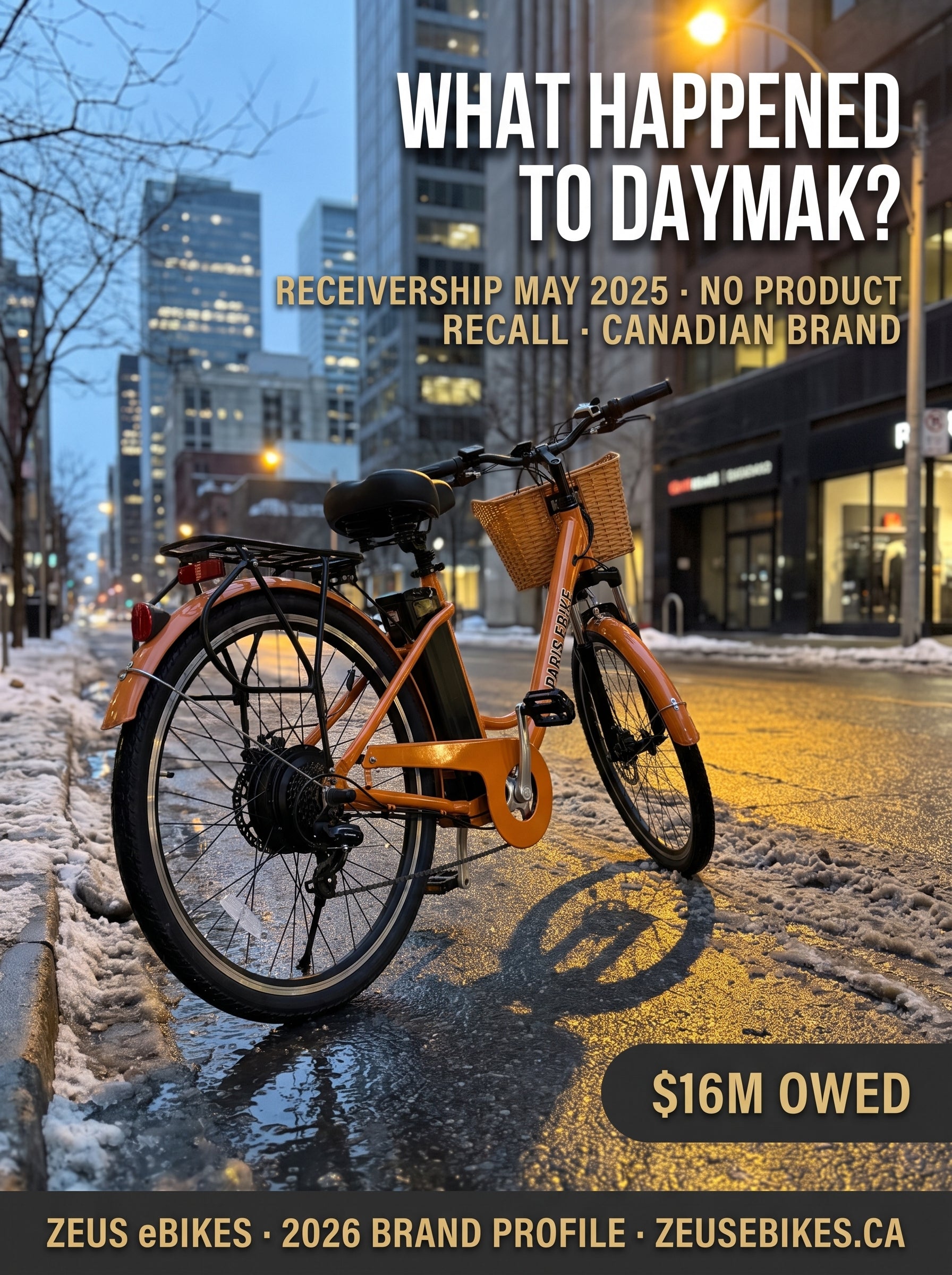
Daymak is no longer an operating company. The Toronto eBike and personal-EV maker, founded in 2002, was placed into receivership on May 23, 2025 — its principal secured creditor, TD Bank, was owed roughly $16 million per the receivership filings reported by Insolvency Insider — and a court-appointed receiver (Albert Gelman Inc.) liquidated the assets through a public auction run by Danbury Global Ltd. and A.D. Hennick & Associates. The practical fallout: the manufacturer warranty is effectively unsupported and there is no factory parts or service pipeline. On safety, the news is genuinely clean — no CPSC recall and no Health Canada advisory for Daymak eBikes is on record as of June 2026. If you own one, plan to service it through independent shops; if you are eyeing a liquidation-priced Daymak, treat it strictly as an as-is purchase. New to vetting eBike sellers? Start with how to spot a legit eBike store in Canada.
What This Profile Covers
What Happened to Daymak?
Daymak Inc. was placed into receivership on May 23, 2025, after defaulting on its debts to TD Bank, and a court-appointed receiver subsequently liquidated the company's assets. That is the event that reframes everything else about the brand: Daymak is no longer a manufacturer you can buy from, warranty with, or call for parts.
For a brand with a 23-year history, the collapse moved quickly. According to the receivership filings reported by Insolvency Insider, Daymak had been in default on its TD Bank facilities since March 31, 2024. TD issued a demand for payment in April 2025; when Daymak responded with a notice of intention to file a proposal (a restructuring step under the Bankruptcy and Insolvency Act), TD opposed it and successfully applied to the court to appoint Albert Gelman Inc. as receiver on May 23, 2025, rather than accept the proposed restructuring. The principal secured debt to TD was reported at approximately $16 million.
What followed was a full liquidation. Named press coverage — Canadian Manufacturing and the CNW/Newswire auction release — described a public auction conducted by Danbury Global Ltd. and A.D. Hennick & Associates, selling off more than 350 new eBikes along with e-scooters, ATVs, mobility scooters and thousands of EV parts. The auction ran with no reserve, and new-in-box bikes once valued at over $2,000 reportedly sold from as little as $50 — the kind of fire-sale economics that signals the assets were being cleared, not the business being rescued.
A receivership followed by an asset liquidation is materially different from a brand that is simply struggling or has paused production. When the receiver sells the inventory and parts at a no-reserve auction, there is no operating company left to stand behind the products. For a buyer or an owner, the corporate status is not a footnote — it is the single fact that determines whether you have a warranty, a parts source, or a service path. Everything below follows from it.
Daymak entered receivership on May 23, 2025 (TD Bank, ~$16M owed) and its assets were liquidated at a no-reserve auction. Treat any Daymak product as coming from a company that no longer exists — that framing is what protects you, whether you own one or are tempted by a liquidation price.
Is Daymak Still in Business — and Can You Still Buy One?
No, Daymak is not in business as an operating manufacturer as of June 2026. You may still find Daymak products for sale, but you would be buying from liquidation stock, retailers clearing remaining inventory, or the second-hand market — not from a company that can support the purchase.
This distinction matters more than it first appears. A Daymak listing on a classifieds site or a liquidation page is not fraudulent — the bikes are real, and a heavily discounted new-in-box unit can genuinely work. But the price reflects what you are actually getting: hardware with no manufacturer warranty, no factory parts supply, and no official service or recall channel. The company that would normally honour those obligations has been wound down through the receivership.
If you are weighing a liquidation-priced Daymak, the calculus is the same as any orphaned-brand purchase. The bike's value is the hardware minus the cost and hassle of supporting it yourself. A bike at $50–$300 from a clearance auction can make sense for a buyer who is comfortable servicing it independently and accepts the battery may need replacing. The same bike at near-original pricing makes no sense, because you would be paying for manufacturer backing that no longer exists. Our guide to spotting a legit eBike store covers the wider set of seller red flags worth checking before any online eBike purchase.
You can still find Daymak eBikes for sale, but only as orphaned stock. Price it as as-is hardware: fair value is the discounted bike minus your cost to service it and eventually replace the battery yourself — never a near-original price that assumes manufacturer support.
The Safety Record: Is There a Daymak Recall?
No. There is no recall or battery-fire safety notice for Daymak electric bikes in either the Health Canada or U.S. CPSC databases as of June 2026, and Daymak does not appear on published lists of recalled e-bike brands. This is one area where the news on Daymak is genuinely reassuring.
We checked this directly rather than relying on summaries. A keyword search for "Daymak" in Health Canada's recall database (recalls-rappels.canada.ca) returns zero results. The U.S. CPSC shows no Daymak recall. Independent compilations of e-bike recalls — which list the brands that have been actioned by CPSC and Health Canada — do not include Daymak among them. For an eBike owner, a clean recall record matters because it means no outstanding safety action requires your response — you are not riding a product under an active federal advisory. In a market where lithium-battery fire warnings have made headlines and prompted recalls for several well-known brands, the absence of any Daymak safety action is a meaningful positive on the record.
One careful distinction matters here, because it is exactly the kind of thing that gets misreported: Toronto has well-documented lithium-battery fires tied to e-mobility devices generally, and Daymak was a Toronto company — but none of those incidents is attributed to a Daymak product in any primary source we could find. We are not aware of a named, sourced Daymak eBike fire. We state the recall record as a verified absence as of June 2026, not as a permanent guarantee about every unit ever built.
No CPSC recall and no Health Canada advisory for Daymak eBikes on record as of June 2026, and no named, sourced Daymak battery-fire incident located in public reporting. On the safety record specifically — separate from the company's financial collapse — Daymak sits in the clean half of this market.
On legality, Daymak's product range was broad — eBikes, e-scooters, ATVs — and Canadian road-legal classification depends on the individual product's motor wattage and speed, not the brand name. Most Daymak eBikes sold in Canada used 500W or sub-500W hub motors and would have fallen within provincial power-assisted bicycle rules, but Daymak also sold higher-powered scooter-class vehicles subject to different rules. If you are trying to determine whether a specific Daymak model is road-legal in your province, check the motor-wattage specification against your province's rules — our eBike laws guide covers every province.
What the Receivership Means If You Own a Daymak
Daymak offered a manufacturer warranty on its products — the specific duration varied by product line and is no longer publicly verifiable now that the company's documentation is offline, but a 1-year manufacturer warranty was standard across most models per Canadian dealer listings at the time of sale (Zeus editorial reconstruction; no longer verifiable from a primary source).
If you own a Daymak eBike, the practical reality is that you are now responsible for supporting it yourself — the manufacturer warranty is effectively unsupported, and there is no factory parts or service channel. The good news is that many Daymak eBikes used generic, serviceable hardware, so an independent shop can often keep one running.
Here is the honest path forward for a stranded Daymak owner:
- Warranty claims: there is no operating entity to process them. Any warranty you were promised is, in practical terms, unenforceable now that the company is in receivership and liquidated. Treat the bike as out of warranty.
- Parts and service: many consumer-grade Daymak eBikes used standard hub-motor architecture — in our experience reviewing their published catalogue — but you should verify your specific model's drivetrain type before assuming generic parts will fit. Where that is the case, an independent eBike shop can often service them with generic or salvaged components, which means you are not locked into a proprietary parts chain that died with the company — the hardware is repairable, which is the best thing that can be said about an orphaned brand. Check your model's documentation or contact an independent eBike technician to confirm whether generic components will fit your bike before purchasing parts. Keep your model name and the motor/controller/battery specifications handy when sourcing parts.
- Batteries: the battery is the part most likely to need replacement over time and the hardest to source for a defunct brand. Standard replacement packs sized to your bike's voltage and form factor, fitted by a competent shop, are usually the realistic route — budget for this if you intend to keep the bike long-term.
- If you are replacing the bike entirely: the same money you might sink into replacing the battery and servicing an orphaned bike can sometimes be better put toward a current model that still carries a warranty and parts support. If you reach that point, our guide to choosing an eBike walks through matching a bike to your actual use case, and the stranded-owner playbook we wrote for Rad Power riders covers the same decision from another orphaned brand.
Stranded by a brand that's no longer there?
You are not the first — Rad Power riders faced the same question in 2025. Our editorial guides walk through how to evaluate any eBike seller and how to choose your next bike on its own merits, with no sales pressure.
How to Choose an eBike → Spot a Legit eBike StoreReputation and Reliability Signal
Daymak's formal complaint record is thin: an A BBB grade with a single unresolved complaint and low self-selected review scores from a small sample. The themes that do appear point at exactly the risk the receivership now makes concrete.
The sample is too small to assert a systemic quality problem, but the recurring friction — parts and warranty difficulty — is precisely what the receivership turns from a risk into a certainty.
On the Better Business Bureau, Daymak Inc. was listed with an A letter grade, marked not accredited, with one unresolved complaint on file and a business start date consistent with the 2002 founding. A single complaint is a low formal-dispute volume for a company that operated for two decades — read it as a weak signal in both directions rather than a verdict. On self-selected complaint platforms, Daymak's average sits low (around 1.7 out of 5 on one such site, from roughly nine reviews), with recurring themes of battery degradation and difficulty obtaining parts and warranty service. These platforms attract dissatisfied customers by design and the sample is small, so we report the numbers without treating them as representative of all owners.
The fair reading: there is no sourced evidence of a widespread Daymak reliability failure, and the formal complaint count is genuinely low. But the few documented complaints centre on parts and warranty difficulty — and with the company now in receivership, that specific friction is no longer a risk, it is the baseline. That is the honest, sourced concern for an owner, and it is a financial-support problem rather than a safety one.
Daymak's formal complaint volume was low (a single BBB complaint; an A grade), so there is no evidence of a systemic defect. The recurring owner theme that does exist — parts and warranty difficulty — is exactly what the receivership turns from a risk into a certainty.
The Honest Ledger: Green Flags vs Red Flags
No brand is all one colour — and a defunct one least of all. On the sourced record, Daymak's strengths are its genuine Canadian identity, its clean safety record (no recall, no named battery fire), and its use of serviceable generic hardware on many models. Its single decisive weakness is that it no longer exists.
Green Flags
- Genuinely Canadian company — Toronto-headquartered, founded 2002, with a 20-plus-year operating history before the receivership
- No CPSC recall and no Health Canada advisory for Daymak eBikes on record as of June 2026
- No named, sourced Daymak battery-fire incident located in public reporting
- Broad historical product range (eBikes, e-scooters, ATVs, mobility scooters) built largely on generic, independently serviceable hub-motor hardware
- Low formal complaint volume — a single unresolved BBB complaint and an A letter grade
Red Flags
- In receivership since May 23, 2025 and assets liquidated — no longer an operating manufacturer as of June 2026
- Manufacturer warranty effectively unsupported — no entity to process claims, supply parts, or service the bikes
- Approximately $16 million owed to secured creditor TD Bank at receivership, per the filings reported by Insolvency Insider
- Owner reviews on self-selected platforms are low and cite parts and warranty difficulty — small sample, but aligned with the after-sales risk a defunct brand creates
- Liquidation pricing means orphaned stock is widely available — easy to overpay relative to what manufacturer-free hardware is actually worth
Daymak was a real, long-running Canadian personal-EV company with a clean safety record — and as of 2026 it is gone, wound down through a May 2025 receivership and asset liquidation. That single fact governs every buying decision: the bikes are not dangerous on the public record, but they are orphaned hardware with no warranty, no factory parts, and no official service. If you already own one, keep it running through independent shops and budget for an eventual battery replacement. If you are looking at a liquidation-priced Daymak, buy it only as a knowingly as-is purchase at a price that reflects zero manufacturer support — and if you are replacing a dead Daymak, choose your next bike on its own merits from a brand that still stands behind it. In our view, the brand's collapse is a financial story, not a safety one — but for a buyer the result is the same: there is no one home.
Ready to choose what comes next?
Our editorial buying guide matches a bike to your actual use case — no sales pressure, no brand bias. And if you are vetting a seller, our legit-store checklist covers every red flag worth checking.
eBike Buying Guide → Legit Store ChecklistFrequently Asked Questions
What happened to Daymak?
Daymak Inc., a Toronto-based maker of eBikes, e-scooters and personal electric vehicles founded in 2002, was placed into receivership on May 23, 2025. Per the receivership filings reported by Insolvency Insider, its principal secured creditor, TD Bank, was owed approximately $16 million; Daymak had been in default since March 31, 2024, and after a demand for payment TD applied to court to appoint Albert Gelman Inc. as receiver rather than accept the company's restructuring proposal. The receiver then liquidated the assets — a public auction by Danbury Global Ltd. and A.D. Hennick & Associates sold more than 350 new eBikes plus e-scooters, ATVs, mobility scooters and thousands of parts, with new-in-box bikes once valued over $2,000 reportedly selling from as little as $50 with no reserve.
Is Daymak still in business in 2026?
No. Daymak was placed into receivership in May 2025 and its assets were liquidated through a court-supervised auction, which effectively ended the company's operations. As of June 2026 there is no manufacturer behind the brand to honour warranties, supply parts, or provide service. Any Daymak product offered for sale now is remaining or second-hand inventory sold without manufacturer backing.
Is there a Daymak recall?
No recall or battery-fire safety notice for Daymak electric bikes was found in either the Health Canada recall database (recalls-rappels.canada.ca) or the U.S. CPSC database (cpsc.gov) as of June 2026, and Daymak does not appear on published lists of recalled e-bike brands. This is a verified absence as of that date — not a guarantee about every product Daymak ever made, but there is no recall on the public record, and we found no named, sourced Daymak eBike fire.
What happens to my Daymak warranty now?
With Daymak in receivership and its assets liquidated, the manufacturer's warranty is effectively unsupported — there is no operating company to process a claim, and the factory parts and service pipeline is gone. In practice, treat the bike as out of warranty. The realistic path is independent eBike shops that can service generic hub-motor and controller hardware, third-party or salvaged parts, and a standard replacement battery sized to your bike when the original pack ages out.
Can you still buy a Daymak eBike?
You may still find Daymak eBikes through liquidation channels, classified listings, and remaining retailer or second-hand stock, but you would be buying a product from a company that no longer exists — no manufacturer warranty, no factory parts supply, no official service. If you are considering a heavily discounted Daymak from liquidation, treat it as an as-is purchase, budget for independent service and an eventual battery replacement, and confirm the battery's age and condition before buying.
Was Daymak a Canadian company?
Yes. Daymak Inc. was a genuinely Canadian company, headquartered in Toronto and founded in 2002. It sold and distributed eBikes, e-scooters, ATVs, mobility scooters and other personal electric vehicles, and promoted the Spiritus solar-assisted EV concept. The Canadian ownership was real — but as of 2026 the company is in receivership and its assets have been liquidated, so its Canadian status no longer translates into Canadian after-sales support.
Informed decision required. The sourced Green and Red Flags above tell the full picture. Every claim in this profile traces to a named primary source — none is opinion without evidence. Before purchasing, confirm the brand's Canadian warranty terms in writing, verify return logistics and costs, and pay by credit card for chargeback protection if buying cross-border. If you want a Canadian-backed eBike with domestic warranty support, no cross-border complications, and local recourse at 1-866-938-7580, see the Zeus lineup →
The Bottom Line
Daymak operated as a Canadian personal-EV company for more than two decades, with no recall on its public safety record. But the story that matters in 2026 is the ending: the company entered receivership in May 2025 and its assets were liquidated, leaving the brand without a manufacturer to support it. For owners, that means servicing the bike independently and planning for a battery replacement; for bargain-hunters, it means pricing any Daymak as orphaned, as-is hardware and nothing more. The bikes are not the problem — the absence of anyone standing behind them is. If you are choosing what comes next, do it the way you would vet any seller: read our legit eBike store checklist, confirm you are legal where you ride, and match the bike to your real use case with our eBike buying guide.
Related Zeus Guides
Stranded-Owner Help
By Category
Why Buy Canadian
This Daymak profile is part of the Zeus eBikes Canadian eBike Brands directory — an independent, sourced reference for Canadian eBike shoppers.
This profile was researched and written by the Zeus eBikes Canada editorial team as part of an independent directory of eBike brands sold in Canada. Zeus eBikes does not sell Daymak products and has no commercial relationship with the brand; the editorial research and sourcing follow the same neutral standards applied to every brand in this directory. Last verified: July 10, 2026 — the May 2025 receivership, the ~$16M TD Bank secured claim and the asset auction re-verified against primary insolvency records.
Sources: Health Canada recall database (recalls-rappels.canada.ca, "Daymak" search — no results); U.S. CPSC recall database (cpsc.gov — no Daymak recall); Insolvency Insider (Daymak Inc. receivership reporting — receivership date, TD Bank ~$16M secured claim, default date, appointment of Albert Gelman Inc. as receiver); Canadian Manufacturing and CNW/Newswire (liquidation-auction coverage — Danbury Global Ltd. and A.D. Hennick & Associates, 350+ eBikes, no-reserve pricing); Better Business Bureau (Daymak Inc. profile — A grade, not accredited, one complaint); independent e-bike recall compilations (Daymak absent). Financial and receivership details are attributed to the named filings and press releases; the recall record is reported as a verified absence as of June 2026. Owner-review figures are from self-selected complaint platforms and are reported as a small, non-representative sample.

Share:
Cube eBikes Canada: The Honest 2026 Brand Profile
Sondors eBikes in Canada: The Verified Brand Profile (2026)