
Yamaha eBikes in Canada: The Verified Brand Profile (2026)

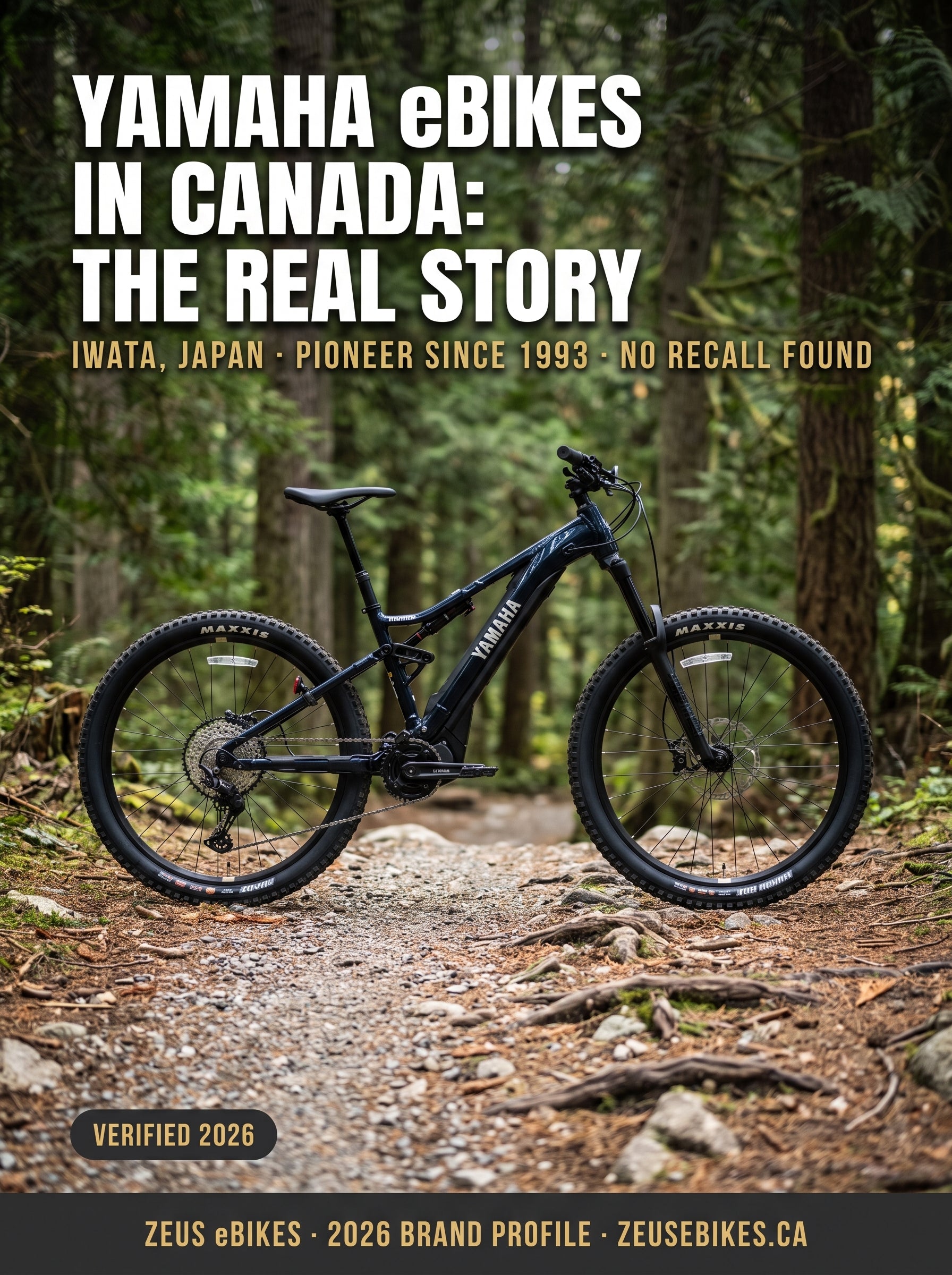
Yamaha is a name most Canadians attach to motorcycles, outboard motors and pianos — so the obvious question is whether a "Yamaha eBike" is a real, Yamaha-engineered machine or a logo licensed onto someone else's frame. The honest answer surprises people: Yamaha didn't just enter the eBike world, it invented it.
This is an independent, fully sourced profile. Zeus does not sell Yamaha and has no stake in the answer — every fact below traces to a named primary source: Yamaha's own pages, Health Canada, the CPSC, and the cycling trade press.
We worked only from named primary sources, re-checking each from scratch rather than trusting prior notes. Corporate history and the 1993 PAS claim come from Yamaha Motor Co.'s own global heritage pages. Warranty terms come directly from Yamaha's US warranty-overview page (read verbatim) and, for Canada, from the trade reports of Yamaha's Canadian launch (Inside Motorcycles, Cycle Canada). The US-market exit is sourced to Bicycle Retailer and Industry News (3 November 2024), Electrek and Powersports Business. Model specs come from Yamaha's product pages and Yamaha Motor Canada. The recall record was checked by hand in both Health Canada's Recalls and Safety Alerts database and the US CPSC database, searching the brand and every model name. Where a fact could not be verified to a primary source, we left it out or framed it as an absence rather than guess. Spotted something we should correct, or speaking for Yamaha? Email milad@zeusebikes.ca and we will review and update.
Quick answer: Yamaha genuinely makes eBikes — it built the world's first mass-produced pedal-assist bicycle (the PAS) in 1993 and still designs its own motors, so a Yamaha eBike is a true Yamaha, not a badge. The hardware earns strong reviews and has no recall on record in Health Canada or the CPSC. The Canadian warranty covers 3 years on Yamaha-made parts and 1 year on supplier parts — shorter than the US 5-year drive-unit term, so confirm in writing with your dealer. The catch is staying power: Yamaha Motor U.S. pulled out of the US eBike market at the end of 2024, so the live question for Canadians is current availability and long-term service. Confirm a supporting dealer before you buy. New to the category? Start with our Canadian eBike buying guide and the federal and provincial eBike laws.
What This Profile Covers
- Who builds a Yamaha eBike — genuine engineering or a licensed badge?
- The US exit and Canadian availability
- The warranty reality — Canada vs the US
- Safety and recall record
- The lineup, prices and specs
- Legality for Canadian roads and paths
- The honest ledger — green flags and red flags
- Frequently asked questions
- The bottom line
Who builds a Yamaha eBike — genuine engineering or a licensed badge?
A Yamaha eBike is a genuine Yamaha — the company invented the mass-produced pedal-assist bicycle with its PAS (Power Assist System) in November 1993, and Yamaha's own heritage pages describe it as the world's first mass-produced electrically power-assisted bicycle. That history settles the badge-engineering worry directly: Yamaha didn't license its way into this category; it created the category that every other brand on the market today is working inside.
That history matters because it answers the badge-engineering worry directly. Yamaha designs and manufactures its own mid-drive motors — the current PW Series drive units — and builds complete bicycles such as the CrossCore RC, the Wabash RT and the off-road YDX-MORO range. It is one of the few eBike makers where the same company engineers the frame, the motor and the battery as a single system. Independent reviewers note exactly that: Electric Bike Report, reviewing the CrossCore RC, framed it as the rare case of a bike made by the same well-established company that manufactures its own motor and battery.
There is a second, lesser-known proof of genuine engineering: Yamaha is also an OEM motor supplier, meaning other bicycle brands buy Yamaha drive units to power their bikes. A company does not become a drive-unit supplier to the wider industry by slapping its name on imported hardware. So whatever else this profile flags, the foundational question — is this a real Yamaha product — has a clean answer.
A Yamaha eBike is genuinely engineered and built by Yamaha, the company that invented the mass-produced pedal-assist bicycle in 1993 and still makes its own motors. The "is this a real Yamaha?" worry is settled — yes. The real questions are about availability, warranty and service, which the rest of this profile covers.
If your curiosity here is really the bigger one — "is buying an eBike from a big-name maker actually a safer bet than a direct-to-consumer brand?" — that is a fair instinct, and it is the exact question our guide on how to spot a legit eBike store in Canada is built to answer. Brand heritage is one signal; in-country service is another, and as you will see below, the two don't always move together.
The US exit and Canadian availability
Yamaha Motor U.S. stopped wholesaling eBikes in the United States at the end of 2024, citing post-COVID oversupply and a softening market (Bicycle Retailer, 3 Nov 2024). Yamaha Motor Canada is a separate operation and has not publicly announced a Canadian exit — but live stock and dealer coverage need to be confirmed before you buy. In early November 2024, YMUS told its dealer network — roughly 400 US dealers — that it would stop wholesaling eBikes in the United States at the end of 2024. Bicycle Retailer and Industry News reported the decision on 3 November 2024, and Yamaha's dealer letter attributed it to post-COVID oversupply across the bicycle industry and a significant softening of the market, conditions the company said made a sustainable business model extremely difficult. Electrek and Powersports Business reported the same exit.
What the company committed to is as important as the exit itself, and we report it precisely: YMUS said it would continue to provide parts, service and customer support in the United States and honour its limited five-year warranty for the full agreed period, and it ran clearance promotions on remaining inventory. So this was an exit from wholesaling new bikes, paired with a stated commitment to support bikes already sold. We have not seen Yamaha characterise the US eBike business as permanently closed forever; we have seen it stop selling new units there.
The public statement was framed around the US business ("YMUS"). Yamaha Motor Canada is a separate operation: it launched power-assist bicycles in Canada in April 2023 (the YDX-MORO 05 and 07) and expanded the line in 2024 with the CrossCore RC and Wabash RT, and trade coverage of the US exit noted that Yamaha eBikes were still being offered in Canada, Europe and Japan. What we cannot verify to a primary Yamaha source as of June 2026 is the precise, current state of Canadian eBike stock and dealer coverage. The honest framing: a North American retreat is underway, the Canadian door has not been publicly declared closed, and live availability needs to be confirmed dealer-by-dealer.
We are deliberately not overstating this. It would be easy — and wrong — to write "Yamaha has abandoned Canada." The company did not say that. What is true is narrower and still important: the brand pulled back from the largest market in North America, which is the kind of signal a careful buyer weighs when spending two to six thousand dollars on a machine they expect to own and service for years. If long-term in-country support is your priority, that instinct is exactly why some Canadians deliberately choose a Canadian eBike brand or retailer — not out of patriotism, but because the warranty desk is in the same country and isn't a candidate to be wound down.
The warranty reality — Canada vs the US
In Canada, Yamaha launched its eBike line with 3 years of warranty on Yamaha-manufactured parts and 1 year on supplier-sourced parts — shorter than the US programme, which covers the drive unit, battery, rigid frame and rigid front fork for 5 years on models purchased from 1 December 2023 onward. Confirm the current term in writing with your Canadian dealer before buying. The gap is real, and conflating the two countries' programmes is the easiest mistake to make.
In the United States, Yamaha's warranty-overview page states that for models purchased on or after 1 December 2023, the drive unit, battery, rigid frame and rigid front fork are warranted for five years from the date of purchase, and all other components for one year. The page also spells out a battery clause most brands gloss over: normal capacity decline is not a defect as long as the battery holds 50% or more of its initial capacity and has 700 or fewer charge cycles within the warranty period. Standard wear items — tires, tubes, cables, grips, brake pads, chains and the like — are excluded, as is damage from abuse, racing, accidents, salt exposure and commercial use. The same page also requires defects to be reported to an authorised dealer within 10 days of discovery — a procedural condition worth knowing before you need to make a claim.
In Canada, the terms Yamaha announced at launch are different and shorter on the headline number. Reporting the Canadian arrival of the line, Inside Motorcycles and Cycle Canada quoted Yamaha as stating the YDX-MORO models carry 3 years of warranty on Yamaha-manufactured parts and 1 year on supplier-sourced parts, with extended coverage available through dealers. So a Canadian buyer should not assume the US five-year drive-unit figure applies here — the Canadian programme as launched was three years on Yamaha's own parts. Note: this 3-year / 1-year structure was stated at the April 2023 Canadian launch as reported by trade press. Zeus was unable to locate a current Yamaha Motor Canada warranty-overview page confirming these terms remain unchanged. Verify the current warranty in writing with a Yamaha Motor Canada dealer before purchase — do not rely on launch-era trade reports alone.
Because the Canadian and US terms diverge, the term that matters is the one written for your specific model and purchase date. Before buying, ask the dealer to show you the Canadian warranty statement in writing, confirm the year count on the drive unit, battery and frame, and confirm who performs warranty service and where. Get it on paper. A brand's warranty is only as good as the service network standing behind it — which, given the US exit, is the part worth nailing down.
None of this is a knock on the coverage itself — three years on Yamaha parts is competitive, and the US five-year term is genuinely generous. The point is accuracy: you are buying the Canadian programme, not the American one, and the gap is real. If you are weighing the total cost of ownership against, say, keeping a car, our breakdown of an eBike versus a car in Canada puts these warranty and service questions in the wider money picture.
Weighing an eBike against other transport costs?
Our Canadian eBike buying guide covers the full financial picture — warranty, maintenance, financing, and what to look for in any brand's service commitment before you spend.
Read the Buying Guide →Safety and recall record
On the single most important safety question — has any Yamaha eBike been recalled — the record is clean, and we verified it by hand rather than trusting a summary. As of June 2026, no recall or safety alert for a Yamaha electric bicycle, power-assist bicycle, PAS, CrossCore, Wabash or YDX-MORO appears in Health Canada's Recalls and Safety Alerts database or in the US Consumer Product Safety Commission (CPSC) database.
To be precise about what those databases do contain: both registries list other, unrelated Yamaha recalls — for motorcycles and ATVs (through Transport Canada in the Canadian system), for golf cars and UMAX utility vehicles, and for AC power adapters made by the separate Yamaha Corporation. We mention these so it is clear we searched thoroughly and are not reporting a gap we failed to look into. None of them involves the eBike line. This is a verified absence of an eBike recall as of the date we checked — not a promise about the future, and not a claim that Yamaha eBikes are immune to any future action.
No Yamaha eBike recall exists in either the Health Canada or CPSC databases as of June 2026. The unrelated Yamaha recalls in those systems are for motorcycles, ATVs, golf cars and power adapters — not the bicycles. On the recall question specifically, Yamaha's eBike line has a clean public record.
Battery fire risk is the headline safety worry across the whole eBike category right now, and it is the reason certification and quality control matter regardless of badge. For the wider context on why some battery packs end up in safety notices and what to look for, our directory work on the Rad Power battery situation and Canadian alternatives lays out how a real safety notice reads versus marketing reassurance.
The lineup, prices and specs
Yamaha's eBike range is built around its own mid-drive system and skews toward sport, fitness and off-road riding rather than the fat-tire and cargo formats many value brands lead with. The lineup uses more than one drive unit: the CrossCore RC and Wabash RT run the urban-tuned PW Series S2-class drive unit (about 70–75 Nm), while the off-road YDX-MORO range uses the higher-torque PW-X3 rated up to 85 Nm (per Yamaha Motor Canada and Inside Motorcycles). These are the manufacturer's stated specs and prices, labelled as such.
The two models most relevant to a Canadian commuter or fitness rider are the CrossCore RC, a flat-bar urban and fitness eBike with a US MSRP around $2,999, and the Wabash RT, a drop-bar gravel eBike with a US MSRP around $4,199. Above them sits the off-road YDX-MORO full-suspension mountain line, which runs roughly $4,799 to $6,499 in US MSRP across its variants. Yamaha states the CrossCore RC pairs a PW Series mid-drive with a 500 Wh, 36 V battery and the brand's Quad Sensor System, and that it is pedal-assist only — there is no throttle on these bikes.
One important note for Canadians: Canadian pricing runs higher than US MSRP. Canadian launch pricing as of April 2023: YDX-MORO 07 at $8,299 CAD and YDX-MORO 05 at $6,999 CAD, freight and assembly included (Inside Motorcycles and Cycle Canada, April 2023) — well above the US MSRP figures above. Current pricing must be confirmed with a Yamaha Motor Canada dealer — prices may have changed. Do not assume the US number applies in Canada; confirm the current Canadian price and any 2026 model-year change before you budget.
This is the spec detail that trips people up. Yamaha states the US-market CrossCore RC and Wabash RT assist up to 28 mph (about 45 km/h). The Canadian-market versions are different: Yamaha Motor Canada describes them as using the PW Series S2 drive unit with maximum power of 500 watts and speed support up to 32 km/h — built to Canadian rules. If you are looking at a US listing or a grey-import bike, you are not looking at the Canadian-compliant configuration. Always confirm you are buying the Canadian-spec model.
One honest fit note: because the range is mid-drive sport and gravel with no throttle, a Yamaha eBike will not suit a buyer who specifically wants a throttle-driven fat-tire cruiser or a cargo hauler. That is not a flaw — it is a different design brief. If a wide, stable fat-tire platform is what you are picturing, that is a separate category worth understanding on its own terms in our fat-tire electric bike guide for Canada, and the broader field of well-supported options sits in our roundup of the best electric bikes in Canada.
Legality for Canadian roads and paths
On legality, the Canadian-spec Yamaha line is on the right side of the provincial PAB standard — which is not something we can say for every brand we profile. Canada's historical federal Power-Assisted Bicycle definition (repealed in 2021; e-bike rules are now provincial) looked for a motor of not more than 500 watts, motor assistance that cuts out at 32 km/h, and functional pedals — and most provinces continue to follow that same standard. Yamaha Motor Canada describes the CrossCore RC and Wabash RT as using the PW Series S2 drive unit with a maximum of 500 watts and speed support up to 32 km/h, pedal-assist only with no throttle. That configuration fits the PAB standard cleanly — but confirming compliance with your own province before riding is still required, as provincial rules vary. See our Canadian eBike laws guide for the province-by-province breakdown.
Two caveats keep this accurate. First, the federal definition was repealed in 2021; the rules that actually govern your ride — minimum age, helmet requirements, and whether you can use a given bike lane, path or trail — are set provincially and municipally, and they vary. Second, the US-spec versions of these same bikes assist to about 45 km/h and would not meet the 32 km/h pedal-assist limit, which is another reason to confirm you have the Canadian model. Our guide to Canadian eBike laws breaks the federal-versus-provincial picture down province by province.
The Canadian-spec Yamaha eBikes sit inside the limits the provincial rules converge on — 500 W max, 32 km/h cut-off, pedals, no throttle. The US versions (45 km/h) do not, so buy the Canadian model. Provincial age, helmet and trail-access rules still apply.
The Honest Ledger: Green Flags vs Red Flags
No brand is all one colour — here is the picture the sourced facts above actually support.
Green Flags
- Genuine builder, not a badge: Yamaha invented the mass-produced pedal-assist bicycle (PAS, 1993) and designs and manufactures its own PW Series mid-drive motors and complete bikes.
- Deep engineering pedigree — a mobility manufacturer founded in 1955 that also supplies eBike drive units to other brands as an OEM motor partner.
- Canadian-spec models sit inside the 500 W / 32 km/h limits Canada's provincial rules converge on: 500 W max, 32 km/h pedal-assist cut-off, no throttle (per Yamaha Motor Canada).
- No recall or safety alert for any Yamaha eBike found in Health Canada or CPSC databases as of June 2026.
- Strong independent review reputation for motor refinement and reliability (Electric Bike Report, eBikes International).
- Sold and serviced through a dealer network rather than direct-only shipping — local test rides and warranty work where a dealer exists.
Red Flags
- Yamaha Motor U.S. exited the US eBike wholesale market at the end of 2024 (Bicycle Retailer, 3 Nov 2024), citing oversupply and a softening market — raising long-term questions about the North American dealer, parts and service footprint.
- Canadian status needs live confirmation: the public exit statement was US-framed, but the North American retreat leaves current Canadian stock and dealer support uncertain — verify with a Yamaha Motor Canada dealer before buying.
- Warranty differs by country: Canada was launched with 3 years on Yamaha parts plus 1 year on supplier parts, versus the US 5-year drive-unit/battery/frame term — confirm the term on your model and purchase date.
- Premium pricing: US MSRP runs about $2,999 (CrossCore RC) to $6,499 (YDX-MORO line); verified Canadian launch pricing was higher still — YDX-MORO 07 at $8,299 CAD and YDX-MORO 05 at $6,999 CAD (freight and assembly included, per Inside Motorcycles and Cycle Canada) — well above budget direct-to-consumer brands.
- US-market versions assist up to 28 mph (about 45 km/h) and would exceed Canada's 32 km/h pedal-assist limit — a grey-import US-spec bike is not a Canadian-compliant PAB.
- Mid-drive sport and gravel focus, not fat-tire or cargo: no throttle and a narrower use-case range than many Canadian buyers expect from a value eBike brand.
In our view, Yamaha is the rare eBike name that fully earns its credibility on engineering. The brand invented the mass-produced pedal-assist bicycle, still builds its own motors, has a clean recall record in both Health Canada and the CPSC as of June 2026, and ships Canadian-spec bikes that genuinely sit inside the 500 W / 32 km/h limits the provinces converge on. On hardware alone, this is a serious, well-reviewed product — not a badge exercise. The hesitation is not about the bike; it is about the runway behind it. Yamaha's decision to stop wholesaling eBikes in the US at the end of 2024 is a real signal, and while the company pledged to support bikes already sold and has not publicly closed the Canadian door, a buyer spending years with this machine is right to want certainty about parts and warranty service over that horizon. We consider a Yamaha eBike a strong choice for a Canadian who can confirm a committed local dealer and is comfortable with that long-tail question — and a reason to pause for anyone who places maximum value on guaranteed, in-country, long-term support, who should weigh it against brands with an expanding Canadian operation. The machine is excellent; do your service due diligence before you commit. If you have information that updates any claim on this page — including current Canadian dealer availability or 2026 warranty terms — email milad@zeusebikes.ca and we will review and correct.
Not sure which eBike brand is right for you?
Browse the Canadian eBike directory for independent, sourced profiles of every major brand available in Canada — or start with our roundup of the best electric bikes Canadians are buying right now.
Best eBikes in Canada → Buying Guide →Frequently Asked Questions
Does Yamaha actually make eBikes?
Yes — and Yamaha effectively created the category. Yamaha Motor Co. launched the PAS, the world's first mass-produced electrically power-assisted bicycle, in November 1993. Yamaha designs and manufactures its own PW Series mid-drive motors and builds complete bikes such as the CrossCore RC, Wabash RT and YDX-MORO. A Yamaha eBike is a genuine Yamaha-engineered product, not a licensed badge — and Yamaha even supplies its drive units to other bicycle brands as an OEM motor partner.
Are Yamaha eBikes still available in Canada in 2026?
Yamaha Motor U.S. announced it would stop wholesaling eBikes in the US market at the end of 2024 (Bicycle Retailer and Industry News, 3 November 2024), citing oversupply and a softening market. That statement was US-framed. Yamaha Motor Canada launched power-assist bicycles in Canada in April 2023 and expanded the line in 2024, and trade coverage indicated Canadian, European and Japanese availability continued. Because the North American retreat creates uncertainty around current Canadian stock and the dealer network, confirm live availability and local service with a Yamaha Motor Canada dealer before buying.
What warranty do Yamaha eBikes have in Canada?
At the Canadian launch, Yamaha stated the YDX-MORO models carry 3 years of warranty on Yamaha-manufactured parts and 1 year on supplier-sourced parts, with extended coverage available through dealers (Inside Motorcycles, Cycle Canada). This differs from the US programme, where Yamaha's warranty page states five years on the drive unit, battery, rigid frame and rigid front fork and one year on other components for models bought on or after 1 December 2023. Confirm the exact term for your model and purchase date with a Canadian dealer.
Have Yamaha eBikes ever been recalled?
No recall or safety alert for a Yamaha electric bicycle, power-assist bicycle, PAS, CrossCore, Wabash or YDX-MORO was found in Health Canada's Recalls and Safety Alerts database or the US CPSC database as of June 2026. Both registries list unrelated Yamaha recalls — motorcycles, ATVs, golf cars and AC power adapters — but none for the eBike line. This is a verified absence as of the date checked, not a guarantee about the future.
Are Yamaha eBikes legal as pedal-assist bicycles in Canada?
Yamaha's Canadian-market eBikes are built to the pedal-assist standard. Yamaha Motor Canada describes the CrossCore RC and Wabash RT as using the PW Series S2 drive unit with maximum power of 500 watts and speed support up to 32 km/h, pedal-assist only with no throttle — inside the 500W / 32 km/h limits Canada's provincial rules converge on. The US-market versions of the same models assist up to 28 mph (about 45 km/h), so confirm you are buying the Canadian-spec bike. Provincial rules on age, helmets and where you can ride still apply.
Is a Yamaha eBike worth buying in Canada right now?
The hardware is well regarded — independent cycling press praised the CrossCore RC's motor refinement, and there is no recall on record. The open question is service certainty: with Yamaha having retreated from the US eBike market at the end of 2024, how robust will the dealer, parts and warranty-service network remain over a multi-year ownership window? In our view it is a genuinely good machine for a buyer who can confirm a supporting Yamaha dealer nearby and is comfortable with that uncertainty; buyers who want maximum assurance of long-term in-country support should weigh that risk against brands with a committed, expanding Canadian operation.
The Bottom Line
Yamaha is the genuine article on engineering — it invented the mass-produced pedal-assist bicycle in 1993, builds its own motors, has zero eBike recalls on record in Health Canada or the CPSC as of June 2026, and sells Canadian-spec bikes inside the 500 W / 32 km/h limits the provinces converge on. The hardware is not in question. What a careful Canadian buyer must settle first is staying power: Yamaha pulled its eBikes out of the US market at the end of 2024, and while the Canadian door has not been publicly closed, long-term parts and warranty service is the real variable. Confirm a committed local dealer, get the Canadian warranty term in writing, and make sure you are buying the 32 km/h Canadian model — then it is a strong bike.
Related Zeus Guides
Compare your options
The bigger money picture
This profile is part of the Canadian eBike Brands & Shops directory — independent, sourced profiles of every major eBike brand available in Canada.
Researched and written by the Zeus eBikes Canada editorial team as part of an independent directory of eBike brands sold in Canada. Zeus eBikes does not sell Yamaha products and has no commercial relationship with the brand; research and sourcing follow the same neutral standards applied to every brand in this directory. Last verified: June 22, 2026.
Primary sources, all checked directly for this profile: Yamaha Motor Co.'s global heritage page on the PAS (global.yamaha-motor.com/about/business/pas) for the 1955 founding and 1993 first-pedal-assist claim; Yamaha's US warranty-overview page (yamahabicycles.com/warranty-overview) read verbatim for the US 5-year drive-unit/battery/frame terms, the 50%/700-cycle battery clause and exclusions; Inside Motorcycles and Cycle Canada for the Canadian launch warranty (3 years Yamaha parts / 1 year supplier parts, April 2023); Bicycle Retailer and Industry News (3 November 2024), Electrek and Powersports Business for the Yamaha Motor U.S. eBike-market exit at the end of 2024 and the stated parts/service/warranty commitment; eBikes International for Yamaha Motor Canada's PW Series S2 spec (500 W max, 32 km/h) and the 2024 CrossCore RC / Wabash RT Canadian launch; Yamaha's CrossCore RC product page for the US 28 mph spec and pedal-assist-only configuration; Health Canada's Recalls and Safety Alerts database (recalls-rappels.canada.ca) and the US CPSC database (cpsc.gov), both searched by brand and model name, confirming no Yamaha eBike recall as of June 2026; and the Yamaha Motor Company corporate record (Iwata, Shizuoka HQ). Where a fact could not be tied to a primary source it was omitted or framed as an absence. Corrections: milad@zeusebikes.ca.
Share:
Wired Freedom eBikes Canada (2026): Brand Profile
Yuba eBikes in Canada: The Verified Brand Profile (2026)