
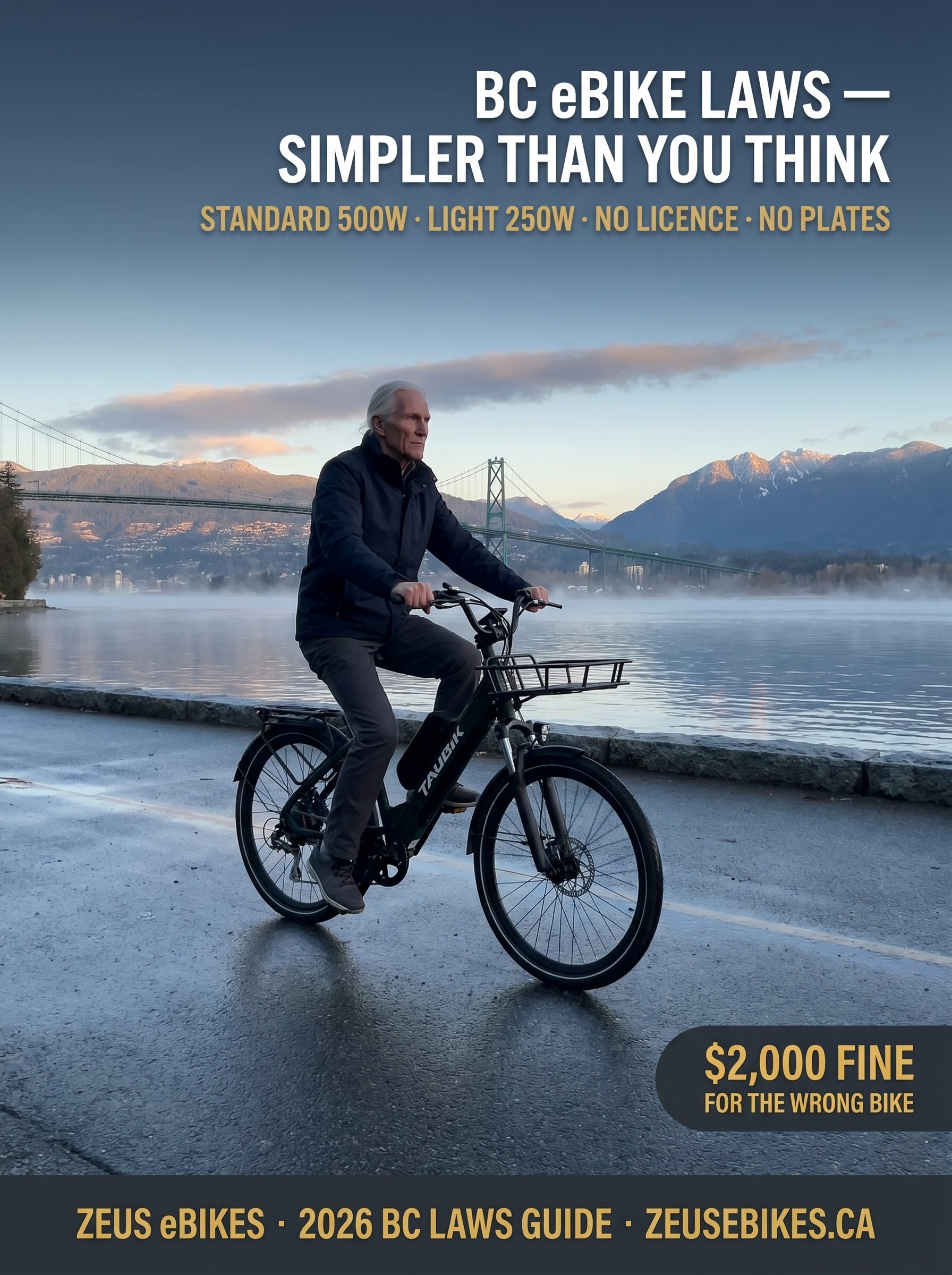
BC eBike Laws 2026: Standard vs Light Rules, Where to Ride & 7 Legal Picks ($899–$2,569)

British Columbia is one of the few provinces with two e-bike categories. A Standard e-bike caps at 500W continuous and 32 km/h, requires age 16+, allows a throttle. A Light e-bike caps at 250W continuous and 25 km/h, allows age 14+, must be pedal-assist only (no throttle). Helmet is mandatory for every rider on every e-bike. No driver's licence, no registration, no insurance.
Most common mistake: Buying a 750W bike with an "off-road unlock" mode and assuming the locked 32 km/h setting makes it a Standard e-bike. It does not — the regulation classifies by motor rating, not software setting. Under the BC Motor Vehicle Act, consequences can range from traffic-ticket fines (starting around $109) to vehicle impoundment to further penalties up to $2,000, depending on the specific offence.
Seven Standard-compliant picks from $899: Samebike CY20 ($899), Movin' Tempo Max ($1,899), Meta Foldable ($1,994), Taubik Tour ($2,199), Blackburn 275T ($2,399), ONE-TRIKE 2.0 ($2,429), Eunorau Defender ($2,569). Or browse the full Urban eBikes collection.
📥 The BC eBike Rider's Almanac — Issue 01 — free, printable, no email required.
16 pages. Every rule. Top 10 verified tourist routes. Charging map. Theft hotspots. Transit survival guide. A clinical first-aid one-pager. A cut-out glove-box card. Built like a national-park field guide. No signup. No data collection. Print it, fold it, ride.
Download the Almanac (PDF) →In This Guide
- 📥 Download the printable Almanac (free, no email)
- Why this guide exists
- Standard vs Light — the legal definition
- Who can ride — age, helmet, throttle
- Where you can and can't ride
- 10 BC tourist routes — verified for 2026
- Vancouver Rider's Master Map
- Charging the eBike
- Victoria Rider's Master Map
- What invalidates your legal status
- BC vs Ontario vs Québec — side-by-side
- 7-point compliance checklist
- 7 legal picks — $899 to $2,569
- FAQ — 13 questions answered
1. Why This Guide Exists
BC's two-category eBike system catches more buyers than any other rule in the province because the line between Standard, Light, and "motor vehicle" depends on a single number on the motor's spec sheet — not the listing copy, and not the display setting. This guide exists to make that line unambiguous before you buy.
You order a 750W e-bike from a US online retailer. The listing promises a "32 km/h speed-locked mode" and an "off-road unlock to 45 km/h." You ride it to work along the Adanac bike route in Vancouver. A constable at a Mount Pleasant intersection asks to see the motor's nameplate.
The rated continuous output is 750W. Not 500W. The "speed-locked mode" is a software setting on a controller, not the rated power on the motor itself. Your bike is not a Standard e-bike under British Columbia's Motor Assisted Cycle (E-Bike) Regulation. It is also not a Light e-bike. It is a motor vehicle. Operating one on a public road without registration, insurance, and a driver's licence is a separate offence under the BC Motor Vehicle Act.
Under the BC Motor Vehicle Act, consequences can range from traffic-ticket fines (starting around $109), to vehicle impoundment, to further penalties up to $2,000 depending on the specific offence. This is not hypothetical. It is the most common mistake e-bike buyers make in this province — partly because BC is one of only a handful of jurisdictions in Canada with a two-category e-bike system, and partly because out-of-province retailers often quote US "Class 1/2/3" terminology that does not map to BC's framework at all.
British Columbia's e-bike rules are among the most rider-friendly in Canada. No driver's licence. No registration. No insurance. The lowest minimum age in the country (14, for Light e-bikes). Roughly 600 designated recreation trails open to e-bikes by default. A defined Light category for younger riders and multi-use trail use. But "rider-friendly" applies only to compliant bikes — and the line between compliant and reclassified is a single number on the motor's spec sheet, paired with a setting on the display.
This guide covers every rule in plain language: the two-category definition, age and helmet rules, where you can and cannot ride (including the BC Parks vs Recreation Sites and Trails BC distinction that catches every visitor), the modification trap, and a side-by-side comparison with Ontario and Québec. If you are still shopping, the seven Zeus picks in Section 8 meet every Standard-category requirement off the shelf, with stock and price verified against the live product page on May 1, 2026. For the broader national context, see our Electric Bike Laws Canada guide.
2. Standard vs Light — The Legal Definition
BC has two eBike categories: Standard (500W max continuous, 32 km/h cut-off, age 16+, throttle permitted) and Light (250W max continuous, 25 km/h cut-off, age 14+, pedal-assist only). A bike that meets either set is treated like a bicycle on BC roads — no licence, no plates, no insurance. A bike that fails either set is classified as a motor vehicle.
Both categories sit under the Motor Assisted Cycle (E-Bike) Regulation, made under the Motor Vehicle Act. Most provinces use a single power-assisted bicycle definition. BC uses two.
The two categories differ on four numbers and one feature.
| Requirement | Standard e-bike | Light e-bike |
|---|---|---|
| Maximum motor output | 500W continuous | 250W continuous |
| Maximum assisted speed | 32 km/h | 25 km/h |
| Minimum rider age | 16 | 14 |
| Throttle | Permitted | Not permitted (pedal-assist only) |
| Helmet | Required for all riders | Required for all riders |
| Driver's licence | Not required | Not required |
| Registration / insurance / plates | Not required | Not required |
Both categories share a common foundation: pedals must be installed and operable, motor assistance must cease automatically at the cut-off speed, and the bike must be powered exclusively by an electric motor. Combustion-assist hybrids do not qualify under either category.
What a compliant Standard bike looks like: The Eunorau Meta Foldable ($1,994) lists a 500W motor and 32 km/h speed on its product page — both prongs of the Standard definition met. Torque sensor, hydraulic disc brakes, folding step-through frame. All seven Standard-compliant picks are detailed in Section 8.
About Light e-bikes: The Light category is a smaller slice of the Canadian market — most retailers default to 500W Standard models because they cover both road riding and the broader Canadian market. Light e-bikes (true 250W, 25 km/h, no throttle) are useful for younger riders (the 14-15 age bracket where Standard is off-limits), some multi-use path applications where a quieter motor draws less attention, and riders who specifically want a slower, simpler bike. None of the seven Zeus picks in this guide are configured as Light e-bikes — if Light category compliance is your specific need (for example, a bike for a 14-year-old), call 1-866-938-7580 to discuss configuration options.

The motor's rated continuous output and the cut-off speed are what classify your bike under BC's Motor Assisted Cycle Regulation — not the listing copy, not the unlock mode. Photograph by Playcut.ai (Salgado-register reference).
3. Who Can Ride — Age, Helmet & What You Don't Need
BC's rider-side requirements are simpler than most riders expect. Two requirements per category. That's it.
Age: 16 for Standard, 14 for Light
The minimum age for a Standard e-bike is 16. The minimum for a Light e-bike is 14. BC has the lowest minimum age in Canada for any e-bike category — most provinces require 16 across the board. There is no maximum age on either category. No driver's licence is required at any age. There is no learner's permit pathway equivalent to Québec's Class 6D, because BC does not require a licence at all for compliant e-bikes.
For families, this means a 14-year-old on a true Light e-bike (250W, 25 km/h, no throttle) is legal in BC where they would not be in Ontario, Alberta, or most other provinces. The catch: a 14-year-old riding a 500W Standard bike is not legal — even with the motor turned off — until they turn 16. The rules tie to the bike's classification, not its current power state.
Helmet: Required for All Riders, Both Categories
The BC Motor Vehicle Act requires every e-bike rider to wear an approved bicycle safety helmet whenever the bike is in operation. This applies to all riders regardless of age, and to both Standard and Light categories. An approved helmet meets the standards of a recognised certification body — CSA, CPSC, ASTM, EN 1078, or equivalent. Standard bicycle helmets qualify. Motorcycle helmets qualify. There is no exemption for adults, no exemption for Light e-bikes, no exemption for short trips.
What You Do Not Need
- Driver's licence: Not required for either category at any age
- Vehicle registration: Not required — ICBC does not register motor-assisted cycles
- Insurance: Not required (though optional personal liability coverage is available through some home and tenant insurance policies)
- Licence plates: Not required
That list — no licence, no registration, no plates, no insurance — is why a compliant e-bike is one of the most legally uncomplicated vehicles you can own in British Columbia. If you are weighing whether the financial case for an e-bike works for your situation, our financing guide breaks down 7 options with real Canadian numbers. If you are eligible for the BC Government's e-bike incentive, the BC eBike Rebate guide covers the current program rules.
Browse BC-legal eBikes at Zeus
Every pick below is verified against BC's Standard category — 500W and 32 km/h cut-off. Canadian warranty. Ships across BC. Real humans answer 1-866-938-7580.
Browse Step-Thru eBikes → Browse Folding eBikes →4. Where You Can and Cannot Ride in BC
Public roads, bike lanes, and most cycle tracks: permitted. Sidewalks and controlled-access highways: prohibited province-wide. Recreation Sites and Trails BC trails (~600 designated): permitted by default. BC Parks: varies by park — check first. Municipal multi-use paths: varies by city. The two grey zones — BC Parks and municipal paths — catch more visitors than any other rule because BC operates two parallel trail systems with two different e-bike policies.

| Location | Status | Notes |
|---|---|---|
| Public roads (city streets, rural roads) | ✓ Permitted | Same rules as conventional bicycles. Follow all traffic signals and signs. |
| Bike lanes and cycle tracks | ✓ Permitted | Vancouver's separated bike network, Victoria's downtown lanes, Kelowna's pathway system — e-bikes welcome on standard cycling infrastructure. |
| Recreation Sites and Trails BC | ✓ Permitted by default | Roughly 600 designated trails. E-bike use is permitted unless the specific trail is posted with restrictions. |
| BC Parks trails | ↔ Separate policy | BC Parks operates a different framework from Recreation Sites and Trails BC. E-bike permission varies by park. Check the specific park's website before riding. |
| Municipal multi-use paths | ↔ Varies by city | Vancouver, Burnaby, Richmond, Surrey, Victoria, and Kelowna each set their own bylaws. The Stanley Park seawall, Galloping Goose, and similar named paths each have specific rules. |
| Sidewalks | ✗ Prohibited | The Motor Vehicle Act prohibits operating a motor-assisted cycle on a sidewalk. Province-wide. |
| Controlled-access highways | ✗ Prohibited | Highway 1 (Trans-Canada through Lower Mainland), Highway 99 controlled-access sections, and other expressways are closed to e-bikes. |
The BC Parks vs Recreation Sites and Trails BC Distinction
This is the rule that catches every visiting rider and most BC residents who have not specifically researched it. British Columbia operates two parallel trail systems with two different e-bike policies.
Recreation Sites and Trails BC manages roughly 600 designated trails across the province. Under the April 2019 policy, e-bike use on these trails is permitted unless a specific trail is posted with restrictions. This is the default-open framework. If you are riding on a Recreation Sites and Trails BC managed trail and there is no signage prohibiting motorised vehicles or specifying e-bike restrictions, you can ride.
BC Parks manages provincial parks under a separate policy framework. The Recreation Sites and Trails BC default-open policy does not apply to BC Parks land. Each park sets its own rules. Some BC Parks permit e-bikes on designated trails. Others restrict them. The only reliable approach is to check the specific park's posted policy before riding.
For multi-modal Vancouver commuters: a folding e-bike like the Eunorau Meta Foldable ($1,994) handles the gap that catches most riders — it folds for SkyTrain off-peak and reads as a bicycle on shared paths, not a moped that invites scrutiny on a Stanley Park seawall enforcement check. Our folding eBikes guide covers the full trade-off between folding and full-size for transit integration.
10 BC eBike Tourist Routes — Verified for 2026
Where you ride matters as much as whether you ride. The 10 routes below are the most popular e-bike-friendly BC routes for tourists and locals, each verified against the relevant 2026 trail authority — Vancouver Park Board, Capital Regional District, Resort Municipality of Whistler, Regional District of North Okanagan, and the relevant Vancouver Island regional districts. Speed limits and 2026 construction notes flagged where they apply.

| # | Route | Region | Length | 2026 Status |
|---|---|---|---|---|
| 1 | Stanley Park Seawall | Vancouver | 9 km loop | ✓ Open since April 2024 Park Board amendment · 15 km/h speed limit |
| 2 | False Creek Seawall | Vancouver | 10 km | ✓ Same Park Board jurisdiction as Stanley Park |
| 3 | Spirit Trail | North Vancouver | ~13 km (Lonsdale Quay → Ambleside) | ✓ Multi-use greenway, e-bikes permitted |
| 4 | Galloping Goose Trail | Victoria | 55 km | ✓ CRD multi-use trail · 2026–2027 widening construction in some sections |
| 5 | Lochside Regional Trail | Saanich Peninsula → Victoria | 29 km | ✓ Flat, ocean views, e-bike rentals widely available |
| 6 | Whistler Valley Trail | Whistler | 40+ km network | ✓ Asphalt sections only for throttle e-bikes (per RMOW POSR Bylaw, December 2025) |
| 7 | Okanagan Rail Trail | Kelowna ↔ Vernon | ~50 km | ✓ Class 1 & 2 only (Class 3 prohibited) · 3.2 km construction segment, March 2026 |
| 8 | Cowichan Valley Trail | Vancouver Island | ~120 km Trans Canada Trail segment | ↔ Multi-use; contact CVRD for current explicit e-bike policy |
| 9 | Burnaby Mountain → SFU | Burnaby | ~7 km climb | ✓ Vancouver-SFU Cycling Connection — ongoing improvements through 2026–27 |
| 10 | Iona Beach Jetty | Richmond / YVR | 4 km flat paved | ✓ Beginner-friendly, ocean views, plane spotting |

Galloping Goose Regional Trail, late October — one of the 10 BC routes verified for e-bike use in 2026. The Capital Regional District's 2026–27 widening construction may require detours; check the CRD alerts page before you ride. Photograph by Playcut.ai (Strohl-register reference).
Vancouver Rider's Master Map
Vancouver's eBike infrastructure is the densest in BC. The map below pulls together everything a rider needs in one cartoon view — charging spots, repair shops, bike-friendly SkyTrain stations, public washrooms, scenic stops, safe parking zones, and theft hotspots to avoid.


Hornby Street separated bike lane, mid-November, 7:30 PM — the Vancouver cycling reality the brochures don't show. Wet, lit, and entirely legal. Photograph by Playcut.ai (Christopher Doyle · Wong Kar-wai cinematography reference).
Charging the eBike — the wall outlet truth
There is no dedicated "BC e-bike charging network" the way there is an EV network. Every Standard e-bike charger plugs into a regular wall outlet (110V / 15A), and 95% of all e-bike charging happens at home or at the destination. The remaining 5% is etiquette: asking a cafe, brewery, hotel, or visitor centre if you can use an outlet for an hour.

A Squamish brewery patio at 3:40 PM — how charging actually works in BC. A patio outlet, a pint, the Stawamus Chief at your back. No EV station required. Photograph by Playcut.ai (Burkard-register reference).
Victoria Rider's Master Map
Victoria is officially "Cycling Capital of Canada." The Galloping Goose and Lochside Regional Trails alone justify a Victoria-specific map. Tourists arriving via BC Ferries at Swartz Bay can ride the Lochside south the entire 29 km to downtown Victoria — a real alternative to a rental car for a weekend visit.


The Okanagan Rail Trail near Lake Country, early August — ~50 km of crushed-gravel rail bed between Kelowna and Vernon. Class 1 and Class 2 (Standard category) e-bikes only; verify the March 2026 construction segment before you ride. Photograph by Playcut.ai (Burkard-register reference).
5. What Invalidates Your Legal Status
A bike that qualified as a Standard or Light e-bike when you bought it can lose that status if it is modified or operated outside its regulated configuration. The consequences of riding a reclassified vehicle on public roads — without the registration, insurance, and licence that motor vehicles require — are offences under the BC Motor Vehicle Act.
- Modifying the motor to exceed the regulated continuous output — controller chips, winding modifications, or motor swaps that raise sustained output above 500W (Standard) or 250W (Light)
- Removing or disabling the speed limiter — riding above 32 km/h Standard or 25 km/h Light under motor power on a public road
- Engaging an "off-road unlock" or "unrestricted" mode on a public road — even if the manufacturer markets it as a legitimate setting, the regulated cut-off applies whenever the bike is on a road, bike lane, or shared-use path
- Adding a throttle to a Light e-bike — throttle reclassifies a Light bike out of its category
- Removing or disabling the pedals — a bike that cannot be propelled by human power is not a motor-assisted cycle under the regulation
- Adding combustion or hybrid propulsion — only electric motor assistance qualifies
If your modified or improperly configured bike is reclassified and you operate it on public roads, consequences under the BC Motor Vehicle Act can range from traffic-ticket fines (starting around $109), to vehicle impoundment, to further penalties up to $2,000 depending on the specific offence. Operating an unregistered, uninsured motor vehicle is also a separate offence under the Motor Vehicle Act.
The smarter path: buy the right bike from the start. The Taubik Blackburn 275T ($2,399) delivers 70 Nm of torque within a 500W motor — more hill-climbing force than most underpowered Standard bikes — and is fully Standard-compliant out of the box. No modification needed. No legal risk. Designed in Canada, with the cold-weather range testing the spec sheet calls out for BC's wet winters.
For buyers considering bikes above 500W for off-road or private property use (where the regulation does not apply), our 500W vs 750W vs 1000W guide covers the full spectrum. Higher-wattage bikes are legal to own and ride on private land — the road-use restriction is the entire constraint.

Whistler Valley Trail, late August — Standard-compliant Class 2 e-bike on the asphalt section where the RMOW bylaw permits throttle MACs (natural-surface trails restrict to pedal-assist only). Photograph by Playcut.ai (Burkard alpine register reference).
6. BC vs Ontario vs Québec — Side-by-Side
If you ride in multiple provinces, or you are weighing rules before a move or a purchase, here is what actually differs. The three big provinces share more than they disagree on — but the differences matter at the point of purchase and the point of pulling onto a bike lane.
| Rule | British Columbia | Ontario | Québec |
|---|---|---|---|
| Categories | Two — Standard + Light | One — PAB | One — PAB |
| Motor limit | 500W (Standard) / 250W (Light) | 500W nominal | 500W rated |
| Speed cut-off | 32 km/h (Standard) / 25 km/h (Light) | 32 km/h | 32 km/h |
| Minimum age | 14 (Light) / 16 (Standard) | 16 | 14 with Class 6D licence |
| Licence required? | None at any age | None at any age | Class 6D for ages 14–17 |
| Helmet | Mandatory all riders, both categories | Mandatory all riders | Mandatory all riders |
| Throttle on Standard | Permitted | Permitted | Permitted |
| Throttle on Light | Not permitted | Category not used | Category not used |
| Vehicle weight limit | Not specified | 120 kg max (incl. battery) | Not specified |
| Highway use | Prohibited (controlled-access) | Prohibited (400-series) | Prohibited |
| Registration / insurance | Not required | Not required | Cannot be registered; not required |
| Recreation trails default | Open on RST BC trails (~600) | Varies by authority | Varies by authority |
| Posted fines | $109 / impoundment / up to $2,000 | Varies by HTA section | Varies by Highway Safety Code |
Key differences that affect buying decisions:
- BC is the only province with a true two-category system. Standard and Light are both first-class regulated categories, not a class hierarchy borrowed from US "Class 1/2/3" terminology. A Light e-bike is its own legal vehicle, not a "lite version" of a Standard one.
- BC has the lowest minimum age in Canada for any e-bike category — 14 on Light, with no licence requirement (unlike Québec's Class 6D pathway, which requires a learner's licence for the same age). For families with a younger rider, this matters.
- Ontario has a 120 kg total weight limit that BC and Québec do not. Heavy cargo or dual-battery builds that approach 50–60 kg are still well under Ontario's ceiling, but extreme builds can exceed it. BC has no such constraint.
- BC's recreation trail default is open. On RST BC trails, e-bikes are permitted unless the trail is posted with restrictions. Ontario and Québec multi-use trails are managed by individual authorities with no provincial default policy — check before riding everywhere.
A bike that is 500W, speed-limited to 32 km/h, and configured without an active off-road unlock is legal as a Standard e-bike in all three provinces. For the full Ontario breakdown, read our Ontario eBike Laws 2026 guide. For Québec, see the Québec eBike Laws 2026 guide. Alberta riders should review the Alberta eBike Laws 2026 guide. For the national pillar, see our Canadian eBike Legal Access Atlas.

Lions Gate Bridge bike lane, late October, 9:15 PM — the most photographed structure in British Columbia, crossed by Standard eBike. Photograph by Playcut.ai (Burkard nocturne reference).
7. The 7-Point BC Compliance Checklist
Before you ride — or before you buy — run through this checklist. Every item must be true for the vehicle and rider combination to be compliant under BC's Motor Assisted Cycle (E-Bike) Regulation. Use the Standard column for adult riders; Light for 14–15 year olds or anyone specifically targeting Light category compliance.
- ✓ Motor is rated 500W or less continuous (Standard) or 250W or less continuous (Light) — verify the motor nameplate, not just the listing
- ✓ Motor assistance cuts off at 32 km/h (Standard) or 25 km/h (Light) — with the display in its road-legal mode, not an off-road unlock
- ✓ Pedals are installed and functional — rider can propel the bike without motor assistance
- ✓ No throttle on Light e-bikes (pedal-assist only); throttle is permitted on Standard
- ✓ Helmet is worn by the rider (CSA, CPSC, ASTM, or EN 1078 certified)
- ✓ Rider is 16+ for Standard or 14+ for Light
- ✓ Route avoids sidewalks and controlled-access highways; trail authority confirmed for BC Parks or municipal multi-use paths
If all seven check, you are riding a legal motor-assisted cycle in British Columbia. If any single box fails, resolve it before your next ride. The seven picks in Section 8 all pass the Standard column — verified against current Zeus product pages, May 1, 2026. If you are buying new, start there.
8. 7 BC-Legal Picks — $899 to $2,569
Every pick below has a motor rated at 500W or less continuous and a listed road assist speed of 32 km/h — meeting both prongs of the Standard category. All specs verified against current Zeus product pages, May 1, 2026. Stock confirmed on each listing. Ordered by price, lowest to highest. The 500W eBikes Canada guide covers the full national landscape if you want a broader comparison; the Best Electric Bikes Vancouver 2026 guide covers BC-specific terrain and transit integration in detail.
| Model | Price | Motor | Torque | Sensor | Brakes | Frame | Best For |
|---|---|---|---|---|---|---|---|
| Samebike CY20 | $899 | 350W | — | Cadence | Mech disc | Folding | Budget / SkyTrain |
| Movin' Tempo Max | $1,899 | 500W | — | Cadence | Hydraulic | Step-over | Vancouver commuter |
| Meta Foldable | $1,994 | 500W | 55 Nm | Torque | Hydraulic | Folding | Condos / SkyTrain |
| Taubik Tour | $2,199 | 500W | 80 Nm | Cadence | Hydraulic | Step-thru fat | UL-certified all-terrain |
| Blackburn 275T | $2,399 | 500W | 70 Nm | Dual | Hydraulic | Step-thru | North Shore hills |
| ONE-TRIKE 2.0 | $2,429 | 500W | 80 Nm | — | Hydraulic | 3-wheel | Stability / cargo |
| Eunorau Defender | $2,569 | 500W | 60 Nm | Cadence | Hydraulic | Full suspension | RST BC trails |
Samebike CY20
$899 CADAt 350W, this motor sits well under BC's 500W Standard ceiling — the gentlest, most predictable power delivery in this guide. Folds to fit in a Yaletown condo elevator, a car trunk, or a SkyTrain luggage area. At 61 lbs it is light enough for most riders to carry up a flight of stairs — relevant if your destination is a fourth-floor walk-up in Mount Pleasant. Mechanical disc brakes and a smaller battery are the trade-offs at this price. If you are not sure whether an e-bike fits your Vancouver commute, $899 is a low-risk test. Ride it for a month. Then decide.
Movin' Tempo Max
$1,899 CADDesigned in Canada. The lightest 500W bike in this guide at 60 lbs. Tektro hydraulic brakes. The 960 Wh Samsung battery delivers 80–90 km of rated range — covers a False Creek-to-UBC commute with reserve, or a day ride along the Galloping Goose without range anxiety. Optional dual-battery upgrade pushes capacity to 1,920 Wh for Sea-to-Sky touring. Note: this is a step-over frame, not step-through — confident riders only. Verified 500W and 32 km/h Standard-compliant. See it in our Canadian-designed eBikes guide.
Eunorau Meta Foldable
$1,994 CADThe practical Vancouver pick. Same torque sensor and hydraulic brake package as the full-size Meta — no drivetrain compromises for the folding frame. Folds to fit in a Yaletown condo elevator, a closet, or a SkyTrain luggage area when buses with rack-only loading are a constraint. The 20×3.0″ tyres handle Vancouver's transition-season pavement — loose gravel after a rainstorm, pothole-stitched bike lanes — without drama. Expands to 1,440 Wh with a secondary battery. Verified 500W and 32 km/h Standard-compliant. Our folding eBikes guide covers the full trade-off between folding and full-size for transit integration.
Taubik Tour
$2,199 CADThe trust pick for Vancouver condo riders — this is the only bike in this guide with a UL 2849 certified electrical system. As Vancouver strata councils tighten policy on lithium-ion battery storage and indoor charging, UL 2849 is increasingly the difference between a permitted bike and one that gets a notice from the property manager. Canadian-owned brand. 80 Nm of torque from the Bafang motor handles North Shore gradients and Sea-to-Sky logging-road climbs. 26×4.0″ Kenda Juggernaut Pro fat tyres absorb February pre-thaw potholes and packed-snow shoulders without drama. Pedal-assist only — no throttle on this build. The cadence sensor delivers steady, predictable power. Verified 500W and 32 km/h Standard-compliant; 41 km/h off-road mode is for private property only.
Taubik Blackburn 275T
$2,399 CADCanadian-designed with the highest road-legal torque in this guide — 70 Nm from the Sutto motor. That means hills. North Vancouver's Mountain Highway approach, Burnaby Mountain to SFU, the climb out of Lonsdale Quay — 70 Nm handles them without the motor straining. The switchable dual torque/cadence sensor lets you toggle from the display: torque mode for natural feel on bike paths, cadence for steady power on long climbs. Zoom hydraulic brakes with dual-piston 180 mm rotors handle wet-weather stopping reliably. Available with a dual-battery upgrade ($2,948) for full-day Sea-to-Sky touring. Verified 500W and 32 km/h Standard-compliant. See it in our step-thru guide.
Eunorau ONE-TRIKE 2.0
$2,429 CADThe stability-first choice. Three wheels eliminate balance demands — critical for older adults, riders recovering from injury, anyone with vestibular issues, and anyone who regularly carries groceries on the rear cargo platform. BC's Motor Assisted Cycle (E-Bike) Regulation covers two- and three-wheel configurations equally, so trikes are fully Standard-compliant. 80 Nm of torque handles Victoria's hills and Kelowna's lakeshore approaches. Hydraulic brakes require less hand force — meaningful for riders with arthritis or hand-strength limitations. 440 lb payload capacity handles heavier riders and heavy cargo. Verified 500W and 32 km/h Standard-compliant tricycle. Our electric trikes guide covers the full trike category, and our seniors guide covers 7 trike options with health condition matching.

Iona Beach Jetty, late August, 8:35 PM — 4 km of flat paved bike path, ocean on both sides, planes inbound to YVR overhead. The most beginner-accessible route in this guide. Photograph by Playcut.ai (Burkard Pacific sunset reference).
Eunorau Defender
$2,569 CADThe full-suspension pick for riders heading to Recreation Sites and Trails BC's roughly 600 designated trails. Front fork at 100mm travel and rear shock at 165mm absorb roots, rock gardens, and the kind of compressions that turn a fully rigid e-bike into a kidney-test on a forest service road. 27.5×3.0″ CST plus tyres bridge the gap between mountain-bike grip and fat-tyre comfort. Critical compliance note: the Defender ships with a manufacturer "off-road unlock" that raises the cut-off above 32 km/h. Keep the bike in its locked 32 km/h Standard mode for any road, bike lane, or shared-use path use. Engaging the unlock on public infrastructure reclassifies the bike as a motor vehicle — reserve unlock for private property only. Verified 500W and 32 km/h when locked — Standard-compliant. See our Defender review for the full long-term test, and our 500W vs 750W vs 1000W guide for the broader power-tier conversation.
Ride BC with confidence — $899 to $2,569
Canadian warranty. Ships across British Columbia. Real humans answer 1-866-938-7580. Every pick above is verified against BC's Standard category — 500W continuous and 32 km/h cut-off — with stock and price confirmed on May 1, 2026.
Browse Urban eBikes → Browse Step-Thru eBikes →Frequently Asked Questions
What are the two e-bike categories in British Columbia?
BC operates a two-tier system. A Standard e-bike has a motor up to 500W continuous and an assisted speed cut-off at 32 km/h. Riders must be 16 or older. Throttles are permitted. A Light e-bike has a motor up to 250W continuous and an assisted speed cut-off at 25 km/h. Riders must be 14 or older. Throttles are not permitted — Light e-bikes must be pedal-assist only. Both categories require a helmet for all riders, and neither requires a driver's licence, registration, or insurance.
What is the minimum age to ride an e-bike in BC?
14 for Light, 16 for Standard. BC has the lowest minimum age in Canada for any e-bike category — most provinces require 16 across all categories. Unlike Québec's Class 6D pathway for 14–17 year olds, BC does not require a learner's licence at any age. The catch: a 14-year-old riding a 500W Standard bike is not legal — even with the motor turned off — until they turn 16. The classification ties to the bike, not the current power state.
Do I need a helmet to ride an e-bike in BC?
Yes — for every rider on every e-bike, regardless of age or category. BC's Motor Vehicle Act requires an approved bicycle safety helmet whenever an e-bike is in operation. Standard, Light, adult, child — all riders, all e-bikes. CSA, CPSC, ASTM, or EN 1078 certification qualifies.
Can I ride an e-bike on BC sidewalks or highways?
No on both. Sidewalks are off-limits to motor-assisted cycles province-wide. Controlled-access highways (Highway 1 through the Lower Mainland, Highway 99 controlled-access sections, other expressways) prohibit e-bikes. E-bikes are permitted on public roads where conventional bicycles are allowed, in dedicated bike lanes, and on most cycle tracks. Multi-use paths, recreation trails, and BC Parks operate under separate rules — check before riding.
Are throttles legal on e-bikes in BC?
Yes on Standard. No on Light. A Standard e-bike (500W max, 32 km/h cut-off) may include a throttle that operates independently of pedalling, provided motor assistance still ceases at 32 km/h. A Light e-bike (250W max, 25 km/h cut-off) must be pedal-assist only — a throttle disqualifies the bike from the Light category. This is a frequent source of confusion when buyers shop "Light-class" or "Class 1" e-bikes from out-of-province retailers, because US "Class 1/2/3" terminology does not map to BC's Standard/Light system.
What happens if I modify my e-bike or use the off-road unlock on a road?
Any modification or configuration that pushes the motor output above the regulated continuous limit (500W Standard or 250W Light) or removes the speed cut-off reclassifies the bike as a motor vehicle under the BC Motor Vehicle Act. Operating a motor vehicle on public roads without registration, insurance, and a driver's licence is a separate offence. Under the BC Motor Vehicle Act, consequences can range from traffic-ticket fines (starting around $109), to vehicle impoundment, to further penalties up to $2,000 depending on the specific offence. Bikes with a manufacturer "off-road unlock" are non-compliant the moment that mode is engaged on any public road, bike lane, or shared-use path — reserve unlock modes for private property only.
Can I take an e-bike on the SkyTrain or TransLink buses?
Folding e-bikes are accepted on SkyTrain and TransLink buses when folded and treated as luggage. Full-size e-bikes face a hard limit: TransLink's bus-mounted bike racks support bicycles up to 25 kg, which excludes most full-size e-bikes (typical e-bike weight 25–35 kg). Full-size e-bikes are permitted on SkyTrain outside peak hours subject to operator policy and on SeaBus. For Vancouver multi-modal commuters, a folding e-bike like the Eunorau Meta Foldable or Samebike CY20 is the most reliable option.
Are e-bikes allowed in BC Parks and on BC trails?
Depends on the trail authority. Recreation Sites and Trails BC, which manages roughly 600 designated trails across the province, permits e-bike use unless a specific trail is posted with restrictions — the default is open. BC Parks operates a separate policy framework with different rules, and not every BC Park permits e-bikes on its trail network. Municipalities can also set their own bylaws on shared-use paths. The reliable approach: check the specific trail authority's posted policy before riding, and assume restrictions apply if you see signage prohibiting motorised vehicles.
Do I need insurance or a licence to ride an e-bike in BC?
No on both, provided your bike meets the Standard or Light category limits. ICBC does not require insurance for compliant motor-assisted cycles. No driver's licence is required at any age 14+ (Light) or 16+ (Standard). No vehicle registration. No plates. Optional personal liability coverage is available through some home and tenant insurance policies — worth considering for daily commuters but not legally required.
Is the Stanley Park seawall e-bike legal in 2026?
Yes. Following an April 2024 Vancouver Park Board bylaw amendment, e-bikes are permitted on the Stanley Park seawall and the broader Vancouver park cycling network. A 15 km/h speed limit applies to all cyclists on the seawall, including e-bikes, and Park Rangers enforce it. Your e-bike must meet BC's Standard or Light category requirements (500W / 32 km/h or 250W / 25 km/h). The False Creek seawall and other park cycling paths follow the same rules. See Section 5 — Top 10 BC Tourist Routes for details.
Can a 14-year-old ride an e-bike in British Columbia?
Yes — on a Light e-bike. BC has the lowest minimum age in Canada for any e-bike category. A 14-year-old can legally ride a Light e-bike (250W maximum motor, 25 km/h maximum assisted speed, pedal-assist only with no throttle). The minimum age for a Standard e-bike (500W, 32 km/h, throttle permitted) is 16. A helmet is mandatory in both categories. No driver's licence is required at any age.
Where can I charge my e-bike in BC as a tourist?
Most e-bike charging happens at home or at the destination. There is no dedicated "BC e-bike charging network" — your charger plugs into a regular wall outlet (110V / 15A). Practical charging spots for tourists: hotels with stated e-bike charging policies, cafes and breweries on bike routes (always ask first), bike shops, visitor centres, and community centres. BC Hydro EV stations are not e-bike chargers — the plugs and voltage are different. Plan for 4–6 hours from empty to full on a typical Standard battery. The printable BC eBike Rider's Almanac has a verified spot list for Vancouver and Victoria.
Are e-bikes allowed on the Galloping Goose Trail in 2026?
Yes. The Galloping Goose Regional Trail is a multi-use trail managed by the Capital Regional District, and e-bikes that meet BC's Motor Assisted Cycle definition are permitted alongside conventional bicycles. Note that the CRD is undertaking a 2026–2027 trail widening project between Selkirk Trestle and Grange Road that may require detours — check the CRD's current alerts page before your ride. Trail etiquette: keep right except to pass, control your speed, yield to pedestrians and equestrians.
Bottom Line
British Columbia operates the most rider-friendly e-bike framework in Canada. Two categories. No driver's licence. No registration. No insurance. The lowest minimum age in the country (14, on Light). Roughly 600 designated recreation trails open by default. Wear a helmet, stay off sidewalks and controlled-access highways, keep the display in its locked road mode. That is the entire list.
The most common mistake: buying a 750W bike with an "off-road unlock" mode and assuming the locked 32 km/h setting makes it Standard. It does not. BC classifies by the motor's rated continuous output, not by what the display says when you press the lock button. Verify the nameplate. That is the five-minute spec sheet review that keeps you legal — and avoids the traffic-ticket, impoundment, and further-penalty consequences the BC Motor Vehicle Act provides for operating a non-compliant vehicle on a public road.
For BC public road use as Standard, the answer is always a 500W continuous motor with a 32 km/h cut-off and the display configured in road mode. Seven picks above meet every requirement — from $899 to $2,569. For off-road or private property use where the regulation does not apply, higher-wattage options open up — see our 500W vs 750W vs 1000W guide.

A Sea-to-Sky granite overlook above Howe Sound, 6:00 PM in early September — the answer to why anyone reads a 4,400-word legal guide for an eBike. Photograph by Playcut.ai (Burkard-register reference).
Published: January 2026 | Last Updated: May 1, 2026 | By: Milad, Co-founder, Zeus eBikes Canada
📥 Take it with you. The 16-page printable BC eBike Rider's Almanac.
Every rule. 10 verified routes. Charging map. Theft hotspots. Transit survival guide. A clinical first-aid one-pager. A cut-out glove-box card with emergency numbers and a medical info field. Free. No email required. No data collection. Print it, fold it, ride.
Download the Almanac (PDF) →Ontario eBike Laws (2026) — 500W rule, the moped trap, 6 legal picks
Québec eBike Laws (2026) — SAAQ guide, Class 6D, 6 legal picks
Alberta eBike Laws (2026) — Alberta PAB rules and rebate eligibility
Canadian eBike Legal Access Atlas — the national pillar guide across all provinces
Electric Bike Laws Canada — the complete national legal guide
BC eBike Rebate Program (2026 Update) — current incentive rules and eligibility
Best 500W eBikes in Canada (2026) — 15 street-legal picks across every riding style
Best Folding eBikes Canada (2026) — 10 picks for transit, condo and SkyTrain integration
Electric Bikes for Seniors Canada (2026) — 19 picks with health condition guidance
All photography by Playcut.ai — personalised AI actor technology
Share:
Ontario eBike Laws 2026: Complete Guide — 500W Rule, Where to Ride & 6 Legal Picks
Québec eBike Laws 2026: Complete SAAQ Guide