
Specialized eBikes Canada: The 2026 Brand Profile

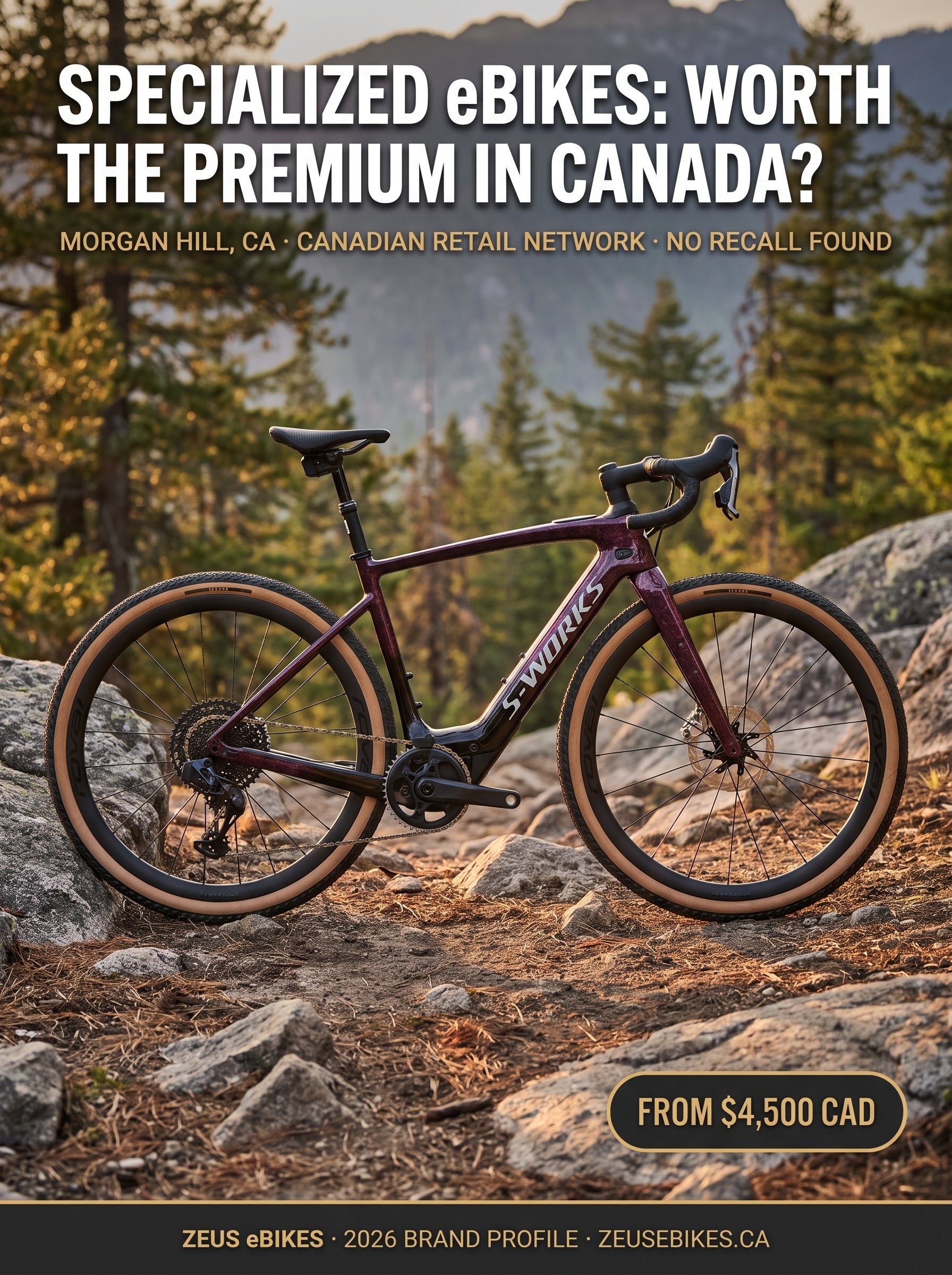
Specialized is one of the most recognised names in cycling — a California company over 50 years old whose Turbo e-bikes sit at the premium end of every Canadian bike shop. That brand weight is real. It is also exactly why a neutral, sourced look matters: a famous logo tells you nothing about how the warranty actually reads, what the recall record says, or how the company handles complaints.
Zeus does not sell Specialized and has no stake in whether you buy one. This profile exists for one reason — to give you the independent picture a dealer with a Turbo Como on the showroom floor has no reason to write: who owns the brand, where the bikes are made, what the warranty really covers (and for how long), the 2026 fork recall, and the Canadian safety record. Every fact below traces to a named primary source — the company's own warranty page, the U.S. Consumer Product Safety Commission, and Health Canada.
If you are weighing a Specialized Turbo against the broader market, pair this with our independent Canadian e-bike buying guide and the checklist in how to spot a legit e-bike store.
We built this profile from primary records only. Founding and ownership were confirmed against encyclopedic company histories; warranty terms were read directly from Specialized's own Canadian Global Warranty page and support documentation; the recall record was pulled from the U.S. Consumer Product Safety Commission (cpsc.gov) and Health Canada (recalls-rappels.canada.ca) by searching the brand name in each registry; the reputation signal comes from the live Better Business Bureau business file. Pricing reflects current Canadian dealer listings. Where a data point could not be verified to a primary source — for example a single reliable independent review average — we left it out rather than guess, and we distinguish Specialized's manufacturer claims (motor torque, range) from independently established fact. Spot an error or want to add Specialized's side of the story? Email milad@zeusebikes.ca and we will correct the record.
Specialized (founded 1974, Morgan Hill, California; ~49% owned by Taiwan's Merida) is a premium brand whose Turbo e-bikes carry a lifetime frame warranty to the original owner — but a battery warranted only 2 years or 300 charge cycles, whichever comes first. CPSC recalled ~5,720 Turbo Como SL e-bikes in March 2026 (fork steerer-tube crack, fall hazard) and ~2,500 Turbo Levo/Kenevo battery packs in 2021 (fire hazard); Health Canada also lists a Specialized crank-arm recall. The brand holds an F rating at the BBB. In our view it builds genuinely good bikes at a premium price — just buy with the warranty fine print and recall record in hand. Compare options in our best e-bikes in Canada guide and the Canadian buying guide.
What This Profile Covers
- Who owns Specialized — and where are the bikes made?
- The warranty reality: lifetime frame, two-year battery
- Safety and recall record: the 2026 Como SL fork, batteries, and Health Canada
- The Turbo lineup and what it costs in Canada
- Can you ride a Specialized Turbo legally in Canada?
- Reputation: what the BBB record shows
- The honest ledger: green flags vs red flags
- Frequently asked questions
- The bottom line
Who owns Specialized — and where are the bikes made?
Specialized Bicycle Components was founded in 1974 by Mike Sinyard, who — as the company's own lore tells it — sold his Volkswagen bus for about US$1,500 to bankroll the European cycling trip that started the business. It began importing Italian parts, made its own touring tyre in 1976, and launched its first complete bikes in 1981. The company has been headquartered in Morgan Hill, California since the 1980s.
Ownership is the part most buyers miss. Taiwan's Merida Industry Co. — a major global bicycle manufacturer — bought a widely reported 49% stake in 2001 for approximately US$30 million (as reported by Wikipedia and trade press; Specialized has not published investor terms publicly). Founder Mike Sinyard has remained majority owner (Scott Maguire has served as CEO since 2022), so Specialized is privately held and not Merida-controlled, but it is a globally manufactured brand with a major Taiwanese shareholder, not a boutique California workshop. A Canadian entity, Specialized Bicycle Components Canada, Inc., is the firm named on Canadian recall notices — meaning there is a real Canadian corporate presence standing behind warranty and recall service, which matters when things go wrong — a point worth understanding alongside our guide to what makes an e-bike store legit in Canada.
Specialized is an over-50-year-old, privately held California brand with a ~49% Taiwanese (Merida) stake and a registered Canadian entity. "Designed in California" is accurate; "hand-built in California" is not — like nearly all major brands, production is global.
The warranty reality: lifetime frame, two-year battery
Specialized's Turbo warranty has three tiers: the frame is covered for life for the original owner who registers within 90 days (two years for a second owner); Turbo electronic components — motor, display, and cables — are covered for five years; and the battery is covered for two years OR 300 charge cycles, whichever comes first. That battery clause is the one every buyer should read twice — for a plain-language comparison of how Turbo warranty terms measure against the wider market, see our Canadian e-bike buying guide. According to the company's own Canadian warranty page and support documentation, normal wear, crash and accidental damage, abuse, and corrosion are all excluded.
On an e-bike ridden regularly, 300 full charge cycles can arrive well before the two-year mark — a daily commuter riding five days a week could reach that limit inside 14 months. The warranty excludes normal wear, crash and accidental damage, abuse, and corrosion (specialized.com/ca/en/warranty; support.specialized.com).
A lifetime frame warranty is excellent. But typically the most expensive single part to replace on any e-bike — the battery — is the shortest-covered component here: two years or 300 cycles. That is the number to weigh against a bike's price, and it is why we always tell readers to compare warranty terms part-by-part, not headline-to-headline. See our Canadian e-bike buying guide for how to read these clauses.
Safety and recall record: the 2026 Como SL fork, batteries, and Health Canada
Specialized has a documented recall history across both U.S. and Canadian regulators — and being a premium brand does not exempt it. Three records matter for e-bike buyers, each attributed to the authority that actually issued it.
2026 — Turbo Como SL fork (CPSC). On 19 March 2026, the U.S. Consumer Product Safety Commission announced a recall of about 5,720 Turbo Como SL 4.0 and 5.0 e-bikes because the fork's steerer tube can develop a fatigue crack that may progress to fork failure, posing a fall hazard. The bikes sold between March 2021 and January 2026 for between US$3,250 and US$4,800. CPSC reported one incident of a steerer tube failing, with no injuries. Specialized first issued a stop-ride notice and then a full recall, and published a Canadian safety notice directing owners to authorized retailers for a free fork replacement (cpsc.gov; specialized.com/ca/en).
2021 — Turbo Levo/Kenevo battery packs (CPSC). CPSC posted the recall alert on 30 July 2021 (Specialized's voluntary recall began in May 2021 and was expanded in August 2022), covering about 2,500 first-generation Turbo Levo FSR, Levo HT, and Kenevo FSR battery packs (Specialized M1) because water could penetrate the seal around the LED control pad and short-circuit the lithium-ion pack, posing fire and burn hazards. No injuries were reported (cpsc.gov).
Health Canada — Sirrus crank-arm recall. Health Canada's registry lists a recall (posted 2021-10-28, expanded 2022-10-06) by Specialized Bicycle Components Canada, Inc. for Sirrus and Sirrus X bicycles whose crank arm can disengage, posing a fall hazard. It covered approximately 4,135 units sold in Canada, with 5 reported Canadian incidents and minor injuries. (This is a pedal-bike line, not a Turbo e-bike — included here because it is the recall with verified Canadian unit and injury figures, and it shows the Canadian entity actively administers recalls.) (recalls-rappels.canada.ca).
This is not a "clean record," but it is a responsibly handled one: real recalls, promptly issued through the proper regulators, with free remedies and — in the e-bike cases — no reported injuries. A recall handled well is a sign of accountability, not a reason to panic. If you own an affected model, act on the notice; if you are shopping used, confirm the recall service was completed.
The Turbo lineup and what it costs in Canada
Specialized Turbo e-bikes in Canada range from roughly $3,040 CAD for the entry-level Tero 3.0 to over $25,000 CAD for the S-Works Levo LTD — premium-to-very-premium territory, two to five times the price of capable direct-to-consumer alternatives. The full lineup, based on Canadian dealer listings as of June 2026:
- Turbo Tero — entry-level hybrid/SUV e-bike, roughly $3,040–$3,800 CAD for the 3.0 trims.
- Turbo Vado — the commuter, around $5,000 CAD for a 4.0 / SL 4.0 EQ.
- Turbo Como — step-through comfort cruiser, about $8,799 CAD for the 5.0 IGH (the SL variant of this model is the one under the 2026 fork recall).
- Turbo Levo — the e-mountain-bike benchmark, from roughly $7,500 CAD in aluminium to about $19,000 for S-Works and a reported $25,000 LTD edition.
Specialized Turbo e-bikes are sold through authorized Canadian dealers including Bow Cycle (Calgary, AB), Dunbar Cycles (Vancouver, BC), Cit-E Cycles, and Rock City Cycles, among others. Use the dealer locator at specialized.com/ca/en to find the nearest retailer. Zeus does not sell Specialized; these are independent dealers named for your reference.
Most full-power Turbo models run Specialized's 2.2 motor, which the company states produces 90 Nm of torque — a manufacturer claim, not an independently bench-verified figure. These are genuinely high-quality, well-supported bikes. They are also priced two to five times above many capable direct-to-consumer e-bikes, which is the trade-off every buyer has to weigh honestly. If your budget sits below the Turbo range, our roundup of the best electric bikes in Canada and the fat-tire guide cover the alternatives.
A dealer network, in-person service, integrated Specialized-built motors and software, and that lifetime frame warranty. What it does not buy is a longer battery warranty — that clause is the same two years / 300 cycles whether you spend $3,000 or $25,000.
Can you ride a Specialized Turbo legally in Canada?
Yes — with a regional caveat worth understanding. In the United States, Turbo commuter models like the Vado and the Levo are tuned as Class 3 e-bikes, meaning motor assist continues up to 28 mph (about 45 km/h). Canada's rules are stricter. Transport Canada repealed the federal power-assisted-bicycle definition in 2021 (SOR/2020-22), so e-bike rules are now set provincially — most provinces set motor assist to cut out at 32 km/h, the motor nominally at 500 W, and require functional pedals, but confirm your specific province's rules in our Canadian e-bike laws guide.
Specialized's own documentation states that the speed at which the motor stops assisting varies by region and is set to local requirements — so Canadian-market Turbo bikes are software-limited to the 32 km/h cap that most Canadian provinces set as the same limit — but confirm your specific province's rules in our Canadian e-bike laws guide. (Specialized labels its motors "250 W nominal," the European convention; the relevant Canadian limits — applied provincially — are the 32 km/h assist cut-off and the 500 W nominal ceiling.) The practical upshot: a Turbo bought from a Canadian dealer is configured to be road-legal here. The risk is buying a U.S.-spec or grey-market unit, or a bike modified to defeat the speed limiter — either can put you outside the law.
Canadian-market Specialized Turbo e-bikes are limited to Canada's 32 km/h assist cap and are legal to ride. Avoid imported U.S.-spec units or de-restricted bikes. The full rules are in our Canadian e-bike laws guide.
Reputation: what the BBB record shows
Specialized Bicycle Components carries an 'F' rating at the Better Business Bureau — the lowest on the BBB's scale — and is not BBB accredited, with the BBB citing failure to respond to 16 complaints filed against the Morgan Hill, California business as of June 2026 (bbb.org).
Context matters here, and we will give it without softening the fact: BBB grades heavily penalize non-response, and a non-accredited company often simply does not engage with the BBB's process — an F can reflect that as much as product quality. The BBB file does not detail individual complaint subject matter in its public summary; the cited F rating reflects the business's failure to respond to 16 complaints filed. We did find independent review-platform listings for Specialized, but the publicly visible review counts and averages were inconsistent at the time of writing, so — per our sourcing rules — we are not citing a single star score we cannot stand behind. The BBB F is the one reputation data point we can attribute to a named primary source, so it is the one we report.
An F at the BBB is a real flag worth knowing, but it is not proof a bike will fail you — it most directly reflects that Specialized does not actively work the BBB complaint channel. The actionable lesson: buy through an authorized Canadian dealer who handles warranty and recall service face-to-face, rather than relying on corporate customer support after the sale.
The Honest Ledger: Green Flags vs Red Flags
No brand is all one colour -- here is the picture the sourced facts above actually support.
Green Flags
- Over-50-year-old, established brand with a real Canadian corporate entity (Specialized Bicycle Components Canada, Inc.) and a nationwide authorized-dealer network for in-person warranty and recall service.
- Lifetime frame/frameset warranty to the original owner (with 90-day registration) — among the strongest frame terms in the industry.
- Five-year warranty on Turbo electronic components (motor, display, cables) — longer than many e-bike brands offer on the drive system.
- Recalls were issued promptly through the correct regulators (CPSC, Health Canada) with free remedies, and the e-bike recalls reported no injuries — a sign of accountability.
- Canadian-market Turbo bikes are configured to Canada's 32 km/h assist limit, so they are road-legal here out of the box.
- Genuinely well-engineered, integrated Turbo motor/software systems with a long product and support history.
Red Flags
- Turbo battery is warranted only 2 years OR 300 charge cycles, whichever comes first — typically the most expensive part to replace has the shortest coverage, and a daily rider can hit 300 cycles fast.
- March 2026 CPSC recall of ~5,720 Turbo Como SL 4.0/5.0 e-bikes for a fork steerer-tube fatigue crack (fall hazard) — a current, active recall on a flagship e-bike model.
- 2021 CPSC recall of ~2,500 first-gen Turbo Levo/Kenevo battery packs for a fire/burn hazard (water-ingress short circuit).
- Health Canada lists a Specialized Sirrus/Sirrus X crank-arm recall (~4,135 Canadian units, 5 reported Canadian incidents with minor injuries) — a documented Canadian safety record.
- 'F' rating and not accredited at the Better Business Bureau, with the BBB citing failure to respond to 16 complaints (June 2026).
- Premium-to-very-premium pricing (~$3,000 to $25,000 CAD) — two to five times the cost of many capable direct-to-consumer e-bikes, with the same short battery warranty at every price.
In our view, Specialized makes genuinely excellent e-bikes — the engineering, the integrated motors, the dealer support, and that lifetime frame warranty are real advantages, and the brand's recalls have been handled responsibly through the proper regulators with free fixes and no reported e-bike injuries. We consider it a credible, accountable manufacturer. The honest caveats are equally real: the battery — your single costliest part — is covered only two years or 300 cycles; there is an active March 2026 fork recall on the Turbo Como SL; and the company carries an F at the BBB for not engaging the complaint process. None of that makes a Specialized a bad bike. It makes it a premium bike you should buy with eyes open — ideally through an authorized Canadian dealer, with the bike registered inside 90 days, and with the battery warranty weighed against the price. If that math works for you, it is a strong choice; if the battery clause or the price gives you pause, the broader Canadian market has capable alternatives for a fraction of the cost.
Frequently Asked Questions
Is Specialized a good e-bike brand?
In our view, yes — Specialized builds high-quality, well-supported Turbo e-bikes with integrated motors, a dealer service network, and a lifetime frame warranty. The honest caveats are a short battery warranty (2 years or 300 charge cycles), an active March 2026 Turbo Como SL fork recall, premium pricing, and an F rating at the BBB. It is a strong bike to buy with the fine print in hand, ideally through an authorized Canadian dealer.
Who owns Specialized, and where are the bikes made?
Specialized was founded in 1974 by Mike Sinyard and is headquartered in Morgan Hill, California. It is privately held: Taiwan's Merida Industry Co. bought a reported 49% stake in 2001 (~US$30 million), while Sinyard remains majority owner; Scott Maguire has served as CEO since 2022. Like nearly all major bicycle brands, Specialized is designed in California but manufactured globally. A Canadian entity, Specialized Bicycle Components Canada, Inc., handles recalls and warranty here.
What is Specialized's warranty on Turbo e-bikes?
Per Specialized's Global Warranty: frames and framesets are lifetime to the original owner who registers within 90 days (two years to a second owner); Turbo electronic components — motor, display, cables — are five years; and the Turbo battery is two years OR 300 charge cycles, whichever comes first. Normal wear, crash/accidental damage, abuse, and corrosion are excluded. The short battery term is the key clause to weigh before buying.
Has Specialized recalled any e-bikes?
Yes. The U.S. CPSC recalled about 5,720 Turbo Como SL 4.0/5.0 e-bikes on 19 March 2026 for a fork steerer-tube crack (fall hazard; one incident, no injuries), and Specialized issued a Canadian safety notice for it. CPSC also recalled about 2,500 first-generation Turbo Levo/Kenevo battery packs in 2021 for a fire hazard (no injuries). Health Canada separately lists a Specialized Sirrus crank-arm recall. Affected owners get free remedies through authorized dealers.
Is a Specialized Turbo legal to ride in Canada?
Yes, when bought from a Canadian dealer. In the U.S., models like the Vado and Levo are Class 3 (assist to 28 mph / ~45 km/h), but Specialized states the assist cut-off is set to local requirements — so Canadian-market units are limited to the 32 km/h power-assisted-bicycle cap that most Canadian provinces set as the same limit — but confirm your specific province's rules in our Canadian e-bike laws guide. The risk is importing a U.S.-spec bike or de-restricting the limiter, either of which can make it non-compliant.
How much does a Specialized e-bike cost in Canada?
Based on Canadian dealer listings as of June 2026: the Turbo Tero runs roughly $3,040–$3,800 CAD; the Turbo Vado around $5,000; the Turbo Como 5.0 IGH about $8,799; and the Turbo Levo from roughly $7,500 in aluminium up to about $19,000 for S-Works and a reported $25,000 LTD. That places Specialized at the premium-to-very-premium end — two to five times the cost of many capable direct-to-consumer e-bikes.
The Bottom Line
Specialized is a credible, over-50-year-old premium brand that makes genuinely good Turbo e-bikes and handles its recalls responsibly — but you should buy one knowing the battery is covered only two years or 300 cycles, that there is an active March 2026 Como SL fork recall, and that the brand holds an F at the BBB for not working its complaint channel. Buy from an authorized Canadian dealer, register within 90 days, and weigh the battery clause against the price. If you want to see how it stacks up against the rest of the market before deciding, start with our best electric bikes in Canada roundup, the Canadian buying guide, and — if a premium price is the sticking point — our guide to buying a Canadian e-bike.
Related Zeus Guides
Know the Rules
Compare & Finance
This Specialized profile is part of the Zeus Canadian eBike Brands & Shops directory — verified brand profiles and city-by-city shop listings.
Researched and written by the Zeus eBikes Canada editorial team as part of an independent directory of eBike brands sold in Canada. Zeus eBikes does not sell Specialized products and has no commercial relationship with the brand; research and sourcing follow the same neutral standards applied to every brand in this directory. Last verified: June 22, 2026.
Sources: Specialized Bicycle Components founding lore — company's own published brand history (specialized.com). Ownership — Merida Industry Co. 49% stake widely reported in trade press (Wikipedia, Encyclopedia.com); Specialized has not published investor terms publicly, so this figure is attributed to secondary reporting only and not independently primary-source verified. Warranty terms — Specialized Global Warranty (specialized.com/ca/en/warranty) and Specialized Support (support.specialized.com). Recalls — U.S. Consumer Product Safety Commission Turbo Como SL recall, 19 March 2026 (cpsc.gov) and Specialized's Canadian safety notice (specialized.com/ca/en/turbo-como-sl-safety-notice-recall-march-2026); CPSC Turbo Levo/Kenevo battery recall, 30 July 2021 (cpsc.gov); Health Canada Specialized Sirrus/Sirrus X crank-arm recall (recalls-rappels.canada.ca). Reputation — Better Business Bureau business profile, Morgan Hill, CA (bbb.org), retrieved June 2026. Canadian dealer pricing as of June 2026 — Bow Cycle, Cit-E Cycles, Dunbar Cycles, and Rock City Cycles listings. Specialized is a registered trademark of Specialized Bicycle Components, Inc.; this independent profile uses the name nominatively for commentary and is not affiliated with, endorsed by, or sponsored by Specialized. Specialized is welcome to respond or request a correction at milad@zeusebikes.ca.
Share:
Rize eBikes in Canada: The Verified Brand Profile (2026)
Super73 eBikes in Canada: The Verified Brand Profile (2026)