
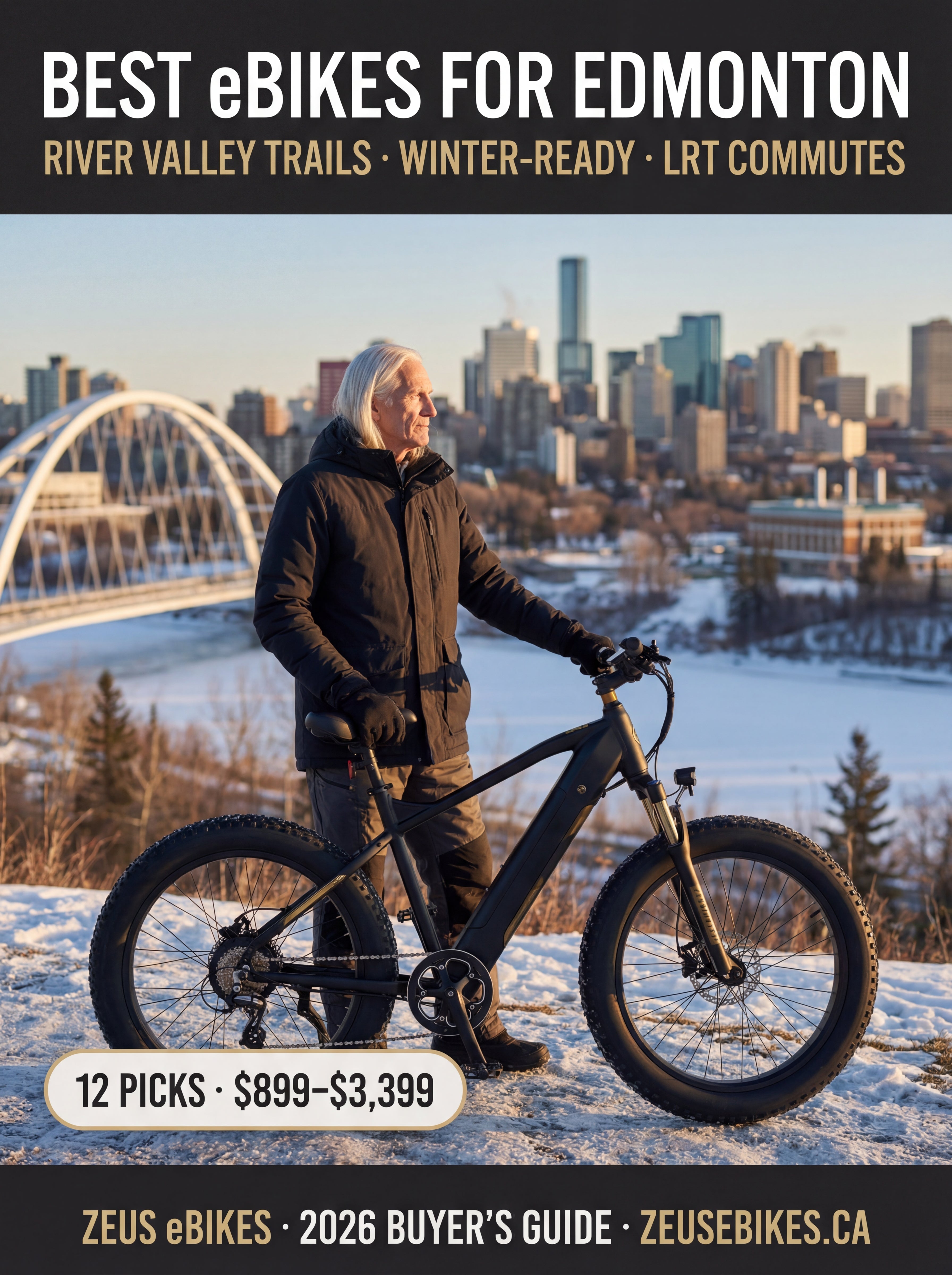
Best Electric Bikes for Edmonton (2026): 12 Picks by Rider Type

Edmonton is not Calgary and it is not Toronto. No chinook winds break the cold — when it hits −25°C in January, it stays there for weeks. The North Saskatchewan River Valley drops 50–60 metres into 7,400 hectares of urban parkland — 22 times the size of Central Park — carving 160 kilometres of trails that demand real torque on the climb back up. And unlike Calgary’s strict 20 km/h pathway cap, Edmonton posts no numerical speed limit on its entire trail network.
We picked 12 electric bikes from $899 to $3,399 that match how Edmontonians actually ride — River Valley climbers, winter warriors who refuse to stop for −30°C, LRT multimodal commuters on the Capital and Valley Lines, satellite-city riders from Sherwood Park and St. Albert, cargo haulers, seniors, and backcountry explorers heading to Elk Island. Every pick is available now on Zeus eBikes Canada with free shipping to Alberta.
In This Guide
- Why Edmonton Needs Its Own E-Bike Guide
- Edmonton E-Bike Laws & Pathway Rules
- The 12 Best Electric Bikes for Edmonton (2026)
- Full Comparison Table
- Which Neighbourhood Are You In?
- Summer vs Winter Range — The No-Chinook Table
- How to Choose — Buyer Decision Guide
- Frequently Asked Questions
- The Bottom Line
Why Edmonton Needs Its Own E-Bike Guide
Edmonton’s riding conditions are unique in Canada. No other major city combines relentless sub-zero winters with zero chinook relief, a 7,400-hectare river valley with 50–60 metre elevation changes, a transit system that welcomes bikes at all hours, and flat suburban corridors stretching 20+ km to satellite cities. A “best e-bikes Canada” list misses all of this. If you are comparing with our Calgary city guide, pay attention to the differences below — they change which bike you should buy.
River Valley — North America’s largest urban parkland. The North Saskatchewan River Valley stretches 7,400 hectares along the river — 22 times the size of Central Park. The trail system covers 160 km (90.6 km paved), with elevation drops of 50–60 metres from the urban rim to the valley floor. That is steeper than most residential grades in NW Calgary. Trails from Kinnaird Ravine to Terwillegar Park are root-covered, sandy, and muddy in summer, packed snow in winter. Motors below 40 Nm struggle on the return climb; full suspension separates comfortable riders from bruised ones.
No chinooks — winter is relentless. Calgary averages 20–35 chinook events per winter, pushing −15°C mornings to +5°C afternoons. Edmonton gets zero. January averages −6°C high / −15°C low, and sustained periods of −25°C to −30°C last for weeks without relief (Environment and Climate Change Canada). That means 30–50% battery range loss for four straight months with no mid-winter warm spells to recover. Edmonton riders need bigger batteries and fat tires as a baseline, not an upgrade.
LRT + $100 million infrastructure. Edmonton Transit allows bicycles on LRT at all times — no rush-hour restrictions, no competing for bike spots. This makes folding e-bikes genuinely practical for ride-LRT-ride commuters on the Capital Line or the new Valley Line. The city invested $100 million in cycling infrastructure between 2020–2024, adding 517 km of new bike lanes and protected pathways (City of Edmonton, 2024). That is more lane-kilometres added per capita than any other Prairie city.
Satellite-city sprawl. Unlike Calgary’s relatively compact quadrant layout, Edmonton’s metro area spreads into distinct satellite cities — Sherwood Park (18 km east), St. Albert (15 km northwest), Spruce Grove (25 km west). Commuting by bike from these communities is viable only with high-capacity batteries and fat tires that handle highway-adjacent shared-use paths through wind and snow.
Edmonton E-Bike Laws & Pathway Rules
Alberta follows the federal definition: a legal e-bike has a motor rated at 500W or less, cannot exceed 32 km/h on motor power alone, and requires operable pedals. Riders must be at least 12 years old, and helmets are mandatory under 18 under Alberta’s Traffic Safety Act. For the full provincial breakdown, read our Alberta E-Bike Laws (2026) guide.
| Rule | Alberta / Edmonton |
|---|---|
| Max motor power (road-legal) | 500W nominal |
| Max assisted speed | 32 km/h |
| Helmet | Required under 18; recommended for adults |
| Licence / insurance | Not required for e-bikes ≤ 500W |
| Minimum age | 12 years |
| Pathway speed limit | None posted — ride at safe speed, yield to pedestrians |
| Throttle on pathways | Pedal-assist preferred; check individual path signage |
| LRT bikes | Allowed at all times (no rush-hour restrictions) |
The 12 Best Electric Bikes for Edmonton (2026)
Every pick below is matched to a specific Edmonton rider type. We list the legal status (pathway-legal or off-road), motor specs, battery capacity in Wh, winter range estimate with Edmonton’s no-chinook penalty factored in, and the Edmonton-specific reason it earned its spot.
1. Movin’ Tempo Max — Best Budget All-Rounder
Best for: First-time buyers, flat suburban commuters (Millwoods, Castledowns, Lewis Farms)
Motor: 500W hub · Battery: 48V 20Ah Samsung (960 Wh) · Range: 80–90 km (est. 50–60 km winter)
Payload: 300 lbs · Weight: 60 lbs · Tires: 26×2.1″ CST · Brakes: Tektro hydraulic 160 mm
Price: $1,599 · Legal status: Pathway-legal (500W, pedal assist)
The Tempo Max is the entry point that does not cut corners. A Samsung 960 Wh battery delivers genuine all-day range for flat SE and NE Edmonton, and at 60 lbs it is light enough to carry up apartment stairs. Most of Edmonton outside the River Valley is flat prairie — you do not need 100 Nm of torque for a 10 km ride from Castledowns to NAIT. You need range, reliability, and a price that does not sting if the bike gets stolen from your apartment parkade. The step-thru frame fits riders of all heights, and hydraulic brakes give confident stopping on icy residential roads.
→ View the Movin’ Tempo Max on Zeus eBikes
2. Eunorau Defender — Best River Valley Hill Climber
Best for: River Valley trail riders, Old Strathcona valley access, Terwillegar Park loops
Motor: 500W hub, 60 Nm · Battery: 48V 15Ah Samsung (720 Wh) · Range: ~64 km (est. 38–45 km winter)
Suspension: Full — ZOOM 100 mm front + EXA rear shock · Tires: 27.5×3.0″ CHAOYANG
Gears: Shimano Altus 7-speed · Weight: 66 lbs · Brakes: Hydraulic disc 180 mm
Price: $2,169 · Legal status: Pathway-legal (500W, pedal assist)
The River Valley drops 50–60 metres from the urban rim to the river floor. The Defender was built for exactly this grade. Full suspension absorbs the rough valley descents — tree roots, gravel washouts, frost heaves on the paved sections — while 27.5×3.0″ plus-size tires grip root-covered trails from Kinnaird Ravine to Gold Bar Park. At 60 Nm through a 500W motor, it is fully pathway-legal and powerful enough for the Connor’s Hill grade that separates river-level Old Strathcona from the university plateau.
One trade-off: the Defender uses a cadence sensor, which can feel less natural on steep climbs than a torque sensor. If smooth pedal response matters more than price, jump to the Fat AWD 3.0 (Pick #9) or the Velotric Nomad 2X (Pick #12) instead.
→ View the Eunorau Defender on Zeus eBikes
3. Ridetar Q20 Pro 2000W — Best Winter Warrior
Best for: Year-round riders, winter commuters who refuse to stop for −25°C
Motor: Dual 1000W AWD (2,000W total), 180 Nm · Battery: 52V dual 20Ah (2,080 Wh) · Range: 120–200 km (est. 75–130 km winter)
Payload: 400 lbs · Weight: 88 lbs · Tires: 20×4.0″ fat · Brakes: Hydraulic disc
Price: $2,239 · Legal status: Off-road / private property (exceeds 500W)
Edmonton has no chinooks. When it hits −25°C in January, it stays there for weeks. The Q20 Pro was built for the rider who does not own a car and does not want one — even in the dead of an Edmonton winter. Its 2,080 Wh dual-battery system is the largest on this list, giving you enough range to lose 40–50% to extreme cold and still complete a 50 km round-trip commute. AWD traction on 20″ fat tires makes it a snowmobile on two wheels. Built-in turn signals and integrated lighting handle Edmonton’s 4:15 PM December sunsets.
The retro cruiser frame keeps you upright with a clear sightline — important on icy roads where reaction time matters. At $2,239 for dual motors and 2,080 Wh, the price-per-watt-hour ratio is the best on this list by a wide margin.
→ View the Ridetar Q20 Pro on Zeus eBikes
4. Samebike CY20 — Best LRT Multimodal Commuter
Best for: Ride-LRT-ride commuters, apartment dwellers, ultra-budget first-timers
Motor: 350W hub, 45 Nm · Battery: 36V 13Ah (468 Wh) · Range: 45–90 km (est. 27–55 km winter)
Folds: Yes — 5 seconds · Weight: 62 lbs · Gears: Shimano 7-speed
Tires: 20×2.35″ · Brakes: Mechanical disc 160 mm · Payload: 330 lbs
Price: $899 · Legal status: Pathway-legal (350W, pedal assist)
Edmonton Transit allows bikes on LRT at all times — but the CY20 skips even that courtesy by folding in 5 seconds into carry-on luggage. Ride from Millwoods to Mill Woods Station, fold, board the Valley Line, unfold at Churchill, ride the last 2 km to your office. That ride-LRT-ride pattern is the fastest commute in Edmonton for anyone living more than 10 km from downtown.
At $899 it is the cheapest bike on this list by $700, which also means theft is less financially devastating — a real consideration in a city with over 2,000 bike thefts per year (Edmonton Police Service). Shimano 7-speed and front suspension handle Edmonton’s flat suburban roads. The 468 Wh battery is thin for deep winter, but for short first/last-mile LRT connections it is more than enough.
→ View the Samebike CY20 on Zeus eBikes
5. Freesky Nova B-360 — Best Long-Range Commuter
Best for: Sherwood Park, St. Albert, and Spruce Grove commuters (15–25 km each way)
Motor: 500W/1000W peak Bafang, 55 Nm · Battery: Dual 48V 15Ah Samsung (1,440 Wh) · Range: 120–193 km (est. 75–125 km winter)
Sensor: Torque · Tires: 27.5×2.2″ · Weight: 77 lbs · Brakes: Hydraulic 180 mm
Price: $2,373 · Legal status: Pathway-legal (500W nominal, pedal assist)
Sherwood Park to downtown is 18 km. St. Albert to the Legislature is 15 km. Spruce Grove to West Edmonton Mall is 25 km. The Nova B-360 is the only sub-$2,500 bike with 1,440 Wh of dual Samsung batteries and a torque sensor — the combination that makes satellite-city commuting realistic year-round. That means 120+ km of real-world pedal-assist range, enough to commute 25 km each way for two days before charging.
The 27.5×2.2″ tires roll faster on pavement than fat tires, saving battery every revolution — important when winter range loss already eats 30–40% of capacity. Step-thru frame, torque sensor, and 500W nominal — fully pathway-legal for River Valley rides after work. For more on why Wh matters more than manufacturer-claimed range, see our Long Range Electric Bikes Canada (2026) guide.
→ View the Freesky Nova B-360 on Zeus eBikes
6. Flash 1000W AWD — Best Satellite City Commuter
Best for: Extreme-range commuters, moped-style comfort, modular battery upgraders
Motor: 2×750W hub AWD (1,500W total), 184 Nm · Battery: 52V 16Ah Samsung (832 Wh), expandable to 2,808 Wh triple
Range: ~80 km single / ~354 km triple · Sensor: Torque · Tires: 20×4.0″ CST fat
Brakes: 4-piston hydraulic 180 mm · Weight: ~88 lbs · Payload: 440 lbs
Price: From $2,429 (AWD) · Also: rear-drive $2,169 / mid-drive $2,869
Legal status: Off-road / private property (exceeds 500W)
The Flash is the modular powerhouse. Start at $2,429 with one Samsung battery (832 Wh) and a pair of 750W hub motors pushing 184 Nm through both wheels for January ice traction. Then scale: the triple-battery option adds two more packs for a staggering 2,808 Wh total — enough for 200+ km even at −20°C. That means a Spruce Grove commuter can ride 50 km round-trip daily for almost a week on a single charge cycle.
The moped-style seating keeps your back comfortable on 40+ km daily round trips. The torque sensor reads your pedal pressure naturally, not with the on/off lurch of a cadence sensor. Start with one battery and add more as your commute demands — no need to buy a new bike. Also available as rear-drive ($2,169, 750W) or mid-drive ($2,869, 1000W Truckrun, 220 Nm).
→ View the Flash 1000W on Zeus eBikes
7. Eunorau Meta 275 — Best for Seniors & Accessibility
Best for: Seniors, riders with mobility limitations, paved River Valley pathways
Motor: 500W hub, 65 Nm · Battery: 48V 13Ah + free 17Ah Samsung (1,440 Wh dual) · Range: 100–160 km dual (est. 60–100 km winter)
Sensor: Torque · Tires: 27.5×2.6″ · Gears: Shimano 9-speed · Brakes: Hydraulic 180 mm
Price: $1,979 · Legal status: Pathway-legal (500W, pedal assist)
The Meta 275 combines everything a senior rider needs: a low step-thru frame for easy mounting without lifting a leg over the saddle, 27.5″ wheels for stability at low pathway speeds, a torque sensor that starts gently without the lurch of a cadence sensor, and dual Samsung batteries totalling 1,440 Wh so range anxiety never enters the picture. The second battery attaches directly to the frame — no wiring, no tools, just plug and ride.
At 65 Nm the motor handles River Valley paved pathway grades without being overwhelming. Shimano 9-speed gives fine gear control for slow riding near Hawrelak Park or along the boardwalk at Louise McKinney Riverfront. At $1,979 with both batteries included, it is the best-value dual-battery step-thru on Zeus’s step-thru collection.
→ View the Eunorau Meta 275 on Zeus eBikes
8. Movin’ Pulse Fat Tire — Best for Cargo & Delivery
Best for: Delivery riders, grocery haulers, UAlberta campus errands
Motor: 500W hub · Battery: 48V 20–45Ah (960–2,160 Wh) · Range: 80–200+ km (battery dependent)
Tires: 20×4.0″ CST fat · Rack: 50 kg rear rack · Brakes: Tektro hydraulic 180 mm
Price: $1,999–$2,799 (varies by battery) · Legal status: Pathway-legal (500W, pedal assist)
The Pulse was purpose-built for hauling. A 50 kg rear rack handles Costco runs from South Common, Skip the Dishes deliveries in the university district, or daily supply hauls across campus. The 20″ fat tires create a low centre of gravity that keeps 50 kg of cargo stable on icy winter roads — critical in a city where packed snow persists for four months straight.
Battery options scale from 960 Wh (base) to a massive 2,160 Wh — choose based on your daily distance. The step-thru frame lets you mount and dismount quickly with cargo on the rack, and compact 20″ wheels make it manoeuvrable in UAlberta campus traffic or tight Whyte Ave lanes. If you are thinking about replacing a car for errands entirely, read our Electric Bike vs Car Canada comparison for the math.
→ View the Movin’ Pulse Fat Tire on Zeus eBikes
9. Eunorau Fat AWD 3.0 — Best River Valley Trail Explorer
Best for: Mixed-surface valley trails, Terwillegar Park, Whitemud Creek, snow riding
Motor: Dual 500W hub AWD (1,000W total), 110 Nm · Battery: 48V 15Ah LG (720 Wh, opt. dual 1,440 Wh)
Range: ~80 km single / ~129 km dual · Sensor: Torque · Tires: 26×4.0″ Kenda Krusade
Suspension: RST Guide 95 mm front · Weight: 79 lbs · Payload: 375 lbs
Price: $2,390 · Legal status: Off-road / private property (exceeds 500W combined)
The River Valley floor is not paved pathway everywhere. Between Terwillegar Park and Whitemud Creek, you hit sandy fire roads, muddy root tangles, and packed snow from November to March. The Fat AWD 3.0 puts dual 500W hub motors through both wheels for AWD traction on exactly this terrain. At 110 Nm combined torque with a torque sensor, it reads your pedal effort naturally — no lag, no lurch, just proportional power on technical climbs from Kinnaird Ravine back to rim level.
Available in both step-thru and step-over frames. Kenda Krusade 26×4.0″ fat tires handle sand, snow, and wet roots with equal confidence. At $2,390, the Fat AWD undercuts the Westridge 4T by $909 while offering something the Westridge does not: dual-motor traction. For a deeper look at how sensor types affect ride feel, see Pedal Assist vs Throttle eBikes Canada.
→ View the Fat AWD 3.0 on Zeus eBikes
10. Addmotor Grandtan II — Best for Trike Stability
Best for: Seniors, riders with balance concerns, grocery hauling, icy pathway stability
Motor: 750W hub (1,400W peak), 90 Nm · Battery: 48V 20Ah Samsung (960 Wh) · Range: 64–137 km
Sensor: Torque · Tires: 24×4.0″ front + 20×4.0″ rear (×2) · Brakes: Tektro disc 180 mm (×3)
Payload: 450 lbs · Rear basket: 100 lbs capacity · Weight: 118 lbs
Price: $2,999 · Legal status: Check local rules (750W)
Three wheels solve two Edmonton problems at once: icy pathway stability and grocery hauling. When packed snow turns shared-use pathways into skating rinks, a trike does not fall over. The Grandtan II’s torque sensor is a premium feature uncommon on trikes at any price — it starts smoothly without the lurch of a cadence sensor, critical for balance-sensitive riders who cannot afford a sudden jolt at low speed.
The 960 Wh Samsung battery is the largest in any trike on Zeus, and three 180 mm disc rotors provide independent braking per wheel for controlled stops on ice. A padded backrest saddle and removable baskets (rear holds 100 lbs) turn this into a genuine car replacement for errands — Safeway, Costco, the farmers’ market at City Market on 104 Street. For more trike options, see our Electric Trikes Canada guide.
→ View the Grandtan II Trike on Zeus eBikes
11. Westridge 4T Off-Road — Best for Elk Island & Backcountry
Best for: Elk Island NP, Cooking Lake trails, Wabamun, weekend backcountry exploring
Motor: 1000W Bafang hub, 90 Nm · Battery: 48V 20Ah Samsung 21700 (960 Wh, UL certified) · Range: ~100 km
Sensor: Torque · Tires: 26×4.8″ Maxxis Minion fat · Gears: Shimano Acera 8-speed
Brakes: Zoom hydraulic 180 mm · Weight: 81 lbs · Payload: 286 lbs
Price: $3,299 · Legal status: Off-road / private property (exceeds 500W)
The only Canadian-designed off-road e-bike on this list. Elk Island National Park sits 45 km east of Edmonton — load the Westridge into your truck, unload at the trailhead, and let 1,000W of Bafang torque handle the sandy, rooted trails where bison graze 50 metres from the path. The standout spec is the tires: 26×4.8″ Maxxis Minion — the gold standard for off-road grip and a full inch wider than most fat tires on this list.
Shimano Acera 8-speed handles mixed terrain from fire roads to singletrack. The 960 Wh UL-certified Samsung 21700 battery delivers approximately 100 km — enough for a full day at Cooking Lake–Blackfoot. If you value supporting Canadian design and manufacturing, explore the full Canadian e-bike collection.
→ View the Westridge 4T on Zeus eBikes
12. Velotric Nomad 2X — Best Premium All-Season
Best for: Year-round River Valley + commute combo, heavy haulers, towing
Motor: 750W hub (1,400W peak), 105 Nm · Battery: 48V 16.7Ah Samsung/LG 21700 (801.6 Wh)
Range: 80–120 km (est. 50–75 km winter) · Sensor: SensorSwap (torque + cadence toggle)
Tires: 26×4.0″ Kenda fat · Suspension: Air fork 120 mm + DNM air 165 mm
Brakes: Tektro hydraulic (203/180 mm) · Payload: 560 lbs + 1,000 lbs towing · Weight: 80 lbs
Certifications: UL 2849, UL 2271, UL 2580 · Price: $3,399
The Nomad 2X is the no-compromise premium pick. SensorSwap lets you toggle between torque sensor (smooth, natural feel for River Valley singletrack) and cadence sensor (consistent output for flat Whitemud Drive commutes) with a single button press. Full air suspension — 120 mm front fork plus 165 mm DNM rear — absorbs Edmonton’s notorious pothole-to-frost-heave road surfaces that appear every spring.
At 560 lbs payload and 1,000 lbs towing capacity, the Nomad 2X doubles as a utility vehicle for weekend projects. Triple UL certification (UL 2849, 2271, 2580) makes it one of the safest e-bikes sold in Canada. IPX7 waterproof battery survives Edmonton’s violent spring melt when every road turns into a river. Stealth mode disables the motor in sensitive park areas along the valley. For more on how hub and mid-drive motors compare, see our mid-drive vs hub motor guide.
→ View the Velotric Nomad 2X on Zeus eBikes
All 12 Bikes — Full Comparison Table
| # | Model | Price | Motor | Torque | Battery | Range | Sensor | Tires | Suspension | Weight | Best For |
|---|---|---|---|---|---|---|---|---|---|---|---|
| 1 | Movin’ Tempo Max | $1,599 | 500W Hub | — | 960 Wh | 80–90 km | Cadence | 26×2.1″ | Front | 60 lbs | Budget flat commute |
| 2 | Eunorau Defender | $2,169 | 500W Hub | 60 Nm | 720 Wh | ~64 km | Cadence | 27.5×3.0″ | Full (100mm) | 66 lbs | River Valley hills |
| 3 | Ridetar Q20 Pro | $2,239 | 2×1000W AWD | 180 Nm | 2,080 Wh | 120–200 km | Torque | 20×4.0″ | Full | 88 lbs | Winter AWD |
| 4 | Samebike CY20 | $899 | 350W Hub | 45 Nm | 468 Wh | 45–90 km | Cadence | 20×2.35″ | Front | 62 lbs | LRT folding |
| 5 | Freesky Nova B-360 | $2,373 | 500W Hub | 55 Nm | 1,440 Wh | 120–193 km | Torque | 27.5×2.2″ | None | 77 lbs | Long-range commute |
| 6 | Flash AWD | $2,429 | 2×750W AWD | 184 Nm | 832–2,808 Wh | 80–354 km | Torque | 20×4.0″ | Front (80mm) | ~88 lbs | Satellite city |
| 7 | Eunorau Meta 275 | $1,979 | 500W Hub | 65 Nm | 1,440 Wh | 100–160 km | Torque | 27.5×2.6″ | None | — | Senior step-thru |
| 8 | Movin’ Pulse | $1,999+ | 500W Hub | — | 960–2,160 Wh | 80–200+ km | Cadence | 20×4.0″ | None | — | Cargo & delivery |
| 9 | Fat AWD 3.0 | $2,390 | 2×500W AWD | 110 Nm | 720 Wh | ~80 km | Torque | 26×4.0″ | Front (95mm) | 79 lbs | Trail explorer |
| 10 | Grandtan II | $2,999 | 750W Hub | 90 Nm | 960 Wh | 64–137 km | Torque | 24/20×4.0″ | Front (80mm) | 118 lbs | Trike stability |
| 11 | Westridge 4T | $3,299 | 1000W Bafang | 90 Nm | 960 Wh | ~100 km | Torque | 26×4.8″ | Front (Mozo) | 81 lbs | Elk Island off-road |
| 12 | Velotric Nomad 2X | $3,399 | 750W Hub | 105 Nm | 801.6 Wh | 80–120 km | SensorSwap | 26×4.0″ | Full air | 80 lbs | Premium all-season |
Which Neighbourhood Are You In?
Edmonton’s terrain changes dramatically from flat suburban sprawl to steep river valley in the span of a few blocks. The bike that works in Millwoods will struggle in Terwillegar’s ravine system. Here is which bike fits where you actually live:
| Area | Terrain | Commute to Downtown | Best Picks |
|---|---|---|---|
| Downtown / Oliver / Garneau | Flat, protected bike lanes, valley edge | 0–5 km | #4 CY20, #7 Meta 275 |
| Old Strathcona / Whyte Ave | Valley rim, moderate grades to river | 3–8 km | #2 Defender, #12 Nomad 2X |
| South Edmonton (Windermere, Summerside, Ellerslie) | Flat suburban, long straight corridors | 15–22 km | #5 Nova B-360, #6 Flash AWD |
| North Edmonton (Castledowns, Clareview, The Palisades) | Flat, Capital Line LRT access | 10–15 km | #1 Tempo Max, #4 CY20 |
| West Edmonton (Lewis Farms, Hamptons, Secord) | Flat suburban, growing bike infrastructure | 15–20 km | #5 Nova B-360, #8 Movin’ Pulse |
| River Valley adjacent (Terwillegar, Riverbend, Mill Creek) | Steep valley access, mixed-surface trails | 8–14 km | #9 Fat AWD 3.0, #2 Defender |
| Satellite Cities (Sherwood Park, St. Albert, Spruce Grove) | Highway corridors, wind exposure | 15–35 km | #6 Flash Triple, #3 Q20 Pro, #5 Nova B-360 |
Summer vs Winter Range — The No-Chinook Table
This is the table that matters most for Edmonton buyers. Calgary riders get chinook relief — 20–35 warm spells per winter that temporarily restore battery performance. Edmonton gets zero. When cold sets in around November, it stays until March. Expect 30–50% battery range loss below −15°C, and up to 50% at −25°C. These estimates assume standard winter riding conditions with batteries stored indoors overnight.
| Bike | Battery | Summer Range | Edmonton Winter (−20°C) | Buffer |
|---|---|---|---|---|
| Movin’ Tempo Max | 960 Wh | 80–90 km | 50–60 km | Moderate |
| Eunorau Defender | 720 Wh | ~64 km | 38–45 km | Thin |
| Ridetar Q20 Pro | 2,080 Wh | 120–200 km | 75–130 km | Excellent |
| Samebike CY20 | 468 Wh | 45–90 km | 27–55 km | Thin |
| Freesky Nova B-360 | 1,440 Wh | 120–193 km | 75–125 km | Excellent |
| Flash AWD (single) | 832 Wh | ~80 km | 48–55 km | Good |
| Flash AWD (triple) | 2,808 Wh | ~354 km | 210–250 km | Overkill |
| Eunorau Meta 275 | 1,440 Wh | 100–160 km | 60–100 km | Good |
| Movin’ Pulse (base) | 960 Wh | 80+ km | 50–55 km | Moderate |
| Fat AWD 3.0 | 720 Wh | ~80 km | 48–55 km | Moderate |
| Grandtan II | 960 Wh | 64–137 km | 40–85 km | Good |
| Westridge 4T | 960 Wh | ~100 km | 60–70 km | Good |
| Velotric Nomad 2X | 801.6 Wh | 80–120 km | 50–75 km | Good |
How to Choose — Buyer Decision Guide
Price Tier Breakdown
| Tier | Bikes | Best For |
|---|---|---|
| Under $1,000 | Samebike CY20 ($899) | LRT folding commute, first-timer on a budget |
| $1,500–$2,000 | Movin’ Tempo Max ($1,599), Meta 275 ($1,979), Movin’ Pulse ($1,999+) | Flat suburban commutes, seniors, cargo |
| $2,000–$2,500 | Defender ($2,169), Q20 Pro ($2,239), Nova B-360 ($2,373), Fat AWD 3.0 ($2,390), Flash AWD ($2,429) | River Valley, winter, long-range, satellite city |
| $2,500+ | Grandtan II ($2,999), Westridge 4T ($3,299), Velotric Nomad 2X ($3,399) | Trike stability, backcountry, premium all-season |
Decision Tree
Do you need to fold for LRT? → Samebike CY20 ($899) — carry-on luggage in 5 seconds
Is your budget under $1,600? → Movin’ Tempo Max ($1,599) — Samsung 960 Wh, pathway-legal
Do you ride the River Valley trails weekly? → Eunorau Defender ($2,169) for pathway-legal; Fat AWD 3.0 ($2,390) for off-road
Do you commute from a satellite city (20+ km)? → Freesky Nova B-360 ($2,373) for legal; Flash AWD ($2,429) for power
Do you ride year-round including −25°C? → Ridetar Q20 Pro ($2,239) — 2,080 Wh, AWD
Do you need a step-thru or low-effort mounting? → Eunorau Meta 275 ($1,979) — torque sensor, dual-battery
Do you haul cargo or make deliveries? → Movin’ Pulse ($1,999+) — 50 kg rack, scalable battery
Do you need three-wheel stability on ice? → Grandtan II Trike ($2,999) — torque sensor, 450 lbs payload
Weekend backcountry and Elk Island? → Westridge 4T ($3,299) — Canadian-designed, Maxxis Minion 4.8″
No budget constraint — want the best? → Velotric Nomad 2X ($3,399) — SensorSwap, full air, UL triple certified
Theft Protection — Edmonton Specific
Edmonton Police reported over 2,000 bicycle thefts per year. The city’s Bike Index program recovers approximately 33% of registered bikes — but only if you register. Protect your investment:
- Register on Bike Index (free) the day your e-bike arrives — photograph the serial number and save it to your phone
- Lock with a U-lock through the frame and rear wheel, plus a cable through the front wheel — cable-only locks are cut in under 10 seconds
- Remove the battery when parking outdoors — it deters thieves (bike is useless without it) and protects the cells from extreme cold
- Insure through your tenant or homeowner policy — most Alberta policies cover e-bikes up to $5,000 as scheduled personal property
- Store indoors whenever possible — apartment parkade bike cages are better than nothing, but a locking bike room or in-unit storage is the only real deterrent
Frequently Asked Questions
Are electric bikes legal in Edmonton?
Yes. Edmonton follows Alberta provincial law: e-bikes with motors of 500W or less and a maximum assisted speed of 32 km/h are classified as power-assisted bicycles. No licence, insurance, or registration required for adults. Riders under 18 must wear a helmet. Bikes over 500W are classified as motor vehicles and need registration and insurance for road use.
Can I ride an e-bike on Edmonton’s River Valley trails?
Yes — pedal-assist e-bikes under 500W are allowed on Edmonton’s paved multi-use pathways, including the River Valley trail system. Unlike Calgary, Edmonton does not post a numerical speed limit on pathways. Riders are expected to travel at a safe and reasonable speed and yield to pedestrians. Throttle-only use may be restricted on some shared-use paths.
Do I need a licence or insurance for an e-bike in Edmonton?
No — not for e-bikes with 500W motors or less. Under Alberta’s Traffic Safety Act, power-assisted bicycles are exempt from licensing, registration, and insurance. You must be at least 12 years old to ride, and riders under 18 must wear a helmet. For the full legal breakdown, see our Alberta E-Bike Laws guide.
Can I bring my e-bike on Edmonton LRT?
Yes. Edmonton Transit allows bicycles on LRT at all times — no rush-hour restrictions (updated 2021). Folding e-bikes like the Samebike CY20 are treated as carry-on luggage. Standard bikes use the designated bike area on each train car. This applies to both the Capital Line and the Valley Line.
How far can an e-bike go in Edmonton’s winter?
Expect 30–50% battery range loss at sustained temperatures below −15°C. A bike rated for 100 km in summer may deliver 50–70 km at −20°C. Edmonton lacks Calgary’s chinook warm spells, so cold-weather range loss persists from November through March. Dual-battery bikes like the Freesky Nova B-360 (1,440 Wh) and Ridetar Q20 Pro (2,080 Wh) provide the best winter buffers. Keep batteries indoors overnight and start rides warm.
What is the best e-bike for climbing Edmonton’s River Valley?
For pathway-legal valley riding, the Eunorau Defender ($2,169) offers full suspension and 60 Nm torque at 500W. For more aggressive off-road valley trails, the Fat AWD 3.0 ($2,390) provides dual-motor AWD with 110 Nm and a torque sensor for natural pedal feel. The premium choice is the Velotric Nomad 2X ($3,399) with 105 Nm, full air suspension, and SensorSwap technology.
Is there a speed limit for e-bikes on Edmonton pathways?
Edmonton does not post a numerical speed limit on its multi-use pathways — unlike Calgary’s strict 20 km/h cap. The city advises riding at a “safe and reasonable speed” and yielding to pedestrians. On busy shared paths, most riders keep to 15–20 km/h as a courtesy. A torque sensor helps you modulate speed naturally near walkers.
The Bottom Line
Best budget: Movin’ Tempo Max ($1,599) — 960 Wh Samsung, pathway-legal, 60 lbs.
Best for River Valley: Eunorau Defender ($2,169) — full suspension, 500W pathway-legal, 100 mm travel.
Best for winter: Ridetar Q20 Pro ($2,239) — 2,080 Wh, AWD, built-in lighting.
Best for LRT: Samebike CY20 ($899) — folds in 5 seconds, carry-on luggage size.
Best long-range: Freesky Nova B-360 ($2,373) — 1,440 Wh dual Samsung, torque sensor.
Best satellite commute: Flash 1000W AWD ($2,429) — expandable to 2,808 Wh triple battery.
Best for seniors: Eunorau Meta 275 ($1,979) — step-thru, torque sensor, 1,440 Wh dual battery.
Best premium: Velotric Nomad 2X ($3,399) — SensorSwap, full air suspension, UL triple certified.
Edmonton’s combination of River Valley climbs, relentless −25°C winters, and flat suburban sprawl stretching to satellite cities means no single e-bike is perfect for every rider. But every bike on this list was picked for how Edmontonians actually ride, where they actually live, and what this city’s climate actually demands. Browse the full Zeus mountain e-bike collection or explore step-thru models to find your match. For financing options, see our How to Finance an Electric Bike in Canada guide.
Ready to ride Edmonton? Browse all 12 picks and more at Zeus eBikes Canada — free shipping to Alberta, 2-year warranty on every bike.
This guide was written by the Zeus eBikes Canada editorial team. Zeus is a Canadian direct-to-consumer electric bike retailer shipping across Canada. Updated February 2026.
Visuals created by Playcut.ai
- Alberta E-Bike Laws (2026): Rules, Fines & Where You Can Ride
- Best Electric Bikes for Calgary (2026): 12 Picks by Rider Type
- 500W vs 750W vs 1000W eBike Canada: Which Wattage Is Right?
- Long Range Electric Bikes Canada (2026): Best by Battery
- Best Electric Bikes for Winter Canada (2026)
- Pedal Assist vs Throttle eBikes Canada
- How to Finance an Electric Bike in Canada (2026)
- Electric Trikes Canada (2026): 10 Best Picks


Share:
Himiway Cobra D7 Review Canada (2026): River-Tested, Trail-Proven
Saskatchewan & Manitoba E-Bike Laws (2026): Rules, Fines & Where to Ride