
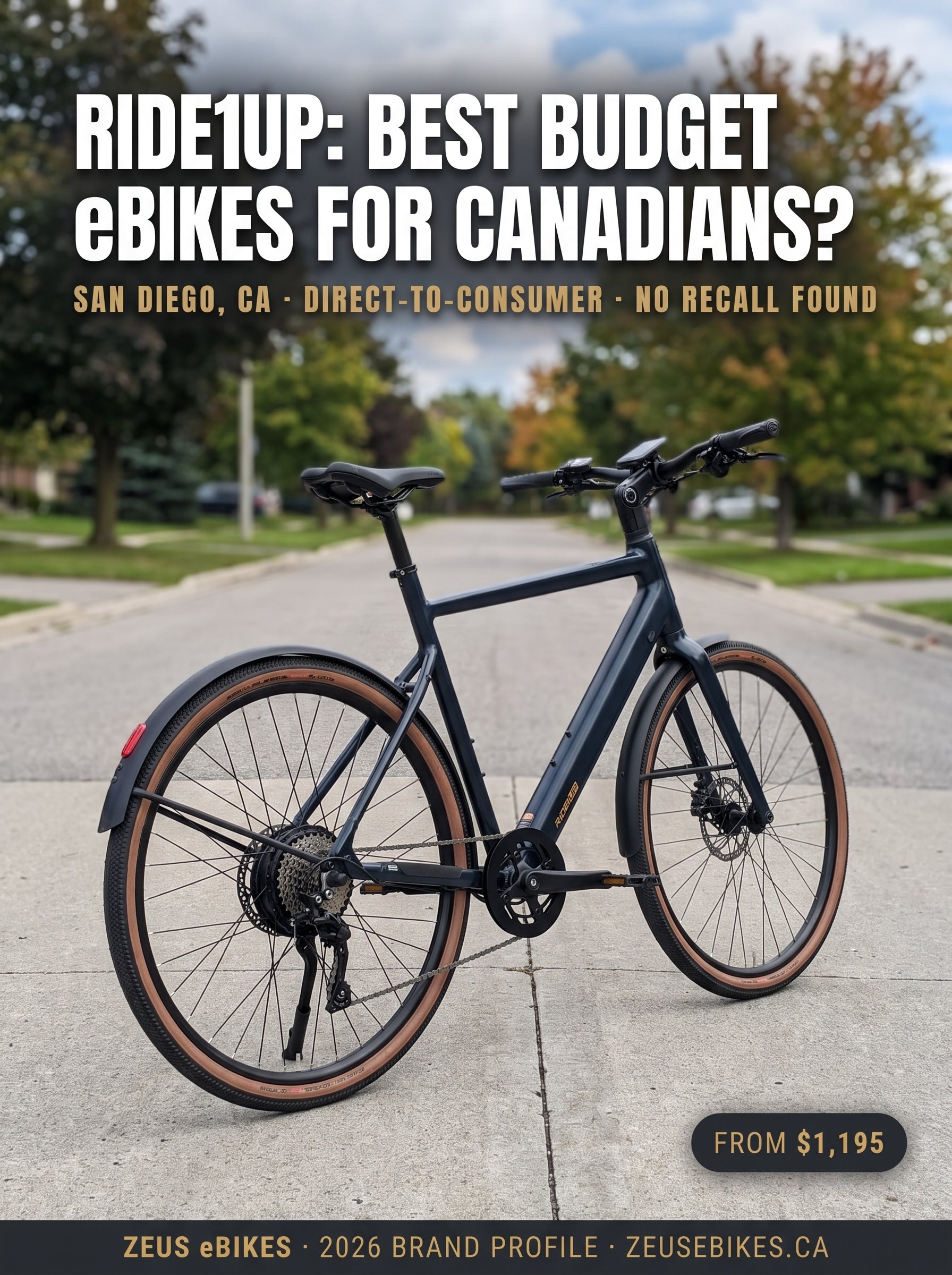
Ride1Up eBikes in Canada: An Honest 2026 Brand Profile
By Milad Ghobadibeygvand, BScN (Western University, 2014), Co-founder, Zeus eBikes Canada

Ride1Up is one of the better-known American value e-bike brands, and a fair number of Canadians end up on its checkout page after seeing a US$1,295 commuter that looks like a steal. Before you wire money across the border, it is worth knowing exactly who you are buying from, what the warranty actually covers once the bike crosses into Canada, and whether the bike is even street-legal where you live.
Zeus does not sell Ride1Up and has no stake in whether you buy one. That is the point of this profile: a plain, sourced read on the brand — ownership, the real warranty wording, the recall record, the lineup, and the Canadian-legality question — written by someone with nothing to gain from the answer. Every negative claim below traces to a named primary source, and where the record is silent, we say so rather than guess.
We built this profile from primary sources only: Ride1Up's own About, warranty, and product pages (read verbatim where the wording matters), the company's Better Business Bureau file, and direct searches of the two regulators that matter — Health Canada's recalls database (recalls-rappels.canada.ca) and the US Consumer Product Safety Commission (cpsc.gov). We re-verified the high-stakes items — recall status, warranty geography, and the certification claims — from scratch rather than trusting secondary write-ups, because a recall attributed to the wrong company or a warranty term overstated by one word is exactly the kind of error that misleads a buyer. Specs and prices are reported as Ride1Up's published figures, not as independently tested results. If you work for Ride1Up and believe any fact here is wrong or out of date, email milad@zeusebikes.ca and we will review and correct it.
Ride1Up is a privately held US e-bike brand founded in 2018 by Kevin Dugger and based in San Diego. No recall appears in Health Canada or the US CPSC as of June 2026. Its warranty is 1 year for manufacturing defects and, per its own page, applies only to buyers in the contiguous United States — the single most important fact for Canadians. Several models ship at 28 mph (45 km/h) and so exceed Canada's 32 km/h power-assist limit out of the box. If you would rather buy from a brand that warranties and ships inside Canada, see our best electric bikes in Canada guide and our checklist for a legit Canadian e-bike store.
What This Profile Covers
- Who Owns Ride1Up and Where the Bikes Are Made
- The Warranty Reality for Canadian Buyers
- Safety and Recall Record
- The Current Lineup and Prices
- Reputation: BBB, Certification and Reliability Signals
- Is a Ride1Up Legal to Ride in Canada?
- The Honest Ledger: Green Flags vs Red Flags
- The Verdict
- Frequently asked questions
- The bottom line
Who Owns Ride1Up and Where the Bikes Are Made
Ride1Up is a privately held American company founded in 2018 by Kevin Dugger, a former bicycle mechanic who, by the account on the company's own About page, set out to build a cheaper e-bike with parts that would last. It is headquartered in San Diego, California, with a corporate address on Laurel Street and a retail storefront on San Diego Avenue (ride1up.com; the company's Better Business Bureau file).
Ownership matters for a reason no seller will volunteer: it tells you who stands behind the warranty if something goes wrong. Ride1Up raised a US$6.5M Series A led by Ecosystem Integrity Fund in 2022 (TechCrunch, Axios), so it is venture-backed rather than purely founder-owned. We found no parent-company acquisition, sale, or insolvency event as of June 2026 — the brand is actively operating, with a known institutional investor on the cap table. That is a meaningfully different situation from a brand in receivership.
On where the bikes are physically built, Ride1Up does not publish a factory location, and we will not invent one. Like the large majority of value e-bike brands sold in North America, Ride1Up designs in the US and sources manufacturing overseas; the specific factory city is not disclosed in public sources, which is common in this category and is an absence of information, not evidence of anything. If country-of-origin is a deciding factor for you, our guide on why buying a Canadian e-bike matters walks through what actually changes for support and shipping.
Founder-led and venture-backed (one US$6.5M Series A, 2022), San Diego-based, actively trading, no acquisition or insolvency on record. Manufacturing is overseas and the factory city is not publicly disclosed — normal for the category, and not a red flag on its own.
The Warranty Reality for Canadian Buyers
This is the section that should decide a cross-border purchase. Ride1Up's warranty page states, word for word, that the company "grants a 1-year guarantee for manufacturing defects only." Coverage splits in two: in the first 30 days Ride1Up covers both labour and parts (if you contact them before any work is done); from day 31 through the end of year one, Ride1Up ships replacement parts free but you pay the labour to fit them. The battery is treated as a covered component under that same one-year defect term — there is no separate, longer battery warranty, which is worth knowing because the battery is the single most expensive part of any e-bike.
The clause that matters most for anyone reading this in Canada is also on that page: the warranty "applies only to customers purchasing and operating in the contiguous United States." Read plainly, the standard warranty is written for US riders. A Canadian buyer is relying on Ride1Up's goodwill and cross-border parts shipping rather than a warranty drafted to cover them — and even in the best case, a warranty that ships a free part but leaves you to pay a Canadian shop for the labour is a different promise than a fully handled, in-country claim.
Ride1Up sells optional 2-year and 3-year extended plans at checkout (the 2-year adds one year, the 3-year adds two; they cover replacement parts and not labour, at roughly 29% of the bike's cost for the 3-year, per ride1up.com/product/extended-warranty and support.ride1up.com), and they do not change the geography clause. None of this is hidden — it is on the company's published pages — but it is easy to miss when the headline is the price. For a sense of what an in-Canada warranty and return path looks like by comparison, our Canadian e-bike buying guide covers the questions to ask before you pay.
Ride1Up's own warranty page limits coverage to "the contiguous United States," and after the first 30 days the owner pays labour even on a valid claim. Confirm in writing with Ride1Up how a defect would be handled at a Canadian address before you order.
See our verified picks — brands that ship, service, and warrant from within Canada — plus our plain-language guide to spotting a store you can trust.
Best eBikes in Canada Spot a Legit StoreSafety and Recall Record
We searched both regulators that govern e-bikes sold to Canadians and Americans. As of June 2026, no recall for Ride1Up appears in Health Canada's recalls database (recalls-rappels.canada.ca) or in the US Consumer Product Safety Commission's recall listings (cpsc.gov). That is a verified absence as of our search date, not a guarantee about the future, and it is a genuinely positive signal in a category where battery recalls are not rare.
One point of confusion is worth heading off directly, because getting it wrong would be unfair to the brand. In March 2026 the CPSC issued a 'stop using immediately' fire-hazard warning against an e-bike maker that refused a recall — that notice names Ridstar (a brand of Huizhou Xingqishi Sporting Goods, China), not Ride1Up. The two are unrelated companies, and the warning has nothing to do with Ride1Up.
On the safety equipment Ride1Up does control, the company states that most of its current bikes are certified to UL 2849 (the whole-bike electrical-system standard) and UL 2271 (the battery-pack standard) through SGS or TUV, and that it has had no reported battery fire since 2018. We report those as Ride1Up's claims; we have not independently tested its bikes. UL-standard certification is the bar safety regulators have been pushing the industry toward, so a brand advertising it is doing the right thing — just verify the specific model you want carries it, since the brand says "most," not all. Our overview of Canadian e-bike rules explains why battery certification is becoming a buying issue, not just a safety one.
No Ride1Up recall on file with Health Canada or the CPSC as of June 2026. The March 2026 CPSC fire warning is about Ridstar, a different company. UL 2849/2271 certification is a manufacturer claim covering "most" models — confirm it on the exact bike you want.
The Current Lineup and Prices
Ride1Up's range is built around affordable commuters, with a moped-style line at the top. All figures below are Ride1Up's own published US specs and prices as of June 2026, subject to change; treat the performance numbers as the manufacturer's claims rather than independently verified results.
- Turris — a 750W hub motor (90 Nm), 48V 14Ah battery with a UL 2271-certified pack, hydraulic brakes; around US$1,295. The value commuter most cross-shoppers land on. 90 Nm is enough torque to hold pace on a 6–8% grade without dropping a gear — the kind of incline you find on most urban arterials. Ships as Class 3 (28 mph / ≈45 km/h) — above Canada's 32 km/h cap.
- Roadster V3 — a lightweight 500W belt-or-geared commuter at around US$1,395, aimed at riders who want something closer to a normal bike's weight. Belt drive is low-maintenance in wet and salted conditions — no chain to de-grease or re-lube through a Canadian winter — at the cost of replacing the entire belt if it snaps, versus a cheap chain link. Available in Class 2 and Class 3 configurations; verify the shipped default before ordering.
- 700 Series — a fuller-equipped commuter with a 720 Wh battery, rack, fenders and lights, around US$1,595.
- Revv1 — the moped-style flagship: a 1000W nominal hub motor with 95 Nm and a 52V 1,040 Wh battery, sold in hardtail, full-suspension and dirt variants. Ride1Up's own product pages describe a multi-class system with an off-road DRT mode restricted to private property; peak output figures by variant are not separately published on ride1up.com as of June 2026.
Pricing is in US dollars, so a Canadian buyer should add the exchange rate, cross-border shipping (Ride1Up lists Canada shipping from US$100 per bike, with larger models at US$400 and the Revv1 DRT excluded), and the possibility of import duty, which the company itself says is variable and not guaranteed either way. That can move a "$1,295" bike well past its sticker by the time it reaches your door. If a moped-style build is what you are after, our fat-tire e-bike guide and our Rad Power alternatives piece cover comparable options that ship and warranty inside Canada.
Reputation: BBB, Certification and Reliability Signals
On the Better Business Bureau, Ride1Up holds a rating of A and has been BBB-accredited since 8 March 2022, with 21 complaints filed against the business on its profile (bbb.org). An A with accreditation is a solid score; 21 complaints over several years for a high-volume direct-to-consumer brand is not unusual, and the themes that surface in the BBB file cluster around the things you would expect from any value e-bike sold direct — components needing adjustment on arrival and the friction of diagnosing or repairing a bike yourself rather than walking it into a shop.
That last point is structural, not a knock specific to Ride1Up: a direct-to-consumer bike shipped in a box means you (or a local shop you pay) handle final assembly and any early fettling. It is part of how the price gets to US$1,295. We have deliberately not quoted a star-rating average here, because the public review samples we could verify were either small or aggregated across sources in ways that would not be representative — and a non-representative number dressed up as a verdict is exactly what this profile exists to avoid.
The reliability signal we can stand behind is the certification posture above: Ride1Up advertising UL 2849 and UL 2271 across most of its line, plus its own statement of no battery fire since 2018. Taken together with a clean regulator record, that paints a brand taking battery safety seriously — the open questions for a Canadian are warranty geography and post-sale support, not a safety scandal.
BBB: A rating, accredited since 2022, 21 complaints on file. Complaint themes are the usual direct-to-consumer assembly-and-support frictions, not safety failures. We withhold a star average because the verifiable samples are too small to be representative.
Is a Ride1Up Legal to Ride in Canada?
This is where a cheap US e-bike can quietly become a problem. Across Canadian provinces a power-assisted bicycle is generally capped at 500W nominal, with assist cutting out at 32 km/h and working pedals present; the federal power-assisted-bicycle definition was repealed in 2021, so enforcement now sits with the provinces. Several Ride1Up models ship configured well past that line.
Per Ride1Up's own pages, the Turris is sold as a Class 3 bike that assists up to 28 mph — about 45 km/h, comfortably above Canada's 32 km/h cap in its top setting. The Roadster V3 is a 500W bike available in Class 2 and Class 3 configurations; check Ride1Up's current product page to confirm the shipped default before ordering, as Class 2 mode (throttle to 20 mph / 32 km/h) would be at Canada's PAB cap, while Class 3 mode (28 mph) would exceed it. The Revv1 goes further: a 1000W nominal motor (peak output well above the 500W limit) with a multi-class system reaching 28 mph in road mode and an off-road DRT mode the company itself says is for private property only. A 1000W bike does not meet the power-assisted-bicycle definition the provinces adopted at any setting, because the motor alone exceeds the 500W nominal limit.
None of this makes a Ride1Up illegal to own — it means you have to match the bike, and its mode, to the rules where you ride, and that a higher-output model may be restricted to private land or reclassified depending on your province. Do not take a marketing 'class' label as Canadian road-legal status; the two are different systems. Before buying anything that tops 32 km/h, read our plain-language Canadian e-bike laws guide, and if you are weighing the bike as a car replacement, our e-bike vs car breakdown is the better lens than top speed alone.
Ride1Up's Turris ships above Canada's 32 km/h limit in its Class 3 configuration, and the Revv1's 1000W motor exceeds Canada's 500W power-assist limit outright. The Roadster V3's Canadian-legal status depends on which class mode it ships in — confirm on Ride1Up's current product page before ordering. A US 'class' label is not a Canadian legality stamp — confirm what is road-legal where you live first.
The Honest Ledger: Green Flags vs Red Flags
No brand is all one colour -- here is the picture the sourced facts above actually support.
Green Flags
- No recall found in Health Canada or the US CPSC as of June 2026 — a clean regulator record in a category where battery recalls are common.
- Operating since 2018 and venture-backed (US$6.5M Series A, 2022), with no acquisition, sale, bankruptcy or insolvency event on public record as of June 2026.
- BBB rating of A, accredited since March 2022 — a solid third-party standing.
- Manufacturer states most current models are certified to UL 2849 and UL 2271 (via SGS/TUV) and reports no battery fire since 2018.
- Transparent, published warranty and shipping pages — the terms are stated plainly, even the limiting ones.
- Genuinely low US sticker prices (Turris ~US$1,295) for the spec on paper.
Red Flags
- Warranty is 1 year for defects only and, per Ride1Up's own page, 'applies only to customers purchasing and operating in the contiguous United States' — it is not written to cover Canadian buyers.
- After the first 30 days, the owner pays labour even on a valid warranty claim; only the replacement part is free.
- No separate, longer battery warranty — the battery is covered under the same 1-year defect term.
- Turris ships at 28 mph (≈45 km/h) in Class 3 mode, above Canada's 32 km/h power-assist cap; the Roadster V3's shipped default class must be confirmed before ordering; the Revv1's 1000W motor exceeds Canada's 500W limit outright.
- US-dollar pricing plus cross-border shipping (from US$100, up to US$400 on larger models) and variable import duty can push the real landed cost well past the sticker.
- Direct-to-consumer model means you handle final assembly and any early adjustments, or pay a local shop to.
Our Canadian eBike buying guide walks through the questions to ask any brand before you pay — including warranty geography, landed cost, and provincial legality.
Canadian eBike Buying Guide Best eBikes in CanadaIn our view, Ride1Up is a legitimate, transparent US value brand with a genuinely clean safety record — no recall in either Health Canada or the CPSC as of June 2026, UL-standard certification on most models, and an A rating at the BBB. For an American buyer, it is an easy brand to recommend on price. For a Canadian, the calculus changes on two facts the brand states itself: the warranty is written for the contiguous United States, and several models ship faster than Canada's 32 km/h power-assist limit. Neither is a scandal — they are the predictable friction of buying a US bike across a border. If you are comfortable confirming warranty handling in writing, paying labour on any post-30-day claim, and matching the bike's mode to your provincial rules, a Ride1Up can be a sound buy. If you would rather not carry that risk, a brand that warranties and ships inside Canada removes all three problems at once.
Frequently Asked Questions
Has Ride1Up ever been recalled?
No. As of June 2026 we found no Ride1Up recall in Health Canada's recalls database (recalls-rappels.canada.ca) or in the US Consumer Product Safety Commission's listings (cpsc.gov). The March 2026 CPSC fire-hazard 'stop-use' warning that some shoppers confuse with Ride1Up actually names Ridstar, an unrelated company. Ride1Up itself states it has had no reported battery fire since 2018.
Does the Ride1Up warranty cover Canadian buyers?
Ride1Up's warranty page states the 1-year defect warranty 'applies only to customers purchasing and operating in the contiguous United States.' Read plainly, the standard warranty is written for US riders, and a Canadian is relying on the company's goodwill and cross-border parts shipping. After the first 30 days, even a valid claim ships the part free but leaves you to pay the labour. Confirm in writing with Ride1Up how a claim would be handled at a Canadian address before ordering.
Who owns Ride1Up?
Ride1Up is a privately held company founded in 2018 by Kevin Dugger, a former bicycle mechanic, and headquartered in San Diego, California. It is venture-backed: it raised a US$6.5M Series A led by Ecosystem Integrity Fund in 2022 (TechCrunch, Axios). We found no parent-company acquisition, sale, or insolvency event on public record as of June 2026 — the company is founder-led and actively operating.
Are Ride1Up bikes legal to ride in Canada?
It depends on the model and mode. Across Canadian provinces a power-assisted bicycle is generally capped at 500W nominal, 32 km/h assist and working pedals; the federal definition was repealed in 2021, so enforcement is provincial. Ride1Up's Turris ships as a Class 3 bike assisting to 28 mph (≈45 km/h) — above Canada's 32 km/h cap. The Roadster V3 is a 500W bike available in Class 2 and Class 3 configurations; confirm the shipped default on Ride1Up's product page, as Class 2 would be at Canada's cap and Class 3 would exceed it. The Revv1's 1000W motor exceeds the 500W limit outright at any mode setting. A US 'class' label is not a Canadian road-legal stamp, so check our Canadian e-bike laws guide and your provincial rules before buying anything that tops 32 km/h.
How much does a Ride1Up cost in Canada?
Ride1Up prices in US dollars — roughly US$1,295 for the Turris, US$1,395 for the Roadster V3 and US$1,595 for the 700 Series. For a Canadian, add the exchange rate, cross-border shipping (the company lists Canada shipping from US$100 per bike, up to US$400 on larger models), and possible import duty, which Ride1Up says is variable. The landed cost can be meaningfully higher than the sticker.
Is Ride1Up a good e-bike brand?
In our view, yes for US buyers and with caveats for Canadians. The safety record is clean, the BBB rating is A with accreditation, and most models carry UL 2849/2271 certification — those are the markers of a serious value brand. The Canadian-specific drawbacks are the US-only warranty wording, the cross-border cost, and that several models ship faster than Canada's 32 km/h limit. Whether it is right for you comes down to how comfortable you are managing those across a border.
Does Ride1Up ship to Canada?
Yes — Ride1Up ships directly to Canada from the United States. The company lists Canada shipping from US$100 per bike, with larger or heavier models up to US$400; the Revv1 DRT is excluded from Canada shipping. Add the current exchange rate and possible variable import duty to reach the real landed cost. The warranty, however, is written for the contiguous United States only — confirm in writing how a defect claim would be handled at your Canadian address before ordering.
The Bottom Line
If you are a Canadian eyeing a Ride1Up, the bikes are real, the brand is legitimate, and the safety record is clean — but the deal is built for American riders. The warranty is written for the contiguous United States, after 30 days you pay the labour on any claim, and the popular models ship faster than Canada's 32 km/h power-assist cap. Go in with your eyes open: confirm warranty handling in writing, budget the real landed cost, and match the bike's mode to your province. If you would rather skip all three frictions, start with our best electric bikes in Canada guide and our checklist for spotting a legit Canadian e-bike store — both point you to brands that warranty and ship inside the country. If you work for Ride1Up or have information that updates any claim on this page, email milad@zeusebikes.ca and we will review and correct it promptly.
Related Zeus Guides
Buy Smart in Canada
Avoid the Pitfalls
Know the Rules
Compare Alternatives
This Ride1Up profile is part of the Canadian eBike Brands & Shops directory -- verified brand profiles and city-by-city shop listings, launching soon.
Researched and written by the Zeus eBikes Canada editorial team as part of an independent directory of eBike brands sold in Canada. Zeus eBikes does not sell Ride1Up products and has no commercial relationship with the brand; research and sourcing follow the same neutral standards applied to every brand in this directory. Last verified: June 22, 2026.
Sources: Ride1Up About page (ride1up.com/about-us); Ride1Up warranty page, read verbatim (ride1up.com/warranty-info); Ride1Up extended-warranty page (ride1up.com/product/extended-warranty) and support centre (support.ride1up.com); Ride1Up Turris product page (ride1up.com/product/turris); Ride1Up international/Canada shipping support article (support.ride1up.com); the company's US$6.5M Series A led by Ecosystem Integrity Fund, reported by TechCrunch and Axios (2022); Ride1Up Better Business Bureau profile, San Diego (bbb.org); Health Canada Recalls and Safety Alerts search for Ride1Up, no result (recalls-rappels.canada.ca); US CPSC recall listings (cpsc.gov); and the CPSC's March 2026 Ridstar fire-hazard warning, confirming that notice concerns Ridstar and not Ride1Up (cpsc.gov). Regulator searches conducted June 2026. Specifications and prices are Ride1Up's published US figures, reported as manufacturer claims.


Share:
Rambo eBikes Canada (2026): The Honest Brand Profile
Rize eBikes in Canada: The Verified Brand Profile (2026)