
Best Electric Bikes Under $2,000 in Canada (2026): 12 Picks, Real Costs, All Legal
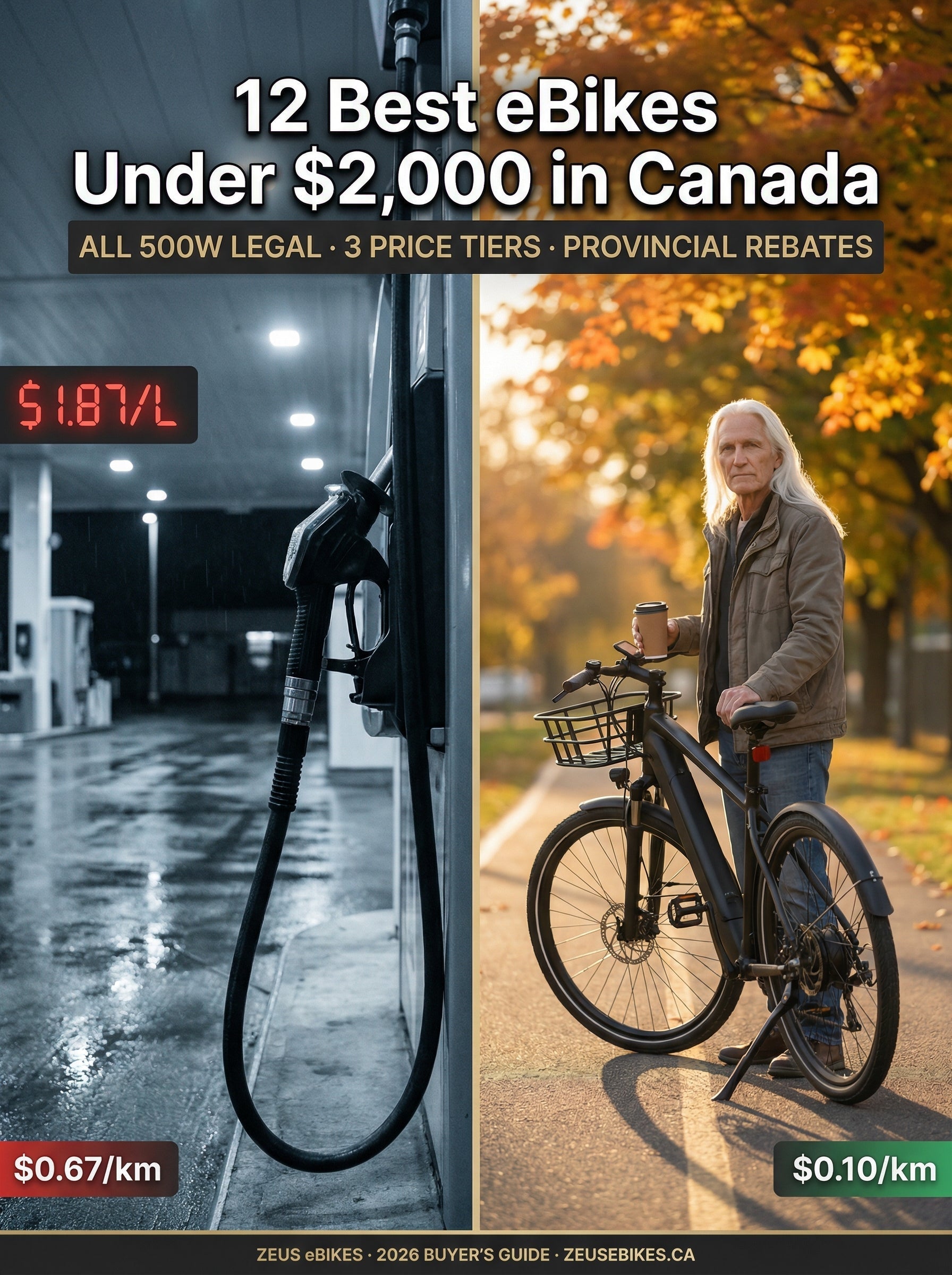
An electric bike costs roughly $0.10 per kilometre to own in Canada. A gas car costs $0.67. That is not a marketing claim — it is math, built from CAA Driving Costs data, Statistics Canada commute figures, and real Canadian electricity rates. Over a year of average commuting, the difference is $2,285 in your pocket.
This guide does what no other "best budget eBike" article does: we show you the money first, then the bikes. Twelve picks across three price tiers, every one 500W or under (federally legal as a PAB), every one verified in stock, every price confirmed as of February 2026. We also mapped every provincial rebate — because in PEI, your $899 bike could cost you $399 after the $500 rebate.
In This Guide
The Real Cost of Riding: eBike vs Car vs Transit
Most "best eBike" guides list specs and skip the question that actually matters: what does it cost to ride this thing every day? We calculated the total cost per kilometre for five modes of Canadian transport — purchase price amortised over useful life, energy, maintenance, and insurance.
| Transport Mode | Purchase | Energy | Maintenance | Insurance | Total $/km |
|---|---|---|---|---|---|
| Regular bicycle | $0.025 | $0.00 | $0.03 | $0.00 | $0.06 |
| Electric bike (<$2K) | $0.051 | $0.002 | $0.048 | $0.00 | $0.10 |
| Public transit | — | — | — | — | $0.33 |
| Electric car | $0.329 | $0.026 | $0.059 | $0.164 | $0.58 |
| Gas car | $0.316 | $0.140 | $0.100 | $0.118 | $0.67 |
Sources: CAA Driving Costs Calculator, Statistics Canada, NRCan 2025 Fuel Consumption Guide, GlobalPetrolPrices.com, provincial electricity rates. eBike purchase amortised over 5 years at 4,200 km/yr commuting. Car purchase based on $48,000 average mid-range vehicle amortised over 5 years at 15,200 km/yr. Transit based on average Canadian monthly pass (~$115) over typical commute distance. Full methodology in the methodology box above.
The median Canadian commute is 8.7 km one-way (Statistics Canada). That is 17.4 km round-trip, roughly 4,200 km per year across 240 working days. At those distances:
A $1,599 eBike replacing a gas-car commute saves approximately $2,285 per year ($0.57 savings/km × 4,200 km). Payback: ~8 months. With PEI's $500 rebate, net cost drops to $1,099 — payback in under 6 months. With Yukon's $750 rebate on an $899 CY20, net cost is $149 — payback in 3 weeks.
That is not hypothetical. An eBike commuter replacing a car can save $15,000–$45,000 over five years depending on whether they eliminate the car entirely or just reduce trips. For a deeper look at total ownership costs across every price range, see our complete eBike cost guide for Canada.
Canadian eBike Rebates: Who Gets Money Back (2026)
Three provinces and territories currently offer eBike rebates. One critical detail: PEI's $500 rebate requires the motor to be 500W or under. Every bike in this guide qualifies. Bikes over 500W do not.
| Province | Rebate | Key Requirements | Status |
|---|---|---|---|
| Prince Edward Island | $500 per eBike | Motor ≤500W; bike must cost $1,200+; 1 per year; PEI resident | Active |
| Yukon | $750 (standard) / $1,500 (cargo) | Yukon resident; max 2 rebates; conversion kits excluded | Active |
| Alberta | Up to $500 | Must scrap an old gas vehicle first (SCRAP-IT); bike must cost $1,000+ | Active (conditional) |
| British Columbia | $350–$1,400 | Income-based tiers; BC resident | Funds exhausted |
| Ontario / Quebec | None | No provincial eBike rebate program | — |
Sources: Government of PEI (Net Zero Navigator), Government of Yukon (yukon.ca), SCRAP-IT Alberta (scrapit.ca), BC eBike Rebates (bcebikerebates.ca). Ontario and Quebec confirmed: no eBike-specific programs as of Feb 2026.
Why $2,000 Is the Sweet Spot in 2026
Two years ago, $2,000 bought you a cadence sensor, a no-name battery, and mechanical disc brakes. In 2026, the under-$2,000 tier has absorbed technology that used to live exclusively above $3,000:
- Torque sensors — three bikes under $2,000 in this guide use torque sensors (Eunorau Meta275, Meta Foldable, Meta Step-Thru). In 2024, zero did.
- Samsung/LG battery cells — branded cells with known chemistry and safety standards, not generic packs
- Hydraulic disc brakes — 8 of our 12 picks include hydraulic brakes. In 2024, most under-$2,000 bikes had mechanical.
- Dual-battery options — the Eunorau Meta275 ships with two batteries included. The Meta Foldable and Meta Step-Thru accept an optional second pack.
What you still sacrifice below $2,000: mid-drive motors (all picks here are hub motors), carbon or aluminium premium frames, and integrated lighting systems. For what those upgrades cost, see our full price guide. For most Canadian commuters, the under-$2,000 tier delivers 90% of the ride quality at 50% of the price.
All 12 picks below are 500W or under — federally legal as a power-assisted bicycle in every province. For a province-by-province breakdown, see our Canadian eBike laws guide.
Tier 1: Under $1,200 — Entry-Level Commuters
Two bikes that prove "budget" is not a euphemism for "bad." These are real commuters. The question is whether you prioritise portability or ride quality.
1. Samebike CY20 Folding Commuter — $899
The Samebike CY20 is the cheapest complete eBike at Zeus eBikes and the lightest folder in the catalogue at 28 kg. The battery hides inside the seat post. The bike folds flat. At 350W, the motor sits well under the legal limit — and well under the PEI rebate threshold (though at $899, it falls below PEI's $1,200 minimum purchase price).
- Motor: 350W hub · Battery: 36V 13Ah (468Wh) · Range: 45–90 km
- Weight: 28 kg · Brakes: Mechanical disc · Sensor: Cadence
- Best for: Flat urban commutes under 15 km; apartment dwellers; car-boot commuters
- Rebate eligible: Yukon ($750 → $149 net) · PEI (no — under $1,200 minimum) · Alberta (conditional $500 → $399 net)
2. Samebike XD26-II — $1,199
The XD26-II is the lightest full-size 26-inch eBike in the Zeus catalogue at 25.5 kg — lighter than most 20-inch folders. Hydraulic disc brakes, 500W motor, 70 Nm torque, 720Wh battery. This is a bike that rides like a regular bicycle with an invisible tailwind. Most under-$2,000 bikes feel heavy and motorised. The XD26-II does not.
- Motor: 500W hub (peak 750W) · Battery: 48V 15Ah (720Wh) · Range: 55–110 km
- Weight: 25.5 kg · Brakes: Hydraulic disc · Sensor: Cadence · Torque: 70 Nm
- Best for: Riders who want a bike that feels like a bicycle, not a scooter — lightweight, efficient, full-size wheels
- Rebate eligible: PEI ($500 → $699 net) · Yukon ($750 → $449 net) · Alberta (conditional)
At $1,199, the XD26-II is our top pick for best value under $1,200. The jump from the CY20's 350W/36V system to the XD26-II's 500W/48V system is noticeable on every hill, in every headwind, and at every traffic light. For riders comparing wattage tiers, see our 500W vs 750W vs 1000W guide.
Tier 2: $1,200–$1,599 — The Sweet Spot
This is where the cost-per-km math gets compelling. Three bikes that deliver serious capability without touching $1,600. If you are replacing a car commute, this tier pays for itself fastest.
3. Samebike LOTDM200-II — $1,299
The LOTDM200-II is the tech-forward folder — the display uses NFC locking (tap your phone to unlock, no keys to lose). Kenda 20×4.0-inch fat tyres, 500W motor, 70 Nm torque, and a folding frame that fits in a car boot. At 28 kg, it matches the CY20's weight in a sturdier fat-tyre package.
- Motor: 500W hub · Battery: 48V 13Ah (624Wh) · Range: 40–90 km
- Weight: 28 kg · Brakes: Mechanical disc · Sensor: Cadence · Torque: 70 Nm
- Best for: Tech-savvy riders; urban folders who want fat-tyre stability and NFC security
- Rebate eligible: PEI ($500 → $799 net) · Yukon ($750 → $549 net)
4. Samebike RS-A02 Pro — $1,299
Same $1,299 price as the LOTDM200-II, but the RS-A02 Pro trades the NFC lock for a bigger battery (48V 15Ah / 720Wh) and more torque (80 Nm). If range and hill performance matter more than tech features, this is the better buy at the same money.
- Motor: 500W hub (peak 1,000W) · Battery: 48V 15Ah (720Wh) · Range: 50–90 km
- Weight: 33 kg · Brakes: Mechanical disc · Sensor: Cadence · Torque: 80 Nm
- Best for: Riders who want maximum battery and torque in a legal 500W folding fat-tyre package — winter-ready
- Rebate eligible: PEI ($500 → $799 net) · Yukon ($750 → $549 net)
The RS-A02 Pro's 20×4.0-inch fat tyres handle light snow, gravel, and rough city roads. For Canadian winter tips, see our winter eBike guide.
5. Movin' Tempo Max — $1,599 (Editor's Pick)
The Movin' Tempo Max is our top overall recommendation. Here is why: 960Wh battery (48V 20Ah) in a bike that weighs only 27 kg. Most 960Wh bikes weigh 35+ kg. That combination — massive range and manageable weight — does not exist anywhere else under $2,000.
Movin' Mobility is a Canadian company. The bike is designed for Canadian conditions and warranty support comes from within the country. Tektro hydraulic brakes stop reliably in rain and cold. The 500W motor is efficient and legal. This is the bike that makes the payback math work best: $1,599 purchase, $2,285 annual savings, 8.4-month payback.
- Motor: 500W hub · Battery: 48V 20Ah (960Wh) · Range: 80–90 km
- Weight: 27 kg · Brakes: Hydraulic disc · Sensor: Cadence
- Best for: Canadian commuters who want domestic brand support, class-leading range, and the lightest weight in its battery class
- Rebate eligible: PEI ($500 → $1,099 net) · Yukon ($750 → $849 net)
For more options from Canadian brands, see our Canadian-designed electric bikes guide.
Tier 3: $1,600–$1,999 — Premium Legal
This is where $2,000 starts feeling like $3,000. Torque sensors, Samsung cells, dual batteries, and a cargo bike — all 500W legal. Five picks across four use cases.
6. Meigi Hera Electric Trike — $1,699
Three wheels, zero balance required. The Meigi Hera opens eBiking to seniors, riders with mobility challenges, and anyone who wants cargo stability. The 350W motor is modest — but trikes do not need raw power. Three wheels handle hills differently: slower, but stable and safe. Rear basket included.
- Motor: 350W hub (peak 540W) · Battery: 36V 13Ah · Range: 40–80 km
- Weight: 56 kg · Brakes: Tektro disc · Gears: Shimano 7-speed
- Best for: Seniors; riders with balance concerns; neighbourhood errands with the rear basket
- Rebate eligible: PEI ($500 → $1,199 net) · Yukon ($750 → $949 net)
The only 500W-legal trike under $2,000 at Zeus. For higher-wattage trike options, see our electric trikes Canada guide. Browse the full trike collection.
7. Eunorau Meta275 — $1,979
The Meta275 is the only bike under $2,000 at Zeus that ships with two batteries included — a 48V 13Ah primary pack plus a free 14Ah second pack. That is over 1,296Wh total out of the box. The torque sensor — the same technology in bikes costing $3,000+ — makes every pedal stroke feel natural instead of robotic. The 27.5-inch wheels ride smoother than 20-inch folders over bumps and cracks.
- Motor: 500W hub, 65 Nm, torque sensor · Battery: 48V 13Ah + 14Ah (dual, ~1,296Wh)
- Range: 56–105 km (single); extended with both · Weight: 31 kg
- Brakes: Hydraulic disc · Gears: Shimano 9-speed
- Best for: Riders who want maximum battery capacity and the smoothest torque-sensor ride on full-size wheels
- Rebate eligible: PEI ($500 → $1,479 net) · Yukon ($750 → $1,229 net)
8. Eunorau Meta Foldable — $1,994
The Meta Foldable takes the same torque-sensor platform and puts it in a folding frame with Samsung 48V 15Ah cells. Pedal assist responds to how hard you push — not just whether you are pedalling. An optional second battery extends range to 161 km. At 30 kg, it is heavier than the CY20 but dramatically more capable.
- Motor: 500W hub, torque sensor · Battery: 48V 15Ah Samsung (optional 2nd for 161 km)
- Range: 80–161 km · Weight: 30 kg · Brakes: Hydraulic disc
- Best for: Riders who value pedal-assist quality above all else in a folding package — the "feels like a real bike" option
- Rebate eligible: PEI ($500 → $1,494 net) · Yukon ($750 → $1,244 net)
For riders deciding between torque and cadence sensors, our pedal assist vs throttle guide explains the real-world difference.
9. Eunorau Meta Step-Thru — $1,994
The Meta Step-Thru uses the same Samsung torque-sensor platform in a low step-over frame available in 24-inch or 26-inch wheels. Mounting is effortless for seniors, riders with hip or knee concerns, or anyone in everyday clothes. Samsung 15Ah cells and an optional second battery for 161 km range.
- Motor: 500W hub, 55 Nm, torque sensor · Battery: 48V 15Ah Samsung
- Range: 80–161 km (with optional dual battery) · Weight: 28–31 kg
- Brakes: Hydraulic disc · Sizes: 24″ or 26″ wheels
- Best for: Riders who want easy mounting + torque-sensor quality + Samsung reliability in a step-through frame
- Rebate eligible: PEI ($500 → $1,494 net) · Yukon ($750 → $1,244 net)
For step-thru options across all price points, see our best step-thru eBikes Canada guide. Browse the step-thru collection.
10. Movin' Pulse Fat Tire Delivery — $1,999
Cargo eBikes are the fastest-growing segment in Canada for 2026 (Mordor Intelligence). The Movin' Pulse is built by the same Canadian company behind the Tempo Max. The defining feature: a delivery-grade rear rack rated for 50 kg — not a bolt-on afterthought but a reinforced frame component. The 20×4.0-inch fat tyres handle curbs, potholes, and light snow.
- Motor: 500W hub · Battery: 48V 20Ah · Range: 70–90 km (estimated)
- Weight: ~32 kg · Brakes: Disc · Rack: 50 kg capacity
- Best for: Small-business delivery; parents hauling groceries and kid gear; anyone who needs heavy-load capacity on a legal eBike
- Rebate eligible: PEI ($500 → $1,499 net) · Yukon ($1,500 cargo rebate → $499 net)
Kids' eBikes
Two sizes from Eunorau — 16-inch wheels for smaller riders, 20-inch for bigger kids. Both use a 250W/24V system (well under the legal limit) with three programmable speed limits so parents can restrict top speed as the child grows. For teen and young-rider options, see our best electric bikes for teens guide.
11. Eunorau EKIDS-16 — $1,079
The EKIDS-16 weighs 13 kg (28.6 lb) — light enough for a child to handle and a parent to carry. Ages 8+, riders 2'8″–4'5″. 250W motor, 24V 10Ah battery, 32 km range, 3 speed limits.
12. Eunorau EKIDS-20 — $1,214
The EKIDS-20 scales to 20-inch wheels for riders 3'5″–5'0″. Same motor, battery, and safety features. 17 kg (37.4 lb) — still manageable for most kids.
All 12 Picks Compared
| Bike | Price | Motor | Battery (Wh) | Range | Weight | Brakes | Sensor |
|---|---|---|---|---|---|---|---|
| Samebike CY20 | $899 | 350W | 468 | 45–90 km | 28 kg | Mechanical | Cadence |
| EKIDS-16 | $1,079 | 250W | 240 | 32 km | 13 kg | Mechanical | Cadence |
| Samebike XD26-II | $1,199 | 500W | 720 | 55–110 km | 25.5 kg | Hydraulic | Cadence |
| EKIDS-20 | $1,214 | 250W | 240 | 32 km | 17 kg | Mechanical | Cadence |
| LOTDM200-II | $1,299 | 500W | 624 | 40–90 km | 28 kg | Mechanical | Cadence |
| RS-A02 Pro | $1,299 | 500W | 720 | 50–90 km | 33 kg | Mechanical | Cadence |
| Movin' Tempo Max | $1,599 | 500W | 960 | 80–90 km | 27 kg | Hydraulic | Cadence |
| Meigi Hera Trike | $1,699 | 350W | 468 | 40–80 km | 56 kg | Tektro disc | Cadence |
| Eunorau Meta275 | $1,979 | 500W | 1,296 | 56–105 km | 31 kg | Hydraulic | Torque |
| Meta Foldable | $1,994 | 500W | 720 | 80–161 km | 30 kg | Hydraulic | Torque |
| Meta Step-Thru | $1,994 | 500W | 720 | 80–161 km | 28–31 kg | Hydraulic | Torque |
| Movin' Pulse | $1,999 | 500W | 960 | 70–90 km | ~32 kg | Disc | Cadence |
5-Point Buyer's Checklist
1. Motor Wattage — 500W or Under Keeps You Legal
Canada's federal PAB definition: motor ≤500W, speed-limited to 32 km/h, operable pedals. Every bike above meets this. Bikes over 500W may need registration, insurance, or a licence. If you want to ride worry-free on bike paths and roads — 500W is the line. PEI's $500 rebate requires 500W or under.
2. Battery — At Least 48V 13Ah (624Wh) for Commuting
The battery is the most expensive component. Under 624Wh, range drops below useful commuting distance in Canadian cold. Every bike $1,199+ on this list meets the threshold. The Tempo Max and Movin' Pulse lead at 960Wh.
3. Brakes — Hydraulic Beats Mechanical in Canadian Weather
Hydraulic disc brakes self-adjust, need less hand force, and hold performance in rain, snow, and ice. Mechanical brakes fade faster and need manual tweaking. Check the comparison table — bikes $1,199 and above increasingly offer hydraulic. All three torque-sensor bikes include hydraulic brakes.
4. Sensor — Torque Gives a Better Ride
A torque sensor measures pedalling force and adjusts assist proportionally. A cadence sensor detects if you are pedalling (binary) and delivers constant assist. Torque is smoother, more efficient, and more natural. The three Eunorau Meta bikes ($1,979–$1,994) are the only torque-sensor options under $2,000 at Zeus.
5. Canadian Warranty
Buy from a retailer that stocks bikes in Canada and handles warranty locally. Zeus eBikes ships from Canada and processes all warranty claims domestically. A $1,599 bike with Canadian warranty support is worth more than a $1,200 bike from an overseas marketplace. See our how to spot a legit eBike store guide.
Frequently Asked Questions
What is the best electric bike under $2,000 in Canada?
The Movin' Tempo Max ($1,599) — Canadian-designed, 500W, 960Wh battery, 80–90 km range, only 27 kg. It costs ~$0.10/km to own and pays for itself in under 9 months of car-replacement commuting. For the best pedal-assist quality, the Eunorau Meta Foldable ($1,994) adds a torque sensor and Samsung cells.
How much does it cost to ride an electric bike per kilometre in Canada?
Approximately $0.10/km all-in (purchase amortised over 5 years, electricity at Canadian rates, annual maintenance). That is 85% cheaper than the $0.67/km cost of a gas car (CAA Driving Costs Calculator, Statistics Canada, NRCan). Over a year of average commuting (4,200 km), the savings are roughly $2,285.
Are electric bikes over 500W legal in Canada?
Under federal law, a power-assisted bicycle (PAB) must have a motor of 500W or less, be speed-limited to 32 km/h, and have operable pedals. Bikes over 500W may need registration, insurance, or a licence depending on the province. All 12 bikes in this guide are 500W or under. Province-by-province details in our Canadian eBike laws guide.
Which Canadian provinces offer eBike rebates in 2026?
Three: PEI ($500, requires ≤500W motor and $1,200+ purchase), Yukon ($750 standard / $1,500 cargo), and Alberta ($500 conditional — must scrap a gas vehicle). BC's program existed but funds are exhausted. Ontario and Quebec have no eBike-specific programs.
What is the cheapest electric bike in Canada worth buying?
The Samebike CY20 at $899 — 350W, 28 kg, folds flat, 45–90 km range. In Yukon it costs $149 after the $750 rebate. For $300 more, the XD26-II ($1,199) upgrades to 500W, hydraulic brakes, and full-size 26″ wheels at 25.5 kg.
How long does an eBike take to pay for itself?
A $1,599 eBike replacing a car commute saves ~$2,285/year. Payback: ~8 months. With PEI's $500 rebate: ~6 months. With Yukon's $750 rebate on an $899 bike: ~3 weeks. Over 5 years, total savings range from $15,000–$45,000 depending on how much driving you eliminate.
Do electric bikes under $2,000 work in Canadian winter?
Yes — expect 20–40% less range below -10°C. Fat-tyre models (RS-A02 Pro, LOTDM200-II) grip better on snow. Store the battery indoors overnight. Hydraulic brakes are essential — mechanical brakes lose stopping power when frozen. See our winter eBike guide.
The Bottom Line
The numbers are simple: $0.10 per kilometre for an eBike. $0.67 for a car. Over a year of average Canadian commuting, that is $2,285 back in your pocket — before provincial rebates.
If you only remember three bikes from this guide:
- Best value: Movin' Tempo Max ($1,599) — Canadian brand, 960Wh, 27 kg, 8-month payback
- Best ride quality: Eunorau Meta Foldable ($1,994) — torque sensor, Samsung cells, folds, 161 km dual-battery range
- Best entry: Samebike XD26-II ($1,199) — 500W, 25.5 kg, hydraulic brakes, $699 in PEI
Every bike is in stock. Every bike is 500W or under. Every bike ships from Canada with a warranty honoured locally. The math works. The law works. Just ride.
Ready? Browse all Zeus eBike collections and filter by price. Need help choosing? Read the full buying guide. Questions? Contact our team.
Published: January 2026 | Last Updated: February 24, 2026 | By: Zeus eBikes Canada Editorial Team
How Much Does an Electric Bike Cost in Canada?
How to Finance an Electric Bike in Canada
500W vs 750W vs 1000W eBike Canada
Pedal Assist vs Throttle eBikes
Electric Bike Laws Canada (Province by Province)
Canadian-Designed Electric Bikes
Best Winter eBikes Canada
Electric Trikes Canada
How to Spot a Legit eBike Store
Electric Mopeds Canada (2026): Best Moped-Style eBikes



Share:
Best eBike Deals in Canada (2026): 12 Picks from $1,199 to $4,019
Best Electric Bikes for Winter in Canada (2026): Snow-Ready Power Picks from Zeus eBikes