

How Do Tariffs Affect Canada? Every Industry, Every Person

By Milad Ghobadibeygvand, BScN (Western University, 2014) · Published 24 August 2026 · Every figure in this guide carries a named source and an as-of date; the full bibliography is at the end.
On Friday night, 21 August, the trade talks collapsed, and how tariffs affect Canada stopped being a forecast and became a bill. At 12:01 a.m. on Saturday, 50% American tariffs took effect on roughly $20 billion of Canadian goods, and that morning the Prime Minister was standing on Parliament Hill describing it this way: “You’re at war when you get attacked. We got attacked.” The help on offer is far narrower than the announcements suggest — and if you decide wrong in the months ahead, about your job, your grocery budget or your business, that gap lands on you personally. This guide walks you through the whole board: what is taxed, who pays, where the money goes, and what you can do.
How this guide was built
Zeus Media traced every claim to a primary or official source between 20 and 24 August 2026: the Prime Minister’s Office, Budget 2025, the Canada Gazette, CEEFC and BDC program pages, Statistics Canada releases, the Bank of Canada’s April 2026 Monetary Policy Report, Congressional Research Service products, and departmental announcements. Where a figure comes from credible press rather than a primary source, it is labelled as reported. Where a statement is our reading of published criteria rather than a source’s claim, it is labelled as analysis. Sector coverage spans every industry named in the tariff instruments of both countries. Independent editorial, legal, and fact-checking reviews were run before publication. Zeus Media is not affiliated with the Government of Canada; this is independent analysis, not government guidance.
About this document
Version 1.5 · 25 August 2026 · data current to 25 August 2026. Published by Zeus Media, the editorial arm of Zeus eBikes Canada, an independent Canadian retailer in Waterloo, Ontario. This is independent analysis. It is not government guidance, not legal or benefits advice, and not an official publication of any government, and Zeus Media is not affiliated with the Government of Canada or any of its departments or agencies.
Labels. Three are used throughout and mean exactly what they say. verified the figure appears in the cited primary or official source. reported the figure comes from credible press or professional commentary, not a primary source. analysis the statement is our reading of published criteria, or our own arithmetic on published denominators — not a claim any source makes. Projections are labelled as projections wherever they appear, and where this guide's own arithmetic produces a figure, the denominators are published so it can be checked.
Declared interest. Zeus eBikes Canada sells electric bicycles in Canada and therefore has a commercial interest in Canadian consumer preference for Canadian retailers. Weigh the analysis accordingly.
Corrections. Errors are corrected in place and noted in the revision history. Report one to milad@zeusebikes.ca.
Revision history. v1.0 first draft, 24 August 2026. v1.1 — softwood combined rate corrected to ≈45.2% against the Commerce determinations; the EI extension's beneficiary estimate separated from the original measure's. v1.2 — food-inflation figures updated to the July 2026 CPI release; the LETL section rewritten against CEEFC's public register. v1.3 — Section 301 and Hyde Park citations corrected; copper reclassified after the Bank of Canada's export data; unsourced softwood price series removed. v1.4, 24 August 2026 — five independent editorial reviews applied (structure, sourcing, line, service journalism, reader advocacy). Corrected: the Work-Sharing tariff special measures, which an earlier draft wrongly described as unpublished — they relax nearly every standard gate and are now set out in full; the EI checklist, which omitted the biweekly reporting requirement, the mailed access code, the 28-day decision standard and the 30-day reconsideration deadline; the claim that clinics and hospitals have no tariff paper trail, when goods for medically necessary care can claim surtax remission; and the statement that the steel-input remission ended 1 February 2026, when only its Schedule 2 branch did. Added: what a tariff is and who pays it; the Section 301 forced-labour tariff as a third legal track; the standing Surtax Remission Order ahead of the case-by-case route; a fifth buy-Canadian check on where goods are made; five data charts; and sixteen photographs. v1.5, 25 August 2026 — added the second-front section on social media and the information war: the overt-versus-covert distinction, the Meta news block and the digital-services-tax rescission as structural leverage, the statutory-reach table, and a reader checklist. New sources verified live 25 August: Finance Canada's 29 June 2025 DST release, Meta's news-availability announcement, the Hogue Final Report volumes 1 and 5, the Foreign Influence Transparency Commissioner's interpretation bulletin and public registry, and Elections Alberta's referendum page.
Suggested citation. Ghobadibeygvand, M. (2026). How Do Tariffs Affect Canada? Every Industry, Every Person (Version 1.5, 25 August 2026). Zeus Media. https://zeusebikes.ca/blogs/news/how-do-tariffs-affect-canada
Quick answer: Tariffs hit Canada in three ways. Directly: 50% American duties now cover steel, aluminum, copper and ~$20B of further goods, with Section 232 measures potentially covering about 37% of Canada’s US-bound exports on a five-year average, a figure that includes goods still only under investigation. Through prices: counter-tariffs and supply shifts are feeding grocery and equipment costs. Through the public purse: Ottawa’s announced support tops $25 billion, but Budget 2025 books its expected real cost at just over $12 billion — most of it is repayable lending, which laid-off workers and large firms can reach while teachers, nurses, hospitals and most small businesses cannot. Details, sources and what you can do below — and for the international strategy picture, see our Canada trade-war playbook.
In this guide
- How do tariffs affect Canada right now? The two walls
- What do tariffs mean for Canadians? Fourteen situations
- How do tariffs affect the Canadian economy?
- Which Canadian industries are hit hardest?
- Groceries, car prices, and farms
- Where does tariff money go in Canada?
- What is Canada doing about tariffs? The $25B ledger, line by line
- Is Canada at war with the US?
- How will social media be used against Canada? The second front
- What can Canadians do about tariffs?
- What should the government do next?
- How would history's great wartime leaders play this hand?
- What to do right now: step-by-step
- Frequently asked questions
- The bottom line
How Do Tariffs Affect Canada Right Now? The Two Walls
Two walls of tariffs now stand between Canada and its largest trading partner. Start with the mechanism, because most people have it backwards: a tariff is a tax collected at the border from the importer — not a bill sent to the exporting country. When Washington puts 50% on Canadian steel, the cheque is written by the American firm buying it. The mill in Sault Ste. Marie never receives an invoice; it meets the wall as cancelled orders and prices it has to absorb. When Ottawa answers on 8 September, the cheque is written by the Canadian firm importing American goods — and that one reaches you, at the till.

The tariff is collected from the importer at this line — not billed to the country the goods came from.
The American wall taxes Canadian exports under three legal tracks. Section 232 of the US Trade Expansion Act of 1962 lets a president impose duties on national-security grounds, and now covers metals, vehicles, lumber and chips. The newer Section 338, of the Tariff Act of 1930, allows duties of up to 50% against a country found to discriminate against US commerce; it now covers roughly US$20 billion of further goods, and unlike Section 232 it reaches goods that meet the trade agreement’s rules. And a third track is easy to miss because it is not Canada-specific: a Section 301 forced-labour action put a flat 10% on all Canadian goods that do not qualify under CUSMA — the Canada–United States–Mexico Agreement, the free-trade deal that replaced NAFTA — from 24 July 2026. CUSMA-qualifying goods and goods already under Section 232 are exempt, but that 10% floor reaches sectors the headline measures leave alone. The Canadian wall answers on 8 September with dollar-for-dollar counter-tariffs. Everything else in this guide follows from what these walls cover, and what they leave alone.
The American wall, in force as of 24 August 2026
| Measure | Rate | Since | Source |
|---|---|---|---|
| Steel & aluminum (Section 232) | 50% (many derivatives 25%) | Doubled 4 June 2025; assessed on full customs value since April 2026 | CRS; PwC |
| Copper (Section 232) | 50% on semi-finished copper and copper-intensive derivatives from 1 August 2025; the separate 25% derivative tier and the full-value basis both arrive 6 April 2026. Canada pays; free-trade preferences do not reach this layer | 1 August 2025 | CRS; White & Case |
| Vehicles (Section 232) | 25% on non-CUSMA-compliant autos; parts and heavier trucks covered | 3 April 2025 | ISED |
| Softwood lumber | ≈45.2% combined in force: final anti-dumping/countervailing duties at 35.16% plus the 10% Section 232 timber tariff. A preliminary cut to 24.83% AD/CVD (≈34.8% combined) takes effect only if confirmed in the final determination | Preliminary reduction announced 2026; the dispute itself has run continuously since 1982, and rates have moved in both directions over that time; final determination expected between late August and October 2026 | Global Affairs; CRS |
| Section 301 (forced-labour action) | 10% tier for Canada on non-CUSMA-qualifying goods from 24 July 2026 (replacing the expired Section 122 measure); CUSMA-qualifying goods and Section 232 goods exempt | 24 July 2026 | USTR, 91 FR 47318 (28 July 2026) |
| Semiconductors (Section 232) | 25%, narrow advanced-chip scope | 15 January 2026 | Sandler, Travis & Rosenberg |
| Section 338 round | 50% on ~US$20B of goods (the Prime Minister's 21 August statement puts the same round at roughly $28 billion; press analyses run to $29 billion. No US instrument states a value, so treat US$20B as an estimate rather than an official figure.), regardless of CUSMA status: alcohol and beer, dairy-linked goods, hockey equipment, building materials, cement and clothing (vehicles are not on the Section 338 list — they are already covered by Section 232) | Announced effective 19 August 2026; the Prime Minister described imposition at midnight on 21/22 August after a three-day pause | Wiley; Holland & Knight |
Two structural facts govern the whole map. First, the walls interlock rather than stack: Section 338 duties do not apply to goods already under Section 232 (Holland & Knight). Second, the scale is historic: Section 232 measures potentially cover about 37% of Canada’s exports to the United States on a five-year-average basis — a figure that includes products still only under investigation. For scale on a different denominator, the Bank of Canada puts the industries actually facing sectoral tariffs at roughly 15% of all Canadian exports and about 1% of national output and employment, and one projection puts the new 50% round’s economy-wide risk at roughly 87,000 jobs — 52,000 direct plus 35,000 in supplier and service industries (School of Public Policy, University of Calgary, March 2026; Trevor Tombe in The Hub, 20 August 2026 — a projection, and labelled as one).
What Washington is not taxing
The exemptions shape Canada’s position as much as the tariffs do. CUSMA-qualifying oil, natural gas and electricity enter the United States at 0%, and energy is not among the goods the Section 338 round targets; Canada supplied 63.4% of American crude oil imports in 2025 (US Energy Information Administration series, confirmed by the Canada Energy Regulator; the Prime Minister cited 60% on 22 August). CUSMA-compliant fish and seafood are exempt (Fisheries and Oceans Canada). Services — software, finance, engineering, media — face no tariff instrument at all. And one threat is live but not in force: a 50% tariff on Canadian-built aircraft, floated in late January 2026 alongside a decertification threat against Bombardier jets during the Gulfstream certification dispute (CNBC).
The Canadian wall: 8 September
Canada’s counter-round lands on what the Prime Minister called “the Tuesday after Labour Day”. Labour Day falls on Monday 7 September in 2026, so that is 8 September — our arithmetic, not a date the government has stated — matching the American round dollar for dollar: steel, dairy, appliances, agricultural equipment, pulp and paper, and electronics, plus products tied to the grievance lists (PMO, 22 August). This wall is paid by Canadian buyers of those American goods. That includes farmers buying equipment, builders buying steel, and anyone shopping for an appliance or a laptop this fall.
Takeaway: the tariff war is not one policy but two interlocking walls. If your work or your spending touches metals, vehicles, lumber, or the 8 September counter-list, you are inside it. If you are in energy, services, or CUSMA-compliant seafood, you are — for now — watching from outside.
What Do Tariffs Mean for Canadians? Fourteen Situations
Tariffs reach Canadians unevenly: a millworker and a nurse live in different wars. The table below maps fourteen situations — from a laid-off Brampton auto worker to a retiree on a fixed income — against two questions: how does the war hit them, and what support can they touch? The support column condenses the federal package examined later in this guide.

Brampton Assembly has been idle since December 2023. Unifor puts the layoff at more than 2,200 of its members.
| Who | How the war hits them | What reaches them |
|---|---|---|
| Laid-off millworker | Their plant sits behind a ≈45.2% combined lumber wall; forestry-town mills are curtailing | The most of anyone: EI from week one, severance no longer delays benefits, 20 extra weeks if long-tenured (55% of insurable earnings, to $729/week), retraining money |
| Auto worker, Brampton | On layoff since the plant was idled in December 2023; Jeep Compass production moved to the US; Unifor puts it at 2,200+ members — and on 12 August 2026 the company told the union it intends to open talks on selling the plant | The EI 20-week extension fits them best; the remission framework aims to hold what production remains |
| Laid-off server | A demand-side casualty: food costs squeeze the restaurant until shifts go | EI basics (the waiting week is waived on all claims); the 20 extra weeks only if they pass the long-tenured test |
| Farmer | Machinery is about to cost more (8 September counter-tariff on US agricultural equipment); the steel-input remission narrowed on 1 February 2026, though the Schedule 1 branch runs to 1 July 2027 | Farm Credit Canada lending and deferrals. Debt, in other words |
| Small-business owner (retail) | Supplier prices, the counter-tariff lists, and price-capped patriotism at the till | Approximately $0 non-repayable; BDC loans if the firm can show a direct or indirect tariff impact (BDC criteria) |
| Restaurant owner | Eighteen straight months of above-headline food inflation, now decelerating, with thin pricing power | Nothing targeted; their laid-off staff get the EI measures |
| Family doctor (clinic owner) | Clinic costs ride the same prices; the federal support package offers them nothing — but a clinic importing US goods can claim surtax remission, and the invoice showing surtax paid is the paper trail | $0 — every program in this package requires tariff impact |
| Nurse | Consumer prices, plus a workplace with no line item in the package | $0 |
| Teacher | Consumer prices, plus taxpayer exposure to the war’s bills | $0 |
| Hospital unit that needs beds | Costs up; capital budgets are provincial; the federal package is silent on care | $0. The package’s package contains no healthcare allocation we could find; for scale, a single softwood firm’s loan announcement was $100M |
| Retiree on a fixed income | Groceries and appliances repriced by both walls, with no wage growth to absorb it | Nothing tariff-specific names them |
| New graduate job-hunting | Youth unemployment sits at 12.6% (July Labour Force Survey) while walled sectors freeze hiring | Nothing targeted; retraining streams aim at displaced workers, not entrants |
| Large-enterprise executive | Export walls, but options too: the $10B loan facility, the Strategic Response Fund, remission files | The most doors of anyone — all of them lending or process |
| Energy worker | Largely untouched; the CUSMA energy exemption is doing its work | The package barely matters to them, and the war barely reaches them |

Retirees on fixed incomes sit on the paying side of this ledger: grocery inflation reaches them, and no tariff program does.
Takeaway: support flows to two groups — laid-off workers, through looser rules on their own Employment Insurance, and firms big enough or export-shaped enough to borrow. Public-sector workers, healthcare, clinics, restaurants and most small retailers are on the paying side of the ledger.
How Do Tariffs Affect the Canadian Economy?
The honest macro answer is a divided one: the aggregate economy is holding. Unemployment fell to 6.4% in July 2026 as the economy added 75,000 jobs, the best reading in two years (Statistics Canada, Labour Force Survey). The war’s damage is concentrated in the walled sectors rather than spread economy-wide, which is exactly why individual experiences of it diverge so sharply — and why the July data, collected before the 22 August round, is a baseline rather than a verdict.
Inside the walls, the Bank of Canada’s April 2026 assessment reads differently: steel exports to the United States roughly halved; aluminum exports ran about 50% below 2024 levels by July 2025, with layoffs among downstream manufacturers absorbing higher input costs even as smelter employment held. Softwood shipments fell 28% year over year by January 2026. Canada’s automotive sector — 125,000 direct jobs, $16.8 billion of GDP in 2024 — has watched Stellantis idle Brampton and General Motors end BrightDrop van production, after which Ottawa cut Stellantis’ tariff-free import quota in October 2025 (Globe and Mail). Brampton got worse while this guide was being written. Unifor stated on 14 August 2026 that two days earlier the company had informed the union it intended to open discussions with another firm about selling the plant — where more than 2,200 Local 1285 members have been on layoff since it was idled in December 2023. Read that precisely: Stellantis has given no formal written notice of closure, and the collective agreement requires at least a year’s notice of any closure or sale. The union calls the shift to pursue a sale “a dire development” and attributes it to the auto tariffs (Unifor statement, 14 August 2026, retrieved 24 August 2026).

Steel exports to the United States roughly halved after the 50% wall went up, on the Bank of Canada’s April 2026 assessment.
Watch the food line, though. Food purchased from stores rose 3.1% year over year in July 2026 — the eighteenth consecutive month it outpaced headline inflation, but the third straight month of deceleration, down from 4.3% in May and 3.9% in June. Statistics Canada attributes the 45.2% jump in tomato prices partly to Mexican supply contractions that followed US tariffs. The streak itself predates the 2026 tariff rounds, and Statistics Canada attributes specific line items to tariff effects rather than the streak as a whole. Even so, the tariff war reaches Canadians who never touch an export dock through the grocery bill (StatCan CPI, May 2026).
Which Canadian Industries Are Hit Hardest?

Hospitals are never tariffed. They are also absent from the $25-billion package, while their input costs ride the counter-tariff lists.
Four industries take the war’s direct fire — steel, aluminum, autos and softwood. Copper sits in a stranger place: tariffed at 50%, yet with exports running roughly 40% above their 2024 average. Others are squeezed at one remove, through prices and demand rather than duties; a final group is genuinely insulated by exemptions; and one is neither tariffed nor supported. The exposure labels below mean exactly what they say: critical (a direct tariff wall on their exports), serious (direct but partial, or a live threat), indirect (hit through prices and demand), mixed (losses and gains at once), and insulated (exempt or untargeted). One row carries a variant label — unshielded — for the sectors with no tariff exposure and no access to the support package either.
Not every tariffed sector is losing
Three of the four industries behind the highest walls are shipping far less. One is shipping more. Bar length shows the size of each move, not its direction: red is a fall, green a rise.
Bank of Canada, April 2026 assessment. Aluminum exports ran about 50% below 2024 levels by July 2025 and later regained over half those losses. The Bank’s own subheading on copper reads “Copper exports have surged.”
| Sector | The hit | Evidence to date | Support open to them | Exposure |
|---|---|---|---|---|
| Steel | 50% Section 232; Canada’s own counter-round also taxes US steel, raising some domestic input costs | Exports roughly halved (Bank of Canada, April 2026) | A $1B steel transition envelope — announced July 2025 via the Strategic Innovation Fund and counted inside the $5B Strategic Response Fund, not on top of it; the $10B loan facility — Algoma Steel drew its first loan, $400M (September 2025); EI for workers | Critical |
| Aluminum | 50% Section 232 on their main export market | Exports about 50% below 2024 by July 2025; downstream layoffs; smelter employment resilient. The same Bank of Canada assessment notes exports later rebounded, regaining over half their initial losses | Lending programs; EI | Critical |
| Copper products | 50% Section 232 from 1 August 2025; a 25% derivative tier and full-value assessment added 6 April 2026; no free-trade relief at this layer | Canada supplies about a fifth of the US$7.2B semi-finished slice of a US$16.2B affected category (CRS). But the Bank of Canada reports copper exports to the US running 40% above their 2024 average — producers shifted to product types outside the 50% line | General lending programs; EI | Mixed |
| Autos & parts | 25% Section 232 on non-CUSMA vehicles; parts and heavier trucks covered; vehicles are not on the Section 338 list — they are already inside Section 232 | Brampton idle since December 2023 with 2,200+ Unifor members on layoff; Compass moved to the US; BrightDrop ended; quota cuts followed — and on 12 August 2026 Stellantis told the union it intends to open talks on selling the plant | Performance-based remission framework; Strategic Response Fund; the EI 20-week extension | Critical |
| Softwood & forestry | ≈45.2% combined duties in force; a preliminary cut to ≈34.8% awaits the final determination | Lumber exports roughly 20% below their 2024 average by February 2026 (Bank of Canada); curtailments at forestry-town mills | Millar Western ($100M) and Arbec ($60M) federal loans, July 2026, part of five approved LETL loans totalling $825M; up to $1.2B in BDC loan guarantees ($700M plus a $500M top-up, November 2025) | Critical |
| Aerospace | No tariff in force; a 50% aircraft tariff and Bombardier decertification threatened in January 2026 | Bombardier stock fell sharply on the threat; Transport Canada and the FAA resolved the certification dispute in February 2026; the IAM machinists’ union warns of thousands of jobs at risk on both sides of the border (IAM statement) | General programs only | Serious (threatened) |
| Farming & agri-food | Dairy is the named Section 338 grievance; Canada’s 8 September counter-tariff raises US equipment costs; steel-input remission narrowed on 1 February 2026, though the Schedule 1 branch runs to 1 July 2027 | Squeezed from both walls at once — the clearest friendly-fire case in counter-tariff design (analysis of the verified lists) | Farm Credit Canada $1B lending and deferrals | Serious |
| Seafood & fisheries | CUSMA-compliant fish and seafood are exempt from US tariffs (DFO) | Lobster exports have declined for other reasons; relief on the second front — China cut its added lobster tariff on 1 March 2026 after shipments fell ~40% under it (USDA FAS) | Agri-food lending where applicable | Insulated (US wall) |
| Alcohol producers | Section 338 puts 50% on beer and liquor exports to the US | US access damaged; the offset is real — provincial liquor boards delisted US alcohol through 2025–26, and 74% of Canadians tell Nanos they would keep avoiding US alcohol even if relisted, the strongest-polling boycott behaviour tracked | General programs; no sector fund | Mixed |
| Construction & building products | Section 338 taxes building-material and cement exports; the counter-round raises US steel input costs at home | Export side hit as of 22 August; the domestic cost side arrives 8 September (analysis of the verified lists) | General lending programs | Serious |
| Pharmaceuticals | Patented pharmaceuticals now sit under the Section 232 regime; Canada-specific application is still settling | Coverage confirmed in trade-law tracking; a UK carve-out (0%, July 2026) shows country deals being cut case by case (reported) | General programs | Serious (evolving) |
| Retail & e-commerce | No tariff on the sector; exposure comes through supplier prices, the 8 September counter-list, and demand reshaped by the boycott | Buy-Canadian demand is real but price-capped: the grocery lift levelled once price gaps bit, and shoppers still cross-shop US platforms where prices diverge (analysis; Loblaw’s chief executive has said shoppers drift back to cheaper US goods — Globe and Mail) | Effectively none non-repayable | Indirect |
| Restaurants & hospitality | No tariff; the war arrives on the plate | Food from stores +3.1% y/y in July 2026, an eighteenth month above headline but decelerating from 4.3% in May; tomatoes +45.2% in May (StatCan) | Nothing targeted; staff get EI | Indirect |
| Tourism | Two-way flows repriced by the war | Canadians’ US trips fell 25% in 2025, bottoming about a third below prior-year in July 2025 — the deepest sustained drop outside the pandemic (StatCan); University of Toronto mobility data shows a 42% fall in visits to US metro areas over Apr 2025–Mar 2026. That spending is rebalancing to Canadian operators (RBC). Inbound US visitors: +4.4% y/y in March 2026; full-year 2025 ran at 91.3% of 2019 (StatCan) | Nothing targeted | Mixed |
| Energy | CUSMA-qualifying oil, gas and electricity enter at 0%; energy is not on the Section 338 lists | 63.4% of US crude oil imports are Canadian (EIA, 2025). Canada’s largest unused lever, with matching costs if ever pulled (analysis) | Not needed | Insulated |
| Tech & services | Services face no tariff instrument; the narrow chip tariff touches only advanced categories | Professional, scientific and technical services added 17,000 jobs in July (StatCan LFS) | Largely not applicable | Insulated |
| Public services (hospitals, schools, clinics) | Never tariffed, and absent from the support package — but not without a route | $0 of the announced $25B package touches them, while their input costs ride the counter-tariff lists and food inflation | Nothing in the $25B package; separately, surtax remission covers goods for medically necessary care | Unshielded |

Softwood carries a combined duty of about 45.2% — anti-dumping and countervailing duties plus the Section 232 timber tariff.
Takeaway: if you work in metals, autos, or forestry, the war is your daily weather. If you work in energy or services, it is somebody else’s. Most Canadians live in between — untariffed but paying the war’s prices, with no line in the support package.
The strategy side of this story is a separate piece. This guide maps the home front; the verified record of nine countries’ trade-war outcomes and the leverage Canada still holds is in The Trade-War Playbook.
How Will Tariffs Affect Canadian Groceries, Car Prices, and Farms?

Squeezed from both walls at once: American tariffs on farm exports, Canada’s own counter-tariffs on US farm equipment from 8 September.
These three questions dominate what Canadians ask search engines about the trade war, and they have three different answers. Groceries: already hit, measurably. Cars: pressure building on both sides of the border, with the mechanics mattering more than headlines. Farms: squeezed from both walls at once, with the counter-tariff list itself part of the squeeze.
Grocery inflation is still high, and it is coming down
The easy story is that tariffs are driving food prices up. The measured trend is going the other way: still above headline inflation for an 18th month, but falling three months running.
Statistics Canada, Consumer Price Index, food purchased from stores, year over year. July 2026 release published 17 August 2026. The streak above headline inflation predates the 2026 tariff rounds; StatCan attributes specific line items to tariff effects, not the streak as a whole.
Groceries
The measured facts: food purchased from stores is up 3.1% year over year (July 2026), its eighteenth straight month above headline inflation — though the rate is falling, from 4.3% in May to 3.9% in June to 3.1% in July, and Statistics Canada links specific spikes — tomatoes +45.2% — partly to US tariffs disrupting Mexican supply. The one piece of deliberate good news is in the counter-tariff design: the sectors the Prime Minister named on 22 August are mostly not grocery aisles — appliances, electronics, equipment — though dairy is among them. The itemized list has not been published yet, so this is a reading of the sectors announced, not of a final schedule.
Car prices
Two forces are converging on Canadian car buyers. American Section 232 tariffs raised the cost of cross-border vehicle production, and Ottawa reduced the number of US-built vehicles Stellantis may import tariff-free after the company moved Jeep Compass production from Brampton to Illinois. General Motors, separately, ended BrightDrop van production at CAMI in Ingersoll in October 2025, citing an electric delivery-van market that developed far slower than expected, a plant running below capacity and the loss of US tax credits; the company has said that production will not be relocated (Globe and Mail; GM newsroom, October 2025). Neither force is a posted price increase, and we found no verified national price-impact figure as of 24 August; treat any specific “cars will cost $X more” claim you encounter as unproven.
Farms
Dairy supply management is the stated grievance behind the Section 338 wall; Canadian farm exports face the American tariffs, while Canadian farm inputs face Canada’s own counter-tariffs on US agricultural equipment from 8 September. The steel-input remission that offset some machinery costs narrowed on 1 February 2026 — but read that carefully before you give up on it: only the Schedule 2 branch closed. Relief under section 3 for Schedule 1 goods, which expressly covers the production of any agricultural product as well as manufacturing, processing and food or beverage packaging, runs until goods are imported before 1 July 2027 (CBSA Customs Notice 25-19, retrieved 24 August 2026). Support is Farm Credit Canada’s $1 billion in lending capacity and loan deferrals — financing, not compensation. Our earlier investigation into fertilizer and food prices mapped how input costs travel from the farm gate to the shelf.
Takeaway: the grocery effect is measured and real; the car effect is structural and building; the farm effect is a two-wall squeeze in which Canada’s own counter-list plays a part. Every claim beyond that — including any specific car-price number — is currently projection, and should be labelled that way wherever you read it.
Where Does Tariff Money Go in Canada?

A demand-side casualty. Restaurants pay more for imported inputs and get squeezed when household budgets tighten — with no sector fund.
Counter-tariff revenue goes to the federal government’s general revenues. In 2025, Ottawa pledged that revenue to affected workers and businesses: the Liberals’ spring platform estimated $20 billion for the fiscal year; Canada collected just over $3 billion — a figure that excludes amounts collected and then returned to industry through remission — then dropped most counter-tariffs in September 2025 (Finance Department figures, via CBC News). For the 8 September round, which matches the American tariffs in the value of goods covered, the accompanying pledge is the $25-billion support package; the 2025-style promise to recycle the revenue itself has not been repeated in the 22 August remarks.
The war chest was promised twice and filled once
The support package was to be part-funded by counter-tariff revenue. That revenue did not arrive.
2025 platform estimate versus collections before most counter-tariffs were dropped in September 2025. Budget 2025 projects a further $4.4 billion in tariff revenue — the only forward figure Ottawa has published.
The war chest was promised twice and filled once, to 15%. The 2025 platform estimated $20 billion in counter-tariff revenue for the fiscal year. Canada collected just over $3 billion — about 15% — before most counter-tariffs were dropped that September. Budget 2025 projects $4.4 billion in tariff revenue over its own five-year window, the only forward number Ottawa has published.
Why did the first promise underdeliver? Partly because remission — refunds and exemptions for businesses that could not source inputs elsewhere — returned a share of what was collected, and partly because the counter-tariffs themselves were withdrawn within months. Our full investigation, Why Did Canada Drop Its Retaliatory Tariffs?, traces that story document by document. The lesson it left behind applies directly to the new round: a revenue promise without monthly public reporting of collections against disbursements is a press line, and the difference between the two is measured in billions.
What Is Canada Doing About Tariffs? The $25-Billion Ledger, Line by Line

Below roughly $2 million in sales, most of the federal doors do not open. Document the tariff link anyway — every program turns on proving it.
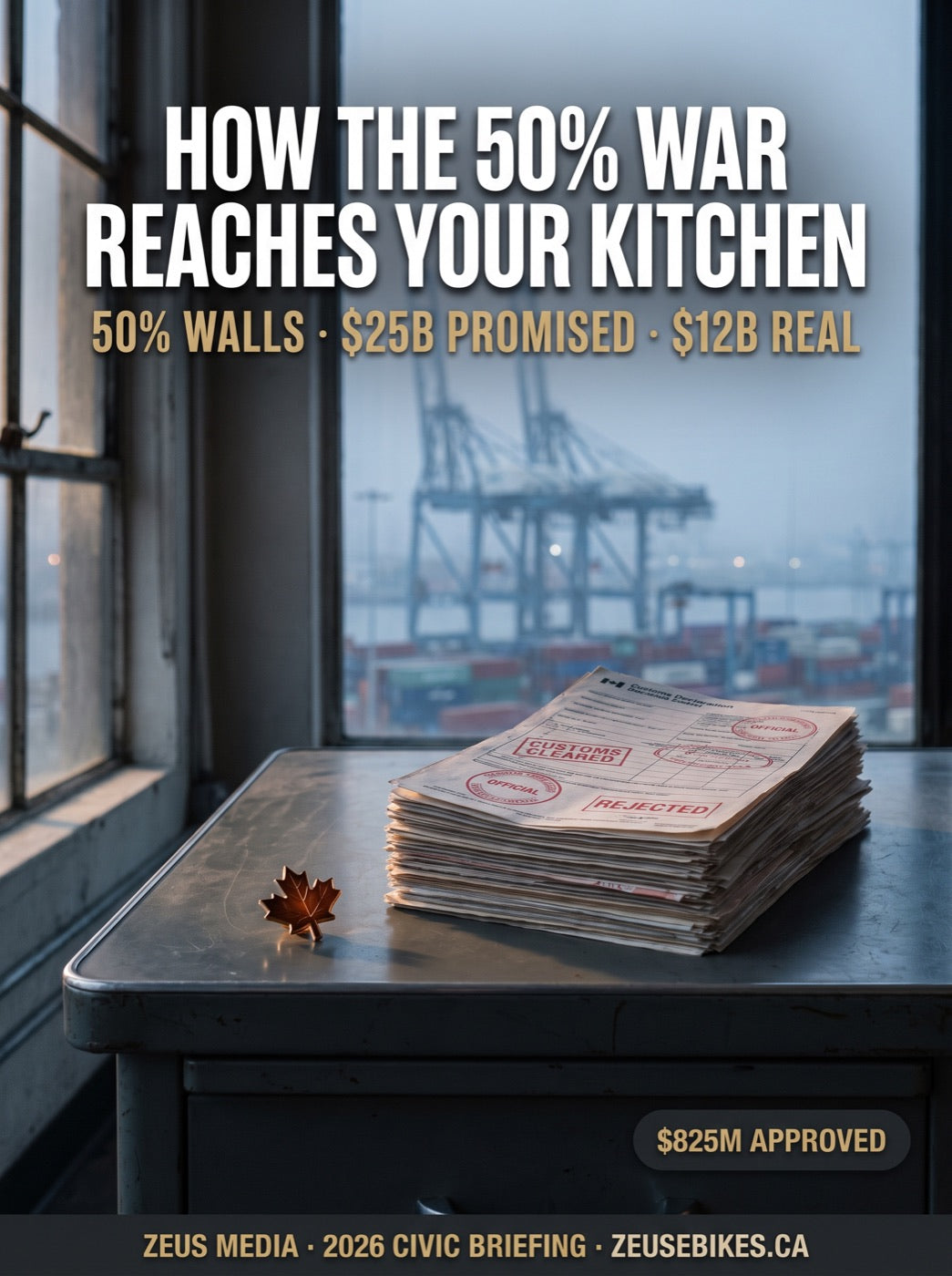
The Prime Minister’s 21 August statement cites “the nearly $25 billion in support provided over the past 18 months,” and Budget 2025 itself carries the official aggregate: “over $25 billion has been announced for supports for workers and businesses, with an expected cost of over $12 billion on an accrual basis over five years.” That gap between the announced figure and the booked cost is the story. More than half the headline is lending and guarantees whose real fiscal cost is a fraction of face value. Our tally of the largest components runs this way. About $18.7 billion is lending- or financing-shaped: the loan facility, EDC’s $5-billion Trade Impact Program, BDC, Farm Credit Canada, and the forestry guarantees topped up to $1.2 billion in November 2025. About $7 billion is program contributions on flexible or unpublished terms: the Strategic Response Fund, which already contains the $1B steel envelope, and the Regional Tariff Response Initiative, grown from $450 million at launch to $1.95 billion across four top-ups. And $3.7 billion is Employment Insurance — looser rules on a program workers and employers already fund. (This is Zeus arithmetic on Budget 2025 plus later announcements; the envelopes overlap and run over different windows, which is why they exceed the headline.) None of it is a new cheque program.
The ledger: announced, booked, approved
Three different numbers describe the same support package. Only one of them is money that has reached a decision.
Budget 2025, Chapter 2 — “over $25 billion has been announced… expected cost of over $12 billion on an accrual basis over five years.” Approved lending from the CEEFC public register, last updated 30 July 2026, retrieved 24 August 2026. Approved is not advanced.
| Program | Envelope | Shape | Window / who |
|---|---|---|---|
| Large Enterprise Tariff Loan | $10.0B | Lending | Firms ~$150M+ Canadian revenue |
| EDC Trade Impact Program | $5.0B | Financing capacity | 2 years |
| Strategic Response Fund | $5.0B | Contributions | 6 years — contains the $1B steel envelope |
| EI temporary measures | $3.7B | Income support | 3 years |
| Regional Tariff Response Initiative | $1.95B | Contributions | Via the regional development agencies |
| BDC tariff lending | $1.5B | Lending | Pivot to Grow plus the 2026 metals program |
| Forestry loan guarantees | ≤$1.2B | Guarantees | After the November 2025 top-up |
| Farm Credit Canada | $1.0B | Lending | Agri-food |
| Steel transition envelope | $1.0B | Contributions | Inside the Strategic Response Fund, not additive |
Budget 2025, Chapter 2 (retrieved 24 August 2026): “over $25 billion has been announced… expected cost of over $12 billion on an accrual basis over five years, starting in 2025-26.” CEEFC, ISED and Finance Canada releases. Envelopes run over several years and overlap; where a program publishes only a maximum, the ceiling is shown. Smaller measures — Work-Sharing, the CRA deferral, retraining and agri programs — are not listed.
Who can actually touch it?
Eligibility does the real sorting. The Large Enterprise Tariff Loan requires roughly $150 million or more in annual Canadian revenue, solvency as of 31 December 2024, and evidence the applicant has already sought financing through traditional market sources. CEEFC is explicit that the facility is for otherwise-viable firms and is “not intended to resolve insolvencies”. The rate floor is of the 10-year Government of Canada bond yield plus 25 basis points, with no minimum loan size (CEEFC). CEEFC publishes every approved loan. Its public register, last updated 30 July 2026 and retrieved 24 August 2026, lists five, totalling $825 million: Algoma Steel $400 million — the facility’s first, announced 29 September 2025 and completed that November within a $500-million package with Ontario; Arctic Canadian Diamond Company (Burgundy Diamond Mines) $175 million; C.A.T. North America $90 million; Millar Western Forest Products, a pulp producer, $100 million; and Gestion Rémabec (Arbec Bois d’œuvre) $60 million. The register publishes amounts approved, not amounts advanced. We found no published figure for funds actually disbursed under the facility, and none for the wider package program by program. BDC’s Pivot to Grow lends up to $5 million to firms with at least $2 million in annual sales and a demonstrated direct or indirect tariff impact — typically with 15%+ US-export exposure — and BDC describes its newer $1 billion envelope as directed at steel and aluminum companies (bdc.ca, retrieved 24 August). The CRA measure was a spring 2025 payment deferral — corporate income tax and GST/HST remittances put off from 2 April to 30 June 2025. Budget 2025 books its fiscal cost at $940 million; the cash it left in businesses' hands was far larger, up to $40 billion in temporary liquidity. Note the distinction: $940 million is what the deferral cost the treasury, not what businesses received to keep. The EI measures run to 10 October 2026: no waiting week on any claim, severance no longer delays benefits, and 20 extra weeks for long-tenured workers — a premium-history test (at least 30% of the maximum annual premium paid in 7 of the last 10 years, with limited recent EI use) with about 190,600 expected beneficiaries for the original measure and 43,500 additional claims under the extension (Canada Gazette SOR/2025-205; ESDC, March 2026).
The eligibility reading worth putting to the department: the published loan-facility criteria require Canadian revenue and “significant operations in Canada or a significant workforce in Canada” — and say nothing about Canadian ownership. On paper, a foreign multinational with large Canadian operations qualifies. That is our reading of the published criteria, and it deserves an official answer from Finance Canada.

Energy, services and CUSMA-compliant seafood cross this line untouched. What is exempt shapes Canada’s position as much as what is taxed.
Takeaway: “over $25 billion announced” is real as an envelope and narrow as a lifeline — the government’s own books expect just over $12 billion in real cost across five years. If you are a laid-off worker, file your EI claim in week one; the waiting-week waiver is live until 10 October 2026. If you run a small business without US-export exposure, assume $0 in non-repayable help from the federal programs built for this, and plan accordingly; the one exception is the Regional Tariff Response Initiative, whose non-repayable contributions are delivered case by case through the regional development agencies. If someone tells you Ottawa “sent $25 billion to Canadians,” the composition above is the correction.
What shape the support actually takes
The announced package is not one thing. Sorted by what a recipient actually receives, it is mostly debt.
Zeus arithmetic on Budget 2025 plus later announcements. Envelopes overlap and run over different windows, which is why they exceed the headline figure. The $1B steel envelope sits inside the Strategic Response Fund and is not added twice.
Is Canada at War with the US?

Youth unemployment sat at 12.6% in July 2026. Nothing tariff-specific names this group.
Not in any legal sense: no state of armed conflict exists, and “war” here is the Prime Minister’s own characterization of an economic attack. What Mark Carney said on Parliament Hill on 22 August, after suspending negotiations, was reported this way by Yahoo News Canada and NPR: “You’re at war when you get attacked. We got attacked.” The line does not appear in the PMO’s published texts. In his written statement the night before, he said Canada “will not return to our old relationship” with the United States. The words matter because they mark the government’s framing shift — from negotiating partner to adversary — and because they anchor the policy that followed: dollar-for-dollar counter-tariffs and a promise of further support measures “in the coming days” (PMO statement, 21 August; press conference reporting, Yahoo News Canada).
If the government’s own language is war language, the civic standard that follows is straightforward. Asking where the announced $25 billion flowed, which programs disbursed what, and whether the 8 September revenue promise is reported monthly is ordinary oversight — the kind Parliament and citizens owe any wartime spending, whatever the war is made of.
How Will Social Media Be Used Against Canada? The Second Front
Through four channels, and three are already in motion: overt commentary from American figures with enormous reach, algorithmic amplification on platforms Canada does not regulate, a news vacuum where Canadian journalism used to be, and — documented this month — covert content networks that no Canadian law currently reaches. Only the last one is illegal. That is the problem this section maps.
The clock on it is specific. On 19 October, Alberta votes on whether to start a process that could end with leaving Canada, and in the four weeks to mid-August, researchers monitoring known foreign state-linked outlets logged 296 online items aimed at that debate (The Globe and Mail, 17–18 August 2026). reported Carry that number with its method attached: the unit is a single online item regardless of reach, counted against watchlists of entities governments have already designated, from reports the researchers have not published. It is a floor, not a census — and the lead researcher’s own caveat is the part to remember: a content-farm post nobody reads and a broadcast that reaches millions each count as one.
The overt channel is legal — by design
The documented American engagement with Canadian division is not spycraft. The foreign-interference report that put Alberta on the national agenda in May says so in its own words: US involvement is “not covert — it is overt” (DisinfoWatch et al., May 2026). It is named figures with vast audiences: the US Treasury Secretary said of Albertans considering separation, “We should let them come down into the U.S.” (BNN Bloomberg, 23 January 2026), the President spent the winter of 2024–25 posting about a “51st state,” and commentators whose single segments out-reach entire Canadian newsrooms treat the referendum as running material. reported None of it is illegal. CSIS’s director said exactly that in May: overt commentary from influencers or officials of any country “doesn’t constitute foreign interference” under the legal definition, which requires conduct that is clandestine, deceptive or threatening (CBC’s The House, 9 May 2026). A democracy cannot criminalize foreigners publicly arguing at it without becoming less of one — which is exactly why the leverage flows through this channel. It works in the open, at scale, and no statute stands in front of it. analysis
The covert playbook exists — read the flags carefully
The covert operations documented against the Alberta debate are, on the public evidence, overwhelmingly linked to Russian networks: fabricated local-news sites, AI-generated content farms, coordinated amplification. No covert American operation against Canada appears anywhere in the public record we could find. analysis The honest statement of the American risk is structural rather than accusatory: the playbook is proven to work on these platforms, and Canadian law’s reach is identical whatever flag runs it — which is to say, thin. Running a covert influence operation against a Canadian political process is an indictable offence carrying up to life imprisonment under the foreign-interference offences Parliament passed in 2024. The gap is not the offence; it is detection. The Hogue Commission’s finding from January 2025 still stands: “No government body has a mandate at present to monitor the Canadian online information environment to identify foreign-based disinformation campaigns” (Final Report, Vol. 5). The same commission called information manipulation, foreign or not, “the single biggest risk to our democracy… an existential threat” (Vol. 1), and recommended a monitoring body. Eighteen months later, it has not been created. verified
The structure is the leverage: the pipes are theirs
Strip away the content question and a harder fact remains: the platforms Canadians argue on are American companies, moderated under American politics, with amplification decisions made in California. Two events make that leverage concrete rather than theoretical. First, Meta ended news availability on Facebook and Instagram in Canada in August 2023 in response to the Online News Act, by its own announcement: content from news outlets “will no longer be available to people accessing our platforms in Canada” (Meta, updated 1 August 2023). In the middle of a trade war, what looks like news in a Canadian feed on those platforms is not coming from a newsroom, and the vacuum does not stay empty. verified Second, the one time platform governance collided with the trade war directly, the trade war won in a weekend: on 29 June 2025 Canada rescinded its digital services tax on large American technology firms — the release’s own title says it plainly, “to advance broader trade negotiations with the United States” — recording that the Prime Minister and the President had agreed talks would resume (Finance Canada, 29 June 2025). Resume, because they had been broken off over that tax. Canada’s authority to regulate the information infrastructure its citizens live on is itself a chip on the trade table, and it has already been played once. verified
The referendum is the live test, and the shield has gaps
Canada’s election-defence machinery — the SITE Task Force and the critical-election-incident protocol — is scoped in its own founding documents to federal elections; neither carries a referendum provision (Global Affairs Canada; Privy Council Office). Alberta’s campaign-finance law bans foreign money from referendum advertising through a residency test, with an enforcement ceiling of $10,000 per contravention — but it expressly exempts “the transmission… on a non-commercial basis on the Internet” of political views, the exact vector the documented operations use, and Elections Alberta itself says it has no substantive mandate against misinformation (Elections Alberta). reported The new federal Foreign Influence Transparency Registry, in force since 4 August, requires an arrangement with a foreign principal before any duty arises — its commissioner’s own guidance excludes “parallel or coincidental actions” and “ideological alignment” (interpretation bulletin) — so a foreign actor posting unilaterally never triggers it. The commissioner said as much on launch day: it is “not going to solve foreign interference in Canada” (CBC News, 4 August 2026). When we checked the public registry on 24 August, twenty days in, it showed zero registrations — filings may exist unpublished, and the deadline for pre-existing arrangements is 3 October — but the shape of the tool is clear. It is a transparency ledger, not a shield. verified

The second front runs through the feed. Meta ended news availability on Facebook and Instagram in Canada in August 2023 — what looks like news there is not coming from a newsroom.
| The conduct | What reaches it |
|---|---|
| A covert foreign operation running fake accounts or content farms | An indictable offence, up to life imprisonment — if it is detected and attributed. No body yet holds the monitoring mandate Hogue recommended |
| Overt commentary by foreign politicians and influencers, however large the reach | Nothing. Lawful by design, and outside the legal definition of interference |
| Foreign money buying referendum advertising in Alberta | Banned through a residency test; the administrative penalty is capped at $10,000 per contravention |
| Foreign accounts posting unpaid “organic” advocacy into the referendum | Expressly exempt from Alberta’s advertising law |
| The platforms’ own amplification choices | No Canadian instrument reaches them — and the adjacent lever Canada tried, the digital services tax, was rescinded in June 2025 to restart the trade talks |
Statutory reach compiled from the Foreign Interference and Security of Information Act (2024 offences), the CSIS Act definition of threats, Alberta’s Election Finances and Contributions Disclosure Act (Part 6.12), the Foreign Influence Transparency and Accountability Act and its commissioner’s interpretation bulletins, and Finance Canada’s 29 June 2025 release. Retrieved 24–25 August 2026.
What would actually work
Not a blackout. Blocking American platforms or speech eight weeks before a vote would hand the operation its best narrative, and the expert record warns that restriction tends to boomerang — “driving more influence operations underground and making them more difficult to detect” (Wesley Wark, May 2024). reported The Hogue Commission’s diagnosis of 2019–2021 was never that Canada lacked powers to restrict; it was delays, poor coordination and flawed communication. And any new machinery must survive the civil-liberties objection on its face — a historian of Canada’s 1940s registrations warned that a registry of enemy agents is “dangerous territory”, and the internment record is why (The Conversation, April 2023). The workable list is unglamorous: build the open-source monitoring body Hogue recommended eighteen months ago; extend election-integrity support to provincial votes the way Australia’s federal taskforce already assists its state electoral commissions (a contrast Canada’s own G7 Rapid Response Mechanism report records); publish attributions quickly, as Ottawa did before Moldova’s 2025 election and has not done for Alberta’s; and hold to the rule the wartime-leaders section documents in Mackenzie King’s Quebec playbook — refuse the confrontation that makes the grievance the story. analysis
The strongest counter is the one no statute can supply. Five habits, for the eight weeks ahead:
- Treat “news” on Facebook and Instagram as unverified by default. News-outlet links are not available in Canada on those platforms; what fills the space is built to look like journalism without being any.
- Before sharing anything about the referendum or the trade war, find the original. A real outlet has a masthead, named reporters and a street address. A content farm has none of the three.
- Reverse-search the shocking local story. The documented networks specialize in fabricated local news, and a ten-second image search usually breaks them.
- Slow down on anything engineered to make you furious. Outrage is the amplification strategy; sharing angrily does the operation’s distribution for free.
- Report what looks coordinated. Suspected foreign interference can be reported to CSIS through its national-security reporting channels; suspected unregistered foreign-influence arrangements go to the Foreign Influence Transparency Commissioner.
The second front, summarized: the covert lane is illegal but under-watched, the overt lane is legal by design, and the pipes belong to the other side of the negotiating table. The strongest defence is distributed across 41 million people — a citizen who checks before sharing is doing counter-intelligence work no agency can do at scale. The audit demand that runs through this guide applies here too: Hogue’s monitoring body was recommended in January 2025. Ask your MP why it does not exist yet.
What Can Canadians Do About Tariffs?

Schools sit in the same category: no tariff exposure, and no line in the support package.
Ranked by evidence, not sentiment. Two of these behaviours have already moved measurable money; the rest are reasoned actions built on verified program facts. Each entry says which it is.
1. Keep travel dollars in Canada — the strongest measured lever
Canadians changed this behaviour at historic scale: trips to the US fell 25% across 2025, bottoming about a third below prior-year levels at the July 2025 trough — the deepest sustained drop outside the pandemic — and University of Toronto mobility data shows a 42% fall in visits to US metro areas over the following twelve months. RBC Economics tracks that spending rebalancing to Canadian operators (domestic tourism spending +2.7% in 2025; dining and accommodation +5.6%). Every rebooked trip is a direct transfer into the domestic hospitality economy.
2. Substitute at the shelf — measured, where the price gap is small
Scanner data at major grocers showed US-sourced product volumes falling by double digits from March 2025 (Retail Insider); Loblaw’s chief executive has said shoppers drift back to cheaper US goods (Globe and Mail). Substitution is proven where the premium is small, and alcohol polls strongest — 74% of Canadians tell Nanos they would keep avoiding US alcohol even if it returned to shelves. Sustaining the shift is the actual fight.
3. Buy from Canadian businesses, not Canadian-looking websites
A .ca domain and CAD prices prove nothing about where a company lives. Before counting a purchase as buying Canadian, check five things: a Canadian corporate address, a GST number, whose time zone the support line keeps, who answers the phone, and — the one most guides leave out — where the product itself is made. The first four measure where a business lives. The fifth measures where the goods come from, and those are different questions: most Canadian retailers, this one included, sell imported goods. Buying from a Canadian business keeps the margin, the jobs and the warranty here; it does not make an imported product domestic. Decide which of those you are buying, and say so honestly to yourself. Disclosure: this guide’s publisher, Zeus eBikes Canada, is a Canadian retailer of largely Asian-built bicycles and has a commercial interest in that answer — read the advice knowing it.
4. If you are laid off, file for EI in week one — verified program, live deadline
The tariff measures run until 10 October 2026: no waiting week on any claim, severance no longer delays benefits, and long-tenured workers get 20 extra weeks. EI pays 55% of insurable earnings to a maximum of $729 a week — gross and taxable, with tax deducted at source, so budget the net. Families with a net income at or below $25,921 who receive the Canada Child Benefit may qualify for the family supplement, which can lift the rate as high as 80%. The Canada Gazette estimated about 190,600 beneficiaries when the measure was introduced; ESDC's own estimate for this extension is 43,500 additional claims — if you qualify, claim it; don’t find out afterward that you could have. Check current rules and apply at canada.ca.
5. Trade and hire across provinces — the federal barriers just fell
The One Canadian Economy Act’s Free Trade and Labour Mobility in Canada Act came into force on 1 January 2026, removing all 53 federal exceptions under the Canadian Free Trade Agreement; provincial exceptions remain, and mutual-recognition work continues. The Government of Canada’s own estimate puts full internal liberalization at up to $200 billion in added output over time. Sourcing and hiring interprovincially is materially easier than it was a year ago.
6. Ask your MP for the disbursement numbers — reasoned, and overdue
CEEFC’s public register lists five approved loans totalling $825 million against a $10-billion facility, and approval is not advance. Asking your MP how much of the announced $25 billion has actually been disbursed, program by program, is ordinary oversight of a war budget.
What Should the Government Do Next?

Clinics have no line in the package — but goods imported for medically necessary care can claim surtax remission through CBSA.
Each recommendation below is anchored to a verified fact from this guide; the prescriptions themselves are our analysis, offered the way a citizen offers them.
| The anchor (verified) | The gap it points to (analysis) |
|---|---|
| CEEFC publishes approved LETL loans (five, $825M as of 30 July 2026) but not amounts advanced, and no program-by-program disbursement reporting exists across the wider package | Publish a monthly disbursement dashboard — committed and disbursed, by program and sector. Announced envelopes are not delivered support |
| Small firms have no dedicated non-repayable federal program; the RTRI is the exception, case by case | Open a receipt-verified grant lane for demonstrably tariff-hit small businesses too small for the loan facility and too indebted for more debt |
| Food inflation has run above headline for eighteen straight months, though it has decelerated since May | Keep counter-tariffs off the dinner table. The announced sectors are mostly not grocery aisles, though dairy is among them — hold that line when the itemized list is published |
| $3B collected of a $20B revenue estimate, before most counter-tariffs were dropped — and the revenue pledge has not been repeated for the new round | Attach the pledge explicitly this time, and report collections against disbursements monthly. The 2025 pledge died partly for lack of exactly that reporting |
| The package’s package contains no healthcare allocation we could find, while procurement costs ride the counter-lists | Shield public services with a war-cost top-up to provincial transfers, sized to measured procurement inflation |
| The energy exemption stands; the CUSMA review window is open; internal trade reform has momentum | Play the slow levers, hold the fast one. Finish mutual recognition and trucking, use the review, diversify — and keep the energy lever visibly in reserve, where its power costs nothing |

Ottawa has announced more than $25 billion. Budget 2025 books its expected cost at just over $12 billion on an accrual basis.
How Would History's Great Wartime Leaders Play This Hand?
Four leaders held a version of the job Carney holds now: head of government of a smaller power, in a fight it did not choose, against or alongside a stronger country it could not afford to lose. Their reputations are not why they are here — their positions are. Where standing matters at all, it is in the record: King placed first among long-serving prime ministers in Maclean's 2016 survey of 123 historians and political scientists, and Churchill, de Gaulle and Roosevelt hold comparable places in the British, French and American surveys cited in the sources. Below, each leader's documented wartime move, what it maps to on 24 August 2026, and what it would cost.
How to read the per-100 numbers. They are arithmetic from published denominators, shown so you can check them. Canada: 21,215,000 people were employed in July 2026 (Statistics Canada), and production for export to the United States accounted for more than 2.5 million jobs and 15.9% of GDP in 2024 — roughly 12 of every 100 Canadian workers. That 12 is the size of the relationship, not the size of the wound: energy, services and CUSMA-compliant seafood sit inside the count and outside the walls, as the industries table sets out. The exposed share is a subset of the 12, and no published figure isolates it. In manufacturing the ratio is far higher: US demand accounted for 694,000 jobs, 41.0% of manufacturing payroll jobs, and in autos specifically 76.4%. The American side has no equivalent current figure — published estimates of US jobs tied to Canadian trade range from about 1.4 million to nearly 9 million depending on method — and the two ends are years apart: the 1.4 million counts jobs supported by US exports to Canada on 2023 data (International Trade Administration), while the ~9 million comes from a 2014 study modelling the total cessation of Canada-US trade on 2013 data. unverified for 2026 Where the US column below needs a denominator, it uses the one solid current fact: Canada is the number-one export market for 26 of the 50 states and a top-three market for 45 (Prime Minister's Office, 22 August 2026, on 2025 data). That count has fallen steadily — 36 states on 2023 data, 32 on 2024 — which is itself a measure of what the tariffs have already done. Anything modelled is labelled as a projection, never as a measurement.
Mackenzie King: make them need your capacity
What he actually did. Twice, in eight months, King converted Canadian weakness into American dependence. At Ogdensburg, New York on 17–18 August 1940, he and Roosevelt agreed to create the Permanent Joint Board on Defence — continental defence stopped being a favour and became a shared project. Then came the real crisis: Canada was arming Britain on credit, earning no US dollars, and the March 1941 Lend-Lease Act threatened to divert British orders away from Canadian factories to American ones. King went to Roosevelt's estate and secured the Hyde Park Declaration of 20 April 1941, under which the United States agreed to buy roughly $200–300 million of war supplies in Canada, and Britain obtained Canadian-bound component parts under Lend-Lease and forwarded them north. Canada's dollar crisis resolved not by concession but by becoming indispensable to American production.
The 2026 move. Stop arguing about the tariff and start negotiating the supply chain. Identify what American industry cannot presently build without Canada — aluminum for their own defence plants, uranium, potash, the 63.4% of its crude oil imports that Canada supplies — and offer a production-integration agreement that makes cutting Canada off cost Washington more than the tariff earns. King's insight was that the strong party will not remove a wall to be fair; it will remove a wall to get something it needs.
| Step | Effect per 100 Canadian workers | Effect on the US side | Cost to Canada | Time to bite |
|---|---|---|---|---|
| 1. Publish the dependency audit — every input American industry cannot replace within 24 months | 0 immediately; it is preparation, not action | Names the constituencies that will lobby Washington on Canada's behalf | Analytical cost only | Weeks |
| 2. Offer integrated production in the exempt sectors, not tariff relief in the walled ones | Widens the untariffed share of the ~12 in 100 whose work is US-bound | Delivers materials to US manufacturers now paying more for them | Locks in deeper integration — the dependence Canada says it wants to reduce | Months |
| 3. Tie it to a defence-procurement board, as Ogdensburg did | Indirect; sustains industrial employment outside the tariff walls | Engages the one Washington constituency that outranks trade politics | Sovereignty questions in procurement | 1–2 years |
King's lesson: he never won an argument about fairness, and never tried to. He changed what the stronger country needed. That is the only one of these four playbooks Canada has already run successfully against this exact counterpart.
Churchill: refuse the frame, then widen the room
What he actually did. Between 25 and 28 May 1940, with France collapsing and the army trapped at Dunkirk, Foreign Secretary Lord Halifax pressed the War Cabinet to explore peace terms brokered by Mussolini. Churchill opposed it — then, rather than keep fighting a five-man committee he might lose, he took the question to the 25-member Outer Cabinet and won the room outright. Nine months later, on 9 February 1941, he went over the head of every negotiator and spoke directly to the American public: “Give us the tools, and we will finish the job.” Roosevelt's Lend-Lease bill cleared the Senate on 8 March and was signed on 11 March 1941. Churchill also understood barter: in September 1940 he traded 99-year leases on British bases for 50 American destroyers — giving up something permanent to get something urgent.
The 2026 move. Canada has already done the first half: talks are suspended, the frame is refused. The unplayed half is the February 1941 move — a direct, sustained appeal to Americans in the 26 states where Canada is still the number-one export market, addressed not to the White House but to the governors, senators and workers who lose when the wall goes up.
| Step | Effect per 100 Canadian workers | Effect on the US side | Cost to Canada | Time to bite |
|---|---|---|---|---|
| 1. Hold the refusal — no return to the table on terms already rejected | Protects nothing today; prevents a worse deal being locked in | Removes the expectation that pressure produces concessions | The 12 in 100 stay exposed while the wall stands | Immediate, and open-ended |
| 2. Take the case to the American public and the states, not the administration | 0 direct effect on Canadian jobs | Aimed at the 26 states for which Canada is still the top export market — the widest available room | Diplomatic friction; risks being read as interference | Months; it works on a political calendar, not a trade one |
| 3. Barter something permanent for something urgent, as destroyers-for-bases did | Depends entirely on what is traded — and some Canadian assets cannot be traded back | Gives Washington a win it can announce | Potentially the largest cost on this page | Fast, if it happens at all |
de Gaulle: legitimacy is manufactured, not granted
What he actually did. De Gaulle spent the war leading from London with almost no material power, excluded by Roosevelt from Allied decisions affecting France — he was summoned from Algiers on 2 June 1944 and not told of the Normandy landings until Churchill briefed him in person on 4 June — two days out, with the invasion fleet already loading. He responded by behaving as the legitimate government of France until the fact became undeniable, refusing every arrangement that would have let the Allies administer liberated France over his head.
The 2026 move. The de Gaulle play is about the negotiation Canada is not in the room for: the CUSMA review. Build the alternative structures — European and Indo-Pacific trade depth, a diversified defence relationship, domestic capacity in the sectors currently walled — so that being excluded costs the excluder rather than the excluded. His discipline was refusing to be traded away by allies who found him inconvenient, which is a live risk in any three-country review.
Roosevelt: the mirror
What he actually did. FDR gave King the Hyde Park Declaration and Churchill the destroyers and Lend-Lease — but never out of sentiment. Each time, he took something home: bases in the Caribbean and Newfoundland, a war production system that ran through American industry, and a domestic political story he could sell to a country that did not want the war. He excluded de Gaulle precisely because de Gaulle offered him nothing he needed.
Why he belongs on this list. Every move above only works if the person on the other side of the table can announce a win. The three successful plays in this section — Ogdensburg, Hyde Park, destroyers-for-bases — were all structured so Washington got something concrete and visible. The failed relationship, de Gaulle's, is the one where nothing was on offer. That is the design constraint on any Canadian move from here.
What the four have in common, and what none of them offers. Not one of these leaders won by conceding, and not one won quickly. King took eight months from Ogdensburg to Hyde Park; Churchill took nine from the Outer Cabinet to Lend-Lease. Each of them changed what the stronger country needed rather than what it felt, then let it act on its own interest. What the record offers is a method with a known clock: refuse the bad frame, widen the room, build the dependency, and give the other side a win it can announce. It works in months to years, and King's version has worked against this exact counterpart before. None of the four faced a tariff wall, so none of them supplies a move that takes these tariffs to zero — and no Canadian government can honestly promise one. analysis
What to Do Right Now: Step-by-Step

Apply in the first week. Service Canada’s own warning is that filing more than four weeks after your last day can cost you benefits.
Four situations, four checklists, every step taken from the program's own published requirements as of 24 August 2026. Programs change — verify current rules at the source before you act, and treat this as a map rather than advice about your particular case.
If you have been laid off: file for EI this week
The four-week trap. Service Canada's own instruction: "If you apply for Employment Insurance more than 4 weeks after your last day of work, you may lose benefits." Do not wait for your Record of Employment — you can send documents after you apply. Waiting is the single most common self-inflicted loss in this system.
- Apply immediately, online. The application takes about an hour. Your progress is saved for 72 hours; miss that window and you start over.
- Have these ready before you start: your Social Insurance Number (if it begins with 9, proof of immigration status and work permit); the last name at birth of one of your parents; your mailing and residential addresses with postal codes; your banking information for direct deposit — institution name, branch/transit number and account number; the names, addresses, employment dates and reason for separation for every employer in the last 52 weeks; and the dates and earnings of your highest-paid weeks of insurable earnings in that period, which set your benefit rate.
- If you quit or were dismissed from any job in the last 52 weeks, you will need to give your own detailed version of the facts. Write it out before you start the form.
- Sign up for direct deposit inside the application — payments land two business days after processing.
- Know what the tariff measures give you — you do not have to ask for it. Until 10 October 2026 there is no one-week waiting period on any claim, and severance no longer delays or reduces benefits. If you are long-tenured — you paid at least 30% of the annual maximum EI premium in 7 of the 10 years before your claim starts, with limited recent EI use — you get 20 additional weeks, and Service Canada states they “will be automatically added to your claim.” Regular benefits are capped at 65 weeks in total. The Canada Gazette estimated about 190,600 long-tenured beneficiaries for the original measure; ESDC’s estimate for this extension is 43,500 additional claims.
- Submit a report every two weeks, or you are not paid. This is the step people miss. Service Canada: “You’ll have to submit reports to Service Canada every 2 weeks for as long as you receive benefits,” and payments issue only after those reports are processed. Failure to file can mean a loss of benefits.
- Watch the mail for your access code. A benefit statement is mailed to you shortly after you apply, carrying a four-digit access code. You need it plus your SIN to file those reports. If you have moved, couch-surfed, or given a temporary address, fix that now — the code does not arrive by email.
- Expect a decision in about four weeks, and budget for it. Service Canada’s published standard is a decision within 28 days of filing, met 80% of the time. Plan your rent and groceries around that gap rather than around your last pay date.
- Set up My Service Canada Account and check for your ROE there. Your employer should issue the Record of Employment within 5 calendar days after your final pay period; if it has not appeared, contact Service Canada rather than waiting. MSCA is also where you see your claim status and benefit rate. Keep looking for work and keep a written record of employers contacted — it is a condition of continuing eligibility.
- If you are refused, you have 30 days. A decision can be challenged through a Request for Reconsideration, and the deadline is 30 days from when the decision was communicated to you. Missing it is how a wrong refusal becomes final.
- Ask about retraining through the Workforce Tariff Response stream delivered under Labour Market Development Agreements, which funds skills training for workers displaced by tariffs.
If you are an employer facing layoffs: Work-Sharing before you cut
Work-Sharing lets you keep staff on reduced hours while EI tops up their income, instead of laying them off and losing them. If your decline is tariff-related, do not judge yourself against the standard rules — the tariff special measures relax almost every gate, and they run to 31 March 2027. The costliest thing to get wrong is timing: your start date must be a Sunday, at least 10 business days after you submit, and ESDC states plainly that “retroactive start dates aren’t possible” (ESDC, How to apply, retrieved 24 August 2026).
| Test | Standard rule | Under the tariff special measures |
|---|---|---|
| Time in operation | Year-round in Canada for at least 2 years | Operating in Canada for a minimum of 1 year |
| Decline in work activity | At least 10% over the last six months | Open to employers with a decrease of less than 10% |
| Hours reduction | Between 10% and 60%, averaged | Utilization may exceed 60% |
| Maximum duration | 38 weeks (26 plus a 12-week extension) | Up to 76 weeks |
| Cooling-off period | Mandatory, equal to the weeks used, up to 38 | Waived while the measures are in place — and firms currently serving one may still apply |
| Non-profits and charities | A drop in grants, donations or investment income alone does not qualify | Eligible where the revenue decline is a direct or indirect result of the tariffs |
| Seasonal and cyclical employers | A cyclical or seasonal slowdown is a ground for refusal | Expressly included — as are seasonal and cyclical employees |
| Minimum unit | 2 employees | 2 EI-eligible employees, plus employees assisting recovery efforts |
| Recovery measures | Must be “measurable, quantifiable and verifiable” | Refocused on maintaining the business’s viability against the threat or realization of tariffs |
Source: ESDC, Work-Sharing Program — Special measures: Tariffs, and Who is eligible. Both retrieved 24 August 2026. Measures extended from 6 March 2026 to 31 March 2027; originally in effect 7 March 2025 to 6 March 2026.
- Check yourself against the right column, not the left. If your decline is attributable to the threat or realization of tariffs, the relaxed tests apply. Two gates still bind: you need a genuine decrease in work available for employees — ESDC is explicit that this “cannot be limited to financial factors such as sales or revenues” and asks how many hours of work were lost — and public sector employers and crown corporations remain ineligible.
- You are not too late if you have already cut. ESDC states that core staff recently laid off may be included in the Work-Sharing unit, and that you should include employees who will immediately be called back. A recent layoff does not close this door.
- Know who cannot be in the unit. Casual and on-call staff, temp-agency workers, co-op students, the self-employed, anyone holding more than 40% of voting shares, and the people needed to generate work — senior management, product development, marketing and sales agents. Exclude anyone on long-term leave.
- Ask for the special measures explicitly — they are not automatic. Indicate them under type of application, then set out what you are requesting at question 24 of form EMP5100, the question describing the events that reduced your business activity. Supplying your NAICS code helps ESDC judge whether your sector falls inside the measures.
- Open your GCOS account before you need it. Grants and Contributions Online Services requires identity verification and your CRA payroll (RP) number, and ESDC warns to create the account “as early as possible to avoid delays.” Against a Sunday start ten business days out, that lead time is the whole game. If you file through GCOS you do not need to attach the RP document; you do if you file by email or mail.
- Submit, then confirm you actually submitted. Send EMP5100 and EMP5101 (Attachment A, one per unit). ESDC’s own warning: if you don’t get a tracking number or an acknowledgement email, your application wasn’t submitted. Extensions need their paperwork at least four weeks before the current end date.
- Get agreement in writing from the employees in the affected unit — and the union, if there is one. The application is made jointly by employer, employee representative and union representative.
- Look at the Worker Retention Grant. Employers with an approved and implemented Work-Sharing agreement who commit to training can top up participating employees’ income toward normal wages while they train outside working hours. The application window runs to 31 December 2026, 3 p.m. EST.
- Ask the people who administer it. ESDC publishes an address for exactly this question: the Work-Sharing Employer Inquiry Unit, edsc.dgop.tp.rep-res.ws.pob.esdc@servicecanada.gc.ca. Put your situation in writing and keep the reply.
The measures are the point. As of 14 March 2026, roughly 1,500 Work-Sharing applications had been approved for tariff-affected businesses since the start of 2025, covering over 54,000 workers and preventing an estimated 20,000 layoffs (ESDC, 20 March 2026). That is the largest measurable job-preservation result anywhere in this package — and it is the one program in it that is neither a loan nor a cheque.
If your inputs are hit by Canada's counter-tariffs: request remission
Check the standing order first — many readers never need to apply for anything. There are two routes, and the checklist below describes the harder one. The United States Surtax Remission Order (2025) already grants relief, by rule, for whole categories of goods: inputs used in Canadian manufacturing, processing and food or beverage packaging; the production of any agricultural product; and goods imported “for use in the provision of medically necessary health care services” — expressly including at a hospital, a health care or dental clinic, a medical, dental or diagnostic laboratory, or a long-term care facility. If your goods are covered you claim through CBSA at the border or as a refund, with no application to Finance Canada at all. Two dates govern it: the goods must generally be imported before 1 July 2027, and the importer must claim within two years after the date of importation. CBSA’s Duties Relief and Drawback programs are also available for surtax paid. Start at CBSA Customs Notice 25-19 (retrieved 24 August 2026), not at the email address below.
If the standing order does not reach your goods, the case-by-case route is next. Remission here is relief from Canada's own counter-tariffs, granted by Order in Council under section 115 of the Customs Tariff. Only companies registered in Canada may apply. Requests go to remissions-remises@fin.gc.ca with "U.S. Remission" in the subject line, and are assessed by the Department of Finance with recommendations to the Minister.
- Confirm you fit one of the two grounds: either the goods are inputs that cannot be sourced domestically — nationally or regionally — or reasonably from non-US suppliers; or your case presents other exceptional circumstances that could have severe adverse impacts on the Canadian economy — the published test is economy-wide, not hardship to your own firm. The government states plainly that remission is an exception, granted only in compelling cases.
- Build the sourcing evidence before anything else. It is the most demanding item on the template, and the one the department sets out in the most detail. You must show you tried: request-for-proposal notices, the names of every company canvassed, and copies of their replies. If contracts prevent you switching suppliers, include the contracts.
- Assemble the company file: 15-digit business number, corporate structure, all locations, employee count.
- Describe the goods precisely: full description plus the 8-digit tariff item (10-digit statistical level if applicable), and the annual volume and value excluding surtaxes. If you have already imported, attach the customs documentation (B3 forms) and invoices showing tariffs paid.
- Show the economics: for manufacturing inputs, the per-unit cost of the end product broken into the goods under request, other imported articles, Canadian materials, labour, overhead, and administrative and selling expenses — plus the unit selling price and what remission would do to it.
- State the stakes and the competition: the effect on employment, production, investment; the names and locations of your Canadian competitors and how relief would affect them; whether your sourcing problem is temporary or permanent.
- Include your consent to share non-confidential information with domestic producers for validation, mark confidential material clearly, and file one request even if several programs might apply — say so, and provide the information each framework requires.
If you run a small business the programs were not built for
- Test yourself against the real thresholds before spending time applying. The Large Enterprise Tariff Loan needs roughly $150 million in annual Canadian revenue. BDC's Pivot to Grow lends up to $5 million, but the gates are real: at least $2 million in annual sales, a total BDC commitment above $350,000, headquarters in Canada, positive cash flow and demonstrated profitability, and prior viability. The impact test is either/or — 15%+ of sales exported to the US, or a demonstrated likelihood of adverse effect. Available until 31 March 2027 or until the $400-million envelope is used.
- Go regional if you are below those floors. The Regional Tariff Response Initiative — now $1.95 billion, delivered by the regional development agencies — is the door most likely to open for a smaller firm, and it explicitly includes increased non-repayable contributions for eligible businesses. Terms vary by agency and project, so ask yours what is repayable before you accept anything.
- Document your tariff impact now, whether or not you apply today. Every one of these programs turns on proving a tariff link: keep invoices showing duty paid, supplier price-increase notices, lost-order correspondence and month-over-month margin changes. Businesses that start the file after they need it lose weeks.
- Use the free help before the paid help. The Trade Commissioner Service provides export support and market diversification assistance at no charge.
- Check the counter-tariff list against your own purchase orders before 8 September — steel, dairy, appliances, agricultural equipment, pulp and paper and electronics. If you buy any of those from the United States, your landed costs change that day, and pre-buying or re-sourcing is a decision for this week.
The pattern across all four checklists: the programs reward whoever documents earliest. EI punishes a four-week delay, Work-Sharing needs six months of business-activity evidence, and remission turns on proof you already tried to source elsewhere. Whatever your situation, the file you start today is the one that qualifies you later.
Frequently Asked Questions
What products are included in the 50% tariffs on Canada?
The Section 338 proclamations put 50% tariffs on roughly US$20 billion of Canadian goods, effective 22 August 2026, regardless of CUSMA compliance: alcohol and beer, dairy-linked goods, hockey equipment, building materials, cement and clothing. Vehicles are not on the Section 338 list — they are already inside Section 232. Separate Section 232 tariffs cover steel and aluminum (50%), semi-finished copper (50%), non-CUSMA vehicles (25%), softwood (10% plus duties) and narrow semiconductor categories (25%).
What is Section 338 and why does it matter?
Section 338 of the US Tariff Act of 1930 lets a president impose duties of up to 50% on goods from a country found to discriminate against US commerce; it had never been used this way before July 2026. It matters because it applies even to CUSMA-compliant goods, 50% is the statute’s ceiling, and it does not stack on goods already under Section 232.
How much money has Canada collected from counter-tariffs?
Just over $3 billion, per Finance Department figures reported by CBC News — a figure that excludes amounts collected and then returned to industry through remission — against a spring 2025 platform estimate of $20 billion for the fiscal year. Most counter-tariffs were dropped in September 2025. The new dollar-for-dollar counter-round takes effect 8 September 2026, accompanied by the $25-billion support package rather than a repeated revenue pledge.
What support can laid-off workers get during the tariff war?
Three temporary EI measures run until 10 October 2026: the one-week waiting period is waived on all claims, severance no longer delays benefits, and long-tenured workers receive 20 extra weeks of regular benefits. EI pays 55% of insurable earnings to a maximum of $729 per week in 2026, and the Canada Gazette impact analysis estimated about 190,600 long-tenured beneficiaries for the original measure, and ESDC estimates 43,500 additional claims under this extension.
How will tariffs affect Canadian farmers?
From both walls at once. Dairy supply management is the named grievance behind the American Section 338 tariffs, while Canada’s own 8 September counter-tariffs add duties to US agricultural equipment, raising machinery costs; the steel-input remission narrowed on 1 February 2026, though the Schedule 1 branch runs to 1 July 2027. The dedicated support is Farm Credit Canada’s $1 billion in lending and deferrals. It is financing.
What do tariffs mean for Canadian grocery bills?
Food purchased from stores rose 3.1% year over year in July 2026 — the eighteenth consecutive month above headline inflation, though decelerating from 4.3% in May and 3.9% in June. Statistics Canada ties May's 45.2% tomato spike partly to Mexican supply contractions that followed US tariffs. The sectors announced for 8 September are mostly not grocery aisles — appliances, electronics, equipment — though dairy is among them. The itemized list has not been published yet.
Is Canada still exporting energy to the US tariff-free?
Yes. CUSMA-qualifying Canadian oil, natural gas and electricity enter the United States at 0%, and energy is not among the Section 338 targets. Canada supplied 63.4% of US crude oil imports in 2025, which is why energy is often described as Canada’s largest unused lever.
How soon do I have to apply for EI after being laid off?
Right away. Service Canada warns that if you apply more than four weeks after your last day of work, you may lose benefits. Do not wait for your Record of Employment — you can submit supporting documents after applying. The online application takes about an hour, and your progress is saved for only 72 hours. Until 10 October 2026 there is no one-week waiting period on any claim and severance no longer delays benefits.
What can a Canadian business do about tariff costs right now?
Three things, in order. If your inputs are hit by Canada's counter-tariffs and you cannot source them domestically or from non-US suppliers, request remission from the Department of Finance at remissions-remises@fin.gc.ca — building your sourcing evidence first, since that is where requests fail. If you are facing layoffs, apply for Work-Sharing before cutting staff; the tariff special measures run to 31 March 2027. And document your tariff impact now — duty-paid invoices, supplier price notices, lost orders — because every support program turns on proving that link.
Are eBikes affected by the Canada–US tariffs?
Largely no on the import side: most eBikes sold in Canada are built in Asia, enter Canada at 0% duty, and are not on Canada’s announced counter-tariff lists. The meaningful effects are indirect — consumer prices, exchange rates and shipping. Our separate guide to eBike tariffs and prices in Canada covers the details.
Is the United States running a disinformation campaign against Canada?
No covert American operation against Canada is documented in the public record. What is documented is overt: named American politicians and media figures with enormous audiences amplifying Canadian division — which CSIS’s director notes does not meet the legal definition of foreign interference. The covert operations documented against the Alberta debate are Russian-linked. Canada’s exposure is structural: the law reaches neither lawful foreign commentary nor the American-owned platforms that amplify it.
The Bottom Line
Some Canadians are behind the walls and some are in front of them, and nearly everyone pays for both. The walled industries — metals, autos, forestry — are taking it directly: halved exports, idled plants, curtailed mills. Most Canadians never go near an export dock and pay anyway, through the grocery bill and the public purse, with no line in a support package that, read item by item, is a lending shelf with an EI valve rather than a rescue. The most useful things you can do this month are specific: keep travel and shelf dollars domestic where the premium is small, verify that “Canadian” sellers are Canadian, file EI in week one if the war takes your job, and ask your MP how much of the announced $25 billion has actually been disbursed, program by program. The war is real enough that the Prime Minister named it one. Wars get audited — this guide is a citizen’s audit, and it will be updated as the numbers move.
Keep reading the record: why Canada dropped its retaliatory tariffs · the trade-war playbook · How to Negotiate with the USA — the satirical comic
Milad Ghobadibeygvand, BScN (Western University, 2014), is the co-founder of Zeus eBikes Canada.
Visuals created by Playcut.ai
Sources
- Statement by the Prime Minister on Canada-U.S. trade negotiations, PMO, 21 August 2026 — “nearly $25 billion in support provided over the past 18 months,” verbatim.
- Prime Minister Carney delivers remarks on Canada-U.S. trade negotiations, PMO, 22 August 2026 — dollar-for-dollar commitment; counter-tariff sector list; “Tuesday after Labour Day.”
- “You’re at war when you get attacked,” Carney says after trade talks collapse, Yahoo News Canada, 22 August 2026; corroborated by NPR, 22 August 2026. The quotation is press-verified from the Parliament Hill press conference; it does not appear in the PMO’s published texts.
- Budget 2025, Chapter 2 — the official aggregate: “over $25 billion has been announced for supports for workers and businesses, with an expected cost of over $12 billion on an accrual basis over five years.” Component figures: EI measures $3.7B/3yr; Strategic Response Fund $5B/6yr; EDC Trade Impact Program $5B/2yr; steel transition envelope $1B (announced July 2025 via the Strategic Innovation Fund, later carried under the SRF); forestry loan guarantees up to $700M/2yr; LETL $10B; CRA deferral $940M in fiscal cost. Fetched 24 August 2026.
- CDEV/CEEFC — Algoma Steel: the first LETL loan, $400M federal (announced 29 September 2025, completed 17 November 2025), within a $500M package with Ontario; corroborated by CBC News and Algoma Steel.
- ESDC news release, March 2026 — the three EI measures extended to 10 October 2026 (primary for the extension).
- Program figures updated since Budget 2025: the Regional Tariff Response Initiative now stands at $1.95 billion — $450M at launch (March 2025), raised to $1B (5 September 2025), plus $500M (4 May 2026), $300M for the forest sector (3 June 2026) and $150M for the food system (11 June 2026) — per PacifiCan, 10 August 2026; note the national ISED RTRI page still shows the older $1B figure. Forestry loan guarantees rose from $700M (5 August 2025) to $1.2 billion with a $500M top-up announced 26 November 2025 — after Budget 2025 was tabled — and confirmed by Natural Resources Canada, 15 December 2025. The CRA deferral's $940M is a fiscal cost; the liquidity it provided businesses was up to $40 billion.
- CEEFC — Large Enterprise Tariff Loan overview and factsheet — ~$150M revenue threshold; “significant operations in Canada or a significant workforce in Canada”; solvency and last-resort terms; rate floor. Fetched 24 August 2026.
- BDC — Pivot to Grow — current criteria: direct or indirect tariff impact, minimum $2M annual sales, loans to $5M. Retrieved 24 August 2026.
- Canada Gazette, SOR/2025-205 — EI measures; long-tenured definition; ~190,600 expected beneficiaries.
- Canada Gazette, SOR/2026-64 (P.C. 2026-301, registered 30 March 2026) — the instrument that set the 10 October 2026 end date and whose impact analysis carries the 43,500 figure. Note SOR/2025-205, cited above, ends at 11 April 2026; SOR/2026-64 supersedes it. Summarized by Hicks Morley.
- ESDC — 2026 maximum insurable earnings — 55% benefit rate; $729/week maximum; $68,900 MIE.
- Finance Canada, 27 July 2026 — Millar Western $100M LETL loan; Finance Canada, 28 July 2026 — Arbec $60M.
- CBC News — $3B collected; $20B platform estimate; most counter-tariffs dropped September 2025.
- Blakes — steel-input remission narrowed on 1 February 2026 — the Schedule 2 branch closed while Schedule 1 relief for manufacturing, processing, food/beverage packaging and agricultural production runs to 1 July 2027; effective 1 February 2026.
- Service Canada — EI regular benefits: Apply — the four-week rule, the document checklist, the one-hour application and 72-hour save window, direct-deposit timing. Retrieved 24 August 2026.
- ESDC — Work-Sharing: How to apply and About the Work-Sharing Program — two-year and 10%-reduction tests, GCOS filing, forms EMP5100/EMP5101, tariff special measures extended to 31 March 2027; Worker Retention Grant — application window to 31 December 2026.
- Department of Finance — Process for requesting remission of tariffs on certain goods from the U.S. — the two grounds, the full evidence template, the Canadian-registration requirement, the section 115 Customs Tariff mechanism, and the remissions-remises@fin.gc.ca channel. Retrieved 24 August 2026.
- Statistics Canada — Value added and job creation associated with Canadian manufacturing exports to the United States (2024 data) — 15.9% of GDP and more than 2.5 million jobs tied to US-bound exports; 694,000 manufacturing jobs at 41.0% of manufacturing payroll jobs; 76.4% in autos; $644B of $922B exports US-bound.
- Wartime-leadership precedents. Consensus rankings: Maclean's 2016 survey of 123 historians and political scientists (Mackenzie King placed first among long-serving prime ministers); BBC 100 Greatest Britons, 2002 (Churchill, winner); France 2, Le Plus Grand Français, 2005 (de Gaulle, winner); C-SPAN Historians Survey of Presidential Leadership (Roosevelt, consistently top three). Events: Hyde Park Declaration, 20 April 1941 (Canada Treaty Information) with King's Commons statement of 28 April 1941; Ogdensburg Declaration, 17–18 August 1940 (Canada Treaty Information) and the Permanent Joint Board on Defence — note that secondary accounts date the meeting variously to 16, 17 or 18 August; the treaty record governs here. The May 1940 War Cabinet crisis, 25–28 May (Cabinet conclusions, CAB 65/13, The National Archives, Kew). Churchill's broadcast of 9 February 1941 — closing words verified as “Give us the tools, and we will finish the job” against America's National Churchill Museum and the original BBC source discs. The Lend-Lease Act (cleared the Senate 8 March, signed 11 March 1941). Destroyers-for-bases, September 1940. De Gaulle summoned from Algiers 2 June 1944 and briefed by Churchill 4 June, two days before the landings (The Churchill Documents, vol. 20).
- Bank of Canada, Monetary Policy Report, April 2026 — steel exports halved; aluminum ~50% below 2024; downstream layoffs.
- Statistics Canada, Labour Force Survey, July 2026 — unemployment 6.4%; +75,000 jobs; youth 12.6%.
- Statistics Canada, Consumer Price Index, May 2026 — food from stores +4.3% y/y; tomatoes +45.2%.
- Statistics Canada, travel between Canada and other countries, March 2026 — US-resident trips +4.4% y/y; 91.3% of 2019. Outbound record decline: StatCan year-in-review and CBC/University of Toronto; rebalancing: RBC Economics.
- CRS IN12519 (steel/aluminum); CRS IN12614 (copper); CRS R48781 (softwood); CRS IF12595 (trade relations, March 2026).
- Holland & Knight, July 2026 — Section 338 scope; non-stacking with Section 232. Wiley — proclamations and ~$20B coverage (outlet estimates range $20–29B; this guide uses the USTR-based figure).
- School of Public Policy, University of Calgary (Dade & Sun, March 2026) — Section 232 covers ~37% of Canada’s US-bound exports. Trevor Tombe, The Hub, 20 August 2026 — ~87,000-job projection (52,000 direct + 35,000 indirect).
- ISED Question Period note — auto sector: 125,000 direct jobs; $16.8B GDP (2024); Section 232 vehicle tariffs; remission framework. Globe and Mail — Brampton, quota cuts. Unifor, “Statement on the future of Stellantis Brampton Assembly Plant”, 14 August 2026 (retrieved 24 August 2026) — 2,200+ Local 1285 members on layoff since December 2023; company notified the union 12 August 2026 of intent to discuss a sale; no formal written notice of closure; one-year notice required under the collective agreement.
- CNBC, 29 January 2026, and Al Jazeera, 30 January 2026 — aircraft tariff threat; Bombardier reaction.
- DFO Question Period note — CUSMA-compliant fish and seafood exempt. USDA FAS, April 2026 — China lifts added lobster tariff.
- CRS IF12595 (March 2026) — Canada supplied 63.4% of US crude oil imports in 2025 (EIA series; CRS reports 64% on a slightly different basis). US EIA — US–Canada natural gas and electricity trade values (2025).
- Canada.ca and Canada Gazette SI/TR 107 — One Canadian Economy Act in force 1 January 2026; all 53 federal CFTA exceptions removed. The up-to-$200B liberalization estimate is the Government of Canada’s own, carried on its internal-trade pages.
- Nanos Research — boycott behaviour by category; Globe and Mail — Loblaw chief executive on shoppers switching back; Retail Insider — scanner-data traction.


Share:
Canadian News
Danielle Smith, Trump, and the Trade War: What the Record Shows