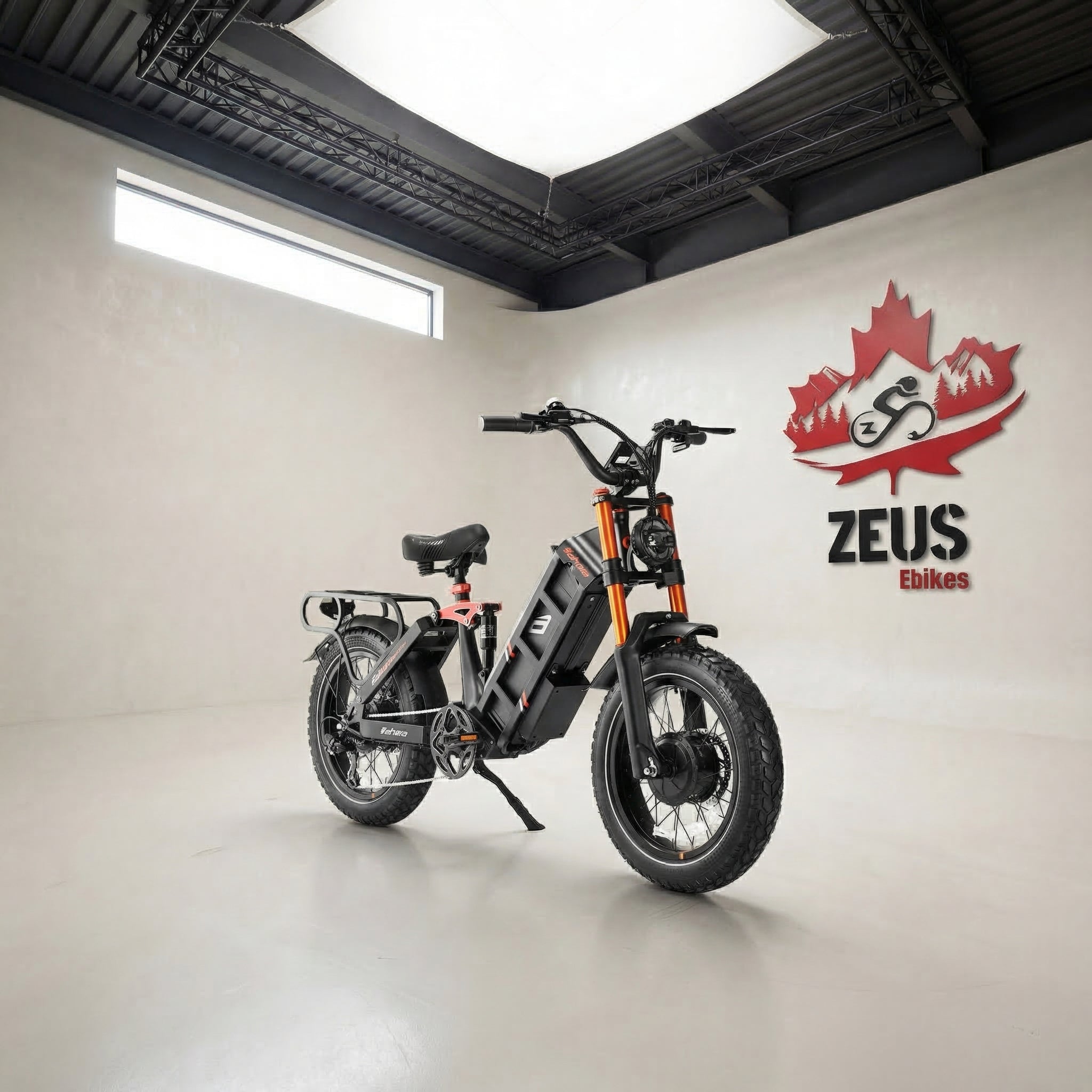
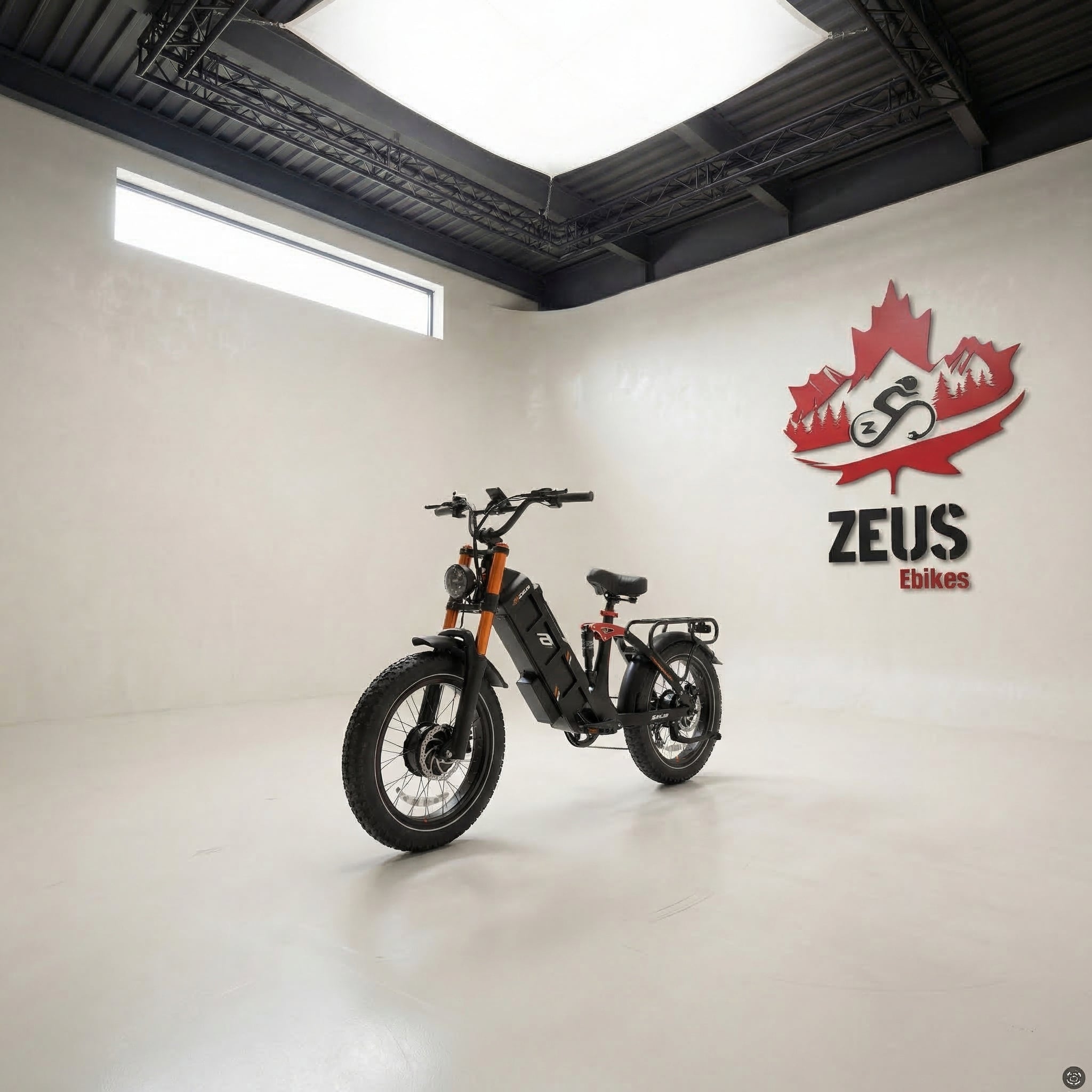
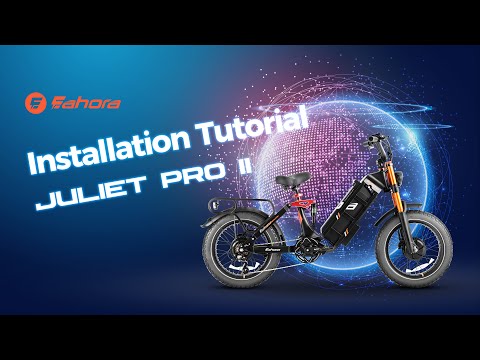
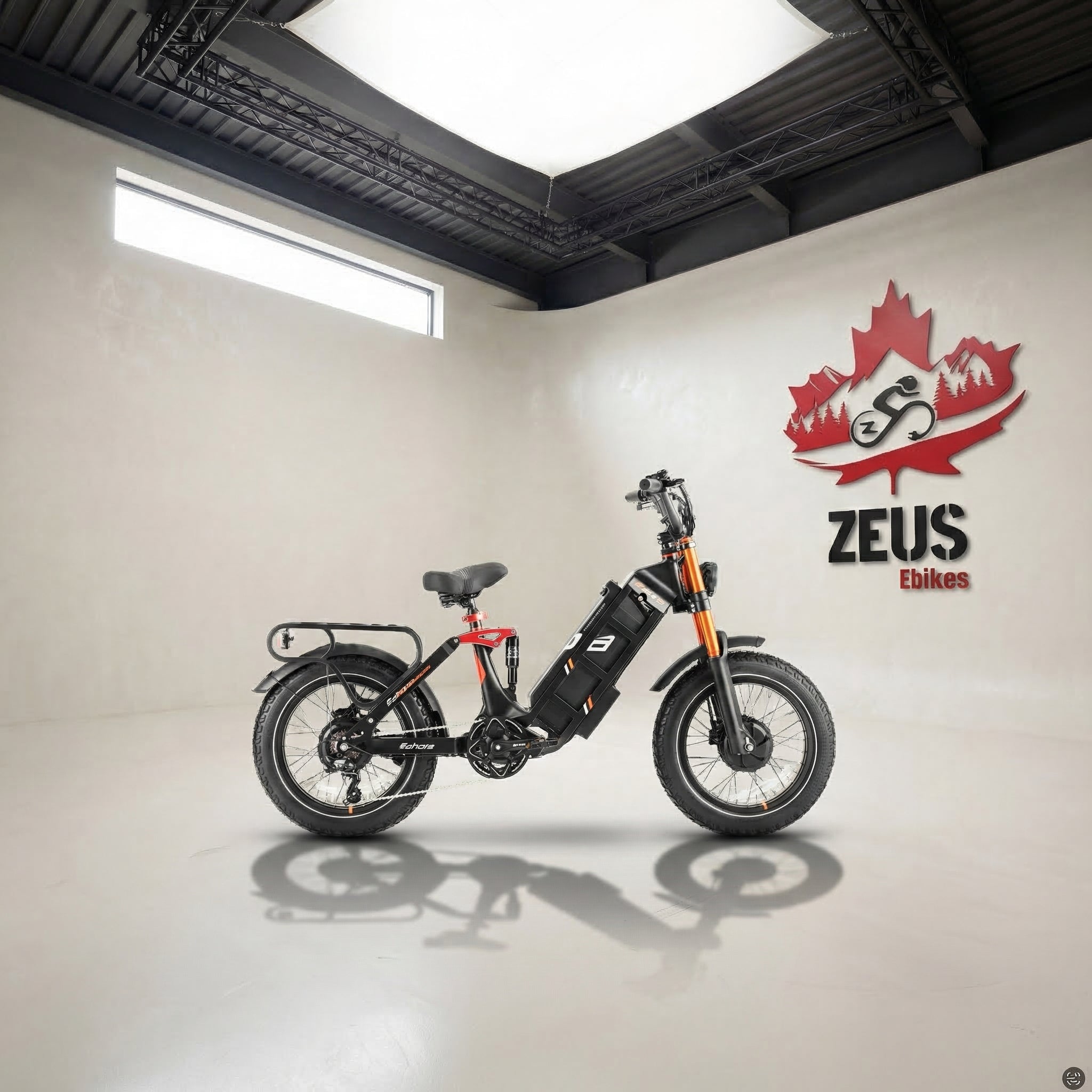
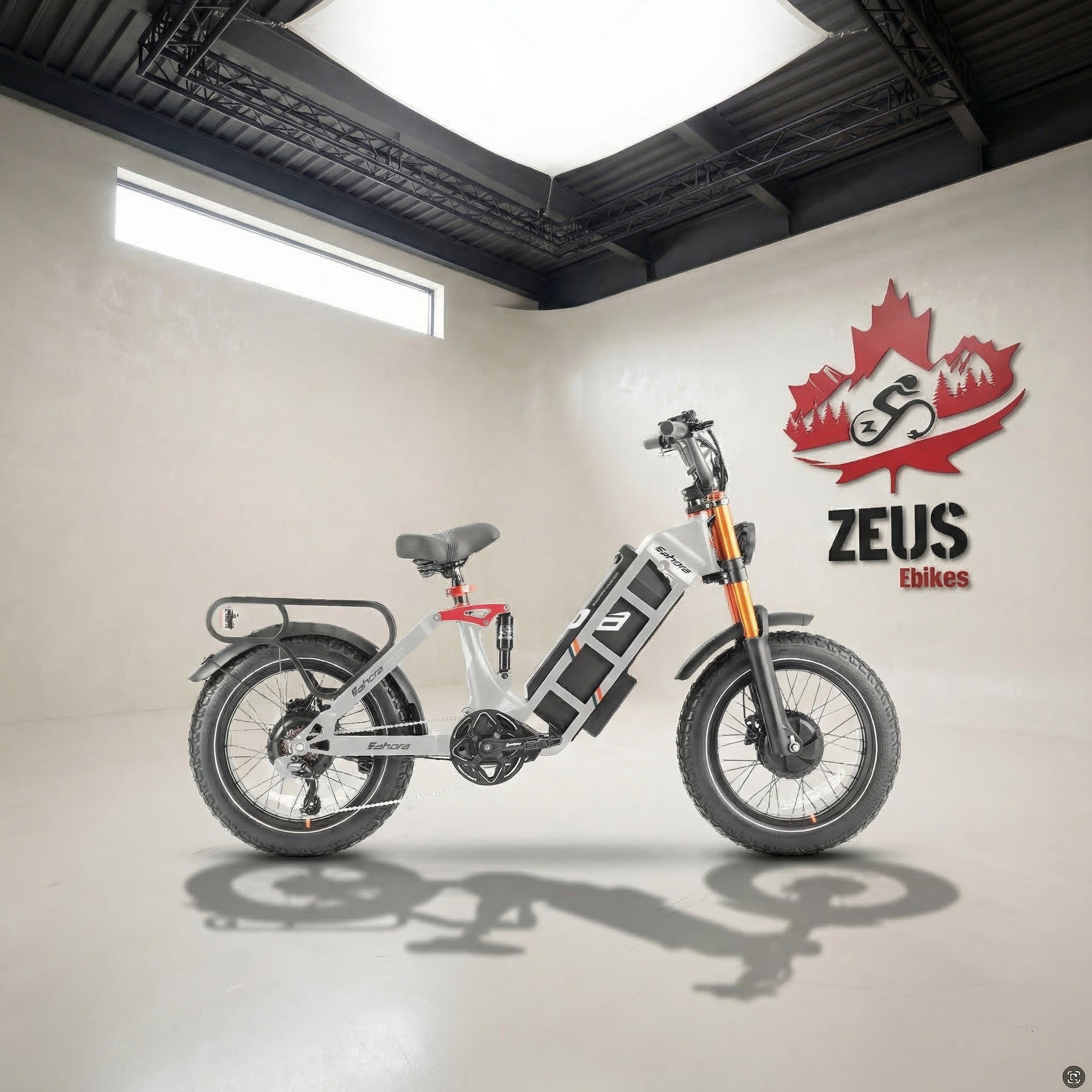
Eahora Juliet Pro II
Every Zeus e-bike comes with the manufacturer’s warranty and your first month of Zeus Care included. Add a Zeus Care plan to keep our Canadian team on your side for up to 5 years — remote diagnostics, we handle the manufacturer claim for you, return-shipping coordination.
Your selected plan is added automatically when you tap Add to Cart. No plan is added by default.
Zeus Care is a service plan, not a warranty — it does not add coverage or pay for parts or labour. Non-refundable once purchased. Full terms →
Eahora Juliet Pro II
Eahora Juliet Pro II — 4,200 Wh of Step-Thru Touring Range
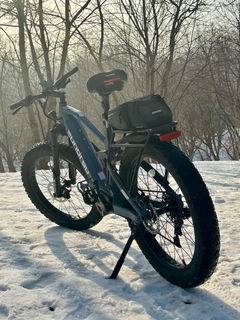
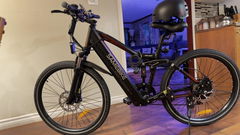
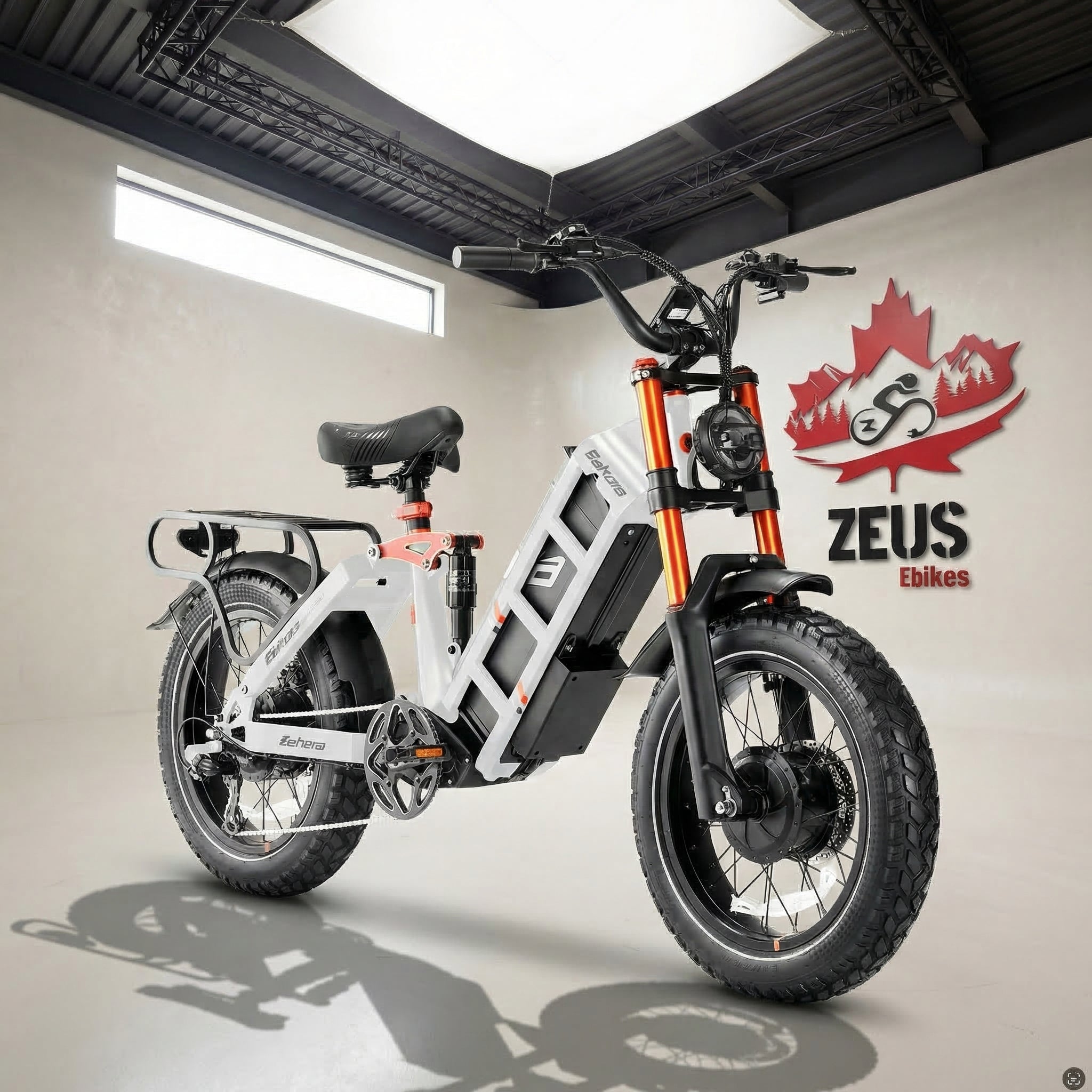
The Juliet Pro II is what happens when a step-thru frame is built around the biggest battery in its category. 60V, 70Ah, 4,200 watt-hours — several times the capacity of a typical step-thru, which usually tops out around 500–750 Wh. Add dual hub motors rated 2 × 2,200W (4,400W combined AWD) producing 2 × 95 Nm of maximum torque, full suspension (100mm hydraulic fork + 50mm rear coil link), 4-piston hydraulic disc brakes with semi-metallic pads, a 2,000-lumen LED headlight with built-in horn, and a 4-inch colour LCD with Bluetooth and USB charge port, and the spec sheet stops looking like a typical step-thru. It looks like a touring eBike that happens to have a step-thru frame.
That is the honest read on this bike. The Juliet Pro II is not a commuter. It is a distance machine on a low-step platform — the kind of bike a rider buys when they have stopped pretending they will only ride 10 km at a time. The 4,200 Wh battery is genuinely enough for a multi-day camping trip, a cottage-to-town round trip without recharging, or a winter ride that loses range to the cold and still gets you home. Eahora rates PAS range at 193–354 km and throttle-only at 97–105 km; both are credible given the battery, though real-world results depend on rider weight, terrain, assist level, and temperature.
The honest part: this is not a federally-classified Power-Assisted Bicycle (PAB) in Canada, regardless of the software setting. Eahora’s “500W road-mode” is a system-output cap, not a hardware nominal rating — and dual motors rated 2,200W each (4,400W combined) sit far above Canada’s federal 500W ceiling. Strict provincial reading (Ontario and Quebec especially) classifies dual-motor eBikes outside the PAB framework regardless of speed-limiter settings. The Juliet Pro II is built for private property, Crown land, designated motorized off-road trails, and provinces or municipalities where moped-class or off-road eBike use is permitted. Provincial enforcement varies — verify your local bylaws. Canadian eBike laws explained →
🇨🇦 Ships from Canada · Free Canada-wide shipping · Eahora 1-year warranty + Zeus 1-month coverage · 1-866-938-7580 — real humans answer. Financing over 3–60 months →
🎁 Eahora’s End-of-Summer Gifts — Included When You Buy From Zeus
Eahora’s Canadian store is currently bundling three free accessories with the Juliet Pro II as part of its 2026 End of Summer sale: a handlebar phone holder, rearview mirrors, and a splittable turn-signal light with remote. Order the Juliet Pro II from Zeus and the same three accessories are included with your order — at our listed price, no code needed, on orders placed through September 1, 2026.
On top of that, every Zeus e-bike ordered through August 31, 2026 also gets the Zeus Free Accessory Bundle — 14 accessories, $1,336 total value — included automatically.
Quick Answer
The Eahora Juliet Pro II is a long-range dual-motor AWD touring eBike on a step-thru frame. Dual hub motors rated 2 × 2,200W (4,400W combined, 2 × 95 Nm). A 60V 70Ah Grade-A battery (4,200 Wh) — the largest in its class — with manufacturer-rated range of 193–354 km on pedal assist. Full suspension (100mm front + 50mm rear), 4-piston hydraulic brakes on 180mm rotors, 20″ × 4.0″ fat tires, 2,000-lumen headlight with horn, 4″ colour LCD with Bluetooth. High-carbon steel step-thru frame, 148 lbs / 67 kg, up to 400 lb (181 kg) payload, fits riders 5’7″–6’4″. Ships with a 67.2V 7A quick charger (8–10h). Because the dual-motor hardware exceeds Canada’s federal 500W PAB ceiling, it is not a federally-classified PAB at any setting — it is a touring / off-road eBike for private property, Crown land, and motorized trails. Eahora 1-year warranty. Free Canada-wide shipping. Browse more step-thru eBikes → or long-range eBikes →
Why a 4,200 Wh Dual-Motor Step-Thru Is Unusual
The Canadian step-thru market is built around two assumptions: step-thru riders want easy mounting and short rides. Most step-thru eBikes top out at 500–750 Wh of battery and a single 500W–750W motor. That works for a 25 km commute. It does not work for a rider who wants the easy-mount geometry and the range to ride from one end of a province to the other without thinking about it.
The Juliet Pro II is built for that rider. The 60V 70Ah battery (4,200 Wh) is in the touring class, not the commuter class. The dual hub motors deliver redundant traction — lose the rear on wet pavement and the front compensates — and spread the load across two motors so each runs cooler on sustained climbs. The 4-piston brakes are touring-grade. The step-thru geometry is the only spec line that says “step-thru” on this bike. Everything else is touring-tier.
The trade-offs are real and stated up front: 148 lbs total weight, a cadence sensor (not torque), a steel frame, and an 8–10 hour charge time. None of these are flaws. They are deliberate consequences of putting a 4,200 Wh battery and dual motors on a low-step chassis. We cover each in the honest-take section below.
Key Features
- Dual Hub Motors — 2 × 2,200W (4,400W Combined AWD) — 2 × 95 Nm Max Torque — Front and rear hub motors working together. When the rear loses grip on wet pavement, gravel, or snow, the front compensates. AWD also distributes torque load across two motors instead of one, so each runs cooler under sustained climbs and lasts longer. Both motors are sealed brushless hubs with IPX6 water resistance and a peak rating of 2 × 2,600W. Eahora’s “factory-limited to 500W output” setting is a road-mode software cap, not the motors’ rated capability — see the legal note below.
- 60V 70Ah Battery — 4,200 Wh — ≥1,200 Cycle Lifespan — The largest battery on any Eahora step-thru and one of the largest on any eBike Zeus carries. Eahora rates the cells as Grade-A lithium-ion pouch (cell brand not published — see honest take). Manufacturer PAS range: 193–354 km; throttle-only: 97–105 km. Canadian deep-cold estimate (−10°C to −15°C): roughly 60–70% of rated range. Long-range eBike range math →
- 67.2V 7A Quick Charger — 8–10 Hours — The included charger is a 7A quick charger, but a 4,200 Wh pack is large enough that a full charge from empty still takes 8–10 hours. Designed for overnight charging, not between-ride top-ups. The 67.2V charge voltage confirms a true 60V (16S) pack.
- 5-Level Cadence Sensor PAS — The motor detects pedalling motion and delivers assist at the selected level. Steady, predictable, easy to learn. Not a torque sensor — the assist is stepped rather than proportional to your effort. For touring at a sustained cadence on flat or rolling terrain, cadence sensors work well; for technical trail riding, a torque sensor is smoother. PAS vs throttle explained →
- 5-Level Twist Throttle With Delayed Response — Twist throttle on the right handlebar with a deliberate brief delay before motor engagement. The delay prevents an accidental full-power surge if the rider bumps the throttle while mounting or pushing the bike — a small but smart safety design on a heavy machine.
- Full Suspension — 100mm Hydraulic Fork + 50mm Rear Coil Link — The front fork is hydraulically damped with adjustable preload. The rear uses a 4-bar coil-link system — coil over air for durability and zero air-shaft maintenance. 100mm of front travel is generous for a step-thru and absorbs urban potholes, gravel washboard, and rough pavement.
- 4-Piston Hydraulic Disc Brakes — 180mm × 2.3mm Steel Rotors — Significantly more clamping force than the 2-piston callipers found on most step-thrus. Semi-metallic pads engage stronger and last longer than organic pads, and the motor cutoff kills power the instant a lever is squeezed. On a 148 lb bike rated for up to 400 lbs, 4-piston brakes are the right spec — not a luxury.
- 4″ Colour LCD Display — Bluetooth + USB Charge Port — Larger and brighter than the typical 3″ eBike display. Bluetooth pairs to a smartphone for ride data, and the USB port runs off the main battery so you can charge a phone or GPS while you ride.
- 2,000-Lumen LED Headlight With Built-In Horn — 20W of forward illumination, bright enough to ride unlit gravel roads after dusk. The integrated electric horn runs off the main battery and is louder than the squeeze-bulb units most eBikes ship with — the safety feature most riders do not realise they need until traffic ignores their bell.
- LED Taillight With Integrated Brake-Signal Blinker — Steady-on rear visibility that brightens and blinks under braking, the same logic as automotive brake lights. Following cars and cyclists see your brake intent before they see your speed change.
- Shimano 7-Speed Drivetrain — A 14–28T freewheel against a 170mm aluminium 44T crankset with WELLGO platform pedals. The right spec for a hub-motor eBike where the motors handle climbing and the gears manage cadence; cassette and chain wear is a fraction of a mid-drive because the hub motors do not drive through the drivetrain.
- High-Carbon Steel Step-Thru Frame — Steel, not aluminium — a deliberate choice for durability under load, weld-repairability, and vibration damping. The 51 × 38 cm (20″ × 15″) frame fits riders 170–193 cm (5′7″–6′4″); seat height adjusts from 82–102 cm. The low step-over makes mounting accessible despite the bike’s weight.
- Cruise Control + Walk Mode + IPX6 Weatherproofing — 8-second auto-cruise holds throttle setting hands-free on long open paths. A 6 km/h walk mode provides slow motor-assisted forward movement when navigating the bike through tight spaces or up a ramp. IPX6 means the electronics resist powerful water jets from any direction — full coverage for Canadian rain, snow, and slush.
- Leather Wide Saddle With Memory Foam — Fenders + Heavy-Duty Kickstand Included — The wide memory-foam saddle is built for sustained-distance comfort. Front and rear fenders and a heavy-duty aluminium kickstand are included — no aftermarket spend to make this a real touring rig.
About the “500W Road Mode” — The Honest Truth
Eahora’s product page states the Juliet Pro II is “factory-limited to 500W output to comply with local road regulations.” The implication is that the road-mode setting makes the bike a federally-classified Power-Assisted Bicycle (PAB). This is not how Canada’s federal PAB framework actually reads, and we will not repeat the marketing claim.
Canada’s federal PAB regulation (under the Motor Vehicle Safety Act) defines a PAB as a vehicle whose “one or more electric motors” have a total continuous power output rating of 500 W or less. The legal test is the motor’s rated capability, not a downstream software setting.
The Juliet Pro II has dual hub motors rated 2,200W each — 4,400W combined nominal, roughly nine times the federal 500W ceiling. A software cap that limits delivered output to 500W during operation does not change the motors’ underlying rated capacity. Provincial enforcement is variable, but Ontario and Quebec apply the strict reading: dual-motor bikes rated above 500W combined are not classified as PABs at any setting.
The Juliet Pro II is therefore appropriate for:
- Private property and farmland
- Crown land and forest service roads where motorized cycles are permitted
- Designated motorized off-road and snowmobile trails
- Provincial off-road permit zones
It is not appropriate for federally-PAB-restricted infrastructure such as multi-use paths and bike-lane networks. If your primary riding is pathway commuting, choose a single-motor 500W-nominal bike that is unambiguously PAB-classified at the hardware level — the Taubik Westridge 29T is one example. The Juliet Pro II is a touring eBike, not a pathway commuter, and the spec sheet reflects that intention. Full Canadian eBike laws by province →
Why Steel + 148 lbs Is the Honest Trade-Off for This Battery
The battery alone weighs 16.6 kg (36.6 lbs) — a meaningful share of the bike before the frame, two motors, and components are added. Full suspension, 4-piston brakes, a 4-inch display, fenders, kickstand, and a touring saddle pile on quickly. The Juliet Pro II frame is high-carbon steel for three reasons:
- Durability under load. A payload rated up to 400 lbs (181 kg) on a step-thru chassis with a low top tube concentrates stress at the head tube and bottom-bracket junction. Steel handles repeated impact and flex loads better than entry-tier aluminium at this tier. An aluminium step-thru with this payload spec would need premium 6061-T6 with reinforced welds.
- Weld-repairability. Steel can be welded by any local fabrication shop if damaged in transit or after a fall. Aluminium requires specialised TIG equipment most local shops do not have — and for a touring eBike that rides remote routes far from a dealer, repair access matters.
- Vibration damping. Steel naturally absorbs road vibration better than aluminium. On a bike a touring rider will sit on for 4–6 hours at a stretch, that difference is felt in the wrists and lower back at the end of a day.
The trade-off: 148 lbs is heavy, and that affects everything else. Loading the bike on a vehicle rack requires a hitch rack rated for 80+ lbs (most trunk racks are not). Carrying it up apartment stairs is impractical — ground-floor or garage storage is the realistic expectation. Walk mode (6 km/h) exists precisely to manage steep ramps without the motor under full load. Plan storage and transport before purchase — this is a touring bike, not a sixth-floor walk-up bike.
Everything Included
The Juliet Pro II ships in two cartons (Box A and Box B), 85% pre-assembled per Eahora, with virtual assembly assistance available:
- Eahora Juliet Pro II eBike (your choice of Black or White)
- 60V 70Ah Eahora battery (4,200 Wh) with 2 keys
- 67.2V 7A quick charger
- Front wheel set
- Pedals (left and right)
- Front and rear fenders
- Integrated headlight (pre-installed)
- 4″ colour LCD display (pre-installed)
- Screws and toolkit for assembly
- Owner’s manual
Final assembly is front-wheel installation, fender installation, handlebar alignment, and seat-post fitting with the included tools. Virtual assembly sessions are available on request — call 1-866-938-7580 to book one before unboxing if you want a technician to walk you through it.
What You Should Know (Honest Take)
- Cadence sensor, not torque. Power is delivered at a fixed rate for the selected assist level rather than proportional to your pedal force. Fine for touring at a steady cadence on flat or rolling terrain; for technical singletrack or steep variable climbs, a torque-sensor bike like the Taubik Westridge 29T is the better fit.
- Not a federally-classified PAB at any setting. Covered in detail above. The dual-motor hardware (4,400W combined) exceeds the federal 500W ceiling regardless of Eahora’s road-mode software cap. Use is appropriate off-road and on private property. Provincial enforcement varies.
- Cell brand not published. Eahora describes the cells as Grade-A lithium-ion pouch and rates ≥1,200 cycles, but does not name the cell manufacturer the way some brands do. Common across mid-tier suppliers, but worth noting against named-cell alternatives like the Westridge 29T (Samsung).
- 148 lbs is genuinely heavy. Storage, transport, and stair access need real planning before purchase. Ground-floor storage, garage access, or a hitch-mount rack rated for 80+ lbs are practical requirements, not nice-to-haves.
- 8–10 hour charge time. The 67.2V 7A charger is a quick charger, but a 4,200 Wh battery still takes the full night to fill. Plan to charge overnight, not between rides.
- Cadence-stepped power on a heavy bike. With dual motors and a cadence sensor, power arrives at a fixed level per assist step — smooth once you learn it, but it does not modulate with pedal pressure. Use the throttle for fine control off the line.
- Tire brand not specified. Eahora lists the tires as 20″ × 4.0″ without naming the manufacturer. House-brand fat tires are typical at this tier; performance is usually fine for paved and gravel use, but worth noting against Kenda- or Maxxis-spec’d bikes.
- Range realism. Treat the 354 km PAS figure as a marketing upper bound. Realistic Canadian riding is roughly 130–280 km depending on terrain, assist, rider weight, and temperature — still exceptional for any eBike.
The Juliet Pro II’s core value proposition is concrete: the largest battery on any step-thru in our lineup, dual-motor AWD, full suspension, 4-piston brakes, IPX6, cruise control, and a step-thru geometry that does not compromise the rest of the spec sheet. The trade-offs (weight, cadence sensor, charge time, PAB classification, cell-brand disclosure) are real and proportional. Stated up front so there are no surprises post-delivery.
Full Specifications
| Motor | Dual brushless hub motors (front + rear AWD), IPX6 |
|---|---|
| Motor Power | 2 × 2,200W nominal / 2 × 2,600W peak (4,400W combined nominal) |
| Combined Torque (Max) | 2 × 95 Nm |
| Output Cap | Eahora road-mode software cap (500W); off-road unlock available |
| Sensor | 5-level cadence sensor |
| Throttle | 5-level twist throttle, delayed response (safety design) |
| Top Speed | 28 mph (45 km/h) standard; up to 43 mph (69 km/h) unlocked — off-road |
| Gradeability | 35–40° |
| Federal PAB Status | Not federally PAB-classified at any setting — dual-motor 4,400W combined exceeds the 500W ceiling. Off-road / private-property use. |
| Battery & Range | |
| Battery | 60V 70Ah — Grade-A lithium-ion pouch cells (cell brand not published) |
| Capacity | 4,200 Wh nominal |
| Range (PAS) | 193–354 km / 120–220 mi (manufacturer-rated) |
| Range (Throttle-Only) | 97–105 km / 60–65 mi (manufacturer-rated) |
| Range (Zeus realistic) | ~130–280 km mixed Canadian riding; 60–70% of that in deep cold |
| Battery Lifespan | ≥1,200 charge cycles to 80% capacity |
| Charger | 67.2V 7A quick charger |
| Charge Time | 8–10 hours from empty |
| Frame & Dimensions | |
| Frame | High-carbon steel, step-thru |
| Frame Size | 51 × 38 cm (20″ × 15″) |
| Rider Height | 170–193 cm (5′7″–6′4″), inseam ≥ 26.8″ |
| Seat Height Range | 82–102 cm (32.3″–40.2″) |
| Total Length | 183 cm (72.05″) |
| Wheelbase | 124 cm (48.8″) |
| Weight (with battery) | 148 lbs / 67 kg — battery alone 36.6 lbs / 16.6 kg |
| Payload Capacity | ≤400 lbs / 181 kg (manufacturer-rated) |
| Colours | Black · White |
| Suspension & Brakes | |
| Front Fork | Adjustable hydraulic suspension, 100 mm travel |
| Rear Suspension | 4-bar coil link, 50 mm travel |
| Brakes | 4-piston hydraulic disc, 180 mm × 2.3 mm steel rotors, semi-metallic pads, motor cutoff |
| Wheels & Tires | |
| Tires | 20″ × 4.0″ fat (with tubes, 28–33 psi) — tire brand not specified |
| Rims | 36H aluminium alloy |
| Drivetrain | |
| Gears | Shimano 7-speed |
| Freewheel | 14–28T |
| Crankset | 170 mm aluminium, 44T |
| Pedals | WELLGO aluminium alloy platform |
| Electronics & Display | |
| Display | 4″ colour LCD with Bluetooth and USB charge port |
| Headlight | 2,000-lumen (20W) LED with built-in horn |
| Taillight | LED with integrated brake-signal blinker |
| Cruise Control | 8-second auto-cruise |
| Walk Mode | 6 km/h |
| Water Resistance | IPX6 (powerful water jets, any direction) |
| Components | |
| Saddle | Leather wide saddle with memory foam |
| Handlebar | Aluminium, 710 mm × 31.8 mm centre, rise bar |
| Fenders | Front + rear included |
| Kickstand | Heavy-duty aluminium alloy |
| Warranty & Support | |
| Manufacturer Warranty | 1 year — components and parts (Eahora policy) |
| Zeus Coverage | 1-month Zeus complimentary limited warranty + extended Zeus plans available (1, 2, 3, 5 years) |
| Return Window | 15 days (Eahora policy) |
| Shipping & Assembly | |
| Delivery | Standard Canada-wide delivery as per Zeus shipping policy; tracking email at dispatch |
| Assembly | 85% pre-assembled (2 cartons) — virtual assembly assistance available |
| Shipping | Free Canada-wide |
| Support | Zeus phone: 1-866-938-7580 — real humans answer |
Who Is the Juliet Pro II For?
- Touring riders who want the easy mount of a step-thru without giving up range — The 4,200 Wh battery genuinely covers multi-day touring, cottage-to-town round trips without recharging, and long backroad loops. For riders who have aged out of high-top-tube frames but refuse to ride 25 km loops only.
- Riders with mobility, knee, or hip considerations who want the longest range possible — Step-thru geometry removes the lift-leg-over-bar mounting that becomes painful with knee, hip, or balance issues, and the huge battery means a rider who depends on the motor can ride a full touring day on one charge.
- Heavier riders within the 400 lb payload — The manufacturer-rated 181 kg payload is generous and the steel frame handles sustained load better than entry-aluminium step-thrus. Heavy rider eBike guide →
- Riders who want AWD traction for wet pavement, gravel, or winter — Two-motor traction matters most in low-grip conditions: wet leaves, packed snow, gravel washboard. The front motor pulling while the rear pushes keeps the bike tracking straight where a single-motor bike would slip. Winter eBike guide →
- Property owners and Crown-land riders who want a step-thru that works off-road — Full suspension, fat tires, dual motors, a 400 lb payload, and IPX6 sealing handle gravel laneways, farm property, forest service roads, and ATV-permitted trails. The step-thru frame just makes mounting easier; the rest of the bike is off-road-capable.
- Riders who have stopped pretending they will get up a steep ramp without motor help — Walk mode at 6 km/h pushes the bike up parking, garage, and trail-access ramps that would be a workout to walk it up manually.
Who it’s NOT for: Apartment-stair-access riders — 148 lbs is a stairs problem at any frame style (the Eahora Juliet 2026 is the same step-thru platform in a single-motor, lighter, lower-battery configuration). Riders who need a federally-PAB-classified bike for multi-use paths — choose the Taubik Westridge 29T (single-motor, PAB-compliant). Riders who want torque-sensor proportional power. Riders shorter than 5′7″ or taller than 6′4″. Riders who need fast-charge capability — 8–10 hours is an overnight charge.
How the Juliet Pro II Compares
Three Eahora touring and step-thru options Zeus carries, three different priorities (scroll horizontally on mobile to see all columns):
| Spec | ★ Eahora Juliet Pro II | Eahora Romeo II | Eahora Juliet 2026 |
|---|---|---|---|
| Frame Style | Step-thru steel | Step-over aluminium | Step-thru |
| Motor | Dual hub 2×2,200W (4,400W, 2×95 Nm) | Dual hub | Single hub |
| Battery | 60V 70Ah / 4,200 Wh | 3,120 Wh | Lower-capacity commuter pack |
| Range (PAS, rated) | 193–354 km | 174–193 km | Shorter (urban) |
| Sensor | Cadence | Cadence | Cadence |
| Tires | 20″ × 4.0″ | 20″ × 4.5″ | Narrower |
| Suspension | Full (100mm + 50mm) | Full | Front only |
| Brakes | 4-piston hydraulic 180mm | 4-piston hydraulic 180mm | Hydraulic disc |
| Payload | ≤400 lbs | 330 lbs | Lower |
| Weight | 148 lbs | 143 lbs | Lightest |
| Federal PAB | Not PAB (off-road) | Not PAB (off-road) | PAB-compliant (single motor) |
| Best For | Max range + AWD on a step-thru | Step-over touring, wider tires, lighter | Budget urban, pathway-legal |
Choose the Juliet Pro II for the largest battery in this comparison, step-thru geometry, AWD traction, and full touring spec on a low-step platform. Choose the Eahora Romeo II if you prefer a step-over frame, wider 4.5″ tires, and a slightly lighter chassis. Choose the Eahora Juliet 2026 if your rides are urban and under 80 km and federal PAB compliance matters for pathway access. See our full long-range eBike guide →
Frequently Asked Questions
Can I ride the Juliet Pro II on Canadian bike paths?
No. The dual-motor hardware (2 × 2,200W — 4,400W combined) exceeds Canada’s federal 500W combined-output PAB ceiling, regardless of Eahora’s road-mode software cap. The bike is not federally PAB-classified at any setting and is therefore not pathway-legal in most municipalities. Use is appropriate on private property, Crown land, designated motorized off-road trails, and provinces or municipalities where moped-class or off-road eBike use is permitted. Provincial enforcement varies — check your local bylaws. If pathway access is your priority, choose a federally-PAB-classified single-motor bike like the Taubik Westridge 29T. Canadian eBike laws explained →
What is the real-world range?
Eahora rates the Juliet Pro II at 193–354 km PAS and 97–105 km throttle-only. The high end of the PAS rating assumes flat terrain, the lowest assist level, a light rider, and warm weather. Realistic Canadian-conditions estimates:
- Flat hardpack, low PAS, 75–85 kg rider: 200–280 km
- Mixed terrain, moderate PAS: 130–180 km
- Hilly off-road or heavy throttle use: 80–120 km
- Canadian winter (−10°C to −15°C): 60–70% of the warm-weather range
For any eBike, even the conservative numbers are unusual. The 4,200 Wh battery is the spec line that defines this bike. Long-range eBike guide →
How heavy is it and how much can it carry?
148 lbs / 67 kg with the battery installed (about 111 lbs with the 36.6 lb battery removed). The manufacturer-rated payload is up to 400 lbs / 181 kg. Ground-level storage is strongly recommended and stairs are a two-person job; the 6 km/h walk mode helps with ramps. Heavy rider eBike guide →
Why doesn’t the Juliet Pro II have a torque sensor?
Cadence sensors are simpler, deliver predictable steady assist at a chosen level, and suit long-distance touring at a sustained cadence. Torque sensors deliver proportional power based on pedal force — better for technical trail riding and variable terrain. Eahora’s positioning for the Juliet Pro II is touring and accessible mounting, where cadence sensors are appropriate. If you prioritise a torque-sensor ride feel, the Taubik Westridge 29T has one. PAS vs throttle explained →
Why is the frame steel instead of aluminium?
High-carbon steel is heavier than aluminium but more durable under sustained load, weld-repairable by any local fabrication shop, and naturally vibration-damping. On a bike rated for up to 400 lbs of rider plus gear, steel is the appropriate choice — aluminium would require premium 6061-T6 with reinforced welds. The trade-off is weight: plan storage and transport accordingly.
How long does the battery take to charge?
8–10 hours from empty with the included 67.2V 7A quick charger. A 4,200 Wh battery is large enough that even a quick charger takes the night to fill it. Plan to charge overnight, not between rides.
What cell brand is in the battery?
Eahora describes the cells as Grade-A lithium-ion pouch and rates the pack at ≥1,200 cycles to 80% capacity, without naming the cell manufacturer. This is typical for mid-tier suppliers. A verified Samsung-cell option at a lower tier is the Taubik Westridge 29T. Call 1-866-938-7580 for the current cell spec on shipping inventory.
Is the Juliet Pro II good for winter riding?
The 20″ × 4.0″ fat tires are competent on packed snow and frozen trails, IPX6 weatherproofing handles rain, snow, and slush, and the dual-motor AWD is genuinely useful on low-grip surfaces. Battery range drops to 60–70% of warm-weather rated range in deep cold — plan distance accordingly. Studded tires are an aftermarket upgrade worth considering for ice. Winter eBike guide →
What warranty applies?
The bike ships with Eahora’s 1-year manufacturer warranty covering material, quality, and workmanship defects on components and parts. Zeus adds a 1-month complimentary limited warranty for claim coordination. Extended Zeus support plans are available at checkout (1, 2, 3, or 5 years). Standard exclusions apply: wear items (tires, brake pads, chain, grips, saddle), misuse, improper maintenance, and unauthorised modifications. Call 1-866-938-7580 for current terms.
How do I finance this?
Multiple options at checkout: Klarna Pay-in-4 (0% interest, 4 biweekly payments), Shop Pay Instalments (0% interest, no credit check), or PayPlan by RBC for monthly payments over 3–60 months. Full Canadian eBike financing guide →
Does Zeus ship to my province?
Free Canada-wide shipping to every province and territory. The Juliet Pro II ships in two cartons, 85% pre-assembled, with virtual assembly assistance available. Call 1-866-938-7580 to book an assembly session before unboxing if you want a technician to walk you through it.
Zeus eBikes Canada — Canadian eBike retailer shipping nationwide since 2023. Every Eahora Juliet Pro II ships free across Canada with the Eahora manufacturer warranty plus Zeus complimentary coverage. Real humans answer the phone at 1-866-938-7580 or email milad@zeusebikes.ca.
More resources:
If you have any questions, you are always welcome to contact us. We'll get back to you as soon as possible, within 24 hours on weekdays.
-
Shipping Information
Use this text to answer questions in as much detail as possible for your customers.
-
Customer Support
Use this text to answer questions in as much detail as possible for your customers.
-
FAQ’s
Use this text to answer questions in as much detail as possible for your customers.
-
Contact Us
Use this text to answer questions in as much detail as possible for your customers.
Free Shipping Canada Wide

Exceptional Service
At Zeus Ebikes, we go beyond just selling ebikes. We're dedicated to offering the best customer service and support to ensure you're fully satisfied. Your happiness is our priority, and we're here to make your experience as smooth as your ride.
Blog posts