
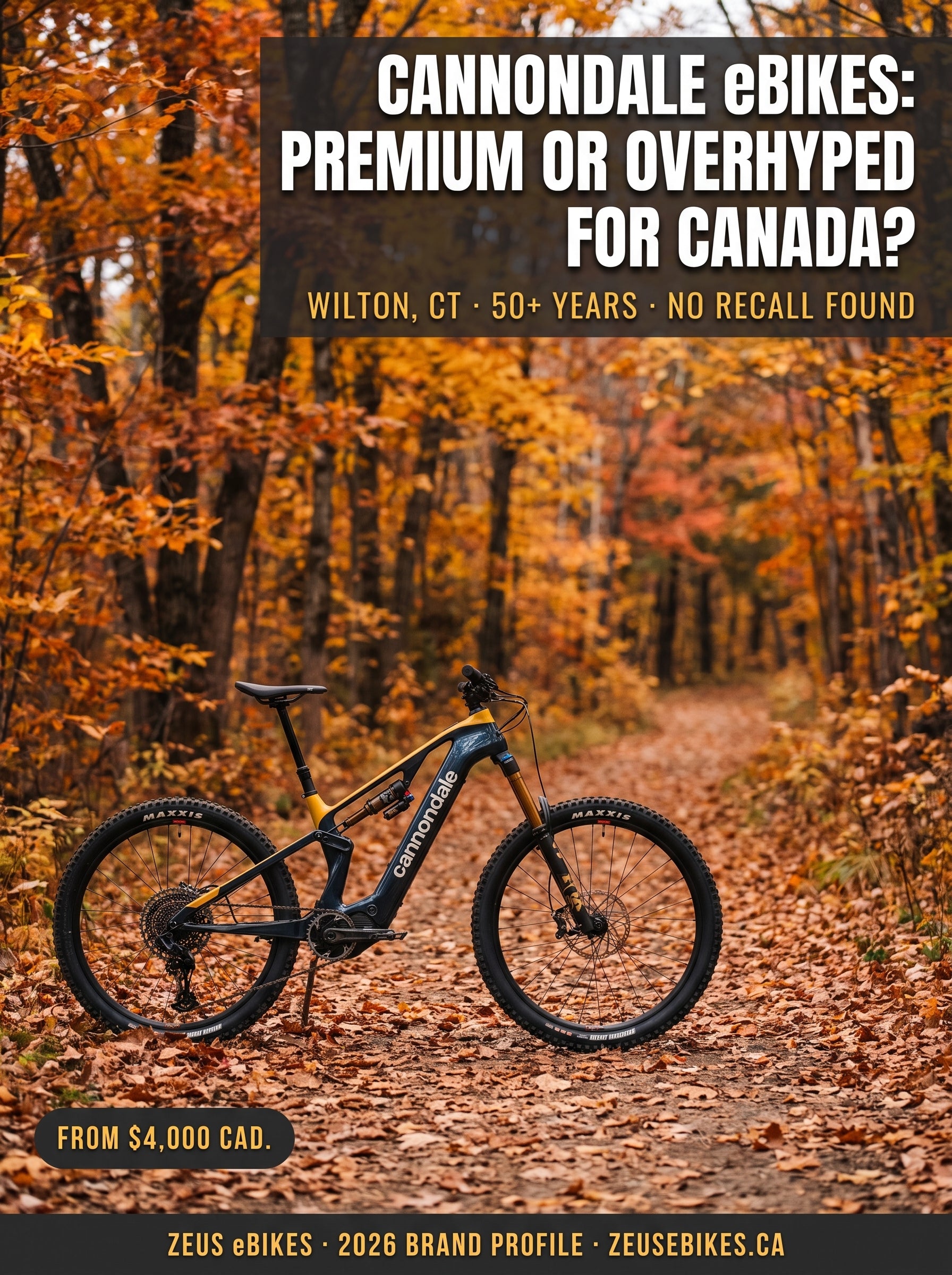
Cannondale eBikes in Canada: The Verified Brand Profile (2026)

You searched Cannondale because you are weighing a premium, dealer-sold eBike against the cheaper direct-to-consumer brands — and you want to know whether the name actually buys you anything. The honest answer involves three things no Cannondale dealer will lay out plainly: who owns the company now, how the warranty splits between Cannondale and Bosch, and what is actually on the recall record.
This profile is independent. Zeus does not sell Cannondale and earns nothing whether you buy one or not. That is the point — every claim below traces to a named primary source (Cannondale's own warranty page, Health Canada, the US CPSC, the Better Business Bureau, and Dorel's acquisition filings), and where the public record is silent, we say so rather than guess.
If you want the wider lay of the land first, our Canadian eBike buying guide and eBike brands overview give the category context this single-brand profile sits inside.
We built this profile from primary sources only. Ownership and corporate status were confirmed against Dorel Industries' own acquisition filings and the Pon Holdings record; warranty terms were read directly from Cannondale's Canadian warranty page and cross-checked against Bosch's published eBike warranty for the powertrain; the recall record was pulled by searching the brand name on both Health Canada (recalls-rappels.canada.ca) and the US CPSC (cpsc.gov), then reading each notice for the exact authority, date, models and hazard; the reputation signal was read directly from the Better Business Bureau profile of the operating entity, Cycling Sports Group, Inc. Performance figures are labelled as Cannondale's or Bosch's published claims, not independent test results. Where a fact could not be verified in public records, we frame it as an absence rather than fill the gap. Cannondale, Cycling Sports Group or Pon Holdings is welcome to correct anything here — email milad@zeusebikes.ca and we will update with sourced information.
Quick answer: Cannondale is a legitimate, long-established American bike brand (founded 1971, Wilton, Connecticut) now owned by Dutch mobility group Pon Holdings since January 2022. Its eBikes use Bosch mid-drive systems and are sold in Canada through bricks-and-mortar dealers, not direct. The warranty has a split worth understanding: the frame is covered for life (on models introduced in 2026 and after), but the battery and motor are covered by Bosch (about 2 years), not by Cannondale. There is no Cannondale eBike battery or electrical recall on Health Canada or US CPSC record as of June 2026 — the recalls that exist are structural (forks, frames) or accessory (a front rack), plus one US brake-configuration recall. If you are comparing Cannondale against other options, see our best electric bikes in Canada guide and our checklist for a legit Canadian eBike store.
What This Profile Covers
- Who owns Cannondale, and is it still in business?
- Where are Cannondale eBikes made?
- The warranty reality: lifetime frame, Bosch battery
- The safety and recall record, stated precisely
- The eBike lineup and Canadian pricing
- Are Cannondale eBikes road-legal in Canada?
- The honest ledger: green flags vs red flags
- Frequently asked questions
- The bottom line
Who owns Cannondale, and is it still in business?
Cannondale has been owned since January 2022 by Pon Holdings BV, a privately held Dutch mobility group that paid US$810 million for the entire Dorel sports segment — a deal confirmed in Dorel's own press release. Pon is one of the world's largest bicycle companies, with brands including Gazelle, Cervélo and Santa Cruz — and its ownership of Cannondale has remained stable, with no bankruptcy or distress on public record as of June 2026.
By way of background: Cannondale was founded in 1971 in Wilton, Connecticut, and built its reputation on American-made aluminium frames. Canadian consumer-products company Dorel Industries bought it in 2008 before the Pon sale. The day-to-day operating entity in North America is Cycling Sports Group, Inc., registered at 1 Cannondale Way, Wilton, Connecticut. For the full landscape of which brands selling in Canada are domestic vs foreign-owned, our eBike brands in Canada overview maps the field.
On the question buyers actually worry about — is it about to disappear, the way some direct-to-consumer brands have — the public record shows no bankruptcy, receivership or distress for Cannondale as of June 2026. It is an active, going concern inside a large, diversified parent. Pon has been streamlining its bike business — it announced the eventual closure of Cannondale's Almelo, Netherlands assembly plant (about 120 roles, winding down toward end of 2027, per a June 2026 Pon Holdings announcement) and restructured some distribution in 2025–2026 — but these are operational consolidations within a large, multi-brand group, not signs of insolvency. Pon is privately held and does not publish brand-level financials, so Cannondale-specific revenue is simply not disclosed; we note that as an absence, not a red flag.
One note on customer-service reputation: the North American operating entity, Cycling Sports Group, Inc., held a Better Business Bureau grade of F as of June 2026 — driven by failure to respond to 5 of 10 complaints filed with the BBB (per bbb.org, accessed June 2026). That is a small sample across the whole company, not an eBike-specific metric, but it is worth knowing before you need to make a warranty claim: route all warranty and service issues through your authorised dealer rather than the manufacturer directly.
Cannondale is a stable, 50-plus-year-old brand owned since January 2022 by Dutch giant Pon Holdings. There is no sign of the financial distress that has hit some online-only eBike sellers — a real point in its favour if continuity of parts and warranty support matters to you.
Where are Cannondale eBikes made?
Cannondale eBikes are manufactured primarily in Asia — its corporate footprint lists an operations and engineering presence in Taichung, Taiwan, the centre of the global bicycle supply chain. The eBike drive systems (motor, battery and controller) are made by Bosch in Germany. Cannondale does not publish a model-by-model country of final assembly on its consumer pages.
This is where the marketing and the manufacturing diverge from the brand's origins. Cannondale began as a genuinely American manufacturer, and for years its high-end frames were welded in the United States — today that production has moved primarily to Asia, as it has across essentially the entire mainstream bicycle industry. The frames are designed in the US and Europe and manufactured primarily in Asia. The part of the bike that does the electric work — the drive system — is made by Bosch, a German supplier, on every current Cannondale eBike we reviewed. That last point matters more than the frame's birthplace, because the motor, battery and controller are where eBike reliability and warranty questions concentrate.
On an eBike, the frame is the easy part. The expensive, failure-prone, safety-relevant parts are the battery, motor and electronics. Cannondale outsources all of that to Bosch — a mature, well-established supplier — which is reassuring for reliability but, as the next section shows, also determines who actually backs your battery. If you want to understand what the Bosch powertrain commitment means for reliability and parts supply compared to other drive systems, our Canadian eBike buying guide covers motor types and what to look for.
The warranty reality: lifetime frame, Bosch battery
Cannondale's warranty headline is genuinely strong, and it is worth stating plainly: per the company's own Canadian warranty page, frames on models introduced in 2026 and after carry a lifetime warranty, and Cannondale-branded components carry one year. For a frame, that is among the better terms in the industry.
But read one clause further. Cannondale's warranty explicitly states that non-Cannondale-branded components — and it names electronic systems directly — are 'Covered by the warranty of their manufacturer (not covered under this limited warranty).' On a Bosch-powered eBike, that means the motor, controller, display and battery are not warranted by Cannondale at all. They fall under Bosch's warranty.
That is not a hidden defect — it is standard practice across premium eBikes that use third-party drive systems — but it changes what 'lifetime warranty' means for a buyer. Bosch's published eBike warranty covers the battery for 2 years (or 500 charge cycles, whichever comes first), with a guarantee that the battery retains at least 60% of capacity in that window, and a 2-year term on the system. So the realistic picture is: frame covered for life by Cannondale; powertrain covered for roughly two years by Bosch. At one charge per day, 500 cycles is roughly 16 months of daily use; at every other day, about 2.5 years — which means a heavy daily commuter could hit the cycle limit before the 2-year calendar term expires. A replacement Bosch battery out of warranty runs several hundred dollars CAD, so this is a cost to factor into a multi-year ownership calculation.
One practical advantage of the dealer model: because Cannondale eBikes are sold through bricks-and-mortar shops rather than shipped direct, warranty and service claims generally route through a local authorised dealer who handles the Bosch and Cannondale sides for you — a smoother path than mailing a bike back to a warehouse. Our guide to spotting a legit eBike store in Canada explains why that local service relationship is worth real money.
Lifetime frame warranty from Cannondale (on 2026 and later models); about 2 years on the battery and motor from Bosch, not Cannondale. Budget for an eventual out-of-warranty battery replacement, and buy from a dealer who will process both warranties for you.
Not sure whether a dealer-sold premium brand is worth the price premium for your use case?
Our independent Canadian eBike buying guide breaks down what you actually get — and give up — at each price tier, with no brand agenda.
Read the Buying Guide Best eBikes in CanadaThe safety and recall record, stated precisely
There is no Cannondale eBike battery or electrical-system recall on either Health Canada or US CPSC record as of June 2026 — a meaningful clean record at a time when battery-fire warnings have hit several direct-to-consumer brands. The recalls that do exist are structural (forks, frame welds) or an accessory rack, and one eBike brake-configuration error on US-shipped units. (We verified this by searching the Cannondale name on both Health Canada at recalls-rappels.canada.ca and the US Consumer Product Safety Commission at cpsc.gov and reading each notice.) The full recall list:
- CAADX cyclocross bikes (Health Canada): model years 2013–2016 with disc brakes, where the fork can fracture. As of July 2019 the company reported 11 incidents worldwide, 7 injuries, and one fatality. These are non-electric bikes; the remedy was a free upgraded fork.
- Dave bikes and framesets (Health Canada): model years 2021–2023, where the headtube/downtube weld can separate. As of February 28, 2024, Cycling Sports Group reported no incidents in Canada or the US. Also non-electric.
- Treadwell front bicycle rack (Health Canada, Sept 9, 2020): about 114 units in Canada. The front rack could detach and stop the front wheel. This is an accessory rack — sold separately or bundled with some Treadwell EQ and Treadwell Neo EQ bikes. The Treadwell Neo is electric, but the recall is the rack, not the battery or motor. Health Canada records one fall injury in Canada and additional incidents reported internationally per the recall notice (as of August 2020); the remedy was free.
- Tesoro Neo X Speed (US CPSC, March 30, 2023): about 75 units, model year 2022. A small batch of European-specification bikes reached US dealers with the brake levers configured to the European standard (right lever = front brake) instead of the US standard. The remedy was a free repair, and no injuries were reported. This is the only eBike-specific recall — and it is a market-configuration setup error, not a component defect or fire risk.
Stated honestly: Cannondale has a recall history, as most large, long-running bike makers do, and one of those recalls (the CAADX fork) involved a fatality — but that was a non-electric cyclocross frame, not an eBike, and it was addressed with a free fork replacement. On the question that brings most people to a brand-safety search — eBike battery fires — Cannondale's record in both Canadian and US registries is clean. For how Canadian battery-safety rules and certifications work generally, our eBike buying guide walks through what to look for.
No Cannondale eBike battery or electrical recall exists on Health Canada or CPSC record as of June 2026. The recalls on file are frame, fork and accessory issues on mostly non-electric bikes — the kind of structural recalls that even the most reputable bike makers periodically issue.
The eBike lineup and Canadian pricing
Cannondale's Canadian eBike range is built around Bosch drive systems and sold through dealers, so pricing varies by shop. Prices below are based on Cannondale's Canadian site and authorised Canadian dealers as of June 2026 and may have changed — confirm current pricing with your local dealer. Based on Cannondale's Canadian site and authorised Canadian dealers (such as Amego EV in Toronto and Calgary, and Bicycle Sport Pacific in Vancouver), the current lines break down roughly as follows:
- Adventure Neo / Adventure Neo Allroad — upright, comfort-oriented city and light-trail eBikes on Bosch Active or Performance Line motors. Roughly $1,675–$2,500+ CAD depending on trim, with step-through options.
- Tesoro Neo X / Tesoro X 3 — touring-commuter eBikes with a 100mm suspension fork, fenders, rack and lights, on the Bosch Performance Line CX motor and a 750Wh battery — enough capacity for a 50–80 km real-world commute in Canadian conditions (Bosch's published claim; cold weather and hills reduce that range). Cannondale claims a range up to roughly 175 km on the Tesoro X 1 under optimal conditions. Roughly $3,400–$4,000+ CAD.
- Tesoro Neo X Speed — a Class-3 speed pedelec on the Bosch Performance Line Speed motor that assists up to about 45 km/h (see the legality section below); priced around the top of the range, well above the $3,400–$4,000 band (the US CPSC recall listed it at roughly US$5,500).
- Moterra and Mavaro — full-suspension electric mountain and premium city models at the higher end of the range.
All range and speed figures above are Cannondale's or Bosch's published claims, not independent test results — real-world range depends on rider weight, terrain, temperature and assist level, and Canadian winters in particular cut battery range. These are premium prices: a Tesoro Neo X sits well above the typical direct-to-consumer commuter eBike, and you are paying for the brand, the dealer service relationship and the Bosch system rather than raw spec-sheet numbers. If you want to see how that price positions against the wider Canadian market, our best electric bikes in Canada guide and our eBike financing guide are the places to compare.
Cannondale eBikes run roughly $1,675 to $4,000+ CAD, all on Bosch drive systems, sold through dealers. They are premium-priced commuter and trail bikes — you are buying the brand, the Bosch reliability and local service, not the cheapest watt-hours per dollar.
Weighing Cannondale against what else is available in Canada at that price?
Our best electric bikes guide covers the full market — including what Canadian-made and direct-to-consumer options deliver for the same budget — with no brand to sell you.
Compare the Full Market Why Buy Canadian?Are Cannondale eBikes road-legal in Canada?
Most of Cannondale's lineup is built to the Class-1 pattern: pedal-assist, no throttle, with assistance cutting out at about 32 km/h and a 250W Bosch motor (enough torque for most urban commuting and moderate hills). That fits the power-assisted-bicycle rules in force across the provinces — 500W or less, pedal-assist cutting out around 32 km/h, operable pedals (Canada has had no single federal e-bike definition since the Motor Vehicle Safety Regulations definition was repealed in 2021; e-bike road rules are set provincially and converge on these limits) — so the standard Adventure Neo and Tesoro Neo X models are treated as regular bicycles in most provinces.
The one model to flag is the Tesoro Neo X Speed. As a Class-3 speed pedelec it assists up to about 45 km/h, which exceeds the 32 km/h power-assisted-bicycle assist limit. A bike that assists past 32 km/h falls outside the power-assisted-bicycle limits the provinces use, and several provinces restrict where — or whether — such speed pedelecs may be ridden on bike paths and multi-use trails. If you are considering the Speed variant, confirm your province's rules before buying.
eBike rules in Canada are set provincially and vary on age, helmet and trail-access details, so do not assume the rules from one province apply in another. Our Canadian eBike laws guide breaks the framework down province by province, and our eBike vs car comparison covers the cost and practicality side of switching.
The standard Cannondale eBikes (250W, 32 km/h) meet the provincial power-assisted-bicycle limits and are treated as bicycles (Newfoundland and Labrador's Act reads two ways). The Tesoro Neo X Speed assists to ~45 km/h, which exceeds the 500W/32 km/h power-assisted-bicycle limits the provinces use — check your provincial and municipal trail rules before you commit to that variant.
The Honest Ledger: Green Flags vs Red Flags
No brand is all one colour -- here is the picture the sourced facts above actually support.
Green Flags
- Stable ownership and continuity — owned since January 2022 by Pon Holdings, one of the world's largest bike groups; no bankruptcy, receivership or distress found in public records as of June 2026.
- Lifetime frame warranty on models introduced in 2026 and after, per Cannondale's own Canadian warranty page — among the better frame terms in the industry.
- Bosch mid-drive systems on the eBike lineup — a mature, well-established German supplier, with the powertrain reliability and parts network that implies.
- No Cannondale eBike battery or electrical-system recall on Health Canada or US CPSC record as of June 2026 — a clean eBike-safety record at a time of widespread battery-fire warnings.
- Dealer-based sales and service in Canada (e.g. Amego EV in Toronto and Calgary, Bicycle Sport Pacific in Vancouver) — local test rides, fitting and a single point of contact for warranty claims.
- Standard models (250W, ~32 km/h assist) meet the provincial power-assisted-bicycle limits and are treated as regular bicycles in most provinces.
- Strong, long-standing reputation for its road and mountain bikes in the enthusiast cycling press.
Red Flags
- The eBike battery and motor are not covered by Cannondale's warranty — they fall under Bosch's ~2-year (or 500-cycle) terms, so 'lifetime warranty' applies to the frame only.
- Price point: $1,675–$4,000+ CAD through authorised dealers — higher than direct-to-consumer brands for equivalent watt-hours; reflects the Bosch system, brand and dealer service relationship.
- As of June 2026, the operating entity Cycling Sports Group, Inc. held a BBB grade of F and was not BBB accredited, driven by failure to respond to 5 of 10 complaints on file (per bbb.org, accessed June 2026) — a small, parent-wide complaint sample, not an eBike-specific signal.
- Recall history on non-electric models — including a CAADX cyclocross fork recall (MY2013–16) that involved one worldwide fatality, remedied with a free fork; and a Dave frame-weld recall (MY2021–23) with no reported incidents.
- One eBike recall on record (Tesoro Neo X Speed, US CPSC 2023, ~75 units) — a European brake-configuration setup error on US-shipped bikes, remedied free, no injuries.
- The Tesoro Neo X Speed (Class 3, ~45 km/h) exceeds the 500W/32 km/h power-assisted-bicycle limits the provinces use — trail and path access is restricted in several provinces.
- Country of final assembly is not published model-by-model on Cannondale's consumer pages; manufacturing is primarily in Asia (Taiwan), as with most of the industry.
In our view, Cannondale is a legitimate, premium eBike brand backed by a stable Dutch parent and what we consider a proven Bosch drive system — a genuinely different proposition from the cheap online-only brands, and one with a clean eBike-battery-recall record to match. The two caveats a buyer should weigh are honest, not damning: the celebrated 'lifetime warranty' covers the frame only (on models introduced in 2026 and after), with the battery and motor backed by Bosch for about two years; and the prices are premium, so you are paying for the brand, the Bosch system and a local dealer relationship rather than the most watt-hours per dollar. We consider Cannondale a sound choice for a rider who values dealer service, build quality and powertrain reliability over price — and who buys the standard Class-1 models rather than the Class-3 Speed variant unless their province's trail rules clearly allow it. If you have information that updates any claim here — from Cannondale, a dealer, or a Canadian owner — email milad@zeusebikes.ca and we will revise with sourced corrections.
Frequently Asked Questions
Who owns Cannondale in 2026?
Cannondale is owned by Pon Holdings BV, a privately held Dutch mobility group, which acquired Dorel's sports segment (including Cannondale) in a US$810 million deal that completed in early January 2022. Pon is one of the world's largest bicycle groups, with brands including Gazelle, Cervélo and Santa Cruz. The North American operating entity is Cycling Sports Group, Inc., based in Wilton, Connecticut.
Are Cannondale eBikes good quality?
Cannondale is a long-established (1971) brand with a strong reputation for its bikes and uses Bosch mid-drive systems on its eBikes — a mature, well-regarded German supplier. In our view that makes them a genuinely premium, reliable proposition, distinct from cheap direct-to-consumer brands. The trade-offs are price (roughly $1,675–$4,000+ CAD) and a warranty that covers the frame for life but the battery and motor only through Bosch's ~2-year terms.
Does Cannondale cover the eBike battery under its lifetime warranty?
No. Cannondale's own warranty page states that non-Cannondale-branded components — including electronic systems — are covered by the component manufacturer's warranty, not Cannondale's. On its Bosch-powered eBikes, the motor, controller, display and battery fall under Bosch's warranty, which Bosch states is 2 years (or 500 charge cycles) on the battery with a 60% capacity guarantee. The lifetime warranty applies to the frame only (on models introduced in 2026 and after, per Cannondale's Canadian warranty page).
Has Cannondale ever recalled an eBike?
Yes, once for an eBike-specific issue: the US CPSC recalled about 75 model-year-2022 Tesoro Neo X Speed bikes in March 2023 because a batch of European-spec bikes reached US dealers with the brake levers configured to the European standard. It was remedied with a free repair and no injuries were reported. There is no Cannondale eBike battery or electrical-system recall on Health Canada or US CPSC record as of June 2026. Cannondale's other recalls (CAADX, Dave, Treadwell rack) involve non-electric frames, an electric bike accessory (the Treadwell Neo EQ front rack), or an accessory sold separately — none involve an eBike battery, motor, or electrical system.
Where are Cannondale eBikes made?
Cannondale was founded in the US and historically manufactured frames there, but today, like most of the bicycle industry, it manufactures primarily in Asia, with an operations and engineering presence in Taichung, Taiwan. Cannondale does not publish a model-by-model country of final assembly on its consumer pages. The eBike drive systems (motor, battery, controller) are made by Bosch in Germany.
Are Cannondale eBikes legal to ride in Canada?
Most Cannondale eBikes (250W Bosch motor, pedal-assist cutting out at about 32 km/h) meet the power-assisted-bicycle rules the provinces use (500W or less, pedal-assist cutting out around 32 km/h) and are treated as regular bicycles in most provinces. The exception is the Tesoro Neo X Speed, a Class-3 speed pedelec that assists up to about 45 km/h — that exceeds the 32 km/h provincial power-assisted-bicycle limit and faces trail and path restrictions in several provinces. Canada has had no single federal e-bike definition since 2021; always confirm your provincial and municipal rules.
The Bottom Line
If you want a premium, dealer-supported eBike from a stable, well-known brand on what we consider a proven Bosch drive system, Cannondale delivers exactly that — with the genuine reassurance of no eBike battery recall on Canadian or US record. Just go in clear-eyed on the two real caveats: the lifetime warranty is on the frame (on models introduced in 2026 and after), with the battery and motor backed by Bosch for about two years, and you will pay a premium for the badge and the service. Compare it honestly against the field in our best electric bikes in Canada guide, weigh the case for buying domestic in why buy a Canadian eBike, and make sure whoever you buy from clears the bar in our legit eBike store checklist.
Related Zeus Guides
Know the Rules
Compare Brands
This Cannondale profile is part of the Canadian eBike Brands & Shops directory — independent, sourced profiles of eBike brands sold in Canada.
Researched and written by the Zeus eBikes Canada editorial team as part of an independent directory of eBike brands sold in Canada. Zeus eBikes does not sell Cannondale products and has no commercial relationship with the brand; research and sourcing follow the same neutral standards applied to every brand in this directory. Last verified: June 22, 2026.
Sources: Cannondale brand history: Cannondale.com About page (accessed June 2026); corporate history for the 2022 Pon Holdings acquisition: Dorel Industries press release on the completed US$810M sale of Dorel Sports to Pon Holdings. Cannondale Canadian warranty page (cannondale.com/en-ca/warranty); Cannondale Safety Notices & Recalls (cannondale.com); Health Canada Recalls and Safety Alerts (recalls-rappels.canada.ca) for the CAADX cyclocross, Dave, and Treadwell front-rack notices; US Consumer Product Safety Commission (cpsc.gov) for the 2023 Tesoro Neo X Speed recall; Bosch eBike Systems published warranty (bosch-ebike.com) for the battery and motor terms; Better Business Bureau profile of Cycling Sports Group, Inc. (bbb.org/us/ct/wilton/profile/bicycle-dealers/cycling-sports-group-inc), accessed June 2026, for the accreditation status and complaint record; and Canadian Cannondale dealers Amego EV and Bicycle Sport Pacific for current Canadian pricing. Performance figures are Cannondale's or Bosch's published claims, not independent test results. All sources accessed June 2026.



Share:
Brompton eBikes Canada: The Honest 2026 Brand Profile
Electra eBikes in Canada: The Verified Brand Profile (2026)