
Québec eBike Laws 2026: The Complete SAAQ Guide — 500W Limit, Moped Trap & 6 Legal Picks, $899–$2,429

Québec defines a legal e-bike (“power-assisted bicycle”) as: motor rated 500W or less, motor assist stops at 32 km/h, functional pedals, and helmet mandatory for all riders. Age 18+ needs no licence. Age 14–17 needs a Class 6D licence. Under 14 cannot ride. No highways. No registration.
Most common mistake: Buying a 750W bike and assuming a 32 km/h speed limiter makes it legal. It does not — the SAAQ classifies by motor rating, not software settings. Helmet fine: $60–$100. Non-compliant vehicle: $300–$600. Critical gap: SAAQ auto insurance does not cover solo e-bike crashes.
Six SAAQ-compliant picks from $899: Samebike CY20 ($899), Movin’ Tempo Max ($1,899), Eunorau Meta ($1,994), Meta Foldable ($1,994), Blackburn 275T ($2,399), ONE-TRIKE 2.0 ($2,429).
In This Guide
1. Why This Guide Exists
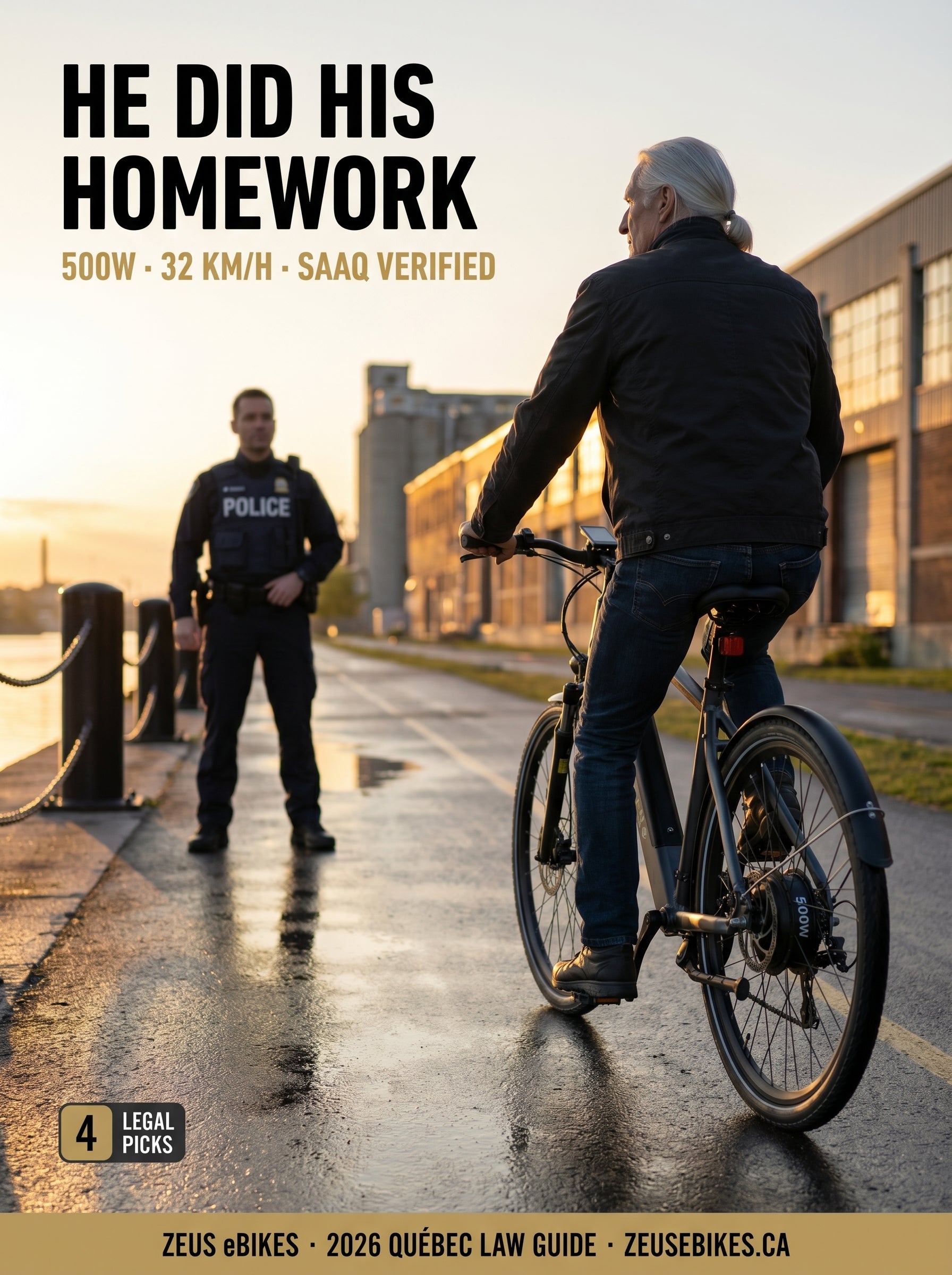
You buy a 750W e-bike. It had great reviews. The listing said “32 km/h speed limit.” You ride it on a Montréal bike path. A police officer stops you.
Your bike does not qualify as a power-assisted bicycle under SAAQ rules. The 750W motor — regardless of its programmed speed ceiling — exceeds Québec’s 500W limit. You are operating an unregistered motor vehicle on a public road. The SAAQ cannot register it. You cannot insure it. It cannot legally be on this path.
This is not hypothetical. It is the most common mistake e-bike buyers make in Québec — and it is the reason this guide exists.
Québec’s e-bike rules are stricter than most Canadian provinces. The 500W motor limit, mandatory helmet for all ages, and Class 6D licence requirement for younger riders all go further than Ontario, BC, or Alberta. The “moped trap” (Section 6) catches buyers every month: vehicles marketed as e-bikes that the SAAQ classifies as motor vehicles, leaving the buyer with an illegal, unregisterable, uninsurable machine.
This guide covers every SAAQ rule, the classification traps, a side-by-side comparison with Ontario, and four Zeus picks that meet every requirement off the shelf. If you already own an e-bike in Québec, run the 7-point checklist in Section 8. If you are still shopping, the 500W eBikes Canada guide covers the full national landscape of compliant models.
2. The SAAQ Definition — What Counts as Legal
Québec uses the term power-assisted bicycle rather than “e-bike.” The SAAQ’s requirements are specific — and a significant number of products sold as “e-bikes” in Canada do not qualify under Québec law.
Five requirements must all be met simultaneously. Meeting four is not sufficient — each is independently required.
| Requirement | SAAQ Standard |
|---|---|
| Motor power rating | 500W maximum (rated, not peak) |
| Motor assist cut-off | Must stop generating power at 32 km/h |
| Pedals | Functional — must be operable like a normal bicycle without motor assistance |
| Frame | 2 or 3 wheels, handlebars, and a seat |
| Operation | Must be rideable by muscle power alone |
The dual requirement — both motor rating and speed cut-off — is where buyers most often get caught. A motor rated above 500W does not qualify even if it is speed-limited. A 500W motor without a 32 km/h cut-off fails the second test. Both must pass independently.
The pedal requirement is also non-negotiable. Vehicles where pedals are installed but purely decorative — or where the pedalling mechanism is disconnected from the drivetrain — do not meet the definition.
What a compliant bike looks like: The Eunorau Meta ($1,994) lists a 500W motor and 32 km/h speed on its product page — both prongs of the SAAQ definition met. Torque sensor, hydraulic brakes, step-through frame. All six SAAQ-compliant picks are in Section 9.

5:50 AM. The lobby. The number that keeps you legal: 500W. He checks it every time. · Playcut.ai
3. Age & Licence Rules
Québec’s age rules are more structured than most Canadian provinces. Where Ontario requires 16+ with no licence, Québec draws a line at 14 and introduces a licensing requirement for younger riders.
| Age Group | Requirement |
|---|---|
| 18 and over | No driver’s licence required |
| 14–17 | Class 6D (moped or scooter) licence required |
| Under 14 | Not authorised to ride on public roads |
The Class 6D licence exists in Québec as the entry-level motorised two-wheel authorisation — covering mopeds and scooters with engines under 50cc or equivalent. The SAAQ extends this to e-bike riders aged 14–17, treating their use of a power-assisted bicycle more like moped operation than bicycle operation.
For riders 18 and over: no licence, no registration, no insurance requirement. The power-assisted bicycle is treated as a bicycle from an administrative standpoint — provided it meets the technical definition in Section 2.
4. Helmet Requirement
Helmet use is mandatory for all e-bike riders in Québec. No age exemption. No exceptions. The SAAQ states the fine for riding without a helmet is $60–$100 under the Protective Helmets Regulation (Article 2.1).
This distinguishes Québec from provinces where helmet rules apply only to certain age groups. In Québec, every rider on a power-assisted bicycle is required to wear a helmet every time they ride on a public road. The helmet must have a rigid shell, padded interior, and chin strap meeting one of these standards: CAN/CSA-D113.2, ASTM F1447, EN 1078, or Snell B-90/B-95. A standard bicycle helmet from any major manufacturer will meet at least one.
Browse SAAQ-compliant eBikes at Zeus
Every pick below is verified against the 500W + 32 km/h power-assisted bicycle definition. Canadian warranty. Ships Québec-wide.
Browse Step-Thru eBikes → Browse Trikes →5. Where You Can and Can’t Ride
A Québec-compliant power-assisted bicycle may be ridden on public roadways where bicycles are ordinarily permitted — city streets, local roads, designated bike lanes, and multi-use paths. Québec’s cycling infrastructure is extensive: Montréal’s 900+ km bike network, the Route Verte spanning 5,300+ km, and dedicated lanes in Québec City, Gatineau, Sherbrooke, and most mid-sized cities.
The prohibition is clear and province-wide: e-bikes may not be ridden on highways or their access and exit ramps. This applies to all autoroutes, expressways, and controlled-access roads regardless of speed limit or traffic volume. A power-assisted bicycle that is otherwise fully SAAQ-compliant cannot legally use a highway, even briefly, to connect two local roads.
Montréal-specific enforcement: The SPVM’s published enforcement guidance adds two notes. First, a power-assisted bicycle must display a removable manufacturer label identifying it as a power-assisted bicycle and complying with Motor Vehicle Safety Regulations — officers in bike lanes may ask to see it. Second, power-assisted bicycles with moveable steps cannot access bicycle paths or lanes — a hard ban, not discretionary. If your bike has a moveable step (common on moped-style frames), it is restricted to roadways only.

Route Verte, October. 5,300 kilometres of legal riding. He is deciding which direction. · Playcut.ai
6. The Moped Trap — “eBikes” That Aren’t Legal in Québec
This is where buyers get caught. And it is where Québec differs most from the rest of Canada.
The SAAQ explicitly warns that certain vehicles sold as “electric bicycles” — particularly those that look like mopeds, scooters, or motorcycles — may be prohibited on public roads and bikeways in Québec, even when marketed as e-bikes in other provinces.
The issue is structural. If a vehicle’s primary operation is throttle-based and its pedals are installed for appearance rather than genuine propulsion, it does not meet the SAAQ’s definition. The vehicle may have a 500W motor rated correctly — but without functional pedals that allow the rider to propel the vehicle by muscle power alone, the power-assisted bicycle classification does not apply. It may fall into the moped, scooter, or motor vehicle category, requiring registration and insurance that are not available for power-assisted bicycles.
The practical test is simple: Can you ride the vehicle as a normal bicycle if the motor were removed? If the answer is no — if the vehicle cannot be meaningfully propelled by pedalling — it is not a power-assisted bicycle under Québec law. This rules out most moped-style e-bikes with vestigial pedals, cargo e-bikes with dummy cranks, and any vehicle where the pedalling mechanism is disconnected from the drivetrain.
For comparison, our electric mopeds Canada guide covers moped-style vehicles — but be aware that most of those bikes exceed the SAAQ’s 500W threshold. If you are buying for Québec, stick to the verified picks below.

Plateau-Mont-Royal, Tuesday morning. One rides. One doesn’t. The ticket tells you which did the homework. · Playcut.ai
7. What Happens If You Get Caught
The rules above are not theoretical. Montréal police actively enforce e-bike compliance on bike paths, and the SPVM publishes specific guidance on what officers check. Here is what actually happens when a non-compliant rider is stopped.
If Your Bike Is Compliant but You Break a Rule
Riding a legal 500W e-bike without a helmet, running a red light, or riding on a highway ramp — these are Highway Safety Code violations. Fines are the same as for cyclists:
| Violation | Fine (CAD) | Legal Reference |
|---|---|---|
| No helmet | $60–$100 | Protective Helmets Regulation, Art. 2.1 |
| Red light / stop sign | $80–$100 | Highway Safety Code |
| Earphones while riding | $80–$100 | Highway Safety Code |
| Other HSC violations | $100 + applicable fees | HSC Art. 492.2 |
If Your Bike Is Non-Compliant (Over 500W, No Pedals, Moped-Style)
This is where the consequences escalate. If your vehicle does not meet the SAAQ’s power-assisted bicycle definition, it is classified as a motor vehicle. You are operating an unregistered, uninsured motor vehicle on a public road. Fines range from $300 to $600 — and the fine is the least of it.
- Unregistered vehicle charge: The SAAQ cannot register most imported e-bikes as motor vehicles because they lack CMVSS (Canada Motor Vehicle Safety Standards) certification. You cannot fix the problem by registering — the registration path does not exist.
- No insurance path: You cannot insure an unregisterable vehicle. Riding without insurance is a separate offence.
- Vehicle may be seized: Police have the authority to remove non-compliant motor vehicles from the road.
8. Québec vs Ontario — Side-by-Side
If you ride in both provinces, or you are comparing rules before a move or purchase, here is what actually differs. The two provinces share more rules than they differ on — but the differences matter.
| Rule | Québec | Ontario |
|---|---|---|
| Motor limit | 500W rated | 500W rated |
| Speed cut-off | 32 km/h | 32 km/h |
| Helmet | Mandatory (all ages) | Mandatory (all ages on e-bikes) |
| Minimum age | 14 (with Class 6D) | 16 (no licence) |
| Licence needed | Class 6D for ages 14–17 | None at any age |
| Vehicle weight limit | Not specified | 120 kg max (including battery) |
| Highway use | Prohibited | Prohibited |
| Registration | Cannot be registered | Not required |
| Insurance | Not required | Not required |
| Moped enforcement | Stricter — SAAQ actively flags moped-style vehicles | Less aggressive |
| Label requirement | Manufacturer label recommended (Montréal enforcement) | Federal compliance label |
Key differences that affect buying decisions:
- Québec allows younger riders (14 vs 16) but requires a Class 6D licence for 14–17 year olds. Ontario has no licence requirement at any age.
- Ontario has a weight limit (120 kg including battery) that Québec does not. Heavy-duty cargo e-bikes and fat-tire models with large battery packs can exceed 120 kg — legal in Québec but potentially non-compliant in Ontario.
- Québec’s moped enforcement is stricter. Moped-style e-bikes that fly under the radar in Ontario may be flagged in Québec, especially on Montréal bike paths.
For the full Ontario breakdown, read our Ontario eBike Laws 2026 guide. If you ride in Montréal specifically, our Montréal eBike Rules guide covers city-specific enforcement and bike path regulations.

Alexandra Bridge, 7:02 PM. Left foot in Québec. Right foot in Ontario. Same bike. Same rider. Legal both sides. · Playcut.ai
9. The 7-Point Legality Checklist
Before you ride — or before you buy — run through this checklist. Every item must be true for the vehicle and rider combination to be compliant under SAAQ guidance.
- ✓ Motor is rated 500W or less (check the motor nameplate spec, not just the programmed speed)
- ✓ Motor assistance cuts off at 32 km/h
- ✓ Pedals are installed and functional — rider can propel the bike by pedalling without motor assistance
- ✓ Helmet is worn by the rider
- ✓ Rider is 18+, or aged 14–17 with a Class 6D licence
- ✓ Route avoids highways and all highway access and exit ramps
- ✓ Vehicle is not a moped-style device lacking CMVSS certification or with non-functional pedals
If all seven boxes check, you are riding a legal power-assisted bicycle in Québec. If any single box fails, resolve it before your next ride.
10. 6 SAAQ-Legal Picks (+ 2 Verify) — $899 to $2,429
Every pick below has a motor rated at 500W or less and a listed speed of 32 km/h — meeting both prongs of the SAAQ’s power-assisted bicycle definition. All specs verified against current Zeus product pages, April 2026. Ordered by price, lowest to highest. The 500W eBikes Canada guide covers the full national landscape if you want a broader comparison.
Samebike CY20
$899 CADThe entry point. At 350W the motor is well under the SAAQ’s 500W ceiling — the gentlest, most predictable power delivery in this guide. Folds to fit in a Montréal apartment hallway, a car trunk, or a transit bus luggage area. At 61 lbs it is light enough for most riders to carry up a flight of stairs. Mechanical disc brakes and a smaller battery are the trade-offs at this price. If you are not sure whether you will use an e-bike and do not want to invest $2,000 to find out, start here — $899, ride it for a month, then decide.
Movin’ Tempo Max
$1,899 CADDesigned in Toronto. The lightest 500W bike in this guide at 60 lbs. Hydraulic brakes. 960 Wh Samsung battery delivers 80–90 km of rated range — enough for the Route Verte day trip without range anxiety. Accepts a dual-battery upgrade to 1,920 Wh for touring. Note: this is a step-over frame, not step-through — confident riders only. Verified 500W and 32 km/h — SAAQ-compliant. See it in our Canadian-designed eBikes guide.
Eunorau Meta (2024) Step-Thru
$1,994 CADThe default recommendation for Québec commuters. The torque sensor delivers proportional, natural-feeling assist — a meaningful upgrade over the cadence sensors on the CY20 and Tempo Max. The step-thru frame handles Montréal’s cobblestone Old Port, the Route Verte, and Québec City hillsides. The 2.6″ tyres sit between road and fat: enough volume to absorb uneven pavement without the rolling resistance of a full fat setup. Accepts a secondary battery for expanded range. Verified 500W and 32 km/h — SAAQ-compliant off the shelf. See it in our urban eBikes guide.
Eunorau Meta Foldable
$1,994 CADThe practical choice for Montréal condo riders. Same torque sensor and hydraulic brake package as the full-size Meta — no drivetrain compromises for the folding frame. Folds to fit in an elevator cabin or a closet. The 20×3.0″ tyres handle Montréal’s transition-season roads without drama. Expands to 1,440 Wh with a secondary battery. Verified 500W and 32 km/h — SAAQ-compliant. Our folding eBikes guide covers the full trade-off between folding and non-folding.
Taubik Blackburn 275T
$2,399 CADCanadian-designed with the highest torque in this guide — 70 Nm from the Sutto motor. That means hills. Mont-Royal, the Québec City Old Town climb, Gatineau Park grades — 70 Nm handles them without the motor straining. The switchable dual torque/cadence sensor lets you toggle from the display. Zoom hydraulic brakes with dual-piston 180 mm rotors. Available with a dual-battery upgrade ($2,948) for long-distance touring on the Route Verte. Verified 500W and 32 km/h — SAAQ-compliant. See it in our step-thru guide.
Eunorau ONE-TRIKE 2.0
$2,429 CADThe stability-first choice. Three wheels eliminate balance demands — critical for older adults, riders recovering from injury, and anyone who regularly carries groceries on the rear cargo platform. The SAAQ explicitly includes vehicles with two or three wheels in the power-assisted bicycle definition, so trikes are fully covered. 80 Nm of torque handles hills. Hydraulic brakes require less hand force. 440 lb payload handles heavier riders and heavy cargo. Verified 500W and 32 km/h — SAAQ-compliant tricycle. Our electric trikes guide covers the full trike category.
Ride Québec with confidence — $899 to $2,429
Canadian warranty. Ships Québec-wide. Real humans answer 1-866-938-7580. Every pick above is verified against SAAQ’s 500W + 32 km/h definition.
Browse Urban eBikes → Browse Step-Thru eBikes →Frequently Asked Questions
What is the legal definition of an e-bike in Québec?
The SAAQ uses the term “power-assisted bicycle” and defines it as a vehicle with a motor rated 500W or less, motor assistance that stops at 32 km/h, functional pedals operable without electric assistance, and the ability to ride normally as a bicycle. It must have two or three wheels, handlebars, and a seat. All five elements must be present simultaneously. A vehicle meeting four but not all five does not qualify.
Do I need a licence to ride an e-bike in Québec?
It depends on your age. Riders 18 and over do not need a driver’s licence. Riders aged 14–17 must hold a Class 6D licence (moped or scooter category). Riders under 14 are not authorised to ride on public roads. These requirements are enforced under the Highway Safety Code.
Is a helmet required for e-bikes in Québec?
Yes — helmet use is mandatory for all e-bike riders in Québec, regardless of age. There are no exemptions. The fine is $60–$100 under the Protective Helmets Regulation (Article 2.1). The helmet must have a rigid shell, padded interior, and chin strap meeting CAN/CSA-D113.2, ASTM F1447, EN 1078, or Snell B-90/B-95 standards. A standard bicycle helmet from any major manufacturer qualifies.
Can I ride my e-bike on Québec highways?
No. SAAQ guidance explicitly prohibits power-assisted bicycles on highways and their access and exit ramps. This is province-wide with no exceptions for low-traffic sections or brief ramp crossings.
What if my e-bike is over 500W but speed-limited to 32 km/h?
It still does not qualify. The SAAQ’s definition requires the motor to be rated at 500W or less — the nameplate specification. A 750W motor with a 32 km/h software limit is still a 750W motor. Both requirements must be independently satisfied. A motor rated above 500W may be classified as a moped or motor vehicle under Québec law.
Can e-bikes be registered or insured in Québec?
No. The SAAQ states that power-assisted bicycles cannot be registered. If your e-bike does not qualify as a power-assisted bicycle (motor above 500W, no functional pedals), it falls into the motor vehicle category — requiring certification, registration, and insurance that may not be available for many imported e-bikes.
How do Québec e-bike laws differ from Ontario?
Both provinces share the 500W motor limit, 32 km/h assist cut-off, mandatory helmet, and highway ban. Key differences: Québec allows riders from age 14 (with Class 6D licence) while Ontario requires 16+. Ontario has a 120 kg vehicle weight limit that Québec does not. Québec enforces the moped classification more aggressively on bike paths. See the full comparison table above or our Ontario eBike Laws guide.
What fines apply for e-bike violations in Québec?
For a compliant e-bike: $60–$100 for no helmet (Protective Helmets Regulation, Art. 2.1), $80–$100 for running a red light or stop sign, and $100 plus applicable fees for other Highway Safety Code violations (Art. 492.2). For a non-compliant vehicle (motor over 500W, non-functional pedals): $300–$600 for operating an unregistered motor vehicle, with potential vehicle seizure.
Does SAAQ auto insurance cover e-bike accidents?
No — not for solo crashes. The SAAQ states that injuries from an e-bike accident are not covered by Québec’s public automobile insurance plan unless the accident involves a moving vehicle covered by the plan (car, truck, bus). A solo e-bike crash with no other motor vehicle involved is not covered. You are relying on your personal health insurance and any private accident or disability coverage.
The Bottom Line
Québec’s e-bike framework is narrower than most Canadian provinces: 500W motor rating (not peak, not software-limited — the nameplate), 32 km/h assist cut-off, functional pedals, helmet every ride. Both requirements must be independently met. The moped trap catches buyers every month who assumed a speed limiter was enough.
The practical consequence of getting it wrong is not just a fine. A non-compliant vehicle cannot be registered, cannot be insured, and may be seized. And regardless of compliance, SAAQ auto insurance does not cover solo e-bike crashes — a detail most guides leave out.
If you are buying for Québec: verify the motor’s nameplate rating (not the marketing claim), confirm the 32 km/h cut-off, and run the 7-point checklist before your first ride. The six picks above — from the $899 Samebike CY20 to the $2,429 ONE-TRIKE 2.0 — are verified against both SAAQ prongs. If you need help choosing, call 1-866-938-7580 — real humans answer.
Toronto eBike Laws 2026 — lanes, trails, parking, legal picks
Montréal eBike Rules 2026 — city-specific enforcement, where to ride
Best 500W eBikes Canada (2026) — 15 picks legal for every province
Electric Bikes for Seniors Canada (2026) — 19 picks, health condition guide
Best Step-Thru eBikes Canada (2026) — 10 verified step-through picks
Electric Trikes Canada (2026) — 10 trikes by price and type
How to Finance an Electric Bike in Canada — 7 options, real math
All photography by Playcut.ai — personalised AI actor technology


Share:
BC E-Bike Laws (2026): Standard vs Light E-Bike Rules, Ages, Helmets + Where You Can Ride
Montreal E-Bike Rules (2026): Laws, Fines & Where You Can Ride