

Who Pays Canada’s Tariffs: The $4.3-Billion Ledger, and the Two Levers Nobody Pulled
At 12:01 a.m. on 8 September 2026, Canada’s counter-tariffs took effect: 15, 25 and 50 per cent on roughly $27.6 billion of American goods, each rate matched to the corresponding US rate. The argument on television is about whether Canada should fight, and we have already fact-checked one viral version of it line by line. This piece is not about that. It is about a narrower question with a checkable answer: when the tariff is collected, whose bank account does the money leave?
We ran that question across three levers — the counter-tariffs now in force, an export levy on potash, and an export levy on crude — using published federal figures, the US Geological Survey, refinery data, and the Canadian Association of Petroleum Producers’ own pricing deck. It attributes no motive to anyone. It is a ledger, and a ledger answers one question: who writes the cheque.

The cheque is written here. Every photograph in this piece is an editorial illustration created for the article and declared as such; none depicts a real person, business or place. Every number beside them is sourced.
Quick answer: Under the counter-tariffs in force since 8 September 2026, the cheque is written by the Canadian importer, at the border. Five days before it took effect, the CFIB found 49 per cent of small importers already had goods on the list, and 11 per cent said three more months would finish them; in the first round, in 2025, 58 per cent of small firms said the tariff hitting them hardest was Canada’s own. Ottawa’s net revenue from the countermeasures is $4.3 billion, on its own figures. Almost none of it lands on Americans, because Canada’s economy is under a tenth the size of the United States’ and has no buying power to exercise. Two levers point the other way. Canada supplies about 73 per cent of the potash Americans use, and the next supplier is Russia at 12 per cent. Midwest refineries take every imported barrel from Canada, 72 per cent of everything they run, through cokers that cannot be fed anything lighter. On those two, the cheque is written abroad. The oil case carries real Canadian exposure, and the piece says so.
How this was researched. Built 8 September 2026 from primary and named sources retrieved directly: Finance Canada’s countermeasures announcement and its remission-process page (dated 31 August 2026); two Canadian Federation of Independent Business surveys, dated 20 August 2025 (1,721 respondents, margin of error ±2.36 per cent, 19 times out of 20; the first round of counter-tariffs) and 3 September 2026 (the current round, 1,545 respondents); World Bank GDP data for the Canada–US size comparison; the US Geological Survey’s Mineral Commodity Summaries 2026; US Energy Information Administration and International Energy Agency refinery figures for Petroleum Administration for Defense Districts 2 and 4; and the Canadian Association of Petroleum Producers’ April 2026 WCS–WTI deck, with price data through March 2026 and pipeline-flow data through December 2025. The $9.7-billion, $5.5-billion and $4.3-billion revenue figures are quoted from Annex 1 of the Spring Economic Update 2026, read directly; the Update uses the word “assessed,” not “collected,” and this piece keeps that distinction. The count of lines removed from the measure on 26 August comes from an item-by-item comparison of the Internet Archive’s capture of the Finance Canada backgrounder (25 August, 16:27 UTC) against the live page on 8 September; both copies and the diff are saved. Where a figure is arithmetic rather than a published number — the 73 per cent potash share, the relief-envelope ratios — the calculation is shown. Claims that are structural inference rather than measurement are marked analysis in the text; measured figures are marked verified. One question could not be answered: whether a House of Commons e-petition on tariffs is currently open for signature. The petitions search is protected by a challenge-response gate; six retrieval routes were attempted and are named in the limitations section. That is recorded as unretrieved, not as an absence.
In this ledger
- The cheque, and whose name is on it
- Lever one: the counter-tariffs — Canadians pay
- Lever two: potash — Americans pay
- Lever three: crude — contested
- The three ledgers, side by side
- What is actually on the September list — our own count
- The list changed once already — 254 lines came off in two days
- The form that decides who gets relief
- What a business can actually do now
- What this piece does not claim
- Questions people are asking
- Limitations, corrections and right of reply
- Bibliography
The cheque, and whose name is on it
Canada’s counter-tariffs came into force at 12:01 a.m. on 8 September 2026, at 15, 25 and 50 per cent, on products drawn from those Washington targeted under Section 338 and Section 232, with each Canadian rate matched to the corresponding American one. verified They cover steel, aluminum, furniture, clothing, apparel, appliances and dairy, among other categories. For a small importer, the practical consequence is not abstract: in a survey published five days before the measure took effect, 11 per cent of small importers told the CFIB that three more months of this would end their viability. What follows is not an argument about whether to fight. It is a ledger of who pays for the fight, under the lever chosen and under the two that were not.
A tariff is a tax collected at a border, and borders have two sides. Which side actually bears the cost is not decided by who announces the measure or who it is aimed at. It is decided by market structure: by whether the party being taxed has somewhere else to go. That single question, asked three times, produces three very different answers.
Lever one: the counter-tariffs — Canadians pay
A counter-tariff is a tax on a Canadian purchase. The importer of record remits it to the Canada Border Services Agency at the moment of entry. The American exporter is not party to that transaction and does not remit anything. Whether any of the cost travels back across the border afterwards depends entirely on whether the American seller has to cut their price to keep the sale, and that depends on how badly they need Canadian customers.
They do not need them very badly. Canada’s economy is under a tenth the size of the United States’: about one-thirteenth, on World Bank figures for 2024. A manufacturer in Ohio who loses Canadian orders has a home market some thirteen times the size of Canada’s to sell into. analysis Buying power is what forces a seller to absorb a tax, and on most of the 2026 counter-tariff list Canada does not have any. The result is that the tax is paid, in substance as well as in form, on this side of the border.
The survey evidence matches the structure, in two waves. On 3 September 2026, five days before the measure took effect, the Canadian Federation of Independent Business reported that 49 per cent of small importers and 46 per cent of small exporters already had products directly hit by the latest round of tariffs and counter-tariffs, and that 11 per cent of importers and 18 per cent of exporters would stop being viable if the trade war lasted three months or more. verified — CFIB, 3 September 2026, 1,545 respondents Nine in ten said counter-tariff revenue should go to the businesses hit hard. The earlier wave, from August 2025 and the first round of counter-tariffs, is the one that names the source of the pain: 58 per cent of small businesses said they were being hit hardest by Canada’s own retaliatory tariffs on American goods, against 59 per cent citing the steel and aluminum tariffs; 19 per cent of those carrying tariff costs said they could not last six months, 38 per cent said less than a year, and 82 per cent said any tariff revenue returned should include support for smaller businesses. verified — CFIB, 20 August 2025, 1,721 respondents, ±2.36 per cent
First round, August 2025: one in five tariff-hit small firms said they had less than six months
Canadian Federation of Independent Business, 20 August 2025, 1,721 respondents, ±2.36 per cent, 19 times out of 20. Base: small businesses reporting tariff costs. The September 2026 wave (11 per cent of importers non-viable at three months) is in the text.
The revenue itself, in the government’s own words from Annex 1 of the Spring Economic Update 2026: “$9.7 billion in gross revenue has been assessed from Canada’s countermeasures in response to U.S. tariffs. A total of $5.5 billion in revenue has been remitted to mitigate the impact of the countermeasures on the Canadian economy. The net revenue assessed is $4.3 billion and remains subject to revision.” verified — Annex 1, read directly Two words in that passage matter. “Assessed” means determined to be owing at the border, not necessarily received; and “subject to revision” means the net figure can move. Roughly 57 cents of every dollar assessed has gone back out as remission. Against that, the support package announced on 25 August totals $7.5 billion, of which $3.5 billion is worker measures and retraining, $2 billion is a diversification fund for capital projects, $1.5 billion is the Regional Tariff Response Initiative for small and medium enterprises, and $500 million is a Business Development Bank liquidity stream whose minimum revenue threshold sits at $1 million. There is also an enhanced Large Enterprise Tariff Loan facility. verified
One number we worked out ourselves. The Regional Tariff Response Initiative — the only envelope in the $7.5-billion package that the release ties to small and medium enterprises by name — is $1.5 billion; the separate $500-million Business Development Bank liquidity stream is open to businesses with at least $1 million in revenue and is not described as SME-specific. Set that against the $9.7 billion of gross revenue assessed and it comes to about 15 per cent of the gross take. Set it against the government’s own $4.3 billion net figure and the net revenue is about 2.9 times the dedicated small-business envelope. Neither ratio is published anywhere; both are our arithmetic on figures quoted above from the Spring Economic Update, and both move if the Update’s “subject to revision” net figure moves. analysis

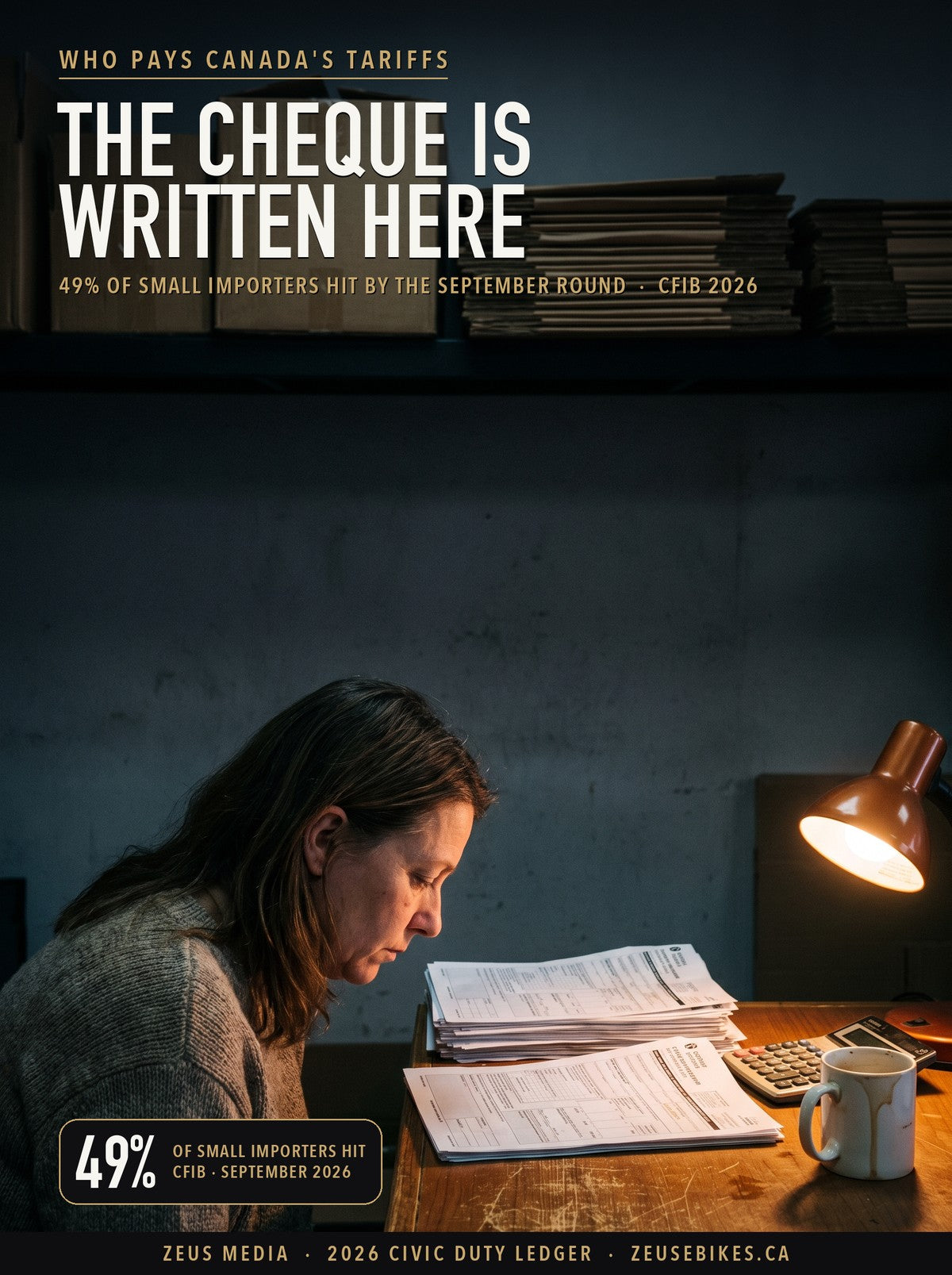
Eleven per cent of small importers told the CFIB in September 2026 that three more months would end their viability. Editorial illustration; no real business depicted.
Lever one. The cheque is written in Canada, by the importer, at the border. Canada lacks the buying power to push any material share of it back onto American sellers — so this is the one lever aimed squarely at the party pulling it.
A tariff is a tax collected at a border, and borders have two sides. Which side bears it is not decided by who announces it. It is decided by whether the party being taxed has somewhere else to go.
Lever two: potash — Americans pay
Now ask the same question with the flow reversed. An export levy is remitted by the Canadian seller, but the cost lands on the foreign buyer to whatever extent that buyer cannot go elsewhere. On potash, they cannot.
The US Geological Survey’s Mineral Commodity Summaries 2026 puts American net import reliance for potash at 92 per cent (a 2025 estimate), with 79 per cent of imports over 2021–24 coming from Canada. verified Multiply the two and Canada supplies roughly 73 per cent of all the potash consumed in the United States — that figure is our arithmetic on the USGS’s two published shares, not a published number itself.
What makes it a lever is not the share but the absence of a second option. The next-largest supplier to the United States is Russia, at 12 per cent, followed by Israel at 3. American domestic production runs to 500 thousand tonnes against apparent consumption of 5,900 thousand tonnes — about eight and a half per cent of what the country uses, with no capacity to close that gap on any short horizon. verified And fertilizer runs on an agronomic calendar. A refinery can slow a run; a farmer cannot postpone a spring.
On the Canadian side of that ledger, the cost falls on potash producers’ margins and on Saskatchewan royalties. Those are large, capitalised, professionally hedged firms. analysis Whatever else is true of that outcome, the money does not come out of a four-person importer in Hamilton.

Seventy-three per cent of the potash Americans use leaves from terminals like this one. Editorial illustration.
Lever two. Same country, opposite side of the leverage: on potash Canada is the dominant seller into a market with no replacement, so the cost travels across the border instead of staying home.
Lever three: crude — contested
Crude is the harder case, and a ledger that pretended otherwise would not be worth reading. The argument for it is physical, and it is strong.
The US Midwest — Petroleum Administration for Defense Districts 2 and 4 in the government’s districting — is where the International Energy Agency says the challenge would be sharpest. Canadian crude made up 100 per cent of the region’s 3.2 million barrels a day of imports in 2024, and 72 per cent of its 4.5 million barrels a day of refinery runs. verified — IEA analysis, reported by Oil & Gas Journal The region has 4.9 million barrels a day of refining capacity, and 3 million of it sits in refineries equipped with coking units — in the IEA’s words, “a necessary component to handle the high proportion of heavy material that requires upgrading.” A coker is a piece of equipment built to break down heavy, high-sulphur crude; it cannot be fed light shale economically, and that capital is sunk, illiquid, and worthless without the feedstock it was built for. The pipelines that once fed the Midwest from the Gulf Coast have been reversed to carry shale and Canadian barrels south: transfers from the Gulf Coast to the Midwest fell from 2.1 million barrels a day in 1999 to 700,000 in 2024. The IEA’s conclusion, as reported, is that Midwest refineries “lack access to the necessary infrastructure to secure alternative supplies” and, under a tariff, “would struggle to adjust their supply due to infrastructure constraints.” The competing heavy sour grades are Mexico’s Maya and Venezuela’s Merey, both constrained.

A coker is built to break down heavy, high-sulphur crude and cannot economically run anything else. Three million of the Midwest’s 4.9 million barrels a day of refining capacity sits in plants with coking units, per the IEA. Editorial illustration.
Now the other side, which belongs in the same section rather than a footnote. Canada exported 4.3 million barrels a day in 2025 and 90.1 per cent of it went to the United States. verified Western Canadian Select trades at a discount to West Texas Intermediate that has averaged about US$13 a barrel since the Trans Mountain expansion entered service, and during past periods of pipeline constraint that discount exceeded US$20. A standing discount is market evidence that the seller currently absorbs the cost of being landlocked. Anyone arguing this lever has to carry that number, not skip it — and the IEA carries it too, noting that “Canadian producers may still see value in supplying US refineries, given the poor alternate value for their crude and the logistical constraints they face to access new markets.”
What has changed is the existence of a second door. The Trans Mountain expansion took system capacity to 890 thousand barrels a day, up from 300 — and as of December 2025 the system was moving about 425 thousand barrels a day through the Westridge Marine Terminal for seaborne export, roughly 60 per cent of its crude flows, bound largely for Californian and Chinese refineries. verified The pipeline has not reached capacity. The differential has narrowed by about US$3 since it opened.
analysis So the honest characterisation is not a clean tax on a captive buyer. It is two captives facing one another: they cannot re-plumb their refineries in a season, and we cannot re-route four million barrels a day. The difference from the pipeline-constrained years before Trans Mountain is that the Canadian side now has an unused outlet and a narrowing discount, and the American side has three million barrels a day of coking capacity to keep fed. That is a real lever with real exposure, and both halves belong on the page.
Lever three. Physically the Midwest is captive — 72 per cent of its runs, through cokers built for nothing else. But 90.1 per cent of Canadian exports still go south and WCS still trades US$13 under WTI, so this is the lever with genuine risk on our side, and it should be argued that way or not at all.
The three ledgers, side by side
On the levers Canada did not pull, Canada is the one who cannot be replaced
USGS Mineral Commodity Summaries 2026 (2025 reliance estimate; import-source shares are a 2021–24 average; 73% is 92% × 79%, our arithmetic). IEA analysis via Oil & Gas Journal (Midwest = PADD 2 and 4; import and run shares, 2024).
| Lever | Who remits | Who bears it | Canadian small business |
|---|---|---|---|
|
Counter-tariffs live 8 Sept 2026 |
Canadian importer, at the border | Canadian buyers. $4.3B net assessed after remissions, per the Spring Economic Update | Pays it. 49% of small importers have goods on the list; 11% say three more months finishes them (CFIB, Sept 2026) |
|
Potash levy not used |
Canadian producers | American buyers. 73% of US supply, next option Russia at 12% | Untouched |
|
Crude levy not used |
Canadian producers | Contested. The Midwest (PADD 2 and 4) runs 72% Canadian through purpose-built cokers; but 90.1% of our exports go there and WCS sits US$13 under WTI | Untouched, with real producer-side risk |
Read down the right-hand column of that table and the finding states itself. Both of the levers Canada did not use leave the small importer alone. The one it did use is collected from them.
What is actually on the September list — our own count
Every figure to this point is someone else’s, well sourced but borrowed. So we parsed the government’s own list. Finance Canada publishes the complete schedule of American goods subject to counter-tariffs as a web page; we saved it, wrote a parser, and counted it. The script and both output files are in the research folder behind this piece.
The first thing the parse found is that the page is a history, not a single list. It carries three tables. The first is the measure in force since 8 September 2026, labelled as updated on 26 August. The second is the narrower schedule that applied from 1 September 2025 to 7 September 2026, after Ottawa dropped most of its counter-tariffs that summer: 313 lines, and every one of them steel, aluminum or motor vehicles. The third is the original 2025 list, in force until 31 August 2025, whose rows still carry their March and April 2025 effective dates. The period labels are there, but they sit between the tables and are easy to scroll past, and a count of every row on the page gives 2,775, more than four times the measure actually in force. our count Only the first table is the September measure.
The September 8, 2026 measure is 648 tariff items, spread across 27 chapters of the Harmonized System. 413 of them (63.7 per cent) carry the 50 per cent rate, 214 carry 25 per cent, and 21 carry 15 per cent. Every rate parsed cleanly; none was inferred. our count, from the published list
Nearly half the September list is one industry: 303 of 648 items are steel and aluminum
Our parse of Finance Canada’s published counter-tariff list, retrieved and counted 8 September 2026. Table 1 only, the measure in force since 8 September 2026; the two historical tables on the same page (in force up to 7 September 2026) are excluded. Script and CSVs in the research folder.
Nearly half the list is one industry. Chapters 72 and 73, iron and steel and articles of it, account for 274 of the 648 items, 42.3 per cent. Add aluminum at 29 and metals reach 303 items, 46.8 per cent of the whole measure. Chapter 72 is the most concentrated of all: all 134 of its items carry the 50 per cent rate, without exception. our count
The remaining 345 items are a different kind of list. Dairy is 51. Machinery is 50. Carpets are 32, more items than aluminum. Then tools and cutlery at 25, vehicles at 24, furniture and lighting at 22, wood at 20, apparel at 18, paper at 17. analysis A counter-tariff on imported steel raises the price of a competing import and therefore shelters a domestic producer of the same thing. A counter-tariff on carpets, tools, furniture and paper does something different: those are largely finished goods and shop inputs, bought by businesses that do not make a competing version of them. The two halves of this list do not work the same way on the firm that pays them, and the ledger for each is not the same ledger.
The count. 648 items, 27 chapters, 63.7 per cent of them at the 50 per cent rate — and 46.8 per cent of the entire September measure is steel and aluminum. The other 345 items are carpets, tools, furniture, paper and machinery, which the firms that import them do not make.
The list changed once already — 254 lines came off in two days
The measure announced on 25 August was not the measure that took effect on 8 September. On the evening of 26 August, Finance Canada removed every fish and seafood line from the list, citing “feedback,” and added copper wire, charcoal, plaster sheets, tiles and printed photographs at the 50 per cent rate to keep the dollar-for-dollar total intact. CBC reported the reversal on 27 August; the department’s statement said it was “continually working with Canadian industries to assess the effectiveness of these measures, with a primary focus on industries that have been targeted by U.S. tariffs.” verified
We found no published count of how many lines that was. So we counted. Using archived copies of the government’s backgrounder from 25 August and its live version today, an item-by-item comparison shows the schedule went from 874 tariff items to 629: 254 removed, every one of them in Chapter 03, fish and seafood — from live ornamental fish to frozen fillets to crab — and 9 added: four copper lines, two wood lines (charcoal), and one each of printed matter, plaster and glass. Eight of the nine match the examples the department gave; the ninth is a line of glass containers. our count — archived copies, item-level diff, files in the research folder
A quarter of the list came off in two days: 874 items became 629
Our item-level comparison of the Finance Canada backgrounder as archived 25 August 2026 (16:27 UTC) against the live page on 8 September. Removal confirmed independently by CBC News, 27 August 2026. Bar widths proportional to item count.
analysis Two things follow, and neither is a claim about anyone’s motives. First, the measure is a working document: it moved by 254 lines inside 48 hours when one sector told the department what the list would do to it. The channel exists and it works. Second, the sector that used it was heard within two days. Whether a single firm can move a line is a different question — and it is the question the remission form in the next section answers in its own way.
A note on our own record. Our earlier guide to the list, published on 26 August, counted 874 items and named fish and seafood as the largest chapter. That was correct on the day it was written. The measure changed that night, and a dated correction has been prepared for that guide.
The measure has been reshaped before. In August 2025, Ottawa removed its counter-tariffs on CUSMA-compliant American goods and kept only the sectoral steel, aluminum and auto measures — and did not publish why, as far as we could find; we traced which offices legally owe that answer.
The change. 874 became 629. All 254 removed lines were seafood; the 9 added were copper, charcoal, plaster, tiles and printed photographs at 50 per cent. Feedback from one sector moved a quarter of the list in two days.
The form that decides who gets relief
There is a way out of a counter-tariff you have already paid. It is called a remission request, its authority is section 115 of the Customs Tariff, and Finance Canada published the current process on 31 August 2026. You submit it to remissions-remises@fin.gc.ca with “U.S. Remission” in the subject line. Only Canadian-registered companies are eligible. There are two grounds: that the input cannot be sourced domestically or reasonably from non-US suppliers, or that exceptional circumstances would cause severe adverse impact.
What the department asks for is a matter of public record, and it is worth reading as a list rather than a summary. A business must supply: verified — Finance Canada, 31 August 2026
- its 15-digit business number, corporate structure, every location, and headcount;
- a description of the goods, classified to the eight-digit tariff item;
- volumes and values excluding surtaxes, with B3 customs forms and invoices where already imported;
- evidence it tried to source elsewhere: request-for-proposal notices, the names of every company canvassed, and copies of their replies;
- copies of contracts where contractual obligations prevent re-sourcing;
- whether the difficulty is temporary or transitional, and for how long;
- if it manufactures, a per-unit cost breakdown: the input, other imported articles itemised, Canadian materials itemised, labour, overhead, administrative and selling expenses;
- its unit selling price, and the effect of relief on cost and price;
- the effect of relief on employment, production and investment;
- the names and locations of its Canadian competitors, and how relief would affect them;
- a detailed statement of the exceptional circumstances that merit relief;
- consent to share non-confidential information with domestic producers so that they may be consulted;
- letters of support, independent studies or market data;
- anything else that may be significant.

Fourteen categories of disclosure to recover a tax already paid. Editorial illustration; the form shown is not the Finance Canada template.
The request is then assessed by Finance, in consultation with other federal departments and potentially with domestic producers, before a recommendation goes to the Minister and an Order in Council is signed by the Governor in Council. The page carries no published service standard or turnaround time.
analysis Describe that plainly, without attributing a motive to anyone: to recover a tax you have already paid, you disclose your cost structure and your selling price, name your competitors, and agree that those competitors may be consulted about your request — after which cabinet must sign an order. That is not a form a four-person shop completes on a Sunday. It is a submission a trade-law practice prepares. The compliance cost is fixed, which means it falls hardest, as a share of the amount at stake, on the smallest claimant. No intent needs to be alleged for that to be true. It is the arithmetic of a fixed cost.
The asymmetry, demonstrated rather than asserted. Relief exists and is real. But the document required to obtain it is priced in professional hours, and the same document is required whether the surtax at stake is $4,000 or $4 million.
What a business can actually do now
Three routes exist, and they are not equivalent. In order of how quickly they can matter to you:
1. File a remission request. This is the only route that puts money back in your account. The address, the grounds and the full document list are above. If you import from the United States and your goods are on the counter-tariff list, this is the first call — and our companion guide to the list walks it item by item, including the classification questions most importers have never been told to ask.
2. Check your classification before you assume you are hit. Tariffs apply to classifications, not to brand names or to countries of shipment. A great many importers assume they are covered when they are not, and the reverse. That determination is made at the eight-digit tariff item, and getting it right is free — we set out where the tariff wall does and does not apply in a companion piece.
3. Petition, if a live one exists. The House of Commons e-petition system is a real mechanism, not a gesture: a petition stays open for 30, 60, 90 or 120 days, needs 500 valid signatures to be presented in the House, and once presented the government must respond within 45 calendar days. verified Whether a petition on tariffs and small business is currently open, we could not determine — the search is behind a challenge-response gate that six retrieval routes failed to pass. The search page is open to anyone with a browser; filter to “Open” and search tariff. If one exists, 500 signatures is a low bar for a sector this size. If none exists, starting one requires an MP sponsor and five supporters — and we have already drafted six petitions on the tariff question, with a guide to filing one in an afternoon.
What this piece does not claim
This is a ledger, and the discipline of a ledger is that it stops where the evidence stops.
It does not claim that anyone chose the counter-tariffs in order to protect large firms. We do not know why the export levers were left unused, we have not established it, and we are not going to infer a motive from an outcome. Several explanations are available and this piece does not adjudicate between them; we take up the wider question of what Canada can and cannot build for itself in a separate piece on industrial capacity.
It does not claim that small business opposes the counter-tariffs. The CFIB’s own president says a majority of small firms are “generally supportive” of the decision to walk away from the talks and impose them. This ledger is about who bears the cost of that decision, not whether it was right.
It does not claim that large Canadian firms are unharmed. Steel and aluminum producers have been hit hard by American tariffs, with real layoffs. The measured asymmetry here is narrower and more specific: it is about the cost of accessing relief, which is a fixed professional cost and therefore regressive by firm size.
It does not claim the export levers are free. A potash levy would be paid partly out of Saskatchewan royalties. A crude levy carries the exposure set out above, honestly, in its own section. And sustained premium pricing invites new supply over the long run, so any window is a window rather than a permanent position. analysis
What it does claim is the arithmetic: under the lever in force since 8 September, the money leaves Canadian accounts. Under the two that are not in force, it would not.
Questions people are asking
Who actually pays Canada’s counter-tariffs?
The Canadian importer of record pays, remitting to the Canada Border Services Agency at the moment the goods enter. The American exporter remits nothing. Some of the cost can travel back to the seller if they cut prices to hold the sale, but that requires the buyer to have leverage, and Canada, whose economy is under a tenth the size of the United States’, has very little on most of the listed goods. In the CFIB’s September 2026 survey, 49 per cent of small importers already had goods on the list; in its August 2025 survey, on the first round, 58 per cent of small businesses said the tariff hitting them hardest was Canada’s own.
How much tariff revenue has Canada assessed, and how much came back?
Annex 1 of the Spring Economic Update 2026 states that $9.7 billion in gross revenue has been assessed from the countermeasures, $5.5 billion has been remitted, and the net revenue assessed is $4.3 billion, “subject to revision.” The Update says “assessed,” not “collected,” and this piece keeps that word. Separately, a $7.5-billion support package was announced on 25 August 2026, of which $1.5 billion is directed at small and medium enterprises through the Regional Tariff Response Initiative.
Would an export tax on potash actually be paid by Americans?
Largely, yes, because of market structure rather than intent. The United States imports 92 per cent of its potash and, over 2021–24, 79 per cent of those imports came from Canada, which works out to about 73 per cent of everything it uses. The next supplier is Russia at 12 per cent. Domestic American production is roughly 500 thousand tonnes against 5,900 thousand tonnes of consumption. With no substitute at scale and a planting calendar that cannot be deferred, a seller in that position can pass a levy through.
Is an export tax on oil the same kind of lever?
No. Physically the US Midwest (PADD 2 and 4) is captive: Canadian crude is 100 per cent of the region’s imported barrels and 72 per cent of everything it refines, and 3 million of its 4.9 million barrels a day of capacity sits in refineries with cokers that cannot run on light shale, according to the International Energy Agency. But Canada is also exposed — 90.1 per cent of Canadian crude exports went to the United States in 2025, and Western Canadian Select has averaged about US$13 under West Texas Intermediate since the Trans Mountain expansion opened. It is a lever with genuine risk on both sides, not a clean pass-through.
How do I apply for tariff remission as a small business?
Submit to remissions-remises@fin.gc.ca with “U.S. Remission” in the subject line; only Canadian-registered companies are eligible. Finance Canada’s published template requires, among other things, your business number and headcount, goods classified to the eight-digit tariff item, B3 customs forms and invoices, documented evidence that you tried to source elsewhere including replies from companies you canvassed, a per-unit cost breakdown and unit selling price if you manufacture, the names and locations of your Canadian competitors, and consent for domestic producers to be consulted on your request. Assessment runs through Finance to the Minister, and relief requires an Order in Council.
Is there a petition on this I can sign?
We could not determine whether one is currently open — the Commons petitions search sits behind a challenge-response gate that six automated retrieval routes failed to clear, so this is recorded as unretrieved rather than as an absence. The mechanism itself is confirmed: e-petitions run 30 to 120 days, require 500 valid signatures to be presented in the House, and oblige a government response within 45 calendar days. The search page is public; filter to “Open” and search tariff.
Did the counter-tariff list change after it was announced?
Yes. The schedule announced on 25 August 2026 held 874 tariff items. On the evening of 26 August, Finance Canada removed all fish and seafood products, citing feedback from industry, and added copper wire, charcoal, plaster sheets, tiles and printed photographs at 50 per cent to preserve the dollar-for-dollar total. Our item-level comparison of the archived and live backgrounders puts the change at 254 lines removed — all Chapter 03 — and 9 added, leaving 629 items. Adding the 19 motor-vehicle lines carried forward from April 2025 gives the 648 items in the consolidated table.
Limitations, corrections and right of reply
Unretrieved. Whether a House of Commons e-petition on tariffs or small business is currently open for signature. Routes attempted: the Open-category listing page; keyword= and text= query parameters; the XML output pattern with View=D; parliaments 45 and 44; the site’s home index parse; and an external search index. Every route returned the page shell or boilerplate, yielding zero petition identifiers. The search form carries a challenge-response token. This is a limit of our retrieval, not a finding about the world.
“Assessed” is not “collected.” The Spring Economic Update reports revenue assessed — determined owing at the border — and says the $4.3-billion net figure “remains subject to revision.” This piece uses the government’s word and its number, and the two ratios built on them move if the number does. An earlier draft carried these figures from a secondary source and said “collected”; that was corrected on reading the Annex directly.
Arithmetic, not publication. The 73 per cent figure for Canada’s share of American potash consumption is our multiplication of two separately published USGS shares (92 per cent import reliance × 79 per cent Canadian share of imports). The USGS does not publish that product directly.
Dates. Refinery import figures are 2024. Potash reliance, production and consumption are USGS estimates for 2025 published in 2026; the import-source shares are a 2021–24 average. Crude export figures are 2025. The two CFIB surveys are dated where they are used; the 58 per cent figure is from the 2025 wave and describes the first round, not the September 2026 measure. The Canada–US economy comparison uses World Bank GDP in current US dollars for 2024. WCS–WTI pricing runs through March 2026 and Trans Mountain flow data through December 2025. Nothing here is a forecast.
Not resolved. We did not obtain refinery-level coking economics that would settle precisely how much of a crude levy would pass through to American refiners rather than being absorbed by Canadian producers. The section says so rather than picking the convenient answer.
Right of reply. If any figure here is wrong, we will correct it and say what changed. Write to milad@zeusebikes.ca.
Bibliography
- Department of Finance Canada — Canada announces targeted countermeasures and substantive support for workers and businesses, 25 August 2026.
- Department of Finance Canada — Process for requesting remission of tariffs that apply on certain goods from the U.S., page dated 31 August 2026.
- Department of Finance Canada — Complete list of U.S. products subject to counter tariffs.
- Canadian Federation of Independent Business — Half of Canada’s small exporters and importers hit by new U.S. tariffs and Canadian counter-tariffs, 3 September 2026.
- Canadian Federation of Independent Business — Nearly one in five small businesses dealing with tariff costs won’t last more than six months, 20 August 2025 (1,721 respondents, ±2.36 per cent).
- World Bank — GDP (current US$), Canada and United States, 2024: US$2.27 trillion and US$29.30 trillion.
- U.S. Geological Survey — Mineral Commodity Summaries 2026 (potash: 2025 estimated import reliance, production and consumption; import-source shares 2021–24).
- Canadian Association of Petroleum Producers — Understanding the WCS–WTI Differential, April 2026 (price data to March 2026; Trans Mountain flows to December 2025).
- International Energy Agency, via Oil & Gas Journal — US Midwest refineries and Canadian crude (PADD 2 and 4 import and run shares, 2024).
- U.S. Energy Information Administration — Refinery Capacity Report.
- Canada Energy Regulator — Overview of 2025 Canada–U.S. energy trade.
- CBC News — Ottawa removes seafood from counter-tariffs list, adds copper wire and charcoal, 27 August 2026.
- Internet Archive — Finance Canada backgrounder as captured 25 August 2026, 16:27 UTC (the 874-item version).
- Department of Finance Canada — List of products from the United States subject to counter-tariffs effective September 8, 2026 (live, 629-item version).
- House of Commons — Petitions open for signature.
- Department of Finance Canada — Spring Economic Update 2026, Annex 1: Details of economic and fiscal projections (“Canada’s Surtaxes in Response to U.S. Tariffs on Canadian Goods”: $9.7B gross assessed, $5.5B remitted, $4.3B net, “subject to revision”).
Visuals created by Playcut.ai; typography composited by Zeus Media. Editorial illustrations, declared as such.



Share:
AI Companies Are Destroying Books. We Read the Court File.
YVY K20 Electric Bike on Amazon.ca: Who Sells It, Who Fixes It